EP4464478A1 - Rasierklinge mit parylen und titan - Google Patents
Rasierklinge mit parylen und titan Download PDFInfo
- Publication number
- EP4464478A1 EP4464478A1 EP23174334.5A EP23174334A EP4464478A1 EP 4464478 A1 EP4464478 A1 EP 4464478A1 EP 23174334 A EP23174334 A EP 23174334A EP 4464478 A1 EP4464478 A1 EP 4464478A1
- Authority
- EP
- European Patent Office
- Prior art keywords
- parylene
- razor blade
- layer
- razor
- titanium
- Prior art date
- Legal status (The legal status is an assumption and is not a legal conclusion. Google has not performed a legal analysis and makes no representation as to the accuracy of the status listed.)
- Pending
Links
Images


Classifications
-
- B—PERFORMING OPERATIONS; TRANSPORTING
- B05—SPRAYING OR ATOMISING IN GENERAL; APPLYING FLUENT MATERIALS TO SURFACES, IN GENERAL
- B05D—PROCESSES FOR APPLYING FLUENT MATERIALS TO SURFACES, IN GENERAL
- B05D1/00—Processes for applying liquids or other fluent materials
- B05D1/60—Deposition of organic layers from vapour phase
-
- B—PERFORMING OPERATIONS; TRANSPORTING
- B05—SPRAYING OR ATOMISING IN GENERAL; APPLYING FLUENT MATERIALS TO SURFACES, IN GENERAL
- B05D—PROCESSES FOR APPLYING FLUENT MATERIALS TO SURFACES, IN GENERAL
- B05D3/00—Pretreatment of surfaces to which liquids or other fluent materials are to be applied; After-treatment of applied coatings, e.g. intermediate treating of an applied coating preparatory to subsequent applications of liquids or other fluent materials
- B05D3/02—Pretreatment of surfaces to which liquids or other fluent materials are to be applied; After-treatment of applied coatings, e.g. intermediate treating of an applied coating preparatory to subsequent applications of liquids or other fluent materials by baking
- B05D3/0254—After-treatment
-
- B—PERFORMING OPERATIONS; TRANSPORTING
- B05—SPRAYING OR ATOMISING IN GENERAL; APPLYING FLUENT MATERIALS TO SURFACES, IN GENERAL
- B05D—PROCESSES FOR APPLYING FLUENT MATERIALS TO SURFACES, IN GENERAL
- B05D3/00—Pretreatment of surfaces to which liquids or other fluent materials are to be applied; After-treatment of applied coatings, e.g. intermediate treating of an applied coating preparatory to subsequent applications of liquids or other fluent materials
- B05D3/04—Pretreatment of surfaces to which liquids or other fluent materials are to be applied; After-treatment of applied coatings, e.g. intermediate treating of an applied coating preparatory to subsequent applications of liquids or other fluent materials by exposure to gases
- B05D3/0493—Pretreatment of surfaces to which liquids or other fluent materials are to be applied; After-treatment of applied coatings, e.g. intermediate treating of an applied coating preparatory to subsequent applications of liquids or other fluent materials by exposure to gases using vacuum
-
- B—PERFORMING OPERATIONS; TRANSPORTING
- B05—SPRAYING OR ATOMISING IN GENERAL; APPLYING FLUENT MATERIALS TO SURFACES, IN GENERAL
- B05D—PROCESSES FOR APPLYING FLUENT MATERIALS TO SURFACES, IN GENERAL
- B05D5/00—Processes for applying liquids or other fluent materials to surfaces to obtain special surface effects, finishes or structures
- B05D5/08—Processes for applying liquids or other fluent materials to surfaces to obtain special surface effects, finishes or structures to obtain an anti-friction or anti-adhesive surface
-
- B—PERFORMING OPERATIONS; TRANSPORTING
- B05—SPRAYING OR ATOMISING IN GENERAL; APPLYING FLUENT MATERIALS TO SURFACES, IN GENERAL
- B05D—PROCESSES FOR APPLYING FLUENT MATERIALS TO SURFACES, IN GENERAL
- B05D7/00—Processes, other than flocking, specially adapted for applying liquids or other fluent materials to particular surfaces or for applying particular liquids or other fluent materials
- B05D7/14—Processes, other than flocking, specially adapted for applying liquids or other fluent materials to particular surfaces or for applying particular liquids or other fluent materials to metal, e.g. car bodies
-
- B—PERFORMING OPERATIONS; TRANSPORTING
- B05—SPRAYING OR ATOMISING IN GENERAL; APPLYING FLUENT MATERIALS TO SURFACES, IN GENERAL
- B05D—PROCESSES FOR APPLYING FLUENT MATERIALS TO SURFACES, IN GENERAL
- B05D7/00—Processes, other than flocking, specially adapted for applying liquids or other fluent materials to particular surfaces or for applying particular liquids or other fluent materials
- B05D7/50—Multilayers
- B05D7/51—One specific pretreatment, e.g. phosphatation, chromatation, in combination with one specific coating
-
- B—PERFORMING OPERATIONS; TRANSPORTING
- B26—HAND CUTTING TOOLS; CUTTING; SEVERING
- B26B—HAND-HELD CUTTING TOOLS NOT OTHERWISE PROVIDED FOR
- B26B21/00—Razors of the open or knife type; Safety razors or other shaving implements of the planing type; Hair-trimming devices involving a razor-blade; Equipment therefor
- B26B21/54—Razor-blades
- B26B21/58—Razor-blades characterised by the material
- B26B21/60—Razor-blades characterised by the material by the coating material
-
- C—CHEMISTRY; METALLURGY
- C23—COATING METALLIC MATERIAL; COATING MATERIAL WITH METALLIC MATERIAL; CHEMICAL SURFACE TREATMENT; DIFFUSION TREATMENT OF METALLIC MATERIAL; COATING BY VACUUM EVAPORATION, BY SPUTTERING, BY ION IMPLANTATION OR BY CHEMICAL VAPOUR DEPOSITION, IN GENERAL; INHIBITING CORROSION OF METALLIC MATERIAL OR INCRUSTATION IN GENERAL
- C23C—COATING METALLIC MATERIAL; COATING MATERIAL WITH METALLIC MATERIAL; SURFACE TREATMENT OF METALLIC MATERIAL BY DIFFUSION INTO THE SURFACE, BY CHEMICAL CONVERSION OR SUBSTITUTION; COATING BY VACUUM EVAPORATION, BY SPUTTERING, BY ION IMPLANTATION OR BY CHEMICAL VAPOUR DEPOSITION, IN GENERAL
- C23C14/00—Coating by vacuum evaporation, by sputtering or by ion implantation of the coating forming material
- C23C14/06—Coating by vacuum evaporation, by sputtering or by ion implantation of the coating forming material characterised by the coating material
- C23C14/067—Borides
-
- C—CHEMISTRY; METALLURGY
- C23—COATING METALLIC MATERIAL; COATING MATERIAL WITH METALLIC MATERIAL; CHEMICAL SURFACE TREATMENT; DIFFUSION TREATMENT OF METALLIC MATERIAL; COATING BY VACUUM EVAPORATION, BY SPUTTERING, BY ION IMPLANTATION OR BY CHEMICAL VAPOUR DEPOSITION, IN GENERAL; INHIBITING CORROSION OF METALLIC MATERIAL OR INCRUSTATION IN GENERAL
- C23C—COATING METALLIC MATERIAL; COATING MATERIAL WITH METALLIC MATERIAL; SURFACE TREATMENT OF METALLIC MATERIAL BY DIFFUSION INTO THE SURFACE, BY CHEMICAL CONVERSION OR SUBSTITUTION; COATING BY VACUUM EVAPORATION, BY SPUTTERING, BY ION IMPLANTATION OR BY CHEMICAL VAPOUR DEPOSITION, IN GENERAL
- C23C14/00—Coating by vacuum evaporation, by sputtering or by ion implantation of the coating forming material
- C23C14/06—Coating by vacuum evaporation, by sputtering or by ion implantation of the coating forming material characterised by the coating material
- C23C14/14—Metallic material, boron or silicon
- C23C14/16—Metallic material, boron or silicon on metallic substrates or on substrates of boron or silicon
- C23C14/165—Metallic material, boron or silicon on metallic substrates or on substrates of boron or silicon by cathodic sputtering
-
- C—CHEMISTRY; METALLURGY
- C23—COATING METALLIC MATERIAL; COATING MATERIAL WITH METALLIC MATERIAL; CHEMICAL SURFACE TREATMENT; DIFFUSION TREATMENT OF METALLIC MATERIAL; COATING BY VACUUM EVAPORATION, BY SPUTTERING, BY ION IMPLANTATION OR BY CHEMICAL VAPOUR DEPOSITION, IN GENERAL; INHIBITING CORROSION OF METALLIC MATERIAL OR INCRUSTATION IN GENERAL
- C23C—COATING METALLIC MATERIAL; COATING MATERIAL WITH METALLIC MATERIAL; SURFACE TREATMENT OF METALLIC MATERIAL BY DIFFUSION INTO THE SURFACE, BY CHEMICAL CONVERSION OR SUBSTITUTION; COATING BY VACUUM EVAPORATION, BY SPUTTERING, BY ION IMPLANTATION OR BY CHEMICAL VAPOUR DEPOSITION, IN GENERAL
- C23C16/00—Chemical coating by decomposition of gaseous compounds, without leaving reaction products of surface material in the coating, i.e. chemical vapour deposition [CVD] processes
- C23C16/02—Pretreatment of the material to be coated
- C23C16/0272—Deposition of sub-layers, e.g. to promote the adhesion of the main coating
- C23C16/0281—Deposition of sub-layers, e.g. to promote the adhesion of the main coating of metallic sub-layers
-
- C—CHEMISTRY; METALLURGY
- C23—COATING METALLIC MATERIAL; COATING MATERIAL WITH METALLIC MATERIAL; CHEMICAL SURFACE TREATMENT; DIFFUSION TREATMENT OF METALLIC MATERIAL; COATING BY VACUUM EVAPORATION, BY SPUTTERING, BY ION IMPLANTATION OR BY CHEMICAL VAPOUR DEPOSITION, IN GENERAL; INHIBITING CORROSION OF METALLIC MATERIAL OR INCRUSTATION IN GENERAL
- C23C—COATING METALLIC MATERIAL; COATING MATERIAL WITH METALLIC MATERIAL; SURFACE TREATMENT OF METALLIC MATERIAL BY DIFFUSION INTO THE SURFACE, BY CHEMICAL CONVERSION OR SUBSTITUTION; COATING BY VACUUM EVAPORATION, BY SPUTTERING, BY ION IMPLANTATION OR BY CHEMICAL VAPOUR DEPOSITION, IN GENERAL
- C23C16/00—Chemical coating by decomposition of gaseous compounds, without leaving reaction products of surface material in the coating, i.e. chemical vapour deposition [CVD] processes
- C23C16/56—After-treatment
-
- B—PERFORMING OPERATIONS; TRANSPORTING
- B05—SPRAYING OR ATOMISING IN GENERAL; APPLYING FLUENT MATERIALS TO SURFACES, IN GENERAL
- B05D—PROCESSES FOR APPLYING FLUENT MATERIALS TO SURFACES, IN GENERAL
- B05D2202/00—Metallic substrate
- B05D2202/10—Metallic substrate based on Fe
- B05D2202/15—Stainless steel
-
- B—PERFORMING OPERATIONS; TRANSPORTING
- B05—SPRAYING OR ATOMISING IN GENERAL; APPLYING FLUENT MATERIALS TO SURFACES, IN GENERAL
- B05D—PROCESSES FOR APPLYING FLUENT MATERIALS TO SURFACES, IN GENERAL
- B05D2350/00—Pretreatment of the substrate
- B05D2350/60—Adding a layer before coating
- B05D2350/63—Adding a layer before coating ceramic layer
-
- B—PERFORMING OPERATIONS; TRANSPORTING
- B05—SPRAYING OR ATOMISING IN GENERAL; APPLYING FLUENT MATERIALS TO SURFACES, IN GENERAL
- B05D—PROCESSES FOR APPLYING FLUENT MATERIALS TO SURFACES, IN GENERAL
- B05D2350/00—Pretreatment of the substrate
- B05D2350/60—Adding a layer before coating
- B05D2350/65—Adding a layer before coating metal layer
-
- B—PERFORMING OPERATIONS; TRANSPORTING
- B05—SPRAYING OR ATOMISING IN GENERAL; APPLYING FLUENT MATERIALS TO SURFACES, IN GENERAL
- B05D—PROCESSES FOR APPLYING FLUENT MATERIALS TO SURFACES, IN GENERAL
- B05D2401/00—Form of the coating product, e.g. solution, water dispersion, powders or the like
- B05D2401/30—Form of the coating product, e.g. solution, water dispersion, powders or the like the coating being applied in other forms than involving eliminable solvent, diluent or dispersant
- B05D2401/33—Form of the coating product, e.g. solution, water dispersion, powders or the like the coating being applied in other forms than involving eliminable solvent, diluent or dispersant applied as vapours polymerising in situ
Definitions
- the present invention relates to the field of razor blades. More specifically, the present invention relates to razor blades comprising lubrication layers.
- Razor heads are usually part of a shaving razor assembly that includes a razor handle.
- a razor head typically comprises one or more cutting members, each including a razor blade, and being arranged between a leading longitudinal side and a trailing longitudinal side of the razor head.
- a user holds the razor handle in a shaving direction and brings the razor head into contact with a portion of skin. By movement of the razor head in a shaving direction, unwanted hair is removed.
- Razor blades for razor cartridges typically comprise a lubrication layer.
- the lubrication layer is intended to reduce the required cutting force during the shaving process. By reducing the required cutting force, the razor may exhibit improved glide during the shaving action, which in turn would facilitate the razor's use. Additionally, reducing the required cutting force may result in lesser pulling on the hair and thereby hair follicles, which may result in discomfort to the user.
- the lubrication coating may also reduce the friction between the razor blade and the user's skin, which may also improve the razor's glide. Furthermore, the reduced required cutting force and improved glide may result in improved shaving result, e.g. less stubbles, nicks and cuts.
- lubricating coatings for razor blades are made of a perfluoro- or a polyfluoroalkyl substance (PFAS) such as polytetrafluoroethylene (PTFE).
- PFAS polyfluoroalkyl substance
- PTFE coated razor blades are effective in cutting through hair, show little friction on the skin, as well as a low degree of pulling on the hair.
- PTFE coatings may also experience drawbacks.
- PTFE coatings are typically applied by spraying PTFE particles onto a razor blade and subsequently sintering those particles at temperatures above the melting point of PTFE.
- the resulting coating may lack uniformity, which in turn may result in a reduced shaving performance of the razor blades. Further, the increased temperatures during the sintering step may reduce the hardness and corrosion resistance of the razor blade.
- PTFE is a highly persistent material and is therefore the subject of environmental concerns.
- the present disclosure aims to address one or more of the aforementioned issues in optimizing lubrication layers.
- the present disclosure relates to a razor blade provided with a first layer comprising titanium and a second layer comprising a parylene.
- the first layer may comprise the titanium as metallic titanium.
- the parylene may be selected from the group of Parylene-N, Parylene-C, Parylene-F and combinations thereof, and in particular the parylene may be selected from Parylene-N and/or Parylene-C.
- the razor blade may comprise a cutting edge portion and the first layer and second layer may be provided on the cutting edge portion.
- the razor blade may be configured to be disposed within a razor cartridge.
- the first layer may have a thickness between about 5 nm to about 70 nm, more specifically between about 10 nm to about 60 nm and in particular between about 20 nm to about 50 nm.
- the second layer may have a thickness between about 0.005 ⁇ m to about 5 ⁇ m, more specifically between about 0.02 ⁇ m to about 2 ⁇ m and in particular between about 0.1 ⁇ m to about 1 ⁇ m.
- the second layer may comprise no holes, in particular no holes with a diameter of between about 5 nm to about 200 nm.
- the second layer may comprise less than 1 wt.-%, more specifically less than 0.1 wt.-% and in particular no or substantially no polytetrafluoroethylene.
- the razor blade may be additionally provided with a hard coating.
- the hard coating may comprise a ceramic, a metal and/or a non-metallic coating.
- the ceramic may comprise a boride and/or a carbide and in particular titanium diboride.
- the ceramic may comprise titanium, boron and carbon.
- the non-metallic coating may comprise diamond-like-carbon.
- the metal of the hard coating may comprise chromium.
- the first layer may be disposed between the hard coating and the second layer.
- the first layer may be provided directly on the razor blade.
- the hard coating may be provided directly on the razor blade.
- an intermediate layer may be provided on the razor blade and the hard coating may be provided on the intermediate layer.
- the intermediate layer may comprise a metal, more specifically niobium and/or titanium, even more specifically titanium and in particular metallic titanium.
- the razor blade may comprise, essentially consist or consist of a metal, in particular a stainless steel.
- the cross-section of the cutting edge portion may have a substantially symmetrical tapering geometry terminating in a blade tip, the cross-section may have a central longitudinal axis originating from the blade tip, and the cutting edge portion may have a thickness of between 1.5 ⁇ m and 2.4 ⁇ m measured at a distance of 5 ⁇ m along the central longitudinal axis from the blade tip.
- the present disclosure relates to a razor cartridge comprising at least one razor blade according to any preceding claim.
- the present disclosure relates to a method for coating a razor blade.
- the method comprises coating a razor blade with a first layer comprising titanium, more specifically by physical vapor deposition, and coating the razor blade with a second layer comprising a parylene, more specifically by chemical vapor deposition.
- coating the razor blade with titanium may be performed prior to coating the razor blade with the parylene.
- coating the razor blade with the first layer comprising titanium may be performed by sputtering.
- coating the razor blade with the parylene by chemical vapor deposition may comprise sublimating a dimer of a parylene-precursor, pyrolyzing the sublimated dimer of a parylene-precursor to attain parylene-precursor monomers, and depositing the parylene-precursor monomers on the razor blade.
- sublimating the dimer of a parylene-precursor may be performed at a temperature between about 130 °C to about 190 °C, more specifically between about 150 °C to about 180 °C, and/or at a pressure of between about 0.5 Torr to about 2 Torr, more specifically between about 0.8 Torr to about 1.2 Torr.
- pyrolyzing the sublimated dimer of a parylene-precursor may be performed at a temperature of between about 400 °C to about 800°C, more specifically between about 500 °C to about 700 °C, and/or at a pressure of between about 0.2 Torr to about 1 Torr, more specifically between about 0.4 Torr to about 0.6 Torr.
- depositing the parylene-precursor monomers may be performed at a temperature of between about 10 °C to about 50°C, more specifically between about 17 °C to about 28 °C, and/or at a pressure of between about 0.01 Torr to about 0.5 Torr, more specifically between about 0.05 Torr to about 0.2 Torr.
- the method for coating a razor blade may further comprise an annealing step, in particular, the razor blade may be annealed at a temperature between about 300 °C to about 400 °C, more specifically at a temperature between about 330 °C to about 370 °C in an inert gas atmosphere, in particular after deposition of the parylene.
- the razor blade may be annealed for a duration between about 10 s to about 20 min, more specifically between about 1 min to about 5 min.
- typically lubricating coatings for razor blades are made of a perfluoro- or a polyfluoroalkyl substance (PFAS) such as polytetrafluoroethylene (PTFE), as PTFE coated razor blades are effective in cutting through hair, show little friction on the skin, as well as low pulling on the hair.
- PFAS perfluoro- or a polyfluoroalkyl substance
- PTFE polytetrafluoroethylene
- PTFE coatings may lack uniformity as a result of deposition by spraying particles, which in turn may result in a reduced shaving performance of the razor blades. Further, the increased temperatures (for prolonged times) during the sintering step may reduce the hardness and corrosion resistance of the razor blade. Additionally, PTFE is a highly persistent material and is therefore the subject of environmental concerns.
- PTFE coatings or any other PFAS coating
- coatings comprising polymers selected from the group of parylenes, which also show a low coefficient of friction.
- parylene coatings may lack adhesion to the razor blade.
- the present disclosure relates to a razor blade provided with a first layer comprising titanium and a second layer comprising a parylene.
- the razor blade according to the first aspect exhibits a low cutting force.
- the cutting force is a measure for the amount of force required to cut through hair.
- the use of the first layer comprising titanium may result in a reduction in the required cutting force.
- the adherence of PTFE coatings to the razor blade is typically enabled by using a chromium coating.
- adhesion of parylene on chromium may be weak, which may result in an increase in the required cutting forces.
- the increase of the required cutting forces may result from the parylene coating being removed from the razor blade while shaving. The removal may occur already during the first shave when the parylene is provided on chromium, but may only gradually occur when the parylene is provided on titanium. It has been surprisingly found that by providing a layer of titanium, as opposed to chromium, for the parylene to adhere to, the required cutting force of the razor blade can be substantially reduced.
- the first layer may comprise the titanium as metallic titanium.
- Metallic titanium may be especially suited for the parylene to bind to it.
- the term "metallic titanium” is well known and i.a. attributed its common meaning in the art. Additionally or alternatively, the term “metallic titanium” may relate to a reduced state of titanium wherein its oxidation number is 0. Additionally or alternatively, the term “metallic titanium” may relate to the titanium atoms comprised in the first layer forming metallic bonds with one another.
- the first layer may consist, or essentially consist of titanium (as detailed above).
- the parylene may be selected from the group of Parylene-N, Parylene-C, Parylene-F and combinations thereof.
- the parylene may be selected from Parylene-N and/or Parylene-C. It has been surprisingly found that a second layer comprising Parylene-N may result in a reduced cutting force compared to other parylenes.
- a second layer comprising Parylene-C may result in a lower cutting force after multiple uses of the razor blade, compared to Parylene-N.
- the second layer may consist, or essentially consist of parylene (as detailed above).
- parylene refers to a polymer whose backbone consists of para-benzenediyl rings - C 6 H 4 connected by 1,2-ethanediyl bridges -CH 2 -CH 2 -. Substitution of the para-benzenediyl rings results in different types of parylenes.
- Parylene-N (or parylene-N) is an un-substituted parylene. Parylene-N may be obtained by polymerization of para-xylylene. Parylene-N consists of the following repeating unit:
- Parylene-C (or parylene-C) is a chlorinated-parylene. Parylene-C may be obtained by polymerization of 2,8-Dichlorotricyclo[8.2.2.24,7]hexadeca-1(12),4,6,10,13,15-hexaene. Parylene-C consists of the following repeating unit:
- Parylene-F (or parylene-F) is a fluorinated-parylene, in particular wherein the four hydrogens on the aryl ring are substituted by fluorine. Parylene-F may be obtained by polymerization of 4,5,7,8,12,13,15,16-Octafluoro[2.2]paracyclophane. Parylene-F consists of the following repeating unit:
- the combination of Parylene-C and Parylene-N results in a reduced cutting force compared to either a second layer comprising Parylene-C or Parylene-N.
- the second layer may comprise a first sublayer comprising Parylene-C and a second sublayer comprising Parylene-N.
- the first sublayer comprising Parylene-C may be provided on the first layer and the second sublayer comprising Parylene-N may be provided on the first sublayer.
- the first sublayer may comprise Parylene N and the second sublayer may comprise Parylene C.
- the razor blade may comprise, essentially consist or consist of a metal, in particular a stainless steel.
- Stainless steel razor blades may exhibit high strength, hardness and corrosion resistance. Further, stainless steel razor blades may be easier to process compared to for example ceramic razor blades.
- the razor blade may have undergone grinding to form an edge. More specifically, the razor blade may be shaped such that it terminates in a cutting edge portion having substrate sides which converge towards a substrate edge. Accordingly, in some embodiments, the razor blade may comprise a cutting edge portion and the first layer and second layer may be provided on the cutting edge portion.
- the second layer comprising the parylene may be configured to act as a lubrication coating. The lubrication coating may improve cutting of the hairs by the razor blade. Therefore, it may be beneficial to provide the first layer and second layer at least on the cutting edge portion.
- cutting edge portion which is provided with a first layer and a second layer
- the term cutting edge portion is also meant to encompass those parts of the razor blade sides which are immediately adjacent to the strict geometrical edge of the cutting edge portion.
- the region forming the cutting edge portion extends away from the strict geometric edge of the cutting edge portion along a central longitudinal axis of the cutting edge portion for a distance of: about 5 ⁇ m or less, about 10 ⁇ m or less, about 15 ⁇ m or less, about 25 ⁇ m or less, about 50 ⁇ m or less, about 75 ⁇ m or less, about 100 ⁇ m or less, about 125 ⁇ m or less, about 150 ⁇ m or less, about 175 ⁇ m or less, or about 200 ⁇ m or less.
- the first layer and/or the second layer may generally follow the surface and contour of the underlying cutting edge portion.
- the second layer may form the outermost layer disposed on the razor blade. Accordingly, the second layer may form the blade's edge.
- the first layer may have a thickness between about 5 nm to about 70 nm, more specifically between about 10 nm to about 60 nm and in particular between about 20 nm to about 50 nm.
- the second layer may have a thickness between about 0.005 ⁇ m to about 5 ⁇ m, more specifically between about 0.02 ⁇ m to about 2 ⁇ m and in particular between about 0.1 ⁇ m to about 1 ⁇ m.
- the razor blade may be configured to be disposed within a razor cartridge.
- the use of lubrication coatings, such as the second layer, may be particularly beneficial for razor blades used in razor cartridges.
- the razor blade may be additionally provided with a hard coating.
- the hard coating may improve the razor blades hardness, in turn increasing the blade's durability, in particular its useful life.
- the hard coating may comprise a ceramic, a metal and/or a non-metallic coating.
- the ceramic may comprise a boride and/or a carbide and in particular titanium diboride.
- the ceramic may comprise titanium, boron and carbon.
- the metal of the hard coating may comprise chromium.
- the non-metallic coating may comprise diamond-like-carbon.
- the coating as such may be harder than the coated cutting edge portion and/or that the coated cutting edge portion may be hardened in its entirety in comparison to an uncoated substrate portion.
- the hardness of the hard coating or coated cutting edge portion may be determined by using a nanoindenter. During the nanoindentation process, a hard tip whose properties (mechanical properties, geometry, tip radius etc.) are known, penetrates the hard coating sample to be analyzed. For example, a Berkovich tip may be used for the indentation tests. The load enforced on the indenter tip was increased as the tip penetrated further into the specimen until penetration depth of 50-100 nm was reached.
- the hard coating or the cutting edge portion may exhibit a hardness between about 5 GPa to about 30 GPa, more specifically between about 10 GPa to about 20 GPa.
- the first layer may be disposed between the hard coating and the second layer.
- the second layer may form the outer most layer provided on the razor blade. Accordingly, the first layer may be provided closer to the razor blade than the second layer and the hard coating may be disposed closer to the razor blade than the first layer.
- the first layer may be provided directly on the razor blade.
- the razor blade may not comprise a hard coating.
- the hard coating may be provided directly on the razor blade.
- a hard coating comprising, essentially consisting or consisting of a metal, in particular chromium, may be disposed directly on the razor blade.
- Some hard coatings in particular hard coatings comprising a ceramic, may exhibit improved adhesion to the razor blade, when an intermediate layer binds the hard coating to the razor blade. Accordingly, in some embodiments, an intermediate layer may be provided on the razor blade and the hard coating may be provided on the intermediate layer. In some embodiments, the intermediate layer comprises titanium and/or niobium, more specifically titanium and in particular metallic titanium.
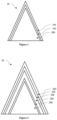
- Fig. 1 shows the cutting edge portion 100 of a first exemplary razor blade 10 according to the first aspect.
- a first layer 102 comprising titanium is provided on the cutting edge portion 100.
- a second layer 104 comprising a parylene is provided on the first layer 102, in particular as the outer most layer provided on the razor blade 10.
- Fig. 2 shows the cutting edge portion 200 of a second exemplary razor blade 20 according to the first aspect.
- an intermediate layer 206 is provided, on which a hard coating 208 is provided.
- the hard coating 208 of the exemplary razor blade 20 may be in particular a ceramic.
- a first layer 202 comprising titanium is provided.
- a second layer 204 comprising a parylene is then provided on the first layer 202, in particular as the outer most layer.
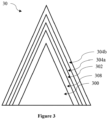
- Fig. 3 shows the cutting edge portion 300 of a third exemplary razor blade 30 according to the first aspect.
- a hard coating 308 is directly provided on the cutting edge portion 300.
- a first layer 302 comprising titanium is provided on the hard coating 300.
- a first sublayer 304a comprising Parylene-C is provided and thereon a second sublayer 304b comprising Parylene-N.
- the first layer and second layer can be applied by thin film deposition technologies.
- the first layer may be deposited by physical vapor deposition.
- the second layer may be deposited by chemical vapor deposition.
- the first layer and second layer can be applied to relatively small blade edge portions.
- the first layer and the second layer may be applied to smaller blade edge portions compared to conventional PTFE coatings prepared by spraying. Smaller blade edge portions may reduce the cutting force needed during the shaving action.
- the cross-section of the cutting edge portion may have a substantially symmetrical tapering geometry terminating in a blade tip, the cross-section may have a central longitudinal axis originating from the blade tip, and the cutting edge portion may have a thickness of between 1.5 ⁇ m and 2.4 ⁇ m measured at a distance of 5 ⁇ m along the central longitudinal axis from the blade tip.
- the blade's edge portion has a thickness of between about 4.6 ⁇ m and about 6.8 ⁇ m, in particular about 4.62 to about 6.74 ⁇ m, measured at a distance of about 20 ⁇ m along the central longitudinal axis from the blade tip.
- the blade's edge portion has a thickness of between about 10.3 ⁇ m and 14.4 ⁇ m, in particular about 10.32 to about 14.35 ⁇ m, measured at a distance of about 50 ⁇ m along the central longitudinal axis from the blade tip. In some embodiments, the blade's edge portion has a thickness of between about 19.8 ⁇ m and 27.6 ⁇ m, in particular about 19.82 to about 27.52 ⁇ m, measured at a distance of about 100 ⁇ m along the central longitudinal axis from the blade tip.
- the above-described razor blades can be manufactured by any suitable means. More specifically, the preparation and grinding of the blade substrate can be performed by any suitable means, for instance as disclosed in US 2017/136641 A1 which is incorporated by reference in its entirety.
- the second layer may comprise less than 1 wt.-%, more specifically less than 0.1 wt.-% and in particular no or substantially no polytetrafluoroethylene (PTFE) or any other perfluoro- or a polyfluoroalkyl substance (PFAS).
- PTFE polytetrafluoroethylene
- PFAS polyfluoroalkyl substance
- the first layer and second layer can be applied by thin film deposition technologies, as opposed to PTFE coatings which require a spraying step. Thin film deposition technologies may allow depositing layers of greater uniformity compared to spraying. Additionally, thin film deposition technologies may allow depositing layer with less defects compared to spraying.
- the second layer may comprise no holes, in particular no holes with a diameter of between about 5 nm to about 200 nm.
- the present disclosure relates to a razor cartridge comprising at least one razor blade as described above.
- the lubrication coating provided by the second layer may be in particular beneficial for razor blades for razor cartridges.
- the present disclosure relates to a method for coating a razor blade.
- the method comprises coating a razor blade with a first layer comprising titanium, more specifically by physical vapor deposition, and coating the razor blade with a second layer comprising a parylene, more specifically by chemical vapor deposition.
- coating the razor blade with titanium may be performed prior to coating the razor blade with the parylene. Accordingly, the parylene may be deposited on the titanium, whereby adhesion of the parylene to the razor blade is improved.
- coating the razor blade with a first layer comprising titanium may be performed by sputtering. In some embodiments, coating the razor blade with a first layer comprising titanium may be performed by in particular, DC Sputtering, RF Sputtering, Closed Field Unbalanced Magnetron Sputtering (CFUMS), Ion Beam Sputtering, Cathodic Arc Deposition, and High-Power Impulse Magnetron Sputtering (HiPIMS) using sintered titanium targets in an Ar atmosphere.
- DC Sputtering DC Sputtering
- RF Sputtering Closed Field Unbalanced Magnetron Sputtering
- CUMS Closed Field Unbalanced Magnetron Sputtering
- Ion Beam Sputtering Ion Beam Sputtering
- Cathodic Arc Deposition Cathodic Arc Deposition
- HiPIMS High-Power Impulse Magnetron Sputtering
- coating the razor blade with the parylene by chemical vapor deposition may comprise the steps of sublimating a dimer of a parylene-precursor, pyrolyzing the sublimated dimer of a parylene-precursor to attain parylene-precursor monomers, and depositing the parylene-precursor monomers on the razor blade, in particular such that the parylene-precursor monomers polymerize.
- the parylene-precursor monomers may polymerize on the razor blade during or following the deposition.
- the polymerization of the parylene-precursor monomers may lead to the formation of a parylene layer.
- the second layer comprises a first sublayer comprising a first parylene such as Parylene-C and a second sublayer comprising a second parylene such as Parylene-N
- the above steps of chemical vapor deposition may be carried out individually for each sublayer.
- sublimating the dimer of a parylene-precursor may be performed at a temperature between about 130 °C to about 190 °C, more specifically between about 150 °C to about 180 °C, and/or at a pressure of between about 0.5 Torr to about 2 Torr, more specifically between about 0.8 Torr to about 1.2 Torr.
- pyrolyzing the sublimated dimer of a parylene-precursor may be performed at a temperature of between about 400 °C to about 800°C, more specifically between about 500 °C to about 700 °C, and/or at a pressure of between about 0.2 Torr to about 1 Torr, more specifically between about 0.4 Torr to about 0.6 Torr.
- depositing the parylene-precursor monomers may be performed at a temperature of between about 10 °C to about 50°C, more specifically between about 17 °C to about 28 °C, and/or at a pressure of between about 0.01 Torr to about 0.5 Torr, more specifically between about 0.05 Torr to about 0.2 Torr.
- the method may comprise a film-growth step following the deposition of the parylene precursor monomers, wherein the film-growth step is performed at a temperature of between about 50 °C to about 100°C, more specifically between about 60 °C to about 80 °C, and/or at a pressure of between about 0.0001 Torr to about 0.05 Torr, more specifically between about 0.0005 Torr to about 0.002 Torr.
- the film-growth step may improve the polymerization of the parylene-precursor monomers deposited on the razor blade.
- the method for coating a razor blade may further comprise an annealing step.
- the razor blade may be annealed at a temperature between about 300 °C to about 400 °C, more specifically at a temperature between about 330 °C to about 370 °C in an inert gas atmosphere, in particular after deposition of the parylene, or if performed, after the film-growth step.
- the razor blade may be annealed for a duration between about 10 s to about 20 min, more specifically between about 1 min to about 5 min. If the annealing exceeds 20 minutes, the hardness and/or corrosion resistance of the razor blades may degrade.
- the razor blade may be annealed in an inert atmosphere, more specifically a nitrogen or argon atmosphere.
- the annealing step may allow to reduce the required cutting force during the shaving action. Without wishing to be bound by theory, it is believed that the annealing step may increase the crystallinity of the parylene, which may result in an increased strength of the parylene, which in turn may reduce the required cutting force. Further, the softening of the parylene during the annealing step may also further increase the uniformity of the second layer.
- the annealing step may reduce the surface defects in the second layer, e.g. reduce its porosity.
- a hard coating may be provided on the razor blade.
- the razor blade may be coated with a hard coating, in particular prior to being coated with the fist layer.
- the razor blade may be coated with a hard coating for example using chemical vapor deposition or physical vapor deposition process. Exemplary hard coating deposition processes are described in US 2018/215056 A1 and US 10,442,098 B2 , both of which are incorporated by reference in their entirety.
- an intermediate layer may be provided on the razor blade.
- the razor blade may be coated with an intermediate layer, in particular prior to being coated with the hard coating.
- the razor blade may be coated with the intermediate layer similar to the method of coating the razor blade with the first layer. Accordingly, in some embodiments, coating the razor blade with the intermediate layer, in particular an intermediate layer comprising titanium, may be performed by sputtering.
- coating the razor blade with an intermediate layer may be performed by in particular, DC Sputtering, RF Sputtering, Closed Field Unbalanced Magnetron Sputtering (CFUMS), Ion Beam Sputtering, Cathodic Arc Deposition, and High-Power Impulse Magnetron Sputtering (HiPIMS) using sintered metal targes, in particular sintered titanium targets, in an Ar atmosphere.
- DC Sputtering DC Sputtering
- RF Sputtering Closed Field Unbalanced Magnetron Sputtering
- CUMS Closed Field Unbalanced Magnetron Sputtering
- Ion Beam Sputtering Ion Beam Sputtering
- Cathodic Arc Deposition Cathodic Arc Deposition
- HiPIMS High-Power Impulse Magnetron Sputtering
- sample lots first, second, third, fourth and fifth sample lots according to the first aspect were prepared. Furthermore, a first comparative sample lot and a second comparative sample lot not according to the first aspect were prepared as well.
- the first sample lot according to the first aspect comprises a first layer comprising titanium and a second layer comprising Parylene-C.
- the first sample lot was prepared by the following protocol: Ten stainless steel razor blades were stacked on blade carriers in a rotating fixture of a depositing chamber.
- the depositing chamber comprised a titanium target and a TiB 2 target.
- a chromium layer was also deposited, e.g. as a capping layer, the depositing chamber also comprised a chromium target.
- a preparative sequence of steps was carried out before the deposition of the intermediate layer, to perform a sputter etching.
- the depositing chamber was evacuated up to a base pressure of 10-5 Torr using vacuum means.
- Ar gas was inserted from an Ar gas source into the chamber up to a pressure of 8 mTorr (8.10-3 Torr).
- the loaded bayonets were rotated in the rotating fixture at a constant speed of 6 rpm using a motor, all targets, and notably the Ti and TiB 2 targets were operated under DC current control at 0.2 Amps.
- a DC voltage of 200-600 V was applied on the stainless steel blades for 4 minutes.
- the sputter etching step aids in removing impurities from the blade substrates and the targets through bombardment of Argon ions.
- the chamber pressure was adjusted to 3 mTorr.
- the Ti and TiB 2 target(s) were operated under DC current control at 3 and 0.2 Amps respectively while a DC voltage of 0-50 V was applied on the rotating blades. Adjusting the deposition time, a Ti layer of 20-40 nm was deposited on the edge of the blade samples.
- a TiB 2 hard coating was deposited, after the deposition of the Ti interlayer.
- the hard coating deposition also took place at pressure of 3mTorr.
- the Ti, Cr (if present), and TiB 2 targets were operated simultaneously, with the current on the Cr and Ti target set to 0.2 Amps, and the current on TiB 2 target set to 3 Amps.
- the current on the Ti and Cr target was used to prevent elements from depositing on that target.
- a DC bias voltage of 150 to 350 V was applied on the rotating blades. Adjusting the deposition time, a TiB 2 layer of 150-300 nm was deposited on the Ti layer.
- a first layer was deposited on the hard coating.
- the first layer was also deposited at a pressure of 3 mTorr.
- the titanium target was operated under DC current control at 3-10 Amps while a DC voltage of 0-50 V was applied on the rotating blades. Adjusting the deposition time, a titanium layer with a thickness of 20-40 nm was deposited on the razor blades.
- the rotating fixture was transferred to a second deposition chamber comprising a vaporizer, a pyrolysis chamber, a deposition chamber, a cold trap and a mechanical vacuum pump. Subsequently, the second chamber was evacuated up to a base pressure of 1 Torr. Parylene-C-precursor dimers were vaporized at a temperature of 175 °C. Subsequently, the pressure in the chamber was reduced to 0.5 Torr and the Parylene-C-precursor-dimers pyrolyzed to form Parylene-C-precursor-monomers at a temperature of 680 °C.
- Parylene-C-precursor-monomers were deposited at a temperature of 25 °C at a pressure of 0.1 Torr. The temperature was then raised to 70 °C at a pressure of 0.001 Torr.
- the second chamber was filled with argon at atmospheric pressure and heated to a temperature of 350 °C for 10 minutes to anneal the razor blades. After cooling to room temperature, the finished razor blades according to the first aspect were removed from the second chamber.
- the second sample lot according to the first aspect was prepared analogously to the first sample lot, except that Parylene-N-precursor-dimers were used as opposed to Parylene-C-precursor-dimers in the fourth sequence of steps.
- the third sample lot according to the first aspect was prepared analogously to the first sample lot, except that after deposition of the Parylene-C, the fourth sequence of steps was repeated using Parylene-N-precursor-dimers to deposit a first sublayer comprising Parylene-C and a second sublayer comprising Parylene-N.
- the fourth sample lot was prepared analogously to the first sample lot, except that Parylene-F-precursor-dimers were used as opposed to Parylene-C-precursor-dimers in the fourth sequence of steps.
- a fifth sample lot was prepared by coating the razor blades the same as for the third sample lot, however, the fifth sequence of steps was not performed. Hence, the fifth sample lot was not annealed.
- a first comparative sample lot was prepared analogously to the first sample lot but by coating the razor blades with chromium instead of titanium in the third sequence of steps.
- a second comparative sample lot was prepared.
- the second comparative sample lot underwent the first sequence of step and second sequence of steps. Further, the second comparative sample lot underwent the third sequence of steps, however, it was coated with chromium instead of titanium.
- the second comparative sample lot did not undergo the fourth sequence of steps or fifth sequence of steps.
- Ten blades per sample lot were each subjected to 10 consecutive cuts on a moving wool felt.
- the blades were placed individually in a holder connected to a load cell.
- the load cell was used to measure the load on the blade during the cutting action.
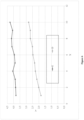
- the "Y"-Axis shows the required cutting force in "kg”
- the "X"-Axis denotes the number of cuts.
- the first sample lot is denoted by the letter “A”
- the second sample lot is denoted by the letter “B”
- the third sample lot is denoted by the letter “D”
- the fourth sample lot is denoted by the letter “C”
- the fifth sample lot is denoted by the letter "E”.
- the first comparative sample lot is denoted by the letter "F”.
- Fig. 4 shows a comparison of the cutting force of the third sample lot and the first comparative sample lot.
- the razor blades comprising the first layer comprising titanium exhibit a significantly reduced cutting force compared to the razor blades comprising the first layer comprising chromium.
- Fig. 5 shows a comparison of the cutting force of the first, second, third and fourth sample lots.
- the razor blades comprising a second layer comprising Parylene-N exhibit a lower cutting force during the first cuts, however, the required cutting force increases with the number of cuts, until it is higher than that of the Parylene-C coated blades (first sample lot).
- the Parylene-C coated blades (first sample lot) exhibit a higher required cutting force during the first use.
- the razor blades coated by a first sublayer comprising Parylene-C and a second sublayer comprising Parylene-N (third sample lot) outperform the first and second sample lots during all 10 cuts.
- the razor blades comprising a second layer comprising Parylene-F exhibit a consistently higher cutting force compared to the other parylenes.
- Fig. 6 shows a comparison of the cutting force of the third sample lot and the fifth sample lot. As shown in Fig. 6 the annealed razor blades exhibit a significantly reduced cutting force compared to the non-annealed razor blades.
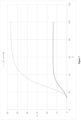
- Fig. 7 shows a comparison of the friction force in the unit “grams" (Y-Axis) of the second sample lot "B" compared to the second comparative sample lot "G".
- the X-axis shows the travelled distance over the paper in millimeters.
- the felt was exchanged with a cellulose paper.
- One razor blade of the second sample lot was placed parallel to the paper and the paper was allowed to move and the friction force was measured over the travelled distance. The test was then repeated for the second comparative sample lot. As shown in Fig. 7 the friction force of the second sample lot is significantly lower compared to the second comparative sample lot.
Landscapes
- Chemical & Material Sciences (AREA)
- Engineering & Computer Science (AREA)
- Mechanical Engineering (AREA)
- Chemical Kinetics & Catalysis (AREA)
- Materials Engineering (AREA)
- Metallurgy (AREA)
- Organic Chemistry (AREA)
- Life Sciences & Earth Sciences (AREA)
- Wood Science & Technology (AREA)
- General Chemical & Material Sciences (AREA)
- Forests & Forestry (AREA)
- Physical Vapour Deposition (AREA)
Priority Applications (4)
| Application Number | Priority Date | Filing Date | Title |
|---|---|---|---|
| EP23174334.5A EP4464478A1 (de) | 2023-05-19 | 2023-05-19 | Rasierklinge mit parylen und titan |
| KR1020257041241A KR20260010732A (ko) | 2023-05-19 | 2024-05-02 | 파릴렌 및 티타늄을 포함하는 면도날 |
| PCT/EP2024/062068 WO2024240459A1 (en) | 2023-05-19 | 2024-05-02 | Razor blade comprising a parylene and titanium |
| IL324472A IL324472A (en) | 2023-05-19 | 2024-05-02 | Razor blade containing parylene and titanium |
Applications Claiming Priority (1)
| Application Number | Priority Date | Filing Date | Title |
|---|---|---|---|
| EP23174334.5A EP4464478A1 (de) | 2023-05-19 | 2023-05-19 | Rasierklinge mit parylen und titan |
Publications (1)
| Publication Number | Publication Date |
|---|---|
| EP4464478A1 true EP4464478A1 (de) | 2024-11-20 |
Family
ID=86469014
Family Applications (1)
| Application Number | Title | Priority Date | Filing Date |
|---|---|---|---|
| EP23174334.5A Pending EP4464478A1 (de) | 2023-05-19 | 2023-05-19 | Rasierklinge mit parylen und titan |
Country Status (4)
| Country | Link |
|---|---|
| EP (1) | EP4464478A1 (de) |
| KR (1) | KR20260010732A (de) |
| IL (1) | IL324472A (de) |
| WO (1) | WO2024240459A1 (de) |
Citations (7)
| Publication number | Priority date | Publication date | Assignee | Title |
|---|---|---|---|---|
| US4950365A (en) * | 1988-12-22 | 1990-08-21 | Vac-Tec Systems, Inc. | Corrosion free hard coated metal substrates |
| US5869135A (en) * | 1997-10-03 | 1999-02-09 | Massachusetts Institute Of Technology | Selective chemical vapor deposition of polymers |
| US20170113359A1 (en) * | 2014-06-19 | 2017-04-27 | Veco B.V. | Coated shaving foil |
| US20170136641A1 (en) | 2014-07-31 | 2017-05-18 | Bic-Violex Sa | Razor blade |
| US20180215056A1 (en) | 2014-07-31 | 2018-08-02 | Bic-Violex Sa | Razor blade coating |
| US20200316803A1 (en) * | 2009-01-12 | 2020-10-08 | The Gillette Company Llc | Formation of thin uniform coatings on blade edges using isostatic press |
| US20230066180A1 (en) * | 2020-04-16 | 2023-03-02 | The Gillette Company Llc | Cutting blade and hair removal device |
-
2023
- 2023-05-19 EP EP23174334.5A patent/EP4464478A1/de active Pending
-
2024
- 2024-05-02 IL IL324472A patent/IL324472A/en unknown
- 2024-05-02 WO PCT/EP2024/062068 patent/WO2024240459A1/en not_active Ceased
- 2024-05-02 KR KR1020257041241A patent/KR20260010732A/ko active Pending
Patent Citations (8)
| Publication number | Priority date | Publication date | Assignee | Title |
|---|---|---|---|---|
| US4950365A (en) * | 1988-12-22 | 1990-08-21 | Vac-Tec Systems, Inc. | Corrosion free hard coated metal substrates |
| US5869135A (en) * | 1997-10-03 | 1999-02-09 | Massachusetts Institute Of Technology | Selective chemical vapor deposition of polymers |
| US20200316803A1 (en) * | 2009-01-12 | 2020-10-08 | The Gillette Company Llc | Formation of thin uniform coatings on blade edges using isostatic press |
| US20170113359A1 (en) * | 2014-06-19 | 2017-04-27 | Veco B.V. | Coated shaving foil |
| US20170136641A1 (en) | 2014-07-31 | 2017-05-18 | Bic-Violex Sa | Razor blade |
| US20180215056A1 (en) | 2014-07-31 | 2018-08-02 | Bic-Violex Sa | Razor blade coating |
| US10442098B2 (en) | 2014-07-31 | 2019-10-15 | Bic Violex Sa | Razor blade coating |
| US20230066180A1 (en) * | 2020-04-16 | 2023-03-02 | The Gillette Company Llc | Cutting blade and hair removal device |
Also Published As
| Publication number | Publication date |
|---|---|
| KR20260010732A (ko) | 2026-01-21 |
| IL324472A (en) | 2026-01-01 |
| WO2024240459A1 (en) | 2024-11-28 |
Similar Documents
| Publication | Publication Date | Title |
|---|---|---|
| EP2429777B2 (de) | Rasierklingenbeschichtung | |
| US5724868A (en) | Method of making knife with cutting performance | |
| US9855665B2 (en) | Strengthened razor blade | |
| WO1997025167A9 (en) | Knife with improved cutting performance | |
| US5129289A (en) | Shaving razors | |
| KR20210067877A (ko) | 면도기 블레이드 코팅물 | |
| EP1899121B1 (de) | Rasierklingen | |
| US5088202A (en) | Shaving razors | |
| CA2515457C (en) | Razor blade | |
| EP0579756B1 (de) | Beschichtetes schneidwerkzeug | |
| EP4464478A1 (de) | Rasierklinge mit parylen und titan | |
| EP4464477A1 (de) | Rasierklinge mit parylen c und parylen n | |
| NZ229934A (en) | Shaving razor with blade having hard and lubricant coated cutting edge; method of making the blade | |
| US20260054403A1 (en) | Hydrocarbon Polymer Coating Material for a Razor Blade and the Method of Coating |
Legal Events
| Date | Code | Title | Description |
|---|---|---|---|
| PUAI | Public reference made under article 153(3) epc to a published international application that has entered the european phase |
Free format text: ORIGINAL CODE: 0009012 |
|
| STAA | Information on the status of an ep patent application or granted ep patent |
Free format text: STATUS: THE APPLICATION HAS BEEN PUBLISHED |
|
| AK | Designated contracting states |
Kind code of ref document: A1 Designated state(s): AL AT BE BG CH CY CZ DE DK EE ES FI FR GB GR HR HU IE IS IT LI LT LU LV MC ME MK MT NL NO PL PT RO RS SE SI SK SM TR |
|
| STAA | Information on the status of an ep patent application or granted ep patent |
Free format text: STATUS: REQUEST FOR EXAMINATION WAS MADE |
|
| 17P | Request for examination filed |
Effective date: 20250520 |
|
| GRAP | Despatch of communication of intention to grant a patent |
Free format text: ORIGINAL CODE: EPIDOSNIGR1 |
|
| STAA | Information on the status of an ep patent application or granted ep patent |
Free format text: STATUS: GRANT OF PATENT IS INTENDED |
|
| RIC1 | Information provided on ipc code assigned before grant |
Ipc: B26B 21/60 20060101AFI20251223BHEP Ipc: B05D 1/00 20060101ALI20251223BHEP Ipc: B05D 5/08 20060101ALI20251223BHEP Ipc: B05D 7/00 20060101ALI20251223BHEP Ipc: B26B 21/22 20060101ALI20251223BHEP Ipc: B26B 21/40 20060101ALI20251223BHEP Ipc: C23C 14/02 20060101ALI20251223BHEP Ipc: C23C 14/06 20060101ALI20251223BHEP Ipc: C23C 14/14 20060101ALI20251223BHEP Ipc: C23C 14/34 20060101ALI20251223BHEP Ipc: C23C 14/16 20060101ALI20251223BHEP Ipc: C23C 16/02 20060101ALI20251223BHEP Ipc: C23C 16/56 20060101ALI20251223BHEP Ipc: B05D 3/02 20060101ALN20251223BHEP Ipc: B05D 3/04 20060101ALN20251223BHEP Ipc: B05D 7/14 20060101ALN20251223BHEP |
|
| INTG | Intention to grant announced |
Effective date: 20260114 |