EP4464808A1 - Leichtes hartmetall - Google Patents
Leichtes hartmetall Download PDFInfo
- Publication number
- EP4464808A1 EP4464808A1 EP24184895.1A EP24184895A EP4464808A1 EP 4464808 A1 EP4464808 A1 EP 4464808A1 EP 24184895 A EP24184895 A EP 24184895A EP 4464808 A1 EP4464808 A1 EP 4464808A1
- Authority
- EP
- European Patent Office
- Prior art keywords
- phase
- metal
- cemented carbide
- gamma
- grain size
- Prior art date
- Legal status (The legal status is an assumption and is not a legal conclusion. Google has not performed a legal analysis and makes no representation as to the accuracy of the status listed.)
- Pending
Links
Images





Classifications
-
- C—CHEMISTRY; METALLURGY
- C22—METALLURGY; FERROUS OR NON-FERROUS ALLOYS; TREATMENT OF ALLOYS OR NON-FERROUS METALS
- C22C—ALLOYS
- C22C29/00—Alloys based on carbides, oxides, nitrides, borides, or silicides, e.g. cermets, or other metal compounds, e.g. oxynitrides, sulfides
- C22C29/02—Alloys based on carbides, oxides, nitrides, borides, or silicides, e.g. cermets, or other metal compounds, e.g. oxynitrides, sulfides based on carbides or carbonitrides
-
- B—PERFORMING OPERATIONS; TRANSPORTING
- B22—CASTING; POWDER METALLURGY
- B22F—WORKING METALLIC POWDER; MANUFACTURE OF ARTICLES FROM METALLIC POWDER; MAKING METALLIC POWDER; APPARATUS OR DEVICES SPECIALLY ADAPTED FOR METALLIC POWDER
- B22F3/00—Manufacture of workpieces or articles from metallic powder characterised by the manner of compacting or sintering; Apparatus specially adapted therefor ; Presses and furnaces
- B22F3/12—Both compacting and sintering
- B22F3/14—Both compacting and sintering simultaneously
-
- B—PERFORMING OPERATIONS; TRANSPORTING
- B22—CASTING; POWDER METALLURGY
- B22F—WORKING METALLIC POWDER; MANUFACTURE OF ARTICLES FROM METALLIC POWDER; MAKING METALLIC POWDER; APPARATUS OR DEVICES SPECIALLY ADAPTED FOR METALLIC POWDER
- B22F3/00—Manufacture of workpieces or articles from metallic powder characterised by the manner of compacting or sintering; Apparatus specially adapted therefor ; Presses and furnaces
- B22F3/12—Both compacting and sintering
- B22F3/16—Both compacting and sintering in successive or repeated steps
-
- B—PERFORMING OPERATIONS; TRANSPORTING
- B22—CASTING; POWDER METALLURGY
- B22F—WORKING METALLIC POWDER; MANUFACTURE OF ARTICLES FROM METALLIC POWDER; MAKING METALLIC POWDER; APPARATUS OR DEVICES SPECIALLY ADAPTED FOR METALLIC POWDER
- B22F5/00—Manufacture of workpieces or articles from metallic powder characterised by the special shape of the product
- B22F5/007—Manufacture of workpieces or articles from metallic powder characterised by the special shape of the product of moulds
-
- C—CHEMISTRY; METALLURGY
- C22—METALLURGY; FERROUS OR NON-FERROUS ALLOYS; TREATMENT OF ALLOYS OR NON-FERROUS METALS
- C22C—ALLOYS
- C22C1/00—Making non-ferrous alloys
- C22C1/04—Making non-ferrous alloys by powder metallurgy
- C22C1/05—Mixtures of metal powder with non-metallic powder
- C22C1/051—Making hard metals based on borides, carbides, nitrides, oxides or silicides; Preparation of the powder mixture used as the starting material therefor
-
- C—CHEMISTRY; METALLURGY
- C22—METALLURGY; FERROUS OR NON-FERROUS ALLOYS; TREATMENT OF ALLOYS OR NON-FERROUS METALS
- C22C—ALLOYS
- C22C29/00—Alloys based on carbides, oxides, nitrides, borides, or silicides, e.g. cermets, or other metal compounds, e.g. oxynitrides, sulfides
- C22C29/005—Alloys based on carbides, oxides, nitrides, borides, or silicides, e.g. cermets, or other metal compounds, e.g. oxynitrides, sulfides comprising a particular metallic binder
-
- C—CHEMISTRY; METALLURGY
- C22—METALLURGY; FERROUS OR NON-FERROUS ALLOYS; TREATMENT OF ALLOYS OR NON-FERROUS METALS
- C22C—ALLOYS
- C22C29/00—Alloys based on carbides, oxides, nitrides, borides, or silicides, e.g. cermets, or other metal compounds, e.g. oxynitrides, sulfides
- C22C29/02—Alloys based on carbides, oxides, nitrides, borides, or silicides, e.g. cermets, or other metal compounds, e.g. oxynitrides, sulfides based on carbides or carbonitrides
- C22C29/06—Alloys based on carbides, oxides, nitrides, borides, or silicides, e.g. cermets, or other metal compounds, e.g. oxynitrides, sulfides based on carbides or carbonitrides based on carbides, but not containing other metal compounds
- C22C29/08—Alloys based on carbides, oxides, nitrides, borides, or silicides, e.g. cermets, or other metal compounds, e.g. oxynitrides, sulfides based on carbides or carbonitrides based on carbides, but not containing other metal compounds based on tungsten carbide
-
- B—PERFORMING OPERATIONS; TRANSPORTING
- B22—CASTING; POWDER METALLURGY
- B22F—WORKING METALLIC POWDER; MANUFACTURE OF ARTICLES FROM METALLIC POWDER; MAKING METALLIC POWDER; APPARATUS OR DEVICES SPECIALLY ADAPTED FOR METALLIC POWDER
- B22F5/00—Manufacture of workpieces or articles from metallic powder characterised by the special shape of the product
- B22F2005/001—Cutting tools, earth boring or grinding tool other than table ware
-
- B—PERFORMING OPERATIONS; TRANSPORTING
- B22—CASTING; POWDER METALLURGY
- B22F—WORKING METALLIC POWDER; MANUFACTURE OF ARTICLES FROM METALLIC POWDER; MAKING METALLIC POWDER; APPARATUS OR DEVICES SPECIALLY ADAPTED FOR METALLIC POWDER
- B22F2301/00—Metallic composition of the powder or its coating
- B22F2301/15—Nickel or cobalt
-
- B—PERFORMING OPERATIONS; TRANSPORTING
- B22—CASTING; POWDER METALLURGY
- B22F—WORKING METALLIC POWDER; MANUFACTURE OF ARTICLES FROM METALLIC POWDER; MAKING METALLIC POWDER; APPARATUS OR DEVICES SPECIALLY ADAPTED FOR METALLIC POWDER
- B22F2302/00—Metal Compound, non-Metallic compound or non-metal composition of the powder or its coating
- B22F2302/10—Carbide
-
- B—PERFORMING OPERATIONS; TRANSPORTING
- B22—CASTING; POWDER METALLURGY
- B22F—WORKING METALLIC POWDER; MANUFACTURE OF ARTICLES FROM METALLIC POWDER; MAKING METALLIC POWDER; APPARATUS OR DEVICES SPECIALLY ADAPTED FOR METALLIC POWDER
- B22F2302/00—Metal Compound, non-Metallic compound or non-metal composition of the powder or its coating
- B22F2302/15—Carbonitride
-
- B—PERFORMING OPERATIONS; TRANSPORTING
- B22—CASTING; POWDER METALLURGY
- B22F—WORKING METALLIC POWDER; MANUFACTURE OF ARTICLES FROM METALLIC POWDER; MAKING METALLIC POWDER; APPARATUS OR DEVICES SPECIALLY ADAPTED FOR METALLIC POWDER
- B22F2302/00—Metal Compound, non-Metallic compound or non-metal composition of the powder or its coating
- B22F2302/20—Nitride
-
- B—PERFORMING OPERATIONS; TRANSPORTING
- B22—CASTING; POWDER METALLURGY
- B22F—WORKING METALLIC POWDER; MANUFACTURE OF ARTICLES FROM METALLIC POWDER; MAKING METALLIC POWDER; APPARATUS OR DEVICES SPECIALLY ADAPTED FOR METALLIC POWDER
- B22F2998/00—Supplementary information concerning processes or compositions relating to powder metallurgy
- B22F2998/10—Processes characterised by the sequence of their steps
Definitions
- the present subject matter relates to a cemented carbide having a hard phase, a binder phase and a gamma phase and in particular although not exclusively to a gamma phase comprising metal carbides and metal nitrides and/or metal carbonitrides.
- Cemented carbides are known to exhibit a favourable combination of high hardness and moderate toughness making them ideal materials for use in manufacturing wear resistant applications including material-forming tools, structural components, mining bits, press moulds, punch dies and other wear parts in high demand applications.
- cemented carbides have been used to form punch bodies in the manufacturing of metal beverage cans. Over 200 billion cans are produced worldwide every year. A single production line can make up to 500k cans per year in a continuous process from aluminium or steel strip. Additionally, horizontal presses can run at speeds of 250 to 390 cans per minute.
- a cup, pressed from the metal sheet is formed into the can body in one continuous punch stroke in about one fifth of a second, forming the inside diameter of about 66 mm, and increasing the height from 33 to 57 mm.
- the can body is then typically passed through ironing rings, to stretch the wall to 130 mm high, before forming a concave dome at the can base. Due to the very tight tolerances required for the tooling ( ⁇ 0.002 mm) and to keep the correct can dimensions, alignment of the punch with respect to the ironing rings and dome die is important.
- EP 2439294 Al describes a cemented carbide composition having a hard phase including WC and a binder phase with the composition comprising in wt% from 50 to 70 WC, from 15 to 30 TiC and from 12 to 20 Co + Ni.
- US 6,521,353 B1 describes a low thermal conductivity hard metal for high wear applications such as use as a face of a pelletizing die.
- the material comprises WC at 50 to 80 wt%, TiC in at a least 10 wt%, a binder material comprising nickel and cobalt in which TiN and TiNC are not added to the alloy.
- the lightweight punches as described in EP 2439294 A1 are intended to provide a reduced mass at the end of the operating ram to decrease the punch dynamic oscillations to try and achieve higher punch body speeds (cans per minute) and improved can wall thickness consistency which in turn requires less metal and reduces the carbon footprint.
- Such materials represent a compromise between an attempt to achieve the above advantages versus maximising the service lifetime due to wear resistance. Accordingly, there is a need for a lightweight hard metal grade material exhibiting the appropriate hardness and toughness and accordingly wear resistance.
- the present disclosure is directed to lightweight cemented carbide materials having desired wear resistance and mechanical properties suitable for use to make tooling and components for high demand applications. Also provided are cemented carbide materials for the manufacture of a punch for metal forming having a density of approximately 10 g/cm 3 in combination with exhibiting high mechanical wear resistance and preferably corrosion resistance.
- cemented carbides having physical and mechanical characteristics to enable a surface roughening procedure particularly when the material is used for the manufacture of a punch for metal forming such as a body maker punch forming an end or attachable to an end of a ram as part of metal can manufacture.
- the objectives are achieved by providing a cemented carbide formed from three or at least three phases including a WC phase, a binder phase and a gamma phase.
- the present cemented carbide is specifically configured with a gamma phase comprising metal carbides in combination with metal nitrides and/or metal carbonitrides and having a particular ratio or quotient of average grain size of the WC phase to the average grain size of the gamma phase.
- the inventors have identified that a quotient of WC average grain size/gamma phase average grain size in the range 0.5 to 1.5 is particularly advantageous in combination with the recited gamma phase composition to provide a material exhibiting high hardness, moderate toughness and a density of less than 14 g/cm 3 and in particular approximately or nearly 10 g/cm 3 .
- the present cemented carbide for use as a tool for punching metal is advantageous to achieve similar wear rates to conventional much higher density cemented carbides typically used for punch applications whilst being appreciably lighter. This in turn is advantageous to provide higher punch speeds, improved can body wall consistency (of the as-formed can) which in turn requires less aluminium or steel strip to reduce the carbon foot print. Further advantages include reduced average can weight, spoilage, maintenance and machine down time.
- the present grade may also be advantageous for use in the manufacture of components in a variety of applications including in particular use a saw tip, a cutting die, a cutting component, a mining bit, a component within a press mould, a drill, a bearing or component within a bearing, a mechanical seal and the like.
- the present material composition utilises a combination of cubic metal carbides with cubic metal nitrides and/or cubic metal carbonitrides that provides i) grain growth inhibition of the gamma phase, ii) improved corrosion resistance, iii) improved hot hardness and iv) minimised density to provide a lightweight carbide material.
- the gamma phase forming components may be pre-alloyed raw materials to contribute to the desired physical and mechanical characteristics including in particular low density, high hardness, moderate toughness and importantly high wear resistance.
- cemented carbide comprising a hard phase including WC, a binder phase and a gamma phase characterised in that: the cemented carbide comprises WC in the range 50 to 70 wt%; a quotient of the average grain size of WC/the average grain size of the gamma phase is in a range 0.5 to 1.5; and the gamma phase comprises at least one metal carbide in combination with at least one metal nitride and/or metal carbonitride.
- the metal carbides, metal nitrides and/or metal carbonitrides comprise anyone or a combination of: Ti, Ta, V, Nb, Zr, Hf.
- the cemented carbide comprises TiC, NbC, TaC and/or TiCN.
- the gamma phase of the cemented carbide comprise a cubic mixed carbide and preferably (Ti, Ta, Nb, W)C. Such a composition is advantageous to improve strength, toughness and wear resistance and in turn provide better performance as a tool for metal forming, processing and/or machining.
- Nitrogen may be added in the form Me(C, N) where Me is any one of or a combination of Ti, Ta, V, Nb, Zr, Hf, W, Mo, Cr.
- an average grain size of the WC is in a range 0.5 to 2 ⁇ m; 0.75 to 2 ⁇ m; 0.8 to 2 ⁇ m; 0.8 to 1.8 ⁇ m; or 0.8 to 1.4 ⁇ m.
- an average grain size of the gamma phase is in a range 0.5 to 2 ⁇ m; 0.75 to 2 ⁇ m; 0.8 to 2 ⁇ m; 0.8 to 1.8 ⁇ m or 1 to 1.6 ⁇ m.
- the recited ratio or quotient of the average WC grain size/average gamma grain size is particularly advantageous to reduce grain pull out and cracking in addition to improving adhesion between the different phases of the cemented carbide.
- the cemented carbide may further comprise Mo.
- the cemented carbide may include Mo in a range wt% 0.1 - 0.7; 0.2 - 0.6 or 0.3 - 0.6. This is beneficial to improve the mechanical properties, corrosion resistance and binder-carbide adhesion.
- Mo may be present in elemental, carbide form and/or mixed carbide form.
- the cemented carbide may further comprise Cr.
- the cemented carbide may comprise Cr in a range wt% 0.1 - 0.7; 0.2 - 0.6 or 0.3 - 0.6. This is beneficial to improve the mechanical properties, corrosion resistance and binder-carbide adhesion.
- Cr may be present in elemental, carbide form and/or mixed carbide form
- the WC is included in a range wt% 50 - 65; 52 - 62; 54 - 60; or 55 - 59.
- the present cemented carbide is at least a tri-phase material.
- the cemented carbide preferably comprises WC as balance within any and all compositions described herein.
- the binder phase comprises Co and Ni.
- the binder phase comprises Co + Ni.
- the binder phase includes further elements and/or compounds.
- the binder phase further comprises any one or a combination of Fe, Cr, Mo.
- the cemented carbide comprising a base of cobalt and nickel is advantageous for improved corrosion resistance optionally with incorporation of molybdenum.
- the cemented carbide comprises Co + Ni in a range wt% 10 - 20.
- the cemented carbide comprises in wt%: 50-70 WC; 10-20 Co+Ni; 10-14 TiC; 8-12 NbC; 0.5-2.5 TaC; 0.1-1.0 Cr 3 C 2 ; 0.1-1.0 Mo 2 C; 1-7 TiCN and/or 1-5 TiN.
- the cemented carbide comprises in wt%: 50-70 WC; 5-13 Co; 1-9 Ni; 10-14 TiC; 8-12 NbC; 0.5-2.5 TaC; 0.1-1.0 Cr 3 C 2 ; 0.1-1.0 Mo 2 C; 1-7 TiCN and/or 1-5 TiN.
- the cemented carbide comprises in wt%: 50-65 WC; 7-11 Co; 3-7 Ni; 10-14 TiC; 8-12 NbC; 0.5-2.5 TaC; 0.3-0.7 Cr 3 C 2 ; 0.3-0.7 Mo 2 C; 2-6 TiCN and/or 1-5 TiN.
- the cemented carbide consists of in wt%: 50-70 WC; 10-20 Co+Ni; 10-14 TiC; 8-12 NbC; 0.5-2.5 TaC; 0.1-1.0 Cr 3 C 2 ; 0.1-1.0 Mo 2 C; 1-7 TiCN and/or 1-5 TiN.
- the cemented carbide consists of in wt%: 50-70 WC; 5-13 Co; 1-9 Ni; 10-14 TiC; 8-12 NbC; 0.5-2.5 TaC; 0.1-1.0 Cr 3 C 2 ; 0.1-1.0 Mo 2 C; 1-7 TiCN and/or 1-5 TiN.
- the cemented carbide consists of in wt%: 50-65 WC; 7-11 Co; 3-7 Ni; 10-14 TiC; 8-12 NbC; 0.5-2.5 TaC; 0.3-0.7 Cr 3 C 2 ; 0.3-0.7 Mo 2 C; 2-6 TiCN and/or 1-5 TiN.
- the present cemented carbide may further include any of V, Re, Ru, Zr, Al and/or Y at impurity levels. These elements may be present either in elemental, carbide, nitride or carbonitride form.
- the impurity level is a level such as less than 0.1wt% for the total amount of impurities present within the cemented carbide.
- references within this specification to powdered (starting) materials encompass starting materials that form the initial powder batch for possible milling, optional formation of a pre-form compact and subsequent/final sintering.
- the metal carbide, metal nitride and/or metal carbonitride that form the gamma phase are added to a pre-milled powdered batch as pre-alloyed gamma phase components.
- the gamma phase within the final sintered material is a product resulting from a powdered batch of pre-alloyed gamma phase compounds.
- Such pre-alloyed gamma phase components are advantageous to inhibit grain growth of the gamma phase (and potentially the WC hard phase) during sintering so as to provide in turn increased adhesion between the different phases and increased resistance to grain pull-out.
- a method of making a cemented carbide comprising a hard phase including WC, a binder phase and a gamma phase, the method comprising: preparing a batch of powdered materials comprising WC in the range 50 to 70 wt%, binder phase constituents and gamma phase constituents that include at least one metal carbide in combination with at least one metal nitride and/or metal carbonitride; milling the powdered materials; pressing the milled powdered materials to form a pre-compact; and sintering the pre-compact; wherein within the sintered pre-compact, a quotient of the average grain size of WC/the average grain size of the gamma phase is in a range 0.5 to 1.5.
- WC is included within the powdered materials at wt% 50 - 65; 52 - 62; 54 - 60; or 55 - 59.
- the metal carbides, metal nitrides and/or metal carbonitrides included within the powdered materials comprise any one or a combination of the elements: Ti, Ta, V, Nb, Zr, Hf, W.
- the gamma phase constituents within the powdered materials comprise TiC, NbC, TaC, TiN and/or TiCN.
- the powdered batch further comprises Cr, Mo, Cr 3 C 2 , MoC and/or Mo 2 C.
- the powdered batch further comprises Co and Ni and optionally Co, Ni, Fe, Cr and Mo to form the binder phase.
- the powdered batch comprises in wt%: 55 - 59 WC; 10 - 14 TiC; 8-12 NbC; 5 - 13 Co; 0.1 - 1.0 Cr 3 C 2 ; 1 - 9 Ni; 0.1 - 1.0 Mo 2 C; 0.5 - 2.5 TaC; 1 - 7 TiCN and/or 1 - 5 TiN.
- the powdered batch consists of in wt%: 55-59 WC; 10-14 TiC; 8-12 NbC; 5-13 Co; 0.1-1.0 Cr 3 C 2 ; 1-9 Ni; 0.1-1.0 Mo 2 C; 0.5-2.5 TaC; 1-7 TiCN and/or 1-5 TiN.
- the inventors have identified a cemented carbide material having improved toughness for alike hardness levels of existing materials for example as described in EP 2439294 A1 with a corresponding low density so as to provide a lightweight component.
- the present material When utilised as a punch for metal forming and in particular as a punch for the manufacture of beverage cans, the present material exhibits lower wear rates during linear reciprocation against Al 2 O 3 , lower adhesion of aluminium during linear reciprocating wear tests, improved surface characteristics to enable surface roughening in addition to moderate to high corrosion resistance.
- the desired physical and mechanical characteristics are achieved, at least in part, by controlling the average grain size of the gamma phase with regard to the hard phase WC in combination with selecting appropriate constituents of the gamma phase being formed from metal carbides, metal nitrides and/or metal carbonitrides.
- the present material grade achieves selective refinement of the gamma phase only. Such refinement is achieved by the combination of cubic metal carbides with cubic metal nitrides and/or cubic metal carbonitrides.
- the present composition may utilise pre-alloyed gamma phase materials within the initial powdered batch.
- the following preparation method corresponds to Grade G of Table 1 below having starting powdered materials: WC 44.36 g, Cr 3 C 2 0.37 g, Co 5.98 g, Ni 2.99 g, NbC 11.91 g, Mo 2 C 0.37 g, TiC 5.59 g, TaC 1.12 g, TiN 0.19g, PEG 2.25 g, Ethanol 50 ml. It will be appreciated by those skilled in the art that it is the relative amounts of the powdered materials that allow the skilled person and suitable adjustment is needed to make the powdered batch and achieve the final fully sintered composition of the cemented carbides of Table 1.
- the average grain size of the WC powders and gamma phase constituent powders was varied for grades A to I as detailed in figure 1 .
- Medium coarse grain WC powder was used to assist reduction of differences in the grain size with the gamma phase.
- Characterisation of the sample grades was undertaken including magnetic properties; microstructure, density, hardness and toughness and sliding wear performance.
- Coercivity force, Hc, and magnetic saturation of Co, Com were measured in all sintered samples to study if eta-phase or graphite were present in the microstructure.
- the density of the sintered alloys was measured by Archimedes method as well as theoretically calculated.
- Can tooling is one of the main applications in which the use of lightweight grades would be an improvement in the metal forming process when used for the carbide punches.
- Replicating can tooling conditions implies testing wear damage in samples which have been previously texturized in similar way to the ones used in the field (crosshatching). This operation leaves a rough surface finish that facilitates the mechanical bonding of aluminum. The methodology used to assess wear behaviour is described below:
- the addition of the above carbides in large quantities can decrease some of the desired mechanical properties in particular wear resistance.
- the properties that are more adversely affected by the introduction of cubic carbides are toughness, strength and thermal conductivity. Also, for similar hardness values higher wear rates can be found for those materials when tested in sliding friction conditions, partially related to a lower interfacial strength between the cubic carbides and the binder.
- some properties might be improved through the addition of cubic carbides, such as hot hardness and resistance to plastic deformation.
- the gamma phase might contribute to reduce friction forces and act as an anti-galling agent.
- One of the main wear mechanisms for sintered pieces containing high cubic carbide contents that are subjected to wear tests is the pull-out of individual or clusters of carbide grains.
- This preferential pull-out is mainly related to a poor interfacial strength between the carbide and the binder, and it accelerates wear rates due to two main reasons. Firstly, wear rates increase because full carbide grains are easily de-attached from the surface. Secondly, the detached grains tend to sit between the hard metal piece and the workpiece material. Since they have high hardness levels, they act as abrasive media, promoting abrasive wear mechanisms. In order to decrease grain pull-out and minimize their effects, it was one aim to develop grades with a refined gamma phase grain size and an improved interfacial strength.
- TiC is a low-density carbide (i.e. density around 4.9 g/cm 3 ) and therefore, its addition to the composition contributes to a decrease the overall density of the material. Accordingly, the developed grades may have relatively high TiC content, i.e., between 7.5%wt to 15%wt i.e., corresponding to a volume content between 15% to 30%, as can be seen in Table 1.
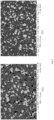
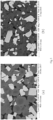
- TiN and TiCN are used to refine grain size and improve the strength in Tie-based cermets. Consequently, since TiC may be one of the main gamma phase elements, it was of interest to evaluate the effect of TiN and/or TiCN in reducing the grain size of the gamma phase. In doing so, the microstructure of materials with similar composition both with and without the addition of TiN was evaluated.
- pre-alloyed gamma phase i.e. (W Ti Ta)C
- W Ti Ta gamma phase grain growth inhibitor
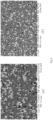
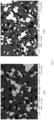
- Figure 6 and Figure 7 are micrographs at 2000x magnification of:(a) sample E (without pre-alloyed gamma-phase) and sample F (with pre-alloyed gamma-phase) and Figure 7 is micrographs at 5000 ⁇ magnification of: (a) sample E (without pre-alloyed gamma-phase) and sample F (with pre-alloyed gamma-phase).
- sample materials E and F have similar compositions, but material E combines TiN and pre-alloyed gamma phase, whereas material F has the same amount of TiN as material E, but does not contain pre-alloyed (W,Ti,'I'a)C gamma phase
- pre-alloyed gamma phase in addition to TiN, reduces slightly more the gamma-phase mean grain size as compared with the material with only TiN. It was noted that at this stage the additional grain refinement obtained was limited.
- one objective of the present invention is to increase the interfacial strength between the gamma phase and the binder to reduce grain pull-out during wear.
- the addition of several additives such as Mo 2 C, TaC and Cr 2 C 3 , as well as the use of pre-alloyed gamma phase, was evaluated.
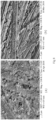
- Figure 8 are magnified images of crosshatching simulation in: (a) sample E and (b) sample I.
- WC grain fragmentation and debonding are observed in both samples due to the high stresses of the diamond abrasive grains during the process. Nevertheless, sample I showed slightly more surface damage and more grains pull-out. Accordingly, it is suspected that adhesion wear mechanisms during in-service performance (Al or steel galling) would be enhanced potential leading to early tool failure.
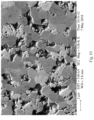
- FIG. 9 is magnified images of the worn surfaces after sliding wear test of: (a) sample E and (b) sample 1.
- the wear track depths for grade E and I were 2.20 ⁇ 0.18 ⁇ m and 2.76 ⁇ 0.08 ⁇ m respectively, indicating that sample I suffers larger wear damage.
- the worn regions that correspond to the respective wear tracks are quite similar, showing a smooth surface with initial asperities from the crosshatching having ploughed away. Also grain pull out due to the abrasive effect of the hard counterpart was observed.
- sample I has larger amount of TiC which is hard but brittle, therefore being able to promote further abrasive effect if it is chipped or detached. This confirms the measurement of deeper wear tracks in sample I.
- the presence of refined gamma phase is also determinant in that the interfaces are better adhered, presenting better resistance to grain pull out.
- Figure 10 is a micrograph at 5000x magnification of a worn surface of sample F after sliding wear test. As can be seen, some WC gains appear to be chipped and some pitting is preferentially observed, indicating the sample is susceptible to tribocorrosion damage (abrasive + lubricant effect).
- FIG 11 is SEM images of adhesive wear response of: (a) Sample E and (b) Sample I. From figure 1 1b it can be seen that sample I exhibits a larger amount of galling (Al adhesion), both at the scratches and at the grain pull outs left by crosshatching, whereas sample E mainly shows galling within the regions of grain pull out as can be seen from Figure 11a . As commented, sample I shows poorest performance under crosshatching, leaving further grain pull out and cracking providing more regions to which the Al may adhere. Also, the higher amount of binder in sample I allows for more welding. The local galling at all these regions would promote full grain detachment.
- Al adhesion Al adhesion
- any reference to “wt%” refers to the mass fraction of the component relative to the total mass of the cemented carbide.
Landscapes
- Chemical & Material Sciences (AREA)
- Engineering & Computer Science (AREA)
- Mechanical Engineering (AREA)
- Materials Engineering (AREA)
- Metallurgy (AREA)
- Organic Chemistry (AREA)
- Manufacturing & Machinery (AREA)
- Powder Metallurgy (AREA)
- Cutting Tools, Boring Holders, And Turrets (AREA)
- Mounting, Exchange, And Manufacturing Of Dies (AREA)
Applications Claiming Priority (3)
| Application Number | Priority Date | Filing Date | Title |
|---|---|---|---|
| GBGB1900988.5A GB201900988D0 (en) | 2019-01-24 | 2019-01-24 | Lightweight cemented carbide |
| PCT/EP2020/051668 WO2020152291A1 (en) | 2019-01-24 | 2020-01-23 | Lightweight cemented carbide |
| EP20701988.6A EP3914743B1 (de) | 2019-01-24 | 2020-01-23 | Leichtes hartmetall |
Related Parent Applications (2)
| Application Number | Title | Priority Date | Filing Date |
|---|---|---|---|
| EP20701988.6A Division EP3914743B1 (de) | 2019-01-24 | 2020-01-23 | Leichtes hartmetall |
| EP20701988.6A Division-Into EP3914743B1 (de) | 2019-01-24 | 2020-01-23 | Leichtes hartmetall |
Publications (1)
| Publication Number | Publication Date |
|---|---|
| EP4464808A1 true EP4464808A1 (de) | 2024-11-20 |
Family
ID=65656069
Family Applications (2)
| Application Number | Title | Priority Date | Filing Date |
|---|---|---|---|
| EP20701988.6A Active EP3914743B1 (de) | 2019-01-24 | 2020-01-23 | Leichtes hartmetall |
| EP24184895.1A Pending EP4464808A1 (de) | 2019-01-24 | 2020-01-23 | Leichtes hartmetall |
Family Applications Before (1)
| Application Number | Title | Priority Date | Filing Date |
|---|---|---|---|
| EP20701988.6A Active EP3914743B1 (de) | 2019-01-24 | 2020-01-23 | Leichtes hartmetall |
Country Status (10)
| Country | Link |
|---|---|
| US (1) | US12276011B2 (de) |
| EP (2) | EP3914743B1 (de) |
| JP (1) | JP7544719B2 (de) |
| KR (1) | KR102783629B1 (de) |
| CN (1) | CN113383098A (de) |
| ES (1) | ES2989500T3 (de) |
| GB (1) | GB201900988D0 (de) |
| HU (1) | HUE069456T2 (de) |
| PL (1) | PL3914743T3 (de) |
| WO (1) | WO2020152291A1 (de) |
Families Citing this family (3)
| Publication number | Priority date | Publication date | Assignee | Title |
|---|---|---|---|---|
| TWI863063B (zh) * | 2022-01-12 | 2024-11-21 | 美商合銳材料科技公司 | 經改良燒結碳化物組成物 |
| KR102643761B1 (ko) | 2022-08-23 | 2024-03-06 | (주)자모네 | 기능성 침대 |
| WO2025197502A1 (ja) * | 2024-03-21 | 2025-09-25 | 京セラ株式会社 | 被覆工具及び切削工具 |
Citations (5)
| Publication number | Priority date | Publication date | Assignee | Title |
|---|---|---|---|---|
| US6521353B1 (en) | 1999-08-23 | 2003-02-18 | Kennametal Pc Inc. | Low thermal conductivity hard metal |
| JP2006144089A (ja) * | 2004-11-22 | 2006-06-08 | Tungaloy Corp | 超微粒子超硬合金 |
| US20110150692A1 (en) * | 2008-09-25 | 2011-06-23 | Roediger Klaus | Submicron Cemented Carbide with Mixed Carbides |
| EP2439294A1 (de) | 2010-10-07 | 2012-04-11 | Sandvik Intellectual Property AB | Hartmetallstempel |
| JP2012193430A (ja) * | 2011-03-17 | 2012-10-11 | Dijet Industrial Co Ltd | 超硬質合金 |
Family Cites Families (12)
| Publication number | Priority date | Publication date | Assignee | Title |
|---|---|---|---|---|
| JPS601383B2 (ja) * | 1981-04-06 | 1985-01-14 | 三菱マテリアル株式会社 | 熱間加工装置部材用炭化タングステン基超硬合金 |
| ES2039367T3 (es) * | 1986-03-28 | 1993-10-01 | Mitsubishi Materials Corporation | Elemento de alambre de carburo cementado, a base de carburo de tungsteno. |
| SE522730C2 (sv) * | 2000-11-23 | 2004-03-02 | Sandvik Ab | Metod för tillverkning av en belagd hårdmetallkropp avsedd för skärande bearbetning |
| CA2423273A1 (fr) * | 2003-03-26 | 2004-09-26 | Paul Caron | Carbures de tungstene fondu et methode de fabrication |
| SE527348C2 (sv) * | 2003-10-23 | 2006-02-14 | Sandvik Intellectual Property | Sätt att tillverka en hårdmetall |
| SE0602813L (sv) * | 2006-12-27 | 2008-06-28 | Sandvik Intellectual Property | Korrosionsresistent verktyg för kallbearbetningsoperationer |
| GB0816837D0 (en) * | 2008-09-15 | 2008-10-22 | Element Six Holding Gmbh | A Hard-Metal |
| CN101358314B (zh) * | 2008-09-22 | 2010-06-09 | 牡丹江工具有限责任公司 | 多元m类硬质合金 |
| CN102418023A (zh) * | 2011-11-03 | 2012-04-18 | 重庆泰蒙科技有限公司 | 表层脱β相和富γ相梯度结构的涂层硬质合金基体的制备方法 |
| EP2607512B1 (de) * | 2011-12-21 | 2017-02-22 | Sandvik Intellectual Property AB | Verfahren zur Herstellung eines zementierten Karbids |
| EP3398703B1 (de) * | 2017-05-05 | 2020-05-27 | Hyperion Materials & Technologies (Sweden) AB | Körper aus cermet und verfahren zur herstellung davon |
| GB201902272D0 (en) * | 2019-02-19 | 2019-04-03 | Hyperion Materials & Tech Sweden Ab | Hard metal cemented carbide |
-
2019
- 2019-01-24 GB GBGB1900988.5A patent/GB201900988D0/en not_active Ceased
-
2020
- 2020-01-23 ES ES20701988T patent/ES2989500T3/es active Active
- 2020-01-23 WO PCT/EP2020/051668 patent/WO2020152291A1/en not_active Ceased
- 2020-01-23 EP EP20701988.6A patent/EP3914743B1/de active Active
- 2020-01-23 EP EP24184895.1A patent/EP4464808A1/de active Pending
- 2020-01-23 PL PL20701988.6T patent/PL3914743T3/pl unknown
- 2020-01-23 KR KR1020217022833A patent/KR102783629B1/ko active Active
- 2020-01-23 HU HUE20701988A patent/HUE069456T2/hu unknown
- 2020-01-23 JP JP2021542417A patent/JP7544719B2/ja active Active
- 2020-01-23 CN CN202080010041.2A patent/CN113383098A/zh active Pending
- 2020-01-23 US US17/425,403 patent/US12276011B2/en active Active
Patent Citations (5)
| Publication number | Priority date | Publication date | Assignee | Title |
|---|---|---|---|---|
| US6521353B1 (en) | 1999-08-23 | 2003-02-18 | Kennametal Pc Inc. | Low thermal conductivity hard metal |
| JP2006144089A (ja) * | 2004-11-22 | 2006-06-08 | Tungaloy Corp | 超微粒子超硬合金 |
| US20110150692A1 (en) * | 2008-09-25 | 2011-06-23 | Roediger Klaus | Submicron Cemented Carbide with Mixed Carbides |
| EP2439294A1 (de) | 2010-10-07 | 2012-04-11 | Sandvik Intellectual Property AB | Hartmetallstempel |
| JP2012193430A (ja) * | 2011-03-17 | 2012-10-11 | Dijet Industrial Co Ltd | 超硬質合金 |
Also Published As
| Publication number | Publication date |
|---|---|
| JP7544719B2 (ja) | 2024-09-03 |
| JP2022523664A (ja) | 2022-04-26 |
| CN113383098A (zh) | 2021-09-10 |
| GB201900988D0 (en) | 2019-03-13 |
| HUE069456T2 (hu) | 2025-03-28 |
| EP3914743C0 (de) | 2024-09-25 |
| PL3914743T3 (pl) | 2025-02-24 |
| KR102783629B1 (ko) | 2025-03-18 |
| US20220098710A1 (en) | 2022-03-31 |
| EP3914743A1 (de) | 2021-12-01 |
| KR20210118398A (ko) | 2021-09-30 |
| US12276011B2 (en) | 2025-04-15 |
| ES2989500T3 (es) | 2024-11-26 |
| WO2020152291A1 (en) | 2020-07-30 |
| EP3914743B1 (de) | 2024-09-25 |
Similar Documents
| Publication | Publication Date | Title |
|---|---|---|
| EP1548136B1 (de) | Sinterkarbideinsatz und Method zu dessen Herstellung. | |
| US7699904B2 (en) | Functionally graded cemented tungsten carbide | |
| EP3914743B1 (de) | Leichtes hartmetall | |
| EP3927480B1 (de) | Hartmetall und verfahren zu seiner herstellung | |
| KR102814569B1 (ko) | 분쇄·교반·혼합·혼련기 부재 | |
| JP4357160B2 (ja) | スパッタリングターゲットおよびそれを用いた硬質被膜、硬質膜被覆部材 | |
| JP6213935B1 (ja) | 微細遊離炭素分散型の超硬合金と被覆超硬合金の製造方法 | |
| EP3763840B1 (de) | Gradientenhartmetallkörper und verfahren zur herstellung davon | |
| JP5268771B2 (ja) | スパッタリングターゲットの製造方法、それを用いた硬質被膜の形成方法および硬質被膜被覆部材 | |
| US20190144973A1 (en) | Method for manufacturing fine free carbon dispersion type cemented carbide, cutting tip with exchangeable cutting edge, machined product formed from alloy, and method for manufacturing same | |
| EP3120956A1 (de) | Cermet-werkzeug | |
| US20220411903A1 (en) | Microstructure of nbc-based cemented carbide | |
| US8172915B2 (en) | Method of making a composite diamond body | |
| JP2009172697A (ja) | 高速断続重切削加工ですぐれた耐欠損性、耐熱亀裂性、耐摩耗性を示すwc基超硬合金製切削工具 | |
| Sheremet et al. | Phase and microstructure formation in WC-Co cemented carbide tools via cold isostatic pressing | |
| JP4280525B2 (ja) | サーメット | |
| Sandberg et al. | PM Tool Steels: Properties of Powder Metallurgical and Spray Formed Tool Steels and Experiences in Powder Pressing Applications |
Legal Events
| Date | Code | Title | Description |
|---|---|---|---|
| PUAI | Public reference made under article 153(3) epc to a published international application that has entered the european phase |
Free format text: ORIGINAL CODE: 0009012 |
|
| STAA | Information on the status of an ep patent application or granted ep patent |
Free format text: STATUS: THE APPLICATION HAS BEEN PUBLISHED |
|
| AC | Divisional application: reference to earlier application |
Ref document number: 3914743 Country of ref document: EP Kind code of ref document: P |
|
| AK | Designated contracting states |
Kind code of ref document: A1 Designated state(s): AL AT BE BG CH CY CZ DE DK EE ES FI FR GB GR HR HU IE IS IT LI LT LU LV MC MK MT NL NO PL PT RO RS SE SI SK SM TR |
|
| STAA | Information on the status of an ep patent application or granted ep patent |
Free format text: STATUS: REQUEST FOR EXAMINATION WAS MADE |
|
| 17P | Request for examination filed |
Effective date: 20241202 |
|
| RBV | Designated contracting states (corrected) |
Designated state(s): AL AT BE BG CH CY CZ DE DK EE ES FI FR GB GR HR HU IE IS IT LI LT LU LV MC MK MT NL NO PL PT RO RS SE SI SK SM TR |