EP4464978A1 - Verfahren und system zum abtasten eines teils - Google Patents
Verfahren und system zum abtasten eines teils Download PDFInfo
- Publication number
- EP4464978A1 EP4464978A1 EP24173678.4A EP24173678A EP4464978A1 EP 4464978 A1 EP4464978 A1 EP 4464978A1 EP 24173678 A EP24173678 A EP 24173678A EP 4464978 A1 EP4464978 A1 EP 4464978A1
- Authority
- EP
- European Patent Office
- Prior art keywords
- scanning
- fixture
- markers
- frame
- branches
- Prior art date
- Legal status (The legal status is an assumption and is not a legal conclusion. Google has not performed a legal analysis and makes no representation as to the accuracy of the status listed.)
- Pending
Links
Images



Classifications
-
- G—PHYSICS
- G01—MEASURING; TESTING
- G01B—MEASURING LENGTH, THICKNESS OR SIMILAR LINEAR DIMENSIONS; MEASURING ANGLES; MEASURING AREAS; MEASURING IRREGULARITIES OF SURFACES OR CONTOURS
- G01B11/00—Measuring arrangements characterised by the use of optical techniques
- G01B11/24—Measuring arrangements characterised by the use of optical techniques for measuring contours or curvatures
-
- G—PHYSICS
- G06—COMPUTING OR CALCULATING; COUNTING
- G06T—IMAGE DATA PROCESSING OR GENERATION, IN GENERAL
- G06T17/00—Three-dimensional [3D] modelling for computer graphics
-
- G—PHYSICS
- G01—MEASURING; TESTING
- G01B—MEASURING LENGTH, THICKNESS OR SIMILAR LINEAR DIMENSIONS; MEASURING ANGLES; MEASURING AREAS; MEASURING IRREGULARITIES OF SURFACES OR CONTOURS
- G01B21/00—Measuring arrangements or details thereof, where the measuring technique is not covered by the other groups of this subclass, unspecified or not relevant
- G01B21/02—Measuring arrangements or details thereof, where the measuring technique is not covered by the other groups of this subclass, unspecified or not relevant for measuring length, width, or thickness
- G01B21/04—Measuring arrangements or details thereof, where the measuring technique is not covered by the other groups of this subclass, unspecified or not relevant for measuring length, width, or thickness by measuring coordinates of points
- G01B21/045—Correction of measurements
-
- G—PHYSICS
- G01—MEASURING; TESTING
- G01B—MEASURING LENGTH, THICKNESS OR SIMILAR LINEAR DIMENSIONS; MEASURING ANGLES; MEASURING AREAS; MEASURING IRREGULARITIES OF SURFACES OR CONTOURS
- G01B21/00—Measuring arrangements or details thereof, where the measuring technique is not covered by the other groups of this subclass, unspecified or not relevant
- G01B21/02—Measuring arrangements or details thereof, where the measuring technique is not covered by the other groups of this subclass, unspecified or not relevant for measuring length, width, or thickness
- G01B21/04—Measuring arrangements or details thereof, where the measuring technique is not covered by the other groups of this subclass, unspecified or not relevant for measuring length, width, or thickness by measuring coordinates of points
- G01B21/042—Calibration or calibration artifacts
-
- G—PHYSICS
- G06—COMPUTING OR CALCULATING; COUNTING
- G06T—IMAGE DATA PROCESSING OR GENERATION, IN GENERAL
- G06T2207/00—Indexing scheme for image analysis or image enhancement
- G06T2207/10—Image acquisition modality
- G06T2207/10028—Range image; Depth image; 3D point clouds
-
- G—PHYSICS
- G06—COMPUTING OR CALCULATING; COUNTING
- G06T—IMAGE DATA PROCESSING OR GENERATION, IN GENERAL
- G06T2207/00—Indexing scheme for image analysis or image enhancement
- G06T2207/30—Subject of image; Context of image processing
- G06T2207/30204—Marker
Definitions
- Manufactured parts used in aircraft engines may be scanned, using a three-dimensional (3D) scanning system for example, in order to measure and/or inspect surfaces of the parts and ensure geometric conformity within acceptable tolerances.
- 3D three-dimensional
- Laser line scans are sometimes used for this purpose, however typical laser line scanning systems require utmost precision of the robot that controls the scanner's position and orientation relative to the part being scanned.
- Scanning systems which employ topometric sensors can be less susceptible to this issue, but require reference targets to function. These reference markers, or targets, must be placed on the part itself and/or on a table or other surface in close proximity to the part. This can be very time consuming, given that these markers need to be applied one-by-one on the part prior to scanning and subsequently removed after scanning, and then this process needs to be repeated for the next part to be scanned. Improvements are therefore sought.
- a method of scanning a part using a three-dimensional (3D) scanning system comprising: positioning a scanning fixture adjacent to the part within a field of view of a sensor of the 3D scanning system, the scanning fixture having a plurality of markers thereon, and maintaining the scanning fixture in a fixed position relative to the part; and acquiring, by the 3D scanning system, scanned part data and spatial coordinates of the plurality of markers of the scanning fixture, the spatial coordinates of the markers providing digitization reference points; and performing a compensation or transformation of the scanned part data, using the digitization reference points, to generate compensated part data.
- 3D three-dimensional
- the acquiring further comprises scanning the part and the scanning fixture from two or more sensor locations.
- the scanning fixture includes a frame defining an internal cavity, further comprising positioning the frame such that the part is located within the internal cavity when in the second position.
- the plurality of markers are located on multiple branches of a frame of the scanning fixture, the branches defining therewithin an internal cavity of the scanning fixture, further comprising placing the frame over the part to position the part within the internal cavity.
- the method further includes, following the acquiring, displacing the scanning fixture away from an initial position of the scanning fixture relative the part, and removing the part from the field of view of the 3D scanning system.
- the method further includes placing another part within the field of view of the 3D scanning system and repositioning the scanning fixture in the initial position.
- a method of scanning a part of an aircraft engine using a three-dimensional (3D) scanning system comprising: positioning the part at least partially within a scanning fixture, the scanning fixture having a plurality of markers thereon; scanning, with the 3D scanning system, the part to generate scanned part data; acquiring, by the 3D scanning system, spatial coordinates of the plurality of markers of the scanning fixture; performing a compensation or transformation of the scanned part data, using the spatial coordinates of the markers as digitization reference points, to generate compensated part data; and generating a digital model of the part using the compensated part data.
- 3D three-dimensional
- the method as defined above and described herein may further include one or more of the following features, in whole or in part, and in any combination.
- the markers are passive optical markers.
- the combustor 16 of the engine 10 may include a combustor liner 17, which defines therewithin an annular combustion chamber 15 of the engine 10.
- the combustor liner 17 is generally annular and extends circumferentially about the longitudinally extending engine axis 11.
- the combustor 16 of the exemplary engine 10 is a reverse-flow combustor and thus the combustor liner 17 of FIG. 2 is a reverse flow liner.
- a number of the manufactured parts used within the engine 10 may undergo three-dimensional (3D) scanning for inspection purposes, after they have been produced. It is to be understood that the methods and systems described herein for inspecting parts may be used to inspect any manufactured part within the engine 10. However, because combustor liners 17 are relatively large and complex parts, they may be particularly well suited for the methods and systems described herein for inspecting parts, and as such are referred to herein as an exemplary part for which the scanning fixture as described herein may be used for the purposes of a conducting a 3D scan of the part.
- Other parts of the engine 10 that can also be scanned using the scanning fixture and system as described herein include, but are not limited to, impellers, integrally bladed rotors, discs (e.g. of axial compressors or turbines), cases, fans and fan blades, etc.
- the topometric sensor(s) 21 of the 3D scanning system 20 are used to acquire actual digitized points (e.g., point clouds) that define the surfaces of the part being scanned, and a compensation or transformation of the collected scan data is performed to produce compensated part data that more accurately reflects the surfaces of the part.
- digitized points e.g., point clouds
- a compensation or transformation of the collected scan data is performed to produce compensated part data that more accurately reflects the surfaces of the part.
- laser line scanners are used to acquire part surfaces, but the line scanner uses laser triangulation that requires either a laser tracker or a specially designed process to address different size parts.
- the topometric sensors 21 of the 3D scanning system 20 do not require tracking systems, and instead use reference targets, or markers 50 as will be described in further detail below, as fixed references (visible in each scan taken from different positions) thereby permitting the transformation of the scanning shots taken by the topometric sensor 21 at different scanner positions.
- the scanning fixture 30 as described herein may be configured such as to accommodate any part size, shape and/or type that can be scanned by a topometric sensor 21 of the 3D scanning system 20.
- the scanning fixture 30 provides a removable support for the reference targets, or markers 50, which are identified by the topometric sensor(s) 21.
- the transformation of the scan data from two scanner positions, requires a minimum number of common reference targets visible from both positions.
- the scanning fixture 30 facilitates this, as will be described herein.
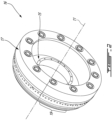
- the first portions 35 of the branches 36 extend substantially radially outward from the center hub 33, relative to the center axis 31 of the scanning fixture 30, and the second portions 37 of the branches 36 extend substantially axially (which may be vertically) from remote ends of the first portions 35 to the base frame 39.
- the base frame 39 is an annular ring that has a circular outer perimeter, and each of the branches 36 may be substantially identical.
- the frame 32 may define a generally square or rectangular shape (rather than a cylindrical one as per the embodiment of FIG. 3 ), in which case the base frame 39 may be square or rectangular and the branches 36 are configured to form the square or rectangular frame structure.
- the frame 32 may be substantially bell shaped, wherein the branches 36 may for example have a first (or upper) portion 35 and an lower portion 37, one or both of which are curved.
- the first, upper, portion 35 may however have a greater curvature than the lower portions, and in fact the lower portions 37 may be substantially axially extending while the upper portions 35 remain curved.
- each of the branches 36 includes a plurality of sub-branches 40 which project from one or more of the first and second portions 35, 37 of the branches 36. These sub-branches 40 project outwardly from the respective first and second portions 35, 37 on which they are mounted and extend transversely relative thereto. As seen in FIG. 3 , pairs of sub-branches 40 are disposed at an angle relative to each longitudinally extending branch, such as to define the overall general shape of the frame 32. In this case, the frame 32 is generally cylindrical in shape, and thus the sub-branches 40 on the second portions 37 of the branches 36 project radially inwardly as the sub-branches 40 extend away from the main body of the portions 37.
- the sub-branches 40 on the first portions 35 of the branches 36 extend in a plane that is substantially perpendicular to the center axis 31, the first portions 35 also lying in this plane.
- digitization reference points are used to transform different scans, in order to create the digitized part (i.e., a digital model of part).
- the scanning program performed by the 3D scanning system 20 is done such that that, between scans there are a given number of reference points that remain fixed and common between the scans, and these digitization reference points are used to perform the transformation (i.e., a compensation of the data acquire from each scan such that the resultant digital model created by the 3D scanning system 20 is as accurate as possible).
- the frame 32 ensures that a plurality of the markers 50 are located relatively close to the surfaces of the part to be scanned (but without the frame 32 touching the part), such that the topometric sensor(s) 21 of the 3D scanning system 20 is/are capable of "seeing” (e.g., identifying their precise locations in space) both the part being scanned and these markers 50 within a field of view 23 of the 3D scanning system 20 (which may also be a field of view and/or a focus range of the topometric sensor 21).
- markers 50 which may also be referred to as "targets" are located in fixed positions at fixed locations on the frame 32.
- the second portion 37 of the branch 36 includes a number (four are shown) of markers 50 in a surface thereof, facing an outward direction, and the sub-branches 40 extending from the second portion 37 of the branch 36 also include a number (three, in this case) of markers 50 on a surface thereof.
- the markers 50 are substantially equally spaced apart, both along the vertically-extending second portion 37 of the branch 36 and along the transversely extending sub-branch 40.
- markers 50 are disposed on one or more surfaces of the components making up the frame 32, in such a manner that these markers 50 are "visible" to the topometric sensor(s) 21 of the 3D scanning system 20.
- the movable scanning fixture 30 thus permits rapid and repeatable 3D scanning of parts using a topometric sensor 21 and associated 3D scanning system 20, without needing to apply any reference targets to the part or parts themselves.
- the reference targets namely the markers 50
- the scanning fixture 30 is readily moveable and does not need to be fixed or fastened in place, such as to a table or supporting substrate, while still ensuring scanning accuracy. Consequently, the speed and throughput of the scanning process may be increased.
- one scanning fixture 30 can be used during the scanning of multiple parts simultaneously. For example, if the scanning fixture 30 is sufficiently large to fit overtop of multiple parts at once, a single scanning process by the 3D scanning system 20 can be performed, whereby the multiple parts can be digitized and the single fixture 30 provides the necessary reference for each of the parts that are scanned. For example, multiple combustor liner 17 may be scanned at once using the same removable scanning fixture 30.
- the method 100 disclosed reduces the time required for part position and orientation, compensation and inspection, and may thus enhance the overall quality of the part.
- full automation may be achieved by using the topometric scanning sensors 21 with the removable scanning fixture 30.
- the present process can be scaled to fit any geometry of large parts.
- Such adaptive fixturing, using the scanning fixture 30 as defined herein, can permit the scanning process to be fully automated, and enables higher quality data transformation hence high accuracy laser drilling and little to no maintenance.
- the method 600 may further include performing a compensation or transformation of the scanned part data, using the digitization reference points, to generate compensated part data.
- a digital bone model of the part may also be generated, by the 3D scanning system, using the compensated part data.
- the step 604 of acquiring may further include scanning the part, and the scanning fixture, from two or more sensor locations.
- the method 600 may further include displacing the scanning fixture from a first position to a second position located within a field of view of the sensor of the 3D scanning system, the scanning fixture being located adjacent the part in the second position.
- the scanning feature at least partially surrounds the part in the second position.
- the scanning fixture may includes a frame defining an internal cavity, and the method may include positioning the frame such that the part is located within the internal cavity when in the second position.
- the plurality of markers are located on multiple branches of a frame of the scanning fixture, the branches defining an internal cavity of the scanning fixture.
- the method may accordingly further include placing the frame over the part to position the part within the internal cavity.
- the method 600 may also include, following the acquiring, displacing the scanning fixture away from an initial position of the scanning fixture relative the part, and removing the part from the field of view of the 3D scanning system. In certain cases, another part is then placed within the field of view of the 3D scanning system and repositioning the scanning fixture in the initial position.
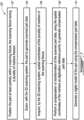
- a method 700 of scanning a part such as a part of an aircraft engine 10 for example, using a three-dimensional (3D) scanning system 20, is schematically depicted.
- the method 700 includes, at step 702, positioning the part at least partially within a scanning fixture, wherein the scanning fixture has a plurality of markers thereon.
- the method 700 includes scanning, with the 3D scanning system 20, the part to generate scanned part data.
- spatial coordinates of the plurality of markers of the scanning fixture are acquired, by the 3D scanning system 20.
- a compensation or transformation of the scanned part data is performed, using the spatial coordinates of the markers as digitization reference points, to generate compensated part data.
- a digital mode of the part is generated using the compensated part data.
- a system of one or more computers can be configured to perform particular operations or actions by virtue of having software, firmware, hardware, or a combination of them installed on the system that in operation causes or cause the system to perform the actions.
- One or more computer programs can be configured to perform particular operations or actions by virtue of including instructions that, when executed by data processing apparatus, cause the apparatus to perform the actions.
- One general aspect includes a method of scanning a part using a three-dimensional (3D) scanning system.
- the method also includes positioning a scanning fixture adjacent to the part within a field of view of a sensor of the 3D scanning system, the scanning fixture having a plurality of markers thereon, and maintaining the scanning fixture in a fixed position relative to the part; and acquiring, by the 3D scanning system, scanned part data and spatial coordinates of the plurality of markers of the scanning fixture, the spatial coordinates of the markers providing digitization reference points.
- Other embodiments of this aspect include corresponding computer systems, apparatus, and computer programs recorded on one or more computer storage devices, each configured to perform the actions of the methods.
- Implementations may include one or more of the following features.
- the method may include performing a compensation or transformation of the scanned part data, using the digitization reference points, to generate compensated part data.
- the method may include generating a digital model of the part using the compensated part data.
- the acquiring further may include scanning the part and the scanning fixture from two or more sensor locations.
- the method may include displacing the scanning fixture from a first position to a second position located within a field of view of the sensor of the 3D scanning system, the scanning fixture being located adjacent the part in the second position.
- the scanning feature at least partially surrounds the part in the second position.
- the scanning fixture includes a frame defining an internal cavity, may include positioning the frame such that the part is located within the internal cavity when in the second position.
- the plurality of markers are located on multiple branches of a frame of the scanning fixture, the branches defining therewithin an internal cavity of the scanning fixture, may include placing the frame over the part to position the part within the internal cavity.
- the method may include, following the acquiring, displacing the scanning fixture away from an initial position of the scanning fixture relative the part, and removing the part from the field of view of the 3D scanning system.
- One general aspect includes a method of scanning a part of an aircraft engine using a three-dimensional (3D) scanning system.
- the method also includes positioning the part at least partially within a scanning fixture, the scanning fixture having a plurality of markers thereon; scanning, with the 3D scanning system, the part to generate scanned part data; acquiring, by the 3D scanning system, spatial coordinates of the plurality of markers of the scanning fixture; performing a compensation or transformation of the scanned part data, using the spatial coordinates of the markers as digitization reference points, to generate compensated part data; and generating a digital model of the part using the compensated part data.
- Other embodiments of this aspect include corresponding computer systems, apparatus, and computer programs recorded on one or more computer storage devices, each configured to perform the actions of the methods.
- Implementations may include one or more of the following features.
- the positioning the part further may include displacing the scanning fixture and positioning the scanning fixture adjacent to the part within a field of view of a sensor of the 3D scanning system.
- One general aspect includes a three-dimensional (3D) scanning system for scanning a part.
- the three - dimensional also includes a sensor defining a field of view of the 3D scanning system; and a scanning fixture that is displaceable and sized to at least partially surround the part within the field of view, the scanning fixture including: a frame having a base, a center hub axially spaced apart from the base and defining a center axis of the scanning fixture, and a plurality of branches extending between the base and the center hub, the braches defining an internal cavity defined within the frame, the internal cavity being sized to receive the part; and a plurality of markers located on the frame, the markers being identified by the sensor to determine spatial coordinates of the markers.
- Other embodiments of this aspect include corresponding computer systems, apparatus, and computer programs recorded on one or more computer storage devices, each configured to perform the actions of the methods.
- Implementations may include one or more of the following features.
- the scanning fixture where a manipulation element is attached to the frame, the manipulation element permitting displacement of the scanning fixture.
- the markers are disposed on the branches of the frame facing an outward direction.
- the markers are substantially equally spaced apart along at least a portion the branches of the frame.
- the frame includes sub-branches extending transversely from the branches, the sub-branches disposed at an angle relative to a respective longitudinally extending branch.
Landscapes
- Physics & Mathematics (AREA)
- General Physics & Mathematics (AREA)
- Engineering & Computer Science (AREA)
- Computer Graphics (AREA)
- Geometry (AREA)
- Software Systems (AREA)
- Theoretical Computer Science (AREA)
- Length Measuring Devices By Optical Means (AREA)
Applications Claiming Priority (1)
| Application Number | Priority Date | Filing Date | Title |
|---|---|---|---|
| US18/312,028 US12462477B2 (en) | 2023-05-04 | 2023-05-04 | Method and system for scanning a part by performing compensation or transformation of scanned part data |
Publications (1)
| Publication Number | Publication Date |
|---|---|
| EP4464978A1 true EP4464978A1 (de) | 2024-11-20 |
Family
ID=90970712
Family Applications (1)
| Application Number | Title | Priority Date | Filing Date |
|---|---|---|---|
| EP24173678.4A Pending EP4464978A1 (de) | 2023-05-04 | 2024-05-01 | Verfahren und system zum abtasten eines teils |
Country Status (3)
| Country | Link |
|---|---|
| US (1) | US12462477B2 (de) |
| EP (1) | EP4464978A1 (de) |
| CA (1) | CA3232673A1 (de) |
Families Citing this family (1)
| Publication number | Priority date | Publication date | Assignee | Title |
|---|---|---|---|---|
| CN120760594B (zh) * | 2025-09-09 | 2025-12-12 | 成都飞机工业(集团)有限责任公司 | 一种用于飞机定位的激光跟踪仪厂房靶球布局评价方法 |
Citations (4)
| Publication number | Priority date | Publication date | Assignee | Title |
|---|---|---|---|---|
| DE102013012890B3 (de) * | 2013-08-02 | 2014-09-11 | Audi Ag | Rahmenkulisse für die optische 3D-Vermessung von großvolumigen Messobjekten mit Hilfe von Referenzmarken |
| WO2015140183A1 (en) * | 2014-03-17 | 2015-09-24 | Rapidfit Nv | Exterior target frame for optical 3-d scanning of objects |
| US20200318954A1 (en) * | 2019-04-05 | 2020-10-08 | Faro Technologies, Inc. | Three-dimensional measuring system |
| DE102019111499A1 (de) * | 2019-05-03 | 2020-11-05 | Gom Gmbh | Messeinrichtung und Verfahren zum dreidimensionalen Vermessen von Objekten |
Family Cites Families (13)
| Publication number | Priority date | Publication date | Assignee | Title |
|---|---|---|---|---|
| KR20050052979A (ko) | 2004-02-18 | 2005-06-07 | 양균의 | 3차원 레이저 스캐너용 소형물 측정지그 및 이를 이용한측정방법 |
| AU2008331478B2 (en) | 2007-12-05 | 2015-03-19 | Halliburton Energy Services, Inc. | Method and apparatus to improve design, manufacture, performance and/or use of well tools |
| US7905031B1 (en) * | 2009-03-06 | 2011-03-15 | Florida Turbine Technologies, Inc. | Process for measuring a part |
| GB2498333A (en) | 2011-12-21 | 2013-07-17 | Rolls Royce Plc | Measurement fixture for use in determining position and orientation of object and method of determining position, orientation of object relative to reference |
| US9983566B2 (en) | 2015-12-03 | 2018-05-29 | The Boeing Company | Part inspection system and method |
| US10434555B2 (en) * | 2015-12-11 | 2019-10-08 | The Boeing Company | Metrology Assisted Part Forming System and Method |
| KR102118058B1 (ko) * | 2018-11-06 | 2020-06-02 | 주식회사 알 메디 | 3차원 입체 스캐닝 시스템 및 방법 |
| US10690491B1 (en) | 2019-03-27 | 2020-06-23 | Raytheon Technologies Corporation | Standoff fixture for laser inspection |
| US11144037B2 (en) | 2019-04-15 | 2021-10-12 | The Boeing Company | Methods, systems, and header structures for tooling fixture and post-cure fixture calibration |
| CN110553584A (zh) | 2019-08-30 | 2019-12-10 | 长春理工大学 | 一种小型复杂零件的测量工装、自动测量系统及测量方法 |
| WO2022086557A1 (en) * | 2020-10-23 | 2022-04-28 | Hewlett-Packard Development Company, L.P. | Scanning systems |
| CN215930812U (zh) | 2021-08-23 | 2022-03-01 | 华瑞(江苏)燃机服务有限公司 | 一种燃气轮机叶片3d扫描定位工装 |
| US12247829B2 (en) * | 2023-01-31 | 2025-03-11 | Lawrence Livermore National Security, Llc | Optimal parameter selection for structured light metrology |
-
2023
- 2023-05-04 US US18/312,028 patent/US12462477B2/en active Active
-
2024
- 2024-03-20 CA CA3232673A patent/CA3232673A1/en active Pending
- 2024-05-01 EP EP24173678.4A patent/EP4464978A1/de active Pending
Patent Citations (4)
| Publication number | Priority date | Publication date | Assignee | Title |
|---|---|---|---|---|
| DE102013012890B3 (de) * | 2013-08-02 | 2014-09-11 | Audi Ag | Rahmenkulisse für die optische 3D-Vermessung von großvolumigen Messobjekten mit Hilfe von Referenzmarken |
| WO2015140183A1 (en) * | 2014-03-17 | 2015-09-24 | Rapidfit Nv | Exterior target frame for optical 3-d scanning of objects |
| US20200318954A1 (en) * | 2019-04-05 | 2020-10-08 | Faro Technologies, Inc. | Three-dimensional measuring system |
| DE102019111499A1 (de) * | 2019-05-03 | 2020-11-05 | Gom Gmbh | Messeinrichtung und Verfahren zum dreidimensionalen Vermessen von Objekten |
Also Published As
| Publication number | Publication date |
|---|---|
| CA3232673A1 (en) | 2025-06-25 |
| US20240371090A1 (en) | 2024-11-07 |
| US12462477B2 (en) | 2025-11-04 |
Similar Documents
| Publication | Publication Date | Title |
|---|---|---|
| US7574035B2 (en) | System and method for inspection of hole location on turbine airfoils | |
| US6909800B2 (en) | Process and apparatus for locating coated cooling holes on turbine vanes | |
| JP2007009908A (ja) | 1つまたは複数の孔の位置および角度方向の特定方法および特定装置 | |
| JP7455814B2 (ja) | 冷却孔の自動識別及びツールパスの生成 | |
| US8218001B2 (en) | Performing a process on a workpiece | |
| US6912446B2 (en) | Systems and methods for automated sensing and machining for repairing airfoils of blades | |
| JP2007010654A (ja) | 孔のパターンの位置および角度方向の特定方法および特定装置 | |
| US11407067B2 (en) | Method for repairing a part | |
| US20240059036A1 (en) | Method of repairing a combustor liner of a gas turbine engine | |
| EP3348960B1 (de) | Verfahren zur herstellung eines passiven dehnungssensors auf ein vorhandenes komponent | |
| EP4464978A1 (de) | Verfahren und system zum abtasten eines teils | |
| EP1760427B1 (de) | Verfahren zur Messung des durchströmten Querschnitts zwischen den Leitschaufeln von Gasturbinen | |
| US10546071B2 (en) | Multi coordinate reference system for positioning bladed drum | |
| EP2960736A2 (de) | Komponentenverarbeitung | |
| EP4660726A1 (de) | Verfahren zur herstellung eines teils eines flugzeugtriebwerks und system dafür | |
| CN121067718A (zh) | 一种零部件气膜孔修复的高精度重复定位方法 |
Legal Events
| Date | Code | Title | Description |
|---|---|---|---|
| PUAI | Public reference made under article 153(3) epc to a published international application that has entered the european phase |
Free format text: ORIGINAL CODE: 0009012 |
|
| STAA | Information on the status of an ep patent application or granted ep patent |
Free format text: STATUS: THE APPLICATION HAS BEEN PUBLISHED |
|
| AK | Designated contracting states |
Kind code of ref document: A1 Designated state(s): AL AT BE BG CH CY CZ DE DK EE ES FI FR GB GR HR HU IE IS IT LI LT LU LV MC ME MK MT NL NO PL PT RO RS SE SI SK SM TR |
|
| STAA | Information on the status of an ep patent application or granted ep patent |
Free format text: STATUS: REQUEST FOR EXAMINATION WAS MADE |
|
| 17P | Request for examination filed |
Effective date: 20250520 |