EP4465256A2 - Détection des risques dans une scène comprenant de l'ombre agitée - Google Patents
Détection des risques dans une scène comprenant de l'ombre agitée Download PDFInfo
- Publication number
- EP4465256A2 EP4465256A2 EP24186059.2A EP24186059A EP4465256A2 EP 4465256 A2 EP4465256 A2 EP 4465256A2 EP 24186059 A EP24186059 A EP 24186059A EP 4465256 A2 EP4465256 A2 EP 4465256A2
- Authority
- EP
- European Patent Office
- Prior art keywords
- moving
- image
- road
- vehicle
- motion
- Prior art date
- Legal status (The legal status is an assumption and is not a legal conclusion. Google has not performed a legal analysis and makes no representation as to the accuracy of the status listed.)
- Withdrawn
Links
Images




Classifications
-
- G—PHYSICS
- G06—COMPUTING OR CALCULATING; COUNTING
- G06V—IMAGE OR VIDEO RECOGNITION OR UNDERSTANDING
- G06V20/00—Scenes; Scene-specific elements
- G06V20/50—Context or environment of the image
- G06V20/56—Context or environment of the image exterior to a vehicle by using sensors mounted on the vehicle
- G06V20/58—Recognition of moving objects or obstacles, e.g. vehicles or pedestrians; Recognition of traffic objects, e.g. traffic signs, traffic lights or roads
-
- G—PHYSICS
- G06—COMPUTING OR CALCULATING; COUNTING
- G06T—IMAGE DATA PROCESSING OR GENERATION, IN GENERAL
- G06T7/00—Image analysis
- G06T7/20—Analysis of motion
- G06T7/246—Analysis of motion using feature-based methods, e.g. the tracking of corners or segments
- G06T7/248—Analysis of motion using feature-based methods, e.g. the tracking of corners or segments involving reference images or patches
-
- G—PHYSICS
- G06—COMPUTING OR CALCULATING; COUNTING
- G06T—IMAGE DATA PROCESSING OR GENERATION, IN GENERAL
- G06T7/00—Image analysis
- G06T7/40—Analysis of texture
-
- G—PHYSICS
- G06—COMPUTING OR CALCULATING; COUNTING
- G06V—IMAGE OR VIDEO RECOGNITION OR UNDERSTANDING
- G06V20/00—Scenes; Scene-specific elements
- G06V20/50—Context or environment of the image
- G06V20/56—Context or environment of the image exterior to a vehicle by using sensors mounted on the vehicle
- G06V20/588—Recognition of the road, e.g. of lane markings; Recognition of the vehicle driving pattern in relation to the road
-
- H—ELECTRICITY
- H04—ELECTRIC COMMUNICATION TECHNIQUE
- H04N—PICTORIAL COMMUNICATION, e.g. TELEVISION
- H04N7/00—Television systems
- H04N7/18—Closed-circuit television [CCTV] systems, i.e. systems in which the video signal is not broadcast
- H04N7/183—Closed-circuit television [CCTV] systems, i.e. systems in which the video signal is not broadcast for receiving images from a single remote source
-
- G—PHYSICS
- G06—COMPUTING OR CALCULATING; COUNTING
- G06T—IMAGE DATA PROCESSING OR GENERATION, IN GENERAL
- G06T2207/00—Indexing scheme for image analysis or image enhancement
- G06T2207/10—Image acquisition modality
- G06T2207/10016—Video; Image sequence
-
- G—PHYSICS
- G06—COMPUTING OR CALCULATING; COUNTING
- G06T—IMAGE DATA PROCESSING OR GENERATION, IN GENERAL
- G06T2207/00—Indexing scheme for image analysis or image enhancement
- G06T2207/30—Subject of image; Context of image processing
- G06T2207/30248—Vehicle exterior or interior
- G06T2207/30252—Vehicle exterior; Vicinity of vehicle
- G06T2207/30256—Lane; Road marking
-
- G—PHYSICS
- G06—COMPUTING OR CALCULATING; COUNTING
- G06T—IMAGE DATA PROCESSING OR GENERATION, IN GENERAL
- G06T2207/00—Indexing scheme for image analysis or image enhancement
- G06T2207/30—Subject of image; Context of image processing
- G06T2207/30248—Vehicle exterior or interior
- G06T2207/30252—Vehicle exterior; Vicinity of vehicle
- G06T2207/30261—Obstacle
Definitions
- the present invention relates to processing image motion from a moving camera mounted in a host vehicle for detection of hazards.
- DAS camera based driver assistance systems
- FCW forward collision warning
- TTC time-to-contact/collision
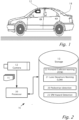
- FIGS 1 and 2 illustrate a driver assistance system (DAS) 16 including a camera or image sensor 12 mounted in a vehicle 18 .
- Image sensor 12 imaging a field of view in the forward direction provides image frames 15 in real time which are captured by an image processor 30 .
- Processor 30 may be used to process image frames 15 simultaneously and/or in parallel to serve a number of driver assistance systems/applications.
- image frames 15 are used to serve pedestrian detection 20, lane departure warning (LDW) 21 , forward collision warning (FCW) 22.
- LDW lane departure warning
- FCW forward collision warning
- Processor 30 may be used to process image frames 15 to detect and recognize an image of an object, e . g . vehicle or pedestrian, in the forward field of view of camera 12 .
- Lane departure warning (LDW) 21 may provide a warning in the case of unintentional lane departure. The warning may be given when the vehicle crosses or is about to cross the lane marker. Driver intention is determined based on use of turn signals, change in steering wheel angle, vehicle speed and brake activation.
- Driver assistance system (DAS) 16 also includes real time hazard detection 23 by sensing the vertical deviation of the contour of the road or deviation from the road plane such as according to teachings of US patent application publication US20150086080 .
- Driver assistance system (DAS) 16 may be implemented using specific hardware circuitry (not shown) with on board software and/or software control algorithms in storage 13 .
- Image sensor 12 may be monochrome or black-white, i.e. without color separation or image sensor 12 may be color sensitive. In some cases, image frames 15 are partitioned between different driver assistance applications and in other cases the image frames 15 may be shared between the different driver assistance applications.
- Figure 3 illustrates camera or pinhole projection which relates a point P(X,Y,Z) in world space Cartesian coordinates to a point p(x,y) image coordinates on image plane 15
- X is the horizontal Cartesian coordinate in world space
- Y is the vertical Cartesian coordinate in world space
- Z is the direction along the optical axis of camera 12
- the origin O of camera projection is at the pinhole
- image plane 15 is in reality is behind the origin at focal length f with the image inverted.
- Image plane 15 is shown in the projection of Figure 3 in a symmetric position with a non-inverted image in front of origin O at a distance focal length f .
- x ⁇ X Z
- y ⁇ Y Z
- homography refers to an invertible transformation from a projective space to itself that maps straight lines to straight lines.
- two images of the same planar surface in space are related by a homography assuming the pinhole camera model.
- Structure-from-Motion refers to methods for recovering three-dimensional information of a scene that has been projected onto the back focal plane of a camera.
- the structural information derived from a SfM algorithm may take the form of a set of projection matrices, one projection matrix per image frame, representing the relationship between a specific two-dimensional point in the image plane and its corresponding three-dimensional point.
- SfM algorithms rely on tracking specific image features from image frame to image frame to determine structural information concerning the scene.
- a fixed grid of points is used for tracking (step 507 ).
- a grid of points is selected (step 503 ) from a region, e.g. trapezoidal, that roughly maps up to 15 meters ahead and one lane in width. Points may be spaced every 20 pixels in the horizontal (x) direction and 10 pixels in the vertical (y) direction.
- An alternative would be to randomly select points according to a particular distribution.
- Tracked points 509 as a result of tracking step 507 are fit to a homography (step 511 ) using RANdom SAmple Consensus (RANSAC).
- RANSAC RANdom SAmple Consensus
- a number, e . g . four, of points are chosen at random and used to compute the homography.
- Points 509 are then transformed using the homography and the number of points which are closer than a threshold are counted. Randomly choosing 4 points and counting the number of points which are closer than a threshold may repeated many times and the four points that gave the highest count are retained.
- the four best points are used to again (step 513 ) transform the points and all the points (inliers) that are closer than a (possibly different) threshold are used to compute a homography using least squares. The rest of the points that are not closer than a (possibly different) threshold are considered outliers.
- the number of inliers and their spread in the warped image give an indication to the success of finding the road plane model. It is usual to get over 80% inliers and a good fit.
- the homography can then be used to correct the initial alignment for warping (step 501 ). Correction of the initial alignment can be done by integrating the correction into the initial warp (step 501 ) or to do two warps consecutively.
- the former is advantageous as it requires only one interpolation step and can be performed optionally by matrix multiplication of the two homography matrices.
- the tracking of points may be repeated using a finer grid (e.g. every 5th pixel on every 5th row) and over a wider region of the road. Since the road plane is very well aligned, a smaller region may be searched over such as 2 pixels in each direction, again, with a subpixel search.
- Object points in world space above the road plane such as an elevated sidewalk have an image flow greater than the characteristic image flow of tracked points 509 of the road.
- Object points in world space below the road plane such as sunken manhole covers, have an image flow less than the characteristic image flow of tracked points 509 of the road.
- image flow of tracked points 509 is compared with the expected image flow of the modeled road plane and any differences or residual image flow are associated with vertical deviation in the road. Tracked image points 509 of objects above the road plane have residual image flow greater than zero and objects below the road plane have residual image flow below zero.
- the present invention seeks to provide an improved hazard detection system and method.
- driver assistance systems mountable in a host vehicle and computerized methods performable by the driver assistance systems while the host vehicle is moving are described herein.
- the driver assistance systems include a camera operatively connectible to a processor.
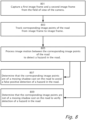
- First and second image frames are captured from the field of view of the camera.
- Corresponding image points of the road are tracked from the first image frame to the second image frame.
- Image motion between the corresponding image points of the road is processed to detect a hazard in the road.
- Moving objects normally found in the road environment include vehicles, bicycles and pedestrians. In most cases, these moving objects are detected by the DAS system 16 using class-based recognition techniques performed by forward collision warning FCW 22 and pedestrian detection 20 and thus image regions corresponding to these recognized objects may be masked out and ignored by hazard detection 23 which uses structure-from-motion techniques.
- Objects moving in a general direction results in image flow that does not in general match the image flow of the rigid world.
- images of generally moving objects may be segmented out as hazards.
- points on objects moving in the same direction as host vehicle 18 will also show up as hazards although there will be errors in estimation of height H of the candidate object and distance Z to the candidate object. It can be shown that for each height H of the point above the ground there will be one relative speed at which that point will appear to be a stationary point on the road and thus might not be segmented as a hazard. However, there is no one relative speed which "works" for two object points of different heights (H). Thus a moving object which normally has multiple heights cannot "hide "and is detected as a hazard.
- the image flow of object points of moving shadows does not correspond to the image flow of the planar road surface.
- the first priority is to avoid false hazard detection due to moving shadows and the second priority is to determine the road profile of the road which include moving shadows which may appear to be hazards or bumps in the road profile.
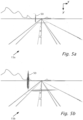
- FIGS 5a, and 5b show road scenes of successive image frames 15 captured by processor 30 from camera 12 mounted in host vehicle 18 , according to features taught herein.
- Captured image frames 15a and 15b in Figures 5a and 5b respectively show a tree 50 and its shadow cast on the road surface as host vehicle 18 advances forward along the road. Tree 50 appears to be unmoving and the shadows of the tree appear to be static in the road as host vehicle 18 advances from a first position in which image frame 15a of Figure 5a is captured to the second position in which image frame 15b of Figure 5b is captured.
- Image motion of the tree shadow which may be measured in pixels in x,y directions in image space (Cartesian coordinate axes are shown in Figure 5a ) appears identical to image motion of the road plane between respective image frames 15 of Figures 5a and 5b .
- a structure-from-motion algorithm designed to detect road hazards would not detect any hazard from the tree shadows of Figures 5a and 5b .
- FIGS 5c and 5d show additional road scenes of successive image frames 15c and 15d captured by processor 30 from camera 12 mounted in host vehicle 18 , according to features taught herein.
- image frame 15c of Figure 5c tree 50 is bent by wind away from host vehicle 18 and in image frame 15d of Figure 5d , tree 50 is bent by wind toward from host vehicle 18.
- Image motion of the respective shadows between image frames 15c and 15d is not identical with and less than image motion of the road and a structure-from-motion algorithm may interpret image motion of the moving tree shadow as hazard or depression in the road of some depth. Such a detection would be a false positive detection.
- Another example of road shadows caused by shrubs is shown in Figure 6 in which motion of the shadows due to wind may result in false positive detection using Structure-from-Motion techniques.
- Moving shadows from trees are examples of unstructured shadow motion.
- the direction of motion is not necessarily in the direction of the focus of expansion (FOE) and the direction changes in sign as the leaves and branches sway in the wind.
- FOE focus of expansion
- the following approaches may be used to determine that the image motion is from a moving shadow, does not represent a hazard and a collision warning should be inhibited.
- a first approach is to segment out regions where the image flow does not match the general image flow direction away from the focus of expansion (FOE) and/or the sign and magnitude of the image flow changes in some apparently random way due to wind.
- FOE focus of expansion
- Shadows at night or twilight may originate from street lamps. Trees or brush moving under the influence of wind positioned under or near the street lamps may generate moving shadows which may appear to be hazards using a structure-from-motion algorithm. Images of street lamps may be recognized by being aligned along lines at the side of the road which meet at the focus of expansion and have an image flow characteristic of street lamps in which the vertical image coordinate y moves according to equation 2 above with Y being the difference between height of the street lamp and the camera height. Lines may be drawn between the shadow points, the image of the tree casting the shadow and the image of the street lamp which are a strong indication that the moving shadows are not hazards in the road.
- texture analysis may be performed on the candidate image to see if the candidate image has leaf and/or branch texture. Texture analysis may also be performed in the texture on the road. Even though tree shadows may extend to a few meters on the road, due to foreshortening the vertical extent of the shadow in the image is quite small. If the moving shadows are large in vertical image coordinate y and the shadows likely originate from many trees and the motion is not expected to be uniform over the entire shadow. An example of multiple tree texture on the road surface is shown in Figure 6 .
- a lane mark may be detected using an output from lane departure warning LDW 21 algorithm.
- the detected lane mark leads into a moving shadow (of tree 50 ) in which image motion is detected.
- the shadow moves over different portion of a broken lane marker.
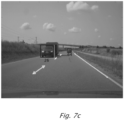
- Figure 7a includes an image frame 15 showing an oncoming vehicle and trailer in an adjacent lane creating a moving shadow in the lane of host vehicle 18 , illustrating a feature of the teachings herein.
- the shadow of the oncoming vehicle in the adjacent lane as shown often appears as a dark horizontal strip moving towards host vehicle 18 , the closer (bottom) edge of the shadow and the farther (upper) edge may be considered.
- a vehicle with a complex shape might produce more than two horizontal edges (in this example two pairs of moving edges are visible).
- the image motion of the shadows on the road may correspond to a static object of a certain height H and distance Z .
- height H and distance Z remain consistent and appear to be a hazard of height H in the road to a structure-from-motion algorithm. Since the moving shadow is moving towards host vehicle 18 a structure-from-motion algorithm may incorrectly interpret the moving shadow to be a hazard of finite height H above the road plane.
- Figure 7b shows tracked points on the road plane, according to teachings of US20150086080 for the respective shadows of the vehicle and the trailer illustrated in Figure 7a .
- the tracked points marked with triangles near the shadow regions of the oncoming vehicle and its trailer fit the road plane model but have strong residual motion.
- the shadows associated with the oncoming vehicle and trailer appear as false hazards according the teachings of US20150086080 .
- a hazard has strong horizontal texture so the patch should have a significant horizontal edge.
- An edge detection may be performed and the number of horizontal edge points in a patch and in each row of the patch may be counted.
- a good horizontal edge should have a cluster of horizontal edge points in one or two adjacent rows.
- the patch used to count edge points can have more rows and/or columns than the patch used for tracking.
- a hazard should have a horizontal edge both at the top and where it touches the road.
- the edge on the road should have no residual flow associated with it.
- Points that exhibit significant residual flow are suspect hazard points.
- the suspect hazard points might be moving shadows on the planar surface.
Landscapes
- Engineering & Computer Science (AREA)
- Physics & Mathematics (AREA)
- General Physics & Mathematics (AREA)
- Multimedia (AREA)
- Theoretical Computer Science (AREA)
- Computer Vision & Pattern Recognition (AREA)
- Signal Processing (AREA)
- Image Analysis (AREA)
- Traffic Control Systems (AREA)
- Image Processing (AREA)
Applications Claiming Priority (2)
| Application Number | Priority Date | Filing Date | Title |
|---|---|---|---|
| US201462013562P | 2014-06-18 | 2014-06-18 | |
| EP15275152.5A EP2958054B1 (fr) | 2014-06-18 | 2015-06-12 | Détection des risques dans une scène comprenant de l'ombre agitée |
Related Parent Applications (1)
| Application Number | Title | Priority Date | Filing Date |
|---|---|---|---|
| EP15275152.5A Division EP2958054B1 (fr) | 2014-06-18 | 2015-06-12 | Détection des risques dans une scène comprenant de l'ombre agitée |
Publications (2)
| Publication Number | Publication Date |
|---|---|
| EP4465256A2 true EP4465256A2 (fr) | 2024-11-20 |
| EP4465256A3 EP4465256A3 (fr) | 2025-02-19 |
Family
ID=53489899
Family Applications (2)
| Application Number | Title | Priority Date | Filing Date |
|---|---|---|---|
| EP15275152.5A Active EP2958054B1 (fr) | 2014-06-18 | 2015-06-12 | Détection des risques dans une scène comprenant de l'ombre agitée |
| EP24186059.2A Withdrawn EP4465256A3 (fr) | 2014-06-18 | 2015-06-12 | Détection des risques dans une scène comprenant de l'ombre agitée |
Family Applications Before (1)
| Application Number | Title | Priority Date | Filing Date |
|---|---|---|---|
| EP15275152.5A Active EP2958054B1 (fr) | 2014-06-18 | 2015-06-12 | Détection des risques dans une scène comprenant de l'ombre agitée |
Country Status (2)
| Country | Link |
|---|---|
| US (4) | US9892328B2 (fr) |
| EP (2) | EP2958054B1 (fr) |
Families Citing this family (31)
| Publication number | Priority date | Publication date | Assignee | Title |
|---|---|---|---|---|
| JP6285958B2 (ja) * | 2013-01-15 | 2018-02-28 | モービルアイ ビジョン テクノロジーズ リミテッド | ローリングシャッターを伴うステレオ支援 |
| JP2015200976A (ja) * | 2014-04-04 | 2015-11-12 | 富士通株式会社 | 移動量推定装置、移動量推定方法、およびプログラム |
| US10115024B2 (en) | 2015-02-26 | 2018-10-30 | Mobileye Vision Technologies Ltd. | Road vertical contour detection using a stabilized coordinate frame |
| US10209712B2 (en) * | 2015-11-26 | 2019-02-19 | Mobileye Vision Technologies Ltd. | Predicting and responding to cut in vehicles and altruistic responses |
| US10156441B2 (en) | 2016-01-05 | 2018-12-18 | Texas Instruments Incorporated | Ground plane estimation in a computer vision system |
| EP3403216B1 (fr) * | 2016-01-11 | 2023-11-01 | Mobileye Vision Technologies Ltd. | Systèmes et procédés pour augmenter une détection d'objet vertical |
| CN105975913B (zh) * | 2016-04-28 | 2020-03-10 | 武汉大学 | 一种基于自适应聚类学习的道路网提取的方法 |
| CN106778467B (zh) * | 2016-11-14 | 2020-06-19 | 天津津航技术物理研究所 | 基于区域结构树的红外夜视行人目标跟踪方法 |
| US10325163B2 (en) * | 2016-11-22 | 2019-06-18 | Ford Global Technologies, Llc | Vehicle vision |
| MY202749A (en) * | 2016-11-30 | 2024-05-19 | Ricoh Co Ltd | Information processing device, imaging device, apparatus control system, movable body, information processing method, and computer program product |
| JP2018092596A (ja) | 2016-11-30 | 2018-06-14 | 株式会社リコー | 情報処理装置、撮像装置、機器制御システム、移動体、情報処理方法、およびプログラム |
| DE102017206973A1 (de) * | 2017-04-26 | 2018-10-31 | Conti Temic Microelectronic Gmbh | Verfahren zur Nutzung einer indirekten Detektion eines verdeckten Verkehrsteilnehmers zur Steuerung eines Fahrerassistenzsystems oder einer Fahrautomatisierungsfunktion eines Fahrzeugs |
| JP6782192B2 (ja) * | 2017-05-17 | 2020-11-11 | 株式会社デンソーアイティーラボラトリ | 物体検出装置、物体検出方法、及びプログラム |
| US10365650B2 (en) | 2017-05-25 | 2019-07-30 | GM Global Technology Operations LLC | Methods and systems for moving object velocity determination |
| CN109033951B (zh) * | 2017-06-12 | 2022-05-27 | 法拉第未来公司 | 用于基于图形处理来检测遮挡对象的系统及方法 |
| US11209306B2 (en) | 2017-11-02 | 2021-12-28 | Fluke Corporation | Portable acoustic imaging tool with scanning and analysis capability |
| US20190129027A1 (en) | 2017-11-02 | 2019-05-02 | Fluke Corporation | Multi-modal acoustic imaging tool |
| CN108122230B (zh) * | 2018-01-10 | 2022-06-24 | 广东工业大学 | 图像块的识别方法、装置及倒装芯片的焊球位置识别系统 |
| WO2019166141A1 (fr) * | 2018-03-01 | 2019-09-06 | Jaguar Land Rover Limited | Procédé et appareil de commande de véhicule |
| JP2021532355A (ja) | 2018-07-24 | 2021-11-25 | フルークコーポレイションFluke Corporation | 音響画像にタグを付けて関連付けるためのシステム及び方法 |
| US11436839B2 (en) | 2018-11-02 | 2022-09-06 | Toyota Research Institute, Inc. | Systems and methods of detecting moving obstacles |
| JP7183729B2 (ja) * | 2018-11-26 | 2022-12-06 | トヨタ自動車株式会社 | 撮影異常診断装置 |
| US10902634B2 (en) * | 2018-12-04 | 2021-01-26 | Here Global B.V. | Method and apparatus for providing feature triangulation |
| DE102019206036A1 (de) * | 2019-04-26 | 2020-10-29 | Volkswagen Aktiengesellschaft | Verfahren und Vorrichtung zur Bestimmung der geografischen Position und Orientierung eines Fahrzeugs |
| US10867190B1 (en) * | 2019-11-27 | 2020-12-15 | Aimotive Kft. | Method and system for lane detection |
| US11713047B2 (en) * | 2020-02-21 | 2023-08-01 | Calamp Corp. | Technologies for driver behavior assessment |
| GB2599380A (en) * | 2020-09-30 | 2022-04-06 | Roadmetric Ltd | Measuring vehicle speeds with an uncalibrated camera |
| CN112417967B (zh) * | 2020-10-22 | 2021-12-14 | 腾讯科技(深圳)有限公司 | 障碍物检测方法、装置、计算机设备和存储介质 |
| US20230092198A1 (en) * | 2021-09-23 | 2023-03-23 | Aeye, Inc. | Systems and methods of real-time detection of and geometry generation for physical ground planes |
| US12272158B2 (en) | 2021-11-05 | 2025-04-08 | Samsung Electronics Co., Ltd. | Method and apparatus with lane generation |
| CN114463989B (zh) * | 2021-12-13 | 2023-09-08 | 浙江明航智能科技有限公司 | 一种民航特种车限高检测系统 |
Citations (2)
| Publication number | Priority date | Publication date | Assignee | Title |
|---|---|---|---|---|
| US7113867B1 (en) | 2000-11-26 | 2006-09-26 | Mobileye Technologies Limited | System and method for detecting obstacles to vehicle motion and determining time to contact therewith using sequences of images |
| US20150086080A1 (en) | 2012-12-04 | 2015-03-26 | Mobileye Vision Technologies Ltd. | Road vertical contour detection |
Family Cites Families (14)
| Publication number | Priority date | Publication date | Assignee | Title |
|---|---|---|---|---|
| US6762769B2 (en) * | 2002-01-23 | 2004-07-13 | Microsoft Corporation | System and method for real-time texture synthesis using patch-based sampling |
| JP3977802B2 (ja) * | 2003-12-16 | 2007-09-19 | 株式会社東芝 | 障害物検出装置、障害物検出方法および障害物検出プログラム |
| US7720580B2 (en) * | 2004-12-23 | 2010-05-18 | Donnelly Corporation | Object detection system for vehicle |
| JP4185077B2 (ja) | 2005-07-15 | 2008-11-19 | 本田技研工業株式会社 | 車両、画像処理システム、画像処理方法、及び画像処理プログラム |
| US8164628B2 (en) * | 2006-01-04 | 2012-04-24 | Mobileye Technologies Ltd. | Estimating distance to an object using a sequence of images recorded by a monocular camera |
| EP1837803A3 (fr) * | 2006-03-24 | 2008-05-14 | MobilEye Technologies, Ltd. | Détection de phare, feu rouge arrière et réverbère |
| JP2008003695A (ja) * | 2006-06-20 | 2008-01-10 | Toyota Motor Corp | 画像処理装置 |
| EP2674324B1 (fr) * | 2007-04-30 | 2018-12-26 | Mobileye Vision Technologies Ltd. | Détection d'obstruction arrière |
| WO2011018999A1 (fr) * | 2009-08-12 | 2011-02-17 | 日本電気株式会社 | Dispositif, procédé et système de détection d'obstacle |
| US9959595B2 (en) | 2010-09-21 | 2018-05-01 | Mobileye Vision Technologies Ltd. | Dense structure from motion |
| CN103518230B (zh) * | 2011-03-14 | 2017-02-22 | 加州大学评议会 | 用于车辆分类的方法和系统 |
| US9547795B2 (en) * | 2011-04-25 | 2017-01-17 | Magna Electronics Inc. | Image processing method for detecting objects using relative motion |
| US8848978B2 (en) * | 2011-09-16 | 2014-09-30 | Harman International (China) Holdings Co., Ltd. | Fast obstacle detection |
| US8886387B1 (en) * | 2014-01-07 | 2014-11-11 | Google Inc. | Estimating multi-vehicle motion characteristics by finding stable reference points |
-
2015
- 2015-06-12 US US14/737,522 patent/US9892328B2/en active Active
- 2015-06-12 EP EP15275152.5A patent/EP2958054B1/fr active Active
- 2015-06-12 EP EP24186059.2A patent/EP4465256A3/fr not_active Withdrawn
-
2018
- 2018-01-10 US US15/867,550 patent/US10262216B2/en active Active
-
2019
- 2019-03-11 US US16/298,256 patent/US10956756B2/en active Active
-
2021
- 2021-03-19 US US17/207,206 patent/US11854272B2/en active Active
Patent Citations (2)
| Publication number | Priority date | Publication date | Assignee | Title |
|---|---|---|---|---|
| US7113867B1 (en) | 2000-11-26 | 2006-09-26 | Mobileye Technologies Limited | System and method for detecting obstacles to vehicle motion and determining time to contact therewith using sequences of images |
| US20150086080A1 (en) | 2012-12-04 | 2015-03-26 | Mobileye Vision Technologies Ltd. | Road vertical contour detection |
Also Published As
| Publication number | Publication date |
|---|---|
| EP4465256A3 (fr) | 2025-02-19 |
| US10956756B2 (en) | 2021-03-23 |
| US20190205671A1 (en) | 2019-07-04 |
| US10262216B2 (en) | 2019-04-16 |
| EP2958054A3 (fr) | 2016-05-25 |
| US20180225529A1 (en) | 2018-08-09 |
| US20150371096A1 (en) | 2015-12-24 |
| US9892328B2 (en) | 2018-02-13 |
| EP2958054A2 (fr) | 2015-12-23 |
| US20210264176A1 (en) | 2021-08-26 |
| US11854272B2 (en) | 2023-12-26 |
| EP2958054B1 (fr) | 2024-07-03 |
Similar Documents
| Publication | Publication Date | Title |
|---|---|---|
| US11854272B2 (en) | Hazard detection from a camera in a scene with moving shadows | |
| US11170466B2 (en) | Dense structure from motion | |
| US11763571B2 (en) | Monocular cued detection of three-dimensional structures from depth images | |
| US9141870B2 (en) | Three-dimensional object detection device and three-dimensional object detection method | |
| US9754172B2 (en) | Three-dimenisional object detection device | |
| Huang et al. | On-board vision system for lane recognition and front-vehicle detection to enhance driver's awareness | |
| EP3832529A1 (fr) | Détection nocturne d'obstacles par l'analyse d'ombres | |
| US20070211919A1 (en) | Vehicle surroundings monitoring apparatus | |
| US9349059B2 (en) | Three-dimensional object detection device | |
| JP2007234019A (ja) | 車両画像領域特定装置およびその方法 | |
| CN109635737A (zh) | 基于道路标记线视觉识别辅助车辆导航定位方法 | |
| US9830519B2 (en) | Three-dimensional object detection device | |
| JP2015064752A (ja) | 車両監視装置、および車両監視方法 | |
| JP2008158958A (ja) | 路面判別方法および路面判別装置。 | |
| KR102824305B1 (ko) | IPM 이미지와 정밀도로지도(HD Map) 피팅을 통해 노면객체의 변화를 자동으로 판단하고 갱신하는 정밀도로지도 자동갱신 방법 및 시스템 | |
| CN106671991B (zh) | 基于多线索视觉特征融合的车道偏离预警方法 | |
| Rosebrock et al. | Real-time vehicle detection with a single camera using shadow segmentation and temporal verification | |
| WO2013129359A1 (fr) | Dispositif de détection d'objet en trois dimensions |
Legal Events
| Date | Code | Title | Description |
|---|---|---|---|
| PUAI | Public reference made under article 153(3) epc to a published international application that has entered the european phase |
Free format text: ORIGINAL CODE: 0009012 |
|
| STAA | Information on the status of an ep patent application or granted ep patent |
Free format text: STATUS: THE APPLICATION HAS BEEN PUBLISHED |
|
| AC | Divisional application: reference to earlier application |
Ref document number: 2958054 Country of ref document: EP Kind code of ref document: P |
|
| AK | Designated contracting states |
Kind code of ref document: A2 Designated state(s): AL AT BE BG CH CY CZ DE DK EE ES FI FR GB GR HR HU IE IS IT LI LT LU LV MC MK MT NL NO PL PT RO RS SE SI SK SM TR |
|
| PUAL | Search report despatched |
Free format text: ORIGINAL CODE: 0009013 |
|
| AK | Designated contracting states |
Kind code of ref document: A3 Designated state(s): AL AT BE BG CH CY CZ DE DK EE ES FI FR GB GR HR HU IE IS IT LI LT LU LV MC MK MT NL NO PL PT RO RS SE SI SK SM TR |
|
| RIC1 | Information provided on ipc code assigned before grant |
Ipc: G06V 20/58 20220101AFI20250116BHEP |
|
| STAA | Information on the status of an ep patent application or granted ep patent |
Free format text: STATUS: THE APPLICATION IS DEEMED TO BE WITHDRAWN |
|
| 18D | Application deemed to be withdrawn |
Effective date: 20250820 |