EP4465539A2 - Procédé et appareil de traitement d'adaptation de débit de codes polaires - Google Patents
Procédé et appareil de traitement d'adaptation de débit de codes polaires Download PDFInfo
- Publication number
- EP4465539A2 EP4465539A2 EP24185277.1A EP24185277A EP4465539A2 EP 4465539 A2 EP4465539 A2 EP 4465539A2 EP 24185277 A EP24185277 A EP 24185277A EP 4465539 A2 EP4465539 A2 EP 4465539A2
- Authority
- EP
- European Patent Office
- Prior art keywords
- bit sequence
- circular buffer
- bits
- predefined
- initial
- Prior art date
- Legal status (The legal status is an assumption and is not a legal conclusion. Google has not performed a legal analysis and makes no representation as to the accuracy of the status listed.)
- Pending
Links
Images


Classifications
-
- H—ELECTRICITY
- H03—ELECTRONIC CIRCUITRY
- H03M—CODING; DECODING; CODE CONVERSION IN GENERAL
- H03M13/00—Coding, decoding or code conversion, for error detection or error correction; Coding theory basic assumptions; Coding bounds; Error probability evaluation methods; Channel models; Simulation or testing of codes
- H03M13/65—Purpose and implementation aspects
- H03M13/6502—Reduction of hardware complexity or efficient processing
-
- H—ELECTRICITY
- H03—ELECTRONIC CIRCUITRY
- H03M—CODING; DECODING; CODE CONVERSION IN GENERAL
- H03M13/00—Coding, decoding or code conversion, for error detection or error correction; Coding theory basic assumptions; Coding bounds; Error probability evaluation methods; Channel models; Simulation or testing of codes
- H03M13/03—Error detection or forward error correction by redundancy in data representation, i.e. code words containing more digits than the source words
- H03M13/05—Error detection or forward error correction by redundancy in data representation, i.e. code words containing more digits than the source words using block codes, i.e. a predetermined number of check bits joined to a predetermined number of information bits
- H03M13/13—Linear codes
-
- H—ELECTRICITY
- H03—ELECTRONIC CIRCUITRY
- H03M—CODING; DECODING; CODE CONVERSION IN GENERAL
- H03M13/00—Coding, decoding or code conversion, for error detection or error correction; Coding theory basic assumptions; Coding bounds; Error probability evaluation methods; Channel models; Simulation or testing of codes
- H03M13/27—Coding, decoding or code conversion, for error detection or error correction; Coding theory basic assumptions; Coding bounds; Error probability evaluation methods; Channel models; Simulation or testing of codes using interleaving techniques
- H03M13/2792—Interleaver wherein interleaving is performed jointly with another technique such as puncturing, multiplexing or routing
-
- H—ELECTRICITY
- H03—ELECTRONIC CIRCUITRY
- H03M—CODING; DECODING; CODE CONVERSION IN GENERAL
- H03M13/00—Coding, decoding or code conversion, for error detection or error correction; Coding theory basic assumptions; Coding bounds; Error probability evaluation methods; Channel models; Simulation or testing of codes
- H03M13/63—Joint error correction and other techniques
- H03M13/635—Error control coding in combination with rate matching
-
- H—ELECTRICITY
- H03—ELECTRONIC CIRCUITRY
- H03M—CODING; DECODING; CODE CONVERSION IN GENERAL
- H03M13/00—Coding, decoding or code conversion, for error detection or error correction; Coding theory basic assumptions; Coding bounds; Error probability evaluation methods; Channel models; Simulation or testing of codes
- H03M13/65—Purpose and implementation aspects
- H03M13/6577—Representation or format of variables, register sizes or word-lengths and quantization
- H03M13/6591—Truncation, saturation and clamping
-
- H—ELECTRICITY
- H04—ELECTRIC COMMUNICATION TECHNIQUE
- H04L—TRANSMISSION OF DIGITAL INFORMATION, e.g. TELEGRAPHIC COMMUNICATION
- H04L1/00—Arrangements for detecting or preventing errors in the information received
- H04L1/004—Arrangements for detecting or preventing errors in the information received by using forward error control
- H04L1/0041—Arrangements at the transmitter end
-
- H—ELECTRICITY
- H04—ELECTRIC COMMUNICATION TECHNIQUE
- H04L—TRANSMISSION OF DIGITAL INFORMATION, e.g. TELEGRAPHIC COMMUNICATION
- H04L1/00—Arrangements for detecting or preventing errors in the information received
- H04L1/004—Arrangements for detecting or preventing errors in the information received by using forward error control
- H04L1/0056—Systems characterized by the type of code used
- H04L1/0057—Block codes
-
- H—ELECTRICITY
- H04—ELECTRIC COMMUNICATION TECHNIQUE
- H04L—TRANSMISSION OF DIGITAL INFORMATION, e.g. TELEGRAPHIC COMMUNICATION
- H04L1/00—Arrangements for detecting or preventing errors in the information received
- H04L1/004—Arrangements for detecting or preventing errors in the information received by using forward error control
- H04L1/0056—Systems characterized by the type of code used
- H04L1/0067—Rate matching
-
- H—ELECTRICITY
- H04—ELECTRIC COMMUNICATION TECHNIQUE
- H04L—TRANSMISSION OF DIGITAL INFORMATION, e.g. TELEGRAPHIC COMMUNICATION
- H04L1/00—Arrangements for detecting or preventing errors in the information received
- H04L1/004—Arrangements for detecting or preventing errors in the information received by using forward error control
- H04L1/0056—Systems characterized by the type of code used
- H04L1/0071—Use of interleaving
Definitions
- the present disclosure relates to the field of communications and, for example, to a rate matching method and device for a Polar code.
- Polar code is a rigorously proven constructive code capable of reaching a channel capacity and satisfying requirements of the fifth generation radio access technology (5G RAT) for the throughput and latency in the communication.
- the information bits may include one or more check bits.
- the check bits may be generated through parity check encoding, cyclic redundancy check encoding, RS encoding and the like.
- the frozen bits are known bits in the encoding, and generally are 0 or pseudo-random bits.
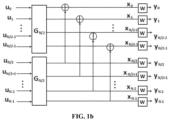
- FIG. 1a and FIG. 1b are schematic diagrams of a recursive structure of a Polar code in the related art.
- the length N of a data bit sequence obtained from the Polar encoding is a power of 2 and unnecessary bits can be discarded in a puncturing or shortening manner to perform rate matching for the transmission of any code length.
- Different code lengths and code rates correspond to different rate matching patterns. Therefore, different hardware modules are needed to implement the rate matching, thereby resulting in high complexity of Polar code hardware in different application scenarios.
- the present disclosure provides a rate matching method and device for a Polar code to solve at least the problem in the related art of high complexity of Polar code hardware for transmitting a bit sequence of any length.
- the present disclosure provides a rate matching method for a Polar code, including: K information bits and (N-K) frozen bits are concatenated to generate a bit sequence of N bits, and the bit sequence of N bits is encoded by means of a Polar code encoder with a generator matrix of size N ⁇ N to generate an initial bit sequence ⁇ S 0 , S 1 ,..., S N- 1 ⁇ of N bits, wherein K and N are both positive integers and K is less than or equal to N.
- a bit sequence of a specified length is sequentially selected from a predefined starting position in a bit sequence in the circular buffer, and the bit sequence of the specified length is taken as a bit sequence to be transmitted.
- the K information bits may include check bits.
- mapping ⁇ n ⁇ f(n) ⁇ is a one-to-one mapping
- an inverse function p(n) of f(n) which satisfies a mapping ⁇ p(n) ⁇ n ⁇
- Selecting the bits from the initial bit sequence ⁇ S 0 , S 1 ,..., S N -1 ⁇ in the non-repeated manner and writing the bits into the q parts of the circular buffer according to the predefined rule includes: mapping a bit S p(n) with a bit position index p(n) in the initial bit sequence onto a position with a position index n in the circular buffer according to the one-to-one mapping interleaving function p(n).
- the data characteristic includes at least one of: a transport block length, a code rate, a number of available physical resource blocks, a modulation and coding level, a user equipment type index and a data transmission link direction.
- the predefined starting position includes one of the following: A starting bit position of the bit sequence in the circular buffer is taken as the predefined starting position.
- An ending bit position of the bit sequence in the circular buffer is taken as the predefined starting position.
- the predefined starting position is determined by a code rate of the Polar encoding.
- the predefined starting position is selected according to the code rate of the Polar encoding, when the code rate of the Polar encoding is greater than the predefined threshold, the predefined starting position is determined by one of the following manners: The starting bit position of the bit sequence in the circular buffer is taken as the predefined starting position.
- the ending bit position of the bit sequence in the circular buffer is taken as the predefined starting position.
- the circular buffer is composed of a sixth part, a seventh part, an eighth part and a ninth part arranged sequentially, a starting bit position of the seventh part of the bit sequence in the circular buffer is taken as the predefined starting position.
- an ending bit position of the eighth part of the bit sequence in the circular buffer is taken as the predefined starting position.
- a starting bit position of the eighth part of the bit sequence in the circular buffer is taken as the predefined starting position.
- a starting bit position of the ninth part of the bit sequence in the circular buffer is taken as the predefined starting position.
- an ending bit position of the sixth part of the bit sequence in the circular buffer is taken as the predefined starting position.
- the starting bit position of the ninth part of the bit sequence in the circular buffer is taken as the predefined starting position.
- an ending bit position of the seventh part of the bit sequence in the circular buffer is taken as the predefined starting position.
- the ending bit position of the sixth part of the bit sequence in the circular buffer is taken as the predefined starting position.
- the predefined starting position may be determined by the following manner: When the code rate of the Polar encoding is greater than the predefined threshold, the starting bit position of the bit sequence in the circular buffer is taken as the predefined starting position.
- BRO bit reversal order
- BRO bit reversal order
- sequentially selecting the bit sequence of the specified length from the predefined starting position in the bit sequence in the circular buffer and taking the bit sequence of the specified length as the bit sequence to be transmitted includes: Bits are sequentially selected in an ascending or descending order of indexes from a predefined position in the bit sequence in the circular buffer, when reaching to an end of the bit sequence in the circular buffer, the selecting is continued from an other end of the bit sequence in the circular buffer until the bit sequence of the specified length is selected, and the bit sequence of the specified length is taken as the bit sequence to be transmitted.
- a starting bit position of the bit sequence in the circular buffer is taken as the predefined starting position and M bits are sequentially selected in an ascending order of indexes; when the reading goes to an end of the bit sequence in the circular buffer, the reading is continued from an other end of the bit sequence in the circular buffer, wherein N is a length of the initial bit sequence.
- the bit sequence to be transmitted is arranged in a same order or in a reverse order of the bit sequence of the specified length read from the circular buffer.
- the present disclosure further provides a rate matching device for a Polar code, including a generation module, a writing module, a selecting module and a determination module.
- the generation module is configured to concatenate K information bits and (N-K) frozen bits to generate a bit sequence of N bits, and encode the bit sequence of N bits by means of a Polar code encoder with a generator matrix of size N ⁇ N to generate an initial bit sequence ⁇ S 0, S 1 ,..., S N -1 ⁇ of N bits, where K and N are both positive integers and K is less than or equal to N.
- the selecting module is configured to sequentially select a bit sequence of a specified length from a predefined starting position in a bit sequence in the circular buffer.
- the determination module is configured to take the bit sequence of the specified length as a bit sequence to be transmitted.
- the writing module is configured to map a bit Sn with a bit position index n in the initial bit sequence onto a position with a position index f(n) in the circular buffer according to the one-to-one mapping interleaving function f(n).
- mapping ⁇ n ⁇ f(n) ⁇ is a one-to-one mapping
- an inverse function p(n) of f(n) which satisfies a mapping ⁇ p(n) ⁇ n ⁇
- Selecting the bits from the initial bit sequence ⁇ S 0 , S 1 ,..., S N -1 ⁇ in the non-repeated manner and writing the bits into the q parts of the circular buffer according to the predefined rule includes: mapping a bit S p(n) with a bit position index p(n) in the initial bit sequence onto a position with a position index n in the circular buffer according to the one-to-one mapping interleaving function p(n).
- the predefined starting position is selected in one of the following manners: A starting bit position of the bit sequence in the circular buffer is taken as the predefined starting position.
- An ending bit position of the bit sequence in the circular buffer is taken as the predefined starting position.
- the present disclosure further provides a rate matching device for a Polar code, including: a processor and a memory.
- the memory is configured to perform the following operations: K information bits and (N-K) frozen bits are concatenated to generate a bit sequence of N bits, and the bit sequence of N bits is encoded by means of a Polar code encoder with a generator matrix of size N ⁇ N to generate an initial bit sequence ⁇ S 0 , S 1 ,..., S N -1 ⁇ of N bits, where K and N are both positive integers and K is less than or equal to N;
- mapping ⁇ n ⁇ f(n) ⁇ is a one-to-one mapping
- the operation of selecting the bits from the initial bit sequence ⁇ S 0 , S 1 ,..., S N -1 ⁇ in the non-repeated manner and writing the bits into the q parts of the circular buffer according to the predefined rule includes: mapping a bit S p(n) with a bit position index p(n) in the initial bit sequence onto a position with a position index n in the circular buffer according to the one-to-one mapping interleaving function p(n).
- the predefined starting position is selected in one of the following manners: A starting bit position of the bit sequence in the circular buffer is taken as the predefined starting position.
- An ending bit position of the bit sequence in the circular buffer is taken as the predefined starting position.
- the present disclosure further provides a computer storage medium, which is configured to store executive instructions for executing any rate matching method for the Polar code in the embodiments described above.
- the rate matching method and device for the Polar code provided by the present disclosure can solve the problem that Polar code hardware has high complexity and has a complicated encoding process in a hybrid automatic repeat request mechanism, significantly reducing the complexity of Polar code hardware and simplifying the encoding process in the hybrid automatic repeat request mechanism.
- a rate matching method for a Polar code is provided in this embodiment.
- the steps illustrated in the flowcharts in the accompanying drawings may be performed by a computer system such as a group of instructions executable to a computer. Although logical sequences are illustrated in the flowcharts, the illustrated or described steps may be performed in sequences different from those described herein in some cases.
- FIG. 3 is a flowchart of a rate matching method for a Polar code according to this embodiment.
- the method includes: In 302, K information bits and (N-K) frozen bits are concatenated to generate a bit sequence of N bits, and the bit sequence of N bits is encoded by means of a Polar code encoder with a generator matrix of size N ⁇ N to generate an initial bit sequence ⁇ S 0 , S 1 , ..., S N -1 ⁇ of N bits, where K and N are both positive integers and K is less than or equal to N.
- the K information bits may be mapped onto a bit channel and may include a check bit.
- a bit sequence of a specified length is sequentially selected from a predefined starting position in a bit sequence in the circular buffer and the bit sequence of the specified length is taken as a bit sequence to be transmitted.
- a bit sequence is encoded by Polar encoder, a bit sequence after Polar encoding is processed according to a predefined rule to obtain the bit sequence in the circular buffer, and a bit sequence of a specified length is sequentially selected from a predefined starting position and taken as the bit sequence to be transmitted.
- proper processing and selecting rules are used to adapt to the transmission of data in different scenarios, thereby solving the problem in the related art that Polar code hardware has high complexity and has a complicated encoding process in a hybrid automatic repeat request mechanism, significantly reducing the complexity of Polar code hardware and simplifying the encoding process.
- the circular buffer here may be a hardware circular buffer, and may also be a virtual device, which is not limited in this embodiment.
- mapping ⁇ n ⁇ f(n) ⁇ is a one-to-one mapping
- the data characteristic includes at least one of: a transport block length, a code rate, a number of available physical resource blocks, a modulation and coding level, a user equipment type index and a data transmission link direction.
- the predefined starting position is selected in one of the following manners: A starting bit position of the bit sequence in the circular buffer is taken as the predefined starting position.
- An ending bit position of the bit sequence in the circular buffer is taken as the predefined starting position.
- the predefined starting position is determined by a code rate of the Polar encoding.
- the predefined starting position is determined by the code rate of the Polar encoding, when the code rate of the Polar encoding is greater than the predefined threshold, the predefined starting position is selected in one of the following manners: The starting bit position of the bit sequence in the circular buffer is taken as the predefined starting position.
- the ending bit position of the bit sequence in the circular buffer is taken as the predefined starting position.
- the circular buffer is composed of a sixth part, a seventh part, an eighth part and a ninth part arranged sequentially, a starting bit position of the seventh part of the bit sequence in the circular buffer is taken as the predefined starting position.
- an ending bit position of the eighth part of the bit sequence in the circular buffer is taken as the predefined starting position.
- a starting bit position of the eighth part of the bit sequence in the circular buffer is taken as the predefined starting position.
- a starting bit position of the ninth part of the bit sequence in the circular buffer is taken as the predefined starting position.
- an ending bit position of the sixth part of the bit sequence in the circular buffer is taken as the predefined starting position.
- the starting bit position of the ninth part of the bit sequence in the circular buffer is taken as the predefined starting position.
- an ending bit position of the seventh part of the bit sequence in the circular buffer is taken as the predefined starting position.
- the ending bit position of the sixth part of the bit sequence in the circular buffer is taken as the predefined starting position.
- the predefined starting position may be selected in the following manner: When the code rate of the Polar encoding is greater than the predefined threshold, the starting bit position of the bit sequence in the circular buffer is taken as the predefined starting position.
- the circular buffer includes a first part and a second part.
- BRO bit reversal order
- the first part and the second part are sequentially arranged to form the bit sequence in the circular buffer.
- the initial bit sequence is written as ⁇ S 0 , S 1 ,..., S N -1 ⁇
- the first part is composed of t1 continuous bits ⁇ S 0 , S 1 ,..., S t 1 -1 ⁇ in the initial bit sequence in the sequential manner or in the BRO interleaving manner
- the second part is composed of the remaining N-t 1 continuous bits ⁇ S t 1 , S t 1 +1 ,..., S N -1 ⁇ in the initial bit sequence in the BRO interleaving manner.
- the first part is composed of N-t 1 continuous bits ⁇ S N -1 , S N- 2 ,..., S t 1 ⁇ in the initial bit sequence in the BRO interleaving manner
- the second part is composed of the remaining t1 continuous bits ⁇ S t 1 -1 , S t 1 -2 ,..., S 0 ⁇ in the initial bit sequence in the sequential manner or in the BRO interleaving manner.
- the circular buffer includes a third part, a fourth part and a fifth part.
- the third part is composed of t3 continuous bits in the initial bit sequence in the sequential manner or in the BRO interleaving manner or in a row-column interleaving manner;
- the fourth part is determined in the following manner: two continuous bit sequences of length t4 are selected from the initial bit sequence and arranged in the BRO interleaving manner or in the row-column interleaving manner or in an interlace manner;
- the third part, the fourth part and the fifth part are sequentially arranged to form the bit sequence in the circular buffer.
- the initial bit sequence is written as ⁇ S 0, S 1 , ..., S N -1 ⁇
- the third part is composed of t3 continuous bits ⁇ S 0 , S 1 ,..., S t 3 -1 ⁇ in the sequential manner or in the BRO interleaving manner or in the row-column interleaving manner
- the fourth part is composed of t4 bits ⁇ S N /4 ,S N /4+1 ,...,S N /4+ t 4 -1 ⁇ and t4 bits ⁇ S N / 2 , S N /2+1 , ..., S N / 2+t 4 -1 ⁇ in the BRO interleaving manner or in the row-column interleaving manner or in the interlace manner
- the fifth part is composed of the remaining N-t 3 -2 ⁇ t 4 bits ⁇ S t 3 , S t 3 +1 ,..., S N /4-1 ⁇ , ⁇ S N /4+ t 4 , S N /4
- the third part is composed of N-t 3 -2 ⁇ t 4 bits ⁇ S N -1 , S N -2 ,..., S N /2+ t 4 ⁇ , ⁇ S N / 2- 1 ,S N /2-2 ,..., S N /4+ t 4 ⁇ and ⁇ S N /4-1 ,S N /4-2 ,..., S t 3 ⁇ in the sequential manner or in the BRO interleaving manner or in the row-column interleaving manner;
- the fourth part is composed of t4 bits ⁇ S N / 2+t 4 -1 ,S N /2+ t 4 -2 ,..., S N /4 ⁇ and t4 bits ⁇ S N / 2+t 4 -1 ,S N /2+ t 4 -2 ,..., S N /2 ⁇ in the BRO interleaving manner or in the row-column interleaving manner or in the interlace manner; and the fifth part is composed of a bit sequence ⁇ S N
- the predefined starting position is selected in one of the following manners: The starting bit position of the bit sequence in the circular buffer is taken as the predefined starting position.
- the circular buffer includes the sixth part, the seventh part, the eighth part and the ninth part.
- the sixth part is composed of t 6 bits in the initial bit sequence in the BRO interleaving manner
- the seventh part is composed of t 7 bits in the initial bit sequence in the sequential manner or in the BRO interleaving manner
- the eighth part is composed of t 8 bits in the initial bit sequence in the BRO interleaving manner
- the sixth part is composed of t 9 bits in the initial bit sequence in the BRO interleaving manner
- the seventh part is composed of t 8 bits in the initial bit sequence in the BRO interleaving manner
- the eighth part is composed of t 7 bits in the initial bit sequence in the sequential manner or in the BRO interleaving manner
- the initial bit sequence is written as ⁇ S 0 , S 1 ,..., S N -1 ⁇ ;
- the seventh part is composed of t 7 bits ⁇ I 2 ⁇ in the sequential manner or in the BRO interleaving manner, where ⁇ I 2 ⁇ is a difference set of the bit sequence set ⁇ S 0 , S 1 ,..., S a -1 ⁇ and
- the initial bit sequence is written as ⁇ S 0 , S 1 ,..., S N -1 ⁇ ;
- the seventh part is composed of t 8 bits ⁇ I 3 ⁇ in the BRO interleaving manner, where ⁇ I 3 ⁇ is a difference set of the bit sequence set ⁇ S N -1, S N -2 ,..., S a ⁇ and the bit
- the sixth part, the seventh part, the eighth part and the ninth part are sequentially arranged to form the bit sequence in the circular buffer.
- the predefined starting position is selected according to the code rate of the Polar encoding.
- the ending bit position of the bit sequence in the circular buffer is taken as the predefined starting position; when the code rate of the Polar encoding is greater than the predefined threshold, the ending bit position of the eighth part of the bit sequence in the circular buffer is taken as the predefined starting position.
- the starting bit position of the bit sequence in the circular buffer is taken as the predefined starting position; when the code rate of Polar encoding code is greater than the predefined threshold, the starting bit position of the seventh part of the bit sequence in the circular buffer is taken as the predefined starting position.
- the predefined starting position needs to be selected according to the code rate of the Polar encoding which may be seen from the above manners in which the predefined starting option is selected.
- the circular buffer includes the sixth part, the seventh part, the eighth part and the ninth part.
- the sixth part is composed of t 6 bits in the initial bit sequence in the sequential manner or in the BRO interleaving manner
- the seventh part is composed of t 7 bits in the initial bit sequence in the BRO interleaving manner
- the eighth part is composed of t 8 bits in the initial bit sequence in the BRO interleaving manner
- the sixth part is composed of t 9 bits in the initial bit sequence in the BRO interleaving manner
- the seventh part is composed of t 8 bits in the initial bit sequence in the BRO interleaving manner
- the eighth part is composed of t 7 bits in the initial bit sequence in the BRO interleaving manner
- the initial bit sequence is written as ⁇ S 0 , S 1 ,...,S N -1 ⁇ ;
- the sixth part is composed of t 6 bits ⁇ I 1 ⁇ in the sequential manner or in the BRO interleaving manner, where ⁇ I 1 ⁇ is a difference set of the bit sequence set ⁇ S 0 , S 1 , ...
- the initial bit sequence is written as ⁇ S 0 , S 1 ,..., S N -1 ⁇ ;
- the sixth part is composed of t 9 bits ⁇ I 4 ⁇ in the BRO interleaving manner, where ⁇ I 4 ⁇ is a difference set of the bit sequence set ⁇ S N- 1 , S N -2 ,..., S a ⁇ and the bit
- the ninth part is composed of t 6 bits ⁇ I 1 ⁇ in the sequential manner or in the sequential manner or in the BRO interleaving manner, where ⁇ S i 1 ⁇ is a difference set of the bit sequence set ⁇ S a -1 ,S a -2 ,..., S 0 ⁇ and the bit sequence set ⁇ I 2 ⁇ .
- the sixth part, the seventh part, the eighth part and the ninth part are sequentially arranged to form the bit sequence in the circular buffer.
- the predefined starting position is selected in one of the following manners: When the code rate of the Polar encoding is less than or equal to the predefined threshold, the starting bit position of the eighth part of the bit sequence in the circular buffer is taken as the predefined starting position; when the code rate of the Polar encoding is greater than the predefined threshold, the starting bit position of the ninth part of the bit sequence in the circular buffer is taken as the predefined starting position.
- the ending bit position of the seventh part of the bit sequence in the circular buffer is taken as the predefined starting position; when the code rate of the Polar encoding is greater than the predefined threshold, the ending bit position of the sixth part of the bit sequence in the circular buffer is taken as the predefined starting position.
- the predefined starting position needs to be selected according to the code rate of the Polar encoding which may be seen from the above manners in which the predefined starting option is selected.
- the predefined threshold is taken from a set ⁇ 1/3, 1/2 ⁇ , that is, the predefined threshold may be 1/3 or 1/2.
- the predefined starting position is selected in one of the following manners: The starting bit position of the bit sequence in the circular buffer is taken as the predefined starting position.
- the ending bit position of the bit sequence in the circular buffer is taken as the predefined starting position.
- sequentially selecting the bit sequence of the specified length from the predefined starting position in the bit sequence in the circular buffer and taking the bit sequence of the specified length as the bit sequence to be transmitted includes the following step: Bits are sequentially selected in an ascending or descending order of indexes from a predefined position in the bit sequence in the circular buffer, when reaching to an end of the bit sequence in the circular buffer, the selecting is continued from an other end of the bit sequence in the circular buffer until the bit sequence of the specified length is selected, and the bit sequence of the specified length is taken as the bit sequence to be transmitted.
- the bits are read in an ascending order of indexes from the predefined starting position to the ending bit position of the bit sequence in the circular buffer, if the bit sequence of the specified length is not read, the reading is continued from the starting bit position of the bit sequence in the circular buffer until the bit sequence of the specified length is read and the bit sequence of the specified length is taken as the bit sequence to be transmitted.
- the bits are read in a descending order of indexes from the predefined starting position to the starting bit position of the bit sequence in the circular buffer, if the bit sequence of the specified length is not read, the reading is continued from the ending bit position of the bit sequence in the circular buffer until the bit sequence of the specified length is read and the bit sequence of the specified length is taken as the bit sequence to be transmitted.
- the starting bit position of the bit sequence in the circular buffer is taken as the predefined starting position and the M bits are sequentially selected in the ascending order of indexes; when the reading goes to an end of the bit sequence in the circular buffer, the reading is continued from the other end of the bit sequence in the circular buffer, where N is the length of the initial bit sequence.
- a process for determining the predefined starting position may be applied to any one of the above cases where the circular buffer is divided into two parts, three parts and four parts, and may also be applied to any one of the first combination, the second combination, the third combination and the fourth combination, which are not limited in this embodiment.
- the bit sequence to be transmitted is arranged in a same order or in a reverse order of the bit sequence of the specified length read from the circular buffer.
- the method in embodiments described above may be implemented by software plus a necessary general-purpose hardware platform, or may of course be implemented by hardware, but in many cases, the former is a preferred implementation mode.
- the content provided by this embodiment substantially, or the part contributing to the existing art, may be embodied in the form of a software product.
- the software product is stored on a storage medium (such as a ROM/RAM, a magnetic disk or an optical disk) and includes several instructions for enabling a terminal device (which may be a mobile phone, a computer, a server or a network device) to execute the method according to the embodiments described above.
- This embodiment provides a rate matching device for a Polar code.
- the device may implement the method according to the embodiments described above. What has been described will not be repeated.
- the term "module” may be software, hardware or a combination thereof capable of implementing predetermined functions.
- the device in the embodiment described below is preferably implemented by software, but implementation by hardware or by a combination of software and hardware is also possible and conceived.
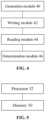
- FIG. 4 is a block diagram of a device for processing a bit sequence according to this embodiment.
- the device may include a generation module 40, a writing module 42, a reading module 44 and a determination module 46.
- the generation module 40 is configured to concatenate K information bits and (N-K) frozen bits to generate a bit sequence of N bits and encode the bit sequence of N bits by means of a Polar code encoder with a generator matrix of size N ⁇ N to generate an initial bit sequence ⁇ S 0 , S 1 ,..., S N -1 ⁇ of N bits, where K and N are both positive integers and K is less than or equal to N.
- the reading module 44 is configured to sequentially selected a bit sequence of a specified length from a predefined starting position in a bit sequence in the circular buffer.
- the determination module 46 is configured to take the bit sequence of the specified length as a bit sequence to be transmitted.
- the generation module 40 may concatenate K bit channels as information bits with the (N-K) frozen bits to generate the bit sequence of N bits and encode the bit sequence of N bits by means of the Polar code encoder with the generator matrix of size N ⁇ N to generate the initial bit sequence of N bits; the writing module 41 divides the circular buffer into the q parts, select the bits from the initial bit sequence in the non-repeated manner, and write the bits into the q parts of the circular buffer according to the predefined rule; the reading module 44 sequentially selecteds the bit sequence of the specified length from the predefined starting position in the bit sequence in the circular buffer; and the determination module 46 takes the bit sequence of the specified length as the bit sequence to be transmitted.
- the writing module is configured to map a bit Sn with a bit position index n in the initial bit sequence onto a position with a position index f(n) in the circular buffer according to the one-to-one mapping interleaving function f(n).
- mapping ⁇ n ⁇ f(n) ⁇ is a one-to-one mapping
- an inverse function p(n) of f(n) which satisfies a mapping ⁇ p(n) ⁇ n ⁇
- the step of selecting the bits from the initial bit sequence ⁇ S 0 , S 1 ,..., S N -1 ⁇ in the non-repeated manner and the non-repeated manner and writing the bits into the q parts of the circular buffer according to the predefined rule includes: mapping a bit S p(n) with a bit position index p(n) in the initial bit sequence onto a position with a position index n in the circular buffer according to the one-to-one mapping interleaving function p(n).
- the predefined starting position is selected in one of the following manners: A starting bit position of the bit sequence in the circular buffer is taken as the predefined starting position.
- the predefined starting position is selected according to a code rate of the Polar encoding.
- the predefined starting position is selected according to the code rate of the Polar encoding, when the code rate of the Polar encoding is greater than the predefined threshold, the predefined starting position is selected in one of the following manners:
- the starting bit position of the bit sequence in the circular buffer is taken as the predefined starting position.
- the circular buffer is composed of a sixth part, a seventh part, an eighth part and a ninth part arranged sequentially, a starting bit position of the seventh part of the bit sequence in the circular buffer is taken as the predefined starting position.
- an ending bit position of the eighth part of the bit sequence in the circular buffer is taken as the predefined starting position.
- a starting bit position of the eighth part of the bit sequence in the circular buffer is taken as the predefined starting position.
- a starting bit position of the ninth part of the bit sequence in the circular buffer is taken as the predefined starting position.
- an ending bit position of the sixth part of the bit sequence in the circular buffer is taken as the predefined starting position.
- the starting bit position of the ninth part of the bit sequence in the circular buffer is taken as the predefined starting position.
- an ending bit position of the seventh part of the bit sequence in the circular buffer is taken as the predefined starting position.
- the ending bit position of the sixth part of the bit sequence in the circular buffer is taken as the predefined starting position.
- the predefined starting position may be selected in the following manner: When the code rate of the Polar encoding is greater than the predefined threshold, the starting bit position of the bit sequence in the circular buffer is taken as the predefined starting position.
- the circular buffer includes a first part and a second part.
- the first part and the second part are sequentially arranged to form the bit sequence in the circular buffer.
- the circular buffer includes a third part, a fourth part and a fifth part.
- the third part is composed of t3 continuous bits in the initial bit sequence in the sequential manner or in the BRO interleaving manner or in a row-column interleaving manner;
- the fourth part is determined in the following manner: two continuous bit sequences of length t4 are selected from the initial bit sequence and arranged in the BRO interleaving manner or in the row-column interleaving manner or in an interlace manner;
- the third part, the fourth part and the fifth part are sequentially arranged to form the bit sequence in the circular buffer.
- the predefined starting position is selected in one of the following manners: The starting bit position of the bit sequence in the circular buffer is taken as the predefined starting position.
- the ending bit position of the bit sequence in the circular buffer is taken as the predefined starting position.
- the circular buffer includes the sixth part, the seventh part, the eighth part and the ninth part.
- the sixth part is composed of t 6 bits in the initial bit sequence in the BRO interleaving manner
- the seventh part is composed of t 7 bits in the initial bit sequence in the sequential manner or in the BRO interleaving manner
- the eighth part is composed of t 8 bits in the initial bit sequence in the BRO interleaving manner
- the sixth part is composed of t 9 bits in the initial bit sequence in the BRO interleaving manner
- the seventh part is composed of t 8 bits in the initial bit sequence in the BRO interleaving manner
- the eighth part is composed of t 7 bits in the initial bit sequence in the sequential manner or in the BRO interleaving manner
- the circular buffer includes the sixth part, the seventh part, the eighth part and the ninth part.
- the sixth part is composed of t 6 bits in the initial bit sequence in the sequential manner or in the BRO interleaving manner
- the seventh part is composed of t 7 bits in the initial bit sequence in the BRO interleaving manner
- the eighth part is composed of t 8 bits in the initial bit sequence in the BRO interleaving manner
- the sixth part is composed of t 9 bits in the initial bit sequence in the BRO interleaving manner
- the seventh part is composed of t 8 bits in the initial bit sequence in the BRO interleaving manner
- the eighth part is composed of t 7 bits in the initial bit sequence in the BRO interleaving manner
- This embodiment provides a rate matching device for a Polar code to illustrate an application body of the device in the embodiments described above.
- the system may implement the method according to the embodiments described above. What has been described will not be repeated in this embodiment.
- FIG. 5 is a block diagram of a device for processing a bit sequence according to this embodiment.
- the device may include a processor 50 and a memory 52.
- the memory 52 is configured to store instructions executable by the processor.
- the processor 50 is configured to perform, according to the instructions sored in the memory, the following operations: K bit channels used as information bits and (N-K) frozen bits are concatenated to generate a bit sequence of N bits, and the bit sequence of N bits is encoded by means of a Polar code encoder with a generator matrix of size N ⁇ N to generate an initial bit sequence ⁇ S 0 , S 1 , ..., S N -1 ⁇ of N bits, where K and N are both positive integers and K is less than or equal to N; a circular buffer is divided into q parts, bits are selected from the initial bit sequence ⁇ S 0 , S 1 , ..., S N -1 ⁇ in a non-repeated manner, and the bits are written into each part of the circular buffer according to a pre
- Polar code is performed on a bit sequence to be transmitted, the bit sequence subject to the Polar code is processed according to a predefined rule to obtain the bit sequence in the circular buffer, and the bit sequence of the specified length is sequentially selected from the predefined starting position and taken as the bit sequence to be transmitted.
- mapping ⁇ n ⁇ f(n) ⁇ is a one-to-one mapping
- an inverse function p(n) of f(n) which satisfies a mapping ⁇ p(n) ⁇ n ⁇
- the operation of selecting the bits from the initial bit sequence ⁇ S 0 , S 1 , ..., S N -1 ⁇ in the non-repeated manner and writing the bits into the q parts of the circular buffer according to the predefined rule includes: mapping a bit S p(n) with a bit position index p(n) in the initial bit sequence onto a position with a position index n in the circular buffer according to the one-to-one mapping interleaving function p(n).
- the predefined starting position is selected in one of the following manners: A starting bit position of the bit sequence in the circular buffer is taken as the predefined starting position.
- An ending bit position of the bit sequence in the circular buffer is taken as the predefined starting position.
- the predefined starting position is selected according to a code rate of the Polar encoding.
- the predefined starting position may be selected in the following manner: When the code rate of the Polar encoding is greater than the predefined threshold, the starting bit position of the bit sequence in the circular buffer is taken as the predefined starting position.
- the circular buffer includes a first part and a second part.
- the first part and the second part are sequentially arranged to form the bit sequence in the circular buffer.
- the circular buffer includes a third part, a fourth part and a fifth part.
- the third part is composed of t3 continuous bits in the initial bit sequence in the sequential manner or in the BRO interleaving manner or in a row-column interleaving manner;
- the fourth part is determined in the following manner: two continuous bit sequences of length t4 are selected from the initial bit sequence and arranged in the BRO interleaving manner or in the row-column interleaving manner or in an interlace manner;
- the third part, the fourth part and the fifth part are sequentially arranged to form the bit sequence in the circular buffer.
- the predefined starting position is selected in one of the following manners: The starting bit position of the bit sequence in the circular buffer is taken as the predefined starting position.
- the ending bit position of the bit sequence in the circular buffer is taken as the predefined starting position.
- the circular buffer includes a sixth part, a seventh part, an eighth part and a ninth part.
- the sixth part is composed of t 6 bits in the initial bit sequence in the BRO interleaving manner
- the seventh part is composed of t 7 bits in the initial bit sequence in the sequential manner or in the BRO interleaving manner
- the eighth part is composed of t 8 bits in the initial bit sequence in the BRO interleaving manner
- the sixth part is composed of t 9 bits in the initial bit sequence in the BRO interleaving manner
- the seventh part is composed of t 8 bits in the initial bit sequence in the BRO interleaving manner
- the eighth part is composed of t 7 bits in the initial bit sequence in the sequential manner or in the BRO interleaving manner
- the circular buffer includes the sixth part, the seventh part, the eighth part and the ninth part.
- the sixth part is composed of t 6 bits in the initial bit sequence in the sequential manner or in the BRO interleaving manner
- the seventh part is composed of t 7 bits in the initial bit sequence in the BRO interleaving manner
- the eighth part is composed of t 8 bits in the initial bit sequence in the BRO interleaving manner
- the sixth part is composed of t 9 bits in the initial bit sequence in the BRO interleaving manner
- the seventh part is composed of t 8 bits in the initial bit sequence in the BRO interleaving manner
- the eighth part is composed of t 7 bits in the initial bit sequence in the BRO interleaving manner
- the operation of selecting the bits from the initial bit sequence ⁇ S 0 , S 1 , ..., S N -1 ⁇ in the non-repeated manner and writing the bits into the q parts of the circular buffer according to the predefined rule includes: mapping a bit S p(n) with a bit position index p(n) in the initial bit sequence onto a position with a position index n in the circular buffer according to the one-to-one mapping interleaving function p(n).
- the predefined starting position is selected in one of the following manners: A starting bit position of the bit sequence in the circular buffer is taken as the predefined starting position.
- An ending bit position of the bit sequence in the circular buffer is taken as the predefined starting position.
- the predefined starting position is selected according to a code rate of the Polar encoding.
- the predefined starting position may be selected in the following manner: When the code rate of the Polar encoding is greater than the predefined threshold, the starting bit position of the bit sequence in the circular buffer is taken as the predefined starting position.
- the circular buffer includes a first part and a second part.
- the first part is composed of t2 continuous bits in the initial bit sequence in the BRO interleaving manner and the second part is composed of the remaining t1 bits in the initial bit sequence in the sequential manner or in the BRO interleaving manner, where t1 and t2 are
- N is the number of bits in the initial bit sequence, and N is an integer greater than or equal to 0.
- the first part and the second part are sequentially arranged to form the bit sequence in the circular buffer.
- the circular buffer includes a third part, a fourth part and a fifth part.
- the third part is composed of t3 continuous bits in the initial bit sequence in the sequential manner or in the BRO interleaving manner or in a row-column interleaving manner;
- the fourth part is determined in the following manner: two continuous bit sequences of length t4 are selected from the initial bit sequence and arranged in the BRO interleaving manner or in the row-column interleaving manner or in an interlace manner;
- the third part, the fourth part and the fifth part are sequentially arranged to form the bit sequence in the circular buffer.
- the predefined starting position is selected in one of the following manners: The starting bit position of the bit sequence in the circular buffer is taken as the predefined starting position.
- the ending bit position of the bit sequence in the circular buffer is taken as the predefined starting position.
- the circular buffer includes a sixth part, a seventh part, an eighth part and a ninth part.
- the sixth part is composed of t 6 bits in the initial bit sequence in the BRO interleaving manner
- the seventh part is composed of t 7 bits in the initial bit sequence in the sequential manner or in the BRO interleaving manner
- the eighth part is composed of t 8 bits in the initial bit sequence in the BRO interleaving manner
- the sixth part is composed of t 9 bits in the initial bit sequence in the BRO interleaving manner
- the seventh part is composed of t 8 bits in the initial bit sequence in the BRO interleaving manner
- the eighth part is composed of t 7 bits in the initial bit sequence in the sequential manner or in the BRO interleaving manner
- the circular buffer includes the sixth part, the seventh part, the eighth part and the ninth part.
- the sixth part is composed of t 6 bits in the initial bit sequence in the sequential manner or in the BRO interleaving manner
- the seventh part is composed of t 7 bits in the initial bit sequence in the BRO interleaving manner
- the eighth part is composed of t 8 bits in the initial bit sequence in the BRO interleaving manner
- the sixth part is composed of t 9 bits in the initial bit sequence in the BRO interleaving manner
- the seventh part is composed of t 8 bits in the initial bit sequence in the BRO interleaving manner
- the eighth part is composed of t 7 bits in the initial bit sequence in the BRO interleaving manner
- Step 1 and step 2 are the same as those in the example 1.
- Step 1 and step 2 are the same as those in the example 1.
- Step 1 and step 2 are the same as those in the example 1.
- Step 1 is the same as that in the example 1. 2.
- the bit sequence in the circular buffer obtained in the example 1 is reversely arranged to obtain ⁇ S 7 ,S 3 ,S 5 ,S 1 ,S 6 ,S 2 ,S 4 ,S 0 ⁇ .
- Step 3 and step 4 are the same as those in the example 1.
- Step 1 and step 2 are the same as those in the example 5.
- Step 3 and step 4 are the same as those in the example 2.
- Step 1 and step 2 are the same as those in the example 5.
- Step 3 and step 4 are the same as those in the example 3.
- Step 1 and step 2 are the same as those in the example 5.
- Step 3 and step 4 are the same as those in the example 4.
- Step 1 and step 2 are the same as those in the example 9.
- Step 1 and step 2 are the same as those in the example 9.
- Step 1 and step 2 are the same as those in the example 9.
- Step 1 is the same as that in the example 9. 2.
- the bit sequence in the circular buffer obtained in the example 9 is reversely arranged to obtain ⁇ S 3 , S 1 , S 2 , S 0 ⁇ .
- Step 3 and step 4 are the same as those in the example 9.
- Step 1 and step 2 are the same as those in the example 13.
- Step 3 and step 4 are the same as those in the example 10.
- Step 1 and step 2 are the same as those in the example 13.
- Step 3 and step 4 are the same as those in the example 11.
- Step 1 and step 2 are the same as those in the example 13.
- Step 3 and step 4 are the same as those in the example 12.
- the rate matching method for the circular buffer of the Polar code includes the steps described below.
- the rate matching method for the circular buffer of the Polar code includes the steps described below.
- Step 1 and step 2 are the same as those in the example 117.
- the rate matching method for the circular buffer of the Polar code includes the steps described below.
- the rate matching method for the circular buffer of the Polar code includes the steps described below.
- Step 1 and step 2 are the same as those in the example 17.
- the rate matching method for the circular buffer of the Polar code includes the steps described below.
- the rate matching method for the circular buffer of the Polar code includes the steps described below.
- Step 1 and step 2 are the same as those in the example 21.
- the rate matching method for the circular buffer of the Polar code includes the steps described below.
- the rate matching method for the circular buffer of the Polar code includes the steps described below.
- Step 1 and step 2 are the same as those in the example 23.
- the bit sequence in the circular buffer is ⁇ S 5 , S 3 , S 0 , S 1 , S 2 , S 4 , S 16 , S 8 , S 24 , S 20 , S 12 , S 28 , S 18 , S 10 , S 26 , S 6 , S 22 , S 14 , S 30 , S 17 , S 9 , S 25 , S 21 , S 13 , S 29 , S 19 , S 11 , S 27 , S 7 , S 23 , S 15 , S 31 ⁇ .
- Step 1 and step 2 are the same as those in the example 25.
- the step 1 is the same as that in the example 25.
- Step 1 and step 2 are the same as those in the example 27.
- Step 1 is the same as that in the example 25.
- Step 1 and step 2 are the same as those in the example 29.
- Step 1 is the same as that in the example 29.
- Step 1 and step 2 are the same as those in the example 31.
- Step 1 and step 2 are the same as those in the example 33.
- Step 1 and step 2 are the same as those in the example 33.
- Step 1 and step 2 are the same as those in the example 33.
- Step 1 is the same as that in the example 33. 2.
- the bit sequence in the circular buffer obtained in the example 33 is reversely arranged to obtain ⁇ S 7 ,S 3 ,S 5 ,S 1 ,S 6 ,S 2 ,S 4 ,S 0 ⁇ .
- Step 3 and step 4 are the same as those in the example 33.
- Step 1 and step 2 are the same as those in the example 37.
- Step 3 and step 4 are the same as those in the example 34.
- Step 1 and step 2 are the same as those in the example 37.
- Step 3 and step 4 are the same as those in the example 35.
- Step 1 and step 2 are the same as those in the example 37.
- Step 3 and step 4 are the same as those in the example 36.
- the storage medium may be configured to store program codes for executing the method for processing the bit sequence according to the embodiment described above.
- the storage medium may be located in any one of a group of computer terminals in a computer network, or located in any one of a group of mobile terminals.
- the storage medium is configured to store program codes for executing the steps described below.
- bit channels used as information bits and (N-K) frozen bits are concatenated to generate a bit sequence of N bits, and the bit sequence of N bits is encoded by means of a Polar code encoder with a generator matrix of size N ⁇ N to generate an initial bit sequence ⁇ S 0 , S 1 ,..., S N -1 ⁇ of N bits, where K and N are both positive integers and K is less than or equal to N.
- a bit sequence of a specified length is sequentially selected from a predefined starting position in a bit sequence in the circular buffer and the bit sequence of the specified length is taken as a bit sequence to be transmitted.
- a unit classification is merely a logical function classification, and, in practice, the unit classification may be implemented in other ways. For example, multiple units or components may be combined or may be integrated into another system, or some features may be omitted or not executed. Additionally, the presented or discussed mutual coupling, direct coupling or communication connections may be indirect coupling or communication connections via interfaces, units or modules, or may be electrical or in other forms.
- the units described above as separate components may or may not be physically separated.
- Components presented as units may or may not be physical units, i.e., may be located in one place or may be distributed on multiple network units. Part or all of these units may be selected according to actual requirements to achieve objects of the solutions in the embodiments of the present disclosure.
- multiple functional units in each embodiment may be integrated into one processing unit, or each unit may be physically present, or two or more units may be integrated into one unit.
- the integrated unit may be implemented by hardware or a software functional unit.
- the integrated unit may be stored in a computer-readable storage medium if implemented in the form of a software functional unit and sold or used as an independent product.
- the content provided by the present disclosure substantially or the part contributing to the existing art or all or part of the technical solutions may be embodied in the form of a software product.
- the software product is stored in a storage medium and includes several instructions for enabling a computer device (which may be a personal computer, a server, a network device or the like) to execute all or part of the steps in the method according to the embodiments described above.
- the foregoing storage medium includes: a U disk, a read-only memory (ROM), a random access memory (RAM), a mobile hard disk, a magnetic disk, an optical disk or another medium capable of storing program codes.
- the rate matching method and device for the Polar code provided by the present disclosure can solve the problems that Polar code hardware has high complexity and has a complicated encoding process in a hybrid automatic repeat request mechanism, significantly reducing the complexity of Polar code hardware and simplifying the encoding process.
Landscapes
- Engineering & Computer Science (AREA)
- Physics & Mathematics (AREA)
- Probability & Statistics with Applications (AREA)
- Theoretical Computer Science (AREA)
- Computer Networks & Wireless Communication (AREA)
- Signal Processing (AREA)
- Error Detection And Correction (AREA)
- Compression, Expansion, Code Conversion, And Decoders (AREA)
- Detection And Prevention Of Errors In Transmission (AREA)
- Optical Communication System (AREA)
Applications Claiming Priority (4)
| Application Number | Priority Date | Filing Date | Title |
|---|---|---|---|
| CN201710014289 | 2017-01-09 | ||
| CN201710056532.0A CN108288966B (zh) | 2017-01-09 | 2017-01-25 | 极性Polar码的速率匹配处理方法及装置 |
| PCT/CN2018/071956 WO2018127206A1 (fr) | 2017-01-09 | 2018-01-09 | Procédé et appareil de traitement de mise en correspondance de débits de codes polaires |
| EP18736435.1A EP3567734B1 (fr) | 2017-01-09 | 2018-01-09 | Procédé et appareil de traitement de mise en correspondance de débits de codes polaires |
Related Parent Applications (2)
| Application Number | Title | Priority Date | Filing Date |
|---|---|---|---|
| EP18736435.1A Division EP3567734B1 (fr) | 2017-01-09 | 2018-01-09 | Procédé et appareil de traitement de mise en correspondance de débits de codes polaires |
| EP18736435.1A Division-Into EP3567734B1 (fr) | 2017-01-09 | 2018-01-09 | Procédé et appareil de traitement de mise en correspondance de débits de codes polaires |
Publications (2)
| Publication Number | Publication Date |
|---|---|
| EP4465539A2 true EP4465539A2 (fr) | 2024-11-20 |
| EP4465539A3 EP4465539A3 (fr) | 2025-02-19 |
Family
ID=62831294
Family Applications (2)
| Application Number | Title | Priority Date | Filing Date |
|---|---|---|---|
| EP18736435.1A Active EP3567734B1 (fr) | 2017-01-09 | 2018-01-09 | Procédé et appareil de traitement de mise en correspondance de débits de codes polaires |
| EP24185277.1A Pending EP4465539A3 (fr) | 2017-01-09 | 2018-01-09 | Procédé et appareil de traitement d'adaptation de débit de codes polaires |
Family Applications Before (1)
| Application Number | Title | Priority Date | Filing Date |
|---|---|---|---|
| EP18736435.1A Active EP3567734B1 (fr) | 2017-01-09 | 2018-01-09 | Procédé et appareil de traitement de mise en correspondance de débits de codes polaires |
Country Status (5)
| Country | Link |
|---|---|
| US (3) | US11342945B2 (fr) |
| EP (2) | EP3567734B1 (fr) |
| JP (2) | JP6882490B2 (fr) |
| KR (2) | KR102244117B1 (fr) |
| CN (2) | CN108288966B (fr) |
Families Citing this family (10)
| Publication number | Priority date | Publication date | Assignee | Title |
|---|---|---|---|---|
| CN117500062A (zh) | 2016-08-12 | 2024-02-02 | 中兴通讯股份有限公司 | 一种无线通信方法、终端以及非暂时性计算机可读存储介质 |
| CN108288966B (zh) | 2017-01-09 | 2022-11-18 | 中兴通讯股份有限公司 | 极性Polar码的速率匹配处理方法及装置 |
| WO2018176495A1 (fr) * | 2017-04-01 | 2018-10-04 | Huawei Technologies Co., Ltd. | Procédé et appareil de transmission de code polaire |
| KR102896730B1 (ko) * | 2020-06-26 | 2025-12-05 | 삼성전자주식회사 | 통신 시스템에서 극 부호의 부호화 또는 복호화를 위한 장치 및 방법 |
| CN114513212A (zh) * | 2020-11-16 | 2022-05-17 | 华为技术有限公司 | 一种极化编码方法和装置 |
| CN116830802A (zh) * | 2021-02-19 | 2023-09-29 | 松下知识产权经营株式会社 | Rf能量辐射装置 |
| US12021548B2 (en) | 2022-05-10 | 2024-06-25 | Samsung Display Co., Ltd. | System and method for efficient transition encoding for decimation CDR |
| KR20260012214A (ko) * | 2023-05-16 | 2026-01-26 | 엘지전자 주식회사 | 정보 블록을 전송하는 방법, 통신 기기, 프로세싱 장치, 및 저장 매체, 그리고 정보 블록을 수신하는 방법, 통신 기기, 프로세싱 장치, 및 저장 매체 |
| WO2025018457A1 (fr) * | 2023-07-20 | 2025-01-23 | 엘지전자 주식회사 | Procédé, dispositif de communication, dispositif de traitement et support de stockage permettant de transmettre un bloc d'informations, et procédé, dispositif de communication, dispositif de traitement et support de stockage përmettant de recevoir un bloc d'informations |
| WO2025263649A1 (fr) * | 2024-06-18 | 2025-12-26 | 엘지전자 주식회사 | Procédé, dispositif de communication et dispositif de traitement pour transmettre un bloc d'informations, support de stockage, procédé, dispositif de communication et dispositif de traitement pour recevoir un bloc d'informations, et support de stockage |
Family Cites Families (23)
| Publication number | Priority date | Publication date | Assignee | Title |
|---|---|---|---|---|
| US8726121B2 (en) | 2007-03-27 | 2014-05-13 | Qualcomm Incorporated | Circular buffer based rate matching |
| US20080301536A1 (en) | 2007-05-31 | 2008-12-04 | Interdigital Technology Corporation | Channel coding and rate matching for lte control channels |
| US8416794B2 (en) * | 2007-06-13 | 2013-04-09 | Lg Electronics Inc. | Method for sub-packet generation with adaptive bit index |
| US8780930B2 (en) * | 2008-08-21 | 2014-07-15 | Telefonaktiebolaget L M Ericsson (Publ) | System and method for removing PDCCH detection errors in a telecommunications network |
| CN103312442B (zh) * | 2012-03-15 | 2017-11-17 | 中兴通讯股份有限公司 | 基于有限长度循环缓存速率匹配的数据发送方法及装置 |
| CN103023618B (zh) * | 2013-01-11 | 2015-04-22 | 北京邮电大学 | 一种任意码长的极化编码方法 |
| CN103746708A (zh) * | 2013-10-25 | 2014-04-23 | 中国农业大学 | 一种Polar-LDPC级联码的构造方法 |
| MX355585B (es) * | 2013-11-13 | 2018-04-24 | Lg Electronics Inc | Aparato para transmitir señales de radiodifusion, aparato para recibir señales de radiodifusion, metodo para transmitir señales de radiodifusion y metodo para recibir señales de radiodifusion. |
| RU2688751C2 (ru) * | 2013-12-30 | 2019-05-22 | Хуавей Текнолоджиз Ко., Лтд. | Способ и устройство согласования кодовой скорости полярного кода |
| AU2014383811B2 (en) * | 2014-02-21 | 2017-09-28 | Huawei Technologies Co., Ltd. | Rate matching method and apparatus for polar code |
| CN105874736B (zh) * | 2014-03-19 | 2020-02-14 | 华为技术有限公司 | 极性码的速率匹配方法和速率匹配装置 |
| CA2972643C (fr) * | 2014-03-21 | 2020-05-26 | Huawei Technologies Co., Ltd. | Procede d'adaptation de debit de code polaire et dispositif d'adaptation de debit |
| CA2972655C (fr) | 2014-03-24 | 2020-10-20 | Huawei Technologies Co., Ltd. | Procede de mise en correspondance de debits et appareil de mise en correspondance de debits pour des codes polaires |
| CN104065457B (zh) * | 2014-06-27 | 2017-12-19 | 京信通信系统(中国)有限公司 | 一种合并译码的方法及装置 |
| CN106533611A (zh) * | 2015-09-14 | 2017-03-22 | 中兴通讯股份有限公司 | 一种卷积码的数据发送方法及装置 |
| CN105811998B (zh) * | 2016-03-04 | 2019-01-18 | 深圳大学 | 一种基于密度演进的极化码构造方法及极化码编译码系统 |
| EP3273602B1 (fr) * | 2016-07-19 | 2022-01-26 | MediaTek Inc. | Adaptation de taux de codage à faible complexité pour codes polaires |
| US10389484B2 (en) | 2016-07-29 | 2019-08-20 | Lg Electronics Inc. | Method for performing polar coding and apparatus therefor |
| WO2018125182A1 (fr) | 2016-12-30 | 2018-07-05 | Whirlpool Corporation | Protection hybride économique d'un amplificateur haute puissance |
| CN109889304B (zh) | 2017-01-05 | 2020-06-16 | 华为技术有限公司 | 速率匹配方法、编码装置和通信装置 |
| CN108288966B (zh) * | 2017-01-09 | 2022-11-18 | 中兴通讯股份有限公司 | 极性Polar码的速率匹配处理方法及装置 |
| WO2018126476A1 (fr) | 2017-01-09 | 2018-07-12 | Qualcomm Incorporated | Schéma d'adaptation de débit pour canaux de commande utilisant des codes polaires |
| KR102541319B1 (ko) * | 2018-03-29 | 2023-06-08 | 삼성전자주식회사 | 무선 통신 시스템에서 극 부호를 이용한 부호화 및 복호화를 위한 장치 및 방법 |
-
2017
- 2017-01-25 CN CN201710056532.0A patent/CN108288966B/zh active Active
- 2017-01-25 CN CN202211583734.8A patent/CN116707540B/zh active Active
-
2018
- 2018-01-09 JP JP2019537290A patent/JP6882490B2/ja active Active
- 2018-01-09 EP EP18736435.1A patent/EP3567734B1/fr active Active
- 2018-01-09 KR KR1020197023378A patent/KR102244117B1/ko active Active
- 2018-01-09 KR KR1020217011598A patent/KR102383593B1/ko active Active
- 2018-01-09 EP EP24185277.1A patent/EP4465539A3/fr active Pending
-
2019
- 2019-07-08 US US16/505,688 patent/US11342945B2/en active Active
-
2021
- 2021-05-06 JP JP2021078310A patent/JP7321208B2/ja active Active
-
2022
- 2022-05-23 US US17/664,491 patent/US11955992B2/en active Active
-
2024
- 2024-04-08 US US18/629,536 patent/US12388469B2/en active Active
Also Published As
| Publication number | Publication date |
|---|---|
| JP6882490B2 (ja) | 2021-06-02 |
| EP3567734A1 (fr) | 2019-11-13 |
| CN116707540A (zh) | 2023-09-05 |
| EP3567734A4 (fr) | 2020-09-09 |
| CN116707540B (zh) | 2024-04-26 |
| CN108288966A (zh) | 2018-07-17 |
| US20240259035A1 (en) | 2024-08-01 |
| KR20210046842A (ko) | 2021-04-28 |
| JP2021119706A (ja) | 2021-08-12 |
| EP4465539A3 (fr) | 2025-02-19 |
| CN108288966B (zh) | 2022-11-18 |
| US11342945B2 (en) | 2022-05-24 |
| EP3567734B1 (fr) | 2024-08-07 |
| KR20190111991A (ko) | 2019-10-02 |
| US20220399906A1 (en) | 2022-12-15 |
| JP2020507250A (ja) | 2020-03-05 |
| JP7321208B2 (ja) | 2023-08-04 |
| US11955992B2 (en) | 2024-04-09 |
| US20200083912A1 (en) | 2020-03-12 |
| US12388469B2 (en) | 2025-08-12 |
| KR102244117B1 (ko) | 2021-04-27 |
| KR102383593B1 (ko) | 2022-04-08 |
Similar Documents
| Publication | Publication Date | Title |
|---|---|---|
| EP3567734B1 (fr) | Procédé et appareil de traitement de mise en correspondance de débits de codes polaires | |
| US10608668B2 (en) | Method and device for interleaving data | |
| US11432186B2 (en) | Method and device for transmitting data with rate matching | |
| CN108347302B (zh) | 一种编译码方法和终端 | |
| US20190007165A1 (en) | Polar code encoding method and device | |
| EP3614701B1 (fr) | Procédé et dispositif de transmission de code polaire | |
| US11683052B2 (en) | Data processing method and device | |
| EP3474472B1 (fr) | Procédé, dispositif et appareil de codage | |
| EP3567732A1 (fr) | Procédé et dispositif de traitement de données | |
| CN108574494B (zh) | 编译码方法及装置 | |
| EP3605905A1 (fr) | Procédé et dispositif d'entrelacement | |
| US12218682B2 (en) | Encoding method, decoding method, electronic device and storage medium | |
| US20250070928A1 (en) | Encoding method and apparatus | |
| CN115765761B (zh) | 一种低复杂度的适用于nr标准的ldpc编码方法、介质及装置 | |
| CN101335597A (zh) | 一种译码方法及装置 | |
| CN110912567A (zh) | 极化码的译码方法及设备 |
Legal Events
| Date | Code | Title | Description |
|---|---|---|---|
| PUAI | Public reference made under article 153(3) epc to a published international application that has entered the european phase |
Free format text: ORIGINAL CODE: 0009012 |
|
| STAA | Information on the status of an ep patent application or granted ep patent |
Free format text: STATUS: THE APPLICATION HAS BEEN PUBLISHED |
|
| AC | Divisional application: reference to earlier application |
Ref document number: 3567734 Country of ref document: EP Kind code of ref document: P |
|
| AK | Designated contracting states |
Kind code of ref document: A2 Designated state(s): AL AT BE BG CH CY CZ DE DK EE ES FI FR GB GR HR HU IE IS IT LI LT LU LV MC MK MT NL NO PL PT RO RS SE SI SK SM TR |
|
| REG | Reference to a national code |
Ref country code: DE Ref legal event code: R079 Free format text: PREVIOUS MAIN CLASS: H03M0013000000 Ipc: H03M0013130000 |
|
| PUAL | Search report despatched |
Free format text: ORIGINAL CODE: 0009013 |
|
| AK | Designated contracting states |
Kind code of ref document: A3 Designated state(s): AL AT BE BG CH CY CZ DE DK EE ES FI FR GB GR HR HU IE IS IT LI LT LU LV MC MK MT NL NO PL PT RO RS SE SI SK SM TR |
|
| RIC1 | Information provided on ipc code assigned before grant |
Ipc: H03M 13/00 20060101ALI20250113BHEP Ipc: H04L 1/00 20060101ALI20250113BHEP Ipc: H03M 13/13 20060101AFI20250113BHEP |
|
| STAA | Information on the status of an ep patent application or granted ep patent |
Free format text: STATUS: REQUEST FOR EXAMINATION WAS MADE |
|
| 17P | Request for examination filed |
Effective date: 20250819 |
|
| STAA | Information on the status of an ep patent application or granted ep patent |
Free format text: STATUS: EXAMINATION IS IN PROGRESS |