EP4465595A1 - Déclenchement d'une procédure d'authentification entre un équipement mobile et un réseau central - Google Patents
Déclenchement d'une procédure d'authentification entre un équipement mobile et un réseau central Download PDFInfo
- Publication number
- EP4465595A1 EP4465595A1 EP24174737.7A EP24174737A EP4465595A1 EP 4465595 A1 EP4465595 A1 EP 4465595A1 EP 24174737 A EP24174737 A EP 24174737A EP 4465595 A1 EP4465595 A1 EP 4465595A1
- Authority
- EP
- European Patent Office
- Prior art keywords
- mobile equipment
- counter
- core network
- identifier
- determining
- Prior art date
- Legal status (The legal status is an assumption and is not a legal conclusion. Google has not performed a legal analysis and makes no representation as to the accuracy of the status listed.)
- Pending
Links
Images




Classifications
-
- H—ELECTRICITY
- H04—ELECTRIC COMMUNICATION TECHNIQUE
- H04W—WIRELESS COMMUNICATION NETWORKS
- H04W12/00—Security arrangements; Authentication; Protecting privacy or anonymity
- H04W12/06—Authentication
-
- H—ELECTRICITY
- H04—ELECTRIC COMMUNICATION TECHNIQUE
- H04L—TRANSMISSION OF DIGITAL INFORMATION, e.g. TELEGRAPHIC COMMUNICATION
- H04L63/00—Network architectures or network communication protocols for network security
- H04L63/08—Network architectures or network communication protocols for network security for authentication of entities
- H04L63/0853—Network architectures or network communication protocols for network security for authentication of entities using an additional device, e.g. smartcard, SIM or a different communication terminal
-
- H—ELECTRICITY
- H04—ELECTRIC COMMUNICATION TECHNIQUE
- H04W—WIRELESS COMMUNICATION NETWORKS
- H04W12/00—Security arrangements; Authentication; Protecting privacy or anonymity
- H04W12/60—Context-dependent security
- H04W12/69—Identity-dependent
- H04W12/72—Subscriber identity
Definitions
- the present application relates to a method, apparatus, system and computer program and in particular but not exclusively to SoR and UPU counter storage in USIM and ME.
- a communication system can be seen as a facility that enables communication sessions between two or more entities such as user terminals, base stations and/or other nodes by providing carriers between the various entities involved in the communications path.
- a communication system can be provided for example by means of a communication network and one or more compatible communication devices.
- the communication sessions may comprise, for example, communication of data for carrying communications such as voice, video, electronic mail (email), text message, multimedia and/or content data and so on.
- Non-limiting examples of services provided comprise two-way or multi-way calls, data communication or multimedia services and access to a data network system, such as the Internet.
- wireless communication system at least a part of a communication session between at least two stations occurs over a wireless link.
- wireless systems comprise public land mobile networks (PLMN), satellite based communication systems and different wireless local networks, for example wireless local area networks (WLAN).
- PLMN public land mobile networks
- WLAN wireless local area networks
- Some wireless systems can be divided into cells, and are therefore often referred to as cellular systems.
- a user can access the communication system by means of an appropriate communication device or terminal.
- a communication device of a user may be referred to as user equipment (UE) or user device.
- UE user equipment
- a communication device is provided with an appropriate signal receiving and transmitting apparatus for enabling communications, for example enabling access to a communication network or communications directly with other users.
- the communication device may access a carrier provided by a station, for example a base station of a cell, and transmit and/or receive communications on the carrier.
- the communication system and associated devices typically operate in accordance with a given standard or specification which sets out what the various entities associated with the system are permitted to do and how that should be achieved. Communication protocols and/or parameters which shall be used for the connection are also typically defined.
- UMTS Universal Mobile Telecommunications System
- UTRAN Universal Mobile Telecommunications System
- Other examples of communication systems are the long-term evolution (LTE) of the Universal Mobile Telecommunications System (UMTS) radio-access technology and so-called 5G or New Radio (NR) networks.
- LTE Long-term evolution
- NR New Radio
- NR is being standardized by the 3rd Generation Partnership Project (3GPP).
- 3GPP 3rd Generation Partnership Project
- Other examples of communication systems include 5G-Advanced (NR Rel-18 and beyond) and 6G.
- an apparatus comprising means for determining, on insertion of a universal subscriber identity module, USIM, in a mobile equipment, that at least one counter stored at the mobile equipment is invalid and means for, based on the determining, providing an indication to a core network to cause an authentication procedure between the mobile equipment and the core network.
- USIM universal subscriber identity module
- the USIM may comprise a first identifier stored thereon.
- the apparatus may comprise means for determining that the at least one counter is invalid based on the first identifier.
- Means for determining that the at least one counter is invalid may comprise means for comparing the first identifier with a second identifier of the mobile equipment.
- the message may comprise a mobility management message.
- the received value may comprise a first message authentication code value.
- the generated value may comprise a second message authentication code value.
- the data packet may comprise a steering of roaming packet or a user equipment parameter update packet and the apparatus may comprise means for receiving an indication from the core network to provide an acknowledgement for steering of roaming or user equipment parameter update packets having a message authentication code value which matches the message authentication code value generated at the mobile equipment.
- an apparatus comprising means for, at an entity of a core network, determining an indication from a mobile equipment to cause an authentication procedure between the mobile equipment and the core network and means for, based on the determining, causing the authentication procedure between the mobile equipment and the core network.
- the indication to the core network may comprise an indication of an error condition associated with the data packet.
- the indication to the core network may comprise an indication of an error condition associated with the data packet being not verifiable at the core network.
- the entity may be a network function node for managing access to the core network or a network function node for unified data management.
- the data packet may comprise a steering of roaming packet or a user equipment parameter update packet.
- the apparatus may comprise means for providing an indication from the core network to the mobile equipment to provide an acknowledgement for steering of roaming or user equipment parameter update packets having a message authentication code value which matches a message authentication code value generated at the mobile equipment and wherein determining an indication from a mobile equipment to cause a reauthentication procedure between the mobile equipment and the core network comprises means for determining that no acknowledgement of the data packet has been received after a given time period.
- the entity may be a network function node for unified data management.
- the indication may comprise a mobility management message.
- the mobility management message may be a registration request message including a subscription concealed identifier, SUCI or includes an indication of a PE! change.
- a method comprising determining, on insertion of a universal subscriber identity module, USIM, in a mobile equipment, that at least one counter stored at the mobile equipment is invalid and, based on the determining, providing an indication to a core network to cause an authentication procedure between the mobile equipment and the core network.
- USIM universal subscriber identity module
- the USIM may comprise a first identifier stored thereon.
- the method may comprise determining that the at least one counter is invalid based on the first identifier.
- Determining that the at least one counter is invalid may comprise comparing the first identifier with a second identifier of the mobile equipment.
- the first identifier may comprise a first permanent equipment identifier, PEI.
- the second identifier may comprise a second PEI.
- a command to the mobile equipment from the USIM may trigger the mobile equipment to provide a message to the core network causing the authentication procedure.
- the message may comprise a mobility management message.
- the mobility management message may be a registration request message including a subscription concealed identifier, SUCI.
- the mobility management message may include an indication of a PE! change.
- the method may comprise receiving a data packet comprising a value and determining that the at least one counter is invalid based on the received value.
- Determining that the at least one counter is invalid may comprise comparing the received value with a value generated at the mobile equipment.
- the received value may comprise a first message authentication code value.
- the generated value may comprise a second message authentication code value.
- the indication to the core network may comprise an indication of an error condition associated with the data packet.
- the data packet may comprise a steering of roaming packet or a user equipment parameter update packet.
- the method may comprise receiving an indication from the core network to provide an acknowledgement for steering of roaming or user equipment parameter update packets having a message authentication code value which matches the message authentication code value generated at the mobile equipment.
- a key may be derived in the mobile equipment during the authentication procedure and the mobile equipment may reset the at least one counter to zero upon deriving the key.
- the at least one counter may be stored in a non-volatile memory of the mobile equipment.
- the at least one counter comprises at least one of the following: a user equipment parameter update, UPU, counter and a steering of roaming, SOR, counter.
- a method comprising, at an entity of a core network, determining an indication from a mobile equipment to cause an authentication procedure between the mobile equipment and the core network and, based on the determining, causing the authentication procedure between the mobile equipment and the core network.
- the indication to the core network may comprise an indication of an error condition associated with the data packet.
- the indication to the core network may comprise an indication of an error condition associated with the data packet being not verifiable at the core network.
- the data packet may comprise a steering of roaming packet or a user equipment parameter update packet.
- the method may comprise providing an indication from the core network to the mobile equipment to provide an acknowledgement for steering of roaming or user equipment parameter update packets having a message authentication code value which matches a message authentication code value generated at the mobile equipment and wherein determining an indication from a mobile equipment to cause a reauthentication procedure between the mobile equipment and the core network comprises determining that no acknowledgement of the data packet has been received after a given time period.
- the mobility management message may be a registration request message including a subscription concealed identifier, SUCI or includes an indication of a PE! change.
- the apparatus may be caused to perform receiving a data packet comprising a value and determining that the at least one counter is invalid based on the received value.
- the apparatus may be caused to perform comparing the received value with a value generated at the mobile equipment.
- the received value may comprise a first message authentication code value.
- the generated value may comprise a second message authentication code value.
- the indication to the core network may comprise an indication of an error condition associated with the data packet.
- the data packet may comprise a steering of roaming packet or a user equipment parameter update packet and the apparatus may be caused to perform receiving an indication from the core network to provide an acknowledgement for steering of roaming or user equipment parameter update packets having a message authentication code value which matches the message authentication code value generated at the mobile equipment.
- the at least one counter may be stored in a non-volatile memory of the mobile equipment.
- the at least one counter comprises at least one of the following: a user equipment parameter update, UPU, counter and a steering of roaming, SOR, counter.
- the indication to the core network may comprise an indication of an error condition associated with the data packet.
- the indication to the core network may comprise an indication of an error condition associated with the data packet being not verifiable at the core network.
- the entity may be a network function node for managing access to the core network or a network function node for unified data management.
- the data packet may comprises a steering of roaming packet or a user equipment parameter update packet.
- the apparatus may be caused to perform providing an indication from the core network to the mobile equipment to provide an acknowledgement for steering of roaming or user equipment parameter update packets having a message authentication code value which matches a message authentication code value generated at the mobile equipment and wherein determining an indication from a mobile equipment to cause a reauthentication procedure between the mobile equipment and the core network comprises determining that no acknowledgement of the data packet has been received after a given time period.
- the mobility management message may be a registration request message including a subscription concealed identifier, SUCI or includes an indication of a PE! change.
- an apparatus comprising at least one processor and at least one memory storing instructions that, when executed by the at least one processor, cause the apparatus at least to: determine, on insertion of a universal subscriber identity module, USIM, in a mobile equipment, that at least one counter stored at the mobile equipment is invalid and based on the determining, provide an indication to a core network to cause an authentication procedure between the mobile equipment and the core network.
- USIM universal subscriber identity module
- the USIM may comprise a first identifier stored thereon.
- the apparatus may be caused to determine that the at least one counter is invalid based on the first identifier.
- the first identifier may comprise a first permanent equipment identifier, PEI.
- the second identifier may comprise a second PEI.
- a command to the mobile equipment from the USIM may trigger the mobile equipment to provide a message to the core network causing the authentication procedure.
- the message may comprise a mobility management message.
- the mobility management message may be a registration request message including a subscription concealed identifier, SUCI.
- the mobility management message may include an indication of a PE! change.
- the apparatus may be caused to receive a data packet comprising a value and determining that the at least one counter is invalid based on the received value.
- the apparatus may be caused to compare the received value with a value generated at the mobile equipment.
- the received value may comprise a first message authentication code value.
- the generated value may comprise a second message authentication code value.
- the indication to the core network may comprise an indication of an error condition associated with the data packet.
- the data packet may comprise a steering of roaming packet or a user equipment parameter update packet and the apparatus may be caused to perform receiving an indication from the core network to provide an acknowledgement for steering of roaming or user equipment parameter update packets having a message authentication code value which matches the message authentication code value generated at the mobile equipment.
- a key may be derived in the mobile equipment during the authentication procedure and the mobile equipment may reset the at least one counter to zero upon deriving the key.
- the at least one counter may be stored in a non-volatile memory of the mobile equipment.
- the at least one counter comprises at least one of the following: a user equipment parameter update, UPU, counter and a steering of roaming, SOR, counter.
- an apparatus comprising at least one processor and at least one memory storing instructions that, when executed by the at least one processor, cause the apparatus at least to: at an entity of a core network, determine an indication from a mobile equipment to cause an authentication procedure between the mobile equipment and the core network and based on the determining, cause the authentication procedure between the mobile equipment and the core network.
- the indication to the core network may comprise an indication of an error condition associated with the data packet.
- the indication to the core network may comprise an indication of an error condition associated with the data packet being not verifiable at the core network.
- the entity may be a network function node for managing access to the core network or a network function node for unified data management.
- the data packet may comprises a steering of roaming packet or a user equipment parameter update packet.
- the apparatus may be caused to provide an indication from the core network to the mobile equipment to provide an acknowledgement for steering of roaming or user equipment parameter update packets having a message authentication code value which matches a message authentication code value generated at the mobile equipment and wherein determining an indication from a mobile equipment to cause a reauthentication procedure between the mobile equipment and the core network comprises determining that no acknowledgement of the data packet has been received after a given time period.
- the entity may be a network function node for unified data management.
- the indication may comprise a mobility management message.
- the mobility management message may be a registration request message including a subscription concealed identifier, SUCI or includes an indication of a PE! change.
- a ninth aspect there is provided a non-transitory computer readable medium comprising program instructions for causing an apparatus to perform at least the method according to the third or fourth aspect.
- MIMO Multiple Input - Multiple Output
- step 3 the USIM is removed from ME#1 and inserted into ME#2.
- a key (e.g., new K AUSF ) may derived in the mobile equipment (and the core network) during the authentication procedure and the mobile equipment may reset the at least one counter to zero upon deriving the key.
- the USIM may comprise a first identifier stored thereon and the method may comprise determining that the at least one counter is invalid based on the first identifier.
- the first identifier may be a first PEI.
- the first identifier may be referred to below as PEI#2.
- Determining that the counter is invalid may comprise comparing the first identifier with a second identifier of the mobile equipment.
- the second identifier may be a second PEI.
- the second identifier may be stored in the NVM of the UE.
- the second identifier may be referred to as PEI#1 in example below.
- a command to the mobile equipment from the USIM may trigger the mobile equipment to provide a message to the core network causing the authentication procedure.
- the message may comprise a mobility management message.
- the mobility management message may be a registration request message including a subscription concealed identifier, SUCI or include an indication of a PE! change.
- a stored PEI#2 from USIM and PEI#1 from ME#1 is verified along with SUPI. This is an example of determining that the counter stored at the user equipment is invalid based on the first identifier and of comparing the first identifier with a second identifier of the mobile equipment.
- the USIM triggers a REFRESH command to ME.
- This triggers a registration request with SUCI.
- the registration request is with SUCI, it reaches UDM and triggers authentication for USIM in ME#1.
- This is an example of a command to the mobile equipment from the USIM triggering the mobile equipment to provide a message to the core network causing the authentication procedure, wherein the message is a MM message comprising a SUCI..
- the USIM informs the PE! failure results to ME.
- the ME triggers a 5GMM status message with new 5GMM cause as PEI change. This is an example of a command to the mobile equipment from the USIM triggering the mobile equipment to provide a message to the core network causing the authentication procedure, wherein the message is a MM message and includes an indication of a PE! change..
- AMF may use the UDM service to trigger re-authentication.
- the method may comprise receiving a data packet comprising a value and means for determining that the at least one counter is invalid based on the received value.
- the received value may be a first message authentication code (MAC) value.
- Determining that the at least one counter is invalid may comprise comparing the received value with a value generated at the mobile equipment.
- the generated value may be a second MAC value.
- the data packet me a SOR or UPU packet.
- a UE when a UE receives a SoR packet, the UE generates message authentication code SoR-MAC-I AUSF and it is mismatched with the received MAC value due to counter mismatch.
- the UE sends an error message indication to AMF. Based on this error message, AMF performs the reauthentication.
- the UE may send an error message indication to AMF and AMF sends the ACK to UDM. Based on this error message, UDM starts reauthentication, e.g., UDM will ask AMF to starts the reauthentication.
- the indication to the core network comprises an indication of an error condition associated with the data packet.
- the indication to the core network may comprises an indication of an error condition associated with the data packet being not verifiable at the core network.
- the UE may generate an ACK with an error indication.
- the UE may includes the generated SoR-MAC-I UE in a SOR transparent container in the Registration Complete message. If UDM receives an ACK with error indication or received SoR-MAC-I UE is not matching with the expected SoR-XMAC-I UE (this is an example of an indication of an error condition associated with the data packet not being not verifiable at the core network), UDM may initiate the authentication procedure
- UE may ignore the SoR packet. If UDM does not receives an acknowledgement within a configured time, UDM starts reauthentication, e.g., UDM will ask AMF to starts the reauthentication. For this, UDM may retry sending SoR packet again before starting the reauthentication. This is an example of determining that no acknowledgement of the data packet has been received after a given time period.
- the data packet may be a SOR packet or a UPU packet and the method may comprise providing an indication from the core network to the mobile equipment to provide an acknowledgement for steering of roaming or user equipment parameter update packets having a message authentication code value which matches a message authentication code value generated at the mobile equipment. For example, a UDM forces Ack for all SoR/UPU message, and when ACK is not received, UDM starts reauthentication on its own.
- Figure 10 shows a signaling diagram according to an example embodiment.
- step 5a PEI#2 is stored in the USIM.
- step 6 SUPI in USIM and ME#1 are the same but the stored PEI#2 and PEI#1 from ME#1 mismatches. SUPI check will pass as it is same, but the PE! check will fail.
- step 7 the USIM sends a REFRESH command to ME.
- This triggers a registration request with SUCI.
- registration request is with SUCI, it reach UDM and it triggers fresh authentication for USIM in ME#1.
- a new K AUSF is derived by ME#1 and AUSF. Since K AUSF is changed, the counters in ME#1 are deleted. This is an example of the mobile equipment resetting the at least one counter to zero upon deriving the key.
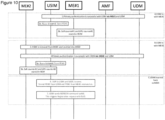
- Figure 11 shows a signaling diagram according to an example embodiment.
- Steps 1 to 6 are as shown in Figure 10 .
- step 7 the USIM informs the PE! failure results to ME.
- the ME triggers 5GMM status message with new 5GMM cause as PEI change.
- step 8 the AMF uses the new UDM service to trigger re-authentication.
- Figure 12 shows a signaling diagram according to an example embodiment.
- Steps 1 to 5 are as shown in Figure 7 .
- the UE When UE receives a SoR packet in step 6, the UE generates SoR-MAC-I AUSF and it is mismatched with the received MAC value due to SoR counter mismatch. The UE sends an error message indication to AMF in step 7 and 8. Based on this error message, AMF performs the reauthentication in step 9.
- Figure 13 shows a signaling diagram according to an example embodiment.
- Steps 1 to 5 are as shown in Figure 7 .
- the UE When UE receives a SoR packet in step 6, the UE generates SoR-MAC-lausf and it is mismatched with the received MAC value due to counter mismatch. The UE sends an error message indication to AMF and AMF sends the ACK to UDM. Based on this error message, UDM starts reauthentication, i.e. UDM will ask AMF to starts the reauthentication.
- Figure 14 shows a signaling diagram according to an example embodiment.
- Steps 1 to 5 are as shown in Figure 7 .
- the UE When UE receives a SoR packet in step 6, the UE generates SoR-MAC-I AUSF and it is mismatched with the received MAC value due to counter mismatch. The UE ignores the SoR packet. If UDM does not receives an ack within a configured time (e.g. the given time), UDM starts reauthentication.e.g., UDM will ask AMF to starts the reauthentication. For this, UDM may retry sending SoR packet again before starting the reauthentication.
- a configured time e.g. the given time
- An apparatus may comprise means for determining, on insertion of a universal subscriber identity module, USIM, in a mobile equipment, that at least one counter stored at the mobile equipment is invalid and means for, based on the determining, providing an indication to a core network to cause an authentication procedure between the mobile equipment and the core network.
- USIM universal subscriber identity module
- the apparatus may comprise a user equipment, such as a mobile phone, be the user equipment or be comprised in the user equipment or a chipset for performing at least some actions of/for the user equipment.
- a user equipment such as a mobile phone
- an apparatus may comprise means for, at an entity of a core network, determining an indication from a mobile equipment to cause an authentication procedure between the mobile equipment and the core network; and means for, based on the determining, causing the authentication procedure between the mobile equipment and the core network.
- the apparatus may comprise a control apparatus, be the control apparatus or be comprised in the control apparatus or a chipset for performing at least some actions of/for the control apparatus.
- apparatuses may comprise or be coupled to other units or modules etc., such as radio parts or radio heads, used in or for transmission and/or reception.
- apparatuses have been described as one entity, different modules and memory may be implemented in one or more physical or logical entities.
- the various embodiments may be implemented in hardware or special purpose circuitry, software, logic or any combination thereof. Some aspects of the disclosure may be implemented in hardware, while other aspects may be implemented in firmware or software which may be executed by a controller, microprocessor or other computing device, although the disclosure is not limited thereto. While various aspects of the disclosure may be illustrated and described as block diagrams, flow charts, or using some other pictorial representation, it is well understood that these blocks, apparatus, systems, techniques or methods described herein may be implemented in, as non-limiting examples, hardware, software, firmware, special purpose circuits or logic, general purpose hardware or controller or other computing devices, or some combination thereof.
- circuitry may refer to one or more or all of the following:
- circuitry also covers an implementation of merely a hardware circuit or processor (or multiple processors) or portion of a hardware circuit or processor and its (or their) accompanying software and/or firmware.
- circuitry also covers, for example and if applicable to the particular claim element, a baseband integrated circuit or processor integrated circuit for a mobile device or a similar integrated circuit in server, a cellular network device, or other computing or network device.
- the embodiments of this disclosure may be implemented by computer software executable by a data processor of the mobile device, such as in the processor entity, or by hardware, or by a combination of software and hardware.
- Computer software or program also called program product, including software routines, applets and/or macros, may be stored in any apparatus-readable data storage medium and they comprise program instructions to perform particular tasks.
- a computer program product may comprise one or more computer-executable components which, when the program is run, are configured to carry out embodiments.
- the one or more computer-executable components may be at least one software code or portions of it.
- any blocks of the logic flow as in the Figures may represent program steps, or interconnected logic circuits, blocks and functions, or a combination of program steps and logic circuits, blocks and functions.
- the software may be stored on such physical media as memory chips, or memory blocks implemented within the processor, magnetic media such as hard disk or floppy disks, and optical media such as for example DVD and the data variants thereof, CD.
- the physical media is a non-transitory media.
- non-transitory is a limitation of the medium itself (i.e., tangible, not a signal) as opposed to a limitation on data storage persistency (e.g., RAM vs. ROM).
- the memory may be of any type suitable to the local technical environment and may be implemented using any suitable data storage technology, such as semiconductor based memory devices, magnetic memory devices and systems, optical memory devices and systems, fixed memory and removable memory.
- the data processors may be of any type suitable to the local technical environment, and may comprise one or more of general purpose computers, special purpose computers, microprocessors, digital signal processors (DSPs), application specific integrated circuits (ASIC), FPGA, gate level circuits and processors based on multi core processor architecture, as non-limiting examples.
Landscapes
- Engineering & Computer Science (AREA)
- Computer Security & Cryptography (AREA)
- Computer Networks & Wireless Communication (AREA)
- Signal Processing (AREA)
- Computer Hardware Design (AREA)
- Computing Systems (AREA)
- General Engineering & Computer Science (AREA)
- Mobile Radio Communication Systems (AREA)
Applications Claiming Priority (1)
| Application Number | Priority Date | Filing Date | Title |
|---|---|---|---|
| IN202341034118 | 2023-05-15 |
Publications (1)
| Publication Number | Publication Date |
|---|---|
| EP4465595A1 true EP4465595A1 (fr) | 2024-11-20 |
Family
ID=91067219
Family Applications (1)
| Application Number | Title | Priority Date | Filing Date |
|---|---|---|---|
| EP24174737.7A Pending EP4465595A1 (fr) | 2023-05-15 | 2024-05-08 | Déclenchement d'une procédure d'authentification entre un équipement mobile et un réseau central |
Country Status (2)
| Country | Link |
|---|---|
| US (1) | US20240388902A1 (fr) |
| EP (1) | EP4465595A1 (fr) |
Families Citing this family (1)
| Publication number | Priority date | Publication date | Assignee | Title |
|---|---|---|---|---|
| EP4654743A3 (fr) * | 2020-09-23 | 2026-01-28 | Telefonaktiebolaget LM Ericsson (publ) | Gestion des enregistrements d'un équipement utilisateur dans différents réseaux de communication |
Citations (1)
| Publication number | Priority date | Publication date | Assignee | Title |
|---|---|---|---|---|
| WO2022215331A1 (fr) * | 2021-04-08 | 2022-10-13 | Nec Corporation | Procédé d'équipement utilisateur (ue), procédé d'accès et fonction de gestion de mobilité (amf), procédé de gestion unifiée de données (udm), ue, amf et udm |
Family Cites Families (1)
| Publication number | Priority date | Publication date | Assignee | Title |
|---|---|---|---|---|
| CN116325842A (zh) * | 2020-10-16 | 2023-06-23 | 日本电气株式会社 | Ue的方法和ue |
-
2024
- 2024-05-08 EP EP24174737.7A patent/EP4465595A1/fr active Pending
- 2024-05-14 US US18/664,221 patent/US20240388902A1/en active Pending
Patent Citations (1)
| Publication number | Priority date | Publication date | Assignee | Title |
|---|---|---|---|---|
| WO2022215331A1 (fr) * | 2021-04-08 | 2022-10-13 | Nec Corporation | Procédé d'équipement utilisateur (ue), procédé d'accès et fonction de gestion de mobilité (amf), procédé de gestion unifiée de données (udm), ue, amf et udm |
Non-Patent Citations (2)
| Title |
|---|
| MIRKO CANO SOVERI ET AL: "LS on Handling of SOR counter and the UE parameter update counter if stored in NVM", vol. 3GPP SA 3, no. Berlin, DE; 20230522 - 20230526, 11 May 2023 (2023-05-11), XP052308448, Retrieved from the Internet <URL:https://www.3gpp.org/ftp/TSG_SA/WG3_Security/TSGS3_111_Berlin/Docs/S3-232312.zip S3-232312.docx> [retrieved on 20230511] * |
| ROLAND GRUBER ET AL: "Handling of SOR counter and the UE parameter update counter if stored in NVM", vol. 3GPP CT 1, no. Online; 20230417 - 20230421, 6 April 2023 (2023-04-06), XP052294479, Retrieved from the Internet <URL:https://www.3gpp.org/ftp/tsg_ct/WG1_mm-cc-sm_ex-CN1/TSGC1_141e/Docs/C1-232043.zip C1-232043_24501_SORCount_NVM_03.docx> [retrieved on 20230406] * |
Also Published As
| Publication number | Publication date |
|---|---|
| US20240388902A1 (en) | 2024-11-21 |
Similar Documents
| Publication | Publication Date | Title |
|---|---|---|
| CN113438268B (zh) | 与存储在nrf中的scp和sepp的信息有关的装置、方法和计算机程序 | |
| US10868869B2 (en) | Method, apparatus and computer program | |
| EP4465595A1 (fr) | Déclenchement d'une procédure d'authentification entre un équipement mobile et un réseau central | |
| US20250175537A1 (en) | Apparatus, method and computer program | |
| US12587982B2 (en) | Apparatus, method and computer program | |
| WO2025056431A1 (fr) | Appareil, procédé et programme informatique | |
| US12563393B2 (en) | Determining authentication credentials for a device-to-device service | |
| US20250037022A1 (en) | Apparatus, method and computer program | |
| EP4443966A1 (fr) | Appareil, procédé et programme informatique pour ltm | |
| US20230246767A1 (en) | Method, apparatus and computer program for enabling a communication session | |
| GB2621184A (en) | Apparatus, method and computer program | |
| US20230058943A1 (en) | Apparatus, Method and Computer Program | |
| US20230319677A1 (en) | Shared cu up address management | |
| WO2025171550A1 (fr) | Appareil, procédé et programme informatique | |
| US12477316B2 (en) | Network slice local switching at a distributed unit | |
| WO2025180857A1 (fr) | Appareil, procédé et programme informatique | |
| GB2637323A (en) | Apparatus, method and computer program | |
| WO2025087781A1 (fr) | Appareil, procédé et programme informatique | |
| CN121359514A (zh) | 装置、方法和计算机程序 | |
| CN119256574A (zh) | 用于订阅标识符的隐私保护的装置、方法、以及计算机程序 | |
| WO2024208556A1 (fr) | Seuil pour demander des répétitions d'un message de procédure d'accès aléatoire | |
| WO2019092311A1 (fr) | Procédé, appareil, et programme informatique pour déterminer une application de services de proximité |
Legal Events
| Date | Code | Title | Description |
|---|---|---|---|
| PUAI | Public reference made under article 153(3) epc to a published international application that has entered the european phase |
Free format text: ORIGINAL CODE: 0009012 |
|
| STAA | Information on the status of an ep patent application or granted ep patent |
Free format text: STATUS: THE APPLICATION HAS BEEN PUBLISHED |
|
| AK | Designated contracting states |
Kind code of ref document: A1 Designated state(s): AL AT BE BG CH CY CZ DE DK EE ES FI FR GB GR HR HU IE IS IT LI LT LU LV MC ME MK MT NL NO PL PT RO RS SE SI SK SM TR |
|
| STAA | Information on the status of an ep patent application or granted ep patent |
Free format text: STATUS: REQUEST FOR EXAMINATION WAS MADE |
|
| 17P | Request for examination filed |
Effective date: 20250520 |
|
| GRAP | Despatch of communication of intention to grant a patent |
Free format text: ORIGINAL CODE: EPIDOSNIGR1 |
|
| STAA | Information on the status of an ep patent application or granted ep patent |
Free format text: STATUS: GRANT OF PATENT IS INTENDED |