EP4465660A1 - Dispositifs d'aide auditive avec commande de gain dynamique sur la base d'une mastication ou d'une déglutition détectées - Google Patents
Dispositifs d'aide auditive avec commande de gain dynamique sur la base d'une mastication ou d'une déglutition détectées Download PDFInfo
- Publication number
- EP4465660A1 EP4465660A1 EP24176149.3A EP24176149A EP4465660A1 EP 4465660 A1 EP4465660 A1 EP 4465660A1 EP 24176149 A EP24176149 A EP 24176149A EP 4465660 A1 EP4465660 A1 EP 4465660A1
- Authority
- EP
- European Patent Office
- Prior art keywords
- hearing assistance
- assistance device
- chewing
- microphone
- detected
- Prior art date
- Legal status (The legal status is an assumption and is not a legal conclusion. Google has not performed a legal analysis and makes no representation as to the accuracy of the status listed.)
- Pending
Links
Images






Classifications
-
- H—ELECTRICITY
- H04—ELECTRIC COMMUNICATION TECHNIQUE
- H04R—LOUDSPEAKERS, MICROPHONES, GRAMOPHONE PICK-UPS OR LIKE ACOUSTIC ELECTROMECHANICAL TRANSDUCERS; ELECTRIC HEARING AIDS; PUBLIC ADDRESS SYSTEMS
- H04R25/00—Electric hearing aids
- H04R25/45—Prevention of acoustic reaction, i.e. acoustic oscillatory feedback
- H04R25/453—Prevention of acoustic reaction, i.e. acoustic oscillatory feedback electronically
-
- H—ELECTRICITY
- H04—ELECTRIC COMMUNICATION TECHNIQUE
- H04R—LOUDSPEAKERS, MICROPHONES, GRAMOPHONE PICK-UPS OR LIKE ACOUSTIC ELECTROMECHANICAL TRANSDUCERS; ELECTRIC HEARING AIDS; PUBLIC ADDRESS SYSTEMS
- H04R25/00—Electric hearing aids
- H04R25/50—Customised settings for obtaining desired overall acoustical characteristics
- H04R25/505—Customised settings for obtaining desired overall acoustical characteristics using digital signal processing
-
- A—HUMAN NECESSITIES
- A61—MEDICAL OR VETERINARY SCIENCE; HYGIENE
- A61B—DIAGNOSIS; SURGERY; IDENTIFICATION
- A61B5/00—Measuring for diagnostic purposes; Identification of persons
- A61B5/45—For evaluating or diagnosing the musculoskeletal system or teeth
- A61B5/4538—Evaluating a particular part of the muscoloskeletal system or a particular medical condition
- A61B5/4561—Evaluating static posture, e.g. undesirable back curvature
-
- A—HUMAN NECESSITIES
- A61—MEDICAL OR VETERINARY SCIENCE; HYGIENE
- A61B—DIAGNOSIS; SURGERY; IDENTIFICATION
- A61B7/00—Instruments for auscultation
-
- H—ELECTRICITY
- H04—ELECTRIC COMMUNICATION TECHNIQUE
- H04R—LOUDSPEAKERS, MICROPHONES, GRAMOPHONE PICK-UPS OR LIKE ACOUSTIC ELECTROMECHANICAL TRANSDUCERS; ELECTRIC HEARING AIDS; PUBLIC ADDRESS SYSTEMS
- H04R2225/00—Details of deaf aids covered by H04R25/00, not provided for in any of its subgroups
- H04R2225/41—Detection or adaptation of hearing aid parameters or programs to listening situation, e.g. pub, forest
-
- H—ELECTRICITY
- H04—ELECTRIC COMMUNICATION TECHNIQUE
- H04R—LOUDSPEAKERS, MICROPHONES, GRAMOPHONE PICK-UPS OR LIKE ACOUSTIC ELECTROMECHANICAL TRANSDUCERS; ELECTRIC HEARING AIDS; PUBLIC ADDRESS SYSTEMS
- H04R2430/00—Signal processing covered by H04R, not provided for in its groups
- H04R2430/01—Aspects of volume control, not necessarily automatic, in sound systems
Definitions
- Embodiments herein relate to hearing assistance systems and devices.
- Hearing assistance devices can provide tremendous benefit to those with some degree of hearing loss or perceived hearing difficulty. Modern hearing assistance devices are extremely powerful and have many capabilities.
- hearing assistance devices Because of the substantial benefits, individuals typically wear hearing assistance devices continuously throughout their day encompassing many different activities including, working, socializing, exercising, eating, and the like. Such different activities may include different sound environments, different activity levels, and different demands on the hearing assistance device. However, it is desirable for hearing assistance devices to perform optimally regardless of the activity taking place.
- a hearing assistance device can be included having a control circuit, a microphone, a motion sensor, a receiver, and a sound processor.
- the hearing assistance device can be configured to output sound to a wearer of the hearing assistance device with the receiver based on sound detected with the microphone, detect chewing of the wearer by evaluating signals from the microphone and/or the motion sensor, and modulate a gain value of the sound processor for sounds output through the receiver based on the chewing detected.
- the hearing assistance device can be configured to reduce the gain value of the sound processor for sounds detected with the microphone and then output through the receiver based on the chewing detected.
- the hearing assistance device can be configured to receive an input regarding a degree of gain value reduction when the chewing can be detected.
- the hearing assistance device can be configured to adjust the gain value of the sound processor greater than 20 times per second.
- the hearing assistance device can be configured to detect chewing of the wearer by detecting a predetermined pattern within signals from the microphone and/or the motion sensor.
- the hearing assistance device can be configured to execute a binary classification for the chewing detection on a per time unit basis.
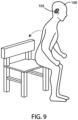
- the hearing assistance device can be configured to adjust a weighting factor for detection of the chewing based on a detected posture.
- the hearing assistance device can be configured to adjust a weighting factor for detection of the chewing based on detection that the device wearer is seated.
- the hearing assistance device can be configured to characterize an ambient sound environment and set a degree of gain value modulation based on the same.
- the sound processor can include an amplifier.
- the sound processor can include a digital signal processor.
- the motion sensor can include an accelerometer.
- the receiver can include a speaker.
- the hearing assistance device can include at least one selected from the group consisting of a RIC hearing aid and a custom hearing aid.
- a hearing-assistance system having a first hearing assistance device and a second hearing assistance device.
- the first hearing assistance device can include a first control circuit, a first microphone, a first motion sensor, and a first speaker.
- the second hearing assistance device can include a second control circuit, a second microphone, a second motion sensor, and a second speaker.
- the hearing-assistance system can be configured to output sound to a wearer of the hearing-assistance system based on sound detected with the first microphone and/or the second microphone, detect chewing of a device wearer by evaluating signals from the microphones and/or the motion sensors, and modulate a gain value for sounds detected with the microphones and then output through the speakers based on the detected chewing.
- the hearing-assistance system can be configured to reduce the gain value for sounds detected with the first microphone and/or the second microphone and then output through the first speaker and/or the second speaker based on the chewing detected.
- the hearing-assistance system can be configured to receive an input regarding a degree of gain value reduction when the chewing can be detected.
- the hearing-assistance system can be configured to adjust the gain value greater than 20 times per second.
- the hearing-assistance system can be configured to detect chewing of the wearer by detecting a predetermined pattern within signals from the microphones and/or the motion sensors.
- the hearing-assistance system can be configured to execute a binary classification for the chewing detection on a per time unit basis.
- the hearing-assistance system can be configured to adjust a weighting factor for detection of the chewing based on a detected posture.
- the hearing-assistance system can be configured to adjust a weighting factor for detection of the chewing based on detection that the device wearer can be seated.
- the hearing-assistance system can be configured to characterize an ambient sound environment and set a degree of gain value modulation based on the same.
- gain values for the first hearing assistance device and the second hearing assistance device can be adjusted independently.
- the hearing-assistance system can include at least one selected from the group consisting of a RIC hearing aid and a custom hearing aid.
- a method of dynamically adjusting gain values for a hearing assistance device can be included. The method including outputting sound to a wearer of a wearer of a hearing assistance device based on sound detected with a microphone, detecting chewing of the device wearer by evaluating signals from the microphone and/or the motion sensor, and modulating a gain value of a sound processor for sounds output through the receiver based on the chewing detected.
- the method can further include reducing the gain value of the sound processor for sounds detected with the microphone and then output through the receiver based on the chewing detected.
- the method can further include receiving an input regarding a degree of gain value reduction when the chewing can be detected.
- the method can further include adjusting the gain value of the sound processor greater than 20 times per second.
- the method can further include detecting chewing of the wearer by detecting a predetermined pattern within signals from the microphone and/or the motion sensor.
- the method can further include executing a binary classification for the chewing detection on a per time unit basis.
- the method can further include adjusting a weighting factor for detection of the chewing based on a detected posture.
- the method can further include adjusting a weighting factor for detection of the chewing based on detecting that the device wearer can be seated.
- the method can further include characterizing an ambient sound environment and setting a degree of gain value modulation based on the same.
- hearing assistance devices As referenced above, individuals typically wear hearing assistance devices continuously throughout their day encompassing many different activities including, working, socializing, exercising, eating, and the like. It is desirable for hearing assistance devices to perform optimally regardless of the activity taking place.
- the gain of a hearing assistance device can be thought of as the difference between the level of a sound entering a microphone of the hearing assistance device and the amplified level of the sound exiting a speaker (which may be part of a receiver) of the hearing assistance device.
- Appropriate gain values ensure that the hearing aid user can hear sounds comfortably and clearly across different frequencies and input levels while also preventing acoustic feedback, which is a squeal or screech that occurs when the amplified sound from the speaker leaks back to the microphone and creates a positive feedback loop.
- Some types of hearing assistance devices form a seal with the inner surface of the ear canal that acoustically separates the microphone(s) and the speaker(s). When this seal is disrupted, more sound can leak back from the speaker to the microphone potentially creating feedback issues. Chewing and/or related jaw motion such as that associated with eating, drinking, mastication, etc. can cause movement of the inner surface of the ear canal which can disrupt the seal between the hearing assistance device and the inner surface of the ear canal potentially leading to feedback issues.
- systems and devices herein can reduce feedback issues associated with chewing and/or related jaw motions.
- systems and devices herein can detect chewing and/or related jaw motion using sensors as described herein and then dynamically adjust the gain parameters of the hearing assistance device in order to reduce or eliminate any feedback issues that may otherwise occur. Such adjustments can be executed by the system or device automatically such that the device wearer is unaware of the dynamical changes made to the gain parameters.
- a hearing assistance device is included in various embodiments herein having a control circuit, a microphone, a motion sensor, a receiver, and a sound processor.
- the hearing assistance device can be configured to output sound to a wearer of the hearing assistance device via the receiver based on sound detected with the microphone. Further, the hearing assistance device can detect chewing of the wearer by evaluating signals from the microphone and/or the motion sensor and then modulate a gain value of the sound processor for sounds output through the receiver based on the chewing detected.
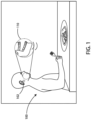
- FIG. 1 a schematic view is shown of a device wearer 100 with a hearing assistance device 102.
- the device wearer 100 is shown eating.
- FIG. 1 also shows an enlarged view of the device wearer's mouth 110.
- the hearing assistance device 102 can be configured to output sound to the device wearer 100 with a receiver (which can include a speaker) based on sound detected with a microphone.
- the hearing assistance device 102 can be configured to detect chewing (or similar jaw motion) of the wearer by evaluating signals from a microphone and/or a motion sensor. Exemplary techniques for detecting chewing will be described further below.
- the hearing assistance device 102 can be configured to modulate a gain value of a sound processor for sounds output through the receiver based on the chewing detected. For example, the gain value can be reduced when chewing is detected to reduce the chance of feedback issues occurring.
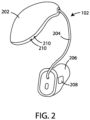
- the hearing assistance device 102 includes a housing 202.
- the hearing assistance device 102 also includes a cable 204.
- the hearing assistance device 102 also includes a receiver 206.
- the hearing assistance device 102 also includes a sensor 208.
- the hearing assistance device 102 also includes electrical contacts 210.
- FIG. 2 illustrates one type of hearing assistance device (or ear-wearable device) consistent with embodiments herein, many other types of hearing assistance devices are also contemplated.
- hearing assistance device can include devices that can aid a person with impaired hearing.
- the term “hearing assistance device” shall also refer to devices that can produce optimized or processed sound for persons with normal hearing.
- Hearing assistance devices herein can include, but are not limited to, behind-the-ear (BTE), in-the ear (ITE), in-the-canal (ITC), invisible-in-canal (IIC), receiver-in-canal (RIC), receiver in-the-ear (RITE) and completely-in-the-canal (CIC) type hearing assistance devices.
- BTE behind-the-ear
- ITE in-the ear
- ITC in-the-canal
- IIC invisible-in-canal
- RIC receiver-in-canal
- RITE receiver in-the-ear
- CIC completely-in-the-canal
- hearing assistance devices wherein can include those wherein a portion of the device forms a seal with an inner surface of the ear, such as the ear canal.
- the hearing assistance device can be a hearing aid falling under 21 C.F.R. 9 801.420.
- the hearing assistance device can be an over-the-counter (OTC) hearing aid.
- the hearing assistance device can include one or more Personal Sound Amplification Products (PSAPs).
- PSAPs Personal Sound Amplification Products
- the hearing assistance device can include one or more "hearable" devices that provide various types of functionality.
- hearing assistance devices can include other types of devices that are wearable in, on, or in the vicinity of the user's ears.
- the ear includes the ear canal 302, the pinna 310, and the tympanic membrane 314.
- the hearing assistance device 102 includes a cable 204 and a receiver 206.
- the receiver 206 is disposed within the ear canal 302 and portions of the hearing assistance device 102 form a seal with the inner surfaces of the ear canal 302.
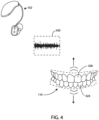
- FIG. 4 a schematic view of signal generation associated with chewing is shown in accordance with various embodiments herein.
- the mouth 110 of the device wearer includes lower teeth 424 and upper teeth 426 which move relative to one another during chewing based on movement of the jaw.
- FIG. 4 also shows a hearing assistance device 102.
- the hearing assistance device 102 can include various sensors generating sensor signals 420.
- the sensor signals 420 can be processed to determine that the device wearer is chewing.
- the term "chewing" will also include other activities including similar jaw motion unless the context dictates otherwise.
- a device wearer may only be wearing a single hearing assistance device. However, it will be appreciated that in many embodiments a device wearer will be wearing a pair of hearing assistance devices with one in each ear.
- FIG. 5 a schematic view of signal generation associated with chewing is shown in accordance with various embodiments herein. As before, the mouth 110 of the device wearer is shown. FIG. 5 shows a first hearing assistance device 102 generating right side signals 504 and a second hearing assistance device 502 generating left side signals 506.
- the first hearing assistance device 102 and the second hearing assistance device 502 can operate independently from one another with respect to chewing detection and/or gain control herein. However, in other embodiments, the first hearing assistance device 102 and the second hearing assistance device 502 can operate in a coordinated matter with each other with respect to chewing detection and/or gain control herein.
- the first hearing assistance device 102 and the second hearing assistance device 502 are in signal communication with one another and/or with an accessory device.
- the first hearing assistance device 102 and the second hearing assistance device 502 are configured to send and/or receive sensor signals (such as microphone signals and/or motion sensor signals).
- the first hearing assistance device 102 and the second hearing assistance device 502 are configured to send and/or receive indications of chewing detection. In some embodiments, the first hearing assistance device 102 and the second hearing assistance device 502 are configured to send and/or receive commands regarding gain modulation, such as reducing gain when chewing is detected and/or returning gain to an initial or default level within chewing is not detected. In some embodiments, a consensus approach can be used such that a hearing assistance device will only modulate gain for chewing detection when both the devices detect chewing.
- systems and/or devices herein can execute various data processing and/or signal processing operations to detect chewing. Such operations can be performed on hearing assistance devices, on accessory devices, on computing resources in the cloud, and/or can be distributed across multiple of such sites.
- FIG. 6 a diagram of data processing operations 600 is shown in accordance with various embodiments herein.
- Raw sensor data 602 can be subjected to an operation of segmentation 604. Segmentation can include breaking up the signal into discrete units cover a specific time span.
- time spans can be used, however in some embodiments the time span can be on the order of millisecond, such as 5, 10, 25, 50, 100, 150, 200, 300 milliseconds, or an amount a time falling within a range between any of the foregoing.
- Feature extraction and signal processing 606 herein can include the use of Mel frequency cepstral coefficient (MFCC) feature extraction.
- MFCC Mel frequency cepstral coefficient
- Feature extraction and signal processing 606 can also include WOLA (weighted-overlap add) algorithm signal processing creating WOLA bands.
- Feature extraction and signal processing 606 can also include an acoustic echo cancelation (AEC) operation.
- AEC acoustic echo cancelation
- the processed data (such as WOLA bands) can then be evaluated 608 in an artificial intelligence (AI) system comprising a recurrent neural network, such as a long short-term memory (LSTM) architecture using a plurality of neuron units.
- AI artificial intelligence
- the data fed into the LSTM can by an M*N AEC matrix, where M is a fixed number of time points and N is a number of WOLA/Mel features.
- M is a fixed number of time points and N is a number of WOLA/Mel features.
- two layers of LSTM are used with 128 hidden layers in the first layer and 256 layers in the second.
- a supervised learning approach can be used with labeled learning data including recordings of chewing or the like. However, semi-supervised learning approaches can also be used.
- the LSTM recurrent neural network output can then be fed into a dense layer 610 (a fully connected layer that follows LSTM layers and is used for outputting a prediction).
- the output of the dense layer can then be subject to a sigmoid activation 612 function as the last layer.
- the final output can be a probability per time period.
- the probability can be compared with a threshold value and if the threshold value is exceeded then the time period or frame can be taken as indicative of chewing taking place. It will be appreciated that the described approach for data processing / signal processing is only one specific example and many variations on this approach are contemplated herein.
- FIG. 7 a diagram of an exemplary process for detecting chewing using data from a microphone and/or a motion sensor is shown in accordance with various embodiments herein.
- various operations are performed at the level of an ear-worn device, an external device, and/or the cloud.
- a front microphone 706 is used to generate signals representative of sound along with a rear microphone 708.
- the signals from the front microphone 706 are then processed to evaluate/extract spectral and/or temporal features 710 therefrom.
- signals from a motion sensor 704 can also be processed to evaluate/extract spectral and/or temporal features 710 therefrom.
- Many different spectral and/or temporal features can be evaluated/extracted including, but not limited to, those shown in the following table.
- Spectral and/or temporal features that can be utilized from signals of a single-mic can include, but are not limited to, HLF (the relative power in the high-frequency portion of the spectrum relative to the low-frequency portion), SC (spectral centroid), LS (the slope of the power spectrum below the Spectral Centroid), PS (periodic strength), and Envelope Peakiness (a measure of signal envelope modulation).
- HLF the relative power in the high-frequency portion of the spectrum relative to the low-frequency portion
- SC spectral centroid
- LS the slope of the power spectrum below the Spectral Centroid
- PS periodic strength
- Envelope Peakiness a measure of signal envelope modulation
- the MSC feature can be used to determine whether a source is a point source or distributed.
- the ILD and IPD features can be used to determine the direction of arrival of the sound. Chewing sounds are located at a particular location relative to the microphones on the device. Also chewing sounds are distributed and caused by chewing activities in the whole mouth (in contrast, for example, speech is mostly emitted from the lips.)
- signals from the front microphone 706 and the rear microphone 708 can be correlated in order to extract those signals representing sound with a point of origin falling in an area associated with the inside of the device wearer. As such, this operation can be used to separate signals associated with external noise and external speech from signals associated with chewing sounds of the device wearer.
- an operation can be executed in order to detect 714 chewing.
- a technique can be used to detect chewing as described in FIG. 6 .
- various machine learning techniques can be applied in order to take the signals from sensors as described herein and determine whether or not chewing is happening.
- machine learning techniques related to classification can be applied in order to determine whether or not chewing is occurring.
- the hearing assistance device can be configured to detect chewing of the wearer by detecting a predetermined pattern within signals from the microphone and/or the motion sensor.
- Machine learning techniques that can be applied can include supervised learning, unsupervised learning, and reinforcement learning.
- techniques applied can include one or more of artificial neural networks, convolutional neural networks, K nearest neighbor techniques, decision trees, support vector machines, or the like.
- a multi-node decision tree can be used to reach a binary result (e.g. binary classification) on whether the individual is chewing or not.
- the gain value can be adjusted (up or down) by 0.1 dB, 1 dB, 2 dB, 3 dB, 4 dB, 5 dB, 10 dB, 15 dB, 20 dB, 30 dB or more, or by an amount falling within a range between any of the foregoing.
- the gain value can be adjusted within one or more specific frequency ranges.
- the gain value can be adjusted at frequencies including those typical for feedback. Gain modulation can be particularly helpful in high-gain scenarios.
- gain modulation herein can be performed when the default level of gain at one or more frequencies is 50, 60, 70, 80, 90, or 100 dB or more.
- gain modulation herein could include a drop from 65 dB down to 45 dB. However, many different magnitudes of gain modulation are contemplated herein.
- data regarding chewing events can be buffered 720 at the level of the ear-worn device 702 before being passed on to another device 722. While FIG. 7 illustrates detection of chewing at the level of the ear-worn device 702, it will be appreciated that in some embodiments signal data can be passed from the ear-worn device 702 onto another device and detection can occur there.
- Microphones herein can be of various types including, but not limited to, unidirectional, omnidirectional, MEMS based microphones, piezoelectric microphones, magnetic microphones, electret condenser microphones, and the like.
- the DSP 1112 incorporates or is coupled to audio signal processing circuitry such as a sound processor configured to implement various functions described herein.
- a sensor package 1114 can be coupled to the DSP 1112 via the flexible mother circuit 1118.
- the sensor package 1114 can include one or more different specific types of sensors such as those described in greater detail below.
- One or more user switches 1110 are electrically coupled to the DSP 1112 via the flexible mother circuit 1118. It will be appreciated that the user switches 1110 can extend outside of the housing 202.
- the communication device 1108 can be a BLUETOOTH ® transceiver, such as a BLE (BLUETOOTH ® low energy) transceiver or other transceiver(s) (e.g., an IEEE 802.11 compliant device).
- the communication device 1108 can be configured to communicate with one or more external devices, such as those discussed previously, in accordance with various embodiments.
- the communication device 1108 can be configured to communicate with an external visual display device such as a smart phone, a video display screen, a tablet, a computer, or the like.
- the hearing assistance device 102 can also include a control circuit 1122 and a memory storage device 1124.
- the control circuit 1122 can be in electrical communication with other components of the device.
- a clock circuit can be in electrical communication with the control circuit.
- the control circuit 1122 can execute various operations, such as those described herein.
- the control circuit 1122 can execute operations resulting in the provision of a user input interface by which the hearing assistance device 102 can receive inputs (including audible inputs, touch based inputs, and the like) from the device wearer.
- an accessory device can include various of the components as described with respect to an ear-wearable device.
- an accessory device can include a control circuit, a microphone, a motion sensor, and a power supply, amongst other things.
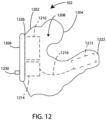
- the shell 1204 extends from an ear canal end 1222 to an aperture end 1226. At the aperture end 1226, the shell 1204 defines an aperture that is closed by the faceplate 1206.
- the faceplate 1206 is sealed to the shell 1204.
- the faceplate 1206 is shown in FIG. 12 only in a side view but can include many features and structures.
- a user input device 1230 is shown as part of the faceplate in FIG. 12 , and can be a button, lever, switch, dial, or other input device.
- the faceplate 1206 may also include a battery door, a microphone opening, a pull handle, and other features.
- FIG. 13 is a schematic view of an hearing assistance device 102 disposed within the ear of a wearer in accordance with various embodiments herein.
- the housing 1202 of the hearing assistance device 102 is defined by the shell 1204, which is positioned within the ear canal 302, and the faceplate 1206, which is positioned in the concha.
- the user input device 1230 on the faceplate 1206 is accessible to be manipulated by the user without having to remove the ear-wearable device from their ear.
- the ear canal end 1222 of the shell 1204 is positioned close to the user's tympanic membrane 314. Ideally, the shell 1204 fits properly within the user's ear cavity.
- operations described herein and method steps can be performed as part of a computer-implemented method executed by one or more processors of one or more computing devices.
- operations described herein and method steps can be implemented instructions stored on a non-transitory, computer-readable medium that, when executed by one or more processors, cause a system to execute the operations and/or steps.
- the method can further include adjusting the gain value of the sound processor greater than 1, 5, 10, 15, 20, or 30 times per second.
- the method can further include detecting chewing of the wearer by detecting a predetermined pattern within signals from the microphone and/or the motion sensor. In an embodiment, the method can further include executing a binary classification for the chewing detection on a per time unit basis.
- the method can further include adjusting a weighting factor for detection of the chewing based on a detected posture. In an embodiment, the method can further include adjusting a weighting factor for detection of the chewing based on detecting that the device wearer is seated.
- IMU inertial measurement unit
- IMUs can include one or more accelerometers (3, 6, or 9 axis) to detect linear acceleration and a gyroscope to detect rotational rate.
- an IMU can also include a magnetometer to detect a magnetic field.
- the sensor package can include one or more of an IMU, and accelerometer (3, 6, or 9 axis), a gyroscope, a barometer, an altimeter, a magnetometer, a magnetic sensor, an eye movement sensor, a pressure sensor, an acoustic sensor, a telecoil, a heart rate sensor, a global positioning system (GPS), a temperature sensor, a blood pressure sensor, an oxygen saturation sensor, an optical sensor, a blood glucose sensor (optical or otherwise), a galvanic skin response sensor, a cortisol level sensor (optical or otherwise), a microphone, acoustic sensor, an electrocardiogram (ECG) sensor, electroencephalography (EEG) sensor which can be a neurological sensor, eye movement sensor (e.g., electrooculogram (EOG) sensor), myographic potential electrode sensor (EMG), a heart rate monitor, a pulse oximeter or oxygen saturation sensor (SpO2), a wireless radio antenna, blood perfusion sensor, hydrometer
- GPS global positioning
Landscapes
- Health & Medical Sciences (AREA)
- Life Sciences & Earth Sciences (AREA)
- General Health & Medical Sciences (AREA)
- Engineering & Computer Science (AREA)
- Physics & Mathematics (AREA)
- Physical Education & Sports Medicine (AREA)
- Surgery (AREA)
- Animal Behavior & Ethology (AREA)
- Medical Informatics (AREA)
- Public Health (AREA)
- Veterinary Medicine (AREA)
- Heart & Thoracic Surgery (AREA)
- Molecular Biology (AREA)
- Biomedical Technology (AREA)
- Neurosurgery (AREA)
- Signal Processing (AREA)
- Acoustics & Sound (AREA)
- Otolaryngology (AREA)
- Oral & Maxillofacial Surgery (AREA)
- Pathology (AREA)
- Biophysics (AREA)
- Rheumatology (AREA)
- Orthopedic Medicine & Surgery (AREA)
- Dentistry (AREA)
- Circuit For Audible Band Transducer (AREA)
Applications Claiming Priority (1)
| Application Number | Priority Date | Filing Date | Title |
|---|---|---|---|
| US202363467145P | 2023-05-17 | 2023-05-17 |
Publications (1)
| Publication Number | Publication Date |
|---|---|
| EP4465660A1 true EP4465660A1 (fr) | 2024-11-20 |
Family
ID=91129495
Family Applications (1)
| Application Number | Title | Priority Date | Filing Date |
|---|---|---|---|
| EP24176149.3A Pending EP4465660A1 (fr) | 2023-05-17 | 2024-05-16 | Dispositifs d'aide auditive avec commande de gain dynamique sur la base d'une mastication ou d'une déglutition détectées |
Country Status (2)
| Country | Link |
|---|---|
| US (1) | US20240388857A1 (fr) |
| EP (1) | EP4465660A1 (fr) |
Citations (9)
| Publication number | Priority date | Publication date | Assignee | Title |
|---|---|---|---|---|
| US9848273B1 (en) | 2016-10-21 | 2017-12-19 | Starkey Laboratories, Inc. | Head related transfer function individualization for hearing device |
| US20180317837A1 (en) | 2017-05-08 | 2018-11-08 | Starkey Laboratories, Inc. | Hearing assistance device incorporating virtual audio interface for therapy guidance |
| US20180343527A1 (en) | 2006-07-10 | 2018-11-29 | Starkey Laboratories, Inc. | Method and apparatus for a binaural hearing assistance system using monaural audio signals |
| US20210037324A1 (en) * | 2018-01-24 | 2021-02-04 | Eargo, Inc. | Hearing assistance device with an accelerometer |
| WO2021242571A1 (fr) * | 2020-05-29 | 2021-12-02 | Starkey Laboratories, Inc. | Dispositif auditif ayant un capteur de mouvement utilisé pour détecter une instabilité de trajet de rétroaction |
| WO2022026557A1 (fr) | 2020-07-28 | 2022-02-03 | Starkey Laboratories, Inc. | Dispositifs portés sur l'oreille avec détection d'événement oropharyngien |
| EP4009667A1 (fr) * | 2018-06-22 | 2022-06-08 | Oticon A/s | Appareil auditif comprenant un détecteur d'événement acoustique |
| EP4064730A1 (fr) * | 2021-03-26 | 2022-09-28 | Oticon A/s | Traitement de signal sur la base de données de mouvement |
| EP4064731A1 (fr) * | 2021-03-26 | 2022-09-28 | Oticon A/s | Élimination améliorée du larsen dans une prothèse auditive |
Family Cites Families (2)
| Publication number | Priority date | Publication date | Assignee | Title |
|---|---|---|---|---|
| US5225836A (en) * | 1988-03-23 | 1993-07-06 | Central Institute For The Deaf | Electronic filters, repeated signal charge conversion apparatus, hearing aids and methods |
| US9048798B2 (en) * | 2013-08-30 | 2015-06-02 | Qualcomm Incorporated | Gain control for a hearing aid with a facial movement detector |
-
2024
- 2024-05-16 EP EP24176149.3A patent/EP4465660A1/fr active Pending
- 2024-05-16 US US18/666,432 patent/US20240388857A1/en active Pending
Patent Citations (9)
| Publication number | Priority date | Publication date | Assignee | Title |
|---|---|---|---|---|
| US20180343527A1 (en) | 2006-07-10 | 2018-11-29 | Starkey Laboratories, Inc. | Method and apparatus for a binaural hearing assistance system using monaural audio signals |
| US9848273B1 (en) | 2016-10-21 | 2017-12-19 | Starkey Laboratories, Inc. | Head related transfer function individualization for hearing device |
| US20180317837A1 (en) | 2017-05-08 | 2018-11-08 | Starkey Laboratories, Inc. | Hearing assistance device incorporating virtual audio interface for therapy guidance |
| US20210037324A1 (en) * | 2018-01-24 | 2021-02-04 | Eargo, Inc. | Hearing assistance device with an accelerometer |
| EP4009667A1 (fr) * | 2018-06-22 | 2022-06-08 | Oticon A/s | Appareil auditif comprenant un détecteur d'événement acoustique |
| WO2021242571A1 (fr) * | 2020-05-29 | 2021-12-02 | Starkey Laboratories, Inc. | Dispositif auditif ayant un capteur de mouvement utilisé pour détecter une instabilité de trajet de rétroaction |
| WO2022026557A1 (fr) | 2020-07-28 | 2022-02-03 | Starkey Laboratories, Inc. | Dispositifs portés sur l'oreille avec détection d'événement oropharyngien |
| EP4064730A1 (fr) * | 2021-03-26 | 2022-09-28 | Oticon A/s | Traitement de signal sur la base de données de mouvement |
| EP4064731A1 (fr) * | 2021-03-26 | 2022-09-28 | Oticon A/s | Élimination améliorée du larsen dans une prothèse auditive |
Also Published As
| Publication number | Publication date |
|---|---|
| US20240388857A1 (en) | 2024-11-21 |
Similar Documents
| Publication | Publication Date | Title |
|---|---|---|
| US12149893B2 (en) | Hearing assistance system with enhanced fall detection features | |
| US11826138B2 (en) | Ear-worn devices with deep breathing assistance | |
| US11517708B2 (en) | Ear-worn electronic device for conducting and monitoring mental exercises | |
| US11477583B2 (en) | Stress and hearing device performance | |
| US20180263562A1 (en) | Hearing system for monitoring a health related parameter | |
| EP4085657B1 (fr) | Dispositif électronique physiologique porté à l'oreille avec adaptation à l'acoustique d'environnement | |
| US11869505B2 (en) | Local artificial intelligence assistant system with ear-wearable device | |
| CN113891225A (zh) | 听力装置的算法参数的个人化 | |
| CN111669691B (zh) | 包括传感器配置检测器的听力装置 | |
| WO2020176414A1 (fr) | Détection de mouvements oculaires d'un utilisateur à l'aide de capteurs placés dans des instruments auditifs | |
| US20220361787A1 (en) | Ear-worn device based measurement of reaction or reflex speed | |
| US10757511B2 (en) | Hearing device adapted for matching input transducers using the voice of a wearer of the hearing device | |
| US11523229B2 (en) | Hearing devices with eye movement detection | |
| US20230016667A1 (en) | Hearing assistance systems and methods for monitoring emotional state | |
| US20230130889A1 (en) | Ear-wearable electronic device including in-ear optical heart rate and blood oxygen saturation sensor | |
| EP3021599A1 (fr) | Dispositif auditif présentant plusieurs modes | |
| CN111956181A (zh) | 具有听力器的听力系统 | |
| US12432506B2 (en) | Hearing aid comprising a signal processing network conditioned on auxiliary parameters | |
| EP4465660A1 (fr) | Dispositifs d'aide auditive avec commande de gain dynamique sur la base d'une mastication ou d'une déglutition détectées | |
| US20240377430A1 (en) | Binaural hearing system with distributed sensors, and method of its operation | |
| Bhowmik et al. | Hear, now, and in the future: Transforming hearing aids into multipurpose devices | |
| US20240430626A1 (en) | Method for operating a hearing device, and hearing device | |
| US11980477B2 (en) | Hearing aid determining listening effort | |
| US20240276159A1 (en) | Operating a hearing device for classifying an audio signal to account for user safety | |
| CN121176037A (zh) | 声音处理装置及声音处理系统 |
Legal Events
| Date | Code | Title | Description |
|---|---|---|---|
| PUAI | Public reference made under article 153(3) epc to a published international application that has entered the european phase |
Free format text: ORIGINAL CODE: 0009012 |
|
| STAA | Information on the status of an ep patent application or granted ep patent |
Free format text: STATUS: THE APPLICATION HAS BEEN PUBLISHED |
|
| AK | Designated contracting states |
Kind code of ref document: A1 Designated state(s): AL AT BE BG CH CY CZ DE DK EE ES FI FR GB GR HR HU IE IS IT LI LT LU LV MC ME MK MT NL NO PL PT RO RS SE SI SK SM TR |
|
| STAA | Information on the status of an ep patent application or granted ep patent |
Free format text: STATUS: REQUEST FOR EXAMINATION WAS MADE |
|
| 17P | Request for examination filed |
Effective date: 20250519 |