EP4465711A1 - Procédé de prédiction de réseau de communication, terminal et dispositif côté réseau - Google Patents
Procédé de prédiction de réseau de communication, terminal et dispositif côté réseau Download PDFInfo
- Publication number
- EP4465711A1 EP4465711A1 EP23739995.1A EP23739995A EP4465711A1 EP 4465711 A1 EP4465711 A1 EP 4465711A1 EP 23739995 A EP23739995 A EP 23739995A EP 4465711 A1 EP4465711 A1 EP 4465711A1
- Authority
- EP
- European Patent Office
- Prior art keywords
- information
- terminal
- result
- network
- models
- Prior art date
- Legal status (The legal status is an assumption and is not a legal conclusion. Google has not performed a legal analysis and makes no representation as to the accuracy of the status listed.)
- Pending
Links
Images


Classifications
-
- H—ELECTRICITY
- H04—ELECTRIC COMMUNICATION TECHNIQUE
- H04L—TRANSMISSION OF DIGITAL INFORMATION, e.g. TELEGRAPHIC COMMUNICATION
- H04L41/00—Arrangements for maintenance, administration or management of data switching networks, e.g. of packet switching networks
- H04L41/14—Network analysis or design
- H04L41/147—Network analysis or design for predicting network behaviour
-
- H—ELECTRICITY
- H04—ELECTRIC COMMUNICATION TECHNIQUE
- H04L—TRANSMISSION OF DIGITAL INFORMATION, e.g. TELEGRAPHIC COMMUNICATION
- H04L41/00—Arrangements for maintenance, administration or management of data switching networks, e.g. of packet switching networks
- H04L41/50—Network service management, e.g. ensuring proper service fulfilment according to agreements
- H04L41/5041—Network service management, e.g. ensuring proper service fulfilment according to agreements characterised by the time relationship between creation and deployment of a service
- H04L41/5054—Automatic deployment of services triggered by the service manager, e.g. service implementation by automatic configuration of network components
-
- H—ELECTRICITY
- H04—ELECTRIC COMMUNICATION TECHNIQUE
- H04L—TRANSMISSION OF DIGITAL INFORMATION, e.g. TELEGRAPHIC COMMUNICATION
- H04L41/00—Arrangements for maintenance, administration or management of data switching networks, e.g. of packet switching networks
- H04L41/14—Network analysis or design
- H04L41/145—Network analysis or design involving simulating, designing, planning or modelling of a network
-
- G—PHYSICS
- G06—COMPUTING OR CALCULATING; COUNTING
- G06N—COMPUTING ARRANGEMENTS BASED ON SPECIFIC COMPUTATIONAL MODELS
- G06N20/00—Machine learning
-
- G—PHYSICS
- G06—COMPUTING OR CALCULATING; COUNTING
- G06N—COMPUTING ARRANGEMENTS BASED ON SPECIFIC COMPUTATIONAL MODELS
- G06N20/00—Machine learning
- G06N20/20—Ensemble learning
-
- G—PHYSICS
- G06—COMPUTING OR CALCULATING; COUNTING
- G06N—COMPUTING ARRANGEMENTS BASED ON SPECIFIC COMPUTATIONAL MODELS
- G06N3/00—Computing arrangements based on biological models
- G06N3/02—Neural networks
- G06N3/04—Architecture, e.g. interconnection topology
-
- G—PHYSICS
- G06—COMPUTING OR CALCULATING; COUNTING
- G06N—COMPUTING ARRANGEMENTS BASED ON SPECIFIC COMPUTATIONAL MODELS
- G06N3/00—Computing arrangements based on biological models
- G06N3/02—Neural networks
- G06N3/04—Architecture, e.g. interconnection topology
- G06N3/044—Recurrent networks, e.g. Hopfield networks
-
- G—PHYSICS
- G06—COMPUTING OR CALCULATING; COUNTING
- G06N—COMPUTING ARRANGEMENTS BASED ON SPECIFIC COMPUTATIONAL MODELS
- G06N3/00—Computing arrangements based on biological models
- G06N3/02—Neural networks
- G06N3/04—Architecture, e.g. interconnection topology
- G06N3/045—Combinations of networks
-
- G—PHYSICS
- G06—COMPUTING OR CALCULATING; COUNTING
- G06N—COMPUTING ARRANGEMENTS BASED ON SPECIFIC COMPUTATIONAL MODELS
- G06N3/00—Computing arrangements based on biological models
- G06N3/02—Neural networks
- G06N3/08—Learning methods
-
- G—PHYSICS
- G06—COMPUTING OR CALCULATING; COUNTING
- G06N—COMPUTING ARRANGEMENTS BASED ON SPECIFIC COMPUTATIONAL MODELS
- G06N5/00—Computing arrangements using knowledge-based models
- G06N5/01—Dynamic search techniques; Heuristics; Dynamic trees; Branch-and-bound
-
- G—PHYSICS
- G06—COMPUTING OR CALCULATING; COUNTING
- G06N—COMPUTING ARRANGEMENTS BASED ON SPECIFIC COMPUTATIONAL MODELS
- G06N7/00—Computing arrangements based on specific mathematical models
- G06N7/01—Probabilistic graphical models, e.g. probabilistic networks
-
- H—ELECTRICITY
- H04—ELECTRIC COMMUNICATION TECHNIQUE
- H04L—TRANSMISSION OF DIGITAL INFORMATION, e.g. TELEGRAPHIC COMMUNICATION
- H04L41/00—Arrangements for maintenance, administration or management of data switching networks, e.g. of packet switching networks
- H04L41/08—Configuration management of networks or network elements
- H04L41/085—Retrieval of network configuration; Tracking network configuration history
-
- H—ELECTRICITY
- H04—ELECTRIC COMMUNICATION TECHNIQUE
- H04L—TRANSMISSION OF DIGITAL INFORMATION, e.g. TELEGRAPHIC COMMUNICATION
- H04L41/00—Arrangements for maintenance, administration or management of data switching networks, e.g. of packet switching networks
- H04L41/08—Configuration management of networks or network elements
- H04L41/0866—Checking the configuration
-
- H—ELECTRICITY
- H04—ELECTRIC COMMUNICATION TECHNIQUE
- H04W—WIRELESS COMMUNICATION NETWORKS
- H04W64/00—Locating users or terminals or network equipment for network management purposes, e.g. mobility management
-
- H—ELECTRICITY
- H04—ELECTRIC COMMUNICATION TECHNIQUE
- H04W—WIRELESS COMMUNICATION NETWORKS
- H04W88/00—Devices specially adapted for wireless communication networks, e.g. terminals, base stations or access point devices
- H04W88/14—Backbone network devices
-
- H—ELECTRICITY
- H04—ELECTRIC COMMUNICATION TECHNIQUE
- H04W—WIRELESS COMMUNICATION NETWORKS
- H04W88/00—Devices specially adapted for wireless communication networks, e.g. terminals, base stations or access point devices
- H04W88/18—Service support devices; Network management devices
Definitions
- This application pertains to the field of communications technologies, and in particular, relates to a communication network prediction method, a terminal, and a network-side device.
- a wireless communication network positioning method mainly relies on a measurement result of a direct path, which can achieve high positioning precision with low implementation complexity in presence of a line-of-sight (line-of-sight, LOS) path.
- line-of-sight line-of-sight
- NLOS non-line-of-sight
- an artificial intelligence Artificial Intelligence, AI
- machine learning Machine Learning
- the stability, robustness and generalization capability of the AI-based positioning method are still important factors restricting its large-scale application. Therefore, how to effectively improve the positioning precision and reduce the failure probability is a problem to be urgently resolved.
- a terminal including a processor and a communication interface, where the processor is configured to: perform a target task by using L models respectively and obtain a first result output by the L models, where L is a positive integer; and perform at least one of the following operations:
- a network-side device includes a processor and a memory, and a program or instructions executable on the processor are stored in the memory.
- the program or the instructions are executed by the processor, the steps of the method according to the second aspect are implemented.
- a chip includes a processor and a communication interface, the communication interface is coupled to the processor, and the processor is configured to run a program or instructions to implement the method according to the first aspect or implement the method according to the second aspect.
- first and second are intended to distinguish between similar objects but do not necessarily indicate a specific order or sequence. It should be understood that the terms used in this way is interchangeable in appropriate circumstances so that the embodiments of this application can be implemented in other orders than the order illustrated or described herein, and “first” and “second” are usually for distinguishing same-type objects but not limiting the number of objects, for example, there may be one or more first objects.
- first and second are usually for distinguishing same-type objects but not limiting the number of objects, for example, there may be one or more first objects.
- “and/or” in this specification and claims indicates at least one of connected objects, and the symbol “/" generally indicates that the associated objects are in an "or” relationship.
- LTE Long Term Evolution
- LTE-A LTE-advanced
- LTE-A LTE-Advanced
- CDMA code division multiple access
- TDMA time division multiple access
- FDMA frequency division multiple access
- OFDMA Orthogonal Frequency Division Multiple Access
- SC-FDMA single-carrier Frequency-Division Multiple Access
- system and “network” in the embodiments of this application are usually used interchangeably. Techniques described herein may be used in the aforementioned systems and radio technologies, and may also be used in other systems and radio technologies.
- New Radio New Radio
- NR New Radio
- NR terms are used in most of the following descriptions, although these technologies may also be applied to other applications than an NR system application, for example, the 6th generation (6th Generation, 6G) communication system.
- the terminal after determining the prediction result of the target task based on the first result, the terminal makes a decision associated with the target task based on the prediction result of the target task.
- the terminal requests the network-side device to configure a plurality of models for the terminal.
- the task information is used to indicate a task performed by using a model.
- the task information may include a positioning task or a CSI estimation task.
- the terminal sends third information to the network-side device, where the third information is used to indicate capability information of the terminal.
- the third information includes at least one of the following:
- the terminal autonomously configures a plurality of models.
- the model pool includes at least one model.
- the terminal selects the L models from the model pool based on target information, where the model pool includes K models, K being greater than or equal to L, and K being a positive integer.
- the statistical information of the output result of each model includes: statistical information of results of a same model in a period of time. For example, statistical information that is input and output for different models in a period of time is calculated separately.
- the statistical information is, for example, a mean or a variance.
- the precision requirement information may include at least one of the following: absolute precision requirement and precision quantization level; where the absolute precision requirement may include: horizontal error and/or vertical height error.
- the task information is used to indicate a task performed by a model.
- the task information may include a positioning task or a CSI estimation task.
- the channel state information may include at least one of the following: time domain information, frequency domain information, space domain information, delay domain information, and Doppler domain information.
- the received signal information is used to describe signal quality and/or characteristics; and the received signal information may include at least one of the following: RSRP, RSRQ, SINR, bit error rate, and frame error rate.
- the historical state information may include historical position information of past N moments.
- the measurement information of the reference signal of the current terminal may include at least one of the following: SSB measurement information, SRS measurement information, CSI-RS measurement information, and PRS measurement information.
- the network-side device determines M models; then, the network-side device performs a target task by using the M models respectively and obtains a second result output by the M models; and the network-side device determines the prediction result of the target task based on the second result. Further, the network-side device makes a decision associated with the target task based on the prediction result of the target task.
- the network-side device configures a plurality of models.
- the network-side device may obtain fifth information and/or sixth information from the terminal.
- the fifth information and/or the sixth information may be used to assist network-side device in model selection and model configuration.
- the environment information of the terminal may include at least one of the following: LOS/NLOS scenario, dense urban/rural scenario, the number of surrounding base stations, base station ID, and measurement information of a reference signal.
- the data type may include at least one of the following: data format information and data preprocessing mode.
- the target information may include at least one of the following:
- the statistical information of output results of a plurality of models includes: statistical information of statistics output by different models in a period of time.
- the statistical information is, for example, a mean or a variance.
- the mobility information of the terminal may include a moving speed and/or beam switching information.
- the moving speed of the terminal is greater than a first threshold; and for another example, a beam switching frequency is greater than a second threshold.
- the precision requirement information may include at least one of the following: absolute precision requirement and precision quantization level; where the absolute precision requirement may include: horizontal error and/or vertical height error.
- the reference terminal includes a peripheral terminal of the current terminal, such as a transmit terminal or a receive terminal in a sidelink scenario.
- the measurement information of the reference signal of the reference terminal may include at least one of the following: SSB measurement information, SRS measurement information, CSI-RS measurement information, and PRS measurement information.
- the network-side device sends seventh information to the terminal after determining the M models; where the seventh information includes configuration information of the M models.
- the terminal receives the seventh information sent by the network-side device, and obtains a measurement quantity corresponding to the M models based on the configuration information of the M models included in the seventh information; and the terminal sends measurement quantity information to the network-side device.
- the network-side device receives the measurement quantity information sent by the terminal, and performs the target task by using the M models respectively based on the measurement quantity information sent by the terminal and obtains a second result output by the M models.
- the seventh information may include at least one of the following:
- input requirements of various models may include at least one of the following: measurement quantity information input by various types of models.
- the measurement quantity information input by the various types of models may include at least one of the following: channel state information, received signal information, historical state information, and sensor information.
- the channel state information may include at least one of the following: time domain information, frequency domain information, space domain information, delay domain information, and Doppler domain information.
- the received signal information is used to describe signal quality and/or characteristics; and the received signal information may include at least one of the following: RSRP, RSRQ, SINR, bit error rate, and frame error rate.
- the historical state information may include historical position information of past N moments.
- the implementation of determining, by the network-side device, a prediction result of the target task based on the second result may include: determining, by the network-side device, the prediction result of the target task based on a second fusion manner and the second result.
- the second fusion manner may include at least one of the following:
- the network-side device determines the second fusion manner based on target information.
- the target information may include at least one of the following:
- the statistical information of output results of a plurality of models includes: statistical information of statistics output by different models in a period of time.
- the statistical information is, for example, a mean or a variance.
- the model error information of each model includes instantaneous error information and/or statistical error information within a period of time.
- the mobility information of the terminal may include a moving speed and/or beam switching information.
- the moving speed of the terminal is greater than a first threshold; and for another example, a beam switching frequency is greater than a second threshold.
- the environment information of the terminal may include at least one of the following: LOS/NLOS scenario, dense urban/rural scenario, the number of surrounding base stations, base station ID, and measurement information of a reference signal.
- the precision requirement information may include at least one of the following: absolute precision requirement and precision quantization level; where the absolute precision requirement may include: horizontal error and/or vertical height error.
- the task information is used to indicate a task performed by the model.
- the task information may include a positioning task or a CSI estimation task.
- the measurement quantity information input by the various types of models may include at least one of the following: channel state information, received signal information, historical state information, and sensor information.
- the channel state information may include at least one of the following: time domain information, frequency domain information, space domain information, delay domain information, and Doppler domain information.
- the received signal information is used to describe signal quality and/or characteristics; and the received signal information may include at least one of the following: RSRP, RSRQ, SINR, bit error rate, and frame error rate.
- the historical state information may include historical position information of past N moments.
- the measurement information of the reference signal may include at least one of the following: SSB measurement information, SRS measurement information, CSI-RS measurement information, and PRS measurement information.
- Mode 3 A plurality of models are deployed separately on the terminal side and the network-side device side, and the terminal determines a prediction result of the target task.
- the terminal determines L models; and the network-side device determines M models.
- the terminal obtains a first result output by the L models based on the L models deployed in the terminal.
- the network-side device obtains a second result output by M models based on the M models deployed in the network-side device, and sends the second result to the terminal.
- the terminal determines a prediction result of the target task based on the first result and the second result. Further, the terminal makes a decision associated with the target task based on the prediction result of the target task.
- the network-side device may send eleventh information to the terminal, where the eleventh information is used to indicate a prediction mode based on the first result and the second result.
- the terminal receives the eleventh information sent by the network-side device.
- the prediction mode includes any one of the following:
- a prediction mode corresponding to mode 3 is a terminal-centered and network-side device-assisted mode.
- the implementation of determining, by the terminal, a prediction result of the target task based on the first result and the second result may include: determining, by the terminal, the prediction result of the target task based on a first fusion manner, the first result, and the second result.
- the first fusion manner may include at least one of the following:
- the terminal determines the first fusion manner based on target information.
- the target information may include at least one of the following:
- the statistical information of the output result of each model includes: statistical information of results of a same model in a period of time. For example, statistical information that is input and output for different models in a period of time is calculated separately.
- the statistical information is, for example, a mean or a variance.
- the statistical information of output results of a plurality of models includes: statistical information of statistics output by different models in a period of time.
- the statistical information is, for example, a mean or a variance.
- the model error information of each model includes instantaneous error information and/or statistical error information within a period of time.
- the mobility information of the terminal may include a moving speed and/or beam switching information.
- the moving speed of the terminal is greater than a first threshold; and for another example, a beam switching frequency is greater than a second threshold.
- the environment information of the terminal may include at least one of the following: LOS/NLOS scenario, dense urban/rural scenario, the number of surrounding base stations, base station ID, and measurement information of a reference signal.
- the precision requirement information may include at least one of the following: absolute precision requirement and precision quantization level; where the absolute precision requirement may include: horizontal error and/or vertical height error.
- the task information is used to indicate a task performed by the model.
- the task information may include a positioning task or a CSI estimation task.
- the measurement quantity information input by the various types of models may include at least one of the following: channel state information, received signal information, historical state information, and sensor information.
- the channel state information may include at least one of the following: time domain information, frequency domain information, space domain information, delay domain information, and Doppler domain information.
- the received signal information is used to describe signal quality and/or characteristics; and the received signal information may include at least one of the following: RSRP, RSRQ, SINR, bit error rate, and frame error rate.
- the historical state information may include historical position information of past N moments.
- the measurement information of the reference signal of the current terminal may include at least one of the following: SSB measurement information, SRS measurement information, CSI-RS measurement information, and PRS measurement information.
- the reference terminal includes a peripheral terminal of the current terminal, such as a transmit terminal or a receive terminal in a sidelink scenario.
- the measurement information of the reference signal of the reference terminal may include at least one of the following: SSB measurement information, SRS measurement information, CSI-RS measurement information, and PRS measurement information.
- Mode 4 A plurality of models are deployed separately on the terminal side and the network-side device side, and the network-side device determines a prediction result of the target task.
- the terminal determines L models; and the network-side device determines M models.
- the terminal obtains a first result output by the L models based on the L models deployed in the terminal, and sends the first result to the network-side device.
- the network-side device obtains a second result output by the M models based on the M models deployed in the network-side device; and the network-side device determines a prediction result of the target task based on the first result and the second result. Further, the network-side device makes a decision associated with the target task based on the prediction result of the target task.
- the network-side device may send eleventh information to the terminal, where the eleventh information is used to indicate a prediction mode based on the first result and the second result.
- the terminal receives the eleventh information sent by the network-side device.
- the prediction mode includes any one of the following:
- Terminal-centered and network-side device-assisted mode (1) Terminal-centered and network-side device-assisted mode:
- the terminal determines the prediction result of the target task based on the first result and the second result.
- the network-side device determines the prediction result of the target task based on the first result and the second result.
- a prediction mode corresponding to Mode 4 is a network-side device-centered and terminal-assisted mode.
- the implementation of determining, by the network-side device, the prediction result of the target task based on the first result and the second result may include: determining, by the network-side device, the prediction result of the target task based on a second fusion manner, the first result, and the second result.
- the second fusion manner may include at least one of the following:
- the network-side device determines the second fusion manner based on target information.
- the target information may include at least one of the following:
- the statistical information of the output result of each model includes: statistical information of results of a same model in a period of time. For example, statistical information that is input and output for different models in a period of time is calculated separately.
- the statistical information is, for example, a mean or a variance.
- the statistical information of output results of a plurality of models includes: statistical information of statistics output by different models in a period of time.
- the statistical information is, for example, a mean or a variance.
- the model error information of each model includes instantaneous error information and/or statistical error information within a period of time.
- the mobility information of the terminal may include a moving speed and/or beam switching information.
- the moving speed of the terminal is greater than a first threshold; and for another example, a beam switching frequency is greater than a second threshold.
- the environment information of the terminal may include at least one of the following: LOS/NLOS scenario, dense urban/rural scenario, the number of surrounding base stations, base station ID, and measurement information of a reference signal.
- the precision requirement information may include at least one of the following: absolute precision requirement and precision quantization level; where the absolute precision requirement may include: horizontal error and/or vertical height error.
- the task information is used to indicate a task performed by the model.
- the task information may include a positioning task or a CSI estimation task.
- the measurement quantity information input by the various types of models may include at least one of the following: channel state information, received signal information, historical state information, and sensor information.
- the channel state information may include at least one of the following: time domain information, frequency domain information, space domain information, delay domain information, and Doppler domain information.
- the received signal information is used to describe signal quality and/or characteristics; and the received signal information may include at least one of the following: RSRP, RSRQ, SINR, bit error rate, and frame error rate.
- the historical state information may include historical position information of past N moments.
- the measurement information of the reference signal may include at least one of the following: SSB measurement information, SRS measurement information, CSI-RS measurement information, and PRS measurement information.
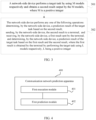
- FIG. 3 is a second schematic flowchart of a communication network prediction method according to an embodiment of this application. As shown in FIG. 3 , the method includes steps 301 and 302.
- Step 301 A network-side device performs a target task by using M models respectively and obtains a second result output by the M models, where M is a positive integer.
- Step 302 The network-side device performs any one of the following operations:
- the terminal includes, but is not limited to, the types of terminals 11 listed above.
- the network-side device includes, but is not limited to, the types of the network-side devices 12 listed above.
- the network-side device includes at least one of the following: a core network node, an access network node (such as a base station), and a neural network processing node.
- the core network node is, for example, a network data analytics function (Network Data Analytics Function, NWDAF) network element and/or a location service management function (location management function, LMF) network element.
- NWDAF Network Data Analytics Function
- LMF location management function
- the target task performed by the model in this embodiment of this application may include a task such as positioning and/or channel state information (Channel State Information, CSI) estimation.
- CSI Channel State Information
- the type of any one of the L models includes an AI-based model or a non-AI-based model.
- the type of any one of the M models includes an AI-based model or a non-AI-based model.
- the non-AI-based model may include a wireless communication network positioning method based on a measurement result of a direct path, and the like.
- the AI-based model may include at least one of the following: a convolutional neuron network with attention (CNN with attention) model; and a vision transformer (Vision Transformer) model.
- the terminal uses the L models to perform the target task, and each model outputs its own output result.
- the first result may include L output results respectively output by the L models, or a fusion result of the L output results.
- the second result sent by the network-side device may include M output results respectively output by the M models, or a fusion result of the M output results.
- the terminal after determining the prediction result of the target task based on the first result, the terminal makes a decision associated with the target task based on the prediction result of the target task.
- a same task is performed by using a plurality of models in a communication network respectively, and after a result corresponding to each model is obtained, results corresponding to the plurality of models are fused to obtain a prediction result of the task, so as to make a decision.
- decision-making can be implemented by comprehensively considering the results of the plurality of models/algorithms, which can effectively improve decision-making precision, reduce a failure probability, reduce the frequency of model switching, and implement compatible coexistence and deployment of different models.
- the method further includes:
- the first information includes at least one of the following:
- the measurement quantity information input by various types of models includes at least one of the following:
- the output information of various types of models includes at least one of the following:
- the request information includes second information, where the second information includes at least one of the following:
- the method further includes: receiving, by the network-side device, third information sent by the terminal; where the third information is used to indicate capability information of the terminal.
- the third information includes at least one of the following:
- the data type includes at least one of the following:
- the method further includes: receiving, by the network-side device, feedback information sent by the terminal, where the feedback information is used to indicate whether the terminal supports a model corresponding to the model configuration information.
- the method further includes: determining, by the network-side device, the M models.
- the determining, by the network-side device, the M models includes:
- the method further includes: receiving, by the network-side device, fifth information sent by the terminal, where the fifth information includes at least one of the following:
- the method further includes: receiving, by the network-side device, sixth information sent by the terminal; where the sixth information is used to indicate capability information of the terminal.
- the sixth information includes at least one of the following:
- the data type includes at least one of the following:
- the method further includes: sending, by the network-side device, seventh information to the terminal, where the seventh information includes configuration information of the M models.
- the seventh information includes at least one of the following:
- the method further includes: receiving, by the network-side device, measurement quantity information sent by the terminal.
- the determining, by the network-side device, a prediction result of the target task based on the second result includes: determining, by the network-side device, the prediction result of the target task based on a second fusion manner and the second result; or the determining, by the network-side device, a prediction result of the target task based on the first result and the second result includes: determining, by the network-side device, the prediction result of the target task based on a second fusion manner, the first result, and the second result.
- the second fusion manner includes:
- the method further includes: determining, by the network-side device, the second fusion manner based on target information.
- the target information includes at least one of the following:
- the method further includes: making, by the network-side device, a decision associated with the target task based on the prediction result of the target task.
- the second result includes: M output results respectively output by the M models, or a fusion result of the M output results.
- the method further includes: sending, by the network-side device, eleventh information to the terminal, where the eleventh information is used to indicate a prediction mode based on the first result and the second result.
- the prediction mode includes any one of the following:
- the execution subject can be a communication network prediction apparatus.
- the communication network prediction method being performed by the communication network prediction apparatus is used as an example to describe the communication network prediction apparatus provided in the embodiments of this application.
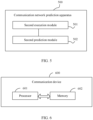
- FIG. 4 is a first schematic structural diagram of a communication network prediction apparatus according to an embodiment of this application. As shown in FIG. 4 , the communication network prediction apparatus 400 is applied to a terminal and includes:
- the communication network prediction apparatus in this embodiment of this application performs a same task by using a plurality of models in a communication network respectively, and after a result corresponding to each model is obtained, results corresponding to the plurality of models are fused to obtain a prediction result of the task, so as to make a decision.
- decision-making can be implemented by comprehensively considering the results of the plurality of models/algorithms, which can effectively improve decision-making precision, reduce a failure probability, reduce the frequency of model switching, and implement compatible coexistence and deployment of different models.
- the apparatus further includes: a first determining module, configured to determine the L models.
- the first determining module is specifically configured to perform any one of the following:
- the first information includes at least one of the following:
- the measurement quantity information input by various types of models includes at least one of the following:
- the output information of various types of models includes at least one of the following:
- the request information includes second information, where the second information includes at least one of the following:
- the apparatus further includes: a first sending module, configured to send third information to the network-side device, where the third information is used to indicate capability information of the terminal.
- a first sending module configured to send third information to the network-side device, where the third information is used to indicate capability information of the terminal.
- the third information includes at least one of the following:
- the data type includes at least one of the following:
- the apparatus further includes: a second sending module, configured to send feedback information to the network-side device, where the feedback information is used to indicate whether the terminal supports a model corresponding to the model configuration information.
- a second sending module configured to send feedback information to the network-side device, where the feedback information is used to indicate whether the terminal supports a model corresponding to the model configuration information.
- the apparatus further includes: a third sending module, configured to send fifth information to the network-side device, where the fifth information includes at least one of the following:
- the apparatus further includes: a fourth sending module, configured to send sixth information to the network-side device, where the sixth information is used to indicate capability information of the terminal.
- a fourth sending module configured to send sixth information to the network-side device, where the sixth information is used to indicate capability information of the terminal.
- the sixth information includes at least one of the following:
- the data type includes at least one of the following:
- the apparatus further includes: a first receiving module, configured to receive seventh information sent by the network-side device, where the seventh information includes configuration information of the M models.
- the seventh information includes at least one of the following:
- the apparatus further includes: a fifth sending module, configured to send measurement quantity information to the network-side device.
- a fifth sending module configured to send measurement quantity information to the network-side device.
- the first prediction module 402 is configured to:
- the first fusion manner includes:
- the apparatus further includes: a second determining module, configured to determine the first fusion manner based on target information.
- the target information includes at least one of the following:
- the apparatus further includes: a first decision-making module, configured to make a decision associated with the target task based on the prediction result of the target task.
- a first decision-making module configured to make a decision associated with the target task based on the prediction result of the target task.
- the first result includes: L output results respectively output by the L models; or a fusion result of the L output results.
- the apparatus further includes: a second receiving module, configured to receive eleventh information sent by the network-side device, where the eleventh information is used to indicate a prediction mode based on the first result and the second result.
- a second receiving module configured to receive eleventh information sent by the network-side device, where the eleventh information is used to indicate a prediction mode based on the first result and the second result.
- the prediction mode includes any one of the following:
- FIG. 5 is a second schematic structural diagram of a communication network prediction apparatus according to an embodiment of this application. As shown in FIG. 5 , the communication network prediction apparatus 500 is applied to a network-side device and includes:
- the communication network prediction apparatus in this embodiment of this application performs a same task by using a plurality of models in a communication network respectively, and after a result corresponding to each model is obtained, results corresponding to the plurality of models are fused to obtain a prediction result of the task, so as to make a decision.
- decision-making can be implemented by comprehensively considering the results of the plurality of models/algorithms, which can effectively improve decision-making precision, reduce a failure probability, reduce the frequency of model switching, and implement compatible coexistence and deployment of different models.
- the apparatus further includes:
- the first information includes at least one of the following:
- the measurement quantity information input by various types of models includes at least one of the following:
- the output information of various types of models includes at least one of the following:
- the request information includes second information, where the second information includes at least one of the following:
- the apparatus further includes: a third receiving module, configured to receive third information sent by the terminal, where the third information is used to indicate capability information of the terminal.
- a third receiving module configured to receive third information sent by the terminal, where the third information is used to indicate capability information of the terminal.
- the third information includes at least one of the following:
- the data type includes at least one of the following:
- the apparatus further includes: a fourth receiving module, configured to receive feedback information sent by the terminal, where the feedback information is used to indicate whether the terminal supports a model corresponding to the model configuration information.
- a fourth receiving module configured to receive feedback information sent by the terminal, where the feedback information is used to indicate whether the terminal supports a model corresponding to the model configuration information.
- the apparatus further includes: a second determining module, configured to determine the M models.
- the second determining module is configured to:
- the apparatus further includes: a fifth receiving module, configured to receive fifth information sent by the terminal, where the fifth information includes at least one of the following:
- the apparatus further includes: a sixth receiving module, configured to receive sixth information sent by the terminal; where the sixth information is used to indicate capability information of the terminal.
- a sixth receiving module configured to receive sixth information sent by the terminal; where the sixth information is used to indicate capability information of the terminal.
- the sixth information includes at least one of the following:
- the data type includes at least one of the following:
- the apparatus further includes: a seventh sending module, configured to send seventh information to the terminal, where the seventh information includes configuration information of the M models.
- the seventh information includes at least one of the following:
- the apparatus further includes: a seventh receiving module, configured to receive measurement quantity information sent by the terminal.
- the second execution module is configured to perform the target task by using the M models respectively based on the measurement quantity information sent by the terminal, and obtain the second result output by the M models.
- the second prediction module is configured to:
- the second fusion manner includes:
- the apparatus further includes: a third determining module, configured to determine the second fusion manner based on target information.
- the target information includes at least one of the following:
- the apparatus further includes: a second decision-making module, configured to, for the network-side device, make a decision associated with the target task based on the prediction result of the target task.
- a second decision-making module configured to, for the network-side device, make a decision associated with the target task based on the prediction result of the target task.
- the second result includes: M output results respectively output by the M models, or a fusion result of the M output results.
- the apparatus further includes: an eighth sending module, configured to send eleventh information to the terminal, where the eleventh information is used to indicate a prediction mode based on the first result and the second result.
- an eighth sending module configured to send eleventh information to the terminal, where the eleventh information is used to indicate a prediction mode based on the first result and the second result.
- the prediction mode includes any one of the following:
- the communication network prediction apparatus in this embodiment of the application may be an electronic device, such as an electronic device with an operating system, or a component in the electronic device, such as an integrated circuit or a chip.
- the electronic device may be a terminal or other devices than the terminal.
- the terminal may include, but is not limited to, the types of the terminal 11 listed above, and other devices may be a server, a network attached storage (Network Attached Storage, NAS), and the like. This is not limited in the embodiments of this application.
- the communication network prediction apparatus provided in this embodiment of this application is capable of implementing the processes implemented in the method embodiments in FIG. 1 to FIG. 3 , with the same technical effects achieved. To avoid repetition, details are not described herein again.
- FIG. 6 is a schematic structural diagram of a communication device according to an embodiment of this application.
- the communication device 600 includes a processor 601, a memory 602, and a program or instructions stored in the memory 602 and executable on the processor 601.
- the steps of the foregoing embodiments of the communication network prediction method are implemented, with the same technical effects achieved.
- the steps of the foregoing embodiments of the communication network prediction method are implemented, with the same technical effects achieved.
- the steps of the foregoing embodiments of the communication network prediction method are implemented, with the same technical effects achieved. To avoid repetition, details are not described herein again.
- An embodiment of this application further provides a terminal, including a processor and a communication interface.
- the processor is configured to: perform a target task by using L models respectively and obtain a first result output by the L models, where L is a positive integer; and perform at least one of the following operations:
- the terminal embodiments correspond to the foregoing terminal-side method embodiments, and the implementation processes and implementations of the foregoing method embodiments can be applied to the terminal embodiments, with the same technical effects achieved.
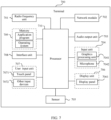
- FIG. 7 is a schematic structural diagram of hardware of a terminal according to an embodiment of this application.
- the terminal 700 includes but is not limited to at least part of components such as a radio frequency unit 701, a network module 702, an audio output unit 703, an input unit 704, a sensor 705, a display unit 706, a user input unit 707, an interface unit 708, a memory 709, and a processor 710.
- the terminal 700 may further include a power supply (for example, a battery) supplying power to the components, and the power supply may be logically connected to the processor 710 through a power management system. In this way, functions such as charge management, discharge management, and power consumption management are implemented by using the power management system.
- a power supply for example, a battery
- functions such as charge management, discharge management, and power consumption management are implemented by using the power management system.
- the structure of the terminal shown in FIG. 7 does not constitute any limitation on the terminal.
- the terminal may include more or fewer components than shown in the figure, or a combination of some components, or the components disposed differently. Details are not described herein again.
- the input unit 704 may include a graphics processing unit (Graphics Processing Unit, GPU) 7041 and a microphone 7042.
- the graphics processing unit 7041 processes image data of a still picture or video obtained by an image capture apparatus (such as a camera) in a video capture mode or an image capture mode.
- the display unit 706 may include a display panel 7061, and the display panel 7061 may be configured in a form of a liquid crystal display, an organic light-emitting diode, and the like.
- the user input unit 707 may include at least one of a touch panel 7071 and other input devices 7072.
- the touch panel 7071 is also referred to as a touchscreen.
- the touch panel 7071 may include two parts: a touch detection apparatus and a touch controller.
- the other input devices 7072 may include but are not limited to a physical keyboard, a function key (such as a volume control key or a power on/off key), a trackball, a mouse, a joystick, and the like. Details are not described herein.
- the radio frequency unit 701 receives downlink data from a network-side device, and then sends the downlink data to the processor 710 for processing. In addition, the radio frequency unit 701 may send uplink data to the network-side device.
- the radio frequency unit 701 includes but is not limited to an antenna, an amplifier, a transceiver, a coupler, a low noise amplifier, a duplexer, and the like.
- the memory 709 may be configured to store software programs or instructions and various data.
- the memory 709 may include a first storage area for storing a program or instructions and a second storage area for storing data.
- the first storage area may store an operating system, an application program or instruction required by at least one function (for example, a sound playback function or an image playback function), and the like.
- the memory 709 may include a volatile memory or a non-volatile memory, or the memory 709 may include both a volatile memory and a non-volatile memory.
- the non-volatile memory may be a read-only memory (Read-Only Memory, ROM), a programmable read only memory (Programmable ROM, PROM), an erasable programmable read-only memory (Erasable PROM, EPROM), and an electrically erasable programmable read-only memory (Electrically EPROM, EEPROM), or flash memory.
- ROM Read-Only Memory
- PROM programmable read only memory
- Erasable PROM Erasable PROM
- EPROM erasable programmable read-only memory
- Electrically erasable programmable read-only memory Electrically erasable programmable read-only memory
- the volatile memory can be a random access memory (Random Access Memory, RAM), a static random access memory (Static RAM, SRAM), a dynamic random access memory (Dynamic RAM, DRAM), a synchronous dynamic random access memory (Synchronous DRAM, SDRAM), a double data rate synchronous dynamic random access memory (Double Data Rate SDRAM, DDRSDRAM), an enhanced synchronous dynamic random access memory (Enhanced SDRAM, ESDRAM), a synchlink dynamic random access memory (Synch link DRAM, SLDRAM), and a direct rambus random access memory (Direct Rambus RAM, DRRAM).
- RAM Random Access Memory
- SRAM static random access memory
- DRAM dynamic random access memory
- DRAM synchronous dynamic random access memory
- SDRAM double data rate synchronous dynamic random access memory
- Enhanced SDRAM, ESDRAM enhanced synchronous dynamic random access memory
- Synch link DRAM, SLDRAM synchlink dynamic random access memory
- Direct Rambus RAM Direct Rambus RAM
- the processor 710 may include one or more processing units.
- an application processor and a modem processor may be integrated in the processor 710.
- This application processor primarily processes operations involving an operating system, user interfaces, application programs, and the like.
- the modem processor primarily processes radio communication signals, for example, being a baseband processor. It can be understood that the modem processor may alternatively be not integrated in the processor 710.
- the processor 710 is configured to perform a target task by using L models respectively and obtain a first result output by the L models, where L is a positive integer; and perform at least one of the following operations:
- the terminal in this embodiment of this application performs a same task by using a plurality of models respectively in a communication network, and after a result corresponding to each model is obtained, results corresponding to the plurality of models are fused to obtain a prediction result of the task, so as to make a decision.
- decision-making can be implemented by comprehensively considering the results of the plurality of models/algorithms, which can effectively improve decision-making precision, reduce a failure probability, reduce the frequency of model switching, and implement compatible coexistence and deployment of different models.
- An embodiment of this application further provides a network-side device, including a processor and a communication interface, where the processor is configured to: perform a target task by using M models respectively and obtain a second result output by the M models, where M is a positive integer; and perform at least one of the following operations:
- the network-side device embodiments correspond to the foregoing network-side device method embodiments, and the implementation processes and implementations of the foregoing method embodiments can be applied to the network-side device embodiments, with the same technical effects achieved.
- FIG. 8 is a first schematic structural diagram of a network-side device according to an embodiment of this application.
- the network-side device 800 includes an antenna 801, a radio frequency apparatus 802, a baseband apparatus 803, a processor 804, and a memory 805.
- the antenna 801 is connected to the radio frequency apparatus 802.
- the radio frequency apparatus 802 receives information by using the antenna 801, and sends the received information to the baseband apparatus 803 for processing.
- the baseband apparatus 803 processes to-be-sent information, and sends the information to the radio frequency apparatus 802; and the radio frequency apparatus 802 processes the received information and then sends the information out by using the antenna 801.
- the method executed by the network-side device in the foregoing embodiments can be implemented in the baseband apparatus 803, and the baseband apparatus 803 includes a baseband processor
- the baseband apparatus 803 may include, for example, at least one baseband board, where a plurality of chips are disposed on the baseband board. As shown in FIG. 8 , one of the chips is, for example, a baseband processor, and is connected to the memory 805 through the bus interface, to invoke a program in the memory 805 to perform the operations of the network device shown in the foregoing method embodiments.
- the network-side device may further include a network interface 806, where the interface is, for example, a common public radio interface (common public radio interface, CPRI).
- a common public radio interface common public radio interface, CPRI
- the network-side device 800 in this embodiment of the present invention further includes: instructions or a program stored in the memory 805 and executable on the processor 804.
- the processor 804 invokes the instructions or program in the memory 805 to execute the steps of the communication network prediction method on the network-side device side, with the same technical effects achieved. To avoid repetition, details are not repeated herein.
- FIG. 9 is a second schematic structural diagram of a network-side device according to an embodiment of this application.
- the network-side device 900 includes a processor 901, a network interface 902, and a memory 903.
- the network interface 902 is, for example, a common public radio interface (common public radio interface, CPRI).
- CPRI common public radio interface
- the network-side device 900 in this embodiment of the present invention further includes: instructions or a program stored in the memory 903 and executable on the processor 901.
- the processor 901 invokes the instructions or program in the memory 903 to execute the steps of the communication network prediction method on the network-side device side, with the same technical effects achieved. To avoid repetition, details are not repeated herein.
- An embodiment of this application further provides a communication network prediction system, including a terminal and a network-side device, where the terminal can be configured to execute the steps of the communication network prediction method described above, and the network-side device can be configured to execute the steps of the communication network prediction method described above.
- An embodiment of this application further provides a readable storage medium.
- the readable storage medium may be volatile or non-volatile.
- a program or instructions are stored in the readable storage medium. When the program or the instructions are executed by a processor, the processes of the foregoing embodiment of the communication network prediction method can be implemented, with the same technical effects achieved. To avoid repetition, details are not described herein again.
- the processor is a processor in the terminal described in the foregoing embodiments.
- the readable storage medium includes a computer-readable storage medium, for example, a computer read only memory ROM, a random access memory RAM, a magnetic disk, or an optical disc.
- An embodiment of this application further provides a chip, where the chip includes a processor and a communication interface.
- the communication interface is coupled to the processor, and the processor is configured to run a program or instructions to implement the processes of the embodiments of the communication network prediction method, with the same technical effects achieved. To avoid repetition, details are not described herein again.
- the chip mentioned in the embodiments of this application may also be referred to as a system-level chip, a system chip, a chip system, a system-on-chip, or the like.
- An embodiment of this application further provides a computer program/program product, where the computer program/program product is stored in a storage medium, and when being executed by at least one processor, the computer program/program product is configured to implement the processes of the embodiments of the communication network prediction method, with the same technical effects achieved. To avoid repetition, details are not repeated herein.
- the computer software product is stored in a storage medium (such as a ROM/RAM, a magnetic disk, or an optical disc), and includes several instructions for instructing a terminal (which may be a mobile phone, a computer, a server, an air conditioner, a network device, or the like) to perform the methods described in the embodiments of this application.
- a storage medium such as a ROM/RAM, a magnetic disk, or an optical disc
- a terminal which may be a mobile phone, a computer, a server, an air conditioner, a network device, or the like
Landscapes
- Engineering & Computer Science (AREA)
- Theoretical Computer Science (AREA)
- Physics & Mathematics (AREA)
- Software Systems (AREA)
- General Physics & Mathematics (AREA)
- Artificial Intelligence (AREA)
- General Engineering & Computer Science (AREA)
- Data Mining & Analysis (AREA)
- Evolutionary Computation (AREA)
- Mathematical Physics (AREA)
- Computing Systems (AREA)
- Computer Networks & Wireless Communication (AREA)
- Signal Processing (AREA)
- Computational Linguistics (AREA)
- Life Sciences & Earth Sciences (AREA)
- General Health & Medical Sciences (AREA)
- Biophysics (AREA)
- Biomedical Technology (AREA)
- Molecular Biology (AREA)
- Health & Medical Sciences (AREA)
- Computer Vision & Pattern Recognition (AREA)
- Medical Informatics (AREA)
- Probability & Statistics with Applications (AREA)
- Mathematical Analysis (AREA)
- Mathematical Optimization (AREA)
- Pure & Applied Mathematics (AREA)
- Computational Mathematics (AREA)
- Algebra (AREA)
- Mobile Radio Communication Systems (AREA)
Applications Claiming Priority (2)
| Application Number | Priority Date | Filing Date | Title |
|---|---|---|---|
| CN202210044930.1A CN116489035A (zh) | 2022-01-14 | 2022-01-14 | 通信网络预测方法、终端及网络侧设备 |
| PCT/CN2023/071486 WO2023134653A1 (fr) | 2022-01-14 | 2023-01-10 | Procédé de prédiction de réseau de communication, terminal et dispositif côté réseau |
Publications (2)
| Publication Number | Publication Date |
|---|---|
| EP4465711A1 true EP4465711A1 (fr) | 2024-11-20 |
| EP4465711A4 EP4465711A4 (fr) | 2025-04-30 |
Family
ID=87212545
Family Applications (1)
| Application Number | Title | Priority Date | Filing Date |
|---|---|---|---|
| EP23739995.1A Pending EP4465711A4 (fr) | 2022-01-14 | 2023-01-10 | Procédé de prédiction de réseau de communication, terminal et dispositif côté réseau |
Country Status (4)
| Country | Link |
|---|---|
| US (1) | US20240372789A1 (fr) |
| EP (1) | EP4465711A4 (fr) |
| CN (1) | CN116489035A (fr) |
| WO (1) | WO2023134653A1 (fr) |
Families Citing this family (3)
| Publication number | Priority date | Publication date | Assignee | Title |
|---|---|---|---|---|
| CN120825742A (zh) * | 2024-04-15 | 2025-10-21 | 华为技术有限公司 | 通信系统中任务执行的方法及相关装置 |
| CN120957105A (zh) * | 2024-05-14 | 2025-11-14 | 维沃移动通信有限公司 | 信息处理方法、装置及设备 |
| CN119155706B (zh) * | 2024-11-07 | 2025-02-07 | 成都乐超人科技有限公司 | 基于智能ai实现5g通信质量分析方法及系统 |
Family Cites Families (14)
| Publication number | Priority date | Publication date | Assignee | Title |
|---|---|---|---|---|
| US9900790B1 (en) * | 2016-12-08 | 2018-02-20 | Futurewei Technologies, Inc. | Prediction of performance indicators in cellular networks |
| CN109597104A (zh) * | 2018-10-22 | 2019-04-09 | 中国科学院光电研究院 | 一种采用多模型多系统对目标跟踪定位的方法 |
| WO2021019498A1 (fr) * | 2019-07-30 | 2021-02-04 | Telefonaktiebolaget Lm Ericsson (Publ) | Collecte de données assistée par équipement utilisateur pour une prédiction de mobilité |
| KR102192147B1 (ko) * | 2019-08-30 | 2020-12-16 | 엘지전자 주식회사 | 지능적 기기 제어 방법, 이동 단말기 및 지능형 컴퓨팅 디바이스 |
| US11221848B2 (en) * | 2019-09-25 | 2022-01-11 | Intel Corporation | Sharing register file usage between fused processing resources |
| EP4074097A4 (fr) * | 2019-12-10 | 2022-12-28 | Telefonaktiebolaget Lm Ericsson (Publ) | Procédés, ue et premier n?ud de réseau pour gérer des informations de mobilité dans un réseau de communication |
| WO2021121585A1 (fr) * | 2019-12-18 | 2021-06-24 | Telefonaktiebolaget Lm Ericsson (Publ) | Procédés d'apprentissage fédéré en cascade pour la performance de réseau de télécommunications et appareil associé |
| WO2021163895A1 (fr) * | 2020-02-18 | 2021-08-26 | Oppo广东移动通信有限公司 | Procédé de gestion de modèle de réseau, procédé d'établissement ou de modification de session, et appareil |
| CN113839797B (zh) * | 2020-06-23 | 2022-11-25 | 华为技术有限公司 | 数据处理方法和装置 |
| US20240040461A1 (en) * | 2020-07-03 | 2024-02-01 | Telefonaktiebolaget Lm Ericsson (Publ) | Ue, network node and methods for handling mobility information in a communications network |
| CN116684917A (zh) * | 2020-07-17 | 2023-09-01 | 北京小米移动软件有限公司 | 定位测量数据上报方法、装置、终端及存储介质 |
| CN112218330B (zh) * | 2020-11-19 | 2023-11-03 | 中国联合网络通信集团有限公司 | 定位方法及通信装置 |
| KR20230156307A (ko) * | 2021-01-06 | 2023-11-14 | 스포츠 데이타 랩스, 인코포레이티드 | 동물 데이터 준수 시스템 및 방법 |
| US11983238B2 (en) * | 2021-12-03 | 2024-05-14 | International Business Machines Corporation | Generating task-specific training data |
-
2022
- 2022-01-14 CN CN202210044930.1A patent/CN116489035A/zh active Pending
-
2023
- 2023-01-10 EP EP23739995.1A patent/EP4465711A4/fr active Pending
- 2023-01-10 WO PCT/CN2023/071486 patent/WO2023134653A1/fr not_active Ceased
-
2024
- 2024-07-12 US US18/770,810 patent/US20240372789A1/en active Pending
Also Published As
| Publication number | Publication date |
|---|---|
| CN116489035A (zh) | 2023-07-25 |
| US20240372789A1 (en) | 2024-11-07 |
| EP4465711A4 (fr) | 2025-04-30 |
| WO2023134653A1 (fr) | 2023-07-20 |
Similar Documents
| Publication | Publication Date | Title |
|---|---|---|
| US20240414073A1 (en) | Data Collection Method And Device | |
| EP4422248A1 (fr) | Procédé de demande de modèle, procédé de traitement de demande de modèle et dispositif associé | |
| EP4465711A1 (fr) | Procédé de prédiction de réseau de communication, terminal et dispositif côté réseau | |
| WO2023143572A1 (fr) | Procédé de positionnement basé sur un modèle d'intelligence artificielle (ia), et dispositif de communication | |
| US20240356819A1 (en) | Communication method and apparatus, and related device | |
| CN116234000A (zh) | 定位方法及通信设备 | |
| WO2023236979A1 (fr) | Procédé de sélection de modèle de positionnement, terminal et dispositif côté réseau | |
| US20250330392A1 (en) | Model information transmission method and apparatus, and device | |
| EP4451738A1 (fr) | Procédé et appareil de configuration de paramètres, et dispositif de communication, support de stockage et système | |
| WO2023179617A1 (fr) | Procédé et appareil de localisation, terminal et dispositif côté réseau | |
| WO2024067281A1 (fr) | Procédé et appareil de traitement de modèle d'ia, et dispositif de communication | |
| WO2024067438A1 (fr) | Procédé de raisonnement de modèle d'ia, dispositif et support de stockage lisible | |
| US20250240345A1 (en) | Model request method and apparatus, communication device, and readable storage medium | |
| US20250227688A1 (en) | Information transmission method and apparatus, and device | |
| US20240137781A1 (en) | Spatial relation indication method and device | |
| KR20250006308A (ko) | 사이드링크 포지셔닝 방법, 장치, 단말, 서버 및 무선접속망 기기 | |
| CN116418467B (zh) | 探测参考信号的配置方法、装置、终端及网络侧设备 | |
| US20260006477A1 (en) | Measurement Method and Apparatus, and Device | |
| US20250310858A1 (en) | Information interaction method and device | |
| US20250254633A1 (en) | Signal sending method and apparatus, and terminal and network-side device | |
| US20260065168A1 (en) | Model management method and apparatus, and communication device | |
| CN121396404A (zh) | 模型使用方法、终端及网络侧设备 | |
| CN122002305A (zh) | Ai模型管理方法、装置及通信设备 | |
| CN120021208A (zh) | 模型确定方法、装置及通信设备 | |
| CN120456226A (zh) | 基于ai模型的终端定位方法、终端及网络侧设备 |
Legal Events
| Date | Code | Title | Description |
|---|---|---|---|
| STAA | Information on the status of an ep patent application or granted ep patent |
Free format text: STATUS: THE INTERNATIONAL PUBLICATION HAS BEEN MADE |
|
| PUAI | Public reference made under article 153(3) epc to a published international application that has entered the european phase |
Free format text: ORIGINAL CODE: 0009012 |
|
| STAA | Information on the status of an ep patent application or granted ep patent |
Free format text: STATUS: REQUEST FOR EXAMINATION WAS MADE |
|
| 17P | Request for examination filed |
Effective date: 20240809 |
|
| AK | Designated contracting states |
Kind code of ref document: A1 Designated state(s): AL AT BE BG CH CY CZ DE DK EE ES FI FR GB GR HR HU IE IS IT LI LT LU LV MC ME MK MT NL NO PL PT RO RS SE SI SK SM TR |
|
| DAV | Request for validation of the european patent (deleted) | ||
| DAX | Request for extension of the european patent (deleted) | ||
| A4 | Supplementary search report drawn up and despatched |
Effective date: 20250328 |
|
| RIC1 | Information provided on ipc code assigned before grant |
Ipc: H04W 88/14 20090101ALN20250324BHEP Ipc: H04W 88/18 20090101ALN20250324BHEP Ipc: G06N 20/00 20190101ALI20250324BHEP Ipc: H04L 41/147 20220101ALI20250324BHEP Ipc: H04W 64/00 20090101AFI20250324BHEP |