EP4467009A1 - Verfahren zur herstellung eines gegossenen bahnmaterials. - Google Patents
Verfahren zur herstellung eines gegossenen bahnmaterials. Download PDFInfo
- Publication number
- EP4467009A1 EP4467009A1 EP24170010.3A EP24170010A EP4467009A1 EP 4467009 A1 EP4467009 A1 EP 4467009A1 EP 24170010 A EP24170010 A EP 24170010A EP 4467009 A1 EP4467009 A1 EP 4467009A1
- Authority
- EP
- European Patent Office
- Prior art keywords
- slurry
- sheet material
- slurries
- cast sheet
- different
- Prior art date
- Legal status (The legal status is an assumption and is not a legal conclusion. Google has not performed a legal analysis and makes no representation as to the accuracy of the status listed.)
- Granted
Links
Images



Classifications
-
- A—HUMAN NECESSITIES
- A24—TOBACCO; CIGARS; CIGARETTES; SIMULATED SMOKING DEVICES; SMOKERS' REQUISITES
- A24B—MANUFACTURE OR PREPARATION OF TOBACCO FOR SMOKING OR CHEWING; TOBACCO; SNUFF
- A24B3/00—Preparing tobacco in the factory
- A24B3/14—Forming reconstituted tobacco products, e.g. wrapper materials, sheets, imitation leaves, rods, cakes; Forms of such products
-
- A—HUMAN NECESSITIES
- A24—TOBACCO; CIGARS; CIGARETTES; SIMULATED SMOKING DEVICES; SMOKERS' REQUISITES
- A24B—MANUFACTURE OR PREPARATION OF TOBACCO FOR SMOKING OR CHEWING; TOBACCO; SNUFF
- A24B15/00—Chemical features or treatment of tobacco; Tobacco substitutes, e.g. in liquid form
- A24B15/10—Chemical features of tobacco products or tobacco substitutes
- A24B15/12—Chemical features of tobacco products or tobacco substitutes of reconstituted tobacco
-
- A—HUMAN NECESSITIES
- A24—TOBACCO; CIGARS; CIGARETTES; SIMULATED SMOKING DEVICES; SMOKERS' REQUISITES
- A24B—MANUFACTURE OR PREPARATION OF TOBACCO FOR SMOKING OR CHEWING; TOBACCO; SNUFF
- A24B15/00—Chemical features or treatment of tobacco; Tobacco substitutes, e.g. in liquid form
- A24B15/10—Chemical features of tobacco products or tobacco substitutes
- A24B15/12—Chemical features of tobacco products or tobacco substitutes of reconstituted tobacco
- A24B15/14—Chemical features of tobacco products or tobacco substitutes of reconstituted tobacco made of tobacco and a binding agent not derived from tobacco
-
- A—HUMAN NECESSITIES
- A24—TOBACCO; CIGARS; CIGARETTES; SIMULATED SMOKING DEVICES; SMOKERS' REQUISITES
- A24B—MANUFACTURE OR PREPARATION OF TOBACCO FOR SMOKING OR CHEWING; TOBACCO; SNUFF
- A24B15/00—Chemical features or treatment of tobacco; Tobacco substitutes, e.g. in liquid form
- A24B15/10—Chemical features of tobacco products or tobacco substitutes
- A24B15/16—Chemical features of tobacco products or tobacco substitutes of tobacco substitutes
-
- A—HUMAN NECESSITIES
- A24—TOBACCO; CIGARS; CIGARETTES; SIMULATED SMOKING DEVICES; SMOKERS' REQUISITES
- A24B—MANUFACTURE OR PREPARATION OF TOBACCO FOR SMOKING OR CHEWING; TOBACCO; SNUFF
- A24B3/00—Preparing tobacco in the factory
- A24B3/08—Blending tobacco
-
- A—HUMAN NECESSITIES
- A24—TOBACCO; CIGARS; CIGARETTES; SIMULATED SMOKING DEVICES; SMOKERS' REQUISITES
- A24D—CIGARS; CIGARETTES; TOBACCO SMOKE FILTERS; MOUTHPIECES OF CIGARS OR CIGARETTES; MANUFACTURE OF TOBACCO SMOKE FILTERS OR MOUTHPIECES
- A24D1/00—Cigars; Cigarettes
- A24D1/02—Cigars; Cigarettes with special covers
-
- D—TEXTILES; PAPER
- D21—PAPER-MAKING; PRODUCTION OF CELLULOSE
- D21F—PAPER-MAKING MACHINES; METHODS OF PRODUCING PAPER THEREON
- D21F13/00—Making discontinuous sheets of paper, pulpboard or cardboard, or of wet web, for fibreboard production
Definitions
- the present invention relates to a method for forming a cast sheet material, comprising introducing a slurry in a casting apparatus, casting the slurry onto a movable support by means of a casting means to form a layer and drying the layer for obtaining the cast sheet material.
- the present invention also relates to a cast sheet material and its use.
- EP 3 232 823 relates to a method for forming a cast web of homogenized tobacco material, comprising the introduction of a slurry of homogenized tobacco material in a casting box, casting said slurry onto a movable support by means of a casting blade so as to form a cast web.
- Homogenized tobacco materials are formed by mixing several ingredients with water to obtain a slurry and in a further step, a continuous web of homogenized material is created on a support by casting the slurry onto the support, wherein the resulting homogenized tobacco material has a relatively high tensile strength and a good homogeneity.
- EP 1 489 927 relates to a method for manufacturing a top loaded cigarette filler, the method comprising the steps of dosing a slurry composed on a basis of a fraction of fine tobacco and cellulose fibres on a drying conveyor for forming a base layer, spreading over the base layer a fraction of coarse tobacco for forming a top load on the base layer and subsequently subjecting the total to a drying treatment, wherein composing the base layer comprises a steps of combining and mixing the slurry.
- EP 3 075 267 relates to a method for manufacturing a film consisting of at least two layers, the method comprising the following steps of arranging a first, still liquid bottom layer on an endless belt, arranging a second, still liquid top layer on the still liquid bottom layer, after which the composition of bottom layer and top layer is subjected to a drying treatment for the purpose of obtaining said film consisting of at least two layers.
- the compositions of each of the layers to be arranged differ from each other and as a result of the use of different layers different properties at the same moment in the same end product can be obtained.
- US 2021/267260 relates to a casting apparatus to cast a sheet of a material containing alkaloids
- the casting apparatus includes a casting box apt to contain a slurry to be cast to form the sheet, a slurry supply element defining a feeding channel apt to introduce the slurry into the casting box in a supply direction, path diverting fins positioned within the feeding channel, the path diverting fins being apt to come into contact with the slurry inside the feeding channel, a movable support, and a casting blade apt to cast the slurry contained in the casting box onto the movable support so as to form the cast sheet.
- US 2022/287354 relates to a method for casting a sheet of a material containing alkaloids, the method comprising forming a slurry of the material containing alkaloids, the slurry having a viscosity value, storing the slurry in a first tank, providing a first flow-path and a second flow-path for fluid communication between the first tank and a casting box, directing the slurry either along the first flow-path or along the second flow-path from the first tank to the casting box, defining a flow of slurry through the first flow-path or through the second flow-path, on the basis of the viscosity value of the slurry, and casting the slurry to obtain a sheet of material containing alkaloids.
- Heat-not-burn articles are well known in the art.
- EP 3,949,771 discloses a heat-not-burn smoking article comprising a tobacco filler containing tobacco and an aerosol former; and a filter disposed downstream of the tobacco filler.
- US 2019/373948 discloses a heat-not-burn cigarette.
- EP 1 85 0685 relates to a cigarette where the cigarette filter includes one or more capsules containing an additive material for modifying characteristics of tobacco smoke during smoking of the cigarette.
- the one or more capsules each comprise a frangible wall encapsulating the additive material, wherein the frangible wall breaks to expose the additive material when the capsule is subjected to external force, wherein the additive material comprises menthol.
- flavour capsule cigarettes Since 2007, the popularity of flavour capsule cigarettes is rapidly growing, which shows there is a desire for a more variable smoking experience. When consuming a smoking article, the taste and aroma of the wrapping material contribute significantly to the smoking experience. Thus, a wrapper with a variable taste and/or aroma will result in a desirable variable smoking experience.
- the cast sheet materials as discussed above can be seen as sheet materials having a homogenous composition.
- a homogeneous composition means that the composition of the cast sheet material in the length direction is the same as in the width direction, and the composition of the cast sheet material is the same over the thickness of the material as well. There is no difference of the composition in any of its directions.
- the term homogeneous as used here refers to a macroscopic level, i.e. on a scale of a few mm and upward. Under a microscope, inhomogeneities, like air pockets and agglomerates of certain components may be visible, but on a macroscopic level, the microscopic inhomogeneities are of a scale that is usually no longer visible or otherwise organoleptically distinguishable. In a situation wherein a cast sheet material having a homogenous composition is used, for example, as a tobacco material, the consumer of such a tobacco material will not notice any difference during the use of the tobacco material, i.e. during the smoking process.
- flavouring components when added to the tobacco material, these flavouring components will be distributed over the cast sheet material in a homogeneous way. Thus, the consumer will experience a constant flavouring taste during the smoking process.
- the cast sheet material obtained after drying is a single layer.
- the at least two different types of slurries are distinguishable as different types of sheet, wherein the types of slurries may be present in the length and/or width direction of the cast sheet material.
- the at least two different types of slurries are different from each other in the amount of the components of the composition.
- the components used in the slurries are the same, but its concentration is different.
- the at least two different types of slurries are mixed in the same ratio or in different ratios.
- an intermediate step is carried out between the step of casting and the step of drying, the intermediate step comprising disturbing the layer on the moveable support for changing the pattern of the layer formed by the casting step.
- the present invention also relates to a cast sheet material consisting of a layer, in which layer at least two different types of slurries are distinguishable as different types of sheet material.
- Such a cast sheet material can be obtained by using different mixing ratios of slurries having different compositions, applying different or multiple positions of slurries having different compositions and disturbing the slurry layer after casting, for instance using a comb or a needle.
- the cast sheet material is a single layer.
- the at least two different types of slurries are different from each other in the composition thereof, wherein components of the composition are chosen from the group of fragrances, flavours, colouring agents, plant based materials, binding agents, humectants and fibers, or a combination thereof.
- Another way of preparing different types of slurries is to use different particle sizes of powder thereby creating texture differences, using different amounts of fibers per slurry, using different types of fibers which will have an influence on tensile strength and/or tear properties.
- the at least two different types of slurries are different from each other in the amounts of some or all of the components of the composition.
- the composition comprises components X, Y and Z, wherein the weight percentage of X+Y+Z amounts to 100 wt.%, and one would like to change the amount of, for example component X, it is clear that the amount of component Y, the amount of component Z, or the amount of both component Y and Z has to be changed as well.
- the present invention also relates to the use of a cast sheet material obtained according to a method as discussed above or a cast sheet material as discussed above as a wrapper for a smoking article.
- the wrapper is a heat-not-burn article.
- the term "cast sheet” as used here refers to a class of materials that is produced, for example, according to a process comprising the following steps: preparing a fluid, microscopically largely homogeneous slurry mix that may comprise web forming materials (e.g. cellulose fibers and binding agents), structural components (e.g. powdered cellulose, tobacco, herbal components), humectants (e.g. glycerol, propylene glycol), product enhancing components (e.g. colorants, preservatives, sweeteners, aromas), and other additional ingredients for influencing physical properties.
- the carrier of this fluid is usually water, but also organic solvents are known in the art.
- the prepared and microscopically largely homogeneous slurry is applied as an even layer, on a carrier, which is usually is a stainless steel belt.
- a carrier i.e. a movable support such as a stainless steel belt
- several well-known technologies comprise, inter alia, knife casting, (reversed) roll coater casting and slot die casting.
- Knife casting is concerned with a bar positioned horizontally over the whole width of the carrier, usually perpendicular to the moving direction of the carrier. There is a small vertical gap over the width of the bar between the carrier and the bar.
- the slurry is deposited on the carrier, just before the bar, and the slurry is transported under the bar by the movement of the carrier and formed into a flat layer on the carrier by the action between the carrier and the bar.
- the technology of (reversed) roll coater casting is concerned with a rubber roller positioned very closely (e.g. a distance of micrometres) from the carrier.
- the rubber roller rotates in the same direction of the carrier, meaning that where the surface of the rubber roller is closest to the carrier, the carrier and the roller rotate in opposite directions.
- a thin, homogeneous layer of slurry is applied on the rubber roller and this thin layer is subsequently transferred to the movable carrier by the rotating rubber roller.
- the slurry is fed under pressure to a chamber with a slit shaped outlet, wherein the slurry is pressed through the slit and flows as a layer with even thickness out of the chamber and drops onto the carrier.
- the carrier provided with the layer of slurry is transported through a drying process wherein water is removed by means of (heated) air. Extra heat may be applied against the underside of the carrier.
- the slurry Once the slurry has formed into a sheet, having a desired moisture content, it is removed from the carrier (doctoring). In some cases the sheet may be remoistened prior to the doctoring step. In subsequent steps the sheet can be slit and rolled, sheeted, shredded, or cut in flakes, or subjected to other processes.
- the cast sheet material manufactured according to the prior art processes is by nature largely macroscopically, homogenous. As a result of imperfections in the process, air pockets, incomplete dissolving of soluble components, agglomeration of solid materials and inhomogeneities in the sheet may be present, but these are usually on a microscopic level and its dimensions are no larger than a few millimetres.
- Homogeneity is usually seen as a positive property of cast sheet materials, however the present invention relates to a process for manufacturing an inhomogeneous sheet product where this inhomogeneity on a macro scale (e.g. a few mm up to centimetres) enhances the usability and attractiveness of the product.
- a macro scale e.g. a few mm up to centimetres
- the present invention is thus related to a technology where two or more slurries with different aspects and/or properties are processed in such a way that on the carrier, a macroscopically inhomogeneous sheet layer is formed.
- a visual difference is to be obtained, a visible random pattern like marble may be created, or a visible regular pattern, like for instance striping may be formed. After drying the slurry, these differences in aspects and/or properties are reflected in the cast sheet material.
- the present method can also be applied in a continuous producing installation, as is common in the industry of cast sheet manufacturing. Important for the present invention is what happens before the drying process, also identified as "the wet end.”
- a cast sheet installation may consist of the following parts on the wet end: an installation for preparing a slurry mixture, as will be discussed in Example 1, a buffer tank from which the prepared slurry is fed to the drying line, a feeding system for controlled and continuous feeding of the slurry to the drying line, a slurry divider with which the slurry is supplied to the receptacle of the casting system on or more points or continuously over the width, a casting system for applying the slurry in a an even layer on the carrier, a stainless steel belt carrying the slurry layer through a drying oven.
- the process can be modified in various ways.
- the first way for preparing a macroscopically inhomogeneous blend of slurries assumes a batch based slurry mixing process, where two (or more) slurry batches with different aspects are prepared separately and stored in separate buffer tanks. In case more than two slurries are used, it may be advantageous when still a number of the slurries are identical.
- Each buffer tank is provided with an individual pump and a piping system leading up to the slurry dividing system.
- the individual pumps are controlled in such a way (electronically and/or mechanically) that the total amount of slurry of all types is sufficient to keep the receptacle of the casting system filled, without overfilling.
- the second function of the control system is to ensure a given ratio between the different slurries. However, the ratio between the slurries may be varied on purpose, e.g. for changing the created pattern.
- the slurries may be blended in a number of ways, or a combination thereof.
- a manifold is used, and two or more slurry pipes may be joined into one pipe.
- the pipes may be provided with an in-line static or dynamic mixer.
- a slurry divider is used that starts a small width, and may spread out over a wider area, i.e. up until the total cast width, ridges, needles, baffles, or similar obstructions may be used to redirect the flow and promote intermixing of the slurries.
- Slurry feed pipes may each have one or more separate nozzles with which the slurry is deposited in the receptacle of the casting system.
- Nozzles may be used to feed a flow of slurry into a slurry that already flows inside the divider.
- the slurry divider or nozzles, or both, may be moved continuously with the objective to create patterns of the different slurries in eventually the receptacle of the casting system.
- the movement of the slurry divider and/or the nozzles may be predetermined and repeatable or random in shape and/or frequency.
- An object may be moved through the slurries in the slurry divider, the receptacle of the casting system, on the carrier, or any combination thereof. That object may have different geometries, e.g. a needle, a paddle, or a spoon.
- the movement of the object may be predetermined and repeatable or random in shape and/or frequency.
- the system may be simplified as follows. From a slurry tank, two pipelines (or one pipeline that is being split) exit towards the slurry divider, identified as line 1 and line 2. Before the divider, via a separate system with a vessel, a pump and a flow control mechanism, an amount of an additional ingredient is fed into the main slurry flow of line 1. After this action, the slurry of line 1 passes through an in line static or dynamic mixer to form a modified slurry.
- the additional ingredient may for instance be a taste component, such as vanillin or caramel.
- slurry line 2 preferably with a different additional ingredient, for instance a taste component that differs from the taste component that was used for the slurry in slurry line 1.
- a different additional ingredient for instance a taste component that differs from the taste component that was used for the slurry in slurry line 1.
- Each of the different streams form a slurry much like the different slurries described above, and the same steps may be used to create the macroscopically inhomogeneous blend. It is understood that the above mentioned steps may be repeated as often as needed thereby creating a virtually unlimited number of different slurries.
- An aqueous slurry is prepared, comprising the components as shown here.
- the weight percentage is based on the weight of the final product excluding moisture
- Component Amount (wt.%) Cellulose fibers 10% Carboxymethylcellulose 10% Powdered cellulose 70% Glycerol 10%
- a sheet making set up consisting of a glass plate, acting as a carrier material, a casting knife, or film applicator to apply a thin layer of slurry on the carrier material.
- the film applicator having a small receptacle over the width of the applicator, just before the feed side of the applicator, and a water bath on which the glass plate can rest during the drying stage.
- the film applicator is placed on the glass plate, and slurry A and B are placed in the receptacle.
- the ratio between the different components may be varied, for example a composition having a more hemp like character with hints of tobacco, or a composition where the amount of tobacco is increased.
- Component Amount (wt.%) Cellulose fibers 5% Carboxymethylcell u lose 15% Tobacco powder 70% Glycerol 10%
- Component Amount (wt.%) Cellulose fibers 10% Carboxymethylcellulose 10% Tobacco powder 70% Glycerol 10%
- Component Amount (wt.%) Cellulose fibers 10% Carboxymethylcellulose 10% Tobacco powder 70% Glycerol 10%
- Component Amount (wt.%) Cellulose fibers 10% Carboxymethylcellulose 10% Tobacco powder 69.5% Vanillin 0.5% Glycerol 10%
- one of two slurries (the slurry according to Example 6) is provided with a flavouring agent with a low vapour pressure.
- a flavouring agent with a low vapour pressure.
- this will result in a product whereby consumption will lead to a variation in taste during consumption.
- the macroscopical inhomogeneities of the product will not be directly visible but will be organoleptically (smell) detectable.
- various flavouring agents, aromas, and taste enhancing components can be used in this fashion.
- a component with a high vapour pressure e.g. menthol
- a component with a high vapour pressure e.g. menthol
- the slurries prepared on basis of the composition of Example 8 and Example 9 are identical in composition from a chemical point of view, and both contain tobacco. However, because in one of the slurries, i.e. the slurry according to Example 9, a coarser ground tobacco is used, the final cast sheet material will show areas with a fine structure, interspersed with areas with a tactile noticeable coarser structure.
- a cast sheet material with areas of tobacco character, interspersed with areas of hemp character may have as a third feature that the final product is provided with lines where the product may tear easily.
- a cast sheet material may be produced with two optically remarkably similar materials (for instance hemp and taro leaf).
- the hemp slurry may for instance be made with finely ground hemp powder, whereas the taro slurry may be made with a coarse ground taro powder. The difference in texture of the final cast sheet material will then indicate a difference in smoking properties to the consumer.
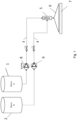
- Figure 1 shows a batch based slurry mixing process according to the present invention.
- a batch based slurry mixing process two slurry batches, i.e. a slurry A and a slurry B with a different composition are prepared separately and stored in separate buffer tanks 1, 2.
- Slurry A is transported via pump 8
- slurry B is transported via pump 9 and both slurries 3, 4 are mixed in mixer 5, such as an in- line static or dynamic mixer.
- the slurry thus obtained is cast onto a movable support (not shown) by means of a slurry divider 6 and a coating device 7 to form a layer.
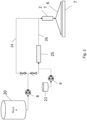
- FIG. 2 shows a slurry mixing process according to the present invention.
- a slurry is transported via pump 8 and split into two separate lines.
- An amount of an additional ingredient stored in tank 21 is fed via pump 9 into the main slurry flow.
- the slurry passes through an in line static or dynamic mixer 25 to form a modified homogeneous slurry 26 of that additional component.
- the composition of slurry 24 differs from the composition of slurry 26.
- Slurry 24 originating from tank 20 is mixed with slurry 26 in mixer 27.
- Such a mixing step results in a slurry comprising two different types of slurries that are inhomogeneously blended with each other.
- the slurry thus obtained is cast onto a movable support (not shown) by means of a slurry divider 6 and a coating device 7 to form a layer.
- Figure 3 shows a slurry divider.
- a slurry divider 6 In a situation where a slurry divider 6 is used that starts a small width, and may spread out over a wider area, i.e. up until the total cast width, ridges, needles, baffles, or similar obstructions may be used to redirect the flow and promote intermixing of the slurries 30, 31.
- Figure 4 shows another example of a slurry divider.
- nozzles 42 are used to feed a flow of slurry 41 into a slurry 40 that already flows inside divider 6.
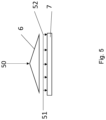
- FIG. 5 shows another example of a slurry divider.
- Slurry feed pipes may each have one or more separate nozzles 52 with which slurry 51 is deposited in coating device 7.
- a slurry divider 6 for slurry 50 is used, and a nozzle system for slurry 51 is used, and both slurries are simultaneously deposited in the coating device.
- Figure 6 shows a slurry mixing process according to the present invention.
- An intermediate step is carried out between the step of casting and the step of drying, the intermediate step comprises disturbing layer 64 on moveable support 63 for changing the pattern of the layer formed by the casting step.
- Such an intermediate step enables the formation of different patterns of the layer.
- slurry 60 and slurry 61 are fed to mixing means 62 and the thus obtained inhomogeneous blend of slurries 60, 61 is transported to slurry divider 6 and coating device 7.
- Bar 65 rod provided with pins that are in contact with layer 64 on moveable support 63 can be moved in a plane parallel to the moveable support 63, or even perpendicular to the movement direction of the moveable support 63 ("left to right"), and these movements may be carried out in a continuous or discontinuous mode, or a combination thereof.
- the perpendicular movement may be combined with an alternating movement parallel to the direction of movement of the moveable support 63. In specific cases, it may be advantageous to have no movement of bar 65.
- the function of bar 65 is to change the pattern of layer 64 formed by the casting step.
Landscapes
- Chemical & Material Sciences (AREA)
- Chemical Kinetics & Catalysis (AREA)
- General Chemical & Material Sciences (AREA)
- Manufacture Of Tobacco Products (AREA)
Applications Claiming Priority (1)
| Application Number | Priority Date | Filing Date | Title |
|---|---|---|---|
| NL2034929A NL2034929B1 (en) | 2023-05-26 | 2023-05-26 | A method for forming a cast sheet material. |
Publications (2)
| Publication Number | Publication Date |
|---|---|
| EP4467009A1 true EP4467009A1 (de) | 2024-11-27 |
| EP4467009B1 EP4467009B1 (de) | 2026-07-22 |
Family
ID=86942174
Family Applications (1)
| Application Number | Title | Priority Date | Filing Date |
|---|---|---|---|
| EP24170010.3A Active EP4467009B1 (de) | 2023-05-26 | 2024-04-12 | Verfahren zur herstellung eines gegossenen bahnmaterials. |
Country Status (3)
| Country | Link |
|---|---|
| US (1) | US20240389632A1 (de) |
| EP (1) | EP4467009B1 (de) |
| NL (1) | NL2034929B1 (de) |
Citations (8)
| Publication number | Priority date | Publication date | Assignee | Title |
|---|---|---|---|---|
| EP1489927A1 (de) | 2002-03-29 | 2004-12-29 | B.V. Deli-Htl Tabak Maatschappij | Verfahren zur herstellung eines zigarettenfilters mit oberladung |
| EP1850685A2 (de) | 2005-02-04 | 2007-11-07 | Philip Morris Products S.A. | Geschmackskapsel zur verbesserten geschmackszuführung in zigaretten |
| EP3075267A1 (de) | 2015-03-31 | 2016-10-05 | B.V. Deli-HTL Tabak Maatschappij | Ein verfahren zum herstellen eines films mit wenigstens zwei schichten |
| EP3232823A1 (de) | 2014-12-16 | 2017-10-25 | Philip Morris Products S.a.s. | Giessvorrichtung zur herstellung einer gegossenen bahn aus homogenisiertem tabakmaterial |
| US20190373948A1 (en) | 2018-05-31 | 2019-12-12 | Xue Zhao | Heat-not-burn cigarettes |
| US20210267260A1 (en) | 2018-06-29 | 2021-09-02 | Philip Morris Products S.A. | Casting apparatus and method for the production of a cast sheet of a material containing alkaloids |
| EP3949771A1 (de) | 2019-03-29 | 2022-02-09 | Japan Tobacco Inc. | Rauchartikel mit erwärmung ohne verbrennung, verfahren zur verwendung davon und rauchsystem mit erwärmung ohne verbrennung |
| US20220287354A1 (en) | 2019-07-17 | 2022-09-15 | Philip Morris Products S.A. | Method and apparatus to cast a sheet of material containing alkaloids |
-
2023
- 2023-05-26 NL NL2034929A patent/NL2034929B1/en active
-
2024
- 2024-04-12 EP EP24170010.3A patent/EP4467009B1/de active Active
- 2024-05-24 US US18/673,997 patent/US20240389632A1/en active Pending
Patent Citations (8)
| Publication number | Priority date | Publication date | Assignee | Title |
|---|---|---|---|---|
| EP1489927A1 (de) | 2002-03-29 | 2004-12-29 | B.V. Deli-Htl Tabak Maatschappij | Verfahren zur herstellung eines zigarettenfilters mit oberladung |
| EP1850685A2 (de) | 2005-02-04 | 2007-11-07 | Philip Morris Products S.A. | Geschmackskapsel zur verbesserten geschmackszuführung in zigaretten |
| EP3232823A1 (de) | 2014-12-16 | 2017-10-25 | Philip Morris Products S.a.s. | Giessvorrichtung zur herstellung einer gegossenen bahn aus homogenisiertem tabakmaterial |
| EP3075267A1 (de) | 2015-03-31 | 2016-10-05 | B.V. Deli-HTL Tabak Maatschappij | Ein verfahren zum herstellen eines films mit wenigstens zwei schichten |
| US20190373948A1 (en) | 2018-05-31 | 2019-12-12 | Xue Zhao | Heat-not-burn cigarettes |
| US20210267260A1 (en) | 2018-06-29 | 2021-09-02 | Philip Morris Products S.A. | Casting apparatus and method for the production of a cast sheet of a material containing alkaloids |
| EP3949771A1 (de) | 2019-03-29 | 2022-02-09 | Japan Tobacco Inc. | Rauchartikel mit erwärmung ohne verbrennung, verfahren zur verwendung davon und rauchsystem mit erwärmung ohne verbrennung |
| US20220287354A1 (en) | 2019-07-17 | 2022-09-15 | Philip Morris Products S.A. | Method and apparatus to cast a sheet of material containing alkaloids |
Also Published As
| Publication number | Publication date |
|---|---|
| EP4467009B1 (de) | 2026-07-22 |
| NL2034929B1 (en) | 2024-12-05 |
| US20240389632A1 (en) | 2024-11-28 |
Similar Documents
| Publication | Publication Date | Title |
|---|---|---|
| CN112399801B (zh) | 用于生产含有生物碱的材料的流延片材的流延设备和方法 | |
| EP4076016A1 (de) | Bahn aus einem alkaloidhaltigen material | |
| US20260013546A1 (en) | Method and apparatus for producing a plurality of sheets of material containing alkaloids | |
| EP4076015B1 (de) | Verfahren und system zur herstellung einer alkaloidhaltigen materialbahn | |
| US20240389632A1 (en) | Method for forming a cast sheet material | |
| CN112351695B (zh) | 流延含有生物碱的材料的幅材的方法和设备 | |
| EP3998874B1 (de) | Verfahren und vorrichtung zum giessen einer alkaloidhaltigen materialbahn | |
| US20190343065A1 (en) | Method and device for applying ingredients in food production | |
| CN112334020B (zh) | 用于生产含有生物碱的材料的流延片材的流延设备和方法 | |
| US12426618B2 (en) | Method to produce a sheet of material containing alkaloids | |
| WO1998017455A1 (en) | Method and device for manufacturing plastic-based materials in web form, such as floor and wall covering materials, and also such material manufactured by the method | |
| KR102355495B1 (ko) | 균질화 담배 물질의 주조 웹의 제조 장치 및 방법 | |
| EP4566461A1 (de) | Verfahren zur herstellung einer gegossenen folie | |
| CN112312777B (zh) | 用于生产含有生物碱的材料的流延片材的流延设备和方法 | |
| EP4393314A1 (de) | Verfahren zum dekorauftrag auf lebensmittelprodukte | |
| RU2796003C2 (ru) | Способ и установка для литья полотна материала, содержащего алкалоиды | |
| RU2800854C2 (ru) | Литейная установка и способ производства формованного листа материала, содержащего алкалоиды | |
| EP4499525A1 (de) | Verfahren zum beschichten oder zur herstellung eines behälters aus einem essbaren oder zumindest biologisch abbaubaren material | |
| EP4362713A1 (de) | Perlzucker und verfahren zu seiner herstellung | |
| DE1532039A1 (de) | Bahnfoermiges Tabakerzeugnis und Vorrichtung zu dessen Herstellung |
Legal Events
| Date | Code | Title | Description |
|---|---|---|---|
| PUAI | Public reference made under article 153(3) epc to a published international application that has entered the european phase |
Free format text: ORIGINAL CODE: 0009012 |
|
| STAA | Information on the status of an ep patent application or granted ep patent |
Free format text: STATUS: THE APPLICATION HAS BEEN PUBLISHED |
|
| AK | Designated contracting states |
Kind code of ref document: A1 Designated state(s): AL AT BE BG CH CY CZ DE DK EE ES FI FR GB GR HR HU IE IS IT LI LT LU LV MC ME MK MT NL NO PL PT RO RS SE SI SK SM TR |
|
| STAA | Information on the status of an ep patent application or granted ep patent |
Free format text: STATUS: REQUEST FOR EXAMINATION WAS MADE |
|
| 17P | Request for examination filed |
Effective date: 20250515 |
|
| GRAP | Despatch of communication of intention to grant a patent |
Free format text: ORIGINAL CODE: EPIDOSNIGR1 |
|
| STAA | Information on the status of an ep patent application or granted ep patent |
Free format text: STATUS: GRANT OF PATENT IS INTENDED |
|
| RIC1 | Information provided on ipc code assigned before grant |
Ipc: A24B 3/14 20060101AFI20260504BHEP Ipc: A24B 15/14 20060101ALI20260504BHEP Ipc: A24B 15/16 20200101ALI20260504BHEP Ipc: A24B 15/12 20060101ALI20260504BHEP |
|
| GRAS | Grant fee paid |
Free format text: ORIGINAL CODE: EPIDOSNIGR3 |
|
| GRAA | (expected) grant |
Free format text: ORIGINAL CODE: 0009210 |
|
| STAA | Information on the status of an ep patent application or granted ep patent |
Free format text: STATUS: THE PATENT HAS BEEN GRANTED |
|
| INTG | Intention to grant announced |
Effective date: 20260527 |
|
| AK | Designated contracting states |
Kind code of ref document: B1 Designated state(s): AL AT BE BG CH CY CZ DE DK EE ES FI FR GB GR HR HU IE IS IT LI LT LU LV MC ME MK MT NL NO PL PT RO RS SE SI SK SM TR |
|
| REG | Reference to a national code |
Ref country code: CH Ref legal event code: F10 Free format text: ST27 STATUS EVENT CODE: U-0-0-F10-F00 (AS PROVIDED BY THE NATIONAL OFFICE) Effective date: 20260722 Ref country code: GB Ref legal event code: FG4D |
|
| REG | Reference to a national code |
Ref country code: CH Ref legal event code: R17 Free format text: ST27 STATUS EVENT CODE: U-0-0-R10-R17 (AS PROVIDED BY THE NATIONAL OFFICE) Effective date: 20260730 |
|
| REG | Reference to a national code |
Ref country code: DE Ref legal event code: R096 Ref document number: 602024006238 Country of ref document: DE |
|
| REG | Reference to a national code |
Ref country code: IE Ref legal event code: FG4D |