EP4467329A1 - Fabrication de pièce composite hors moule fermé perméable - Google Patents
Fabrication de pièce composite hors moule fermé perméable Download PDFInfo
- Publication number
- EP4467329A1 EP4467329A1 EP24178058.4A EP24178058A EP4467329A1 EP 4467329 A1 EP4467329 A1 EP 4467329A1 EP 24178058 A EP24178058 A EP 24178058A EP 4467329 A1 EP4467329 A1 EP 4467329A1
- Authority
- EP
- European Patent Office
- Prior art keywords
- resin
- mold
- prepreg part
- prepreg
- permeable media
- Prior art date
- Legal status (The legal status is an assumption and is not a legal conclusion. Google has not performed a legal analysis and makes no representation as to the accuracy of the status listed.)
- Withdrawn
Links
Images

Classifications
-
- B—PERFORMING OPERATIONS; TRANSPORTING
- B29—WORKING OF PLASTICS; WORKING OF SUBSTANCES IN A PLASTIC STATE IN GENERAL
- B29C—SHAPING OR JOINING OF PLASTICS; SHAPING OF MATERIAL IN A PLASTIC STATE, NOT OTHERWISE PROVIDED FOR; AFTER-TREATMENT OF THE SHAPED PRODUCTS, e.g. REPAIRING
- B29C37/00—Component parts, details, accessories or auxiliary operations, not covered by group B29C33/00 or B29C35/00
- B29C37/006—Degassing moulding material or draining off gas during moulding
- B29C37/0064—Degassing moulding material or draining off gas during moulding of reinforced material
-
- B—PERFORMING OPERATIONS; TRANSPORTING
- B29—WORKING OF PLASTICS; WORKING OF SUBSTANCES IN A PLASTIC STATE IN GENERAL
- B29C—SHAPING OR JOINING OF PLASTICS; SHAPING OF MATERIAL IN A PLASTIC STATE, NOT OTHERWISE PROVIDED FOR; AFTER-TREATMENT OF THE SHAPED PRODUCTS, e.g. REPAIRING
- B29C70/00—Shaping composites, i.e. plastics material comprising reinforcements, fillers or preformed parts, e.g. inserts
- B29C70/04—Shaping composites, i.e. plastics material comprising reinforcements, fillers or preformed parts, e.g. inserts comprising reinforcements only, e.g. self-reinforcing plastics
- B29C70/28—Shaping operations therefor
- B29C70/40—Shaping or impregnating by compression not applied
- B29C70/42—Shaping or impregnating by compression not applied for producing articles of definite length, i.e. discrete articles
- B29C70/44—Shaping or impregnating by compression not applied for producing articles of definite length, i.e. discrete articles using isostatic pressure, e.g. pressure difference-moulding, vacuum bag-moulding, autoclave-moulding or expanding rubber-moulding
-
- B—PERFORMING OPERATIONS; TRANSPORTING
- B29—WORKING OF PLASTICS; WORKING OF SUBSTANCES IN A PLASTIC STATE IN GENERAL
- B29C—SHAPING OR JOINING OF PLASTICS; SHAPING OF MATERIAL IN A PLASTIC STATE, NOT OTHERWISE PROVIDED FOR; AFTER-TREATMENT OF THE SHAPED PRODUCTS, e.g. REPAIRING
- B29C33/00—Moulds or cores; Details thereof or accessories therefor
- B29C33/10—Moulds or cores; Details thereof or accessories therefor with incorporated venting means
-
- B—PERFORMING OPERATIONS; TRANSPORTING
- B29—WORKING OF PLASTICS; WORKING OF SUBSTANCES IN A PLASTIC STATE IN GENERAL
- B29C—SHAPING OR JOINING OF PLASTICS; SHAPING OF MATERIAL IN A PLASTIC STATE, NOT OTHERWISE PROVIDED FOR; AFTER-TREATMENT OF THE SHAPED PRODUCTS, e.g. REPAIRING
- B29C43/00—Compression moulding, i.e. applying external pressure to flow the moulding material; Apparatus therefor
- B29C43/02—Compression moulding, i.e. applying external pressure to flow the moulding material; Apparatus therefor of articles of definite length, i.e. discrete articles
- B29C43/10—Isostatic pressing, i.e. using non-rigid pressure-exerting members against rigid parts or dies
- B29C43/12—Isostatic pressing, i.e. using non-rigid pressure-exerting members against rigid parts or dies using bags surrounding the moulding material or using membranes contacting the moulding material
-
- B—PERFORMING OPERATIONS; TRANSPORTING
- B29—WORKING OF PLASTICS; WORKING OF SUBSTANCES IN A PLASTIC STATE IN GENERAL
- B29C—SHAPING OR JOINING OF PLASTICS; SHAPING OF MATERIAL IN A PLASTIC STATE, NOT OTHERWISE PROVIDED FOR; AFTER-TREATMENT OF THE SHAPED PRODUCTS, e.g. REPAIRING
- B29C43/00—Compression moulding, i.e. applying external pressure to flow the moulding material; Apparatus therefor
- B29C43/32—Component parts, details or accessories; Auxiliary operations
- B29C43/36—Moulds for making articles of definite length, i.e. discrete articles
- B29C43/3642—Bags, bleeder sheets or cauls for isostatic pressing
-
- B—PERFORMING OPERATIONS; TRANSPORTING
- B29—WORKING OF PLASTICS; WORKING OF SUBSTANCES IN A PLASTIC STATE IN GENERAL
- B29C—SHAPING OR JOINING OF PLASTICS; SHAPING OF MATERIAL IN A PLASTIC STATE, NOT OTHERWISE PROVIDED FOR; AFTER-TREATMENT OF THE SHAPED PRODUCTS, e.g. REPAIRING
- B29C70/00—Shaping composites, i.e. plastics material comprising reinforcements, fillers or preformed parts, e.g. inserts
- B29C70/04—Shaping composites, i.e. plastics material comprising reinforcements, fillers or preformed parts, e.g. inserts comprising reinforcements only, e.g. self-reinforcing plastics
- B29C70/06—Fibrous reinforcements only
- B29C70/08—Fibrous reinforcements only comprising combinations of different forms of fibrous reinforcements incorporated in matrix material, forming one or more layers, and with or without non-reinforced layers
- B29C70/086—Fibrous reinforcements only comprising combinations of different forms of fibrous reinforcements incorporated in matrix material, forming one or more layers, and with or without non-reinforced layers and with one or more layers of pure plastics material, e.g. foam layers
-
- B—PERFORMING OPERATIONS; TRANSPORTING
- B29—WORKING OF PLASTICS; WORKING OF SUBSTANCES IN A PLASTIC STATE IN GENERAL
- B29C—SHAPING OR JOINING OF PLASTICS; SHAPING OF MATERIAL IN A PLASTIC STATE, NOT OTHERWISE PROVIDED FOR; AFTER-TREATMENT OF THE SHAPED PRODUCTS, e.g. REPAIRING
- B29C70/00—Shaping composites, i.e. plastics material comprising reinforcements, fillers or preformed parts, e.g. inserts
- B29C70/04—Shaping composites, i.e. plastics material comprising reinforcements, fillers or preformed parts, e.g. inserts comprising reinforcements only, e.g. self-reinforcing plastics
- B29C70/28—Shaping operations therefor
- B29C70/30—Shaping by lay-up, i.e. applying fibres, tape or broadsheet on a mould, former or core; Shaping by spray-up, i.e. spraying of fibres on a mould, former or core
- B29C70/34—Shaping by lay-up, i.e. applying fibres, tape or broadsheet on a mould, former or core; Shaping by spray-up, i.e. spraying of fibres on a mould, former or core and shaping or impregnating by compression, i.e. combined with compressing after the lay-up operation
- B29C70/342—Shaping by lay-up, i.e. applying fibres, tape or broadsheet on a mould, former or core; Shaping by spray-up, i.e. spraying of fibres on a mould, former or core and shaping or impregnating by compression, i.e. combined with compressing after the lay-up operation using isostatic pressure
-
- B—PERFORMING OPERATIONS; TRANSPORTING
- B29—WORKING OF PLASTICS; WORKING OF SUBSTANCES IN A PLASTIC STATE IN GENERAL
- B29C—SHAPING OR JOINING OF PLASTICS; SHAPING OF MATERIAL IN A PLASTIC STATE, NOT OTHERWISE PROVIDED FOR; AFTER-TREATMENT OF THE SHAPED PRODUCTS, e.g. REPAIRING
- B29C70/00—Shaping composites, i.e. plastics material comprising reinforcements, fillers or preformed parts, e.g. inserts
- B29C70/04—Shaping composites, i.e. plastics material comprising reinforcements, fillers or preformed parts, e.g. inserts comprising reinforcements only, e.g. self-reinforcing plastics
- B29C70/28—Shaping operations therefor
- B29C70/40—Shaping or impregnating by compression not applied
- B29C70/42—Shaping or impregnating by compression not applied for producing articles of definite length, i.e. discrete articles
- B29C70/44—Shaping or impregnating by compression not applied for producing articles of definite length, i.e. discrete articles using isostatic pressure, e.g. pressure difference-moulding, vacuum bag-moulding, autoclave-moulding or expanding rubber-moulding
- B29C70/443—Shaping or impregnating by compression not applied for producing articles of definite length, i.e. discrete articles using isostatic pressure, e.g. pressure difference-moulding, vacuum bag-moulding, autoclave-moulding or expanding rubber-moulding and impregnating by vacuum or injection
-
- B—PERFORMING OPERATIONS; TRANSPORTING
- B29—WORKING OF PLASTICS; WORKING OF SUBSTANCES IN A PLASTIC STATE IN GENERAL
- B29C—SHAPING OR JOINING OF PLASTICS; SHAPING OF MATERIAL IN A PLASTIC STATE, NOT OTHERWISE PROVIDED FOR; AFTER-TREATMENT OF THE SHAPED PRODUCTS, e.g. REPAIRING
- B29C70/00—Shaping composites, i.e. plastics material comprising reinforcements, fillers or preformed parts, e.g. inserts
- B29C70/04—Shaping composites, i.e. plastics material comprising reinforcements, fillers or preformed parts, e.g. inserts comprising reinforcements only, e.g. self-reinforcing plastics
- B29C70/28—Shaping operations therefor
- B29C70/40—Shaping or impregnating by compression not applied
- B29C70/42—Shaping or impregnating by compression not applied for producing articles of definite length, i.e. discrete articles
- B29C70/46—Shaping or impregnating by compression not applied for producing articles of definite length, i.e. discrete articles using matched moulds, e.g. for deforming sheet moulding compounds [SMC] or prepregs
- B29C70/48—Shaping or impregnating by compression not applied for producing articles of definite length, i.e. discrete articles using matched moulds, e.g. for deforming sheet moulding compounds [SMC] or prepregs and impregnating the reinforcements in the closed mould, e.g. resin transfer moulding [RTM], e.g. by vacuum
-
- B—PERFORMING OPERATIONS; TRANSPORTING
- B29—WORKING OF PLASTICS; WORKING OF SUBSTANCES IN A PLASTIC STATE IN GENERAL
- B29C—SHAPING OR JOINING OF PLASTICS; SHAPING OF MATERIAL IN A PLASTIC STATE, NOT OTHERWISE PROVIDED FOR; AFTER-TREATMENT OF THE SHAPED PRODUCTS, e.g. REPAIRING
- B29C43/00—Compression moulding, i.e. applying external pressure to flow the moulding material; Apparatus therefor
- B29C43/32—Component parts, details or accessories; Auxiliary operations
- B29C43/36—Moulds for making articles of definite length, i.e. discrete articles
- B29C43/3642—Bags, bleeder sheets or cauls for isostatic pressing
- B29C2043/3657—Bags, bleeder sheets or cauls for isostatic pressing additional materials, e.g. permeable bleeder or breather sheets, cloths, blankets
Definitions
- the present disclosure generally relates composite part manufacturing, and more particularly, to closed mold composite part manufacturing.
- Resin pressurized molding (RPM) processes such as same qualified resin transfer molding (SQRTM) are used to manufacture composite parts. Such processes may use a material that is pre-impregnated with a resin.
- various resins include materials that may outgas during the curing process which is not suitable with current RPM and SQRTM processes.
- Volatiles include anything that may produce off gassing such as benzene, hexane, solvents, and/or materials that convert to gas at room temperature. Other materials produce outgas at high temperatures, including moisture in the resin.
- the off gassing of volatiles during the curing process tends to create porosity, voids, delamination, and may delaminated, inflated, or bubbled during post cure panels that compromises the composite part.
- the system includes a mold defining an interior space and having a conduit through the mold and into the interior space, a prepreg part configured to fit in the interior space, and a permeable media configured to fit in the interior space and around the prepreg part, wherein a vacuum is applied to the interior space through the conduit to extract volatiles from the prepreg part, through the permeable media, and out the conduit.
- the prepreg part includes a plurality of fibers and a resin, the plurality of fibers being impregnated by the resin.
- the plurality of fibers include at least one of a carbon fiber, a fiber glass, or a polyaramid fiber.
- the resin includes a thermoset, a thermoplastic, an elastomer rubber, a bismaleimide (BMI), a thermoplastic, a liquid rubbers, an epoxy resin, a phenolic resin, or a polymer.
- the resin has a first flow rate through the permeable media in response to the vacuum and the volatiles has a second flow rate through the permeable media in response to the vacuum, the second flow rate being greater than the first flow rate.
- the mold is further configured to heat the interior space including the prepreg part while maintaining the vacuum.
- the system further includes a compress air source configured to wherein the mold is further configured to apply compressed air to the interior space through the conduit to apply hydrostatic pressure to the prepreg part during a curing process of the prepreg part.
- the system further includes an inlet configured to provide compressed air to the interior space while the conduit applies the vacuum and a pressure film disposed between the inlet and the prepreg part and the pressure film disposed between a top portion of the mold and the prepreg part.
- the permeable media includes a high density fiber, a cement, a ceramic, a foam, a wood, or a cork.
- the system further includes a resin source coupled to the mold, the resin source configured to inject resin into the prepreg part before performing a curing process.
- the method includes placing a prepreg part into a mold, placing a permeable media in the mold and around the prepreg part, and applying a vacuum to the mold, causing volatiles in vapor form to exit the prepreg part and the mold through the permeable media.
- the method further includes applying heat to the mold and the prepreg part, the heat causing additional volatiles to flow through the permeable media. In various embodiments, the method further includes removing the vacuum from the mold and applying compressed air to the mold and the prepreg part, generating a hydrostatic pressure in the prepreg part. In various embodiments, the method further includes removing the heat from the mold and curing the prepreg part under the hydrostatic pressure.
- the method further includes introducing additional resin to the prepreg part using a resin film or oversaturating the prepreg part before placing the prepreg part in the mold.
- the prepreg part includes a plurality of fibers and a resin, the plurality of fibers being impregnated by the resin.
- the plurality of fibers include at least one of a carbon fiber, a fiber glass, or a polyaramid fiber.
- the resin includes a bismaleimide (BMI), a thermoplastic, a liquid rubbers, an epoxy resin, a phenolic resin, or a polymer.
- the resin has a first flow rate through the permeable media in response to the vacuum and the volatiles have a second flow rate through the permeable media in response to the vacuum, the second flow rate being greater than the first flow rate.
- the permeable media includes a high density fiber glass, a chromatography column, a cement, a ceramic, a foam, a wood, or a cork.
- any reference to singular includes plural embodiments, and any reference to more than one component or step may include a singular embodiment or step.
- any reference to attached, fixed, connected, or the like may include permanent, removable, temporary, partial, full or any other possible attachment option.
- any reference to without contact (or similar phrases) may also include reduced contact or minimal contact. It should also be understood that unless specifically stated otherwise, references to "a,” “an” or “the” may include one or more than one and that reference to an item in the singular may also include the item in the plural. Further, all ranges may include upper and lower values and all ranges and ratio limits disclosed herein may be combined.
- a resin pressurized molding (RPM) process that provides an improved out-of-autoclave process.
- the RPM process disclosed herein does not use injection resin.
- the RPM process disclosed herein may be used for most pre-impregnated ("prepreg") systems (e.g., prepreg compression molding (PCM)).
- prepreg prepreg compression molding
- the out-of-autoclave RPM process disclosed herein may produce composite parts of a higher quality than is possible with conventional autoclave processes.
- a prepreg part is placed inside a closed mold and a permeable zone is created around the prepreg part.
- a resin film may be added to the mold, providing additional resin for manufacturing to account for resin loss during the manufacturing process.
- the prepreg part may be oversaturated (i.e., have a higher resin content) with additional resin prior to being placed in the mold, providing additional resin for manufacturing to account for resin loss during the manufacturing process.
- the permeable zone allows volatiles to escape from the resin and be purged through the permeable zone during the out-of-autoclave RPM process.
- the movement of volatiles from the prepreg part and through the permeable zone may be modeled by Darcy's law.
- Darcy's law describes the flow of a fluid through a porous medium as a function of permeability, dynamic viscosity of the fluid, and a pressure drop.
- the out-of-autoclave process begins with the prepreg part being placed in a mold, a permeable zone being formed around the prepreg part, and the mold being closed.
- the resin is added to the mold and the prepreg part.
- the resin is present in the prepreg part before being placed in the mold.
- a vacuum is applied to create a pressure drop, or delta pressure, between the prepreg part, the permeable zone, and outside the permeable zone.
- the mold is heated so that as the prepreg part increases in temperature, volatiles and/or air bubbles, if any, flow along with the resin in the direction of pressure drop.
- the viscosity of the volatiles and the air are much lower than the viscosity of the resin so that the volatiles and the air flow faster than the resin and escape from the resin through the permeable zone.
- compressed air may be applied to provide a hydrostatic pressure on the prepreg part as it is cured in mold.
- the out-of-autoclave RPM process disclosed herein provides a cost savings including reducing capital expenditure by removing the autoclave from the RPM process.
- the RPM process may allow for net shape parts that use less machining to achieve their final shape.
- the closed mold aspect of the RPM process described herein may produce parts that have smoother surfaces and allow for better control of part configurations, including, in various embodiments, part thickness.
- the RPM process described herein allows for wider variety of resins to be used in manufacturing the composite parts.
- the RPM process allows manufacturing of composite parts having a higher fiber volume by improving the removal of volatiles and off gassing.
- the RPM process is applicable with most prepreg systems.
- resin injection is not used and where resin injection is used there may be less waste than current processes.
- System 100 may be used to manufacture the composite part without the use of an autoclave.
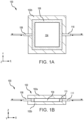
- System 100 includes a mold 102, a prepreg part 104, a permeable media 106, a first conduit 108, and a second conduit 110.
- Mold 102 includes a top portion 102a and a bottom portion 102b that close around prepreg part 104 and permeable media 106. Mold 102 defines an interior space between top portion 102a and bottom portion 102b that define a shape and configuration of the final composite part.
- First conduit 108 and second conduit 110 provide a path for air to enter and exit mold 102.
- FIG. 1A is a top down view of system 100 without the top portion 102a.
- FIG. 1B is a cross-section side view of system 100.
- prepreg part 104 including a resin
- permeable media 106 is placed around prepreg part 104.
- a vacuum is applied to mold 102.
- mold 102 is heated, allowing the resin to flow within prepreg part 104.
- prepreg part 104 is cured in mold 102 to form a composite material.
- Prepreg part 104 is a composite material including fibers pre-impregnated with a resin or polymer resin.
- the fibers may include carbon fiber, fiber glass, polyaramid fibers, or any reinforced fibers, among others.
- the resin may be partially cured in prepreg part 104.
- the resin may include a thermoset (e.g., a liquid or hotmelt thermoset), a thermoplastic, an elastomeric rubber, bismaleimide (BMI), thermoplastics, liquid rubbers, epoxy resin, phenolic resin, and/or polymers, among others.
- the resin has a different viscosity a cold temperatures, room temperature, and warm temperatures. Generally, the resin is less viscous at cold temperature than at room temperature and more viscous at warm temperatures than at room temperatures.
- the resin is typically partially cured among the fibers of prepreg part 104.
- the fibers of prepreg part 104 may be woven together into matrix to which the resin is bonded.
- the resin may strengthen and support the fibers and the fibers may strengthen and support the resin, though further processing, as described below, is used to create the composite component from prepreg part 104.
- Prepreg part 104 may be any shape accommodated by mold 102. It should be appreciated, that while mold 102 and prepreg part 104 are illustrated as being rectangular, both mold 102 and/or prepreg part 104 may be any suitable shape for a composite component, including freeform shapes. This is possible because the RPM process, as described herein, is performed in mold 102 and does not use an auto-clave for curing the resin or composite component.
- prepreg part 104 may be larger than the final component to allow for removing material around the edge of prepreg part 104 for a uniform, or smooth edge on the final composite component. In various embodiments, about 0.5 inches to about 2 inches, and more specifically, about 1 inch of material may be removed from the outer edge of prepreg part 104 at the end of the RPM process.
- Certain resins include volatiles that cause gasses to be produced within the resin. Such resins cannot be used in traditional RPM processes as the volatiles produce off gasses that result in bubbling or other imperfections in the composite component. Volatiles may include anything that produces an off gassing from the resin such as benzene, hexane, solvents, and/or materials that convert to gas at room temperature. Other materials, such as water/moisture, may produce off gassing at high temperatures used in the curing process. In various embodiments, the volatiles within the resin may begin off gassing before prepreg part 104 is placed in mold 102. In various embodiments, the volatiles within the resin may produce additional off gassing in response to the resin being heated within mold 102. As will be discussed in more detail below, the resin has a first viscosity and the off gasses have a second viscosity that is generally lower than the first viscosity.
- Permeable media 106 is formed around an outer edge perimeter of prepreg part 104. Permeable media 106 may be designed to restrict the flow of the resin while permitting the flow of the volatiles so that the volatiles exit prepreg part 104 and the resin stays mostly in prepreg part 104. As such, mold 102 is sized to accommodate prepreg part 104 and permeable media 106. In various embodiments, permeable media 106 may include a low permeable material, such as a low permeable breather, including high density fiber glass with a fiber volume dependent on the viscosity of the resin system used or a chromatography column for low viscous (or liquid) resin.
- a low permeable material such as a low permeable breather, including high density fiber glass with a fiber volume dependent on the viscosity of the resin system used or a chromatography column for low viscous (or liquid) resin.
- the high density fiber glass may have a fiber volume of about 60% to about 90%, and more specifically, about 70% to about 80%.
- permeable media 106 may include cement, ceramic, foam, wood, or cork, among other porous materials. Permeable media 106 extends a length L from the outer edge perimeter of prepreg part 104. Length L varies depending on multiple variables including the flow the resin, the flow of the gasses escaping the resin in prepreg part 104, the cross-sectional area of permeable media 106, and the pressure drop across permeable media 106, among others. In various embodiments, length L may be about 0.5 inches to about 10 inches, depending design and process variables.
- Darcy's law may be used to determine the type and size of material to use for permeable media 106.
- Darcy's law may be applied based on the flow rate of the resin or based on the flow rate of the volatiles escaping from the resin.
- First conduit 108 and second conduit 110 allow air to be removed from or introduced into mold 102.
- a vacuum is applied to mold 102 via first conduit 108 and second conduit 110.
- the vacuum creates a pressure drop across prepreg part 104 and permeable media 106.
- the vacuum allows forces the volatiles, and associated off gasses and, the resin to flow through prepreg part 104 and into permeable media 106 with the resin having a first flow rate and the volatiles having a second flow rate that is generally greater than the first flow rate.
- permeable media 106 is designed to restrict the flow of the resin and reducing the first flow rate to trap the resin in permeable media 106 while allowing the volatiles to pass through permeable media 106 with little to no reduction in the second flow rate.
- mold 102 may be heated, resulting in a decrease in the viscosity of the resin and therefore an increase in the first flow rate.
- the heat may further cause an increase in the rate of volatilization of volatiles, and associated off gasses.
- the heating process allows for volatiles to exit prepreg part 104 and the resin prior to the curing process, resulting in a more complete elimination of volatiles and other outgassing materials.
- the vacuum is removed and compressed air is introduced to mold 102 through first conduit 108 and second conduit 110.
- the compressed air pressurizes prepreg part 104 within mold 102.
- Prepreg part 104 then cures under the hydrostatic pressure from the compressed air, similar to the autoclave process but without the autoclave.
- Portion 200 includes prepreg part 104 and permeable media 106 having a cross sectional area A.
- Prepreg part 104 includes a resin 202 and a plurality of volatiles 204, as described above with respect to system 100 in FIGS. 1A and 1B .
- Permeable media 106 has length L and includes a first portion 206 and a second portion 208. Permeable media 106 is designed to restrict the flow of resin 202 while permitting the flow of volatiles 204 (e.g., along the x-axis).
- resin 202 and volatiles 204 flow through prepreg part 104 and into first portion 206 of permeable media 106 and volatiles 204 flow through first portion 206 and into second portion 208 of permeable media 106.
- resin 202 stays mostly in prepreg part 104 while volatiles 204 escape prepreg part 104 allowing the composite component to cure properly.
- a pressure drop occurs across length L of permeable media 106 in response to a vacuum being applied to mold 102. Accordingly, there is a first pressure Pa at the junction of prepreg part 104 and permeable media 106 and a second pressure Pb at the junction of permeable media 106 and second conduit 110. In response to the vacuum being applied, first pressure Pa is higher than second pressure Pb, causing the pressure drop and forcing resin 202 and volatiles 204 to flow (e.g., in the positive x-axis) in the direction of the pressure drop.
- the vacuum may be removed and compressed air may be introduced to mold 102 through second conduit 110, as illustrated in FIG. 2 .
- the compressed air causes the pressure differential across permeable media 106 to reverse so that first pressure Pa is lower than second pressure Pb.
- This pressure differential may force resin 202 back into prepreg part 104.
- Prepreg part 104 may then be cured with little to no loss of resin 202.
- prepreg part 104 may be cured under a desired hydrostatic pressure produced by compressed air.
- pressurized nitrogen, or other non-reactive gasses may be used to eliminate the presence of oxygen, moisture, and other potential contaminants common in compressed air.
- additional resin 202 may be introduced to prepreg part 104 during different stages of this process.
- System 300 may be used to manufacture the composite part without the use of an autoclave.
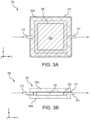
- System 300 includes similar components to those described above with respect to system 100 in FIGS. 1A and 1B , including a mold 302, a prepreg part 304, and a permeable media 306, descriptions of which may not be repeated below.
- System 300 further includes an inlet 312, an outlet 314, and a pressurized film 316.
- Pressurized film 316 is placed under (e.g., in the negative z-direction) inlet 312 and over (e.g., in the positive z-direction) prepreg part 304, permeable media 306, and outlet 314.
- Compressed air may be introduced to mold 302 through inlet 312 while at the same time a vacuum is pulled on outlet 314 so that a higher pressure can be applied to prepreg part 304 than is possible by a vacuum alone.
- the vacuum may be maintained for continuous volatile removal during the curing process.
- Pressurized film 316 is an isolation film between the inlet 312 and the outlet 314.
- Pressurized film may be a bagging film, a non-stick or release film such as Fluorinated ethylene propylene (FEP), a thin caul sheet, or a thin elastomer rubber sheet, among others.
- System 300 may be used with various types of resins (e.g., PRM-15 resins and phenolic resins) that continue releasing volatiles and off gasses during the curing process.
- Pressurized film 316 allows for the volatiles to continue to flow out prepreg part 304 and through permeable media 306 during the curing process.
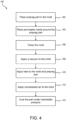
- method 400 may be performed by system 100 described above in FIGS. 1A and 1B .
- method 400 may include more or fewer steps than are described herein.
- a pre-impregnated (prepreg) part (e.g., prepreg part 104) is placed in a mold (e.g., mold 102).
- a permeable media (e.g., permeable media 106) is placed around prepreg part 104.
- mold 102 is closed.
- a vacuum is applied to mold 102 to extract volatiles from prepreg part 104.
- the vacuum causes the volatiles to leave prepreg part 104 through permeable media 106.
- heat is applied to mold 102 and prepreg part 104.
- the vacuum is maintained in order to continue extracting volatiles from prepreg part 104 while volatiles remain in prepreg part 104.
- prepreg part 104 is cured under hydrostatic pressure to create the composite component.
- additional resin may be added to mold 102 in the form of a resin film placed over prepreg part 104 or by increasing the amount of resin in prepreg part 104 above what is normally used.
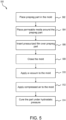
- method 500 may be performed by system 300 described above in FIGS. 3A and 3B .
- a pre-impregnated (prepreg) part (e.g., prepreg part 104) is placed in a mold (e.g., mold 102).
- a permeable media (e.g., permeable media 106) is placed around prepreg part 104.
- a pressurized film 316 is placed over prepreg part 104.
- mold 102 is closed.
- a vacuum is applied to mold 102 to extract volatiles from prepreg part 104. The vacuum causes the volatiles to leave prepreg part 104 through permeable media 106.
- compressed air is applied to the mold 102 at the same time as the vacuum is applied.
- the compressed air applies pressure to prepreg part 104 while the vacuum draws the volatiles out of prepreg part 104 and through permeable media 106.
- the compressed air may be applied to mold 102 prior to applying the vacuum to mold 102.
- prepreg part 104 is cured under hydrostatic pressure to create the composite component.
- additional resin may be added to mold 102 in the form of a resin film placed over prepreg part 104 or by increasing the amount of resin in prepreg part 104 above what is normally used.
- method 400 may be performed by a controller.
- the controller may comprise one or more processors configured to implement various logical operations in response to execution of instructions, for example, instructions stored on a non-transitory, tangible, computer-readable medium.
- the one or more processors can be a general purpose processor, a microprocessor, a microcontroller, a digital signal processor (DSP), an application specific integrated circuit (ASIC), a field programmable gate array (FPGA) or other programmable logic device, discrete or transistor logic, discrete hardware components, or any combination thereof.
- the controller may further comprise memory to store data, executable instructions, system program instructions, and/or controller instructions to implement the control logic of the controller.
- System program instructions and/or controller instructions may be loaded onto a non-transitory, tangible computer-readable medium having instructions stored thereon that, in response to execution by a controller, cause the controller to perform various operations.
- non-transitory is to be understood to remove only propagating transitory signals per se from the claim scope and does not relinquish rights to all standard computer-readable media that are not only propagating transitory signals per se.
- references to "one embodiment,” “an embodiment,” “various embodiments,” etc. indicate that the embodiment described may include a particular feature, structure, or characteristic, but every embodiment may not necessarily include the particular feature, structure, or characteristic. Moreover, such phrases are not necessarily referring to the same embodiment. Further, when a particular feature, structure, or characteristic is described in connection with an embodiment, it is submitted that it is within the knowledge of one skilled in the art to affect such feature, structure, or characteristic in connection with other embodiments whether or not explicitly described. After reading the description, it will be apparent to one skilled in the relevant art(s) how to implement the disclosure in alternative embodiments.
- Numbers, percentages, or other values stated herein are intended to include that value, and also other values that are about or approximately equal to the stated value, as would be appreciated by one of ordinary skill in the art encompassed by various embodiments of the present disclosure.
- a stated value should therefore be interpreted broadly enough to encompass values that are at least close enough to the stated value to perform a desired function or achieve a desired result.
- the stated values include at least the variation to be expected in a suitable industrial process, and may include values that are within 5% of a stated value.
- the terms “substantially,” “about” or “approximately” as used herein represent an amount close to the stated amount that still performs a desired function or achieves a desired result.
- the term “substantially,” “about” or “approximately” may refer to an amount that is within 5% of a stated amount or value.
Landscapes
- Engineering & Computer Science (AREA)
- Mechanical Engineering (AREA)
- Chemical & Material Sciences (AREA)
- Composite Materials (AREA)
- Casting Or Compression Moulding Of Plastics Or The Like (AREA)
Applications Claiming Priority (1)
| Application Number | Priority Date | Filing Date | Title |
|---|---|---|---|
| US18/323,586 US20240391184A1 (en) | 2023-05-25 | 2023-05-25 | Permeable closed-mold out-of-autoclave composite part manufacturing |
Publications (1)
| Publication Number | Publication Date |
|---|---|
| EP4467329A1 true EP4467329A1 (fr) | 2024-11-27 |
Family
ID=91248413
Family Applications (1)
| Application Number | Title | Priority Date | Filing Date |
|---|---|---|---|
| EP24178058.4A Withdrawn EP4467329A1 (fr) | 2023-05-25 | 2024-05-24 | Fabrication de pièce composite hors moule fermé perméable |
Country Status (2)
| Country | Link |
|---|---|
| US (1) | US20240391184A1 (fr) |
| EP (1) | EP4467329A1 (fr) |
Citations (4)
| Publication number | Priority date | Publication date | Assignee | Title |
|---|---|---|---|---|
| EP0028637B1 (fr) * | 1979-05-21 | 1985-10-23 | Rockwell International Corporation | Procede de fabrication d'une structure composite |
| US5709893A (en) * | 1995-06-06 | 1998-01-20 | The Boeing Company | Breathable tooling for forming parts from volatile-emitting composite materials |
| US20130099427A1 (en) * | 2010-04-10 | 2013-04-25 | Eads Deutschland Gmbh | Method and device for producing a composite molded part from fiber-reinforced plastic |
| EP2190650B1 (fr) * | 2007-08-07 | 2017-01-18 | Aerosud Technology Solutions (Ptd) Ltd | Procédé de fabrication d'une structure composite creuse |
Family Cites Families (3)
| Publication number | Priority date | Publication date | Assignee | Title |
|---|---|---|---|---|
| US4808362A (en) * | 1987-06-04 | 1989-02-28 | The Budd Company | Hollow reinforced fiber structure formed by resin transfer molding |
| US4942013A (en) * | 1989-03-27 | 1990-07-17 | Mcdonnell Douglas Corporation | Vacuum resin impregnation process |
| US5863365A (en) * | 1997-04-30 | 1999-01-26 | Scaled Composites, Inc. | Method of manufacturing composite articles |
-
2023
- 2023-05-25 US US18/323,586 patent/US20240391184A1/en active Pending
-
2024
- 2024-05-24 EP EP24178058.4A patent/EP4467329A1/fr not_active Withdrawn
Patent Citations (4)
| Publication number | Priority date | Publication date | Assignee | Title |
|---|---|---|---|---|
| EP0028637B1 (fr) * | 1979-05-21 | 1985-10-23 | Rockwell International Corporation | Procede de fabrication d'une structure composite |
| US5709893A (en) * | 1995-06-06 | 1998-01-20 | The Boeing Company | Breathable tooling for forming parts from volatile-emitting composite materials |
| EP2190650B1 (fr) * | 2007-08-07 | 2017-01-18 | Aerosud Technology Solutions (Ptd) Ltd | Procédé de fabrication d'une structure composite creuse |
| US20130099427A1 (en) * | 2010-04-10 | 2013-04-25 | Eads Deutschland Gmbh | Method and device for producing a composite molded part from fiber-reinforced plastic |
Also Published As
| Publication number | Publication date |
|---|---|
| US20240391184A1 (en) | 2024-11-28 |
Similar Documents
| Publication | Publication Date | Title |
|---|---|---|
| JP5533743B2 (ja) | 繊維強化プラスチックの製造方法 | |
| US20080210372A1 (en) | Composite article debulking process | |
| EP1162055B1 (fr) | Moulage sous vide avec membrane d'un matériau composite à couches | |
| KR102023644B1 (ko) | 차등 진공을 사용하여 복합재 물품을 경화시키는 방법 | |
| CN101365580B (zh) | 整体树脂浸渍系统装置和方法 | |
| US6739861B2 (en) | High pressure co-cure of lightweight core composite article utilizing a core having a plurality of protruding pins | |
| EP1808282B1 (fr) | Moulage pressurisé de pièces composites | |
| JP2011140226A (ja) | 制御された大気圧樹脂注入プロセス | |
| US8591796B2 (en) | Methods and apparatus for molding and curing of composites | |
| JP2010512257A (ja) | 複合構造体の形成及び硬化のためのシステム及び方法 | |
| US20150102535A1 (en) | Method of liquid resin infusion of a composite preform | |
| US9815246B2 (en) | Supporting profiled element, method for producing a supporting profiled element, and use of said supporting profiled element in a method for producing a reinforced vehicle fuselage component | |
| US10507622B2 (en) | System and method for curing polymer matrix composite parts in manufacturing and repairing processes | |
| JP6154670B2 (ja) | 繊維強化プラスチック部材の成形方法及び成形装置 | |
| US20090218713A1 (en) | Vacuum heat-set of net shape latex vacuum bags | |
| US20040000745A1 (en) | Moulding of composite materials | |
| JP4967405B2 (ja) | 繊維強化プラスチックの製造方法 | |
| EP4467329A1 (fr) | Fabrication de pièce composite hors moule fermé perméable | |
| JPWO2018030470A1 (ja) | 繊維強化樹脂成形品の製造方法 | |
| KR101447136B1 (ko) | 섬유 강화 복합재의 성형방법 | |
| US6350115B1 (en) | Pressure transmitters for use in the production of composite components | |
| JP5980348B2 (ja) | 分解性膜を使用して複合材を製造する方法 | |
| JP4432563B2 (ja) | Frpの製造方法 | |
| JP7318112B2 (ja) | 繊維強化複合材成形方法および繊維強化複合材成形装置 | |
| US6644954B2 (en) | Pressure transmitters for use in the production of composite components |
Legal Events
| Date | Code | Title | Description |
|---|---|---|---|
| PUAI | Public reference made under article 153(3) epc to a published international application that has entered the european phase |
Free format text: ORIGINAL CODE: 0009012 |
|
| STAA | Information on the status of an ep patent application or granted ep patent |
Free format text: STATUS: THE APPLICATION HAS BEEN PUBLISHED |
|
| AK | Designated contracting states |
Kind code of ref document: A1 Designated state(s): AL AT BE BG CH CY CZ DE DK EE ES FI FR GB GR HR HU IE IS IT LI LT LU LV MC ME MK MT NL NO PL PT RO RS SE SI SK SM TR |
|
| STAA | Information on the status of an ep patent application or granted ep patent |
Free format text: STATUS: REQUEST FOR EXAMINATION WAS MADE |
|
| 17P | Request for examination filed |
Effective date: 20250522 |
|
| STAA | Information on the status of an ep patent application or granted ep patent |
Free format text: STATUS: THE APPLICATION HAS BEEN WITHDRAWN |
|
| 18W | Application withdrawn |
Effective date: 20251119 |