EP4467631B1 - Mischung mit europium-organischer koordinationsverbindung und verfahren zur herstellung davon - Google Patents
Mischung mit europium-organischer koordinationsverbindung und verfahren zur herstellung davon Download PDFInfo
- Publication number
- EP4467631B1 EP4467631B1 EP23174607.4A EP23174607A EP4467631B1 EP 4467631 B1 EP4467631 B1 EP 4467631B1 EP 23174607 A EP23174607 A EP 23174607A EP 4467631 B1 EP4467631 B1 EP 4467631B1
- Authority
- EP
- European Patent Office
- Prior art keywords
- organic
- atoms
- charge
- coordination compound
- compound
- Prior art date
- Legal status (The legal status is an assumption and is not a legal conclusion. Google has not performed a legal analysis and makes no representation as to the accuracy of the status listed.)
- Active
Links
Images





Classifications
-
- C—CHEMISTRY; METALLURGY
- C07—ORGANIC CHEMISTRY
- C07F—ACYCLIC, CARBOCYCLIC OR HETEROCYCLIC COMPOUNDS CONTAINING ELEMENTS OTHER THAN CARBON, HYDROGEN, HALOGEN, OXYGEN, NITROGEN, SULFUR, SELENIUM OR TELLURIUM
- C07F15/00—Compounds containing elements of Groups 8, 9, 10 or 18 of the Periodic Table
-
- C—CHEMISTRY; METALLURGY
- C09—DYES; PAINTS; POLISHES; NATURAL RESINS; ADHESIVES; COMPOSITIONS NOT OTHERWISE PROVIDED FOR; APPLICATIONS OF MATERIALS NOT OTHERWISE PROVIDED FOR
- C09K—MATERIALS FOR MISCELLANEOUS APPLICATIONS, NOT PROVIDED FOR ELSEWHERE
- C09K11/00—Luminescent materials, e.g. electroluminescent or chemiluminescent
- C09K11/06—Luminescent materials, e.g. electroluminescent or chemiluminescent containing organic luminescent materials
-
- C—CHEMISTRY; METALLURGY
- C07—ORGANIC CHEMISTRY
- C07F—ACYCLIC, CARBOCYCLIC OR HETEROCYCLIC COMPOUNDS CONTAINING ELEMENTS OTHER THAN CARBON, HYDROGEN, HALOGEN, OXYGEN, NITROGEN, SULFUR, SELENIUM OR TELLURIUM
- C07F5/00—Compounds containing elements of Groups 3 or 13 of the Periodic Table
- C07F5/02—Boron compounds
- C07F5/027—Organoboranes and organoborohydrides
-
- C—CHEMISTRY; METALLURGY
- C09—DYES; PAINTS; POLISHES; NATURAL RESINS; ADHESIVES; COMPOSITIONS NOT OTHERWISE PROVIDED FOR; APPLICATIONS OF MATERIALS NOT OTHERWISE PROVIDED FOR
- C09K—MATERIALS FOR MISCELLANEOUS APPLICATIONS, NOT PROVIDED FOR ELSEWHERE
- C09K11/00—Luminescent materials, e.g. electroluminescent or chemiluminescent
- C09K11/02—Use of particular materials as binders, particle coatings or suspension media therefor
-
- H—ELECTRICITY
- H10—SEMICONDUCTOR DEVICES; ELECTRIC SOLID-STATE DEVICES NOT OTHERWISE PROVIDED FOR
- H10K—ORGANIC ELECTRIC SOLID-STATE DEVICES
- H10K71/00—Manufacture or treatment specially adapted for the organic devices covered by this subclass
- H10K71/10—Deposition of organic active material
-
- H—ELECTRICITY
- H10—SEMICONDUCTOR DEVICES; ELECTRIC SOLID-STATE DEVICES NOT OTHERWISE PROVIDED FOR
- H10K—ORGANIC ELECTRIC SOLID-STATE DEVICES
- H10K85/00—Organic materials used in the body or electrodes of devices covered by this subclass
- H10K85/30—Coordination compounds
- H10K85/351—Metal complexes comprising lanthanides or actinides, e.g. comprising europium
-
- H—ELECTRICITY
- H10—SEMICONDUCTOR DEVICES; ELECTRIC SOLID-STATE DEVICES NOT OTHERWISE PROVIDED FOR
- H10K—ORGANIC ELECTRIC SOLID-STATE DEVICES
- H10K85/00—Organic materials used in the body or electrodes of devices covered by this subclass
- H10K85/60—Organic compounds having low molecular weight
- H10K85/658—Organoboranes
-
- C—CHEMISTRY; METALLURGY
- C09—DYES; PAINTS; POLISHES; NATURAL RESINS; ADHESIVES; COMPOSITIONS NOT OTHERWISE PROVIDED FOR; APPLICATIONS OF MATERIALS NOT OTHERWISE PROVIDED FOR
- C09K—MATERIALS FOR MISCELLANEOUS APPLICATIONS, NOT PROVIDED FOR ELSEWHERE
- C09K2211/00—Chemical nature of organic luminescent or tenebrescent compounds
- C09K2211/10—Non-macromolecular compounds
- C09K2211/1003—Carbocyclic compounds
- C09K2211/1011—Condensed systems
-
- C—CHEMISTRY; METALLURGY
- C09—DYES; PAINTS; POLISHES; NATURAL RESINS; ADHESIVES; COMPOSITIONS NOT OTHERWISE PROVIDED FOR; APPLICATIONS OF MATERIALS NOT OTHERWISE PROVIDED FOR
- C09K—MATERIALS FOR MISCELLANEOUS APPLICATIONS, NOT PROVIDED FOR ELSEWHERE
- C09K2211/00—Chemical nature of organic luminescent or tenebrescent compounds
- C09K2211/10—Non-macromolecular compounds
- C09K2211/1003—Carbocyclic compounds
- C09K2211/1014—Carbocyclic compounds bridged by heteroatoms, e.g. N, P, Si or B
-
- C—CHEMISTRY; METALLURGY
- C09—DYES; PAINTS; POLISHES; NATURAL RESINS; ADHESIVES; COMPOSITIONS NOT OTHERWISE PROVIDED FOR; APPLICATIONS OF MATERIALS NOT OTHERWISE PROVIDED FOR
- C09K—MATERIALS FOR MISCELLANEOUS APPLICATIONS, NOT PROVIDED FOR ELSEWHERE
- C09K2211/00—Chemical nature of organic luminescent or tenebrescent compounds
- C09K2211/10—Non-macromolecular compounds
- C09K2211/1018—Heterocyclic compounds
- C09K2211/1025—Heterocyclic compounds characterised by ligands
- C09K2211/1029—Heterocyclic compounds characterised by ligands containing one nitrogen atom as the heteroatom
-
- C—CHEMISTRY; METALLURGY
- C09—DYES; PAINTS; POLISHES; NATURAL RESINS; ADHESIVES; COMPOSITIONS NOT OTHERWISE PROVIDED FOR; APPLICATIONS OF MATERIALS NOT OTHERWISE PROVIDED FOR
- C09K—MATERIALS FOR MISCELLANEOUS APPLICATIONS, NOT PROVIDED FOR ELSEWHERE
- C09K2211/00—Chemical nature of organic luminescent or tenebrescent compounds
- C09K2211/10—Non-macromolecular compounds
- C09K2211/1018—Heterocyclic compounds
- C09K2211/1025—Heterocyclic compounds characterised by ligands
- C09K2211/1074—Heterocyclic compounds characterised by ligands containing more than three nitrogen atoms as heteroatoms
- C09K2211/1077—Heterocyclic compounds characterised by ligands containing more than three nitrogen atoms as heteroatoms with oxygen
-
- C—CHEMISTRY; METALLURGY
- C09—DYES; PAINTS; POLISHES; NATURAL RESINS; ADHESIVES; COMPOSITIONS NOT OTHERWISE PROVIDED FOR; APPLICATIONS OF MATERIALS NOT OTHERWISE PROVIDED FOR
- C09K—MATERIALS FOR MISCELLANEOUS APPLICATIONS, NOT PROVIDED FOR ELSEWHERE
- C09K2211/00—Chemical nature of organic luminescent or tenebrescent compounds
- C09K2211/10—Non-macromolecular compounds
- C09K2211/1018—Heterocyclic compounds
- C09K2211/1025—Heterocyclic compounds characterised by ligands
- C09K2211/1074—Heterocyclic compounds characterised by ligands containing more than three nitrogen atoms as heteroatoms
- C09K2211/1085—Heterocyclic compounds characterised by ligands containing more than three nitrogen atoms as heteroatoms with other heteroatoms
-
- C—CHEMISTRY; METALLURGY
- C09—DYES; PAINTS; POLISHES; NATURAL RESINS; ADHESIVES; COMPOSITIONS NOT OTHERWISE PROVIDED FOR; APPLICATIONS OF MATERIALS NOT OTHERWISE PROVIDED FOR
- C09K—MATERIALS FOR MISCELLANEOUS APPLICATIONS, NOT PROVIDED FOR ELSEWHERE
- C09K2211/00—Chemical nature of organic luminescent or tenebrescent compounds
- C09K2211/10—Non-macromolecular compounds
- C09K2211/1018—Heterocyclic compounds
- C09K2211/1025—Heterocyclic compounds characterised by ligands
- C09K2211/1092—Heterocyclic compounds characterised by ligands containing sulfur as the only heteroatom
-
- C—CHEMISTRY; METALLURGY
- C09—DYES; PAINTS; POLISHES; NATURAL RESINS; ADHESIVES; COMPOSITIONS NOT OTHERWISE PROVIDED FOR; APPLICATIONS OF MATERIALS NOT OTHERWISE PROVIDED FOR
- C09K—MATERIALS FOR MISCELLANEOUS APPLICATIONS, NOT PROVIDED FOR ELSEWHERE
- C09K2211/00—Chemical nature of organic luminescent or tenebrescent compounds
- C09K2211/10—Non-macromolecular compounds
- C09K2211/1018—Heterocyclic compounds
- C09K2211/1025—Heterocyclic compounds characterised by ligands
- C09K2211/1096—Heterocyclic compounds characterised by ligands containing other heteroatoms
-
- C—CHEMISTRY; METALLURGY
- C09—DYES; PAINTS; POLISHES; NATURAL RESINS; ADHESIVES; COMPOSITIONS NOT OTHERWISE PROVIDED FOR; APPLICATIONS OF MATERIALS NOT OTHERWISE PROVIDED FOR
- C09K—MATERIALS FOR MISCELLANEOUS APPLICATIONS, NOT PROVIDED FOR ELSEWHERE
- C09K2211/00—Chemical nature of organic luminescent or tenebrescent compounds
- C09K2211/18—Metal complexes
- C09K2211/182—Metal complexes of the rare earth metals, i.e. Sc, Y or lanthanide
-
- H—ELECTRICITY
- H10—SEMICONDUCTOR DEVICES; ELECTRIC SOLID-STATE DEVICES NOT OTHERWISE PROVIDED FOR
- H10K—ORGANIC ELECTRIC SOLID-STATE DEVICES
- H10K2101/00—Properties of the organic materials covered by group H10K85/00
- H10K2101/10—Triplet emission
Definitions
- the invention concerns a mixture of a metal-organic coordination compound with a second charge-neutral organic compound wherein the coordination compound comprises one divalent europium coordinated by a polycyclic organic ligand, and organic electronic devices containing the mixture, as well as methods for forming the same.
- Electroluminescent devices that make use of organic light emitting diodes are state-of-the-art for flat panel display applications used in everyday consumer electronics.
- OLEDs organic light emitting diodes
- emitters special organic materials, so-called emitters, are employed for the purpose of converting electrical excitation into light emission.
- red, green, and blue emitters are needed.
- blue emitter materials are needed.
- advanced consumer display layouts use color conversion to generate the red and green spectral portions from the short wavelength blue emission as this provides certain advantages in manufacturing. Therefore, only blue emitting electroluminescent OLED devices are needed in future displays.
- the transition responsible for light emission from Eu(II) complexes is intrametallic and thus strongly confined on the Eu atom.
- electronically exciting the complex does not weaken any chemical bonds, offering the potential of exceptional chemical stability.
- hole-trapping on Eu frequently occurs, which corresponds to an oxidation of Eu(II) to Eu(III). Consequently, another mandatory requirement for stable OLED operation is a reversible oxidation/reduction, requiring a stabilization of Eu(II) over Eu(III). This creates a certain challenge, since the most stable oxidation state of Eu is typically the trivalent one. In other words, a stabilization of trivalent europium after it has captured a positive charge must be avoided.
- polymacrocyclic (cryptands) ligands are well-suited to provide the necessary rigid chemical environment. Since the ionic radius of Eu(III) is significantly smaller than that of Eu(II), adapting the cavity size of the polymacrocyclic ligand specifically to Eu(II) stabilizes the divalent over the trivalent oxidation state.
- coordinating divalent europium using rigid symmetrical polymacrocyclic ligands yellow-green ( Li, J., Wang, L., Zhao, Z. et al. Highly efficient and air-stable Eu(II)-containing azacryptates ready for organic light-emitting diodes. Nat Commun 11, 5218 (2020 )) and blue ( WO 2021/244801A1 ) electroluminescent devices have been demonstrated.
- WO 2022/218562A1 discloses, twofold negatively charged polymacrocyclic ligands for Eu(II) for improved thermal vacuum sublimation. The concept is based on the same basic symmetrical cryptand design as Li, J., Wang, L., Zhao, Z. et al. Highly efficient and air-stable Eu(II)-containing azacryptates ready for organic light-emitting diodes. Nat Commun 11, 5218 (2020 ) and WO 2021/244801A1 .
- CN 113 8011 0 A discloses Europium complexes containing 2 ligands. Each ligand contains hetero aromatic groups linked in a linear sequence, see Eu-1 to Eu-5 in claim 2 and example 1, where for example the hydrotris(3-methyl pyrazolyl) borate is employed as ligand. This ligand resembles the above-mentioned polycyclic aromatic ring systems which have one carbon common to two adjoining rings (like for example in biphenyl). However, the ligands employed are not bicyclic or polycyclic ligands as defined herein.
- the emitter molecules are usually embedded into charge transport matrices, usually called hosts.
- the yellow-green-emitting material based on symmetrical ligand design and disclosed in [ Li, J., Wang, L., Zhao, Z. et al. Highly efficient and air-stable Eu(II)-containing azacryptates ready for organic light-emitting diodes. Nat Commun 11, 5218 (2020 )] only showed bright emission in a surprisingly small selection of host materials. In most of the disclosed materials, the emission was fully or partially quenched.
- the mixtures are particularly intended for the design of highly efficient multilayer OLED devices by means of gas transfer processes. It is thus a further objective of this invention to enable the excellent photophysical properties of divalent Europium metal organic complexes for mass production of consumer electronics, especially consumer displays and especially using sublimation or evaporation techniques.
- the objective is achieved according to the present invention by a mixture of
- the organic layer is deposited from a gas phase, preferably using an evaporation and/or sublimation and/or carrier gas process.
- the cavity size of the mostly symmetrical polycyclic organic ligands did, in fact, not match the central cation too well, as it was often far too large.
- too large cavity diameters have been employed, since the polycyclic organic ligands were typically based on ring sizes containing 18 atoms.
- the ligand contains a plurality of hard donor atoms to achieve electronic stabilization and deep blue color point.
- a feature of the present invention is to provide distinct asymmetrical polycyclic organic ligands, since at least one of the chemical linkages between the two nitrogen bridgehead atoms is different to the other two.
- the desired asymmetry allows two singly negatively charged anionic species to integrate in a way that they simultaneously stabilize the central divalent Europium and achieve a small dipole moment of the overall charge-neutral complex, thereby significantly improving its volatility.
- the provided metal-organic coordination compounds are perfectly suited for display mass production.
- the invention features strict rules on how to choose the charge-transporting host materials such that the favorable emission characteristics of the divalent Europium complex are maintained.
- the organic host material must have a higher electron binding energy (approximately corresponding to the absolute value of the energy of highest occupied molecular orbital [HOMO] of the organic material) than the Europium coordination compound.
- Divalent Europium in the metal-organic complex cannot trap an electron as this is energetically extremely unfavorable.
- the mandatory first step in the light generation process is to capture a hole, which corresponds to oxidizing the Eu(II) in the complex to Eu(III).
- the higher electron binding energy of the organic host material relative to the divalent neutral Europium compound ensures that the hole is confined to the emitter molecule.
- the individual components of the mixture i.e., the coordination compound (charge neutral metal-organic coordination compound) comprising the asymmetrical ligand according to formula (1-1) and divalent Europium as well as many organic host materials are sufficiently volatile and as such ideally suited for processing using sublimation or evaporation techniques, as used in the mass production of consumer displays today.
- the mixtures are highly luminescent.
- the combination of the above-mentioned properties enables the straightforward design of very efficient deep-blue-emitting OLED devices with high operational stability. With this combination of ideal emission characteristics, good processing characteristics, and freedom of OLED design the mixtures according to the invention are ideally suited as active emitting materials in electroluminescent (consumer) electronics applications.
- mixtures of metal-organic coordination compounds comprising divalent Europium and asymmetrical aza-cryptands with organic materials methods for making the mixtures, organic electronic devices comprising the same, and methods for synthesizing divalent Europium compounds with asymmetrical aza-cryptands are provided.
- the objective is achieved by a mixture of a metal-organic coordination compound (a) with an organic material (b) as defined above and in claim 1.
- a metal-organic coordination compound (a) with an organic material (b) as defined above and in claim 1.
- the luminescent active cation must be sufficiently chemically stabilized to avoid undesired irreversible oxidation of divalent to trivalent Europium.
- the key ingredient here is the polymacrocyclic ligand according to structure (1-1).
- L 1 and L 2 are connected by two atoms selected from substituted or non-substituted Si, C, B, N, P to form a cyclic crown-ether like fragment, herein referred to as basis ring.
- those connecting atoms are two nitrogens.
- the two atoms are further linked to each other by means of L 0 , finally forming a polycyclic organic ligand, which in case of nitrogen bridgehead atoms is an aza-cryptand.
- the basis ring must be smaller than the typically used 18-crown-6 motif and as such the shortest sequences of L 1 , L 2 must only be 4-7 atoms, preferably 5 atoms long.
- L 1 , L 2 must contain each at least one complexing heteroatom selected from B, N, P, S, O.
- polarizable donor-atoms may cause an undesirable red-shift of the emission energy, so preference is given to the heteroatoms N and O.
- the polymacrocyclic ligand according to formula (1-1) is asymmetrical as the lengths of the shortest sequences of atoms linking L 0 , L 1 , L 2 to the bridgehead-atoms Y are different.
- the two negative charges present in the coordination compound to charge-neutralize the Eu(II)
- the organic host material present in the mixture according to the invention must have a higher electron binding energy compared to the Europium coordination compound (1-1). This ensures that a positive charge - a perquisite for electroluminescent light generation - is confined on the coordination compound.
- the second charge-neutral organic host compound (b) has an electron binding energy higher than 4.5 eV, preferably higher than 5.3 eV and most preferably higher than 6.0 eV.
- high electron binding energies correlate with chemical stability, especially during reversible oxidation and reduction in electroluminescent device operation.
- Component (a) is imbedded in the host material in the final application. The above embodiments describe what is commonly known as hole-trapping on the emitter molecule.
- the positively charged emitter molecule accepts an electron into a 5d orbital, forming the charge-neutral emitting molecule in an electronically excited state.
- the captured electron as well as the excitation energy should be confined to the emitter in the electronically excited state.
- the lowest excited state of the vast majority of organic molecules is the first excited triplet state.
- the second charge-neutral organic compound (b) has a higher triplet energy compared to the energy of the coordination compound (a) in its lowest electronically excited state to avoid transfer of the excitation energy from the emitter to the host.
- compound (b) is the only host material. Same content of additional host materials is possible, but not preferred. If present, the following applies: Preferably, at least 50 wt-%, more preferably at least 70 wt-%, most preferably at least 95 wt% (with a maximum of 100 wt-% which is most preferred) of the host material in the mixture and in an emitting layer of an organic electronic device are composed of the at least one compound (b) as defined herein.
- the amount of additional host components should not impair or affect the electronic relationship between compounds (a) and (b) in the mixture of the invention.
- the mixtures according to the invention emit substantially in the deep blue spectral region below 496 nm, preferably below 477 nm, or even more preferred below 459 nm.
- the second organic host compound (b) has a triplet energy preferably higher than 2.5 eV, more preferably higher than 2.6 eV, and most preferably higher than 2.7 eV.
- substantially means that at least 50%, preferably at least 65%, more preferably at least 80% of the emission or of the integral under the wavelength emission spectrum are below the above thresholds and/or that the peak of a Gaussian emission spectrum is a shorter wavelength compared to the preferred boundary wavelength defined above.
- the second charge-neutral organic compound (b) has an electron affinity or electron binding energy (approximately corresponding to the absolute value of the energy of the lowest unoccupied molecular orbital [LUMO]) that is lower than the electron binding energy of the metal-organic coordination compound (a) in its lowest electronically excited state.
- LUMO and thus the electron binding energy can be determined by for example be quantified using simple Quantum mechanical methods, as for example demonstrated in detail in the experimental section below.
- the second organic compound (b) has an electron affinity or electron building energy higher than 2.0 eV.
- the concentration of the emitting coordination compound (a) inside the second organic material (b) may span a very wide range. Rather low concentrations may be preferred if they are intended for color-conversion applications. Somewhat higher concentrations may be preferred if the mixture is used in an electroluminescent device, where efficient charge trapping is needed. Therefore, in preferred embodiments the coordination compound (a) is imbedded into the at least one second charge-neutral organic compound (b) at preferably 0.1 - 99.0 vol%, more preferably at 1 - 90 vol%, and most preferably at 3 - 30 vol%, based on the mixture which is 100 vol%.
- rigid ligands are generally preferred. This may be achieved and rigid ligands of formula (1-1) can be obtained by incorporation of one or more, preferably 1 to 6, more preferably 1 to 4, most preferably 1 to 3 aryl and/or heteroaryl groups as part of the complexing parts of the polycyclic ligand, i.e., in L 0 , L 1 and/or L 2 . Such (hetero) aromatic units may as well improve the charge transport or charge capture properties of the metal organic coordination compounds.
- each (hetero) aromatic group(s) preferably contain(s) 1 to 5, more preferably 1 to 4, most preferably 1, 2 or 3, preferably fused or annelated, ring structures, preferably (hetero) aromatic) ring structures that contain 0 or 1 non (hetero)aromatic ring, like in a benzofuran group. Therefore, in preferred embodiments, the polycyclic organic ligand according to formula (1-1) is selected from aza-cryptands according to the generic formulae (1-2) to (1-4): with
- the europium in the emissive coordination compound (a) as part of the mixture is twofold positively charged.
- the coordination compound comprises an asymmetrical ligand according to formula (1-1) and two singly negatively charged anions that are not covalently linked to the polycyclic organic ligand according to formula (1-1). This is to ensure charge-neutrality once the organic ligand is coordinating the positively charged cation. If, for example, the polymacrocyclic organic ligand according to formula (1-1) is charge-neutral and combined with divalent Eu, then two singly negatively charged anions are necessary to form the overall charge-neutral coordination compound (a).
- those negatively charged counterions or anions can be any desired molecules that fulfil the above-mentioned requirements, i.e., preferably having sufficiently high triplet energy and no strong chemical interaction with Europium, so that the above electron binding requirement is fulfilled.
- those two singly negatively charged anions each individually comprise more than 1 atom, preferably more than 3 atoms and/or may have a mass of more than 128 g/mol. This prevents an undesired drift of the non-covalently bound anions of the coordination compound within the mixture according to invention, especially in an electroluminescent device configuration.
- preferred anions are chemically inert, lightweight, do not strongly interacting with the central Eu, which typically requires the anions to be chemically soft, and do not absorb light with a wavelength in the range of 380-700 nm, more preferably in the range 430-500 nm.
- Anions with these desired properties are preferably selected from closo -carborates or nido -borane clusters, preferably from closo-carborates according to formula (3-1) and (3-2) or nido-borane clusters according to formula (3-3) with R b independently in each occurrence representing either hydrogen, deuterium, fluorine, chlorine, bromine, or a C 1-12 -, preferably C 1-6 -, more preferably C 1-3 -alkyl chain - preferably methyl.
- the polymacrocyclic ligand according to formula (1-1) itself is already twofold negatively charged.
- a coordination compound of neutral charge is formed, and no free anions are present as part of the coordination compound and therefore as part of the mixture according to the invention.
- Such compounds (1-1) without free (i.e., non-covalently bonded) negatively charged anions might be beneficial in electroluminescent device applications, where those anions may drift during operation in high electrical fields, leading to short device lifetimes and hysteresis effects.
- the two negative charges are present in form of two anionic side groups.
- carborate cluster fragments preferably selected from (3-4) or (3-5) with the dashed lines indicating the covalent linkage to the remainder of the polycyclic ligand, and R b independently in each occurrence representing either hydrogen, deuterium, fluorine, chlorine, bromine, or an C 1-12 -, preferably C 1-6 -, more preferably C 1-3 -alkyl chain - preferably methyl.
- the coordination compound (a) present in the mixture according to the invention is selected from E01 to E08:
- This molecular design ensures a favourable size of the basis ring, i.e., the cyclic crown ether motif comprises the two shortest sequences of atoms of L 1 and L 2 linked by the two bridging nitrogen atoms of 5 atoms each.
- the basis rings exclusively comprise of complexing units that do not cause an undesired red-shift of the emission color, i.e., oxygen or furan as hetero atom or hetero aromatic group.
- L 0 is much longer compared to L 1 and L 2 , with a shortest sequence of 11 atoms, giving a distinctly asymmetrical ligand according to formula (1-1).
- the anions or anionic groups can coordinate to the metal cation by entering the two identical larger crown-type ring structures formed by L 1 and L 0 ; and L 0 and L 2 , respectively.
- the free anions (e.g.
- closo-carborates, or iodides) or the covalently attached anions like covalently attached (closo-)carborates cluster fragments are lightweight, chemically inert, do not absorb light with a wavelength in the range of 380-700 nm, more preferably in the range of 430-500 nm, and are chemically soft to ensure the desired deep blue emission from the metal-organic coordination compound.
- the second organic material (b) may serve as charge transporting host to enable electrical excitation of the coordination compound (a) present in the mixture according to the invention.
- the second charge-neutral compound in preferred embodiments comprises (hetero)arene fragments derived from benzene, pyridine, pyrrole, furan, carbazole, dibenzofuran, triazine, triazole, or benzofuran by removing one or two hydrogen atoms.
- the second charge-neutral compound (b) has a molecular weight M n above 1000 g/mol, and the coordination compound (a) and the second charge-neutral compound (b) are chemically linked with each other, for example by a covalent or coordinative chemical bond.
- the mixture is a polymeric compound, which might have benefits in terms of very high glass transition temperatures, or it may ease the processing of the mixtures using wet solution techniques.
- the mixture according to the invention is used in an organic electronic device, comprising a first electrode, a second electrode, and a first organic layer arranged such that it is electrically interposed between the first and second electrodes, wherein the organic layer comprises a mixture according to the various embodiments described above, preferably a composition containing at least 50 vol%, more preferably at least 80 vol%, most preferably at least 95 vol% of the mixture of (a) and (b) as emitter and host materials. Preferably no host apart from compound (b) is employed in the (first) organic layer.
- the organic electronic device being an organic light emitting diode, emitting preferably substantially in the blue spectra region at ⁇ 500 nm.
- the term “substantially” is defined as above.
- the electroluminescent device emits mostly in the desired deep blue spectral region urgently needed for consumer display applications.
- the organic layer comprising the mixture that includes the coordination compound (a) according to various embodiments described above is in physical contact with a second substantially organic layer, which contains an organic material, i.e., they form a sequence or a stack.
- the organic material present in the second layer (i) has a higher electron binding energy than the charge-neutral coordination compound (a), (ii) and/or has a higher triplet energy than the emission energy of the coordination compound (a), and (iii) and/or has an electron affinity that is lower than the electron binding energy of the coordination compound (a) in its lowest electronically excited state.
- the (first) organic layer comprising mixture including the luminescent coordination compound (a) has no further organic materials present.
- organic device configuration light emission will typically take place at the interface with neighbouring charge transport materials. Again, in this situation it is preferred that the excitation and the charges are confined on the coordination compound (a) present in the pure layer of the mixture of (a) and (b), thereby avoiding excitation or charge leakage into the nearby charge transport materials.
- an organic electronic device comprises a first electrode, a second electrode, and a sequence of a first and a second organic layer arranged such that they are electrically interposed between the first and second electrodes, wherein the first organic layer consists substantially of a metal organic coordination compound (a) comprising divalent Europium and compound (b), and wherein the second organic layer comprises an organic material that has (i) a higher electron binding energy than the charge-neutral coordination compound (a), (ii) and/or having a higher triplet energy compared to the emission energy of coordination compound (a) present in the first organic layer being in its lowest electronically excited state, (iii) and/or having an electron affinity that is lower than the electron binding energy of the coordination compound (a) in the first organic layer in its lowest electronically excited state.
- the first organic layer consists substantially of a metal organic coordination compound (a) comprising divalent Europium and compound (b)
- the second organic layer comprises an organic material that has (i) a higher electron binding energy than the charge-neutral coordination compound (a), (
- a layer comprising a mixture according to any of the embodiments described above is deposited, preferably from gas phase, in particular using evaporation and/or sublimation and/or carrier gas processes.
- thermal sublimation and/or evaporation are the standard processes used in industrial consumer display production processes.
- the coordination compound applied in the organic electronic device is deposited from solution, which may offer advantages in terms of throughput or production cost.
- Various embodiments relate to mixtures comprising a metal-organic coordination compound containing divalent Europium coordinated by a polycyclic organic ligand and the applications of those compounds.
- a coordination compound is taken to mean a compound where the central active metal, Europium, is coordinated without a direct metal carbon bond.
- complex metal-organic coordination compound, and emitter (molecule) will be used interchangeably.
- Polymacrocyclic, poly-macrocyclic or polycyclic, bis-cyclic are used interchangeably and refer to a molecule where two given atoms selected from Si, C, B, N, P are at least three times linked with each other using at least partially aliphatic organyl groups.
- the two threefold linked atoms are preferably nitrogen atoms, resulting in molecules known as aza-cryptands.
- aza designation in the fragments described herein, i.e., aza-cryptate, etc. means that one or more carbon atom or (other) heteroatom of a parent compound is replaced by a nitrogen atom, without any limitation.
- a crown ether -O-is replaced by -NH- to give the respective aza-crown ether.
- nitrogen analogs of the aza-derivatives are intended to be encompassed by the terms as set forth herein.
- deuterium refers to an isotope of hydrogen. Deuterated compounds can be readily prepared using methods known in the art.
- halo halogen
- halide halogen
- fluorine chlorine, bromine, and iodine
- the arylene is a divalent organic fragment that is derived from an aromatic or heteroaromatic hydrocarbon (arene or heteroarene) by removing two hydrogen atoms from the aromatic or heteroaromatic hydrocarbon, preferably from different carbon and/or hetero atoms.
- an aromatic or heteroaromatic hydrocarbon arene or heteroarene
- One example is a (hetero) aromatic hydrocarbon that has had hydrogen atoms removed from two, preferably adjacent, hydrogen-bearing atoms (in case of aromatic hydrocarbon two carbon atoms, in case of heteroaromatic hydrocarbons two atoms selected from carbon and heteroatoms).
- An aromatic hydrocarbon or arene is a cyclic hydrocarbon comprising only sp 2 -hybridized carbon atoms, leading to a delocalized ⁇ -system.
- An alkylene is a divalent organic fragment that is derived from an alkyl group by removing one additional substituent.
- alkyl refers to and includes both straight and branched alkyl chain radicals and can furthermore also include cycloalkyl radicals.
- Preferred alkyl groups are those containing from one to fifteen, preferably one to ten, more preferably one to five carbon atoms and includes methyl, ethyl, propyl, 1-methylethyl, butyl, 1-methylpropyl, 2-methylpropyl, pentyl, 1-methylbutyl, 2-methylbutyl, 3-methylbutyl, 1,1-dimethylpropyl, 1,2-dimethylpropyl, 2,2-dimethylpropyl, and the like. Additionally, the alkyl group is optionally substituted, e.g., by halogen, preferably fluorine, or cycloalkyls.
- cycloalkyl radical refers to and includes monocyclic, polycyclic, and spiro alkyl radicals.
- Preferred cycloalkyl groups are those containing 3 to 12, preferably 3 to 8 ring carbon atoms and includes cyclopropyl, cyclopentyl, cyclohexyl, bicyclo[3.1.1]heptyl, spiro[4.5]decyl, spiro[5.5]undecyl, adamantyl, and the like. Additionally, the cycloalkyl group is optionally substituted, e.g., by halogen, deuterium, alkyl or heteroalkyl.
- heteroalkyl or “heterocycloalkyl” refer to an alkyl or a cycloalkyl radical, respectively, having at least one carbon atom replaced by a heteroatom.
- the at least one heteroatom is selected from O, S, N, P, B, and Si, more preferably O, or N.
- the radical can be covalently linked with the remainder of the molecule via a carbon or heteroatom (e.g., N).
- the heteroalkyl or heterocycloalkyl group is optionally substituted as indicated for alkyl and cycloalkyl.
- alkenyl refers to and includes both, straight and branched chain alkene radicals.
- Alkenyl groups are essentially alkyl groups with more than one carbon atom that include at least one carbon-carbon double bond in the alkyl chain.
- Cycloalkenyl groups are essentially cycloalkyl groups that include at least one carbon-carbon double bond in the cycloalkyl ring.
- heteroalkenyl refers to an alkenyl radical having at least one, preferably 1 to 5, more preferably 1 to 3, most preferably 1 or 2 carbon atoms replaced by a heteroatom.
- the at least one heteroatom is selected from O, S, N, P, B, and Si, more preferably O, S, or N.
- Preferred alkenyl/cycloalkenyl/heteroalkenyl groups are those containing two/three/one to fifteen carbon atoms. Additionally, the alkenyl, cycloalkenyl, or heteroalkenyl group is optionally substituted, as indicated above.
- aralkyl or "arylalkyl” are used interchangeably and refer to an alkyl group that is substituted with an aryl group. Additionally, the aralkyl group is optionally substituted, as indicated for alkyl and aryl.
- heterocyclic group refers to and includes aromatic and non-aromatic cyclic radicals containing at least one, preferably 1 to 5, more preferably 1 to 3 heteroatoms. Preferably at least one heteroatom is selected from O, S, N, P, B, and Si, more preferably O, S, or N. Hetero-aromatic cyclic radicals may be used interchangeably with heteroaryl.
- Preferred hetero-non-aromatic cyclic groups are those containing 3 to 7 ring atoms, which includes at least one hetero atom, and includes cyclic amines such as morpholino, piperidino, pyrrolidino, and the like, and cyclic ethers/thio-ethers, such as tetrahydrofuran, tetrahydropyran, tetrahydrothiophene, and the like. Additionally, the heterocyclic group may be optionally substituted, e.g., by halogen, deuterium, alkyl or aryl.
- the heterocyclic group can be covalently linked with the remainder of the molecule via carbon and/or heteroatoms, preferably one carbon or nitrogen atom.
- the heterocyclic group can as well be linked to the remainder of the molecules with two carbon and/or heteroatoms. In such a case, the heterocyclic group can be part of the scaffolding of the polymacrocyclic ligand according to formula (1-1).
- aryl refers to and includes both, single-ring aromatic hydrocarbon groups and polycyclic aromatic ring systems.
- the polycyclic rings may have two or more rings in which two carbons are common to two adjoining rings (the rings are "fused"), or wherein one carbon is common to two adjoining rings (e.g., biphenyl), wherein at least one of the rings is an aromatic hydrocarbon group, e.g., the other rings can be cycloalkyls, cycloalkenyls, aryl, heterocycles, and/or heteroaryls.
- Preferred aryl groups are those containing three to eight aromatic carbon atoms. Especially preferred is an aryl group having six carbons.
- Suitable aryl groups include phenyl and radialene. Most preferred is phenyl that can be substituted by non-aromatic groups. Additionally, the aryl group is optionally substituted, e.g., by halogen, alkyl, heteroalkyl, or deuterium. The aryl group is connected to the remainder of the ligand via one or two carbon atoms.
- heteroaryl refers to and includes both, single-ring aromatic groups and polycyclic aromatic ring systems that include at least one heteroatom.
- the heteroatoms include, but are not limited to and are preferably selected from O, S, N, P, B, and Si. In many instances, O, S, or N are the preferred heteroatoms.
- Heteroaromatic ring systems with a single heteroatom are preferably single rings with five or six ring atoms, and the ring can have from one to five or six, preferably one to three heteroatoms.
- the hetero-polycyclic ring systems can have two or more rings in which two atoms are common to two adjoining rings (the rings are "fused"), or wherein one carbon is common to two adjoining rings (e.g., bipyridine), wherein at least one of the rings is a heteroaryl, e.g., the other rings can be cycloalkyls, cycloalkenyls.
- the hetero-polycyclic aromatic ring systems can have from 1 to 5, preferably 1 to 3 heteroatoms per ring of the polycyclic aromatic ring system.
- Preferred heteroaryl groups are those containing three to thirty carbon atoms, preferably three to twenty carbon atoms, more preferably three to twelve carbon atoms.
- Suitable heteroaryl groups include dibenzothiophene, dibenzofuran, dibenzoselenophene, furan, thiophene, benzofuran, benzothiophene, benzoselenophene, carbazole, indolocarbazole, pyridylindole, pyrrolodipyridine, pyrazole, imidazole, triazole, oxazole, thiazole, oxadiazole, oxatriazole, dioxazole, thiadiazole, pyridine, pyrrole, pyrazole, pyridazine, pyrimidine, pyrazine, triazine, oxazine, oxathiazine, oxadiazine, indole, benzimidazole, indazole, indoxazine, benzoxazole, benzisoxazole, benzothiazole, quinoline, isoquino
- heteroaryl group with two hydrogens removed can as well be linked with two carbon and/or heteroatoms with the remainder of the molecules, in which case the heteroaryl group can be part of a larger cyclic group. Additionally, the heteroaryl group is optionally substituted, e.g., by halogen, deuterium, alkyl or aryl.
- aryl and heteroaryl groups with triplet level > 2.5 eV or more, preferably >2.6 eV, or most preferably > 2.7 eV such as the groups derived from benzene, furan, dibenzofuran, dibenzoselenophene, carbazole, imidazole, pyridine, pyrazine, pyrimidine, triazine, and the respective aza-analogs of each thereof are of particular interest.
- triplet energy level of an organic molecule A simple way is to use suitable quantum mechanical calculations. A more experimental way takes the onset of the phosphorescence spectrum, which is usually detected using gated spectroscopy, as pioneered by Romanovskii et al.
- alkyl, cycloalkyl, heteroalkyl, heterocycloalkyl, alkenyl, cycloalkenyl, heteroalkenyl, alkynyl, aralkyl, heterocyclic group, aryl, and heteroaryl groups or residues, as used herein, are independently unsubstituted, or independently substituted, with one or more (general) substituents, preferably the substituents mentioned below.
- Any type of substituent can replace a hydrogen atom in an organic or heterorganic group of compound (a) or (b) or the second organic layer above, as long as it results in a chemical compound which is stable under conditions that occur in an OLED display device or organic electronic device and which does not chemically react with other compounds and components of the OLED display device or organic electronic device.
- the (general) substituents are selected from the group consisting of deuterium, halogen, alkyl, cycloalkyl, heteroalkyl, heterocycloalkyl, arylalkyl, alkoxy, aryloxy, amino, silyl, alkenyl, cycloalkenyl, heteroalkenyl, alkynyl, aryl, heteroaryl, acyl, carboxylic acid, ether, ester, nitrile, isonitrile, sulfanyl, sulfinyl, sulfonyl, phosphino, and combinations thereof with the number of carbon atoms and heteroatoms as defined above for the respective term.
- one or two substituents can be selected from polymer chains which can be covalently linked with the remainder of the molecule by a suitable organic spacer. Therefore, the cyclic organic ligand can be covalently linked with a polymer chain or a polymer backbone.
- the preferred general substituents are selected from the group consisting of deuterium, alkyl, cycloalkyl, heteroalkyl, alkoxy, aryloxy, amino, silyl, alkenyl, cycloalkenyl, heteroalkenyl, aryl, heteroaryl, nitrile, isonitrile, sulfanyl, and combinations thereof with the number of carbon atoms and heteroatoms as defined above for the respective term.
- the more preferred general substituents are selected from the group consisting of deuterium, alkyl, cycloalkyl, aryl, heteroaryl, and combinations thereof with the number of carbon atoms and heteroatoms as defined above for the respective term.
- substituted and substitution refer to a substituent other than H that is bonded to the relevant position, e.g., a carbon or nitrogen.
- R represents mono-substitution
- one R must be other than H (i.e., a substitution).
- R represents di-substitution
- two of R must be other than H.
- R represents no substitution
- R can be a hydrogen for available valencies of straight or branched chain or ring atoms, as in carbon atoms for benzene and the nitrogen atom in pyrrole, or simply represents nothing for ring atoms with fully filled valencies, e.g., the nitrogen atom in pyridine.
- the maximum number of substitutions possible in a straight or branched chain or ring structure will depend on the total number of available valencies in the ring atoms or number of hydrogen atoms that can be replaced. All residues and substituents are selected in a way that a chemically stable and accessible chemical group results.
- substitution includes a combination of two to four of the listed groups.
- substitution includes a combination of two to three groups.
- substitution includes a combination of two groups.
- Preferred combinations of substituent groups are those that contain up to fifty atoms that are not hydrogen or deuterium, or those which include thirty to forty atoms that are not hydrogen or deuterium, or those that include up to 30 atoms that are not hydrogen or deuterium counted for all substituents of a given molecule, or for the respective molecule in total.
- a combination of substituent groups will include up to twenty atoms that are not hydrogen or deuterium, counted for all substituents of a given molecule.
- a pair of adjacent residues can be optionally joined (i.e., covalently linked with each other) or fused into a ring.
- the preferred ring formed therewith is a five-, six-, or seven-membered carbocyclic or heterocyclic ring, including both instances where the portion of the ring formed by the pair of substituents is saturated and where the portion of the ring formed by the pair of substituents is unsaturated.
- adjacent means that the two substituents involved can be on the same ring next to each other, or on two neighboring rings having the two closest available substitutable positions, such as 2, 2' positions in a biphenyl, or 1, 8 position in a naphthalene, or 2,3-positions in a phenyl, or 1,2-positions in a piperidine, as long as they can form a stable fused ring system.
- a pair of non-adjacent substituents can be optionally joined usually by an, at least partial, alkane or heteroalkene chain of atoms, thereby forming another macrocyclic ring system as part of the polymacrocyclic ring present as part of the coordination compound.
- a pair of substituents present on the same carbon atom can be optionally joined, i.e., into an aryl or heteroaryl group, thus, forming a spiro linkage at the given carbon atom.
- organyl refers to any chemically stable organic arrangement of atoms where one or more hydrogen atom has been removed such as to use those free vacancies to covalently link the organic group with another molecular entity.
- organyl encompasses the majority of the above defined organic groups e.g., fluorine, alkyl, cycloalkyl, heteroalkyl, alkoxy, aryloxy, amino, silyl, alkenyl, cycloalkenyl, heteroalkenyl, aryl, heteroaryl, nitrile, isonitrile, sulfanyl, and combinations thereof with the number of carbon atoms and heteroatoms as defined above for the respective term.
- organyl shall especially as well encompass sufficiently chemically stable negatively charged species, such as anions, or anionic side groups.
- Organic groups are derived or formed by removing one or more hydrogen atoms from organic molecules containing at least a corresponding number of hydrogen atoms.
- benzene results in phenyl or phenylene groups by removing one or two hydrogen atoms, resulting in a monovalent or divalent organic group.
- Suitable organic molecules and groups are as identified above, e.g. alkyl, aryl, heteroaryl groups. Sequences of atoms linking the two Ys are composed of atoms present in organic molecules, preferably of covalent carbon chains, in which one or more (preferably non-neighboring) carbon atoms can be replaced by heteroatoms. Preferably the (carbon) atoms covalently attached to Y are not replaced.
- substantially may refer to (relative) amounts of a compound and typically means at least 80 wt%, preferably at least 90 wt%, more preferably at least 95 wt%, specifically 100 wt%, not considering impurities or additives. It may define ranges of 80 to 100 wt% etc. for the content or purity of a compound. This definition refers e.g. to amounts like weight or volume or other parameters like wavelength. For single values, “substantially” allows for a variation or deviation from a given number by 20% or less, preferably 10% or less, more preferably 5% or less, specifically 1% or less.
- An emission substantially in the deep blue spectral region below 500 nm means that at least 80% of the light emission integrated over wavelength are below 500 nm etc., e.g. of a measured integral of the emission intensity over wavelength.
- a substantially organic substrate contains at least 80% of organic substances. When not indicated otherwise, % means wt%.
- an electroluminescent coordination compound is any material that is able to emit light upon electrical excitation, resulting from recombination of electrons and holes. It shall be irrelevant in this context whether the recombination of the electrons and holes takes place directly on the electroluminescent compound or first an excitation is formed on a different compound and subsequently transferred to the electroluminescent compound. Further, it shall be irrelevant in this context whether the light emitted is visible for the human eye or not. Especially, compounds emitting infrared and near ultra-violet emission shall be explicitly included. Further, the mixture comprising the electroluminescent coordination compound does not necessarily have to be used in an electronic device but, for example, may be used as a dye or a contrast enhancement medium for magnetic resonance tomography. In particular it may be used for down-converting high energy photons after optical excitation.
- the emission of metal organic coordination compounds is usually classified as fluorescence, if it is originating from an aromatic chromophore and decays within a few nanoseconds, or as phosphorescence if the emission is originating from a spin-forbidden, meta-stable transition, such as from the first excited triplet state of aromatic molecules.
- the emission from the first electronically excited state of the metal-organic complex comprising divalent Europium is a spin allowed 5d-4f transition with a typical excited state lifetime of 1.2 ⁇ s. It is thus clearly neither fluorescent nor phosphorescent in the classical sense used in OLED community. We refer to it as an intrametallic transition.
- the two atoms Y are threefold linked with each other via the linkers L 0 , L 1 , and L 2 . They thus form a polymacrocyclic, specifically a bis-cyclic ligand, which is an aza-cryptand in case both Y are chosen from nitrogen, which is the preferred bridgehead atom.
- the intended use of this cryptand is to complex divalent Europium. Consequently, heteroatoms suitable to complex metals such as B, N, P, S, O are independently in both occurrences present as part of L 1 , and L 2 . Therefore, the cryptand is a multidentate ligand.
- the two covalently bonded linkers L 1 , and L 2 together with the two bridgehead atoms Y form a basic cyclic crown ether, which might be referred to as di-aza-crown ether in case of Y in both instances being N.
- This macrocyclic ring (excluding any optional substituents) contains at most 16 ring-forming atoms, in case both linkers L 1 , and L 2 are equal to 7 atoms in their shortest sequence connecting the two atoms Y (7+7+two Y). It thus offers a substantially smaller cavity size than the often used 18C6 motif, which, when used as a basis ring, is in fact often too large to form stable complexes with divalent Europium.
- a 12C4 motif i.e., 12 macrocyclic atoms of which 4 are heteroatoms as part of the polymacrocyclic ligand according to formula (1-1) yields very chemically stable coordination compounds in combination with divalent Europium.
- the macrocyclic basis ring should not be too small in diameter and should especially not be smaller than a 10C4 macrocyclic ring, as such ligands would not be able to form stable complexes with divalent Europium.
- the polycyclic ligand according to formula (1-1) is completed by connecting those two atoms Y with the linker L 0 .
- L 0 must at least contain 8 atoms in its shortest sequence connecting the two atoms Y, excluding any possible substitutions. (For explanation: If any L were 1,4-phenylene, it would have 4 atoms between the two linkages. In 1,3-phenylene it would have 3 atoms in the shortest sequence, and not 5.)
- the polymacrocyclic ligand according to formula (1-1) is distinctively asymmetrical with respect to the three shortest sequences of L 0 , L 1 , and L 2 that connect the two bridgehead atoms Y.
- All linkages between L 0 , L 1 , and L 2 and the two bridgehead atoms Y are aliphatic single bonds (non-aromatic) to ensure high triplet energy of the polycyclic ligand according to the invention.
- L 0 , L 1 , and L 2 in their further sequence of atoms may contain for example C-C double bonds or aromatic bonds as found in 1,4-, 1,3- or 1,2-phenylene groups, i.e. they include one or more aromatic ring structures as shown below.
- the preferred embodiment for the shortest sequences of L 1 and L 2 between the two bridgehead nitrogens is of the type -C-C-Y 2 -C-C-, with Y 2 being a heteroatom selected from B, N, P, S, O, preferably N, O and more preferably O, with C being a substituted or non-substituted carbon atom otherwise saturated with hydrogen.
- substituted also includes the carbon atoms being part of an aryl, heteroaryl or other ring system.
- Examples of polycyclic ligands according to formula (1-1) with nitrogen being the bridgehead atom Y and the shortest sequence of L 1 and L 2 between the two nitrogens being 5 atoms are illustrated by the generic formulae (1-2) to (1-4): with X being independently in each occurrence selected from (2-1) to (2-9): with Y 1 being independently in each occurrence selected from B-R, N-R, P-R, O, S, preferably from N-R, O, and with R being H, D, or any covalently bound substituent being identical or different in each occurrence, and the dashed lines indicating the covalent linkage to the remainder of the polycyclic ligands according to formulae (1-2) to (1-4).
- the at least one heteroatom present in L 1 and L 2 is selected from S, N, and O.
- Y 2 being in this embodiment O, N, or S.
- the coordinating heteroatom, this time nitrogen is still in the center of a 5 membered sequence.
- the sequence is not symmetrical anymore as two heteroatoms are present in the shortest sequence of L 1 and L 2 linking the two bridgehead nitrogens. The shortest sequence of atoms is thus -C-C-N-N-C-.
- Combining two such sequences selected from (2-7) to (2-9) includes isomers as part of the basis ring.
- All linkers L 0 , L 1 , and L 2 can be further substituted, for example at positions indicated with R in formulae (2-1) - (2-9).
- the substitution might be present on the coordinating heteroatom such as indicated in formula (2-4), or on one or more carbon atoms present in the shortest sequence of atoms linking the two bridgehead nitrogens, such as indicated in (2-4) and (2-5).
- substitutions from two atoms present in the linker are linked together thus forming a heteroalkyl group as in (2-3) or a heteroaryl group as in the other examples.
- substituents of two carbon atoms may be linked as for example in formula (2-1), thereby forming an oxadiazole motif, or the substituents of one carbon and one nitrogen as for example exemplified in formula (2-7) to (2-9) forming various triazole motifs.
- Each of those fused cyclic organyl groups may be further substituted on suitable carbon or heteroatoms as (for example) indicated by R in formula (2-2), thus replacing hydrogen atoms.
- substituted or non-substituted ethyleneoxy, azaethylene, and dimethylfuran fragments as the shortest sequences of L 1 and L 2 , which are obtained by selecting X present in the generic formulae (1-2) to (1-4) from formula (2-2), (2-4), or (2-5).
- linkers L 0 as part of formula (1-1) is chemically easily accessible, preferably chosen from substituted or non-substituted alkane, arene, or heteroarene by removing two hydrogen atoms.
- the preferred linker has a shortest sequence of more than 7 atoms. In preferred embodiments, the shortest sequence is more than 8 atoms yet less than 15 atoms, and even more preferred are sequences of 11 atoms.
- the shortest sequence L 0 of atoms between the two bridgehead atoms Y as part of formula (1-1) may only contain substituted or non-substituted carbon atoms.
- linkers that do comprise a plurality of heteroatoms, preferably selected from Si, B, N, P, or O. More preferred are relatively hard and chemically innocent heteroatoms such as N or O.
- 2 to 4 atoms which are part of the at least 8 atoms forming the shortest sequence of atoms (as part) of L 0 between the two Y atoms in formula (1-1) are heteroatoms.
- ligands L 0 with 3 heteroatoms present that are separated by C atoms and not in terminal position.
- Preferably all, preferably 3, hetero atoms are separated by 1,2-alkylene groups.
- the preferred linker L 0 has an odd number of atoms in its shortest sequence, preferably 9, 11, or 13, while 11 atoms is most preferred.
- the shortest sequences of atoms in L 0 , L 1 , and L 2 together with both Y form a bicyclic cage in which all heteroatoms that are inserted into or part of the two shortest sequence or chain length cycles are separated by, preferably 2, carbon atoms each.
- polycyclic ligands with respect to L 0 and in view of the above preferences may be selected from the generic formulae (1-3) or (1-4).
- the shortest sequence of atoms as part of L 0 between the two Y atoms in formula (1-1) are 11 atoms.
- three coordinating heteroatoms, selected from P, B, N, O, or S are present as part of L 0 .
- one of those coordinating heteroatoms is in the centre of the shortest sequence.
- L 0 may be non-substituted or substituted, for example on positions R shown in formulae (2-1) to (2-9).
- substitutions such as deuterium or short alkyl groups like methyl or ethyl may be beneficial for thermal stability or to improve the solubility and or volatility.
- preference is generally given to symmetrical substitution pattern with respect to the two bridgehead nitrogen atoms.
- the two Rs shown would preferably be equal.
- anionic negative side groups are attached to the ligands according to the generic formulas (1-1), then preferably two such groups are attached symmetrically, and preferably chemically soft groups that do not absorb light with a wavelength in the range of 380-700 nm, more preferably in the range of 430-500 nm, are chosen.
- Suitable anionic substitutions are found in the class of closo -carborate clusters.
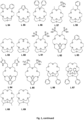
- L1 to L69 shown in FIG. 1 further illustrate examples of the organic ligand present as part of the coordination compound (a) being mixed with a second organic material (b) according to various embodiments and represented by the generic formulae (1-1) with linkers, L 1 , L 2 , and L 0 .
- the bridgehead atom, Y as part of formula (1-1) is in both instances chosen to be N.
- the shortest sequence of the two linkers L 1 , and L 2 is 5 atoms and the one hetero atom is in the center of this 5 atom sequence.
- Examples with different shortest sequence of L 1 , and L 2 are L44-L47, L50, and L53-L55, where either L 1 or L 1 , and L 2 possess of 4 or 6 atoms.
- L44, L50, and L55 the shortest sequence of L 1 is 5 atoms, while it is 6 atoms for L 2 .
- L46, L53, and L54 the shortest sequence of L 1 is 5 atoms, while it is 4 atoms for L 2 .
- L45 and L47 illustrate the situation of both L 1 , and L 2 being 6 and 4 atoms, respectively, in their shortest sequence of atoms between the two bridgehead nitrogens.
- L 1 and L 2 does alter the diameter of the basis di-aza-crown ether, which may be beneficial to adapt the cavity of the polymacrocyclic ligand according to formula (1-1) to perfectly match the diameter of the divalent Europium cation. Therefore, preferably L 1 can be four atoms long and L 2 six atoms long in (1-1).
- the one heteroatom that is present in the shortest sequence of the two linkers L 1 , and L 2 is nitrogen, or the more preferred oxygen.
- other heteroatoms are possible as well such as S, B, P.
- L33, L35, L36, and L39 illustrate the integration of a 5 atom shortest sequence of a diethylthio-fragment in either L 1 or L 1 and L 2 .
- the heteroatom present in L 1 and L 2 is the same, yet different heteroatoms in both linkers are possible too, which may for example be easier synthetically accessible and as such in the scope of this invention.
- L36 and L39 with O and S two different heteroatoms are present in L 1 and L 2 whilst L40 and L41 illustrate the same situation for the heteroatoms O and N.
- L 0 may contain one or more heteroatoms.
- L2 and L3 illustrate the situation of just four heteroatoms being present in L 0 while L5, L21, L23, L24, L30, L43, L59, L63 depict the situation of two heteroatoms being present in L 0 .
- macrocyclic ligands according to formula (1-1) with L 0 comprising 3 heteroatoms in the shortest sequence of atoms linking L 0 to the remainder of the macrocyclic ligands.
- those heteroatoms are selected from B, N, P, S, O, preferably form N, and O, and even more preferably from O.
- L1 to L4 illustrate the situation of N and O being simultaneously being present as part of L 0 , whilst in L27 one B and two N are present.
- the heteroatoms that are part of L 1 , and L 2 are selected independently of any optionally present heteroatom in L 0 .
- L11 to L15 only O is present as heteroatom in L 1 , L 2 , and L 0
- L22 and L23 exemplifies the case of O being the mandatory heteroatom as part of L 1
- L 2 and a plurality of N being present as part of L 0
- the linker L 1 , L 2 , and L 0 present in (1-1) only comprise of hydrogen, and/or deuterium, carbon, and oxygen. This situation is for example illustrated in examples L6, L11 to L15, L21, L24, L29, L31, or L32 in Fig 1 .
- L 1 , and L 2 are 4 to 7 atoms in their shortest sequence between the two Y according to formula (1-1), while L 0 must be 8 or more atoms. Yet, preference is generally given to L 1 , and L 2 being 5 and L 0 being 11 atoms.
- most stable cryptands are usually based on a repeating -C-C-X- pattern with X being a hetero atom. In other words, in most stable macrocyclic compounds two "neighboring" heteroatoms are separated from each other by two carbon atoms.
- the ideal number of atoms for linking to heteroatoms Y in shortest sequence in L 0 , L 1 , or L 2 taken together as part of formula (1-1) is 3n+2 with n being integer number representing the number of heteroatoms present in the linker L 0 , L 1 , and L 2 .
- At least two atoms present in the shortest sequence of atoms of either L 0 , L 1 , or L 2 are substituted and their substitutions are fused with each other, such that they become part of a benzene, pyridine, pyrrole, pyrazole, furan, carbazole, dibenzofuran, or benzofuran ring structure, whereby preference is given to furan and benzene.
- L3 and L4 two carbon atoms present in the shortest sequence of L 0 and L 1 , respectively are fused into a benzene ring.
- L15 and L42 four carbon atoms present in the shortest sequence of L 0 and L 1 , respectively are part of two non-fused benzene rings.
- L10 and L11 5 atoms present in the shortest sequence of L 0 are part of a dibenzofuran and carbazole ring structure, respectively.
- furan aromatic ring structures which is exemplified for the case of introduction into L 0 in structures in L12, L13, and L34, and for the case of introduction into either L 1 , or L 2 in structures L9, L11, L12, L13, and L14 for example.
- both L 1 , and L 2 comprise of a furan unit as part of their shortest sequence of atoms, which is exemplified in FIG. 1 in L9, L12, L14, and so on.
- "Shortest sequence” shall always be the shortest sequence (i.e., number) of atoms that link the two bridgehead atoms Y, preferably nitrogens, in case of L 0 , L 1 , or L 2 according to formulae (1-1).
- the shortest sequence of L 0 is 11 atoms in all cases.
- heteroarene groups may be introduced into the shortest sequence of L 1 , L 0 , or L 2 in various ways, general preference is given to connecting them symmetrically relative to the one heteroatom or heteroatoms. Further and preferentially, heteroaromatic groups are introduced into the shortest sequence of L 1 , L 0 , or L 2 in a way that the heteroatom itself is part of the shortest sequence of L 1 , L 0 , or L 2 .
- the preferred connecting carbon atoms are the 2 and 5 positions neighbouring the heteroatom, while for carbazole and dibenzofuran the preferred connection points are the 1 and 8 positions as illustrated in examples L9 - L14 in FIG. 1 .
- substituents may be any chemical fragment that can be covalently attached in accordance with formula (1-1).
- suitable substituents include alkyl, heteroalkyl, cycloheteroalkyl, halogens, aryl, or heteroaryl groups.
- two or more carbon atoms may simultaneously be substituted by a single substituent, whereby the two or more substituted carbon atoms may become part of an aryl or heteroaryl ring structure or cycloalkane or cycloheteroalkane structure, or a spiro linkage is formed. Therefore a wide variety of substitution patterns can be considered and may be preferable in various embodiments of this invention.
- FIG. 1 often potential substitutions R, are set to hydrogen for sake of clarity.
- any chemical fragment that can be covalently attached is in the scope of the invention.
- substituents include L1 to L5, where various substitutions are covalently attached to two nitrogen atoms.
- L48, and L49 some of the carbon atoms present in the scaffold of the ligand are twofold substituted.
- L52 two hydrogens are substituted by deuterium.
- L3 or L15 two neighboring carbon atoms present in L 0 are substituted to form benzene rings, whereas in L18 and L34 two non-neighboring carbon atoms are substituted to form a furan and pyrrole heteroaryl group, respectively.
- L29 and L38 illustrate cases where two R are linked together to form a hetero alkane.
- substitution patterns may reduce the symmetry of the polycyclic ligand relative to the unsubstituted base structure. For example, in L66 and L69, L 1 is differently substituted from L 2 . Similarly, in L57 and L58, L 0 is substituted twice with different substituents and therefore the symmetry of this linker is reduced.
- substitution patterns that reduce the symmetry of the ligand are clearly within the scope of the invention, they are not the preferred options as asymmetrical substitution patterns often lower the chemical stability of the complex, may cause an undesired red-shift of the emission energy, and/or increase the dipole moment of the complex.
- asymmetrical substitution patterns may improve the solubility of the final coordination compounds or reduce their tendency to crystalize.
- Substituents may be charge-neutral, for example alkane or alkene fragments with two or more covalent links to two or more carbon atoms of the polycyclic ligands according to the invention. Otherwise, for example, linear or branched alkane side chains may be chosen if a good solubility in non-polar solvents is needed. For other applications, coordination compounds with high thermal stability, for example suitable for evaporation or sublimation, may be needed. In this case, small and light weight substituents are preferably employed, i.e., organyl fragments with individually less than 20 atoms and or individually a molecular weight of less than 100g/mol.
- halogenated, particularly fluorinated, side groups may improve volatility and/or stability of the coordination compound according to the invention.
- the ligand preferably may be chosen such that the excitation of the coordination compound is confined to the central Eu cation. In other words, ligand-to-metal or metal-to-ligand change transfer character in the excited state is preferably avoided. In this way, an intrametallic transition with highest efficiency is obtained.
- side groups that are not easily polarized and that have a sufficiently high triplet level above the transition of the first electronically excited state of the emitter molecule. Low polarizability is ensured for aliphatic or heteroaliphatic substituents or using small aryl- or heteroaryl systems with less than 8 conjugated atoms or heteroatoms.
- heteroatoms are part of conjugated side groups, preference is generally given to the heteroatoms N and O, and even more preference is given to O.
- side groups with a triplet energy > 2.5 eV, or preferably > 2.7 eV are used.
- triplet energies of organic molecules can be calculated easily and with sufficient accuracy using a wide range of open source or commercial density functional theory (DFT) and time-dependent (TD)-DFT software packages.
- DFT density functional theory
- TD time-dependent
- triplet energies can be experimentally probed, for example as described in van Dijken, A., et al. "Carbazole compounds as host materials for triplet emitters in organic light-emitting diodes: polymer hosts for high-efficiency light-emitting diodes.” Journal of the American Chemical Society 126.24 (2004): 7718-7727 .
- suitable high triplet energy building blocks of the polymacrocyclic organic ligand according to formula (1-1) are preferably either non-aromatic (aliphatic) or comprises aromatic building blocks containing at most 8 aromatic carbon or hetero atoms, whereby various aromatic building blocks are being separated from each other by at least one nonaromatic carbon or heteroatom.
- the nitrogen and oxygen present in carbazole and dibenzofuran are considered a nonaromatic heteroatom.
- the polycyclic organic ligand according to formula (1-1) that coordinates to a divalent Europium cation within the coordination compound being part of the mixture according to invention may itself already be singly or multiply (dualy) negatively charged.
- suitable anionic groups are covalently attached to the polycyclic organic ligand according to formula (1-1) for example at positions R.
- examples of such anionic substitutions may be any singly or doubly negatively charged organyl groups that are sufficiently chemically stable.
- Examples of twofold negatively charged polycyclic ligands according to formula (1-1) include L4, L5, L7, L23, L30, L32, L61, L62, L64, and L65 in FIG. 1 with two substituted or non-substituted singly negatively charged anionic groups being covalently attached to the remainder of the macrocyclic ligand (1-1) via a carbon or nitrogen atom.
- the hydrogenated neutral version of the polycyclic ligand is depicted.
- L57 represents an example of a singly negatively charged ligand comprising covalently attached fluorinated and branched alcohol becoming an anionic alcoholate after deprotonation.
- the polymacrocyclic organic ligand may as well comprise negatively charged hetero atoms, such as borates or negatively charged aryl groups, such as pyrrolate as part of the scaffold of the polycyclic organic ligand.
- negatively charged hetero atoms such as borates or negatively charged aryl groups, such as pyrrolate
- this can be achieved by deprotonation of the aromatic pyrrole or triazole building blocks depicted as L9, L10, L18 and L25, L26 in FIG. 1 , respectively.
- the optional negative charge present in the ligand may as well be substantially localized on a particular heteroatom that is part of the scaffold of the organic ligand according to the invention that is generically represented by formula (1-1).
- a negatively charged borate is part of the linker L 0 , illustrating a singly negatively charged ligand according to formula (1-1).
- the sum of the negative charges of the covalently attached anionic groups matches the charge of the central divalent Eu cation, such that the resulting metal-organic coordination compound is charge-neutral.
- no unbound negatively charged anions are present, which elegantly avoids anion drift in device configuration under applied electric fields. Therefore, preferred are negatively charged ligands containing exactly two singly charged anionic groups or exactly one twofold negatively charged anionic group.
- ligand examples such as L23, L26, L30, or L32 are preferably chosen.
- anionic side groups exemplified in FIG. 1 shall not limit the scope of the invention.
- anionic groups covalently linked to the organic polycyclic ligand may be twofold or even higher charged, for example by attaching sulfate, phosphate, or chromate anionic groups.
- the polycyclic organic ligand may carry more than two negative charges.
- a charge neutral compound may be obtained by incorporation of additional suitable organic or inorganic cations, such as ammonium, alkali, alkaline earth metal cations or similar into the coordination compound being part of the mixture according to invention. While any of the anionic side groups depicted in FIG.
- carborate cluster fragments selected from (3-4) or (3-5) with the dashed lines indicating the covalent linkage to the remainder of the polycyclic ligand, and R b independently in each occurrence represents either hydrogen, deuterium, fluorine, chlorine, bromine, or an alkyl chain - preferably methyl.
- the coordination compound may include at least one negatively charged anion that is not covalently bound to the polycyclic organic ligand according to formula (1-1).
- the negatively charged anion may be a small inorganic anion such as, but not limited to, halogens, such as chloride or iodide, BF 4 , PF 6 , and so on.
- a light emitting chemical cell may be an embodiment of an OLED in this description.
- Drift of charged species within the mixture including the Europium coordination compound having an organic ligand according to formula (1-1) may lead to very low driving voltages in case of employing the mixture in an electroluminescent device, which may facilitate high power-efficiencies. This may be desirable for some applications, such as general illumination or signage. Yet, for other applications that require fast response times, for example flat panel displays, such ion drift may lead to time dependent current-voltage-luminance (IVL) characteristics, which may be difficult to control, and may not be desirable as such. Therefore, the choice of the anions may depend strongly on the application.
- IVL current-voltage-luminance
- the coordination compound may contain comparably large and bulky organic anions. Such anions may be employed if ion drift is not desired. Examples without limiting the general scope of the invention of such anions include fluorinated or non-fluorinated fullerene (C 60 - , C 60 F 36 - , C 60 F 48 - ) fluorinated aryls and fluorinated or non-fluorinated aryl or heteroaryl-borates.
- the negatively charged anion may include more than one atom, preferably more than three atoms. Such larger anions are generally bulkier and, as such, are better suited for applications where drift of anions is not desired. Furthermore, the anion may have a molecular weight of at least 128 g/mol. Suitable anions are disclosed in WO 2021/244801 .
- anions without substantial absorption at wavelengths in the range of 380-700 nm, more preferably in the range of 430-500 nm, may be used.
- they may be the same or of different type.
- a doubly negatively charged anion is present in the coordination compound according to the invention, such as for example the closoborate [B 12 H 12 ] 2- or the borane cluster fac -[B 20 H 18 ] 2- .
- anions that do not strongly interact with the electronically excited central Eu cation preference is given to anionic side groups that do not tend to form covalent chemical bond with the central cation, but where the interaction is mainly of electrostatic nature.
- bulky anions or anionic groups in which the negative charge is distributed over many atoms are preferred.
- light weight anions with individually less than 1000 g/mol and more preferably less than 500 g/mol.
- Very well suited in this context, and therefore preferred are substituted or non-substituted closo- and/or nido- (car)borate cluster anions.
- two identical anions selected from (3-1) to (3-3) are chosen: with R b independently in each occurrence representing either hydrogen, deuterium, fluorine, chlorine, bromine, or an alkyl chain - preferably methyl.
- Examples of charge-neutral coordination compounds being present in the mixture according to the invention are shown as E01 - E36 in FIG. 2 .
- both bridgehead atoms Y according to formula (1-1) are chosen to be nitrogen.
- the shortest sequence of L 1 and L 2 reflects the preferred situation of 5 atoms, while it is 11 for L 0 .
- substitutions are symmetrically with respect to the linkers L 0 , L 1 and L 2 (one symmetry plane may be preferably present in (1-1)). All L 1 and L 2 contain exactly one heteroatom in their shortest sequence between the two bridgehead atoms Y according to formula (1-1), which is either O or S.
- L 0 contains exactly three heteroatoms in its shortest sequence between the two bridgehead atoms Y selected from N, O, or S.
- All ligands are examples of the preferred situation, where neighboring heteroatoms are separated from each other by exactly two carbon atoms.
- the heteroatom is part of an heteroaryl fragment, in particular a furan or thiophene.
- those heteroaryl fragments are integrated into the scaffold of the organic ligand in the 2,5 positions to ensure that the heteroatom present in furan and thiophene is part of the shortest sequence of atoms linking the two bridgehead atoms Y in formula (1-1), and, to ensure that the heteroatoms are able to coordinate the central divalent Europium.
- E01 to E05 exemplify further substitutions, where for example nitrogen atoms are substituted by methyl groups or benzene rings are fused into the scaffold of the ligand.
- E03 and E17 to E19 all ligands are charge-neutral and two identical anions are present in the coordination compound. While triflimide is exemplified in E34, iodide is used in E08 to E12 and E32, E33, E35, and E36. In the other examples, the more preferred closoborate type anion is used. For example, in E01 a CB 11 H 12 type closoborate is used, while in E02, the fully methylated version of this anion in exemplified.
- the coordination compound (a) is mixed with a second charge-neutral organic compound (b).
- the second organic material (b) may be chosen from a wide range of generic classes of substantially organic materials, including but not limited to small organic molecules, preferably with a molecular weight less than 1500 g/mol, large molecules or polymers with organic weight of more than 1500 g/mol, dendrimers, metal-organic complexes, or organic materials not comprising any metals.
- the second organic material may as well be processed in a low molecular weight form and later be combined into a higher molecular weight form. Examples here are metal organic frameworks or crosslinkable polymers.
- second organic materials that add a desired functionality to the mixture according to the invention.
- Such a functionality can be, without limitation, improved air or moisture stability, improved thermal stability, improved charge transport properties, improved dispersion of the coordination compound according to formula (1-1), improved optical characteristics - such as lowering the refractive index of the mixture or improved processing to name just a few.
- the coordination compound (a) is imbedded into the at least one second charge-neutral organic compound (b) at 0.1 - 99.0 vol%, preferably at 1 - 90 vol%, and most preferably at 3 - 30 vol%, based on the mixture which is 100 vol%.
- the coordination compound might take a majority or a minority of the overall volume of the mixture.
- the coordination compound (a) takes a minority part of the volume and has the function of an organic dopant, whereas the one or more organic materials (b) take a majority part of the volume for example to funnel energy or charges towards the coordination compound.
- the second organic material being part of the mixture may be a matrix having suitable optical properties, such as, for example, a high transparency in certain desired parts of the visible spectrum. If this matrix is brought in optical contact to a light source emitting at a sufficiently short wavelength, this light may be absorbed by the coordination compound and reemitted at a substantially longer wavelength.
- a suitable light source may for example be a light emitting diode, emitting light at a wavelength substantially shorter than 430 nm, which may be reemitted by the coordination compound present in the mixture at a wavelength longer than 430 nm.
- the matrix may have any physical dimensions. It may for example be a thin layer of 10 nm to 10,000 nm.
- the matrix may as well be of granular form or in form of small particles of average diameter between 10 nm and 100,000 nm. For use in optical devices, in the latter cases, the matrix may be applied inside another host material for support.
- the mixture according to the invention is used as emitting material, particularly to generate color-pure deep blue emission from the intrametallic transition after direct or indirect optical or electrical excitation.
- the excitation on the coordination compound qualitatively consists of an electron and a hole.
- hole To emit light with high efficiency while imbedded into a second organic material, it is mandatory that the positive charge, commonly referred to as hole, is confined to the coordination compound.
- the second charge-neutral organic compound has a higher electron binding energy than the charge-neutral coordination compound.
- the most weakly bound electron in the coordination compound should be less strongly bound than the most weakly bound electron of the second organic material. The requirement thus means that for a hole being present in the mixture according to invention, it is energetically favorable to reside on the coordination compound as opposed to residing on the second organic material.
- Measuring the transport levels of organic materials is an established field based on a wide selection of methods and a wide variety of techniques have been published in the literature. However, for the purpose of various embodiments, the particular technique of how to measure the electron binding energy and or the electron affinity is not essential, e.g., only the relative order of the materials being present in the mixture according to the invention, i.e., between the coordination compound and the second organic materials, may be of importance.
- Both, HOMO and EBE (and IP) refer to the binding energy of the most weakly bound electron in a molecule, though the value given for the HOMO is typically of opposite sign. Accordingly, removing an electron from or, in other words, accepting a hole on divalent Europium leaves six electrons in its originally half full 4f-shell, which corresponds to the following change in its electronic configuration: [Xe] 4f 7 5d 0 6s 0 ⁇ [Xe] 4f 6 5d 0 6s 0 . Formally, this process yields trivalent europium, or Eu(III), and requires to overcome the electron binding energy. Furthermore, to describe the electron-binding energy in electronically excited metal-organic compounds comprising Eu(II), we use the term excited-state electron binding energy (ES-EBE), which is related to what is commonly known as the electron affinity or LUMO energy of most organic materials.
- ES-EBE excited-state electron binding energy
- the second charge-neutral organic compound has an electron binding energy higher than 4.5 eV, preferably higher than 5.3 eV and most preferably higher than 6.0eV.
- organic materials with deeper HOMO corresponding to a higher EBE
- the coordination compound present in the mixture according to invention is preferably emitting deep blue light with a substantial fraction of the emitted light at emission energies higher than 2.5 eV. With an electron binding energy of no more than 4.5 eV, this would imply an electron binding energy in the lowest excited state (ES-EBE) of the emitter molecule of no more than 2.0 eV, which might still yield a chemically stable emitter, yet stronger bound excited electrons are preferred.
- ES-EBE electron binding energy in the lowest excited state
- the typical coordination compounds comprising divalent Europium according to invention typically do not trap electrons. Or in yet other words: an excited divalent Europium would not create a charge transfer state by transferring a hole to a surrounding matrix, whilst leaving the excited electron on the coordination compound.
- the second charge-neutral organic compound (b) has a triplet energy that is higher than the emission energy of the coordination compound (a).
- the multiplicity of the coordination compound in both, its ground state and first electronically excited state is neither a triplet nor a singlet but, as already mentioned above, a multiplet with seven unpaired electrons.
- the emission proceeds via the spin-conserving and thus parity- and Laporte-allowed 5d-4f transition: [Xe] 4f 6 5d 1 6s 0 ⁇ [Xe] 4f 7 5d 0 6s 0 .
- the lowest electronic energy levels are in most cases the triplet levels. Therefore, to confine the energy on the emitting coordination compound the surrounding matrix should have a higher triplet energy vs the emission energy of the coordination compound.
- the mixture according to invention emits in the deep blue spectral region substantially at wavelength shorter than 496 nm, preferably less than 477 nm, most preferably less than 459 nm. Consequently, the second organic compound has preferably a triplet energy higher than 2.5 eV, preferably higher than 2.6 eV and most preferably higher than 2.7 eV to still ensure sufficient energy confinement on the coordination compound.
- the coordination compound in its first electronically excited state will not transfer a hole to the nearby matrices, it might transfer an electron leaving behind the positively charged coordination compound comprising Eu(III).
- the coordination compound for high emission efficiency from the coordination compound, such a transfer of charge/electrons from the excited emitter molecule is preferably prevented by confining the excited electron to the coordination compound. Therefore, the preferred second charge-neutral organic material (b) being part of the mixture according to the invention has an electron affinity that is lower than the electron binding energy of the coordination compound in its lowest electronically excited state (ES-EBE).
- electron affinity is associated with the energy of the lowest unoccupied molecular orbital (LUMO) of the organic material.
- an organic electronic device may be any device or structure including substantially organic layers or subunits, where an electro-magnetic stimulus may be converted into an electrical field or current or vice versa, or where an input electrical current or electrical field may be used to modulate an output electrical current or electrical field.
- the organic electronic device including the mixture according to various embodiments may be used as semiconducting organic layer in an organic field-effect transistor or an organic thin-film transistor.
- FIG. 4 and FIG. 6 illustrate embodiments of an organic electronic device 100 configured as optically active device.
- the organic electronic device may include a first electrode 104, e.g., on a substrate 102 or as the substrate; a second electrode 108; and an organic layer 106 arranged such that it is electrically interposed between the first and second electrodes 104, 108.
- the first and second electrodes 104, 108 may be electrically insulated from each other by an insulating structure 110, e.g. a resin or polyimide.
- the first and second electrodes 104, 108 may be stacked over each other ( FIG. 4 ) or may be arranged in a common plane ( FIG. 6 ).
- the organic layer 106 may include the mixture according to any of the described or illustrated embodiments, e.g., the layer may contain just the mixture, or the mixture might comprise of further organic or non-organic materials.
- the organic layer may be a single layer or contain a plurality of layers.
- FIG. 5 illustrates the situation where the organic layer 106 comprises a plurality of layer 111, 112, and 113.
- the mixture according to invention may be part partly or exclusively contained in one or more layers present in the overall organic layer 106.
- the organic electronic device 100 may be an optoelectronic device, the optoelectronic device being at least one of an organic light emitting diode (OLED), a light emitting cell (LEC), an organic photodetector, or a photovoltaic cell. That is, photons from an external electromagnetic field may be absorbed in the organic layer 106 and converted into current by means of an electrical field between the first and second electrodes 104, 108.
- Such a device would be a photodiode (OPD) and its primarily use may be to sense external light. It would be an organic photovoltaic (OPV) device, if the primarily use is to convert light into current.
- OPD photodiode
- OCV organic photovoltaic
- the organic layer 106 is arranged electrically between the first and second electrodes 104, 108, such that an electronic current may flow from the first electrode 104 through the organic layer 106 to the second electrode 108 and vice versa during operation, e.g., in light emission applications.
- a charge carrier pair may be formed in the organic layer 106 and charge carriers of the charge carrier pair may be transported to the first and second electrodes 104, 108 respectively.
- holes and electrons are injected from the anode and the cathode, respectively, and drift towards the organic layer 106, where charges of opposite sign recombine to form a short-lived localized excited state.
- the short-lived excited state may relax to the ground state thereby giving rise to light emission.
- the first and second electrodes 104, 108 may be substantially unstructured layers, e.g., for general lighting applications, or may be structured, e.g., for light emitting diodes or transistors for pixels in a display application.
- the organic electronic device 100 may be configured to emit substantially monochromatic light such as red, green, blue, or polychromatic light such as white.
- the light may be emitted through the first electrode 104 (bottom emitter), through the second electrode 108 (top emitter), or through first and second electrodes 104, 108 (bidirectional emitter).
- the light may as well be substantially emitted in a direction parallel to the organic layer 106 using suitable opaque electrodes 104, 108.
- lasing may be achieved, and the device may be an organic laser, which, in this description, may be considered as a specific type of electroluminescent devices.
- the mixtures according to various embodiments may have excellent emission properties, including a narrow deep blue emission spectrum with short excited state lifetime. Given their high atomic weight and open shell electronic structure, the optical transitions of Eu(II) complexes are widely indifferent to excitation with either spin 1 or spin 0 electron-hole pairs. In other words, both singlet and triplet excitations are harvested, resulting in very efficient light emission. As such, the mixtures according to various embodiments may be ideally suited for application in organic electroluminescent devices, such as organic light emitting diodes (OLED).
- an electroluminescent device may be any device including an organic layer disposed between and electrically connected to an anode 104/108 and a cathode 108/104.
- Organic light emitting cells may be considered as a subclass of OLED devices comprise of mobile charged species inside the active organic layer 106, which are able to drift inside an external applied electrical field. As such OLEDs encompass LEC type devices.
- FIG. 5 may represent the situation where the mixture according to invention is present in layer 112 whereas the nearby layers 111 and or 113 may be configured as charge transport or charge blocking layers.
- the recombination of electrons and holes may as well happen at the interface of the organic layer 106, which contains the mixture according to the invention and an adjacent layer, such as an electron blocking layer.
- an adjacent layer such as an electron blocking layer.
- the layer in physical contact 111 is configured to be an electron transporting layer, then charge recombination may happen at the interface between layer 111 and 112 with subsequent energy or charge transfer to the coordination compound present in layer 112.
- Further optically functional layers e.g., a further electroluminescent material and/or a wavelength conversion material may be formed electrically between the first and second electrodes 104, 108 and in the optical path of the organic layer 106, e.g., on top of the second electrode 108 and/or on the opposite side of the substrate 102.
- encapsulation structures may be formed encapsulating the electrically active area, e.g., the area in which electrical current flows and may be configured to reduce or avoid intrusion of oxygen and/or water into the electrically active area.
- Further optically functional layers e.g., an antireflection coating, a waveguide structure and/or an optical decoupling layer may be formed within the optical light path of the organic layer 106.
- hole or electron blocking layers may be used to optimize the individual hole and electron currents through the organic electronic device 100. This may be known to those skilled in the art as charge balance in order to optimize efficiency and operational stability.
- dedicated hole or electron charge transport layers may be present in the organic electronic device 100 to space the emission region from the first and second electrodes 104, 108.
- layers 111 and or 113 depicted in FIG. 5 may be configured as electron - and or hole blocking layer, while layer 112 contains the mixture according to the invention.
- Examples of hole transport materials include known materials such as fluorene and derivatives thereof, aromatic amine and derivatives thereof, carbazole derivatives, dibenzofuran, dibenzothiophene, and polyparaphenylene derivatives.
- Examples of electron transport materials include oxadiazole derivatives, triazine derivatives, anthraquinodimethane and derivatives thereof, benzoquinone and derivatives thereof, naphthoquinone and derivatives thereof, anthraquinone and derivatives thereof, tetracyanoanthraquinodimethane and derivatives thereof, fluorenone derivatives, diphenyldicyanoethylene and its derivative, diphenoquinone derivatives, and metal complexes of 8-hydroxyquinoline and its derivatives and various derivatives of silanes.
- those charge transport layers may include electrical dopant molecules or metals or may be in contact to charge injection layers.
- auxiliary layers may be fully organic or may include inorganic functional moieties.
- charge transport layers may be made of the class of Perovskite materials.
- the organic materials being present in the charge transport or blocking layer have a higher electron binding energy than the charge-neutral coordination compound, and/or having a higher triplet energy compared to the emission energy of the coordination compound in its lowest electronically excited state, and/or having an electron affinity that is lower than the electron binding energy of the coordination compound in its lowest electronically excited state.
- This ensures that both charges and excitons are confined on the coordination compound being part of the mixture according to the invention instead of transferring to the nearby organic layer.
- the layer in physical contact 111 is configured to be an electron transporting layer, then charge recombination may happen at the interface between layer 111 and 112.
- organic materials present in layer 111 have a higher electron binding energy relative to the neutral coordination compound present in the mixture in layer 112. Therefore, positive charges that may be present in the mixture in layer 112 do not transfer significantly to the organic layer 111.
- a higher triplet energy and/or an electron affinity that is lower than the electron binding energy of the coordination compound in its lowest electronically excited state.
- electrons, holes, and excitations are confined on the coordination compound being present in layer 112 instead of transferring to the organic materials present in layer 111.
- the mixture according to the invention as illustrated or described in any one of the embodiments may be used as a thin substantially organic emission layer 106 of any thickness in the range of 0.1 to 100 nm, preferably in the range of 3 to 20 nm.
- concentration of the coordination compound throughout the cross section of the organic layer may be constant or varied. Typical variable concentrations are in the range of 0 to 100 vol%, i.e., the layer may be partially containing either no coordination compound or just coordination compound. Such situations are indeed frequently observed if mobile evaporation sources are employed to co-sublime the organic material with the coordination compound.
- the emission layer 106 may as well be configured as a plurality of mixtures according to the invention having different concentrations of coordination compound. For example, in FIG.
- layer 111, 112, and 113 may all contain the second organic material present in the mixture according to the invention and three layers may contain 0, 3, 20 vol% of the metal-organic coordination compound, respectively.
- the emission layer 106 may as well be configured such that the metal organic coordination compound is present in two adjacent layers, for example 112 and 113 depicted in FIG. 5 , but the second organic material being present in the mixture according to the invention is different in both layers. It may for example be a substantially hole transporting material in layer 112, yet a substantially electron transporting organic material in layer 113.
- the mixture according to the invention has a very high volume or weight or molar concentration of the coordination compound.
- the mixture may contain only 1% or less or the second organic material, i.e., it is a substantially pure layer containing the divalent Europium coordination compound having an asymmetrical ligand according to formula (1-1). It might for example be beneficial to avoid co-deposition but instead to sandwich a nearly pure and thin layer of the coordination compound within two suitable organic layers. In such a situation the substantially pure layer containing the coordination compound may be rather thin, i.e., between 0.2 to 10 nm, or preferably 1 to 3 nm.
- layer 112 may be configured as substantially pure layer of coordination compound, while layer 111 and or layer 113 may contain organic material, in particular charge transport or charge blocking materials.
- the organic materials being present in the charge transport or blocking layer 111 and or 113 have a higher electron binding energy than the charge-neutral coordination compound, and/or having a higher triplet energy compared to the emission energy of the coordination compound in its lowest electronically excited state, and/or having an electron affinity that is lower than the electron binding energy of the coordination compound in its lowest electronically excited state. This ensures that both charges and excitons are confined on the coordination compound being present in layer 112 instead of transferring to the nearby organic layers.
- the second organic material being present in the mixture according to the invention being part of the organic layer 106 may in various embodiments be a charge transport material to improve charge transport into and through the organic layer 106 or to facilitate charge recombination.
- Charge transport materials may be any material that are able to transport either holes or electrons or both types of charges upon applying a suitable electrical field.
- a charge transport material may be any aryl, or heteroaryl organic compound or any metal complex or any mixture thereof.
- Examples of materials present in the light emitting layer 106 include carbazole derivatives, including carbazole-phosphine oxide materials, oxadiazole derivatives, triazine derivatives, silane derivatives and any other material or combination of materials with sufficiently high triplet level that may transport charges or otherwise benefit the device performance. Without limiting the scope of the invention, a small selection of possible charge transport materials is depicted as H1 to H20 in FIG. 3 .
- the organic layer 106 that contains the mixture according to the invention may contain any further organic or inorganic material in a range of 0.1 to 99.0 vol% that is not intended to transport charges.
- the organic layer 106 may include polymers (in a mixture or as a compound) which may be added to improve film quality and prevent crystallization. Other materials may be added to evenly space the coordination compound inside the organic layer 106.
- the mixtures according to various embodiments may allow the ease of processing using vacuum based techniques.
- the evaporation temperature of the mixtures including the coordination compound and the second organic material may be sufficiently low to allow for thermal vacuum processing techniques to be used.
- Reduced evaporation temperatures can be achieved according to the invention by using the metal-organic coordination compounds with their asymmetrical ligand according to formula (1-1) as here the ionic character of the compounds is strongly suppressed, if compared to similar organic salts based on symmetrical ligand design. Consequently, the evaporation temperature is reduced and incorporation into organic electronic devices becomes possible using state-of-the-art vacuum deposition techniques.
- the organic electronic device 100 includes two or more subunits each including at least one light emitting layer.
- the subunits may be stacked over each other physically separated and electrically connected by a charge generation layer or, alternatively, may be arranged side by side.
- the subunits may be subpixels of a pixel in a display or general lighting application.
- the light emitted by the subunits may be mixed to generate a light of a predetermined color.
- Each subunit may emit light of the same or a different color.
- the overall light emitted by such organic electronic device 100 may contain a narrow spectral region, such as blue, or may contain a wide spectral region such as white, or a combination thereof.
- the mixture according to the invention comprising the divalent Europium compound illustrated or described in any one of the embodiments may or may not be present in all subunits of the organic electronic device 100.
- the light emitted by the organic electronic device 100 may be in optical contact to at least one optically active layer, including any optically active materials such as organic molecules or quantum dots.
- the optically active layer may be a spectral filter element, which may absorb part of the light emitted by the organic electronic device 100.
- the optically active layer may absorb at least part of the light emitted by the organic electronic device 100 and may reemit it at longer wavelength (wavelength conversion), e.g., by quantum dots.
- the organic layer 106 may be configured to emit light substantially at wavelengths shorter than 500 nm and the optically active layer may be configured to substantially reemit light at wavelengths longer than 500 nm.
- the optically active layer may be placed in between the anode and cathode of the organic electronic device 100 or outside of it. The optically active layer may as well be part of the organic layer 106.
- the organic electronic device 100 may be configured as a large area OLED device used for illumination, signage, or as a backlight.
- the organic electronic device 100 may include a plurality of OLEDs arranged in a pixelated layout (plurality of OLED pixels) that are individually connected electrically, e.g., for flat panel display applications.
- individual pixels may have the capability of emitting light of substantially narrow spectral portions; especially of red, green, and blue. The mixture may or may not be present in any of the individual pixels.
- the individual pixels may be configured to emit white light. Red, green, and blue spectral portions are generated by using suitable filter elements in optical contact with the respective pixelated OLEDs.
- the OLED pixels emit blue light, and the red and green spectral portions may be generated by using a suitable color conversion element in optical contact with the OLED pixels.
- the OLED pixels emit substantially in the near-UV spectral region with wavelength ⁇ 450 nm and the red and green and blue spectral portions may be generated by using a suitable color conversion element in optical contact with the OLED pixels.
- the organic electronic device 100 includes an anode 104; a cathode 108; and an organic layer 106 disposed between the anode 104 and the cathode 108.
- the organic layer 106 includes a mixture according to various embodiments.
- the mixture includes - divalent Europium coordinated by a polymacrocyclic organic ligand according to the present invention according to formula (1-1).
- An organic electronic device 100 may be fabricated using a wide range of commonly used techniques, including, but not limited to, deposition of all or some layers, from gas phase vacuum deposition, solution phase, or gas phase using a carrier gas method.
- the transfer into the gas phase may be improved by using a carrier gas technology, whereby an inert gas that may not be deposited into the organic layer comprising the mixture may be helping the sublimation or evaporation of the coordination compound or the mixture to be deposited.
- the coordination compound may be co-deposited with the second organic material using two separate thermal sources, in other words, the mixture is formed in-situ after deposition.
- two or more additional materials may be deposited using a triple or quadruple evaporation, whereby the mixture according to the invention is further diluted.
- the mixture may as well be thermally processed from one crucible. In other words, the mixture or a precursor thereof is already present before sublimation or evaporation.
- a precursor may for example be an additional auxiliary ligand present as part of the coordination compound that dissociates during thermal evaporation and that is substantially not built into the organic layer comprising the mixture according to the invention. Preferred in this situation are similar volatilities for the second organic material and the coordination compound. Alternatively, the coordination compound and the second organic material may form a frozen glass, thereby forcing the individual components to sublime at similar temperatures.
- Another preferred technique to fabricate layers including the mixture according to various embodiments may be deposition from a liquid phase using a mixture of or a single organic solvent, whereby the mixture according to various embodiments may be dissolved or forms a suspension within the organic solvent; in this description may be referred to as the ink.
- the ink using this deposition process may include a wide variety of other materials apart from the two materials present in the mixture according to various embodiments to allow fabrication of triple or higher-order mixed layers from solution.
- Additives within the ink may for example, but may not be limited to, be organic or inorganic materials capable of transporting charges, materials that improve the film formation, materials that improve the distribution of the mixture within a third material, organic or inorganic materials that improve the efficiency of the device, e.g., by reducing the refractive index.
- the deposition from solution may not be limited to any specific technique. Examples of the deposition from solution include spin coating, casting, dip coating, gravure coating, bar coating, roll coating, spray coating, screen printing, flexographic printing, offset printing, inkjet printing.
- the improved solubility of the coordination compounds being present in the mixtures according to the present invention in non-polar solvents eases the deposition from solution and makes it advantageous.
- solvents with relatively low polarity index such as tetrahydrofuran or toluene may be used as part of the ink formulation.
- some or all layers of the organic electronic device include functional groups capable of chemically crosslinking upon thermal or optical exposure thereby forming larger covalently bound molecules with improved physical properties.
- the functional groups are present in the second organic material and after crosslinking the second organic material becomes a polymer.
- the functional groups capable of crosslinking are present on both, the coordination compound and the second organic layer, and after crosslinking, a single polymeric material comprising both materials is formed.
- the coordination compound as part of the mixture may be formed in-situ using deposition from solution.
- the organic ligand according to formula (1-1) of the present invention including the second organic materials, but excluding the divalent Europium may first be deposited onto a suitable substrate or other organic layer thereby forming a seed layer. Any suitable technique may be used to fabricate this seed layer.
- This seed layer including the organic ligand and second organic material may include any further material. Preferred may be further additional inert organic or inorganic materials that aid the layer formation or improve its thermal stability or improve the distribution of the organic ligand or second organic material within this seed layer.
- a layer including a molecular salt comprising the divalent Europium may be fabricated using a solution process.
- the Europium compound may be any charge neutral compound including Eu(II) and one or two suitable anions.
- the anions may as well be covalently bound to a suitable polymer.
- the ink including the Europium compound may as well include one or more additives to fabricate mixed layers. These additives may be organic or inorganic materials to aid charge transport, may be organic or inorganic materials that improve the efficiency of the device, or may be any material that improves the film formation.
- the solubilized divalent Europium compound will interact with the polymacrocyclic organic ligand according to formula (1-1) to form the coordination compound as part of the mixture according to various embodiments in-situ.
- the process of first forming the layer containing the ligand and secondly processing the lanthanide compound may be inverted.
- At least one of the components set forth in one or more of the preceding figures may be configured to perform one or more operations, techniques, processes, and/or methods as set forth in the example section below.
- Trimethylammonium carbadodecaborate (1 eq, 4 mmol) was dried in a Glovebox for 1 h at 100 °C, then dissolved in anhydrous THF (20 ml). A solution of Eu(HMDS) 2 (0.5 eq, 2 mmol) in anhydrous THF (10 ml) was added dropwise at RT. The mixture was stirred for 1 h. White crystals formed which were collected via suction filtration, washed with THF and dried in vacuum to yield the title compound.
- the colorless solid was filtered off, dissolved in a small amount of water and passed through an anion-exchange column (Amberlite IRA-410 (OH), eluant MeOH/H 2 O 20/1).
- the aqueous eluate was concentrated under reduced pressure and the remaining oil was extracted with boiling hexane (3x). The solvent was removed in vacuum and the title compound obtained as a colorless oil which crystallized by refrigeration.
- the title compound was prepared using a known procedure ( R.-P. Moldovan et al. J. Med. Chem. 2016, 59, 7840-7855 ).
- the product was isolated as a colorless oil and dried in vacuum before use.
- the solvent was removed under reduced pressure and the residue passed through a pad of aluminium oxide (neutral) using THF/EtOH (100/1, 500 ml) as eluant.
- the solvents were removed in vacuum to give a crude, which was purified by flash-chromatography (alumina oxide, neutral, CH 2 Cl 2 /MeOH 0% to 5%). After evaporation of the solvents the obtained slightly yellow oil was dissolved in MeOH and acidified with HCl aq . (1 M). The aqueous mixture was concentrated to dryness. The remaining white solid was dissolved in a minimal amount of H 2 O and passed through a anion-exchange column (Amberlite IRA-410 (OH), MeOH/H 2 O 20:1). The eluate was concentrated under reduced pressure and the obtained oil extracted with hexane. After removal of the solvent in vacuum, the obtained crude product was purified by by distillation using a Kugelrohr-apparatus to give the title compound as a colorless oil.
- the europium(II) salt (1 eq) and the ligand (1.05 eq) were dissolved separately in an appropriate solvent (THF or methanol).
- the solution, containing Eu(II) was added dropwise to the stirred solution of the ligand at RT. If the product precipitated, it was separated by filtration, washed with THF, hexane and dried. In other cases, the reaction mixture was evaporated to dryness, the residue triturated with THF or diethyl ether, the precipitated product separated by filtration, washed with THF (diethyl ether), hexane and dried.
- the compounds being made are tabulated in table 1.
- the coordination compounds were further purified using a three-temperature zone sublimation tool (CreaPhys, DSU-5) being installed in a nitrogen glovebox.
- a three-temperature zone sublimation tool (CreaPhys, DSU-5) being installed in a nitrogen glovebox.
- the weight of the sublimed material was measured relative to the weight of the material in the sublimation source, giving the sublimation yield.
- Photo-emission spectra of E32 to E35 dissolved in water and oxygen free methanole are depicted in FIG. 7 testifying to the deep blue emission of those coordination compounds.
- the computational protocol to determine structures, emission energies ( EE ), and the electron binding energies of Eu(II) complexes in their electronic ground (4 f 7 5 d 0 ) ( EBE ) and first (energetically lowest) excited (4 f 6 5 d 1 ) ( ES-EBE ) state consists of 3 main steps, all of which can be accomplished with freely available open-source software (xTB: https://github.com/grimme-lab/xtb; CREST https://github.com/crest-lab/crest; CENSO https://github.com/grimme-lab/CENSO) and the commercially available quantum-chemical program package ORCA (https://www.faccts.de/orca/).
- any quantum-chemistry software can be used for these calculations and would provide near-identical results if the methods described in detail below (functionals, dispersion corrections, basis sets, geometric Counter Poise corrections, effective core potentials, solvent models and parameters) are applied in the same way. Due to the statistical (non-deterministic) nature of the simulations in step one of this approach, the results are not exactly reproducible. However, if the simulation times are sufficiently long, the approach will always yield the same relevant (lowest energy) conformer after step 2, which will have very similar properties in the calculations in step 3. As a very conservative estimate, the precision of the predicted dipole moments (over repeated runs for the same molecule) should be ⁇ 1 D and ⁇ 0.1 eV for emission energies and ionization potentials.
- step 1. and 2. of this protocol is taken from the following article with some modifications to the default energy cutoffs and methods:
- sample jobs include all keywords relating to the methods described above. However, additional keywords and settings might be required in some or all cases to avoid technical problems (e.g. SCF convergence issues). As these settings depend on the individual case, they are not provided here.
- the names and relevant parameters of organic materials used in the mixtures are presented in Table 3.
- the organic materials were purchased from Ossila (labeled 1) or Lumtec (labeled 2) and their corresponding HOMO, LUMO and Triplet energy values are taken from the website of the vendors (www.ossila.com and https://www.lumtec.com.tw/) by searching for the material using its name or synonym.
- the chemical structures for the organic materials are shown in FIG. 3 .
- HOMO and LUMO energies correspond to electron binding energy (EBE) and electron affinity (EA), respectively.
- Mixtures of a coordination compound (E) and a second organic material (H) are created by thermal co-evaporation of both materials in an ultra-high-vacuum chamber.
- the ratio of the coordination compound to the organic material is 1:9 vol%, which is achieved during the sample preparation by fixing the evaporation rates of each material accordingly.
- the samples are produced on precleaned 25 x 25 mm quartz substrates.
- the resulting samples are organic thin films with a total thickness reaching 50 nm. Subsequently, there is a 100 nm layer of Aluminum deposited on the thin film to prevent any negative impact of oxygen and moisture exposure on the sample over time.
- the samples are characterized by way of time-correlated single photon counting method (TCSPC).
- TCSPC time-correlated single photon counting method
- the experiment is carried out in a HORIBA Fluoromax 4P spectrofluorometer with a TCSPC extension.
- the excitation wavelength of the laser used in the experiment is 371 nm.
- the laser pulse width is ⁇ 1 ns.
- the slit in front of the detector is set to 1 nm and the monochromator in front of the detector is set to the peak emission of the coordination compound in solution (compare FIG. 7 ) used in the mixture.
- Example decay curves of coordination compound E32 in mixtures with three organic materials, as indicated in the graph, are plotted in FIG. 8 in a semi-logarithmical fashion.
- the area under each curve is calculated. Prior to the calculation, each curve is normalized to have the same noise level at 1.
- the initial luminescence from the mixture originates from fluorescence of the organic material used in the mixture.
- the integration is carried out in the range of 150 - 1000 ns. It is considered that a larger area under the curve is directly correlated to larger quantum efficiency of the coordination compound in the mixture.
- a + or - sign marks whether the condition for each mixture of the organic compound and the coordination compound is satisfied according to claim 1 (EBE), claim 3 (Triplet) and claim 5 (ES-EBE).
- EBE claim 1
- Triplet claim 3
- ES-EBE claim 5
- the area under the decay curves for a wide range of mixtures of a second organic material, H, combined with various coordination compounds, E, are summarized in Table 4.
- the chemical structures and the names and the relevant properties of the organic materials can be found in FIG. 3 and table 2, respectively.
- the structures are depicted in FIG. 2 , while the relevant parameters are tabulated in Table 1 above.
- the organic compound (b), H must have a higher electron binding energy than the charge-neutral coordination compound.
- a plus (+) in column "EBE" indicates that this criterium is met, otherwise its labeled minus (-).
- the organic compound has an electron affinity that is lower than the electron binding energy of the coordination compound in its lowest electronically excited state.
- a plus (+) in column “ES-EBE” indicates that this criterium is met, otherwise its labeled minus (-).
- the second organic compound has a higher triplet energy compared to the emission energy of the coordination compound from the first electronically exited state.
- a plus (+) in column “Triplet” indicates that this criterium is met, otherwise its labeled minus (-).
- the area under the decay curve corresponds to the emission quantum yield of the coordination compound.
- mixtures #4 and #9 are examples according to the invention, while the others are comparative examples.
Landscapes
- Chemical & Material Sciences (AREA)
- Engineering & Computer Science (AREA)
- Organic Chemistry (AREA)
- Materials Engineering (AREA)
- Inorganic Chemistry (AREA)
- Manufacturing & Machinery (AREA)
- Physics & Mathematics (AREA)
- Spectroscopy & Molecular Physics (AREA)
- Electroluminescent Light Sources (AREA)
Claims (15)
- Mischung von(a) mindestens einer ladungsneutralen metallorganischen Koordinationsverbindung, die ein zweiwertiges Europium umfasst, das durch einen polycyclischen organischen Liganden mit der Formel (1-1) koordiniert ist:
 • Y unabhängig bei jedem Auftreten aus Si-R, C-R, B, N, P, vorzugsweise N, ausgewählt ist, wobei R eine einwertige organische Gruppe ist, die durch Entfernung eines Wasserstoffatoms von einem organischen Molekül, das mindestens ein Wasserstoffatom enthält, gebildet wird, und• L0, L1, L2 unabhängig jeweils eine zweiwertige organische Gruppe, die durch Entfernen von zwei Wasserstoffatomen von einem organischen Molekül, das mindestens zwei Wasserstoffatome enthält, gebildet wird, sind, wobei• die kürzeste Abfolge von Atomen, die die beiden Y-Atome als Teil von L1 und L2 verknüpft, jeweils 4 bis 7 und vorzugsweise 5 Atome beträgt, wobei eines dieser 4 bis 7 und vorzugsweise 5 Atome, vorzugsweise ein nicht endständiges Kohlenstoffatom davon, jeweils unabhängig aus B, N, P, S, O, vorzugsweise N oder O, ausgewählt ist, und wobei• die kürzeste Abfolge von Atomen, die die beiden Y-Atome als Teil von L0 verknüpft, 8 oder mehr Atome beträgt, und(b) mindestens einer zweiten organischen Verbindung, bei der es sich um ein ladungsneutrales Wirtsmaterial handelt,wobei die zweite ladungsneutrale organische Verbindung eine höhere Elektronenbindungsenergie als die ladungsneutrale metallorganische Koordinationsverbindung aufweist, vorzugsweise wobei die zweite ladungsneutrale organische Verbindung (b) eine Elektronenbindungsenergie von mehr als 4,5 eV, vorzugsweise mehr als 5,3 eV und ganz besonders bevorzugt mehr als 6,0 eV aufweist, und wobei die Verbindungen (a) und (b) physikalisch gemischt sind oder wobei die zweite ladungsneutrale Verbindung (b) ein Molekulargewicht Mn über 1000 g/mol aufweist und die Koordinationsverbindung (a) und die zweite ladungsneutrale Verbindung (b) chemisch miteinander verknüpft sind, zum Beispiel über eine kovalente oder koordinative chemische Bindung.
 - Mischung nach Anspruch 1,wobei die zweite ladungsneutrale organische Verbindung (b) eine höhere Triplettenergie im Vergleich zu der Energie der Koordinationsverbindung (a) in ihrem niedrigsten elektronisch angeregten Zustand aufweist, vorzugsweisewobei die zweite organische Verbindung (b) eine Triplettenergie von mehr als 2,5 eV, vorzugsweise mehr als 2,6 eV und ganz besonders bevorzugt mehr als 2,7 eV aufweist.
- Mischung nach einem der Ansprüche 1 oder 2,wobei die zweite ladungsneutrale organische Verbindung (b) eine Elektronenaffinität aufweist, die niedriger als die Elektronenbindungsenergie der Koordinationsverbindung (a) in ihrem niedrigsten elektronisch angeregten Zustand ist, vorzugsweisewobei die zweite organische Verbindung eine Elektronenaffinität von mehr als 2,0 eV aufweist.
- Mischung nach einem der Ansprüche 1 bis 3, wobei die Koordinationsverbindung (a) in einer Menge von 0,1 - 99,0 Vol.-%, vorzugsweise 1 - 90 Vol.-% und ganz besonders bevorzugt 3 - 30 Vol.-%, bezogen auf die Mischung, die 100 Vol.-% beträgt, in die mindestens eine zweite ladungsneutrale organische Verbindung (b) eingebettet ist.
- Mischung nach einem der Ansprüche 1 bis 4, wobei der polycyclische organische Ligand gemäß Formel (1-1) aus Azakryptanden gemäß den Formeln (1-2) bis (1-4) ausgewählt ist:
 • X unabhängig bei jedem Auftreten aus (2-1) bis (2-9), vorzugsweise aus (2-2), (2-4) oder (2-5), ausgewählt ist:
 • wobei Y1 bei jedem Auftreten unabhängig aus B-R, N-R, P-R, O, S, vorzugsweise aus N-R, O, ausgewählt ist und wobei• R bei jedem Auftreten gleich oder verschieden H, D oder ein beliebiger kovalent gebundener Substituent ist und• die gestrichelten Linien die kovalente Verknüpfung mit dem Rest des polycyclischen Liganden anzeigen.
 - Mischung nach einem der Ansprüche 1 bis 5, wobei die Koordinationsverbindung (a) zwei einfach negativ geladene Anionen umfasst, die nicht kovalent mit dem polycyclischen organischen Liganden gemäß Formel (1-1) verknüpft sind, und der polycyclische organische Ligand gemäß Formel (1-1) selbst ladungsneutral ist, vorzugsweise wobei die zwei einfach negativ geladenen Anionen jeweils einzeln mehr als 1 Atom, vorzugsweise mehr als 3 Atome, besonders bevorzugt mehr als 18 Atome, umfassen.
- Mischung nach Anspruch 6, wobei die beiden einfach negativ geladenen Anionen gleich aus (3-1) bis (3-3) ausgewählt sind:
 • Rb unabhängig bei jedem Auftreten entweder Wasserstoff, Deuterium, Fluor, Chlor, Brom oder eine Alkylkette, vorzugsweise Methyl, ist.
 - Mischung nach einem der Ansprüche 1 bis 5, wobei der polycyclische organische Ligand gemäß Formel (1-1) zweifach negativ geladen ist, vorzugsweise wobei der polycyclische organische Ligand gemäß Formel (1-1) zwei kovalent gebundene Carboratclusterfragmente umfasst, die aus (3-4) oder (3-5) ausgewählt sind:
 • die gestrichelten Linien die kovalente Verknüpfung mit dem Rest des polycyclischen Liganden anzeigen und• Rb unabhängig bei jedem Auftreten entweder Wasserstoff, Deuterium, Fluor, Chlor, Brom oder eine Alkylkette, vorzugsweise Methyl, ist.
 - Mischung nach einem der Ansprüche 1 bis 7, wobei die Koordinationsverbindung (a) aus E01 bis E08 ausgewählt ist:


- Mischung nach einem der Ansprüche 1 bis 9, wobei die zweite ladungsneutrale Verbindung (b) Heteroarenfragmente umfasst, die aus Benzol, Pyridin, Pyrrol, Furan, Carbazol, Dibenzofuran, Triazin, Triazol oder Benzofuran ausgewählt sind.
- Verwendung einer Mischung nach einem der Ansprüche 1 bis 10 als aktives emittierendes Material in Elektrolumineszenz-Elektronikanwendungen.
- Organische elektronische Vorrichtung, umfassend:eine erste Elektrode,eine zweite Elektrode undeine erste organische Schicht, die so angeordnet ist, dass sie sich elektrisch zwischen der ersten und der zweiten Elektrode befindet, wobei die erste organische Schicht eine Mischung nach einem der Ansprüche 1 bis 10 umfasst,wobei es sich bei der organischen elektronischen Vorrichtung vorzugsweise um eine organische Leuchtdiode handelt, die vorzugsweise weitgehend im blauen Spektralbereich bei <500 nm emittiert.
- Organische elektronische Vorrichtung nach Anspruch 12, umfassend eine zweite weitgehend organische Schicht, die ein organisches Material enthält und die in physischem Kontakt mit der ersten organischen Schicht steht, wobei das organische Material in der zweiten weitgehend organischen Schicht(i) eine höhere Elektronenbindungsenergie als die ladungsneutrale Koordinationsverbindung (a) aufweist(ii) und/oder eine höhere Triplettenergie im Vergleich zu der Emissionsenergie der Koordinationsverbindung (a) in ihrem niedrigsten elektronisch angeregten Zustand aufweist(iii) und/oder eine Elektronenaffinität aufweist, die niedriger als die Elektronenbindungsenergie der Koordinationsverbindung (a) in ihrem niedrigsten elektronisch angeregten Zustand ist,wobei vorzugsweise eine Abfolge der ersten organischen Schicht und der zweiten weitgehend organischen Schicht so angeordnet ist, dass sie sich elektrisch zwischen der ersten und der zweiten Elektrode befinden.
- Verfahren zur Bildung einer organischen elektronischen Vorrichtung nach Anspruch 12 oder 13, wobei das Verfahren Folgendes umfasst:
Bilden einer Schicht aus einer Mischung nach einem der Ansprüche 1 bis 10 durch Abscheidung aus einer Gasphase, vorzugsweise unter Verwendung eines Verdampfungs- und/oder Sublimations- und/oder Trägergasprozesses, oder durch Abscheidung aus Lösung. - Organische elektronische Vorrichtung, umfassend:eine erste Elektrode,eine zweite Elektrode undeine organische Schicht, die so angeordnet ist, dass sie sich elektrisch zwischen der ersten und der zweiten Elektrode befindet, wobei die organische Schicht einen metallorganischen Komplex umfasst, wobei der metallorganische Komplex ein zweiwertiges Europium und zwei einfach negativ geladene Anionen, die aus (3-1) ausgewählt sind, oder zwei kovalent gebundene anionische Fragmente, die aus (3-4) oder (3-5) ausgewählt sind, umfasst:

 • die gestrichelten Linien die kovalente Verknüpfung mit dem Rest des metallorganischen Komplexes anzeigen und• Rb unabhängig bei jedem Auftreten entweder Wasserstoff, Deuterium, Fluor, Chlor, Brom oder eine Alkylkette, vorzugsweise Methyl, ist.
Priority Applications (2)
| Application Number | Priority Date | Filing Date | Title |
|---|---|---|---|
| EP23174607.4A EP4467631B8 (de) | 2023-05-22 | 2023-05-22 | Mischung mit europium-organischer koordinationsverbindung und verfahren zur herstellung davon |
| US18/671,783 US20250002515A1 (en) | 2023-05-22 | 2024-05-22 | Mixture comprising europium-organic coordination compound and method for producing the same |
Applications Claiming Priority (1)
| Application Number | Priority Date | Filing Date | Title |
|---|---|---|---|
| EP23174607.4A EP4467631B8 (de) | 2023-05-22 | 2023-05-22 | Mischung mit europium-organischer koordinationsverbindung und verfahren zur herstellung davon |
Publications (3)
| Publication Number | Publication Date |
|---|---|
| EP4467631A1 EP4467631A1 (de) | 2024-11-27 |
| EP4467631B1 true EP4467631B1 (de) | 2025-05-14 |
| EP4467631B8 EP4467631B8 (de) | 2025-06-18 |
Family
ID=86497500
Family Applications (1)
| Application Number | Title | Priority Date | Filing Date |
|---|---|---|---|
| EP23174607.4A Active EP4467631B8 (de) | 2023-05-22 | 2023-05-22 | Mischung mit europium-organischer koordinationsverbindung und verfahren zur herstellung davon |
Country Status (2)
| Country | Link |
|---|---|
| US (1) | US20250002515A1 (de) |
| EP (1) | EP4467631B8 (de) |
Family Cites Families (7)
| Publication number | Priority date | Publication date | Assignee | Title |
|---|---|---|---|---|
| US9655982B2 (en) * | 2010-01-19 | 2017-05-23 | Wayne State University | Formation and uses of europium complexes |
| EP3774025A4 (de) * | 2018-03-27 | 2021-12-29 | Selux Diagnostics, Inc. | System, verfahren und schnittstelle zur parallelen verarbeitung von antimikrobiellen suszeptibilitätstests unter verwendung verschiedener proben |
| EP4161941A1 (de) * | 2020-06-04 | 2023-04-12 | beeOLED GmbH | Metallorganische koordinationsverbindung und verfahren zu deren herstellung |
| WO2021244801A1 (en) | 2020-06-04 | 2021-12-09 | Beeoled Gmbh | Metal-organic coordination compound and method for producing the same |
| CN113801148B (zh) * | 2020-06-15 | 2022-11-22 | 北京大学 | 亚铕大环配合物及其作为电致发光材料的应用 |
| CN113801150B (zh) * | 2020-06-15 | 2022-11-22 | 北京大学 | Eu(II)配合物及其作为电致发光材料的应用 |
| US20240251658A1 (en) | 2021-04-16 | 2024-07-25 | Beeoled Gmbh | Metal-organic coordination compound and method for producing the same |
-
2023
- 2023-05-22 EP EP23174607.4A patent/EP4467631B8/de active Active
-
2024
- 2024-05-22 US US18/671,783 patent/US20250002515A1/en active Pending
Also Published As
| Publication number | Publication date |
|---|---|
| US20250002515A1 (en) | 2025-01-02 |
| EP4467631B8 (de) | 2025-06-18 |
| EP4467631A1 (de) | 2024-11-27 |
Similar Documents
| Publication | Publication Date | Title |
|---|---|---|
| KR102917952B1 (ko) | 유기 전계 발광 소자 | |
| CN105308022B (zh) | 稠合荧蒽化合物、含有该化合物的有机电致发光元件用材料、以及使用了该化合物的有机电致发光元件及电子设备 | |
| EP4323371B1 (de) | Metallorganische koordinationsverbindung und verfahren zu deren herstellung | |
| KR20190008129A (ko) | 유기 분자, 특히 광전자 디바이스에 사용하기 위한 유기 분자 | |
| KR20170105557A (ko) | 유기 분자, 특히 광전자 구성성분에 사용하기 위한 유기 분자 | |
| KR20240172182A (ko) | 세륨(iii)을 포함하는 금속-유기 배위 화합물 | |
| EP4467631B1 (de) | Mischung mit europium-organischer koordinationsverbindung und verfahren zur herstellung davon | |
| US20250107432A1 (en) | Divalent europium-organic coordination compound and method for producing the same | |
| KR20230171428A (ko) | 광전자 소자용 유기 분자 | |
| EP3581632B1 (de) | Organische moleküle für optoelektronische vorrichtungen | |
| EP4503900B1 (de) | Elektrolumineszente vorrichtung mit europium-organischer koordinationsverbindung und herstellungsverfahren dafür | |
| EP4467551B1 (de) | Metallorganische koordinationsverbindung und verfahren zu deren herstellung | |
| EP4502105B1 (de) | Zweiwertige europium-organische koordinationsverbindung und verfahren zu deren herstellung | |
| CN118541373A (zh) | 用于光电器件的有机分子 | |
| EP4326732A1 (de) | Organische moleküle für optoelektronische vorrichtungen | |
| US20260007065A1 (en) | Electroluminescent device comprising a metal organic coordination compound with electronic spin as host material | |
| EP4399213B1 (de) | Organische moleküle für optoelektronische vorrichtungen | |
| EP4389754A1 (de) | Metallorganische koordinationsverbindung und verfahren zu deren herstellung | |
| CN117730639A (zh) | 包含式(i)化合物的有机电子器件、包含所述有机电子器件的显示器件以及式(i)化合物 | |
| KR20220092799A (ko) | 함질소 축합환 화합물, 형광 발광제, 유기 전계발광 소자용 재료 및 유기 전계발광 소자 |
Legal Events
| Date | Code | Title | Description |
|---|---|---|---|
| STAA | Information on the status of an ep patent application or granted ep patent |
Free format text: STATUS: EXAMINATION IS IN PROGRESS |
|
| PUAI | Public reference made under article 153(3) epc to a published international application that has entered the european phase |
Free format text: ORIGINAL CODE: 0009012 |
|
| 17P | Request for examination filed |
Effective date: 20231110 |
|
| AK | Designated contracting states |
Kind code of ref document: A1 Designated state(s): AL AT BE BG CH CY CZ DE DK EE ES FI FR GB GR HR HU IE IS IT LI LT LU LV MC ME MK MT NL NO PL PT RO RS SE SI SK SM TR |
|
| GRAP | Despatch of communication of intention to grant a patent |
Free format text: ORIGINAL CODE: EPIDOSNIGR1 |
|
| STAA | Information on the status of an ep patent application or granted ep patent |
Free format text: STATUS: GRANT OF PATENT IS INTENDED |
|
| RIC1 | Information provided on ipc code assigned before grant |
Ipc: H10K 85/30 20230101ALI20241218BHEP Ipc: C07F 5/02 20060101ALI20241218BHEP Ipc: H10K 50/00 20230101ALI20241218BHEP Ipc: C09K 11/06 20060101AFI20241218BHEP |
|
| INTG | Intention to grant announced |
Effective date: 20250120 |
|
| GRAS | Grant fee paid |
Free format text: ORIGINAL CODE: EPIDOSNIGR3 |
|
| GRAA | (expected) grant |
Free format text: ORIGINAL CODE: 0009210 |
|
| STAA | Information on the status of an ep patent application or granted ep patent |
Free format text: STATUS: THE PATENT HAS BEEN GRANTED |
|
| AK | Designated contracting states |
Kind code of ref document: B1 Designated state(s): AL AT BE BG CH CY CZ DE DK EE ES FI FR GB GR HR HU IE IS IT LI LT LU LV MC ME MK MT NL NO PL PT RO RS SE SI SK SM TR |
|
| REG | Reference to a national code |
Ref country code: GB Ref legal event code: FG4D |
|
| REG | Reference to a national code |
Ref country code: CH Ref legal event code: EP |
|
| REG | Reference to a national code |
Ref country code: DE Ref legal event code: R096 Ref document number: 602023003432 Country of ref document: DE |
|
| REG | Reference to a national code |
Ref country code: CH Ref legal event code: PK Free format text: BERICHTIGUNG B8 |
|
| REG | Reference to a national code |
Ref country code: IE Ref legal event code: FG4D |
|
| RAP4 | Party data changed (patent owner data changed or rights of a patent transferred) |
Owner name: BEEOLED GMBH |
|
| PGFP | Annual fee paid to national office [announced via postgrant information from national office to epo] |
Ref country code: AT Payment date: 20250721 Year of fee payment: 3 |
|
| REG | Reference to a national code |
Ref country code: NL Ref legal event code: FP |
|
| PG25 | Lapsed in a contracting state [announced via postgrant information from national office to epo] |
Ref country code: FI Free format text: LAPSE BECAUSE OF FAILURE TO SUBMIT A TRANSLATION OF THE DESCRIPTION OR TO PAY THE FEE WITHIN THE PRESCRIBED TIME-LIMIT Effective date: 20250514 Ref country code: PT Free format text: LAPSE BECAUSE OF FAILURE TO SUBMIT A TRANSLATION OF THE DESCRIPTION OR TO PAY THE FEE WITHIN THE PRESCRIBED TIME-LIMIT Effective date: 20250915 Ref country code: ES Free format text: LAPSE BECAUSE OF FAILURE TO SUBMIT A TRANSLATION OF THE DESCRIPTION OR TO PAY THE FEE WITHIN THE PRESCRIBED TIME-LIMIT Effective date: 20250514 |
|
| REG | Reference to a national code |
Ref country code: LT Ref legal event code: MG9D |
|
| PG25 | Lapsed in a contracting state [announced via postgrant information from national office to epo] |
Ref country code: GR Free format text: LAPSE BECAUSE OF FAILURE TO SUBMIT A TRANSLATION OF THE DESCRIPTION OR TO PAY THE FEE WITHIN THE PRESCRIBED TIME-LIMIT Effective date: 20250815 Ref country code: NO Free format text: LAPSE BECAUSE OF FAILURE TO SUBMIT A TRANSLATION OF THE DESCRIPTION OR TO PAY THE FEE WITHIN THE PRESCRIBED TIME-LIMIT Effective date: 20250814 |
|
| PG25 | Lapsed in a contracting state [announced via postgrant information from national office to epo] |
Ref country code: PL Free format text: LAPSE BECAUSE OF FAILURE TO SUBMIT A TRANSLATION OF THE DESCRIPTION OR TO PAY THE FEE WITHIN THE PRESCRIBED TIME-LIMIT Effective date: 20250514 |
|
| REG | Reference to a national code |
Ref country code: AT Ref legal event code: MK05 Ref document number: 1794800 Country of ref document: AT Kind code of ref document: T Effective date: 20250514 |
|
| PG25 | Lapsed in a contracting state [announced via postgrant information from national office to epo] |
Ref country code: BG Free format text: LAPSE BECAUSE OF FAILURE TO SUBMIT A TRANSLATION OF THE DESCRIPTION OR TO PAY THE FEE WITHIN THE PRESCRIBED TIME-LIMIT Effective date: 20250514 |
|
| PG25 | Lapsed in a contracting state [announced via postgrant information from national office to epo] |
Ref country code: HR Free format text: LAPSE BECAUSE OF FAILURE TO SUBMIT A TRANSLATION OF THE DESCRIPTION OR TO PAY THE FEE WITHIN THE PRESCRIBED TIME-LIMIT Effective date: 20250514 |
|
| PG25 | Lapsed in a contracting state [announced via postgrant information from national office to epo] |
Ref country code: AT Free format text: LAPSE BECAUSE OF FAILURE TO SUBMIT A TRANSLATION OF THE DESCRIPTION OR TO PAY THE FEE WITHIN THE PRESCRIBED TIME-LIMIT Effective date: 20250514 |
|
| PGFP | Annual fee paid to national office [announced via postgrant information from national office to epo] |
Ref country code: FR Payment date: 20250926 Year of fee payment: 3 |
|
| PG25 | Lapsed in a contracting state [announced via postgrant information from national office to epo] |
Ref country code: RS Free format text: LAPSE BECAUSE OF FAILURE TO SUBMIT A TRANSLATION OF THE DESCRIPTION OR TO PAY THE FEE WITHIN THE PRESCRIBED TIME-LIMIT Effective date: 20250814 |
|
| PG25 | Lapsed in a contracting state [announced via postgrant information from national office to epo] |
Ref country code: IS Free format text: LAPSE BECAUSE OF FAILURE TO SUBMIT A TRANSLATION OF THE DESCRIPTION OR TO PAY THE FEE WITHIN THE PRESCRIBED TIME-LIMIT Effective date: 20250914 |
|
| PG25 | Lapsed in a contracting state [announced via postgrant information from national office to epo] |
Ref country code: LV Free format text: LAPSE BECAUSE OF FAILURE TO SUBMIT A TRANSLATION OF THE DESCRIPTION OR TO PAY THE FEE WITHIN THE PRESCRIBED TIME-LIMIT Effective date: 20250514 |
|
| PGFP | Annual fee paid to national office [announced via postgrant information from national office to epo] |
Ref country code: DE Payment date: 20251028 Year of fee payment: 3 |
|
| PG25 | Lapsed in a contracting state [announced via postgrant information from national office to epo] |
Ref country code: DK Free format text: LAPSE BECAUSE OF FAILURE TO SUBMIT A TRANSLATION OF THE DESCRIPTION OR TO PAY THE FEE WITHIN THE PRESCRIBED TIME-LIMIT Effective date: 20250514 Ref country code: SM Free format text: LAPSE BECAUSE OF FAILURE TO SUBMIT A TRANSLATION OF THE DESCRIPTION OR TO PAY THE FEE WITHIN THE PRESCRIBED TIME-LIMIT Effective date: 20250514 |
|
| PG25 | Lapsed in a contracting state [announced via postgrant information from national office to epo] |
Ref country code: LU Free format text: LAPSE BECAUSE OF NON-PAYMENT OF DUE FEES Effective date: 20250522 |
|
| PG25 | Lapsed in a contracting state [announced via postgrant information from national office to epo] |
Ref country code: CZ Free format text: LAPSE BECAUSE OF FAILURE TO SUBMIT A TRANSLATION OF THE DESCRIPTION OR TO PAY THE FEE WITHIN THE PRESCRIBED TIME-LIMIT Effective date: 20250514 |
|
| PG25 | Lapsed in a contracting state [announced via postgrant information from national office to epo] |
Ref country code: SK Free format text: LAPSE BECAUSE OF FAILURE TO SUBMIT A TRANSLATION OF THE DESCRIPTION OR TO PAY THE FEE WITHIN THE PRESCRIBED TIME-LIMIT Effective date: 20250514 |
|
| PG25 | Lapsed in a contracting state [announced via postgrant information from national office to epo] |
Ref country code: IT Free format text: LAPSE BECAUSE OF FAILURE TO SUBMIT A TRANSLATION OF THE DESCRIPTION OR TO PAY THE FEE WITHIN THE PRESCRIBED TIME-LIMIT Effective date: 20250514 |
|
| REG | Reference to a national code |
Ref country code: BE Ref legal event code: MM Effective date: 20250531 |
|
| REG | Reference to a national code |
Ref country code: DE Ref legal event code: R097 Ref document number: 602023003432 Country of ref document: DE |
|
| PG25 | Lapsed in a contracting state [announced via postgrant information from national office to epo] |
Ref country code: MC Free format text: LAPSE BECAUSE OF FAILURE TO SUBMIT A TRANSLATION OF THE DESCRIPTION OR TO PAY THE FEE WITHIN THE PRESCRIBED TIME-LIMIT Effective date: 20250514 |
|
| PG25 | Lapsed in a contracting state [announced via postgrant information from national office to epo] |
Ref country code: RO Free format text: LAPSE BECAUSE OF FAILURE TO SUBMIT A TRANSLATION OF THE DESCRIPTION OR TO PAY THE FEE WITHIN THE PRESCRIBED TIME-LIMIT Effective date: 20250514 |
|
| PLBE | No opposition filed within time limit |
Free format text: ORIGINAL CODE: 0009261 |
|
| STAA | Information on the status of an ep patent application or granted ep patent |
Free format text: STATUS: NO OPPOSITION FILED WITHIN TIME LIMIT |
|
| REG | Reference to a national code |
Ref country code: CH Ref legal event code: L10 Free format text: ST27 STATUS EVENT CODE: U-0-0-L10-L00 (AS PROVIDED BY THE NATIONAL OFFICE) Effective date: 20260325 |
|
| PG25 | Lapsed in a contracting state [announced via postgrant information from national office to epo] |
Ref country code: IE Free format text: LAPSE BECAUSE OF NON-PAYMENT OF DUE FEES Effective date: 20250522 |
|
| PG25 | Lapsed in a contracting state [announced via postgrant information from national office to epo] |
Ref country code: BE Free format text: LAPSE BECAUSE OF NON-PAYMENT OF DUE FEES Effective date: 20250531 |
|
| 26N | No opposition filed |
Effective date: 20260217 |