EP4468019A1 - Verfahren und system zur schätzung der positionierung einer kommunikationsvorrichtung in einem drahtlosen telekommunikationssystem - Google Patents
Verfahren und system zur schätzung der positionierung einer kommunikationsvorrichtung in einem drahtlosen telekommunikationssystem Download PDFInfo
- Publication number
- EP4468019A1 EP4468019A1 EP23305835.3A EP23305835A EP4468019A1 EP 4468019 A1 EP4468019 A1 EP 4468019A1 EP 23305835 A EP23305835 A EP 23305835A EP 4468019 A1 EP4468019 A1 EP 4468019A1
- Authority
- EP
- European Patent Office
- Prior art keywords
- gnbs
- communication device
- time
- arrival
- positioning estimation
- Prior art date
- Legal status (The legal status is an assumption and is not a legal conclusion. Google has not performed a legal analysis and makes no representation as to the accuracy of the status listed.)
- Withdrawn
Links
Images

Classifications
-
- G—PHYSICS
- G01—MEASURING; TESTING
- G01S—RADIO DIRECTION-FINDING; RADIO NAVIGATION; DETERMINING DISTANCE OR VELOCITY BY USE OF RADIO WAVES; LOCATING OR PRESENCE-DETECTING BY USE OF THE REFLECTION OR RERADIATION OF RADIO WAVES; ANALOGOUS ARRANGEMENTS USING OTHER WAVES
- G01S5/00—Position-fixing by co-ordinating two or more direction or position line determinations; Position-fixing by co-ordinating two or more distance determinations
- G01S5/02—Position-fixing by co-ordinating two or more direction or position line determinations; Position-fixing by co-ordinating two or more distance determinations using radio waves
- G01S5/06—Position of source determined by co-ordinating a plurality of position lines defined by path-difference measurements
-
- G—PHYSICS
- G01—MEASURING; TESTING
- G01S—RADIO DIRECTION-FINDING; RADIO NAVIGATION; DETERMINING DISTANCE OR VELOCITY BY USE OF RADIO WAVES; LOCATING OR PRESENCE-DETECTING BY USE OF THE REFLECTION OR RERADIATION OF RADIO WAVES; ANALOGOUS ARRANGEMENTS USING OTHER WAVES
- G01S5/00—Position-fixing by co-ordinating two or more direction or position line determinations; Position-fixing by co-ordinating two or more distance determinations
- G01S5/02—Position-fixing by co-ordinating two or more direction or position line determinations; Position-fixing by co-ordinating two or more distance determinations using radio waves
- G01S5/10—Position of receiver fixed by co-ordinating a plurality of position lines defined by path-difference measurements, e.g. omega or decca systems
Definitions
- the invention lies in the field of the positioning estimation of a communication device in a wireless communication network.
- GNSS Global Navigation Satellite System
- LOS Line of Sight
- LOS Line-of-Sight: LOS refers to a propagation condition where there is a clear and unobstructed path between the transmitter and the receiver. In other words, there are no significant obstacles or physical obstructions between the communicating entities. However, In indoor LOS conditions, the signal travels directly from the transmitter to the receiver among significant reflections or diffractions.
- NLOS Non-Line-of-Sight: NLOS in indoor conditions, refers to a propagation condition where there are obstacles or obstructions between the transmitter and the receiver, blocking the direct line-of-sight path as well as reflections, diffractions, scattering, or other forms of propagation effects due to the presence of clutters or scatterers. These obstacles can cause signal degradation, multipath fading, and reduced signal strength at the receiver.
- the present invention describes a communication device positioning estimation method in a wireless telecommunication system comprising a plurality of communication devices connected through wireless telecommunication links, said method comprising the following steps implemented by at least an electronic system connected to said wireless telecommunication system:
- such a method will also comprise at least one of the following characteristics:
- the invention describes a computer program adapted to be stored in the memory of a communication device positioning estimation system further comprising a microcomputer, said computer program including instructions which, when executed on the microcomputer, implement the steps of a method according to the first aspect of the invention.
- the invention also discloses a non-transitory computer-readable medium, storing a computer program product comprising code instructions for executing a method of the invention.
- the invention describes a communication device positioning estimation system adapted for positioning estimation, in a wireless telecommunication system comprising a plurality of communication devices connected through wireless telecommunication links; predefined reference signals being transmitted at a given time on said telecommunication links between a communication device whose position is to be estimated, called hereafter UE, and each one of at N communication devices whose positions are known and called hereafter gNBs, wherein N ⁇ 3, said communication device positioning estimation system is adapted for obtaining T time values, where these T time values are :
- such a system will also comprise at least one of the following characteristics:
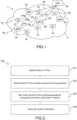
- Figure 1 represents a wireless communication system 1 implementing an embodiment of the invention.
- the wireless communication system 1 includes a plurality of wireless communication devices.
- Each communication device includes a wireless (for example Radio Frequency) emission and reception block adapted to exchange data upon wireless links (symbolically referenced 2), a processor and a memory.
- the memory stores software instructions that when executed upon the processor, enables the wireless communication device to implement a predefined communication protocol.
- wireless communication devices Some of the wireless communication devices are wireless communication devices 20 having known positions (and they are for example immobile), and some of the wireless communication devices are wireless communication devices 10 having unknown positions and being for example mobile.
- the wireless communication system 1 is 5G New Radio (5GNR) cellular system
- the wireless communication devices 10 are user mobile equipment (UE)
- the wireless communication devices 20 are gNBs 20.
- 5GNR 5G New Radio
- the wireless communication system 1 includes also a Location Management electronic Equipment 30 (LME 30), including at least a telecommunication block, a processor and a memory storing the coordinates of the gNB 20 in a referential R.
- LME 30 Location Management electronic Equipment 30
- the LME 30 is dedicated equipment or is located inside one or several gNBs or distributed into several equipments.
- Time of Arrival (ToA) approach is a known ranging technique, used in the wireless telecommunication domain, and based on knowing the exact time that a signal was sent from the source communication device ( t sent ), the exact time the signal arrives at a destination communication device ( t arrival ), and the speed, c , at which the signal travels (usually the speed of light).
- One ("the reference point)" of the source and destination communication devices has a known position and the other one (“the target point”) has an unknown position that has to be determined.
- Time Difference of Arrival (TDoA) approach is also a ranging technique.
- TDoA does not require the time that the signal was sent from the source communication device, only the time the signal was received and the speed that the signal travels.
- a UE position estimation method 100 in a wireless telecommunication system for example, the wireless telecommunication system 1 of Figure 1 , is now described according to an embodiment of the invention.
- TdoA method network-wide synchronization in not required, it means UE and gNBs do not have to be synched, however, the gNBs are assumed to be tightly synched which is normal.
- the UE 10_1 transmits a predefined reference signal, called SRS (Sounding Reference Signal) through its Emission/reception block upon wireless connections (the resources corresponding to these wireless connections are for example allocated to the UE 10_1 by a serving UE gNB 20 as a function of the last position estimated for the UE 10_1).
- SRS Sounding Reference Signal
- N surrounding gNBs 20 at wireless range, here for example N 3 and at least each of gNB 20_1, 20_2 and 20_3, receives, and identifies, the SRS, the associated Time of Arrival (ToA) of the SRS at said gNB, and the source UE 10_1.
- the Time of Arrivals (ToA) of the UE SRS are transmitted from each gNB 20_1, 220_2, 20_3 to the LME 30 via communication links 40 between the gNBs 20 and the LME 30.
- the LME 30 receives from at least each of the N gNB the ToA corresponding to the last SRS sent by the UE 10_1. Upon reception of these ToA, to avoid UE clock synchronization issues, ToAs are then transformed by the LME 30 into TDoAs, for example by substracting ToA of gNB 20_1 to the other ToA. N-1 TDoAs are thus extracted from N gNBs.
- TDoAs issued from step 101 are transformed, by the LME block 30, into relative distances (by multiplying the TDoA by c), which, together with the known locations of the N gNBs, form a nonlinear system of equations in which the distance differences are observations and the (x,y) coordinates of the UE 10_1 in a given referential R are unknown : a system of positioning equations is thus determined based upon the TDoAs (see section "Basics of ToA and TDoA approaches" hereabove).
- LLS Linear Least Squares
- gNBs anchors
- WLLS Weighted Linear Least Squares algorithm
- Non-linear approaches address this issue directly by solving nonlinear equations.
- the Non-Linear Least Squares (NLS) approach is used to minimize the Mean Squared. If noise statistics are given, this technique is equivalent to the Maximum Likelihood method (ML).
- ML Maximum Likelihood method
- These solutions employ Taylor's series linearization and, for example, the Gauss-Newton technique to compensate for approximation error.
- the Maximum Likelihood can match the Cramer Rao Lower Bound (CRLB), which is the performance benchmark for time or position estimators.
- CRLB Cramer Rao Lower Bound
- a solution could be to estimate a coarse position using LLS and then, from this initial coarse position, to iteratively converge to the minimal error using NLS or ML.
- the performance of these approaches is still dependent on an initial estimation, which is based on the number of gNBs.
- gNBs have fixed known positions(x,y,z), and the UE's 5G tag is also mounted on the UE with a fixed height in regard to the UE, z is always known in the equations (if we assume that a UE moves in Z axis, then TDOA is not enough to estimate the z, one needs Angle information in that case for example Uplink Angle of Arrival).
- a step 103 the positioning non linear equation system determined in previous step 102 is solved by LME 30 using PSO.
- PSO is a stochastic solution that uses a swarm of points in a limited interval to converge to the position with the least error.
- PSO algorithm optimizes a problem by iteratively trying to improve a candidate position solution with regard to a given measure of quality (or cost function). It solves a problem by having a population of candidate solutions (particles of the Swarm), and moving these particles around in the search-space according to simple mathematical formula over the particle's position and velocity. Each particle's movement is influenced by its local best known position, but is also guided toward the best known positions in the search-space, which are updated as better positions are found by other particles. This is expected to move the swarm toward the best solutions.
- This strategy is independent of the number of gNBs utilized and does not rely on a single initial guess, avoiding a local minimum in error optimization.
- the PSO algorithm updates the entire swarm at each iteration by moving the particles, updating the velocity and position of each particle in every dimension as a function of three components :
- the number of points in the swarm depends on the dimensions of the problem.
- InFH Indoor Factory Hall
- the global and individual weights (0.5 and 0.9) is found by experiment, as well as the number of iterations required to reach the global minimum for the cost function(10-20).
- PSO can quickly converge to the correct position after a few iterations by having a few hundred swarm points (for example M is chosen between [200 ; 500] because the indoor positioning problem is likewise confined to a 2D or 3D bounded region.
- the positioning method according to the invention provides an optimum UE location estimate utilizing just 5G pilot signals and does not need GNSS support for initializing the estimators. The method enables a sub-meter UE positioning.
- a determination of if a SRS signal received by a gNB has followed a path of Direct Line of Sight between the UE and the gNB is performed, and only ToAs calculated for SRS having followed a such path of Line of Sight (LoS signal) between the UE and the gNB are taken into account in the positioning estimation method steps 101-103, thus providing a better accuracy of UE position.
- LoS signal Line of Sight
- the first peak in the received SRS signal impulse response from each of the N gNB in the time domain is considered to determine the ToA times values
- the subsequent received signal peaks corresponding to this given SRS are on the contrary estimated as not LOS path signals (but as a reflected signal), and thus are not being used to calculate ToAs.
- N tot the number of gNBs available to be used for the positioning method of the invention
- N tot gNBs 3 or 4 of these N tot gNBs -and the corresponding N ToAs- are for example used in the steps 101-103 in an embodiment of the invention, these N gNBs being gNBs for which the ToAs have been determined selectively based upon LOS signals.
- the steps of the positioning method 100 are iterated for each active UE at least every period T, with T for example being the period of UL-SRS or DL-PRS transmission, suggested, in the standard, to be every 10-20 ms, and/or when specific events are detected (change of gNB serving the UE ).
- the UE position determined by the method 100 is then used for example by at least an electronic telecommunication equipment in the system 1, in order to perform, depending on the considered application: UE time and/or frequency communication resources allocation and/or beamforming and/or selection of UE serving base station, as a function of the last determined UE position.
- the positioning solution thus enables to overcome the synchronization challenges, detect and mitigate non-LOS, and solve the system of equations to produce a global minimum error for the location estimation non-linear problem.
- TdoAs have been calculated on uplinks (from UE to gNBs), here based on UL-SRS of 5GNR; the invention can in other embodiments be implemented calculating TDoAs on downlink (from gNBs to UE), for example in 5GNR based on DL-PRS reference signals.
- TDoA approach has been considered in the description of the invention hereabove.
- the set of equations is deduced from ToA approach instead of TDoA approach.
- Figure 3 shows graphs of positioning errors (horizontal axis "error", the error value being expressed in meter) for Cumulative Distribution Functions (CDF) of Root Mean Squared Errors (RMSE) for distance estimation.
- CDF Cumulative Distribution Functions
- RMSE Root Mean Squared Errors
- the compared methods fort position estimation are :
- PSO has better performance with the least number of gNBs (3 or 4) while similar results from NLS (ML) require time estimations from more LOS gNBs.
- the invention has been described above in an embodiment considering a 5GNR cellular system, but of course it can be implemented to various other wireless technology networks, such as LTE, 3G, 4G ..., loT, and more generally in any wireless telecommunication system comprising wireless communication devices at known positions (that can behave as the gNBs in the hereabove described method) and wireless communication devices (that can each behave as the UE in the hereabove described method), using PSO on the UL or DL of any communication system that is able to measure the range between an anchor (gNB) and an unknown coordinate device (UE) over time, power, angle, frequency estimation.
- gNB anchor
- UE unknown coordinate device
- the method steps hereabove described as performed by the LME 30 can be implemented by executing software instructions on a processor of the LME. Alternatively, it can be implemented by dedicated hardware, typically a digital integrated circuit, either specific (ASIC) or based on programmable logic (e.g. FPGA/Field Programmable Gate Array).
- ASIC application specific integrated circuit
- FPGA Field Programmable Gate Array
Landscapes
- Physics & Mathematics (AREA)
- Engineering & Computer Science (AREA)
- General Physics & Mathematics (AREA)
- Radar, Positioning & Navigation (AREA)
- Remote Sensing (AREA)
- Position Fixing By Use Of Radio Waves (AREA)
Priority Applications (1)
| Application Number | Priority Date | Filing Date | Title |
|---|---|---|---|
| EP23305835.3A EP4468019A1 (de) | 2023-05-25 | 2023-05-25 | Verfahren und system zur schätzung der positionierung einer kommunikationsvorrichtung in einem drahtlosen telekommunikationssystem |
Applications Claiming Priority (1)
| Application Number | Priority Date | Filing Date | Title |
|---|---|---|---|
| EP23305835.3A EP4468019A1 (de) | 2023-05-25 | 2023-05-25 | Verfahren und system zur schätzung der positionierung einer kommunikationsvorrichtung in einem drahtlosen telekommunikationssystem |
Publications (1)
| Publication Number | Publication Date |
|---|---|
| EP4468019A1 true EP4468019A1 (de) | 2024-11-27 |
Family
ID=86688584
Family Applications (1)
| Application Number | Title | Priority Date | Filing Date |
|---|---|---|---|
| EP23305835.3A Withdrawn EP4468019A1 (de) | 2023-05-25 | 2023-05-25 | Verfahren und system zur schätzung der positionierung einer kommunikationsvorrichtung in einem drahtlosen telekommunikationssystem |
Country Status (1)
| Country | Link |
|---|---|
| EP (1) | EP4468019A1 (de) |
-
2023
- 2023-05-25 EP EP23305835.3A patent/EP4468019A1/de not_active Withdrawn
Non-Patent Citations (7)
| Title |
|---|
| "TOA and DOA Based Positioning", 2018, JOHN WILEY & SONS, LTD, pages: 197 - 198 |
| HUAWEI ET AL: "Uplink based solutions for NR positioning", vol. RAN WG1, no. Taipei; 20190121 - 20190125, 20 January 2019 (2019-01-20), XP051592963, Retrieved from the Internet <URL:http://www.3gpp.org/ftp/Meetings%5F3GPP%5FSYNC/RAN1/Docs/R1%2D1900037%2Ezip> [retrieved on 20190120] * |
| J. KENNEDYR. EBERHART: "Particle swarm optimization", IEEE INTERNATIONAL CONFERENCE ON NEURAL NETWORKS, 1995. PROCEEDINGS, vol. 4, November 1995 (1995-11-01), pages 1942 - 1948 |
| MODERATOR (AT&T): "Summary of UE features for NR positioning enhancements", vol. RAN WG1, no. e-Meeting; 20220221 - 20220303, 4 March 2022 (2022-03-04), XP052122336, Retrieved from the Internet <URL:https://ftp.3gpp.org/tsg_ran/WG1_RL1/TSGR1_108-e/Docs/R1-2202853.zip R1-2202853 - ePos UE Features_v034_FINAL.docx> [retrieved on 20220304] * |
| PIOTROWSKI ADAM P. ET AL: "Population size in Particle Swarm Optimization", SWARM AND EVOLUTIONARY COMPUTATION, 1 November 2020 (2020-11-01), pages 1 - 18, XP093096786, ISSN: 2210-6502, Retrieved from the Internet <URL:https://www.sciencedirect.com/science/article/pii/S2210650220303710/pdfft?md5=b79aa8a339af61134c09d633eaae626e&pid=1-s2.0-S2210650220303710-main.pdf> [retrieved on 20231031], DOI: 10.1016/j.swevo.2020.100718 * |
| WANG YI ET AL: "Jointly positioning multiple users in aid of user-to-user distances", 2017 IEEE 28TH ANNUAL INTERNATIONAL SYMPOSIUM ON PERSONAL, INDOOR, AND MOBILE RADIO COMMUNICATIONS (PIMRC), IEEE, 8 October 2017 (2017-10-08), pages 1 - 5, XP033321631, ISBN: 978-1-5386-3529-2, [retrieved on 20180214], DOI: 10.1109/PIMRC.2017.8292736 * |
| WANG YI: "User positioning with particle swarm optimization", 2017 INTERNATIONAL CONFERENCE ON INDOOR POSITIONING AND INDOOR NAVIGATION (IPIN), IEEE, 18 September 2017 (2017-09-18), pages 1 - 5, XP033261527, DOI: 10.1109/IPIN.2017.8115935 * |
Similar Documents
| Publication | Publication Date | Title |
|---|---|---|
| US12057918B2 (en) | Non-line-of-sight path detection for user equipment positioning in wireless networks | |
| Kanhere et al. | Position locationing for millimeter wave systems | |
| US7203499B2 (en) | Position determination in wireless communication systems | |
| US12259486B2 (en) | Time difference of arrival multilateration method for mobile positioning | |
| El-Sayed et al. | Evaluation of localization methods in millimeter-wave wireless systems | |
| EP3751305A2 (de) | Verfahren und vorrichtung zur positionierung mit drahtlosen signalen | |
| WO2004036924A2 (en) | Enhancing the accuracy of a location estimate | |
| WO2016050258A1 (en) | Positioning method and system for wireless communication networks | |
| Ammous et al. | Positioning and tracking using reconfigurable intelligent surfaces and extended Kalman filter | |
| Vaghefi et al. | Cooperative RF pattern matching positioning for LTE cellular systems | |
| US9591609B1 (en) | Base station location derived from wireless terminal information | |
| US20240155537A1 (en) | Methods for positioning a wireless device, a related wireless node and a related location network node | |
| US12192948B2 (en) | Method and apparatus of positioning for accommodating wireless-environment change | |
| CN117750308A (zh) | 一种终端定位与感知方法、电子设备和存储介质 | |
| Schmitz et al. | TDOA fingerprinting for localization in non-line-of-sight and multipath environments | |
| US10156630B2 (en) | Method for passively locating a non-movable transmitter | |
| Lee et al. | New TDOA‐Based Three‐Dimensional Positioning Method for 3GPP LTE System | |
| Huilla et al. | Smartphone-based indoor positioning using Wi-Fi fine timing measurement protocol | |
| US7965237B2 (en) | Mobile system and method for position estimation | |
| Rahman | Investigations of 5G localization with positioning reference signals | |
| KR102577520B1 (ko) | 무선 환경 변화 수용을 위한 위치 측위 방법 및 장치 | |
| Riesebos et al. | Smartphone-based real-time indoor positioning using BLE beacons | |
| KR20130079183A (ko) | 포지셔닝 방법 및 이를 수행하는 장치 | |
| Steffes et al. | Direct position determination for TDOA-based single sensor localization | |
| US9408173B1 (en) | Base station timing derived from wireless terminal information |
Legal Events
| Date | Code | Title | Description |
|---|---|---|---|
| PUAI | Public reference made under article 153(3) epc to a published international application that has entered the european phase |
Free format text: ORIGINAL CODE: 0009012 |
|
| STAA | Information on the status of an ep patent application or granted ep patent |
Free format text: STATUS: THE APPLICATION HAS BEEN PUBLISHED |
|
| AK | Designated contracting states |
Kind code of ref document: A1 Designated state(s): AL AT BE BG CH CY CZ DE DK EE ES FI FR GB GR HR HU IE IS IT LI LT LU LV MC ME MK MT NL NO PL PT RO RS SE SI SK SM TR |
|
| STAA | Information on the status of an ep patent application or granted ep patent |
Free format text: STATUS: THE APPLICATION IS DEEMED TO BE WITHDRAWN |
|
| 18D | Application deemed to be withdrawn |
Effective date: 20250528 |