EP4468228A2 - Maintenance anticipée pour un dispositif dans l'industrie alimentaire au moyen d'un jumeau numérique et planification de production optimisée - Google Patents
Maintenance anticipée pour un dispositif dans l'industrie alimentaire au moyen d'un jumeau numérique et planification de production optimisée Download PDFInfo
- Publication number
- EP4468228A2 EP4468228A2 EP24206672.8A EP24206672A EP4468228A2 EP 4468228 A2 EP4468228 A2 EP 4468228A2 EP 24206672 A EP24206672 A EP 24206672A EP 4468228 A2 EP4468228 A2 EP 4468228A2
- Authority
- EP
- European Patent Office
- Prior art keywords
- malfunction
- production
- operational
- machine learning
- digital twin
- Prior art date
- Legal status (The legal status is an assumption and is not a legal conclusion. Google has not performed a legal analysis and makes no representation as to the accuracy of the status listed.)
- Pending
Links
Images




Classifications
-
- G—PHYSICS
- G06—COMPUTING OR CALCULATING; COUNTING
- G06F—ELECTRIC DIGITAL DATA PROCESSING
- G06F18/00—Pattern recognition
- G06F18/20—Analysing
- G06F18/21—Design or setup of recognition systems or techniques; Extraction of features in feature space; Blind source separation
- G06F18/214—Generating training patterns; Bootstrap methods, e.g. bagging or boosting
-
- G—PHYSICS
- G05—CONTROLLING; REGULATING
- G05B—CONTROL OR REGULATING SYSTEMS IN GENERAL; FUNCTIONAL ELEMENTS OF SUCH SYSTEMS; MONITORING OR TESTING ARRANGEMENTS FOR SUCH SYSTEMS OR ELEMENTS
- G05B23/00—Testing or monitoring of control systems or parts thereof
- G05B23/02—Electric testing or monitoring
- G05B23/0205—Electric testing or monitoring by means of a monitoring system capable of detecting and responding to faults
- G05B23/0259—Electric testing or monitoring by means of a monitoring system capable of detecting and responding to faults characterized by the response to fault detection
- G05B23/0283—Predictive maintenance, e.g. involving the monitoring of a system and, based on the monitoring results, taking decisions on the maintenance schedule of the monitored system; Estimating remaining useful life [RUL]
-
- G—PHYSICS
- G06—COMPUTING OR CALCULATING; COUNTING
- G06F—ELECTRIC DIGITAL DATA PROCESSING
- G06F18/00—Pattern recognition
- G06F18/20—Analysing
- G06F18/24—Classification techniques
- G06F18/241—Classification techniques relating to the classification model, e.g. parametric or non-parametric approaches
- G06F18/2415—Classification techniques relating to the classification model, e.g. parametric or non-parametric approaches based on parametric or probabilistic models, e.g. based on likelihood ratio or false acceptance rate versus a false rejection rate
- G06F18/24155—Bayesian classification
-
- G—PHYSICS
- G06—COMPUTING OR CALCULATING; COUNTING
- G06N—COMPUTING ARRANGEMENTS BASED ON SPECIFIC COMPUTATIONAL MODELS
- G06N20/00—Machine learning
-
- G—PHYSICS
- G06—COMPUTING OR CALCULATING; COUNTING
- G06Q—INFORMATION AND COMMUNICATION TECHNOLOGY [ICT] SPECIALLY ADAPTED FOR ADMINISTRATIVE, COMMERCIAL, FINANCIAL, MANAGERIAL OR SUPERVISORY PURPOSES; SYSTEMS OR METHODS SPECIALLY ADAPTED FOR ADMINISTRATIVE, COMMERCIAL, FINANCIAL, MANAGERIAL OR SUPERVISORY PURPOSES, NOT OTHERWISE PROVIDED FOR
- G06Q10/00—Administration; Management
- G06Q10/06—Resources, workflows, human or project management; Enterprise or organisation planning; Enterprise or organisation modelling
- G06Q10/063—Operations research, analysis or management
- G06Q10/0631—Resource planning, allocation, distributing or scheduling for enterprises or organisations
-
- G—PHYSICS
- G06—COMPUTING OR CALCULATING; COUNTING
- G06Q—INFORMATION AND COMMUNICATION TECHNOLOGY [ICT] SPECIALLY ADAPTED FOR ADMINISTRATIVE, COMMERCIAL, FINANCIAL, MANAGERIAL OR SUPERVISORY PURPOSES; SYSTEMS OR METHODS SPECIALLY ADAPTED FOR ADMINISTRATIVE, COMMERCIAL, FINANCIAL, MANAGERIAL OR SUPERVISORY PURPOSES, NOT OTHERWISE PROVIDED FOR
- G06Q10/00—Administration; Management
- G06Q10/06—Resources, workflows, human or project management; Enterprise or organisation planning; Enterprise or organisation modelling
- G06Q10/063—Operations research, analysis or management
- G06Q10/0631—Resource planning, allocation, distributing or scheduling for enterprises or organisations
- G06Q10/06312—Adjustment or analysis of established resource schedule, e.g. resource or task levelling, or dynamic rescheduling
-
- G—PHYSICS
- G06—COMPUTING OR CALCULATING; COUNTING
- G06Q—INFORMATION AND COMMUNICATION TECHNOLOGY [ICT] SPECIALLY ADAPTED FOR ADMINISTRATIVE, COMMERCIAL, FINANCIAL, MANAGERIAL OR SUPERVISORY PURPOSES; SYSTEMS OR METHODS SPECIALLY ADAPTED FOR ADMINISTRATIVE, COMMERCIAL, FINANCIAL, MANAGERIAL OR SUPERVISORY PURPOSES, NOT OTHERWISE PROVIDED FOR
- G06Q10/00—Administration; Management
- G06Q10/20—Administration of product repair or maintenance
-
- G—PHYSICS
- G06—COMPUTING OR CALCULATING; COUNTING
- G06Q—INFORMATION AND COMMUNICATION TECHNOLOGY [ICT] SPECIALLY ADAPTED FOR ADMINISTRATIVE, COMMERCIAL, FINANCIAL, MANAGERIAL OR SUPERVISORY PURPOSES; SYSTEMS OR METHODS SPECIALLY ADAPTED FOR ADMINISTRATIVE, COMMERCIAL, FINANCIAL, MANAGERIAL OR SUPERVISORY PURPOSES, NOT OTHERWISE PROVIDED FOR
- G06Q50/00—Information and communication technology [ICT] specially adapted for implementation of business processes of specific business sectors, e.g. utilities or tourism
- G06Q50/04—Manufacturing
-
- Y—GENERAL TAGGING OF NEW TECHNOLOGICAL DEVELOPMENTS; GENERAL TAGGING OF CROSS-SECTIONAL TECHNOLOGIES SPANNING OVER SEVERAL SECTIONS OF THE IPC; TECHNICAL SUBJECTS COVERED BY FORMER USPC CROSS-REFERENCE ART COLLECTIONS [XRACs] AND DIGESTS
- Y02—TECHNOLOGIES OR APPLICATIONS FOR MITIGATION OR ADAPTATION AGAINST CLIMATE CHANGE
- Y02P—CLIMATE CHANGE MITIGATION TECHNOLOGIES IN THE PRODUCTION OR PROCESSING OF GOODS
- Y02P90/00—Enabling technologies with a potential contribution to greenhouse gas [GHG] emissions mitigation
- Y02P90/30—Computing systems specially adapted for manufacturing
-
- Y—GENERAL TAGGING OF NEW TECHNOLOGICAL DEVELOPMENTS; GENERAL TAGGING OF CROSS-SECTIONAL TECHNOLOGIES SPANNING OVER SEVERAL SECTIONS OF THE IPC; TECHNICAL SUBJECTS COVERED BY FORMER USPC CROSS-REFERENCE ART COLLECTIONS [XRACs] AND DIGESTS
- Y02—TECHNOLOGIES OR APPLICATIONS FOR MITIGATION OR ADAPTATION AGAINST CLIMATE CHANGE
- Y02P—CLIMATE CHANGE MITIGATION TECHNOLOGIES IN THE PRODUCTION OR PROCESSING OF GOODS
- Y02P90/00—Enabling technologies with a potential contribution to greenhouse gas [GHG] emissions mitigation
- Y02P90/80—Management or planning
Definitions
- the invention relates to a method for automatically detecting a malfunction of a device in the food industry or the beverage industry, in particular for predictive maintenance according to the preamble of claim 1, a system for automatically detecting a malfunction according to the preamble of claim 9, a machine learning algorithm for automatically detecting a malfunction according to the preamble of claim 12, a method for determining an optimized production plan according to the preamble of claim 13 and a system for determining an optimized production plan according to the preamble of claim 15.
- Detecting an impending malfunction of a device is important in order to carry out maintenance measures in good time (such as replacing a wearing part or cleaning a component of the device) in order to prevent the malfunction (such as bearing damage to the device) from occurring. It is often the case that the cause (such as reduced lubrication or increased friction) of the malfunction has already been present for a certain period of time, but the malfunction only occurs at a later point in time. For example, a contaminated ball bearing of a device can continue to be used for a certain period of time before the ball bearing is damaged and/or the device stops. It is therefore important to recognize the causal event (such as increased friction) that leads to a future malfunction at an early stage in order to prevent the malfunction from occurring. Detecting such an operational malfunction and the resulting timely implementation of maintenance measures is also known as predictive maintenance.
- predictive maintenance techniques rely on human experience (such as the experience of a plant operator) to perform predictive maintenance measures. For example, an experienced employee recognizes that certain output signals of a device, such as temperature, or movement of the device are unusual and determines a maintenance measure for the device based on its experience.
- Another disadvantage of the state of the art is that many additional sensors (in addition to the sensors already present for the intended operation of the device) must be attached to the device in order to be able to precisely detect an impending malfunction. These additional sensors detect additional operating data that make it possible to improve the detection of operating faults despite the rare occurrence of some operating faults.
- the additional operating data recorded by the additional sensors must be transmitted, processed and stored, which involves additional effort (for example, additional memory and additional computing power are required) and can lead to a delay in the detection of the operational fault.
- this delay due to the additional operating data
- this delay can result in the necessary timely response to the operational fault being lost. In any case, this delay is undesirable because the measures to prevent the operational fault can only be initiated with a delay.
- the additional sensors may limit the function or application of the device and require complex installation. Another problem is finding suitable locations for attaching the additional sensors so that they record the most informative operating data possible to detect an impending malfunction (which therefore enables the most precise detection of a malfunction).
- the object is achieved according to the invention by a method according to claim 1, a system according to claim 9, a machine learning algorithm according to claim 12, as well as a method according to claim 13 and a system according to claim 15.
- One embodiment of the invention relates to a method for automatically detecting a malfunction of a device in the food industry or the beverage industry, in particular for predictive maintenance.
- the method comprises generating simulation data using a digital twin of the device, wherein the simulation data is generated for a plurality of malfunctions; training a machine learning algorithm based on the simulation data and the plurality of malfunctions to generate a trained machine learning algorithm (60); and detecting a malfunction of the device by the trained machine learning algorithm based on operating data of the device.
- the detected malfunction of the device can be an event, a malfunction and/or a maintenance measure to be carried out.
- the event can include increased friction, increased vibration, an imbalance, a wear parameter, or a reduced lubricating effect
- the malfunction can include motor damage, bearing damage, an axle break, a crack, an incorrectly positioned bottle, a short circuit or a stopping of the device
- the maintenance measure to be carried out can include cleaning, greasing, oiling, fastening, adjusting, replacing or repairing.
- detecting the malfunction may further comprise detecting a component of the device at which the malfunction occurs.
- the detection of the operational disruption may also include the detection of an expected period of time until the occurrence of an incident caused by the operational disruption.
- a production plan of a system assigned to the device can also be determined based on the expected time period and/or on a duration of a maintenance measure to be carried out for the detected operational malfunction.
- the operational data may include output signals of the device and the simulation data may include output signals of the digital twin.
- Each of the The output signals of the digital twin can correspond to a respective output signal of the device.
- each of the output signals of the device can be measured by a sensor of the device that is used during the intended operation of the device.
- the operating data of the device can comprise at least one additional output signal of the device, wherein the additional output signal is measured by an additional sensor of the device that is not required for the intended operation of the device.
- the simulation data can comprise at least one corresponding additional output signal of the digital twin.
- the additional sensor of the device can be selected from a large number of possible additional sensors using the digital twin such that the output signal of the additional sensor optimizes the detection of the operational fault.
- the trained machine learning algorithm for detecting the malfunction may determine a probability for each of the malfunctions based on the operation data (20A) of the device, and detect a malfunction of the malfunctions as the malfunction when the probability of the malfunction reaches a threshold value.
- the machine learning algorithm can be additionally trained with recorded operating data of the device.
- the device is a tripod of the food industry.
- a further embodiment of the invention corresponds to a system for automatically detecting a malfunction of a device in the food industry or the beverage industry, in particular for predictive maintenance, which comprises a digital twin of the device and a machine learning algorithm.
- the digital twin is set up to generate simulation data of the device, wherein the simulation data is generated for a plurality of malfunctions of the digital twin.
- the machine learning algorithm is trained based on the simulation data and the malfunctions of the digital twin and is set up to detect a malfunction of the device based on operational data of the device.
- the machine learning algorithm can be executed by a controller of the device, a processor connected to the device, or a cloud.
- a further embodiment of the invention relates to a machine learning algorithm for automatically detecting a malfunction of a device in the food industry or the beverage industry, in particular for predictive maintenance, wherein the machine learning algorithm is trained based on simulation data and malfunctions of a digital twin of the device, wherein the machine learning algorithm is configured to detect a malfunction of the device based on operating data of the device.
- a further embodiment of the invention relates to a method for determining an optimized production plan for the production of one or more products using one or more production lines in the food industry or the beverage industry.
- the changeover time of the production plan is optimized.
- the changeover time includes a product change, bottle change, type change, format change and/or pack change during the production of the products.
- the production plan is broken down into a large number of related units. Each of the units corresponds to at least one product, a processing step or at least one device of a production line for producing a product of the production plan.
- the units are arranged so that the changeover time has a minimal value.
- the production costs are determined by retrofitting times and production times for the units using the devices, whereby the retrofitting times and production times are defined depending on the product and device.
- Optimizing production costs involves assigning units to a production line and determining an order in which the units are to be processed by the production lines.
- the changeover time and/or the production costs may additionally include a duration of a maintenance measure for a detected malfunction of a device of a production line, wherein the malfunction is caused by a mechanical Learning algorithm that is trained based on simulation data and operational faults of a digital twin of the device or is detected by the digital twin itself.
- the machine learning algorithm is set up to detect the operational fault of the device based on operational data of the device.
- a further embodiment of the invention relates to a system which is adapted to carry out the method described above for determining an optimized production plan.
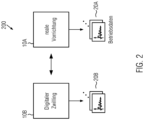
- the Fig. 1 shows an example of a system 100 according to the present invention.
- the system 100 is divided into four components 200, 300, 400, 500.
- the Fig. 1 An overview is given before the four exemplary components 200, 300, 400, 500 are discussed in connection with the Fig. 2-5 be described in more detail.
- a digital twin 10B of a (real) device 10A is created. This is shown by way of example by component 200 and is described in more detail in connection with Fig. 2 .
- This digital twin 10B has the same physical properties as the real device 10A.
- the digital twin 10B provides simulation data 20B that correspond one-to-one to the operating data 20A of the device 10A.
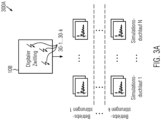
- this digital twin 10B is used to generate simulation data 40 for possible operational disturbances 30. This is shown by way of example by component 300 and is described in more detail in connection with the Fig. 3A and 3B .
- These simulation data 40 of the digital twin 10B correspond one-to-one to the operating data 20A of the real device.
- the operational malfunction 30 is simulated using the digital twin 10B in order to obtain simulation data 40 that correspond one-to-one to the operating data of the device 10A when an operational malfunction occurs.
- An operational malfunction 30 here refers, on the one hand, to events that do not themselves represent a direct malfunction, but can lead to a future malfunction if no maintenance measures are carried out, such as increased friction (e.g. due to contamination), increased vibration, imbalance, a wear parameter, or a reduced lubrication effect. On the other hand, it also refers to malfunctions that occur in As a result of this event, serious consequences may occur, such as motor failure, bearing failure, axle breakage, crack, incorrectly positioned bottle, short circuit or stopping of the device (because, for example, a critical value has been exceeded which causes the device to stop).
- a large number of operational disruptions 30 can be defined for the digital twin 10B, which can be based, for example, on empirical values, operational disruptions that have already occurred, or randomly generated operational disruptions. These operational disruptions can also be defined and simulated for various components of the digital twin (such as a bearing, a chain, a gear, a motor, etc.). These operational disruptions 30 are then simulated using the digital twin 10B, whereby a large number of simulation data 40 can be generated for each of the operational disruptions 30. The simulation data generated in this way can then be used to train a machine learning algorithm 50 (such as a classifier).
- a machine learning algorithm 50 such as a classifier
- the machine learning algorithm 50 can then be trained to generate a trained machine learning algorithm 60.
- the training of the machine learning algorithm 50 is carried out in such a way that the trained machine learning algorithm 60 is able to recognize this operational disturbance based on the simulation data 40 of a specific operational disturbance 30.
- This is shown by way of example by component 400 and is described in more detail in connection with Fig. 4
- the invention makes it possible to generate simulation data 40 for training the machine learning algorithm 50, which, since they were generated by the digital twin 10B of the real device 10A, correspond one-to-one to the operating data of the real device 10A.
- simulation data 40 are generated for operational disturbances 30 simulated on the digital twin 10B. It is thus possible to generate a large number of training data (namely the simulation data 40) for a large number of corresponding operational disturbances 40 (i.e. also for operational disturbances that only rarely occur during operation of the real device).
- the machine learning algorithm 60 trained on the simulation data 40 of the digital twin 10B is then used to predict a malfunction of the (real) device 10A based on current operating data 20A of the real device 10A.
- This is exemplified by component 500 and is described in more detail in connection with Fig. 5 .
- the trained machine learning algorithm 60 can, for example, be translated into a generally executable code and ported to the control of the (real) device 10A or an additional industrial PC (IPC). It is also possible to use the trained machine learning algorithm 60 in a cloud.
- the output signals of the (real) device 10A are then continuously provided to the trained machine learning algorithm 60.
- the trained learning algorithm 60 then automatically determines (based on its trained knowledge and the output signals of the device 10A) the current state of the device 10A and recognizes whether a malfunction is present and/or imminent. Furthermore, the machine learning algorithm 60 can identify what the malfunction is (which can be used to initiate appropriate maintenance measures to eliminate the malfunction and prevent an incident/damage from occurring), which component of the device is experiencing the malfunction, and how long it will take until an incident occurs if no maintenance measures are carried out. For example, in addition to identifying that there is increased friction in a certain bearing, it can determine how long the device can still be operated before the bearing fails, trigger the ordering of a new bearing and/or notify a service technician.
- a further advantage of the invention is that no (or only a few) additional sensors need to be attached to the device 10A, which (as described above) are used in the prior art to obtain additional operating data of the device in order to enable a more precise detection of an operating fault.
- An additional sensor is understood here to mean a sensor which is not already present in the device 10A for other reasons (which are not directly related to predictive maintenance), such as, for example, because it is necessary for the intended operation of the device, and is used to improve predictive maintenance.
- a sensor which is already present in the device 10A (and for the intended operation of the device) is hereinafter referred to as operational sensor.
- the digital twin 10B can generate a large number of simulation data 40 for all possible operational disturbances 30 and thus the additional operating data of additional sensors can be dispensed with when training the machine learning algorithm 50.
- the digital twin 10B generates the same output signals (as simulation data 20B) that are also measured in the real device 10A (as operating data 20A).
- the digital twin 10B has the same operational sensors as the (real) device 10A and thus provides simulated output signals that correspond to the real operating data 20A of the real device 10A, in particular the real operating data that the operational sensors provide, which arise anyway during operation of the device 10A.
- the digital twin 10B generates (for a large number of operational disturbances 30) a large number of simulation data 40 that correspond to the operational data 20A of the operational sensors of the real device 10A.
- simulation data 40 i.e. the simulated output signals of the operational sensors of the digital twin that correspond to the real output signals of the operational sensors of the real device
- the digital twin 10B it is possible to select this additional sensor as optimally as possible in the event that an additional sensor is to be used.
- the type of additional sensor e.g., a vibration, voltage, or torque sensor
- the location of the sensor on the device 10A can be determined with the help of the digital twin 10B in such a way that the detection of an operational fault is optimally improved by a trained machine learning algorithm 60.
- one or more additional sensors can be added to the digital twin 10B and simulation data 40 can be generated for the operational sensors and the one or more additional sensors.
- a machine learning algorithm 50 is then based only on the simulation data of the operational sensors, and the same machine learning algorithm 50 is trained based on the simulation data of the operational sensors and the one or more additional sensors.
- the trained machine learning algorithm 60-2 which was additionally trained based on the simulation data of the one or more additional sensors, can predict an operational malfunction better (e.g., earlier or with a higher probability) than the trained machine learning algorithm 60-1 which was only trained on the simulation data of the operational sensors.
- This process can be repeated with one or more other additional sensors on the digital twin 10B and a large number of trained machine learning algorithms 60-1 ... 60-L can be generated with the respective simulation data.
- the influence of various additional sensors on the precision of the trained machine learning algorithms 60-1 to 60-L for detecting an operational malfunction can be compared.
- the additional sensor(s) based on whose simulation data a trained machine learning algorithm with the best precision was generated can then be selected.
- This sensor determined by means of the digital twin 10B, can then be attached to the real device 10A and used for predictive maintenance of the real device.
- Fig. 1 shows an embodiment of the present invention for a device 10A in the food industry, in particular the beverage industry.
- the device 10A is a tripod of the food industry, as is known from DE 10 2013 208 082 A1 is known.
- the device 10A generates operating data 20A, such as the time course of the output signals of the device 10A.
- the output signals comprise one or more of a torque, a speed, an acceleration, a current, a voltage, a temperature and a vibration, which are measured by corresponding sensors of the device 10A.
- Typical maintenance work is, for example, the cleaning of individual components of the device, the replacement of wearing parts, the lubrication of bearings, etc.
- the detection of a malfunction and the resulting timely implementation of maintenance measures is also known as predictive maintenance.
- an operational malfunction only on the basis of the operating data of operational sensors of the device (i.e. sensors that are used and available for the operation of the device anyway) or on the basis of the operating data of the operational sensors and only a few selected additional sensors (which are used specifically for predictive maintenance).
- a digital twin 10B of the device 10A is generated for this purpose.
- the digital twin 10B is a digital representative of the (real) device 10A, which replicates the real device 10A in a computer-executable component.
- the generation of a digital twin is known in the prior art.
- the digital twin 10B of the device 10A can then be used to simulate all processes that are carried out by the (real) device 10A.
- the digital twin 10B can be used to simulate the temporal course of the translational and rotational movement of the device 10A as well as the control signals used for this purpose and the output signals of the device 10A generated thereby.
- the digital twin 10B can thus generate simulation data 20B that correspond to the operating data 20A of the real device 10A.
- the digital twin 10B may generate simulation data 20B of the temporal output signals (such as one or more of a torque, a speed, an acceleration, a current, a voltage, a temperature, and a vibration) measured by (simulated) sensors of the digital twin 10B.
- This simulation data 20B corresponds to the operational data 20A that the device 10A would output if the same process (which is simulated by means of the digital twin 10B and results in the simulation data 20B of the digital twin 10B) were performed on the real device 10A.
- this simulation data 20B corresponds to the temporal output signals (such as one or more of a torque, a speed, an acceleration, a current, a voltage, a temperature, and a vibration) that would be measured by the (real) sensors of the device 10A when performing the same process.
- the temporal output signals such as one or more of a torque, a speed, an acceleration, a current, a voltage, a temperature, and a vibration
- malfunctions of the device 10A are simulated by the digital twin 10B, which enables the generation of a large number of simulation data 40 for a large number of malfunctions 30.
- FIG. 3A shows the Fig. 3A , in which K operational disruptions 30-1, 30-2 ... 30-K of the digital twin 10B are illustrated by way of example.
- K operational disruptions can be a damage class or correspond to a damage class that can be predefined on the digital twin 10B.
- the digital twin 10B can carry out a large number (N) of simulation runs for each of the K operational disruptions.
- the digital twin 10B can generate simulation data 40-1-1 ... 40-KN for each of the N simulation runs, each of which represents the temporal progression of the M output signals of the digital twin 10B.
- N simulation runs are carried out for K operational disruptions, each of which contains M output signals.
- K ⁇ N ⁇ M temporal progressions of individual output signals can be generated (K, N and M are integers).
- simulation data 20B of the digital twin 10B can also be generated without operational disruption.
- An operational malfunction here refers, on the one hand, to events that do not constitute a malfunction themselves but can lead to a future malfunction (if no maintenance measures are carried out), such as contamination, wear, imbalance and/or increased friction, and, on the other hand, to the malfunctions themselves that can occur as a result of this event, such as engine failure, bearing damage, cracks in a component, incorrectly placed bottles or even the device stopping (e.g. as a result of exceeding a critical value that leads to an (emergency) stop of the device).
- the operational malfunctions 30-1, 30-2 ... 30-K described above can be a damage class and/or defined as damage classes on the digital twin 10B and can be simulated using the digital twin 10B. For example, different classes of friction in one (or more) component(s) can be simulated as different operational malfunctions using different friction coefficients.
- Possible events that lead to a malfunction for the above-mentioned tripod in the food industry are, for example, increased friction in a joint, reduced Lubricating effect in a prismatic cardan joint, or increased friction between the container and the mat chain due to contamination.
- Possible malfunctions that can occur with the tripod used in the food industry as an example above are, for example, bearing damage in a joint, the loosening of the connection between the container and the mat chain and engine damage.
- N simulation runs of the digital twin 10B can be carried out for each of the K operational disruptions or damage classes (and, for example, also in the event that there is no operational disruption) in order to generate N different simulation data for each operational disruption.
- N simulation runs of the digital twin can be carried out, each of which is subject to the same operational disruption but which nevertheless differ from one another.
- N is any natural number greater than 1, preferably greater than 100.
- random starting conditions can be selected for the simulation of the operational disruption or the parameters that describe the operational disruption (such as the friction coefficient) can be slightly varied.
- a simulation can then either be stopped after a predetermined time has elapsed or when a certain event occurs (in particular the incident associated with an event).
- simulation data 40-1-1 ... 40-K-N can be generated for each of the K operational faults 30-1, 30-2 ... 30-K. It was previously described that N simulation data are generated for each operational fault; however, this does not mean that exactly the same amount of simulation data must be available for each operational fault 30-1, 30-2 ... 30-K. It is of course also possible that less or more than N simulation data are generated for one or more of the operational faults 30-1, 30-2 ... 30-K.
- any number of simulation data 40-1-1 ... 40-KN for all possible operational faults can be generated by the digital twin 10B of the device 10A. This solves the problem in the prior art described above that for some operational faults only a few recorded operating data 20A of the device 10A are available or that these can only be generated with great effort.
- FIG. 3B An example of generating simulation data for a single one of the M output signals (e.g. for sensor 1 of the M sensors) for a single simulation run of the digital twin 10B for no operational fault 310 and for three exemplary operational faults 320, 330, 340 is shown below using the Fig. 3B
- N simulation runs with M output signals each are usually carried out for K operational disturbances.
- the Fig. 3B The example described for a simulation run and an output signal can easily be extended to this general case.
- the diagram 310 shows the simulated output signal of a sensor (in this example sensor 1) for a simulation run of the digital twin 10B in the event that there is no operational fault.
- the diagrams 320, 330 and 340 show the simulated output signal of a sensor (in this example sensor 1) for a simulation run of the digital twin 10B in the event that there are various operational faults 30-1, 30-2 and 30-3.
- various components of the digital twin 10B can be selected on the digital twin 10B (such as a specific bearing, an axle, a motor, etc.) and different types of operational faults (such as increased friction, imbalance, etc.) can be simulated for the selected components.
- a specific bearing is selected as a component of the digital twin as an example. Furthermore, three different malfunctions 30-1, 30-2 and 30-3 are simulated for this component as an example.
- the diagram 320 shows an example of an malfunction 30-1, which represents an event (in the sense described above), here increased friction in the selected bearing. As described above, an event represents an malfunction that can be remedied by maintenance measures, but which, if not remedied, can lead to a malfunction, such as damage to the device.
- the malfunction increased friction in the selected bearing is simulated for a certain time using the digital twin 10B and generates the simulation data 40-1-1 (here as an example for sensor 1).
- the diagram 330 shows an example of an operational malfunction 30-2, which represents an malfunction (in the sense described above), here damage to the selected bearing.
- the operational fault damage of the selected bearing is simulated for a certain time using the digital twin 10B and generates the simulation data 40-2-1 (here as an example for sensor 1).
- the diagram also shows 340 illustrates, by way of example, an operational disturbance 30-3 that includes both an event ("increased friction") and a malfunction ("bearing damage"), the malfunction being caused by the event.
- an event is initially simulated and a malfunction occurs during the simulation of the event.
- a plurality of operational disturbances can be defined (e.g., by selecting a type of operational disturbance and a location of the operational disturbance), each of which can provide simulation data for M sensors and N simulation runs using the digital twin 10B.
- the time courses of the translatory and rotary movements of the device 10A, as well as their input, control and output signals, can be simulated in each simulation run using the digital twin 10B.
- the time courses of the M output signals of the digital twin 10B can then be used as simulation data 20B, 40-1-1, ..., 40-K-N.
- the digital twin 10B has the same physical properties as the (real) device 10A and provides the same M output signals (i.e. the operating data 20A) as the device 10A.
- the simulation data 40-1-1 ... 40-K-N generated for the K operational disturbances using the digital twin 10B correspond to the operating data 20A that the device 10A would output if it were subject to the respective operational disturbance.
- simulation data of the digital twin 10B can be generated which correspond to the operating data of the real device 10A.
- This simulation data of the digital twin 10B (which corresponds to the operating data of the device 10A) can then be used to train a machine learning algorithm 50, such as a classifier.
- the machine learning algorithm 50 learns characteristic features that occur in the simulation data 20B, 40-1-1 ... 40-KN of the simulated malfunction 30-1 ... 30-K of the digital twin 10B.
- a machine learning algorithm 60 trained in this way can then also find these characteristic features in the operating data 20A of the real device 10A and thus recognize a malfunction of the real device 10A. This makes it possible not only to recognize whether a malfunction is present, but also which malfunction is present, which component it is present on and/or how much time remains to carry out a maintenance measure before damage or a malfunction occurs.
- the previously described malfunctions 30-1, 30-2 ... 30-K defined for the digital twin 10B can then also be detected on the real device 10A by means of a trained machine learning algorithm, as described in more detail below.
- the trained machine learning algorithm it is possible for the trained machine learning algorithm to detect both the type and the location of the malfunction, since a malfunction defined for the digital twin 10B can include both a type of malfunction (e.g., an event such as increased friction) and a location of the malfunction (e.g., at which component of the digital twin 10B the malfunction occurs). For example, if the malfunction of the digital twin is "increased friction in bearing X", the trained machine learning algorithm can detect these two pieces of information based on the device's operating data, i.e. the type of malfunction ("increased friction") and the location of the malfunction ("bearing X").
- this time period can be determined directly based on the simulation data.
- One possibility is, for example, to form the average of the time period t 1 (in diagram 340) until the occurrence of the malfunction associated with the event over all N simulation runs for this event. If the trained machine learning algorithm 60 then recognizes this event based on the operating data of the device 10A, the average thus formed can be output as additional information (in addition to the type and location of the event).
- a corresponding notification could be: "Increased friction in bearing X, expected time period until bearing damage occurs: t 1 ".
- the machine learning algorithm could also be trained to predict the expected time period until the occurrence of an incident.
- the term time period can be a specific period of time (such as another 24 hours) or a number of units still to be produced (such as another 1000 production units) until the occurrence of the incident associated with the event.
- the Fig. 4 shows, by way of example, the training of a machine learning algorithm 50 based on the simulation data 20B, 40-1-1, ..., 40-KN and the operational faults 30-1 ... 30-K of the digital twin 10B.
- the machine learning algorithm 50 can be any suitable machine learning algorithm as known in the state of the art, such as a classifier or a regression method.
- a classifier or a regression method.
- Well-known examples are neural networks, support vector machines, boosting, naive Bayes, etc.
- the operational disruptions 30-1 ... 30-K (and the presence of no operational disruption) or the damage classes can be used as ground truth and the simulation data 20B, 40-1-1, ..., 40-K-N as corresponding training data.
- the training determines the parameters of the machine learning algorithm 50 with which the trained machine learning algorithm 60 can optimally recognize the respective ground truth (e.g. whether one of the operational disruptions 30-1 ... 30-K that correspond to the respective simulation data 20B, 40-1-1, ..., 40-K-N is present and if so which one).
- the machine learning algorithm 50 with the optimal parameters thus determined is the trained machine learning algorithm 60.
- Training machine learning algorithms e.g., by splitting the training data into a test set and a training set, optimizing an error term, and using cross-validation
- the trained machine learning algorithm 60 is then able, given a data set of simulation data (e.g., 40-2-1), to accurately predict the operational disturbance that was present when simulating this data set (for 40-2-1, this is operational disturbance 30-2).
- An additional or alternative learning objective (ground truth) of the machine learning algorithm can also be an expected time period until a malfunction occurs.
- several operational malfunctions or damage classes (such as several classes of increased friction) can be summarized so that the trained machine learning algorithm only recognizes the summarized operational malfunction (for example, only increased friction and not how high the increased friction is in the individual case).
- Another possibility is to output the maintenance measure for the detected operational malfunction instead of, or in addition to, the learning objectives (ground truth) discussed above.
- historical operating data of the device 10A can also be used for training the machine learning algorithm. If there is historical operating data for operational disturbances that are equal to one of the simulated operational disturbances 30-1 ... 30-K, this historical operating data can be added to the simulation data of this Malfunction can be added and the machine learning algorithm 50 can be trained based on the simulation data 20B, 40-1-1, ..., 40-KN and the historical operating data for this malfunction. In addition, it is possible to define additional malfunctions or damage classes that cannot be simulated with the digital twin 10B.
- An example of this is the intervention of an operator of the device 10A, in which the operator, for example, takes over control of the device 10A (e.g., by overriding the automatic control of the device). This is the case, for example, if the operator determines based on his experience that there is an irregularity in the operation of the device 10A.
- An intervention by an operator of the device can thus be defined as a new malfunction (e.g., 30-K+1) and the operating data that was recorded before the intervention occurred can be used as historical operating data to train the machine learning algorithm 50.
- the machine learning algorithm 60 described above, trained with the aid of the digital twin 10B, is then used according to the invention to detect a malfunction of the (real) device 10A, as in Fig. 5 shown by way of example.
- the (current) operating data 20A of the device 10A is made available to the trained machine learning algorithm 60, which can recognize an operational malfunction of the device 10A based on the operating data 20A.
- the trained machine learning algorithm is set up to recognize which operational malfunction is present (e.g., an event such as increased friction), where this operational malfunction is present (e.g., increased friction in the universal joint) and/or to determine an expected period of time after which a malfunction will occur (e.g., damage to the universal joint in 12 hours).
- the notification 70 can, for example, contain the detected malfunction k (e.g., the location on the device and the type of malfunction) and/or an estimated time period (e.g., how many hours are left or how many product units can still be produced) until a malfunction of the device 10A associated with the malfunction occurs. Furthermore, the notification can also contain a maintenance measure that must be carried out to remedy the malfunction and/or a duration of this maintenance measure. For example, the notification 70 can be sent to an operator of the device and/or to maintenance personnel.
- the trained machine learning algorithm 60 can be ported to the controller of the device 10A or an additional industrial PC (IPC). Alternatively, it is also possible to apply the trained machine learning algorithm 60 in a cloud.
- the trained machine learning algorithm 60 which was trained on the simulation data 20B, 40-1-1, ... 40-K-N of the digital twin 10B, is able to detect an operational malfunction of the device 10A.
- This has the advantage that the operational malfunctions (and any associated malfunctions) do not have to occur on the real device 10A (in order to obtain the operating data associated with the operational malfunctions for training the machine learning algorithm), but can be simulated using the digital twin.
- the digital twin 10B is used to determine one (or more) additional sensors that optimally improve the prediction of a malfunction (according to the present invention).
- various additional sensors such as a vibration, current, torque, temperature, or acceleration sensor
- the influence of these additional sensors on the detection of a malfunction can then be compared and one or more of the additional sensors can be selected that optimally improve the prediction of the malfunction.
- These selected sensors of the digital twin 10B can then also be attached to the (real) device 10A in order to improve the detection of a malfunction of the device 10A.
- various additional sensors can be simulated using the digital twin 10B and compared with regard to their information content for detecting the malfunctions 30-1 ... 30-K simulated on the digital twin.
- different sensors such as a vibration, current, torque, temperature, or acceleration sensor can be applied to different locations of the digital twin 10B (which is a one-to-one image of the device 10A) and tested (by means of simulation by the digital twin) as to which sensor at which location of the device provides an output signal that optimally improves the precision of the machine learning algorithm trained on this simulation data (compared to other additional sensors of the digital twin and compared to using no additional sensors).
- the digital twin delivers Z+X output signals as simulation data for each simulation run.
- the digital twin (with the Z additional sensors) can now be used as described in connection with Fig. 3 described for the K faults 30-1 ... 30-K with N simulation runs each.
- This provides simulation data with K ⁇ N ⁇ (X+Z) individual output signals, similar to the one described above.
- Z+1 different trained machine learning algorithms can then be generated by training a machine learning algorithm on the simulation data without the output signals of the additional sensors and by training a machine learning algorithm for each of the Z additional sensors with the respective output signal of one of the Z additional sensors.
- the precision (such as the optimized error term of the trained machine learning algorithm or the Bayesian information criterion) of the Z+1 trained machine learning algorithms can then be compared with each other.
- the additional sensor that is added to the trained machine Learning algorithm with the best precision (e.g. the smallest error term) (or the n additional sensors that led to the n best trained learning algorithms) can then be selected and the same sensor can then also be attached to the real device at the same location (as on the digital twin) and used to detect a malfunction of the device according to the invention.
- the Fig. 6 shows a method 600 according to the invention for automatically detecting a malfunction of a device (10A) in the food industry or the beverage industry, in particular for predictive maintenance.
- simulation data 20B, 40-1-1, 40-2-1, ..., 40-KN are generated using the digital twin 10B of the device 10A.
- the simulation data are generated for a large number of malfunctions 30-1-1, 30-2-1, ..., 30-KN of the digital twin 10B.
- a second step 620 the machine learning algorithm 50 is trained based on the simulation data 20B, 40-1-1, 40-2-1, ..., 40-KN of the digital twin 10B and the plurality of simulated operational faults 30-1-1, 30-2-1, ..., 30-KN to generate a trained machine learning algorithm 60.
- This trained machine learning algorithm 60 is then used to detect the operational fault of the (real) device 10A based on operating data 20A of the (real) device.
- the prediction of a malfunction can also be used to optimize the production plan of a plant with one or more production lines (e.g., the food industry and in particular the beverage industry).
- the information about whether a maintenance measure is imminent for a device on a line of the plant, which maintenance measure is imminent (i.e., how long the maintenance measure will take) and/or in which time window the maintenance measure must be carried out i.e., how much time remains or how many products can still be produced before the maintenance measure must be carried out at the latest in order to prevent a malfunction
- This information which is available through the inventive detection of a malfunction, can thus be incorporated into the automatic optimization of the production plan of the plant.
- utilization forecasts of the system are used for automatic production planning (which can be supplemented with information about predictive maintenance).
- the automatic determination of an optimal production plan involves dividing the production plan into individual units and determining an optimal sequence for the units of the production plan. For example, when determining the optimal production plan, consideration is given to how long the production time is, how long the retooling time is, and how long the changeover time is (which includes, for example, product changes, bottle changes and/or packaging changes). Based on this information, an optimal production plan is automatically created that minimizes the time it takes to produce all planned products (each in a specific number of units). An optimal production plan ensures that the system is down for as short a time as possible and thus increases the production volume of the system.
- the changeover time of the production plan is optimized with the aim of minimizing the changes that take the longest.
- the changeover time can include the duration of all activities required for a change, such as a product change, bottle change, type change, format change and/or pack change.
- the production plan is broken down into small, connected units and these are arranged in such a way that the total changeover time is minimized.
- Each unit can correspond to at least one product, one processing step or at least one device on a production line for producing a product in the production plan.
- the maintenance time determined by the trained machine learning algorithm 60 described above can also be taken into account.
- the information on how long a maintenance takes and/or the period when the maintenance must be carried out can be included in the optimization of the changeover time of the production plan. For example, it is possible to set the maintenance time of a device so that it coincides with the changeover time of the system to which this device belongs. This means that maintenance can be carried out at the same time as a product changeover.
- the production costs of the production plan can be optimized.
- the changeover time can be optimized by the cost-optimized allocation of the units of the production plan to the individual production lines of the plant.
- the production plan can be optimized according to the minimum production costs K that are to be spent on processing the units of the production plan.
- t Per , i , whole sum t Per , i . ⁇ z act , i
- t Per , i t Per , i , 1 t Per , i , 2 t Per , i , 3 with t Pro,i,j as the production time of a state j on line i in hours
- the information about how long one (or more) devices of one of the lines i can still be operated before a malfunction related to an operational disruption (predicted by the trained machine learning algorithm 60) occurs can optionally be used at this point.
- the information that a device can only process a certain number of product units (or can only run for a certain period of time) before the malfunction occurs can be used as an additional boundary condition during the optimization of the production plan.
- the optimization results in an allocation of the units (of the production plan) to the individual lines and also an order in which the units of the production plan should be processed on the individual lines in order to achieve maximum production efficiency of the entire system and thus minimum costs.
- the retrofitting time and the production time can be defined depending on the product and line, so that the specifications of the system are taken into account when determining the optimized production plan.
- an optimal production plan can be determined that minimizes the time required to produce all planned products. This enables the system to be designed optimally.
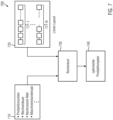
- the changeover duration, the production times of each state j of each line i t Pro,i,j , the retrofitting time matrices M j,i and the machine hourly rate H i are provided as the first input 710 and the line layout of the system as the second input 720 to a calculation tool 730.
- the first input 710 can also optionally include the maintenance time, which is determined using the machine learning algorithm 60 trained on simulation data of the digital twin 10B, and/or the time until this maintenance measure must be carried out.
- the calculation tool 730 determines an optimal production plan 740 based on the first input 710 and the second input 720.
- the optimal production plan includes on which line and in which order the individual units of the production plan should be run so that the production costs K are minimized.
- the optimization process described above includes the changeover time as well as the production and retrofitting times for the units (of the production plan).
- information about upcoming maintenance measures i.e. whether and which maintenance measure is imminent for a specific device in the system, how long this maintenance measure will take and/or how much time is left to carry out the maintenance measure in order to avoid the disruption
- the Fig. 8 shows a method 800 according to an embodiment of the invention for determining an optimized production plan 740 for the production of one or more products by means of one or more production lines 721-1, ..., 721-N in the food industry or the beverage industry.
- a first step 810 the changeover time of the production plan is optimized.
- This first step 810 includes breaking down 820 the production plan into a plurality of related units and arranging 830 the units so that the changeover time has a minimum value.
- this first step 810 can additionally be carried out based on a duration of a maintenance measure for a detected malfunction of a device 10A of a production line of the plurality of production lines 721-1, ..., 721-N.
- This second step 840 includes assigning 850 the units to a product line and determining 860 an order in which the units are to be processed on the production lines. As already described above, this second step 840 can additionally be carried out based on an expected duration until the occurrence of the predicted malfunction (which was determined using the trained machine learning algorithm 60).
Landscapes
- Engineering & Computer Science (AREA)
- Business, Economics & Management (AREA)
- Human Resources & Organizations (AREA)
- Theoretical Computer Science (AREA)
- Physics & Mathematics (AREA)
- General Physics & Mathematics (AREA)
- Strategic Management (AREA)
- Economics (AREA)
- Data Mining & Analysis (AREA)
- Entrepreneurship & Innovation (AREA)
- Marketing (AREA)
- General Business, Economics & Management (AREA)
- Tourism & Hospitality (AREA)
- Software Systems (AREA)
- Computer Vision & Pattern Recognition (AREA)
- Evolutionary Computation (AREA)
- General Engineering & Computer Science (AREA)
- Artificial Intelligence (AREA)
- Operations Research (AREA)
- Quality & Reliability (AREA)
- Medical Informatics (AREA)
- Automation & Control Theory (AREA)
- Mathematical Physics (AREA)
- Computing Systems (AREA)
- Game Theory and Decision Science (AREA)
- Bioinformatics & Cheminformatics (AREA)
- Educational Administration (AREA)
- Life Sciences & Earth Sciences (AREA)
- Bioinformatics & Computational Biology (AREA)
- Development Economics (AREA)
- Evolutionary Biology (AREA)
- Probability & Statistics with Applications (AREA)
- Manufacturing & Machinery (AREA)
- Health & Medical Sciences (AREA)
- General Health & Medical Sciences (AREA)
- Primary Health Care (AREA)
- Testing And Monitoring For Control Systems (AREA)
- Testing Of Devices, Machine Parts, Or Other Structures Thereof (AREA)
- General Factory Administration (AREA)
Applications Claiming Priority (3)
| Application Number | Priority Date | Filing Date | Title |
|---|---|---|---|
| DE102019119352.4A DE102019119352A1 (de) | 2019-07-17 | 2019-07-17 | Vorausschauende Wartung für eine Vorrichtung in der Lebensmittelindustrie mithilfe eines digitalen Zwillings und optimierte Produktionsplanung |
| PCT/EP2020/065918 WO2021008782A1 (fr) | 2019-07-17 | 2020-06-09 | Maintenance prévisionnelle pour un dispositif de l'industrie des denrées alimentaires à l'aide d'un jumeau numérique et planification de production optimisée |
| EP20731471.7A EP4000018B1 (fr) | 2019-07-17 | 2020-06-09 | Maintenance prévisionnelle pour un dispositif de l'industrie des denrées alimentaires à l'aide d'un jumeau numérique et planification de production optimisée |
Related Parent Applications (1)
| Application Number | Title | Priority Date | Filing Date |
|---|---|---|---|
| EP20731471.7A Division EP4000018B1 (fr) | 2019-07-17 | 2020-06-09 | Maintenance prévisionnelle pour un dispositif de l'industrie des denrées alimentaires à l'aide d'un jumeau numérique et planification de production optimisée |
Publications (2)
| Publication Number | Publication Date |
|---|---|
| EP4468228A2 true EP4468228A2 (fr) | 2024-11-27 |
| EP4468228A3 EP4468228A3 (fr) | 2025-02-19 |
Family
ID=71069860
Family Applications (2)
| Application Number | Title | Priority Date | Filing Date |
|---|---|---|---|
| EP20731471.7A Active EP4000018B1 (fr) | 2019-07-17 | 2020-06-09 | Maintenance prévisionnelle pour un dispositif de l'industrie des denrées alimentaires à l'aide d'un jumeau numérique et planification de production optimisée |
| EP24206672.8A Pending EP4468228A3 (fr) | 2019-07-17 | 2020-06-09 | Maintenance anticipée pour un dispositif dans l'industrie alimentaire au moyen d'un jumeau numérique et planification de production optimisée |
Family Applications Before (1)
| Application Number | Title | Priority Date | Filing Date |
|---|---|---|---|
| EP20731471.7A Active EP4000018B1 (fr) | 2019-07-17 | 2020-06-09 | Maintenance prévisionnelle pour un dispositif de l'industrie des denrées alimentaires à l'aide d'un jumeau numérique et planification de production optimisée |
Country Status (5)
| Country | Link |
|---|---|
| US (1) | US20220269259A1 (fr) |
| EP (2) | EP4000018B1 (fr) |
| CN (1) | CN114175044A (fr) |
| DE (1) | DE102019119352A1 (fr) |
| WO (1) | WO2021008782A1 (fr) |
Families Citing this family (23)
| Publication number | Priority date | Publication date | Assignee | Title |
|---|---|---|---|---|
| AU2020379834A1 (en) * | 2019-11-05 | 2022-06-09 | Strong Force Vcn Portfolio 2019, Llc | Control tower and enterprise management platform for value chain networks |
| WO2021092260A1 (fr) | 2019-11-05 | 2021-05-14 | Strong Force Vcn Portfolio 2019, Llc | Tour de contrôle et plateforme de gestion d'entreprise pour réseaux de chaîne de valeur |
| US20210133670A1 (en) | 2019-11-05 | 2021-05-06 | Strong Force Vcn Portfolio 2019, Llc | Control tower and enterprise management platform with a machine learning/artificial intelligence managing sensor and the camera feeds into digital twin |
| US11393175B2 (en) | 2020-02-06 | 2022-07-19 | Network Documentation & Implementation Inc. | Methods and systems for digital twin augmented reality replication of non-homogeneous elements in integrated environments |
| US11954309B2 (en) * | 2020-05-04 | 2024-04-09 | Adobe Inc. | Systems for predicting a terminal event |
| KR20230135069A (ko) | 2020-12-18 | 2023-09-22 | 스트롱 포스 브이씨엔 포트폴리오 2019, 엘엘씨 | 밸류 체인 네트워크를 위한 로봇 플릿 관리 및 적층제조 |
| CN113011085B (zh) * | 2021-02-26 | 2021-10-26 | 青岛弯弓信息技术有限公司 | 一种设备数字孪生建模方法及系统 |
| KR20230081501A (ko) * | 2021-11-30 | 2023-06-07 | 주식회사 엘지에너지솔루션 | 생산 계획 수립 장치 및 방법 |
| DE102021133164B3 (de) | 2021-12-15 | 2023-02-23 | Krones Aktiengesellschaft | Verfahren zum Durchführen eines Einstellbetriebs einer Behältnisinspektionsvorrichtung und Behältnisinspektionsvorrichtung |
| CN114297927B (zh) * | 2021-12-28 | 2025-06-03 | 中国科学院自动化研究所 | 基于数据驱动的工业装备数字孪生构建维护方法及系统 |
| US12085930B2 (en) | 2022-01-05 | 2024-09-10 | International Business Machines Corporation | AI-enabled process recovery in manufacturing systems using digital twin simulation |
| US20240070041A1 (en) * | 2022-08-29 | 2024-02-29 | Novity, Inc. | Method and system for generating test inputs for fault diagnosis |
| US20240078465A1 (en) * | 2022-09-01 | 2024-03-07 | Disney Enterprises, Inc. | Training of machine learning models with hardware-in-the-loop simulations |
| US12585260B2 (en) * | 2022-09-02 | 2026-03-24 | International Business Machines Corporation | Computer-based virtual environment for managing work product quality |
| WO2024065484A1 (fr) * | 2022-09-29 | 2024-04-04 | 西门子股份公司 | Procédé et appareil de reconnaissance d'événement, et dispositif et support |
| CN115622862B (zh) * | 2022-10-18 | 2026-04-14 | 浪潮通信信息系统有限公司 | 基于数字孪生的算力网络系统及算力处理方法 |
| CN115712251A (zh) * | 2022-10-31 | 2023-02-24 | 南京航空航天大学 | 基于近红外检测和数字孪生技术的生鲜食品运输包装系统及方法 |
| FR3142812B1 (fr) * | 2022-12-02 | 2025-03-28 | Nexter Systems | Procédé de maintenance prédictive frugale, produit programme d'ordinateur et support lisible par ordinateur correspondants |
| CN116700194B (zh) * | 2023-07-20 | 2026-01-16 | 浪潮云洲工业互联网有限公司 | 一种用于smt生产线的生产效率优化方法、设备及介质 |
| WO2025253243A1 (fr) | 2024-06-06 | 2025-12-11 | Arol S.P.A. | Procédé de capsulage et machine de capsulage électronique pour appliquer des bouchons à vis |
| DE102024119907A1 (de) * | 2024-07-12 | 2026-01-15 | Krones Aktiengesellschaft | Behälterbehandlungsmaschine zum Behandeln von Behältern |
| CN118805924B (zh) * | 2024-07-22 | 2025-03-07 | 山东冠珍轩豆制食品有限公司 | 一种基于数字孪生的全自动煮浆系统 |
| DE102024124078A1 (de) * | 2024-08-22 | 2026-02-26 | Krones Aktiengesellschaft | Verfahren zum Betreiben einer Behältnisbehandlungsanlage und Steuervorrichtung für eine Behältnisbehandlungsanlage |
Citations (1)
| Publication number | Priority date | Publication date | Assignee | Title |
|---|---|---|---|---|
| DE102013208082A1 (de) | 2013-05-02 | 2014-11-06 | Krones Aktiengesellschaft | Vorrichtung zum Umgang mit Artikeln |
Family Cites Families (24)
| Publication number | Priority date | Publication date | Assignee | Title |
|---|---|---|---|---|
| GB2446002A (en) * | 2007-01-15 | 2008-07-30 | Greycon Ltd | Manufacturing schedule optimisation |
| DE102012217570A1 (de) * | 2012-09-27 | 2014-03-27 | Krones Ag | Verfahren zur Unterstützung von Bedien- und Umstellprozessen |
| WO2014090310A1 (fr) | 2012-12-13 | 2014-06-19 | Abb Technology Ag | Système et procédé permettant de contrôler et/ou d'évaluer le fonctionnement d'une chaîne de production d'une installation industrielle |
| AT514680A2 (de) * | 2013-08-05 | 2015-02-15 | Uptime Engineering Gmbh | Prozess zur Optimierung der Wartung technischer Systeme |
| JP6332154B2 (ja) * | 2015-06-11 | 2018-05-30 | 横河電機株式会社 | プラント運転支援装置、プラント運転支援方法、及びプログラム |
| DE102015211344B4 (de) * | 2015-06-19 | 2019-06-27 | Krones Aktiengesellschaft | Vorrichtung zur Handhabung von Artikeln und Verfahren zur Verschleißerkennung bei einer solchen Handhabungsvorrichtung |
| US10642258B2 (en) * | 2015-07-01 | 2020-05-05 | Panasonic Intellectual Property Management Co., Ltd. | Maintenance work support system |
| JP5992087B1 (ja) * | 2015-12-28 | 2016-09-14 | ファナック株式会社 | 機械の保全計画を作成する予防保全管理システム |
| US20170286572A1 (en) * | 2016-03-31 | 2017-10-05 | General Electric Company | Digital twin of twinned physical system |
| US9811074B1 (en) * | 2016-06-21 | 2017-11-07 | TruPhysics GmbH | Optimization of robot control programs in physics-based simulated environment |
| US10466142B2 (en) | 2016-07-13 | 2019-11-05 | Hitachi, Ltd. | Equipment control based on failure determination |
| US20180137219A1 (en) * | 2016-11-14 | 2018-05-17 | General Electric Company | Feature selection and feature synthesis methods for predictive modeling in a twinned physical system |
| US10127659B2 (en) * | 2016-11-23 | 2018-11-13 | General Electric Company | Deep learning medical systems and methods for image acquisition |
| US10401838B2 (en) * | 2016-12-02 | 2019-09-03 | General Electric Company | Apparatus and method for production line changeover |
| DE102016124083B4 (de) * | 2016-12-12 | 2018-07-05 | Phoenix Contact Gmbh & Co. Kg | Verfahren zur Überwachung einer elektromechanischen Komponente eines Automatisierungssystems |
| US10877470B2 (en) * | 2017-01-26 | 2020-12-29 | Honeywell International Inc. | Integrated digital twin for an industrial facility |
| EP3358431A1 (fr) * | 2017-02-07 | 2018-08-08 | Primetals Technologies Austria GmbH | Planification intégrée des plans de la production et / ou les plans de service |
| EP3428756B1 (fr) | 2017-07-10 | 2019-06-19 | Siemens Aktiengesellschaft | Surveillance d'intégrité pour des systèmes d'automatisation |
| EP3454150A1 (fr) * | 2017-09-06 | 2019-03-13 | Siemens Aktiengesellschaft | Procédé et dispositif de génération d'un modèle de données permettant la surveillance d'une installation industrielle |
| US10732618B2 (en) * | 2017-09-15 | 2020-08-04 | General Electric Company | Machine health monitoring, failure detection and prediction using non-parametric data |
| DE112018004407T5 (de) * | 2017-09-27 | 2020-05-20 | Johnson Controls Technology Company | Webdienstplattform mit smart-entitäten, zeitreihen und verschachtelter stream-generierung |
| US20190147413A1 (en) * | 2017-11-13 | 2019-05-16 | Ge Energy Power Conversion Technology Ltd | Maintenance optimization system through predictive analysis and usage intensity |
| CN109933035A (zh) * | 2019-04-24 | 2019-06-25 | 中国科学院重庆绿色智能技术研究院 | 一种基于数字孪生的生产线控制系统、方法及生产系统 |
| EP3757703A1 (fr) | 2019-06-27 | 2020-12-30 | Siemens Aktiengesellschaft | Système, appareil et procédé de gestion basée sur l'état d'au moins un système électromécanique |
-
2019
- 2019-07-17 DE DE102019119352.4A patent/DE102019119352A1/de active Pending
-
2020
- 2020-06-09 EP EP20731471.7A patent/EP4000018B1/fr active Active
- 2020-06-09 US US17/597,666 patent/US20220269259A1/en active Pending
- 2020-06-09 WO PCT/EP2020/065918 patent/WO2021008782A1/fr not_active Ceased
- 2020-06-09 EP EP24206672.8A patent/EP4468228A3/fr active Pending
- 2020-06-09 CN CN202080051860.1A patent/CN114175044A/zh active Pending
Patent Citations (1)
| Publication number | Priority date | Publication date | Assignee | Title |
|---|---|---|---|---|
| DE102013208082A1 (de) | 2013-05-02 | 2014-11-06 | Krones Aktiengesellschaft | Vorrichtung zum Umgang mit Artikeln |
Also Published As
| Publication number | Publication date |
|---|---|
| DE102019119352A1 (de) | 2021-01-21 |
| EP4000018A1 (fr) | 2022-05-25 |
| CN114175044A (zh) | 2022-03-11 |
| US20220269259A1 (en) | 2022-08-25 |
| EP4000018C0 (fr) | 2024-10-23 |
| EP4000018B1 (fr) | 2024-10-23 |
| WO2021008782A1 (fr) | 2021-01-21 |
| EP4468228A3 (fr) | 2025-02-19 |
Similar Documents
| Publication | Publication Date | Title |
|---|---|---|
| EP4000018B1 (fr) | Maintenance prévisionnelle pour un dispositif de l'industrie des denrées alimentaires à l'aide d'un jumeau numérique et planification de production optimisée | |
| EP3538963B1 (fr) | Procédé pour faire fonctionner un système de surveillance d'état d'une machine vibrante et système de surveillance d'état | |
| DE102016009032A1 (de) | Maschinenlerneinheit, Spindelersatzbeurteilungsvorrichtung, Steuerung, Werkzeugmaschine, Produktionssystem und maschinelles Lernverfahren, die zur Beurteilung der Notwendigkeit eines Spindelersatzes fähig sind | |
| EP1599842A2 (fr) | Minimisation des risques et optimisation de la maintenance par la determination de pourcentages de deterioration a partir de donnees de fonctionnement | |
| EP1607192B1 (fr) | Méthode et système pour estimer l'usure des articulations d'un bras de robot | |
| EP4068018B1 (fr) | Dispositif et procédé de surveillance d'un processus de poinçonnage | |
| DE112019005909T5 (de) | Vorrichtung, verfahren und system zur vorausschauenden wartung einer industriemaschine | |
| DE112019005836T5 (de) | System und verfahren zum sammeln von trainingsdaten | |
| DE102022002464A1 (de) | Verfahren und Vorrichtung zur Bestimmung der Restlebensdauer eines Getriebes | |
| DE102016005214A1 (de) | Vorrichtung zum Überprüfen eines Zustandes eines Maschinenteils | |
| DE112019002515T5 (de) | Zustands- bzw. gesundheitsmanagement eines bewegungssystems unter verwendung vorhandener servoantriebsvariablen | |
| EP2479630A1 (fr) | Procédé de transfert sans collision d'une installation à partir d'un mode d'arrêt d'éclairage dans un mode de fonctionnement | |
| DE102019107242A1 (de) | Diagnoseverfahren, Diagnosesystem und Kraftfahrzeug | |
| DE102022121211B4 (de) | Verfahren zum Betreiben einer Sensor-Anordnung und Sensor-Anordnung sowie Einrichtung zur Datenverarbeitung und Vorrichtung | |
| EP3776117B1 (fr) | Analyse complète de perturbations de dispositifs de commande et d'installations techniques industrielles | |
| EP3715987A1 (fr) | Procédé et système de gestion de messages dans un système d'automatisation | |
| EP3734381A1 (fr) | Procédé de détection d'une défaillance imminente des composants de machines, en particulier des unités d'entraînement | |
| WO2008019764A1 (fr) | Système d'atelier comprenant une pluralité de dispositifs de diagnostic et/ou de programmation pour véhicules reliés en réseau par le biais de liaisons de données | |
| EP4653966A1 (fr) | Procédé de génération d'un signal représentatif d'erreurs pour une installation industrielle | |
| DE102015008752A1 (de) | Verfahren zum Betreiben eines Produktionsleittechniksystems | |
| EP4700507A1 (fr) | Méthode de surveillance de l'état d'une machine de finition dure, en particulier d'une machine de meulage | |
| WO2023041308A1 (fr) | Système, procédé et programme informatique pour optimiser un processus de fabrication dans une installation de production industrielle, en particulier une installation de l'industrie de production de métal, de l'industrie non ferreuse ou de l'acier ou de la fabrication d'un alliage mère | |
| DE112022005413T5 (de) | Überwachungssystem | |
| DE102023113136A1 (de) | Verfahren und Vorrichtung zur Erfassung von Messdaten einer Maschine sowie Reifenheizpresse aufweisend eine Vorrichtung zur Erfassung von Messdaten | |
| DE112019005908T5 (de) | Server, verfahren und system zur bereitstellung eines wartungsverwaltungsdienstes für eine industriemaschine an einen client-computer |
Legal Events
| Date | Code | Title | Description |
|---|---|---|---|
| PUAI | Public reference made under article 153(3) epc to a published international application that has entered the european phase |
Free format text: ORIGINAL CODE: 0009012 |
|
| STAA | Information on the status of an ep patent application or granted ep patent |
Free format text: STATUS: THE APPLICATION HAS BEEN PUBLISHED |
|
| AC | Divisional application: reference to earlier application |
Ref document number: 4000018 Country of ref document: EP Kind code of ref document: P |
|
| AK | Designated contracting states |
Kind code of ref document: A2 Designated state(s): AL AT BE BG CH CY CZ DE DK EE ES FI FR GB GR HR HU IE IS IT LI LT LU LV MC MK MT NL NO PL PT RO RS SE SI SK SM TR |
|
| REG | Reference to a national code |
Ref country code: DE Ref legal event code: R079 Free format text: PREVIOUS MAIN CLASS: G06Q0050040000 Ipc: G06Q0010000000 |
|
| PUAL | Search report despatched |
Free format text: ORIGINAL CODE: 0009013 |
|
| AK | Designated contracting states |
Kind code of ref document: A3 Designated state(s): AL AT BE BG CH CY CZ DE DK EE ES FI FR GB GR HR HU IE IS IT LI LT LU LV MC MK MT NL NO PL PT RO RS SE SI SK SM TR |
|
| RIC1 | Information provided on ipc code assigned before grant |
Ipc: G06Q 10/20 20230101ALI20250116BHEP Ipc: G06Q 10/0631 20230101ALI20250116BHEP Ipc: G05B 23/02 20060101ALI20250116BHEP Ipc: G06Q 10/06 20230101ALI20250116BHEP Ipc: G06Q 50/04 20120101ALI20250116BHEP Ipc: G06Q 10/00 20230101AFI20250116BHEP |
|
| STAA | Information on the status of an ep patent application or granted ep patent |
Free format text: STATUS: REQUEST FOR EXAMINATION WAS MADE |
|
| 17P | Request for examination filed |
Effective date: 20250811 |
|
| GRAP | Despatch of communication of intention to grant a patent |
Free format text: ORIGINAL CODE: EPIDOSNIGR1 |
|
| STAA | Information on the status of an ep patent application or granted ep patent |
Free format text: STATUS: GRANT OF PATENT IS INTENDED |
|
| INTG | Intention to grant announced |
Effective date: 20260311 |