EP4468581A1 - Limiteur de courant pour régulateur de pompe de charge - Google Patents
Limiteur de courant pour régulateur de pompe de charge Download PDFInfo
- Publication number
- EP4468581A1 EP4468581A1 EP23175046.4A EP23175046A EP4468581A1 EP 4468581 A1 EP4468581 A1 EP 4468581A1 EP 23175046 A EP23175046 A EP 23175046A EP 4468581 A1 EP4468581 A1 EP 4468581A1
- Authority
- EP
- European Patent Office
- Prior art keywords
- voltage
- charge pump
- transistor
- current
- pump regulator
- Prior art date
- Legal status (The legal status is an assumption and is not a legal conclusion. Google has not performed a legal analysis and makes no representation as to the accuracy of the status listed.)
- Pending
Links
Images



Classifications
-
- H—ELECTRICITY
- H02—GENERATION; CONVERSION OR DISTRIBUTION OF ELECTRIC POWER
- H02M—APPARATUS FOR CONVERSION BETWEEN AC AND AC, BETWEEN AC AND DC, OR BETWEEN DC AND DC, AND FOR USE WITH MAINS OR SIMILAR POWER SUPPLY SYSTEMS; CONVERSION OF DC OR AC INPUT POWER INTO SURGE OUTPUT POWER; CONTROL OR REGULATION THEREOF
- H02M3/00—Conversion of DC power input into DC power output
- H02M3/02—Conversion of DC power input into DC power output without intermediate conversion into AC
- H02M3/04—Conversion of DC power input into DC power output without intermediate conversion into AC by static converters
- H02M3/06—Conversion of DC power input into DC power output without intermediate conversion into AC by static converters using resistors or capacitors, e.g. potential divider
- H02M3/07—Conversion of DC power input into DC power output without intermediate conversion into AC by static converters using resistors or capacitors, e.g. potential divider using capacitors charged and discharged alternately by semiconductor devices with control electrode, e.g. charge pumps
-
- G—PHYSICS
- G01—MEASURING; TESTING
- G01R—MEASURING ELECTRIC VARIABLES; MEASURING MAGNETIC VARIABLES
- G01R19/00—Arrangements for measuring currents or voltages or for indicating presence or sign thereof
- G01R19/165—Indicating that current or voltage is either above or below a predetermined value or within or outside a predetermined range of values
- G01R19/16533—Indicating that current or voltage is either above or below a predetermined value or within or outside a predetermined range of values characterised by the application
- G01R19/16538—Indicating that current or voltage is either above or below a predetermined value or within or outside a predetermined range of values characterised by the application in AC or DC supplies
- G01R19/16552—Indicating that current or voltage is either above or below a predetermined value or within or outside a predetermined range of values characterised by the application in AC or DC supplies in I.C. power supplies
-
- G—PHYSICS
- G01—MEASURING; TESTING
- G01R—MEASURING ELECTRIC VARIABLES; MEASURING MAGNETIC VARIABLES
- G01R31/00—Arrangements for testing electric properties; Arrangements for locating electric faults; Arrangements for electrical testing characterised by what is being tested not provided for elsewhere
- G01R31/40—Testing power supplies
-
- G—PHYSICS
- G11—INFORMATION STORAGE
- G11C—STATIC STORES
- G11C5/00—Details of stores covered by group G11C11/00
- G11C5/14—Power supply arrangements, e.g. power down, chip selection or deselection, layout of wirings or power grids, or multiple supply levels
- G11C5/145—Applications of charge pumps; Boosted voltage circuits; Clamp circuits therefor
-
- H—ELECTRICITY
- H02—GENERATION; CONVERSION OR DISTRIBUTION OF ELECTRIC POWER
- H02H—EMERGENCY PROTECTIVE CIRCUIT ARRANGEMENTS
- H02H9/00—Emergency protective circuit arrangements for limiting excess current or voltage without disconnection
- H02H9/02—Emergency protective circuit arrangements for limiting excess current or voltage without disconnection responsive to excess current
-
- H—ELECTRICITY
- H02—GENERATION; CONVERSION OR DISTRIBUTION OF ELECTRIC POWER
- H02M—APPARATUS FOR CONVERSION BETWEEN AC AND AC, BETWEEN AC AND DC, OR BETWEEN DC AND DC, AND FOR USE WITH MAINS OR SIMILAR POWER SUPPLY SYSTEMS; CONVERSION OF DC OR AC INPUT POWER INTO SURGE OUTPUT POWER; CONTROL OR REGULATION THEREOF
- H02M1/00—Details of apparatus for conversion
- H02M1/0003—Details of control, feedback or regulation circuits
-
- H—ELECTRICITY
- H02—GENERATION; CONVERSION OR DISTRIBUTION OF ELECTRIC POWER
- H02M—APPARATUS FOR CONVERSION BETWEEN AC AND AC, BETWEEN AC AND DC, OR BETWEEN DC AND DC, AND FOR USE WITH MAINS OR SIMILAR POWER SUPPLY SYSTEMS; CONVERSION OF DC OR AC INPUT POWER INTO SURGE OUTPUT POWER; CONTROL OR REGULATION THEREOF
- H02M1/00—Details of apparatus for conversion
- H02M1/0003—Details of control, feedback or regulation circuits
- H02M1/0025—Arrangements for modifying reference values, feedback values or error values in the control loop of a converter
-
- H—ELECTRICITY
- H02—GENERATION; CONVERSION OR DISTRIBUTION OF ELECTRIC POWER
- H02M—APPARATUS FOR CONVERSION BETWEEN AC AND AC, BETWEEN AC AND DC, OR BETWEEN DC AND DC, AND FOR USE WITH MAINS OR SIMILAR POWER SUPPLY SYSTEMS; CONVERSION OF DC OR AC INPUT POWER INTO SURGE OUTPUT POWER; CONTROL OR REGULATION THEREOF
- H02M1/00—Details of apparatus for conversion
- H02M1/08—Circuits specially adapted for the generation of control voltages for semiconductor devices incorporated in static converters
-
- H—ELECTRICITY
- H02—GENERATION; CONVERSION OR DISTRIBUTION OF ELECTRIC POWER
- H02M—APPARATUS FOR CONVERSION BETWEEN AC AND AC, BETWEEN AC AND DC, OR BETWEEN DC AND DC, AND FOR USE WITH MAINS OR SIMILAR POWER SUPPLY SYSTEMS; CONVERSION OF DC OR AC INPUT POWER INTO SURGE OUTPUT POWER; CONTROL OR REGULATION THEREOF
- H02M1/00—Details of apparatus for conversion
- H02M1/32—Means for protecting converters other than automatic disconnection
-
- H—ELECTRICITY
- H02—GENERATION; CONVERSION OR DISTRIBUTION OF ELECTRIC POWER
- H02M—APPARATUS FOR CONVERSION BETWEEN AC AND AC, BETWEEN AC AND DC, OR BETWEEN DC AND DC, AND FOR USE WITH MAINS OR SIMILAR POWER SUPPLY SYSTEMS; CONVERSION OF DC OR AC INPUT POWER INTO SURGE OUTPUT POWER; CONTROL OR REGULATION THEREOF
- H02M3/00—Conversion of DC power input into DC power output
- H02M3/02—Conversion of DC power input into DC power output without intermediate conversion into AC
- H02M3/04—Conversion of DC power input into DC power output without intermediate conversion into AC by static converters
- H02M3/06—Conversion of DC power input into DC power output without intermediate conversion into AC by static converters using resistors or capacitors, e.g. potential divider
- H02M3/07—Conversion of DC power input into DC power output without intermediate conversion into AC by static converters using resistors or capacitors, e.g. potential divider using capacitors charged and discharged alternately by semiconductor devices with control electrode, e.g. charge pumps
- H02M3/073—Charge pumps of the Schenkel-type
Definitions
- the present disclosure relates to a current limiter for a charge pump regulator.
- a current limiter configured to clamping a feedback voltage with an adaptive maximum voltage.
- a charge pump or charge pump regulator, is a kind of switching regulator that provides an output voltage based on a received input voltage, by charging and discharging capacitors.
- a traditional current mode regulation may for be achieved by operating a regulation transistor (a MOSFET transistor) as a controlled current source. The current regulation may be achieved by adding the regulation transistor to a discharge current path.
- the feedback loop may also comprise an error amplifier, which may provide an output that adjusts the discharge current for different Vin/Vout voltage and load conditions.
- An existing problem for charge pump regulators is that the current limit threshold may vary a lot at different Vin/Vout conditions. This may present a problem in setups where the value of Vin or Vout set value may vary significantly. In smartphone and/or tablet computer applications, a wide Vin/Vout range support is required.
- an accurate current limit threshold may help the regulated charge pump keep the same current capability when Vin/Vout changes.
- output voltage Vout remains regulated with a small ripple voltage.
- the output voltage Vout voltage may lose regulation, and large voltage ripple will be observed. Therefore, it is desirable to keep the load current below the current limit threshold to maintain stable operation of a charge pump regulator.
- an LCD panel display system of smartphone or tablet is provided.
- a regulated positive voltage rail and a negative voltage rail may be required for tuning the display effect.
- a charge pump regulator may be used and implemented for example in a display bias integrated circuit IC.
- a current limit function may be desirable.
- An accurate current limit threshold may help to better protect internal devices.
- a current limiter for a charge pump regulator.
- the charge pump regulator is for converting an input voltage Vin to an output voltage Vout.
- the charge pump regulator comprises a feedback loop comprising a first transistor M0 for regulating a discharge current Idis from the charge pump regulator.
- the current limiter is configured to limit the current provided by the charge pump regulator.
- the current limiter comprises a sampling block configured to sample a first drain-source voltage Vds of the first transistor M0 and hold it as a reference drain-source voltage Vds_ref.
- the current limiter further comprises an adaptive tracking block configured to receive the reference drain-source voltage Vds_ref and to generate a maximum voltage Vmax based on the reference drain-source voltage Vdsref, such that the maximum voltage Vmax tracks the reference drain-source voltage Vds_ref.
- the current limiter also comprises a voltage clamp block configured to clamp a feedback voltage Vcomp to the maximum voltage Vmax, and to provide the clamped voltage as a first gate-source voltage Vgs of the first transistor M0.
- the adaptive tracking block may comprise a sense transistor Ms connected to a sense amplifier AMP1 and connected to a reference current lref_max, wherein the sense amplifier AMP1 and the reference current lref_max may be configured to clamp the drain-source voltage Vds_sns of the sense transistor Ms to the reference drain-source voltage Vds_ref.
- a current limit Ilim output by the charge pump regulator may be based on a size ratio of the sensing transistor Ms and the first transistor M0.
- the voltage clamp block may comprise a clamp amplifier AMP2 and a clamp transistor M 1 configured to receive the feedback voltage Vcomp and the maximum voltage Vmax, to clamp output the feedback voltage Vcomp clamped to the maximum voltage Vmax.
- the input voltage may be in a range from 2.7 V to 4.4 V.
- the charge pump regulator may be one of a doubler charge pump, a tripler charge pump, or an inverter charge pump.
- the output voltage Vout may be a set value in a range from -10V to +10V.
- a charge pump regulator for converting an input voltage Vin to an output voltage Vout.
- the charge pump regulator comprises a switched-capacitor array configured to receive the input voltage and convert it to the output voltage.
- the charge pump regulator further comprises an oscillator comprising a first clock signal and a second clock signal, wherein the first and second clock signals do not overlap and are configured to control the switched-capacitor array by generating a charge phase and a discharge phase.
- the charge pump regulator also comprises a feedback loop comprising a resistor divider, an error amplifier EA and a first transistor M0.
- the charge pump regulator further comprises a current limiter as described above.
- Figure 1 depicts a schematic circuit diagram for a conventional current limit circuit and system for a charge pump regulator.
- a switched-capacitor array is provided to realize a voltage conversion from a received input voltage Vin to generate an output voltage Vout.
- the conversion rate may roughly equal Vout ⁇ to K*Vin, wherein the conversion ratio K is a constant that depends on the design of the switched capacitor array.
- Common conversion ratios may include for example a doubler (2x), tripler (3), or inverter (-1x). Other ratios may be achieved as well (e.g. -2x, 1.5x, etc).
- the conversion may be realized by turning parts within the switched capacitor array on and off, alternatively, in a predetermined pattern.
- the switched capacitor array may be controlled by non-overlapping clock signals P1 and P2, provided by an oscillator OSC.
- the clock signals may generate charge phases and discharge phases in different portions of the switched capacitor array, according to the desired conversion ratio.
- the constant conversion ratio of Vout ⁇ K*Vin may provide a stable conversion in theory.
- the value of Vin may value within a range of values, leading to a range of output voltage values spanning K8[range of Vin values].
- This range of output voltages provided by the charge pump regulator may be undesirable, and instead it is preferred that the charge pump output voltage is regulated (to a more constant value). This regulation may be achieved by having a feedback loop from the output voltage to the switched capacitor array.
- a feedback loop and transistor M0 may be added to the discharge current path to adjust the discharge current Idis.
- a regulated output voltage may be understood to mean an output voltage that remains stable as the input voltage varies within a range.
- the transistor may be a MOSFET.
- the drain-source voltage Vds of the first transistor voltage M0 may be regulated by the feedback loop to IK*Vin-Voutl. As the value of the input voltage Vin may vary significantly, this resulting Vds may have a large variation as well.
- the regulation loop depicted in figure 1 includes the feedback loop, which may be composed of a resistor divider and an error amplifier EA.
- the feedback loop may further comprise the first transistor M0.
- the resistor divider may sense the output voltage Vout, while the error amplifier EA may amplify a difference between the voltage FB provided by the resistor divider and a reference voltage VREF.
- the error amplifier may output a feedback voltage Vcomp to adjust discharge current Idis as the feedback loop requires.
- the charge pump regulator may have a maximum discharge current Idis_max that the circuit is able to tolerate. Currents exceeding this threshold may for example cause damage to the charge pump regulator, or internal devices.
- the charge pump regulator may be connected to a load, having a resistance Rload and drawing a current Iload.
- a current limiter may be provided to the charge pump regulator.
- a maximum voltage clamp block may be added to realize a current limit function.
- the maximum voltage clamp block may receive the high Vcomp value and if it is larger than a predetermined maximum voltage Vmax, the maximum voltage clamp block may clamp its output voltage in the feedback loop to a maximum voltage Vmax.
- the voltage output by the clamp may be provided as a gate-source voltage for the first transistor M0.
- the maximum discharge current Idis_max for the charge pump regulator may be determined by the values of the maximum voltage Vmax and a drain-source voltage Vds of the first transistor.
- VthO may be a threshold voltage of the first transistor M0.
- VthO may be a material and deficiency-dependent, and may be specific to each particular transistor. VthO may vary as a process corner.
- Kn may be a process parameter
- ⁇ may be the channel length modulation coefficient.
- FIG. 2 depicts a schematic circuit diagram of a charge pump regulator with a current limiter.
- a charge pump regulator 100 is provided in line with the one described in relation to figure 1 .
- the charge pump regulator is configured to convert an input voltage Vin to an output voltage Vout, and comprises a feedback loop with a first transistor M0 for regulating a discharge current Idis from the charge pump regulator.
- a current limiter 102 is provided on the feedback loop to limit the discharge current Idis that can be provided by the charge pump regulator.
- the current limiter 102 comprises a sampling block (Sample&Hold in figure 2 ) configured to sample a first drain-source voltage Vds of the first transistor M0 and hold it as a reference drain-source voltage Vds_ref.
- the current limiter further comprises an adaptive tracking block (Adaptive Vmax Generation in figure 2 ) configured to receive the reference drain-source voltage Vds_ref, and to generate a maximum voltage Vmax based on the reference drain-source voltage Vds_ref, such that the maximum voltage Vmax tracks the reference drain-source voltage Vds_ref.
- Adaptive Vmax Generation in figure 2 configured to receive the reference drain-source voltage Vds_ref, and to generate a maximum voltage Vmax based on the reference drain-source voltage Vds_ref, such that the maximum voltage Vmax tracks the reference drain-source voltage Vds_ref.
- the current limiter further comprises a voltage clamp block (Maximum Voltage Clamp in figure 2 ) configured to clamp a feedback voltage Vcomp provided by the feedback loop to the maximum voltage Vmax such that the voltage output by the block is min(Vcomp, Vmax).
- the voltage clamp further provides its output voltage to the first transistor M0 as a first gate-source voltage Vgs of the first transistor M0. The provision of the tracking maximum voltage Vmax may realize a stable limit to the discharge current Idis when the feedback voltage Vcomp is clamped to Vmax.
- An advantage of the current limiter as described in relation to figure 2 is that it can apply an accurate current limit threshold to the charge pump regulator 100 for a wide range of Vin/Vout applications.
- Accurate may be understood to mean that the current limit may have a relatively stable value that is independent or only weakly dependent on variations in the input voltage Vin/Vout.
- the current limiter may realize an accurate current limit by controlling at least one voltage from the feedback loop to the first transistor. The voltage may be controlled such that it tracks a variation in the ratio between input and output voltages Vin/Vout.
- the current limiter may achieve an accurate current limit threshold by having the drain-source voltage and the gate-source voltage of the first transistor M0 have a corresponding dependency on the Vin/Vout ratio.
- the current limiter 102 may achieve this by sampling the drain-source voltage of the first transistor M0 during a discharge phase to be the reference drain-source voltage Vds_ref. The current limiter then uses this reference drain-source voltage to clamp another voltage so that this can be provided as a maximum voltage for the feedback loop clamp. By making the maximum voltage used in the feedback loop clamp dependent on the drain-source voltage of the first transistor, the dependence on the value of this voltage on Vin/Vout may be removed. This may be because both the drain-source voltage and the gate-source voltage of the first transistor have corresponding dependency on the Vin/Vout ratio (when the feedback loop voltage is clamped to Vmax).
- output voltage Vout regulation may be realized by the feedback loop.
- the feedback loop may comprise a resistor divider, an error amplifier EA, and a first transistor M0.
- the first transistor M0 may be a regulator MOSFET.
- the drain-source voltage Vds of the first transistor M0 may be regulated by the feedback loop to IK*Vin-Voutl. As mentioned above, this value may have a large variation as the input value may have a large variation (e.g Vin may vary in a range from 2.7V to 4.4V).
- An accurate current limit function may be achieved by adding the maximum voltage clamp block, an adaptive tracking block, and a sampling block.
- the blocks may for example be integrated circuits comprising integrated electronic elements to achieve the functions described. These electronic elements may have known designs and implementations (e.g. operational amplifier, MOSFET transistor, etc).
- the sampling block may sample the drain-source voltage Vds of the first transistor M0 during a discharge phase of clock signal P2. The sampled may be performed during the discharge phase such that the drain-source voltage is at its largest value in the clock charge/discharge cycle. The sampling block may output this sampled voltage as a reference drain-source voltage Vds_ref.
- the reference drain-source voltage may be provided to the adaptive tracking block.
- the adaptive tracking block may receive the reference drain-source voltage Vds_ref.
- the adaptive tracking block may also receive a reference current lref_max, also referred to as a reference bias current.
- the reference bias current may be provided by a reference current source.
- the reference current source may be supplied by a drain power voltage VDD.
- the adaptive tracking block may use the provided reference drain-source voltage and reference current to generate a maximum voltage Vmax that tracks the reference drain-source voltage Vds_ref according to different Vin/Vout voltages.
- a feedback voltage Vcomp may be pulled up by the feedback loop.
- the voltage clamp block may clamp a high feedback voltage Vcomp to a the maximum voltage Vmax which now tracks variations in Vin-Vout. Therefore, at different Vin/Vout conditions, variation in the drain-source voltage Vds of the first transistor M0 may be large, but they are neutralized as the gate-source voltage Vgs of the first transistor M0 is clamped to a tracking maximum Vmax voltage.
- a constant Idis may generated during the discharge phase P2, thereby achieving an accurate current limit threshold Ilim through the circuit topology as provided in figure 2 .
- Figure 3 depicts a schematic circuit diagram of an example implementation of a charge pump regulator 200 with an accurate current limiter 202.
- the current limiter achieves a current limit function by adding a voltage clamping block, an adaptive tracking block and a sampling block as described in relation to figure 2 above.
- the drain-source voltage voltage Vds of the first transistor M0 may be sampled by the sampling block during a discharge phase of clock signal P2,
- the sampling block may output a reference drain-source voltage Vds_ref as reference voltage for the sense transistor Ms.
- the drain-source voltage Vds_sns of the sense transistor Ms may be clamped to Vds_ref using a first amplifier AMP1 and the reference current lref_max provided in the adaptive tracking block.
- the feedback voltage Vcomp may be pulled up by the feedback loop and clamped to maximum voltage Vmax that tracks the reference drain-source voltage Vds_ref.
- the voltage clamp block may clamp the feedback voltage using an amplifier AMP2 receiving the feedback voltage Vcomp as negative input and the maximum voltage as positive input.
- a transistor M1 may be provided to receive the output voltage of AMP2 (min(Vcomp, Vmax)) and transfer it to the gate of first transistor M0.
- the current limit threshold Ilim is generated as 0.5*Gain*Iref_max, wherein Gain may be the size ratio of the first transistor M0 and the sense transistor Ms.
- the Gain number has a constant, accurate value, resulting in an accurate current limit threshold, obtained with the circuit topology of figure 3 .
- FIG. 4 depicts a circuit diagram of an example sampling block (Sample&Hold) of a current limiter 102, 202.
- the sampling block receives a drain-source voltage Vds of first transistor M0, and a switch Ssample connected to the second clock signal P2.
- the clock signal P2 operates the switch Ssample such that the drain-source voltage Vds is connected to a hold capacitor Chold during a discharge phase.
- the voltage Vds loaded onto the hold capacitor Chold may be at be at the same part of the clock each repeat.
- the hold capacitor may therefore hold the same Vds value which may be takes as Vds_ref.
- the discharge phase may be the part of the clock phase where Vds has its highest voltage value.
- FIG. 5 depicts a circuit diagram of an example adaptive tracking block (Adaptive Vmax Generation) of a current limiter 102, 202.
- Vds_ref may be received and connected to the negative input of an amplifier AMP1.
- the output of the amplifier AMP1 may generate the tracking maximum voltage Vmax, and may be connected to a gate of sense transistor Ms.
- a reference current lref_max may be provided to a drain of sense transistor Ms.
- the drain-source voltage Vds_sns may be clamped to the reference drain-source voltage Vds_ref by the amplifier AMP1.
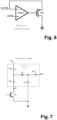
- Figure 6 depicts a circuit diagram of an example voltage sampling block (Maximum Voltage Clamp) of a current limiter 102, 202.
- a feedback voltage Vcomp may be provided to the negative input of an amplifier AMP2.
- the maximum voltage may be provided to a positive input of amplifier AMP2.
- the output of amplifier AMP2 may be clamped, via a negative feedback loop, to be the lower value of the feedback voltage and the maximum voltage: min(Vcomp, Vmax).
- the output voltage of AMPs may be provided to the gate of transistor M1.
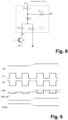
- FIG. 7 depicts a circuit diagram of an example switched capacitor array of a charge pump regulator 100, 200 functioning as an inverter (-1x).
- the switch-cap array of an inverter (-1x) may be composed of a capacitor Cfly and switches S0 - S3.
- the switches may be controlled by non-overlapping clock signals P1 and P2.
- the switches may be implemented as MOSFET, bipolar transistors, and/or diodes.
- Clock signal P1 may be the charge phase, in which S0/S1 may be on and S2/S3 may be off. Capacitor Cfly may be charged to input voltage Vin.
- Clock signal P2 may be the discharge phase, in which S0/S1 may be off and S2/S3 may be on.
- the energy may be transferred as output voltage Vout.
- Figure 8 depicts a circuit diagram of an example switched capacitor array of a charge pump regulator 100, 200 functioning as a doubler (2x).
- the array may be composed of capacitor Cfly and switches S0 - S3.
- the switches may be controlled by non-overlapping clock signals P1 and P2.
- the switches may be implemented as MOSFET, bipolar transistors and/or diodes.
- P1 may be the charge phase, in which S0/S1 may be on, and S2/S3 may be off.
- the capacitor Cfly may be charged to input voltage Vin.
- the clock signal P2 may be the discharge phase, in which S0/S1 may be off and S2/S3 may be on.
- the energy may be transferred as output voltage Vout.
- FIG. 9 depicts a schematic waveform for some example voltages in a charge pump resonator as described in relation to figures 2 and 3 .
- Vds may be sampled and held to generate the Vds_ref voltage.
- the adaptive tracking block may receive the Vds_ref voltage and a reference bias current lref_max to generate a tracking Vmax voltage accordingly.
- the current limit threshold Ilim may in this way be kept accurate at a set value for different Vin/Vout voltage ratios.
- the maximum voltage Vmax tracks the reference drain-source voltage Vds_ref.
- Figure 10 depicts an example graph 300 of current limit threshold as a function of input voltage Vin for different charge pump regulators.
- a 80mA current capability may be required.
- the current limit threshold may for example be set to around 110 mA to balance the current capability requirement and safe operation of internal devices of the smartphone.
- the Vds voltage may have a variation of 0.3V to 1.5V.
- the maximum variation of current limit threshold for previously known topologies (e.g. as shown in figure 1 ) may be 51% and 55% for the whole input voltage Vin range.
- the proposed topology as described herein may have a variation of only 2%. This variation is substantially smaller, illustrating a much more accurate (constant) current limit.
- the accurate current limit threshold may help to better protect internal devices.
- a commonly used doubler charge pump regulator with a regulated output voltage Vout 5V for a wide input voltage Vin range from 2.7V to 4.4V, the Vds may have a variation of 0.4V to 3.8V. Similar improvements in current limit accuracy may be observed in the doubler application compared to the inverter application.
- the input voltage Vin as described herein may for example be in a range from 0 to 10V, from 1V to 5V, from 2.5V to 5V, or from 2.7V to 4.4V.
- the output voltage may be a regulated (i.e. approximately constant) value in a range from -10V to 10V.
Landscapes
- Engineering & Computer Science (AREA)
- Power Engineering (AREA)
- Physics & Mathematics (AREA)
- General Physics & Mathematics (AREA)
- Dc-Dc Converters (AREA)
Priority Applications (3)
| Application Number | Priority Date | Filing Date | Title |
|---|---|---|---|
| EP23175046.4A EP4468581A1 (fr) | 2023-05-24 | 2023-05-24 | Limiteur de courant pour régulateur de pompe de charge |
| CN202311255664.8A CN117335649B (zh) | 2023-05-24 | 2023-09-27 | 用于电荷泵调节器的限流器 |
| US18/673,737 US12573949B2 (en) | 2023-05-24 | 2024-05-24 | Current limiter for a charge pump regulator |
Applications Claiming Priority (1)
| Application Number | Priority Date | Filing Date | Title |
|---|---|---|---|
| EP23175046.4A EP4468581A1 (fr) | 2023-05-24 | 2023-05-24 | Limiteur de courant pour régulateur de pompe de charge |
Publications (1)
| Publication Number | Publication Date |
|---|---|
| EP4468581A1 true EP4468581A1 (fr) | 2024-11-27 |
Family
ID=86604044
Family Applications (1)
| Application Number | Title | Priority Date | Filing Date |
|---|---|---|---|
| EP23175046.4A Pending EP4468581A1 (fr) | 2023-05-24 | 2023-05-24 | Limiteur de courant pour régulateur de pompe de charge |
Country Status (3)
| Country | Link |
|---|---|
| US (1) | US12573949B2 (fr) |
| EP (1) | EP4468581A1 (fr) |
| CN (1) | CN117335649B (fr) |
Families Citing this family (1)
| Publication number | Priority date | Publication date | Assignee | Title |
|---|---|---|---|---|
| CN121415842B (zh) * | 2025-12-24 | 2026-03-24 | 南京优存科技有限公司 | 参考电流产生电路和非易失存储器 |
Citations (4)
| Publication number | Priority date | Publication date | Assignee | Title |
|---|---|---|---|---|
| US6091350A (en) * | 1994-03-15 | 2000-07-18 | Paulos; John J. | Automatic voltage reference scaling in analog-to-digital and digital-to-analog converters |
| CN110445364A (zh) * | 2019-09-11 | 2019-11-12 | 上海南芯半导体科技有限公司 | 用于1:2反向电荷泵的软启电和驱动电路及其实现方法 |
| US20200313563A1 (en) * | 2019-03-27 | 2020-10-01 | Mitsumi Electric Co., Ltd. | Switching power supply device |
| US20220407511A1 (en) * | 2020-03-03 | 2022-12-22 | Denso Corporation | Gate drive device |
Family Cites Families (18)
| Publication number | Priority date | Publication date | Assignee | Title |
|---|---|---|---|---|
| US5392205A (en) * | 1991-11-07 | 1995-02-21 | Motorola, Inc. | Regulated charge pump and method therefor |
| EP0631369A1 (fr) * | 1993-06-21 | 1994-12-28 | STMicroelectronics S.r.l. | Multiplicateur de tension avec courant de sortie elevé et tension de sortie stabilisée |
| US5680300A (en) * | 1995-12-22 | 1997-10-21 | Analog Devices, Inc. | Regulated charge pump DC/DC converter |
| US6400203B1 (en) * | 2000-08-07 | 2002-06-04 | Maxim Integrated Products, Inc. | Hot swap current limit circuits and methods |
| US7285995B2 (en) * | 2004-02-02 | 2007-10-23 | Toshiba America Electronic Components, Inc. | Charge pump |
| US7492197B2 (en) * | 2005-11-17 | 2009-02-17 | Realtek Semiconductor Corp. | Charge pump circuit with regulated current output |
| KR100787940B1 (ko) * | 2006-07-07 | 2007-12-24 | 삼성전자주식회사 | 고전압 발생회로 및 그것을 구비한 플래시 메모리 장치 |
| US7535281B2 (en) * | 2006-09-29 | 2009-05-19 | Micron Technology, Inc. | Reduced time constant charge pump and method for charging a capacitive load |
| US9118238B2 (en) * | 2007-11-21 | 2015-08-25 | O2Micro, Inc. | Charge pump systems with adjustable frequency control |
| US8134403B2 (en) * | 2009-12-22 | 2012-03-13 | Fairchild Semiconductor Corporation | Reduced current charge pump |
| US9819260B2 (en) * | 2015-01-15 | 2017-11-14 | Nxp B.V. | Integrated circuit charge pump with failure protection |
| EP3157011B1 (fr) * | 2015-10-13 | 2019-08-07 | Nxp B.V. | Régulation de pompe de charge |
| US10333393B2 (en) * | 2016-09-23 | 2019-06-25 | Qualcomm Incorporated | Embedded charge pump voltage regulator |
| US10243548B2 (en) * | 2017-04-10 | 2019-03-26 | Microchip Technology Incorporated | Gate driver circuit for high-side switch |
| CN106936310B (zh) * | 2017-04-11 | 2019-03-08 | 东南大学 | 一种低电压电流自匹配栅极开关电荷泵 |
| US11411490B2 (en) * | 2018-09-26 | 2022-08-09 | Analog Devices International Unlimited Company | Charge pumps with accurate output current limiting |
| CN110888487B (zh) * | 2019-12-30 | 2022-03-04 | 锐芯微电子股份有限公司 | 一种低压差线性稳压器及电子设备 |
| US10998816B1 (en) * | 2020-06-11 | 2021-05-04 | Sandisk Technologies Llc | On-chip determination of charge pump efficiency using a current limiter |
-
2023
- 2023-05-24 EP EP23175046.4A patent/EP4468581A1/fr active Pending
- 2023-09-27 CN CN202311255664.8A patent/CN117335649B/zh active Active
-
2024
- 2024-05-24 US US18/673,737 patent/US12573949B2/en active Active
Patent Citations (4)
| Publication number | Priority date | Publication date | Assignee | Title |
|---|---|---|---|---|
| US6091350A (en) * | 1994-03-15 | 2000-07-18 | Paulos; John J. | Automatic voltage reference scaling in analog-to-digital and digital-to-analog converters |
| US20200313563A1 (en) * | 2019-03-27 | 2020-10-01 | Mitsumi Electric Co., Ltd. | Switching power supply device |
| CN110445364A (zh) * | 2019-09-11 | 2019-11-12 | 上海南芯半导体科技有限公司 | 用于1:2反向电荷泵的软启电和驱动电路及其实现方法 |
| US20220407511A1 (en) * | 2020-03-03 | 2022-12-22 | Denso Corporation | Gate drive device |
Also Published As
| Publication number | Publication date |
|---|---|
| CN117335649B (zh) | 2024-08-30 |
| US20240396445A1 (en) | 2024-11-28 |
| US12573949B2 (en) | 2026-03-10 |
| CN117335649A (zh) | 2024-01-02 |
Similar Documents
| Publication | Publication Date | Title |
|---|---|---|
| US10181792B2 (en) | Sensor-less buck current regulator with average current mode control | |
| US8334681B2 (en) | Domino voltage regulator (DVR) | |
| US10877502B2 (en) | Input dependent voltage regulator with a charge pump | |
| US9471078B1 (en) | Ultra low power low drop-out regulators | |
| US8362755B2 (en) | Current-mode control type DC-DC converter and control method therefor | |
| US7830132B2 (en) | Output ripple control circuit and method for a PWM system | |
| US9774255B2 (en) | Synchronous buck DC-DC converter and method thereof | |
| US10534390B2 (en) | Series regulator including parallel transistors | |
| US20240250613A1 (en) | Dynamic current limit circuitry for power converters | |
| US10312899B2 (en) | Over-voltage clamp circuit | |
| EP3414826B1 (fr) | Condensateur électronique prêt à l'emploi pour applications à des modules régulateurs de tension | |
| US10333401B2 (en) | Circuits and devices related to voltage conversion | |
| US11353904B2 (en) | Multi-slope startup voltage regulator system | |
| US12334811B2 (en) | Closed loop stability ramp implementation for Constant On-Time buck converter | |
| WO2006003751A1 (fr) | Convertisseur cc-cc et dispositif du convertisseur | |
| CN114070015A (zh) | 一种功率器件的驱动控制方法及其驱动系统 | |
| US12573949B2 (en) | Current limiter for a charge pump regulator | |
| US11709515B1 (en) | Voltage regulator with n-type power switch | |
| US20180248473A1 (en) | Over-Current Protection Circuit | |
| US20200112252A1 (en) | Switched-Mode Power Converter | |
| US20210132648A1 (en) | Device and system | |
| US12166419B2 (en) | Control circuit of boost DC-DC converter, power supply circuit, and electronic device | |
| US11876448B2 (en) | Booster circuit performing feedback control of output voltage | |
| US11507128B1 (en) | Low on-time control for switching power supply | |
| US10008923B2 (en) | Soft start circuit and power supply device equipped therewith |
Legal Events
| Date | Code | Title | Description |
|---|---|---|---|
| PUAI | Public reference made under article 153(3) epc to a published international application that has entered the european phase |
Free format text: ORIGINAL CODE: 0009012 |
|
| STAA | Information on the status of an ep patent application or granted ep patent |
Free format text: STATUS: THE APPLICATION HAS BEEN PUBLISHED |
|
| AK | Designated contracting states |
Kind code of ref document: A1 Designated state(s): AL AT BE BG CH CY CZ DE DK EE ES FI FR GB GR HR HU IE IS IT LI LT LU LV MC ME MK MT NL NO PL PT RO RS SE SI SK SM TR |
|
| STAA | Information on the status of an ep patent application or granted ep patent |
Free format text: STATUS: REQUEST FOR EXAMINATION WAS MADE |
|
| 17P | Request for examination filed |
Effective date: 20250527 |