EP4468639A1 - Procédé et appareil de communication - Google Patents
Procédé et appareil de communication Download PDFInfo
- Publication number
- EP4468639A1 EP4468639A1 EP23759103.7A EP23759103A EP4468639A1 EP 4468639 A1 EP4468639 A1 EP 4468639A1 EP 23759103 A EP23759103 A EP 23759103A EP 4468639 A1 EP4468639 A1 EP 4468639A1
- Authority
- EP
- European Patent Office
- Prior art keywords
- transmission
- occasions
- domain interval
- transmission occasions
- frequency domain
- Prior art date
- Legal status (The legal status is an assumption and is not a legal conclusion. Google has not performed a legal analysis and makes no representation as to the accuracy of the status listed.)
- Pending
Links
Images



Classifications
-
- H—ELECTRICITY
- H04—ELECTRIC COMMUNICATION TECHNIQUE
- H04W—WIRELESS COMMUNICATION NETWORKS
- H04W56/00—Synchronisation arrangements
- H04W56/001—Synchronization between nodes
- H04W56/0015—Synchronization between nodes one node acting as a reference for the others
-
- H—ELECTRICITY
- H04—ELECTRIC COMMUNICATION TECHNIQUE
- H04W—WIRELESS COMMUNICATION NETWORKS
- H04W74/00—Wireless channel access
- H04W74/002—Transmission of channel access control information
- H04W74/004—Transmission of channel access control information in the uplink, i.e. towards network
-
- H—ELECTRICITY
- H04—ELECTRIC COMMUNICATION TECHNIQUE
- H04W—WIRELESS COMMUNICATION NETWORKS
- H04W72/00—Local resource management
- H04W72/04—Wireless resource allocation
- H04W72/044—Wireless resource allocation based on the type of the allocated resource
- H04W72/0446—Resources in time domain, e.g. slots or frames
-
- H—ELECTRICITY
- H04—ELECTRIC COMMUNICATION TECHNIQUE
- H04W—WIRELESS COMMUNICATION NETWORKS
- H04W72/00—Local resource management
- H04W72/04—Wireless resource allocation
- H04W72/044—Wireless resource allocation based on the type of the allocated resource
- H04W72/0453—Resources in frequency domain, e.g. a carrier in FDMA
-
- H—ELECTRICITY
- H04—ELECTRIC COMMUNICATION TECHNIQUE
- H04W—WIRELESS COMMUNICATION NETWORKS
- H04W74/00—Wireless channel access
- H04W74/08—Non-scheduled access, e.g. ALOHA
- H04W74/0866—Non-scheduled access, e.g. ALOHA using a dedicated channel for access
- H04W74/0891—Non-scheduled access, e.g. ALOHA using a dedicated channel for access for synchronized access
-
- H—ELECTRICITY
- H04—ELECTRIC COMMUNICATION TECHNIQUE
- H04L—TRANSMISSION OF DIGITAL INFORMATION, e.g. TELEGRAPHIC COMMUNICATION
- H04L5/00—Arrangements affording multiple use of the transmission path
- H04L5/003—Arrangements for allocating sub-channels of the transmission path
- H04L5/0048—Allocation of pilot signals, i.e. of signals known to the receiver
- H04L5/005—Allocation of pilot signals, i.e. of signals known to the receiver of common pilots, i.e. pilots destined for multiple users or terminals
-
- H—ELECTRICITY
- H04—ELECTRIC COMMUNICATION TECHNIQUE
- H04W—WIRELESS COMMUNICATION NETWORKS
- H04W74/00—Wireless channel access
- H04W74/002—Transmission of channel access control information
- H04W74/006—Transmission of channel access control information in the downlink, i.e. towards the terminal
-
- H—ELECTRICITY
- H04—ELECTRIC COMMUNICATION TECHNIQUE
- H04W—WIRELESS COMMUNICATION NETWORKS
- H04W74/00—Wireless channel access
- H04W74/08—Non-scheduled access, e.g. ALOHA
- H04W74/0833—Random access procedures, e.g. with 4-step access
Definitions
- This application relates to the field of communication technologies, and in particular, to a communication method and apparatus.
- This application provides a communication method and apparatus, to implement preamble retransmission and increase a random access success probability of a terminal device.
- an embodiment of this application provides a communication method.
- the method may be applied to a terminal device or a module in a terminal device.
- the method is applied to a terminal device.
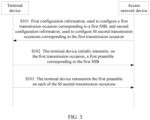
- the terminal device receives first configuration information and second configuration information from an access network device.
- the first configuration information is used to configure a first transmission occasion corresponding to a first synchronization signal broadcast channel block SSB
- the second configuration information is used to configure M second transmission occasions corresponding to the first transmission occasion
- the M second transmission occasions and the first transmission occasion correspond to a same SSB.
- the terminal device may initially transmit, on the first transmission occasion, a preamble corresponding to the first SSB, and retransmit the preamble on each of the M second transmission occasions, where M is a positive integer.
- the terminal device can implement preamble retransmission on the second-type transmission occasion, so as to increase a probability that the access network device successfully receives the preamble, and increase a random access success probability of the terminal device.
- the second configuration information includes at least one of the following: a value of M; first information, where the first information is used to determine time domain positions of the M second transmission occasions; and second information, where the second information is used to determine frequency domain positions of the M second transmission occasions.
- the first information includes: a first time domain interval, where the first time domain interval is a time domain interval between any adjacent transmission occasions among the first transmission occasion and the M second transmission occasions; or M time domain intervals, where the M time domain intervals include a time domain interval between the first transmission occasion and a 1 st second transmission occasion in the M second transmission occasions, and a time domain interval between each of the M second transmission occasions except the 1 st second transmission occasion and a previous second transmission occasion, or a time domain interval between each of the M second transmission occasions and the first transmission occasion.
- the second information includes: a first frequency domain interval, where the first frequency domain interval is a frequency domain interval between any adjacent transmission occasions among the first transmission occasion and the M second transmission occasions; or M frequency domain intervals, where the M frequency domain intervals include a frequency domain interval between the first transmission occasion and the 1 st second transmission occasion in the M second transmission occasions, and a frequency domain interval between each of the M second transmission occasions except the 1 st second transmission occasion and a previous second transmission occasion, or a frequency domain interval between each of the M second transmission occasions and the first transmission occasion, or a frequency domain interval between each of the M second transmission occasions and a reference point.
- the M second transmission occasions respectively belong to M sets of transmission occasions.
- the first information includes time domain position information corresponding to each of the M sets of transmission occasions.
- the second information includes frequency domain position information corresponding to each of the M sets of transmission occasions.
- the second configuration information includes at least one of the following: a value of M; a first offset, where the first offset is used to determine a first time domain interval and a first frequency domain interval, the first time domain interval is a time domain interval between any adjacent transmission occasions among the first transmission occasion and the M second transmission occasions, and the first frequency domain interval is a frequency domain interval between any adjacent transmission occasions among the first transmission occasion and the M second transmission occasions; and M offsets, where the M offsets are used to determine M time domain intervals and the M frequency domain intervals.
- the M time domain intervals include a time domain interval between the first transmission occasion and a 1 st second transmission occasion in the M second transmission occasions and a time domain interval between each of the M second transmission occasions except the 1 st second transmission occasion and a previous second transmission occasion, or a time domain interval between each of the M second transmission occasions and the first transmission occasion.
- the M frequency domain intervals include a frequency domain interval between the first transmission occasion and the 1 st second transmission occasion in the M second transmission occasions and a frequency domain interval between each of the M second transmission occasions except the 1 st second transmission occasion and a previous second transmission occasion, or a frequency domain interval between each of the M second transmission occasions and the first transmission occasion, or a frequency domain interval between each of the M second transmission occasions and a reference point.
- offset is the first offset
- symbol_offset is the first time domain interval
- frequency _offset is the second frequency domain interval
- MAX_SYMBOL_OFFSET is a sum of 1 and a maximum value of symbol _offset.
- an embodiment of this application provides a communication method.
- the method may be applied to an access network device or a module in an access network device.
- the method is applied to an access network device.
- the access network device determines first configuration information and second configuration information.
- the first configuration information is used to configure a first transmission occasion corresponding to a first SSB
- the second configuration information is used to configure M second transmission occasions corresponding to the first transmission occasion
- the M second transmission occasions and the first transmission occasion correspond to a same SSB.
- the access network device sends the first configuration information and the second configuration information.
- the second configuration information includes at least one of the following: a value of M; first information, where the first information is used to determine time domain positions of the M second transmission occasions; and second information, where the second information is used to determine frequency domain positions of the M second transmission occasions.
- the first information includes: a first time domain interval, where the first time domain interval is a time domain interval between any adjacent transmission occasions among the first transmission occasion and the M second transmission occasions; or M time domain intervals, where the M time domain intervals include a time domain interval between the first transmission occasion and a 1 st second transmission occasion in the M second transmission occasions, and a time domain interval between each of the M second transmission occasions except the 1 st second transmission occasion and a previous second transmission occasion, or a time domain interval between each of the M second transmission occasions and the first transmission occasion.
- the second information includes: a first frequency domain interval, where the first frequency domain interval is a frequency domain interval between any adjacent transmission occasions among the first transmission occasion and the M second transmission occasions; or M frequency domain intervals, where the M frequency domain intervals include a frequency domain interval between the first transmission occasion and the 1 st second transmission occasion in the M second transmission occasions, and a frequency domain interval between each of the M second transmission occasions except the 1 st second transmission occasion and a previous second transmission occasion, or a frequency domain interval between each of the M second transmission occasions and the first transmission occasion, or a frequency domain interval between each of the M second transmission occasions and a reference point.
- the M second transmission occasions respectively belong to M sets of transmission occasions.
- the first information includes time domain position information corresponding to each of the M sets of transmission occasions.
- the second information includes frequency domain position information corresponding to each of the M sets of transmission occasions.
- the second configuration information includes at least one of the following: a value of M; a first offset, where the first offset is used to determine a first time domain interval and a first frequency domain interval, the first time domain interval is a time domain interval between any adjacent transmission occasions among the first transmission occasion and the M second transmission occasions, and the first frequency domain interval is a frequency domain interval between any adjacent transmission occasions among the first transmission occasion and the M second transmission occasions; and M offsets, where the M offsets are used to determine M time domain intervals and the M frequency domain intervals.
- the M time domain intervals include a time domain interval between the first transmission occasion and a 1 st second transmission occasion in the M second transmission occasions and a time domain interval between each of the M second transmission occasions except the 1 st second transmission occasion and a previous second transmission occasion, or a time domain interval between each of the M second transmission occasions and the first transmission occasion.
- the M frequency domain intervals include a frequency domain interval between the first transmission occasion and the 1 st second transmission occasion in the M second transmission occasions and a frequency domain interval between each of the M second transmission occasions except the 1 st second transmission occasion and a previous second transmission occasion, or a frequency domain interval between each of the M second transmission occasions and the first transmission occasion, or a frequency domain interval between each of the M second transmission occasions and a reference point.
- offset is the first offset
- symbol_offset is the first time domain interval
- frequency _offset is the second frequency domain interval
- MAX_SYMBOL_OFFSET is a sum of 1 and a maximum value of symbol_offset.
- this application provides a communication apparatus.
- the communication apparatus has a function for implementing the first aspect.
- the communication apparatus includes a corresponding module, unit, or means (means) for performing an operation in the first aspect.
- the module, unit, or means may be implemented by software, or implemented by hardware, or implemented by hardware executing corresponding software.
- the communication apparatus includes a processing unit and a communication unit.
- the communication unit may be configured to receive and send signals, to implement communication between the communication apparatus and another apparatus.
- the processing unit may be configured to perform some internal operations of the communication apparatus. Functions performed by the processing unit and the communication unit may correspond to the operations in the first aspect.
- the communication apparatus includes a processor, and the processor may be configured to be coupled to a memory.
- the memory may store a necessary computer program or necessary instructions for implementing the functions in the first aspect.
- the processor may execute the computer program or instructions stored in the memory. When the computer program or instructions are executed, the communication apparatus is enabled to implement the method in any possible design or implementation of the first aspect.
- the communication apparatus includes a processor and a memory.
- the memory may store a necessary computer program or necessary instructions for implementing the functions in the first aspect.
- the processor may execute the computer program or instructions stored in the memory. When the computer program or instructions are executed, the communication apparatus is enabled to implement the method in any possible design or implementation of the first aspect.
- the communication apparatus includes a processor and an interface circuit, and the processor is configured to: communicate with another apparatus through the interface circuit, and perform the method in any possible design or implementation of the first aspect.
- this application provides a communication apparatus.
- the communication apparatus has a function for implementing the second aspect.
- the communication apparatus includes a corresponding module, unit, or means for performing an operation in the second aspect, and the function, unit, or means may be implemented by software, or implemented by hardware, or implemented by hardware executing corresponding software.
- the communication apparatus includes a processing unit and a communication unit.
- the communication unit may be configured to receive and receive signals, to implement communication between the communication apparatus and another apparatus.
- the communication unit is configured to send system information to a terminal device.
- the processing unit may be configured to perform some internal operations of the communication apparatus. Functions performed by the processing unit and the communication unit may correspond to the operations in the second aspect.
- the communication apparatus includes a processor, and the processor may be configured to be coupled to a memory.
- the memory may store a necessary computer program or necessary instructions for implementing the functions in the second aspect.
- the processor may execute the computer program or instructions stored in the memory. When the computer program or instructions are executed, the communication apparatus is enabled to implement the method in any possible design or implementation of the second aspect.
- the communication apparatus includes a processor and a memory.
- the memory may store a necessary computer program or necessary instructions for implementing the functions in the second aspect.
- the processor may execute the computer program or instructions stored in the memory. When the computer program or instructions are executed, the communication apparatus is enabled to implement the method in any possible design or implementation of the second aspect.
- the second configuration information includes the value of M, the first time domain interval, and the frequency domain interval list.
- the first time domain interval is X slots
- the frequency domain interval list includes ⁇ Y1 PRBs, Y2 PRBs ⁇ .
- the second configuration information includes the value of M, the time domain interval list, and the first frequency domain interval.
- the time domain interval list includes ⁇ X1 slots, X2 slots ⁇ , and the first frequency domain interval is Y PRBs.
- the second configuration information may include at least one of the following: (1) the value of M; (2) a first offset; and (3) M offsets.
- the second configuration information may include the value of M and the first offset, or the second configuration information may include the M offsets.
- the first offset is used to determine the first time domain interval and the first frequency domain interval.
- the M offsets are used to determine the M time domain intervals and the M frequency domain intervals. For example, if the M offsets include an offset 1, an offset 2, ..., and an offset M, the offset 1 is used to determine the time domain interval 1 and the frequency domain interval 2, the offset 2 is used to determine the time domain interval 2 and the frequency domain interval 2, and so on.
- the first time domain interval, the first frequency domain interval, the M time domain intervals, and the M frequency domain intervals refer to the descriptions in Implementation 1.
- offset is the first offset
- symbol_offset is the first time domain interval
- frequency _offset is the first frequency domain interval
- MAX_SYMBOL_OFFSET is a sum of 1 and a maximum value of symbol_offset.
- the time domain position information corresponding to each of the M sets of transmission occasions may include a prach-ConfigurationIndex parameter 1, a prach-ConfigurationIndex parameter 2, ..., and a prach-ConfigurationIndex parameter M.
- a random access period corresponding to any one of the M sets of transmission occasions may be the same as a random access period configured by using the first configuration information.
- a frequency domain position of the second-type transmission occasion corresponding to the first-type transmission occasion may be the same as a frequency domain position of the first-type transmission occasion.
- the second configuration information may no longer include the frequency domain position information corresponding to each of the M sets of transmission occasions.
- the first configuration information includes a prach-ConfigurationIndex parameter 0 and ⁇ msg1-FDM parameter 0, msg1-FrequencyStart parameter 0 ⁇
- the second configuration information includes the prach-ConfigurationIndex parameter 1, the prach-ConfigurationIndex parameter 2, ..., and the prach-ConfigurationIndex parameter M.
- the first transmission occasion may be one of a plurality of transmission occasions corresponding to the first SSB.
- the access network device may determine, based on the first transmission occasion, that a downlink beam used for communicating with the terminal device is a beam corresponding to the first SSB, and perform a subsequent random access process (for example, send an RAR to the terminal device) based on the first preamble. Further, if the access network device receives the first preamble on the M second transmission occasions after sending the RAR, the access network device may determine that the first preamble received in this case is the preamble retransmitted by the terminal device, and then may not need to respond, that is, the RAR is not repeatedly sent.
- the access network device may determine, based on the second transmission occasion, that a downlink beam used for communicating with the terminal device is a beam corresponding to the first SSB, and perform a subsequent random access process based on the first preamble.
- the terminal device can implement preamble retransmission on the second-type transmission occasion, so as to increase a probability that the access network device successfully receives the preamble, and increase a random access success probability of the terminal device.
- FIG. 7 is a schematic flowchart corresponding to a communication method according to Embodiment 2 of this application. As shown in FIG. 7 , the method includes the following steps.
- An access network device sends third configuration information to a terminal device.
- the third configuration information is used to configure a plurality of transmission occasions corresponding to a plurality of SSBs, the plurality of SSBs include a first SSB, and transmission occasions corresponding to the first SSB include a first-type transmission occasion and a second-type transmission occasion.
- the plurality of SSBs may include all SSBs actually transmitted by the access network device in one synchronization burst set.
- one synchronization burst set includes 16 SSBs. If the access network device selects 10 SSBs from the 16 SSBs for transmission, the plurality of SSBs may include the 10 SSBs.
- the third configuration information may include time domain position information and frequency domain position information of the plurality of transmission occasions.
- the plurality of transmission occasions may include transmission occasions that appear in one random access period.
- the third configuration information may further include indication information.
- the indication information indicates the first-type transmission occasion in the plurality of transmission occasions.
- the indication information may indicate a time domain position, and a transmission occasion at the time domain position is the first-type transmission occasion. In this manner, the access network device does not need to configure the second-type transmission occasion for the terminal device by using an additional configuration parameter, thereby effectively reducing signaling overheads.
- the indication information may include duration of a first period and an identifier of a time unit in which the first-type transmission occasion is located in the first period.
- the first period may also be referred to as an association period (association period), the duration of the first period may be 2 to the power of n of duration of the random access period, and n is a positive integer.
- a transmission occasion in each first period includes at least one transmission occasion corresponding to each of the plurality of SSBs.
- the first period may include a plurality of time units, and numbers of the plurality of time units are respectively a time unit 0, a time unit 1, ..., and the like.
- the identifier of the time unit in which the first-type transmission occasion is located may be a number of the time unit in which the first-type transmission occasion is located. For example, as shown in FIG. 8 , the duration of the first period is four times the duration of the random access period.
- the indication information may indicate that a transmission occasion in the time unit 0 in the first period is the first-type transmission occasion, and a transmission occasion in another time unit in the first period is the second-type transmission occasion.
- the time unit may be a slot or another possible time unit. This is not specifically limited.
- the third configuration information may further include other possible information, for example, information about a correspondence between each of the plurality of transmission occasions and an SSB, information about a correspondence between an SSB and a preamble, a threshold 1, and a threshold 2.
- information about a correspondence between each of the plurality of transmission occasions and an SSB information about a correspondence between an SSB and a preamble
- a threshold 1 information about a correspondence between an SSB and a preamble
- a threshold 1 for details, refer to the descriptions in Embodiment 1.
- the access network device may send the third configuration information to the terminal device by using a system message.
- the first transmission occasion may be the first-type transmission occasion corresponding to the first SSB.
- S703 The terminal device retransmits the first preamble on at least one second-type transmission occasion corresponding to the first SSB.
- the terminal device may retransmit the first preamble on all second-type transmission occasions (that is, the transmission occasion 2 in the time unit 1, the transmission occasion 2 in the time unit 2, and the transmission occasion 2 in the time unit 3 in the first period) corresponding to the first SSB, or the terminal device may flexibly determine a quantity of retransmission times based on other possible information. This is not specifically limited.
- Embodiment 2 and Embodiment 1 lie in that a manner in which the access network device configures the transmission occasion is different.
- Embodiment 2 and Embodiment 1 may be mutually referenced.
- the terminal device can implement preamble retransmission on the second-type transmission occasion, so as to increase a probability that the access network device successfully receives the preamble, and increase a random access success probability of the terminal device.
- Embodiment 1 and Embodiment 2 describe specific implementations of retransmitting the preamble by the terminal device.
- the terminal device may retransmit a message 3 in the random access process.
- the access network device may configure, for the terminal device, a transmission occasion used to request retransmission of the message 3. Then, when the terminal device sends a preamble on the transmission occasion, the access network device may configure, for the terminal device, a plurality of physical uplink shared channel (physical uplink shared channel, PUSCH) resources used for retransmission of the message 3.
- PUSCH physical uplink shared channel
- the terminal device may implement preamble retransmission by using the method in Embodiment 1 or Embodiment 2.
- the terminal device may implement, on the transmission occasion used to request retransmission of the message 3, retransmission of the message 3 by sending the preamble.
- Preamble retransmission may depend on retransmission of the message 3.
- a terminal device that supports retransmission of the message 3 may support preamble retransmission or not support preamble retransmission, and a terminal device that does not support retransmission of the message 3 definitely does not support preamble retransmission.
- preamble retransmission may not depend on retransmission of the message 3, that is, preamble retransmission and retransmission of the message 3 are independent of each other.
- the terminal device may support both preamble retransmission and retransmission of the message 3, or may support preamble retransmission but not support retransmission of the message 3, or may support retransmission of the message 3 but not support preamble retransmission, or may support neither preamble retransmission or retransmission of the message 3.
- a first-type terminal device is a terminal device that supports both preamble retransmission and retransmission of the message 3.
- a second-type terminal device is a terminal device that does not support preamble retransmission but supports retransmission of the message 3.
- a third-type terminal device is a terminal device that supports neither preamble retransmission nor retransmission of the message 3. For this case, the following describes a possible implementation with reference to FIG. 9 .
- FIG. 9 is a schematic flowchart corresponding to a communication method according to an embodiment of this application. As shown in FIG. 9 , the method includes the following steps.
- An access network device sends fourth configuration information to a terminal device.
- the terminal device receives the fourth configuration information.
- the fourth configuration information is used to configure a plurality of groups of transmission occasions, and the plurality of groups of transmission occasions include a first group of transmission occasions that supports neither preamble retransmission nor retransmission of the message 3, and further include P groups of transmission occasions that support preamble retransmission and Q groups of transmission occasions that support retransmission of the message 3.
- the P groups of transmission occasions respectively correspond to P thresholds
- the Q groups of transmission occasions respectively correspond to Q thresholds
- both P and Q are positive integers.
- the access network device may send the fourth configuration information to the terminal device by using a system message.
- the fourth configuration information may further include other possible information, for example, a threshold 1.
- Each of the plurality of groups of transmission occasions may include transmission occasions corresponding to a plurality of SSBs.
- the plurality of SSBs may include all SSBs actually transmitted by the access network device in one synchronization burst set.
- the terminal device selects, from the plurality of groups of transmission occasions based on a measurement value of a first cell and at least one of the P thresholds and the Q thresholds, a transmission occasion for sending a preamble.
- the terminal device may be a first-type terminal device, and the first cell may be a cell in which the terminal device prepares to initiate random access.
- the terminal device may send the preamble on a plurality of transmission occasions of the second group of transmission occasions. In other words, the terminal device may retransmit the preamble.
- the terminal device may select a first SSB from the plurality of SSBs based on measurement values of the plurality of SSBs of the first cell and the threshold 1, initially transmit a first preamble on a first transmission occasion corresponding to the first SSB of the second group of transmission occasions, and retransmit the first preamble on each of M transmission occasions corresponding to the first transmission occasion.
- the access network device configures the second group of transmission occasions
- the terminal device sends the preamble on the plurality of transmission occasions of the second group of transmission occasions refer to Embodiment 2 or Embodiment 2.
- the terminal device may send the preamble on one of the first group of transmission occasions. In other words, the terminal device does not retransmit the preamble. For example, when the measurement value of the first cell is less than the first threshold, the terminal device may select the first SSB from the plurality of SSBs based on the measurement values of the plurality of SSBs of the first cell and the threshold 1, and send the first preamble on one transmission occasion corresponding to the first SSB of the first group of transmission occasions.
- the P groups of transmission occasions include the second group of transmission occasions, and the second group of transmission occasions corresponds to the first threshold.
- the terminal device may send the preamble on the plurality of transmission occasions of the second group of transmission occasions; when the measurement value of the first cell is greater than or equal to the first threshold and less than the second threshold, the terminal device may send the preamble on one of the third group of transmission occasions; or when the measurement value of the first cell is greater than or equal to the second threshold, the terminal device may send the preamble on one of the first group of transmission occasions.
- the plurality of groups of transmission occasions include the first group of transmission occasions, the Q groups of transmission occasions, and the W groups of transmission occasions.
- the Q groups of transmission occasions include a third group of transmission occasions, and the third group of transmission occasions corresponds to a second threshold.
- the W groups of transmission occasions include the fifth group of transmission occasions, and the fifth group of transmission occasions corresponds to the fourth threshold in the W thresholds.
- the second threshold is greater than the fourth threshold.
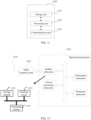
- FIG. 11 is a block diagram of a possible example of an apparatus according to an embodiment of this application.
- the apparatus 1100 may include a processing unit 1102 and a communication unit 1103.
- the processing unit 1102 is configured to control and manage an action of the apparatus 1100.
- the communication unit 1103 is configured to support communication between the apparatus 1100 and another device.
- the communication unit 1103 is also referred to as a transceiver unit, and may include a receiving unit and/or a sending unit, respectively configured to perform a receiving operation and a sending operation.
- the apparatus 1100 may further include a storage unit 1101 that is configured to store program code and/or data of the apparatus 1100.
- the apparatus 1100 may be the terminal device in the foregoing embodiments.
- the processing unit 1102 may support the apparatus 1100 in performing actions of the terminal device in the foregoing method examples.
- the processing unit 1102 mainly performs an internal action of the terminal device in the method examples, and the communication unit 1103 may support communication between the apparatus 1100 and another device.
- a unit in any one of the foregoing apparatuses may be one or more integrated circuits configured to implement the foregoing methods, for example, one or more application-specific integrated circuits (application-specific integrated circuits, ASICs), one or more microprocessors (digital signal processors, DSPs), one or more field programmable gate arrays (field programmable gate arrays, FPGAs), or a combination of at least two of these forms of integrated circuits.
- the processing element may be a processor, for example, a general-purpose central processing unit (central processing unit, CPU) or another processor that can invoke the program.
- the units may be integrated and implemented in a form of a system-on-a-chip (system-on-a-chip, SOC).
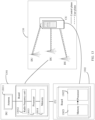
- the access network device shown in FIG. 13 can implement all processes related to the access network device in the foregoing method embodiment. Operations and/or functions of the modules in the access network device shown in FIG. 13 are respectively used to implement corresponding processes in the foregoing method embodiment. For details, refer to the descriptions in the foregoing method embodiment. To avoid repetition, detailed descriptions are properly omitted herein.
- this application may be provided as a method, a system, or a computer program product. Therefore, this application may use a form of hardware only embodiments, software only embodiments, or embodiments with a combination of software and hardware. In addition, this application may use a form of a computer program product that is implemented on one or more computer-usable storage media (including but not limited to a disk memory, a CD-ROM, an optical memory, and the like) that include computer-usable program code.
- computer-usable storage media including but not limited to a disk memory, a CD-ROM, an optical memory, and the like
- These computer program instructions may be provided for a general-purpose computer, a special-purpose computer, an embedded processor, or a processor of any other programmable data processing device to generate a machine, so that the instructions executed by a computer or a processor of any other programmable data processing device generate an apparatus for implementing a specific function in one or more processes in the flowcharts and/or in one or more blocks in the block diagrams.
- These computer program instructions may alternatively be stored in a computer-readable memory that can instruct a computer or any other programmable data processing device to work in a specific manner, so that the instructions stored in the computer-readable memory generate an artifact that includes an instruction apparatus.
- the instruction apparatus implements a specific function in one or more processes in the flowcharts and/or in one or more blocks in the block diagrams.
- the computer program instructions may alternatively be loaded onto a computer or another programmable data processing device, to enable a series of operations and steps to be performed on the computer or the another programmable device, so that computer-implemented processing is generated. Therefore, the instructions executed on the computer or the another programmable device provide steps for implementing a specific function in one or more processes in the flowcharts and/or in one or more blocks in the block diagrams.
Landscapes
- Engineering & Computer Science (AREA)
- Computer Networks & Wireless Communication (AREA)
- Signal Processing (AREA)
- Mobile Radio Communication Systems (AREA)
Applications Claiming Priority (2)
| Application Number | Priority Date | Filing Date | Title |
|---|---|---|---|
| CN202210173063.1A CN116709559A (zh) | 2022-02-24 | 2022-02-24 | 一种通信方法及装置 |
| PCT/CN2023/076911 WO2023160478A1 (fr) | 2022-02-24 | 2023-02-17 | Procédé et appareil de communication |
Publications (2)
| Publication Number | Publication Date |
|---|---|
| EP4468639A1 true EP4468639A1 (fr) | 2024-11-27 |
| EP4468639A4 EP4468639A4 (fr) | 2025-04-30 |
Family
ID=87764730
Family Applications (1)
| Application Number | Title | Priority Date | Filing Date |
|---|---|---|---|
| EP23759103.7A Pending EP4468639A4 (fr) | 2022-02-24 | 2023-02-17 | Procédé et appareil de communication |
Country Status (4)
| Country | Link |
|---|---|
| US (1) | US20240414669A1 (fr) |
| EP (1) | EP4468639A4 (fr) |
| CN (1) | CN116709559A (fr) |
| WO (1) | WO2023160478A1 (fr) |
Family Cites Families (10)
| Publication number | Priority date | Publication date | Assignee | Title |
|---|---|---|---|---|
| EP3105988B1 (fr) * | 2014-02-10 | 2018-09-05 | Telefonaktiebolaget LM Ericsson (publ) | Équipement utilisateur, noeud de réseau et procédés correspondants pour gérer des transmissions de préambule sur un canal d'accès aléatoire dans un réseau de radiocommunication |
| US10405354B2 (en) * | 2016-12-09 | 2019-09-03 | Samsung Electronics Co., Ltd. | Method and apparatus for RACH procedure in wireless systems |
| CN114024812B (zh) * | 2019-08-02 | 2023-09-05 | Oppo广东移动通信有限公司 | 一种prs资源的配置方法及装置、用户设备、网络设备 |
| EP4017198A4 (fr) * | 2019-08-16 | 2022-09-07 | Huawei Technologies Co., Ltd. | Procédé d'accès aléatoire, dispositif terminal et dispositif de réseau |
| CN111867129B (zh) * | 2019-08-16 | 2023-06-23 | 维沃移动通信有限公司 | 物理随机接入信道传输方法、终端及网络侧设备 |
| CN115399051A (zh) * | 2020-04-14 | 2022-11-25 | Oppo广东移动通信有限公司 | 资源确定方法、装置、设备及存储介质 |
| CN113543360A (zh) * | 2020-04-22 | 2021-10-22 | 北京三星通信技术研究有限公司 | 一种传输方法和设备 |
| CN112040558B (zh) * | 2020-08-07 | 2022-01-18 | 中国信息通信研究院 | 一种随机接入过程中的上行数据传输方法和设备 |
| CN116456487A (zh) * | 2022-01-05 | 2023-07-18 | 维沃移动通信有限公司 | Prach重复传输方法、终端及网络侧设备 |
| WO2023135763A1 (fr) * | 2022-01-14 | 2023-07-20 | 株式会社Nttドコモ | Terminal et procédé de communication |
-
2022
- 2022-02-24 CN CN202210173063.1A patent/CN116709559A/zh active Pending
-
2023
- 2023-02-17 WO PCT/CN2023/076911 patent/WO2023160478A1/fr not_active Ceased
- 2023-02-17 EP EP23759103.7A patent/EP4468639A4/fr active Pending
-
2024
- 2024-08-23 US US18/813,803 patent/US20240414669A1/en active Pending
Also Published As
| Publication number | Publication date |
|---|---|
| WO2023160478A1 (fr) | 2023-08-31 |
| CN116709559A (zh) | 2023-09-05 |
| EP4468639A4 (fr) | 2025-04-30 |
| US20240414669A1 (en) | 2024-12-12 |
Similar Documents
| Publication | Publication Date | Title |
|---|---|---|
| US11895709B2 (en) | Random access method and terminal | |
| US11546870B2 (en) | Method and apparatus for transmitting or receiving information | |
| US20210068154A1 (en) | Channel sensing method, related device, and system | |
| US12402167B2 (en) | Communication method and system, and device | |
| WO2019184956A1 (fr) | Procédé et appareil d'accès aléatoire | |
| WO2022017118A1 (fr) | Procédé d'accès aléatoire et dispositif de communication | |
| US12133196B2 (en) | Communications method and apparatus | |
| US12603731B2 (en) | Carrier configuration method and related device | |
| US12457610B2 (en) | Communication method including a physical uplink shared channel (PUSH) based on a synchronization signal broadcast block (SSB) and apparatus | |
| EP4564968A1 (fr) | Procédé de configuration de ressource et appareil de communication | |
| EP3780870B1 (fr) | Transmission de messages de contrôle de ressources radio en liaison descendante dans un accès aléatoire en deux étapes | |
| US20230337223A1 (en) | Communication method and apparatus | |
| JP2024545327A (ja) | 伝送決定方法、装置、端末、ネットワーク側機器及び記憶媒体 | |
| US20250185016A1 (en) | Uplink scheduling method and apparatus | |
| WO2024099185A1 (fr) | Procédé et appareil d'accès aléatoire, terminal, dispositif côté réseau et support | |
| EP4304272A1 (fr) | Procédé de transmission de signaux et appareil de communication | |
| US12114371B1 (en) | Method and device for node for wireless communication | |
| EP4468639A1 (fr) | Procédé et appareil de communication | |
| US20240098720A1 (en) | Terminal, System, and Method for Bandwidth Part Out-of-Sync Detection and Recovery | |
| US20250227634A1 (en) | Communication Method and Apparatus | |
| EP4572485A1 (fr) | Procédé et appareil de communication | |
| US20260067940A1 (en) | Communication method and apparatus | |
| CA3130234C (fr) | Methode d'acces aleatoire et appareil | |
| CN119325735A (zh) | 用于侧链路通信的资源选择 | |
| WO2025148928A1 (fr) | Procédé et appareil d'accès aléatoire, terminal et dispositif côté réseau |
Legal Events
| Date | Code | Title | Description |
|---|---|---|---|
| STAA | Information on the status of an ep patent application or granted ep patent |
Free format text: STATUS: THE INTERNATIONAL PUBLICATION HAS BEEN MADE |
|
| PUAI | Public reference made under article 153(3) epc to a published international application that has entered the european phase |
Free format text: ORIGINAL CODE: 0009012 |
|
| STAA | Information on the status of an ep patent application or granted ep patent |
Free format text: STATUS: REQUEST FOR EXAMINATION WAS MADE |
|
| 17P | Request for examination filed |
Effective date: 20240823 |
|
| AK | Designated contracting states |
Kind code of ref document: A1 Designated state(s): AL AT BE BG CH CY CZ DE DK EE ES FI FR GB GR HR HU IE IS IT LI LT LU LV MC ME MK MT NL NO PL PT RO RS SE SI SK SM TR |
|
| REG | Reference to a national code |
Ref country code: DE Ref legal event code: R079 Free format text: PREVIOUS MAIN CLASS: H04L0005000000 Ipc: H04W0074000000 |
|
| A4 | Supplementary search report drawn up and despatched |
Effective date: 20250327 |
|
| RIC1 | Information provided on ipc code assigned before grant |
Ipc: H04W 74/0833 20240101ALN20250321BHEP Ipc: H04L 5/00 20060101ALN20250321BHEP Ipc: H04L 1/08 20060101ALI20250321BHEP Ipc: H04W 74/00 20090101AFI20250321BHEP |
|
| DAV | Request for validation of the european patent (deleted) | ||
| DAX | Request for extension of the european patent (deleted) |