EP4470592A1 - Verpackung für eine medizinische vorrichtung mit carrageenansperrfolie - Google Patents
Verpackung für eine medizinische vorrichtung mit carrageenansperrfolie Download PDFInfo
- Publication number
- EP4470592A1 EP4470592A1 EP23176706.2A EP23176706A EP4470592A1 EP 4470592 A1 EP4470592 A1 EP 4470592A1 EP 23176706 A EP23176706 A EP 23176706A EP 4470592 A1 EP4470592 A1 EP 4470592A1
- Authority
- EP
- European Patent Office
- Prior art keywords
- carrageenan
- medical device
- film
- iota
- films
- Prior art date
- Legal status (The legal status is an assumption and is not a legal conclusion. Google has not performed a legal analysis and makes no representation as to the accuracy of the status listed.)
- Pending
Links
Images


Classifications
-
- A—HUMAN NECESSITIES
- A61—MEDICAL OR VETERINARY SCIENCE; HYGIENE
- A61M—DEVICES FOR INTRODUCING MEDIA INTO, OR ONTO, THE BODY; DEVICES FOR TRANSDUCING BODY MEDIA OR FOR TAKING MEDIA FROM THE BODY; DEVICES FOR PRODUCING OR ENDING SLEEP OR STUPOR
- A61M25/00—Catheters; Hollow probes
- A61M25/002—Packages specially adapted therefor ; catheter kit packages
-
- A—HUMAN NECESSITIES
- A61—MEDICAL OR VETERINARY SCIENCE; HYGIENE
- A61M—DEVICES FOR INTRODUCING MEDIA INTO, OR ONTO, THE BODY; DEVICES FOR TRANSDUCING BODY MEDIA OR FOR TAKING MEDIA FROM THE BODY; DEVICES FOR PRODUCING OR ENDING SLEEP OR STUPOR
- A61M25/00—Catheters; Hollow probes
- A61M25/0017—Catheters; Hollow probes specially adapted for long-term hygiene care, e.g. urethral or indwelling catheters to prevent infections
-
- A—HUMAN NECESSITIES
- A61—MEDICAL OR VETERINARY SCIENCE; HYGIENE
- A61M—DEVICES FOR INTRODUCING MEDIA INTO, OR ONTO, THE BODY; DEVICES FOR TRANSDUCING BODY MEDIA OR FOR TAKING MEDIA FROM THE BODY; DEVICES FOR PRODUCING OR ENDING SLEEP OR STUPOR
- A61M27/00—Drainage appliance for wounds or the like, i.e. wound drains, implanted drains
Definitions
- the present invention relates to a medical device assembly comprising a medical device, and preferably a hydrophilic medical device, and more preferably a hydrophilic catheter, such as a hydrophilic urinary catheter, and a package enclosing at least a part of the medical device.
- a medical device assembly comprising a medical device, and preferably a hydrophilic medical device, and more preferably a hydrophilic catheter, such as a hydrophilic urinary catheter, and a package enclosing at least a part of the medical device.
- Hydrophilic medical devices are used for many different purposes.
- hydrophilic urinary catheters are commonly used as intermittent urinary catheters to drain urine from the bladder.
- Such catheters are wetted and activated prior to use by being immersed in water, or being wetted in other ways.
- urinary catheter may be arranged in a wetted, ready-to-use state in the package.
- the catheters may be packaged together with a wetting fluid compartment, allowing the wetting fluid to be released immediately prior to use.
- Urinary catheters are e.g. used by a large group of persons for intermittent catheterization, which is a daily-life procedure, taking place several times a day.
- catheters for intermittent catheterization are used by patients suffering from urinary incontinence or by disabled individuals like para- or tetraplegics.
- the bladder may be drained through a natural or artificial urinary canal.
- Many catheters for intermittent catheterization are provided with a hydrophilic coating or the like, providing a smooth and slippery surface when wetted, for safe and comfortable insertion in the urinary canal.
- hydrophilic catheter assemblies include a supply of wetting fluid, either in direct contact with the catheter or in a separate compartment, for clean and convenient activation of the hydrophilic surface before use.
- Such catheter assemblies are e.g. disclosed in US 8459455 , US 10384033 and US 8808275 .
- the activation of the catheter is obtained e.g. by pressing at the bottom of the catheter packaging.
- the activation aims to wet the catheter with sterile water on the inside of the packaging to swell the hydrophilic coating on the catheter to make it slippery and by that simplify the insertion of the catheter and minimize trauma on the urethra.
- the packaging is here typically a plastic packaging, or a laminate of plastic and metal film or a metal oxide layer, AlOx, or the like.
- the packaging that encloses the catheter is also a part of the medical device as it encapsulates the liquid during activation.
- Another way to release the sterile water and activate the catheter coating is to fold the packaging, thus the packaging also needs to have sufficient mechanical durability.
- the catheter is used within six minutes and is then disposed of together with its packaging after a single use, which is why a more sustainable alternative to plastic packaging would be of interest.
- bio-based materials such as paper
- plastic can be used in a wide variety of areas due to its properties
- paper has inherent disadvantages, such as being deteriorated when in contact with water.
- Bioplastics are another feasible alternative.
- the benefits of bioplastics are that they are non-toxic, have a shorter degradation time, reduce fossil fuel consumption, and reduce emission of greenhouse gases and reduces the carbon footprint. Additionally, bioplastics are biodegradable and are a promising approach to substitute petroleum-based plastic.
- a medical device assembly comprising a package which can be produced and recycled in an environmentally friendly manner, and which still efficiently serves the further needs of the medical device assembly, such as enabling a sterile interior, enabling activation of a hydrophilic surface of the medical device when arranged inside the package, etc.
- a medical device assembly comprising a medical device, and preferably a hydrophilic medical device, and a package forming an interior cavity, the cavity arranged to enclose at least a part of said medical device, wherein the package comprises an outer substrate made of a bio-based material and a film made of carrageenan arranged on said substrate.
- a medical device assembly comprising a hydrophilic urinary catheter and a package forming an interior cavity, the cavity arranged to enclose at least a part of said hydrophilic medical device, wherein the package comprises an outer substrate made of a bio-based material, such as paper, and a hydrophobic film made of linear sulfated polysaccharides, such as carrageenan, wherein the films is arranged facing the interior cavity.
- a bio-based material such as paper
- a hydrophobic film made of linear sulfated polysaccharides, such as carrageenan
- carrageenan is well suited to produce a film, which can be made thin and transparent, and with adequate mechanical properties.
- the film may consequently be used as a protective layer on a substrate material, e.g. made of paper, in order to improve the overall properties of the package.
- a substrate material e.g. made of paper
- the hydrophobicity of the film can easily be increased by addition of further constituents and modification of the carrageenan, such as addition of azetidinium salt, e.g. to form a water or moisture barrier.
- the mechanical properties could easily be modified by addition of further constituents, such as a plasticizer or amines, e.g. to increase elasticity, flexibility and/or tensile strength.
- a film made of linear sulfated polysaccharides, and in particular carrageenan is highly efficient in providing a barrier for the cavity formed in the package.
- the film could be used together with a substrate made of bio-based material, such as paper, which makes the package very environmentally friendly and biocompatible.
- the film is efficient in providing other advantageous properties, such as enabling and maintaining a sterile environment inside the cavity, allowing wetting of the hydrophilic medical device inside the cavity without destruction or damage to the package, etc.
- the package can also be produced cost-efficiently.
- the film is hereby made as a biobased plastic.
- Biobased plastic can be made from various types of materials. Generally, proteins, polysaccharides and lipids are used to make bioplastic.
- Today many bioplastics are derived from biomaterials such as corn, food waste or cereal crops.
- a crucial aspect of bioplastics is that the material they are produced from is renewable.
- Advances in research have shown potential for the use of seaweeds as a biomaterial for bioplastic production as they have the ability to form films. There are many advantages of using seaweed as a feedstock due to its high availability and being planted in sea water instead of on land. Additionally, they reduce global warming and ocean acidity due to seaweeds ability to bind CO2 during photosynthesis.
- Seaweeds such as algae comprise polysaccharides similar to wood and is therefore a potential source as a bio-based material.
- Carrageenan is a type of polysaccharide that is found in algae and can be used for bioplastics. Carrageenan is used in many applications for instance it is a common stabilizing agent in food and can used as a film for preserving food. However, pure carrageenan films are hydrophilic and can have weak mechanical properties.
- carrageenan can be used as to create a hydrophobic carrageenan barrier film, e.g. for use on the inside of a paper packaging, that can serve as a substitute for the current plastic packaging of urinary catheter assemblies.
- a hydrophobic carrageenan barrier film e.g. for use on the inside of a paper packaging
- modification with azetidinium salts and addition of plasticizers and amines have been explored. These properties are useable in order to retain the catheter functions.
- the package may be formed by a first and second sheet material which are connected around the edges, and preferably by means of welding.
- the bio-based material serving as a substrate of the package, is preferably a cellulose based material, and preferably based on paper or seaweed.
- substrate materials such as paper, are very affordable and cost-efficient, and are also recyclable and environmentally friendly.
- substrate materials could for many applications not be used as packages on their own, but the addition of the film enables use of such substrates for a great variety of medical assemblies.
- kappa-carrageenan and iota-carrageenan are particularly suitable for this use, and specifically iota-carrageenan is highly suitable.
- the film may further comprise an azetidinium salt bonded to, or mixed with, the carrageenan. It has been found that the properties of film of carrageenan modified with azetidinium salt is greatly improved, e.g. in respect of hydrophobicity. Thus the modified carrageenan film may form a barrier against water and moisture. This is particularly efficient when the film is arranged on the inside of a substrate, such as made by paper.
- the azetidinium salt and the carrageenan are preferably arranged to form a cross-linked network.
- the azetidinium salt may comprise different R and R' groups.
- the azetidinium salt comprises alkyl groups that are linear or branched and that may contain functional groups such as alcohol, carbonyl groups, nitriles etc.
- the alkyl groups are branched.
- the azetidinium salt comprises at least one of morpholine-azetidinium salt (M-Az), 1,1-dihexyl-3-hydroxy-azetidinium salt (DHA-Az), and 1,1-diallyl-3-hydroxy-azetidinium salt (DAL-Az).
- M-Az morpholine-azetidinium salt
- DHA-Az 1,1-dihexyl-3-hydroxy-azetidinium salt
- DAL-Az 1,1-diallyl-3-hydroxy-azetidinium salt
- a molar ratio between sulphate in the carrageenan and the azetidinium salt is preferably in the range 1:1 to 2:1.
- the film may further comprise a plasticizer.
- the plasticizer is efficient in providing the desired mechanical properties of the film, such as flexibility, elasticity, tensile strength, etc. By selection of an appropriate plasticizer, and the amount of plasticizer, the mechanical properties of the film could easily be designed to suit various needs and applications. Further, it has been found that in many embodiments the addition of a plasticizer improves the hydrophobic properties of the film.
- the plasticizer is at least one of a polyol, and in particular a sugar alcohol, and a triol, including three hydroxyl groups, and preferably at least one of sorbitol and glycerol, and most preferably glycerol.
- the plasticizer is at least one of: glycerol, sorbitol, polyethylene glycol (PEG), and in particular PEG 300, sucrose, fructose, polypropylene glycol (PPG), and water.
- the film preferably comprises 5-50 wt% of plasticizer, and preferably 15-50 wt%, and most preferably 20-45 wt%.
- the film is hydrophobic and forms a water barrier.
- the package can be used together with water and other wetting fluids, for activation of the hydrophilic medical device, without any significant degradation or damage to the package.
- the film is preferably arranged as an inner film on the substrate, facing the interior cavity.
- the film protects the substrate material from being wetted and potentially damaged by any liquid or fluid inside the interior cavity.
- the film may instead, or additionally, be arranged as an outer film on the substrate, i.e. facing away from the interior cavity.
- the hydrophilic medical device may be a hydrophilic catheter, and preferably a hydrophilic urinary catheter.
- the hydrophilic catheter may e.g. be provided with a coating of a hydrophilic material, such as PVP, but could also be made entirely by a hydrophilic material.
- the medical device may further comprise a wetting fluid compartment arranged within said interior cavity.
- the wetting fluid compartment may e.g. comprise a sachet or pouch containing the wetting fluid.
- the wetting fluid compartment may be openable by twisting, compression, bending or the like to release the wetting fluid into the interior cavity, thereby to wet and activate the hydrophilic medical device.
- the package may also be used for accommodation of other types of medical devices, not being provided with hydrophilic coatings or otherwise being hydrophilic.
- the medical device may in such embodiments be indwelling urinary catheters, stents, rectal catheters, etc.
- the package of the present disclosure is particularly useful for hydrophilic urinary catheters, in particular urinary catheters for intermittent use, which are stored in a dry condition and wetted within the package immediately prior to use.
- Catheters may be used for many different purposes, and for insertion into various types of body-cavities.
- the following discussion is in particular concerned with the preferred field of use, hydrophilic urinary catheters, even though the invention is not limited to this particular type of catheters.
- the package is also useful for many other medical device assemblies, such as other types of urinary catheter assemblies, assemblies for other types of catheters, as well as for other types of medical devices, and in particular medical devices stored and used in a similar way as hydrophilic urinary catheters.
- Even though the following description will be mainly focused on hydrophilic urinary catheters, it is to be acknowledged that the disclosure is also relevant for all such other types of medical devices, and also medical devices not being hydrophilic.
- the catheter may be an intermittent urinary catheter that is used by female or male users with bladder dysfunction.
- the catheter may have a hydrophilic coating which is dry before use and therefore needs to be activated with an aqueous fluid, such as water.
- the activation serves to activate the hydrophilic coating on the catheter which will facilitate the catheterization and prevent trauma on the urethra.
- the catheter Prior to use, the catheter is enclosed by a packaging, which forms a part of the medical device, and e.g. serves to encapsulate the water during activation of the hydrophilic coating and thereby aid the catheterization procedure.
- the catheter assembly comprises a catheter and a package, e.g. a resealable package, accommodating the catheter.
- the catheter may have a hydrophilic surface coating, and the assembly may also include a wetting fluid for activation of the hydrophilic surface coating.
- a wetting fluid is also included in the assembly.
- the wetting fluid may be arranged in direct contact with the hydrophilic surface of the catheter.
- the wetting fluid is arranged separately from said catheter within the package.
- the separate arrangement of the wetting fluid can be obtained by means of closed compartment within the package.
- the wetting fluid is arranged in a wetting fluid container arranged within said package, such as in a pouch, sachet or the like.
- the container or compartment may be openable into the part of the package housing the catheter, in order to enable release of the wetting fluid into contact with the hydrophilic part of the catheter before use. Release of the wetting fluid can be obtained by squeezing, bending or the like, as is per se well known in the art.
- the package is elongate, and preferably with an essentially rectangular form.
- a very compact product is obtained.
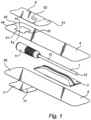
- the catheter assembly as illustrated in Figs. 1-2 comprises a catheter 1 having a hydrophilic surface coating, a wetting fluid for activation of said hydrophilic surface coating and a package 3 accommodating the catheter and the wetting fluid.
- the catheter 1 may be any type of hydrophilic catheter, as is per se well known in the art.
- the catheter may comprise a flared rearward portion, forming a flared connector 11, and an elongated shaft 12, connected to the flared connector 11, and in the opposite end having a catheter insertion end 13.
- At least a part of the elongate shaft 12 forms an insertable length to be inserted through a body opening of the user, such as the urethra in case of a urinary catheter.
- insertable length is normally, in the context of a hydrophilic catheter, meant that length of the elongate shaft 12 which is coated with a hydrophilic material, for example PVP, and which is insertable into the urethra of the patient. Typically, this will be 50-140 mm for a female patient and 200-350 mm for a male patient.
- hydrophilic material is the preferred hydrophilic material
- other hydrophilic materials may be used, such as hydrophilic polymers selected from polyvinyl compounds, polysaccharides, polyurethanes, polyacrylates or copolymers of vinyl compounds and acrylates or anhydrides, especially polyethyleneoxide, polyvinyl-pyrrolidone, heparin, dextran, xanthan gum, polyvinyl alcohol, hydroxy propyl cellulose, methyl cellulose, copolymer of vinylpyrrolidone and hydroxy ethylmethyl acrylate or copolymer of polymethylvinyl ether and maleinic acid anyhydride.
- the coating may also comprise an osmolality-increasing compound, as is e.g. taught in EP 0 217 771
- the wetting fluid is preferably arranged separated from the catheter, in a wetting fluid container 2, such as a pouch or a sachet.
- the wetting fluid container is openable by means of e.g. exerting a pressure to the container, whereby the wetting fluid is released into the package, thereby wetting the hydrophilic surface of the catheter.
- the wetting fluid is preferably an aqueous liquid, such as water or saline.
- Such wetting fluid containers and wetting fluids are per se well known in the art.
- the wetting fluid container can e.g. be made of sheet material comprising aluminium.
- the wetting fluid may be any fluid that wets a hydrophilic surface of the catheter, such as pure water, saline, etc.
- the wetting fluid container 2 is arranged close to the insertion end of the catheter, whereby a compact catheter assembly can be obtained.
- the package may be formed in various ways, such as in the form of a tube, etc.
- the package comprises a first sheet material 4 and a second sheet material 5, connected around the edges to form an inner cavity housing the catheter and the wetting fluid.
- the first and second sheet materials are preferably connected around the edges by means of welding.
- the first and second sheet materials comprise sheets having weldable inner layers.
- the package comprises a resealable opening.
- the first sheet material may comprise a perforation line 41 extending along a non-closed loop defining a flap opening.
- the non-closed loop defining a flap opening, is preferably arranged over the connector end of the catheter 1.
- the non-closed loop preferably has an opening 42 debouching towards the end of the package being opposite to the insertion end of the catheter.
- the non-closed loop preferably forms a tongue 43 directed inwardly towards the non-closed opening of the non-closed loop.
- the loop ends, at the opening 42 are preferably directed towards the interior of the non-closed loop.
- the non-closed loop may generally form a C- or U-shape.
- a third sheet material 6 may be arranged, and connected to the first sheet material 4 by means of an adhesive.
- the third sheet material is here arranged to cover the entire flap opening with a margin, preferably exceeding 2 mm, and most preferably exceeding 5 mm.
- An end of the third sheet material is not adhered to the first sheet material, and forms a tab 61 providing a grip portion for peel opening of the package.
- the tab is preferably arranged in the end directed towards the insertable part of the catheter.
- the third sheet material further preferably comprises a weakened area 62 forming a seal integrity mark.
- the seal integrity mark is arranged between the tab and the part of the third sheet material overlying the perforation line.
- the weakened area preferably comprises weakened or perforated lines arranged in a pattern, e.g. as illustrated in the drawings, making part of the third sheet material to remain adhered to the first sheet material during peel off of the third sheet material.
- the catheter assembly may further comprise a fourth sheet material 7 arranged on the second sheet material, i.e. on the side of the package being opposed to the third sheet material.
- the fourth sheet material is also connected by means of an adhesive to the package, and forms a tab 71 not provided with adhesive, said tab providing a grip portion for exposure of said adhesive to form a holding arrangement for the package.
- the catheter assembly may e.g. be attached to a sink, a wall or the like, which enables very efficient and easy handling of the product, even for users with reduced dexterity.
- the package is elongate, and preferably with an essentially rectangular form.
- the short side 45, 55 of the elongate package, being closest to the flap opening has an inwardly protruding shape.
- wrinkling, buckling and the like of the package is avoided, ensuring a tight seal by means of the third sheet material.
- the wetting fluid container is opened, for activation of the hydrophilic surface of the catheter.
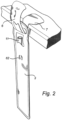
- the tab of the fourth sheet may be peeled, so that the catheter assembly can be connected to a sink or the like (see Fig. 2 ).
- the tab of the third sheet is peeled open, and the catheter is removed and used. Thereafter, the catheter may be reinserted, and the package can then be closed, and stored for later disposal.
- the catheter need not be reinserted into the package, and may be discarded immediately, together with the package.
- the package need not to be reclosable.
- other opening means may also be provided, such as peel openings, tear openings and the like.
- the package of the medical device assembly will be discussed in more detail in the following.
- the medical device assembly discussed in the foregoing, with reference to Figs. 1 and 2 generally corresponds to the package disclosed in US 8459455 , said document hereby incorporated in its entirety by reference.
- the package of this disclosure may also be used in other types of medical device assemblies, such as the packages disclosed in US 10384033 and US 8808275 , said document hereby also being incorporated in their entirety by reference.
- the medical device is arranged within the package together with a supply of wetting liquid arranged in a separate wetting fluid compartment, such as a pouch or sachet.
- the package material of the present disclosure has been found to be of particular great advantage in respect of such medical device assemblies, and the film could here serve as a protection for the substrate of the package, and e.g. be arranged on the inside of the catheter package, to hinder water to wet the paper or other material used as the substrate.
- assemblies can also be used, such as assemblies not including any supply of wetting fluid, and assemblies where a wetting liquid is arranged directly together with the medical device, without any separate wetting fluid compartment.
- plasticizers to the iota-carrageenan films modified with azetidinium salt could in some occasions infer slightly with the hydrophobic effect observed for the modified film without plasticizer, but on the other hand significantly improved the mechanical properties. In other occasions, the addition of a plasticizer improves the hydrophobicity.
- Seaweeds are a non-flowering organism called macroalgae and are found in both seas and oceans all over the globe which are occupying 71% of the globes total area. The availability of this feedstock is thus abundant. Seaweeds are known for their high content of minerals, vitamins, polysaccharides and bioactive substances like lipids and proteins. The large content of polysaccharides is produced in the growing process of the seaweed and can be extracted for further use.
- polysaccharides The structure of polysaccharides is defined by long chains of simple sugars called monomers, which are linked together with glycosidic bonds. Polysaccharides can vary in many ways in terms of altering monomers and chain length. The molecular structure of polysaccharides can be linear or highly branched. Additionally, polysaccharides can be composed of either heteropolysaccharides or homopolysaccharides, further adding to the diversity of their molecular composition. Polysaccharides are eco-friendly and versatile. The polysaccharides may alter in conformation and configuration, depending on the composition, and in particular the sequences of type of monomers.
- Carrageenans are a family of natural linear sulfated polysaccharides that are extracted from red edible seaweeds. Carrageenans are widely used in the food industry, for their gelling, thickening, and stabilizing properties. Their main application is in dairy and meat products, due to their strong binding to food proteins.
- Carrageenans contain 15-40% ester-sulfate content, which makes them anionic polysaccharides. They can be mainly categorized into three different classes based on their sulfate content. Kappa-carrageenan has one sulfate group per disaccharide, iota-carrageenan has two, and lambda-carrageenan has three. These are the three main commercial classes of carrageenan, but other classes of carrageenan are also in existence and can also be used.
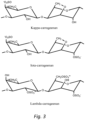
- Carrageenan is a collective name for a polysaccharide which is extracted from various types of red algae. This polysaccharide is composed of linear chains, featuring alternating units of 3,6-anhydro-D-galactose and D-galactose, which are sulfonated, rendering it highly hydrophilic. The polysaccharides can comprise different monomer units with different sulphate content and positions. Carrageenan has therefore been classified into three different main groups: Kappa, iota and lambda. The chemical structures of the dimers for kappa-, iota-, and lambda-carrageenan are shown in Fig. 3 . The range from one to three sulphate ester units in the dimer of carrageenan provides different properties.
- Carrageenan's are known to have useful rheological properties such as their viscoelasticity and viscosity. Additionally, the reactivity of carrageenan is primarily determined by the sulphate groups of half-ester type present within its structure.
- the chemical structure for all types of carrageenan provides properties such as water solubility, pH stability, and the ability of the polymer to form high-viscosity solutions.
- the viscosity increase can be caused by two mechanisms: 1) a decrease in free volume by interaction by linear chains or 2) crosslinking between chains resulting in the formation of a physical gel. Solutions of carrageenan can form a gel, with apparent increase in viscosity.
- the viscosity of carrageenan depends on the temperature, concentration, and the solvent used. The viscosity increases almost exponentially with increasing concentration, while it decreases with increasing temperature. Since carrageenan is a polysaccharide, its viscosity will also depend on its molecular weight, as this can contribute to an increased entanglement of chains.
- the gel formation of carrageenan is an important property in relation to the present disclosure, since it allows carrageenan to evaporate to a film.
- a gel is here defined as a crosslinked network structure with weak or strong bonds.
- the gel formation can be achieved through a heating and cooling process that allows carrageenan to change structure.
- the solution forms gel due to a helix formation due to hydrogen bonds between the galactosyl units of the carrageenan structure, which further creates junction zones.
- the junction zones play an important role as crosslinkers within the network and significantly contribute to the overall structure of the gel.
- Hot carrageenan solution is in a conformation of random coils, and when the solution cools, it transforms to helical rods in a rigid structure. This process is illustrated in Fig. 4 . However, it is primarily kappa- and iota-carrageenan that go through this process while lambda-carrageenan is less prone to undergo gelation.
- lambda-carrageenan does not have the 3,6-anhydrogalactose unit in the structure, contrary to kappa- and iota-carrageenan.
- the 3,6-anhydrogalactose unit promotes the rotation in the structure while galactose unit form hydrogen bonds between the chains, resulting in the formation of helices which is beneficial for the gel formation.
- kappa- and iota-carrageenan are preferred over lambda-carrageenan in relation to the present disclosure, and the use of carrageenan as a protective film in a package of a medical device assembly.
- carrageenan In the carrageenan structure, the strong anionic half-ester is primarily responsible for its reactivity. Since this free acid is present, carrageenan may be provided with a positive counterion such as sodium or potassium.
- a positive counterion such as sodium or potassium.
- the water solubility depends on the number of sulphate groups as well as the bound cations to these groups.
- Seaweed polysaccharides such as carrageenan
- the film In addition to the gelling and thickening properties, which provides structure to the film, the film also has good barrier and protective properties.
- Carrageenan also has certain antibacterial, antioxidant and antiviral properties.
- Carrageenan is extracted from the cell wall of red algae.
- the extraction can be made either by hot water, to obtain a high yield, or alkali treatment for a better gel-formation ability.
- the general extraction process of carrageenan is to treat a collection of dried red algae in powder-form by either of the two methods, with the general purpose to let the cell walls of the algae swell and get raptured and in this way extract carrageenan.
- the advantage of the alkali compared to hot water extraction is that it increases the 3,6-anhydro- ⁇ -D-galactopyranose content and thereby gives a lower sulphate content, since it modifies the carrageenan precursors into kappa- and iota-carrageenan.
- the gel formation is enhanced by the alkali treatment given that kappa- and iota-carrageenan have good properties for gel forming.
- the diluted carrageenan is filtered to concentrate and remove algal residues.
- Carrageenan can form a film due to its gelling properties.
- the film is formed from the gel as the solution evaporates, thus the formation of the film is based on the same phenomena of physical entanglements.
- the film forming process involves different driving forces.
- One driving force is the electrostatic interaction.
- Carrageenan contains a negatively charged sulphate ion and by introducing a positive ion, the charge of sulphate is neutralized and the film formation is initiated.
- Another driving force is the hydrogen bonds present.
- Carrageenan contains several hydroxyl groups that can form intra- and intermolecular bonds with each other, which is of importance for the film formation due to the double helices that are formed.
- Carrageenan films can be shaped by several different methods.
- a film may be formed by dip coating, which involves immersing a substrate surface in a carrageenan coating solution and then allowing it to air dry, and results in the formation of a film directly on the surface. Dip coating is rather simple to perform, however, it can be difficult to control the thickness of the film.
- Another coating method is solvent casting which involves spreading the carrageenan film solution on a mold and letting it dry while the solvent evaporates. It is of advantage to use a mold made of a material that interact as little as possible with the film forming chemicals and polymers. This method is also quite simple to perform and has a low cost, however, since it requires a long drying time, it might not be the best technique to use for large scale production.
- Film thickness can be affected by several different conditions. It has been noted that a higher carrageenan concentration will increase the thickness of the film. A higher carrageenan concentration prevents mobility of the molecules in the film forming solution, resulting in the molecules being locked into these positions as the gel dries to form the film. The thickness is also affected by the drying environment. A higher temperature and a longer drying time will result in a thinner carrageenan film. This is because a higher temperature will create a more compact cross section in carrageenan as well as increasing the degree of crystallization.
- the mechanical properties of the carrageenan film may be determined by tensile strength and elongation at break. By using the tensile test, a stress-strain curve can be obtained and analyzed to provide the average values of stress and strain. The tensile strength has been found to increase with thickness, while elongation at break and water vapor transport rate exhibit a decrease as the film thickness increases.
- Kappa-carrageenan has better mechanical properties in comparison to iota-carrageenan. This is due to its low sulphate content and negative charge. However, the kappa-carrageenan film exhibits a more brittle behavior. Further, a higher concentration of carrageenan will result in a stronger intermolecular interaction which will lead to a loss of elasticity of the film.
- plasticizers can be added.
- a plasticizer is a low-volatile substance added to a material to improve the flexibility and elasticity.
- the addition of plasticizers has also been shown to increase film thickness. Further, addition of plasticizers in film formation results in fewer defects and thus improvement of the mechanical properties.
- the plasticizer is preferably a triol, such as glycerol, or a sugar alcohol, such as sorbitol.
- glycerol and sorbitol Two suitable plasticizers for carrageenan have been found to be glycerol and sorbitol.
- the addition of glycerol and sorbitol to carrageenan speeds up the formation of double helices in the carrageenan structure due to carrageenan being less soluble in glycerol and sorbitol. These helices are more randomly ordered compared to when carrageenan is dissolved in water.
- Glycerol may be used as a plasticizer due to it being compatible and stable with biopolymers.
- Glycerol may also increase the hydrophobicity of the film. This may be due to glycerol's ability to form stronger hydrogen bonds with polysaccharides than water, which prevents the water molecules to combine with the glycerol and polysaccharides. As mentioned previously, a higher concentration of plasticizer has demonstrated an increase in film thickness. Despite glycerol having a low evaporation rate, it still evaporates at room temperature during film formation, resulting in a loss of glycerol as the film solidifies. Carrageenan does not evaporate at all, thus there is no loss of carrageenan as the films solidifies.
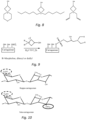
- Fig. 5 illustrates the chemical structure of glycerol.
- sorbitol a polyol and sugar alcohol, which is a compound made up of many hydroxyl groups.
- the chemical structure of sorbitol is shown in Fig. 6 . Due to its ability to form hydrogen bonds with polymers containing numerous active OH- and NH-groups, sorbitol is a suitable choice as a plasticizer, effectively enhancing the properties of such polymers.
- the addition of sorbitol as a plasticizer reduces internal hydrogen bonding in carrageenan, due to sorbitol being able to access between polymer chains, which results in an increased flexibility.
- the film thickness increases with an increasing sorbitol concentration because sorbitol can access into the carrageenan network which leads to pores in the matrix shrinking. This will in turn result in an obstacle for water to permeate the surface and the film therefore becomes more water resistant.
- Azetidinium salts may be used to modify the functionality or mechanical properties of various organic compounds.
- Fig. 7 the general structure of an azetidinium salt is illustrated.
- Azetidinium salts are synthesized by reacting either dialkylamines or asymmetric secondary amines with epichlorohydrin, depending on whether a symmetric or asymmetric salt is desired.
- the salts can either form a ring-closed or ring-open product, depending on the solvent used in synthesis. Using isopropanol as a solvent has shown to result in ring-open structures, while using water as a solvent has shown to result in ring-closed structures.
- Azetidinium salts comprise, or consist of, a four membered carbon ring, with a hydroxyl group attached at the third position and a positively charged nitrogen atom at the 1,1-position. There are also two end groups, R' and R", attached to the ring which can be varied depending on desired properties.
- Azetidinium salts can be divided into two groups, symmetrical and asymmetrical azetidinium salts depending on the structure of their end groups R' and R".
- the symmetric azetidinium salts comprise two identical end groups, while the end groups of the asymmetrical azetidinium salts may differ in length and or ratio.
- a wide range of azetidinium salts can be obtained by simply changing the R-groups in the starting material, each possessing distinct characteristics.
- three different azetidinium salts were chosen, namely morpholine-, 1,1-dihexyl-3-hydroxy-, and 1,1-diallyl-3-hydroxy-azetidinium salt.
- the three salts will further be referred to as M-Az, DHA-Az, and DAL-Az, respectively. These three salts were chosen based on their properties and because their structures differ from each other.
- M-Az is a ring-closed, symmetrical azetidinium salt which comprises a morpholine functional group attached to the nitrogen at the 1,1-position. Morpholine salt reacts well with fatty acids and increases water resistance.
- DHA-Az was chosen due to its long carbon chains, where longer carbon chains increase hydrophobicity. DHA-Az comprises two carbon chains with six carbons in each chain. However, DHA-Az exhibits a lower water solubility than the other two salts.
- DAL-Az comprises a secondary amine and two alkene groups. This salt is soluble in water at room temperature and is useable as a solvent in organic synthesis. DAL-Az contains double bonds in its carbon chains which should make it more reactive than for example DHA-Az, which only has single bonds.
- Azetidinium salts react with nucleophiles through the nucleophiles large orbitals which enables the reaction.
- Sulphate ester groups function as a nucleophile as it possesses the similar arrangement of orbitals and therefore is suitable for a ring opening reaction with azetidinium salts.
- Sulphate groups can be used as a nucleophile in the ring opening reaction. Since carrageenan naturally contains these sulphate ester groups, azetidinium salt react in the same manner as in e.g. sulfonated nanocrystalline cellulose.
- FTIR Fourier Transform Infrared Spectroscopy
- FTIR measures absorbance of infrared radiation applied to a sample.
- FTIR is a versatile technique that can analyze gaseous, liquid, and solid samples and provides real-time measurements. Another advantage with FTIR is that it is a non-destructive characterization method meaning that the samples are not destroyed during analysis. This means that one sample can be analyzed several times. From the FTIR measurements a FTIR spectra is obtained with absorbance peaks and wavenumbers.
- the absorbance bands of the peaks in the spectrum can be divided into two groups: group frequencies and molecular fingerprint frequencies.
- the group frequencies show the different bonds of typical functional groups in a molecule. These are typically above 1500 cm -1 in the spectra.
- the molecular fingerprint frequency group shows the frequency of the more specific bonds, and these are typically below 1500 cm -1 in the spectra. However, this region is less reliable since the functional groups can absorb light in this region as well.
- interpreting the FTIR- spectrum one usually starts by identifying the functional groups present at the high frequencies. Then the functional groups are typically confirmed by analyzing and confirming the structure of the compound in the sample. There are several FTIR spectra available to use as a comparison when trying to decide which compounds and functional groups are present in a sample.
- Fig. 10 illustrates the chemical structures of the investigated kappa-and iota-carrageenan with marked functional groups.
- the sulphate group C4-O-S in galactose is present in both kappa- and iota-carrageenan, circled in dashed line in Fig. 10 .
- iota-carrageenan has one more sulphate group C2-O-S in the 3,6-anhydrogalactose unit, circled in solid line in Fig. 11 .
- Water contact angle measurements is a simple, rapid, and inexpensive method which gives an indication of a surface's hydrophobicity.
- the measurement is, however, limited, which can lead to discrepancies in the results due to wetness of the sample surface and surface morphology, e.g., roughness.
- Water contact angle is the measure of wettability. When a drop of water is placed on a surface, the liquid will interact differently depending on the intramolecular bonds in the material of the surface. There will be an angle formed between the liquid and the solid surface, and this angle is called the contact angle.
- the contact angle can be divided into static, dynamic, and roughness corrected contact angles.
- the water contact angle may be measured by an optical tensiometer. It comprises a camera, a dispenser, sample stage and a light source.
- the most common method of measurement of water contact angle is the sessile drop method.
- a drop of distilled water is placed on the sample surface.
- a direct measurement is taken by the camera and the angle to the surface is assessed. If the angle of the droplet is below 90°, then the surface is said to be wetted. This means that the water drop will be spread out on the surface. Conversely if the water contact angle is more than 90°, the surface is not wetted. The water drop will stay on the surface as a bead and the surface is said to be showing hydrophobic properties.
- a cut-off value 65° was chosen for the definition of hydrophobicity.
- the two types of carrageenan that were investigated are kappa- and iota-carrageenan.
- modification of carrageenan with different types of azetidinium salts has been evaluated.
- Azetidinium salts are suitable for this modification due to their selective reaction with sulphate groups and depending on which salt that is used, the hydrophobicity can be increased.
- plasticizers may be used. It has been found that glycerol and sorbitol are particularly suitable for use as plasticizers in the present context.
- iota- and kappa-carrageenan powders of commercial grade were purchased from Sigma-Aldrich and used without further purification.
- the azetidinium salts, M-Az, DHA-Az and DAL-Az were prepared in the way proposed in: P. Rosendahl "Design and synthesis of azetidinium salts for chemical modification of nanocrystalline cellulose", 2017, available from: https://www.semanticscholar.org/paper/Design-and-synthesis-of-azetidinium-salts-for-of-Rosendahl/590db9db8230040927669310ede075f84d2295ee .
- the preparation was made by reacting epichlorohydrin with three different secondary amines.
- plasticizers sorbitol and glycerol were purchased from Sigma-Aldrich.
- Iota- and kappa-carrageenan were dissolved in deionized water (1 wt%) in a vial.
- the vial was then sealed with a lid and transferred to a heating block at 70°C for two hours.
- the vials were instead stirred with a glass rod after one hour.
- the sample solutions were transferred to plastic petri dishes. The plastic petri dishes were then left in contact with surrounding air to let the water in the films evaporate for a minimum of 48 hours.
- plasticizers Two different concentrations of glycerol and sorbitol were used as plasticizers. The used concentrations were 20 wt% and 45 wt% (based on the dry weight of the carrageenan powder). Plasticizers of the selected concentrations (20 or 45 wt%) were added to the prepared kappa-, and iota-carrageenan solutions and films were prepared according to the method described above.
- FTIR Fourier Transform Infrared Spectroscopy
- FTIR was recorded on two different PerkinElmer spectroscometers, namely PerkinElmer Frontier Fourier Transform Infrared Spectrometer and PerkinElmer Precisely Spectrum 100 FTIR Spectrometer. Experiments of FTIR were performed at room temperature and recorded at 4000-400 cm -1 with 16 scans. All spectra were normalized to the peak of maximum absorbance (in the peak range 1024-1035cm -1 ).
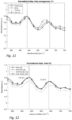
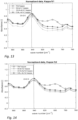
- Figs. 11 and 12 results from FTIR measurements on films from iota-carrageenan functionalised with different azetidinium salts at different molar ratios are presented.
- a change in frequency implies the formation of a new bond and further underlines that a reaction has occurred.
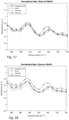
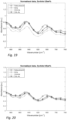
- Figs. 13 and 14 show the FTIR results for the kappa-carrageenan samples.
- the C2-O-S bond is absent and consequently there should not be a peak at this frequency for any of the samples. Nevertheless, a small peak can be seen at this frequency in the reference sample. The reason for this peak could be due to impurities in the sample. From Figs. 13 and 14 it can be seen that there is no change in frequency in the C4-O-S region. This implies that there is no significant reaction between kappa-carrageenan and azetidinium salt.
- Table 3 results from the samples of kappa-carrageenan functionalized with azetidinium salt are presented. Overall, the films based on iota-carrageenan (see Table 4 below) seem to exhibit a higher hydrophobicity than the kappa-carrageenan films. Table 3: Results from water contact angle measurements on kappa-carrageenan films functionalized with azetidinium salt. Percentual change compared to initial value in parentheses.
- azetidinium salt in the kappa-carrageenan film in most cases improves the hydrophobicity of the film, and at least makes the hydrophobicity/contact angle more stable over time, indicating an improved resistance to water, and consequently improved barrier and protection properties of the film.
- Table 4 Results from water contact angle measurements on iota-carrageenan films functionalized with azetidinium salt. Percentual change compared to initial value in parentheses.
- azetidinium salt in the iota-carrageenan film improves the hydrophobicity of the film, and also makes the hydrophobicity/contact angle more stable over time, indicating an improved resistance to water, and consequently improved barrier and protection properties of the film.
- the contact angle results from the addition of plasticizers are shown in Table 5.
- the contact angle cut-off value namely the film with a concentration of 20 wt% glycerol. It may further be noted that some of the kappa-carrageenan films with plasticizer have a greatly improved hydrophobicity compared to the reference (without any plasticizer), whereas the other have essentially the same hydrophobicity. Still further, all the samples with plasticizer exhibit a rather stable hydrophobicity during the studied time interval, and the percentual change in contact angle over time is much lower for all the tested samples than for the reference sample.
- iota-carrageenan films they all exhibit a surprisingly good hydrophobicity as they all fulfil the cut-off value of 65°.
- the decrease in water contact angle seems to be smallest for iota film with 45 wt% added sorbitol over the time span of 60s, while the iota film with 20 wt% sorbitol demonstrates to be more hydrophobic at the initial measurement but becomes rapidly less hydrophobic after 60s.
- a plasticizer in the kappa- and iota-carrageenan film improves the hydrophobicity of the film, and in particular this is the case for iota-carrageenan films, and also makes the hydrophobicity/contact angle more stable over time, indicating an improved resistance to water, and consequently improved barrier and protection properties of the film.
- both glycerol and sorbitol seem to increase the hydrophobicity when comparing to the carrageenan films without any added plasticizer. This can be due to the formation of double helices which are formed during the film formation. These double helices can then align with each other and this could possibly lead to stronger hydrogen bonds to the plasticizer than to the water resulting in the films becoming more water repellent (19).
- Table 6 the measurement results for sample films of iota-carrageenan films with both added plasticizer and added M-Az are shown.
- Table 6 Results of water contact angle from iota carrageenan films functionalized with M-Az and added plasticizers. Percentual change compared to initial value in parentheses.
- Table 6 presents the results of iota-carrageenan films with the addition of M-Az and the plasticizer.
- the only films that meet the contact angle cut-off requirement are the ones having an addition of 45 wt% glycerol or 20 wt% sorbitol. This is interesting since the glycerol in this case seems to work best at a higher concentration and sorbitol at the lower concentration. If we compare these to the M-Az iota-reference film the hydrophobicity is lower in all cases where plasticizer has been added. However, compared to the reference without plasticizer and salt, the samples with 45 wt% glycerol and 20 wt% sorbitol have a much greater hydrophobicity.
- Table 7 the measurement results for sample films of iota-carrageenan films with both added plasticizer and added DHA-Az are shown.
- Table 7 Results of water contact angle from iota carrageenan films functionalized with DHA-Az and added plasticizers. Percentual change compared to initial value in parentheses.
- Table 8 the measurement results for sample films of iota-carrageenan films with both added plasticizer and added DAL-Az are shown.
- Table 8 Results of water contact angle from iota films carrageenan functionalized with DAL-Az and added plasticizers. Percentual change compared to initial value in parentheses.
- plasticizers to the carrageenan films without azetidinium salt seemed to improve the ocular and tactile film properties in terms of durability and elasticity (see also Fig. 16 ). The majority of the films were easier to remove from the plastic petri dish and intact films were formed. The kappa-carrageenan films seemed to have slightly better mechanical properties than iota-carrageenan films with the plasticizers.
- the package will be exposed to water or other wetting liquids only for a very limited time.
- This time could comprise the time needed for wetting and activation of the hydrophilic medical device, which would typically take only a few seconds, or at least less than a minute, and possibly also the time during which catheterization takes place, which would normally be at most 5 minutes for intermittent catheterization. Thereafter, the package and catheter may normally be discarded.
- the ability of the package to resist water for 6 minutes were tested. Since this type of catheter product is intended to be used during six minutes after activation, it may be of some importance that the films can provide a water barrier for this time interval.
- Table 9 the result of the kappa- and iota-carrageenan films with added plasticizer is shown.
- the films that provided a water barrier for six minutes is marked with "YES”, whereas films that did not meet the water barrier requirement are marked with "NO”.
- Table 10 the results of the functional water-resistant evaluation of the iota-carrageenan films functionalized with azetidinium salt and added plasticizer are shown in the same way.
- Table 9 Results for the final water barrier evaluation for kappa- and iota-carrageenan films with added plasticizer. The films that could uphold a water barrier for six minutes is marked with "YES", and the films that could not is marked with "NO ".
- carrageenan can be used to form a film, useful in packages as a protective layer.
- the film could be used as a barrier or protection against water and other liquids.
- a plasticizer and/or a salt and in particular an azetidinium salt, and most particularly DHA-Az.
- the approach has been to functionalize carrageenan with salt, and in particular the three different azetidinium salts discussed above.
- FTIR-spectroscopy of the carrageenan films functionalized with different azetidinium salts indicated that the salts react with iota-carrageenan but not with kappa-carrageenan.
- Modified iota-carrageenan has a particularly high hydrophobicity.
- the iota-film modified with DHA-Az had the best hydrophobic properties.
- the other two tested salts form even films and also show good hydrophobic properties.
- Plasticizers can be added to improve the mechanical properties of the films.
- the plasticizers were found to work best with the kappa-carrageenan films, but an overall improvement of the films for both carrageenan types could be observed.
- the film could be arranged on other types of substrates than paper, such as other cellulose based materials, bioplastic materials, etc.
- the package could also be used for other types of urinary catheter products, or for catheter intended for other purposes, and also for other types of hydrophilic and non-hydrophilic medical devices.
- Such and other obvious modifications must be considered to be within the scope of the present invention, as it is defined by the appended claims.
Landscapes
- Health & Medical Sciences (AREA)
- Life Sciences & Earth Sciences (AREA)
- Biophysics (AREA)
- Pulmonology (AREA)
- Engineering & Computer Science (AREA)
- Anesthesiology (AREA)
- Biomedical Technology (AREA)
- Heart & Thoracic Surgery (AREA)
- Hematology (AREA)
- Animal Behavior & Ethology (AREA)
- General Health & Medical Sciences (AREA)
- Public Health (AREA)
- Veterinary Medicine (AREA)
- Materials For Medical Uses (AREA)
Priority Applications (2)
| Application Number | Priority Date | Filing Date | Title |
|---|---|---|---|
| EP23176706.2A EP4470592A1 (de) | 2023-06-01 | 2023-06-01 | Verpackung für eine medizinische vorrichtung mit carrageenansperrfolie |
| PCT/EP2024/064886 WO2024246193A1 (en) | 2023-06-01 | 2024-05-30 | A package for a medical device with a carrageenan barrier film |
Applications Claiming Priority (1)
| Application Number | Priority Date | Filing Date | Title |
|---|---|---|---|
| EP23176706.2A EP4470592A1 (de) | 2023-06-01 | 2023-06-01 | Verpackung für eine medizinische vorrichtung mit carrageenansperrfolie |
Publications (1)
| Publication Number | Publication Date |
|---|---|
| EP4470592A1 true EP4470592A1 (de) | 2024-12-04 |
Family
ID=86657162
Family Applications (1)
| Application Number | Title | Priority Date | Filing Date |
|---|---|---|---|
| EP23176706.2A Pending EP4470592A1 (de) | 2023-06-01 | 2023-06-01 | Verpackung für eine medizinische vorrichtung mit carrageenansperrfolie |
Country Status (2)
| Country | Link |
|---|---|
| EP (1) | EP4470592A1 (de) |
| WO (1) | WO2024246193A1 (de) |
Citations (6)
| Publication number | Priority date | Publication date | Assignee | Title |
|---|---|---|---|---|
| EP0217771A1 (de) | 1985-09-30 | 1987-04-08 | Astra Meditec AB | Verfahren zur Herstellung eines hydrofilen Überzugs auf einer polymeren Oberfläche |
| US8459455B2 (en) | 2009-09-04 | 2013-06-11 | Astra Tech Ab | Catheter assembly with resealable opening |
| EP2609955A1 (de) * | 2011-12-27 | 2013-07-03 | Dentsply IH AB | Katheteranordnung mit wiederversiegelbarer Öffnung |
| US8808275B2 (en) | 2010-05-25 | 2014-08-19 | Astra Tech Ab | Catheter assembly comprising a receptacle accommodating a catheter and a wetting fluid pouch |
| US10569047B2 (en) * | 2015-06-17 | 2020-02-25 | Hollister Incorporated | Water disintegrable flushable catheter |
| US20220177618A1 (en) * | 2019-08-21 | 2022-06-09 | Terumo Kabushiki Kaisha | Medical device and method for manufacturing same |
-
2023
- 2023-06-01 EP EP23176706.2A patent/EP4470592A1/de active Pending
-
2024
- 2024-05-30 WO PCT/EP2024/064886 patent/WO2024246193A1/en not_active Ceased
Patent Citations (7)
| Publication number | Priority date | Publication date | Assignee | Title |
|---|---|---|---|---|
| EP0217771A1 (de) | 1985-09-30 | 1987-04-08 | Astra Meditec AB | Verfahren zur Herstellung eines hydrofilen Überzugs auf einer polymeren Oberfläche |
| US8459455B2 (en) | 2009-09-04 | 2013-06-11 | Astra Tech Ab | Catheter assembly with resealable opening |
| US8808275B2 (en) | 2010-05-25 | 2014-08-19 | Astra Tech Ab | Catheter assembly comprising a receptacle accommodating a catheter and a wetting fluid pouch |
| EP2609955A1 (de) * | 2011-12-27 | 2013-07-03 | Dentsply IH AB | Katheteranordnung mit wiederversiegelbarer Öffnung |
| US10384033B2 (en) | 2011-12-27 | 2019-08-20 | Dentsply Ih Ab | Catheter assembly with resealable opening |
| US10569047B2 (en) * | 2015-06-17 | 2020-02-25 | Hollister Incorporated | Water disintegrable flushable catheter |
| US20220177618A1 (en) * | 2019-08-21 | 2022-06-09 | Terumo Kabushiki Kaisha | Medical device and method for manufacturing same |
Non-Patent Citations (2)
| Title |
|---|
| SEDAYU BAKTI B ET AL: "A Review of Property Enhancement Techniques for Carrageenan-based Films and Coatings", CARBOHYDRATE POLYMERS, vol. 216, 15 July 2019 (2019-07-15), pages 287 - 302, XP085671542, ISSN: 0144-8617, DOI: 10.1016/J.CARBPOL.2019.04.021 * |
| WOJNO, SSONKER, A. K.FELDHUSEN, JWESTMAN, GKADAR R, ISOTROPIC GELS OF CELLULOSE NANOCRYSTALS GRAFTED WITH DIALKYL GROUPS: INFLUENCE OF SURFACE GROUP TOPOLOGY FROM NONLINEAR OSCILLATORY SHEAR |
Also Published As
| Publication number | Publication date |
|---|---|
| WO2024246193A1 (en) | 2024-12-05 |
Similar Documents
| Publication | Publication Date | Title |
|---|---|---|
| Liang et al. | A Janus hydrogel sealant with instant wet adhesion and anti-swelling behavior for gastric perforation repair | |
| Croisier et al. | Chitosan-based biomaterials for tissue engineering | |
| US12053552B2 (en) | Functional wound dressing | |
| JP4606586B2 (ja) | 機能性キトサン誘導体 | |
| US11724008B2 (en) | Hydrophilic medical device | |
| CN110753565B (zh) | 经蒸汽灭菌的导管组件 | |
| DE60018010T2 (de) | Verfahren zur Modifikation einer Materialoberfläche | |
| AU2006243188B2 (en) | A method for sterilising a medical device having a hydrophilic coating | |
| Ma et al. | Development of the mussel-inspired pH-responsive hydrogel based on Bletilla striata polysaccharide with enhanced adhesiveness and antioxidant properties | |
| DE60202866T2 (de) | Beschichtungen vom typ "bottle-brush" mit verwirbelten polymeren | |
| JPWO2000027889A1 (ja) | 機能性キトサン誘導体 | |
| Jankaew et al. | “Smart” carboxymethylchitosan hydrogels crosslinked with poly (N-isopropylacrylamide) and poly (acrylic acid) for controlled drug release | |
| Feng et al. | Properties of an active film based on glutenin/tamarind gum and loaded with binary microemulsion of melatonin/pummelo essential oil and its preservation for Agaricus bisporus | |
| Yekrang et al. | A novel transdermal delivery route for energy supplements: electrospun chitosan/polyvinyl alcohol nanofiber patches loaded with vitamin B12 | |
| EP2454286A1 (de) | Chitosanhydrogelderviate als beschichtungsmittel mit breitem antimikrobiellem spektrum | |
| JPS63503466A (ja) | アミノ多糖類及びそれらの誘導体の酸による非晶出化方法 | |
| WO2005010093A1 (ja) | α-1,4-グルカンおよび/またはその修飾物を含む成型物およびその製造方法 | |
| Sharma et al. | Tannic acid crosslinked chitosan-guar gum composite films for packaging application | |
| KR102425132B1 (ko) | 구아니디늄 이온으로 개질된 키토산 나노섬유 기반의 생체접착용 조성물 및 이의 제조방법 | |
| Vogel et al. | Medical uses for polyelectrolyte complexes | |
| WO2024246193A1 (en) | A package for a medical device with a carrageenan barrier film | |
| Gond et al. | Preparation and application of biomimetic and bioinspired membranes based on chitosan | |
| KR20210125339A (ko) | 조직 접착용 키토산 하이드로젤 | |
| FI20225321A1 (en) | Adhesive body bandage and method of making an adhesive body bandage | |
| Masuelli et al. | Biopackaging: Tara Gum Films |
Legal Events
| Date | Code | Title | Description |
|---|---|---|---|
| PUAI | Public reference made under article 153(3) epc to a published international application that has entered the european phase |
Free format text: ORIGINAL CODE: 0009012 |
|
| STAA | Information on the status of an ep patent application or granted ep patent |
Free format text: STATUS: THE APPLICATION HAS BEEN PUBLISHED |
|
| AK | Designated contracting states |
Kind code of ref document: A1 Designated state(s): AL AT BE BG CH CY CZ DE DK EE ES FI FR GB GR HR HU IE IS IT LI LT LU LV MC ME MK MT NL NO PL PT RO RS SE SI SK SM TR |
|
| STAA | Information on the status of an ep patent application or granted ep patent |
Free format text: STATUS: REQUEST FOR EXAMINATION WAS MADE |
|
| 17P | Request for examination filed |
Effective date: 20250602 |
|
| STAA | Information on the status of an ep patent application or granted ep patent |
Free format text: STATUS: EXAMINATION IS IN PROGRESS |
|
| 17Q | First examination report despatched |
Effective date: 20260611 |