EP4470727A1 - Procédé de fonctionnement sécurisé d'une machine - Google Patents
Procédé de fonctionnement sécurisé d'une machine Download PDFInfo
- Publication number
- EP4470727A1 EP4470727A1 EP23176264.2A EP23176264A EP4470727A1 EP 4470727 A1 EP4470727 A1 EP 4470727A1 EP 23176264 A EP23176264 A EP 23176264A EP 4470727 A1 EP4470727 A1 EP 4470727A1
- Authority
- EP
- European Patent Office
- Prior art keywords
- volume
- movement
- protection volume
- machine part
- movable machine
- Prior art date
- Legal status (The legal status is an assumption and is not a legal conclusion. Google has not performed a legal analysis and makes no representation as to the accuracy of the status listed.)
- Granted
Links
Images
Classifications
-
- B—PERFORMING OPERATIONS; TRANSPORTING
- B25—HAND TOOLS; PORTABLE POWER-DRIVEN TOOLS; MANIPULATORS
- B25J—MANIPULATORS; CHAMBERS PROVIDED WITH MANIPULATION DEVICES
- B25J9/00—Program-controlled manipulators
- B25J9/16—Program controls
- B25J9/1674—Program controls characterised by safety, monitoring, diagnostic
- B25J9/1676—Avoiding collision or forbidden zones
-
- B—PERFORMING OPERATIONS; TRANSPORTING
- B25—HAND TOOLS; PORTABLE POWER-DRIVEN TOOLS; MANIPULATORS
- B25J—MANIPULATORS; CHAMBERS PROVIDED WITH MANIPULATION DEVICES
- B25J9/00—Program-controlled manipulators
- B25J9/16—Program controls
- B25J9/1674—Program controls characterised by safety, monitoring, diagnostic
-
- B—PERFORMING OPERATIONS; TRANSPORTING
- B25—HAND TOOLS; PORTABLE POWER-DRIVEN TOOLS; MANIPULATORS
- B25J—MANIPULATORS; CHAMBERS PROVIDED WITH MANIPULATION DEVICES
- B25J13/00—Controls for manipulators
- B25J13/08—Controls for manipulators by means of sensing devices, e.g. viewing or touching devices
-
- B—PERFORMING OPERATIONS; TRANSPORTING
- B25—HAND TOOLS; PORTABLE POWER-DRIVEN TOOLS; MANIPULATORS
- B25J—MANIPULATORS; CHAMBERS PROVIDED WITH MANIPULATION DEVICES
- B25J19/00—Accessories fitted to manipulators, e.g. for monitoring, for viewing; Safety devices combined with or specially adapted for use in connection with manipulators
- B25J19/02—Sensing devices
-
- B—PERFORMING OPERATIONS; TRANSPORTING
- B25—HAND TOOLS; PORTABLE POWER-DRIVEN TOOLS; MANIPULATORS
- B25J—MANIPULATORS; CHAMBERS PROVIDED WITH MANIPULATION DEVICES
- B25J19/00—Accessories fitted to manipulators, e.g. for monitoring, for viewing; Safety devices combined with or specially adapted for use in connection with manipulators
- B25J19/06—Safety devices
-
- B—PERFORMING OPERATIONS; TRANSPORTING
- B25—HAND TOOLS; PORTABLE POWER-DRIVEN TOOLS; MANIPULATORS
- B25J—MANIPULATORS; CHAMBERS PROVIDED WITH MANIPULATION DEVICES
- B25J9/00—Program-controlled manipulators
- B25J9/0081—Program-controlled manipulators with leader teach-in means
-
- B—PERFORMING OPERATIONS; TRANSPORTING
- B25—HAND TOOLS; PORTABLE POWER-DRIVEN TOOLS; MANIPULATORS
- B25J—MANIPULATORS; CHAMBERS PROVIDED WITH MANIPULATION DEVICES
- B25J9/00—Program-controlled manipulators
- B25J9/16—Program controls
- B25J9/1656—Program controls characterised by programming, planning systems for manipulators
- B25J9/1664—Program controls characterised by programming, planning systems for manipulators characterised by motion, path, trajectory planning
-
- B—PERFORMING OPERATIONS; TRANSPORTING
- B25—HAND TOOLS; PORTABLE POWER-DRIVEN TOOLS; MANIPULATORS
- B25J—MANIPULATORS; CHAMBERS PROVIDED WITH MANIPULATION DEVICES
- B25J9/00—Program-controlled manipulators
- B25J9/16—Program controls
- B25J9/1694—Program controls characterised by use of sensors other than normal servo-feedback from position, speed or acceleration sensors, perception control, multi-sensor controlled systems, sensor fusion
-
- G—PHYSICS
- G05—CONTROLLING; REGULATING
- G05B—CONTROL OR REGULATING SYSTEMS IN GENERAL; FUNCTIONAL ELEMENTS OF SUCH SYSTEMS; MONITORING OR TESTING ARRANGEMENTS FOR SUCH SYSTEMS OR ELEMENTS
- G05B19/00—Program-control systems
- G05B19/02—Program-control systems electric
- G05B19/18—Numerical control [NC], i.e. automatically operating machines, in particular machine tools, e.g. in a manufacturing environment, so as to execute positioning, movement or co-ordinated operations by means of program data in numerical form
- G05B19/406—Numerical control [NC], i.e. automatically operating machines, in particular machine tools, e.g. in a manufacturing environment, so as to execute positioning, movement or co-ordinated operations by means of program data in numerical form characterised by monitoring or safety
- G05B19/4061—Avoiding collision or forbidden zones
-
- G—PHYSICS
- G05—CONTROLLING; REGULATING
- G05B—CONTROL OR REGULATING SYSTEMS IN GENERAL; FUNCTIONAL ELEMENTS OF SUCH SYSTEMS; MONITORING OR TESTING ARRANGEMENTS FOR SUCH SYSTEMS OR ELEMENTS
- G05B2219/00—Program-control systems
- G05B2219/30—Nc systems
- G05B2219/40—Robotics, robotics mapping to robotics vision
- G05B2219/40202—Human robot coexistence
-
- G—PHYSICS
- G05—CONTROLLING; REGULATING
- G05B—CONTROL OR REGULATING SYSTEMS IN GENERAL; FUNCTIONAL ELEMENTS OF SUCH SYSTEMS; MONITORING OR TESTING ARRANGEMENTS FOR SUCH SYSTEMS OR ELEMENTS
- G05B2219/00—Program-control systems
- G05B2219/30—Nc systems
- G05B2219/40—Robotics, robotics mapping to robotics vision
- G05B2219/40203—Detect position of operator, create non material barrier to protect operator
-
- G—PHYSICS
- G05—CONTROLLING; REGULATING
- G05B—CONTROL OR REGULATING SYSTEMS IN GENERAL; FUNCTIONAL ELEMENTS OF SUCH SYSTEMS; MONITORING OR TESTING ARRANGEMENTS FOR SUCH SYSTEMS OR ELEMENTS
- G05B2219/00—Program-control systems
- G05B2219/30—Nc systems
- G05B2219/40—Robotics, robotics mapping to robotics vision
- G05B2219/40584—Camera, non-contact sensor mounted on wrist, indep from gripper
Definitions
- the invention relates to a method for the safe operation of a machine, in particular in the context of a human-robot collaboration, wherein the machine has a movable machine part with a hazardous section, i.e. with a section from which or from whose structure a particular risk can in principle arise for a person working with the machine.
- Robots or similar machines are used, particularly in industrial environments, to perform specific tasks. This particularly applies to tasks that require the exertion of particularly large forces and/or that must be performed with high speed and precision, particularly when the task in question must be performed in the same way very often. However, there are also tasks that can be performed better by a human than by a machine. This particularly applies to tasks that are difficult to automate, for example because they require experience and/or a high level of adaptability. In processes that include both work of one type and work of another, it can therefore be useful for humans and machines to work together in order to combine their respective strengths as efficiently as possible.
- the type of cooperation can vary.
- the work areas of a robot and a human can simply overlap, with no direct interaction between the robot and the human taking place, or interaction is only planned when the robot is stationary.
- This type of cooperation is also known as human-robot cooperation.
- the collaboration can also go so far that there is direct interaction or even planned contact between a human and a robot, for example when the human and the robot are working on a workpiece at the same time or the robot is manually guided.
- This type of collaboration is also referred to as human-robot collaboration.
- human-robot collaboration should be understood in a rather broad sense and include all of the forms of collaboration mentioned, including human-robot cooperation.
- a tool for example a gripper or a dispenser
- a tool tip can be provided on a free end of a robot arm that is used to process a workpiece, whereby the tool tip must be designed in such a way that can be dangerous for a person working with the machine, for example because they can injure themselves on the tool.
- it can be useful to ensure that the tool can only be operated at a certain safety distance from people present.
- robots or comparable machines such as AGVs (Automated Guided Vehicles), AGCs (Automated If robots (e.g. guided containers) or drones work together with people in a defined work environment without being permanently separated from one another by a separating device, a risk can arise for a person involved in the collaboration, in particular if a collision occurs between the machine and the person. This risk can be countered in various ways.
- the machine One possibility is for the machine to only be operated under the direct control of a person, who can then ensure that neither he nor other people are endangered by the machine. If, on the other hand, the machine is controlled automatically or even works autonomously, the safety of the people working with the machine can be ensured according to a further safety concept by limiting the movements of the machine, in particular its force and speed, so that in the event of a collision, there is a high probability that this will neither be painful for the person concerned nor lead to injuries.
- a safety concept based on limiting the machine is only possible if the work for which the machine is used does not require high forces or speeds. In addition, there may be sections of the machine that pose a risk even with low forces and speeds, for example because they are pointed, sharp or hot.
- the aim is to prevent a collision between a person and the machine from occurring in the first place.
- the machine can only be put into operation if no person is in a defined area around the machine or at least in a particular hazardous area of the machine, and that it is immediately braked or stopped as soon as a person enters the defined area.
- the area can be protected in particular by a safety distance from the machine or from a tool on the machine. and can be static or, if the environment is defined relative to a moving element of the machine, dynamic. The environment is continuously monitored so that the presence of a person in the environment can be responded to immediately with a suitable safety measure.
- a safety device can be provided at the distal end of a robot arm, on which a tool or a tool holder for a tool can be provided, which can in principle pose a risk to a person working with the robot arm, which safeguards against the danger emanating from this hazardous section of the robot arm by monitoring a protective volume enclosing the hazardous section.
- the protective volume can be implemented using several sensors that can determine whether the protective volume is free or not. If an intervention in the protective volume is detected, a safety-related response can be made, in particular by braking or stopping the movement of the robot arm.
- the reference data is typically taught in when configuring a sequence program for the respective machine.
- a configuration can be carried out using templates that represent various work steps of the machine (e.g. moving, rotating, searching, gripping, etc.) and can be parameterized as function blocks and linked together to form a sequence in order to create a sequence program for the machine.
- a protection volume for a respective hazardous section of the machine can be defined and monitored independently of the sequence program. However, if the sequence program contains sections whose execution would trigger a safety-related reaction, the protection volume must be adapted to the respective sequence program.
- a special dedicated template could be provided that can be integrated into the sequence program to provide a secured waypoint that ensures that the reference data required for the adaptation are taught along a defined approach movement together with the coordinates of the waypoint. In this way, a kind of calibration can be carried out to teach the Reference data needed to adjust the protection volume are carried out.
- the method according to the invention serves for the safe operation of a machine which has a moving machine part with a hazardous section, in particular safe operation in the context of human-robot collaboration.
- the moving machine part can be a robot arm, for example.
- the hazardous section can in principle be any section of the moving machine part for which it is to be ensured that a person working with the machine is protected from it.
- a section that poses a risk to the person, for example due to its structure or function is particularly considered to be a hazardous section.
- the hazardous section can in particular be the distal end (the free end opposite a fixed end) of a robot arm, a tool holder provided at this end or at another point on the respective machine, or a tool held in the tool holder or designed as part of the machine.
- the machine can also have several (similar or different) hazardous sections.
- the method comprises: the movable machine part moves according to a sequence program specified for the machine; and an environment of the hazardous section is monitored, wherein a safety-related reaction is triggered in the event of an object intervening in a defined protective volume within the monitored environment.
- the safety-related reaction comprises (if necessary, among other things) that the movement of the movable machine part is stopped if the intervention exceeds a defined intervention threshold of the protective volume.
- the machine can be controlled, for example by a control device integrated into the machine or external to the machine, so that the movable machine part according to the specified sequence program.
- the sequence program can be specified for the machine, for example, by parameterizing and linking different function templates to form a sequence.
- the sequence program can define parameters such as movement paths, speeds of movements and work steps at different points in the sequence.
- the hazardous section of the moving machine part runs through a movement path corresponding to the sequence program.
- the sequence program can not only determine at what point in time within the sequence the hazardous section should be located at which point in space, but also what orientation it should have.
- the sequence program expediently includes at least parts of the sequence program being executed repeatedly, so that the hazardous section runs through its movement path repeatedly.
- the hazardous section is secured during (normal) operation of the machine by monitoring the surroundings of the hazardous section.
- the surroundings are to be understood as relative to the hazardous section, i.e. they move with it.
- Monitoring can be carried out in particular by means of one or more sensors, in particular distance sensors.
- the surroundings of the hazardous section are not necessarily defined to a fixed spatial extent relative to the hazardous section, but can be limited by the detection range of the sensors used, for example, correspond to the measuring range that can be detected by the sensors used.
- the monitored surroundings of the hazardous section can also be restricted, for example to Reduction of computational effort for the evaluation of the data collected by the sensors.
- the fact that the environment of the hazardous section is monitored does not necessarily mean that a reaction is made to every event detected in the monitored environment. Rather, reactions can be limited to only being triggered when a relevant event is detected in a protection volume defined within the monitored environment, which can therefore be smaller than the monitored environment.
- the safety-related reaction is triggered at least in the event of an object interfering with the defined protection volume (i.e. when monitoring the environment determines that an object is interfering with the defined protection volume).
- the intervention in the protection volume does not necessarily have to occur through a movement of the respective object, but is to be understood relatively, so that a movement of the moving machine part with the hazardous section towards a possibly static object can also lead to the object interfering with the protection volume.
- the object can basically be any object that could disrupt the movement of the moving machine part or could be endangered by the movement of the moving machine part, in particular the hazardous section.
- at least all objects should be recorded whose intervention in the protective volume is not intended as part of the activity to be carried out by the machine in accordance with the sequence program. This includes in particular the hands or other body parts of a person working with the machine in order to protect them from danger from the hazardous section. It is conceivable that as part of the monitoring of the environment, it is also recorded whether an object intervening in the protective volume is a person (or generally a living being) or an object, whereby the safety-related reaction can then depend on the type of object detected. However, such a distinction is not absolutely necessary.
- the protective volume is expediently defined relative to the hazardous section so that it moves with it.
- the protective volume preferably envelops or surrounds the hazardous section in such a way that an object (at least an object of a certain size, such as a body part) cannot come into contact with the hazardous section without first interfering with the protective volume. For this to happen, the hazardous section does not necessarily have to be contained in the protective volume itself.
- the protective volume can also be designed as a type of protective casing that surrounds the hazardous section, i.e. delimits an interior space in which the hazardous section is located, for example in the manner of a lampshade that surrounds the respective light source.
- the shape and dimensions of the protection volume can result in particular from the detection volume (measurement range) of one or more sensors used for monitoring and thus in particular from the number, arrangement and orientation of the sensors. Additional limitations can also be defined.
- the protection volume can be limited to a maximum (and/or minimum) distance from the sensors (from all sensors or from at least one of the sensors), particularly if the sensors are distance sensors. Intervention in the protection volume can therefore correspond to falling below a certain distance threshold.
- the safety-related reaction is a reaction to an external event (intervention in the protected volume) and is therefore not part of the sequence program. Rather, the monitoring of the environment of the hazardous section and the safety-related reaction triggered, if necessary, take place independently of the Sequence program as a background process, whereby the safety-related reaction can intervene in the sequence program. Preferably, however, the implementation of the sequence program is not modified by the safety-related reaction, but only slowed down or interrupted and ideally ultimately continued again (without changing the specified sequence).
- the safety-related reaction can include a whole bundle of measures that are not necessarily triggered at the same time, but for which different triggering conditions can be defined.
- the general term of safety-related reaction can cover various individual reactions, each of which is triggered depending on how critical the intervention of a particular object in the protection volume is. This makes it possible to react to intervention in the protection volume in a graduated manner, for example by initially slowing down the movement of the moving machine part when the distance between the object and the hazardous section falls below a first distance and only stopping it completely when the distance falls below a smaller second distance.
- the intervention of the object in the protective volume exceeds a defined intervention threshold of the protective volume, the (procedurally compliant) movement of the moving machine part is stopped.
- the intervention threshold can be defined in different ways, for example as a time threshold, so that the movement is stopped if an object intervenes in the protection volume for longer than a certain period of time, and/or as a distance threshold, so that the movement is stopped if an object intervening in the protection volume falls below a certain distance from the hazard section.
- the distance threshold can in principle be It can also be defined in a direction-dependent manner (anisotropic distance threshold), so that the object can approach the hazardous section from different directions to different distances before the movement of the moving machine part is stopped.
- the safety-related reaction includes slowing down the (program-based) movement of the movable machine part when the intervention exceeds a defined further intervention threshold of the protection volume.
- this further threshold is exceeded, the movement of the movable machine part (at least initially) continues essentially according to the program, in particular in a path-true manner, but at a reduced speed compared to the speed according to the program.
- the intervention threshold mentioned and the further intervention threshold differ from each other in that the movement of the moving machine part is stopped when the intervention threshold mentioned is exceeded and is only slowed down when the further intervention threshold is exceeded, and in the time at which they are exceeded.
- the intervention thresholds are expediently defined in such a way that the further intervention threshold is exceeded before the intervention threshold mentioned, so that the movement is initially only slowed down and only stopped later.
- the further intervention threshold can also be referred to as the first intervention threshold
- the intervention threshold mentioned (the other) can be referred to as the second intervention threshold, whereby these terms are not intended to exclude the possibility of further Intervention thresholds are provided, when exceeded, the movement is slowed down to varying degrees (compared to the speed specified in the sequence program).
- the intervention threshold mentioned, when exceeded, leads to a stopping of the movement of the moving machine part is preferably exceeded last and can therefore also be referred to as the last intervention threshold.
- the protection volume is variable, namely dependent on the current position of the hazardous section, in order to allow the hazardous section to approach one or more objects as planned.
- the same protection volume relative to the hazardous section
- the protection volume depends on the position at which the hazardous section is currently located along the movement path corresponding to the sequence program. The protection volume is therefore position-dependent.
- the protection volume is therefore not simply defined as a specific volume of space relative to the hazardous section, but also includes a reference to the respective position along the movement path.
- the protection volume defined for a given sequence program includes information that allows each position of the hazardous section along the movement path corresponding to the sequence program to be assigned a volume of space (including the respective intervention thresholds, if applicable) to be used at this position as the respective protection volume monitored with regard to intervention.
- This volume of space can be defined identically for entire sections of the movement path.
- the respective sequence program defines the protection volume, and different spatial volumes are assigned to different points or sections of the movement path as the protection volume to be taken into account,
- protection volume can be understood differently depending on the context. If it refers to a particular position of the hazardous section along the movement path corresponding to the sequence program, it means the respective volume of space to be taken into account at this position for monitoring for intervention; if the term (as with the initial protection volume and the adapted protection volume derived from it through learning, which are explained below) refers to the entire sequence program or the entire corresponding movement sequence, it means the totality of the possibly different volumes of space that are assigned to a particular point or a particular section of the sequence program or the movement path as the respective volume of space to be taken into account for monitoring for intervention (if applicable including the respective intervention thresholds) due to the position dependency.
- the shape and/or dimensions (generally the spatial extent) of the protective volume can vary depending on the current position of the hazardous section.
- the protective volume can also be variable in that the intervention threshold mentioned, when exceeded, the movement of the moving machine part is stopped, and/or one or more further intervention thresholds of the protective volume, when exceeded, the safety-related reaction (or one of the individual reactions summarized under it, such as slowing down the movement) is triggered, is/are dependent on the current position of the hazardous section.
- the one or more objects that the hazardous section should be able to approach as planned without the safety-related reaction being triggered may, for example, be a workpiece to be machined, a holder or support for the workpiece and/or a work surface.
- the protection volume is variable, it is possible to assume a safety volume generally defined with regard to the desired level of safety for the execution of the sequence program; however, in sections of the movement of the moving machine part (i.e. in sections of the movement path of the hazardous section mentioned above) in which the hazardous section is planned to approach one or more objects so closely that the one or more objects would intervene in the protection volume defined in this way and thus trigger the safety-related reaction, it is advisable to assume a protection volume adapted to the approach (if necessary gradually or continuously) into which the one or more objects do not intervene.
- the protection volume therefore changes depending on the position of the hazardous section in order to achieve the highest possible level of safety on the one hand, but to avoid unnecessary triggering of the safety-related reaction on the other.
- variable protection volume it is useful to define the position dependency of the protection volume in relation to the respective sequence program and the resulting movement path of the hazardous section relative to the respective objects. For a new sequence program specified for the machine or a change in the objects that the hazardous section should be able to approach, the variable protection volume must therefore first be taught.
- the protection volume is taught in by: first specifying an initial protection volume; then controlling the machine that the movable machine part moves according to the predetermined sequence program while the surroundings of the hazardous section are monitored; that if the movement of the movable machine part is stopped as a result of an object entering the initial protection volume, a learning mode can be started by means of a first user input in which the movement is continued and position data of objects in the surroundings of the hazardous section are recorded; that the learning mode can be ended by means of a second user input; and that the protection volume (adapted for a planned approach to the objects) is defined based on the recorded position data.
- the definition of a protective volume suitable for a planned approach to certain objects does not take place upstream of the aforementioned (normal) operation of the machine (for example, using special templates when creating the sequence program specified for the machine), but rather a type of machine learning operation is provided that is embedded in the aforementioned (normal) operation of the machine.
- the fact that the learning of the protective volume takes place downstream of the definition of the sequence program and thus independently of it enables particularly intuitive use of the machine and also enables existing sequence programs to be easily continued to be used.
- the initial protection volume When creating the sequence program, no protection volume needs to be taken into account or defined. Rather, the initial protection volume only needs to be specified immediately before the first run of the sequence program in the presence of the objects that the hazardous section is to be able to approach, so that the aforementioned teach-in operation can be carried out. However, it can be useful if the initial protection volume is optionally active beforehand, at least for information purposes (for example, through LED indicators), but without intervention in the initial protection volume causing a safety-related reaction would be triggered. This makes it advantageous to be able to see, when setting up the sequence program, in which sections of the sequence program a safeguarding of the hazardous section adapted to one or more respective objects will take place.
- the specified sequence program is then initially executed without a safeguard specifically adapted to an approach of the hazardous section to the one or more objects provided for within the sequence program.
- the initial protection volume used as the protection volume relevant for monitoring for intervention is not specifically adapted to the approach mentioned, but can, for example, be the safety volume generally defined with regard to the desired level of safety.
- the initial protection volume can also be position-independent, i.e. have the same spatial extent (relative to the hazardous section) at every point on the path of movement traversed by the hazardous section. In principle, however, the initial protection volume can also be position-dependent, but without being specifically adapted to the approach mentioned.
- the moving machine part is then moved according to the specified sequence program.
- the area around the hazardous section is monitored for any (arbitrary) object entering the protection volume, whereby the protection volume is the initial protection volume.
- the initial protection volume is not adapted to the approach to one or more objects
- the sequence program when executed, one or more objects intervene in the initial protection volume, which according to the (normal) operation of the machine, this leads to the sequence-based movement of the movable machine part being stopped as part of the safety-related reaction.
- the user can be prompted in such a situation to enter the first user input (or optionally another user input).
- the first user input can only be entered after the movement of the movable machine part has stopped as a result of an object intervening in the respective protection volume.
- the first user input may not be entered. If the safety-related reaction (stopping the movement according to the sequence program) was triggered by an object that the hazardous section should not approach according to the sequence program, it is advisable to omit the first user input and thus not start the learning mode.
- the designation of the first user input as the first user input serves only to conceptually distinguish between different user inputs and is neither to be understood as an indication of a specific number of user inputs nor as an indication of a specific sequence or hierarchy between different user inputs. The same applies to other user inputs mentioned below.
- the teach-in mode which may be started by the first user input, differs from the (normal) operation of the machine in particular in that the movement of the moving machine part according to the sequence program is continued despite the intervention in the protective volume that led to the movement being stopped, even if the intervention continues.
- the safeguarding of the hazardous section by monitoring the surroundings of the hazardous section and, if necessary, triggering the safety-related reaction is virtually suspended in the teach-in mode.
- Another special feature of the teach-in mode is that, while the movement of the moving machine part according to the sequence program continues, position data of objects in the monitored surroundings of the hazardous section are recorded. These objects can then be in particular the one or more objects that the hazardous section should be able to approach according to plan without this triggering the safety-related reaction.
- the position data can be recorded in particular by means of the same sensors that are also used outside the learning mode for monitoring the surroundings of the hazardous section.
- the learning mode can finally be ended by means of a second user input. Ending the learning mode results in the machine being operated normally again according to the specified sequence program, in particular so that the movement of the moving machine part, if it has not yet been completed, is continued in accordance with the sequence program.
- the position data recorded in the learning mode are then used as a basis (namely as the reference data mentioned) for adjusting the protection volume at least in that section of the movement of the moving machine part (or the movement path of the danger section) that was passed through in the learning mode. This is because the recorded position data can be used to determine the maximum spatial extent of the protection volume depending on the current position of the danger section. without the objects whose position data were recorded interfering with the protection volume. This makes it possible to optimally adapt the protection volume to the approach to the objects provided for in the sequence program. In the other sections of the movement of the moving machine part (or the movement path of the danger section), however, the initial protection volume can simply be retained.
- the teaching of the protection volume according to the invention can be carried out comparatively easily, since it does not need to be carried out separately from the actual implementation of the sequence program and does not require any modification of the sequence program. In particular, this eliminates the need to implement a specific sequence program template. Instead, the teaching can be started exactly when it is needed (possibly for the first time or again) and is then embedded in the sequence program. This means that the overall setup of the machine for a particular application can be simplified and shortened.
- the movement of the moving machine part is continued in a risk-reduced manner in the teach-in mode.
- the risk reduction can result from changed movement parameters of the movement of the moving machine part, which can otherwise take place according to the sequence program.
- the movement in the teach-in mode can be continued at a reduced speed compared to a speed according to the specified sequence program.
- the movement is continued in a path-true manner, in particular such that the hazardous section moves along the same movement path corresponding to the sequence program along which it would also move without an object intervening in the protection volume and starting the teach-in mode.
- the safety function By starting the teach-in mode, the safety function, according to which a safety-related reaction is triggered when the protective volume is intervened, is temporarily suspended.
- the fact that further movement in the teach-in mode is continued in a risk-reduced manner or at a reduced speed makes it possible to carry out the planned approach to one or more objects under controlled conditions and thus with a comparatively low risk of danger despite the suspended safety function.
- the protection volume is defined by reducing the initial protection volume until these objects no longer intervene in it.
- the protection volume can simply be equated with the initial protection volume or the initial protection volume can be retained.
- the initial protection volume is used for the adjusted protection volume, the spatial extent of which is reduced for each point of the movement path of the hazardous section until none of the objects encroach on the protection volume. It may be useful to provide a certain safety distance, i.e. to reduce the protection volume by this safety distance further than is at least necessary.
- the reduction of the protection volume can be carried out in stages, so that the respective section of the movement can have one or more subsections within which the protection volume is defined uniformly.
- the protection volume can also be defined continuously, so that it is basically defined individually for each point of the respective section.
- the protection volume can be reduced to different degrees in different spatial directions in order to adapt the protection volume to the respective objects as ideally as possible, including its shape. Ideally, the adjusted protection volume will reach at least substantially (in particular up to the safety distance mentioned) to each of the objects. Reducing the protection volume can also include adjusting the intervention threshold mentioned and, if necessary, other intervention thresholds of the protection volume, which can shift according to the reduction, in particular approaching the danger section.
- the movement of the movable machine part (which may be continued in a risk-reduced manner) is stopped as soon as no object is interfering with the initial protection volume; the learning mode can then be ended using the second user input.
- the learning mode can then be ended using the second user input.
- monitoring the area surrounding the hazardous section determines that no object is interfering with the initial protection volume, it is possible to end the learning mode.
- a user is prompted in this situation to enter the second user input in order to acknowledge and thus finalize the learning of the protection volume adapted to the planned approach.
- the second user input to end the learning mode is only possible if no object is interfering with the initial protection volume.
- the learning mode does not necessarily have to be terminated by means of the second user input after the movement of the moving machine part has been stopped because no object is interfering with the initial protection volume anymore.
- the learning mode can be continued optionally, for example by means of a fourth user input.
- the user can be prompted to enter either the second or the fourth user input.
- Continuing the learning mode can be useful, for example, if, based on knowledge of the sequence program, an immediate renewed intervention in the initial protection volume is to be expected. If the learning mode is continued, it is therefore expedient if no special reaction is made to a renewed intervention of an object in the initial protection volume (in particular, the movement of the movable machine part is not stopped in this case and the first user input is not requested), since the learning mode has already started.
- the learning mode is continued after a renewed intervention of an object in the initial protection volume, the movement of the movable machine part is advantageously stopped again as soon as no object is again intervening in the initial protection volume; the learning mode can then again be optionally ended or continued (by means of the second or fourth user input).
- the movement of the movable machine part is continued in accordance with the sequence program. If the movement of the movable machine part has been continued in the learning mode in a risk-reduced manner, after the learning mode has ended, it is preferably continued again in a non-risk-reduced manner, in particular again at the same speed as before the learning mode was started.
- the type of operation of the machine before the learning mode (before the first user input) and the type of operation of the machine after the learning mode (after the second user input) differ from each other at most in that the environment of the hazardous section after the learning is in relation to a different protection volume (namely in relation to to the protection volume adjusted by the learning to the planned approach to one or more objects) than before the learning.
- the movement of the movable machine part will not continue as long as the object is entering the protective volume. This is because the object that caused the movement to stop does not necessarily have to be an object that the hazardous section should be able to approach, but can also be an object that disrupts the movement of the movable machine part and/or can be endangered by the hazardous section.
- the first user input can confirm that it is an object that it should be possible to approach; if the first user input is not made, however, it can be assumed that it is an interfering or endangered object, so that the safety-related reaction of stopping the movement is maintained, preferably at least as long as the object is still entering the protective volume. Even afterwards (when the object no longer intervenes in the protection volume), the movement is not necessarily continued immediately. Instead, it may be planned to wait for a certain period of time during which no further intervention takes place and/or that the continuation of the movement requires a third user input, which authorizes the continuation.
- a user of the machine is prompted to enter either the first user input or a third user input (the one mentioned above), by means of which a continuation of the movement of the movable machine part according to the sequence program (with sequence program-compliant movement parameters, in particular at a sequence program-compliant speed). If the third user input is entered, the movement does not necessarily have to be continued immediately.
- an additional requirement for continuing the movement can be that no object is interfering with the protective volume and, if necessary, that a certain period of time has elapsed since the last intervention.
- the surroundings of the hazardous section are monitored by means of one or more sensors, in particular one or more contactless distance sensors.
- Monitoring includes detecting an intrusion into the protective volume.
- the protective volume is expediently spanned by the one or more sensors.
- the sensors are preferably moved along with the movable machine part, for example by being arranged within the hazardous section or adjacent to the movable machine part.
- the sensors can in particular be arranged in a ring shape or in another way rotationally symmetrical.
- the shape of the protective volume can then result from the arrangement and the orientation, in particular from the respective angle of attack, of the sensors, if necessary in conjunction with distance thresholds.
- Distance sensors can be sensors that generate a single distance value, or multiple sensors that generate distance values from several neighboring measuring points.
- the measuring principle on which the sensors work can be an optical measuring principle, an acoustic measuring principle (e.g. using ultrasound) or an electromagnetic measuring principle (e.g. using RADAR).
- an optical measuring principle so-called SPAD (single-photon avalanche diodes) can be used as sensors.
- the position data mentioned are recorded by means of one or at least one of the several sensors, i.e. by means of the same one sensor or by means of at least one of the same several sensors (if necessary by means of exactly the same several sensors) by means of which the surroundings of the hazardous section are also monitored.
- sensors other than those used for monitoring can also be used to record the position data.
- the sequence program is independent of the protection volume. This means in particular that the sequence program can be compiled and specified to the machine without taking the protection volume into account (be it an initial protection volume or a protection volume that has already been suitably adapted). This means that no final protection volume needs to be defined when programming the sequence program, nor does it need to be planned to teach in a protection volume, for example using a dedicated template.
- sequence program is not modified by the teaching of the protection volume.
- no special secured waypoint needs to be inserted into the sequence program that has to be approached so that reference data for defining the protection volume can be recorded from there in a program block provided specifically for this purpose.
- the sequence program is also not changed in any other way either for the teaching or as a result of the teaching of the protection volume. Although it may be temporarily executed in a risk-reduced manner in the teaching mode, it is retained overall and used again unchanged after the teaching mode.
- the movement of the moving machine part in those sections of the sequence program in which the protection volume has been adapted by the described teaching of objects to which the hazardous section should be able to approach is also carried out in a risk-reduced manner, in particular at a reduced speed.
- the sequence program does not necessarily have to be modified for this purpose; it can be sufficient if the machine is controlled so that the specified sequence program is carried out in a risk-reduced manner in the sections mentioned (similar to teaching mode).
- the risk reduction can be less than in teaching mode, in particular the speed can be reduced less than in teaching mode.
- the protection volume can be adapted for a planned approach to changed objects by repeating the described learning process, with the last learned protection volume being specified as the initial protection volume during the repeated learning process.
- the changed objects are changed in particular compared to those objects whose position data were recorded as part of the previous learning of the protection volume.
- the changed objects can be changed in particular in that the number of objects, their position in space and/or their arrangement relative to one another has changed and/or one or more of the objects have been exchanged for other objects.
- any change that makes it necessary to (re)adjust the protection volume in order to allow a planned approach to the objects, but at the same time to maintain the security of the danger section as far as possible by monitoring its surroundings, is considered.
- An advantage of the method according to the invention is that a repeated (even multiple) adjustment of the protective volume to changed circumstances essentially does not require any special measures. Rather, the described method can automatically result in the possibility of re-learning the protection volume if, due to the change in the objects, one of the objects intervenes in the current (last learned) protection volume, whereupon the learning mode can then be started using the first user input. The newly adjusted protection volume is then learned in the same way as the previously performed learning. In the event that the change in the objects means that the overall protection volume can increase again, it can also be useful to first reset the protection volume before the repeated learning in order to adapt the protection volume to changed objects, for example to an original initial protection volume (used for the first learning).
- the machine according to the invention has a movable machine part with a hazardous section.
- the machine also comprises a control device which is designed for safe operation of the machine according to one of the methods described above.
- the machine, the movable machine part and the hazardous section can each be designed in particular in one of the ways described above.
- control device is designed for safe operation of the machine can in particular include that it is designed to: control the movable machine part to move according to a sequence program specified for the control device; and to monitor an environment of the hazardous section and, in the event of an object intervening in a defined protective volume within the monitored environment, to trigger a safety-related reaction which includes stopping the movement of the movable machine part if the intervention exceeds a defined intervention threshold of the protective volume; wherein the protective volume is variable, namely dependent on the current position of the hazardous section, in order to to allow a planned approach of the hazardous section to one or more objects.
- the control device is (further) designed to teach the protection volume according to one of the methods described above. The advantages of the respective method then also arise in a corresponding manner for the machine.
- the machine further comprises one or more sensors, in particular one or more contactless distance sensors, which are moved along with the movable machine part, wherein the control device is designed to control the one or more sensors to monitor the surroundings of the hazardous section.
- the control device can, for example, control the one or more sensors to take measurements within the surroundings of the hazardous section and then evaluate the measured values resulting from the measurements with regard to whether or not an object intervenes in the protective volume.
- the control device can control the movable machine part to interrupt the movement according to the sequence program.
- control device is designed to control the one or at least one of the several sensors to record the position data of the respective objects in the learning mode.
- the control device can then use the position data to redefine the protection volume, namely adapted to a planned approach of the hazardous section to the objects whose position data has been recorded.
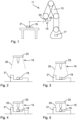
- the exemplary embodiment of a machine 11 according to the invention shown is a robot that has a movable machine part 13 in the form of a robot arm.
- the machine 11 has a tool holder with a tool that, due to its structure (sharp-edged, pointed) and its function, poses a risk to a person (not shown) working with the machine 11.
- the tool holder with the tool represents a hazardous section 15 of the movable machine part 13.
- the machine 11 further comprises a control device 17 which is designed to operate the machine, namely in particular to move the movable machine part 13 according to a sequence program specified by the control device 17 of the machine 11. Due to this movement of the movable machine part 13, the hazardous section 15 of the movable machine part 13 moves along a movement path corresponding to the sequence program.
- a control device 17 which is designed to operate the machine, namely in particular to move the movable machine part 13 according to a sequence program specified by the control device 17 of the machine 11. Due to this movement of the movable machine part 13, the hazardous section 15 of the movable machine part 13 moves along a movement path corresponding to the sequence program.
- An example of at least part of such a movement path is shown in Fig. 1 in the form of a dashed line which is shown in relation to a tool tip of the said tool as a representative point for the entire hazard section 15.
- the hazardous section 15 As illustrated by the arrowheads along the movement path, the hazardous section 15 according to the exemplary sequence program initially moves horizontally over an object 19, which is a workpiece that is arranged on another object 21, which is a workpiece holder that rests on a work surface; from there, the hazardous section 15 moves vertically towards the object 19 until the tool tip is in contact with the object 19, for example in order to machine the workpiece; and finally moves vertically away from the object 19.
- the hazardous section 15 can then also move horizontally again into the Fig. 1 Move back to the starting position shown.
- the hazardous section 15 and the objects 19, 21 are shown in enlarged detail views for different states of the said vertical movement of the hazardous section 15.
- the machine 11 also has a plurality of sensors 23, namely contactless distance sensors, in the form of a ring-shaped sensor arrangement, which is arranged at the distal end of the movable machine part 13 and surrounds the hazardous section 15.
- the sensors 23 are arranged in such a way that they can be controlled by the control device 17 to monitor an environment of the hazardous section 15. Due to their arrangement and orientation, the sensors 23 can detect distances of objects relative to the respective sensor 23 along a measuring area, which in the exemplary embodiment essentially has the shape of a truncated cone.
- a protective volume 25 which has the shape of a lampshade.
- the protective volume 25 is shown in the Fig. 1 to 5 through dotted lines.
- the maximum distance mentioned can correspond to a defined intervention threshold of the protection volume 25.
- the machine 11 can be operated in a safe manner to protect a person working with the machine 11.
- the sensors 23 monitor the protective volume 25 and, in the event of an object interfering with the protective volume 25, a safety-related reaction is triggered.
- the movement of the movable machine part 13 according to the sequence program is stopped as soon as the sensors 23 determine that the intervention threshold of the protective volume 25 has been exceeded, i.e. that an object has approached the hazardous section 15 to a distance that is smaller than the maximum distance mentioned.
- the movement of the movable machine part 13 is immediately stopped as soon as any object, for example a body part (such as a hand) of the person mentioned, comes too close to the hazardous section 15. This significantly reduces the risk of an accident.
- the safety-related reaction is also triggered when the hazardous section 15 approaches the object 19 as planned, i.e. according to the specified sequence program (see the sequence of Fig. 2 to 4 ), since the objects 19, 21 encroach on the protective volume 25 (cf. Fig. 4 ), provided that the same protective volume 25 is used throughout. It is therefore advisable to define the protective volume 25 for the planned approach of the hazardous section 15 to the objects 19, 21 depending on its position along the movement sequence mentioned and to adapt it for positions in the vicinity of the objects 19, 21 in such a way that they no longer trigger the safety-related reaction.
- the protective volume 25 therefore first have to be taught in, i.e. adapted to this specific arrangement.
- Such an adaptation can, for example, consist in the maximum distance from the sensors 23 to which the protection volume 25 is limited (and thus also the intervention threshold mentioned) being reduced in a suitable manner at least for the section of the movement in which the danger section 15 is located in the vicinity of the objects 19, 21.
- An example of an adapted protection volume 25 is shown in Fig. 5 shown, in which it can also be seen that the adaptation (here: the reduction of the maximum distance from the sensors 23) can be orientation-dependent (more on the left than on the right) so that the protection volume 25 can be adapted to a correspondingly irregular structure of the objects 19, 21.
- the adjustment of the protection volume 25 can also depend on the position of the hazardous section 15 along its path of movement.
- the hazardous section 15 is located at the turning point of its vertical movement towards or away from the object 19, at which the maximum distance mentioned must be reduced the most in order to adjust the protection volume 25.
- the maximum distance can be reduced to a lesser extent for the position of the hazardous section 15 shown.
- the adjusted protective volume 25 can be continuously adjusted to the objects 19, 21 depending on the respective position of the hazardous section 15.
- the adjustment can also be stepped to the point where the protective volume 25 is reduced along the entire section of the movement path from the Fig. 3 shown position, over which in Fig. 5 shown position back to the one in Fig. 3 shown position to the one in Fig. 5 illustrated manner.
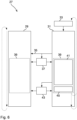
- the learning of the protection volume 25 for adaptation to specific objects 19, 21 can be carried out according to the Fig. 6 shown visualization of an exemplary embodiment of the method 27 according to the invention for the safe operation of a machine 11.
- the method 27 comprises a block 29 in which the movable machine part 13 moves according to a sequence program specified for the machine 11.
- the execution of the sequence program is shown in Fig. 6 symbolized by a dotted arrow (left) extending vertically along block 29; another dotted arrow connecting the end of said arrow with its beginning, so that the two arrows form a loop, symbolizes that the sequence program can be run through several times.
- Block 33 initially specifies an initial protective volume as the protective volume 25, which may be, for example, the volume specified in the Fig. 1 to 4
- a safety-related reaction is triggered, which includes stopping the movement of the moving machine part 13 if the intervention exceeds the aforementioned intervention threshold of the protection volume 25. Stopping the movement as part of the safety-related reaction is symbolized by an arrow 35. To this extent, the procedure corresponds to the normal operation of the machine 11.
- the protection volume 25 must be adapted for this planned approach.
- a user can enter a first user input in block 37 and thereby start a learning mode 39, which affects both the movement of the movable machine part 13 according to the sequence program in block 29 and the monitoring of the surroundings of the hazardous section 15 in block 31.
- this learning mode 39 on the one hand, the movement of the movable machine part 13 is continued, but (in the present exemplary embodiment) in a risk-reduced manner, namely at a reduced speed.
- position data of the objects 19, 21 are recorded by means of the sensors 23.
- a user can enter a second user input in block 43 and thereby end the learning mode 39.
- a position-dependent adapted protection volume 25 is then defined in block 45 based on the recorded position data of the objects 19, 21. This generally results in the adapted protection volume 25 only differing from the initial protection volume in the section of the sequence program between the first user input and the second user input and being identical to the initial protection volume in the remaining sections of the sequence program.
- the movement of the movable machine part 13 according to the sequence plan is continued again in block 29 in a non-risk-reduced manner, i.e. again at the speed provided for in the sequence plan.
- the position-dependently adjusted protection volume 25 can then be used for the continued monitoring of the surroundings of the hazardous section 15, which in Fig. 6 symbolized by a vertical dotted arrow (bottom right) is, whereby the adjusted protection volume 25 in this section of the sequence program can (as mentioned above) be identical to the initial protection volume.
- the protection volume 25 defined in block 45 is then used for monitoring the surroundings of the hazardous section 15 and for this purpose is specified in block 33 as a new position-dependent protection volume 25 to block 31 (see the further dotted arrow on the right, which leads back to block 33).
- this new protection volume 25 does not differ from the original initial protection volume.
- the new protection volume 25 is adapted compared to the original initial protection volume in such sections in which a planned approach to the objects 19, 21 is planned and would lead to an intervention of the objects 19, 21 in the original initial protection volume, so that the objects 19, 21 do not intervene in the protection volume 25.
- the method 27 can then continue with the new protection volume 25. If one or more objects, which the hazardous section 15 should be able to approach, again intervene in the respective protection volume 25 (for example due to a changed arrangement of the objects 19, 21 or another change to the objects 19, 21), the learning mode 39 can be started again using the first user input, position data of the respective objects can be recorded and a newly adjusted protection volume 25 can be defined based on the recorded position data.
- the new protection volume 25 defined in block 45 which is specified to block 31 in block 33 during the subsequent run through of the sequence program, can be regarded as a new initial protection volume for this subsequent run, which is position-dependent and differs from the original initial protection volume differs only in the section of approach to objects 19, 21.
- the particular simplicity of the method 27 results in particular from the fact that the teaching does not have to be specifically planned, for example built into the sequence program at a certain point or provided for in it from the outset, but is always possible automatically when it is necessary for the first time after a change in the circumstances to adapt the protection volume 25 to these.
- the user only needs to confirm by means of the first user input that the stopping of the movement according to the sequence program was triggered by an object that it should be possible to approach and that the teaching mode 39 should therefore be started, and finally to confirm by means of the second user input that the protection volume should be newly defined, namely based on the position data of the respective objects recorded during the teaching mode 39. Safe operation of the machine can thus be achieved in a particularly simple and convenient manner.
Landscapes
- Engineering & Computer Science (AREA)
- Robotics (AREA)
- Mechanical Engineering (AREA)
- Human Computer Interaction (AREA)
- Manufacturing & Machinery (AREA)
- Physics & Mathematics (AREA)
- General Physics & Mathematics (AREA)
- Automation & Control Theory (AREA)
- Manipulator (AREA)
- Numerical Control (AREA)
Priority Applications (4)
| Application Number | Priority Date | Filing Date | Title |
|---|---|---|---|
| EP23176264.2A EP4470727B1 (fr) | 2023-05-31 | 2023-05-31 | Procédé de fonctionnement sécurisé d'une machine |
| DK23176264.2T DK4470727T3 (da) | 2023-05-31 | 2023-05-31 | Fremgangsmåde til sikker drift af en maskine |
| KR1020240069454A KR20240172095A (ko) | 2023-05-31 | 2024-05-28 | 기계의 안전한 작동을 위한 방법 |
| US18/679,409 US20240399582A1 (en) | 2023-05-31 | 2024-05-30 | Method for the safe operation of a machine |
Applications Claiming Priority (1)
| Application Number | Priority Date | Filing Date | Title |
|---|---|---|---|
| EP23176264.2A EP4470727B1 (fr) | 2023-05-31 | 2023-05-31 | Procédé de fonctionnement sécurisé d'une machine |
Publications (2)
| Publication Number | Publication Date |
|---|---|
| EP4470727A1 true EP4470727A1 (fr) | 2024-12-04 |
| EP4470727B1 EP4470727B1 (fr) | 2025-07-30 |
Family
ID=86646482
Family Applications (1)
| Application Number | Title | Priority Date | Filing Date |
|---|---|---|---|
| EP23176264.2A Active EP4470727B1 (fr) | 2023-05-31 | 2023-05-31 | Procédé de fonctionnement sécurisé d'une machine |
Country Status (4)
| Country | Link |
|---|---|
| US (1) | US20240399582A1 (fr) |
| EP (1) | EP4470727B1 (fr) |
| KR (1) | KR20240172095A (fr) |
| DK (1) | DK4470727T3 (fr) |
Families Citing this family (1)
| Publication number | Priority date | Publication date | Assignee | Title |
|---|---|---|---|---|
| DE102023116500A1 (de) * | 2023-06-22 | 2024-12-24 | Intel Corporation | Sensorgestützte objektcharakterisierung als statisch oder dynamisch |
Citations (3)
| Publication number | Priority date | Publication date | Assignee | Title |
|---|---|---|---|---|
| US20190270199A1 (en) * | 2018-03-02 | 2019-09-05 | Omron Corporation | Robot system |
| EP3988256A1 (fr) * | 2020-10-21 | 2022-04-27 | Sick Ag | Fixation d'une pièce de machine mobile |
| EP4124789A1 (fr) * | 2021-07-27 | 2023-02-01 | Sick Ag | Fixation d'une pièce de machine mobile |
-
2023
- 2023-05-31 DK DK23176264.2T patent/DK4470727T3/da active
- 2023-05-31 EP EP23176264.2A patent/EP4470727B1/fr active Active
-
2024
- 2024-05-28 KR KR1020240069454A patent/KR20240172095A/ko active Pending
- 2024-05-30 US US18/679,409 patent/US20240399582A1/en active Pending
Patent Citations (3)
| Publication number | Priority date | Publication date | Assignee | Title |
|---|---|---|---|---|
| US20190270199A1 (en) * | 2018-03-02 | 2019-09-05 | Omron Corporation | Robot system |
| EP3988256A1 (fr) * | 2020-10-21 | 2022-04-27 | Sick Ag | Fixation d'une pièce de machine mobile |
| EP4124789A1 (fr) * | 2021-07-27 | 2023-02-01 | Sick Ag | Fixation d'une pièce de machine mobile |
Also Published As
| Publication number | Publication date |
|---|---|
| KR20240172095A (ko) | 2024-12-09 |
| EP4470727B1 (fr) | 2025-07-30 |
| US20240399582A1 (en) | 2024-12-05 |
| DK4470727T3 (da) | 2025-09-01 |
Similar Documents
| Publication | Publication Date | Title |
|---|---|---|
| DE102018121388B4 (de) | Robotersystem | |
| DE102016120559B4 (de) | Verfahren und System zur Steuerung eines Roboters | |
| DE102016008908B4 (de) | Industrierobotersystem und Steuerverfahren dafür | |
| AT509927B1 (de) | Verfahren zum programmieren oder vorgeben von bewegungen oder abläufen eines industrieroboters | |
| DE102015008577B4 (de) | Robotersteuervorrichtung zum Verhindern von Fehlbeurteilungen durch Kollisionsbeurteilungsteil | |
| DE102007037077B4 (de) | Verfahren zur Einhaltung von Arbeitsraumgrenzen eines Arbeitsmittels eines Roboters | |
| EP3744482B1 (fr) | Fixation d'une pièce de machine mobile | |
| DE102013110901B4 (de) | MRK Planungstechnologie | |
| DE102015012232A1 (de) | Mit Menschen kollaborierendes Robotersystem | |
| DE102015016528B4 (de) | Laserbearbeitungsvorrichtung mit Kollisionsvermeidungsfunktion für den Zeitpunkt einer Düsenannäherung | |
| DE112017002639T5 (de) | Robotersteuerungsvorrichtung | |
| DE102012007242A1 (de) | Vorrichtung und Verfahren zur sicheren Mensch-Roboter-Kooperation | |
| EP3988256B1 (fr) | Fixation d'une pièce de machine mobile | |
| DE102016001967A1 (de) | Robotersteuervorrichtung zum automatischen Wechseln eines Betriebsbegrenzungsmodus eines Roboters | |
| WO2017041885A1 (fr) | Procédé et système de commande d'un ensemble robotique | |
| EP2208584B1 (fr) | Procédé destiné à la commande de robots industriels | |
| EP4470727B1 (fr) | Procédé de fonctionnement sécurisé d'une machine | |
| EP2625008B1 (fr) | Commande de robot | |
| EP4272907A1 (fr) | Procédé d'amélioration d'un déroulement de mouvement préprogrammé pour la commande d'un robot | |
| DE202017100522U1 (de) | Überwachungseinrichtung | |
| DE102017101905B4 (de) | Überwachungseinrichtung | |
| EP2999574B1 (fr) | Surveillance de sécurité d'une cinématique série | |
| EP3427904B1 (fr) | Système comprenant un manipulateur et un dispositif de limitation d'un espace de travail | |
| EP3740358B1 (fr) | Surveillance d'une zone de travail d'un ensemble robotique | |
| DE102018114156B3 (de) | Verfahren zur Steuerung eines Roboters, insbesondere eines Industrieroboters, sowie Vorrichtung zur Steuerung des Roboters |
Legal Events
| Date | Code | Title | Description |
|---|---|---|---|
| STAA | Information on the status of an ep patent application or granted ep patent |
Free format text: STATUS: EXAMINATION IS IN PROGRESS |
|
| PUAI | Public reference made under article 153(3) epc to a published international application that has entered the european phase |
Free format text: ORIGINAL CODE: 0009012 |
|
| 17P | Request for examination filed |
Effective date: 20240328 |
|
| AK | Designated contracting states |
Kind code of ref document: A1 Designated state(s): AL AT BE BG CH CY CZ DE DK EE ES FI FR GB GR HR HU IE IS IT LI LT LU LV MC ME MK MT NL NO PL PT RO RS SE SI SK SM TR |
|
| GRAP | Despatch of communication of intention to grant a patent |
Free format text: ORIGINAL CODE: EPIDOSNIGR1 |
|
| STAA | Information on the status of an ep patent application or granted ep patent |
Free format text: STATUS: GRANT OF PATENT IS INTENDED |
|
| RIC1 | Information provided on ipc code assigned before grant |
Ipc: B25J 19/02 20060101ALN20250320BHEP Ipc: B25J 19/06 20060101ALI20250320BHEP Ipc: B25J 9/16 20060101AFI20250320BHEP |
|
| RIC1 | Information provided on ipc code assigned before grant |
Ipc: B25J 19/02 20060101ALN20250321BHEP Ipc: B25J 19/06 20060101ALI20250321BHEP Ipc: B25J 9/16 20060101AFI20250321BHEP |
|
| INTG | Intention to grant announced |
Effective date: 20250403 |
|
| GRAS | Grant fee paid |
Free format text: ORIGINAL CODE: EPIDOSNIGR3 |
|
| GRAA | (expected) grant |
Free format text: ORIGINAL CODE: 0009210 |
|
| STAA | Information on the status of an ep patent application or granted ep patent |
Free format text: STATUS: THE PATENT HAS BEEN GRANTED |
|
| AK | Designated contracting states |
Kind code of ref document: B1 Designated state(s): AL AT BE BG CH CY CZ DE DK EE ES FI FR GB GR HR HU IE IS IT LI LT LU LV MC ME MK MT NL NO PL PT RO RS SE SI SK SM TR |
|
| REG | Reference to a national code |
Ref country code: GB Ref legal event code: FG4D Free format text: NOT ENGLISH |
|
| REG | Reference to a national code |
Ref country code: CH Ref legal event code: EP |
|
| REG | Reference to a national code |
Ref country code: DE Ref legal event code: R096 Ref document number: 502023001453 Country of ref document: DE |
|
| REG | Reference to a national code |
Ref country code: IE Ref legal event code: FG4D Free format text: LANGUAGE OF EP DOCUMENT: GERMAN |
|
| REG | Reference to a national code |
Ref country code: DK Ref legal event code: T3 Effective date: 20250826 |
|
| REG | Reference to a national code |
Ref country code: SE Ref legal event code: TRGR |
|
| REG | Reference to a national code |
Ref country code: NL Ref legal event code: MP Effective date: 20250730 |
|
| PG25 | Lapsed in a contracting state [announced via postgrant information from national office to epo] |
Ref country code: PT Free format text: LAPSE BECAUSE OF FAILURE TO SUBMIT A TRANSLATION OF THE DESCRIPTION OR TO PAY THE FEE WITHIN THE PRESCRIBED TIME-LIMIT Effective date: 20251202 |
|
| PG25 | Lapsed in a contracting state [announced via postgrant information from national office to epo] |
Ref country code: IS Free format text: LAPSE BECAUSE OF FAILURE TO SUBMIT A TRANSLATION OF THE DESCRIPTION OR TO PAY THE FEE WITHIN THE PRESCRIBED TIME-LIMIT Effective date: 20251130 |
|
| PG25 | Lapsed in a contracting state [announced via postgrant information from national office to epo] |
Ref country code: NO Free format text: LAPSE BECAUSE OF FAILURE TO SUBMIT A TRANSLATION OF THE DESCRIPTION OR TO PAY THE FEE WITHIN THE PRESCRIBED TIME-LIMIT Effective date: 20251030 |
|
| REG | Reference to a national code |
Ref country code: LT Ref legal event code: MG9D |
|
| PG25 | Lapsed in a contracting state [announced via postgrant information from national office to epo] |
Ref country code: FI Free format text: LAPSE BECAUSE OF FAILURE TO SUBMIT A TRANSLATION OF THE DESCRIPTION OR TO PAY THE FEE WITHIN THE PRESCRIBED TIME-LIMIT Effective date: 20250730 |
|
| PG25 | Lapsed in a contracting state [announced via postgrant information from national office to epo] |
Ref country code: HR Free format text: LAPSE BECAUSE OF FAILURE TO SUBMIT A TRANSLATION OF THE DESCRIPTION OR TO PAY THE FEE WITHIN THE PRESCRIBED TIME-LIMIT Effective date: 20250730 Ref country code: NL Free format text: LAPSE BECAUSE OF FAILURE TO SUBMIT A TRANSLATION OF THE DESCRIPTION OR TO PAY THE FEE WITHIN THE PRESCRIBED TIME-LIMIT Effective date: 20250730 |
|
| PG25 | Lapsed in a contracting state [announced via postgrant information from national office to epo] |
Ref country code: GR Free format text: LAPSE BECAUSE OF FAILURE TO SUBMIT A TRANSLATION OF THE DESCRIPTION OR TO PAY THE FEE WITHIN THE PRESCRIBED TIME-LIMIT Effective date: 20251031 |
|
| PG25 | Lapsed in a contracting state [announced via postgrant information from national office to epo] |
Ref country code: LV Free format text: LAPSE BECAUSE OF FAILURE TO SUBMIT A TRANSLATION OF THE DESCRIPTION OR TO PAY THE FEE WITHIN THE PRESCRIBED TIME-LIMIT Effective date: 20250730 |
|
| PG25 | Lapsed in a contracting state [announced via postgrant information from national office to epo] |
Ref country code: BG Free format text: LAPSE BECAUSE OF FAILURE TO SUBMIT A TRANSLATION OF THE DESCRIPTION OR TO PAY THE FEE WITHIN THE PRESCRIBED TIME-LIMIT Effective date: 20250730 Ref country code: PL Free format text: LAPSE BECAUSE OF FAILURE TO SUBMIT A TRANSLATION OF THE DESCRIPTION OR TO PAY THE FEE WITHIN THE PRESCRIBED TIME-LIMIT Effective date: 20250730 |
|
| PG25 | Lapsed in a contracting state [announced via postgrant information from national office to epo] |
Ref country code: RS Free format text: LAPSE BECAUSE OF FAILURE TO SUBMIT A TRANSLATION OF THE DESCRIPTION OR TO PAY THE FEE WITHIN THE PRESCRIBED TIME-LIMIT Effective date: 20251030 |
|
| PG25 | Lapsed in a contracting state [announced via postgrant information from national office to epo] |
Ref country code: ES Free format text: LAPSE BECAUSE OF FAILURE TO SUBMIT A TRANSLATION OF THE DESCRIPTION OR TO PAY THE FEE WITHIN THE PRESCRIBED TIME-LIMIT Effective date: 20250730 |
|
| PG25 | Lapsed in a contracting state [announced via postgrant information from national office to epo] |
Ref country code: SM Free format text: LAPSE BECAUSE OF FAILURE TO SUBMIT A TRANSLATION OF THE DESCRIPTION OR TO PAY THE FEE WITHIN THE PRESCRIBED TIME-LIMIT Effective date: 20250730 |
|
| PG25 | Lapsed in a contracting state [announced via postgrant information from national office to epo] |
Ref country code: IT Free format text: LAPSE BECAUSE OF FAILURE TO SUBMIT A TRANSLATION OF THE DESCRIPTION OR TO PAY THE FEE WITHIN THE PRESCRIBED TIME-LIMIT Effective date: 20250730 |
|
| PG25 | Lapsed in a contracting state [announced via postgrant information from national office to epo] |
Ref country code: CZ Free format text: LAPSE BECAUSE OF FAILURE TO SUBMIT A TRANSLATION OF THE DESCRIPTION OR TO PAY THE FEE WITHIN THE PRESCRIBED TIME-LIMIT Effective date: 20250730 |
|
| PG25 | Lapsed in a contracting state [announced via postgrant information from national office to epo] |
Ref country code: SK Free format text: LAPSE BECAUSE OF FAILURE TO SUBMIT A TRANSLATION OF THE DESCRIPTION OR TO PAY THE FEE WITHIN THE PRESCRIBED TIME-LIMIT Effective date: 20250730 Ref country code: EE Free format text: LAPSE BECAUSE OF FAILURE TO SUBMIT A TRANSLATION OF THE DESCRIPTION OR TO PAY THE FEE WITHIN THE PRESCRIBED TIME-LIMIT Effective date: 20250730 |