EP4471079A1 - Composite cellulosique - Google Patents
Composite cellulosique Download PDFInfo
- Publication number
- EP4471079A1 EP4471079A1 EP24178492.5A EP24178492A EP4471079A1 EP 4471079 A1 EP4471079 A1 EP 4471079A1 EP 24178492 A EP24178492 A EP 24178492A EP 4471079 A1 EP4471079 A1 EP 4471079A1
- Authority
- EP
- European Patent Office
- Prior art keywords
- cellulose
- fibers
- lignocellulose
- mixture
- lignocellulose fibers
- Prior art date
- Legal status (The legal status is an assumption and is not a legal conclusion. Google has not performed a legal analysis and makes no representation as to the accuracy of the status listed.)
- Pending
Links
Images


Classifications
-
- C—CHEMISTRY; METALLURGY
- C08—ORGANIC MACROMOLECULAR COMPOUNDS; THEIR PREPARATION OR CHEMICAL WORKING-UP; COMPOSITIONS BASED THEREON
- C08L—COMPOSITIONS OF MACROMOLECULAR COMPOUNDS
- C08L1/00—Compositions of cellulose, modified cellulose or cellulose derivatives
- C08L1/02—Cellulose; Modified cellulose
-
- B—PERFORMING OPERATIONS; TRANSPORTING
- B29—WORKING OF PLASTICS; WORKING OF SUBSTANCES IN A PLASTIC STATE IN GENERAL
- B29B—PREPARATION OR PRETREATMENT OF THE MATERIAL TO BE SHAPED; MAKING GRANULES OR PREFORMS; RECOVERY OF PLASTICS OR OTHER CONSTITUENTS OF WASTE MATERIAL CONTAINING PLASTICS
- B29B9/00—Making granules
- B29B9/12—Making granules characterised by structure or composition
-
- B—PERFORMING OPERATIONS; TRANSPORTING
- B29—WORKING OF PLASTICS; WORKING OF SUBSTANCES IN A PLASTIC STATE IN GENERAL
- B29B—PREPARATION OR PRETREATMENT OF THE MATERIAL TO BE SHAPED; MAKING GRANULES OR PREFORMS; RECOVERY OF PLASTICS OR OTHER CONSTITUENTS OF WASTE MATERIAL CONTAINING PLASTICS
- B29B9/00—Making granules
- B29B9/12—Making granules characterised by structure or composition
- B29B9/14—Making granules characterised by structure or composition fibre-reinforced
-
- B—PERFORMING OPERATIONS; TRANSPORTING
- B29—WORKING OF PLASTICS; WORKING OF SUBSTANCES IN A PLASTIC STATE IN GENERAL
- B29C—SHAPING OR JOINING OF PLASTICS; SHAPING OF MATERIAL IN A PLASTIC STATE, NOT OTHERWISE PROVIDED FOR; AFTER-TREATMENT OF THE SHAPED PRODUCTS, e.g. REPAIRING
- B29C45/00—Injection moulding, i.e. forcing the required volume of moulding material through a nozzle into a closed mould; Apparatus therefor
- B29C45/0001—Injection moulding, i.e. forcing the required volume of moulding material through a nozzle into a closed mould; Apparatus therefor characterised by the choice of material
-
- B—PERFORMING OPERATIONS; TRANSPORTING
- B29—WORKING OF PLASTICS; WORKING OF SUBSTANCES IN A PLASTIC STATE IN GENERAL
- B29C—SHAPING OR JOINING OF PLASTICS; SHAPING OF MATERIAL IN A PLASTIC STATE, NOT OTHERWISE PROVIDED FOR; AFTER-TREATMENT OF THE SHAPED PRODUCTS, e.g. REPAIRING
- B29C45/00—Injection moulding, i.e. forcing the required volume of moulding material through a nozzle into a closed mould; Apparatus therefor
- B29C45/0005—Injection moulding, i.e. forcing the required volume of moulding material through a nozzle into a closed mould; Apparatus therefor using fibre reinforcements
-
- C—CHEMISTRY; METALLURGY
- C08—ORGANIC MACROMOLECULAR COMPOUNDS; THEIR PREPARATION OR CHEMICAL WORKING-UP; COMPOSITIONS BASED THEREON
- C08J—WORKING-UP; GENERAL PROCESSES OF COMPOUNDING; AFTER-TREATMENT NOT COVERED BY SUBCLASSES C08B, C08C, C08F, C08G or C08H
- C08J3/00—Processes of treating or compounding macromolecular substances
- C08J3/12—Powdering or granulating
-
- C—CHEMISTRY; METALLURGY
- C08—ORGANIC MACROMOLECULAR COMPOUNDS; THEIR PREPARATION OR CHEMICAL WORKING-UP; COMPOSITIONS BASED THEREON
- C08J—WORKING-UP; GENERAL PROCESSES OF COMPOUNDING; AFTER-TREATMENT NOT COVERED BY SUBCLASSES C08B, C08C, C08F, C08G or C08H
- C08J5/00—Manufacture of articles or shaped materials containing macromolecular substances
- C08J5/04—Reinforcing macromolecular compounds with loose or coherent fibrous material
- C08J5/045—Reinforcing macromolecular compounds with loose or coherent fibrous material with vegetable or animal fibrous material
-
- C—CHEMISTRY; METALLURGY
- C08—ORGANIC MACROMOLECULAR COMPOUNDS; THEIR PREPARATION OR CHEMICAL WORKING-UP; COMPOSITIONS BASED THEREON
- C08J—WORKING-UP; GENERAL PROCESSES OF COMPOUNDING; AFTER-TREATMENT NOT COVERED BY SUBCLASSES C08B, C08C, C08F, C08G or C08H
- C08J5/00—Manufacture of articles or shaped materials containing macromolecular substances
- C08J5/04—Reinforcing macromolecular compounds with loose or coherent fibrous material
- C08J5/047—Reinforcing macromolecular compounds with loose or coherent fibrous material with mixed fibrous material
-
- C—CHEMISTRY; METALLURGY
- C08—ORGANIC MACROMOLECULAR COMPOUNDS; THEIR PREPARATION OR CHEMICAL WORKING-UP; COMPOSITIONS BASED THEREON
- C08L—COMPOSITIONS OF MACROMOLECULAR COMPOUNDS
- C08L23/00—Compositions of homopolymers or copolymers of unsaturated aliphatic hydrocarbons having only one carbon-to-carbon double bond; Compositions of derivatives of such polymers
- C08L23/02—Compositions of homopolymers or copolymers of unsaturated aliphatic hydrocarbons having only one carbon-to-carbon double bond; Compositions of derivatives of such polymers not modified by chemical after-treatment
- C08L23/10—Homopolymers or copolymers of propene
- C08L23/12—Polypropene
-
- C—CHEMISTRY; METALLURGY
- C08—ORGANIC MACROMOLECULAR COMPOUNDS; THEIR PREPARATION OR CHEMICAL WORKING-UP; COMPOSITIONS BASED THEREON
- C08L—COMPOSITIONS OF MACROMOLECULAR COMPOUNDS
- C08L97/00—Compositions of lignin-containing materials
- C08L97/02—Lignocellulosic material, e.g. wood, straw or bagasse
-
- B—PERFORMING OPERATIONS; TRANSPORTING
- B29—WORKING OF PLASTICS; WORKING OF SUBSTANCES IN A PLASTIC STATE IN GENERAL
- B29C—SHAPING OR JOINING OF PLASTICS; SHAPING OF MATERIAL IN A PLASTIC STATE, NOT OTHERWISE PROVIDED FOR; AFTER-TREATMENT OF THE SHAPED PRODUCTS, e.g. REPAIRING
- B29C45/00—Injection moulding, i.e. forcing the required volume of moulding material through a nozzle into a closed mould; Apparatus therefor
- B29C45/0005—Injection moulding, i.e. forcing the required volume of moulding material through a nozzle into a closed mould; Apparatus therefor using fibre reinforcements
- B29C2045/0008—Injection moulding, i.e. forcing the required volume of moulding material through a nozzle into a closed mould; Apparatus therefor using fibre reinforcements the fibres being oriented randomly
-
- B—PERFORMING OPERATIONS; TRANSPORTING
- B29—WORKING OF PLASTICS; WORKING OF SUBSTANCES IN A PLASTIC STATE IN GENERAL
- B29C—SHAPING OR JOINING OF PLASTICS; SHAPING OF MATERIAL IN A PLASTIC STATE, NOT OTHERWISE PROVIDED FOR; AFTER-TREATMENT OF THE SHAPED PRODUCTS, e.g. REPAIRING
- B29C45/00—Injection moulding, i.e. forcing the required volume of moulding material through a nozzle into a closed mould; Apparatus therefor
- B29C2045/0091—Pellets or granules, e.g. their structure, composition, length, height, width
-
- B—PERFORMING OPERATIONS; TRANSPORTING
- B29—WORKING OF PLASTICS; WORKING OF SUBSTANCES IN A PLASTIC STATE IN GENERAL
- B29K—INDEXING SCHEME ASSOCIATED WITH SUBCLASSES B29B, B29C OR B29D, RELATING TO MOULDING MATERIALS OR TO MATERIALS FOR MOULDS, REINFORCEMENTS, FILLERS OR PREFORMED PARTS, e.g. INSERTS
- B29K2001/00—Use of cellulose, modified cellulose or cellulose derivatives, e.g. viscose, as moulding material
-
- B—PERFORMING OPERATIONS; TRANSPORTING
- B29—WORKING OF PLASTICS; WORKING OF SUBSTANCES IN A PLASTIC STATE IN GENERAL
- B29K—INDEXING SCHEME ASSOCIATED WITH SUBCLASSES B29B, B29C OR B29D, RELATING TO MOULDING MATERIALS OR TO MATERIALS FOR MOULDS, REINFORCEMENTS, FILLERS OR PREFORMED PARTS, e.g. INSERTS
- B29K2023/00—Use of polyalkenes or derivatives thereof as moulding material
- B29K2023/10—Polymers of propylene
- B29K2023/12—PP, i.e. polypropylene
-
- B—PERFORMING OPERATIONS; TRANSPORTING
- B29—WORKING OF PLASTICS; WORKING OF SUBSTANCES IN A PLASTIC STATE IN GENERAL
- B29K—INDEXING SCHEME ASSOCIATED WITH SUBCLASSES B29B, B29C OR B29D, RELATING TO MOULDING MATERIALS OR TO MATERIALS FOR MOULDS, REINFORCEMENTS, FILLERS OR PREFORMED PARTS, e.g. INSERTS
- B29K2105/00—Condition, form or state of moulded material or of the material to be shaped
- B29K2105/06—Condition, form or state of moulded material or of the material to be shaped containing reinforcements, fillers or inserts
- B29K2105/12—Condition, form or state of moulded material or of the material to be shaped containing reinforcements, fillers or inserts of short lengths, e.g. chopped filaments, staple fibres or bristles
-
- B—PERFORMING OPERATIONS; TRANSPORTING
- B29—WORKING OF PLASTICS; WORKING OF SUBSTANCES IN A PLASTIC STATE IN GENERAL
- B29K—INDEXING SCHEME ASSOCIATED WITH SUBCLASSES B29B, B29C OR B29D, RELATING TO MOULDING MATERIALS OR TO MATERIALS FOR MOULDS, REINFORCEMENTS, FILLERS OR PREFORMED PARTS, e.g. INSERTS
- B29K2201/00—Use of cellulose, modified cellulose or cellulose derivatives, e.g. viscose, as reinforcement
-
- C—CHEMISTRY; METALLURGY
- C08—ORGANIC MACROMOLECULAR COMPOUNDS; THEIR PREPARATION OR CHEMICAL WORKING-UP; COMPOSITIONS BASED THEREON
- C08J—WORKING-UP; GENERAL PROCESSES OF COMPOUNDING; AFTER-TREATMENT NOT COVERED BY SUBCLASSES C08B, C08C, C08F, C08G or C08H
- C08J2323/00—Characterised by the use of homopolymers or copolymers of unsaturated aliphatic hydrocarbons having only one carbon-to-carbon double bond; Derivatives of such polymers
- C08J2323/02—Characterised by the use of homopolymers or copolymers of unsaturated aliphatic hydrocarbons having only one carbon-to-carbon double bond; Derivatives of such polymers not modified by chemical after treatment
- C08J2323/10—Homopolymers or copolymers of propene
- C08J2323/12—Polypropene
-
- C—CHEMISTRY; METALLURGY
- C08—ORGANIC MACROMOLECULAR COMPOUNDS; THEIR PREPARATION OR CHEMICAL WORKING-UP; COMPOSITIONS BASED THEREON
- C08J—WORKING-UP; GENERAL PROCESSES OF COMPOUNDING; AFTER-TREATMENT NOT COVERED BY SUBCLASSES C08B, C08C, C08F, C08G or C08H
- C08J2401/00—Characterised by the use of cellulose, modified cellulose or cellulose derivatives
- C08J2401/02—Cellulose; Modified cellulose
-
- C—CHEMISTRY; METALLURGY
- C08—ORGANIC MACROMOLECULAR COMPOUNDS; THEIR PREPARATION OR CHEMICAL WORKING-UP; COMPOSITIONS BASED THEREON
- C08J—WORKING-UP; GENERAL PROCESSES OF COMPOUNDING; AFTER-TREATMENT NOT COVERED BY SUBCLASSES C08B, C08C, C08F, C08G or C08H
- C08J2497/00—Characterised by the use of lignin-containing materials
- C08J2497/02—Lignocellulosic material, e.g. wood, straw or bagasse
-
- C—CHEMISTRY; METALLURGY
- C08—ORGANIC MACROMOLECULAR COMPOUNDS; THEIR PREPARATION OR CHEMICAL WORKING-UP; COMPOSITIONS BASED THEREON
- C08L—COMPOSITIONS OF MACROMOLECULAR COMPOUNDS
- C08L2201/00—Properties
- C08L2201/08—Stabilised against heat, light or radiation or oxydation
-
- C—CHEMISTRY; METALLURGY
- C08—ORGANIC MACROMOLECULAR COMPOUNDS; THEIR PREPARATION OR CHEMICAL WORKING-UP; COMPOSITIONS BASED THEREON
- C08L—COMPOSITIONS OF MACROMOLECULAR COMPOUNDS
- C08L2205/00—Polymer mixtures characterised by other features
- C08L2205/06—Polymer mixtures characterised by other features having improved processability or containing aids for moulding methods
Definitions
- the present invention generally relates to cellulosic composites, composite granulates and articles, and methods of producing cellulosic composites and composite articles, and in particular to such cellulosic composites having improved melt processability.
- the cellulose fibers in the cellulosic composite may cause problems during processing of the cellulosic composite, in particular for elongated cellulose fibers.
- problems for instance, there is a desire to at least partially replace fossil-based plastics in injection molding applications of various articles, such as caps, jars, lids, cutlery and housings.
- injection molding cellulosic composites with such cellulose fibers requires high injection molding pressures and generates a lot of heat during the injection molding process due to the high viscosity of the cellulosic composites. The heat may then thermally degrade the cellulosic composite.
- both the high pressure and thermal degradation are today limiting factors to the use of cellulosic composites with cellulose fibers in many applications.
- WO 2022/084059 discloses a composite material comprising at least one matrix polymer and a mass fraction of at most 80 % of a mixture of cellulose short fibers having a fiber length of less than 500 ⁇ m and cellulose long fibers having a fiber length of more than 1 mm.
- the cellulose short fibers constitute at least 50 % of the mixture of cellulose short fibers and cellulose long fibers.
- An aspect of the invention relates to a cellulosic composite comprising a thermoplastic polymer matrix and from 5 up to 80 weight-% of cellulose and/or lignocellulose fibers comprising a mixture of elongated cellulose and/or lignocellulose fibers having an average elongation equal to or lower than 0.300 and rounded cellulose and/or lignocellulose fibers having an average elongation equal to or higher than 0.325.
- a mass fraction of the elongated cellulose and/or lignocellulose fibers in the mixture is equal to or larger than a mass fraction of the rounded cellulose and/or lignocellulose fibers in the mixture.
- Another aspect of the invention relates to a composite granulate made of a cellulosic composite according to the above.
- a further aspect of the invention relates to a method of producing a composite article.
- the method comprises injection molding composite granulates of the invention to produce a composite article.
- Yet another aspect of the invention relates to a method of producing a cellulosic composite comprising cellulose and/or lignocellulose fibers and a thermoplastic polymer matrix.
- the method comprises melt processing a mixture comprising at least one thermoplastic polymer and from 5 up to 80 weight-% of cellulose and/or lignocellulose fibers comprising a mixture of elongated cellulose and/or lignocellulose fibers having an average elongation equal to or lower than 0.300 and rounded cellulose and/or lignocellulose fibers having an average elongation equal to or higher than 0.325.
- a mass fraction of the elongated cellulose and/or lignocellulose fibers in the mixture is equal to or larger than a mass fraction of the rounded cellulose and/or lignocellulose fibers in the mixture.
- Yet another aspect of the invention relates to use of rounded cellulose and/or lignocellulose fibers having an average elongation equal to or higher than 0.325 as an additive to a cellulosic composite comprising a thermoplastic polymer matrix and elongated cellulose and/or lignocellulose fibers having an average elongation equal to or lower than 0.300 to improve melt processability of the cellulosic composite.
- the cellulosic composite of the invention can be used as an environmentally friendlier alternative to fossil-based plastics in injection molding applications for the production of various articles.
- the cellulose and/or lignocellulose fibers in the cellulosic composite are tailored to obtain desired mechanical properties of the cellulosic composite and articles produced therefrom while improving the processability of the cellulosic composite during injection molding to lower injection molding pressure and reduce the risk of thermal degradation of the cellulosic composite during injection molding.
- the present invention generally relates to cellulosic composites, composite granulates and articles, and methods of producing cellulosic composites and composite articles, and in particular to such cellulosic composites having improved melt processability.
- biocomposites such as cellulosic composites
- cellulosic composites to at least partly replace fossil-based plastics in injection molding applications of various articles, such as caps, jars, lids, cutlery and housings.
- the cellulosic composites and the articles produced therefrom should have desired mechanical properties in terms of, for instance, tensile and flexural properties, such as tensile strength and modulus and flexural strength and elongation. This is typically achieved by including elongated cellulose fibers in the cellulosic composite.
- injection molding cellulosic composites with a certain amount of such elongated cellulose fibers requires high injection molding pressures and generates a lot of heat during the injection molding process due to the high viscosity of cellulosic composites comprising such elongated cellulose fibers. The generated heat may then thermally degrade the cellulosic composite and in particular the cellulose fibers included therein.
- the invention is based on using a mixture of different forms of cellulose and/or lignocellulose fibers in the cellulosic composite.
- less elongated, i.e., rounded, cellulose and/or lignocellulose fibers are included as an additive together with elongated cellulose and/or lignocellulose fibers in the cellulosic composite to improve the processability of the cellulosic composite during injection molding, such as represented by an increase in melt flow volume rate (MVR). This was possible while still maintaining, or even improving, the mechanical properties of the cellulosic composite.
- MVR melt flow volume rate
- An aspect of the invention relates to a cellulosic composite comprising a thermoplastic polymer matrix and from 5 up to 80 weight-% (wt-%) of cellulose and/or lignocellulose fibers.
- These cellulose and/or lignocellulose fibers comprise a mixture of elongated cellulose and/or lignocellulose fibers having an average elongation equal to or lower than 0.300 and rounded cellulose and/or lignocellulose fibers having an average elongation equal to or higher than 0.325.
- a mass fraction of the elongated cellulose and/or lignocellulose fibers in the mixture is equal to or larger than a mass fraction of the rounded cellulose and/or lignocellulose fibers in the mixture.
- the cellulosic composite of the invention thereby comprises a thermoplastic polymer matrix made of one or multiple, i.e., at least two, different thermoplastic polymers.
- This matrix formed by the thermoplastic polymer(s) in turn comprises cellulose and/or lignocellulose fibers as an environmentally friendly replacement of part of the thermoplastic polymer material in the cellulosic composite.
- the cellulosic composite comprises less fossil-based plastics as compared to a material solely consisting of the thermoplastic polymer material, i.e., without any cellulose and/or lignocellulose fibers.
- the cellulose and/or lignocellulose fibers comprises a mixture of elongated cellulose and/or lignocellulose fibers and rounded cellulose and/or lignocellulose fibers.
- the elongated cellulose and/or lignocellulose fibers preferably constitute the main component of the cellulose and/or lignocellulose fibers and with the rounded cellulose and/or lignocellulose fibers as an additive.
- a mass fraction of the elongated cellulose and/or lignocellulose fibers in the mixture is preferably larger than a mass fraction of the rounded cellulose and/or lignocellulose fibers in the mixture.
- the elongated cellulose and/or lignocellulose fibers provide desired mechanical properties in terms of, for instance, tensile and flexural properties, such as tensile strength and modulus and flexural strength and elongation, to the cellulosic composite.
- tensile and flexural properties such as tensile strength and modulus and flexural strength and elongation
- these elongated cellulose and/or lignocellulose fibers require high injection molding pressures and generate heat when producing articles from the cellulosic composite by injection molding due to the comparatively high viscosity of the cellulosic composite comprising such elongated cellulose fibers.
- Elongation of cellulose and/or lignocellulose fibers is preferably as defined in International Standard ISO 9276-6: 2008, Representation of results of particle size analysis, Part 6: Descriptive and quantitative representation of particle shape and morphology.
- an elongated cellulose and/or lignocellulose fiber has a lower elongation as compared to a rounded cellulose and/or lignocellulose fiber.
- individual elongated or rounded cellulose and/or lignocellulose fibers may have an elongation different from the average elongation of the elongated or rounded cellulose and/or lignocellulose fibers.
- the average elongation for the elongated cellulose and/or lignocellulose fibers in the cellulosic composite is equal to or lower than 0.300 and the average elongation for the rounded cellulose and/or lignocellulose fibers is equal to or higher than 0.325.
- Elongated and “rounded” as used herein for the two different forms or fractions of cellulose and/or lignocellulose fibers in the cellulosic composite are used to indicate that the two forms or fractions of cellulose and/or lignocellulose fibers have different elongations as defined in equation [1]. This means that the elongated cellulose and/or lignocellulose fibers have a lower average value of the quotient in equation [1] as compared to the rounded cellulose and/or lignocellulose fibers.
- the elongated cellulose and/or lignocellulose fibers are also referred to herein as first form or fraction or main form or fraction of cellulose and/or lignocellulose fibers having an average elongation equal to or lower than 0.300 and the rounded cellulose and/or lignocellulose fibers are referred to as second form or fraction or auxiliary form or fraction of cellulose and/or lignocellulose fibers having an average elongation equal to or higher than 0.325.
- average elongation as used herein for the cellulose and/or lignocellulose fibers could be defined as: 1 N ⁇ E i or as ⁇ E i A i ⁇ A i or as ⁇ E i V i ⁇ V i
- Equation [2] represents the number average of the elongation
- equation [3] represents the area-weighted average elongation
- equation [4] represents the volume-weighted average elongation.
- the average value of the elongation for the cellulose and/or lignocellulose fibers is an areabased average value as defined in equation [3].
- the cellulose and/or lignocellulose fibers in the cellulosic composite are typically not uniform but often display a distribution of characteristics and parameters, including elongation.
- This distribution in, for instance, elongation around the average elongation can be fitted with various mathematical distributions, such as Gaussian distribution, Cauchy distribution, etc.
- Gaussian distribution elongation around the average elongation
- Cauchy distribution elongation around the average elongation
- the distributions in elongation might be at least partly overlapping for the two forms of cellulose and/or lignocellulose fibers.
- the different forms of cellulose and/or lignocellulose fibers included in the cellulosic composite can still be distinguished by finding the different distributions, which for Gaussian distributions, have peak positions corresponding to the respective average elongations.
- the cellulosic composite comprises the thermoplastic polymer matrix and from 5 up to 80 weight-% of cellulose and/or lignocellulose fibers.
- the cellulose and/or lignocellulose fibers consists of a mixture of elongated cellulose and/or lignocellulose fibers having an average elongation equal to or lower than 0.300 and rounded cellulose and/or lignocellulose fibers having an average elongation equal to or higher than 0.325.
- a mass fraction of the elongated cellulose and/or lignocellulose fibers in the mixture is equal to or larger than a mass fraction of the rounded cellulose and/or lignocellulose fibers in the mixture.
- the elongated cellulose and/or lignocellulose fibers have an average elongation equal to or lower than 0.290. In a preferred embodiment, the elongated cellulose and/or lignocellulose fibers have an average elongation equal to or lower than 0.280, such as equal to or lower than 0.275, or even lower, such as equal to or lower than 0.260.
- the elongated cellulose and/or lignocellulose fibers have an average elongation selected within an interval of from 0.075 up to 0.275, preferably selected within an interval of from 0.100 up to 0.275, more preferably selected within an interval of from 0.125 up to 0.275, such as selected within an interval of from 0.150 up to 0.275, and most preferably selected within an interval of from 0.175 up to 0.275, or selected within an interval of from 0.200 up to 0.275.
- the rounded cellulose and/or lignocellulose fibers have an average elongation equal to or higher than 0.350. In a preferred embodiment, the rounded cellulose and/or lignocellulose fibers have an average elongation equal to or higher than 0.375, such as equal to or higher than 0.400 or equal to or higher than 0.410.
- the rounded cellulose and/or lignocellulose fibers have an average elongation equal to or below 0.800, preferably equal to or below 0.750, and more preferably equal to or below 0.700.
- the rounded cellulose and/or lignocellulose fibers have an average elongation selected within an interval of from 0.325 up to 0.800, preferably selected within an interval of from 0.350 up to 0.750, and more preferably selected within an interval of from 0.375 up to 0.700.
- the rounded cellulose and/or lignocellulose fibers have an average elongation selected within an interval of from 0.375 up to 0.650, preferably selected within an interval of from 0.375 up to 0.600, such as selected within an interval of from 0.375 up to 0.550, and more preferably selected within an interval of from 0.375 up to 0.500, such as selected within an interval of from 0.375 up to 0.450.
- elongation of the elongated and rounded cellulose and/or lignocellulose fibers have been presented as average elongation.
- the elongation of the cellulose and/or lignocellulose fibers could be presented as median elongation.
- the elongated cellulose and/or lignocellulose fibers used in the Example section had an average elongation of 0.260 and a median elongation of 0.152.
- the rounded cellulose and/or lignocellulose fibers used in the Example section had an average elongation of 0.410 and a median elongation of 0.361.
- the cellulosic composite comprises from 5 up to 80 wt% of the cellulose and/or lignocellulose fibers.
- Wt% as used herein is an abbreviation for weight percent, i.e., percentage of total weight.
- the cellulosic composite comprises from 10 up to 80 wt% of the cellulose and/or lignocellulose fibers. In a preferred embodiment, the cellulosic composite comprises from 10 up to 70 wt% cellulose and/or lignocellulose fibers, preferably from 20 up to 60 wt% cellulose and/or lignocellulose fibers, and more preferably from 30 up to 50 wt% cellulose and/or lignocellulose fibers.
- the cellulosic composite comprises a too high content of the cellulose and/or lignocellulose fibers, i.e., above 80 wt%, then the cellulosic composite may have a tendency to decompose or fall apart.
- it is generally hard to successfully produce cellulosic articles by injection molding from a cellulosic composite comprising more than 80 wt% cellulose and/or lignocellulose fibers.
- the cellulose and/or lignocellulose fibers constitute from 5 up to 80 wt% of the weight percentage of the cellulosic composite.
- the cellulose and/or lignocellulose fibers preferably comprise the elongated cellulose and/or lignocellulose fibers as a main fiber constituent and the rounded cellulose and/or lignocellulose fibers as an additive.
- the mass fraction of the elongated cellulose and/or lignocellulose fibers in the mixture, and thereby also in the cellulosic composite is higher than the mass fraction of the rounded cellulose and/or lignocellulose fibers.
- the mass fraction of the elongated cellulose and/or lignocellulose fibers is selected within an interval of from 55 up to 95 % of the mixture of cellulose and/or lignocellulose fibers. In a preferred embodiment, the mass fraction of the elongated cellulose and/or lignocellulose fibers is selected within an interval of from 60 up to 90 % of the mixture, preferably within an interval of from 70 up to 90 % of the mixture, and more preferably within an interval of from 75 up to 87.5 % of the mixture.
- the mass fraction of the rounded cellulose and/or lignocellulose fibers is selected within an interval of from 5 up to 45 % of the mixture.
- the mass fraction of the rounded cellulose and/or lignocellulose fibers is selected within an interval of from 10 up to 40 % of the mixture, preferably within an interval of from 10 up to 30 % of the mixture, and more preferably within an interval of from 12.5 up to 25 % of the mixture.
- the cellulose and/or lignocellulose fibers could be in the form of cellulose fibers, lignocellulose fibers or a mixture of cellulose fibers and lignocellulose fibers.
- Lignocellulose as used herein represent a mixture of cellulose, hemicellulose and lignin.
- the cellulose and/or lignocellulose fibers are milled cellulose and/or lignocellulose fibers, such as milled wood fibers or milled pulp fibers.
- the cellulose and/or lignocellulose fibers are selected from the group consisting of chemical pulp fibers, thermomechanical pulp fibers and mechanical pulp fibers. In a preferred embodiment, the cellulose and/or lignocellulose fibers are chemical pulp fibers.
- the cellulose and/or lignocellulose fibers are selected from the group consisting of sulfate pulp fibers, sulfite pulp fibers, dissolving pulp fibers, thermomechanical pulp (TMP) fibers, high temperature thermomechanical pulp (HTMP) fibers, mechanical fibers intended for medium density fiberboard (MDF-fibers), chemi-thermomechanical pulp (CTMP) fibers, high temperature chemi-thermomechanical pulp (HTCTMP) fibers, and a combination thereof.
- TMP thermomechanical pulp
- HTMP high temperature thermomechanical pulp
- MDF-fibers medium density fiberboard
- CTMP chemi-thermomechanical pulp
- HTCTMP high temperature chemi-thermomechanical pulp
- the cellulose and/or lignocellulose fibers may be bleached or unbleached.
- the cellulose and/or lignocellulose fibers can also be produced by other pulping methods and/or from other cellulosic or lignocellulosic raw materials, such as flax, jute, hemp, kenaf, bagasse, cotton, bamboo, straw, or rice husk. It is also possible to use cellulose and/or lignocellulose fibers that are a mixture of fibers from different raw materials, such as a mixture of wood and any of the materials mentioned above. Also synthetic cellulose and/or lignocellulose fibers could be used.
- the cellulose and/or lignocellulose fibers have an average geodesic length below 1 mm, preferably equal to or below 750 ⁇ m.
- the cellulose and/or lignocellulose fibers have an average geodesic length above 50 ⁇ m but below 1 mm, such as above 50 ⁇ m but equal to or below 750 ⁇ m.
- both the elongated cellulose and/or lignocellulose fibers and the rounded cellulose and/or lignocellulose fibers have an average geodesic length below 1 mm, preferably equal to or below 750 ⁇ m, such as above 50 ⁇ m but below 1 mm, preferably above 50 ⁇ m but below 750 ⁇ m.
- Cellulosic composites comprising cellulose and/or lignocellulose fibers having an average geodesic length above 1 mm are generally harder to process and produce as the long cellulose and/or lignocellulose fibers may become entangled causing an increase in viscosity during injection molding.
- thermoplastic polymer matrix comprises at least one thermoplastic polymer.
- the at least one thermoplastic polymer is selected from the group consisting of polyethylene (PE), polypropylene (PP), polyolefin copolymers, polystyrene (PS), polystyrene copolymers, polyacrylates, polymethacrylates, polyesters, polyvinylchloride (PVC), fluoropolymers, polyamides (PA), polyether imides, polyphenylene sulfides, polysulfones, polylactic acid (PLA), polyacetals, polycarbonates, polyphenylene oxides, polyurethanes, polyacrylates, polyhydroxyalkanoates (PHA), polybutyrate adipate terephthalate (PBAT), polybutylene succinate (PBS), polycaprolactones (PCL), polyglycolic acid (PGA), polyethylene terephthalate (PET), acrylonitrile butadiene styrene (ABS), polycarbonate (PC), poly(methyl methacrylate
- PE polyethylene
- the at least one thermoplastic polymer is selected from the group consisting of PE, PP, a copolymer thereof and a mixture thereof. In a currently preferred embodiment, the at least one thermoplastic polymer is PP or a copolymer thereof.
- thermoplastic polymer matrix could comprise a single thermoplastic polymer, preferably selected among the above-presented thermoplastic polymers.
- thermoplastic polymer matrix comprises a mixture or copolymer of multiple thermoplastic polymers, preferably selected among the above-presented thermoplastic polymers.
- the cellulosic composite comprises at least 20 weight-% and up to 95 weight-% of the at least one thermoplastic polymer. In a preferred embodiment, the cellulosic composite comprises at least 20 weight-% and up to 90 weight-% of the at least one thermoplastic polymer, preferably at least 30 weight-% and up to 90 weight-% of the at least one thermoplastic polymer, and more preferably at least 40 weight-% and up to 80 weight-% of the at least one thermoplastic polymer, such as at least 50 weight% and up to 70 weight-% of the at least one thermoplastic polymer.
- the cellulosic composite comprises the thermoplastic polymer matrix and the cellulose and/or lignocellulose fibers.
- the cellulosic composite may also comprise at least one coupling agent.
- Such coupling agents can be used to promote chemically bonding between the thermoplastic polymer matrix, or the thermoplastic polymers forming the thermoplastic polymer matrix, and the cellulose and/or lignocellulose fibers.
- the cellulosic composite could comprise a single coupling agent or a mixture of two or more coupling agents.
- the cellulosic composite comprises at least 0.5 weight-% and up to 5 weight-% of the at least one coupling agent. In a preferred embodiment, the cellulosic composite comprises at least 1 weight-% and up to 5 weight-% of the at least one coupling agent, and preferably at least 1.5 weight-% and up to 3 weight-% of the at least one coupling agent.
- the cellulosic composite may optionally comprise one or more additives, such as selected from the group consisting of a lubricant, a colorant, a pigment, a filler, an acid scavenger, an antioxidant, a light stabilizer, a blowing agent, a UV-stabilizer, a flame retardant, a heat stabilizer, an antistatic agent, and a foaming additive.
- the at least one additive could thereby be selected among additives traditionally used in cellulosic composites or in thermoplastic materials, for instance, to achieve a visual effect or a desired property to the cellulosic composite.
- the cellulosic composite of the invention could be used as a composite masterbatch, from which various composite articles could be produced.
- the cellulosic composite could be in the form of composite granulates made of the cellulosic composite of the invention. Such composite granulates could then be used as a starting material in the production of the composite articles, such as by injection molding.
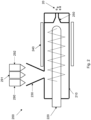
- Fig. 2 schematically illustrates an example of a compounding machine 200 that can be used to produce composite granulates 20, also referred to as composite pellets herein, based on the cellulosic composite.
- the compounding machine 200 comprise a barrel 210, in which an injection ram or rotating screw 220 is arranged.
- the interior of the barrel 210 is in connection with a hopper 230, into which a feeding system 290, 291, 292 feeds the thermoplastic polymer(s), the elongated cellulose and/or lignocellulose fibers and the rounded cellulose and/or lignocellulose fibers.
- the feeding system 290, 291, 292 has been represented by a feed unit 290 for the thermoplastic polymer(s), a feed unit 291 for the elongated cellulose and/or lignocellulose fibers and a feed unit 292 for the rounded cellulose and/or lignocellulose fibers.
- a single feed unit could feed a mixture of the thermoplastic polymer(s), the elongated cellulose and/or lignocellulose fibers and the rounded cellulose and/or lignocellulose fibers or a feed unit feeds the thermoplastic polymer(s) and another feed unit feeds the elongated cellulose and/or lignocellulose fibers and the rounded cellulose and/or lignocellulose fibers into the hopper 230.
- At least a portion of the barrel 210 downstream of the hopper 230 may be heated to at least partly melt the thermoplastic polymer(s).
- one or multiple heating elements 240 may be arranged, preferably circumferentially arranged, in connection with at least a portion of the barrel 210.
- the barrel 210 also comprises a nozzle 250 through which the compounded polymer and fiber material is pushed by the injection ram or rotating screw 220. The extrudate from the nozzle 250 is then cut into segments to form the composite granulates or pellets 20.
- Fig. 3 schematically illustrates an injection molding machine 100 that could be used to produce a cellulosic article 30 based on the composite granules 20 according to the invention.
- the injection molding machine 100 comprises a barrel 110, in which an injection ram or rotating screw 120 is arranged.
- the interior of the barrel 110 is in connection with a hopper 130, into which the composite granules 20 are added.
- At least a portion of the barrel 110 downstream of the hopper 130 may be heated to at least partly melt the thermoplastic polymer matrix of the cellulosic composite.
- one or multiple heating elements 140 may be arranged, preferably circumferentially arranged, in connection with at least a portion of the barrel 110.
- the barrel 110 also comprises a nozzle 150 through which the injection molded cellulosic composite is pushed by the injection ram or rotating screw 120.
- the nozzle 150 is connected with a mold cavity 160 defined by matching molds 170, 180.
- the injection molded cellulosic composite is pushed through the nozzle 150 and into the mold cavity 160.
- At least one of the matching molds 170, 180 is movable to provide access to the mold cavity 160 and the cellulosic article 30 formed therein.
- the disclosure also relates to a composite article 30 obtainable by injection molding composite granulates 20 according to the invention.
- the composite article 30 could be any article that can be manufactured by injection molding using cellulosic composites.
- Illustrative, but non-limiting, examples of such articles include caps, jars, lids, cutlery and housings.
- the present invention also relates to a method of producing a composite article 30.
- the method comprises injection molding composite granulates 20 according to the invention to produce the composite article 30.
- the settings of the injection molding machine used to produce the composite article 30 can be selected based on the particular type of thermoplastic polymer matrix, the types and content of the cellulose and/or lignocellulose fibers in the cellulosic composite, etc.
- the injection pressure is typically selected within an interval of from 10 up to 300 MPa, preferably from 30 up to 200 MPa, and more preferably from 40 up to 150 MPa
- the molding temperature is typically selected to be below the degradation temperature of the cellulose and/or lignocellulose fibers, i.e., typically below 240°C, preferably below 210°, and more preferably below 190°C.
- An aspect of the invention relates to a method of producing a cellulosic composite comprising cellulose and/or lignocellulose fibers and a thermoplastic polymer matrix.
- the method comprises melt processing a mixture comprising at least one thermoplastic polymer and from 5 up to 80 wt% of cellulose and/or lignocellulose fibers comprising a mixture of elongated cellulose and/or lignocellulose fibers having an average elongation equal to or lower than 0.300 and rounded cellulose and/or lignocellulose fibers having an average elongation equal to or higher than 0.325.
- a mass fraction of the elongated cellulose and/or lignocellulose fibers in the mixture is equal to or larger than a mass fraction of the rounded cellulose and/or lignocellulose fibers in the mixture.
- the at least one thermoplastic polymer and the cellulose and/or lignocellulose fibers could be mixed together and then exposed to heat to melt the at least one thermoplastic polymer and form the cellulosic composite.
- the mixture of the at least one thermoplastic polymer and the cellulose and/or lignocellulose fibers is heated to a temperature above the melting point of the thermoplastic polymer or above the highest melting point if more than one type of thermoplastic polymer is used.
- the at least one thermoplastic polymer is melted and the cellulose and/or lignocellulose fibers are added to the melted at least one thermoplastic polymer.
- the at least one thermoplastic polymer is heated to a temperature above the melting point of the thermoplastic polymer or above the highest melting point if more than one type of thermoplastic polymer is used.
- the mixture of elongated and rounded cellulose and/or lignocellulose fibers is then added to the melted thermoplastic polymer(s) and then the mixture is allowed to cool to form the cellulosic composite.
- the cellulose and/or lignocellulose fibers preferably become distributed within the thermoplastic polymer matrix formed by the at least one thermoplastic polymer.
- the invention also relates to the use of rounded cellulose and/or lignocellulose fibers having an average elongation equal to or higher than 0.325 as an additive to a cellulosic composite comprising a thermoplastic polymer matrix and elongated cellulose and/or lignocellulose fibers having an average elongation equal to or lower than 0.300 to improve the melt processability of the cellulosic composite.
- improving the melt processability comprises reducing at least one of injection molding pressure and thermal degradation of the cellulosic composite during injection molding.
- the fibers were analyzed using dynamic image analysis in accordance with International standard ISO 13322-2:2021 Particle size analysis - Image analysis methods, Part 2: Dynamic image analysis methods.
- the fibers were tested in the dry state and in the form as they were fed to the compounder. Clean compressed air was used as dispersing medium.
- the measurements of the fibers included the area A, the long linear dimension x_Fmax and the short linear dimension x_Fmin and were recorded for all imaged fibers. From this data set, the geodesic length ( x LG ) and thickness ( x E ) were determined and the elongation was calculated in accordance with the standard ISO 9276-6: 2008, Representation of results of particle size analysis, Part 6: Descriptive and quantitative representation of particle shape and morphology.
- the materials were compounded using a co-rotating twin screw extruder with a diameter of 50 mm and a LID ratio of 36:1.
- Polypropylene polymer and the coupling agent were added in the main inlet and the fibers were dosed through a side feeder into the melted polymer.
- the temperature in the melt zones was 190°C and in the compounding zones the temperature was kept at 170°C, the rotational speed of the compounder was kept at 150 revolutions per minute (rpm).
- the material from the compounder was pelletized using an underwater pelletizer.
- the ratio between polymer: fiber : coupling agent was selected to 58:40:2 as this led to a cellulosic composite with good mechanical properties, see Table 2.
- melt flow volume rate which can be taken as a measurement of the processability of the cellulosic composite, was determined according to International standard ISO 1133-1:2022 Plastics - Determination of the melt mass-flow rate (MFR) and melt volume-flow rate (MVR) of thermoplastics, Part 1: Standard method with a temperature of 220°C and a load of 5 kg.
- the mass fraction of the rounded cellulose and/or lignocellulose fibers was larger than the mass fraction of the elongated cellulose and/or lignocellulose fibers (Reference composite 2) in the composite, or if merely rounded cellulose and/or lignocellulose fibers were used (Reference composite 3), the mechanical properties of the cellulosic composite, such as tensile strength, flexural strength, elongation at break and flexural elongation, became worse.
- the highest tensile strength and flexural strength of the tested cellulosic composites were obtained by having a mixture of elongated and rounded cellulose and/or lignocellulose fibers but with a mass fraction of the elongated cellulose and/or lignocellulose fibers equal to (Composite 2) or higher (Composite 1) than the mass fraction of the rounded cellulose and/or lignocellulose fibers.
- the cellulosic composites of the invention (Composite 1, 2) did not show any significant deterioration in impact notched as compared to Reference composite 1 with only elongated cellulose and/or lignocellulose fibers.
Landscapes
- Chemical & Material Sciences (AREA)
- Engineering & Computer Science (AREA)
- Medicinal Chemistry (AREA)
- Health & Medical Sciences (AREA)
- Polymers & Plastics (AREA)
- Organic Chemistry (AREA)
- Chemical Kinetics & Catalysis (AREA)
- Manufacturing & Machinery (AREA)
- Materials Engineering (AREA)
- Mechanical Engineering (AREA)
- Life Sciences & Earth Sciences (AREA)
- Wood Science & Technology (AREA)
- Compositions Of Macromolecular Compounds (AREA)
- Injection Moulding Of Plastics Or The Like (AREA)
Applications Claiming Priority (1)
| Application Number | Priority Date | Filing Date | Title |
|---|---|---|---|
| SE2330255A SE547086C2 (en) | 2023-06-02 | 2023-06-02 | Cellulosic composite and method to produce said cellulosic composite |
Publications (1)
| Publication Number | Publication Date |
|---|---|
| EP4471079A1 true EP4471079A1 (fr) | 2024-12-04 |
Family
ID=91302133
Family Applications (1)
| Application Number | Title | Priority Date | Filing Date |
|---|---|---|---|
| EP24178492.5A Pending EP4471079A1 (fr) | 2023-06-02 | 2024-05-28 | Composite cellulosique |
Country Status (3)
| Country | Link |
|---|---|
| US (1) | US20240400772A1 (fr) |
| EP (1) | EP4471079A1 (fr) |
| SE (1) | SE547086C2 (fr) |
Families Citing this family (1)
| Publication number | Priority date | Publication date | Assignee | Title |
|---|---|---|---|---|
| SE547085C2 (en) * | 2023-06-02 | 2025-04-15 | Woodcomposite Sweden Ab | Cellulosic composite and method for producing said cellulosic composite |
Citations (1)
| Publication number | Priority date | Publication date | Assignee | Title |
|---|---|---|---|---|
| WO2022084059A1 (fr) | 2020-10-19 | 2022-04-28 | Cordenka Innovations GmbH | Matériau composite |
Family Cites Families (7)
| Publication number | Priority date | Publication date | Assignee | Title |
|---|---|---|---|---|
| JP3469385B2 (ja) * | 1996-01-10 | 2003-11-25 | 花王株式会社 | 吸収性物品 |
| US6270883B1 (en) * | 1998-10-09 | 2001-08-07 | The United States Of America As Represented By The Secretary Of Agriculture | Composites containing cellulosic pulp fibers and methods of making and using the same |
| WO2008144333A1 (fr) * | 2007-05-16 | 2008-11-27 | Nova Chemicals Inc. | Articles composites de plastique cellulosique |
| WO2015193533A1 (fr) * | 2014-06-18 | 2015-12-23 | Upm-Kymmene Corporation | Procédé pour fournir un composite comprenant un agent de processus de dessiccation et composites associés |
| CA3043937A1 (fr) * | 2016-11-17 | 2018-05-24 | Fibria Celulose S.A. | Procede d'obtention de granules composites thermoplastiques renforces par de la pate de cellulose et de la pate de cellulose supplementaire |
| JP7533318B2 (ja) * | 2021-03-31 | 2024-08-14 | 豊田合成株式会社 | セルロース繊維強化ポリオレフィン系樹脂組成物及び樹脂成形品 |
| SE547085C2 (en) * | 2023-06-02 | 2025-04-15 | Woodcomposite Sweden Ab | Cellulosic composite and method for producing said cellulosic composite |
-
2023
- 2023-06-02 SE SE2330255A patent/SE547086C2/en unknown
-
2024
- 2024-05-28 US US18/675,209 patent/US20240400772A1/en active Pending
- 2024-05-28 EP EP24178492.5A patent/EP4471079A1/fr active Pending
Patent Citations (1)
| Publication number | Priority date | Publication date | Assignee | Title |
|---|---|---|---|---|
| WO2022084059A1 (fr) | 2020-10-19 | 2022-04-28 | Cordenka Innovations GmbH | Matériau composite |
Non-Patent Citations (6)
| Title |
|---|
| BLEDZKI A K ET AL: "High performance hybrid PP and PLA biocomposites reinforced with short man-made cellulose fibres and softwood flour", COMPOSITES PART A, ELSEVIER, AMSTERDAM, NL, vol. 74, 23 April 2015 (2015-04-23), pages 132 - 139, XP029607191, ISSN: 1359-835X, DOI: 10.1016/J.COMPOSITESA.2015.03.029 * |
| BOURMAUD ALAIN ET AL: "About the frontier between filling and reinforcement by fine flax particles in plant fibre composites", INDUSTRIAL CROPS AND PRODUCTS, ELSEVIER, NL, vol. 141, 24 September 2019 (2019-09-24), XP085890449, ISSN: 0926-6690, [retrieved on 20190924], DOI: 10.1016/J.INDCROP.2019.111774 * |
| HEIDI PELTOLA ET AL: "Wood based PLA and PP composites: Effect of fibre type and matrix polymer on fibre morphology, dispersion and composite properties", COMPOSITES PART A, vol. 61, 1 June 2014 (2014-06-01), AMSTERDAM, NL, pages 13 - 22, XP055383202, ISSN: 1359-835X, DOI: 10.1016/j.compositesa.2014.02.002 * |
| MAIJU HIETALA ET AL: "The effect of pre-softened wood chips on wood fibre aspect ratio and mechanical properties of woodpolymer composites", COMPOSITES PART A, ELSEVIER, AMSTERDAM, NL, vol. 42, no. 12, 17 September 2011 (2011-09-17), pages 2110 - 2116, XP028330951, ISSN: 1359-835X, [retrieved on 20110923], DOI: 10.1016/J.COMPOSITESA.2011.09.021 * |
| PONS ET AL.: "Particle morphology: from visualization to measurement", POWDER TECHNOLOGY, vol. 103, 1999, pages 44 - 57 |
| SCHMID ET AL., CHARACTERIZING FLOCK FIBRES USING QUANTITATIVE IMAGE ANALYSIS, FLOCK, vol. 30, 2004, pages 6 - 12 |
Also Published As
| Publication number | Publication date |
|---|---|
| US20240400772A1 (en) | 2024-12-05 |
| SE547086C2 (en) | 2025-04-15 |
| SE2330255A1 (en) | 2024-12-03 |
Similar Documents
| Publication | Publication Date | Title |
|---|---|---|
| US20230331968A1 (en) | Composite polymer | |
| US20200216624A1 (en) | Cellulose composite materials | |
| US20210230804A1 (en) | Composite polymer | |
| CN104302697B (zh) | 复合聚合物 | |
| US20200406505A1 (en) | Polymer composites | |
| US20130207302A1 (en) | Process for Making a Molded Part | |
| EP2814657B1 (fr) | Procédé de fabrication d'une composition de polymère | |
| EP2814656B1 (fr) | Procédé de fabrication d'une composition de polymère | |
| EP4471079A1 (fr) | Composite cellulosique | |
| KR20190062906A (ko) | 표면 특성이 향상된 3차원 프린터 필라멘트용 폴리유산 수지 조성물 | |
| EP2511323A1 (fr) | Composite et son procédé de fabrication | |
| EP4471080A1 (fr) | Composite cellulosique | |
| JP7437106B2 (ja) | 繊維強化樹脂組成物の製造方法 | |
| SE2330258A1 (en) | Cellulosic composite | |
| CN104321475A (zh) | 复合聚合物 | |
| SE2330256A1 (en) | Biocomposite for 3d printing | |
| JP2023079184A (ja) | 熱可塑性樹脂組成物の成形品の成形機、および成形品の製造方法 |
Legal Events
| Date | Code | Title | Description |
|---|---|---|---|
| PUAI | Public reference made under article 153(3) epc to a published international application that has entered the european phase |
Free format text: ORIGINAL CODE: 0009012 |
|
| STAA | Information on the status of an ep patent application or granted ep patent |
Free format text: STATUS: THE APPLICATION HAS BEEN PUBLISHED |
|
| AK | Designated contracting states |
Kind code of ref document: A1 Designated state(s): AL AT BE BG CH CY CZ DE DK EE ES FI FR GB GR HR HU IE IS IT LI LT LU LV MC ME MK MT NL NO PL PT RO RS SE SI SK SM TR |
|
| STAA | Information on the status of an ep patent application or granted ep patent |
Free format text: STATUS: REQUEST FOR EXAMINATION WAS MADE |
|
| 17P | Request for examination filed |
Effective date: 20250507 |