EP4471083A1 - Polymermikropartikel, herstellungsverfahren dafür und verwendung davon - Google Patents
Polymermikropartikel, herstellungsverfahren dafür und verwendung davon Download PDFInfo
- Publication number
- EP4471083A1 EP4471083A1 EP22923134.5A EP22923134A EP4471083A1 EP 4471083 A1 EP4471083 A1 EP 4471083A1 EP 22923134 A EP22923134 A EP 22923134A EP 4471083 A1 EP4471083 A1 EP 4471083A1
- Authority
- EP
- European Patent Office
- Prior art keywords
- polymer microparticles
- polymer
- microparticles according
- rigid
- nanoparticles
- Prior art date
- Legal status (The legal status is an assumption and is not a legal conclusion. Google has not performed a legal analysis and makes no representation as to the accuracy of the status listed.)
- Pending
Links
Images






Classifications
-
- C—CHEMISTRY; METALLURGY
- C08—ORGANIC MACROMOLECULAR COMPOUNDS; THEIR PREPARATION OR CHEMICAL WORKING-UP; COMPOSITIONS BASED THEREON
- C08J—WORKING-UP; GENERAL PROCESSES OF COMPOUNDING; AFTER-TREATMENT NOT COVERED BY SUBCLASSES C08B, C08C, C08F, C08G or C08H
- C08J3/00—Processes of treating or compounding macromolecular substances
- C08J3/24—Crosslinking, e.g. vulcanising, of macromolecules
- C08J3/242—Applying crosslinking or accelerating agent onto compounding ingredients such as fillers, reinforcements
-
- B—PERFORMING OPERATIONS; TRANSPORTING
- B01—PHYSICAL OR CHEMICAL PROCESSES OR APPARATUS IN GENERAL
- B01J—CHEMICAL OR PHYSICAL PROCESSES, e.g. CATALYSIS OR COLLOID CHEMISTRY; THEIR RELEVANT APPARATUS
- B01J20/00—Solid sorbent compositions or filter aid compositions; Sorbents for chromatography; Processes for preparing, regenerating or reactivating thereof
- B01J20/281—Sorbents specially adapted for preparative, analytical or investigative chromatography
- B01J20/282—Porous sorbents
- B01J20/285—Porous sorbents based on polymers
-
- B—PERFORMING OPERATIONS; TRANSPORTING
- B01—PHYSICAL OR CHEMICAL PROCESSES OR APPARATUS IN GENERAL
- B01J—CHEMICAL OR PHYSICAL PROCESSES, e.g. CATALYSIS OR COLLOID CHEMISTRY; THEIR RELEVANT APPARATUS
- B01J20/00—Solid sorbent compositions or filter aid compositions; Sorbents for chromatography; Processes for preparing, regenerating or reactivating thereof
- B01J20/22—Solid sorbent compositions or filter aid compositions; Sorbents for chromatography; Processes for preparing, regenerating or reactivating thereof comprising organic material
- B01J20/24—Naturally occurring macromolecular compounds, e.g. humic acids or their derivatives
-
- B—PERFORMING OPERATIONS; TRANSPORTING
- B01—PHYSICAL OR CHEMICAL PROCESSES OR APPARATUS IN GENERAL
- B01J—CHEMICAL OR PHYSICAL PROCESSES, e.g. CATALYSIS OR COLLOID CHEMISTRY; THEIR RELEVANT APPARATUS
- B01J20/00—Solid sorbent compositions or filter aid compositions; Sorbents for chromatography; Processes for preparing, regenerating or reactivating thereof
- B01J20/22—Solid sorbent compositions or filter aid compositions; Sorbents for chromatography; Processes for preparing, regenerating or reactivating thereof comprising organic material
- B01J20/26—Synthetic macromolecular compounds
-
- B—PERFORMING OPERATIONS; TRANSPORTING
- B01—PHYSICAL OR CHEMICAL PROCESSES OR APPARATUS IN GENERAL
- B01J—CHEMICAL OR PHYSICAL PROCESSES, e.g. CATALYSIS OR COLLOID CHEMISTRY; THEIR RELEVANT APPARATUS
- B01J20/00—Solid sorbent compositions or filter aid compositions; Sorbents for chromatography; Processes for preparing, regenerating or reactivating thereof
- B01J20/22—Solid sorbent compositions or filter aid compositions; Sorbents for chromatography; Processes for preparing, regenerating or reactivating thereof comprising organic material
- B01J20/26—Synthetic macromolecular compounds
- B01J20/262—Synthetic macromolecular compounds obtained otherwise than by reactions only involving carbon to carbon unsaturated bonds, e.g. obtained by polycondensation
-
- B—PERFORMING OPERATIONS; TRANSPORTING
- B01—PHYSICAL OR CHEMICAL PROCESSES OR APPARATUS IN GENERAL
- B01J—CHEMICAL OR PHYSICAL PROCESSES, e.g. CATALYSIS OR COLLOID CHEMISTRY; THEIR RELEVANT APPARATUS
- B01J20/00—Solid sorbent compositions or filter aid compositions; Sorbents for chromatography; Processes for preparing, regenerating or reactivating thereof
- B01J20/22—Solid sorbent compositions or filter aid compositions; Sorbents for chromatography; Processes for preparing, regenerating or reactivating thereof comprising organic material
- B01J20/26—Synthetic macromolecular compounds
- B01J20/265—Synthetic macromolecular compounds modified or post-treated polymers
- B01J20/267—Cross-linked polymers
-
- B—PERFORMING OPERATIONS; TRANSPORTING
- B01—PHYSICAL OR CHEMICAL PROCESSES OR APPARATUS IN GENERAL
- B01J—CHEMICAL OR PHYSICAL PROCESSES, e.g. CATALYSIS OR COLLOID CHEMISTRY; THEIR RELEVANT APPARATUS
- B01J20/00—Solid sorbent compositions or filter aid compositions; Sorbents for chromatography; Processes for preparing, regenerating or reactivating thereof
- B01J20/28—Solid sorbent compositions or filter aid compositions; Sorbents for chromatography; Processes for preparing, regenerating or reactivating thereof characterised by their form or physical properties
- B01J20/28002—Solid sorbent compositions or filter aid compositions; Sorbents for chromatography; Processes for preparing, regenerating or reactivating thereof characterised by their form or physical properties characterised by their physical properties
- B01J20/28004—Sorbent size or size distribution, e.g. particle size
-
- B—PERFORMING OPERATIONS; TRANSPORTING
- B01—PHYSICAL OR CHEMICAL PROCESSES OR APPARATUS IN GENERAL
- B01J—CHEMICAL OR PHYSICAL PROCESSES, e.g. CATALYSIS OR COLLOID CHEMISTRY; THEIR RELEVANT APPARATUS
- B01J20/00—Solid sorbent compositions or filter aid compositions; Sorbents for chromatography; Processes for preparing, regenerating or reactivating thereof
- B01J20/28—Solid sorbent compositions or filter aid compositions; Sorbents for chromatography; Processes for preparing, regenerating or reactivating thereof characterised by their form or physical properties
- B01J20/28014—Solid sorbent compositions or filter aid compositions; Sorbents for chromatography; Processes for preparing, regenerating or reactivating thereof characterised by their form or physical properties characterised by their form
- B01J20/28047—Gels
-
- B—PERFORMING OPERATIONS; TRANSPORTING
- B01—PHYSICAL OR CHEMICAL PROCESSES OR APPARATUS IN GENERAL
- B01J—CHEMICAL OR PHYSICAL PROCESSES, e.g. CATALYSIS OR COLLOID CHEMISTRY; THEIR RELEVANT APPARATUS
- B01J20/00—Solid sorbent compositions or filter aid compositions; Sorbents for chromatography; Processes for preparing, regenerating or reactivating thereof
- B01J20/28—Solid sorbent compositions or filter aid compositions; Sorbents for chromatography; Processes for preparing, regenerating or reactivating thereof characterised by their form or physical properties
- B01J20/28054—Solid sorbent compositions or filter aid compositions; Sorbents for chromatography; Processes for preparing, regenerating or reactivating thereof characterised by their form or physical properties characterised by their surface properties or porosity
- B01J20/28078—Pore diameter
-
- B—PERFORMING OPERATIONS; TRANSPORTING
- B01—PHYSICAL OR CHEMICAL PROCESSES OR APPARATUS IN GENERAL
- B01J—CHEMICAL OR PHYSICAL PROCESSES, e.g. CATALYSIS OR COLLOID CHEMISTRY; THEIR RELEVANT APPARATUS
- B01J20/00—Solid sorbent compositions or filter aid compositions; Sorbents for chromatography; Processes for preparing, regenerating or reactivating thereof
- B01J20/28—Solid sorbent compositions or filter aid compositions; Sorbents for chromatography; Processes for preparing, regenerating or reactivating thereof characterised by their form or physical properties
- B01J20/28054—Solid sorbent compositions or filter aid compositions; Sorbents for chromatography; Processes for preparing, regenerating or reactivating thereof characterised by their form or physical properties characterised by their surface properties or porosity
- B01J20/28078—Pore diameter
- B01J20/28085—Pore diameter being more than 50 nm, i.e. macropores
-
- B—PERFORMING OPERATIONS; TRANSPORTING
- B01—PHYSICAL OR CHEMICAL PROCESSES OR APPARATUS IN GENERAL
- B01J—CHEMICAL OR PHYSICAL PROCESSES, e.g. CATALYSIS OR COLLOID CHEMISTRY; THEIR RELEVANT APPARATUS
- B01J20/00—Solid sorbent compositions or filter aid compositions; Sorbents for chromatography; Processes for preparing, regenerating or reactivating thereof
- B01J20/281—Sorbents specially adapted for preparative, analytical or investigative chromatography
-
- B—PERFORMING OPERATIONS; TRANSPORTING
- B01—PHYSICAL OR CHEMICAL PROCESSES OR APPARATUS IN GENERAL
- B01J—CHEMICAL OR PHYSICAL PROCESSES, e.g. CATALYSIS OR COLLOID CHEMISTRY; THEIR RELEVANT APPARATUS
- B01J20/00—Solid sorbent compositions or filter aid compositions; Sorbents for chromatography; Processes for preparing, regenerating or reactivating thereof
- B01J20/281—Sorbents specially adapted for preparative, analytical or investigative chromatography
- B01J20/286—Phases chemically bonded to a substrate, e.g. to silica or to polymers
-
- C—CHEMISTRY; METALLURGY
- C08—ORGANIC MACROMOLECULAR COMPOUNDS; THEIR PREPARATION OR CHEMICAL WORKING-UP; COMPOSITIONS BASED THEREON
- C08B—POLYSACCHARIDES; DERIVATIVES THEREOF
- C08B15/00—Preparation of other cellulose derivatives or modified cellulose, e.g. complexes
- C08B15/10—Crosslinking of cellulose
-
- C—CHEMISTRY; METALLURGY
- C08—ORGANIC MACROMOLECULAR COMPOUNDS; THEIR PREPARATION OR CHEMICAL WORKING-UP; COMPOSITIONS BASED THEREON
- C08J—WORKING-UP; GENERAL PROCESSES OF COMPOUNDING; AFTER-TREATMENT NOT COVERED BY SUBCLASSES C08B, C08C, C08F, C08G or C08H
- C08J9/00—Working-up of macromolecular substances to porous or cellular articles or materials; After-treatment thereof
- C08J9/0061—Working-up of macromolecular substances to porous or cellular articles or materials; After-treatment thereof characterized by the use of several polymeric components
-
- C—CHEMISTRY; METALLURGY
- C08—ORGANIC MACROMOLECULAR COMPOUNDS; THEIR PREPARATION OR CHEMICAL WORKING-UP; COMPOSITIONS BASED THEREON
- C08J—WORKING-UP; GENERAL PROCESSES OF COMPOUNDING; AFTER-TREATMENT NOT COVERED BY SUBCLASSES C08B, C08C, C08F, C08G or C08H
- C08J9/00—Working-up of macromolecular substances to porous or cellular articles or materials; After-treatment thereof
- C08J9/26—Working-up of macromolecular substances to porous or cellular articles or materials; After-treatment thereof by elimination of a solid phase from a macromolecular composition or article, e.g. leaching out
-
- C—CHEMISTRY; METALLURGY
- C08—ORGANIC MACROMOLECULAR COMPOUNDS; THEIR PREPARATION OR CHEMICAL WORKING-UP; COMPOSITIONS BASED THEREON
- C08J—WORKING-UP; GENERAL PROCESSES OF COMPOUNDING; AFTER-TREATMENT NOT COVERED BY SUBCLASSES C08B, C08C, C08F, C08G or C08H
- C08J9/00—Working-up of macromolecular substances to porous or cellular articles or materials; After-treatment thereof
- C08J9/28—Working-up of macromolecular substances to porous or cellular articles or materials; After-treatment thereof by elimination of a liquid phase from a macromolecular composition or article, e.g. drying of coagulum
-
- C—CHEMISTRY; METALLURGY
- C08—ORGANIC MACROMOLECULAR COMPOUNDS; THEIR PREPARATION OR CHEMICAL WORKING-UP; COMPOSITIONS BASED THEREON
- C08J—WORKING-UP; GENERAL PROCESSES OF COMPOUNDING; AFTER-TREATMENT NOT COVERED BY SUBCLASSES C08B, C08C, C08F, C08G or C08H
- C08J9/00—Working-up of macromolecular substances to porous or cellular articles or materials; After-treatment thereof
- C08J9/36—After-treatment
-
- C—CHEMISTRY; METALLURGY
- C08—ORGANIC MACROMOLECULAR COMPOUNDS; THEIR PREPARATION OR CHEMICAL WORKING-UP; COMPOSITIONS BASED THEREON
- C08K—Use of inorganic or non-macromolecular organic substances as compounding ingredients
- C08K5/00—Use of organic ingredients
- C08K5/04—Oxygen-containing compounds
- C08K5/15—Heterocyclic compounds having oxygen in the ring
- C08K5/151—Heterocyclic compounds having oxygen in the ring having one oxygen atom in the ring
- C08K5/1515—Three-membered rings
-
- C—CHEMISTRY; METALLURGY
- C08—ORGANIC MACROMOLECULAR COMPOUNDS; THEIR PREPARATION OR CHEMICAL WORKING-UP; COMPOSITIONS BASED THEREON
- C08L—COMPOSITIONS OF MACROMOLECULAR COMPOUNDS
- C08L1/00—Compositions of cellulose, modified cellulose or cellulose derivatives
- C08L1/02—Cellulose; Modified cellulose
- C08L1/04—Oxycellulose; Hydrocellulose, e.g. microcrystalline cellulose
-
- C—CHEMISTRY; METALLURGY
- C08—ORGANIC MACROMOLECULAR COMPOUNDS; THEIR PREPARATION OR CHEMICAL WORKING-UP; COMPOSITIONS BASED THEREON
- C08J—WORKING-UP; GENERAL PROCESSES OF COMPOUNDING; AFTER-TREATMENT NOT COVERED BY SUBCLASSES C08B, C08C, C08F, C08G or C08H
- C08J2201/00—Foams characterised by the foaming process
- C08J2201/02—Foams characterised by the foaming process characterised by mechanical pre- or post-treatments
- C08J2201/026—Crosslinking before of after foaming
-
- C—CHEMISTRY; METALLURGY
- C08—ORGANIC MACROMOLECULAR COMPOUNDS; THEIR PREPARATION OR CHEMICAL WORKING-UP; COMPOSITIONS BASED THEREON
- C08J—WORKING-UP; GENERAL PROCESSES OF COMPOUNDING; AFTER-TREATMENT NOT COVERED BY SUBCLASSES C08B, C08C, C08F, C08G or C08H
- C08J2201/00—Foams characterised by the foaming process
- C08J2201/04—Foams characterised by the foaming process characterised by the elimination of a liquid or solid component, e.g. precipitation, leaching out, evaporation
- C08J2201/05—Elimination by evaporation or heat degradation of a liquid phase
- C08J2201/0502—Elimination by evaporation or heat degradation of a liquid phase the liquid phase being organic
-
- C—CHEMISTRY; METALLURGY
- C08—ORGANIC MACROMOLECULAR COMPOUNDS; THEIR PREPARATION OR CHEMICAL WORKING-UP; COMPOSITIONS BASED THEREON
- C08J—WORKING-UP; GENERAL PROCESSES OF COMPOUNDING; AFTER-TREATMENT NOT COVERED BY SUBCLASSES C08B, C08C, C08F, C08G or C08H
- C08J2205/00—Foams characterised by their properties
- C08J2205/02—Foams characterised by their properties the finished foam itself being a gel or a gel being temporarily formed when processing the foamable composition
- C08J2205/022—Hydrogel, i.e. a gel containing an aqueous composition
-
- C—CHEMISTRY; METALLURGY
- C08—ORGANIC MACROMOLECULAR COMPOUNDS; THEIR PREPARATION OR CHEMICAL WORKING-UP; COMPOSITIONS BASED THEREON
- C08J—WORKING-UP; GENERAL PROCESSES OF COMPOUNDING; AFTER-TREATMENT NOT COVERED BY SUBCLASSES C08B, C08C, C08F, C08G or C08H
- C08J2205/00—Foams characterised by their properties
- C08J2205/02—Foams characterised by their properties the finished foam itself being a gel or a gel being temporarily formed when processing the foamable composition
- C08J2205/026—Aerogel, i.e. a supercritically dried gel
-
- C—CHEMISTRY; METALLURGY
- C08—ORGANIC MACROMOLECULAR COMPOUNDS; THEIR PREPARATION OR CHEMICAL WORKING-UP; COMPOSITIONS BASED THEREON
- C08J—WORKING-UP; GENERAL PROCESSES OF COMPOUNDING; AFTER-TREATMENT NOT COVERED BY SUBCLASSES C08B, C08C, C08F, C08G or C08H
- C08J2205/00—Foams characterised by their properties
- C08J2205/04—Foams characterised by their properties characterised by the foam pores
- C08J2205/042—Nanopores, i.e. the average diameter being smaller than 0,1 micrometer
-
- C—CHEMISTRY; METALLURGY
- C08—ORGANIC MACROMOLECULAR COMPOUNDS; THEIR PREPARATION OR CHEMICAL WORKING-UP; COMPOSITIONS BASED THEREON
- C08J—WORKING-UP; GENERAL PROCESSES OF COMPOUNDING; AFTER-TREATMENT NOT COVERED BY SUBCLASSES C08B, C08C, C08F, C08G or C08H
- C08J2207/00—Foams characterised by their intended use
- C08J2207/10—Medical applications, e.g. biocompatible scaffolds
-
- C—CHEMISTRY; METALLURGY
- C08—ORGANIC MACROMOLECULAR COMPOUNDS; THEIR PREPARATION OR CHEMICAL WORKING-UP; COMPOSITIONS BASED THEREON
- C08J—WORKING-UP; GENERAL PROCESSES OF COMPOUNDING; AFTER-TREATMENT NOT COVERED BY SUBCLASSES C08B, C08C, C08F, C08G or C08H
- C08J2301/00—Characterised by the use of cellulose, modified cellulose or cellulose derivatives
- C08J2301/02—Cellulose; Modified cellulose
-
- C—CHEMISTRY; METALLURGY
- C08—ORGANIC MACROMOLECULAR COMPOUNDS; THEIR PREPARATION OR CHEMICAL WORKING-UP; COMPOSITIONS BASED THEREON
- C08J—WORKING-UP; GENERAL PROCESSES OF COMPOUNDING; AFTER-TREATMENT NOT COVERED BY SUBCLASSES C08B, C08C, C08F, C08G or C08H
- C08J2301/00—Characterised by the use of cellulose, modified cellulose or cellulose derivatives
- C08J2301/04—Oxycellulose; Hydrocellulose
-
- C—CHEMISTRY; METALLURGY
- C08—ORGANIC MACROMOLECULAR COMPOUNDS; THEIR PREPARATION OR CHEMICAL WORKING-UP; COMPOSITIONS BASED THEREON
- C08J—WORKING-UP; GENERAL PROCESSES OF COMPOUNDING; AFTER-TREATMENT NOT COVERED BY SUBCLASSES C08B, C08C, C08F, C08G or C08H
- C08J2305/00—Characterised by the use of polysaccharides or of their derivatives not provided for in groups C08J2301/00 or C08J2303/00
- C08J2305/12—Agar-agar; Derivatives thereof
-
- C—CHEMISTRY; METALLURGY
- C08—ORGANIC MACROMOLECULAR COMPOUNDS; THEIR PREPARATION OR CHEMICAL WORKING-UP; COMPOSITIONS BASED THEREON
- C08J—WORKING-UP; GENERAL PROCESSES OF COMPOUNDING; AFTER-TREATMENT NOT COVERED BY SUBCLASSES C08B, C08C, C08F, C08G or C08H
- C08J2401/00—Characterised by the use of cellulose, modified cellulose or cellulose derivatives
- C08J2401/02—Cellulose; Modified cellulose
- C08J2401/04—Oxycellulose; Hydrocellulose
-
- C—CHEMISTRY; METALLURGY
- C08—ORGANIC MACROMOLECULAR COMPOUNDS; THEIR PREPARATION OR CHEMICAL WORKING-UP; COMPOSITIONS BASED THEREON
- C08J—WORKING-UP; GENERAL PROCESSES OF COMPOUNDING; AFTER-TREATMENT NOT COVERED BY SUBCLASSES C08B, C08C, C08F, C08G or C08H
- C08J2405/00—Characterised by the use of polysaccharides or of their derivatives not provided for in groups C08J2401/00 or C08J2403/00
- C08J2405/12—Agar-agar; Derivatives thereof
Definitions
- the invention relates to polymer microparticles with porous structures, and more particularly to polymer microparticles where at least in sections of the microparticles, the constituent molecules or both the constituent molecules and the pore channels are arranged substantially in order, and to a method of manufacturing such polymer microparticles.
- Microparticles comprising inorganic or organic polymer materials or polymer composite materials and having spherical shape with diameters of nanometer to micron are common, and their morphology and internal structure can be diverse, including solid, hollow and porous structures. Such microparticles find wide range of applications in areas including coatings, cosmetics, micro-electronics and the like, more often used in high value-added products such as chromatography media.
- the most common microspheres include: an inorganic silica microsphere, a microsphere with biomacromolecule or polymers as matrices, and the like.
- the most widespread use of microspheres, especially agarose biomacromolecule matrix microspheres is as fillers or biomacromolecule chromatography media in ion exchange chromatography, affinity chromatography, and hydrophobic interaction chromatography.
- the pore structure of the medium is closely related to the surface contact area between the pore and protein, which also determines the resolution and loading effect, etc. of the separation results of proteins. Therefore, as a medium of the chromatography column, the interior pore size, structure, and size distribution, particle size, their distribution, shape, and mechanical property of the polysaccharide gel beads have a significant effect on separation effect and separation speed.
- This invention aims at providing porous microparticles where, at least sections of the microparticles have internal structural ordering, including molecular orientation and pore structure ordering, and methods making thereof, to meet the above-described needs.
- the application provides a porous polymer microparticle which is formed by crosslinking at least partially cross-linkable oligomer materials, including rigid nanoparticles, wherein at least one of the rigid nanoparticles has a non-spherical shape in a solution, and the rigid nanoparticles at least partially form a substantially ordered structure, such as orientational order in the polymer microparticle.
- the inner pores formed by crosslinking, at least in part, basically inherit the same ordered conformation, resulting in a substantially ordered structure at least in part.
- the primary objective of the present application is to provide a porous polymer microparticle, which is formed by crosslinking at least partially cross-linkable oligomer materials, including rigid nanoparticles, and the rigid nanoparticles at least partially form a substantially ordered structure, such as orientational order in the polymer microparticle.
- Another object of the present application is to provide a porous polymer microparticle, whose pore structure formed by crosslinking the rigid nanoparticles is a substantially ordered structure, at least in part.
- Another object of the present application is to provide a porous polymer microparticle, further comprising polysaccharide compounds for providing pressure resistance and structural support, besides the above rigid nanoparticles for providing ordered structure.
- Another object of the present application is to provide a method for preparing the porous polymer microparticle.
- the aforementioned method can obtain the essential structure of the polymer microparticles provided in the present application.
- the application provides a porous polymer microparticle, which is formed by crosslinking at least partially cross-linkable oligomer materials, including rigid nanoparticles, wherein at least one of the rigid nanoparticles has a non-spherical shape in a solution, and the rigid nanoparticles at least partially form a substantially ordered structure, such as orientational order in the polymer microparticle.
- the rigid nanoparticle is a biomacromolecule.
- the polymer microparticles have one or more regions in which rigid nanoparticles are arranged substantially in order, and the molecular arrangement between the plurality of regions may not be correlated, correlated, or partially correlated.
- the shape of the non-spherical rigid nanoparticles are rod-shaped, strip-shaped, sheet-shaped, needle-shaped, or linear with its feature direction along the direction of the longitudinal axis of the molecule.
- the shape of the non-spherical rigid nanoparticles is disk-shaped with its feature direction normal to the disk.
- the distribution of the feature direction is any one of substantially along the particle radius direction, along the particle bipolar axis direction, or on a plurality of concentric circles inside the microparticles.
- the feature direction is substantially parallel, fan-shaped, or spirally arranged.
- At least one member of the biomacromolecules is selected from the group consisting of polypeptide, protein, nucleic acid, polysaccharide, and lipid.
- biomacromolecules with a non-spherical symmetrical shape have or do not have chiral characteristics.
- biomacromolecules with chiral characteristics include left- and right-handed enantiomers of a chiral biomacromolecule.
- biomacromolecules having non-spherical shapes are cellulose nanocrystals or cellulose nanofibers, which are found in abundance in nature and have low cost for extraction.
- the cellulose nanocrystal has a length of 20 -1000 nm and a width of 2-100 nm.
- the aspect ratio of the cellulose nanocrystals in the solution is 2:1 to 200:1.
- the polymer microparticles further comprise a polysaccharide compound having no obvious non-spherical shape in a solution, and the polysaccharide compound and the rigid nanoparticles are copolymerized to form the polymer microparticles.
- At least one member of the polysaccharide compounds is selected from the group consisting of agar, agarose, dextran, starch, chitosan and trehalose.
- the mass ratio of the rigid nanoparticles to the polysaccharide compound is 1:10 -50:1.
- the solid contents of the resulting dispersion is in an amount from 2 % to 90%, by dissolving the rigid nanoparticles and the polysaccharide compound in water.
- the volume of the rigid nanoparticles and the polysaccharide compound account for 1%-10% of the total volume of the polymer microparticles.
- the polymer microparticles further comprise a cross-linking agent, wherein the amount of the cross-linking agent is 10%-100% with respect to the total mass of the biomacromolecule and the polysaccharide compound.
- the cross-linking agent includes one or more selected from the group consisting of an epoxy-based compound, a bis-acid chloride compound, and a halogen compound.
- the epoxy-based compound is selected from the glyceryl ether small molecule organic material.
- the polymer microparticles have a particle size ranging from 1 ⁇ m to 500 ⁇ m.
- the present application also discloses a porous polymer microparticle, the polymer microparticle is at least formed by crosslinking rigid nanoparticles and the interior of the polymer microparticles has a pore structure, wherein at least one of the rigid nanoparticles has a non-spherical shape in a solution, the pore form at least partially a substantially ordered structure and the arrangement direction of the pore is basically consistent with the arrangement direction of the biomacromolecules.
- the rigid nanoparticle is a biomacromolecule.
- the pore diameter is 1-1000 nm.
- At least in a substantially ordered area at least a portion of the pore and at least a portion of its adjacent one has a certain correlation with the arrangement of their directions and positions.
- At least a portion of the pore is substantially parallel, fan-shaped, or spirally arranged with at least a portion of its adjacent one.
- the present application also discloses a method for preparing the aforementioned polymer microparticles, comprising the following steps:
- the rigid nanoparticle is a biomacromolecule.
- step (1) hereinbefore described further comprises the step of adding a polysaccharide compound.
- the mass concentration of the emulsifier in the continuous phase is 2% -20%.
- the emulsifier comprises one or more selected from the group consisting of Span-type surfactants, tween-type emulsifiers, cetyl PEG and polyglycerol polyricinoleate (PGPR).
- the continuous phase comprises one or more selected from the group consisting of n-hexane, n-hexadecane, liquid paraffin, and soybean oil.
- step (3) hereinbefore described is conducted under basic conditions.
- the application also discloses the use of the above-mentioned polymer microparticles as stationary phases for chromatographic separations.
- the application also discloses another application scenario of the above-mentioned polymer microparticles, particularly in step(1), no emulsification operation is performed after the dispersed phase solution is formed, the crosslinking agent is directly added for in-situ polymerization, and the obtained product can be used as an integral column stationary phase.
- the rigid nanoparticles at least partially form a substantially ordered structure in its interior, so as to form a corresponding pore structure which is at least partially ordered, and the separation effect can be effectively improved when used as a stationary phase for chromatographic separation.
- the polymer microparticles are made of rigid nanoparticles having LC alignment and an evenly and radially arranged structure formed in at least some regions inside the microparticles, making the polymer microparticles to have good mechanical properties, and better biocompatibility.
- the raw materials of the polymer microspheres disclosed in the present application are derived from the most abundant natural resources and the most environmentally friendly, and the most mature nanofiber crystal material in the extraction technology, which can greatly reduce the cost of chromatography consumables.
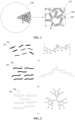
- One preparation method for porous microspheres known in the prior art which is suitable for use in a chromatography column consists of dispersing polysaccharide molecules (such as agarose) in water. Moreover, the polysaccharide-containing tiny aqueous droplets suspended in the oil phase are formed by appropriate emulsification techniques. Referring to FIG. 1 , after the temperature of the emulsion is cooled, the single chain of the polysaccharide compound 101 forms a double helices structure, and then pore 102 are formed between the molecular beams, and finally, the microspheres 100 are formed with the aid of crosslinking agent 103. As the polysaccharide molecules are disorderly arranged in water, the internal pores of the microspheres thus formed are also arranged ordered randomly, and given the inherent soft characteristics of the polysaccharide molecules, the microspheres cross-linked are usually relatively soft.
- polysaccharide molecules such as agarose
- biomacromolecules in nature are independent or dispersed in water to present a non-spherical, symmetrical, rigid form, as shown in FIG.2 , including a rod-like shape shown on the left side of FIG. 2(a) , such as tobacco mosaic virus (TMV), deoxyribonucleic acid (DNA), cellulose nanocrystals (CNC, schematic and structural formulas shown in the right side of FIG.2(a)), and 2 , 3 , 6 , 7 , 10 , 11 - six (1,4,7 - trioxylalkyl-benzo [ 9,10 ] phenanthrene 7) (TP 6EO2M, schematic diagram and structural formula shown in the right side of FIG.
- TMV tobacco mosaic virus
- DNA deoxyribonucleic acid
- CNC cellulose nanocrystals
- TP 6EO2M schematic diagram and structural formula shown in the right side of FIG.
- the tobacco mosaic virus is a rigid rod-like biological nanoparticle that is widely studied in liquid crystal physics.
- the rigid nanoparticles when such rigid nanoparticles are dispersed in a solvent, the rigid nanoparticles may be arranged disorderly in the solvent or in an ordered molecular arrangement of some kind of lyotropic liquid crystals such as a nematic phase (such as a tobacco mosaic virus nanomaterial), a near-crystalline phase, a cholesteric phase, and a columnar phase liquid crystal, depending on the concentration and the characteristics of the rigid nanoparticles.
- Liquid crystal materials ordered usually exhibit optical birefringence, so the ordered droplets or solvents containing non-spherical biomacromolecules are clearly visible under a polarizing microscope, and a common liquid crystal conformation is presented, as shown in FIG. 3 .
- porous polymer microparticles where the orientation of the nanoparticles are ordered and the pore structures are controllable, and the microparticles have excellent mechanical properties.
- an appropriate amount of rigid nanoparticles having non-spherical shape are uniformly dispersed in the solvent 401 alone or with an appropriate amount of amorphous monomers or oligomers 101, to form the lyotropic liquid crystal solution 400 having local or overall molecular orientation ordering as shown in FIG. 4 (a) .
- the lyotropic liquid crystal solution 400 forms an emulsion containing the lyotropic liquid crystal droplets 405 suspended in the solvent 402 by an appropriate emulsification method, including the membrane emulsification shown in FIG. 4 (b) or stirring to emulsify ( FIG.
- the monomers or oligomers and the rigid nanoparticles with polymerizable functional groups are polymerized to form a polymer network structure, thereby forming porous polymer microspheres as shown in FIGS.4(D), (E), (F), and (G) , which contain rigid nanoparticles and the rigid nanoparticles with at least partially form ordered structures in it, that is, the polymer microparticles 410.
- the rigid nanoparticles may be physically wrapped in the polymer microspheres by the surrounding polymer in the polymer microparticles 410, as shown in FIG. 5 (b) , and may also directly participate in the cross-linking reaction, and become part of the polymer via chemical bonding, as shown in FIG. 5 (a) .
- porous biomacromolecule polymer microspheres have at least partially ordered molecules and ordered pore structures.
- cellulose nanocrystals CNC having a suitable aspect ratio and size distribution are biomacromolecules that have certain rigidity in their solvent water and can form a lyotropic liquid crystal phase.
- the biomacromolecules are cellulose nanocrystals (CNC) and as its concentration reaches a critical concentration, the CNC molecules may be self-assembled to form an ordered structure, thereby showing the liquid crystal phase. As shown in FIG.
- the CNC biomacromolecules have chiral characteristics, the chiral characteristics of the biomacromolecules can be clearly shown to form a cholesteric phase molecule arrangement with a spiral structure when the concentration of the dispersion is about 5%.
- concentration of the CNC dispersion is higher than 6%, the arrangement of the biomacromolecules is more orderly.
- the aspect ratio and uniformity of the CNC nanomaterial are changed, the corresponding critical concentration is also changed.
- the ordered structures of molecular can form a liquid crystal molecule arrangement having a helical structure, as shown in FIG. 6 .
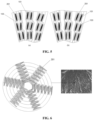
- FIG. 7 is a polymer microparticle having a porous structure according to the present application. Specifically, FIG. 7 (a) shows a diametrical cross-section of the partial interior space of the polymer microsphere.
- the biomacromolecules may still remain an orderedstructure at least in part after crosslinking, and due to the influence of the molecular arrangement, the pore structure formed may also be partially ordered, as shown in FIG. 7 (b) .
- the biomacromolecule solution shown in FIG. 7 (a) may be emulsified to form droplets when it may also be in a local ordering state, and the biomacromolecules 201 within the emulsion also similarly tend to be partially ordered as shown in FIG. 7 (a) .
- the biomacromolecules 201 When the temperature of emulsion is lowered, the biomacromolecules 201 retain the alignment and further cross-linked to form polymer microparticles, then the internal structure at least partially retains the previously ordered conformation, and at the same time, as shown in FIG. 7 (b) , the pores 701 formed between the biomacromolecules basically inherit the same ordered conformation so that the pores of the formed polymer microparticles at least partially form a substantially ordered structure.
- substantially ordered refers to that at least in a substantially ordered area, at least a portion of the pore and at least a portion of its adjacent one has a certain correlation with the arrangement of their directions and positions.
- the pore is substantially parallel, fan-shaped, or spirally arranged with at least a portion of its adjacent one.
- the pore diameter is 1-1000 nm.
- the substantially ordered structures of biomacromolecules in the emulsion may include one or more regions by controlling its concentration. Meanwhile, the molecular arrangement between the plurality of regions may not be correlated, correlated, or partially correlated. Moreover, the substantially ordered structures may be overall ordered, or may be partially ordered. When in overall ordered form, in a substantially ordered region, the distribution of the feature direction of the biomacromolecule is any one of substantially along the particle radius direction, along the particle bipolar axis direction, or in a plurality of concentric circles inside the microparticles. When in partially ordered form, in a substantially ordered region, the feature direction of the biomacromolecule is substantially parallel, fan-shaped, or spirally arranged.
- some special conformations may be formed structurally due to these substantially ordered structures, including the radial configuration (the feature direction is arranged in order along the radius direction), and ordered pores 801 are formed with its directions point at the circle center, as shown in FIG. 8 (a) , and the bipolar configuration as shown in FIG. 8 (b) (the feature direction is arranged in order along the bipolar direction), and ordered pores 802 are formed inside which is along the direction of the bipolar axis, and the loop conformation as shown in FIG. 8 (c) (the feature direction is in concentric circle arrangement), and ordered pores 803 are formed inside whose arrangement is a concentric circle arrangement, however, this disclosure is not limited thereto, and it may also be other ordered conformation.
- these special conformations show a special optical phenomenon under a polarizing microscope.
- the feature direction of the biomacromolecules tends to be arranged in order along the radius direction in the emulsion drops, and the interior structure and the pores of the polymer microparticles formed thereby also tend to be arranged in order along the radius direction, thus having a radial configuration and showing an optical anisotropy of Maltese black cross under a polarizing microscope, as shown in FIG. 8(d) .
- the external region of the polymer microparticles comprises multiple parts B, as shown in FIG. 7(b) and multiple parts C as shown in FIG. 7(c) .
- the part B is a local region with the feature direction of the biomacromolecule substantially ordered
- the part C is a disordering region for the feature direction of the biomacromolecule.
- An ordered pore 701 and a disordered pore 702 are formed inside the polymer microparticles at the same time. Even though the polymer microparticles do not have a specific conformation, the feature directions of the polymer microparticles are still regularly arranged in a small area, and color development can still be observed under a polarizating microscope.
- the average particle size of the polymer microparticles in the solvent which is usually an aqueous solvent, is 1-500 microns. More preferably, the average particle size is 5-150 microns.
- the polymer microparticle 410 which is formed by crosslinking at least partially cross-linkable oligomer materials including rigid nanoparticles 201, wherein at least one of the rigid nanoparticles has a non-spherical shape in a solution.
- the biomacromolecule 201 is a rod shaped molecule with a feature direction 202 in the direction of the longitudinal axis of the molecule.
- the biomacromolecule 203 is a bow-like shaped (banana shaped) molecule with its feature direction 204 in the direction of the longitudinal axis of the molecule, or as shown in FIG.
- the biomacromolecule 205 is a disk-like shaped molecule with a feature direction 206 perpendicular to the disk, the biomacromolecule can also be but is not limited to the form of slice, needle or wire, other suitable non-spherical biomacromolecule can also be used.
- Biomacromolecules with or without spherical shapes are selected from at least one of a polypeptide (e.g., insulin, growth hormone), a protein (e.g., chloroplastin, collagen, etc.), a nucleic acid (e.g., DNA), a polysaccharide (e.g., cellulose, chitosan), and a lipid (e.g., monoglyceride, phospholipid, glycolipid, steroid, etc.).
- a polypeptide e.g., insulin, growth hormone
- a protein e.g., chloroplastin, collagen, etc.
- a nucleic acid e.g., DNA
- a polysaccharide e.g., cellulose, chitosan
- a lipid e.g., monoglyceride, phospholipid, glycolipid, steroid, etc.
- biomacromolecules with chiral characteristics include left- and right-handed biomacromolecules, and the formed liquid crystal phases may form a cholesteric helical structure.
- the broken parts of the polymer microparticles exhibit a helical ribbon-like internal structure.
- One specific embodiment of the present application is a biomacromolecule cellulose nanocrystal (CNC), and the structural formula is shown below.
- the rod-shaped biomacromolecules has a larger aspect ratio, and is easier to form a liquid crystal state.
- the cellulose nanocrystal has a length of 20-1000 nm, a width of 2-100 nm, and an aspect ratio of 1:5-1: 200.
- the polymer microparticles may further include a polysaccharide compound 101 having a non-spherical shape, and these polysaccharide compounds and the biomacromolecules are copolymerized to form the polymer microparticles.
- These polysaccharide compounds are selected from at least one member of agar, agarose, glucan, starch, chitosan and trehalose.
- the polysaccharide compound is agarose with the following structural formula:
- the polysaccharide compound is a gel-like dispersion that can flow prior to emulsification. After the dispersion is emulsified into emulsion droplets, as shown in FIG. 7 (b) , a double helix of the polysaccharide compound 101 was formed by its single chain through the processes of cooling, curing, aging, and the like, and therefore forms a bundled molecular structure that ultimately forms soft but stable solid porous particles. Although these polysaccharide compounds are not self-orderly arranged in the solution, they will arrange along with the biomacromolecules because of a variety of interactions between these polysaccharide compounds and the biomacromolecules, including hydrogen bonds, and eventually form an ordered structure.
- the biomacromolecules are partially ordered to form a liquid crystal state at a specific concentration, and the polysaccharide compounds will be arranged according to the arrangement of biomacromolecules as a template.
- These polysaccharide compounds and biomacromolecules are further copolymerized under the assistance of a cross-linking agent to form a stable particle structure but not to destroy the ordered structure of the polymer microparticles, thereby further improving the pressure resistance of the formed polymer microparticles.
- the polysaccharide compound (such as agarose) can solidify the emulsified emulsion by cooling to provide structural support for the subsequent cross-linking polymerization, thereby simplifying the preparation process.
- the present application further provides a method for preparing the polymer microparticles, and the specific process is described as follows:
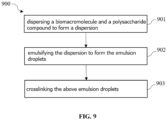
- an embodiment of the present application may include a method 900 of preparing the polymer microparticles.
- the method may include dispersing a biomacromolecule and a polysaccharide compound to form a dispersion 901, specifically, dispersing the biomacromolecule and the polysaccharide compound in water to form a dispersed phase solution.
- a dispersion 901 specifically, dispersing the biomacromolecule and the polysaccharide compound in water to form a dispersed phase solution.
- the solid contents of the dispersions containing a mixture of the biomacromolecule and the polysaccharide compound is 2%-90%, and the volume of the biomacromolecule and the polysaccharide compound is in the range 1%-10% of the total volume of the polymer microparticles.
- mechanical property includes pressure resistance of the polymer microparticle can be further regulated by adjusting the mass ratio of the biomacromolecule and the polysaccharide compound.
- the mass ratio of the biomacromolecule and the polysaccharide compound is 1:10-50:1.
- the mass ratio of the biomacromolecule and the polysaccharide compound is 1:1-15:1.
- the method 900 further comprises the step of emulsifying the dispersion to form the emulsion droplets 902.
- Various methods for emulsification exist, including membrane emulsification.
- the membrane emulsification method refers to a method of forcing a dispersion phase into a continuous phase directly through the pores of a microporous membrane, and then the emulsion droplets are formed and extruded at the end of the pores in a process of emulsification.
- Another common emulsification method involves dispersing a dispersed phase solution formed by a co-dispersing solution of biomacromolecule and a polysaccharide compound in a continuous phase containing emulsifying agents, to form the emulsion droplets containing biomacromolecules.
- the emulsifying agents utilized in the above process may be sorbitol esters based (SPAN) surfactants such as sorbitan monopalmitate (SPAN 40), sorbitan monostearate (SPAN 60), sorbitan tristearate (SPAN 65), sorbitan monooleate (SPAN 80), sorbitan trioleate(SPAN 85) and the like.
- SPAN sorbitol esters based
- Tween surfactants such as Tween20, Tween 40, Tween 60, Tween 80 or Tween 85. It can further be a cetyl alcohol, polyglyceryl polyricinoleate (PGPR), and the like.
- the continuous phase is an oily substance that is incompatible with the water and can dissolve the emulsifier, such as linear alkanes (such as n-hexane, n-hexadecane, etc.), liquid paraffin, animal or vegetable greases (such as soybean oil).
- the emulsifiers can facilitate the formation of dispersions of emulsion droplets, and meanwhile, it can also assist with arranging the biomacromolecule in order and preparing the emulsion droplets with different orientational effect by controlling the temperature and the orientation time, and further prepares the polymer microparticles with the corresponding orientation effect.
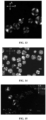
- FIG. 10 (a) and FIG. 10 (b) most of the nanorods in the particles are arranged in a disordered configuration and the nanorods in few regions are ordered. Only a small part of the sheet-like region displays a bright state under a polarization microscope, and then the whole picture presents an uneven dark state.
- the nanorods in the particles are arranged in a disordered configuration, while other regions are ordered, and then unobvious birefringence property begins to be presented.
- the nanorods in the particles are arranged in a plurality of concentric circles, or may be arranged in other overall ordered manner, and the polymer microspheres show a radial optical anisotropy (Maltese Black Cross) under polarized light.
- the mass concentration of the emulsifier in the continuous phase is 2% -20%.
- the ratio of the dispersed phase to the continuous phase is preferably 1:1 to 1:15.
- the dispersion modes may be a common emulsification-diffusion process, such as stirring method, ultrasonic method, and vibration method.
- the method 900 comprises the step of crosslinking the above emulsion droplets 903.
- the specific process is to add a cross-linking agent to the emulsion droplets formed in step 902 to crosslink biomacromolecules in the emulsion, finally forms the polymer microparticles, wherein the crosslinking agent is selected from epoxide, diacid chloride or halogen compound.
- the epoxide is glycerol ethers small-molecule organic compound.
- crosslinking agent is an epoxide
- crosslinking process is as follows:
- crosslinking agent is a halogen compound
- crosslinking process is as follows:
- the surface of the biomacromolecules have numerous hydroxyl groups, which can be further capable of undergoing a cross-polymerization reaction with the aid of the crosslinking agent, and finally form stable polymer microparticles.
- the pore structure formed in the emulsification process is reinforced. Since the ordered molecular arrangement of the biomacromolecules before crosslinking, the finally formed pore also tend to have the same ordered molecular arrangement that further form an ordered internal structure and pore distribution.
- cross-linking is carried out in basic condition, and that make the crosslinking agent more conducive.
- the above polymer microparticles having a porous structure may be used for biochemical separation, in particular as the stationary phase for a column chromatography.
- the constituents in the mobile phase will interact with the stationary phase, and the size of the constituents, the pore size and its distribution of the stationary phase, and the affinity of the constituents in the mobile phase to the stationary phase all contribute to when and how a specific component passes through the column, and thereby achieving separation of the contuents in the mobile phase.
- the microparticles according to the present invention are comprised of biomacromolecules, chromatography columns made using such microparticles show good bio-compatibility with bio-materials such as proteins to be separated. Additionally, due to the internal ordering of the molecules and pores in the microparticles, the constituents in the mobile phase may have a less tortuous path, there can be an improved separation efficiency when compared with like columns using microbeads with no internal structural ordering.
- the present application further provides another application scenario of the above polymer microparticles, specifically, an in-situ polymerization is conducted by adding cross-linking agent directly rather than performing emulsification after the dispersed phase solution is formed, the output of which can be used as stationary phase for monolithic media chromatography.
- FIG. 11 (a) shows that cellulose nanocrystals and agarose molecules are arranged in a plurality of concentric circles inside the emulsion droplet.
- FIG. 11 (b) shows that these emulsion droplets have a Maltese black cross under a polarizing microscope.
- the dispersion was washed to eliminate the emulsifier and liquid paraffin, and the resulting gel was then weighed and poured into 10 ml of aqueous solution containing 500 microliters of the crosslinker pentaerythritol tetraglycidyl ether, and the mixture was stirred for 12 hours.
- the system was added with 500 microliters of aqueous solution containing 40wt% sodium hydroxide and 5wt% sodium borohydride, and the mixture was stirred for 8 hours.
- 500 microliters of epichlorohydrin and 500 microliters of aqueous solution containing 40wt% sodium hydroxide and 5wt% sodium borohydride were mixed and added to the reaction mixture, and the mixture was stirred for 12 hours.
- the resulting polymer microparticles were washed until pH neutral, whose optical properties were shown in FIG. 12 .
- the polymer microspheres show a radial optical anisotropy (Maltese Black Cross) under a polarizing microscope, demonstrating it has radial internal configuration and radial pore distribution.
- the dispersion was washed to eliminate emulsifier and liquid paraffin, and the resulting gel were then weighed and poured into 10 ml of aqueous solution containing 500 microliters of the crosslinker 1,4-butanediol diglycidyl ether, and the mixture was stirred for 12 hours.
- the system was added with 500 microliters of aqueous solution containing 40 wt% sodium hydroxide and 5 wt% sodium borohydride, and the mixture was stirred for 8 hours.
- the dispersion was washed to eliminate emulsifier and liquid paraffin, and the resulting gel were then weighed and poured into 15 ml of aqueous solution containing 800 microliters of the crosslinker 1,4-butanediol diglycidyl ether, and the mixture was stirred for 12 hours.
- the system was added with 800 microliters of aqueous solution containing 40 wt% sodium hydroxide and 5 wt% sodium borohydride, and the mixture was stirred for 8 hours.
- cellulose nanocrystals were dispersed in 9.6 grams of water during the reaction, the mixture was stirred at room temperature, forming a suspension.
- One gram of the suspension was measured and added to 10 grams of soybean oil containing PGPR (2 percent by mass concentration) and were emulsified for 3 hours by stirring, forming a dispersion containing emulsion droplets.
- 400 microliters of cross-linking agent 1,4-butanediol diglycidyl ether was dispersed in 900 microliters of water, and were slowly added to the dispersion, and mixture was stirred at room temperature for 12 hours.
- cellulose nanocrystals were dispersed in 9.6 grams of water during the reaction, the mixture was stirred at room temperature, forming a suspension.
- One gram of the suspension was measured and added to 10 grams of soybean oil containing PGPR (15 percent by mass concentration) and were emulsified for 3 hours by stirring, forming a dispersion containing emulsion droplets.
- 100 microliters of cross-linking agent 1,4-butanediol diglycidyl ether was dispersed in 900 microliters of water, and were slowly added to the dispersion, and mixture was stirred at room temperature for 12 hours.
- the dispersion was washed to eliminate emulsifier and liquid paraffin, and the resulting gel were then weighed and poured into 10 ml of dioxane solution containing 500 microliters of the crosslinker 1,4-butanediol diglycidyl ether, and the mixture was stirred for 2 hours.
- the system was added with 500 microliters of aqueous solution containing 40 wt% sodium hydroxide and 5 wt% sodium borohydride, and the mixture was stirred for 8 hours.
- the dispersion was washed to eliminate emulsifier and liquid paraffin, and the resulting gel were then weighed and poured into 15 ml of aqueous solution containing 800 microliters of the tetrafunctional crosslinker pentaerythritol tetraglycidyl ether, and the mixture was stirred for 12 hours.
- the system was added with 800 microliters of aqueous solution containing 40wt% sodium hydroxide and 5wt% sodium borohydride, and the mixture was stirred for 8 hours.
- the dispersion was washed to eliminate emulsifier and liquid paraffin, and the resulting gel were then weighed and poured into 15 ml of aqueous solution containing 0.4 grams of the bifunctional crosslinker 1,4-butanediol diglycidyl ether, and the mixture was stirred for 12 hours.
- the system was added with 400 microliters of aqueous solution containing 40 wt% sodium hydroxide and 5 wt% sodium borohydride, and the mixture was stirred for 8 hours.
- the dispersion was washed to eliminate emulsifier and liquid paraffin, and the resulting gel was then weighed and poured into 15 ml of aqueous solution containing 9.6 grams of the bifunctional crosslinker 1,4-butanediol diglycidyl ether, and the mixture was stirred for 12 hours.
- the system was added with 400 microliters of aqueous solution containing 40wt% sodium hydroxide and 5wt% sodium borohydride during the reaction, and the mixture was stirred for 8 hours.
- the dispersion was washed to eliminate emulsifier and liquid paraffin, and the resulting gel was then weighed and poured into 15 ml of aqueous solution containing 800 microliters of the bifunctional crosslinker 1,4-butanediol diglycidyl ether, and the mixture was stirred for 12 hours.
- the system was added with 40 microliters of aqueous solution containing 40 wt% sodium hydroxide and 5 wt% sodium borohydride, and the mixture was stirred for 8 hours.
- microparticles obtained in Examples 1-3 and comparative examples 1, 2, and 4 are screened to retain polymer microparticles having a particle size of 40-150 ⁇ m.
- the microparticles were filled into the chromatographic column by homogenate method, and then a corresponding pressure value is obtained by changing different flow rates on a protein liquid chromatography, and ultimately, a pressure-flow velocity curve is obtained, shown in FIG.16 , to explore the critical pressure resistance.
- the pressure in chromatographic column gradually increased with the increase of flow rates, and the relationship between the pressure and the flow rates are linear. When reaches the inflection point, the pressure in chromatographic column no longer increases linearly with the flow rates.
Landscapes
- Chemical & Material Sciences (AREA)
- Chemical Kinetics & Catalysis (AREA)
- Organic Chemistry (AREA)
- Analytical Chemistry (AREA)
- Medicinal Chemistry (AREA)
- Polymers & Plastics (AREA)
- Health & Medical Sciences (AREA)
- Engineering & Computer Science (AREA)
- Materials Engineering (AREA)
- Biochemistry (AREA)
- Life Sciences & Earth Sciences (AREA)
- Dispersion Chemistry (AREA)
- Nanotechnology (AREA)
- Processes Of Treating Macromolecular Substances (AREA)
- Manufacture Of Porous Articles, And Recovery And Treatment Of Waste Products (AREA)
- Manufacturing Of Micro-Capsules (AREA)
Applications Claiming Priority (2)
| Application Number | Priority Date | Filing Date | Title |
|---|---|---|---|
| CN202210098560.XA CN116554536B (zh) | 2022-01-27 | 2022-01-27 | 高分子微粒及其制备方法和应用 |
| PCT/CN2022/095272 WO2023142322A1 (zh) | 2022-01-27 | 2022-05-26 | 高分子微粒及其制备方法和应用 |
Publications (2)
| Publication Number | Publication Date |
|---|---|
| EP4471083A1 true EP4471083A1 (de) | 2024-12-04 |
| EP4471083A4 EP4471083A4 (de) | 2026-04-15 |
Family
ID=87470215
Family Applications (1)
| Application Number | Title | Priority Date | Filing Date |
|---|---|---|---|
| EP22923134.5A Pending EP4471083A4 (de) | 2022-01-27 | 2022-05-26 | Polymermikropartikel, herstellungsverfahren dafür und verwendung davon |
Country Status (5)
| Country | Link |
|---|---|
| US (1) | US20250109261A1 (de) |
| EP (1) | EP4471083A4 (de) |
| JP (1) | JP7808372B2 (de) |
| CN (1) | CN116554536B (de) |
| WO (1) | WO2023142322A1 (de) |
Families Citing this family (1)
| Publication number | Priority date | Publication date | Assignee | Title |
|---|---|---|---|---|
| CN121016694A (zh) * | 2024-05-28 | 2025-11-28 | 江苏集萃智能液晶科技有限公司 | 螯合微粒、层析介质及其制备方法和应用 |
Family Cites Families (14)
| Publication number | Priority date | Publication date | Assignee | Title |
|---|---|---|---|---|
| SE441009B (sv) | 1982-03-08 | 1985-09-02 | Kjell Nilsson | Sett att immobilisera levande biomaterial i perlformiga polymerer |
| FR2694895B1 (fr) * | 1992-08-20 | 1994-11-10 | Coletica | Procédé de fabrication de microparticules en émulsion par modification de la composition chimique de la phase dispersée après émulsification. |
| JP2006028031A (ja) * | 2004-07-12 | 2006-02-02 | Ltt Bio-Pharma Co Ltd | 経粘膜吸収用薬物封入ナノ粒子 |
| DE102008033583A1 (de) * | 2008-07-17 | 2010-01-21 | Universität Zu Köln | Zuckermikro-/nanoschäume |
| JP5594113B2 (ja) * | 2010-12-14 | 2014-09-24 | Jsr株式会社 | 架橋高分子粒子の製造方法、及び、架橋高分子粒子 |
| WO2017141910A1 (ja) * | 2016-02-15 | 2017-08-24 | 東ソー株式会社 | 多孔性架橋セルロースゲル及びその製造方法 |
| GB201613997D0 (en) * | 2016-08-16 | 2016-09-28 | Cambridge Entpr Ltd | Self-assembled nanocrystals |
| BR112019020466A2 (pt) * | 2017-04-13 | 2020-04-28 | F. Hoffmann-La Roche Ag | partículas magnéticas, métodos para preparar uma partícula magnética e para determinar pelo menos um analito em uma amostra de fluido e uso da partícula magnética |
| CN107868161B (zh) * | 2017-12-07 | 2020-06-05 | 张振 | 一种聚合物空心微胶囊的制备方法和其应用 |
| CN110026138B (zh) * | 2018-01-11 | 2020-10-16 | 中国科学院过程工程研究所 | 多糖微球及其制备方法 |
| JP7199871B2 (ja) * | 2018-08-10 | 2023-01-06 | 日揮触媒化成株式会社 | 多孔質セルロース粒子とその製造方法、および洗浄用化粧料 |
| CN111434610B (zh) * | 2019-01-11 | 2021-10-01 | 江苏集萃智能液晶科技有限公司 | 多孔二氧化硅微球及其制备方法和应用 |
| WO2020227816A1 (en) * | 2019-05-10 | 2020-11-19 | Anomera Inc. | Porous cellulose microparticles and methods of manufacture thereof |
| CN110607569B (zh) * | 2019-09-16 | 2022-01-18 | 东华大学 | 一种二维限域自组装制备纳米纤维素液晶微纤维的方法 |
-
2022
- 2022-01-27 CN CN202210098560.XA patent/CN116554536B/zh active Active
- 2022-05-26 EP EP22923134.5A patent/EP4471083A4/de active Pending
- 2022-05-26 US US18/730,210 patent/US20250109261A1/en active Pending
- 2022-05-26 JP JP2024541072A patent/JP7808372B2/ja active Active
- 2022-05-26 WO PCT/CN2022/095272 patent/WO2023142322A1/zh not_active Ceased
Also Published As
| Publication number | Publication date |
|---|---|
| JP2025502868A (ja) | 2025-01-28 |
| JP7808372B2 (ja) | 2026-01-29 |
| US20250109261A1 (en) | 2025-04-03 |
| CN116554536A (zh) | 2023-08-08 |
| EP4471083A4 (de) | 2026-04-15 |
| WO2023142322A1 (zh) | 2023-08-03 |
| CN116554536B (zh) | 2025-10-03 |
Similar Documents
| Publication | Publication Date | Title |
|---|---|---|
| JP5457335B2 (ja) | 多糖ビーズの製造 | |
| EP4537933A1 (de) | Chromatographiemedium und chromatographievorrichtung | |
| US5245024A (en) | Cellulose chromatography support | |
| Breslauer et al. | Generation of monodisperse silk microspheres prepared with microfluidics | |
| US5723601A (en) | Super porous polysaccharide gels | |
| CN103415535B (zh) | 多孔纤维素珠的制造方法 | |
| JPH07505330A (ja) | 制御された寸法のマイクロカプセル又はリポソームの製造方法 | |
| EP4538322A1 (de) | Polymermikropartikel mit porenkanälen von zwei grössen und herstellungsverfahren dafür | |
| EP4471083A1 (de) | Polymermikropartikel, herstellungsverfahren dafür und verwendung davon | |
| CN110026138A (zh) | 多糖微球及其制备方法 | |
| CN109423300B (zh) | 单分散聚合物微粒的制备方法 | |
| CN1640539A (zh) | 一种尺寸均一的琼脂糖凝胶微球及其制备方法 | |
| Chen et al. | Double emulsion-templated microspheres with flow-through pores at micrometer scale | |
| JP5126774B2 (ja) | 微生物内包高分子ゲルビーズの製造方法及び土壌改質材。 | |
| CN116532092A (zh) | 一种新型多核结构复合琼脂糖凝胶微球及其制备方法 | |
| CN112246197B (zh) | 具有光学各向异性的多孔结构聚合物微球及其应用 | |
| Chang et al. | Preparation of agarose microspheres with large pore size and high load and purification of antibody in serum based on microfluidic technology | |
| CN110117341B (zh) | 一种多孔的功能化聚合物微球的制备方法 | |
| EP0479906B1 (de) | Verbesserte zellulose-chromatographieträger | |
| JP2010022287A (ja) | 微生物内包高分子ゲルビーズの製造方法及び土壌改質材。 | |
| EP1971428A2 (de) | Herstellung von chiralen materialien unter verwendung von kristallisationsinhibitoren | |
| CN120837363A (zh) | 一种天然纳米颗粒稳定的刺激响应型乳液的制备方法及应用 |
Legal Events
| Date | Code | Title | Description |
|---|---|---|---|
| STAA | Information on the status of an ep patent application or granted ep patent |
Free format text: STATUS: THE INTERNATIONAL PUBLICATION HAS BEEN MADE |
|
| PUAI | Public reference made under article 153(3) epc to a published international application that has entered the european phase |
Free format text: ORIGINAL CODE: 0009012 |
|
| STAA | Information on the status of an ep patent application or granted ep patent |
Free format text: STATUS: REQUEST FOR EXAMINATION WAS MADE |
|
| 17P | Request for examination filed |
Effective date: 20240725 |
|
| AK | Designated contracting states |
Kind code of ref document: A1 Designated state(s): AL AT BE BG CH CY CZ DE DK EE ES FI FR GB GR HR HU IE IS IT LI LT LU LV MC MK MT NL NO PL PT RO RS SE SI SK SM TR |
|
| DAV | Request for validation of the european patent (deleted) | ||
| DAX | Request for extension of the european patent (deleted) | ||
| A4 | Supplementary search report drawn up and despatched |
Effective date: 20260313 |
|
| RIC1 | Information provided on ipc code assigned before grant |
Ipc: C08J 9/28 20060101AFI20260309BHEP Ipc: B01J 20/24 20060101ALI20260309BHEP Ipc: B01J 20/26 20060101ALI20260309BHEP Ipc: B01J 20/28 20060101ALI20260309BHEP Ipc: B01J 20/281 20060101ALI20260309BHEP Ipc: B01J 20/285 20060101ALI20260309BHEP |