EP4471200A1 - Dispositif d'enregistrement d'image pour métier à tisser - Google Patents
Dispositif d'enregistrement d'image pour métier à tisser Download PDFInfo
- Publication number
- EP4471200A1 EP4471200A1 EP23743376.8A EP23743376A EP4471200A1 EP 4471200 A1 EP4471200 A1 EP 4471200A1 EP 23743376 A EP23743376 A EP 23743376A EP 4471200 A1 EP4471200 A1 EP 4471200A1
- Authority
- EP
- European Patent Office
- Prior art keywords
- image
- unit
- loom
- capturing
- storage unit
- Prior art date
- Legal status (The legal status is an assumption and is not a legal conclusion. Google has not performed a legal analysis and makes no representation as to the accuracy of the status listed.)
- Pending
Links
Images
Classifications
-
- D—TEXTILES; PAPER
- D03—WEAVING
- D03D—WOVEN FABRICS; METHODS OF WEAVING; LOOMS
- D03D47/00—Looms in which bulk supply of weft does not pass through shed, e.g. shuttleless looms, gripper shuttle looms, dummy shuttle looms
- D03D47/28—Looms in which bulk supply of weft does not pass through shed, e.g. shuttleless looms, gripper shuttle looms, dummy shuttle looms wherein the weft itself is projected into the shed
- D03D47/30—Looms in which bulk supply of weft does not pass through shed, e.g. shuttleless looms, gripper shuttle looms, dummy shuttle looms wherein the weft itself is projected into the shed by gas jet
- D03D47/3066—Control or handling of the weft at or after arrival
- D03D47/3073—Detection means therefor
-
- D—TEXTILES; PAPER
- D03—WEAVING
- D03D—WOVEN FABRICS; METHODS OF WEAVING; LOOMS
- D03D47/00—Looms in which bulk supply of weft does not pass through shed, e.g. shuttleless looms, gripper shuttle looms, dummy shuttle looms
- D03D47/28—Looms in which bulk supply of weft does not pass through shed, e.g. shuttleless looms, gripper shuttle looms, dummy shuttle looms wherein the weft itself is projected into the shed
- D03D47/30—Looms in which bulk supply of weft does not pass through shed, e.g. shuttleless looms, gripper shuttle looms, dummy shuttle looms wherein the weft itself is projected into the shed by gas jet
- D03D47/3093—Displaying data
Definitions
- the present invention relates to an image recording device for a loom.
- a loom is configured to store a weft yarn from a yarn supply member in a weft yarn measuring and storing member, to start weft insertion by releasing the stored weft yarn with a main nozzle, to transport the weft yarn inserted in a weaving width with a sub-nozzle, and to end the weft insertion.
- a weft yarn brake is used to apply braking to the weft yarn near the completion of the weft insertion.
- Patent Document 2 Furthermore, a technique of a camera-equipped stroboscope for recording the travel state of the weft yarn is proposed in Patent Document 2.
- the present disclosure which has been made in view of the above problems, is directed to providing an image recording device for a loom that is capable of providing an image showing a weft yarn travel state necessary to reliably classify the type of a weft insertion abnormality with a simple configuration when the weft insertion abnormality occurs.
- An image recording device for a loom includes: an image capture unit configured to capture an image of a weft yarn while the weft yarn travels; a storage unit configured to store the image generated by capturing the image by the image capture unit; a record unit configured to record the image read from the storage unit; and a control unit configured to control capturing the image by the image capture unit, and inputting and outputting the image to and from the storage unit and the record unit, wherein the control unit includes a trigger controller that generates a trigger signal based on an operation signal output according to an operation of the loom, and controls a timing of capturing the image by the image capture unit with the trigger signal, an image controller that causes the storage unit to store the image generated by capturing the image by the image capture unit, and reads the image stored in the storage unit to record in the record unit, and a timer that measures an elapsed time from one of reception of the operation signal by the trigger controller, capturing of the image by the image capture unit, or storing of the image in the storage unit by
- the predetermined period of time is desirably determined according to the rotation speed of the machine base included in the loom.
- the image controller desirably adds time information at a time of capturing the image or time information at a time of storing the image to the image generated by capturing the image by the image capture unit, and stores the image to which the time information is added in the storage unit.
- the image capture unit desirably includes a light emitting unit and a camera, and executes emission of strobe flashes of light by the light emitting unit and capturing of the image while the weft yarn travels by the camera, based on the trigger signal.
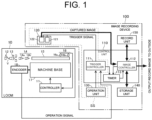
- FIG. 1 is a block diagram illustrating the configuration of the image recording device 100 together with a configuration of the loom 10 according to the first embodiment.
- the image recording device 100 illustrated in FIG. 1 is configured to capture, store, and record images of the weft yarn Y while the weft yarn Y travels in the loom 10, and includes a control unit 110, an image capture unit 120, an operation unit 130, a storage unit 140, and a record unit 150 as main components.
- control unit 110 includes a trigger controller 111, an image controller 112, and a timer 113.
- the trigger controller 111 generates a trigger signal based on an operation signal output according to an operation of the loom 10 and a timing adjustment value input from the operation unit 130, and controls a timing of capturing an image by the image capture unit 120.
- the image controller 112 performs a control in such a manner that the images generated by capturing the images by the image capture unit 120 are stored in the storage unit 140, and that the images stored in the storage unit 140 are read out and recorded in the record unit 150 under certain conditions.
- the image controller 112 may add time information at the time of capturing or storing the images. That is, the image controller 112 controls input and output of the images to and from the storage unit 140 and the record unit 150.
- the timer 113 measures an elapsed time from one of reception of an operation signal by the trigger controller 111, capturing of the images by the image capture unit 120, or storing of the images in the storage unit 140 by the image controller 112.
- the trigger controller 111, the image capture unit 120, and the operation unit 130 cooperate to form a camera-equipped stroboscope SS in which a stroboscope and a camera are combined in order to visually check a travel state of the weft yarn Y in the loom 10.
- the image capture unit 120 includes a light emitting unit 121 and a camera 122.
- the light emitting unit 121 includes a xenon lamp or a light emitting diode.
- the light emitting unit 121 receives a trigger signal from the trigger controller 111, and also receives electric power for emitting strobe flashes of light from an electric power source (not illustrated).
- the light emitting unit 121 emits strobe flashes of light to a capturing range in the loom 10 in accordance with a timing of a trigger signal from the trigger controller 111.
- the camera 122 receives a trigger signal from the trigger controller 111 and electric power for capturing images from the image controller 112.
- the camera 122 captures images of the weft yarn Y while the weft yarn Y travels in the capturing range in the loom 10 in accordance with the timing of the trigger signal from the trigger controller 111 in synchronization with the strobe flashes of light emitted by the light emitting unit 121, and supplies the images generated by the capturing to the image controller 112. In this way, a clear image showing the travel state of the weft yarn Y, which is necessary for reliably classifying the type of weft insertion abnormality, can be obtained.
- the timing adjustment value for adjusting a light emission timing of the light emitting unit 121 is input to the operation unit 130.
- the operation unit 130 transmits the input timing adjustment value to the trigger controller 111.
- the storage unit 140 temporarily stores the images generated by the capturing of the images by the image capture unit 120 under the control by the image controller 112.
- the storage unit 140 is configured to have at least a certain storage capacity corresponding to a fixed number of the images to be recorded in the record unit 150 for analyzing the weft insertion abnormality.
- the storage unit 140 may be a ring buffer that always stores a fixed number of the images captured most recently.
- the storage unit 140 may be configured to have a storage capacity larger than the fixed number of the images to be recorded in the record unit 150 .
- the record unit 150 records the fixed number of the images read from the storage unit 140 as a file that can be output to the outside.
- Storing of the images in the storage unit 140 and recording of the images in the recording device are controlled as follows.
- the image controller 112 refers to the elapsed time measured by the timer 113, and performs a control in such a manner that the images stored in the storage unit 140 are read out and recorded in the record unit 150 when any of a case in which the trigger controller 111 does not receive an operation signal before a predetermined period of time elapses, a case in which the capturing of the images by the image capture unit 120 stops and the image controller 112 does not receive the images from the image capture unit 120 before the predetermined period of time elapses, or a case in which the image controller 112 does not store the images in the storage unit 140 before the predetermined period of time elapses occurs.
- the above-mentioned predetermined period of time that serves as a reference for reading the images stored in the storage unit 140 and recording them in the record unit 150 may be a fixed period of time, or may be a variable time such as n times a rotation time calculated from a rotation speed of the machine base 17, which will be described later.
- the image controller 112 may determine the above-mentioned predetermined period of time by multiplying an interval between operation signals by n.
- the loom 10 includes a control 11, a yarn supply member 12, a weft yarn measuring and storing member 13, a weft insertion nozzle 14, a weft yarn travel passage 15, a travel sensor 16, a machine base 17, and an encoder 18, as main components. It is noted that only main components of the loom 10 related to the image recording device 100 are described.
- the controller 11 executes various controls of the loom 10.
- the yarn supply member 12 is provided on an upstream side of the weft yarn measuring and storing member 13 and stores the weft yarn Y.
- the weft yarn Y of the yarn supply member 12 is drawn out by the weft yarn measuring and storing member 13.
- the weft insertion nozzle 14 includes a tandem nozzle 14a and a main nozzle 14b. Compressed air discharged from the tandem nozzle 14a draws out the weft yarn Y in the weft yarn measuring and storing member 13. Compressed air discharged from the main nozzle 14b inserts the weft yarn Y into the weft yarn travel passage 15.
- a weft insertion brake configured to apply braking to the weft yarn Y travelling before the weft insertion is completed is provided on an upstream side of the tandem nozzle 14a.
- the weft insertion brake applies braking to the weft yarn Y, which is travelling at a high speed, to reduce the travelling speed of the weft yarn Y, thereby mitigating the impact of the weft yarn Y at a timing of completing the weft insertion.
- the weft yarn travel passage 15 is disposed on a downstream side of the weft insertion nozzle 14 and includes a plurality of dents.
- the plurality of dents (not illustrated), sub-nozzles (not illustrated), and the travel sensor 16 are disposed in the weft yarn travel passage 15.
- the travel sensor 16 includes an in-weaving width sensor 16a, and an end sensor 16b.
- the in-weaving width sensor 16a is disposed on an upstream side of the end sensor 16b and on a downstream side of the center of the weaving width in the weft yarn travel passage 15.
- the end sensor 16b is disposed on a downstream side of the weft yarn travel passage 15 and on a downstream side of the weaving width.
- the machine base 17 performs weaving according to the specifications of fabric, and rotates at a predetermined number of revolutions based on instructions from the controller 11.
- the encoder 18 outputs an operation signal corresponding to rotation of the machine base 17, that is, the operation of the loom, to the image recording device 100.
- the controller 11 determines a travel abnormality of the weft yarn Y, i.e., a weft insertion abnormality, when the weft travel sensor 16 detects an abnormality such as delay or arrival failure of the weft yarn Y.
- a weft insertion abnormality the controller 11 stops rotation of the machine base 17, thereby stopping the operation of the loom 10.
- an operation signal from the encoder 18 also stops.
- the image capture unit 120 captures the images of the weft yarn Y while the weft yarn Y travels with an area from the weft insertion brake on the upstream side of the tandem nozzle 14a, through the weft yarn travel passage 15, to the end sensor 16b on the downstream side of the weft yarn travel passage 15 and on the downstream side of the weaving width, as an image capture range.
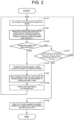
- FIG. 2 is a flowchart showing a procedure of capturing, storing, and recording images by the image recording device 100 according to the first embodiment.
- Step S101 the trigger controller 111 is on standby for receiving an operation signal from the loom 10. Then, the process proceeds to Step S102.
- Step S102 the timer 113 measures an elapsed time from one of reception of the operation signal by the trigger controller 111, reception of the captured image from the image capture unit 120 by the image controller 112, or storing of the image in the storage unit 140 under the control of the image controller 112, which has occurred most recently. Then, the process proceeds to Step S103.
- Step S103 the control unit 110 checks whether an operation signal has been received, and proceeds to Step S104 if the operation signal has been received. At this time, it is sufficient to check whether the trigger controller 111 in the control unit 110 has received an operation signal.
- Step S104 the trigger controller 111 generates a trigger signal based on the operation signal from the loom 10 and the timing adjustment value from the operation unit 130.
- the trigger controller 111 supplies the generated trigger signal to the light emitting unit 121 and the camera 122 of the image capture unit 120. Then, the process proceeds to Step S105.
- Step S105 the light emitting unit 121 emits strobe flashes of light in the capturing range of the loom 10 in accordance with the timing of the trigger signal from the trigger controller 111.
- the camera 122 captures the images of the weft yarn Y while the weft yarn Y travels in the capturing range in the loom 10 in accordance with the timing of the trigger signal from the trigger controller 111, and supplies the images generated by the capturing to the image controller 112. Then, the process proceeds to Step S106.
- Step S106 the image controller 112 stores the images generated by capturing the images by the image capture unit 120 in the storage unit 140. If the storage unit 140 has sufficient storage capacity, the image controller 112 stores new images in addition to the previous images. Furthermore, when the storage capacity of the storage unit 140 is a fixed limited capacity, the image controller 112 stores the newest images in the storage unit 140 so as to overwrite the oldest images stored in the storage unit 140. In other words, the storing of the images in the storage unit 140 is temporary keeping of the images. Then, the process returns to Step S101.
- Step S103 determines in Step S103 that an operation signal has not been received from the loom 10.
- Step S107 the control unit 110 checks whether any of the reception of the operation signal from the loom 10 before the predetermined period of time elapses, capturing of the images by the image capture unit 120 before the predetermined period of time elapses, or storing of the images in the storage unit 140 before the predetermined period of time elapses has occurred.
- the image controller 112 determines whether or not the elapsed time counted by the timer 113, which has started measurement in Step S102, exceeds a predetermined period of time.
- Step S107 If the control unit 110 checks in Step S107 that one of reception of the operation signal, capturing of the images, or storing of the captured images has been performed before the predetermined period of time elapses, the process returns to Step S101.
- Step S107 if the control unit 110 checks in Step S107 that none of reception of the operation signal before the predetermined period of time elapses, capturing of the images by the image capture unit 120 before the predetermined period of time elapses, or storing of the images in the storage unit 140 before the predetermined period of time elapses occurs, the process proceeds to Step S108.
- the control unit 110 may be configured to perform the checking in Step S107 based only on whether the operation signal is received before the predetermined period of time elapses/whether the operation signal is not received for the predetermined period of time or longer.
- Step S108 the control unit 110 performs a control so that a fixed number of the images captured most recently, of the images stored in storage unit 140, are recorded in record unit 150 as files.
- the fixed number of the images recorded in the record unit 150 means the images captured during a certain period of time immediately before the machine base 17 of the loom 10 stops.
- the recording of the images in the record unit 150 corresponds to saving of the images as files that can be output to the outside.
- the images recorded in the record unit 150 are output to the outside as the files under the control of the image controller 112 or in response to a request from the outside.
- the fixed number of the images recorded in the record unit 150 are the images necessary for checking that the travel state of the weft yarn Y gradually deteriorates until a weft insertion abnormality occurs, and corresponds to, for example, the images for about 30 picks of the weft yarn Y.
- the operator can identify circumstances and locations of a weft insertion abnormality, such as clogging or tangling of the weft yarn Y near an outlet of the nozzle, or a problem in introducing the weft yarn Y into a stretch pipe installed near the reed.
- a weft insertion abnormality such as clogging or tangling of the weft yarn Y near an outlet of the nozzle, or a problem in introducing the weft yarn Y into a stretch pipe installed near the reed.
- the image recording device 100 of the first embodiment it is possible to use the image recording device 100 of the first embodiment to reliably classify the type of a weft insertion abnormality, which cannot be accurately classified when the detection result of the conventional travel sensor 16 is used.
- the signal transmitted between the loom 10 and the image recording device 100 is only an operation signal from the loom 10, which is also used in the conventional camera-equipped stroboscope. Therefore, the loom 10 requires no modification. That is, there is no need to transmit the detection result of the weft insertion abnormality in the loom 10 to the image recording device 100, so that the configuration can be simplified.
- the image capture unit 120 includes the light emitting unit 121 that emits strobe flashes of light and the camera 122 that captures images in synchronization with the strobe flashes of light.
- the light emitting unit 121 may be omitted.
- the trigger controller 111, the image controller 112, and the timer 113 forming the control unit 110 do not have to be in the same or adjacent positions or conditions, but may be located at separate positions.
- the image recording device 100 of the first embodiment can be configured by connecting the image controller 112 and the storage unit 140 to the portable camera-equipped stroboscope SS including the trigger controller 111, the image capture unit 120, and the operation unit 130.
- the image recording device 100 since the signal wiring connection with the loom 10 is only for the operation signal, the loom 10 does not have to be modified, and the image recording device 100 may be configured simply.
- the storage unit 140 and the record unit 150 do not have to be physically connected to the image controller 112, and for example, a storage of an external server may be used.
- the trigger controller 111, the image controller 112, and the timer 113 included in the control unit 110 may be independent circuits or devices, or implemented in a single processor.
- the units of the image recording device 100 may receive electric power from a service outlet of the loom 10 or the like.
- the image controller 112 may add time information at the time of capturing or storing the images as a timestamp. In this case, the image controller 112 can distinguish a normal stop due to the end of operation of the loom 10 from a stop due to the weft insertion abnormalities by comparing the latest timestamp added to the images stored in the storage unit 140 with the time of the end of the operation of the loom 10. Furthermore, the image controller 112 can easily check whether images has been captured or stored in Step S107 by comparing the latest timestamp added to the images stored in storage unit 140 with the current time.
- control unit 110 may optimize the checking process efficiently by appropriately changing the predetermined period of time used for the checking in Step S107 in accordance with the change in the interval between the operation signals.
- the image recording device 100 includes: the image capture unit 120 configured to capture an image of the weft yarn Y while the weft yarn Y travels; the storage unit 140 configured to store the image generated by capturing the image; and the control unit 110 configured to control capturing, storing, and recording of the image, the control unit 110 including a trigger controller 111 that generates a trigger signal based on an operation signal generated in accordance with an operation of the loom 10, an image controller 112 that causes the storage unit 140 to store the image generated by capturing the image by the image capture unit 120, and reads out the image stored in the storage unit 140 and records it in the record unit 150, and a timer 113 that measures an elapsed time from one of reception of the operation signal by the trigger controller 111, capturing of the image by the image capture unit 120, or storing of the image in the storage unit 140 by the image controller 112.
- the image controller 112 reads out the image stored in the storage unit 140 and records the image in the record unit 150 .
- the predetermined period of time used for checking the weft insertion abnormality is determined in accordance with the rotation speed of the machine base included in the loom 10. This allows the checking process to be optimized efficiently.
- the image controller 112 adds time information at a time of capturing the image or time information at a time of storing the image, as a timestamp, to the image generated by capturing the image.
- the image capture unit 120 includes the light emitting unit 121 and the camera 122, and executes the emission of strobe flashes of light by the light emitting unit 121 and capturing of the image while the weft yarn travels by the camera 122 based on the trigger signal.
- the image capture unit 120 executes the emission of strobe flashes of light by the light emitting unit 121 and capturing of the image while the weft yarn travels by the camera 122 based on the trigger signal.
Landscapes
- Engineering & Computer Science (AREA)
- Textile Engineering (AREA)
- Looms (AREA)
Applications Claiming Priority (2)
| Application Number | Priority Date | Filing Date | Title |
|---|---|---|---|
| JP2022008430A JP7574811B2 (ja) | 2022-01-24 | 2022-01-24 | 織機の画像記録装置 |
| PCT/JP2023/001976 WO2023140384A1 (fr) | 2022-01-24 | 2023-01-23 | Dispositif d'enregistrement d'image pour métier à tisser |
Publications (2)
| Publication Number | Publication Date |
|---|---|
| EP4471200A1 true EP4471200A1 (fr) | 2024-12-04 |
| EP4471200A4 EP4471200A4 (fr) | 2025-05-14 |
Family
ID=87348393
Family Applications (1)
| Application Number | Title | Priority Date | Filing Date |
|---|---|---|---|
| EP23743376.8A Pending EP4471200A4 (fr) | 2022-01-24 | 2023-01-23 | Dispositif d'enregistrement d'image pour métier à tisser |
Country Status (4)
| Country | Link |
|---|---|
| EP (1) | EP4471200A4 (fr) |
| JP (1) | JP7574811B2 (fr) |
| CN (1) | CN118574957A (fr) |
| WO (1) | WO2023140384A1 (fr) |
Family Cites Families (7)
| Publication number | Priority date | Publication date | Assignee | Title |
|---|---|---|---|---|
| JPS55118121U (fr) | 1979-02-13 | 1980-08-21 | ||
| DE4142356A1 (de) * | 1990-12-28 | 1992-07-02 | Nissan Motor | Einschuss-ueberwachungssystem fuer eine webmaschine |
| WO1993010296A1 (fr) * | 1991-11-22 | 1993-05-27 | Nissan Motor Co., Ltd. | Dispositif de commande dans un metier a tisser |
| JP4145385B2 (ja) | 1998-05-19 | 2008-09-03 | 津田駒工業株式会社 | 織機の緯糸フィーラ装置 |
| JP3982809B2 (ja) | 2002-09-06 | 2007-09-26 | 津田駒工業株式会社 | 織機の不良内容表示装置 |
| EP4055222A4 (fr) | 2019-11-04 | 2023-11-15 | Uster Technologies Ltd. | Procédés et systèmes de collecte d'images multiples dans un système d'inspection de tissu sur métier |
| CN111337502A (zh) * | 2020-03-17 | 2020-06-26 | 任圆 | 一种机器视觉检测织网拉断系统及其实现方法 |
-
2022
- 2022-01-24 JP JP2022008430A patent/JP7574811B2/ja active Active
-
2023
- 2023-01-23 CN CN202380017423.1A patent/CN118574957A/zh active Pending
- 2023-01-23 EP EP23743376.8A patent/EP4471200A4/fr active Pending
- 2023-01-23 WO PCT/JP2023/001976 patent/WO2023140384A1/fr not_active Ceased
Also Published As
| Publication number | Publication date |
|---|---|
| JP2023107308A (ja) | 2023-08-03 |
| JP7574811B2 (ja) | 2024-10-29 |
| EP4471200A4 (fr) | 2025-05-14 |
| WO2023140384A1 (fr) | 2023-07-27 |
| CN118574957A (zh) | 2024-08-30 |
Similar Documents
| Publication | Publication Date | Title |
|---|---|---|
| JP7156201B2 (ja) | 織機の緯糸欠点判定装置 | |
| CN105518195A (zh) | 用于织布机的监控装置、织布机及监控方法 | |
| US4215728A (en) | Electronic thread travel monitoring device | |
| CN104630976B (zh) | 用于喷气织机的纬纱检测器 | |
| EP4471200A1 (fr) | Dispositif d'enregistrement d'image pour métier à tisser | |
| CN112030328A (zh) | 织机的开口不良检测装置 | |
| KR101616413B1 (ko) | Iot 플랫폼 기반의 직조기 모니터링 및 관리 시스템 | |
| JP3238799U (ja) | 織機における緯糸不足検出用の光学機器 | |
| JP2017089020A (ja) | エアジェット織機における緯糸検出方法 | |
| US4784189A (en) | Device for surveying the insertion of a weft yarn | |
| CN109943957B (zh) | 喷气式织机的引纬诊断方法 | |
| JP4449186B2 (ja) | 部品検出方法及び部品実装機 | |
| EP4726086A1 (fr) | Système d'observation pour métier à tisser | |
| EP0584738A1 (fr) | Dispositif pour l'extraction d'un fil de trame défectueux sur un métier à tisser | |
| CS203010B2 (en) | Method of and apparatus for detecting faulty weft picks in weaving machines | |
| EP3348688B1 (fr) | Procédé de diagnostic d'insertion de trame dans un métier à tisser à jet d'air et appareil de diagnostic d'insertion de trame dans un métier à tisser à jet d'air | |
| JPS6324145Y2 (fr) | ||
| US6014991A (en) | Method of monitoring the function of a stop motion arrangement in an air jet loom | |
| JP4128458B2 (ja) | 織機における緯糸検知方法 | |
| JP2777738B2 (ja) | 空気噴射式織機のよこ入れ関連部材良否判定装置 | |
| JP2001181945A (ja) | 緯糸センサ異常検出装置 | |
| CA1137386A (fr) | Systeme et methode de mise en panne d'un metier a tisser | |
| CN110658214A (zh) | 织机的织疵检查方法和织机的织疵检查装置 | |
| JP2739396B2 (ja) | 織機の停止原因の訂正方法 | |
| JP3060061B2 (ja) | 織機における給糸体の緯糸排出方法 |
Legal Events
| Date | Code | Title | Description |
|---|---|---|---|
| STAA | Information on the status of an ep patent application or granted ep patent |
Free format text: STATUS: THE INTERNATIONAL PUBLICATION HAS BEEN MADE |
|
| PUAI | Public reference made under article 153(3) epc to a published international application that has entered the european phase |
Free format text: ORIGINAL CODE: 0009012 |
|
| STAA | Information on the status of an ep patent application or granted ep patent |
Free format text: STATUS: REQUEST FOR EXAMINATION WAS MADE |
|
| 17P | Request for examination filed |
Effective date: 20240625 |
|
| AK | Designated contracting states |
Kind code of ref document: A1 Designated state(s): AL AT BE BG CH CY CZ DE DK EE ES FI FR GB GR HR HU IE IS IT LI LT LU LV MC ME MK MT NL NO PL PT RO RS SE SI SK SM TR |
|
| DAV | Request for validation of the european patent (deleted) | ||
| DAX | Request for extension of the european patent (deleted) | ||
| A4 | Supplementary search report drawn up and despatched |
Effective date: 20250411 |
|
| RIC1 | Information provided on ipc code assigned before grant |
Ipc: D03D 47/30 20060101ALI20250407BHEP Ipc: D03D 47/28 20060101AFI20250407BHEP |
|
| GRAP | Despatch of communication of intention to grant a patent |
Free format text: ORIGINAL CODE: EPIDOSNIGR1 |
|
| STAA | Information on the status of an ep patent application or granted ep patent |
Free format text: STATUS: GRANT OF PATENT IS INTENDED |
|
| INTG | Intention to grant announced |
Effective date: 20260212 |