EP4471209A1 - Papier poreux à faible opacité - Google Patents
Papier poreux à faible opacité Download PDFInfo
- Publication number
- EP4471209A1 EP4471209A1 EP23177037.1A EP23177037A EP4471209A1 EP 4471209 A1 EP4471209 A1 EP 4471209A1 EP 23177037 A EP23177037 A EP 23177037A EP 4471209 A1 EP4471209 A1 EP 4471209A1
- Authority
- EP
- European Patent Office
- Prior art keywords
- paper product
- fibers
- less
- fibrous web
- paper
- Prior art date
- Legal status (The legal status is an assumption and is not a legal conclusion. Google has not performed a legal analysis and makes no representation as to the accuracy of the status listed.)
- Pending
Links
Images
Classifications
-
- D—TEXTILES; PAPER
- D21—PAPER-MAKING; PRODUCTION OF CELLULOSE
- D21H—PULP COMPOSITIONS; PREPARATION THEREOF NOT COVERED BY SUBCLASSES D21C OR D21D; IMPREGNATING OR COATING OF PAPER; TREATMENT OF FINISHED PAPER NOT COVERED BY CLASS B31 OR SUBCLASS D21G; PAPER NOT OTHERWISE PROVIDED FOR
- D21H27/00—Special paper not otherwise provided for, e.g. made by multi-step processes
- D21H27/06—Vegetable or imitation parchment; Glassine paper
-
- D—TEXTILES; PAPER
- D21—PAPER-MAKING; PRODUCTION OF CELLULOSE
- D21C—PRODUCTION OF CELLULOSE BY REMOVING NON-CELLULOSE SUBSTANCES FROM CELLULOSE-CONTAINING MATERIALS; REGENERATION OF PULPING LIQUORS; APPARATUS THEREFOR
- D21C9/00—After-treatment of cellulose pulp, e.g. of wood pulp, or cotton linters ; Treatment of dilute or dewatered pulp or process improvement taking place after obtaining the raw cellulosic material and not provided for elsewhere
-
- D—TEXTILES; PAPER
- D21—PAPER-MAKING; PRODUCTION OF CELLULOSE
- D21H—PULP COMPOSITIONS; PREPARATION THEREOF NOT COVERED BY SUBCLASSES D21C OR D21D; IMPREGNATING OR COATING OF PAPER; TREATMENT OF FINISHED PAPER NOT COVERED BY CLASS B31 OR SUBCLASS D21G; PAPER NOT OTHERWISE PROVIDED FOR
- D21H11/00—Pulp or paper, comprising cellulose or lignocellulose fibres of natural origin only
-
- D—TEXTILES; PAPER
- D21—PAPER-MAKING; PRODUCTION OF CELLULOSE
- D21H—PULP COMPOSITIONS; PREPARATION THEREOF NOT COVERED BY SUBCLASSES D21C OR D21D; IMPREGNATING OR COATING OF PAPER; TREATMENT OF FINISHED PAPER NOT COVERED BY CLASS B31 OR SUBCLASS D21G; PAPER NOT OTHERWISE PROVIDED FOR
- D21H17/00—Non-fibrous material added to the pulp, characterised by its constitution; Paper-impregnating material characterised by its constitution
- D21H17/03—Non-macromolecular organic compounds
- D21H17/05—Non-macromolecular organic compounds containing elements other than carbon and hydrogen only
- D21H17/14—Carboxylic acids; Derivatives thereof
- D21H17/15—Polycarboxylic acids, e.g. maleic acid
- D21H17/16—Addition products thereof with hydrocarbons
-
- D—TEXTILES; PAPER
- D21—PAPER-MAKING; PRODUCTION OF CELLULOSE
- D21H—PULP COMPOSITIONS; PREPARATION THEREOF NOT COVERED BY SUBCLASSES D21C OR D21D; IMPREGNATING OR COATING OF PAPER; TREATMENT OF FINISHED PAPER NOT COVERED BY CLASS B31 OR SUBCLASS D21G; PAPER NOT OTHERWISE PROVIDED FOR
- D21H19/00—Coated paper; Coating material
- D21H19/10—Coatings without pigments
- D21H19/14—Coatings without pigments applied in a form other than the aqueous solution defined in group D21H19/12
- D21H19/18—Coatings without pigments applied in a form other than the aqueous solution defined in group D21H19/12 comprising waxes
-
- D—TEXTILES; PAPER
- D21—PAPER-MAKING; PRODUCTION OF CELLULOSE
- D21H—PULP COMPOSITIONS; PREPARATION THEREOF NOT COVERED BY SUBCLASSES D21C OR D21D; IMPREGNATING OR COATING OF PAPER; TREATMENT OF FINISHED PAPER NOT COVERED BY CLASS B31 OR SUBCLASS D21G; PAPER NOT OTHERWISE PROVIDED FOR
- D21H21/00—Non-fibrous material added to the pulp, characterised by its function, form or properties; Paper-impregnating or coating material, characterised by its function, form or properties
- D21H21/14—Non-fibrous material added to the pulp, characterised by its function, form or properties; Paper-impregnating or coating material, characterised by its function, form or properties characterised by function or properties in or on the paper
- D21H21/22—Agents rendering paper porous, absorbent or bulky
-
- D—TEXTILES; PAPER
- D21—PAPER-MAKING; PRODUCTION OF CELLULOSE
- D21H—PULP COMPOSITIONS; PREPARATION THEREOF NOT COVERED BY SUBCLASSES D21C OR D21D; IMPREGNATING OR COATING OF PAPER; TREATMENT OF FINISHED PAPER NOT COVERED BY CLASS B31 OR SUBCLASS D21G; PAPER NOT OTHERWISE PROVIDED FOR
- D21H21/00—Non-fibrous material added to the pulp, characterised by its function, form or properties; Paper-impregnating or coating material, characterised by its function, form or properties
- D21H21/14—Non-fibrous material added to the pulp, characterised by its function, form or properties; Paper-impregnating or coating material, characterised by its function, form or properties characterised by function or properties in or on the paper
- D21H21/26—Agents rendering paper transparent or translucent
-
- D—TEXTILES; PAPER
- D21—PAPER-MAKING; PRODUCTION OF CELLULOSE
- D21H—PULP COMPOSITIONS; PREPARATION THEREOF NOT COVERED BY SUBCLASSES D21C OR D21D; IMPREGNATING OR COATING OF PAPER; TREATMENT OF FINISHED PAPER NOT COVERED BY CLASS B31 OR SUBCLASS D21G; PAPER NOT OTHERWISE PROVIDED FOR
- D21H27/00—Special paper not otherwise provided for, e.g. made by multi-step processes
- D21H27/10—Packing paper
Definitions
- Transparent or translucent materials are used in all different types of applications. Transparency, for instance, is a highly desirable quality in packaging materials. For example, although packaging materials are necessary to protect products during shipping and sales, consumers prefer to be able to view the product through the packaging.
- plastic materials such as polyester polymers and polyolefin polymers.
- plastic materials are derived from non-renewable, fossil resources, including petroleum-based resources. These resources are not sustainable, are not renewable, and produce polymer products that do not readily degrade. Thus, efforts have been made in the past in an attempt to produce transparent or translucent materials from renewable resources, such as cellulose materials.
- Transparent paper products for instance, have been used in the form of tracing paper, clear windows for envelopes, and more recently packaging paper for cereals, pasta, or bakery products.
- non-renewable resources or components that do not readily biodegrade were combined with the paper.
- one type of paper produced in the past was manufactured from wood pulp fibers that may have been combined with an enzyme, such as xylanase. These substrates typically had a relatively high basis weight in order to provide sufficient strength or other mechanical properties.
- the paper was combined with petroleum-based chemicals or synthesized resins and then fed through a supercalendering process. As used herein, during supercalendering, a paper is first calendered by pressing it between metal cylinders or rollers.
- the paper is sent through an additional set of calenders to produce an even smoother and glossier paper, referred to as a supercalendered paper.
- the supercalender includes several cylinders alternating between polished metal and soft resilient surfaces. The supercalender applies pressure, heat, and friction to glaze both surfaces of the paper to make the paper smooth and/or glossy.
- the present disclosure is directed to a paper product with low opacity characteristics.
- the paper product comprises a fibrous web containing cellulose fibers. At least part of the cellulose fibers contained in the web is unrefined as may be measured according to a freeness value.
- the freeness value (° SR) measures generally the rate at which a dilute suspension of refined fibers may be drained. The freeness is measured by the Schopper Riegler Method for drainability. As used herein, freeness can be measured according to DIN EN ISO 5267-1 :2000.
- the cellulose fibers contained in the web for example, can have a degree of refining of less than about 25° SR, such as less than about 20° SR, such as less than about 15° SR.
- the fibers generally have a freeness value of greater than about 5° SR.
- the basis weight of the fibrous web can be, in one aspect, from about 13 g/m 2 to about 60 g/m 2 , including all increments of 1 g/m 2 therebetween. In one aspect, the fibrous web can have a relatively low basis weight. For instance, the basis weight of the web can be less than about 55 g/m 2 , such as less than about 37 g/m 2 , and generally greater than about 13 g/m 2 .
- the fibrous web defines a first surface and a second surface. As will be readily understood by the skilled person, the first surface and the second surface are the main surfaces of the fibrous web, which may also be referred to as "upper" and lower" surface and are located opposite to each other.
- the paper product comprises a coating on a least one, preferably one, of the first surface and/or the second surface of the fibrous web.
- the coating comprises a transparency agent.
- the transparency agent comprises a bio-based wax or oil.
- Paper products made in accordance with the present disclosure can display an opacity of less than about 45% when tested according to ISO 2471:2008.
- the opacity can be less than about 40%, such as less than about 38%, such as less than about 36%.
- the transparency agent included in the coating is a plant or animal derived wax or oil.
- the transparency agent is a plant derived wax or oil.
- the transparency agent can be a coconut-based wax, a palm-based wax, and/or a soy-based wax.
- the paper product can be produced without containing any paraffins, mineral oils, or hydrocarbon oils.
- the paper product can be repulpable and compostable.
- the basis weight of the paper product can generally be from about 13 g/m 2 to about 60 g/m 2 , including all increments of 1 g/m 2 therebetween. In various embodiments, the basis weight of the paper product can be less than about 55 g/m 2 , such as less than about 50 g/m 2 , such as less than about 40 g/m 2 , and greater than about 13 g/m 2 .
- the paper product can contain cellulose fibers generally in an amount greater than about 50% by weight, such as in an amount greater than about 60% by weight, such as in an amount greater than about 65% by weight, such as in an amount greater than about 70% by weight, such as in an amount greater than about 75% by weight, such as in an amount greater than about 80% by weight. Cellulose fibers are generally present in the paper product in an amount less than about 95% by weight, such as in an amount less than about 90% by weight, such as in an amount less than about 85% by weight, such as in an amount less than about 80% by weight.
- the transparency agent can be present in the paper product generally in an amount greater than about 3 g/m 2 , such as in an amount greater than about 5 g/m 2 , such as in an amount greater than about 8 g/m 2 , such as in an amount greater than about 10 g/m 2 .
- the transparency agent can be present in the paper product in an amount less than about 30 g/m 2 , such as in an amount less than about 20 g/m 2 , such as in an amount less than about 15 g/m 2 .
- Permeability refers to air permeability and is measured as volumetric flow rate of air (cm 3 min -1 ) passing through a 1 cm 2 sample of substrate at an applied pressure difference of 1kPa (in short: cm 3 /min/cm 2 ).
- the paper product can display permeability of greater than about 350 cm 3 /min/cm 2 , such as greater than about 500 cm 3 /min/cm 2 , such as greater than about 1,000 cm 3 /min/cm 2 , such as greater than about 2,000 cm 3 /min/cm 2 , such as greater than about 3,000 cm 3 /min/cm 2 , such as greater than about 4,000 cm 3 /min/cm 2 .
- the porosity or permeability is generally less than about 30,000 cm 3 /min/cm 2 .
- the air permeability is measured according to ISO 2965:2009.
- the paper product Although having a high porosity or permeability, the paper product also displays barrier properties. For instance, the paper product can display a water drop resistance of greater than 10 min according to TAPPI T 432 cm-09 (2 ⁇ L of water drop is used).
- the paper product of the present disclosure can be used in numerous and diverse applications.
- the present disclosure is directed to a packaging paper made from the paper product.
- the present disclosure in another aspect, is also directed to a method for producing a low opacity paper product as described above.
- the method includes coating a fibrous web with an aqueous composition containing a transparency agent.
- the fibrous web can contain unrefined cellulose fibers.
- the transparency agent can comprise a bio-based wax or oil, such as a coconut-based wax, a palm-based wax and/or a soy-based wax.
- the fibrous web is impregnated with the aqueous composition containing the transparency agent using a size press.
- the transparency agent can be applied to the fibrous web by using an applicator roll, by a size-press, by a film-press, by spraying, or by using any suitable coating technique.
- the fibrous web can be a wetlaid web.
- the method of making the product can include combining the unrefined, cellulose fibers with water to form an aqueous suspension of fibers; depositing the aqueous suspension of fibers onto a porous forming surface to form a fibrous web; and coating the fibrous web with an aqueous composition containing the transparency agent.
- the porous forming surface can be an inclined surface.
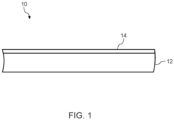
- Figure 1 is a cross-sectional schematic view of one embodiment of a low opacity paper made in accordance with the present disclosure.
- a "coating" on the surface(s) of the fibrous web can be obtained by applying a generally liquid coating agent on the surface(s) of the fibrous web by means of any suitable coating, impregnation or saturation technique, such as for example air knife coating, roll-to-roll coating, blade coating, spray coating, Mayer rod coating, direct gravure printing, offset gravure printing, reverse gravure printing, smooth roll coating, curtain coating, bead coating, slot coating, fill press coating or impregnation via a size press.
- the coating can be a continuous coating or a discontinuous coating. Accordingly, along the lateral dimension of the fibrous web, the coating can be present in a part of or the complete fibrous web.
- the coating composition When applying the coating composition to the fibrous web, it will penetrate into some of the internal spaces and pores between the fibers of the fibrous web resulting in saturation and/or impregnation of the fibrous web with the coating (composition). That is, in the present invention the coating will permeate into the fibrous web, in particular internal spaces and pores therein, and apart from this it can cover and preferably does cover at least part of the first and/or the second surface of the fibrous web in the form of a surface coating. In other words, a “coating” as understood herein covers the saturation and impregnation of the fibrous web.
- low opacity means transparent or translucent.
- a product is considered to have low opacity when the product displays an opacity of, e.g., less than about 45% when tested according to ISO 2471:2008.
- Low opacity characteristics refer to the characteristics which provide a paper product with transparency or translucency, such as the presence of a transparency agent.
- the term "transparency agent” refers to an agent which decreases the opacity of fibrous web when applied inside or on the fibrous web.
- examples include plant or animal derived waxes or oils, such as a coconut-based wax, a palm-based wax, and/or a soy-based wax. Plant or animal derived components as understood herein can be obtained from biomass.
- the transparency agent can be a bio-based wax or oil.
- biomass is broadly understood as encompassing all kinds of plant and animal material and material derived from the same. Biomass does not include petroleum or petroleum-derived products.
- the biomass for use in the present invention may comprise macromolecular compounds, examples of which are lignin and polysaccharides, such as starch, cellulose, hemicellulose commonly also referred to as polyose, glycogen and alginate.
- macromolecular compounds examples of which are lignin and polysaccharides, such as starch, cellulose, hemicellulose commonly also referred to as polyose, glycogen and alginate.
- biomass may include both plant and animal-derived material.
- manure (dung), night soil and sewage sludge can be mentioned.
- the biomass for use in the present invention is preferably plant biomass, i.e. biomass of or derived from plants, certain contents of animal biomass (i.e. biomass of or derived from animals) may be present therein.
- the biomass may contain up to 30 % of animal biomass.
- the biomass for use in the present disclosure which is preferably plant biomass, contains more than 70 wt%, most preferably more than 90 wt%, of polysaccharides and lignines in terms of the solid contents of the biomass.
- the plant biomass may be agricultural plant material (e.g. agricultural wastes) or all kinds of wood material.
- Biomass may be in the form of waxes and oils, including coconut, palm, and soy waxes and oil.
- a “biodegradable” component is a component that is capable of being decomposed by living organisms, such as bacteria or fungi.
- a biodegradable component can thus be decomposed by the action of microorganisms such as bacteria or fungi with or without oxygen.
- a biodegradable component fulfills the requirements of at least one of the international industrial standards ISO 14855:2018, ISO 14853:2017, and ASTM D5338:2015.
- the term "compostable” refers to components that can disintegrate into non-toxic, natural elements. Compostable components, for instance, can degrade at a rate consistent with similar organic materials. Compostable components degrade when exposed to microorganisms, humidity, and/or heat to yield a finished compost product. Coated papers made according to the present disclosure can be formulated to meet international industrial standards ISO 17088:2021, DIN EN 13432:2007, DIN EN 14995:2007, and/or ASTM 6400:2021 defines the requirements for industrially compostable components.
- Pulp refers to fibers from natural sources such as woody and non-woody plants.
- Woody plants include, for example, deciduous and coniferous trees.
- Non-woody plants include, for example, cotton, flax, esparto grass, milkweed, straw, jute, hemp, sisal, abaca and bagasse.
- Pulp fibers can include hardwood fibers, softwood fibers, and mixtures thereof.
- fibrous web refers to a sheet made from the pulp by a wetlaid process without coating.
- unrefined cellulose fibers refers to a fiber pulp which was used without any refining steps in the paper making.
- bio-based wax or oil refers to wax or oil which have a bio-based content more than 90% by weight.
- the "bio-based wax or oil” is preferably derived from plant biomass. Examples include coconut-based wax, a palm-based wax and/or a soy-based wax.
- regenerated cellulose fibers refers to fibers manufactured by the conversion of natural cellulose to a soluble cellulosic derivative and subsequent regeneration. Examples include rayon fibers, viscose fibers, lyocell fibers, and the like.
- the present disclosure is directed to a low opacity paper.
- the paper can be transparent.
- the paper can be formulated to be translucent.
- the low opacity paper of the present disclosure can be formed exclusively from sustainable resources that meets all of the requirements for entering the paper recycle stream after use.
- transparent papers typically contained components derived from fossil-based resources, such as petroleum-derived products.
- the low opacity paper of the present disclosure can be produced having over 90% bio-based content.
- the low opacity paper can be formulated to be paraffin-free.
- the low opacity paper can be constructed in order to meet all of the requirements for food contact and food handling.
- the low opacity paper of the present disclosure is formed from a fibrous web containing unrefined cellulose fibers.
- unrefined cellulose fibers By using unrefined cellulose fibers, less energy is needed in order to produce the web, thus providing further environmental benefits, especially compared to existing solutions.
- the air permeability of the product can also be controlled.
- a highly porous but low opacity paper product can be produced, which can provide various benefits. For example, higher air permeability products are particularly well suited for applications where breathability is important, such as when packaging bread, fruits or vegetables.
- the cellulose fibers comprised in the fibrous web of the paper product are unrefined cellulose fibers.
- the low opacity paper product of the present disclosure can have relatively high transparency (less than 45% of opacity) and can be manufactured without refining the cellulose fibers and without using a supercalender.
- products can be formed having a relatively high air permeability (higher than 350 cm 3 /min/cm 2 ) while still having excellent water resistance.
- the paper product displays excellent mechanical properties necessary for converting and handling.
- the opacity of the paper products can be less than about 40%, such as less than about 38%, such as less than about 36%, such as less than about 32%, such as less than about 28%, such as less than about 25%.
- the actual opacity can depend upon various factors and is generally greater than 1%, such as greater than about 5%.
- the above opacity levels make it possible to see printed matter through the paper product. For instance, bar codes, QR codes, and other machine-readable codes can be scanned through the paper product of the present disclosure.
- FIG. 1 represents a cross-sectional schematic view of the product 10.
- the low opacity paper 10 includes a paper base sheet 12 which is a fibrous web comprising cellulose fibers, wherein the cellulose fibers contain or are unrefined cellulose fibers.
- the fibrous web 12 for instance, can be a wetlaid paper web. In other embodiments, however, the fibrous web 12 can be made using any suitable papermaking technique.
- the fibrous web 12 includes a first surface opposite a second surface. Applied to the first surface of the fibrous web 12 is a coating 14.
- the low opacity paper 10 can be made exclusively from a single layer of a fibrous web in combination with the coating 14.
- the low opacity paper 10 can include a second coating (not shown) applied to the opposite surface of the fibrous web, such as a heat-sealable coating.
- the fibrous web 12 can be a wetlaid paper web containing unrefined cellulose fibers.
- the fibrous web can be formed from an aqueous suspension of fibers.
- the cellulose fibers contained in the fibrous web can be pulp fibers including wood pulp fibers, plant waste fibers, regenerated cellulose fibers, or other plant fibers.
- the aqueous suspension of fibers can be deposited onto a porous forming surface that allows water to drain thereby forming the fibrous web.
- the porous forming surface may be inclined, especially when the fiber furnish contains a significant amount of unrefined fibers.
- the fibrous web is made primarily from plant derived or natural fibers.
- Natural (plant derived) fibers may be selected from chemical pulp, such as sulphate and sulphite pulp, organosolv pulp, recycled fibers, and/or mechanical pulp, nanocellulose, and modifications and combinations thereof.
- the pulp may be a bleached or non-bleached pulp.
- the pulp may originate from hardwood or softwood, including birch, beech, aspen such as European aspen, alder, eucalyptus, maple, acacia, mixed tropical hardwood, pine such as loblolly pine, fir, hemlock, larch, spruce such as Black spruce or Norway spruce, and mixtures thereof.
- Non-wood plant fibers can also be used, such as seed hair fibers, leaf fibers, and bast fibers.
- Plant fibers can be provided from e.g. straws of grain crops, wheat straw, reed canary grass, reeds, flax, hemp, kenaf, jute, ramie, seed, sisal, abaca, coir, bamboo, bagasse, cotton kapok, milkweed, pineapple, cotton, rice, reed, esparto grass, Phalaris arundinacea, or combinations thereof.
- the fibrous web can contain regenerated cellulose fibers.
- Such fibers can include rayon fibers, lyocell fibers, viscose fibers, and mixtures thereof.
- the regenerated cellulose fibers can be present in the fibrous web in an amount from about 3% to about 50% by weight, such as from about 5% to about 15% by weight.
- the fibrous web can be primarily formed from the cellulose fibers without being combined with other components, such as fillers.
- the fibrous web (prior to coating) can contain cellulose fibers in an amount greater than about 90% by weight, such as in an amount greater than about 95% by weight.
- Particular cellulose fibers well suited to producing the fibrous web include softwood fibers, hardwood fibers, birch fibers, hemp fibers, flax fibers, or mixtures thereof.
- the fibrous web can be made exclusively from softwood fibers alone or in combination with hardwood fibers.
- the fibrous web can be made from a blend of wood pulp fibers, such as softwood fibers, with bast fibers, such as hemp fibers or flax fibers.
- the fiber furnish can include softwood fibers and/or hardwood fibers combined with leaf fibers, such as abaca fibers, sisal fibers, or mixtures thereof.
- leaf fibers such as abaca fibers, sisal fibers, or mixtures thereof.
- the entire fibrous web can be made from the leaf fibers described above.
- the cellulose fibers can be selected, for instance, in order to produce a web that can be efficiently drained from aqueous fluids during formation and that can produce a relatively low opacity paper while still retaining mechanical properties needed for processing and handling.
- the non-fibrous web contains unrefined fibers.
- the unrefined fibers can be defined by a freeness value as measured by the Schopper Riegler Method for drainability (ISO 5267-1:2000) that is expressed in the unit of "° SR". As a rule of thumb, the lower the value of °SR, the more unrefined the fibers are.
- the fibrous web can contain unrefined cellulose fibers in an amount greater than about 50% by weight, such as in an amount greater than about 60% by weight, such as in an amount greater than about 70% by weight, such as in an amount greater than about 80% by weight, such as in an amount greater than about 90% by weight, such as in an amount greater than about 95% by weight.
- the fibrous web is made entirely from unrefined cellulose fibers, such as softwood fibers, bast fibers, leaf fibers, or mixtures thereof.
- unrefined cellulose fibers not only reduces the energy requirements for producing the paper product of the present disclosure but can also offer various advantages. For instance, controlling the amount of unrefined fibers in the fibrous web can allow for control over the air permeability of the resulting paper product.
- the paper products of the present disclosure can have low opacity characteristics while still having a air permeability of greater than about 500 cm 3 /min/cm 2 , such as greater than about 750 cm 3 /min/cm 2 , such as greater than about 1,000 cm 3 /min/cm 2 , such as greater than about 1,250 cm 3 /min/cm 2 , such as greater than about 1,500 cm 3 /min/cm 2 , such as greater than about 1,750 cm 3 /min/cm 2 , such as greater than about 2,000 cm 3 /min/cm 2 , such as greater than about 2,250 cm 3 /min/cm 2 , such as greater than about 2,500 cm 3 /min/cm 2 , such as greater than about 2,750 cm 3 /min/cm 2 , such as greater than about 3,000 cm 3 /min/cm 2 , such as greater than about 3,225 cm 3 /min/cm 2 , such as greater than about 3,500 cm 3 /min/cm 2
- the air permeability of the paper product is generally less than about 30,000 cm 3 /min/cm 2 , such as less than about 20,000 cm 3 /min/cm 2 , such as less than about 10,000 cm 3 /min/cm 2 , such as less than about 7,000 cm 3 /min/cm 2 .
- the air permeability can be less than about 3,000 cm 3 /min/cm 2 , such as less than about 2,000 cm 3 /min/cm 2 , such as less than about 1,000 cm 3 /min/cm 2 .
- the basis weight of the fibrous web used to form the paper product of the present disclosure can vary depending upon the particular application and the desired result.
- the basis weight of the fibrous web can be from about 13 g/m 2 to about 60 g/m 2 , including all increments of 1 g/m 2 therebetween.
- the fibrous web can have a relatively high basis weight that is greater than about 30 g/m 2 , such as greater than about 34 g/m 2 , and less than about 55 g/m 2 , such as less than about 53 g/m 2 .
- the basis weight of the fibrous web can be from about 40 g/m 2 to about 60 g/m 2 .
- the basis weight of the fibrous web can be from about 30 g/m 2 to about 40 g/m 2 .
- a coating is applied to the fibrous web.
- the coating comprises a transparency agent that is applied to the fibrous web.
- the transparency agent can comprise a bio-based wax or oil.
- the bio-based wax or oil for instance, can be derived from animal or plant biomass.
- the transparency agent can be a bio-based wax or oil derived from at least 80% by weight vegetable oils, such as at least about 90% by weight vegetable oils, such as up to 100% by weight vegetable oils.
- the bio-based wax or oil can be paraffin-free and can be free of mineral oil saturated hydrocarbons and mineral oil aromatic hydrocarbons.
- the transparency agent can meet all government requirements for food contact and food handling.
- the low opacity paper of the present disclosure can meet all of the requirements of FDA 21 CFR ⁇ 176.180 which is directed to components of paper and paperboard that is in contact with dry food.
- the transparency agent and the low opacity paper can also meet all of the requirements of European Commission Regulation No. 1935/2004 regarding materials and articles intended to come in contact with food.
- the transparency agent comprises a bio-based wax that is a coconut-based wax, a palm-based wax, a soy-based wax or mixtures thereof.
- the transparency agent is a coconut-based wax or oil.
- the coconut-based wax can have a melting point of from about 25 degrees C to about 45 degrees C, such as from about 30 degrees C to about 40 degrees C.
- the coconut-based wax can be applied to the fibrous web as an anionic, aqueous dispersion.
- the transparency agent can be a palm-based wax or oil.
- the palm-based wax can have a melting point of from about 50 degrees C to about 70 degrees C, such as from about 55 degrees C to about 65 degrees C.
- the palm-based wax can be applied to the fibrous web as an anionic, aqueous dispersion.
- the transparency agent can be a soy-based wax that may be applied to the fibrous web as an aqueous cationic emulsion having a melting point of from about 55 degrees C to about 80 degrees C, such as from about 63 degrees C to about 72 degrees C.
- the fibrous web can be calendered without being supercalendered.
- a plain filigree press may be used for a glazing effect on the surface of the product.
- the calender rolls can include a hard roll opposite a soft roll.
- the pressure applied to the coated paper can be greater than about 200 kPa (2 bar), such as greater than about 400 kPa (4 bar), such as greater than about 500 kPa (5 bar), and generally less than about 1200 kPa (12 bar), such as less than about 1000 kPa (10 bar), such as less than about 800 kPa (8 bar), such as less than about 700 kPa (7 bar).
- Calendering can occur at ambient temperature or, alternatively, one or both of the calender rolls can be heated.
- the transparency agent can be applied to the fibrous web in an amount less than about 30 g/m 2 , such as in an amount less than about 20 g/m 2 , such as in an amount less than about 15 g/m 2 , such as in an amount less than about 10 g/m 2 .
- the amount of transparency agent incorporated into the low opacity paper can also be described on a weight percentage basis, based on the weight of the product.
- the transparency agent such as a bio-based wax
- the transparency agent can be present in the coated paper in an amount of from about 5% by weight to about 50% by weight, including all increments of 1% by weight therebetween.
- the transparency agent can be incorporated into the coated paper in an amount greater than about 5% by weight, such as in an amount greater than about 7% by weight, such as in an amount greater than about 10% by weight, such as in an amount greater than about 13% by weight, such as in an amount greater than about 16% by weight.
- the transparency agent can be present in the coated paper, in one aspect, in an amount less than about 50% by weight, such as in an amount less than about 40% by weight, such as in an amount less than about 30% by weight, such as in an amount less than about 25% by weight, such as in an amount less than about 22% by weight, such as in an amount less than about 20% by weight such as in an amount less than about 18% by weight such as in an amount less than about 15% by weight.
- the coating composition applied to the fibrous web can contain at least one coloring agent.
- the coloring agent can be a die, a pigment, or mixtures thereof. In this manner, the final product can display a color and remain translucent.
- the transparency agent can improve various properties and characteristics of the coated paper. For instance, the transparency agent can increase the transparency and/or decrease the opacity of the final product. The transparency agent can also reduce the air permeability of the low opacity paper and increase the barrier properties of the paper.
- Low opacity papers made according to the present disclosure not only display low opacity but also display a beneficial blend of other properties.
- the paper product of the present disclosure can display a tensile strength in at least one direction of greater than about 2,000 cN/30mm, such as greater than about 2,500 cN/30mm, such as greater than about 3,000 cN/30mm, such as greater than about 3,500 cN/30 mm, and less than about 10,000 cN/30mm.
- the elongation in at least one direction can be greater than about 1.2 %, such as greater than about 1.4 %, and less than about 3 %, such as less than about 2.5 %, such as less than about 2 %.
- the tensile strength and elongation are measured according to ISO 1924-2:2008. The measurements are made on a paper band that is 30 mm wide at a speed 10 mm/min.
- the low opacity paper can also have a water drop resistance greater than 10 min according to TAPPI T 432 cm-09.
- the low opacity paper can be laminated to a paper or a paperboard and formed into a container, such as a box or a bag.
- the low opacity paper can be used as a tracing paper.
- the present disclosure is also directed to a method for producing a low opacity paper.
- the method includes forming a fibrous web from a fiber furnish.
- the fibrous web for instance, can be a wetlaid web.
- the fibrous web is then coated with an aqueous composition containing the transparency agent as described above.
- Any suitable technique can be used to coat the fibrous web.
- the fibrous web can be coated using a size press, air knife or bar coating.
- a paper product (10) comprises: a paper base sheet (12) comprising a fibrous web comprising unrefined cellulose fibers, the fibrous web having a basis weight of from 20 to 25 g/m 2 , , wherein the unrefined cellulose are softwood fibers; and a coating (14) comprising a transparency agent, wherein the transparency agent is a coconut-based wax, a palm-based wax or a soy-based wax; and wherein the paper product displays an opacity of less than 30%, preferably less than 25%, when tested according to ISO 2471:2008, and wherein the paper product has a basis weight less than 40 g/m 2 and an air permeability of greater than 3000 cm 3 /min/cm 2 and less than 6000 cm 3 /min/cm 2 .
- a paper product (10) comprises: a paper base sheet (12) comprising a fibrous web containing unrefined cellulose fibers, the fibrous web having a basis weight of from 30 to 55 g/m 2 , preferably 35 to 50 g/m 2 , wherein the unrefined cellulose are softwood fibers; and a coating (14) comprising a transparency agent, wherein the transparency agent is a coconut-based wax; and wherein the paper product displays an opacity of less than 40%, when tested according to ISO 2471:2008, and wherein the paper product has a basis weight less than 72 g/m 2 and an air permeability of greater than 500 cm 3 /min/cm 2 and less than 2000 cm 3 /min/cm 2 .
- Low opacity papers were made in accordance with the present disclosure and tested for various properties. Uncoated basesheets (fibrous webs) were also tested for purposes of comparison.
- a fibrous web was constructed having a basis weight of 22 g/m 2 .
- the fibrous web was formed from 100% unrefined softwood fibers using an inclined wire paper machine.
- Various transparency agents were applied to the fibrous web using a bar coating as follows:
- the coconut-based wax and the palm-based wax were both applied to the fibrous web as anionic aqueous dispersions.
- the soy-based wax was applied to the fibrous web as a cationic emulsion.
- the samples were tested for opacity, mechanical properties, permeability, and water drop resistance. The following results were obtained: Base paper 22 g/m 2 Sample No. 1 Sample No. 2 Sample No. 3 Sample No.
- the opacity of the samples made in accordance with the present disclosure decreased by more than about 20%, such as by more than about 30%, such as by more than about 35% in comparison to the base paper. Water drop resistance dramatically increased while the product still had high air permeability characteristics.
Landscapes
- Life Sciences & Earth Sciences (AREA)
- Engineering & Computer Science (AREA)
- Wood Science & Technology (AREA)
- Paper (AREA)
Priority Applications (6)
| Application Number | Priority Date | Filing Date | Title |
|---|---|---|---|
| EP23177037.1A EP4471209A1 (fr) | 2023-06-02 | 2023-06-02 | Papier poreux à faible opacité |
| CN202480034532.9A CN121175466A (zh) | 2023-06-02 | 2024-05-29 | 多孔的低不透明度纸 |
| KR1020257043485A KR20260018904A (ko) | 2023-06-02 | 2024-05-29 | 다공성, 저 불투명도 종이 |
| AU2024278919A AU2024278919A1 (en) | 2023-06-02 | 2024-05-29 | Porous, low opacity paper |
| PCT/EP2024/064734 WO2024246107A1 (fr) | 2023-06-02 | 2024-05-29 | Papier poreux à faible opacité |
| EP24730291.2A EP4720410A1 (fr) | 2023-06-02 | 2024-05-29 | Papier poreux à faible opacité |
Applications Claiming Priority (1)
| Application Number | Priority Date | Filing Date | Title |
|---|---|---|---|
| EP23177037.1A EP4471209A1 (fr) | 2023-06-02 | 2023-06-02 | Papier poreux à faible opacité |
Publications (1)
| Publication Number | Publication Date |
|---|---|
| EP4471209A1 true EP4471209A1 (fr) | 2024-12-04 |
Family
ID=86688505
Family Applications (2)
| Application Number | Title | Priority Date | Filing Date |
|---|---|---|---|
| EP23177037.1A Pending EP4471209A1 (fr) | 2023-06-02 | 2023-06-02 | Papier poreux à faible opacité |
| EP24730291.2A Pending EP4720410A1 (fr) | 2023-06-02 | 2024-05-29 | Papier poreux à faible opacité |
Family Applications After (1)
| Application Number | Title | Priority Date | Filing Date |
|---|---|---|---|
| EP24730291.2A Pending EP4720410A1 (fr) | 2023-06-02 | 2024-05-29 | Papier poreux à faible opacité |
Country Status (5)
| Country | Link |
|---|---|
| EP (2) | EP4471209A1 (fr) |
| KR (1) | KR20260018904A (fr) |
| CN (1) | CN121175466A (fr) |
| AU (1) | AU2024278919A1 (fr) |
| WO (1) | WO2024246107A1 (fr) |
Citations (5)
| Publication number | Priority date | Publication date | Assignee | Title |
|---|---|---|---|---|
| US20040091585A1 (en) * | 2002-11-08 | 2004-05-13 | Theisen John A. | Treated paper product, combination food and treated paper product, and methods for manufacturing and using treated paper product |
| DE102014119572A1 (de) * | 2014-12-23 | 2016-06-23 | Delfortgroup Ag | Umweltfreundliches Verpackungspapier für Lebensmittel |
| EP3483337A1 (fr) * | 2017-11-14 | 2019-05-15 | Arjo Wiggins Fine Papers Limited | Papier translucide ou transparent recyclable et repulpable à utiliser pour des applications d'emballage |
| US20200253267A1 (en) * | 2019-02-11 | 2020-08-13 | Schweitzer-Mauduit International, Inc. | Cocoa Wrapper For Smoking Articles |
| WO2022243445A1 (fr) * | 2021-05-21 | 2022-11-24 | Neenah Gessner Gmbh | Papier couché destiné à être utilisé comme matériau d'emballage |
-
2023
- 2023-06-02 EP EP23177037.1A patent/EP4471209A1/fr active Pending
-
2024
- 2024-05-29 KR KR1020257043485A patent/KR20260018904A/ko active Pending
- 2024-05-29 AU AU2024278919A patent/AU2024278919A1/en active Pending
- 2024-05-29 EP EP24730291.2A patent/EP4720410A1/fr active Pending
- 2024-05-29 CN CN202480034532.9A patent/CN121175466A/zh active Pending
- 2024-05-29 WO PCT/EP2024/064734 patent/WO2024246107A1/fr not_active Ceased
Patent Citations (5)
| Publication number | Priority date | Publication date | Assignee | Title |
|---|---|---|---|---|
| US20040091585A1 (en) * | 2002-11-08 | 2004-05-13 | Theisen John A. | Treated paper product, combination food and treated paper product, and methods for manufacturing and using treated paper product |
| DE102014119572A1 (de) * | 2014-12-23 | 2016-06-23 | Delfortgroup Ag | Umweltfreundliches Verpackungspapier für Lebensmittel |
| EP3483337A1 (fr) * | 2017-11-14 | 2019-05-15 | Arjo Wiggins Fine Papers Limited | Papier translucide ou transparent recyclable et repulpable à utiliser pour des applications d'emballage |
| US20200253267A1 (en) * | 2019-02-11 | 2020-08-13 | Schweitzer-Mauduit International, Inc. | Cocoa Wrapper For Smoking Articles |
| WO2022243445A1 (fr) * | 2021-05-21 | 2022-11-24 | Neenah Gessner Gmbh | Papier couché destiné à être utilisé comme matériau d'emballage |
Also Published As
| Publication number | Publication date |
|---|---|
| KR20260018904A (ko) | 2026-02-09 |
| WO2024246107A1 (fr) | 2024-12-05 |
| EP4720410A1 (fr) | 2026-04-08 |
| AU2024278919A1 (en) | 2025-11-27 |
| CN121175466A (zh) | 2025-12-19 |
Similar Documents
| Publication | Publication Date | Title |
|---|---|---|
| EP2094910B2 (fr) | Procédé de production d'un produit en papier | |
| WO2022129674A1 (fr) | Papier barrière couché revêtu d'une dispersion | |
| EP3746598B1 (fr) | Processus pour la production d'un film comprenant de la cellulose microfibrillée | |
| EP4031710A1 (fr) | Composition, film ou revêtement comprenant de la cellulose microfibrillée et un produit d'extraction provenant d'écorce de bois ou de bois de liège | |
| CN119365653A (zh) | 热封阻隔材料 | |
| EP4471209A1 (fr) | Papier poreux à faible opacité | |
| US20240401277A1 (en) | Porous, low opacity paper | |
| EP4471210A1 (fr) | Papier à faible opacité | |
| US20240401276A1 (en) | Low opacity paper | |
| EP4471207A1 (fr) | Matériau d'emballage en papier à faible opacité | |
| US20240401280A1 (en) | Low opacity paper packaging material | |
| CA3248642A1 (fr) | Composition de pâte de cellulose hautement raffinée avec pâte de cellulose raffinée par compression | |
| NZ576930A (en) | Method of producing a paper product | |
| WO2026009127A1 (fr) | Papier barrière à utiliser dans un stratifié d'emballage à base de papier ou de carton |
Legal Events
| Date | Code | Title | Description |
|---|---|---|---|
| PUAI | Public reference made under article 153(3) epc to a published international application that has entered the european phase |
Free format text: ORIGINAL CODE: 0009012 |
|
| STAA | Information on the status of an ep patent application or granted ep patent |
Free format text: STATUS: THE APPLICATION HAS BEEN PUBLISHED |
|
| AK | Designated contracting states |
Kind code of ref document: A1 Designated state(s): AL AT BE BG CH CY CZ DE DK EE ES FI FR GB GR HR HU IE IS IT LI LT LU LV MC ME MK MT NL NO PL PT RO RS SE SI SK SM TR |
|
| STAA | Information on the status of an ep patent application or granted ep patent |
Free format text: STATUS: REQUEST FOR EXAMINATION WAS MADE |
|
| 17P | Request for examination filed |
Effective date: 20250131 |