EP4471733A1 - Procédé et système d'analyse de caractéristiques capillaires - Google Patents
Procédé et système d'analyse de caractéristiques capillaires Download PDFInfo
- Publication number
- EP4471733A1 EP4471733A1 EP23200174.3A EP23200174A EP4471733A1 EP 4471733 A1 EP4471733 A1 EP 4471733A1 EP 23200174 A EP23200174 A EP 23200174A EP 4471733 A1 EP4471733 A1 EP 4471733A1
- Authority
- EP
- European Patent Office
- Prior art keywords
- hair
- model
- framework
- branch
- mask
- Prior art date
- Legal status (The legal status is an assumption and is not a legal conclusion. Google has not performed a legal analysis and makes no representation as to the accuracy of the status listed.)
- Pending
Links
Images





Classifications
-
- G—PHYSICS
- G06—COMPUTING OR CALCULATING; COUNTING
- G06V—IMAGE OR VIDEO RECOGNITION OR UNDERSTANDING
- G06V10/00—Arrangements for image or video recognition or understanding
- G06V10/20—Image preprocessing
- G06V10/25—Determination of region of interest [ROI] or a volume of interest [VOI]
-
- A—HUMAN NECESSITIES
- A61—MEDICAL OR VETERINARY SCIENCE; HYGIENE
- A61B—DIAGNOSIS; SURGERY; IDENTIFICATION
- A61B5/00—Measuring for diagnostic purposes; Identification of persons
- A61B5/44—Detecting, measuring or recording for evaluating the integumentary system, e.g. skin, hair or nails
- A61B5/448—Hair evaluation, e.g. for hair disorder diagnosis
-
- A—HUMAN NECESSITIES
- A61—MEDICAL OR VETERINARY SCIENCE; HYGIENE
- A61B—DIAGNOSIS; SURGERY; IDENTIFICATION
- A61B5/00—Measuring for diagnostic purposes; Identification of persons
- A61B5/0059—Measuring for diagnostic purposes; Identification of persons using light, e.g. diagnosis by transillumination, diascopy, fluorescence
-
- A—HUMAN NECESSITIES
- A61—MEDICAL OR VETERINARY SCIENCE; HYGIENE
- A61B—DIAGNOSIS; SURGERY; IDENTIFICATION
- A61B5/00—Measuring for diagnostic purposes; Identification of persons
- A61B5/44—Detecting, measuring or recording for evaluating the integumentary system, e.g. skin, hair or nails
- A61B5/441—Skin evaluation, e.g. for skin disorder diagnosis
- A61B5/446—Scalp evaluation or scalp disorder diagnosis, e.g. dandruff
-
- A—HUMAN NECESSITIES
- A61—MEDICAL OR VETERINARY SCIENCE; HYGIENE
- A61B—DIAGNOSIS; SURGERY; IDENTIFICATION
- A61B5/00—Measuring for diagnostic purposes; Identification of persons
- A61B5/72—Signal processing specially adapted for physiological signals or for diagnostic purposes
- A61B5/7235—Details of waveform analysis
- A61B5/7264—Classification of physiological signals or data, e.g. using neural networks, statistical classifiers, expert systems or fuzzy systems
-
- G—PHYSICS
- G06—COMPUTING OR CALCULATING; COUNTING
- G06N—COMPUTING ARRANGEMENTS BASED ON SPECIFIC COMPUTATIONAL MODELS
- G06N3/00—Computing arrangements based on biological models
- G06N3/02—Neural networks
- G06N3/04—Architecture, e.g. interconnection topology
- G06N3/045—Combinations of networks
-
- G—PHYSICS
- G06—COMPUTING OR CALCULATING; COUNTING
- G06N—COMPUTING ARRANGEMENTS BASED ON SPECIFIC COMPUTATIONAL MODELS
- G06N3/00—Computing arrangements based on biological models
- G06N3/02—Neural networks
- G06N3/04—Architecture, e.g. interconnection topology
- G06N3/0464—Convolutional networks [CNN, ConvNet]
-
- G—PHYSICS
- G06—COMPUTING OR CALCULATING; COUNTING
- G06N—COMPUTING ARRANGEMENTS BASED ON SPECIFIC COMPUTATIONAL MODELS
- G06N3/00—Computing arrangements based on biological models
- G06N3/02—Neural networks
- G06N3/08—Learning methods
-
- G—PHYSICS
- G06—COMPUTING OR CALCULATING; COUNTING
- G06T—IMAGE DATA PROCESSING OR GENERATION, IN GENERAL
- G06T7/00—Image analysis
- G06T7/0002—Inspection of images, e.g. flaw detection
- G06T7/0012—Biomedical image inspection
-
- G—PHYSICS
- G06—COMPUTING OR CALCULATING; COUNTING
- G06V—IMAGE OR VIDEO RECOGNITION OR UNDERSTANDING
- G06V10/00—Arrangements for image or video recognition or understanding
- G06V10/20—Image preprocessing
- G06V10/26—Segmentation of patterns in the image field; Cutting or merging of image elements to establish the pattern region, e.g. clustering-based techniques; Detection of occlusion
-
- G—PHYSICS
- G06—COMPUTING OR CALCULATING; COUNTING
- G06V—IMAGE OR VIDEO RECOGNITION OR UNDERSTANDING
- G06V10/00—Arrangements for image or video recognition or understanding
- G06V10/70—Arrangements for image or video recognition or understanding using pattern recognition or machine learning
- G06V10/77—Processing image or video features in feature spaces; using data integration or data reduction, e.g. principal component analysis [PCA] or independent component analysis [ICA] or self-organising maps [SOM]; Blind source separation
- G06V10/7715—Feature extraction, e.g. by transforming the feature space, e.g. multi-dimensional scaling [MDS]; Mappings, e.g. subspace methods
-
- G—PHYSICS
- G06—COMPUTING OR CALCULATING; COUNTING
- G06V—IMAGE OR VIDEO RECOGNITION OR UNDERSTANDING
- G06V10/00—Arrangements for image or video recognition or understanding
- G06V10/70—Arrangements for image or video recognition or understanding using pattern recognition or machine learning
- G06V10/77—Processing image or video features in feature spaces; using data integration or data reduction, e.g. principal component analysis [PCA] or independent component analysis [ICA] or self-organising maps [SOM]; Blind source separation
- G06V10/80—Fusion, i.e. combining data from various sources at the sensor level, preprocessing level, feature extraction level or classification level
- G06V10/806—Fusion, i.e. combining data from various sources at the sensor level, preprocessing level, feature extraction level or classification level of extracted features
-
- G—PHYSICS
- G06—COMPUTING OR CALCULATING; COUNTING
- G06V—IMAGE OR VIDEO RECOGNITION OR UNDERSTANDING
- G06V10/00—Arrangements for image or video recognition or understanding
- G06V10/70—Arrangements for image or video recognition or understanding using pattern recognition or machine learning
- G06V10/82—Arrangements for image or video recognition or understanding using pattern recognition or machine learning using neural networks
-
- G—PHYSICS
- G06—COMPUTING OR CALCULATING; COUNTING
- G06V—IMAGE OR VIDEO RECOGNITION OR UNDERSTANDING
- G06V2201/00—Indexing scheme relating to image or video recognition or understanding
- G06V2201/03—Recognition of patterns in medical or anatomical images
Definitions
- the present invention relates to a hair analysis system and method, particularly to a hair analysis system and method that uses an artificial intelligence model to analyze hair features, such as hair diameter, thin hair density ratio, and total hair density ratio.
- Hair loss is a common problem affecting millions of people worldwide. Analyzing hair features, such as hair diameter, thin hair density ratio, and total hair density ratio, is crucial for diagnosing hair loss, assessing its severity, and determining appropriate treatment plans.
- Traditional hair analysis methods rely on manual inspection, which can be time-consuming, labor-intensive, and prone to human error. Moreover, these methods may lack accuracy and repeatability, as results may vary depending on the examiner's experience and skills.
- Recently, advancements in computer vision and artificial intelligence have made the development of automated hair analysis systems possible. These technologies typically use machine learning algorithms to process and analyze images of the scalp area, detect hair follicles, and calculate hair widths.
- the object of the present invention is to provide a method and system for analyzing hair features using an artificial intelligence model to meet the specific requirements of hair analysis tasks, providing more accurate and consistent results in detecting hair follicles and calculating hair widths.
- the present invention provides a hair feature analysis method, which includes the following steps: first, high magnification and low magnification images of a scalp area are captured, and then these images are preprocessed. Next, the preprocessed high magnification and low magnification images are input into an artificial intelligence model to simultaneously detect hair follicles in the scalp area and calculate hair widths. Afterwards, at least one hair feature can be calculated from the high magnification and low magnification images analyzed by the artificial intelligence model.
- the artificial intelligence model can adopt an R-CNN model or a variant of the R-CNN model.
- the present invention also provides a hair feature analysis system, which includes: an image capturing device, a preprocessing module, an artificial intelligence model, and an analysis module.
- the image capturing device is used to capture a high magnification and a low magnification image of a scalp area
- the preprocessing module is used to preprocess these images.
- the artificial intelligence model can simultaneously detect hair follicles and calculate hair widths, and the model can be an R-CNN model or a variant of the R-CNN model.
- the analysis module is used to receive the images analyzed by the artificial intelligence model and calculate at least one hair feature.
- the artificial intelligence model is an HTC enhanced model, which is modified from a hybrid task cascade model and has the following features: the model replaces the semantic segmentation module in the hybrid task cascade model with a global feature enhancement module and connects the refined semantic features from the global feature enhancement module with multiple framework branches.
- the model also introduces a framework-mask enhancement module, which is connected with the aforementioned framework branches and at least one mask branch.
- the HTC enhanced model has multiple features.
- the global feature enhancement module includes multiple convolutional layers with different kernel sizes to extract multi-scale features.
- the HTC enhanced model has the framework branch and the mask branch at each stage, and there are multiple framework-mask enhancement modules, each of which is connected between the framework branch and the mask branch at each stage.
- the HTC enhanced model has a framework branch at each stage but only one mask branch, and the framework-mask enhancement module is connected between the last framework branch and the mask branch.
- the hair analysis method and system of the present invention can more accurately and consistently detect hair follicles and calculate hair widths, which helps to analyze and address hair loss problems more effectively.
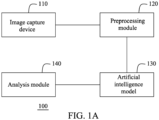
- FIG. 1A shows a first embodiment of a hair feature analysis system of the present invention.
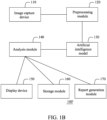
- This hair feature analysis system 100 includes an image capture device 110, a preprocessing module 120, an artificial intelligence model 130, and an analysis module 140.
- the image capture device 110 is responsible for capturing high-magnification and low-magnification images of the scalp area.
- the image capture device 110 can simultaneously capture high-magnification and low-magnification images of a scalp area.
- complementary information from two different images can be obtained, which helps to improve the accuracy and reliability of hair width and density measurements.
- the preprocessing module 120 is responsible for preprocessing the captured high-magnification and low-magnification images, including noise reduction, resizing, normalization or other image enhancement techniques. In addition, the preprocessing module 120 can also evaluate the quality of the images. If the image quality is determined to be poor, it can command the image capture device 110 to recapture the image or notify the operator of the hair feature analysis system 100 to recapture the image.
- the artificial intelligence model 130 is responsible for simultaneously detecting hair follicles from the preprocessed high-magnification and low-magnification images and calculating hair width.
- This artificial intelligence model 130 can be an R-CNN model or other variants of the R-CNN model, and more detailed introduction about what are the variants of the R-CNN model will be provided later.
- the analysis module 140 is responsible for analyzing the image and calculating hair features based on the output of the artificial intelligence model 130. Using the information provided by the artificial intelligence model 130, the analysis module 140 can perform further analysis, calculate the hair features of the scalp area, and provide personalized suggestions for hair care to understand the health of the hair and discover potential problems related to hair. The collaboration between this artificial intelligence model 130 and the analysis module 140 ensures a comprehensive and accurate assessment of hair health and characteristics.
- the hair feature analysis system 100' of the second embodiment further includes other components, such as a display device 150 for presenting analysis images and calculated hair features to the user, a storage module 160 for storing the analysis images and calculated hair features in a database, and a report generation module 170 for generating a report based on the calculated hair features.
- the report generation module 170 generates a comprehensive report based on the calculated hair features. This report may contain various types of information, such as charts, statistical data summaries, and written explanations of the data, and the report can also be shared with others, printed, or saved in digital format for further analysis or record keeping.
- step S210 the capture device 110 captures high-magnification and low-magnification images of the scalp area.
- High-magnification images provide detailed information about follicles, while low-magnification images provide an overall view of hair density and distribution, which is beneficial for subsequent processing and analysis.
- step S220 the preprocessing module 120 preprocesses the captured high-magnification and low-magnification images, such as noise reduction, resizing, and normalization, etc., to improve image quality and assist subsequent analysis.
- step S230 the preprocessing module 120 evaluates the quality of the preprocessed images. If the image quality is insufficient for further processing, the system will enter step S240; otherwise, the process will proceed to step S250.
- step S240 the preprocessing module 120 will command the image capture device 110 to automatically recapture the image or notify the operator of the hair feature analysis system 100 to manually recapture the image.
- step S250 the preprocessed high-magnification and low-magnification images are sent to the artificial intelligence model 130. Afterwards, the process continues with hair feature analysis, the details of which will be described in the following paragraphs.
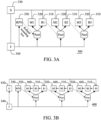
- FIG. 3A illustrates a schematic diagram of a Hybrid Task Cascade model, hereinafter referred to as the HTC model.
- the HTC model 300 is a powerful deep learning model that performs excellently in object detection and segmentation tasks.
- the HTC model 300 includes multiple stages, each of which contains a bounding box detection framework branch 310 and an instance segmentation mask branch 320.
- the HTC model 300 also includes a semantic segmentation module 330 for processing the entire image, which is constructed using a fully convolutional model in this embodiment.
- the semantic segmentation module 330 is built based on the output of the Feature Pyramid Network 340.
- the Region Proposal Network 350 generates a set of region proposals.
- the semantic segmentation model 330 combines mid-level features with higher-level features containing global information and lower-level features containing local information.
- the bounding box branch 310 and mask branch 320 of each stage take the features extracted from the backbone network (i.e., the Region Proposal Network 350) as input, and also utilize the semantic features of the semantic segmentation module 330. This fusion of semantic features with features extracted by the ROI pooling operation or ROIAlign operation enhances the performance of the HTC model 300 in object detection and segmentation tasks.
- the HTC model 300 uses the Feature Pyramid Network 340 to extract multi-scale features from the input image. Then, the Region Proposal Network 350 generates a set of region proposals. Each stage refines the region proposals, outputs the final bounding box coordinates of the detected objects, and predicts a binary mask for each detected object in the refined bounding box.
- the semantic segmentation branch 330 provides additional spatial context to improve object detection and segmentation in cluttered backgrounds.
- the output of the HTC model 300 includes multiple detected hair follicles and multiple hairs, which are subsequently used by the analysis module 140 to calculate various hair features, such as average hair diameter, fine hair density ratio, and total hair density ratio.
- the Hybrid Task Cascade model please refer to the paper "Hybrid Task Cascade for Instance Segmentation" (arxiv.org/abs/1901.07518).
- FIG. 3B illustrates a schematic diagram of the enhanced HTC model of the present invention.
- the semantic segmentation module 330 in the original HTC model 300 (as shown in FIG. 3A ) is replaced with a global feature enhancement module 430.
- the enhanced HTC model 400 also includes at least one box-mask enhancement module 460. This box-mask enhancement module creates a stronger connection, enhancing the relationship between the bounding box branch 310 and the mask branch 320, potentially improving the results of instance segmentation. Therefore, the enhanced HTC model 400 is more suitable for simultaneous detection of hair follicles and calculation of hair width required in the hair feature analysis system 100.
- the enhanced HTC model 400 retains the advantages of the original HTC model 300, but introduces technical features added or modified for hair analysis.
- the enhanced HTC model 400 can effectively handle the unique challenges associated with hair follicle detection and hair strand segmentation, ultimately leading to improved hair analysis results.
- FIG. 4A illustrates a schematic diagram of the global feature enhancement module.
- the global feature enhancement module 430 is designed to enhance the global features extracted from the Feature Pyramid Network 340 and integrate them into the enhanced HTC model 400, thereby improving the performance of the enhanced HTC model 400.
- the output of the Feature Pyramid Network 340 is first connected to a 13x13 convolutional layer 432. This 13x13 convolutional layer 432 is responsible for capturing complex and detailed global features from the Feature Pyramid Network 340.
- the output of this 13 ⁇ 13 convolutional layer 432 is connected to a 3x3 convolutional layer 434, which is used to extract and refine local features from the input (i.e., the output of the 13x13 convolutional layer 432), enhancing the representation of global features. Subsequently, the output of the 3x3 convolutional layer 434 is connected to a 1x1 convolutional layer 436.
- This 1x1 convolutional layer 436 acts as a bottleneck, reducing the dimensionality of features and compressing information while retaining key features.
- the output of this 1x1 convolutional layer 436 is connected to a global average pooling layer 438.
- the global average pooling layer 438 calculates the average of the input feature map, generating a compact representation that captures global context information. Then it outputs the generated feature map, which is used to improve the performance of the enhanced HTC model 400 in detecting hair follicles and calculating hair width.
- the hair feature analysis system 100 can better analyze hair features and provide valuable insights about hair health and personalized hair care recommendations.
- FIG. 4B illustrates a schematic diagram of the box-mask enhancement module.
- the box-mask enhancement module 460 aims to create a stronger connection, combining the bounding box branch 310 and the mask branch 320, which may potentially improve the quality of instance segmentation results.
- the box-mask enhancement module 460 includes a fully connected layer 462, a reshape layer 464, and a 13x13 convolutional layer 466.
- the fully connected layer 462 is connected to one of the output layers of the bounding box branch 310, with an output dimension of Nx4096, for example, where N represents the number of detected bounding boxes.
- the function of the fully connected layer 462 is to capture features from the bounding box branch 310, which can improve the prediction effect of the mask branch 320.
- the output tensor of the fully connected layer 462 is transformed from Nx40 ⁇ 96 to Nx256 ⁇ 14 ⁇ 14 by the reshape layer 464.
- This operation allows the tensor to match the size required by the following 13 ⁇ 13 convolution layer 466.
- the output of the reshape layer 464 is connected to the 13x13 convolution layer 466, which in turn connects to the mask branch 320.
- the box-mask enhancement module 460 can make the predictions of the mask branch 320 more accurate.
- the convolution layer is abbreviated as "conv”
- the deconvolution layer is abbreviated as "dconv”
- FC fully connected layer
- a box-mask enhancement module 460 is placed between the bounding box branch 310 and the mask branch 320 at each stage of the enhanced HTC model 400. This design helps to propagate more accurate bounding box information to the mask prediction process at each stage. By incorporating the box-mask enhancement module 460, the enhanced HTC model 400 can generate more accurate mask predictions and achieve better alignment between the bounding boxes and masks.
- FIG. 5 illustrates a schematic diagram of another embodiment of the enhanced HTC model.
- the mask branch 320' is placed after the last bounding box branch 310, and the box-mask enhancement module 460 is used to connect them.
- the focus of this design is to improve mask prediction in the final stage of the enhanced HTC model 400', so that the most refined bounding box information can be used.
- the box-mask enhancement module 460 may connect the final bounding box branch 310 with the mask branch 320', the enhanced HTC model 400' may generate more accurate instance masks, which are better aligned with the detected bounding boxes.
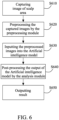
- FIG. 6 illustrates a flowchart of the hair feature analysis method of this invention.
- the hair feature analysis method in this invention includes several steps. First, in step S610, a high magnification image and a low magnification image of a scalp area are captured. Then, in step S620, the captured images are preprocessed by the preprocessing module 120, including various techniques such as resizing, normalization, and augmentation, to prepare the input images for use by the Artificial intelligence model 130. Next, in step S630, the preprocessed images are input into the Artificial intelligence model 130, which uses the enhanced HTC model 400 to simultaneously perform hair follicle detection and calculate hair width. Then, in step S640, the output of the Artificial intelligence model 130 is post-processed by the analysis module 140. Afterward, in step S650, the results of the analysis module 140 are output.
- step S610 a high magnification image and a low magnification image of a scalp area are captured.
- the captured images are preprocessed by the preprocessing module 120,
- step S640 After the Artificial intelligence model 130 simultaneously detects multiple hair follicles in the scalp area and calculates the width of multiple hairs from the preprocessed images, the analysis module 140 receives the information output by the Artificial intelligence model 130. Based on this information, the analysis module 140 segments the hair, with the middle segment of each hair being selected as the basis for width calculation. Then, by analyzing the selected hair segments, the number of pixels corresponding to the hair width is determined. Subsequently, the analysis module 140 converts the pixel count representing hair width into a real-world measurement scale (such as micrometers) to provide accurate hair width.
- a real-world measurement scale such as micrometers
- the analysis module 140 also calculates the fine hair density ratio, which is the ratio of fine hair (i.e., hair with a diameter smaller than a certain threshold) to the total number of hairs. This indicator can help evaluate hair strength and identify potential hair thinning or breakage problems. Furthermore, the analysis module 140 also calculates the total hair density ratio, which is the ratio of the total number of hair follicles in the examined scalp area to the area. This parameter helps identify the degree of hair loss or thinning.
- step S650 presenting the results to the user.
- the display device 150 displays the analyzed images and calculated hair features, providing the user with a visualized result of the hair analysis (as shown in FIG. 8 ).
- the storage module 160 stores the analyzed images and calculated hair features in a database for easy retrieval and comparison of results. This feature can be used to track hair health progress or evaluate the effectiveness of hair care treatments.
- the report generation module 170 generates a report based on the calculated hair features. This report may include a summary of the hair analysis results, personalized hair care recommendations, and any other information related to the user's hair health. The report can be printed, emailed, or shared with the user in other ways for reference and discussion.
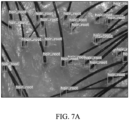
- FIGS. 7A to 7C show real-life images output by the hair feature analysis system in actual operation. These real-life images demonstrate the ability of the Artificial intelligence model 130 of this invention to accurately identify hair follicles and hair, serving as empirical evidence of the effectiveness of the Artificial intelligence model 130 in detecting and analyzing hair-related features. It should be noted that the real-life images in FIGS. 7A to 7C are the output results of the Artificial intelligence model 130 including the enhanced HTC model 400.
- the Artificial intelligence model 130 is able to effectively distinguish individual hair follicles from the surrounding skin and hair strands, highlighting its accuracy in detecting the location of hair follicles. This ability to accurately detect hair follicles enables the hair feature analysis system 100 to provide reliable measurements of hair density and distribution.
- FIG. 7B demonstrates the ability of the Artificial intelligence model 130 to identify individual hairs. With effective identification of individual hairs, the width of each hair can be accurately calculated, thus providing valuable information about hair health to the user, such as average hair diameter, fine hair density ratio, and total hair density ratio.
- FIG. 7C shows that the Artificial intelligence model 130 successfully segmented individual hairs and hair follicles, also confirming the effectiveness of the enhanced HTC model 400 in object detection and instance segmentation tasks. This segmentation allows the hair feature analysis system 100 to simultaneously detect hair follicles and calculate hair width, thereby improving the analysis results.
- the real-life images shown in FIGS. 7A to 7C provide a powerful visual proof of the ability of the Artificial intelligence model 130 to accurately detect and analyze hair follicles and hair, while also demonstrating the practicality and effectiveness of the hair feature analysis system 100 of this invention in a real-world environment.
- the Artificial intelligence model 130 uses the HTC model and the enhanced HTC model as examples, but the Artificial intelligence model 130 can also use the R-CNN model.
- the first step is to generate potential bounding boxes or region proposals for the follicles in the input image. Selective search algorithms or other region proposal algorithms can be used, and regions of interest are determined based on color, texture, and size. Then, for each region of interest, the R-CNN model applies a pre-trained convolutional neural network (CNN) to extract meaningful features.
- CNN convolutional neural network
- a classifier is applied to each region of interest to determine whether it contains a follicle.
- the classifier could be a support vector machine, which uses the features extracted in the previous step to make decisions.
- bounding box regression is performed in parallel with the classification step, optimizing the coordinates of the proposed bounding boxes to better frame the follicles, thereby improving the accuracy of follicle detection and segmentation.
- the R-CNN model can pass the output data to the analysis model 140 for subsequent processing.
- the Artificial intelligence model 130 can also use variants of other R-CNN models, such as the Cascade R-CNN model or the Mask R-CNN model.
- the Cascade R-CNN model can refer to the paper "Cascade R-CNN: High Quality Object Detection and Instance Segmentation” (arxiv.org/abs/1906.09756)
- the Mask R-CNN model can refer to the paper "Mask R-CNN” (arxiv.org/abs/1703.06870)
Landscapes
- Engineering & Computer Science (AREA)
- Health & Medical Sciences (AREA)
- Physics & Mathematics (AREA)
- Life Sciences & Earth Sciences (AREA)
- Theoretical Computer Science (AREA)
- General Health & Medical Sciences (AREA)
- General Physics & Mathematics (AREA)
- Medical Informatics (AREA)
- Evolutionary Computation (AREA)
- Computer Vision & Pattern Recognition (AREA)
- Artificial Intelligence (AREA)
- Biophysics (AREA)
- Molecular Biology (AREA)
- Biomedical Technology (AREA)
- Computing Systems (AREA)
- Software Systems (AREA)
- Multimedia (AREA)
- Public Health (AREA)
- Veterinary Medicine (AREA)
- Pathology (AREA)
- Animal Behavior & Ethology (AREA)
- Surgery (AREA)
- Heart & Thoracic Surgery (AREA)
- Databases & Information Systems (AREA)
- Dermatology (AREA)
- Mathematical Physics (AREA)
- Computational Linguistics (AREA)
- General Engineering & Computer Science (AREA)
- Data Mining & Analysis (AREA)
- Nuclear Medicine, Radiotherapy & Molecular Imaging (AREA)
- Radiology & Medical Imaging (AREA)
- Quality & Reliability (AREA)
- Fuzzy Systems (AREA)
- Physiology (AREA)
- Psychiatry (AREA)
- Signal Processing (AREA)
- Image Analysis (AREA)
- Geometry (AREA)
Applications Claiming Priority (1)
| Application Number | Priority Date | Filing Date | Title |
|---|---|---|---|
| CN202310614302.7A CN119048726A (zh) | 2023-05-29 | 2023-05-29 | 头发特征分析方法与系统 |
Publications (1)
| Publication Number | Publication Date |
|---|---|
| EP4471733A1 true EP4471733A1 (fr) | 2024-12-04 |
Family
ID=88290825
Family Applications (1)
| Application Number | Title | Priority Date | Filing Date |
|---|---|---|---|
| EP23200174.3A Pending EP4471733A1 (fr) | 2023-05-29 | 2023-09-27 | Procédé et système d'analyse de caractéristiques capillaires |
Country Status (3)
| Country | Link |
|---|---|
| US (1) | US20240404094A1 (fr) |
| EP (1) | EP4471733A1 (fr) |
| CN (1) | CN119048726A (fr) |
Families Citing this family (1)
| Publication number | Priority date | Publication date | Assignee | Title |
|---|---|---|---|---|
| CN120031777A (zh) * | 2023-11-23 | 2025-05-23 | 美科实业股份有限公司 | 头皮皮脂特性自动分类系统与方法 |
Citations (2)
| Publication number | Priority date | Publication date | Assignee | Title |
|---|---|---|---|---|
| WO2021215749A1 (fr) * | 2020-04-21 | 2021-10-28 | (주)에임즈 | Procédé et dispositif de fourniture d'informations capillaires, et procédé de génération de modèle d'analyse de racine de cheveux pour ceux-ci |
| CN215534281U (zh) * | 2018-03-12 | 2022-01-18 | 特佰马仕私人有限公司 | 头发和头皮的诊断和治疗 |
-
2023
- 2023-05-29 CN CN202310614302.7A patent/CN119048726A/zh active Pending
- 2023-09-12 US US18/367,441 patent/US20240404094A1/en active Pending
- 2023-09-27 EP EP23200174.3A patent/EP4471733A1/fr active Pending
Patent Citations (2)
| Publication number | Priority date | Publication date | Assignee | Title |
|---|---|---|---|---|
| CN215534281U (zh) * | 2018-03-12 | 2022-01-18 | 特佰马仕私人有限公司 | 头发和头皮的诊断和治疗 |
| WO2021215749A1 (fr) * | 2020-04-21 | 2021-10-28 | (주)에임즈 | Procédé et dispositif de fourniture d'informations capillaires, et procédé de génération de modèle d'analyse de racine de cheveux pour ceux-ci |
Non-Patent Citations (4)
| Title |
|---|
| CHANG WAN-JUNG ET AL: "ScalpEye: A Deep Learning-Based Scalp Hair Inspection and Diagnosis System for Scalp Health", IEEE ACCESS, IEEE, USA, vol. 8, 21 July 2020 (2020-07-21), pages 134826 - 134837, XP011801267, DOI: 10.1109/ACCESS.2020.3010847 * |
| CHEN KAI ET AL: "Hybrid Task Cascade for Instance Segmentation", 2019 IEEE/CVF CONFERENCE ON COMPUTER VISION AND PATTERN RECOGNITION (CVPR), IEEE, 15 June 2019 (2019-06-15), pages 4969 - 4978, XP033687254, DOI: 10.1109/CVPR.2019.00511 * |
| KUKLYTE JOGILE ET AL: "Evaluation of the Use of Single- and Multi-Magnification Convolutional Neural Networks for the Determination and Quantitation of Lesions in Nonclinical Pathology Studies", TOXICOLOGIC PATHOLOGY., vol. 49, no. 4, 23 February 2021 (2021-02-23), US, pages 815 - 842, XP093128676, ISSN: 0192-6233, Retrieved from the Internet <URL:http://journals.sagepub.com/doi/full-xml/10.1177/0192623320986423> [retrieved on 20240207], DOI: 10.1177/0192623320986423 * |
| MRINMOY ROY ET AL: "Hair and Scalp Disease Detection using Machine Learning and Image Processing", ARXIV.ORG, CORNELL UNIVERSITY LIBRARY, 201 OLIN LIBRARY CORNELL UNIVERSITY ITHACA, NY 14853, 31 December 2022 (2022-12-31), XP091522370, DOI: 10.24018/EJCOMPUTE.2023.3.1.85 * |
Also Published As
| Publication number | Publication date |
|---|---|
| US20240404094A1 (en) | 2024-12-05 |
| CN119048726A (zh) | 2024-11-29 |
Similar Documents
| Publication | Publication Date | Title |
|---|---|---|
| AU2019285393B2 (en) | Second reader | |
| US20190392587A1 (en) | System for predicting articulated object feature location | |
| CN110263756A (zh) | 一种基于联合多任务学习的人脸超分辨率重建系统 | |
| CN113902945B (zh) | 一种多模态乳腺磁共振图像分类方法及系统 | |
| CN112201343B (zh) | 基于脸部微表情的认知状态识别系统及方法 | |
| Pal et al. | Advanced convolutional neural network model to identify melanoma skin cancer | |
| KR20230052169A (ko) | Shap 기반 이미지 어노테이션 생성 장치 및 방법 | |
| KR102070828B1 (ko) | 딥러닝의 활성화 함수 분석을 통한 물체 검출 장치 및 방법 | |
| CN112741651B (zh) | 一种内窥镜超声影像的处理方法及系统 | |
| Alrabiah et al. | Computer-based approach to detect wrinkles and suggest facial fillers | |
| Dhanashree et al. | Fingernail analysis for early detection and diagnosis of diseases using machine learning techniques | |
| Tahir et al. | Advances in retinal microaneurysms detection, segmentation and datasets for the diagnosis of diabetic retinopathy: a systematic literature review | |
| CN115116117A (zh) | 一种基于多模态融合网络的学习投入度数据的获取方法 | |
| EP4471733A1 (fr) | Procédé et système d'analyse de caractéristiques capillaires | |
| Bosale | Detection and classification of diabetic retinopathy using deep learning algorithms for segmentation to facilitate referral recommendation for test and treatment prediction | |
| US20250005758A1 (en) | Skin diagnosis system and method based on image analysis using deep learning | |
| Zolfagharnasab et al. | Exploring a novel multi-channel structure to improve facial expression recognition on occluded samples using deep convolutional neural network | |
| Naqvi et al. | Advancements in Facial Expression-Based Automatic Emotion Identification Using Deep Learning | |
| TWI841402B (zh) | 頭髮特徵分析方法與系統 | |
| CN116665310B (zh) | 基于弱监督学习的抽动障碍识别和分类方法及系统 | |
| Kunzo et al. | Processing and segmentation of human teeth from 2D images using weakly supervised learning | |
| Shihabudeen et al. | NUC-Fuse: Multimodal medical image fusion using nuclear norm & classification of brain tumors using ARBFN | |
| Jadon et al. | Interpretable AI for skin lesion detection: Enhancing diagnostic accuracy with CNN and Score-CAM in IoMT systems | |
| JP7728528B2 (ja) | 情報処理方法、プログラム、情報処理装置及び学習済みモデルの生成方法 | |
| Richard et al. | Implementation of ANFIS Assisted Modified CNN Classifier for Autism Spectrum Disorder Detection |
Legal Events
| Date | Code | Title | Description |
|---|---|---|---|
| PUAI | Public reference made under article 153(3) epc to a published international application that has entered the european phase |
Free format text: ORIGINAL CODE: 0009012 |
|
| STAA | Information on the status of an ep patent application or granted ep patent |
Free format text: STATUS: THE APPLICATION HAS BEEN PUBLISHED |
|
| AK | Designated contracting states |
Kind code of ref document: A1 Designated state(s): AL AT BE BG CH CY CZ DE DK EE ES FI FR GB GR HR HU IE IS IT LI LT LU LV MC ME MK MT NL NO PL PT RO RS SE SI SK SM TR |
|
| STAA | Information on the status of an ep patent application or granted ep patent |
Free format text: STATUS: REQUEST FOR EXAMINATION WAS MADE |
|
| 17P | Request for examination filed |
Effective date: 20250513 |