EP4471903A1 - Negativelektrodenaktivmaterial, herstellungsverfahren dafür und anwendung davon - Google Patents
Negativelektrodenaktivmaterial, herstellungsverfahren dafür und anwendung davon Download PDFInfo
- Publication number
- EP4471903A1 EP4471903A1 EP23762815.1A EP23762815A EP4471903A1 EP 4471903 A1 EP4471903 A1 EP 4471903A1 EP 23762815 A EP23762815 A EP 23762815A EP 4471903 A1 EP4471903 A1 EP 4471903A1
- Authority
- EP
- European Patent Office
- Prior art keywords
- anode active
- active material
- particle size
- silicon
- silicon oxide
- Prior art date
- Legal status (The legal status is an assumption and is not a legal conclusion. Google has not performed a legal analysis and makes no representation as to the accuracy of the status listed.)
- Pending
Links
Images
Classifications
-
- H—ELECTRICITY
- H01—ELECTRIC ELEMENTS
- H01M—PROCESSES OR MEANS, e.g. BATTERIES, FOR THE DIRECT CONVERSION OF CHEMICAL ENERGY INTO ELECTRICAL ENERGY
- H01M4/00—Electrodes
- H01M4/02—Electrodes composed of, or comprising, active material
- H01M4/36—Selection of substances as active materials, active masses, active liquids
- H01M4/362—Composites
- H01M4/366—Composites as layered products
-
- H—ELECTRICITY
- H01—ELECTRIC ELEMENTS
- H01M—PROCESSES OR MEANS, e.g. BATTERIES, FOR THE DIRECT CONVERSION OF CHEMICAL ENERGY INTO ELECTRICAL ENERGY
- H01M10/00—Secondary cells; Manufacture thereof
- H01M10/05—Accumulators with non-aqueous electrolyte
- H01M10/052—Li-accumulators
-
- H—ELECTRICITY
- H01—ELECTRIC ELEMENTS
- H01M—PROCESSES OR MEANS, e.g. BATTERIES, FOR THE DIRECT CONVERSION OF CHEMICAL ENERGY INTO ELECTRICAL ENERGY
- H01M10/00—Secondary cells; Manufacture thereof
- H01M10/05—Accumulators with non-aqueous electrolyte
- H01M10/052—Li-accumulators
- H01M10/0525—Rocking-chair batteries, i.e. batteries with lithium insertion or intercalation in both electrodes; Lithium-ion batteries
-
- H—ELECTRICITY
- H01—ELECTRIC ELEMENTS
- H01M—PROCESSES OR MEANS, e.g. BATTERIES, FOR THE DIRECT CONVERSION OF CHEMICAL ENERGY INTO ELECTRICAL ENERGY
- H01M4/00—Electrodes
- H01M4/02—Electrodes composed of, or comprising, active material
- H01M4/04—Processes of manufacture in general
- H01M4/049—Manufacturing of an active layer by chemical means
-
- H—ELECTRICITY
- H01—ELECTRIC ELEMENTS
- H01M—PROCESSES OR MEANS, e.g. BATTERIES, FOR THE DIRECT CONVERSION OF CHEMICAL ENERGY INTO ELECTRICAL ENERGY
- H01M4/00—Electrodes
- H01M4/02—Electrodes composed of, or comprising, active material
- H01M4/13—Electrodes for accumulators with non-aqueous electrolyte, e.g. for lithium-accumulators; Processes of manufacture thereof
- H01M4/134—Electrodes based on metals, Si or alloys
-
- H—ELECTRICITY
- H01—ELECTRIC ELEMENTS
- H01M—PROCESSES OR MEANS, e.g. BATTERIES, FOR THE DIRECT CONVERSION OF CHEMICAL ENERGY INTO ELECTRICAL ENERGY
- H01M4/00—Electrodes
- H01M4/02—Electrodes composed of, or comprising, active material
- H01M4/13—Electrodes for accumulators with non-aqueous electrolyte, e.g. for lithium-accumulators; Processes of manufacture thereof
- H01M4/139—Processes of manufacture
- H01M4/1395—Processes of manufacture of electrodes based on metals, Si or alloys
-
- H—ELECTRICITY
- H01—ELECTRIC ELEMENTS
- H01M—PROCESSES OR MEANS, e.g. BATTERIES, FOR THE DIRECT CONVERSION OF CHEMICAL ENERGY INTO ELECTRICAL ENERGY
- H01M4/00—Electrodes
- H01M4/02—Electrodes composed of, or comprising, active material
- H01M4/36—Selection of substances as active materials, active masses, active liquids
-
- H—ELECTRICITY
- H01—ELECTRIC ELEMENTS
- H01M—PROCESSES OR MEANS, e.g. BATTERIES, FOR THE DIRECT CONVERSION OF CHEMICAL ENERGY INTO ELECTRICAL ENERGY
- H01M4/00—Electrodes
- H01M4/02—Electrodes composed of, or comprising, active material
- H01M4/36—Selection of substances as active materials, active masses, active liquids
- H01M4/362—Composites
- H01M4/364—Composites as mixtures
-
- H—ELECTRICITY
- H01—ELECTRIC ELEMENTS
- H01M—PROCESSES OR MEANS, e.g. BATTERIES, FOR THE DIRECT CONVERSION OF CHEMICAL ENERGY INTO ELECTRICAL ENERGY
- H01M4/00—Electrodes
- H01M4/02—Electrodes composed of, or comprising, active material
- H01M4/36—Selection of substances as active materials, active masses, active liquids
- H01M4/38—Selection of substances as active materials, active masses, active liquids of elements or alloys
-
- H—ELECTRICITY
- H01—ELECTRIC ELEMENTS
- H01M—PROCESSES OR MEANS, e.g. BATTERIES, FOR THE DIRECT CONVERSION OF CHEMICAL ENERGY INTO ELECTRICAL ENERGY
- H01M4/00—Electrodes
- H01M4/02—Electrodes composed of, or comprising, active material
- H01M4/36—Selection of substances as active materials, active masses, active liquids
- H01M4/38—Selection of substances as active materials, active masses, active liquids of elements or alloys
- H01M4/381—Alkaline or alkaline earth metals elements
- H01M4/382—Lithium
-
- H—ELECTRICITY
- H01—ELECTRIC ELEMENTS
- H01M—PROCESSES OR MEANS, e.g. BATTERIES, FOR THE DIRECT CONVERSION OF CHEMICAL ENERGY INTO ELECTRICAL ENERGY
- H01M4/00—Electrodes
- H01M4/02—Electrodes composed of, or comprising, active material
- H01M4/36—Selection of substances as active materials, active masses, active liquids
- H01M4/38—Selection of substances as active materials, active masses, active liquids of elements or alloys
- H01M4/386—Silicon or alloys based on silicon
-
- H—ELECTRICITY
- H01—ELECTRIC ELEMENTS
- H01M—PROCESSES OR MEANS, e.g. BATTERIES, FOR THE DIRECT CONVERSION OF CHEMICAL ENERGY INTO ELECTRICAL ENERGY
- H01M4/00—Electrodes
- H01M4/02—Electrodes composed of, or comprising, active material
- H01M4/36—Selection of substances as active materials, active masses, active liquids
- H01M4/48—Selection of substances as active materials, active masses, active liquids of inorganic oxides or hydroxides
- H01M4/483—Selection of substances as active materials, active masses, active liquids of inorganic oxides or hydroxides for non-aqueous cells
-
- H—ELECTRICITY
- H01—ELECTRIC ELEMENTS
- H01M—PROCESSES OR MEANS, e.g. BATTERIES, FOR THE DIRECT CONVERSION OF CHEMICAL ENERGY INTO ELECTRICAL ENERGY
- H01M4/00—Electrodes
- H01M4/02—Electrodes composed of, or comprising, active material
- H01M4/36—Selection of substances as active materials, active masses, active liquids
- H01M4/58—Selection of substances as active materials, active masses, active liquids of inorganic compounds other than oxides or hydroxides, e.g. sulfides, selenides, tellurides, halogenides or LiCoFy; of polyanionic structures, e.g. phosphates, silicates or borates
- H01M4/583—Carbonaceous material, e.g. graphite-intercalation compounds or CFx
-
- H—ELECTRICITY
- H01—ELECTRIC ELEMENTS
- H01M—PROCESSES OR MEANS, e.g. BATTERIES, FOR THE DIRECT CONVERSION OF CHEMICAL ENERGY INTO ELECTRICAL ENERGY
- H01M4/00—Electrodes
- H01M4/02—Electrodes composed of, or comprising, active material
- H01M4/36—Selection of substances as active materials, active masses, active liquids
- H01M4/58—Selection of substances as active materials, active masses, active liquids of inorganic compounds other than oxides or hydroxides, e.g. sulfides, selenides, tellurides, halogenides or LiCoFy; of polyanionic structures, e.g. phosphates, silicates or borates
- H01M4/583—Carbonaceous material, e.g. graphite-intercalation compounds or CFx
- H01M4/587—Carbonaceous material, e.g. graphite-intercalation compounds or CFx for inserting or intercalating light metals
-
- H—ELECTRICITY
- H01—ELECTRIC ELEMENTS
- H01M—PROCESSES OR MEANS, e.g. BATTERIES, FOR THE DIRECT CONVERSION OF CHEMICAL ENERGY INTO ELECTRICAL ENERGY
- H01M4/00—Electrodes
- H01M4/02—Electrodes composed of, or comprising, active material
- H01M4/62—Selection of inactive substances as ingredients for active masses, e.g. binders, fillers
- H01M4/624—Electric conductive fillers
- H01M4/625—Carbon or graphite
-
- H—ELECTRICITY
- H01—ELECTRIC ELEMENTS
- H01M—PROCESSES OR MEANS, e.g. BATTERIES, FOR THE DIRECT CONVERSION OF CHEMICAL ENERGY INTO ELECTRICAL ENERGY
- H01M4/00—Electrodes
- H01M4/02—Electrodes composed of, or comprising, active material
- H01M2004/021—Physical characteristics, e.g. porosity, surface area
-
- H—ELECTRICITY
- H01—ELECTRIC ELEMENTS
- H01M—PROCESSES OR MEANS, e.g. BATTERIES, FOR THE DIRECT CONVERSION OF CHEMICAL ENERGY INTO ELECTRICAL ENERGY
- H01M4/00—Electrodes
- H01M4/02—Electrodes composed of, or comprising, active material
- H01M2004/026—Electrodes composed of, or comprising, active material characterised by the polarity
- H01M2004/027—Negative electrodes
-
- Y—GENERAL TAGGING OF NEW TECHNOLOGICAL DEVELOPMENTS; GENERAL TAGGING OF CROSS-SECTIONAL TECHNOLOGIES SPANNING OVER SEVERAL SECTIONS OF THE IPC; TECHNICAL SUBJECTS COVERED BY FORMER USPC CROSS-REFERENCE ART COLLECTIONS [XRACs] AND DIGESTS
- Y02—TECHNOLOGIES OR APPLICATIONS FOR MITIGATION OR ADAPTATION AGAINST CLIMATE CHANGE
- Y02E—REDUCTION OF GREENHOUSE GAS [GHG] EMISSIONS, RELATED TO ENERGY GENERATION, TRANSMISSION OR DISTRIBUTION
- Y02E60/00—Enabling technologies; Technologies with a potential or indirect contribution to GHG emissions mitigation
- Y02E60/10—Energy storage using batteries
Definitions
- the application relates to the field of batteries, in particular to an anode active material for a secondary battery, a preparation method thereof, an electrode and a battery.
- silicon anode active materials are mainly studied and developed: monatomic silicon (including nano-silicon, porous silicon, amorphous silicon, and the like) and its composites with carbon materials; alloy materials formed by compounding silicon with other metals (such as ferrum, manganese, nickel, chromium, cadmium, tin, and copper) and non-metals (such as carbon, nitrogen, phosphorus, and boron); and composite material of silicon oxide and carbon material thereof silicon oxide compound.
- the first and second types of materials result in electrode materials with poor cycle performance, and they are prone to pulverization and separation from a current collector.
- the silicon oxide compounds contain many inactive substances, thus having a capacity lower than that of the monatomic silicon anode active material. However, due to the existence of these inactive substances, the expansion of silicon in the cycle process is effectively restrained by the inactive phase, so the silicon oxide compounds have an outstanding advantage in cycle stability.
- the silicon oxide compounds also have some specific problems. When lithium is initially intercalated into the material, too many side reactions occur between the surface of the particles and the electrolyte, and a thick SEI film is generated; moreover, substances that are irreversible to release lithium ions, such as lithium metasilicate and lithium oxide, are generated in the particles, thus resulting in irreversible losses of lithium ions in batteries. These two irreversible reactions reduce the initial coulombic efficiency of lithium ion batteries containing silicon oxide compound anodes, thus limiting the improvement of the energy density of the batteries.
- the silicon oxide compounds also have the problems of low ionic and electronic conductivity, low coulombic efficiency during the cycle process, and the like.
- the surface of silicon oxide compound particles significantly influences the stability of their electrochemical properties, including the stability of the interface reaction between the silicon oxide particle surface and the electrolyte, and the sensitivity of the silicon oxide particle surface to transition metal precipitation.
- the aforementioned interface stability has a significant impact on the cycle life of silicon-containing battery systems, charge/discharge ability and storage stability at high temperatures, and cell expansion problems. Due to the existence of interface side reactions, the cell may experience significant gas generation after multiple charge and discharge cycles or exposure to high-temperature environments, leading to safety risks. Therefore, the preparation of silicon oxide compound particles with stable surface characteristics is one urgent issue to address.
- anode active material comprising anode active substance particles, wherein the anode active substance particles comprise a silicon-based material core and a carbon film layer covering a surface of the silicon-based material core; the silicon-based material core contains a silicon oxide compound;
- the ratio of the median particle size D 50 to the calculated particle size D c of the anode active material satisfies: D 50 /D c ⁇ 10, preferably D 50 /D c ⁇ 5, and further preferably D 50 /D c ⁇ 2.5.
- the specific surface area S of the anode active material is 0.1-15 m 2 /g, preferably 0.3-10 m 2 /g, and further preferably 0.3-6 m 2 /g.
- the median particle size D 50 of the anode active material is 0.2-20 ⁇ m, preferably 1-15 ⁇ m, and further preferably 3-13 ⁇ m; and the particle size distribution span value A of the anode active material is less than or equal to 2.0, preferably less than or equal to 1.5, and further preferably less than or equal to 1.2.
- the silicon-based material core further contains lithium.
- the content of lithium in the anode active substance particles is 0.1-20wt%, preferably 2-18wt%, and more preferably 4-15wt%.
- the content of silicon in the anode active substance particles is 30-80wt%, preferably 35-65wt%, and more preferably 40-65wt%.
- the anode active substance particles further comprise nano-silicon grains, and a median particle size of the nano-silicon grains dispersed in the silicon-based material core is 0.1-35 nm, preferably 0.5-20 nm, and further preferably 1-15 nm.
- a thickness of the carbon film layer is 0.001-5 ⁇ m, preferably 0.005-2 ⁇ m, and more preferably 0.01-1 ⁇ m.
- the mass of the carbon film layer accounts for 0.01-20wt%, preferably 0.1-15wt%, and more preferably 1-12wt% of the total mass of the anode active substance particles.
- the invention further provides an electrode, comprising the anode active material as described above.
- the invention further provides a battery, comprising the electrode as described above.
- the invention further provides a method of preparing the anode active material, comprising:
- the method further comprises: performing lithium doping on the silicon oxide compound particles coated with the carbon film layer.
- the anode active material provided by the invention has fewer defects in the carbon film layer and higher interface stability in an electrochemical system, and exhibits superior cycling stability, high-temperature performance, and lower expansion and gas production.
- the present application provides an anode active material for batteries, comprising anode active substance particles, wherein the anode active substance particles comprise a silicon-based material core and a carbon film layer covering a surface of the silicon-based material core.
- the silicon-based material core contains a silicon oxide compound; and the silicon-based material core may be silicon oxide compound particles or lithium-doped silicon oxide compound particles, that is, the silicon-based material core may also contain lithium.
- A (D 90 -D 10 )/D 50 , where the particle size D 10 is a particle size at which the cumulative distribution of particles is 10%, that is, the volume content of particles smaller than this particle size accounts for 10% of all particles; the median particle size D 50 is a particle size at which the cumulative distribution of particles is 50%, that is, 50% of the particles exceed this value and 50% of the particles are below this value; and the particle size D 90 is a particle size at which the cumulative distribution of particles is 90%, that is, the volume content of particles smaller than this particle size accounts for 90% of all particles.
- the inventors of the present application found in their research that the surface characteristics of the anode active substance particles for batteries, especially their interface stability in an electrochemical system, have a significant correlation with the structure of the carbon film layer on their surfaces.
- Common structural defects of the carbon film layer include pores, impurities, disorder in carbon layer crystal structure, a high content of carbon-hydrogen/carbon-oxygen/carbon-sulfur bonds, high surface roughness, cracks, and so on. These structural defects may lead to an increased specific surface area of the anode active material, increased side reactions with an electrolyte, stronger interactions with transition metals leaching from a positive electrode, deteriorating the cycle stability, high-temperature stability, expansion rate, and other electrochemical properties of the anode active material. Additionally, the presence of interface side reactions may result in severe gas swelling in a cell after cycling or exposure to high temperatures, posing safety risks.
- the ratio of the median particle size D 50 to the calculated particle size D c of the anode active material provided by the present application satisfies: D 50 /D c ⁇ 15.
- the anode active material has fewer defects in the carbon film layer and thus higher interface stability in an electrochemical system, and exhibits superior cycle stability, high-temperature performance, and lower expansion and gas production.
- the specific surface area S of the anode active material is 0.1-15 m 2 /g, preferably 0.3-10 m 2 /g, and further preferably 0.3-6 m 2 /g.
- the median particle size D 50 of the anode active material is 0.2-20 ⁇ m, preferably 1-15 ⁇ m, and further preferably 3-13 ⁇ m.
- the particle size distribution span value A of the anode active material is less than or equal to 2.0, preferably less than or equal to 1.5, and further preferably less than or equal to 1.2.
- the content of silicon in the anode active substance particles may be 30-80wt%, preferably 35-65wt%, and more preferably 40-65wt%, thus making the material have a high reversible capacity.
- the content of lithium in the silicon-based material core is 0.1-20wt%, preferably 2-18wt%, and more preferably 4-15wt%.
- the anode active substance particles also contain nano-silicon grains which can be uniformly dispersed in the silicon-based material core.
- the nano-silicon grains can exist in the form of nano-particles in the silicon-based material core, with a median particle size of 0.1-35 nm, preferably 0.5-20 nm, and more preferably 1-15 nm. Particles within this size range exhibit minimal expansion and are resistant to fracturing during the cyclic process of lithium ion intercalation and deintercalation. As a result, lithium-ion secondary batteries employing this material demonstrate low cycle expansion and enhanced cycle stability.
- a thickness of the carbon film layer may be 0.001-5 ⁇ m, preferably 0.005-2 ⁇ m, and more preferably 0.01-1 ⁇ m,
- the carbon film layer can effectively improve the conductivity of the particles, and reduce the contact resistance between particles in a negative electrode plate and between the negative electrode plate and a current collector, thus improving the delithiation efficiency of materials, reducing the polarization of lithium-ion batteries and promoting their cycle stability.
- the mass of the carbon film layer may account for 0.01-20wt%, preferably 0.1-15wt%, and more preferably 1-12wt% of the total mass of the anode active substance particles.
- the anode active material for batteries provide by the present application has relatively stable surface characteristics, leading to higher interface stability with the electrolyte and fewer interactions with transition metals precipitated from the positive electrode. Batteries produced using such anode active material offer advantages such as high cycle stability, outstanding high-temperature performance, low expansion, and reduced gas production.
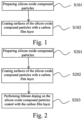
- Fig. 1 is a flowchart of a preparation process of an anode active material according to an exemplary embodiment of the present application.
- silicon oxide compound particles are prepared.
- a mixture of metal silicon powder and silicon dioxide powder is heated in the temperature range of 900-1600°C in an inert gas atmosphere or under reduced pressure, generating silicon oxide gas.
- the molar ratio of metal silicon powder to silicon dioxide powder is set within the range of 0.5-1.5.
- Gas produced by the heating reaction of the raw materials deposits on an adsorption plate.
- a deposited material is then removed when the temperature inside a reacting furnace drops below 100°C, and crushed and pulverized using equipment such as a ball mill and a jet mill, resulting in silicon oxide compound particles.
- the silicon oxide compound particles referred to in the present application include silicon oxide (silicon monoxide and/or silicon dioxide) materials.
- the silicon-to-oxygen stoichiometric ratio in the silicon oxide compound particles can be 1:0.4-1:2, optionally 1:0.6-1:1.5, and more optionally 1:0.8-1:1.2. Additionally, there may be other trace impurity elements besides silicon and oxygen.
- surfaces of the silicon oxide compound particles are coated with a carbon film layer.
- the structure of the carbon film layer on the surfaces of the particles is greatly influenced by the preparation process, with significant structural differences observed in the carbon film layers obtained under different process parameters (such as carbon source type, coating temperature, atmosphere, air pressure, heating rate, carbon content, magnetic field, electric field, and the like) and different furnace structure designs.
- process parameters such as carbon source type, coating temperature, atmosphere, air pressure, heating rate, carbon content, magnetic field, electric field, and the like
- degree of defects in the carbon film layers also varies significantly.
- the silicon oxide compound may be a non-disproportionated silicon oxide compound or a silicon oxide compound subjected to disproportionation heat treatment.
- the disproportionation heat treatment temperature may be 600-1100°C, optionally 700-1000°C, and more preferably 800-1000°C.
- the carbon film layer may be directly obtained by chemical vapor deposition (CVD).
- a carbon source used in CVD is hydrocarbon gas, and the decomposition temperature of the hydrocarbon gas may be 600-1100°C, preferably 700-1000°C, and more preferably 800-1000°C.
- the choice of carbon source, carbonization temperature, the amount of carbon source added, the proportion of gas and the flow rate all have significant effects on the final carbon film structure.
- controlling the air pressure (vacuum degree) and the proportion of atmosphere and devising a unique airflow direction in the process of carbon film growth also have distinct impacts on the carbon film structure.
- introducing a mixture of carbon source gas and inert gas or reducing gas (such as argon, nitrogen, helium, and hydrogen) in a certain proportion yields a carbon film of higher quality compared to using pure carbon source gas alone.
- ensuring that the volume ratio of carbon source gas in the mixed gas does not exceed 90%, preferably not surpassing 75%, and more preferably not going beyond 65% facilitates the formation of a carbon film layer with improved coating quality and uniformity.
- reducing the furnace pressure during the carbon film growth process to maintain a certain level of negative pressure (vacuum degree) greatly enhances the uniformity of the carbon film layer, resulting in a higher degree of smoothness and compactness.
- the carbon film layer can also be obtained by first performing carbon reaction coating and then performing heat treatment carbonization in a non-oxidizing atmosphere.
- the carbon reaction coating can be realized by any one of a mechanical fusion machine, a VC mixer, a coating kettle, a spray dryer, a sand mill or a high-speed dispersion machine.
- a solvent adopted for coating is one or more of water, methanol, ethanol, isopropanol, N-butanol, ethylene glycol, ether, acetone, N-methylpyrrolidone, methyl butanone, tetrahydrofuran, benzene, toluene, xylene, N,N-dimethylformamide, N,N-dimethylacetamide and chloroform.
- a carbon reaction source may be one or more of coal tar pitch, petroleum pitch, polyvinyl alcohol, epoxy resin, polyacrylonitrile, polymethyl methacrylate, glucose, sucrose, polyacrylic acid and polyvinylpyrrolidone.
- Equipment used for heat treatment carbonization may be any one of a rotary furnace, a ladle furnace, a roller kiln, a pushed slab kiln, an atmosphere box furnace or a tube furnace.
- the temperature for heat treatment carbonization may be 600-1100°C, preferably 700-1000°C, and more preferably 800-1000°C.
- the heat preservation time may be 0.5-24 hours.
- the non-oxidizing atmosphere may be provided by at least one of nitrogen, argon, hydrogen or helium.
- the selection of carbon source, carbonization temperature, the amount of carbon source added, the heating speed, the design of heating and heat preservation program, the intensity of mechanical stirring and the selection of coating equipment all have significant effects on the final carbon film structure.
- designing a heating program featuring multi-temperature stage preservation facilitates the formation of a carbon film coating structure of higher quality.
- Selecting appropriate intermediate heat preservation programs enables thorough melting of the carbon source compounds, ensuring proper fluidity and initiating preliminary coke discharge reactions, leading to a more uniform and compact carbon film coating layer.
- dynamic carbonization is preferred, involving dynamic stirring of the material during heating and preservation process to facilitate the efficient release of volatiles produced during carbonization of the carbon source, ultimately resulting in a more compact, less defective carbon film layer.
- Fig. 2 is a flowchart of a preparation process of an anode active material according to another exemplary embodiment of the present application.
- the preparation process comprises the following steps.
- silicon oxide compound particles are prepared.
- surfaces of the silicon oxide compound particles are coated with a carbon film layer.
- lithium doping is performed on the silicon oxide compound particles coated with the carbon film layer.
- the doping (lithium intercalation) of the silicon oxide compound particles may be achieved through electrochemical doping, liquid-phase doping and thermal doping.
- the doping atmosphere of lithium element is a non-oxidizing atmosphere, which is composed of at least one of nitrogen, argon, hydrogen or helium.
- lithium intercalation methods lithium doping modification methods
- An electrochemical cell which comprises a bath, an anode electrode, a cathode electrode and a power supply, wherein the anode electrode and the cathode electrode are respectively connected with two ends of the power supply; the anode electrode is connected to a lithium source, and the cathode electrode is connected to a container containing the silicon oxide compound particles; and the bath is filled with an organic solvent, so that the lithium source (anode electrode) and the container (cathode electrode) containing the silicon oxide compound particles are immersed in the organic solvent.
- the power supply is turned on, due to the electrochemical reaction, lithium ions are intercalated into the silicon oxide compound structure, resulting in lithium-doped modified silicon oxide compound particles.
- the organic solvent may be ethylene carbonate, propylene carbonate, butylene carbonate, fluoroethylene carbonate, dimethyl carbonate, methyl ethyl carbonate, diethyl carbonate, ethyl acetate, n-propyl acetate, ethyl propionate, propyl propionate, dimethyl sulfoxide and other solvents.
- the organic solvent also contains electrolyte lithium salt, which may be LiPF 6 , LiBF 4 and LiClO 4 .
- the lithium source (anode electrode) may be lithium foil or lithium compounds, such as lithium carbonate, lithium oxide, lithium hydroxide, lithium cobaltate, lithium iron phosphate, lithium manganate, lithium vanadium phosphate, lithium nickelate, etc.
- Lithium metal, an electron transfer catalyst and the silicon oxide compound particles are added to an ether-based solvent, and continuously stirred and heated in a non-oxidizing atmosphere to maintain a constant-temperature reaction until lithium metal in the solution completely disappears.
- lithium metal can be dissolved in the ether-based solvent and form coordination compounds of lithium ions, which have low reduction potential, so they can react with silicon oxide compounds, and lithium ions enter the silicon oxide compound structure.
- the electron transfer catalyst may be biphenyl, naphthalene, etc.
- the ether-based solvent may be methyl butyl ether, ethylene glycol butyl ether, tetrahydrofuran, ethylene glycol dimethyl ether and the like.
- the temperature for constant-temperature reaction is 25-200°C.
- the non-oxidizing atmosphere is provided by at least one of nitrogen, argon, hydrogen or helium.
- the silicon oxide compound particles are uniformly mixed with a lithium-containing compound, and then heat treatment is performed in a non-oxidizing atmosphere.
- the lithium-containing compound may be lithium hydroxide, lithium carbonate, lithium oxide, lithium peroxide, lithium hydride, lithium nitrate, lithium acetate, lithium oxalate and the like.
- Mixing is realized by any one of a high-speed disperser, a high-speed stirring mill, a ball mill, a conical mixer, a spiral mixer, a stirring mixer or a VC mixer.
- Equipment used for heat treatment is any one of a rotary furnace, a ladle furnace, a liner furnace, a roller kiln, a pushed slab kiln, an atmosphere box furnace or a tube furnace.
- the temperature for heat treatment is 400-850°C, preferably 550-800°C.
- the heat preservation time is 1-12 hours.
- the heating rate is greater than 0. 1°C per minute and less than or equal to 10°C per minute.
- the non-oxidizing atmosphere is provided by at least one of nitrogen, argon, hydrogen or helium.
- the process of lithium intercalation will have different levels of influence on the carbon film layer structure on the surfaces of the silicon oxide compound particles. If the diffusion process is mild and controllable, the impact on the carbon film layer structure on the surfaces of the particles is minimal; whereas if the diffusion process is relatively intense, it can trigger changes in the carbon film layer structure.
- the specific surface area S of the anode active material obtained in the above steps was 15m 2 /g, the median particle size D 50 of the product was 10.64 ⁇ m, the particle size distribution span value A was 1.52, and the calculated particle size D c estimated according to the specific surface area was 0.71 ⁇ m, so the ratio of the median particle size D 50 to the calculated particle size D c was 15.
- the evaluation results of high-temperature storage for the full cell containing the anode active material were as follows: after 60 days of high-temperature storage at full charge at 60°C, the thermal expansion rate of the cell was 22.7%, and the cell had gas bubbles. After high-temperature storage, the capacity retention rate was 78.6% and the capacity recovery rate was 86.3%.
- Embodiment 1-1 The process was similar to that of Embodiment 1-1, except that the carbonization temperature of coal tar pitch was adjusted to 780°C, while the carbon content remained at 7wt%.
- silicon oxide compound particles were used as raw materials and different carbon film coating processes were adopted, including adjusting the selection of carbon source, carbonization temperature, the amount of carbon source added, air pressure (vacuum degree), atmosphere ratio, air flow direction, heating speed, design of heating and preservation program, intensity of mechanical stirring, selection of equipment, etc., so as to obtain different carbon-coated silicon oxide compound powders of Embodiments 1-9 to 1-17.
- the anode active materials of Embodiments 1-16 were used as raw materials, and the powder, lithium metal foil, and biphenyl were added to a sealable glass container, followed by the addition of methyl butyl ether and stirring reaction in an argon atmosphere. After completion of the reaction and subsequent drying, the obtained powder was subjected to heat treatment in an argon atmosphere, with a heating rate of 2°C per minute, up to 680°C. The powder was then kept at this temperature for 10 hours before undergoing natural cooling, resulting in lithium-doped silicon oxide compound powder.
- Embodiments 1-16 were used as raw materials.
- the process was similar to that in Embodiment 2-1, except that the heat treatment process after lithium doping was changed to: heating to 720°C at a heating rate of 5°C per minute, then maintaining the temperature for 3 hours, and then naturally cooling to obtain lithium-doped silicon oxide compound powder.
- Embodiments 1-16 were used as raw materials.
- the process was similar to that in Embodiment 2-1, except that the heat treatment process after lithium doping was changed to: heating to 720°C at a heating rate of 10°C per minute, then maintaining the temperature for 6 hours, and then naturally cooling to obtain lithium-doped silicon oxide compound powder.
- Embodiments 1-16 were used as raw materials.
- the process was similar to that in Embodiment 2-1, except that the heat treatment process after lithium doping was changed to: heating to 850°C at a heating rate of 10°C per minute, then maintaining the temperature for 2 hours, and then naturally cooling to obtain lithium-doped silicon oxide compound powder.
- Embodiments 1-10 were used as raw materials.
- the aforementioned particles were mixed with a lithium-containing compound (e.g., lithium oxide, lithium hydride, lithium hydroxide, lithium carbonate, etc.), and the mixture was subjected to heat treatment in an argon atmosphere, with a heating rate of 2°C per minute, up to 400°C which was maintained for 3 hours, and then to 650°C which was maintained for 10 hours.
- a lithium-containing compound e.g., lithium oxide, lithium hydride, lithium hydroxide, lithium carbonate, etc.
- Embodiments 1-10 were used as raw materials.
- the process was similar to that in Embodiments 2-5, except that the heat treatment process after lithium doping was changed to: directly heating to 700°C at a heating rate of 5°C per minute, then maintaining the temperature for 6 hours, and then naturally cooling to obtain lithium-doped silicon oxide compound powder.
- Embodiments 1-10 were used as raw materials.
- the process was similar to that in Embodiments 2-5, except that the heat treatment process after lithium doping was changed to: directly heating to 820°C at a heating rate of 10°C per minute, then maintaining the temperature for 2 hours, and then naturally cooling to obtain lithium-doped silicon oxide compound powder.
- the process of lithium intercalation will have different levels of influence on the carbon film layer structure on the surfaces of the silicon oxide compound particles. If the diffusion process is mild and controllable, the impact on the carbon film layer structure on the surfaces of the particles is minimal; whereas if the diffusion process is relatively intense, it can trigger changes in the carbon film layer structure, resulting in a decrease in the interface stability of the material, causing a reduction in the high-temperature storage performance of the battery that uses the anode active material, and an increase in expansion.
Landscapes
- Chemical & Material Sciences (AREA)
- General Chemical & Material Sciences (AREA)
- Chemical Kinetics & Catalysis (AREA)
- Electrochemistry (AREA)
- Composite Materials (AREA)
- Engineering & Computer Science (AREA)
- Materials Engineering (AREA)
- Manufacturing & Machinery (AREA)
- Inorganic Chemistry (AREA)
- Battery Electrode And Active Subsutance (AREA)
Applications Claiming Priority (2)
| Application Number | Priority Date | Filing Date | Title |
|---|---|---|---|
| CN202210197761.5A CN114784233A (zh) | 2022-03-02 | 2022-03-02 | 一种负极活性材料及其制备方法和应用 |
| PCT/CN2023/078030 WO2023165415A1 (zh) | 2022-03-02 | 2023-02-24 | 一种负极活性材料及其制备方法和应用 |
Publications (2)
| Publication Number | Publication Date |
|---|---|
| EP4471903A1 true EP4471903A1 (de) | 2024-12-04 |
| EP4471903A4 EP4471903A4 (de) | 2026-03-18 |
Family
ID=82422961
Family Applications (1)
| Application Number | Title | Priority Date | Filing Date |
|---|---|---|---|
| EP23762815.1A Pending EP4471903A4 (de) | 2022-03-02 | 2023-02-24 | Negativelektrodenaktivmaterial, herstellungsverfahren dafür und anwendung davon |
Country Status (6)
| Country | Link |
|---|---|
| US (1) | US20250192153A1 (de) |
| EP (1) | EP4471903A4 (de) |
| JP (1) | JP7804092B2 (de) |
| KR (1) | KR20240146681A (de) |
| CN (2) | CN114784233A (de) |
| WO (1) | WO2023165415A1 (de) |
Families Citing this family (3)
| Publication number | Priority date | Publication date | Assignee | Title |
|---|---|---|---|---|
| CN114784233A (zh) * | 2022-03-02 | 2022-07-22 | 安普瑞斯(南京)有限公司 | 一种负极活性材料及其制备方法和应用 |
| JP2025540238A (ja) * | 2023-03-06 | 2025-12-11 | 香港時代新能源科技有限公司 | シリコン系負極活物質、二次電池及び電気装置 |
| CN117954592A (zh) * | 2023-12-26 | 2024-04-30 | 博赛利斯(南京)有限公司 | 一种负极活性材料及其制备方法和应用 |
Family Cites Families (10)
| Publication number | Priority date | Publication date | Assignee | Title |
|---|---|---|---|---|
| JP2010225494A (ja) * | 2009-03-25 | 2010-10-07 | Shin-Etsu Chemical Co Ltd | 非水電解質二次電池用負極材及びその製造方法、ならびにリチウムイオン二次電池 |
| JP5411780B2 (ja) * | 2010-04-05 | 2014-02-12 | 信越化学工業株式会社 | 非水電解質二次電池用負極材及び非水電解質二次電池用負極材の製造方法並びにリチウムイオン二次電池 |
| JP5411781B2 (ja) * | 2010-04-05 | 2014-02-12 | 信越化学工業株式会社 | 非水電解質二次電池用負極材及び非水電解質二次電池用負極材の製造方法並びにリチウムイオン二次電池 |
| CN115472816A (zh) * | 2019-10-22 | 2022-12-13 | 安普瑞斯(南京)有限公司 | 一种硅氧颗粒及其制备方法和应用 |
| CN111180693B (zh) * | 2019-12-31 | 2021-06-04 | 安普瑞斯(南京)有限公司 | 负极活性材料及其制备方法和应用 |
| KR20210094685A (ko) * | 2020-01-21 | 2021-07-30 | 대주전자재료 주식회사 | 규소-규소 복합산화물-탄소 복합체, 이의 제조방법 및 이를 포함하는 음극 활물질 |
| CN112310372B (zh) * | 2020-10-26 | 2022-05-24 | 深圳市德方纳米科技股份有限公司 | 硅基负极材料和锂离子电池 |
| CN112687852B (zh) * | 2020-12-10 | 2022-08-26 | 安普瑞斯(南京)有限公司 | 硅氧锂颗粒及其制备方法、负极材料、极片和电池 |
| CN113991095B (zh) * | 2021-12-28 | 2022-04-01 | 安普瑞斯(南京)有限公司 | 负极活性材料及其制备方法、电极、电池 |
| CN114784233A (zh) * | 2022-03-02 | 2022-07-22 | 安普瑞斯(南京)有限公司 | 一种负极活性材料及其制备方法和应用 |
-
2022
- 2022-03-02 CN CN202210197761.5A patent/CN114784233A/zh active Pending
- 2022-03-02 CN CN202510125570.1A patent/CN119786584A/zh active Pending
-
2023
- 2023-02-24 JP JP2024551553A patent/JP7804092B2/ja active Active
- 2023-02-24 KR KR1020247030313A patent/KR20240146681A/ko active Pending
- 2023-02-24 US US18/842,455 patent/US20250192153A1/en active Pending
- 2023-02-24 WO PCT/CN2023/078030 patent/WO2023165415A1/zh not_active Ceased
- 2023-02-24 EP EP23762815.1A patent/EP4471903A4/de active Pending
Also Published As
| Publication number | Publication date |
|---|---|
| WO2023165415A1 (zh) | 2023-09-07 |
| CN119786584A (zh) | 2025-04-08 |
| KR20240146681A (ko) | 2024-10-08 |
| JP7804092B2 (ja) | 2026-01-21 |
| EP4471903A4 (de) | 2026-03-18 |
| CN114784233A (zh) | 2022-07-22 |
| JP2025508921A (ja) | 2025-04-10 |
| US20250192153A1 (en) | 2025-06-12 |
Similar Documents
| Publication | Publication Date | Title |
|---|---|---|
| CN112018367B (zh) | 用于电池的负极活性材料及其制备方法、电池负极、电池 | |
| EP3496189B1 (de) | Verbindung, herstellungsverfahren dafür und verwendung in einer lithium-ionen-sekundärbatterie | |
| CN109713286B (zh) | 一种用于锂离子二次电池的硅基复合材料及其制备方法 | |
| EP4471903A1 (de) | Negativelektrodenaktivmaterial, herstellungsverfahren dafür und anwendung davon | |
| KR20210094623A (ko) | 실리콘-산소 복합 음극 재료 및 그 제조 방법과 리튬 이온 전지 | |
| US20240002239A1 (en) | Silicon-based particle with core-shell structure, method for preparing the same, anode material, electrode and battery | |
| WO2021128603A1 (zh) | 一种用于锂离子电池负极的改性一氧化硅材料及其制备方法 | |
| US20250006923A1 (en) | Anode active material for battery and preparation method thereof, battery anode and secondary battery | |
| KR20220155344A (ko) | 산화 규소 복합 음극재 및 이의 제조 방법, 리튬 이온 전지 | |
| CN111180692A (zh) | 一种用于电池的负极活性材料及其制备方法 | |
| CN111048764A (zh) | 一种硅碳复合材料及其制备方法和应用 | |
| CN106784833A (zh) | 硅碳负极材料及其制备方法 | |
| CN115425222A (zh) | 硅基负极材料及其制备方法及包含它的锂离子电池 | |
| WO2025139216A1 (zh) | 一种负极活性材料及其制备方法和应用 | |
| CN111162269B (zh) | 一种用于电池的负极活性材料及其制备方法 | |
| CN113745519B (zh) | 一种具有人工sei膜的硅基负极材料及其制备方法和应用 | |
| CN118073635A (zh) | 一种基于橄榄石结构磷酸铁的钠离子电池及应用 | |
| CN118183858A (zh) | 一种具有核壳结构的三元正极材料及其制备方法 | |
| CN113258043A (zh) | 硅基负极材料及其制备方法和应用 | |
| CN112736225A (zh) | 硅氧锂颗粒团聚体及其制备方法、负极材料、极片和电池 | |
| CN114361438B (zh) | 一种锂离子电池硅基负极材料的制备工艺及其产品 | |
| Zhang et al. | Facile coating strategy of Si/C composite anode for high-performance lithium-ion battery | |
| CN117638049A (zh) | 用于电池的负极活性材料及其制备方法、电极、电池 | |
| WO2025138111A1 (zh) | 一种磷酸铁锂正极材料及其制备方法和锂离子电池 | |
| CN116387491A (zh) | 一种硅基复合负极材料及其制备方法和应用 |
Legal Events
| Date | Code | Title | Description |
|---|---|---|---|
| STAA | Information on the status of an ep patent application or granted ep patent |
Free format text: STATUS: THE INTERNATIONAL PUBLICATION HAS BEEN MADE |
|
| PUAI | Public reference made under article 153(3) epc to a published international application that has entered the european phase |
Free format text: ORIGINAL CODE: 0009012 |
|
| STAA | Information on the status of an ep patent application or granted ep patent |
Free format text: STATUS: REQUEST FOR EXAMINATION WAS MADE |
|
| 17P | Request for examination filed |
Effective date: 20240828 |
|
| AK | Designated contracting states |
Kind code of ref document: A1 Designated state(s): AL AT BE BG CH CY CZ DE DK EE ES FI FR GB GR HR HU IE IS IT LI LT LU LV MC ME MK MT NL NO PL PT RO RS SE SI SK SM TR |
|
| DAV | Request for validation of the european patent (deleted) | ||
| DAX | Request for extension of the european patent (deleted) | ||
| A4 | Supplementary search report drawn up and despatched |
Effective date: 20260213 |
|
| RIC1 | Information provided on ipc code assigned before grant |
Ipc: H01M 4/505 20100101AFI20260209BHEP Ipc: H01M 4/1395 20100101ALI20260209BHEP Ipc: H01M 4/36 20060101ALI20260209BHEP Ipc: H01M 10/052 20100101ALI20260209BHEP Ipc: H01M 10/0525 20100101ALI20260209BHEP Ipc: H01M 4/38 20060101ALI20260209BHEP Ipc: H01M 4/02 20060101ALI20260209BHEP Ipc: H01M 4/587 20100101ALI20260209BHEP Ipc: H01M 4/62 20060101ALI20260209BHEP Ipc: H01M 4/134 20100101ALI20260209BHEP Ipc: H01M 4/48 20100101ALI20260209BHEP Ipc: H01M 4/583 20100101ALI20260209BHEP |