EP4473948A2 - Système de pose de greffe d'endoprothèse à embout conique décalé - Google Patents
Système de pose de greffe d'endoprothèse à embout conique décalé Download PDFInfo
- Publication number
- EP4473948A2 EP4473948A2 EP24208717.9A EP24208717A EP4473948A2 EP 4473948 A2 EP4473948 A2 EP 4473948A2 EP 24208717 A EP24208717 A EP 24208717A EP 4473948 A2 EP4473948 A2 EP 4473948A2
- Authority
- EP
- European Patent Office
- Prior art keywords
- stent graft
- delivery system
- tapered tip
- opening
- graft delivery
- Prior art date
- Legal status (The legal status is an assumption and is not a legal conclusion. Google has not performed a legal analysis and makes no representation as to the accuracy of the status listed.)
- Pending
Links
- 230000007246 mechanism Effects 0.000 claims description 17
- 238000000034 method Methods 0.000 abstract description 10
- 239000000463 material Substances 0.000 description 15
- 210000002376 aorta thoracic Anatomy 0.000 description 6
- 210000005166 vasculature Anatomy 0.000 description 6
- 210000001367 artery Anatomy 0.000 description 5
- 238000003780 insertion Methods 0.000 description 5
- 230000037431 insertion Effects 0.000 description 5
- 210000000709 aorta Anatomy 0.000 description 4
- 238000005452 bending Methods 0.000 description 4
- 210000004204 blood vessel Anatomy 0.000 description 4
- 206010002329 Aneurysm Diseases 0.000 description 3
- 230000017531 blood circulation Effects 0.000 description 3
- 229910052751 metal Inorganic materials 0.000 description 3
- 239000002184 metal Substances 0.000 description 3
- 229910001000 nickel titanium Inorganic materials 0.000 description 3
- PXHVJJICTQNCMI-UHFFFAOYSA-N Nickel Chemical compound [Ni] PXHVJJICTQNCMI-UHFFFAOYSA-N 0.000 description 2
- 239000004696 Poly ether ether ketone Substances 0.000 description 2
- 201000008982 Thoracic Aortic Aneurysm Diseases 0.000 description 2
- 230000001010 compromised effect Effects 0.000 description 2
- HLXZNVUGXRDIFK-UHFFFAOYSA-N nickel titanium Chemical compound [Ti].[Ti].[Ti].[Ti].[Ti].[Ti].[Ti].[Ti].[Ti].[Ti].[Ti].[Ni].[Ni].[Ni].[Ni].[Ni].[Ni].[Ni].[Ni].[Ni].[Ni].[Ni].[Ni].[Ni].[Ni] HLXZNVUGXRDIFK-UHFFFAOYSA-N 0.000 description 2
- 238000004806 packaging method and process Methods 0.000 description 2
- 229920002530 polyetherether ketone Polymers 0.000 description 2
- 229920000642 polymer Polymers 0.000 description 2
- 229910001220 stainless steel Inorganic materials 0.000 description 2
- 230000000153 supplemental effect Effects 0.000 description 2
- 238000001356 surgical procedure Methods 0.000 description 2
- 238000011282 treatment Methods 0.000 description 2
- VYZAMTAEIAYCRO-UHFFFAOYSA-N Chromium Chemical compound [Cr] VYZAMTAEIAYCRO-UHFFFAOYSA-N 0.000 description 1
- 229920004934 Dacron® Polymers 0.000 description 1
- 206010061818 Disease progression Diseases 0.000 description 1
- 229920002614 Polyether block amide Polymers 0.000 description 1
- 239000004642 Polyimide Substances 0.000 description 1
- 229920006099 Vestamid® Polymers 0.000 description 1
- 230000001174 ascending effect Effects 0.000 description 1
- 239000010953 base metal Substances 0.000 description 1
- 210000001715 carotid artery Anatomy 0.000 description 1
- 210000001168 carotid artery common Anatomy 0.000 description 1
- 229910052804 chromium Inorganic materials 0.000 description 1
- 239000011651 chromium Substances 0.000 description 1
- 239000010941 cobalt Substances 0.000 description 1
- 229910017052 cobalt Inorganic materials 0.000 description 1
- GUTLYIVDDKVIGB-UHFFFAOYSA-N cobalt atom Chemical compound [Co] GUTLYIVDDKVIGB-UHFFFAOYSA-N 0.000 description 1
- 210000004351 coronary vessel Anatomy 0.000 description 1
- 230000005750 disease progression Effects 0.000 description 1
- 229920000295 expanded polytetrafluoroethylene Polymers 0.000 description 1
- 230000000004 hemodynamic effect Effects 0.000 description 1
- 230000000968 intestinal effect Effects 0.000 description 1
- 238000002955 isolation Methods 0.000 description 1
- 238000012986 modification Methods 0.000 description 1
- 230000004048 modification Effects 0.000 description 1
- 239000005445 natural material Substances 0.000 description 1
- 229910052759 nickel Inorganic materials 0.000 description 1
- 210000003516 pericardium Anatomy 0.000 description 1
- 229920000728 polyester Polymers 0.000 description 1
- 239000005020 polyethylene terephthalate Substances 0.000 description 1
- 229920001721 polyimide Polymers 0.000 description 1
- 229920001296 polysiloxane Polymers 0.000 description 1
- 229920002635 polyurethane Polymers 0.000 description 1
- 239000004814 polyurethane Substances 0.000 description 1
- 210000002254 renal artery Anatomy 0.000 description 1
- 239000010935 stainless steel Substances 0.000 description 1
- 229910000601 superalloy Inorganic materials 0.000 description 1
- 210000004876 tela submucosa Anatomy 0.000 description 1
- 210000001519 tissue Anatomy 0.000 description 1
Images


Classifications
-
- A—HUMAN NECESSITIES
- A61—MEDICAL OR VETERINARY SCIENCE; HYGIENE
- A61F—FILTERS IMPLANTABLE INTO BLOOD VESSELS; PROSTHESES; DEVICES PROVIDING PATENCY TO, OR PREVENTING COLLAPSING OF, TUBULAR STRUCTURES OF THE BODY, e.g. STENTS; ORTHOPAEDIC, NURSING OR CONTRACEPTIVE DEVICES; FOMENTATION; TREATMENT OR PROTECTION OF EYES OR EARS; BANDAGES, DRESSINGS OR ABSORBENT PADS; FIRST-AID KITS
- A61F2/00—Filters implantable into blood vessels; Prostheses, i.e. artificial substitutes or replacements for parts of the body; Appliances for connecting them with the body; Devices providing patency to, or preventing collapsing of, tubular structures of the body, e.g. stents
- A61F2/95—Instruments specially adapted for placement or removal of stents or stent-grafts
- A61F2/962—Instruments specially adapted for placement or removal of stents or stent-grafts having an outer sleeve
- A61F2/966—Instruments specially adapted for placement or removal of stents or stent-grafts having an outer sleeve with relative longitudinal movement between outer sleeve and prosthesis, e.g. using a push rod
-
- A—HUMAN NECESSITIES
- A61—MEDICAL OR VETERINARY SCIENCE; HYGIENE
- A61F—FILTERS IMPLANTABLE INTO BLOOD VESSELS; PROSTHESES; DEVICES PROVIDING PATENCY TO, OR PREVENTING COLLAPSING OF, TUBULAR STRUCTURES OF THE BODY, e.g. STENTS; ORTHOPAEDIC, NURSING OR CONTRACEPTIVE DEVICES; FOMENTATION; TREATMENT OR PROTECTION OF EYES OR EARS; BANDAGES, DRESSINGS OR ABSORBENT PADS; FIRST-AID KITS
- A61F2/00—Filters implantable into blood vessels; Prostheses, i.e. artificial substitutes or replacements for parts of the body; Appliances for connecting them with the body; Devices providing patency to, or preventing collapsing of, tubular structures of the body, e.g. stents
- A61F2/02—Prostheses implantable into the body
- A61F2/04—Hollow or tubular parts of organs, e.g. bladders, tracheae, bronchi or bile ducts
- A61F2/06—Blood vessels
- A61F2/07—Stent-grafts
-
- A—HUMAN NECESSITIES
- A61—MEDICAL OR VETERINARY SCIENCE; HYGIENE
- A61F—FILTERS IMPLANTABLE INTO BLOOD VESSELS; PROSTHESES; DEVICES PROVIDING PATENCY TO, OR PREVENTING COLLAPSING OF, TUBULAR STRUCTURES OF THE BODY, e.g. STENTS; ORTHOPAEDIC, NURSING OR CONTRACEPTIVE DEVICES; FOMENTATION; TREATMENT OR PROTECTION OF EYES OR EARS; BANDAGES, DRESSINGS OR ABSORBENT PADS; FIRST-AID KITS
- A61F2/00—Filters implantable into blood vessels; Prostheses, i.e. artificial substitutes or replacements for parts of the body; Appliances for connecting them with the body; Devices providing patency to, or preventing collapsing of, tubular structures of the body, e.g. stents
- A61F2/95—Instruments specially adapted for placement or removal of stents or stent-grafts
- A61F2/954—Instruments specially adapted for placement or removal of stents or stent-grafts for placing stents or stent-grafts in a bifurcation
-
- A—HUMAN NECESSITIES
- A61—MEDICAL OR VETERINARY SCIENCE; HYGIENE
- A61F—FILTERS IMPLANTABLE INTO BLOOD VESSELS; PROSTHESES; DEVICES PROVIDING PATENCY TO, OR PREVENTING COLLAPSING OF, TUBULAR STRUCTURES OF THE BODY, e.g. STENTS; ORTHOPAEDIC, NURSING OR CONTRACEPTIVE DEVICES; FOMENTATION; TREATMENT OR PROTECTION OF EYES OR EARS; BANDAGES, DRESSINGS OR ABSORBENT PADS; FIRST-AID KITS
- A61F2/00—Filters implantable into blood vessels; Prostheses, i.e. artificial substitutes or replacements for parts of the body; Appliances for connecting them with the body; Devices providing patency to, or preventing collapsing of, tubular structures of the body, e.g. stents
- A61F2/95—Instruments specially adapted for placement or removal of stents or stent-grafts
- A61F2/962—Instruments specially adapted for placement or removal of stents or stent-grafts having an outer sleeve
- A61F2/966—Instruments specially adapted for placement or removal of stents or stent-grafts having an outer sleeve with relative longitudinal movement between outer sleeve and prosthesis, e.g. using a push rod
- A61F2/9661—Instruments specially adapted for placement or removal of stents or stent-grafts having an outer sleeve with relative longitudinal movement between outer sleeve and prosthesis, e.g. using a push rod the proximal portion of the stent or stent-graft is released first
-
- A—HUMAN NECESSITIES
- A61—MEDICAL OR VETERINARY SCIENCE; HYGIENE
- A61F—FILTERS IMPLANTABLE INTO BLOOD VESSELS; PROSTHESES; DEVICES PROVIDING PATENCY TO, OR PREVENTING COLLAPSING OF, TUBULAR STRUCTURES OF THE BODY, e.g. STENTS; ORTHOPAEDIC, NURSING OR CONTRACEPTIVE DEVICES; FOMENTATION; TREATMENT OR PROTECTION OF EYES OR EARS; BANDAGES, DRESSINGS OR ABSORBENT PADS; FIRST-AID KITS
- A61F2/00—Filters implantable into blood vessels; Prostheses, i.e. artificial substitutes or replacements for parts of the body; Appliances for connecting them with the body; Devices providing patency to, or preventing collapsing of, tubular structures of the body, e.g. stents
- A61F2/95—Instruments specially adapted for placement or removal of stents or stent-grafts
- A61F2/962—Instruments specially adapted for placement or removal of stents or stent-grafts having an outer sleeve
- A61F2/966—Instruments specially adapted for placement or removal of stents or stent-grafts having an outer sleeve with relative longitudinal movement between outer sleeve and prosthesis, e.g. using a push rod
- A61F2002/9665—Instruments specially adapted for placement or removal of stents or stent-grafts having an outer sleeve with relative longitudinal movement between outer sleeve and prosthesis, e.g. using a push rod with additional retaining means
-
- A—HUMAN NECESSITIES
- A61—MEDICAL OR VETERINARY SCIENCE; HYGIENE
- A61M—DEVICES FOR INTRODUCING MEDIA INTO, OR ONTO, THE BODY; DEVICES FOR TRANSDUCING BODY MEDIA OR FOR TAKING MEDIA FROM THE BODY; DEVICES FOR PRODUCING OR ENDING SLEEP OR STUPOR
- A61M25/00—Catheters; Hollow probes
- A61M25/01—Introducing, guiding, advancing, emplacing or holding catheters
- A61M25/09—Guide wires
Definitions
- the present disclosure relates to a delivery system for a stent graft, for example a branched stent graft.
- a delivery system for a stent graft for example a branched stent graft.
- the present disclosure relates to such a branched stent graft delivery system having an offset tapered tip.
- a stent graft is an implantable device made of a tube-shaped surgical graft covering and an expanding or self-expanding metal frame.
- the stent graft is placed inside a blood vessel to bridge, for example, an aneurismal, dissected, or other diseased segment of the blood vessel, and, thereby, exclude the hemodynamic pressures of blood flow from the diseased segment of a blood vessel such as the aorta.
- the aneurysm may extend into areas having vessel bifurcations or segments of the aorta from which smaller "branch" arteries extend.
- thoracic aortic aneurysms can include aneurysms present in the ascending thoracic aorta, the aortic arch, and/or branch arteries that emanate therefrom, such as subclavian or left or right common carotid arteries.
- a branched stent graft can be used to treat such aneurysms.
- a main stent graft can be deployed in the main vessel (e.g., aortic arch), and a supplemental, secondary stent graft can be deployed in the branched artery (e.g., left subclavian).
- main vessel e.g., aortic arch
- secondary stent graft e.g., left subclavian
- a stent graft delivery system comprises a stent graft cover and a tapered tip.
- the stent graft cover is configured to maintain a stent graft in a constricted configuration, and configured to slide relative to the stent graft to enable the stent graft to expand radially outwardly, wherein the stent graft cover extends along a first central axis.
- the tapered tip defines an opening therethrough that is configured to track along a guidewire, wherein the opening extends along a second central axis that is offset from the first central axis.
- a stent graft delivery system comprises a stent graft cover, a tapered tip, a tip capture mechanism, and a spindle.
- the stent graft cover is configured to maintain a stent graft in a constricted configuration, and configured to slide relative to the stent graft to enable the stent graft to expand radially outwardly.
- the tapered tip defines an opening therethrough that is configured to track along a guidewire.
- the tip capture mechanism has an inner member aligned with the opening, and the inner member has an inner lumen secured to the tapered tip and an outer lumen disposed about the inner lumen and configured to slide along an outer surface of the inner lumen.
- the spindle is aligned with the opening and has an inner surface contacting the inner lumen and an outer surface contacting the tapered tip to secure the tapered tip to the inner lumen.
- a method of assembling a stent graft delivery system comprises fitting a barbed spindle about an outer surface of an inner lumen of an inner member, wherein the barbed spindle defines an opening extending about a central axis; press-fitting a tapered tip about an outer surface of the barbed spindle, wherein the tapered tip includes an opening extending about the central axis when press-fitted to the barbed spindle; and assembling a stent graft cover about a portion of the tapered tip such that a central axis of the stent graft cover is offset from the central axis of the opening of the barbed spindle.
- the stent graft delivery system includes a stent graft cover configured to maintain a stent graft in a constricted configuration, and is configured to slide relative to the stent graft to enable the stent graft to expand radially outwardly.
- the stent graft cover extends along a first central axis.
- a tapered tip defining an opening therethrough is configured to track along a guidewire.
- the opening extends along a second central axis that is offset from the first central axis. This provides a delivery system with an opening in a leading edge that is not center relative to the outer stent graft cover.
- distal and proximal are used in the following description with respect to a position or direction relative to a treating clinician.
- distal and distal are positions distant from or in a direction away from the clinician, and “proximal” and “proximally” are positions near or in a direction toward the clinician.
- proximal is the portion nearer the heart by way of blood flow path while “distal” is the portion of the stent-graft further from the heart by way of blood flow path.
- Thoracic aortic aneurysms with disease progression extending into the aortic arch can be treated with a branched stent graft and delivery system.
- Branched stent graft delivery systems can be used to deliver and deploy stent grafts that are configured to couple with secondary stent grafts that extend into vessels or "branches" within a patient's vasculature, such as the thoracic aorta.
- a main guidewire may be fed into the vasculature and into a main vessel (e.g., aortic arch), and a secondary guidewire may be fed into a secondary vessel or branched artery (e.g., left subclavian).
- the stent graft delivery system can include a main lumen that tracks along the main guidewire, and a secondary lumen that tracks along the secondary guidewire.
- a main stent graft can be deployed in a main vessel, and a supplemental, secondary stent graft can be deployed in the branched artery.
- An example of such a surgical procedure is described in U.S. Patent Application No. 16/828,644 titled Branched Stent Graft Delivery System, which is hereby incorporated by reference.
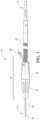
- FIG. 1 shows a branched stent graft delivery system 10 according to one embodiment.
- the branched stent graft delivery system also more simply referred to as a stent graft delivery system or a delivery system, includes an endovascular catheter and extends between a proximal end 12 and a distal end 14.
- proximal end and distal end are not intended to be limiting, as a surgical clinician may, during a procedure, in fact be located closer to the distal end 14 than the proximal end 12. Therefore, the proximal end and the distal end may be referred to as a "first end” and a "second end,” respectively.
- a threaded screw gear 16 extends along an axis between the proximal end 12 and the distal end 14.
- the threaded screw gear may be a multi-part shell configured to connect together to make a tubular screw gear.
- the screw gear 16 is two half-shells configured to connect (e.g., snap or assemble) together.
- a handle assembly 18 is provided for grip by the clinician.
- the handle assembly 18 may include two separable portions, namely a front grip 20 and an external slider 22.
- the front grip 20 may be fixed relative to the screw gear 16, and the external slider 22 may rotate about a threaded outer surface of the screw gear 16 to move linearly along the screw gear 16.
- the external slider 22 is rotated to move toward the proximal end 12. Since the external slider 22 is operatively coupled to a stent graft cover 24 surrounding the stent graft, the stent graft cover 24 is retracted with the linear movement of the external slider 22.
- a tip 26 at the distal end 14 of the delivery system 10 which has openings to track over the guidewires, can remain steady within the vessel as the stent graft cover 24 is retracted away from the tip 26. Retraction of the stent graft cover 24 allows the stent graft to expand within the patient's vessel. Once the stent graft is deployed, the entire stent graft delivery system 10 may be retracted from the patent's vessel.
- the stent graft can be self-expanding, in that it includes structures that are shaped or formed from a material that can be provided with a mechanical memory to return the structure from a compressed or constricted delivery configuration to an expanded deployed configuration.
- the stent graft can include two main components: a tubular graft, and one or more stents for supporting and expanding the graft.
- the graft may be formed from any suitable graft material, for example and not limited to, a low-porosity woven or knit polyester, DACRON material, expanded polytetrafluoroethylene, polyurethane, silicone, or other suitable materials.
- the graft material can also be a natural material such as pericardium or another membranous tissue such as intestinal submucosa.
- the stent is radially-compressible and expandable, is coupled to the graft material for supporting the graft material, and is operable to self-expand into apposition with the interior wall of a body vessel (not shown).
- Each stent can be constructed from a self-expanding or spring material, such as but not limited to Nitinol, stainless steel, a pseudo-elastic metal such as a nickel titanium alloy or nitinol, various polymers, or a so-called super alloy, which may have a base metal of nickel, cobalt, chromium, or other metal, or other suitable material.
- the stent may be a sinusoidal patterned ring including a plurality of crowns or bends and a plurality of struts or straight segments with each crown being formed between a pair of opposing struts.
- screw gear 16 is illustrated and described herein as having a threaded outer surface, it should be understood that in other embodiments, the screw gear is not threaded, the external slider 22 can slide linearly along the screw gear, or any other suitable mechanism may be used to retract the graft cover.
- the stent graft delivery system 10 may also include an access port 28.
- the access port 28 provides an opening for insertion, removal, or receiving of a secondary guidewire lumen, or branching lumen, for surrounding a secondary guidewire.
- the delivery system 10 can track along both the main guidewire and the secondary guidewire during delivery of the stent graft.
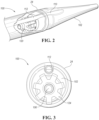
- Figures 2-5 illustrate various views of internal components of a distal end 100 of a stent graft delivery system, such as that illustrated in Figure 1 .
- the structure shown in Figures 2-5 and described below can be substituted for the distal end 14 of Figure 1 .
- the distal end 100 includes a tip 102, also referred to as a tapered tip due to its tapered profile.
- the tapered tip 102 provides a leading edge of the delivery system 10, and tracks over one or more guidewires.
- the tapered tip 102 includes a leading edge or front surface 104 that defines a cut-out or opening 106 configured to receive a main guidewire.
- the opening 106 can be an aperture in the material of the tapered tip 102 with an inner surface of the tapered tip 102 surrounding the main guidewire.
- the opening 106 is aligned with an inner member 108 within the stent graft cover 24, as will be described below.
- the tapered tip 102 can also include a second opening 110 configured to receive a secondary guidewire.
- This second opening 110 allows the delivery system 10 to track over the secondary guidewire simultaneously with the main guidewire.
- the second opening 110 is aligned with a secondary lumen 112 within the stent graft cover 24, as will be described below.
- the stent graft cover 24 is the outer-most sheath or lumen of the stent graft delivery system.
- the stent graft cover initially contains or surrounds a proximal portion of the tapered tip 102, as well as the inner member 108, the secondary lumen 112, and a stent graft (not shown).
- the surgical technician may utilize the handle to retract the stent graft cover 24, allowing the stent graft to deploy.
- the stent graft cover 24 is an elongate tubular member defining a lumen from a proximal end to a distal end thereof.
- the stent graft cover 24 may be formed from a plurality of different materials or combination of materials; in one embodiment, the stent graft cover 24 is formed with a braided stainless steel wire with a flat or rounded cross section that is sandwiched between layers of PEBAX ® or VESTAMID ® .
- the inner member 108 defines a hollow lumen, and can be two parts.
- the inner member 108 can include an inner lumen or guidewire lumen 114, and an outer lumen or capture lumen 116.
- Each of the guidewire lumen 114 and the capture lumen 116 may be made from a high tensile polymer, such as polyether ether ketone (PEEK) or a polyimide.
- PEEK polyether ether ketone
- the capture lumen 116 is larger than the guidewire lumen 114 and receives the guidewire lumen 114 therein.
- the guidewire lumen 114 may be fixed to the tapered tip 102, while the capture lumen 116 may be slideable along the outer surface of the guidewire lumen to slide toward the proximal end of the delivery system 10.
- the guidewire lumen 114 may be fixed in alignment with the opening 106 of the tapered tip 102 to receive the main guidewire therethrough and track along the main guidewire during insertion into the patient.
- the delivery system also includes a tip capture mechanism, shown generally at 120.
- the tip capture mechanism 120 is coupled to, and actuated by, the inner member 108.
- the tip capture mechanism 120 includes a capture fitting 122 having a plurality of fingers 124 or prongs.
- the capture fitting 122 is configured to hold a stent, ring, loop, or other such structure of a proximal end of the stent graft. This allows the stent graft to be deployed (e.g., when the stent graft cover 24 is retracted) while its proximal end is held in a constricted manner during deployment.
- a proximal end of the capture fitting 122 is fixed to the capture lumen 116 to move with the capture lumen 116.
- the capture lumen 116 can be slid toward the surgical technician relative to the guidewire lumen 114, thereby releasing the fingers 124 of the tip capture fitting 122 from the stent, ring, loop, or the like of the stent graft. This releases the stent graft from the delivery system, and the entire catheter can then be removed from the patient. While one example of a tip capture mechanism has been described, any tip capture mechanism may be compatible with the present disclosure.
- the tip capture mechanism may be configured such that the inner tube extends axially forward to move the tip forward relative to the outer tube and spindle, thereby releasing the stent graft.
- Other tip capture mechanisms may include a single tube, three or more tubes, or other systems.
- the secondary lumen 112 is also provided within the stent graft cover 24.
- the secondary lumen 112 is aligned with the opening 110 to receive the secondary guidewire therethrough, and track along the secondary guidewire during insertion into the patient's vasculature.
- the secondary lumen may be located radially outboard of the inner member 108, but radially inward of the stent graft cover 24.
- a secondary lumen within the confines of the stent graft could present several issues. For example, packaging constraints within the delivery system would be compromised, requiring other components within the confines of the stent graft to be reduced in size while still maintaining feasibility. Moreover, a bulge could be created in the stent graft cover as the secondary lumen is bent around the stent graft components. Such a bulge can make the profile of the delivery system lager than the intended outer profile. There is also difficulty in maintaining alignment of the secondary lumen and the inner components. In many cases, the secondary lumen is forced to bend around the arms of the capture mechanism and can become bent or misshapen in a way that could compromise the lumen patency or at least increase wire friction through the lumen.
- the tapered tip 102 is designed to allow for smaller components within the confines of the stent graft cover 24.
- the front surface 104 and the opening 106 at the distal end of the tapered tip 102 is not concentric with the stent graft cover 24.
- These components can be offset from center in a direction away from the secondary lumen 112, giving more space for the secondary lumen 112 to assume and not be bent or create a bulge in the stent graft cover 24. Also, this allows an easier retraction of the secondary lumen 112, if necessary, during a surgical deployment prior to retraction of the stent graft cover 24.
- the nature of the offset can be seen in the Figures 4 and 5 , and in particular Figure 4 .
- the distal surface or front surface 104, the opening 106, the inner member 108, and the tip capture mechanism 120 are all concentric and have a common first central axis 130.
- the stent graft cover 24 has a second central axis 132 that is offset from the first central axis 130.
- the secondary lumen 112 is positioned toward the perimeter (e.g., touching or adjacent) of the stent graft cover 24.
- the first central axis 130 is located away from the second central axis 132 in a direction away from the second central axis 132. While the terms "first" and "second” are used herein, it should be understood that these terms are used merely to delineate and label the two components separately, and the terms can be interchangeable.
- the internal components may be reduced in size.
- the tip capture mechanism 120 may be reduced in size, to allow the components to be offset from their original, central positioning. This creates more space for the secondary lumen 112.
- tapered tip 102 This also allows for the tapered tip 102 to be assembled to (e.g., pressed into) the delivery system late in the assembly process, in which the tapered tip 102 can be precisely positioned, rotationally, to optimize engagement with the secondary lumen 112.
- the tapered tip 102 can be assembled to the remainder of the delivery system at a rotational alignment such that the opening 110 is aligned with the secondary lumen 112.
- a spindle 140 is provided.
- the spindle 140 is a barbed insert for attachment of the tapered tip 102 to the inner member 108.
- the spindle 140 is shown in the cross-sectional view in Figure 5 , in isolation in Figure 6 and attached about the guidewire lumen 114 in Figure 7 .
- the spindle 140 is configured to align with the tip capture device 120 along the first central axis 130 to hold the stent graft in place during delivery (e.g., the stent apices may be held between the spindle 140 and the capture fitting 122).
- the spindle 140 is fixed to the tapered tip 102, and does not move with the capture lumen 116 or stent graft cover 24 during deployment of the stent graft.
- a spindle was overmolded onto a tapered tip, but this can create difficulty with non-concentric arrangements. Instead, in embodiments herein the spindle 140 is a separate component and separately assembled to the tapered tip 102.
- a portion of the delivery system may be pre-assembled or preloaded such that the tapered tip 102 may be assembled to the guidewire lumen 114, which is inserted into the capture lumen 116, and the tapered tip 102 is pressed onto the spindle 140.
- the tapered tip 102 may be formed to include an inner surface 142 that creates a widened portion of the opening 106 at a proximal end of the tapered tip 102.
- the inner surface 142 of the widened opening can be pressed around and fit about an exterior surface 144 of the spindle 140.
- the exterior surface 144 of the spindle 140 may be provided with surface features configured to inhibit movement.
- the exterior surface 144 can include a first set of barbs 146 and a second set of barbs 148.
- the first set of barbs 146 may include one or more fins, projections, or the like that extend annularly about the first central axis 130. As can be seen in Figures 6-7 , these barbs 146 may be formed to be angled such that a proximal end of the barbs 146 extends further radially outward compared to a distal end of the barb 146. This angle inhibits the tapered tip 102 from pulling away from the spindle 140 after assembly.
- the barbs 146 may be flattened or otherwise compressed once the tapered tip 102 is pressed over the barbs 146.
- the second set of barbs 148 may include one or more circumferentially-spaced fins each extending in an axial direction along the exterior surface 144. These barbs 148 are configured to inhibit rotation between the tapered tip 102 and the spindle 140.
- the exterior surface of the guidewire lumen 114 may be provided with one or more barbs 150.
- the barbs 150 may be similar to the first set of barbs 146, being disposed annularly about the first central axis 130. While not shown, the guidewire lumen 114 may also be provided with one or more barb that is similar in design to the second set of barbs 148.
- the offset-axis relationship of the delivery system can yield a tapered tip with varying thicknesses of material.
- the tapered tip 102 has a thicker amount of material above the opening 106 than below. Said another way, there is more material of the tapered tip on the side of the first central axis 130 closer to the second opening 110 than the other side of the first central axis 130.
- the first central axis 130 is not the centerline of the taper of the tapered tip 102.
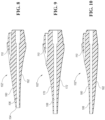
- Figures 8-10 illustrate various embodiments for varying the thickness of the tapered tip on either side of the opening 106. Varying the shape or thickness of the tapered tip 102 can provide a preferential bending direction during insertion into the vasculature.
- the tapered tips of Figures 8-10 include the structure of the tapered tip 102 described above, unless described otherwise.
- Figure 8 shows a tapered tip 102' according to one embodiment.
- the tapered tip 102' has a first portion 160 on the side of the opening 106 closer to the second opening 110, and a second portion 162 on the side of the opening 106 away from the second opening 110.
- the first portion 160 is generally conical in shape, generally constantly increasing in thickness (e.g., between the opening 106 and the outer surface) from the front surface 104 toward the rear.
- the outer surface of the first portion 160 is generally linear.
- the second portion 162 has an outer surface that is concave. Therefore, the second portion 162 is not generally conical in shape, as the thickness of the second portion is not constant. This can influence the tracking performance of the delivery system in a first manner, with a first preferred bending direction that may allow for easier tracking and device placement.
- Figure 9 shows a tapered tip 102" according to another embodiment.
- the tapered tip 102" has a first portion 170 on the side of the opening 106 closer to the second opening 110, and a second portion 172 on the side of the opening 106 away from the second opening 110.
- the first portion 170 has an outer surface that is generally concave
- the second portion 172 has an outer surface that is generally concave.
- the outer surfaces of the two portions 170, 172 can be pitched or concave at different degrees of magnitude.
- the second portion 172 can be more concave than the first portion 170.
- both the first and second portions 170, 172 can be angled such that the thickness of both portions is equal or substantially similar for at least a majority of the length of the portions 170, 172. This can influence the tracking performance of the delivery system in another manner, with another preferred bending direction that may allow for easier tracking and device placement.
- Figure 10 shows a tapered tip 102′′′ according to another embodiment.
- the tapered tip 102′′′ has a first portion 180 on the side of the opening 106 closer to the second opening 110, and a second portion 182 on the side of the opening 106 away from the second opening 110.
- the second portion 182 may have an outer surface that is generally linear, creating a conical shape of the second portion 182. Meanwhile, the outer surface of the first portion 170 may be concave.
- the thickness of the second portion 182 may exceed the thickness of the first portion 180 for at least a majority of the length of the portions 180, 182. This can influence the tracking performance of the delivery system in another manner, with another preferred bending direction that may allow for easier tracking and device placement.
Landscapes
- Health & Medical Sciences (AREA)
- Engineering & Computer Science (AREA)
- Biomedical Technology (AREA)
- Cardiology (AREA)
- Oral & Maxillofacial Surgery (AREA)
- Transplantation (AREA)
- Heart & Thoracic Surgery (AREA)
- Vascular Medicine (AREA)
- Life Sciences & Earth Sciences (AREA)
- Animal Behavior & Ethology (AREA)
- General Health & Medical Sciences (AREA)
- Public Health (AREA)
- Veterinary Medicine (AREA)
- Gastroenterology & Hepatology (AREA)
- Pulmonology (AREA)
- Prostheses (AREA)
- Media Introduction/Drainage Providing Device (AREA)
Applications Claiming Priority (2)
| Application Number | Priority Date | Filing Date | Title |
|---|---|---|---|
| US16/862,720 US11612505B2 (en) | 2020-04-30 | 2020-04-30 | Stent graft delivery system with offset tapered tip |
| EP21170191.7A EP3903746B1 (fr) | 2020-04-30 | 2021-04-23 | Système de pose de greffe d'endoprothèse à embout conique décalé |
Related Parent Applications (2)
| Application Number | Title | Priority Date | Filing Date |
|---|---|---|---|
| EP21170191.7A Division-Into EP3903746B1 (fr) | 2020-04-30 | 2021-04-23 | Système de pose de greffe d'endoprothèse à embout conique décalé |
| EP21170191.7A Division EP3903746B1 (fr) | 2020-04-30 | 2021-04-23 | Système de pose de greffe d'endoprothèse à embout conique décalé |
Publications (2)
| Publication Number | Publication Date |
|---|---|
| EP4473948A2 true EP4473948A2 (fr) | 2024-12-11 |
| EP4473948A3 EP4473948A3 (fr) | 2025-02-26 |
Family
ID=75659931
Family Applications (2)
| Application Number | Title | Priority Date | Filing Date |
|---|---|---|---|
| EP21170191.7A Active EP3903746B1 (fr) | 2020-04-30 | 2021-04-23 | Système de pose de greffe d'endoprothèse à embout conique décalé |
| EP24208717.9A Pending EP4473948A3 (fr) | 2020-04-30 | 2021-04-23 | Système de pose de greffe d'endoprothèse à embout conique décalé |
Family Applications Before (1)
| Application Number | Title | Priority Date | Filing Date |
|---|---|---|---|
| EP21170191.7A Active EP3903746B1 (fr) | 2020-04-30 | 2021-04-23 | Système de pose de greffe d'endoprothèse à embout conique décalé |
Country Status (2)
| Country | Link |
|---|---|
| US (2) | US11612505B2 (fr) |
| EP (2) | EP3903746B1 (fr) |
Families Citing this family (1)
| Publication number | Priority date | Publication date | Assignee | Title |
|---|---|---|---|---|
| CN114533357B (zh) * | 2020-11-26 | 2026-03-31 | 先健科技(深圳)有限公司 | 输送装置 |
Family Cites Families (19)
| Publication number | Priority date | Publication date | Assignee | Title |
|---|---|---|---|---|
| IE20020533A1 (en) | 2001-06-27 | 2003-05-28 | Salviac Ltd | A Catheter |
| US20030109886A1 (en) | 2001-06-27 | 2003-06-12 | Martin Keegan | Catheter |
| US6939368B2 (en) * | 2002-01-17 | 2005-09-06 | Scimed Life Systems, Inc. | Delivery system for self expanding stents for use in bifurcated vessels |
| US6999809B2 (en) | 2002-07-16 | 2006-02-14 | Edwards Lifesciences Corporation | Central venous catheter having a soft tip and fiber optics |
| EP1608293B1 (fr) * | 2003-04-03 | 2015-06-03 | Cook Medical Technologies LLC | Système de déploiement de greffon de stent ramifié |
| US7763063B2 (en) * | 2003-09-03 | 2010-07-27 | Bolton Medical, Inc. | Self-aligning stent graft delivery system, kit, and method |
| US8216298B2 (en) * | 2007-01-05 | 2012-07-10 | Medtronic Vascular, Inc. | Branch vessel graft method and delivery system |
| US7727251B2 (en) * | 2007-04-25 | 2010-06-01 | Medtronic Vascular, Inc. | Low profile dilator for arteriotomy closure system |
| EP2036519A1 (fr) * | 2007-09-16 | 2009-03-18 | Ophir Perelson | Endoprothèse vasculaire pour une bifurcation et système de mise en place d'endoprothèse vasculaire |
| US9474641B2 (en) * | 2007-10-23 | 2016-10-25 | Cook Medical Technologies Llc | Indwelling catheter arrangement |
| US20090276027A1 (en) * | 2008-05-01 | 2009-11-05 | Medtronic Vasscular, Inc. | Stent Graft Delivery System and Method of Use |
| US8419782B2 (en) * | 2009-04-09 | 2013-04-16 | Medtronic Vascular, Inc. | Precise positioning prosthesis delivery system and method |
| US8764811B2 (en) | 2010-04-20 | 2014-07-01 | Medtronic Vascular, Inc. | Controlled tip release stent graft delivery system and method |
| US9839542B2 (en) * | 2011-04-19 | 2017-12-12 | Medtronic Ardian Luxembourg S.A.R.L. | Mobile external coupling for branch vessel connection |
| US8920485B2 (en) | 2012-04-13 | 2014-12-30 | Medtronic Vascular, Inc. | Stent-graft delivery system having a rotatable single shaft tip capture mechanism |
| US11406497B2 (en) * | 2013-03-14 | 2022-08-09 | Jc Medical, Inc. | Heart valve prosthesis |
| US9486350B2 (en) | 2014-03-31 | 2016-11-08 | Medtronic Vascular, Inc. | Stent-graft delivery system having handle mechanism for two-stage tip release |
| CN111529126A (zh) * | 2015-06-30 | 2020-08-14 | 恩朵罗杰克斯股份有限公司 | 用于将第一细长构件固定至第二细长构件的系统及方法 |
| US10195392B2 (en) * | 2015-07-02 | 2019-02-05 | Boston Scientific Scimed, Inc. | Clip-on catheter |
-
2020
- 2020-04-30 US US16/862,720 patent/US11612505B2/en active Active
-
2021
- 2021-04-23 EP EP21170191.7A patent/EP3903746B1/fr active Active
- 2021-04-23 EP EP24208717.9A patent/EP4473948A3/fr active Pending
-
2023
- 2023-03-09 US US18/119,666 patent/US12144753B2/en active Active
Also Published As
| Publication number | Publication date |
|---|---|
| US12144753B2 (en) | 2024-11-19 |
| US20210338466A1 (en) | 2021-11-04 |
| US20230225890A1 (en) | 2023-07-20 |
| EP3903746B1 (fr) | 2024-12-11 |
| US11612505B2 (en) | 2023-03-28 |
| EP3903746A3 (fr) | 2022-02-16 |
| EP4473948A3 (fr) | 2025-02-26 |
| EP3903746A2 (fr) | 2021-11-03 |
Similar Documents
| Publication | Publication Date | Title |
|---|---|---|
| EP3534848B1 (fr) | Système de mise en place de greffe d'endoprothèse présentant une gaine rétrécie | |
| US20220257361A1 (en) | Vascular prosthesis with fenestration ring and methods of use | |
| US9554904B2 (en) | Distal tip assembly for a heart valve delivery catheter | |
| WO2018156848A1 (fr) | Prothèse vasculaire à adaptateur serti et procédés d'utilisation | |
| EP2749253B1 (fr) | Prothèse endoluminale ayant des ramifications modulaires | |
| JP2013524998A (ja) | 分岐血管接続部のための可動外部結合部 | |
| JP2012523908A (ja) | キャステレイテッドスリーブステントグラフト送達システムおよび方法 | |
| US12144753B2 (en) | Stent graft delivery system including a tapered tip offset through-channel aligning with a first guidewire lumen | |
| US20240325183A1 (en) | Stent graft delivery method | |
| US20230380952A1 (en) | Branched stent graft having support stent | |
| US20240407936A1 (en) | Delivery system for delivering an endovascular graft within a blood vessel | |
| IL302050A (en) | Covered stent | |
| EP3981362B1 (fr) | Greffe d'endoprothèse ramifiée | |
| EP4057939B1 (fr) | Couture oblique pour réduire la densité de tassement d'un stent couvert dans un système de pose | |
| EP4327777A1 (fr) | Greffon d'endoprothèse ramifié ayant une endoprothèse de support | |
| US20210282952A1 (en) | Endovascular catheter with delivery system separately assembled to stent graft system | |
| EP4197492A1 (fr) | Système d'administration pour administrer un dispositif cardiovasculaire |
Legal Events
| Date | Code | Title | Description |
|---|---|---|---|
| PUAI | Public reference made under article 153(3) epc to a published international application that has entered the european phase |
Free format text: ORIGINAL CODE: 0009012 |
|
| STAA | Information on the status of an ep patent application or granted ep patent |
Free format text: STATUS: REQUEST FOR EXAMINATION WAS MADE |
|
| 17P | Request for examination filed |
Effective date: 20241024 |
|
| AC | Divisional application: reference to earlier application |
Ref document number: 3903746 Country of ref document: EP Kind code of ref document: P |
|
| AK | Designated contracting states |
Kind code of ref document: A2 Designated state(s): AL AT BE BG CH CY CZ DE DK EE ES FI FR GB GR HR HU IE IS IT LI LT LU LV MC MK MT NL NO PL PT RO RS SE SI SK SM TR |
|
| REG | Reference to a national code |
Ref country code: DE Ref legal event code: R079 Free format text: PREVIOUS MAIN CLASS: A61F0002954000 Ipc: A61F0002962000 |
|
| PUAL | Search report despatched |
Free format text: ORIGINAL CODE: 0009013 |
|
| AK | Designated contracting states |
Kind code of ref document: A3 Designated state(s): AL AT BE BG CH CY CZ DE DK EE ES FI FR GB GR HR HU IE IS IT LI LT LU LV MC MK MT NL NO PL PT RO RS SE SI SK SM TR |
|
| RIC1 | Information provided on ipc code assigned before grant |
Ipc: A61F 2/06 20130101ALN20250120BHEP Ipc: A61F 2/954 20130101ALI20250120BHEP Ipc: A61F 2/962 20130101AFI20250120BHEP |