EP4474592A2 - Mineralwolleplatte mit füllstoffen - Google Patents
Mineralwolleplatte mit füllstoffen Download PDFInfo
- Publication number
- EP4474592A2 EP4474592A2 EP24208317.8A EP24208317A EP4474592A2 EP 4474592 A2 EP4474592 A2 EP 4474592A2 EP 24208317 A EP24208317 A EP 24208317A EP 4474592 A2 EP4474592 A2 EP 4474592A2
- Authority
- EP
- European Patent Office
- Prior art keywords
- mineral wool
- binder
- fibers
- mineral
- fillers
- Prior art date
- Legal status (The legal status is an assumption and is not a legal conclusion. Google has not performed a legal analysis and makes no representation as to the accuracy of the status listed.)
- Pending
Links
Images
Classifications
-
- E—FIXED CONSTRUCTIONS
- E04—BUILDING
- E04F—FINISHING WORK ON BUILDINGS, e.g. STAIRS, FLOORS
- E04F13/00—Coverings or linings, e.g. for walls or ceilings
- E04F13/07—Coverings or linings, e.g. for walls or ceilings composed of covering or lining elements; Sub-structures therefor; Fastening means therefor
- E04F13/08—Coverings or linings, e.g. for walls or ceilings composed of covering or lining elements; Sub-structures therefor; Fastening means therefor composed of a plurality of similar covering or lining elements
- E04F13/16—Coverings or linings, e.g. for walls or ceilings composed of covering or lining elements; Sub-structures therefor; Fastening means therefor composed of a plurality of similar covering or lining elements of fibres or chips, e.g. bonded with synthetic resins, or with an outer layer of fibres or chips
-
- C—CHEMISTRY; METALLURGY
- C03—GLASS; MINERAL OR SLAG WOOL
- C03C—CHEMICAL COMPOSITION OF GLASSES, GLAZES OR VITREOUS ENAMELS; SURFACE TREATMENT OF GLASS; SURFACE TREATMENT OF FIBRES OR FILAMENTS MADE FROM GLASS, MINERALS OR SLAGS; JOINING GLASS TO GLASS OR OTHER MATERIALS
- C03C13/00—Fibre or filament compositions
- C03C13/06—Mineral fibres, e.g. slag wool, mineral wool, rock wool
-
- C—CHEMISTRY; METALLURGY
- C08—ORGANIC MACROMOLECULAR COMPOUNDS; THEIR PREPARATION OR CHEMICAL WORKING-UP; COMPOSITIONS BASED THEREON
- C08K—Use of inorganic or non-macromolecular organic substances as compounding ingredients
- C08K3/00—Use of inorganic substances as compounding ingredients
- C08K3/34—Silicon-containing compounds
- C08K3/346—Clay
-
- C—CHEMISTRY; METALLURGY
- C08—ORGANIC MACROMOLECULAR COMPOUNDS; THEIR PREPARATION OR CHEMICAL WORKING-UP; COMPOSITIONS BASED THEREON
- C08K—Use of inorganic or non-macromolecular organic substances as compounding ingredients
- C08K7/00—Use of ingredients characterised by shape
- C08K7/02—Fibres or whiskers
- C08K7/04—Fibres or whiskers inorganic
- C08K7/14—Glass
-
- C—CHEMISTRY; METALLURGY
- C08—ORGANIC MACROMOLECULAR COMPOUNDS; THEIR PREPARATION OR CHEMICAL WORKING-UP; COMPOSITIONS BASED THEREON
- C08K—Use of inorganic or non-macromolecular organic substances as compounding ingredients
- C08K9/00—Use of pretreated ingredients
- C08K9/08—Ingredients agglomerated by treatment with a binding agent
-
- C—CHEMISTRY; METALLURGY
- C08—ORGANIC MACROMOLECULAR COMPOUNDS; THEIR PREPARATION OR CHEMICAL WORKING-UP; COMPOSITIONS BASED THEREON
- C08L—COMPOSITIONS OF MACROMOLECULAR COMPOUNDS
- C08L101/00—Compositions of unspecified macromolecular compounds
-
- Y—GENERAL TAGGING OF NEW TECHNOLOGICAL DEVELOPMENTS; GENERAL TAGGING OF CROSS-SECTIONAL TECHNOLOGIES SPANNING OVER SEVERAL SECTIONS OF THE IPC; TECHNICAL SUBJECTS COVERED BY FORMER USPC CROSS-REFERENCE ART COLLECTIONS [XRACs] AND DIGESTS
- Y02—TECHNOLOGIES OR APPLICATIONS FOR MITIGATION OR ADAPTATION AGAINST CLIMATE CHANGE
- Y02W—CLIMATE CHANGE MITIGATION TECHNOLOGIES RELATED TO WASTEWATER TREATMENT OR WASTE MANAGEMENT
- Y02W30/00—Technologies for solid waste management
- Y02W30/50—Reuse, recycling or recovery technologies
- Y02W30/91—Use of waste materials as fillers for mortars or concrete
Definitions
- the present invention relates to a method to produce mineral wool boards, as well as a mineral wool board produced by such a method.
- the boards are used, for example, as wall cladding, floor covering or in dry construction.
- laminate panels are widely used as indoor floor coverings. They are usually based on a carrier board made of MDF or HDF wood material with a melamine resin impregnated decorative paper on the top side. The resins harden by pressing under the influence of heat and pressure, so that a highly abrasion-resistant surface is obtained.
- a disadvantage of such laminate panels is that they are generally unsuitable for outdoor applications where they are exposed to weather and moisture.
- an improved outdoor floor panel is known, using a carrier board that is better suited for outdoor use.
- the carrier board should consist of MDF or HDF of acetylated wood, a fiber cement board or a preferably specially treated PVC board.
- high-quality PVC-based panels have also been known for some time and are marketed under the term LVT.
- a decorative paper web is glued onto a soft PVC layer or sheet in order to provide the visible surface of the PVC with a desired decor.
- Such PVC-based panels are hardly suitable for applications where they are exposed to weather conditions, such as UV radiation or moisture.
- building materials made of mineral fibers which are often used as insulating materials, are known from the state of the art.
- mineral fibers are spun from molten basalt stone, for example, and a considerable part of these fibers is sprayed with a liquid binder immediately after the spinning process. The residual heat from the spinning process is used to evaporate the solvent water of the binder and to further condense the binder. Later the fibers are compressed to insulation boards with very low density.
- the binder serves to loosely bond the fibers so that the insulation boards remain in their shape. The density of these insulation boards is between 20 and 200 kg/m 3 .
- the binders used are very low molecular weight and have a high water dilutability. They are especially known under the name "mineral wool resins".
- resin-bound mineral wool fiber boards for cladding facades (as facade panels).
- cladding facades for example, solid powdery resins are used. These powders are mixed dry with the fibers and this mixture is fed to a press.
- the present invention aims to improve the state of the art and in particular to provide an improved method for the production of mineral wool boards.
- the method should lead to robust and resistant boards while still allowing an economical production thereof.
- a method is provided to produce a mineral wool board, which can for example be used as cladding for the exterior of buildings.
- mineral wool fibers having a fiber length of 50 to 800 ⁇ m are provided.
- Mineral wool is a material made of artificially produced mineral fibers.
- slag wool glass wool or rock wool.
- Mineral wool is widely used as insulation material in the thermal insulation of houses or as sound and fire protection material.
- the mineral wool or mineral wool fibers must be provided with a binder and pressed under the influence of heat and pressure to form usable boards or panels.
- a binder which comprises a mixture of liquid resin and mineral fillers with an average grain size d 50 of 10 nm to 150 ⁇ m.
- the mineral fillers are available from commercial suppliers.
- the particle size specifications of the manufacturers are sufficiently reliable, since the effect does not depend on the exact size, but the fillers can be used in a wide range of sizes.
- the corresponding FEPA standards Federation of European Producers of Abrasives
- the mixture of resin and fillers is preferably prepared in advance by stirring the mineral fillers into the liquid resin.
- ultrasound is then applied to the binder, i.e.
- Ultrasonic treatment is an essential means of this process and ensures a good dispersion of the fillers in the liquid resin.
- the provided fibers are glued with the binder.
- the mineral wool fibers can be glued with the binder, i.e. the mixture of liquid resin and fillers, in a blow line so that the liquid binder is well distributed on the fibers.
- the glued fibers are then pressed, if necessary after a drying step, using heat and pressure to form a board with a density of more than 500 kg/m 3 . Due to the high density, the boards are well suitable for many applications, for which commonly produced mineral wool boards are unsuitable due to their low density.
- water is removed from the binder and the resin cures. This results in a chemical reaction of the resin, usually a polycondensation.
- the mineral wool boards produced in this way can then be further processed, for example by applying further decorative layers or surfaces or by cutting the pressed boards to the desired size etc.
- the application of ultrasonic to the binder is essential for the invention, as in this way a very good dispersion of the mineral fillers can be achieved and the agglomeration of particles can be effectively prevented.
- the ultrasonic input must be of sufficient intensity and duration. Exemplary values for the ultrasonic intensity are given in the examples described later in this document. Basically, the selection of the suitable ultrasonic intensity lies in the competence of the skilled person. It is essential that the intensity, based on the equipment used and the composition and quantity of the binder, is selected in such a way that the fillers are dispersed and preferably all larger agglomerations of particles are broken up by the ultrasonic effect.
- the liquid resin preferably comprises phenolic resin or consists preferably of liquid phenolic resin.
- Phenolic resins are typically offered commercially in liquid form, whereby the liquid phenolic resin typically has a solid content of about 40 to 50 % of resin.
- the remaining component is water, which usually evaporates during further processing of the phenolic resins and is therefore no longer present in the finished product.
- different compositions are indicated by weight relative to the binder respectively the liquid resin. This always is based on the solids content of the liquid resin, since the water content can vary and, as mentioned, is not relevant for the finished product.
- the mineral fillers preferably include kaolin, quartz flour, limestone, aluminium oxide and similar materials. Most preferred, the mineral fillers mainly consist of kaolin, quartz flour, limestone and/or aluminium oxide.
- mineral fillers have a mean grain size d 50 from 10 nm to 150 ⁇ m, more preferably from 300 nm to 100 ⁇ m and most preferably from 500 to 900 nm. These grain sizes can be easily dispersed in the liquid resin and thus lead to a homogeneous, high-quality product.
- the mineral fillers are added in an amount of 5 to 150 percent by weight based on the mass of the binder, based on the solids content of the binder, more preferably 10 to 100 percent by weight and most preferably 35 to 90 percent by weight.
- an addition of 30 percent by weight of mineral fillers based on the mass of the binder means that 300 kg of mineral fillers are added for an amount of 1,000 kg of phenolic resin (based on the solids content, i.e. for a liquid phenolic resin without the water content).
- An addition of 120 percent by weight of mineral fillers means an addition of 1,200 kg of mineral fillers.
- the mineral filler is preferably added to the liquid resin before it is used to glue the mineral wool fibers.
- the addition of mineral fillers in an amount of 80% by weight based on the mass of the binder means that 320 kg of filler is added to 1,000 kg of liquid phenolic resin. Because 1,000 kg of liquid phenolic resin with 40 % solids content contains 400 kg of solid resin (80 % of 400 kg is 320 kg). Since the mineral wool fibers are glued with the filler/resin mixture, the mineral fillers are distributed very well in the final board. This distribution is considerably improved by the inventive application of ultrasonic to the binder before the fibers are glued.
- the mineral wool fibers have a fiber length of 60 to 700 ⁇ m, even more preferably 80 to 600 ⁇ m and most preferably 100 to 500 ⁇ m. It has been shown that such fiber lengths are easy to process and can be used to produce stable and durable products.
- the glued fibers are pressed at temperatures between 130 and 180°C, more preferably 140 and 160°C and also preferably at a specific pressing pressure of 15 to 35 bar. These temperature and pressure ranges lead to a good and complete curing of the resins provided, especially when phenolic resins are used. Phenolic resins condense under these pressures and temperatures, so that very stable and resistant mineral wool boards are produced, which can be worked on very well.
- the ratio of binder (based on the solids content of the resin in the binder) to mineral wool fibers is 10 to 30 percent by weight, more preferably 12 to 30 percent by weight and most preferably 14 to 25 percent by weight.
- the mass of mineral fillers is thus not taken into account.
- a binder to mineral wool fibers ratio of 20 percent by weight means that 20 kg of binder is added to 100 kg of mineral wool fibers, based on the solids content of the resin in the binder.
- a liquid phenolic resin with a solids content of 40 % this means that 50 kg of liquid phenolic resin (i.e. containing 20 kg of solid resin) is added per 100 kg of mineral wool fibers.
- the mineral wool fibers are glued with binder (i.e. the mixture of liquid resin and mineral fillers) in a blow line.
- binder i.e. the mixture of liquid resin and mineral fillers
- the binder is injected directly into the fiber flow in the blow line.
- This process leads to a very homogeneous glue distribution and is very economical.
- the general expertise for the production of mineral wool boards can be used for the gluing of mineral wool fibers.
- the mineral wool fibers can also be glued with binding agents using mechanical gluing. If larger quantities of filler are added to the binder, mechanical bonding of the fibers in known mixing devices can also be of advantage.
- the mineral wool board obtained after pressing is further processed into a floor panel.
- the surface of the mineral wool board is provided with a decorative surface, such as a decorative paper or similar.
- coupling means such as in particular tongue and groove elements, so that several mineral wool boards of the same type can be joined together to form a large-area covering.
- the glued fibers are pressed using heat and pressure in such a way that the resulting board has a density of more than 700 kg/m 3 , preferably more than 900 kg/m 3 and most preferably more than 1,000 kg/m 3 .
- Panels with such a density are highly compact, mechanically very robust and can be used in a variety of applications.
- the mineral wool board according to the invention therefore comprises mineral wool fibers with a fiber length of 50 to 800 ⁇ m, a binder in the form of a cured resin, in particular a cured phenolic resin and corresponding mineral fillers with preferably an average grain size d 50 of 10 nm to 150 ⁇ m, whereby the mineral wool board has a density of more than 500 kg/m 3 .
- the mineral fillers preferably include kaolin, quartz flour, limestone and/or aluminium oxide. Particularly preferred, the fillers mainly consist of these materials.
- the mineral fillers have preferably an average grain size from 10 nm to 50 ⁇ m, more preferably from 300 nm to 100 ⁇ m and most preferably from 500 to 900 nm.
- the mineral wool fibers preferably have a fiber length of 60 to 700 ⁇ m, even more preferably 80 to 600 ⁇ m and most preferably 100 to 500 ⁇ m.
- the ratio of binder (based on the solid content of the resin in the binder) to mineral wool fibers is 10 to 30 percent by weight, more preferably 12 to 30 percent by weight and most preferably 14 to 24 percent by weight.
- the mineral wool board preferably has a density of more than 700 kg/m 3 , preferably more than 900 kg/m 3 and most preferably more than 1,000 kg/m 3 .
- a liquid phenolic resin was produced in which one mol of phenol was mixed with 1.05 mol of formaldehyde and the pH was adjusted to approx. 8.3 to 8.9 using caustic soda. Condensation took place at 85°C until the viscosity (measured at 20°C) was approx. 65 mPas. It should be ensured that the water dilutability is 120 to 200 % and the B time (at 150°C) is 100 to 150 seconds. The solids content of the phenolic resin produced in this way according to DIN EN ISO 3251 was approx. 60 %.
- mineral wool fibers were prepared and provided.
- rock wool which was obtained from the molten stone, was frayed to such an extent that no larger fiber agglomerates existed.
- This type of rock wool can be obtained commercially, for example, from manufacturers of such wool, such as Saint Gobain or Rockwool. Fiberization to a fiber length of approx. 50 to 800 ⁇ m allows uniform wetting of the fibers with the liquid binder. If the fiber length is too short, the glued fibers do not have the necessary structural strength. Too long a fiber length makes it difficult to evenly wet the fibers with the liquid binder. The mineral wool fibers provided in this way are then evenly glued with the liquid phenolic resin. The input quantity of phenolic resin was 12 % by weight based on the solid resin.
- the boards produced in this way had a thickness of 7 mm and a density of 1,200 kg/m 3 with the following mechanical properties: bending strength 38 N/mm 2 ; elastic modulus (flexural) 5,600 N/mm 2 , tensile strength 27 N/mm 2 and elastic modulus (tensile) of 5,500 N/mm 2 .
- the second example corresponds to the inventive method, in which mineral fillers were added to the liquid resin and the binder thus produced was subjected to ultrasonic application before it was applied to the fibers.
- the phenolic resin was initially produced as above. Then 650 g of the phenolic resin (with a solids content of 60 % including 390 g of solid resin) were mixed with 350 g of kaolin, to produce 1,000 g of binder. This means that 350 g kaolin was added to 390 g solid in the liquid resin, i.e. an amount of about 90 % mineral filler based on the mass of the binder.
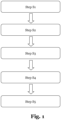
- step S3 the binder, which essentially consists of the liquid resin and the mineral fillers, is subjected to an ultrasonic application, whereby the fillers are distributed in the liquid resin and preferably agglomerates of the fillers are destroyed or reduced in size.
- step S4 the mineral wool fibers provided are glued with the binder.
- the fibers must necessarily be glued after steps S1, S2 and S3, as ultrasonic application only makes sense as long as the mineral wool fibers have not been added to the binder.
- step S4 should take place immediately after step S3, as the fillers dispersed by the ultrasonic application can otherwise settle again in the liquid resin.
- the glued fibers are pressed using heat and pressure to form a mineral wool board.
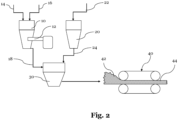
- the dried and glued mineral wool fibers are spread onto a conveyor belt and form a glued fiber mat 42.
- the fiber mat 42 is fed through the double belt press 40 and pressed into a mineral wool board 44 under the effect of heat and pressure.
- the mineral wool board 44 is available as a long strand, which can then be cut to size and further processed if desired.
Landscapes
- Chemical & Material Sciences (AREA)
- Engineering & Computer Science (AREA)
- Architecture (AREA)
- Chemical Kinetics & Catalysis (AREA)
- Organic Chemistry (AREA)
- Medicinal Chemistry (AREA)
- Polymers & Plastics (AREA)
- Health & Medical Sciences (AREA)
- Structural Engineering (AREA)
- Civil Engineering (AREA)
- Life Sciences & Earth Sciences (AREA)
- General Chemical & Material Sciences (AREA)
- Geochemistry & Mineralogy (AREA)
- Materials Engineering (AREA)
- General Life Sciences & Earth Sciences (AREA)
- Dispersion Chemistry (AREA)
- Paper (AREA)
- Nonwoven Fabrics (AREA)
- Dry Formation Of Fiberboard And The Like (AREA)
- Building Environments (AREA)
Priority Applications (1)
| Application Number | Priority Date | Filing Date | Title |
|---|---|---|---|
| EP24208317.8A EP4474592A3 (de) | 2018-07-12 | 2018-07-12 | Mineralwolleplatte mit füllstoffen |
Applications Claiming Priority (3)
| Application Number | Priority Date | Filing Date | Title |
|---|---|---|---|
| EP24208317.8A EP4474592A3 (de) | 2018-07-12 | 2018-07-12 | Mineralwolleplatte mit füllstoffen |
| EP18742979.0A EP3821092B1 (de) | 2018-07-12 | 2018-07-12 | Verfahren zum produzieren einer mineralwolleplatte und mineralwolleplatte mit füllstoffen |
| PCT/EP2018/068993 WO2020011364A1 (en) | 2018-07-12 | 2018-07-12 | Mineral wool board with fillers |
Related Parent Applications (1)
| Application Number | Title | Priority Date | Filing Date |
|---|---|---|---|
| EP18742979.0A Division EP3821092B1 (de) | 2018-07-12 | 2018-07-12 | Verfahren zum produzieren einer mineralwolleplatte und mineralwolleplatte mit füllstoffen |
Publications (2)
| Publication Number | Publication Date |
|---|---|
| EP4474592A2 true EP4474592A2 (de) | 2024-12-11 |
| EP4474592A3 EP4474592A3 (de) | 2025-02-19 |
Family
ID=62976039
Family Applications (2)
| Application Number | Title | Priority Date | Filing Date |
|---|---|---|---|
| EP18742979.0A Active EP3821092B1 (de) | 2018-07-12 | 2018-07-12 | Verfahren zum produzieren einer mineralwolleplatte und mineralwolleplatte mit füllstoffen |
| EP24208317.8A Pending EP4474592A3 (de) | 2018-07-12 | 2018-07-12 | Mineralwolleplatte mit füllstoffen |
Family Applications Before (1)
| Application Number | Title | Priority Date | Filing Date |
|---|---|---|---|
| EP18742979.0A Active EP3821092B1 (de) | 2018-07-12 | 2018-07-12 | Verfahren zum produzieren einer mineralwolleplatte und mineralwolleplatte mit füllstoffen |
Country Status (12)
| Country | Link |
|---|---|
| US (1) | US11970866B2 (de) |
| EP (2) | EP3821092B1 (de) |
| CN (1) | CN112384667B (de) |
| CA (1) | CA3103701C (de) |
| ES (1) | ES3015433T3 (de) |
| HR (1) | HRP20241629T1 (de) |
| HU (1) | HUE069463T2 (de) |
| PL (1) | PL3821092T3 (de) |
| RS (1) | RS66240B1 (de) |
| RU (1) | RU2756192C1 (de) |
| UA (1) | UA126718C2 (de) |
| WO (1) | WO2020011364A1 (de) |
Families Citing this family (1)
| Publication number | Priority date | Publication date | Assignee | Title |
|---|---|---|---|---|
| CA3176158A1 (en) * | 2020-04-03 | 2021-10-07 | Rockwool A/S | Facade system and insulation element for a facade system |
Citations (1)
| Publication number | Priority date | Publication date | Assignee | Title |
|---|---|---|---|---|
| WO2014053186A1 (de) | 2012-10-05 | 2014-04-10 | Kronoplus Technical Ag | FUßBODENPANEEL FÜR DEN AUßENBEREICH |
Family Cites Families (17)
| Publication number | Priority date | Publication date | Assignee | Title |
|---|---|---|---|---|
| CA809125A (en) * | 1969-03-25 | E. Cadotte John | Manufacture of mineral fiberboard | |
| GB1045780A (en) * | 1963-09-16 | 1966-10-19 | Celotex Company | Rigid panel of mineral fibres with synthetic resin binder |
| JPS4926509B1 (de) | 1970-07-29 | 1974-07-09 | ||
| DE3248663C1 (de) * | 1982-12-30 | 1984-06-07 | Grünzweig + Hartmann und Glasfaser AG, 6700 Ludwigshafen | Beschichtete Fassaden- oder Dachdaemmplatte aus Mineralfasern,sowie Verfahren zu ihrer Herstellung |
| JPS6179603A (ja) * | 1984-09-28 | 1986-04-23 | 大建工業株式会社 | 鉱物質繊維板の製造方法 |
| DE68905247T2 (de) * | 1988-06-23 | 1993-10-07 | Celotex Corp | Mineralfaser-Akustikplatte und Verfahren zu ihrer Herstellung. |
| JPH11269795A (ja) * | 1997-12-11 | 1999-10-05 | Asahi Fiber Glass Co Ltd | 無機質繊維板およびその製造方法 |
| NL1008041C2 (nl) | 1998-01-16 | 1999-07-19 | Tidis B V I O | Toepassing van een wateroplosbaar bindmiddelsysteem voor de productie van glas- of steenwol. |
| DE10326815A1 (de) * | 2003-06-13 | 2004-12-30 | Institut für Neue Materialien Gemeinnützige GmbH | Antiadhäsive Hochtemperaturschichten |
| JP4098227B2 (ja) * | 2003-09-02 | 2008-06-11 | 名古屋油化株式会社 | 難燃性繊維シートの製造方法、およびそれによって得られた難燃性繊維シートからなる成形物と積層物、並びにその積層物を用いた成形物 |
| JP2008231788A (ja) | 2007-03-20 | 2008-10-02 | Daiken Trade & Ind Co Ltd | 建築用板及びその製造方法 |
| DE102007018774A1 (de) | 2007-04-20 | 2008-10-23 | Saint-Gobain Isover G+H Ag | Fassadendämmplatte für die Dämmung von Außenfassaden von Gebäuden, Wärmedamm-Verbundsystem mit derartigen Fassadendämmplatten sowie Verfahren zur Herstellung einer Fassadendämmplatte |
| CN100500938C (zh) * | 2007-09-28 | 2009-06-17 | 钢铁研究总院 | 一种用于镀锌板纳米改性丙烯酸树脂乳液及其制备方法 |
| GB201012860D0 (en) * | 2010-07-30 | 2010-09-15 | Rockwool Int | Method for manufacturing a fibre-containing element and element produced by that method |
| EP2662214A1 (de) | 2012-05-07 | 2013-11-13 | Sika Technology AG | Abdichtungsvorrichtung mit verbesserter Haftung |
| RS61867B1 (sr) | 2016-05-13 | 2021-06-30 | Rockwool Int | Sastav veziva za mineralna vlakna koja se sastoje od najmanje jednog hidrokoloida |
| EP3385046A1 (de) * | 2017-04-07 | 2018-10-10 | Omya International AG | Linear beschichtete, dekorative platten auf holzbasis |
-
2018
- 2018-07-12 EP EP18742979.0A patent/EP3821092B1/de active Active
- 2018-07-12 HR HRP20241629TT patent/HRP20241629T1/hr unknown
- 2018-07-12 UA UAA202100576A patent/UA126718C2/uk unknown
- 2018-07-12 PL PL18742979.0T patent/PL3821092T3/pl unknown
- 2018-07-12 RS RS20241320A patent/RS66240B1/sr unknown
- 2018-07-12 HU HUE18742979A patent/HUE069463T2/hu unknown
- 2018-07-12 CA CA3103701A patent/CA3103701C/en active Active
- 2018-07-12 RU RU2021100890A patent/RU2756192C1/ru active
- 2018-07-12 WO PCT/EP2018/068993 patent/WO2020011364A1/en not_active Ceased
- 2018-07-12 US US17/259,652 patent/US11970866B2/en active Active
- 2018-07-12 ES ES18742979T patent/ES3015433T3/es active Active
- 2018-07-12 EP EP24208317.8A patent/EP4474592A3/de active Pending
- 2018-07-12 CN CN201880095564.4A patent/CN112384667B/zh active Active
Patent Citations (1)
| Publication number | Priority date | Publication date | Assignee | Title |
|---|---|---|---|---|
| WO2014053186A1 (de) | 2012-10-05 | 2014-04-10 | Kronoplus Technical Ag | FUßBODENPANEEL FÜR DEN AUßENBEREICH |
Also Published As
| Publication number | Publication date |
|---|---|
| WO2020011364A1 (en) | 2020-01-16 |
| CN112384667B (zh) | 2023-01-13 |
| UA126718C2 (uk) | 2023-01-11 |
| CA3103701C (en) | 2024-07-02 |
| HUE069463T2 (hu) | 2025-03-28 |
| RU2756192C1 (ru) | 2021-09-28 |
| US20220018138A1 (en) | 2022-01-20 |
| EP3821092A1 (de) | 2021-05-19 |
| EP3821092B1 (de) | 2024-10-30 |
| EP3821092C0 (de) | 2024-10-30 |
| PL3821092T3 (pl) | 2025-02-03 |
| CN112384667A (zh) | 2021-02-19 |
| ES3015433T3 (en) | 2025-05-05 |
| CA3103701A1 (en) | 2020-01-16 |
| HRP20241629T1 (hr) | 2025-02-14 |
| EP4474592A3 (de) | 2025-02-19 |
| RS66240B1 (sr) | 2024-12-31 |
| US11970866B2 (en) | 2024-04-30 |
Similar Documents
| Publication | Publication Date | Title |
|---|---|---|
| CN103392040B (zh) | 形成耐火纤维素产品的方法及其相关设备 | |
| EP2875924B1 (de) | Platten auf Holzbasis, Verfahren zu deren Herstellung und deren Verwendung | |
| RU2755311C1 (ru) | Способ изготовления древесноволокнистой панели | |
| KR20090127791A (ko) | 목질재료 전기온돌 일체형판넬 | |
| EP3821091B1 (de) | Verfahren zur herstellung von platten aus mineralwolle und platte aus mineralwolle | |
| EP1525264B1 (de) | Verfahren zur herstellung brandgeschuetzter holzfaserformteile | |
| EP3821092B1 (de) | Verfahren zum produzieren einer mineralwolleplatte und mineralwolleplatte mit füllstoffen | |
| CA3103700C (en) | Method to produce mineral wool boards | |
| CA3127353A1 (en) | Wood fiber-glass composite | |
| KR101130316B1 (ko) | 건축용황토판넬 제조방법 및 이에 의해 제조된 건축용황토판넬 | |
| JPH11315594A (ja) | 耐火性複合建築材料および耐火性複合床材 | |
| JP3403541B2 (ja) | 石膏パーティクルボードおよびその製造方法 | |
| JP5137364B2 (ja) | 無機質板及びその製造方法 | |
| EP3034259B1 (de) | Verfahren zur Herstellung einer Holz-Kunststoff-Verbundwerkstoff-Platte mit Dekor | |
| JP2008231788A (ja) | 建築用板及びその製造方法 | |
| JP2008030401A (ja) | 無機質板及びその製造方法 | |
| JP2008068566A (ja) | 無機質板及びその製造方法 |
Legal Events
| Date | Code | Title | Description |
|---|---|---|---|
| PUAI | Public reference made under article 153(3) epc to a published international application that has entered the european phase |
Free format text: ORIGINAL CODE: 0009012 |
|
| STAA | Information on the status of an ep patent application or granted ep patent |
Free format text: STATUS: REQUEST FOR EXAMINATION WAS MADE |
|
| 17P | Request for examination filed |
Effective date: 20241023 |
|
| AC | Divisional application: reference to earlier application |
Ref document number: 3821092 Country of ref document: EP Kind code of ref document: P |
|
| AK | Designated contracting states |
Kind code of ref document: A2 Designated state(s): AL AT BE BG CH CY CZ DE DK EE ES FI FR GB GR HR HU IE IS IT LI LT LU LV MC MK MT NL NO PL PT RO RS SE SI SK SM TR |
|
| PUAL | Search report despatched |
Free format text: ORIGINAL CODE: 0009013 |
|
| AK | Designated contracting states |
Kind code of ref document: A3 Designated state(s): AL AT BE BG CH CY CZ DE DK EE ES FI FR GB GR HR HU IE IS IT LI LT LU LV MC MK MT NL NO PL PT RO RS SE SI SK SM TR |
|
| RIC1 | Information provided on ipc code assigned before grant |
Ipc: C08K 9/08 20060101ALI20250115BHEP Ipc: C08K 7/14 20060101ALI20250115BHEP Ipc: C08K 3/34 20060101ALI20250115BHEP Ipc: C08K 7/02 20060101ALI20250115BHEP Ipc: C03C 13/06 20060101ALI20250115BHEP Ipc: E04F 13/16 20060101AFI20250115BHEP |
|
| STAA | Information on the status of an ep patent application or granted ep patent |
Free format text: STATUS: EXAMINATION IS IN PROGRESS |
|
| 17Q | First examination report despatched |
Effective date: 20260206 |