EP4474779A1 - Verfahren und vorrichtungen zum verkaufen eines produkts durch gewicht beim pick-and-go-einkauf - Google Patents
Verfahren und vorrichtungen zum verkaufen eines produkts durch gewicht beim pick-and-go-einkauf Download PDFInfo
- Publication number
- EP4474779A1 EP4474779A1 EP24180950.8A EP24180950A EP4474779A1 EP 4474779 A1 EP4474779 A1 EP 4474779A1 EP 24180950 A EP24180950 A EP 24180950A EP 4474779 A1 EP4474779 A1 EP 4474779A1
- Authority
- EP
- European Patent Office
- Prior art keywords
- weighing
- product
- price
- user
- weight
- Prior art date
- Legal status (The legal status is an assumption and is not a legal conclusion. Google has not performed a legal analysis and makes no representation as to the accuracy of the status listed.)
- Pending
Links
Images


Classifications
-
- G—PHYSICS
- G01—MEASURING; TESTING
- G01G—WEIGHING
- G01G19/00—Weighing apparatus or methods adapted for special purposes not provided for in the preceding groups
- G01G19/40—Weighing apparatus or methods adapted for special purposes not provided for in the preceding groups with provisions for indicating, recording, or computing price or other quantities dependent on the weight
- G01G19/413—Weighing apparatus or methods adapted for special purposes not provided for in the preceding groups with provisions for indicating, recording, or computing price or other quantities dependent on the weight using electromechanical or electronic computing means
- G01G19/414—Weighing apparatus or methods adapted for special purposes not provided for in the preceding groups with provisions for indicating, recording, or computing price or other quantities dependent on the weight using electromechanical or electronic computing means using electronic computing means only
- G01G19/4144—Weighing apparatus or methods adapted for special purposes not provided for in the preceding groups with provisions for indicating, recording, or computing price or other quantities dependent on the weight using electromechanical or electronic computing means using electronic computing means only for controlling weight of goods in commercial establishments, e.g. supermarket, P.O.S. systems
-
- G—PHYSICS
- G01—MEASURING; TESTING
- G01G—WEIGHING
- G01G19/00—Weighing apparatus or methods adapted for special purposes not provided for in the preceding groups
- G01G19/40—Weighing apparatus or methods adapted for special purposes not provided for in the preceding groups with provisions for indicating, recording, or computing price or other quantities dependent on the weight
- G01G19/42—Weighing apparatus or methods adapted for special purposes not provided for in the preceding groups with provisions for indicating, recording, or computing price or other quantities dependent on the weight for counting by weighing
-
- G—PHYSICS
- G06—COMPUTING OR CALCULATING; COUNTING
- G06Q—INFORMATION AND COMMUNICATION TECHNOLOGY [ICT] SPECIALLY ADAPTED FOR ADMINISTRATIVE, COMMERCIAL, FINANCIAL, MANAGERIAL OR SUPERVISORY PURPOSES; SYSTEMS OR METHODS SPECIALLY ADAPTED FOR ADMINISTRATIVE, COMMERCIAL, FINANCIAL, MANAGERIAL OR SUPERVISORY PURPOSES, NOT OTHERWISE PROVIDED FOR
- G06Q10/00—Administration; Management
- G06Q10/08—Logistics, e.g. warehousing, loading or distribution; Inventory or stock management
-
- G—PHYSICS
- G06—COMPUTING OR CALCULATING; COUNTING
- G06Q—INFORMATION AND COMMUNICATION TECHNOLOGY [ICT] SPECIALLY ADAPTED FOR ADMINISTRATIVE, COMMERCIAL, FINANCIAL, MANAGERIAL OR SUPERVISORY PURPOSES; SYSTEMS OR METHODS SPECIALLY ADAPTED FOR ADMINISTRATIVE, COMMERCIAL, FINANCIAL, MANAGERIAL OR SUPERVISORY PURPOSES, NOT OTHERWISE PROVIDED FOR
- G06Q20/00—Payment architectures, schemes or protocols
- G06Q20/08—Payment architectures
- G06Q20/20—Point-of-sale [POS] network systems
- G06Q20/203—Inventory monitoring
-
- G—PHYSICS
- G06—COMPUTING OR CALCULATING; COUNTING
- G06Q—INFORMATION AND COMMUNICATION TECHNOLOGY [ICT] SPECIALLY ADAPTED FOR ADMINISTRATIVE, COMMERCIAL, FINANCIAL, MANAGERIAL OR SUPERVISORY PURPOSES; SYSTEMS OR METHODS SPECIALLY ADAPTED FOR ADMINISTRATIVE, COMMERCIAL, FINANCIAL, MANAGERIAL OR SUPERVISORY PURPOSES, NOT OTHERWISE PROVIDED FOR
- G06Q20/00—Payment architectures, schemes or protocols
- G06Q20/08—Payment architectures
- G06Q20/20—Point-of-sale [POS] network systems
- G06Q20/208—Input by product or record sensing, e.g. weighing or scanner processing
-
- G—PHYSICS
- G07—CHECKING-DEVICES
- G07G—REGISTERING THE RECEIPT OF CASH, VALUABLES, OR TOKENS
- G07G1/00—Cash registers
- G07G1/0036—Checkout procedures
-
- G—PHYSICS
- G07—CHECKING-DEVICES
- G07G—REGISTERING THE RECEIPT OF CASH, VALUABLES, OR TOKENS
- G07G1/00—Cash registers
- G07G1/0036—Checkout procedures
- G07G1/0045—Checkout procedures with a code reader for reading of an identifying code of the article to be registered, e.g. barcode reader or radio-frequency identity [RFID] reader
- G07G1/0054—Checkout procedures with a code reader for reading of an identifying code of the article to be registered, e.g. barcode reader or radio-frequency identity [RFID] reader with control of supplementary check-parameters, e.g. weight or number of articles
- G07G1/0063—Checkout procedures with a code reader for reading of an identifying code of the article to be registered, e.g. barcode reader or radio-frequency identity [RFID] reader with control of supplementary check-parameters, e.g. weight or number of articles with means for detecting the geometric dimensions of the article of which the code is read, such as its size or height, for the verification of the registration
-
- G—PHYSICS
- G07—CHECKING-DEVICES
- G07G—REGISTERING THE RECEIPT OF CASH, VALUABLES, OR TOKENS
- G07G1/00—Cash registers
- G07G1/0036—Checkout procedures
- G07G1/0045—Checkout procedures with a code reader for reading of an identifying code of the article to be registered, e.g. barcode reader or radio-frequency identity [RFID] reader
- G07G1/0054—Checkout procedures with a code reader for reading of an identifying code of the article to be registered, e.g. barcode reader or radio-frequency identity [RFID] reader with control of supplementary check-parameters, e.g. weight or number of articles
- G07G1/0072—Checkout procedures with a code reader for reading of an identifying code of the article to be registered, e.g. barcode reader or radio-frequency identity [RFID] reader with control of supplementary check-parameters, e.g. weight or number of articles with means for detecting the weight of the article of which the code is read, for the verification of the registration
Definitions
- the invention relates to methods, devices, systems, and computer programs in the field of frictionless commerce, in particular Pick&Go shopping, for selling a product (item, good, etc.) that needs to be weighed for determining a selling price.
- a product item, good, etc.
- Examples of such a product are unpackaged products, produce, bulk goods, bulk items, fruits, vegetables etc.
- the product may be displayed to a customer in boxes or containers, as it is often the case in groceries, fruit- and vegetable sections of shops, or on shelves.
- a customer decides in a first step on the quantity (amount, number, etc.) of a product she/he wants to buy.
- the customer places this quantity on a weighing device. Placing the quantity on a weighing device starts the weighing process (step 3).
- the selling price is determined (step 4) based on the measured weight of the quantity placed on the weighing device. Selling price determination (i.e., step 4) is usually initiated by a user interaction, such as pressing a button that directly or indirectly (e.g.
- Figure 1 shows a schematic representation of a non-Pick&Go state-of-the-art weighing and pricing process of products (apples, in the exemplary embodiment shown in figure 1 ) that need to be weighed for determining a selling price.
- weighing and pricing processes in Pick&Go shopping cannot rely on well-separated steps that are carried out in a well-defined sequence. This is a direct consequence of the basic idea behind Pick&Go shopping and its ultimate aim of frictionless commerce.
- a customer shall be able to create a shopping experience according to his/her preferences, wherein this experience includes the opportunity to select the products and quantities she/he wants in a manner that fits best for a specific customer - but probably not for another customer - and to leave the store after as little interaction ("friction") as possible.
- a first consequence of this basic idea and ultimate aim of Pick&Go shopping on the weighing and pricing process of products that need to be weighed for determining a selling price is that there are no user interactions that are specific for and have no other purpose than indicating the starting point and/or ending point of the steps of the weighing and pricing process.
- a second consequence of this basic idea and ultimate aim of Pick&Go shopping on the weighing and pricing process of products that need to be weighed for determining a selling price is that various additional customer behaviors need to be considered in Pick&Go shopping processes of products that need to be weighed for determining a selling price for making sure that a customer is charged correctly, this means that a customer pays only for what she/he finally took away.
- a customer may take a quantity of a product and place a part of it back again (e.g., a customer may take a bundle of bananas, separate a few bananas from the bundle and put back the remaining bundle, or a customer may take out and put back items for quality assessment), or two customers that do not shop together may take out quantities of a product from a same basket for this product.
- a third consequence of the basic idea and ultimate aim of Pick&Go shopping on the weighing and pricing process of products that need to be weighed for determining a selling price is that no solutions were available so far, at least no solutions that are economically interesting for a retailer, that are in agreement with regulatory requirements, such as directive 2014/31/EU (or preceding 2009/23/EG or 90/384/EWG) and corresponding EN 45501 and WELMEC guides, OIML R 76-1 etc.
- a "smart shelf” is used, wherein the smart shelf comprises a scale or scales for determining whether an item was taken by a customer, how many items were taken by a customer, or which item was taken by a customer, for example WO2021/137190A1 , US10332066B1 , US10121121B1 , and US2021/0150502A1 .
- dispensers are not able to provide the needed range of applicability, are not really suitable for Pick&Go / frictionless shopping, and are further expensive in maintenance, at least.
- the provided methods, devices and systems are legal-for-trade.
- the methods, devices and systems are legal-for-trade by being in agreement with directive 2014/31/EU and/or by being approved/certified by a competent (national or regional) authority or conformity assessment body.
- the provided methods, devices and systems are configured for identifying a specific (separate) weighing process, in particular its start and end, wherein this identification does not need any user, in particular customer, interaction that is specific for and has no other purpose than indicating the starting or ending of the weighing process. In other words, this identification does not prompt the user to any action that is not a natural part of the user's shopping behavior.
- the provided methods, devices and systems may be configured for real-time and frictionless determination of the end of a weighing process.
- “frictionless commerce” includes any commerce (shopping concept, shopping experience, retail concept etc.) in which the active interaction of a customer with equipment of the store is reduced.
- “frictionless commerce” has the meaning of "friction-reduced commerce", wherein the friction, this means the active interaction of the customer with equipment of the store may be reduced to zero (“frictionless”).
- the term “friction-reduced commerce” is not an established term in the field of the invention, in contrast to the term “frictionless commerce”.
- the fact that the invention relates to frictionless commerce / Pick&Go shopping implies that the provided methods are automated and computer implemented. In particular, the steps of the provided methods that do not concern displaying (laying out), selecting, taking away a product or a quantity of a product, and moving of the customer through the shop are automated. Further, there is no need that a salesperson is involved in the provided methods.
- a method for determining a weight of a product that is sold by weight is provided, wherein a quantity of the product is laid out openly and loads a weighing device, in particular a legal-for-trade (also called "approved") weighing device.
- the method may comprise a step of laying out openly a quantity of the product that is sold by weight, wherein the quantity of the product loads a weighing device.
- the weighing device comprises an indication (display, screen etc.), in particular an indication for displaying a weighing value determined by the weighing device, and optionally further information, such as a selling price calculated from the weighing value and/or the base price of the product or products that load(s) the weighing device.
- a selling price and/or a base price may be displayed in particular in configurations, in which the weighing device is loaded by one product only, by products of the same base price only, or if means for automated detection of the product taken by the user are installed. The weighing device may then be approved accordingly.
- the weighing device may be loaded further by items that are different from the quantity of the product, such as a box comprising the quantity, a device for displaying product information, an indication, for example a display or screen, of or connected to the weighing device, equipment for taking from the quantity, etc. Because the weight of such further items does not change at the end of a weighing event with respect to the start of the weighing event, such further items are not mentioned explicitly in the following although it is clear for a person skilled in the art that the weighing device is loaded by these further items, too.
- "Laying out openly” means that the quantity of the product is freely accessible for any user, in particular customer.
- no user action is needed to access the quantity and to take from this quantity a quantity the user intends to buy, optionally except a user action needed for removing or opening means that are present for hygienic or energetic (in particular cooling) reasons, such as removing a cover or opening a door that may be a sliding door.
- a user action needed for removing or opening means that are present for hygienic or energetic (in particular cooling) reasons, such as removing a cover or opening a door that may be a sliding door.
- there is no user action related to user identification unlocking a sophisticated locking mechanism, in particular a locking mechanism that restricts the group of people who have access to the quantity of the product, activation of a locking slider or shutter, etc.
- a quantity of a product is not laid out openly if it is stored in a dispenser or in a vending machine, because a user action that goes beyond removing or opening means that are present for hygienic or energetic reasons is present in both cases.
- the quantity of the product is laid out in a manner that a user can access it without any action.
- the user can access the laid out quantity directly and without carrying out any revealing, opening, draining, unpacking, unwrapping etc. action.
- the provided method for determining a weight of a product that is sold by weight comprises the following steps:
- the method may comprise a step of bringing an indication of the loaded weighing device to zero, this means of setting an indication of the loaded weighing device to zero.
- this step may apply:
- various different events may cause identification of a start of a weighing event, reading out of a starting weighing value, identification of an end of the weighing event, reading out of an ending weighing value, and - if present - bringing an indication of the loaded weighing device to zero.
- Which events are used for triggering the related steps are product and/or store specific.
- the related steps are coordinated, in particular coordinated with the events caused by the user, in such a way that a condition of the loaded weighing device at the time of reading out the starting weighing value and at the time of reading out the ending weighing value can only differ in the quantity of the product taken away by the user - at least as long as the user exhibits a behavior as expected in a retail environment, e.g., no dismounting of installations, no deposition of items where they do not belong etc.
- the method comprises, in embodiments, a step of displaying a value on a/the indication of the weighing device, said value representing the weight of the quantity taken by the user from the quantity of the product that is laid out openly.
- said related steps are preferably coordinated, in particular coordinated with the events caused by the user, in such a way that the displayed value can only correspond to the quantity taken by the user from the quantity of the product that is laid out openly - at least as long as the user exhibits a behavior as expected in a retail environment.
- the related steps may be coordinated, in particular coordinated with the events caused by the user, in such a way that the displayed value corresponds always during the weighing even to the quantity taken by the user from the quantity of the product that is laid out openly - at least as long as the user exhibits a behavior as expected in a retail environment.
- the step of identifying a start of a weighing event and the step of identifying an end of the weighing event may be configured accordingly. Further, the step or an additional step of bringing the indication to zero, if present, may be coordinated that it does not take place before the user took the scooping tool, and the step or an additional step of bringing the indication to zero, if present, may be coordinated that it does not take place before the user laid down the scooping tool again.
- a weighing value and, as the case may be, a selling price and/or a base price, is provided to the user in real-time, wherein the weighing value represents the weight in which the quantity of the product at the time the starting weighing value of the weighing device is read out differs from an actual quantity of the product.
- the weighing value provided to the user in real-time may represent the weight in which the quantity of the product has decreased with respect to the quantity of the product at the time the starting weighing value of the weighing device was read out.
- the actual quantity is a sub-quantity of the quantity of the product at the time the starting weighing value is read out.
- the actual quantity is at the same place and loads the same weighing device as the quantity of the product at the time the starting weighing value is read out.
- the weighing value and, as the case may be, a selling price and/or a base price, may be provided to the user by an indication of or connected to the weighing device, in particular the indication that is brought to zero, in particular brought to zero when a start of a weighing event is identified.
- the real-time weighing value is the negative value of the weighing value displayed on the indication.
- the weighing value displayed on the indication or a signal on which the weighing value displayed on the indication bases is processed such that the weighing value displayed on the indication corresponds to the real-time weighing value.
- the real-time weighing value may be provided to the user from the time the starting weighing value is read out to the time the ending weighing value is read out, at least.
- a visual and/or acoustic impression may indicate to the user the imminent identification of the end of the weighing event and/or the imminent reading out of the ending weighing value.
- the real-time weighing value may start to blink a few seconds, for example 1, 2, 3, 4, or 5 seconds, before the end of the weighing event is identified and/or before the ending weighing value is read out.
- the weighing device is a multi-interval weighing device.
- the weighing device may comprise a weighing range which is divided into partial weighing ranges each with different scale intervals, wherein the partial weighing range is automatically determined according to the load applied.
- Usage of a multi-interval weighing device is in particular favorable for embodiments comprising the step of bringing an indication of the loaded weighing device to zero according to any embodiment disclosed.
- the weighing device used in the weighing method is usually loaded when the starting and ending weighing values are read out, in particular loaded by the (remaining, in the case of the ending weighing value) quantity of the product that is laid out. Therefore, the weighing device may work in a range with low accuracy if no measures are taken, in particular if a multi-range weighing device is used as it is the case in state-of-the-art weighing processes for selling a product by piece.
- weighing device Independent of the kind of weighing device used, it is no prerequisite that the weighing device is loaded by a quantity of one product, only. Rather, a plurality of quantities of different products may be laid out openly and load the weighing device. In other words, at least a quantity of a first product and a quantity of a second product may be laid out openly and load the (same) weighing device.
- a real-time weighing value may be, and usually is, provided to the user also in embodiments in which the weighing device is loaded by a plurality of quantities of different products.
- the weighing device is loaded by a plurality of quantities of different products, wherein the different products have the same price per unit weight, this means the same base price.
- the weighing device may be loaded by the quantity of one product only for some kinds of products and/or for some shopping concepts. For example, this may be the case in some fruit- and vegetable sections of shops, in some groceries etc.
- the step of identifying an end of the weighing event may comprise a step of detecting a user leaving an area adjacent to the laid out quantity of the product and/or the step of identifying a start of a weighing event may comprise a step of detecting a user entering an area adjacent to the laid out quantity of the product, in an embodiment.
- the area the user leaves may be, and usually is, the same area that the user entered.
- a camera or a plurality of cameras may be configured to detect a user leaving the area adjacent to the laid out quantity of the product and/or to detect a user entering the area adjacent to the laid out quantity of the product, for example.
- the camera may be part of a camera system, wherein the camera system comprises processing means, such as a computer program executed by a computer, that are configured to derive the information that a user is leaving and/or entering the area adjacent to the laid out quantity of the product from images taken by the camera.
- processing means such as a computer program executed by a computer
- the processing means may be remote processing means, such as a computer or server of the shop in which the camera system is installed.
- the camera system is configured for providing real-time information concerning a user's leaving and/or entering of the area adjacent to the laid out quantity of the product.
- the camera system may be a camera system that is primarily or even exclusively used for detecting a user leaving and/or entering the area adjacent to the laid out quantity of the product.
- the processing means are primarily or even exclusively configured for detecting a user leaving and/or entering the area adjacent to the laid out quantity of the product.
- the processing means are not used for close and individual monitoring and mapping of the or each user and its behavior at any time during the user's stay in the store and/or for close and permanent monitoring of the quantity of the product or of a plurality of quantities of displayed products.
- the camera system is able to provide real-time information concerning a user's leaving and/or entering of the area adjacent to the laid out quantity of the product, and thereby, the steps of the method may be coordinated with the user behavior, in particular with events caused by the user, in real-time.
- the real-time weighing value can be provided to the user on a/the indication of the weighing device.
- the camera may be primarily or even exclusively used for detecting a user leaving and/or entering the area adjacent to the laid out quantity of the product.
- full monitoring system there may be a system installed in the store that is configured for close and individual monitoring and mapping of the or each user and its behavior at any time during the user's stay in the store and/or for close and permanent monitoring of the quantity of the product or of a plurality of quantities of displayed products.
- This system is called “full monitoring system” in the following.
- the camera may be a camera of the full monitoring system, in embodiments.
- the processing means used to derive the information that a user is leaving and/or entering the area adjacent to the laid out quantity of the product from images taken by the camera are usually not the processing means of the full monitoring system.
- the processing means of the camera system are separated from the processing means of the full monitoring system in a manner that the computationally intensive processing of images and data gathered by the full monitoring system does not delay the detection of a user leaving and/or entering the area adjacent to the laid out quantity of the product. Thereby, it can be made sure that the computationally intensive processing that is carried out in the full monitoring system does not affect adversely the camera system's ability to provide real-time information.
- the weighing method, the method for determining a price or the selling method disclosed further below may receive information from and/or provide information to the full monitoring system.
- the devices and systems used in the weighing method, the method for determining a price or the selling method may be an integral part of the full monitoring system, and the weighing method, the method for determining a price or the selling method, may be embedded in the purchasing procedure provided by the full monitoring system.
- the full monitoring system may support the system used for carrying out the weighing method according to any embodiment disclosed, the method for determining a price according to any embodiment disclosed or the selling method according to any embodiment disclosed, in unclear situation, in particular in situation that are unclear due to unexpected user behavior or due to interfering presence and/or actions of different users.
- Examples of an unexpected user behaviour are: A user having shown a behavior that indicated the end of a weighing process reconsiders his/her decision and takes more from the quantity of the product that is laid out openly or puts something back to this quantity; or a user taking from a quantity of a first product and from a quantity of a second product without showing a behavior that indicates that the weighing event for the quantity of the first product has ended and the weighing event for the quantity of the second product has started, for example by the user leaning from a place adjacent to a first box in which the quantity of the first product is laid out to a second box in which the quantity of the second product is laid out, for example without moving away from the first box, or by the user using a scooping tool for a product for which it is not intended.
- An example of interfering presence and/or actions of different users is a situation in which two users are that close together and/or show such similar behavior that an attribution of a weighing event to one of these users is only possible with a unacceptable degree of uncertainty.
- the full monitoring system may provide information that enables the system used for carrying out the weighing method to identify users, in particular the user to whom a specific weighing event or even a specific change of a weighing value determined by the weighing device is to be attributed.
- the circumstance that this attribution is maybe not real-time is of minor importance because the user is not aware of such attributions until she/he checks actively her/his virtual basket. More important is that the coordination of the steps of the weighing method with the user behavior, in particular with events caused by the user, and providing the weighing value are real-time. This, however, is enabled by the proposed weighing method and the related system.
- a method for selling a product that is sold by weight and a corresponding method for determining a price of a product that is sold by weight are provided.
- These methods comprise a method for determining a weight of a product that is sold by weight according to any embodiment disclosed, and a step of determining a price on the basis of the difference weighing value, this means on the basis of the difference weighing value that is determined in the above-disclosed step of determining a difference weighing value.
- the price that is determined is the price to be charged to the user.
- the price that is determined is usually a selling price, in particular a selling price for the quantity of the product taken by the user.
- the selling price is determined (calculated) directly from the determined weight of the quantity of the product taken by the user, this weight being represented by the difference weighing value in methods for determining a weight, methods for determining a price of a product and/or methods for selling a product according to the invention.
- the selling price is determined by multiplying the difference weighing value with the base price (i.e., price per unit weight) of the product.
- the selling price and/or the difference weighing value may be assigned, in particular assigned for charging, to a user only after the end of the weighing event was identified in the step of identifying an end of the weighing event.
- the difference weighing value may be provided to a price-computing instrument, in particular an approved price-computing instrument, and/or the selling price may be provided to a device via which the user is charged only after the end of the weighing event was identified in the step of identifying an end of the weighing event.
- the step of identifying an end of the weighing event may be, as pointed out above, a separate step, in particular a step that is separate from a step of identifying a start of a weighing event and that triggers the step of reading out an ending weighing value of the weighing device and, hence, the step of determining the difference weighing value on the basis of which the selling price to be charged to the user is determined.
- the step of determining a price on the basis of the difference weighing value is carried out by an approved device, this means by a device that is approved by a competent authority, a conformity assessment body, or the like.
- the device may be approved for being used in direct sales to the public.
- the device may be an approved price-computing instrument.
- the device may be legal-for-trade.
- the regulatory requirements for a device being approved are country specific. For example, the regulatory requirements in the United States may be considered less restrictive than the national regulatory requirements in many European countries, and the above mentioned directive 2014/31/EU may be considered less restrictive than the national regulatory requirement in some European countries. Further, the regulatory requirements may change over time. In other words, the requirements for a device being approved may differ from country to country and may change over time. However, this does not prevent to determine whether a device is an approved device in the above sense or not.
- the weighing device may be, and usually is, an approved weighing device.
- the weighing device may be approved for the determination of mass for commercial transaction, in particular for being used in direct sales to the public.
- the device that carries out the step of determining a price on the basis of the difference weighing value is an approved price-computing instrument, and the weighing device is an approved weighing device, wherein these devices are approved for use in combination.
- the device that carries out the step of determining a price on the basis of the difference weighing value is an approved price-computing instrument and the weighing device is an approved weighing device, wherein the approved price-computing instrument, or the approved combination as the case may be, may be approved in a manner that a device to which the price-computing instrument provides a price and an optional device that is subsequent to the/a device to which a price is provided does not need to be approved or approved further with respect to selling a product by weight.
- the price-computing instrument may provide the price in a specific format and/or measures to this effect may be taken, for example by making sure that the provided price is the only price-relevant information that is attributed to the user and/or used for charging the user.
- the aspect of providing the price in a specific format and the aspect of taking said measures are described in more detail further below.
- the step of determining a price on the basis of the difference weighing value is carried out by the weighing device that is loaded by the quantity of the product that is laid out openly.
- the weighing device may be an approved price-computing instrument and an approved weighing device.
- the weighing device may be configured and approved in a manner that a device to which the weighing device provides a price and an optional device that is subsequent to the/a device to which a price is provided does not need to be approved or approved further.
- the weighing device may provide the price in a specific format and/or measures to this effect may be taken, therefore.
- the step of determining a price on the basis of the difference weighing value is carried out by a first device, and the method for selling and/or the method for determining a price comprise a step of providing the price to a second device that is different from the first device.
- the first device may be, and usually is, a device that is an approved price-computing instrument.
- the first device may be the weighing device, in particular the approved weighing device.
- the second device may be, and usually is, the above mentioned device to which the price-computing instruments provides a price, wherein the device does not need to be approved or approved further, in embodiments.
- the second device may be, and usually is, the device via which the user is charged.
- the price that is finally charged to the user bases on the price provided in the step of providing the price.
- the price charged to the user may be the price provided in the step of providing the price.
- the charged price may be lower than the provided price, for example due to special offers, price promotion, discount coupons etc.
- special offers, price promotion, discount coupons etc. may be considered by the first device before providing the price.
- the price charged to the user is usually the price provided in the step of providing a price.
- the second device is a Point-of-Sales (POS) system or a Check-out system.
- POS Point-of-Sales
- the POS / Check-out system may be of any kind used in shops, in particular in Pick & Go shops.
- the POS / Check-out system may comprise an app that runs on a mobile device of the user.
- the device that provides the price may provide the price in a specific format.
- the price is provided in at least one of the following formats:
- the first device provides information that is in additional to the price provided in the step of providing the price.
- the difference weighing value and product information are examples of additional information that may be provided.
- the additional information may be provided to the second device and/or to a further device, for example to a computer that is used for inventory purpose.
- the additional information comprises price-relevant information, in particular the difference weighing value.
- any price-relevant information provided by the first device that is in addition to the provided price is attributed to the user and/or used for charging (billing, ...) the user.
- This may be established by an accordingly configured computer program, in particular a computer program that is approved by a competent authority.
- Such ruling out may be considered as another feature that may contribute to the above-mentioned aim to make sure that a device to which the price is provided and an optional device that is subsequent to the/a device to which a price is provided does not need to be approved or approved further.
- the price in particular the price in one of the above mentioned specific formats, and optionally non price-relevant information, such as product information, is/are provided to the system via which a user is charged.
- Any price-relevant information provided by the first device that is in addition to the provided price may be provided only to a device or devices that is/are not involved in charging the user.
- the system via which a user is charged may be a POS system or Check-out system.
- An inventory system and a device having informative character only are examples of devices that are not involved in charging a user.
- the price may be the only price-relevant information provided by the first device, in an embodiment.
- the price may be the only price-relevant information provided by the first device to the second device. Again, this may be considered as another feature that may contribute to the above-mentioned aim to make sure that a device to which the price is provided and an optional device that is subsequent to the/a device to which a price is provided does not need to be approved or approved further.
- the price may be provided as a high-resolution price.
- the price may be provided in a manner that the difference weighing value can be calculated again from the provided price.
- the price is the only price-relevant information provided by the first device to the system via which a user is charged.
- the price is provided in a manner that the system via which a user is charged is enabled to calculate the difference weighing value, this means the weight of the quantity taken by the user, with sufficient accuracy.
- the price may be provided over accurate, in particular exact to more than two digits.
- the price may be provided exact to 0.1, 0.01, or 0.001 cent, centime etc.
- the invention concerns further a computer program comprising instructions which, when the computer program is executed by a computer, cause the computer to carry out at least one of the method for determining a weight of a product that is sold by weight, the method for selling a product that is sold by weight, and/or the method for determining a price of a product that is sold by weight according to any embodiment disclosed.
- the invention concerns further a reproducible computer-readable signal encoding the computer program that, when loaded and executed on a computer, causes the computer to carry out at least one of the method for determining a weight of a product that is sold by weight, the method for selling a product that is sold by weight, and/or the method for determining a price of a product that is sold by weight according to any embodiment disclosed.
- the invention concerns further a computer-readable medium having stored thereon instructions which, when executed by a computer cause the computer to carry out at least one of the method for determining a weight of a product that is sold by weight, the method for selling a product that is sold by weight, and/or the method for determining a price of a product that is sold by weight according to any embodiment disclosed.
- the invention concerns further a data carrier signal carrying instructions which, when executed by a computer cause the computer to carry out at least one of the method for determining a weight of a product that is sold by weight, the method for selling a product that is sold by weight, and/or the method for determining a price of a product that is sold by weight according to any embodiment disclosed.
- the invention concerns further a method for manufacturing a non-transitory computer readable medium, comprising the step of storing, on the computer readable medium, computer-executable instruction which, when executed by a processor of a computing system cause the computing system to perform at least one of the method for determining a weight of a product that is sold by weight, the method for selling a product that is sold by weight, and/or the method for determining a price of a product that is sold by weight according to any embodiment disclosed.
- the computer or processor mentioned with respect to the computer program, the reproducible computer-readable signal, the computer-readable medium, the data carrier signal, and the non-transitory computer readable medium causes the devices involved, such as the weighing device, the first device (if different from the weighing device), the second device, devices used for identifying a start and/or an end of a weighing event, in particular the camera or camera system, the indication, the full monitoring system or elements thereof, to carry out the steps of said methods.
- the devices involved such as the weighing device, the first device (if different from the weighing device), the second device, devices used for identifying a start and/or an end of a weighing event, in particular the camera or camera system, the indication, the full monitoring system or elements thereof, to carry out the steps of said methods.
- the invention concerns further a system comprising a weighing device, wherein the system is configured to carry out at least one of the method for determining a weight of a product that is sold by weight, the method for selling a product that is sold by weight, and/or the method for determining a price of a product that is sold by weight according to any embodiment disclosed.
- the weighing device may be according to any embodiment disclosed with respect to the methods.
- the system may comprise in addition to the weighing device and in dependence on the embodiment or embodiments of the method for which the system is configured to carry it/them out one or more of the following elements:
- the first device if different from the weighing device
- the second device one or more devices used for identifying a start and/or an end of a weighing event, in particular the camera or camera system, the indication, the full monitoring system or elements thereof.
- the system comprises the weighing device, a computer and a memory on which the above-mentioned computer program is stored, wherein the system is configured for carrying out at least one of the method for determining a weight of a product that is sold by weight, the method for selling a product that is sold by weight, and/or the method for determining a price of a product that is sold by weight according to any embodiment disclosed.
- the computer and the memory may be a computer and a memory of the weighing device, of another element of the system, or of a remote device.
- Figure 2 is a schematic representation of an exemplary embodiment of a method according to the invention, wherein the method is a method 200 for selling a product 3 that is sold by weight, and wherein the method is configured for use in frictionless commerce, in particular in Pick&Go shopping.
- a quantity of the product 3 that is sold by weight is arranged in a container 2 (box) that loads a weighing device 10.
- the weighing device 10 and the container 2 may be arranged, for example, on a frame 4 (as shown in figure 2 ), on the floor, or in a shelf, wherein the shelf may form the container 2.
- these means comprise a camera system comprising at least one camera 5 and processing means.
- the at least one camera 5 is arranged to take images of an area comprising an area 6 that is adjacent to the quantity of the product 3 that is laid out in the container 2.
- the processing means are configured to determine from the images taken by the at least one camera 5 the event of a user 1 entering the area 6 that is adjacent to the quantity of the product 3 that is laid out in the container 2 and the event of a user 1 leaving the area 6 that is adjacent to the quantity of the product 3 that is laid out in the container 2.
- an indication 11 (display, screen ...) of or connected to the weighing device 10 is brought S6 to zero.
- the indication 11 shows zero (0.0 kg, in the embodiment shown in figure 2 ), at least now.
- a starting weighing value of the weighing device 10 is read out S2 and stored.
- the starting weighing value may be zero, this means the weighing value displayed on the indication 11, or a weighing value that represent the effective (real) load on the weighing device 10 at the time of, or immediately subsequent to, detecting the event of a user 1 entering the area 6 that is adjacent to the quantity of the product 3 that is laid out in the container 2.
- the user 1 does not perceived any of these activities running in the background (except the indication 11 going to zero, maybe) and continues with his/her preferred shopping behavior.
- the user 1 takes the quantity from the laid out quantity of the product 3 she/he wants to buy, wherein the indication 11 shows always the weight of the quantity the user took away so far (0.2 kg, in the embodiment shown in figure 2 ).
- the indication 11 may display further information, for example the selling price of the quantity taken so far and/or the base price of the product 3. In particular, this may be the case in situations in which the weighing device 10 is loaded by one product only, by products of the same base price only, or if means for automated detection of the product taken by the user 1 are installed.
- the indication 11 is brought S6 to zero, again.
- the indication 11 is brought to zero immediately after detecting the event of the user 1 leaving the area 6 that is adjacent to the quantity of the product 3 that is laid out in the container 2. Brining the indication 11 to zero indicates to a next user that everything is ready for a next weighing event concerning the quantity of the product 3 that is laid out in the container 2.
- the difference weighing value is, or dependent of the concrete situation was, used for determining S11 the selling price of the quantity of the product 3 the user took away.
- the selling price is usually determined by an approved price-computing instrument 21.
- the weighing device 10 is approved for price-computing in direct sales to the public. Therefore, the selling price determined by the weighing device 10, or a separate approved price-computing instrument 21, as the case may be, can be used for charging the user for the quantity of the product 3 she/he took away.
- this system 22 comprises a mobile device 7 of the user 1. On the mobile device 7 runs an app that displays all information concerning the selling process that have to be displayed to the user 1 according to regulatory requirements.
- product information (apple, in the embodiment shown in figure 2 ), the weight determined by the weighing device (0.20 kg, in the embodiment shown in figure 2 ), the base price of the product 3 (1.00 €/kg, in the embodiment shown in figure 2 ), and the selling price (0.20 €, in the embodiment shown in figure 2 ) are displayed.
- the app may be, and often is, configured for check out, this means for charging the user 1.
- This check out may be, and often is, frictionless.
- the check out, and hence at least the part of the app that concerns check out may be according to existing solutions for frictionless or friction-reduced check out in Pick&Go shops.
- the selling price, and optionally further (additional) information is provided in a manner that a device to which the approved price-computing instrument 21 provides the selling price and an optional device that is subsequent to the/a device to which the selling price is provided does not need to be approved, these devices do not need to be approved further. In particular, these devices do not need to be approved (further, as the case may be) for selling a product 3 that is sold by weight.
- the method 100 for determining a weight of a product 3 that is sold by weight and the method 200 for selling a product 3 that is sold by weight as shown exemplarily in figure 2 (and figures 3 and 4 ), may be used in combination with POS- and Check-out systems as actually used in shops, for example in Pick&Go shops, without need for approving them further.
- these methods may be used for POS- and Check-out systems for which it is difficult to get approval, in particular approval for selling a product by weight, for example because the system makes use of a mobile device 7 of the user 1.
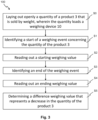
- the method 100 comprises the following steps: A step S0 of laying out openly a quantity of a product 3 that is sold by weight, wherein the quantity loads a weighing device 10.
- step S0 it is noted that "laying out openly” restricts the manner the quantity of the product 3 is offered to a user 1 to situations as usually present in fruit- and vegetable sections of shops, although the field of application of the method 100 is not restricted to fruit- and vegetable sections of shops and/or fruits and vegetables. However, situations as present when offering a product in a vending machine or a dispenser are not covered.
- the step S1 of identifying a start of a weighing event is carried out in an automated manner without conscious or intentional contribution of the user 1.
- Various approaches may be used to carry out the step S1 of identifying a start of a weighing event, for example the camera system disclosed with respect to figure 2 .
- a weighing value is read out that is considered as an absolute or relative weighing value of the loaded weighing device 10 at the time the user 1 starts taking from the quantity of the product 3 that is laid out and loads the weighing device 10.
- the step S3 of identifying an end of the weighing event is carried out in an automated manner without conscious or intentional contribution of the user 1.
- Various approaches may be used to carry out the step S3 of identifying an end of the weighing event.
- the realized approach may base on the same equipment as used in the step S1 of identifying a start of a weighing event.
- the camera system disclosed with respect to figure 2 may be used.
- a weighing value is read out that is considered as an absolute or relative weighing value of the loaded weighing device 10 at the time the user 1 has stopped taking from the quantity of the product 3 that is laid out and loads the weighing device 10, in particular has definitely stopped, this means has taken the quantity of the product 3 she/he wants to buy.
- the kind of weighing value that is read out in the step S4 of reading out an ending weighing value of the weighing device 10 is usually of the same kind as the weighing value that is read out in the step S2 of reading out a starting weighing value.
- Figure 4 shows a flow chart of the method 200 for selling of a product that is sold by weight as disclosed exemplarily with respect to figure 2 in a more general manner.
- the method 200 comprises the following steps: A step S10 of applying a method 100 for determining a weight of a product 3 that is sold by weight according to any embodiment disclosed, for example as disclosed with respect to figure 2 or 3 .
- the price may be determined by an approved price-computing instrument 21 that may be the weighing device 10.
- the price, and optionally further (additional) information is provided to a POS- or Check-out system.
- the price, and optionally the further (additional) information is provided in a manner that a device to which the approved device 21 that determines the price provides the price and an optional device that is subsequent to the/a device to which the price is provided does/do not need to be approved. Therefore, measures may be taken as disclosed with respect to figure 2 , for example (specific format and/or making sure that the provided selling price is the only price-relevant information that is attributed to the user 1 and/or used for charging (billing, ...) the user).
- Figure 5 shows a schematic representation of an exemplary embodiment of a system 300 equipped for carrying out a method 100 for determining a weight of a product 3 that is sold by weight and a method 200 for selling a product that is sold by weight, for example as disclosed with respect to figures 1-4 .
- arrows indicate potential flow of information
- a dashed line indicates optional features or optional communication.
- the system 300 comprises a weighing device 10, for example as disclosed with respect to figures 1-4 .
- the system 300 comprises further at least one device or a system 24 that is configured to identify the start and/or end of a weighing event.
- This device or system 24 may be integrated in the weighing device 10, for example in embodiments in which the start and/or end of a weighing event is detected by analyzing manipulations on the weighing device 10, in particular a temporal course of user interactions with the weighing device 10 and/or the onset or absence of a user interaction.
- the device or system 24 is separate from the weighing device 10, for example if it is configured to detect the user 1 getting, getting soon, or not getting in contact with the quantity of the product 3 that is laid out openly.
- the device or system 24 that is configured to identify the start and/or end of a weighing event may interact with an optional full monitoring system 25 that is installed in the store in which the system 300 is installed.
- the device or system 24 may use elements of the full monitoring system 25, such as a camera thereof.
- the device or system 24 may profit from information generated by the full monitoring system 25, for example in unclear situation.
- the weighing device 10 is enabled to determine the starting weighing value, the ending weighing value, and the difference weighing value.
- the system 300 comprises further a price-computing instrument 21, in particular an approved price-computing instrument.
- the difference weighing value is provided to the price-computing instrument 21.
- the weighing device 10 may be the price-computing instrument 21.
- the price-computing instrument 21 determines a price of the quantity of the product 3 taken by the user 1 during the weighing event, this price being calculated from the determined difference weighing value.
- the system 300 comprises further a POS- or Check-out system 22.
- the price-computing instrument 21 provides the price and, optionally, further (additional) information to the POS- or Check-out system 22.
- measures may be taken as disclosed, for example, with respect to figure 2 (specific format and/or making sure that the provided selling price is the only price-relevant information that is attributed to the user 1 and/or used for charging (billing, ...)) for making sure that the POS- or Check-out system 22 and an optional device that interacts with the POS- or Check-out system for charging the user 1 does/do not need to be approved or approved (further, as the case may be) for selling a product by weight.
- an optional further device 23 is shown to which the price-computing instrument 21 and/or the weighing device 10 may provide information.
- This further device 23 is not involved in the process of charging the user 1.
- it may be a device used for inventory control, problem identification etc.
- a system 300 comprising the weighing device 10 and the device or system 24 that is configured to identify the start and/or end of a weighing event is sufficient to carry out the method 100 for determining a weight of a product 3 that is sold by weight.
Landscapes
- Physics & Mathematics (AREA)
- Business, Economics & Management (AREA)
- General Physics & Mathematics (AREA)
- Engineering & Computer Science (AREA)
- Theoretical Computer Science (AREA)
- Mathematical Physics (AREA)
- Accounting & Taxation (AREA)
- Strategic Management (AREA)
- General Business, Economics & Management (AREA)
- Economics (AREA)
- Finance (AREA)
- Development Economics (AREA)
- Entrepreneurship & Innovation (AREA)
- Human Resources & Organizations (AREA)
- Marketing (AREA)
- Operations Research (AREA)
- Quality & Reliability (AREA)
- Tourism & Hospitality (AREA)
- Geometry (AREA)
- Cash Registers Or Receiving Machines (AREA)
Applications Claiming Priority (1)
| Application Number | Priority Date | Filing Date | Title |
|---|---|---|---|
| CH6142023 | 2023-06-09 |
Publications (1)
| Publication Number | Publication Date |
|---|---|
| EP4474779A1 true EP4474779A1 (de) | 2024-12-11 |
Family
ID=88068455
Family Applications (1)
| Application Number | Title | Priority Date | Filing Date |
|---|---|---|---|
| EP24180950.8A Pending EP4474779A1 (de) | 2023-06-09 | 2024-06-07 | Verfahren und vorrichtungen zum verkaufen eines produkts durch gewicht beim pick-and-go-einkauf |
Country Status (1)
| Country | Link |
|---|---|
| EP (1) | EP4474779A1 (de) |
Citations (12)
| Publication number | Priority date | Publication date | Assignee | Title |
|---|---|---|---|---|
| US20130284806A1 (en) | 2011-10-19 | 2013-10-31 | Ran Margalit | Automated purchasing system |
| US20150039458A1 (en) | 2013-07-24 | 2015-02-05 | Volitional Partners, Inc. | Method and system for automated retail checkout using context recognition |
| US10121121B1 (en) | 2015-12-28 | 2018-11-06 | Amazon Technologies, Inc. | Smart shelves |
| US20190138986A1 (en) | 2013-06-26 | 2019-05-09 | Amazon Technologies, Inc. | Transitioning items from a materials handling facility |
| US10332066B1 (en) | 2015-03-30 | 2019-06-25 | Amazon Technologies, Inc. | Item management system using weight |
| WO2020018585A1 (en) | 2018-07-16 | 2020-01-23 | Accel Robotics Corporation | Autonomous store tracking system |
| US20200082328A1 (en) * | 2018-09-06 | 2020-03-12 | Bizerba SE & Co. KG | Vending device with integrated inventory monitoring |
| US20210150502A1 (en) | 2019-11-18 | 2021-05-20 | AiFi Corp | Cloud based self checkout system |
| WO2021137190A1 (en) | 2020-01-01 | 2021-07-08 | Shekel Scales (2008) Ltd | Methods and systems for conducting weight-based transactions |
| US20210383341A1 (en) | 2019-11-18 | 2021-12-09 | Jun Wang | Self-checkout method and apparatus for unpackaged products |
| EP3940614A1 (de) | 2020-07-15 | 2022-01-19 | Storelift | Autonomes einzelhandelsgeschäft mit selbstbedienung |
| US20220222645A1 (en) * | 2021-01-14 | 2022-07-14 | Toshiba Tec Kabushiki Kaisha | Sales support device and sales support method thereof |
-
2024
- 2024-06-07 EP EP24180950.8A patent/EP4474779A1/de active Pending
Patent Citations (12)
| Publication number | Priority date | Publication date | Assignee | Title |
|---|---|---|---|---|
| US20130284806A1 (en) | 2011-10-19 | 2013-10-31 | Ran Margalit | Automated purchasing system |
| US20190138986A1 (en) | 2013-06-26 | 2019-05-09 | Amazon Technologies, Inc. | Transitioning items from a materials handling facility |
| US20150039458A1 (en) | 2013-07-24 | 2015-02-05 | Volitional Partners, Inc. | Method and system for automated retail checkout using context recognition |
| US10332066B1 (en) | 2015-03-30 | 2019-06-25 | Amazon Technologies, Inc. | Item management system using weight |
| US10121121B1 (en) | 2015-12-28 | 2018-11-06 | Amazon Technologies, Inc. | Smart shelves |
| WO2020018585A1 (en) | 2018-07-16 | 2020-01-23 | Accel Robotics Corporation | Autonomous store tracking system |
| US20200082328A1 (en) * | 2018-09-06 | 2020-03-12 | Bizerba SE & Co. KG | Vending device with integrated inventory monitoring |
| US20210150502A1 (en) | 2019-11-18 | 2021-05-20 | AiFi Corp | Cloud based self checkout system |
| US20210383341A1 (en) | 2019-11-18 | 2021-12-09 | Jun Wang | Self-checkout method and apparatus for unpackaged products |
| WO2021137190A1 (en) | 2020-01-01 | 2021-07-08 | Shekel Scales (2008) Ltd | Methods and systems for conducting weight-based transactions |
| EP3940614A1 (de) | 2020-07-15 | 2022-01-19 | Storelift | Autonomes einzelhandelsgeschäft mit selbstbedienung |
| US20220222645A1 (en) * | 2021-01-14 | 2022-07-14 | Toshiba Tec Kabushiki Kaisha | Sales support device and sales support method thereof |
Similar Documents
| Publication | Publication Date | Title |
|---|---|---|
| US10552814B2 (en) | Shopping cart monitoring system and method for store checkout | |
| US9033227B2 (en) | Methods and systems for performing security weight checks at checkouts | |
| JP5824340B2 (ja) | 計量装置 | |
| JP4115038B2 (ja) | セルフサービス・チェックアウト・ターミナルにおけるセキュリティを確保する方法 | |
| US7620568B1 (en) | Self-checkout system | |
| CA2824784A1 (en) | Point of sale device for use with a shopping cart | |
| US7971787B2 (en) | Commodity-vending system and weight-scale apparatus | |
| JP2003051067A (ja) | スケーラブル・セルフ・チェックアウト・システム | |
| US20040211600A1 (en) | Food product scale and method for providing in-store incentives to customers | |
| CN101201958A (zh) | 自助结账安全的个人化 | |
| JP6501284B2 (ja) | 計量装置 | |
| CN106611305A (zh) | 一种自助结账购物车 | |
| JP6377926B2 (ja) | 計量装置 | |
| JP2024177513A (ja) | 商品販売データ処理システム | |
| US20040044438A1 (en) | Point-of-sale tape measure dispenser | |
| JP2019021102A (ja) | 情報処理システム及びプログラム | |
| EP4474779A1 (de) | Verfahren und vorrichtungen zum verkaufen eines produkts durch gewicht beim pick-and-go-einkauf | |
| JP2014098722A (ja) | 計量装置およびそれを備えたラベル発行・読み取りシステム | |
| JP7595375B2 (ja) | 商品販売データ処理システム、携帯端末装置、及びコンピュータ | |
| JP2005322038A (ja) | 商品清算装置 | |
| GB2457315A (en) | Self-service checkout terminal | |
| JP2004139194A (ja) | 自動会計システム | |
| JP6659371B2 (ja) | 商品販売装置 | |
| CN113554809A (zh) | 一种商品信息更新装置及无人售货系统 | |
| JP7682412B1 (ja) | Pos端末及びセルフレジシステム |
Legal Events
| Date | Code | Title | Description |
|---|---|---|---|
| PUAI | Public reference made under article 153(3) epc to a published international application that has entered the european phase |
Free format text: ORIGINAL CODE: 0009012 |
|
| STAA | Information on the status of an ep patent application or granted ep patent |
Free format text: STATUS: THE APPLICATION HAS BEEN PUBLISHED |
|
| AK | Designated contracting states |
Kind code of ref document: A1 Designated state(s): AL AT BE BG CH CY CZ DE DK EE ES FI FR GB GR HR HU IE IS IT LI LT LU LV MC ME MK MT NL NO PL PT RO RS SE SI SK SM TR |
|
| STAA | Information on the status of an ep patent application or granted ep patent |
Free format text: STATUS: REQUEST FOR EXAMINATION WAS MADE |
|
| 17P | Request for examination filed |
Effective date: 20250611 |