EP4474868A2 - Verfahren zur erzeugung einer hochauflösenden punktwolke und verfahren zum trainieren eines neuronalen bildsynthesenetzwerks - Google Patents
Verfahren zur erzeugung einer hochauflösenden punktwolke und verfahren zum trainieren eines neuronalen bildsynthesenetzwerks Download PDFInfo
- Publication number
- EP4474868A2 EP4474868A2 EP24174421.8A EP24174421A EP4474868A2 EP 4474868 A2 EP4474868 A2 EP 4474868A2 EP 24174421 A EP24174421 A EP 24174421A EP 4474868 A2 EP4474868 A2 EP 4474868A2
- Authority
- EP
- European Patent Office
- Prior art keywords
- point cloud
- sensor data
- generating
- training
- semantic
- Prior art date
- Legal status (The legal status is an assumption and is not a legal conclusion. Google has not performed a legal analysis and makes no representation as to the accuracy of the status listed.)
- Pending
Links
Images



Classifications
-
- G—PHYSICS
- G06—COMPUTING OR CALCULATING; COUNTING
- G06T—IMAGE DATA PROCESSING OR GENERATION, IN GENERAL
- G06T7/00—Image analysis
- G06T7/50—Depth or shape recovery
-
- G—PHYSICS
- G01—MEASURING; TESTING
- G01S—RADIO DIRECTION-FINDING; RADIO NAVIGATION; DETERMINING DISTANCE OR VELOCITY BY USE OF RADIO WAVES; LOCATING OR PRESENCE-DETECTING BY USE OF THE REFLECTION OR RERADIATION OF RADIO WAVES; ANALOGOUS ARRANGEMENTS USING OTHER WAVES
- G01S17/00—Systems using the reflection or reradiation of electromagnetic waves other than radio waves, e.g. lidar systems
- G01S17/86—Combinations of lidar systems with systems other than lidar, radar or sonar, e.g. with direction finders
-
- G—PHYSICS
- G01—MEASURING; TESTING
- G01S—RADIO DIRECTION-FINDING; RADIO NAVIGATION; DETERMINING DISTANCE OR VELOCITY BY USE OF RADIO WAVES; LOCATING OR PRESENCE-DETECTING BY USE OF THE REFLECTION OR RERADIATION OF RADIO WAVES; ANALOGOUS ARRANGEMENTS USING OTHER WAVES
- G01S17/00—Systems using the reflection or reradiation of electromagnetic waves other than radio waves, e.g. lidar systems
- G01S17/88—Lidar systems specially adapted for specific applications
- G01S17/89—Lidar systems specially adapted for specific applications for mapping or imaging
-
- G—PHYSICS
- G06—COMPUTING OR CALCULATING; COUNTING
- G06T—IMAGE DATA PROCESSING OR GENERATION, IN GENERAL
- G06T17/00—Three-dimensional [3D] modelling for computer graphics
-
- G—PHYSICS
- G06—COMPUTING OR CALCULATING; COUNTING
- G06T—IMAGE DATA PROCESSING OR GENERATION, IN GENERAL
- G06T19/00—Manipulating three-dimensional [3D] models or images for computer graphics
- G06T19/20—Editing of three-dimensional [3D] images, e.g. changing shapes or colours, aligning objects or positioning parts
-
- G—PHYSICS
- G06—COMPUTING OR CALCULATING; COUNTING
- G06T—IMAGE DATA PROCESSING OR GENERATION, IN GENERAL
- G06T7/00—Image analysis
- G06T7/70—Determining position or orientation of objects or cameras
-
- G—PHYSICS
- G06—COMPUTING OR CALCULATING; COUNTING
- G06V—IMAGE OR VIDEO RECOGNITION OR UNDERSTANDING
- G06V10/00—Arrangements for image or video recognition or understanding
- G06V10/70—Arrangements for image or video recognition or understanding using pattern recognition or machine learning
- G06V10/764—Arrangements for image or video recognition or understanding using pattern recognition or machine learning using classification, e.g. of video objects
-
- G—PHYSICS
- G06—COMPUTING OR CALCULATING; COUNTING
- G06V—IMAGE OR VIDEO RECOGNITION OR UNDERSTANDING
- G06V10/00—Arrangements for image or video recognition or understanding
- G06V10/70—Arrangements for image or video recognition or understanding using pattern recognition or machine learning
- G06V10/77—Processing image or video features in feature spaces; using data integration or data reduction, e.g. principal component analysis [PCA] or independent component analysis [ICA] or self-organising maps [SOM]; Blind source separation
- G06V10/774—Generating sets of training patterns; Bootstrap methods, e.g. bagging or boosting
-
- G—PHYSICS
- G06—COMPUTING OR CALCULATING; COUNTING
- G06V—IMAGE OR VIDEO RECOGNITION OR UNDERSTANDING
- G06V10/00—Arrangements for image or video recognition or understanding
- G06V10/70—Arrangements for image or video recognition or understanding using pattern recognition or machine learning
- G06V10/82—Arrangements for image or video recognition or understanding using pattern recognition or machine learning using neural networks
-
- G—PHYSICS
- G06—COMPUTING OR CALCULATING; COUNTING
- G06V—IMAGE OR VIDEO RECOGNITION OR UNDERSTANDING
- G06V20/00—Scenes; Scene-specific elements
- G06V20/50—Context or environment of the image
- G06V20/56—Context or environment of the image exterior to a vehicle by using sensors mounted on the vehicle
- G06V20/58—Recognition of moving objects or obstacles, e.g. vehicles or pedestrians; Recognition of traffic objects, e.g. traffic signs, traffic lights or roads
-
- G—PHYSICS
- G01—MEASURING; TESTING
- G01S—RADIO DIRECTION-FINDING; RADIO NAVIGATION; DETERMINING DISTANCE OR VELOCITY BY USE OF RADIO WAVES; LOCATING OR PRESENCE-DETECTING BY USE OF THE REFLECTION OR RERADIATION OF RADIO WAVES; ANALOGOUS ARRANGEMENTS USING OTHER WAVES
- G01S7/00—Details of systems according to groups G01S13/00, G01S15/00, G01S17/00
- G01S7/02—Details of systems according to groups G01S13/00, G01S15/00, G01S17/00 of systems according to group G01S13/00
- G01S7/41—Details of systems according to groups G01S13/00, G01S15/00, G01S17/00 of systems according to group G01S13/00 using analysis of echo signal for target characterisation; Target signature; Target cross-section
- G01S7/417—Details of systems according to groups G01S13/00, G01S15/00, G01S17/00 of systems according to group G01S13/00 using analysis of echo signal for target characterisation; Target signature; Target cross-section involving the use of neural networks
-
- G—PHYSICS
- G06—COMPUTING OR CALCULATING; COUNTING
- G06T—IMAGE DATA PROCESSING OR GENERATION, IN GENERAL
- G06T2207/00—Indexing scheme for image analysis or image enhancement
- G06T2207/10—Image acquisition modality
- G06T2207/10028—Range image; Depth image; 3D point clouds
-
- G—PHYSICS
- G06—COMPUTING OR CALCULATING; COUNTING
- G06T—IMAGE DATA PROCESSING OR GENERATION, IN GENERAL
- G06T2207/00—Indexing scheme for image analysis or image enhancement
- G06T2207/20—Special algorithmic details
- G06T2207/20081—Training; Learning
-
- G—PHYSICS
- G06—COMPUTING OR CALCULATING; COUNTING
- G06T—IMAGE DATA PROCESSING OR GENERATION, IN GENERAL
- G06T2207/00—Indexing scheme for image analysis or image enhancement
- G06T2207/20—Special algorithmic details
- G06T2207/20084—Artificial neural networks [ANN]
-
- G—PHYSICS
- G06—COMPUTING OR CALCULATING; COUNTING
- G06T—IMAGE DATA PROCESSING OR GENERATION, IN GENERAL
- G06T2207/00—Indexing scheme for image analysis or image enhancement
- G06T2207/20—Special algorithmic details
- G06T2207/20212—Image combination
-
- G—PHYSICS
- G06—COMPUTING OR CALCULATING; COUNTING
- G06T—IMAGE DATA PROCESSING OR GENERATION, IN GENERAL
- G06T2207/00—Indexing scheme for image analysis or image enhancement
- G06T2207/20—Special algorithmic details
- G06T2207/20212—Image combination
- G06T2207/20221—Image fusion; Image merging
-
- G—PHYSICS
- G06—COMPUTING OR CALCULATING; COUNTING
- G06T—IMAGE DATA PROCESSING OR GENERATION, IN GENERAL
- G06T2207/00—Indexing scheme for image analysis or image enhancement
- G06T2207/30—Subject of image; Context of image processing
- G06T2207/30248—Vehicle exterior or interior
- G06T2207/30252—Vehicle exterior; Vicinity of vehicle
-
- G—PHYSICS
- G06—COMPUTING OR CALCULATING; COUNTING
- G06T—IMAGE DATA PROCESSING OR GENERATION, IN GENERAL
- G06T2219/00—Indexing scheme for manipulating 3D models or images for computer graphics
- G06T2219/20—Indexing scheme for editing of 3D models
- G06T2219/2012—Colour editing, changing, or manipulating; Use of colour codes
Definitions
- Various embodiments relate to methods for generating a high-resolution point cloud and methods for training an image synthesis neural network.
- Three-dimensional (3D) lidar is a preferred sensor for vehicles, especially autonomous vehicles, due to robustness of its data and the suitability of its sensor data for being used efficiently in perception pipelines.
- point clouds scanned in the real world are often incomplete or sparse due to partial observation and self-occlusion. Due to the nature of scanning lidars and their beam patterns, the number of data points on an object depends on its distance to the lidar sensor and falls off rapidly with increasing distance. "Narrow" classes like pedestrians and cyclists have very few data points at distances larger than 50m, which can lead to a false negative from the object detection network.
- Existing approaches to densifying point clouds typically apply a uniform densification strategy to the entire point cloud.
- a computer-implemented method for generating a high-resolution point cloud includes generating a first point cloud based on first sensor data, generating a semantic occupancy grid based on the first point cloud, generating a second point cloud based on at least one of a second sensor data and a third sensor data, combining the semantic occupancy grid with the second point cloud to result in a third point cloud, and generating a fourth point cloud by an image synthesis neural network.
- the fourth point cloud is generated based on the third point cloud. Resolution of the fourth point cloud is higher than resolution of any one of the first point cloud, the second point cloud and the third point cloud.
- a computer program product includes instructions, embodied in one or more non-transitory computer-readable storage mediums, executable by at least one processor to perform the abovementioned method for generating a high-resolution point cloud.
- a point cloud generation system includes a memory and a processor communicatively coupled to the memory.
- the processor is configured to perform the abovementioned method for generating a high-resolution point cloud.
- a vehicle includes a first sensor configured to generate the first sensor data, a second sensor configured to generate the second sensor data or the third sensor data, and the abovementioned point cloud generation system.
- a method for training an image synthesis neural network includes a first network and a second network.
- the method includes creating a mask using feature values of an input training point cloud, and applying the mask to the input training point cloud, resulting in a modified training point cloud.
- the method further includes inputting the modified training point cloud to the first network to generate a coarse training point cloud, and inputting the coarse training point cloud to the second network, to generate an output training point cloud.
- the method further includes comparing the output training point cloud and the input training point cloud, and adjusting weights of the second neural network based on comparison of the output training point cloud and the input training point cloud.
- a data structure is provided.
- the data structure is generated by carrying out the abovementioned method for training an image synthesis neural network.
- Embodiments described below in context of the devices are analogously valid for the respective methods, and vice versa. Furthermore, it will be understood that the embodiments described below may be combined, for example, a part of one embodiment may be combined with a part of another embodiment.
- Coupled may be understood as electrically coupled or as mechanically coupled, for example attached or fixed, or just in contact without any fixation, and it will be understood that both direct coupling or indirect coupling (in other words: coupling without direct contact) may be provided.
- the device as described in this description may include a memory which is for example used in the processing carried out in the device.
- a memory used in the embodiments may be a volatile memory, for example a DRAM (Dynamic Random Access Memory) or a non-volatile memory, for example a PROM (Programmable Read Only Memory), an EPROM (Erasable PROM), EEPROM (Electrically Erasable PROM), or a flash memory, e.g., a floating gate memory, a charge trapping memory, an MRAM (Magnetoresistive Random Access Memory) or a PCRAM (Phase Change Random Access Memory).
- DRAM Dynamic Random Access Memory
- PROM Programmable Read Only Memory
- EPROM Erasable PROM
- EEPROM Electrical Erasable PROM
- flash memory e.g., a floating gate memory, a charge trapping memory, an MRAM (Magnetoresistive Random Access Memory) or a PCRAM (Phase Change Random Access Memory).
- a method 100 for generating a high-resolution point cloud may be provided.
- the method 100 may include generating a semantic occupancy grid based on a radar-generated point cloud, forming a modified point cloud based on a lidar-generated point cloud and the semantic occupancy grid, and generating an output point cloud by feeding the modified point cloud to a guided diffusion model.
- the output point cloud may be a high-resolution point cloud, with an increased number of data point as compared to any one of the lidar-generated point cloud and the radar-generated point cloud.
- FIG. 1 is a simplified block diagram that illustrates the method 100 according to an embodiment.
- the method 100 may include a semantic occupancy grid (OG) generation process 130.
- a first sensor data 102 may be converted into a first point cloud 110.
- the first sensor data 102 may be generated by a depth sensor.
- the depth sensor may be configured to determine the velocity a target in its field of view.
- the depth sensor may be further configured to estimate the size of the target, for example, by a clustering method.
- Suitable sensor types for the depth sensor may include radar sensors and frequency modulated continuous wave (FMCW) LiDAR sensors.
- a semantic OG 112 may be generated based on the first point cloud 110.
- the first sensor data 102 may be two-dimensional (2D) data or three-dimensional (3D) data.
- the method 100 may further include a point cloud fusion process 140.
- the point cloud fusion process 140 may include combining a second sensor data 104 and a third sensor data 106 into a second point cloud 114.
- the second sensor data 104 may include a point cloud.
- the point cloud may be generated based on output of a lidar sensor.
- LiDAR sensors may be suitable for generating the second sensor data 104, in that LiDAR sensors have long range coverage.
- the point cloud may be generated using pseudo-LiDAR approach, based on the output of other types of sensors, such as ultrasonic sensor, stereo camera, time-of-flight camera, structured light sensor, RGB-D camera and radar sensor.
- the third sensor data 106 may be generated by a camera sensor.
- the third sensor data 106 may include color information.
- the method 100 may further include a point cloud enhancement process 150.
- the point cloud enhancement process 150 may include fusing the semantic OG 112 with the second point cloud 114 to result in a third point cloud 116.
- the method 100 may further include a point cloud synthesis process 160.
- the third point cloud 116 may be input to an image synthesis neural network 118, to generate an output that includes the fourth point cloud 120.
- the data density of the third point cloud may be higher than the data density of each of the first point cloud and the second point cloud, while the fourth point cloud may have a higher data density than the third point cloud.
- the image synthesis neural network 118 may denoise identified selective regions in the third point cloud 116 that resulted from multi-model sensor fusion, thereby generating a uniform and high-resolution point cloud that is the fourth point cloud 120.
- the image synthesis neural network 118 may be a trained network, and may be trained according to a method described subsequently with respect to FIGS. 6 and 8 .
- the image synthesis neural network 118 may include a denoising diffusion probabilistic model (DDPM), also abbreviated as “diffusion model”.
- DDPM denoising diffusion probabilistic model
- An example of a DDPM is disclosed in "Denoising Diffusion Probabilistic Models" by Ho et. al, which can be accessed at https://arxiv.org/pdf/2006.11239.pdf .
- FIG. 2 is a simplified block diagram that illustrates the method 100 according to another embodiment.
- the semantic OG generation process 130 may further include generating an occupancy grid 202 based on the first point cloud 110.
- the semantic OG 112 may then be generated based on the occupancy grid 202.
- the occupancy grid 202 is a form of environment representation where a space is discretized into fixed size cells, and each cell contains a probability that it is occupied.
- the occupancy grid 202 may be a two-dimensional (2D) map or a grid of three-dimensional (3D) cells. Occupancy of a cell may indicate that there is an object or part of an object in the space represented by the cell.
- the semantic OG 112 is a form of an occupancy grid that includes semantic features of the occupancy, such as velocity, class, and uncertainty, among others. Semantic features may be added to each cell of the occupancy grid 202, to result in the semantic OG 112.
- the point cloud fusion process 140 may include feeding the third sensor data 106 to a CNN based network 204, to thereby generate a semantic mask 206.
- the second sensor data 104 may be combined with the semantic mask 206 to result in the second point cloud 114, through a point fusion process 216.
- An example of the CNN based network 204 is disclosed in "Monocular Semantic Occupancy Grid Mapping with Convolutional Variational Auto-Encoders" by Lu et. al., which is incorporated herein by reference.
- the point cloud enhancement process 150 may include a cloud painting process 208.
- the cloud painting process 208 may include painting the second point cloud 114 with the semantic OG 112, to result in the third point cloud 116.
- semantic features of each cell are added to their corresponding voxels in the second point cloud 114, such that the third point cloud 116 includes more information about each cell than in the second point cloud 114.
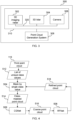
- FIG. 3 shows a block diagram of an example of a vehicle 300 according to various embodiments.
- the vehicle 300 may include a point cloud generation system 308.
- the point cloud generation system 308 may be configured to perform the method 100.
- the vehicle 300 may be equipped with a sensor suite 310.
- the sensor suite 310 may include a lidar 304, an imaging radar 302 and a camera 306.
- the imaging radar 302 may be configured to generate the first sensor data 102.
- the lidar 304 may be configured to generate the second sensor data 104.
- Each of the imaging radar 302 and the lidar 304 may be a 3D sensor, in other words, it may generate spatial data in 3D.
- the camera 306 may be configured to generate the third sensor data 106.
- point cloud generation system 308 may first calibrate the intrinsic and extrinsic parameters of the plurality of sensors, and may also perform temporal alignment of the plurality of sensors.
- the sensor suite 310 and the point cloud generation system may be coupled to one another, for example, electrically or communicatively, via the coupling line 310.
- the imaging radar 302 may be replaced by another type of depth sensor capable of determining velocity and approximate size of targets, such as a LiDAR sensor.
- the point cloud generation system 308 may accumulate and process the first sensor data 102 to generate a semantic OG 112, in the semantic OG generation process 130.
- the first sensor data 102 may include a target list, which includes spatial information of targets detected by the imaging radar 302.
- the spatial information may include the range, elevation angle and bearing angle of the targets.
- the semantic OG generation process 130 may include generating the first point cloud 110 by transforming the target list into the first point cloud 110 in the reference frame of the vehicle 300, in other words, the vehicle 300 may be located at the centre of the reference frame.
- Generating the first point cloud 110 may include transforming the spatial information in the target list to cartesian coordinates, thereby resulting in data points that form the first point cloud 110.
- the first point cloud 110 may represent all static and dynamic radar targets. Semantic features like RCS and velocity may also be added into the first point cloud 110.
- the semantic OG generation process 130 may further include transferring the target list to a local occupancy grid (OG).
- the local occupancy grid may be generated by modelling the detection as a 3D Gaussian with the mean shifted radially away from the vehicle 300.
- the first sensor data 102 may include radar cross-section (RCS) information on the targets. Using RCS heuristics, the RCS information in the first sensor data 102 may be used to model the target occupancy probability as a Gaussian distribution and to determine its primary radial axis of motion with the velocity vectors..
- the vehicle 300 may be equipped with a plurality of imaging radars 302, and the output of each imaging radar 302 may be processed to result in a respective local OG.
- the plurality of local OGs may be integrated into a global OG (also referred herein as occupancy grid 202).
- the global OG is an occupancy grid in the reference frame of the vehicle 300.
- the target lists from a plurality of measurement cycles of the imaging radar 302 may be integrated into the occupancy grid 202, in a process also referred herein as continuous accumulation.
- the image quality of the occupancy grid 202 may be enhanced, as target lists from more measurement cycles are added in.
- the occupancy grid 202 may be passed to a neural network-based feature encoder to output the semantic OG 112.
- the occupancy grid 202 may be a 3D occupancy grid, and accordingly, the neural network-based feature encoder may be a 3D encoder that outputs the semantic OG 112 as a 3D semantic OG.
- An example of the neural network-based feature encoder may be a convolutional neural network (CNN), as disclosed in "Semantic Segmentation on 3D Occupancy Grids for Automotive Radar” by Prophet et. al, which is incorporated herein by reference.
- CNN convolutional neural network
- the neural network-based feature encoder may also include other neural network architectures, such as a transformer neural network.
- the point cloud generation system 308 may be configured to perform the point cloud fusion process 140.
- the point cloud fusion process 140 may include processing lidar data (for example, the second sensor data 104) together with camera image (for example, the third sensor data 106), to generate a colored point cloud (for example, the second point cloud 114).
- the point cloud fusion process 140 may include converting the second sensor data 104 into a 3D point cloud.
- the point cloud fusion process 140 may further include passing the third sensor data 106 to the CNN-based network 204 to output the semantic mask 206.
- the third sensor data 106 may be two-dimensional (2D) in nature, and as such, the semantic mask 206 may accordingly have two dimensions.
- the camera image may contain color information, for example, in the form of red-blue-green (RGB) data, and as such, the semantic mask 206 may also include color information.
- the 2D semantic mask 206 may be projected in the 3D point cloud, to result in a 3D colored point cloud.
- the 3D color point cloud may be the second point cloud 114.
- Color is an important feature in images, and is often found to be a major clustering feature in semantic segmentation networks. As such, including color in the point cloud improves the ability of the image synthesis neural network 118 to understand boundaries of an object to aid in addition of points. This aid in more accurate reconstruction of the underlying geometry.
- An example of the point fusion process 216 is disclosed in "PointPainting: Sequential Fusion for 3D Object Detection" by Vora et. al.
- the CNN-based network 204 may include any one of fully convolution network, SegNet, PSPNet, DeepLab, Mask-R-CNN, U-Net and M-Net, or other CNN-based neural networks.
- the CNN-based network 204 may be replaced by another neural network type, such as the transformer neural network.
- the point cloud generation system 308 may be further configured to perform the point cloud enhancement process 150.
- the point cloud enhancement process 150 may include painting the second point cloud 114 with information from its corresponding voxel in the semantic OG 112, to generate an enhanced version of 3D colored point cloud.
- the point cloud generation system 308 may be further configured to perform the point cloud synthesis process 160, which is described further with respect to FIG. 4 .
- FIG. 4 shows a block diagram of the point cloud synthesis process 160, according to various embodiments.
- the point cloud synthesis process 160 may include feeding the third point cloud 116 to the image synthesis neural network 118 which may include a guided diffusion model 506.
- An example of a suitable guided diffusion model 506 may be a Conditional Point Diffusion-Refinement (PDR) model.
- PDR Conditional Point Diffusion-Refinement
- An example of the conditional PDR model is disclosed in "A Conditional Point Diffusion-Refinement Paradigm for 3D Point Cloud Completion" by Lyu et. al, which is incorporated herein by reference. The PDR model is described further with respect to FIG. 6 .
- the guided diffusion model 506 may be replaced by another type of neural network, such as any one of CNN, Variational Autoencoder, Generative Adversarial Network or transformer neural network.
- the cloud synthesis process 160 may include extracting a list 512 of unique class values from the third point cloud 116.
- third point cloud 116 may be masked based on a single class value from the list 512, to result in a class-masked point cloud 514.
- the masked regions are also referred herein as regions of interest (ROI), as they include the objects of interest such as other traffic participants, vehicles, road infrastructure and more.
- the class-masked point cloud 514 may be passed as an input to a trained CGNet 506 to generate a coarse point cloud 516.
- the coarse point cloud 516 may be passed as an input to the RFNet 508 to generate a refined point cloud 518 on the ROI.
- the refined point cloud 518 may have uniform, sharp local details and high-quality data points in the ROI.
- the refined point cloud 518 may be masked for another single class value at 504, so that the resulting class-masked point cloud 514 may be fed to the CGNet 506 to result in another coarse point cloud 516.
- the other coarse point cloud 516 is fed to the RFNet 508 to generate another refined point cloud 518 where the ROIs have higher quality data points.
- the processes of masking by single class value 504, passing the class-masked point cloud 514 to the CGNet 506, and passing the coarse point cloud 516 to the RFNet 508 to generate a refined point cloud 518, may be repeated for all the class values in the list 512 is exhausted.
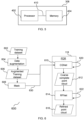
- FIG. 5 shows a block diagram of the point cloud generation system 308 according to various embodiments.
- the point cloud generation system 308 may include a processor 402.
- the processor 402 may be communicatively coupled to the memory 404, and may be configured to perform the method 100.
- the memory 404 may store a computer program product that includes instructions executable by the processor 402 to perform the method 100.
- the memory and the processor 402 may be coupled to one another, for example, electrically or communicatively, via the coupling line 410.
- the memory 404 may store at least one of the first sensor data 102, the second sensor data 104, the third sensor data 106, the occupancy grid 202, the semantic OG 112, the second point cloud 114, the third point cloud 116, the fourth point cloud 120 and the image synthesis neural network 118.
- the image synthesis neural network 118 may include a PDR model.
- the PDR paradigm is a point cloud completion method based on conditional Denoising Diffusion Probabilistic Models (DDPM).
- the PDR model may include a Conditional Generation Network (CGNet) 610 and a ReFincing Network (RFNet) 614.
- CGNet Conditional Generation Network
- RFNet ReFidging Network
- the CGNet 610 may include a conditional generative model.
- An example of the conditional generative model is denoising diffusion probabilistic model (DDPM).
- the CGNet 610 may include a dual-path network architecture that includes an upper subnet and a lower subnet.
- the upper subnet also referred to as a condition feature extraction subnet, may be configured to extract multi-level features from the incomplete point cloud.
- the lower subnet also referred to as a denoise subnet, may be configured to receive the noisy point cloud as an input.
- the CGNet 610 may add a diffusion step, the global features extracted from the incomplete point cloud, and multi-level features extracted by the upper subnet, to the lower subnet.
- the diffusion step is first transformed into a 512-dimension step embedding vector through positional encoding and fully connected and then inserted to every level of the Denoise subnet.
- the network includes two fully-connected (FC) layers, first FC layer has input dimension 128 and output dimension 512.
- the second FC layer has input dimension 512 and output dimension 512. Both layers are followed by the Swish activation function.
- the condition point cloud is first transformed into a 1024-length global feature through a two-stage PointNet, and then inserted to every level of the Denoise subnet.
- the multi-level features extracted by the Condition Feature Extraction subnet are inserted to every level of the Denoise subnet through Feature Transfer modules.
- the CGNet 610 may include an encoder that includes 4 levels of set abstraction modules. Each level has 4 shared fully connected layers i.e. MLP network with output size 1024,256,64,16 respectively.
- the neighboring distance may be set to 0.1, 0.2, 0.4, 0.8, respectively.
- the CGNet 610 may also include a decoder.
- the decoder may include feature propagation modules that include 4 levels of Point Adaptive Deconvolution (PA-Deconv) with attention layer. Each level may have 4 shared fully connected layers i.e. MLP network with output size 64,256,1024,2048 respectively.
- the CGNet 610 may also include feature transfer modules between the Condition Feature Extraction subnet and the Denoise subnet. It may include 9 Feature Transfer modules.
- the neighboring distance may be set to 0.1, 0.2, 0.4, 0.8, 1, 6, 0.8, 0.4, 0.2, 0.1, respectively.
- the architecture of the RFNet may be similar to, or identical to, the CGNet 610.
- FIG. 6 shows a block diagram of a method 600 for training the image synthesis neural network according to various embodiments.
- the method 600 may include a data augmentation process 604.
- the data augmentation process 604 may include rotating, mirroring, translating, and scaling a training dataset 602, to result in an augmented training dataset 606.
- the training dataset 602 may include a plurality of pairs of 3D colored point clouds.
- Each pair of 3D colored point clouds may include a low-resolution point cloud and a high-resolution point cloud, where both point clouds capture a common environment.
- the low-resolution point clouds may be obtained using 32- or 64-channel resolution lidar sensors, while the high-resolution point clouds may be obtained using 128-channel high resolution lidar sensors.
- the low-resolution point clouds are used as input to the image synthesis neural network 118, while the high-resolution point clouds are used as ground truth to the image synthesis neural network 118.
- the KITTI dataset as disclosed in " Vision meets robotics: The kitti dataset” by Geiger et. al., Int. J. Robot. Res. 2013, 32, pages 1231-1237 , may be processed to generate the training dataset 602.
- the KITTI dataset includes 64-channel high resolution point clouds.
- the 64-channel point clouds may be duplicated and have several rows removed from them, to result in corresponding low-resolution point clouds.
- a masking process 608 may be performed on the augmented training dataset 606.
- the masking process 608 may include masking the point clouds in the augmented training data set 606 based on feature values of the point clouds, so as to select or define the regions of interest (ROI).
- the masking process 608 may further include adding in noise to randomize the mask.
- the masking process 608 may include masking ROIs or objects using at least one of various techniques, such as thresholding, clustering, or semantic segmentation.
- the masking process 608 may further include adding Gaussian noise to the masked regions after the ROIs are represented with the mask.
- the resulting output from the masking process 608, also referred to as first training input 630 may be provided to the image synthesis neural network 118.
- the CGNet 610 and the RFNet 614 may be trained separately, using the same ground truth which may be the high-resolution point clouds in the training dataset 602.
- the CGNet 610 may receive the first training input 630, and may be trained via a training loop 620 defined as follows:
- the steps described above may be repeated with the next set of observations until all the observations are used for training. This represents the first training epoch. This may be repeated until at least 500 epochs were completed.
- the trained CGNet 610 may then be used to generate training data, also referred herein as second training input, for the RFNet 614.
- the trained CGNet 610 may be used to generate 10 coarse point clouds for each partial point cloud in the training dataset 602, to increase diversity of the training dataset.
- the ground truth is the same for these coarse complete point clouds 612.
- the RFNet 614 may receive the coarse complete point clouds 612, and may be trained via a training loop 622 defined as follows:
- the reconstruction quality of the point cloud output by the RFNet 614 may be evaluated based on at least one of Chamfer Distance (CD), Earth Mover's Distance (EMD) and F1-score metrics.
- CD Chamfer Distance
- EMD Earth Mover's Distance
- F1-score metrics F1-score metrics
- the steps described above may be repeated with the next set of observations until all the observations are used for training. This represents the first training epoch. This may be repeated until at least 250 epochs were completed.
- the CGNet and the RFNet 614 may be trained independently, in other words, the training loop 622 of the RFNet does not alter the parameters of the CGNet 610.
- the trained RFNet 614 may output a refined point cloud 616 based on the coarse complete point cloud 612.
- FIG. 7 shows a flow diagram of a method 700 for generating a high-resolution point cloud according to various embodiments.
- the method 700 may include, or may be part of, the method 100.
- the method 700 may include processes 702, 704, 706, 708 and 710.
- the process 702 may include generating a first point cloud 110 based on first sensor data 102.
- the process 704 may include generating a semantic occupancy grid 112 based on the first point cloud 110.
- the process 706 may include generating a second point cloud 114 based on at least one of a second sensor data 104 and a third sensor data 106.
- the process 708 may include combining the semantic occupancy grid 112 with the second point cloud 114, to result in a third point cloud 116.
- the process 710 may include generating a fourth point cloud 120 by an image synthesis neural network 118, based on the third point cloud 116, such that resolution of the fourth point cloud 120 is higher than resolution of any one of the first point cloud 110, the second point cloud 114 and the third point cloud 116.
- the fourth point cloud 120 may contain sufficient information for various driver assistance or autonomous driving applications such as 3D reconstruction, obstacle avoidance, navigation, and localization.
- each of the first sensor data 102, the second sensor 104 and the third sensor data 106 is output by a respective type of sensor device. This may enhance the density of the final output of the method 700, as the different types of sensor devices may capture different types of information.
- the first sensor data 102 is output by a radar sensor.
- the radar sensor operates by transmitting electromagnetic waves at radio frequencies that are generally unaffected by poor weather conditions, so the method 700 may be carried out under all weather conditions. Also, radar sensors may be capable of detecting objects even when they are partially occluded, thereby capturing an accurate map of the surroundings.
- the first sensor data 102 is 3D radar data.
- 3D data includes elevation data of objects, and hence, is useful for denoising and densifying a complex 3D scene, for example, a 3D scene that includes overhanging structures or tunnels.
- the second sensor data 104 is output by a LiDAR sensor.
- LiDAR sensor may provide accurate spatial data of objects in the environment.
- the third sensor data 106 is output by a camera.
- Camera data has the advantage of capturing visual details including color and shape.
- generating the semantic occupancy grid comprises generating an intermediate occupancy grid 202 based on the first point cloud 110, and generating the semantic occupancy grid 112 using a first classification neural network, based on the intermediate occupancy grid 202.
- generating the second point cloud 114 comprises generating a semantic mask using a second classification neural network, based on the third sensor data 106, and projecting the semantic mask in the first point cloud 110, to thereby result in the second point cloud 114.
- the second point cloud 114 is a colored point cloud. Colors are often an important visual feature, that may aid the detection and recognition of objects.
- combining the semantic occupancy grid 112 with the second point cloud 114 comprises painting each data point in the second point cloud 114 with information from its corresponding data point in the semantic occupancy grid 112. By doing so, the amount of information of each point second point cloud 114 may be increased, thereby achieving a densification effect.
- FIG. 8 shows a flow diagram of a method 800 for training an image synthesis neural network 118 according to various embodiments.
- the image synthesis neural network 118 may include a first network, for example, the CGNet 610 and a second network, for example, the RFNet 614.
- the method 800 may include, or may be part of, the method 600.
- the method 800 may include processes 802, 804, 806, 808, 810 and 812.
- the process 802 may include creating a mask using feature values of an input training point cloud.
- the input training point cloud may be part of the training dataset 602 or the augmented training dataset 606.
- the process 804 may include applying the mask to the input training point cloud, resulting in a modified training point cloud, also referred herein as the first training input 630.
- the process 806 may include inputting the modified training point cloud to the first network to generate a coarse training point cloud, also referred herein as coarse complete point cloud 612.
- the process 808 may include inputting the coarse training point cloud to the second network, to generate an output training point cloud, such as the refined point cloud 616.
- the process 810 may include comparing the output training point cloud and the input training point cloud.
- the process 812 may include adjusting weights of the second network based on comparison of the output training point cloud and the input training point cloud.
- the resulting trained image synthesis neural network 118 may be used to generate dense point clouds in real-time, as the vehicle sensors collect data about the environment around the vehicle. The vehicle may use these dense point clouds to perceive its surroundings, and to perform assisted or autonomous driving functions such as obstacle avoidance, localization and navigation.
- a data structure may be provided.
- the data structure may be generated by carrying out the steps of the method 800.
- the data structure may include a trained image synthesis neural network that may generate high-resolution point clouds on the fly, as sensors collect data on a vehicle's environment.
- Combinations such as "at least one of A, B, or C,” “one or more of A, B, or C,” “at least one of A, B, and C,” “one or more of A, B, and C,” and "A, B, C, or any combination thereof' include any combination of A, B, and/or C, and may include multiples of A, multiples of B, or multiples of C.
- combinations such as “at least one of A, B, or C,” “one or more of A, B, or C,” “at least one of A, B, and C,” “one or more of A, B, and C,” and “A, B, C, or any combination thereof' may be A only, B only, C only, A and B, A and C, B and C, or A and B and C, where any such combinations may contain one or more member or members of A, B, or C.
Landscapes
- Engineering & Computer Science (AREA)
- Theoretical Computer Science (AREA)
- Physics & Mathematics (AREA)
- General Physics & Mathematics (AREA)
- Software Systems (AREA)
- Multimedia (AREA)
- Evolutionary Computation (AREA)
- Computer Vision & Pattern Recognition (AREA)
- Databases & Information Systems (AREA)
- Medical Informatics (AREA)
- Health & Medical Sciences (AREA)
- Artificial Intelligence (AREA)
- General Health & Medical Sciences (AREA)
- Computing Systems (AREA)
- Computer Graphics (AREA)
- Radar, Positioning & Navigation (AREA)
- Remote Sensing (AREA)
- General Engineering & Computer Science (AREA)
- Computer Hardware Design (AREA)
- Geometry (AREA)
- Architecture (AREA)
- Computer Networks & Wireless Communication (AREA)
- Electromagnetism (AREA)
- Image Analysis (AREA)
- Image Processing (AREA)
Applications Claiming Priority (1)
| Application Number | Priority Date | Filing Date | Title |
|---|---|---|---|
| GB2307401.6A GB2630113A (en) | 2023-05-18 | 2023-05-18 | Method for generating a high-resolution point cloud and method for training an image synthesis neural network |
Publications (2)
| Publication Number | Publication Date |
|---|---|
| EP4474868A2 true EP4474868A2 (de) | 2024-12-11 |
| EP4474868A3 EP4474868A3 (de) | 2025-02-05 |
Family
ID=86949167
Family Applications (1)
| Application Number | Title | Priority Date | Filing Date |
|---|---|---|---|
| EP24174421.8A Pending EP4474868A3 (de) | 2023-05-18 | 2024-05-07 | Verfahren zur erzeugung einer hochauflösenden punktwolke und verfahren zum trainieren eines neuronalen bildsynthesenetzwerks |
Country Status (3)
| Country | Link |
|---|---|
| US (1) | US20240386665A1 (de) |
| EP (1) | EP4474868A3 (de) |
| GB (1) | GB2630113A (de) |
Families Citing this family (2)
| Publication number | Priority date | Publication date | Assignee | Title |
|---|---|---|---|---|
| CN119217373B (zh) * | 2024-10-31 | 2026-04-07 | 北京航空航天大学 | 一种基于扩散模型的工业机器人运动规划方法 |
| CN119625068B (zh) * | 2025-02-11 | 2025-06-13 | 深圳市索威尔科技开发有限公司 | 一种基于3d视觉的物体定位及姿态识别方法 |
Family Cites Families (5)
| Publication number | Priority date | Publication date | Assignee | Title |
|---|---|---|---|---|
| GB2584469B (en) * | 2019-06-05 | 2023-10-18 | Sony Interactive Entertainment Inc | Digital model repair system and method |
| US11113584B2 (en) * | 2020-02-04 | 2021-09-07 | Nio Usa, Inc. | Single frame 4D detection using deep fusion of camera image, imaging RADAR and LiDAR point cloud |
| US12327414B2 (en) * | 2022-05-30 | 2025-06-10 | Huawei Technologies Co., Ltd. | Systems and methods for enhancement of 3D object detection using point cloud semantic segmentation and attentive anchor generation |
| CN116229057B (zh) * | 2022-12-22 | 2023-10-27 | 之江实验室 | 一种基于深度学习的三维激光雷达点云语义分割的方法和装置 |
| CN116110025B (zh) * | 2023-02-02 | 2026-01-13 | 清华大学 | 栅格检测跟踪框架构建环境语义占据与速度场方法及系统 |
-
2023
- 2023-05-18 GB GB2307401.6A patent/GB2630113A/en active Pending
-
2024
- 2024-05-07 EP EP24174421.8A patent/EP4474868A3/de active Pending
- 2024-05-10 US US18/660,529 patent/US20240386665A1/en active Pending
Non-Patent Citations (1)
| Title |
|---|
| GEIGER: "Vision meets robotics: The kitti dataset", INT. J. ROBOT. RES., vol. 32, 2013, pages 1231 - 1237, XP055674191, DOI: 10.1177/0278364913491297 |
Also Published As
| Publication number | Publication date |
|---|---|
| EP4474868A3 (de) | 2025-02-05 |
| GB2630113A (en) | 2024-11-20 |
| US20240386665A1 (en) | 2024-11-21 |
| GB202307401D0 (en) | 2023-07-05 |
Similar Documents
| Publication | Publication Date | Title |
|---|---|---|
| US20230213643A1 (en) | Camera-radar sensor fusion using local attention mechanism | |
| Meyer et al. | Lasernet: An efficient probabilistic 3d object detector for autonomous driving | |
| El Madawi et al. | Rgb and lidar fusion based 3d semantic segmentation for autonomous driving | |
| EP3903293B1 (de) | Crowd-gesourcte erkennung, identifizierung und teilung von gefährlichen strassenobjekten in hd-karten | |
| KR102933653B1 (ko) | 레이더 딥 러닝 | |
| CN111201451B (zh) | 基于场景的激光数据和雷达数据进行场景中的对象检测的方法及装置 | |
| EP3709216B1 (de) | Verfahren und vorrichtungen zur objekterkennung in einer durch tiefendaten eines entfernungserfassungssensors und bilddaten einer kamera dargestellten szene | |
| Wang et al. | Fusing bird’s eye view lidar point cloud and front view camera image for 3d object detection | |
| EP4474868A2 (de) | Verfahren zur erzeugung einer hochauflösenden punktwolke und verfahren zum trainieren eines neuronalen bildsynthesenetzwerks | |
| Prophet et al. | Semantic segmentation on automotive radar maps | |
| Bu et al. | Pedestrian planar LiDAR pose (PPLP) network for oriented pedestrian detection based on planar LiDAR and monocular images | |
| US20230049383A1 (en) | Systems and methods for determining road traversability using real time data and a trained model | |
| US12327414B2 (en) | Systems and methods for enhancement of 3D object detection using point cloud semantic segmentation and attentive anchor generation | |
| Wang et al. | Fusing bird view lidar point cloud and front view camera image for deep object detection | |
| KR20240071594A (ko) | 라이다 및 카메라의 데이터 융합 방법 및 시스템 | |
| Mekala et al. | Deep learning inspired object consolidation approaches using lidar data for autonomous driving: a review | |
| WO2023148285A1 (en) | Neural network training method using semi-pseudo-labels | |
| Zhang et al. | Multi-sensor fusion for autonomous driving | |
| Zhang et al. | Robust pose estimation for non-cooperative space objects based on multichannel matching method | |
| CN116778262A (zh) | 一种基于虚拟点云的三维目标检测方法和系统 | |
| Dagdilelis et al. | Multimodal and Multiview Deep Fusion for Autonomous Marine Navigation | |
| WO2025198717A1 (en) | Efficient cloud-based dynamic multi-vehicle bird's-eye-view (bev) feature fusion for extended robust cooperative perception | |
| Miron et al. | RCF-TP: Radar-camera fusion with temporal priors for 3D object detection | |
| Zhao et al. | A Novel 4D Radar and Image Fusion for 3D Object Detection in Autonomous Driving | |
| Kollmitz et al. | Predicting obstacle footprints from 2D occupancy maps by learning from physical interactions |
Legal Events
| Date | Code | Title | Description |
|---|---|---|---|
| PUAI | Public reference made under article 153(3) epc to a published international application that has entered the european phase |
Free format text: ORIGINAL CODE: 0009012 |
|
| STAA | Information on the status of an ep patent application or granted ep patent |
Free format text: STATUS: THE APPLICATION HAS BEEN PUBLISHED |
|
| AK | Designated contracting states |
Kind code of ref document: A2 Designated state(s): AL AT BE BG CH CY CZ DE DK EE ES FI FR GB GR HR HU IE IS IT LI LT LU LV MC ME MK MT NL NO PL PT RO RS SE SI SK SM TR |
|
| PUAL | Search report despatched |
Free format text: ORIGINAL CODE: 0009013 |
|
| AK | Designated contracting states |
Kind code of ref document: A3 Designated state(s): AL AT BE BG CH CY CZ DE DK EE ES FI FR GB GR HR HU IE IS IT LI LT LU LV MC ME MK MT NL NO PL PT RO RS SE SI SK SM TR |
|
| RIC1 | Information provided on ipc code assigned before grant |
Ipc: G01S 7/41 20060101ALN20250102BHEP Ipc: G01S 17/89 20200101ALI20250102BHEP Ipc: G01S 17/86 20200101AFI20250102BHEP |
|
| RAP3 | Party data changed (applicant data changed or rights of an application transferred) |
Owner name: AUMOVIO AUTONOMOUS MOBILITY GERMANY GMBH Owner name: CONTINENTAL AUTOMOTIVE TECHNOLOGIES GMBH |
|
| STAA | Information on the status of an ep patent application or granted ep patent |
Free format text: STATUS: REQUEST FOR EXAMINATION WAS MADE |
|
| 17P | Request for examination filed |
Effective date: 20250805 |
|
| RAP3 | Party data changed (applicant data changed or rights of an application transferred) |
Owner name: AUMOVIO AUTONOMOUS MOBILITY GERMANY GMBH Owner name: AUMOVIO GERMANY GMBH |