EP4475140A1 - Procédé de traitement de résidus métalliques activés et/ou contaminés et utilisation de big bags - Google Patents
Procédé de traitement de résidus métalliques activés et/ou contaminés et utilisation de big bags Download PDFInfo
- Publication number
- EP4475140A1 EP4475140A1 EP24181026.6A EP24181026A EP4475140A1 EP 4475140 A1 EP4475140 A1 EP 4475140A1 EP 24181026 A EP24181026 A EP 24181026A EP 4475140 A1 EP4475140 A1 EP 4475140A1
- Authority
- EP
- European Patent Office
- Prior art keywords
- contaminated
- activated
- package
- contamination
- packaging
- Prior art date
- Legal status (The legal status is an assumption and is not a legal conclusion. Google has not performed a legal analysis and makes no representation as to the accuracy of the status listed.)
- Pending
Links
Images
Classifications
-
- B—PERFORMING OPERATIONS; TRANSPORTING
- B09—DISPOSAL OF SOLID WASTE; RECLAMATION OF CONTAMINATED SOIL
- B09B—DISPOSAL OF SOLID WASTE NOT OTHERWISE PROVIDED FOR
- B09B3/00—Destroying solid waste or transforming solid waste into something useful or harmless
- B09B3/40—Destroying solid waste or transforming solid waste into something useful or harmless involving thermal treatment, e.g. evaporation
-
- G—PHYSICS
- G21—NUCLEAR PHYSICS; NUCLEAR ENGINEERING
- G21F—PROTECTION AGAINST X-RADIATION, GAMMA RADIATION, CORPUSCULAR RADIATION OR PARTICLE BOMBARDMENT; TREATING RADIOACTIVELY CONTAMINATED MATERIAL; DECONTAMINATION ARRANGEMENTS THEREFOR
- G21F9/00—Treating radioactively contaminated material; Decontamination arrangements therefor
- G21F9/28—Treating solids
- G21F9/30—Processing
- G21F9/308—Processing by melting the waste
Definitions
- the invention relates to a method for processing activated and/or contaminated metallic residues and to the use of big bags made of a combustible material.
- the publication DE 20 2014 001 542 U1 further discloses a three-dimensional measurement of the individual contaminated workpiece (e.g. using a photogrammetric method or laser scan) and a spatially resolving measurement of the contamination beforehand. Decontamination then takes place according to the combined information from the geometry and contamination distribution. Such a method is very complex.
- the publication DE 33 31 383 A1 also deals with the melting of metallic components of nuclear power plants and provides a crushing plant for the metallic components, a transport facility and a melting furnace for the crushed material, a facility for treating the melted material until it solidifies and a facility for removing the solidified material.
- the plant is characterized by at least one container for receiving the crushed material, an electric melting furnace with a head loading device, a horizontal continuous casting plant with A device designed as a strand extraction device for treating the molten material until it solidifies and a separating machine for breaking the strand into strand sections that can be transported away.
- the document is silent on the handling and classification of contaminated parts.
- a mobile plant for processing radioactive waste by melting it into a waste body, a glass block, is described in the publication AT 517861 A1
- melting is only done to prevent the spread of contamination, without producing a usable material or product.
- the publication US 5 037 159 A describes a method and apparatus for vacuuming and packaging particulate materials, such as hazardous, radioactive concrete dust generated during flooring processing, to prevent even small amounts of the material from entering the ambient air.
- Each drum is positioned with its open mouth close to the downward-facing material outlet of the vacuum collection system.
- the cover of the material outlet is pressed against it while the filled container is covered and replaced with an empty container.
- the disposable lid is then thrown into the second container after it has been sealed in a similar manner with the vacuum system for filling. There is no information about the further procedure, in particular the disposal of the filled container.
- EP 2 833 367 B1 discloses a plant for processing activated, contaminated and/or non-contaminated residues and already identifies as a disadvantage of the state of the art that the residue treatment cannot decoupled from the dismantling of the nuclear facilities, but directly on site.
- a modular, reusable facility is therefore proposed.
- paragraph [0003] states that the majority of these materials, around 70%, are either subjected to direct decision measurement or to unrestricted release by melting down. However, subjecting each individual part to a decision measurement is associated with a great deal of effort.
- the problem is solved by a method for processing activated and/or contaminated metallic residues, characterized by the process steps a to h.
- Step a) includes collecting and documenting the activated and/or contaminated and/or non-activated and/or non-contaminated metallic residues, preferably broken down to furnace size, below the limits for approval.
- the residues have a radioactivity below the limits for unrestricted approval. The limits depend on the type of radiation and the applicable official regulations. The surface is not decontaminated, which significantly reduces the effort required for processing and disposal.
- Step b) involves placing the activated and/or contaminated residues in a packaging that is permeable to ionizing radiation and also dust-tight. This permeability allows for unhindered subsequent measurement of the emitted ionizing radiation.
- Step c) involves the production of a container that is protected against the spread of contamination by closing the filled packaging.
- the individual parts are easier to handle in the assembly and, above all, are protected against the spread of contamination adhering to the surfaces. Both effects contribute to significantly increased efficiency in disposal and recycling.
- Step d) involves measuring the strength of the ionizing radiation resulting from the activation and/or contamination using at least one detector. This is preferably done by measuring the clearance in a clearance measuring system, alternatively manually or in another suitable way, whereby the surface contamination influences the measured value.
- Step e) involves changing the position of the packaging so that the influence of individual, particularly external, contaminations and/or activations as sources of ionizing radiation is given appropriate weighting without a specific spatially resolving measurement of the contamination being carried out or being necessary. This allows a comprehensive assessment of the radioactivity of the entire container to be achieved with little effort.
- Step f) involves the repeated execution of process steps d) and e) in order to achieve a detailed and reliable examination of the radioactivity of the entire container by changing the position and the subsequent measurement and its evaluation.
- Step g) involves determining whether the packaging falls below a limit value that is set above that for unrestricted release. If this limit is exceeded in exceptional cases, the container can also be returned and opened in order to separate the offending part, to clean it or to send it to another disposal route.
- Step h) involves melting the packaging, without the need to maintain a minimum mixing ratio with other non-contaminated materials, to produce a product from the melt.
- the aim is to produce a material or semi-finished product.
- the container is disposed of as radioactive waste or, after a further visual inspection, the residual material causing the exceedance is separated out and the container is reassembled.
- the conventional processing steps which lead to unrestricted release but cost a lot of resources and, above all, are associated with a high workload, are replaced by the method according to the invention.
- the direct measurement of all surfaces required for unrestricted release is often difficult with the residual materials that arise in practice.
- the measurement for unrestricted release that is used as part of the method according to the invention in which the measurement is carried out at a distance - with correspondingly high safety margins - leads to a joint consideration of surface and volume, but above all to a simplified determination of the integral measured value.
- the measurement at a distance in the sense of the invention also includes a measurement directly on the container, e.g. a big bag, with a distance of zero.
- the measured radioactivity of the residual materials is primarily caused by activation of the material and/or radioactive contamination of the surface.
- the ionizing radiation comes from the activated material and/or the contamination of the surface.
- the strength of the ionizing radiation is preferably measured by clearance measurement in a clearance measurement system, alternatively manually or by a measuring device guided by a manipulator. The latter can then also determine the position of the measuring device directly and incorporate it into the determination of the total activity a of the container.
- the clearance measurement is preferably carried out using several detectors or several measurements with one detector, which can also be guided by the manipulator, which then also records the respective measuring position.
- the total activity of the container is determined from the measured values of the ionized radiation, taking into account the position, in particular the distance to a point on the container or directly on the container, of the at least one detector.
- the total activity a of the container is preferably calculated from the gross count rate of all positions of the at least one detector by averaging, integration or another mathematical relationship.
- Big bags are widely available and inexpensive. They are usually made of a plastic film that is flammable and burns without residue in the melting process.
- a further aspect of the invention relates to the use of big bags made of a combustible material, wherein the big bags are used for packaging contaminated metallic residues in a method according to one of claims 1 to 8 and are in particular fed to a melt together with the packaged goods.
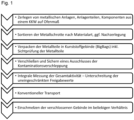
- NPP nuclear power plant
- the metal scrap is then sorted according to material type and, if necessary, dismantled. During the sorting process, those scrap parts are selected for the subsequent process steps that are not expected to require disposal as radioactive waste. Dismantling is particularly important if there are closed containers or containers filled with liquid underneath the scrap. If such containers are not opened and emptied, an explosion can occur in the melting furnace.
- the next step involves placing the metal parts in packaging, for example made of plastic (preferably big bags), including a further visual inspection of the metal parts.
- the packaging is closed and secured to form a container. This is then at least dust-tight, so that contamination can be prevented by escaping radioactive dust that adheres to the metal parts.
- An integral measurement of the total activity is then carried out on the container sealed in this way, preferably by measuring the ionizing radiation from several sides and at different distances. The measured values are then combined to form a total activity based on the position of the detector, its distance from the container and the strength of the ionizing radiation. In the process, it is determined whether the unrestricted release values for this total activity are undercut.
- the containers can then be transported to the melting furnace using conventional transport. There, the sealed containers are melted down in any ratio with other scrap parts or without mixing.
Landscapes
- Physics & Mathematics (AREA)
- Engineering & Computer Science (AREA)
- Thermal Sciences (AREA)
- Environmental & Geological Engineering (AREA)
- General Engineering & Computer Science (AREA)
- High Energy & Nuclear Physics (AREA)
- Processing Of Solid Wastes (AREA)
Applications Claiming Priority (1)
| Application Number | Priority Date | Filing Date | Title |
|---|---|---|---|
| DE102023115174.6A DE102023115174B3 (de) | 2023-06-09 | 2023-06-09 | Verfahren zur Bearbeitung aktivierter und/oder kontaminierter metallischer Reststoffe und Verwendung von Big Bags |
Publications (1)
| Publication Number | Publication Date |
|---|---|
| EP4475140A1 true EP4475140A1 (fr) | 2024-12-11 |
Family
ID=88414118
Family Applications (1)
| Application Number | Title | Priority Date | Filing Date |
|---|---|---|---|
| EP24181026.6A Pending EP4475140A1 (fr) | 2023-06-09 | 2024-06-10 | Procédé de traitement de résidus métalliques activés et/ou contaminés et utilisation de big bags |
Country Status (2)
| Country | Link |
|---|---|
| EP (1) | EP4475140A1 (fr) |
| DE (1) | DE102023115174B3 (fr) |
Citations (10)
| Publication number | Priority date | Publication date | Assignee | Title |
|---|---|---|---|---|
| DE2638174A1 (de) | 1976-08-25 | 1978-03-02 | Steinmueller Gmbh L & C | Verfahren zur entsorgung eines kernkraftwerkes |
| DE3331383A1 (de) | 1983-08-31 | 1985-03-14 | Siempelkamp Gießerei GmbH & Co, 4150 Krefeld | Anlage fuer rueckgewinnung metallischer komponenten von kernkraftwerken |
| DE3404106A1 (de) | 1984-02-07 | 1985-09-05 | Siempelkamp Gießerei GmbH & Co, 4150 Krefeld | Anlage fuer die rueckgewinnung metallischer komponenten von kernkraftwerken |
| US5037159A (en) | 1988-12-30 | 1991-08-06 | Nutter Victor H | Apparatus for collecting and packaging hazardous particulate materials |
| DE4405022C2 (de) * | 1993-02-25 | 1996-03-14 | Siempelkamp Gmbh & Co | Verfahren zur Gewinnung von schadlos verwertbaren Metallen aus radioaktiv kontaminiertem Mischmetallschrott |
| US20130296628A1 (en) * | 2012-05-03 | 2013-11-07 | Kepco Nuclear Fuel Co., Ltd. | Method of disposing of radioactive metal waste using melting decontamination |
| DE102013100463B3 (de) | 2013-01-17 | 2014-06-12 | Ald Vacuum Technologies Gmbh | Schmelzeinrichtung zum Konsolidieren von kontaminiertem Schrott |
| DE202014001542U1 (de) | 2014-02-19 | 2014-06-13 | Ius Institut Für Umwelttechnologien Und Strahlenschutz Gmbh | Vorrichtung Dekontamination und Entscheidungsmessung |
| AT517861A1 (de) | 2015-10-15 | 2017-05-15 | Ame Handelsgesellschaft M B H | Anlage zur Verarbeitung von radioaktiv kontaminiertem Material mit einer Mehrzahl von Anlagenkomponenten |
| EP2833367B1 (fr) | 2013-08-02 | 2019-10-30 | Bilfinger Noell GmbH | Installation et procédé destinés au traitement de résidus |
Family Cites Families (1)
| Publication number | Priority date | Publication date | Assignee | Title |
|---|---|---|---|---|
| KR101200780B1 (ko) | 2012-05-03 | 2012-11-13 | 한전원자력연료 주식회사 | 금속 방사성폐기물의 용융제염 처리방법 |
-
2023
- 2023-06-09 DE DE102023115174.6A patent/DE102023115174B3/de active Active
-
2024
- 2024-06-10 EP EP24181026.6A patent/EP4475140A1/fr active Pending
Patent Citations (10)
| Publication number | Priority date | Publication date | Assignee | Title |
|---|---|---|---|---|
| DE2638174A1 (de) | 1976-08-25 | 1978-03-02 | Steinmueller Gmbh L & C | Verfahren zur entsorgung eines kernkraftwerkes |
| DE3331383A1 (de) | 1983-08-31 | 1985-03-14 | Siempelkamp Gießerei GmbH & Co, 4150 Krefeld | Anlage fuer rueckgewinnung metallischer komponenten von kernkraftwerken |
| DE3404106A1 (de) | 1984-02-07 | 1985-09-05 | Siempelkamp Gießerei GmbH & Co, 4150 Krefeld | Anlage fuer die rueckgewinnung metallischer komponenten von kernkraftwerken |
| US5037159A (en) | 1988-12-30 | 1991-08-06 | Nutter Victor H | Apparatus for collecting and packaging hazardous particulate materials |
| DE4405022C2 (de) * | 1993-02-25 | 1996-03-14 | Siempelkamp Gmbh & Co | Verfahren zur Gewinnung von schadlos verwertbaren Metallen aus radioaktiv kontaminiertem Mischmetallschrott |
| US20130296628A1 (en) * | 2012-05-03 | 2013-11-07 | Kepco Nuclear Fuel Co., Ltd. | Method of disposing of radioactive metal waste using melting decontamination |
| DE102013100463B3 (de) | 2013-01-17 | 2014-06-12 | Ald Vacuum Technologies Gmbh | Schmelzeinrichtung zum Konsolidieren von kontaminiertem Schrott |
| EP2833367B1 (fr) | 2013-08-02 | 2019-10-30 | Bilfinger Noell GmbH | Installation et procédé destinés au traitement de résidus |
| DE202014001542U1 (de) | 2014-02-19 | 2014-06-13 | Ius Institut Für Umwelttechnologien Und Strahlenschutz Gmbh | Vorrichtung Dekontamination und Entscheidungsmessung |
| AT517861A1 (de) | 2015-10-15 | 2017-05-15 | Ame Handelsgesellschaft M B H | Anlage zur Verarbeitung von radioaktiv kontaminiertem Material mit einer Mehrzahl von Anlagenkomponenten |
Non-Patent Citations (1)
| Title |
|---|
| NICHTAMTLICHES INHALTSVERZEICHNIS ET AL: "Verordnung zum Schutz vor der schädlichen Wirkung ionisierender Strahlung (Strahlenschutzverordnung -StrlSchV)", 29 November 2018 (2018-11-29), pages 1 - 74, XP093216176, Retrieved from the Internet <URL:https://www.gesetze-im-internet.de/strlschv_2018/BJNR203600018.html> [retrieved on 20241018] * |
Also Published As
| Publication number | Publication date |
|---|---|
| DE102023115174B3 (de) | 2023-11-09 |
Similar Documents
| Publication | Publication Date | Title |
|---|---|---|
| EP2833367B1 (fr) | Installation et procédé destinés au traitement de résidus | |
| DE202014001542U1 (de) | Vorrichtung Dekontamination und Entscheidungsmessung | |
| JP5800636B2 (ja) | 放射性金属廃棄物処理装置 | |
| DE202018100057U1 (de) | Mobile Vorrichtung zur Behandlung kerntechnisch kontaminierter Körper | |
| DE102023115174B3 (de) | Verfahren zur Bearbeitung aktivierter und/oder kontaminierter metallischer Reststoffe und Verwendung von Big Bags | |
| DE102023115175B3 (de) | Verfahren zur Bearbeitung aktivierter und/oder kontaminierter metallischer Reststoffe und Verwendung von Big Bags | |
| JP6659796B1 (ja) | 金属溶融方法および金属溶融システム | |
| DE102021000011A1 (de) | Mobiles und digitales Bearbeitungszentrum für die Bearbeitung, Bemessung, Prüfung und Freigabe von aktivierten, kontaminierten und/oder nicht kontaminierten, nuklearen Reststoffen, bestehend aus dafür speziell entwickelten und per LKW transportierbaren Containern | |
| DE3238088A1 (de) | Verfahren zur handhabung von radioaktiven abfallmengen | |
| DE102016117703B4 (de) | Vorrichtung zur Behandlung von radioaktiv kontaminierten Abwässern | |
| EP4008012B1 (fr) | Procédé de montage d'un appareil de démantèlement d'une installation industrielle | |
| RU2342629C2 (ru) | Агрегатно-сырьевой способ утилизации изделий | |
| Buoro et al. | Radioactivity Inspections Applied to the Steelmaking Industry | |
| Cho et al. | Development of guideline for safe decommissioning of concrete structures for nuclear facilities based on a comparative analysis with the previous asbestos dismantlement studies | |
| JP2020067456A (ja) | 金属溶融方法および金属溶融システム | |
| Pepin et al. | Regulations on management of NORM residues in Belgium: lessons and challenges | |
| Pepin et al. | Regulatory framework for NORM residues in Belgium | |
| Ponomarev-Stepnoi et al. | Extraction of radioactive wastes and liquidation of old repositories at the Russian Science Center Kurchatov Institute | |
| Kang et al. | Conditioning of Radioactive Wastes Prior to disposal; Segregation and Repackaging | |
| EP4202500A1 (fr) | Évaluation de rapports radionucléides | |
| DE3002697A1 (de) | Verfahren zum lagern radioaktiven abfalls | |
| DE19701893A1 (de) | Anlage zur Behandlung radioaktiv kontaminierter Einsatzmaterialien für ein Schmelzaggregat | |
| CZ278296B6 (en) | Method of sorting radioactive waste from solid waste occurring in a monitored zone, particularly of atomic-power plants | |
| KR20250093281A (ko) | 방사성 폐기물이 보관된 콘크리트 드럼의 절단해체방법 | |
| Khan et al. | Size Reduction of Contaminated Magnox Pond Skips Using Laser Cutting |
Legal Events
| Date | Code | Title | Description |
|---|---|---|---|
| PUAI | Public reference made under article 153(3) epc to a published international application that has entered the european phase |
Free format text: ORIGINAL CODE: 0009012 |
|
| STAA | Information on the status of an ep patent application or granted ep patent |
Free format text: STATUS: THE APPLICATION HAS BEEN PUBLISHED |
|
| AK | Designated contracting states |
Kind code of ref document: A1 Designated state(s): AL AT BE BG CH CY CZ DE DK EE ES FI FR GB GR HR HU IE IS IT LI LT LU LV MC ME MK MT NL NO PL PT RO RS SE SI SK SM TR |
|
| RAP1 | Party data changed (applicant data changed or rights of an application transferred) |
Owner name: SILBITZ GROUP GMBH Owner name: DORNIER HINNEBURG GMBH |
|
| RIN1 | Information on inventor provided before grant (corrected) |
Inventor name: TIEFEL, TORSTEN Inventor name: SCHENKER, SASKIA Inventor name: ANTHOFER, ANTON PHILIPP |
|
| STAA | Information on the status of an ep patent application or granted ep patent |
Free format text: STATUS: REQUEST FOR EXAMINATION WAS MADE |
|
| 17P | Request for examination filed |
Effective date: 20250610 |