EP4475449A1 - Facilitation d'estimation de canal de liaison descendante assistée par ue et à géométrie d'antenne partielle - Google Patents
Facilitation d'estimation de canal de liaison descendante assistée par ue et à géométrie d'antenne partielle Download PDFInfo
- Publication number
- EP4475449A1 EP4475449A1 EP23178244.2A EP23178244A EP4475449A1 EP 4475449 A1 EP4475449 A1 EP 4475449A1 EP 23178244 A EP23178244 A EP 23178244A EP 4475449 A1 EP4475449 A1 EP 4475449A1
- Authority
- EP
- European Patent Office
- Prior art keywords
- reference signal
- indication
- base station
- antenna
- user equipment
- Prior art date
- Legal status (The legal status is an assumption and is not a legal conclusion. Google has not performed a legal analysis and makes no representation as to the accuracy of the status listed.)
- Withdrawn
Links
Images


Classifications
-
- H—ELECTRICITY
- H04—ELECTRIC COMMUNICATION TECHNIQUE
- H04B—TRANSMISSION
- H04B7/00—Radio transmission systems, i.e. using radiation field
- H04B7/02—Diversity systems; Multi-antenna system, i.e. transmission or reception using multiple antennas
- H04B7/04—Diversity systems; Multi-antenna system, i.e. transmission or reception using multiple antennas using two or more spaced independent antennas
- H04B7/0404—Diversity systems; Multi-antenna system, i.e. transmission or reception using multiple antennas using two or more spaced independent antennas the mobile station comprising multiple antennas, e.g. to provide uplink diversity
-
- H—ELECTRICITY
- H04—ELECTRIC COMMUNICATION TECHNIQUE
- H04B—TRANSMISSION
- H04B7/00—Radio transmission systems, i.e. using radiation field
- H04B7/02—Diversity systems; Multi-antenna system, i.e. transmission or reception using multiple antennas
- H04B7/04—Diversity systems; Multi-antenna system, i.e. transmission or reception using multiple antennas using two or more spaced independent antennas
- H04B7/06—Diversity systems; Multi-antenna system, i.e. transmission or reception using multiple antennas using two or more spaced independent antennas at the transmitting station
- H04B7/0613—Diversity systems; Multi-antenna system, i.e. transmission or reception using multiple antennas using two or more spaced independent antennas at the transmitting station using simultaneous transmission
- H04B7/0615—Diversity systems; Multi-antenna system, i.e. transmission or reception using multiple antennas using two or more spaced independent antennas at the transmitting station using simultaneous transmission of weighted versions of same signal
- H04B7/0619—Diversity systems; Multi-antenna system, i.e. transmission or reception using multiple antennas using two or more spaced independent antennas at the transmitting station using simultaneous transmission of weighted versions of same signal using feedback from receiving side
- H04B7/0621—Feedback content
- H04B7/0626—Channel coefficients, e.g. channel state information [CSI]
-
- H—ELECTRICITY
- H04—ELECTRIC COMMUNICATION TECHNIQUE
- H04B—TRANSMISSION
- H04B7/00—Radio transmission systems, i.e. using radiation field
- H04B7/02—Diversity systems; Multi-antenna system, i.e. transmission or reception using multiple antennas
- H04B7/04—Diversity systems; Multi-antenna system, i.e. transmission or reception using multiple antennas using two or more spaced independent antennas
- H04B7/06—Diversity systems; Multi-antenna system, i.e. transmission or reception using multiple antennas using two or more spaced independent antennas at the transmitting station
- H04B7/0613—Diversity systems; Multi-antenna system, i.e. transmission or reception using multiple antennas using two or more spaced independent antennas at the transmitting station using simultaneous transmission
- H04B7/0615—Diversity systems; Multi-antenna system, i.e. transmission or reception using multiple antennas using two or more spaced independent antennas at the transmitting station using simultaneous transmission of weighted versions of same signal
- H04B7/0619—Diversity systems; Multi-antenna system, i.e. transmission or reception using multiple antennas using two or more spaced independent antennas at the transmitting station using simultaneous transmission of weighted versions of same signal using feedback from receiving side
- H04B7/0658—Feedback reduction
-
- H—ELECTRICITY
- H04—ELECTRIC COMMUNICATION TECHNIQUE
- H04L—TRANSMISSION OF DIGITAL INFORMATION, e.g. TELEGRAPHIC COMMUNICATION
- H04L5/00—Arrangements affording multiple use of the transmission path
- H04L5/003—Arrangements for allocating sub-channels of the transmission path
- H04L5/0048—Allocation of pilot signals, i.e. of signals known to the receiver
-
- H—ELECTRICITY
- H04—ELECTRIC COMMUNICATION TECHNIQUE
- H04L—TRANSMISSION OF DIGITAL INFORMATION, e.g. TELEGRAPHIC COMMUNICATION
- H04L25/00—Baseband systems
- H04L25/02—Details ; arrangements for supplying electrical power along data transmission lines
- H04L25/0202—Channel estimation
- H04L25/0224—Channel estimation using sounding signals
Definitions
- the subject application relates to a method, apparatus, system and computer program for MIMO in near-field communication.
- a communication system can be seen as a facility that enables communication sessions between two or more entities such as user terminals, base stations and/or other nodes by providing carriers between the various entities involved in the communications path.
- a communication system can be provided for example by means of a communication network and one or more compatible communication devices.
- the communication sessions may comprise, for example, communication of data for carrying communications such as voice, video, electronic mail (email), text message, multimedia and/or content data and so on.
- Non-limiting examples of services provided comprise two-way or multi-way calls, data communication or multimedia services and access to a data network system, such as the Internet.
- wireless communication system In a wireless communication system, at least a part of a communication session between at least two stations occurs over a wireless link.
- wireless systems comprise public land mobile networks (PLMN), satellite-based communication systems and different wireless local networks, for example wireless local area networks (WLAN).
- PLMN public land mobile networks
- WLAN wireless local area networks
- Some wireless systems can be divided into cells, and are therefore often referred to as cellular systems.
- a user can access the communication system by means of an appropriate communication device or terminal.
- a communication device of a user may be referred to as user equipment (UE) or user device.
- UE user equipment
- a communication device is provided with an appropriate signal receiving and transmitting apparatus for enabling communications, for example enabling access to a communication network or communications directly with other users.
- the communication device may access a carrier provided by a station, for example a base station of a cell, and transmit and/or receive communications on the carrier.
- the communication system and associated devices can operate in accordance with a given standard or specification which sets forth what the various entities associated with the system are permitted to do and how that should be achieved. Communication protocols and/or parameters which are to be used for the connection can also be defined.
- an apparatus comprising: means for receiving, from a base station, configuration information for at least one reference signal, the configuration information comprising at least one of the following: antenna geometry of the base station; a first indication of at least one antenna of the apparatus to use for measuring the at least one reference signal; a second indication of resources used for the at least one reference signal; or a third indication of feedback information requested from the apparatus for the at least one reference signal; wherein the apparatus comprises: means for receiving, from the base station, the at least one reference signal, wherein the at least one reference signal is received from a subset of antennas of the base station; means for determining, using the configuration information, at least one measurement of the at least one reference signal; means for sending, to the base station, the at least one measurement of the at least one reference signal.
- the subset of antennas of the base station comprises a single antenna.
- the configuration information comprises the antenna geometry of the base station, and wherein the antenna geometry of the base station comprises at least one of the following: a geometry of active antennas at the base station; a distance between active antennas of the base station; a fourth indication of at least one active antenna at the base station; or a fifth indication of a reference antenna of the base station.
- the configuration information comprises at least one Transmission Configuration Indicator, TCI, state of the at least one active antenna of the base station.
- the configuration information comprises the first indication of at least one antenna of the apparatus to use
- the first indication of at least one antenna of the apparatus to use comprises at least one of the following: a sixth indication of at least one active antenna at the apparatus; a seventh indication of a reference antenna of the apparatus; or an eighth indication of beams of the apparatus.
- the configuration information comprises the second indication of resources used for the at least one reference signal, the second indication of resources used for the at least one reference signal comprising at least one of the following: a ninth indication of at least one time resource; a tenth indication of at least one frequency resource; or an eleventh indication of at least one code resource.
- the at least one frequency resource used for the at least one reference signal is different to a frequency resource used for data transmission by the apparatus.
- the configuration information comprises the third indication of feedback information requested from the apparatus for the at least one reference signal, the third indication of feedback information requesting at least one of the following: a twelfth indication of whether the apparatus should report measurements for each active antenna of the apparatus separately; a thirteenth indication of whether the apparatus should report a single set of measurements with respect to a reference signal of the base station; a fourteenth indication of whether Angle of Arrival, AoA, measurements for at least one reference signal should be provided by the apparatus; a fifteenth indication of whether at least one apparatus rotation measurement with respect to the base station should be provided by the apparatus; a sixteenth indication of whether channel gain measurements for at least one reference signal should be provided by the apparatus; or a seventeenth indication of whether distance from at least one apparatus reference antenna to a base station reference antenna should be provided.
- the apparatus comprises: means for receiving, from the base station, an indication of channel state information determined by the base station based on the at least one measurement of the at least one reference signal; means for performing data transmission and/or data reception based on the channel state information.
- the data transmission and/or the data reception comprises near-field communication.
- the data transmission and/or the data reception comprises Line of Sight, LoS, communication.
- the configuration information comprises an indication of at least one analog beam used at the base station.
- a method comprising: receiving, from a base station, configuration information for at least one reference signal, the configuration information comprising at least one of the following: antenna geometry of the base station; a first indication of at least one antenna of the user equipment to use for measuring the at least one reference signal; a second indication of resources used for the at least one reference signal; a third indication of feedback information requested from the user equipment for the at least one reference signal; wherein the method comprises; receiving, from the base station, the at least one reference signal, wherein the at least one reference signal is received from a subset of antennas of the base station; determining, using the configuration information, at least one measurement of the at least one reference signal; sending, to the base station, the at least one measurement of the at least one reference signal.
- the subset of antennas of the base station comprises a single antenna.
- the configuration information comprises the antenna geometry of the base station, and wherein the antenna geometry of the base station comprises at least one of the following: a geometry of active antennas at the base station; a distance between active antennas of the base station; a fourth indication of at least one active antenna at the base station; or a fifth indication of a reference antenna of the base station.
- the configuration information comprises at least one Transmission Configuration Indicator, TCI, state of the at least one active antenna of the base station.
- the configuration information comprises the first indication of at least one antenna of the user equipment to use
- the first indication of at least one antenna of the user equipment to use comprises at least one of the following: a sixth indication of at least one active antenna at the user equipment; a seventh indication of a reference antenna of the user equipment or an eighth indication of beams of the user equipment.
- the configuration information comprises the second indication of resources used for the at least one reference signal, the second indication of resources used for the at least one reference signal comprising at least one of the following: a ninth indication of at least one time resource; a tenth indication of at least one frequency resource; or an eleventh indication of at least one code resource.
- the at least one frequency resource used for the at least one reference signal is different to a frequency resource used for data transmission by the user equipment.
- the configuration information comprises the third indication of feedback information requested from the user equipment for the at least one reference signal, the third indication of feedback information requesting at least one of the following: a twelfth indication of whether the user equipment should report measurements for each active antenna of the user equipment separately; a thirteenth indication of whether the user equipment should report a single set of measurements with respect to a reference signal of the base station; a fourteenth indication of whether Angle of Arrival, AoA, measurements for at least one reference signal should be provided by the user equipment; a fifteenth indication of whether at least one user equipment rotation measurement with respect to the base station should be provided by the user equipment; a sixteenth indication of whether channel gain measurements for at least one reference signal should be provided by the user equipment; or a seventeenth indication of whether distance from at least one user equipment reference antenna to a base station reference antenna should be provided.
- the method comprises: receiving, from the base station, an indication of channel state information determined by the base station based on the at least one measurement of the at least one reference signal; performing data transmission and/or data reception based on the channel state information.
- the data transmission and/or the data reception comprises near-field communication.
- the data transmission and/or the data reception comprises Line of Sight, LoS, communication.
- the configuration information comprises an indication of at least one analog beam used at the base station.
- an apparatus comprising at least one processor and at least one memory storing instructions that, when executed by the at least one processor, cause the apparatus at least to perform: receiving, from a base station, configuration information for at least one reference signal, the configuration information comprising at least one of the following: antenna geometry of the base station; a first indication of at least one antenna of the apparatus to use for measuring the at least one reference signal; a second indication of resources used for the at least one reference signal; or a third indication of feedback information requested from the apparatus for the at least one reference signal; wherein the at least one memory and the computer program code are configured to, with the at least one processor, cause the apparatus at least to perform: receiving, from the base station, the at least one reference signal, wherein the at least one reference signal is received from a subset of antennas of the base station; determining, using the configuration information, at least one measurement of the at least one reference signal; sending, to the base station, the at least one measurement of the at least one reference signal.
- the subset of antennas of the base station comprises a single antenna.
- the configuration information comprises the antenna geometry of the base station, and wherein the antenna geometry of the base station comprises at least one of the following: a geometry of active antennas at the base station; a distance between active antennas of the base station; a fourth indication of at least one active antenna at the base station; or a fifth indication of a reference antenna of the base station.
- the configuration information comprises at least one Transmission Configuration Indicator, TCI, state of the at least one active antenna of the base station.
- the configuration information comprises the first indication of at least one antenna of the apparatus to use
- the first indication of at least one antenna of the apparatus to use comprises at least one of the following: a sixth indication of at least one active antenna at the apparatus; a seventh indication of a reference antenna of the apparatus; or an eighth indication of beams of the apparatus.
- the configuration information comprises the second indication of resources used for the at least one reference signal, the second indication of resources used for the at least one reference signal comprising at least one of the following: a ninth indication of at least one time resource; a tenth indication of at least one frequency resource; or an eleventh indication of at least one code resource.
- the at least one frequency resource used for the at least one reference signal is different to a frequency resource used for data transmission by the apparatus.
- the configuration information comprises the third indication of feedback information requested from the apparatus for the at least one reference signal, the third indication of feedback information requesting at least one of the following: a twelfth indication of whether the apparatus should report measurements for each active antenna of the apparatus separately; a thirteenth indication of whether the apparatus should report a single set of measurements with respect to a reference signal of the base station; a fourteenth indication of whether Angle of Arrival, AoA, measurements for at least one reference signal should be provided by the apparatus; a fifteenth indication of whether at least one apparatus rotation measurement with respect to the base station should be provided by the apparatus; a sixteenth indication of whether channel gain measurements for at least one reference signal should be provided by the apparatus; or a seventeenth indication of whether distance from at least one apparatus reference antenna to a base station reference antenna should be provided.
- the at least one memory and the computer program code are configured to, with the at least one processor, cause the apparatus at least to perform: receiving, from the base station, an indication of channel state information determined by the base station based on the at least one measurement of the at least one reference signal; performing data transmission and/or data reception based on the channel state information.
- the data transmission and/or the data reception comprises near-field communication.
- the data transmission and/or the data reception comprises Line of Sight, LoS, communication.
- the configuration information comprises an indication of at least one analog beam used at the base station.
- an apparatus comprising: circuitry for: receiving, from a base station, configuration information for at least one reference signal, the configuration information comprising at least one of the following: antenna geometry of the base station; a first indication of at least one antenna of the apparatus to use for measuring the at least one reference signal; a second indication of resources used for the at least one reference signal; or a third indication of feedback information requested from the apparatus for the at least one reference signal; and circuity for: receiving, from the base station, the at least one reference signal, wherein the at least one reference signal is received from a subset of antennas of the base station; determining, using the configuration information, at least one measurement of the at least one reference signal; sending, to the base station, the at least one measurement of the at least one reference signal.
- a computer program comprising instructions for causing an apparatus to perform at least the following: receiving, from a base station, configuration information for at least one reference signal, the configuration information comprising at least one of the following: antenna geometry of the base station; a first indication of at least one antenna of the apparatus to use for measuring the at least one reference signal; a second indication of resources used for the at least one reference signal; or a third indication of feedback information requested from the apparatus for the at least one reference signal; receiving, from the base station, the at least one reference signal, wherein the at least one reference signal is received from a subset of antennas of the base station; determining, using the configuration information, at least one measurement of the at least one reference signal; sending, to the base station, the at least one measurement of the at least one reference signal.
- a computer program comprising instructions stored thereon for performing at least the following: receiving, from a base station, configuration information for at least one reference signal, the configuration information comprising at least one of the following: antenna geometry of the base station; a first indication of at least one antenna of a user equipment to use for measuring the at least one reference signal; a second indication of resources used for the at least one reference signal; or a third indication of feedback information requested from the user equipment for the at least one reference signal; receiving, from the base station, the at least one reference signal, wherein the at least one reference signal is received from a subset of antennas of the base station; determining, using the configuration information, at least one measurement of the at least one reference signal; sending, to the base station, the at least one measurement of the at least one reference signal.
- a non-transitory computer readable medium comprising program instructions for causing an apparatus to perform at least the following: receiving, from a base station, configuration information for at least one reference signal, the configuration information comprising at least one of the following: antenna geometry of the base station; a first indication of at least one antenna of the apparatus to use for measuring the at least one reference signal; a second indication of resources used for the at least one reference signal; or a third indication of feedback information requested from the apparatus for the at least one reference signal; receiving, from the base station, the at least one reference signal, wherein the at least one reference signal is received from a subset of antennas of the base station; determining, using the configuration information, at least one measurement of the at least one reference signal; sending, to the base station, the at least one measurement of the at least one reference signal.
- a non-transitory computer readable medium comprising program instructions stored thereon for performing at least the following: receiving, from a base station, configuration information for at least one reference signal, the configuration information comprising at least one of the following: antenna geometry of the base station; a first indication of at least one antenna of a user equipment to use for measuring the at least one reference signal; a second indication of resources used for the at least one reference signal; or a third indication of feedback information requested from the user equipment for the at least one reference signal; receiving, from the base station, the at least one reference signal, wherein the at least one reference signal is received from a subset of antennas of the base station; determining, using the configuration information, at least one measurement of the at least one reference signal; sending, to the base station, the at least one measurement of the at least one reference signal.
- an apparatus comprising: means for sending, to a user equipment, configuration information for at least one reference signal, the configuration information comprising at least one of the following: antenna geometry of the apparatus; a first indication of at least one antenna of the user equipment to use for measuring the at least one reference signal; a second indication of resources used for the at least one reference signal; a third indication of feedback information requested from the user equipment for the at least one reference signal; wherein the apparatus comprises: means for sending, to the user equipment, the at least one reference signal, wherein the at least one reference signal is sent by a subset of antennas of the apparatus; means for receiving, from the user equipment, at least one measurement of the at least one reference signal; means for determining channel state information based on the at least one measurement of the at least one reference signal and the configuration information.
- the channel state information is for a plurality of antennas of the apparatus, wherein the subset of antennas is a subset of the plurality of antennas of the apparatus.
- the configuration information comprises the antenna geometry of the apparatus, and wherein the antenna geometry of the apparatus comprises at least one of the following: a geometry of active antennas at the apparatus; a distance between active antennas of the apparatus; a fourth indication of at least one active antenna at the apparatus; or a fifth indication of a reference antenna of the apparatus.
- the apparatus comprises: means for sending, to the user equipment, an indication of the channel state information.
- the configuration information comprises an indication of at least one analog beam used at the apparatus.
- the configuration information comprises at least one Transmission Configuration Indicator, TCI, state of the at least one active antenna of the apparatus.
- the configuration information comprises the first indication of at least one antenna of the user equipment to use for measuring the at least one reference signal, and wherein the first indication of at least one antenna of the user equipment to use comprises at least one of the following: a sixth indication of at least one active antenna at the user equipment; a seventh indication of a reference antenna of the user equipment; or an eighth indication of beams of the user equipment.
- the configuration information comprises the second indication of resources used for the at least one reference signal, the second indication of resources used for the at least one reference signal comprising at least one of the following: a ninth indication of at least one time resource; a tenth indication of at least one frequency resource; or an eleventh indication of at least one code resource.
- the configuration information comprises the third indication of feedback information requested from the user equipment for the at least one reference signal, the third indication of feedback information comprising at least one of the following: a twelfth indication of whether the user equipment should report measurements for each active antenna of the apparatus separately; a thirteenth indication of whether the user equipment should report a single set of measurements with respect to a reference signal of the user equipment; a fourteenth indication of whether Angle of Arrival, AoA, measurements for at least one reference signal should be provided by the user equipment; a fifteenth indication of whether at least one user equipment rotation measurement with respect to the apparatus should be provided by the user equipment; a sixteenth indication of whether channel gain measurements for at least one reference signal should be provided by the user equipment; or a seventeenth indication of whether distance from at least one user equipment reference antenna to a reference antenna of the apparatus should be provided.
- a method comprising: sending, to a user equipment, configuration information for at least one reference signal, the configuration information comprising at least one of the following: antenna geometry of a base station; a first indication of at least one antenna of the user equipment to use for measuring the at least one reference signal; a second indication of resources used for the at least one reference signal; or a third indication of feedback information requested from the user equipment for the at least one reference signal; wherein the method comprises: sending, to the user equipment, the at least one reference signal; receiving, from the user equipment, at least one measurement of the at least one reference signal, wherein the at least one reference signal is sent by a subset of antennas of the base station; determining channel state information based on the at least one measurement of the at least one reference signal and the configuration information.
- the channel state information is for a plurality of antennas of the base station, wherein the subset of antennas is a subset of the plurality of antennas of the base station.
- the configuration information comprises the antenna geometry of the base station, and wherein the antenna geometry of the base station comprises at least one of the following: a geometry of active antennas at the base station; a distance between active antennas of the base station; a fourth indication of at least one active antenna at the base station; or a fifth indication of a reference antenna of the base station.
- the method comprises: sending, to the user equipment, an indication of the channel state information.
- the configuration information comprises an indication of at least one analog beam used at the base station.
- the configuration information comprises at least one Transmission Configuration Indicator, TCI, state of the at least one active antenna of the base station.
- the configuration information comprises the first indication of at least one antenna of the user equipment to use for measuring the at least one reference signal, and wherein the first indication of at least one antenna of the user equipment to use comprises at least one of the following: a sixth indication of at least one active antenna at the user equipment; a seventh indication of a reference antenna of the user equipment; or an eighth indication of beams of the user equipment.
- the configuration information comprises the second indication of resources used for the at least one reference signal, the second indication of resources used for the at least one reference signal comprising at least one of the following: a ninth indication of at least one time resource; a tenth indication of at least one frequency resource; or an eleventh indication of at least one code resource.
- the configuration information comprises the third indication of feedback information requested from the user equipment for the at least one reference signal, the third indication of feedback information comprising at least one of the following: a twelfth indication of whether the user equipment should report measurements for each active antenna of the base station separately; a thirteenth indication of whether the user equipment should report a single set of measurements with respect to a reference signal of the user equipment; a fourteenth indication of whether Angle of Arrival, AoA, measurements for at least one reference signal should be provided by the user equipment; a fifteenth indication of whether at least one user equipment rotation measurement with respect to the base station should be provided by the user equipment; a sixteenth indication of whether channel gain measurements for at least one reference signal should be provided by the user equipment; or a seventeenth indication of whether distance from at least one user equipment reference antenna to a reference antenna of the base station should be provided.
- an apparatus comprising: at least one processor; and at least one memory including computer program code; the at least one memory and the computer program code configured to, with the at least one processor, cause the apparatus at least to perform: sending, to a user equipment, configuration information for at least one reference signal, the configuration information comprising at least one of the following: antenna geometry of the apparatus; a first indication of at least one antenna of the user equipment to use for measuring the at least one reference signal; a second indication of resources used for the at least one reference signal; a third indication of feedback information requested from the user equipment for the at least one reference signal; and wherein the at least one memory and the computer program code are configured to, with the at least one processor, cause the apparatus at least to perform: sending, to the user equipment, the at least one reference signal, wherein the at least one reference signal is sent by a subset of antennas of the apparatus; means for receiving, from the user equipment, at least one measurement of the at least one reference signal; means for determining channel state information based on the at least one measurement
- the channel state information is for a plurality of antennas of the apparatus, wherein the subset of antennas is a subset of the plurality of antennas of the apparatus.
- the configuration information comprises the antenna geometry of the apparatus, and wherein the antenna geometry of the apparatus comprises at least one of the following: a geometry of active antennas at the apparatus; a distance between active antennas of the apparatus; a fourth indication of at least one active antenna at the apparatus; or a fifth indication of a reference antenna of the apparatus.
- the at least one memory and the computer program code are configured to, with the at least one processor, cause the apparatus at least to perform: sending, to the user equipment, an indication of the channel state information.
- the configuration information comprises an indication of at least one analog beam used at the apparatus.
- the configuration information comprises at least one Transmission Configuration Indicator, TCI, state of the at least one active antenna of the apparatus.
- the configuration information comprises the first indication of at least one antenna of the user equipment to use for measuring the at least one reference signal, and wherein the first indication of at least one antenna of the user equipment to use comprises at least one of the following: a sixth indication of at least one active antenna at the user equipment; a seventh indication of a reference antenna of the user equipment; or an eighth indication of beams of the user equipment.
- the configuration information comprises the second indication of resources used for the at least one reference signal, the second indication of resources used for the at least one reference signal comprising at least one of the following: a ninth indication of at least one time resource; a tenth indication of at least one frequency resource; or an eleventh indication of at least one code resource.
- the configuration information comprises the third indication of feedback information requested from the user equipment for the at least one reference signal, the third indication of feedback information comprising at least one of the following: a twelfth indication of whether the user equipment should report measurements for each active antenna of the apparatus separately; a thirteenth indication of whether the user equipment should report a single set of measurements with respect to a reference signal of the user equipment; a fourteenth indication of whether Angle of Arrival, AoA, measurements for at least one reference signal should be provided by the user equipment; a fifteenth indication of whether at least one user equipment rotation measurement with respect to the apparatus should be provided by the user equipment; a sixteenth indication of whether channel gain measurements for at least one reference signal should be provided by the user equipment; or a seventeenth indication of whether distance from at least one user equipment reference antenna to a reference antenna of the apparatus should be provided.
- an apparatus comprising circuitry for: sending, to a user equipment, configuration information for at least one reference signal, the configuration information comprising at least one of the following: antenna geometry of the apparatus; a first indication of at least one antenna of the user equipment to use for measuring the at least one reference signal; a second indication of resources used for the at least one reference signal; a third indication of feedback information requested from the user equipment for the at least one reference signal; and circuitry for sending, to the user equipment, the at least one reference signal, wherein the at least one reference signal is sent by a subset of antennas of the apparatus; means for receiving, from the user equipment, at least one measurement of the at least one reference signal; means for determining channel state information based on the at least one measurement of the at least one reference signal and the configuration information.
- a computer program comprising instructions for causing an apparatus to perform at least the following: sending, to a user equipment, configuration information for at least one reference signal, the configuration information comprising at least one of the following: antenna geometry of the apparatus; a first indication of at least one antenna of the user equipment to use for measuring the at least one reference signal; a second indication of resources used for the at least one reference signal; a third indication of feedback information requested from the user equipment for the at least one reference signal; and sending, to the user equipment, the at least one reference signal, wherein the at least one reference signal is sent by a subset of antennas of the apparatus; means for receiving, from the user equipment, at least one measurement of the at least one reference signal; means for determining channel state information based on the at least one measurement of the at least one reference signal and the configuration information.
- a fourteenth example there is provided a computer program comprising instructions stored thereon for performing at least the following: sending, to a user equipment, configuration information for at least one reference signal, the configuration information comprising at least one of the following: antenna geometry of a base station; a first indication of at least one antenna of the user equipment to use for measuring the at least one reference signal; a second indication of resources used for the at least one reference signal; a third indication of feedback information requested from the user equipment for the at least one reference signal; and sending, to the user equipment, the at least one reference signal, wherein the at least one reference signal is sent by a subset of antennas of the base station; means for receiving, from the user equipment, at least one measurement of the at least one reference signal; means for determining channel state information based on the at least one measurement of the at least one reference signal and the configuration information.
- a non-transitory computer readable medium comprising program instructions for causing an apparatus to perform at least the following: sending, to a user equipment, configuration information for at least one reference signal, the configuration information comprising at least one of the following: antenna geometry of the apparatus; a first indication of at least one antenna of the user equipment to use for measuring the at least one reference signal; a second indication of resources used for the at least one reference signal; a third indication of feedback information requested from the user equipment for the at least one reference signal; and sending, to the user equipment, the at least one reference signal, wherein the at least one reference signal is sent by a subset of antennas of the apparatus; means for receiving, from the user equipment, at least one measurement of the at least one reference signal; means for determining channel state information based on the at least one measurement of the at least one reference signal and the configuration information.
- a non-transitory computer readable medium comprising program instructions stored thereon for performing at least the following: sending, to a user equipment, configuration information for at least one reference signal, the configuration information comprising at least one of the following: antenna geometry of a base station; a first indication of at least one antenna of the user equipment to use for measuring the at least one reference signal; a second indication of resources used for the at least one reference signal; a third indication of feedback information requested from the user equipment for the at least one reference signal; and sending, to the user equipment, the at least one reference signal, wherein the at least one reference signal is sent by a subset of antennas of the base station; means for receiving, from the user equipment, at least one measurement of the at least one reference signal; means for determining channel state information based on the at least one measurement of the at least one reference signal and the configuration information.
- a non-transitory computer readable medium comprising program instructions that, when executed by an apparatus, cause the apparatus to perform at least the method according to any of the preceding examples.
- Some examples describe a method of sending messages between at least one User Equipment (UE) and a base station (e.g., a gNB) to configure the UE(s) for downlink channel estimation. Some examples also include reporting from the UE(s) to the base station of downlink channel parameters, which the base station can use to reconstruct channel information.
- UE User Equipment
- a base station e.g., a gNB
- Future wireless communication e.g., next generation communication
- carrier frequencies ranging from GHz to THz, enabling the inclusion of more antennas within reasonable device sizes for both gNBs and UEs.
- MIMO multi-layer multiple input, multiple output
- RS Reference Signal
- the receive (or transmit) antennas are assumed to be co-located in a single point from the perspective of the transmitter (or receiver). Therefore, the antenna array geometry has a negligible impact on the channel properties.
- the geometry of the antenna (array) locations can significantly affect MIMO channel properties.
- a comprehensive sounding of the antenna-wise channel is necessary.
- the number of base station(s) e.g., gNB(s)
- a greater number of RS resources are required for complete channel estimation using current standard methods.
- the RS resources required for sounding may increase even with UE-specific Channel State Information Reference Signal (CSI-RS) sounding.
- CSI-RS Channel State Information Reference Signal
- the near-field regime in short-range communication opens up new opportunities, as the channel matrix can be high rank, even with line-of-sight links. This allows for multi-layer MIMO communications, even with line-of-sight (LoS) channels.
- the near-field assumption is already valid at room scale for the mid-to-high frequency range (7 to 20 GHz), such that the technology can enhance UE data rate performance, particularly for indoor applications.
- the capacity of a system may be increased, allowing for the possibility of high-rank channels, even with LoS channels (for example at short range).
- the channels can be sounded in an antenna-wise manner.
- an antenna-wise channel matrix is created.
- Sounding can be performed. This process can increase the number of reference signal (RS) resources used for sounding, resulting in a high (potentially even prohibitively high) pilot overhead.
- Pilot signals may include any reference signal, such as CSI-RS or Sounding Reference Signals (SRS), for example.
- LoS communication enables the exploitation of known transmit antenna geometry, i.e., the way the antennas or antenna arrays are positioned at the transmitter.
- the full channel can be reconstructed using the geometry of other antennas with respect to the reference antennas.
- the network overhead for channel estimation can be reduced.
- Some examples describe a UE configuration for UE(s) assisted, geometry-aided downlink channel estimation. Some examples also describe reporting from the UE(s) to a base station. Examples receive the pilot overhead to measure a downlink channel at a single or multiple UE(s). Some examples provide a method for high-rank channel estimation. High-rank channels can be used to increase network efficiency. Some examples also take into account a position of a UE as it is rotated.
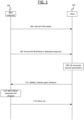
- FIG. 1 shows an example message flow between at least one base station 101 and at least one UE 103.
- base station 101 performs geometry-aided channel estimation with the aid of information provided by UE 103 as feedback.
- the channel estimation is performed using information available from prior transmissions (e.g., random access protocol) as well as the information provided by UE 103 as feedback in FIG. 1 .
- Information available from prior transmissions may include power headroom reporting or UE position, for example.
- Base station 101 may be aware of a capability of UE 103 to receive configuration information as described at 105. According to some examples, this capability may be signalled to base station 101 prior to the method of FIG. 1 .
- the geometry of the antennas of UE 103 with respect to at least one reference antenna of UE 103 may be known to base station 101. According to some examples, the geometry of the antennas of UE 103 with respect to at least one reference antenna may be known to UE 103. According to some examples, a partial geometry of the antennas of base station 101 with respect to at least one reference antenna may be known to UE 103, wherein the partial geometry comprises a geometry of active antennas at the base station 101.
- base station 101 transmits configuration information to UE 103 at 105.
- Base station 101 transmits reference signals (aka CSI-RS or SRS) on a subset of all antenna ports of base station 101.
- reference signals aka CSI-RS or SRS
- a subset of antennas as described herein may comprise less than all antennas of a device.
- a subset of antennas may include a single antenna.
- UE 103 Based on the transmitted reference signals, UE 103 provides measurements to the base station 101.
- the measurements may comprise partial channel state information.
- UE 103 sends the measurements to base station 101.
- base station 101 based on the received measurements and based on the geometry of the UE antennas, reconstructs the full channel state information.
- information based on the full channel state information may be sent to UE 103.
- base station(s) 101 sends configuration information (referred to as control information in FIG. 1 ) to UE(s) 103.
- the configuration information describes features of the partial CSI-RS sent from base station(s) 101 to UE 103 at 107.
- the configuration information may indicate to UE 103 which information to feedback to base station(s) 107 at 111.
- the configuration information may be used to compute channel parameters at 109.
- the configuration information may be used at 113 by base station 101 to compute the full channel.
- the configuration information may comprise at least one of:
- the antenna geometry of base station 101 may include a geometry of active antennas at base station 101. This may include distance between each active antenna at base station 101.
- antenna geometry of base station 101 comprises a partial geometry, wherein the partial geometry comprises a geometry of active antennas at base station 101.
- the antenna geometry may include an indication of active base station antennas at base station 101, for example a number of active base station antennas. In some examples, not all antennas of base station 101 are used as active base station antennas.
- the indication may also include TCI states of active base stations and/or identifiers of beams (if UE 103 knows the codebook of base station 101, it can use the identifier to identify active base station beams).
- the antenna geometry may include a reference antenna of base station 101.
- base station 101 may also include a description of analog beams used at base station 101 in the configuration information sent at 105.
- the indication of at least one antenna for UE 103 may also be included in the configuration information sent at 105.
- the UE 103 antenna information may include a reference antenna to use for measurements at UE 103.
- UE 103 antenna information may include an indication of UE active antennas for measurement at UE 103.
- UE 103 antenna information may also include analog beams to be used at UE 103.
- the indication of resources to use for at least one reference signal included in configuration information sent at 105 may indicate resources used for downlink sounding, such as time resources, frequency resource or code resources.
- Resource information may also include a type of sounding, e.g., CDMA (Code Division Multiplex Access) or TDMA (Time Division Multiplex Access).
- the indication of a type of channel feedback to provide for at least one reference signal included in configuration information sent at 105 may include a type of channel feedback. This may include an indication of which active antenna measurements reported back from UE 103 to base station 101. This indication may include, for example:
- the configuration information at 105 may be broadcast from at least one base station 101 as broadcast, multicast or unicast to at least one user equipment 103.
- base station 101 transmits the configuration information as a broadcast/multicast signal, which includes, base station 101 partial geometry, gNB active antennas, UE references antenna type (if the same for all, for example, one example could be: if all the UE antenna structure is the same, then base station 101 can dictate to use the topmost UE antenna as a reference antenna for the measurements), CSI-RS resources as well as the reporting format.
- base station 101 transmits at least one reference signal (e.g., CSI-RS, SRS) for partial channel information at UE 103.
- the reference signal(s) transmission at 107 may be in line with the indications made in the configuration information sent at 105.
- the at least one reference signal may be sent from a set of active antennas of base station 101.
- UE 103 measures the partial channel-related parameters from the active antenna(s) or reference antenna of base station 101. In some examples the measurements are made for the same reference signal on different channels.
- the channel parameters configured in the configuration information at 105 can be used to compute partial channel parameters, which are then send to base station 101 at 111.
- the channel-related parameters from the same CSI-RS and provide feedback to the gNB(s) as commanded by the network.
- the feedback may include any of the following parameters:
- base station 101 computes full channel information from the partial channel-related parameters. This reconstruction can be based on the geometry of the UE 103 antenna arrays.
- Channels can be reconstructed using AoA(s) measurements and distance measurements from UE antenna(s) to base station antenna(s). Methods for such reconstruction are discussed in:
- base station 101 may indicate to UE 103 information describing parameters for communication. This may include:
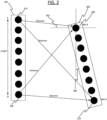
- FIG. 2 shows an example of an antenna array at base station 201 (which may comprise a gNB, for example) and an antenna array at UE 203. Each antenna is represented by a circle.
- UE 203 can measure an AoA 202 from antenna P 224 or antenna Q 226 to a reference antenna 220 (Ref-A) of UE 203.
- Channel gains can also be measured.
- Distance from P 224 to antenna 220 and distance from Q 226 to antenna 220 can also be measured, as well as the relative rotation 204 of UE 203 with respect to base station 201 antennas P 224 and Q 226.
- the relative rotation can be determined using a partial geometry of base station 201 antennas at UE 203.
- relative rotation of a reference antenna (e.g., antenna 220) of UE 203 with respect to base station 201 antennas P 224 and Q can be determined using a partial geometry of base station 201 antennas at UE 203.
- Base station 201 can use these measurements to reconstruct the channel based on the feedback parameters.
- the feedback parameters could be based on the configuration information sent at 105 in Figure 1 .
- the reconstructed channel information could comprise channel gains, distance and/or AoA from antenna 224 (P) to antenna 220 (Ref-A).
- the reconstructed channel information could comprise channel gains, distance and/or AoA from antenna 226 (Q) to antenna 220 (Ref-A).
- AoA measurements can be determined at UE 203 using two reference UE antennas, for example antenna 220 (Ref-A) and antenna 222 (Ref-B).
- UE 203 may use all antennas to measure reference signal(s) from based station 101. This can provide more accurate estimates of AoAs and UE rotation.
- Examples described herein provide a method for determining channel state information between a base station and a user equipment based on a reference signal from a subset of antennas of either or both of the base station and the user equipment. By using a subset of antennas at the base station and/or at the user equipment, signalling overhead is reduced.
- FIG. 3 shows an example method flow. The method may be performed by an apparatus such as UE 103 or UE 203, for example.
- the method comprises receiving, from a base station, configuration information for at least one reference signal, the configuration information comprising at least one of the following: antenna geometry of the base station; a first indication of at least one antenna of the apparatus to use for measuring the at least one reference signal; a second indication of resources used for the at least one reference signal; or a third indication of feedback information requested from the apparatus for the at least one reference signal.
- the method comprises receiving, from the base station, the at least one reference signal, wherein the at least one reference signal is received from a subset of antennas of the base station.
- the subset may comprise fewer than all antennas of the base station.
- the method comprises determining using the configuration information received at 300, at least one measurement of the at least one reference signal.
- the method comprises sending, to the base station, the at least one measurement of the at least one reference signal.
- FIG. 4 shows an example method flow.
- the method may be performed by a base station (e.g., gNB) such as base station 101 or base station 201.
- a base station e.g., gNB
- gNB base station
- the method comprises sending, to a user equipment, configuration information for at least one reference signal, the configuration information comprising at least one of the following: antenna geometry of the apparatus; a first indication of at least one antenna of the user equipment to use for measuring the at least one reference signal; a second indication of resources used for the at least one reference signal; a third indication of feedback information requested from the user equipment for the at least one reference signal.
- the method comprises sending, to the user equipment, the at least one reference signal, wherein the at least one reference signal is sent by a subset of antennas of the apparatus.
- the subset may comprise fewer than all of the antennas of the apparatus.
- the method comprises receiving, from the user equipment, at least one measurement of the at least one reference signal.
- the method comprises determining channel state information based on the at least one measurement of the at least one reference signal and the configuration information.
- FIG. 5 illustrates an example of a control apparatus 560 for controlling a network.
- the control apparatus may comprise at least one random access memory (RAM) 511a, at least on read only memory (ROM) 511b, at least one processor 512, 513 and an input/output interface 514.
- the at least one processor 512, 513 may be coupled to the RAM 511a and the ROM 511b.
- the at least one processor 512, 513 may be configured to execute an appropriate software code 515.
- the software code 515 may, for example, allow the at least one processor 512, 513 to perform one or more steps of any method flow described herein.
- the software code 515 may be stored in the ROM 511b.
- the control apparatus 500 may be interconnected with another control apparatus 500 controlling another function of the RAN or the core network.
- FIG. 6 illustrates an example of a terminal 600, such as a UE.
- the terminal 600 may be provided by any device capable of sending and receiving radio signals.
- the terminal may comprise a user equipment, a mobile station (MS) or mobile device, such as a mobile phone or what is known as a 'smart phone', a computer provided with a wireless interface card or other wireless interface facility (e.g., USB dongle), a personal data assistant (PDA) or a tablet provided with wireless communication capabilities, a machine-type communications (MTC) device, an Internet of things (IoT) type communication device or any combinations of these or the like.
- the terminal 600 may provide, for example, communication of data for carrying communications.
- the communications may be one or more of voice, electronic mail (email), text message, multimedia, data, machine data and so on.
- the terminal 600 may be configured to receive signals over an air or radio interface 607 via appropriate apparatus for receiving and may transmit signals via appropriate apparatus for transmitting radio signals.
- transceiver apparatus is designated schematically by block 606.
- the transceiver apparatus 606 may be provided, for example, by means of a radio part and associated antenna arrangement.
- the antenna arrangement may be arranged internally or externally to the mobile device.
- the terminal 600 may be provided with at least one processor 601, at least one memory ROM 602a, at least one RAM 602b and other possible components 603 and 604 for use in software and hardware aided execution of tasks it is designed to perform, including control of access to and communications with access systems and other communication devices.
- the at least one processor 601 is coupled to the RAM 602b and the ROM 602a.
- the at least one processor 601 may be configured to execute an appropriate software code 608.
- the software code 608 may for example allow to perform one or more of steps of any method flow described herein.
- the software code 608 may be stored in the ROM 602a.
- the processor, storage and other relevant control apparatus can be provided on an appropriate circuit board and/or in chipsets.
- This example is denoted by reference 602.
- the device may optionally have a user interface, such as key pad 605, touch sensitive screen or pad, combinations thereof or the like.
- a user interface such as key pad 605, touch sensitive screen or pad, combinations thereof or the like.
- one or more of a display, a speaker and a microphone may be provided depending on the type of the device.
- FIG. 7 shows a schematic representation of non-volatile memory media 700a (e.g. computer disc (CD) or digital versatile disc (DVD)) and 700b (e.g. universal serial bus (USB) memory stick) storing instructions and/or parameters 702 which when executed by a processor allow the processor to perform one or more of the steps of any method flow described herein.
- non-volatile memory media 700a e.g. computer disc (CD) or digital versatile disc (DVD)
- 700b e.g. universal serial bus (USB) memory stick
- apparatuses may comprise or be coupled to other units or modules etc., such as radio parts or radio heads, used in or for transmission and/or reception.
- apparatuses have been described, in some examples as one entity, different modules and memory may be implemented in one or more physical or logical entities.
- the various examples may be implemented in hardware or special purpose circuitry, software, logic or any combination thereof. Some examples detailed in the subject disclosure may be implemented in hardware, while other aspects may be implemented in firmware or software which may be executed by a controller, microprocessor or other computing device, although the subject disclosure is not limited thereto. While various aspects of the subject disclosure may be illustrated and described as block diagrams, flow charts, or using some other pictorial representation, it is well understood that these blocks, apparatus, systems, techniques or methods described herein may be implemented in, as non-limiting examples, hardware, software, firmware, special purpose circuits or logic, general purpose hardware or controller or other computing devices, or some combination thereof.
- circuitry may refer to one or more or all of the following examples:
- circuitry also covers an implementation of merely a hardware circuit or processor (or multiple processors) or portion of a hardware circuit or processor and its (or their) accompanying software and/or firmware.
- circuitry also covers, for example and if applicable to the particular claim element, a baseband integrated circuit or processor integrated circuit for a mobile device or a similar integrated circuit in server, a cellular network device, or other computing or network device.
- Computer software executable by a data processor of the mobile device such as in the processor entity, or by hardware, or by a combination of software and hardware.
- Computer software or program also called program product, including software routines, applets and/or macros, may be stored in any apparatus-readable data storage medium and they comprise program instructions to perform particular tasks.
- a computer program product may comprise one or more computer-executable components which, when the program is run, are configured to carry out one or more steps of any method flow described herein.
- the one or more computer-executable components may be at least one software code or portions of it.
- any blocks of the logic flow as in the Figures may represent program steps, or interconnected logic circuits, blocks and functions, or a combination of program steps and logic circuits, blocks and functions.
- the software may be stored on such physical media as memory chips, or memory blocks implemented within the processor, magnetic media such as hard disk or floppy disks, and optical media such as DVD and the data variants thereof, CD.
- the physical media may be implemented as a non-transitory media.
- non-transitory is a limitation of the medium itself (e.g., tangible, not a signal) as opposed to a limitation on data storage persistency (e.g., RAM vs. ROM).
- the memory may be of any type suitable to the local technical environment and may be implemented using any suitable data storage technology, such as semiconductor based memory devices, magnetic memory devices and systems, optical memory devices and systems, fixed memory and removable memory.
- the data processors may be of any type suitable to the local technical environment, and may comprise one or more of general purpose computers, special purpose computers, microprocessors, digital signal processors (DSPs), application specific integrated circuits (ASIC), FPGA, gate level circuits and processors based on multi core processor architecture, as non-limiting examples.
- Examples of the subject disclosure may be practiced in various components, such as integrated circuit modules.
- the design of integrated circuits is by and large a highly automated process. Complex and powerful software tools are available for converting a logic level design into a semiconductor circuit design ready to be etched and formed on a semiconductor substrate.
Landscapes
- Engineering & Computer Science (AREA)
- Signal Processing (AREA)
- Computer Networks & Wireless Communication (AREA)
- Mobile Radio Communication Systems (AREA)
Priority Applications (3)
| Application Number | Priority Date | Filing Date | Title |
|---|---|---|---|
| EP23178244.2A EP4475449A1 (fr) | 2023-06-08 | 2023-06-08 | Facilitation d'estimation de canal de liaison descendante assistée par ue et à géométrie d'antenne partielle |
| CN202480034459.5A CN121175932A (zh) | 2023-06-08 | 2024-03-19 | 促进ue辅助和部分天线几何结构协助的下行链路信道估计 |
| PCT/EP2024/057206 WO2024251403A1 (fr) | 2023-06-08 | 2024-03-19 | Facilitation d'une estimation de canal de liaison descendante assistée par ue et par géométrie d'antenne partielle |
Applications Claiming Priority (1)
| Application Number | Priority Date | Filing Date | Title |
|---|---|---|---|
| EP23178244.2A EP4475449A1 (fr) | 2023-06-08 | 2023-06-08 | Facilitation d'estimation de canal de liaison descendante assistée par ue et à géométrie d'antenne partielle |
Publications (1)
| Publication Number | Publication Date |
|---|---|
| EP4475449A1 true EP4475449A1 (fr) | 2024-12-11 |
Family
ID=86732583
Family Applications (1)
| Application Number | Title | Priority Date | Filing Date |
|---|---|---|---|
| EP23178244.2A Withdrawn EP4475449A1 (fr) | 2023-06-08 | 2023-06-08 | Facilitation d'estimation de canal de liaison descendante assistée par ue et à géométrie d'antenne partielle |
Country Status (3)
| Country | Link |
|---|---|
| EP (1) | EP4475449A1 (fr) |
| CN (1) | CN121175932A (fr) |
| WO (1) | WO2024251403A1 (fr) |
Citations (2)
| Publication number | Priority date | Publication date | Assignee | Title |
|---|---|---|---|---|
| US20170288758A1 (en) * | 2014-09-25 | 2017-10-05 | Ntt Docomo, Inc. | Base station and user equipment |
| WO2022246676A1 (fr) * | 2021-05-26 | 2022-12-01 | Qualcomm Incorporated | Sondage partiel pour multiplexage à entrées et sorties multiples de ligne de visée |
-
2023
- 2023-06-08 EP EP23178244.2A patent/EP4475449A1/fr not_active Withdrawn
-
2024
- 2024-03-19 CN CN202480034459.5A patent/CN121175932A/zh active Pending
- 2024-03-19 WO PCT/EP2024/057206 patent/WO2024251403A1/fr not_active Ceased
Patent Citations (2)
| Publication number | Priority date | Publication date | Assignee | Title |
|---|---|---|---|---|
| US20170288758A1 (en) * | 2014-09-25 | 2017-10-05 | Ntt Docomo, Inc. | Base station and user equipment |
| WO2022246676A1 (fr) * | 2021-05-26 | 2022-12-01 | Qualcomm Incorporated | Sondage partiel pour multiplexage à entrées et sorties multiples de ligne de visée |
Non-Patent Citations (3)
| Title |
|---|
| J. KALEVAN. J. MYERSA. TOLLIR. W. HEATH: "A geometry-aided message passing method for AoA-based short range MIMO channel estimation", PROC. IEEE INT. WORKSHOP SIGNAL PROCESS. ADV. IN WIRELESS COMMUN., July 2019 (2019-07-01) |
| N. J. MYERSJ. KALEVAA. TOLLIR. W. HEATH: "Message passing-based link configuration in short range millimeter wave systems", IEEE TRANS. COMMUN., vol. 68, no. 6, June 2020 (2020-06-01), pages 3465 - 3479 |
| S. ESLAMIB. GOUDAA. TOLLID. KUMAR: "Geometry-Aided Joint Estimation of Short-Range MIMO Channels with Hybrid Transceivers", ICC WORKSHOP, June 2023 (2023-06-01) |
Also Published As
| Publication number | Publication date |
|---|---|
| CN121175932A (zh) | 2025-12-19 |
| WO2024251403A1 (fr) | 2024-12-12 |
Similar Documents
| Publication | Publication Date | Title |
|---|---|---|
| US20230122302A1 (en) | Measurement reporting method and apparatus | |
| US11979211B2 (en) | Managing multiple antenna panels for user equipment within wireless networks | |
| US12176986B2 (en) | Apparatus, method and computer program for beam management | |
| US12308919B2 (en) | Channel state information overhead reduction for multi-transmission reception point/panel and cell free multiple input, multiple output | |
| US20250055630A1 (en) | Information processing method, communications device, system, and storage medium | |
| US20190334602A1 (en) | Channel State Information Feedback Method, User Equipment, and Base Station | |
| CN108282211B (zh) | 一种信号传输方法和网络设备以及终端设备 | |
| KR20180098592A (ko) | 다중-입력 및 다중-출력(mimo) 무선 네트워크들에 대한 희소 상관 매트릭스의 피드백 | |
| KR20170117114A (ko) | 무선 네트워크에서 피드백을 위한 기저 함수의 변환 기법 | |
| CN114144977A (zh) | 波束赋形方法、装置、无线接入网设备及可读存储介质 | |
| EP4181537B1 (fr) | Procédé de positionnement de point d'ancrage unique à multiples chemins et appareil de communication | |
| US20240064724A1 (en) | Refined beam prediction with wide beam measurements | |
| US12451982B2 (en) | Beam prediction by user equipment using angle assistance information | |
| US20250125837A1 (en) | Communication method and apparatus applying huygens equivalent surface | |
| WO2024153072A1 (fr) | Procédé de communication et appareil associé | |
| CN118741587A (zh) | 发送信息的方法和通信装置 | |
| EP4475449A1 (fr) | Facilitation d'estimation de canal de liaison descendante assistée par ue et à géométrie d'antenne partielle | |
| EP4447353A1 (fr) | Procédé et appareil de rétroaction d'informations d'état de canal, support et produit-programme | |
| EP4478624A1 (fr) | Procédé, appareil et programme informatique | |
| CN120512699A (zh) | 一种信道测量方法和通信装置 | |
| WO2025078011A1 (fr) | Dispositifs et procédés de communication mimo dans un réseau mobile | |
| WO2026067168A1 (fr) | Procédé et appareil de positionnement | |
| CN118139164A (zh) | 一种定位方法及通信装置 | |
| CN119727819A (zh) | 一种通信方法及通信装置 | |
| CN120076006A (zh) | 信道状态信息上报方法、通信装置及通信系统 |
Legal Events
| Date | Code | Title | Description |
|---|---|---|---|
| PUAI | Public reference made under article 153(3) epc to a published international application that has entered the european phase |
Free format text: ORIGINAL CODE: 0009012 |
|
| STAA | Information on the status of an ep patent application or granted ep patent |
Free format text: STATUS: THE APPLICATION HAS BEEN PUBLISHED |
|
| AK | Designated contracting states |
Kind code of ref document: A1 Designated state(s): AL AT BE BG CH CY CZ DE DK EE ES FI FR GB GR HR HU IE IS IT LI LT LU LV MC ME MK MT NL NO PL PT RO RS SE SI SK SM TR |
|
| STAA | Information on the status of an ep patent application or granted ep patent |
Free format text: STATUS: THE APPLICATION IS DEEMED TO BE WITHDRAWN |
|
| 18D | Application deemed to be withdrawn |
Effective date: 20250612 |