EP4475562A1 - Ensemble de maintenance de prothèse auditive - Google Patents
Ensemble de maintenance de prothèse auditive Download PDFInfo
- Publication number
- EP4475562A1 EP4475562A1 EP23177519.8A EP23177519A EP4475562A1 EP 4475562 A1 EP4475562 A1 EP 4475562A1 EP 23177519 A EP23177519 A EP 23177519A EP 4475562 A1 EP4475562 A1 EP 4475562A1
- Authority
- EP
- European Patent Office
- Prior art keywords
- hearing aid
- filter
- receiving
- assembly
- filters
- Prior art date
- Legal status (The legal status is an assumption and is not a legal conclusion. Google has not performed a legal analysis and makes no representation as to the accuracy of the status listed.)
- Pending
Links
Images


Classifications
-
- H—ELECTRICITY
- H04—ELECTRIC COMMUNICATION TECHNIQUE
- H04R—LOUDSPEAKERS, MICROPHONES, GRAMOPHONE PICK-UPS OR LIKE ACOUSTIC ELECTROMECHANICAL TRANSDUCERS; ELECTRIC HEARING AIDS; PUBLIC ADDRESS SYSTEMS
- H04R25/00—Electric hearing aids
- H04R25/60—Mounting or interconnection of hearing aid parts, e.g. inside tips, housings or to ossicles
-
- H—ELECTRICITY
- H04—ELECTRIC COMMUNICATION TECHNIQUE
- H04R—LOUDSPEAKERS, MICROPHONES, GRAMOPHONE PICK-UPS OR LIKE ACOUSTIC ELECTROMECHANICAL TRANSDUCERS; ELECTRIC HEARING AIDS; PUBLIC ADDRESS SYSTEMS
- H04R25/00—Electric hearing aids
- H04R25/65—Housing parts, e.g. shells, tips or moulds, or their manufacture
- H04R25/652—Ear tips; Ear moulds
- H04R25/654—Ear wax retarders
-
- H—ELECTRICITY
- H04—ELECTRIC COMMUNICATION TECHNIQUE
- H04R—LOUDSPEAKERS, MICROPHONES, GRAMOPHONE PICK-UPS OR LIKE ACOUSTIC ELECTROMECHANICAL TRANSDUCERS; ELECTRIC HEARING AIDS; PUBLIC ADDRESS SYSTEMS
- H04R2460/00—Details of hearing devices, i.e. of ear- or headphones covered by H04R1/10 or H04R5/033 but not provided for in any of their subgroups, or of hearing aids covered by H04R25/00 but not provided for in any of its subgroups
- H04R2460/17—Hearing device specific tools used for storing or handling hearing devices or parts thereof, e.g. placement in the ear, replacement of cerumen barriers, repair, cleaning hearing devices
Definitions
- the invention relates to an assembly and disassembly tool for assembling and disassembling hearing aid filters, with an assembly side for inserting the hearing aid filter into a hearing aid loudspeaker and a disassembly side for removing the hearing aid filter from the hearing aid loudspeaker.
- the invention also relates to a hearing aid filter receiving device for receiving and arranging hearing aid filters, with a receiving compartment for receiving hearing aid filters, which has a removal opening for removing the hearing aid filters, and a cover for reversibly closing the removal opening.
- the invention also relates to a hearing aid maintenance set with at least one assembly and disassembly tool and a corresponding hearing aid filter receiving device.
- the invention also relates to a hearing aid filter for such a hearing aid maintenance set.
- Hearing aid maintenance sets of the type described above are generally known. They are used to insert hearing aid filters into hearing aids to protect the hearing aid loudspeakers and, if necessary, to remove the dirty hearing aid filters and replace them with new hearing aid filters. In most cases, certain hearing aid maintenance sets are assigned to each type of hearing aid loudspeaker. These hearing aid maintenance sets comprise a type of hearing aid filter specifically designed for the respective hearing aid loudspeaker, which are accommodated in a hearing aid filter holder. Such a hearing aid filter holder comprises a holder compartment in which a number of hearing aid filters and assembly and disassembly tools are accommodated. Furthermore, such hearing aid filter holders comprise a lid for closing the holder compartment.
- a number of assembly and disassembly tools are arranged in the receiving compartment, which comprise an assembly side and a disassembly side.
- a hearing aid filter is usually already arranged on the assembly side and is thus held in a defined position in the receiving compartment by the respective assembly and disassembly tool.
- the disassembly side engages with the dirty hearing aid filter in a form-fitting and/or force-fitting manner.
- the dirty hearing aid filter then sits firmly on the disassembly side of the assembly and disassembly tool and is usually disposed of together with it.
- Standard hearing aid maintenance kits usually contain 5 to 10 hearing aid filters and accordingly 5 to 10 assembly and disassembly tools.
- the invention comes in, the purpose of which is to provide an assembly and disassembly tool, a hearing aid filter holder, a hearing aid maintenance set and a hearing aid filter which overcome at least one of the disadvantages known from the prior art. In particular, the amount of waste generated should be reduced.
- the invention solves the problem mentioned at the outset in a first aspect by means of an assembly and disassembly tool according to claim 1.
- the invention proposes an assembly and disassembly tool for assembling and disassembling hearing aid filters with an assembly side which is designed to hold the hearing aid filter for insertion into a To remove a hearing aid loudspeaker from a hearing aid filter receiving device in an installed position and to apply a compressive force along a tool longitudinal axis in the direction of the hearing aid loudspeaker to the received hearing aid filter such that the hearing aid filter is elastically deformed in the hearing aid loudspeaker, and with a disassembly side which is configured to reversibly engage in a form-fitting manner with the hearing aid filter inserted in the hearing aid loudspeaker in order to apply a tensile force directed away from the hearing aid loudspeaker along the tool longitudinal axis and to remove it from the hearing aid loudspeaker.
- the assembly side of the assembly and disassembly tool can be used multiple times.
- the disassembly side can also be used multiple times, as the disassembly side reversibly engages with the hearing aid filter inserted into the hearing aid loudspeaker in a form-fitting manner in order to remove it from the hearing aid loudspeaker.
- the hearing aid filters can therefore be removed again from the disassembly side, so that the assembly and disassembly tool can be used multiple times and a separate assembly and disassembly tool is no longer required to insert each hearing aid filter.
- the disassembly side has a slider which is movably received along the longitudinal axis of the tool and can be brought into a stripping position in which the slider is designed to strip the hearing aid filter from the disassembly side.
- a slider allows used and thus dirty hearing aid filters to be removed from the assembly and disassembly tool without having to strip them off by hand. Handling the assembly and disassembly tool is thus simplified.
- the disassembly side preferably has a receiving area that extends outward in a radial direction and is designed to reversibly engage with an undercut of the hearing aid filter in a form-fitting manner.
- a receiving area enables the elastically deformable hearing aid filters to be easily received, which cannot accidentally slip off the disassembly side. The handling of the assembly and disassembly tool is thus simplified.
- the disassembly side preferably has a base body which is in positive engagement with the slide and is designed to guide the movable slide along the longitudinal axis of the tool.
- a relative movement between the slide and the base body is easily ensured by a correspondingly preferably two-part design of the disassembly side with a base body and a slide which is in positive engagement with the latter.
- the relative movement is also defined by a guide along the longitudinal axis of the tool.
- the base body particularly preferably has the undercut for engaging in the hearing aid filter. The slide, guided by the base body, is thus movable relative to the receiving area and can thus easily strip the hearing aid filter from the receiving area.
- the assembly and disassembly tool has an optical indicator that is designed to allow optical assignment of the assembly and disassembly tool to hearing aid filters with a corresponding optical tool indicator.
- Hearing aid filters usually require the use of an assembly and disassembly tool designed to correspond to this hearing aid filter. Since the assembly and disassembly tool can be used multiple times, an optical indicator makes it easier to handle the assembly and disassembly tool in that it is always only used for the correct hearing aid filters that have the corresponding optical indicator. Incorrect handling, such as accidentally losing a hearing aid filter due to an assembly and disassembly tool that is too small, is thus avoided.
- the optical indicator is particularly preferably assigned to the movable slider.
- the assembly and disassembly tool preferably further comprises a coupling section arranged between the assembly side and the disassembly side, which is designed to releasably engage with a corresponding receiving device of the hearing aid filter receiving device.
- the assembly and disassembly tool can thus be easily attached to the hearing aid filter receiving device.
- the coupling section is further preferably designed to engage with a snap-in receptacle of the receptacle device to form a snap connection.
- the snap-in receptacle is preferably designed to deform elastically to receive the coupling section.
- a snap connection allows the assembly and disassembly tool to be attached quickly and reversibly and allows the coupling section to be designed simply.
- the coupling section is preferably defined only by a cylindrical region and the snap-in receptacle is preferably designed to be ring-shaped in sections corresponding to the coupling section.
- the mounting side has a first length and the dismantling side has a second length which is different from the first length, such that the coupling section can only be brought into engagement with the receiving device in a predefined coupling position.
- the dismantling side is also brought into engagement with the hearing aid filter receiving device in a predefined position and can preferably be arranged in an area from which no dirt can get from the dismantling side to the hearing aid filters.
- the slider can be brought into engagement with the base body on the disassembly side by elastic deformation.
- elastic deformation means that auxiliary elements are not required and the construction is simplified.
- sliders made of plastic conveniently allow such elastic deformation.
- the invention has been described above in a first aspect with respect to an assembly and disassembly tool.
- the invention in a second aspect, relates to a hearing aid filter receiving device for receiving and arranging hearing aid filters, with a receiving compartment for receiving hearing aid filters, which has a removal opening for removing the hearing aid filters, and a lid for reversibly closing the removal opening.
- the invention solves the problem mentioned at the outset according to the second aspect in that the receiving compartment has a number of receiving compartments, each of which is designed to movably receive a plurality of hearing aid filters and has at least one positioning device which is designed to separately arrange at least one of the movably received hearing aid filters of the plurality of hearing aid filters in a predefined position.
- the inventors advantageously recognized that when replacing a hearing aid filter, only one of the accommodated hearing aid filter must be brought into a predefined position in which the hearing aid filter can be easily accommodated by an assembly and disassembly tool. However, it is not necessary for all of the accommodated hearing aid filters to always remain in such a predefined position. In this way, a plurality of hearing aid filters can be accommodated in one of the receiving compartments and only at least one of the hearing aid filters can be brought into a predefined position by means of the positioning device.
- a plurality of hearing aid filters can be successively brought into the predefined position with only one assembly and disassembly tool and removed from this by the assembly and disassembly tool in order to insert the hearing aid filter into a corresponding hearing aid loudspeaker.
- the hearing aid filters are accommodated in the hearing aid filter receiving device according to the invention as bulk material in the respective receiving compartments and are only brought into the predefined position by the positioning device as required.
- the ratio of the accommodated hearing aid filters to the geometric dimensions of the hearing aid filter receiving device and thus to the material used for the receiving device is thus reduced to a considerable extent.
- hearing aid filters of different types are accommodated in the individual compartments of the hearing aid filter receiving device, each of which may require its own assembly and disassembly tool, the assembly and disassembly side of which is designed to correspond to the respective filter type.
- the hearing aid filter receiving device comprises a number of partition walls which are designed to divide the receiving compartment into the number of receiving compartments in such a way that the receiving compartments each form a spatially enclosed receiving space when the removal opening is closed.
- partition walls By inserting partition walls into a receiving compartment, Such a hearing aid filter holder can be manufactured in an integral manner in a simple manner, for example by injection molding.
- the positioning device preferably has at least one recess which is designed to receive and position a hearing aid filter in such a way that the hearing aid filter is positioned in the recess coaxially to a longitudinal axis of the recess.
- Hearing aid filters are usually inserted coaxially to a longitudinal axis of a hearing aid loudspeaker into a corresponding receptacle of the hearing aid loudspeaker.
- By positioning the hearing aid filters coaxially to a recess in the positioning device they can be brought into a removal position in which they can be picked up by the assembly and disassembly tool and can be easily inserted into the corresponding receptacle of the hearing aid loudspeaker.
- the removal position therefore essentially corresponds to the installation position within the hearing aid loudspeaker, i.e. taking into account any differing geometries of the receptacle of the hearing aid loudspeaker and the recess.
- the receiving compartment and/or the number of receiving compartments has a collecting section which is spaced apart from the positioning device, in particular from the recess, and which is designed to receive the hearing aid filters.
- the majority of the hearing aid filters are received in the area of the collecting section. Because this collecting section is spaced apart from the positioning device, this majority of the hearing aid filters do not hinder the removal of the at least one hearing aid filter positioned and separated in the positioning device. The separation of the hearing aid filter to be removed is thus supported.
- the receiving compartment and/or the number of receiving compartments have a base which is designed to slope at least in sections towards the collecting section.
- the hearing aid filters therefore slide through the sloping base towards the collecting section during operation, for example when the hearing aid filter receiving device is moved or put down.
- a base or the base of the receiving compartment and/or the number of receiving compartments has a lowered section in which the positioning device is arranged.
- the lowered section can thus be provided in addition to the collecting section or also independently of the collecting section.
- the lowered section with the positioning device is always arranged at a distance from any collecting section that may be present.
- the lowered section supports the movement of at least one hearing aid filter into the positioning device. It is therefore sufficient, for example, if at least one hearing aid filter enters the lowered section by shaking the hearing aid filter receiving device and is guided through it to the positioning device. The corresponding hearing aid filter is then brought into the predefined position in the positioning device.
- the receiving compartment and/or the number of receiving compartments has a depression and the positioning device is arranged at least in sections in the depression.
- a depression i.e. a lowered section, enables the advantages described above with regard to the positioning of the at least one hearing aid filter in the positioning device.
- the compartments each extend in a longitudinal direction and that the base is designed to slope down in the longitudinal direction of the compartment, with the collecting section being arranged on a front section at a distance from the positioning device in the longitudinal direction.
- the positioning device is preferably arranged in the region of an opposite front section.
- the front length of the receiving compartments is smaller than the length of the compartments transverse to it. This provides a relatively further sloping area of the base over which the hearing aid filters can slide into the collecting section and the positioning device is positioned at a sufficient distance from this collecting section so that the majority of the hearing aid filters accommodated in the collecting section do not obstruct the positioning device.
- the base is also preferably designed to slope orthogonally to the longitudinal direction in the direction of the positioning device and forms the lowered section or depression.
- the majority of the hearing aid filters continue to slide into the area of the collecting section, but if at least one hearing aid filter is present in the area of the positioning device, it slides orthogonally to the longitudinal direction into the positioning device. This supports the separation of the at least one hearing aid filter in the positioning device relative to the majority of the hearing aid filters in the area of the collecting section.
- the lid preferably has a number of mounting means and the receiving compartment has a number of corresponding mounting interfaces, wherein the mounting means are designed to pivotally attach the lid to the receiving compartment so as to engage in the mounting interfaces.
- a pivotable attachment of the lid to the receiving compartment provides protection against loss of the lid.
- a pivotable attachment is also easy to handle and allows sufficient access to the removal opening.
- the collecting section is preferably arranged adjacent to the mounting interfaces.
- the collecting section is located adjacent to the mounting interface, i.e. in a rear section of the hearing aid filter receiving device as seen from the user.
- the positioning device arranged at a distance from the collecting section is therefore arranged in a front section of the hearing aid filter receiving device relative to the user. The reception of the majority of the hearing aid filters in the collecting section further away from the user and the predefined positioning of at least one hearing aid filter in the positioning device in a section closer to the user simplifies handling.
- the hearing aid filter receiving device comprises at least one receiving device which is designed to receive an assembly and disassembly tool for the repeatable assembly and disassembly of the hearing aid filters, in particular for receiving an assembly and disassembly tool according to the first aspect of the invention.
- at least one assembly and disassembly tool can be mounted directly on the hearing aid filter receiving device and used together with it for the repeated assembly and disassembly of hearing aid filters.
- each receiving compartment is assigned a receiving device.
- hearing aid filters of different types can preferably be accommodated in the receiving compartments and an assembly and disassembly tool can be accommodated for each of these filters in a receiving device assigned to the corresponding receiving compartment.
- a spatial assignment of the respective assembly and disassembly tool to the respective receiving compartment and thus to the filter types can be made.
- the at least one receiving device is arranged on the lid, in particular on a side of the lid facing the receiving compartment.
- the arrangement of the receiving device on the lid does not hinder the removal of the hearing aid filters from the receiving compartments.
- the lid is removed or swung to the side, thus completely exposing the removal opening.
- the respective assembly and disassembly tools in the receiving device are then also arranged at a distance from the removal opening.
- the at least one receiving device has a retaining section which is designed to receive a disassembly side of the assembly and disassembly tool at least in sections and to retain dirt particles adhering to the disassembly side.
- a retaining section effectively prevents contamination of the surroundings and in particular of the hearing aid filters.
- the inventors took into account that earwax and the like can adhere in particular to the disassembly side, which must be retained in order not to contaminate the unused hearing aid filters.
- the at least one receiving device comprises a snap-in receptacle which is designed to engage with a corresponding coupling section of the assembly and disassembly tool by elastic deformation.
- a snap-in receptacle offers a quick and easy-to-use option for engaging the assembly and disassembly tool with the receiving device.
- a snap-in receptacle can be manufactured in a simple manner, for example by injection molding, integrally with the lid or the receiving compartment.
- the invention in a third aspect, relates to a hearing aid maintenance set.
- the object mentioned at the outset is achieved according to the third aspect in that the hearing aid maintenance set has an assembly and disassembly tool according to the first aspect of the invention and a hearing aid filter receiving device according to the second aspect of the invention.
- the invention makes use of the objects mentioned at the outset in relation to the first aspect of the invention.
- Advantages and preferred embodiments according to the first aspect of the invention are also advantages and preferred embodiments according to the third aspect of the invention and vice versa.
- the hearing aid maintenance set makes use of the advantages described in relation to the second aspect of the invention through a corresponding hearing aid filter receiving device.
- Advantages and preferred embodiments according to the second aspect of the invention are also advantages and preferred embodiments according to the third aspect of the invention and vice versa.
- the hearing aid maintenance set further comprises a plurality of hearing aid filters, in particular a first plurality of hearing aid filters arranged in a first receiving compartment, and at least a second plurality of hearing aid filters which are different from the first plurality and arranged in a second receiving compartment.
- different hearing aid filters are arranged in the individual receiving compartments, with at least two different types of hearing aid filters being accommodated in the hearing aid filter receiving device of the hearing aid maintenance set.
- the recess of the positioning device has a cross-sectional area corresponding to a base area of the hearing aid filter, which is smaller than the filter cross-sectional area including a collar of the hearing aid filter that extends radially outwards.
- the hearing aid filter can thus be received in the recess with its base area first, with the collar overlapping the recess.
- the hearing aid filter is brought into a removal position in which the assembly side of the assembly and disassembly tool can reach a hollow area of the hearing aid filter and thus engage with it.
- the assembly side can engage with the hearing aid filter in a force-fitting manner, in particular in a frictional manner.
- a first plurality of hearing aid filters in a first receiving compartment each have a first optical filter indicator, wherein a first assembly and disassembly tool assigned to the first receiving compartment has a first optical tool indicator which is designed to correspond to the filter indicator.
- at least a second plurality of hearing aid filters in a second receiving compartment each have a second optical filter indicator, wherein a second assembly and disassembly tool assigned to the second receiving compartment has a second optical tool indicator which is designed to correspond to the second filter indicator.
- An optical indicator can be, for example, a pattern or coloring of parts of the assembly and disassembly tool or the complete assembly and disassembly tool. This ensures that the correct assembly and disassembly tool is always used for the corresponding hearing aid filters.
- the hearing aid filters are each bowl-shaped and have a hexagonal filter cross-sectional area at least in sections along the filter's longitudinal axis.
- the base area is hexagonal and the filter cross-sectional area is preferably constant along the filter's longitudinal axis.
- a hexagonal base area allows hearing aid filters to be inserted into cylindrical recesses in hearing aid loudspeakers and to be brought into force-locking engagement with the hearing aid loudspeaker by elastically deforming the edge areas starting from the hexagonal base area.
- the hearing aid filters each have a lateral surface extending from the base surface in the direction of a filter longitudinal axis and a collar extending from a distal section of the lateral surface in a radial direction outwards.
- a collar facilitates the positioning of the hearing aid filters in a hearing aid loudspeaker or the positioning device. Sliding or slipping of the hearing aid filter into a corresponding recess is thus reliably prevented.
- the base surface is circular and the outer surface has insertion bevels which extend from the circular base surface along the filter's longitudinal axis and finally open into a deformation area of the outer surface with a hexagonal cross-sectional area. This takes into account that with smaller cross-sectional areas of the loudspeaker or loudspeakers that taper towards the base surface, increased deformation must take place in the area of the base surface. In this area, however, the base surface hinders the outer surface during elastic deformation radially inwards.
- the hearing aid filters can be inserted into recesses in hearing aid loudspeakers. inserted and brought into engagement. It should be understood that the surface area of the base is smaller than the surface area of the hexagonal cross-sectional area in the deformation region.
- the hearing aid filters each have an undercut extending radially inwards from a distal section of the lateral surface, which is designed to engage with an assembly and disassembly tool for dismantling the hearing aid filter.
- Such an undercut allows forces to be applied to the hearing aid filter away from the hearing aid loudspeaker, so that it can be moved away from the hearing aid loudspeaker and disengaged.
- the invention relates to a hearing aid filter for a hearing aid maintenance set, in particular for a hearing aid maintenance set according to the third aspect of the invention.
- the object mentioned at the outset is achieved in a fourth aspect in that the hearing aid filter is designed as described in relation to the third aspect of the invention.
- a correspondingly designed hearing aid filter can also be removed from the hearing aid loudspeaker via the disassembly side, wherein the hearing aid filters allow the use of a reusable assembly and disassembly tool according to the first aspect of the invention.
- Preferred embodiments of the first to third aspects are preferably also preferred embodiments of the fourth aspect and advantages described in this regard are also advantages of the hearing aid filter.
- the steps according to the method can be repeated until all hearing aid filters of the majority of hearing aid filters have been used up.
- the method further comprises removing the assembly and disassembly tool from a receiving device of the hearing aid filter receiving device and, after inserting the new hearing aid filter into the hearing aid loudspeaker, engaging the assembly and disassembly tool with the receiving device before closing the lid.
- a hearing aid filter receiving device according to the second aspect of the invention or a hearing aid maintenance set comprising these two components according to the third aspect of the invention and a hearing aid filter according to the fourth aspect of the invention
- the method makes use of the advantages mentioned above.
- Advantages and preferred embodiments of the first to fourth aspects of the invention are also advantages and preferred embodiments of the method according to the fifth aspect of the invention.
- the invention further relates in a sixth aspect to the use of a hearing aid maintenance kit according to the third aspect of the invention for replacing hearing aid filters inserted in loudspeakers.
- a hearing aid filter receiving device By using a corresponding assembly and disassembly tool according to the first aspect of the invention, a hearing aid filter receiving device according to the second aspect of the invention or one of these two components
- the invention according to the fifth aspect makes use of the aforementioned advantages by comprising a hearing aid maintenance set according to the third aspect of the invention and a hearing aid filter according to the fourth aspect of the invention.
- Advantages and preferred embodiments of the first to fourth aspects of the invention are also advantages and preferred embodiments of the method according to the sixth aspect of the invention.
- the hearing aid maintenance set 1 shown comprises a hearing aid filter receiving device 2 and, in the present case, a total of five assembly and disassembly tools 4.1, 4.2, 4.3, 4.4, 4.5, 4.5.
- the hearing aid maintenance set 1 further comprises a plurality of hearing aid filters, in the present case a first plurality of hearing aid filters 6.1 in a first receiving compartment 14.1 of the hearing aid filter receiving device 2 and a second plurality of hearing aid filters 6.2 in a second receiving compartment 14.2 of the hearing aid filter receiving device 2.
- it comprises a third plurality of hearing aid filters 6.3 in a third receiving compartment 14.3, a fourth plurality of hearing aid filters 6.4 in a fourth receiving compartment 14.4 and a fifth plurality of hearing aid filters 6.5 in a fifth receiving compartment 14.5.
- the hearing aid filter receiving device 2 is designed to receive and arrange the hearing aid filters 6.1, 6.2, 6.3, 6.4, 6.5.
- the hearing aid filter receiving device 2 comprises a receiving compartment 8 for receiving the hearing aid filters 6.1, 6.2, 6.3, 6.4, 6.5, which has a removal opening 12 (cf. Fig. 1b ).
- the removal opening 12 can be reversibly closed by a cover 10 of the hearing aid filter receiving device 2.
- the previously described receiving compartments 14.1, 14.2, 14.3, 14.4, 14.5, 14.5 are formed in the receiving compartment 8 and are each designed to movably receive a plurality of hearing aid filters 6.1, 6.2, 6.3, 6.4, 6.5.
- Each receiving compartment 14.1, 14.2, 14.3, 14.4, 14.5 has a positioning device 16 in the present case, whereby only the positioning device 16 in the first receiving compartment 14.1 is provided with a reference number.
- the positioning device 16 is designed to arrange at least one of the hearing aid filters 6E of the plurality of hearing aid filters 6.1, 6.2, 6.3, 6.4, 6.5 separately at a predefined removal position.
- the receiving compartments 14.1, 14.2, 14.3, 14.4, 14.5 are formed by a number of partition walls 18.1, 18.2, 18.3, 18.4, 18.5, which are drawn into the receiving compartment 8.
- the partition walls 18.1, 18.2, 18.3, 18.4, 18.5 divide the receiving compartment 8 in such a way that when the removal opening 12 is closed, the receiving compartments 14.1, 14.2, 14.3, 14.4, 14.5 each form a spatially enclosed receiving space 19.1, 19.2, 19.3, 19.4, 19.5.
- the positioning device 16 has at least one recess 21.1, 21.2, 21.3, 21.4, 21.5.
- each of the positioning devices 16 has a plurality of recesses in the receiving compartments 14.1, 14.2, 14.3, 14.4, 14.5, wherein in the first receiving compartment 14.1, one recess is provided with a reference symbol as the first recess 21.1.
- one of the plurality of recesses is provided with a reference symbol as the second recess 21.2
- one of the plurality of recesses is designed as the third recess 21.3.
- At least one of the recesses is designed as a fourth recess 21.4 and in the fifth receiving compartment 14.5 at least one of the recesses is designed as a fifth recess 21.5.
- a hearing aid filter 6E (cf. Fig. 1b ) is held in a removal position E.
- the receiving compartment 8 has a base 23 which is designed to slope down towards the cover 10.
- the base 23 thus forms a collecting section 27 in a rear area of the receiving compartment 8 or the receiving compartments 14.1, 14.2, 14.3, 14.4, 14.5 from the perspective of a user, in which the majority of the hearing aid filters 6.1, 6.2, 6.3, 6.4, 6.5 are received, while a smaller number or at least one hearing aid filter 6E to be removed is positioned in the positioning device 16 and arranged separately from the other hearing aid filters.
- each of the receiving compartments 14.1, 14.2, 14.3, 14.4, 14.5 has its own collecting section 27, wherein only the collecting section 27 in the first receiving compartment 14.1 is provided with a reference number.
- the base 23 further forms a lowered section 29 in which the positioning device 16 or the corresponding positioning device 16 in each receiving compartment 14.1, 14.2, 14.3, 14.4, 14.5 is arranged.
- the base 23 is orthogonal to a compartment longitudinal direction L (cf. FIG. 1b ), in which the receiving compartments 14.1, 14.2, 14.3, 14.4, 14.5 extend, is designed to slope downwards and thus forms the lowered section 29.
- the positioning device 16 and with it the lowered section 29 is arranged in a direction orthogonal to the compartment longitudinal direction L in the middle of the respective receiving compartment 14.1, 14.2, 14.3, 14.4, 14.5.
- the floor is designed to slope downwards in the compartment longitudinal direction L and the collecting section 27 is thus arranged on a front section in the compartment longitudinal direction L at a distance from the positioning device 16.
- the cover 10 is pivotally attached to the receiving compartment 8.
- the cover 10 has a number of mounting means 31 and the receiving compartment 8 has a number of corresponding mounting interfaces 32 which are designed to pivotally engage with the mounting means 31.
- the collecting section 27 is arranged in particular adjacent to the mounting interfaces 32 of the receiving compartment 8.
- the recess 21.1 extends, as in Fig. 1b shown, along a recess longitudinal axis L3, wherein the hearing aid filter 6E is in the recess 21.1 with its filter longitudinal axis L2 (cf. Fig. 4b ) extends coaxially to the recess longitudinal axis L3.
- the hearing aid filter receiving device 2 further comprises a total of five receiving devices 34.1, 34.2, 34.3, 34.4, 34.5, which are each designed to receive an assembly and disassembly tool 4.1, 4.2, 4.3, 4.4, 4.5, 4.5 and in the present case also each receive such an assembly and disassembly tool 4.1, 4.2, 4.3, 4.4, 4.5, 4.5.
- the first receiving compartment 14.1 is assigned a first receiving device 34.1, which is fastened to the cover 10.
- the second receiving compartment 14.2 is assigned a second receiving device 34.2
- the third receiving compartment 14.3 is assigned a third receiving device 34.3
- the fourth receiving compartment 14.4 is assigned a fourth receiving device 34.4
- the fifth receiving compartment 14.5 is assigned a fifth receiving device 34.5.
- Each of the receiving devices 34.1, 34.2, 34.3, 34.4, 34.5 preferably has a snap-on receptacle 38, which is designed to be connected to a coupling section 52 (cf. Fig. 3a ) in a coupling position K to form a snap connection 53 (cf. Fig. 1b ) to engage.
- each receiving device 34.1, 34.2, 34.3, 34.4, 34.5 preferably has a retaining section 36 which is assigned to a front side of the cover 10 facing the assembly means 31, i.e. the side 10b of the cover 10 facing the receiving compartment 8. If the cover 10 is opened, the retaining section 36 is thus arranged below the received assembly and disassembly tools 4.1, 4.2, 4.3, 4.4, 4.5, 4.5.
- the retaining section is designed to receive at least part of the assembly and disassembly tool 4.1, with in particular a distal section of a disassembly side 42 (cf. Fig. 3a ). This allows dirt particles adhering to the disassembly side 42 to be retained.
- a replacement compartment 25 is preferably also assigned a sixth receiving device 34.6, which can optionally also accommodate an assembly and disassembly tool.
- Fig. 1b shows, when removing the respective hearing aid filter 6E, the tool longitudinal axis L1 extends coaxially to its filter longitudinal axis L2 and also to the recess longitudinal axis L3, wherein the recess longitudinal axis L3 is drawn in a recess adjacent to the recess currently occupied by a hearing aid filter.
- Fig. 2 shows a second embodiment of a hearing aid filter receiving device 2', wherein identical or similar components are provided with identical reference numerals and refer to the description according to Fig. 1a and Fig. 1b
- At least one type of hearing aid filter can be received in the receiving compartment 8, wherein the majority is received in the collecting section 27 in a known manner and, in contrast, only at least one hearing aid filter 6E to be removed is arranged in the removal position E, separated from the other hearing aid filters 6.
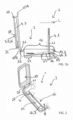
- the Fig. 3a to 3d show the assembly and disassembly tool 4 in detail.
- the assembly and disassembly tool 4 comprises an assembly side 40 with a first length l1 and the disassembly side 42 with a second length l2. Between the assembly side 40 and the disassembly side 42, the assembly and disassembly tool 4 has the coupling section 52.
- the disassembly page 42 is further in Fig. 3b shown in detail.
- the disassembly side 42 has a movable slide 44 and a receiving area 46, wherein the receiving area 46 is designed to come into positive and/or force-fitting contact with the respective hearing aid filter 6 in order to remove it.
- the receiving area 46 preferably comes into contact with an undercut 69 of the filter 6 (cf. Fig. 4a ) into engagement.
- an undercut 69 of the filter 6 cf. Fig. 4a
- a path away from the respective hearing aid loudspeaker 70 (cf. Fig. 4b ) in the direction of the mounting side 40 acting tensile force F2 which in Fig. 3c is shown, are applied to the hearing aid filter 6.
- the assembly and disassembly tool 4 has a base body 48, wherein the slide 44 is movably engaged with the base body 48.
- the slider 44 is movable in the direction of the distal end of the disassembly side 42 into a stiffening position A in order to strip off the received hearing aid filter again.
- Fig. 3c Only the position of the distal end of the slider 44 in the stripping position is shown.
- the slider 44 is brought into engagement with the base body 48 by an elastic deformation, for example by clipping.
- the base body has a guide region 49 in which the slider 44 is guided and limited in its movement, as Fig. 3c shows.
- the slider 44 as shown in the sectioned front view according to Fig. 3d shown, by expanding radially outwardly into engagement with the base body 48 and then reversibly elastically deforms back into a position in which the slide 44 only disengages from the base body 48 by the application of a force radially outward.
- the mounting side 40 is, as in Fig. 3c shown, designed to apply a pressure force F1 directed away from the mounting side 40, which acts in the direction of the respective hearing aid filter 6 in the corresponding recess 21.1, 21.2, 21.3, 21.4 when the assembly and disassembly tool 4 is used.
- the forces F1 and F2 act along the tool's longitudinal axis L1.
- the hearing aid filter 6 can be removed from the positioning device 16 (cf. Fig. 1a - 2 ).
- the hearing aid filter 6 is thereby impaled in a certain way on the distal end 40a of the mounting side 40.
- the hearing aid filter 6 is accommodated in the respective recess 21.1, 21.2, 21.3, 21.4 with such a degree of play that no intervention in the undercut 69 of the hearing aid filter 6 by the distal end of the mounting side 40a is necessary, so that the filter can be easily removed from the mounting side 40 when inserted into the hearing aid loudspeaker 70 (cf. Fig. 4b ) can slide down.
- the assembly and disassembly tool 4 in particular the slider 44, has an optical tool indicator 50, which is designed to make the respective assembly and disassembly tool 4 distinguishable from other assembly and disassembly tools for other filter types.
- the optical tool indicator is, for example, a color, a pattern or a haptic marking.
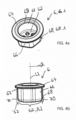
- the Fig. 4a and 4b show a first embodiment of the hearing aid filter 6 in detail.
- the hearing aid filter 6 is designed symmetrically about a filter longitudinal axis L2 and has a substantially hexagonal base surface 62.
- a lateral surface 66 of the hearing aid filter 6 extends from the base surface 62, which preferably has a distal section 67, from which a collar 64 extends outwards in the radial direction R and the undercut 69 extends inwards in the radial direction R.
- the hearing aid filter 6 preferably has an optical filter indicator 68, which is designed to correspond to the respective tool indicator.
- a hearing aid filter 6 of the first plurality of hearing aid filters 6.1 is shown, which has a first optical filter indicator 68.1.
- a second hearing aid filter 6.2 accommodated in an adjacent positioning device 16 could accordingly have a second filter indicator (not shown) that is different from the first filter indicator 68.1.
- the second assembly and disassembly tool 4.2 would then have a second optical tool indicator 50.2 (cf. Fig. 1a and 1b ) which is designed to correspond to the second filter indicator (not shown).
- both the first and second filters 6.1, 6.2 and the first and second assembly and disassembly tools 4.1, 4.2 are designed to be distinguishable from one another.
- a hearing aid loudspeaker 70 into which the hearing aid filter 6 is to be inserted.
- the hearing aid loudspeaker 70 preferably has a cylindrical base surface 72 and a correspondingly designed outer surface 74, so that the hearing aid filter 6 with the hexagonal base surface 62 is elastically deformed to engage with the hearing aid loudspeaker 70 and is thus firmly connected to the hearing aid loudspeaker 70.
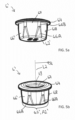
- the Fig. 5a and 5b show a second embodiment of the hearing aid filter 6' in detail.
- the same parts of the hearing aid filter in the Fig. 4a and 4b as well as Fig. 5a and 5b have identical reference numerals.
- the hearing aid filter 6' is designed symmetrically about a filter longitudinal axis L2 and has a substantially circular base area 62 ⁇ .
- a substantially circular base area 62 ⁇ is understood to mean that the cross-sectional area A2' of the base area 62 ⁇ is at least approximated to a circular shape. If this circular shape is approximated by a polygon, the polygon has in particular at least 12 corners, particularly preferably at least 18 corners.
- a lateral surface 66' of the hearing aid filter 6' extends from the base surface 62', which preferably has a distal section 67, from which in radial A collar 64 extends outwards in the direction R and the undercut 69 extends inwards in the radial direction R.
- the filter 6' preferably has FIGS. 4a and 4b a hexagonal cross-section.
- the outer surface 66 ⁇ has insertion bevels 66A, which extend from the circular base surface 62 ⁇ in the direction of the distal end 67 and finally open into a region 66B of the outer surface 66 ⁇ with a hexagonal cross-section.
- the region 66B with a hexagonal cross-section is a deformation region, which is designed to be inserted into a hearing aid loudspeaker 70 (not shown, cf. FIG. 4b ) to deform elastically.
- the hearing aid filter 6' also preferably has an optical filter indicator 68, which is designed to correspond to the respective tool indicator.
Landscapes
- Engineering & Computer Science (AREA)
- Health & Medical Sciences (AREA)
- General Health & Medical Sciences (AREA)
- Neurosurgery (AREA)
- Otolaryngology (AREA)
- Physics & Mathematics (AREA)
- Acoustics & Sound (AREA)
- Signal Processing (AREA)
- Manufacturing & Machinery (AREA)
- Filtering Of Dispersed Particles In Gases (AREA)
Priority Applications (2)
| Application Number | Priority Date | Filing Date | Title |
|---|---|---|---|
| EP23177519.8A EP4475562A1 (fr) | 2023-06-06 | 2023-06-06 | Ensemble de maintenance de prothèse auditive |
| PCT/EP2024/065518 WO2024251845A1 (fr) | 2023-06-06 | 2024-06-06 | Kit d'entretien pour appareils auditifs |
Applications Claiming Priority (1)
| Application Number | Priority Date | Filing Date | Title |
|---|---|---|---|
| EP23177519.8A EP4475562A1 (fr) | 2023-06-06 | 2023-06-06 | Ensemble de maintenance de prothèse auditive |
Publications (1)
| Publication Number | Publication Date |
|---|---|
| EP4475562A1 true EP4475562A1 (fr) | 2024-12-11 |
Family
ID=86692700
Family Applications (1)
| Application Number | Title | Priority Date | Filing Date |
|---|---|---|---|
| EP23177519.8A Pending EP4475562A1 (fr) | 2023-06-06 | 2023-06-06 | Ensemble de maintenance de prothèse auditive |
Country Status (2)
| Country | Link |
|---|---|
| EP (1) | EP4475562A1 (fr) |
| WO (1) | WO2024251845A1 (fr) |
Citations (11)
| Publication number | Priority date | Publication date | Assignee | Title |
|---|---|---|---|---|
| EP0312517A2 (fr) * | 1987-10-14 | 1989-04-19 | Gn Danavox A/S | Distributeur pour éléments filtres de cérumen pour prothèse auditive |
| US5131128A (en) * | 1987-10-14 | 1992-07-21 | Gn Danavox A/S | Protection element for all-in-the-ear hearing aid and tool for use in the replacement hereof |
| WO2003067926A2 (fr) * | 2002-02-07 | 2003-08-14 | Oticon A/S | Manipulateur de filtre, filtre, support de manipulateurs de filtres, et systeme comprenant un manipulateur de filtre et un support pour manipulateur de filtre |
| EP1562398A2 (fr) * | 1998-07-10 | 2005-08-10 | Widex A/S | Protection de cire d'oreille pour prothèse auditive placée dans l'oreille et dispositif utilisé pour l'insertion et le retrait de la protection de cire |
| JP2005260824A (ja) * | 2004-03-15 | 2005-09-22 | Rion Co Ltd | 液状物質の侵入防止構造を備えた補聴器 |
| EP1901580A2 (fr) * | 2006-09-14 | 2008-03-19 | Siemens Audiologische Technik GmbH | Outil de nettoyage pour un appareil auditif |
| EP2645742A1 (fr) * | 2012-03-30 | 2013-10-02 | Oticon A/S | Filtre de cérumen et outil de manutention pour un tel filtre |
| WO2019105527A1 (fr) * | 2017-11-28 | 2019-06-06 | Sonova Ag | Bouchon de protection contre le cérumen |
| WO2019105522A1 (fr) * | 2017-11-28 | 2019-06-06 | Sonova Ag | Applicateur de filtre à cérumen |
| EP3817402A1 (fr) * | 2019-10-30 | 2021-05-05 | GN Hearing A/S | Système de dispositif auditif et outil |
| CN216437483U (zh) * | 2021-10-18 | 2022-05-03 | 深圳市昂思科技有限公司 | 一种助听器用多功能耳帽 |
-
2023
- 2023-06-06 EP EP23177519.8A patent/EP4475562A1/fr active Pending
-
2024
- 2024-06-06 WO PCT/EP2024/065518 patent/WO2024251845A1/fr not_active Ceased
Patent Citations (11)
| Publication number | Priority date | Publication date | Assignee | Title |
|---|---|---|---|---|
| EP0312517A2 (fr) * | 1987-10-14 | 1989-04-19 | Gn Danavox A/S | Distributeur pour éléments filtres de cérumen pour prothèse auditive |
| US5131128A (en) * | 1987-10-14 | 1992-07-21 | Gn Danavox A/S | Protection element for all-in-the-ear hearing aid and tool for use in the replacement hereof |
| EP1562398A2 (fr) * | 1998-07-10 | 2005-08-10 | Widex A/S | Protection de cire d'oreille pour prothèse auditive placée dans l'oreille et dispositif utilisé pour l'insertion et le retrait de la protection de cire |
| WO2003067926A2 (fr) * | 2002-02-07 | 2003-08-14 | Oticon A/S | Manipulateur de filtre, filtre, support de manipulateurs de filtres, et systeme comprenant un manipulateur de filtre et un support pour manipulateur de filtre |
| JP2005260824A (ja) * | 2004-03-15 | 2005-09-22 | Rion Co Ltd | 液状物質の侵入防止構造を備えた補聴器 |
| EP1901580A2 (fr) * | 2006-09-14 | 2008-03-19 | Siemens Audiologische Technik GmbH | Outil de nettoyage pour un appareil auditif |
| EP2645742A1 (fr) * | 2012-03-30 | 2013-10-02 | Oticon A/S | Filtre de cérumen et outil de manutention pour un tel filtre |
| WO2019105527A1 (fr) * | 2017-11-28 | 2019-06-06 | Sonova Ag | Bouchon de protection contre le cérumen |
| WO2019105522A1 (fr) * | 2017-11-28 | 2019-06-06 | Sonova Ag | Applicateur de filtre à cérumen |
| EP3817402A1 (fr) * | 2019-10-30 | 2021-05-05 | GN Hearing A/S | Système de dispositif auditif et outil |
| CN216437483U (zh) * | 2021-10-18 | 2022-05-03 | 深圳市昂思科技有限公司 | 一种助听器用多功能耳帽 |
Also Published As
| Publication number | Publication date |
|---|---|
| WO2024251845A1 (fr) | 2024-12-12 |
Similar Documents
| Publication | Publication Date | Title |
|---|---|---|
| DE3851292T2 (de) | Ausgabegerät für Hörgerätwachsfilterelemente. | |
| DE19513936B4 (de) | Stecker | |
| EP3164095B1 (fr) | Système de stockage d'instruments médicaux | |
| AT517655B1 (de) | Pipettenspitzen-Aufnahmebehälter sowie Verfahren zu dessen Bereitstellung | |
| DE3526632C2 (fr) | ||
| DE102007024230A1 (de) | Halteteil zur Montage eines Sensors | |
| EP2528743B1 (fr) | Unité de stockage d'encre pour un tampon manuel | |
| DE20015848U1 (de) | Verbindungsanordnung zum lösbaren Verbinden zweier Bauteile mit einem Halte-Bolzen, einer Halte-Feder-Anordnung, einem Entriegelungs-Teil und einem Auslösestift | |
| DE102013021056A1 (de) | Wechselmatrize, Fügewerkzeug und Fügeverfahren | |
| EP1439733B1 (fr) | Protection de microphones pour des prothèses auditives | |
| EP4110223B1 (fr) | Manchon de support extensible et ensemble d'outils | |
| DE102017220042A1 (de) | Pipettiervorrichtung mit elektromagnetisch antreibbarem Verriegelungsaktuator zur Verriegelung von lösbar angekuppelten Pipettierspitzen | |
| EP4110224B1 (fr) | Douille expansible de réception et jeu d'instruments | |
| DE102016011587A1 (de) | Reinigungsvorrichtung für ein Elektrokabel | |
| WO2024251845A1 (fr) | Kit d'entretien pour appareils auditifs | |
| DE202023103096U1 (de) | Hörgeräte-Wartungsset | |
| DE202019102059U1 (de) | Auswerfstift mit Verdrehsicherung | |
| DE69506425T2 (de) | Wischmop | |
| DE102021106111A1 (de) | Aufnahme-Expanderhülse sowie Werkzeugset | |
| EP0784323A1 (fr) | Boîtier | |
| DE102005001272B4 (de) | Endoskop | |
| DE4206349C2 (de) | Gerät zum Reinigen von Werkzeugen | |
| EP0780193A1 (fr) | Aimant d'accrochage | |
| DE102012211194B9 (de) | Magazin mit zumindest einem Platz zur Aufnahme eines Moduls, insbesondere eines Moduls eines Koordinatenmessgeräts | |
| EP2812094A1 (fr) | Dispositif de filtration ainsi qu'élément pour un tel dispositif de filtration |
Legal Events
| Date | Code | Title | Description |
|---|---|---|---|
| PUAI | Public reference made under article 153(3) epc to a published international application that has entered the european phase |
Free format text: ORIGINAL CODE: 0009012 |
|
| STAA | Information on the status of an ep patent application or granted ep patent |
Free format text: STATUS: THE APPLICATION HAS BEEN PUBLISHED |
|
| AK | Designated contracting states |
Kind code of ref document: A1 Designated state(s): AL AT BE BG CH CY CZ DE DK EE ES FI FR GB GR HR HU IE IS IT LI LT LU LV MC ME MK MT NL NO PL PT RO RS SE SI SK SM TR |
|
| STAA | Information on the status of an ep patent application or granted ep patent |
Free format text: STATUS: REQUEST FOR EXAMINATION WAS MADE |
|
| 17P | Request for examination filed |
Effective date: 20250611 |