EP4475563A1 - Procédé permettant une intelligibilité de notification d'une prothèse auditive ayant un ou plusieurs événements audio et système auditif associé - Google Patents
Procédé permettant une intelligibilité de notification d'une prothèse auditive ayant un ou plusieurs événements audio et système auditif associé Download PDFInfo
- Publication number
- EP4475563A1 EP4475563A1 EP23217576.0A EP23217576A EP4475563A1 EP 4475563 A1 EP4475563 A1 EP 4475563A1 EP 23217576 A EP23217576 A EP 23217576A EP 4475563 A1 EP4475563 A1 EP 4475563A1
- Authority
- EP
- European Patent Office
- Prior art keywords
- hearing aid
- audio
- hearing
- mapping
- audio signal
- Prior art date
- Legal status (The legal status is an assumption and is not a legal conclusion. Google has not performed a legal analysis and makes no representation as to the accuracy of the status listed.)
- Withdrawn
Links
Images


Classifications
-
- H—ELECTRICITY
- H04—ELECTRIC COMMUNICATION TECHNIQUE
- H04R—LOUDSPEAKERS, MICROPHONES, GRAMOPHONE PICK-UPS OR LIKE ACOUSTIC ELECTROMECHANICAL TRANSDUCERS; ELECTRIC HEARING AIDS; PUBLIC ADDRESS SYSTEMS
- H04R25/00—Electric hearing aids
- H04R25/30—Monitoring or testing of hearing aids, e.g. functioning, settings, battery power
- H04R25/305—Self-monitoring or self-testing
-
- H—ELECTRICITY
- H04—ELECTRIC COMMUNICATION TECHNIQUE
- H04R—LOUDSPEAKERS, MICROPHONES, GRAMOPHONE PICK-UPS OR LIKE ACOUSTIC ELECTROMECHANICAL TRANSDUCERS; ELECTRIC HEARING AIDS; PUBLIC ADDRESS SYSTEMS
- H04R25/00—Electric hearing aids
- H04R25/50—Customised settings for obtaining desired overall acoustical characteristics
- H04R25/505—Customised settings for obtaining desired overall acoustical characteristics using digital signal processing
-
- H—ELECTRICITY
- H04—ELECTRIC COMMUNICATION TECHNIQUE
- H04R—LOUDSPEAKERS, MICROPHONES, GRAMOPHONE PICK-UPS OR LIKE ACOUSTIC ELECTROMECHANICAL TRANSDUCERS; ELECTRIC HEARING AIDS; PUBLIC ADDRESS SYSTEMS
- H04R25/00—Electric hearing aids
- H04R25/55—Electric hearing aids using an external connection, either wireless or wired
- H04R25/554—Electric hearing aids using an external connection, either wireless or wired using a wireless connection, e.g. between microphone and amplifier or using Tcoils
-
- H—ELECTRICITY
- H04—ELECTRIC COMMUNICATION TECHNIQUE
- H04R—LOUDSPEAKERS, MICROPHONES, GRAMOPHONE PICK-UPS OR LIKE ACOUSTIC ELECTROMECHANICAL TRANSDUCERS; ELECTRIC HEARING AIDS; PUBLIC ADDRESS SYSTEMS
- H04R2225/00—Details of deaf aids covered by H04R25/00, not provided for in any of its subgroups
- H04R2225/41—Detection or adaptation of hearing aid parameters or programs to listening situation, e.g. pub, forest
-
- H—ELECTRICITY
- H04—ELECTRIC COMMUNICATION TECHNIQUE
- H04R—LOUDSPEAKERS, MICROPHONES, GRAMOPHONE PICK-UPS OR LIKE ACOUSTIC ELECTROMECHANICAL TRANSDUCERS; ELECTRIC HEARING AIDS; PUBLIC ADDRESS SYSTEMS
- H04R25/00—Electric hearing aids
- H04R25/55—Electric hearing aids using an external connection, either wireless or wired
- H04R25/558—Remote control, e.g. of amplification, frequency
Definitions
- the present disclosure relates to the field of hearing aids.
- the present disclosure related to a method for enabling notification intelligibility of a hearing aid having one or more audio events, and a related hearing system.
- Hearing aids can provide audible signals to a user for notifying a user of a particular event occurring in the hearing aid.
- audible signals can take the form of spoken messages (e.g., pre-recorded voice messages) and/or coded messages (e.g., beeps and/or tonal combinations).
- the creation and evaluation process may include generation of audio signals for each spoken message using a speech synthesis tool, adjustment of auditory settings such as pronunciation, pitch, and speed of the synthesized speech, and evaluation of the synthesized spoken messages in collaboration with language native speakers and impaired-hearing users. Such processes may be repeated for each language for which the hearing aid user may want and/or for all languages used by the hearing aid manufacturer.
- spoken messages may not meet the needs and expectations of hearing-impaired users (e.g., in terms of wording, language, length of the message and/or pronunciation).
- voice prompts generated by a smartphone speech generator may suffer from the same limitations.
- a method of enabling notification intelligibility of a hearing aid having one or more audio events comprises obtaining user input indicating at least one of the one or more audio events to be mapped.
- the method comprises obtaining an audio signal indicative of a sound in an environment via a microphone.
- the method comprises mapping the audio signal to the at least one of the one or more audio events of the hearing aid. The mapping is capable of being performed throughout a time of use of the hearing aid.
- a hearing system :
- a hearing system comprising a hearing aid and an auxiliary device is disclosed.
- the hearing system is configured to perform the method disclosed herein.
- the hearing system may be adapted to establish a communication link between the hearing aid and the auxiliary device to provide that information (e.g., one or more of: control signals, status signals, and audio signals) can be exchanged or forwarded from one to the other.
- information e.g., one or more of: control signals, status signals, and audio signals
- the auxiliary device may comprise one or more of: a remote control, a smartphone, an electronic device, a wearable electronic device, a smartwatch, and any other suitable auxiliary device.
- the auxiliary device may comprise a remote control for controlling functionality and operation of the hearing aid(s).
- the function of a remote control may be implemented in a smartphone, the smartphone possibly running an APP allowing to control the functionality of the audio processing device via the smartphone (the hearing aid(s) comprising an appropriate wireless interface to the smartphone, e.g., based on Bluetooth or some other standardized or proprietary scheme).
- the auxiliary device may comprise an audio gateway device adapted for receiving a multitude of audio signals (e.g., from an entertainment device, e.g., a TV or a music player, a telephone apparatus, e.g., a mobile telephone or a computer, e.g., a PC, a wireless microphone, etc.) and adapted for selecting and/or combining an appropriate one of the received audio signals (or combination of signals) for transmission to the hearing aid.
- an entertainment device e.g., a TV or a music player
- a telephone apparatus e.g., a mobile telephone or a computer, e.g., a PC, a wireless microphone, etc.
- the present disclosure may enable an increase in individual customization and hearing aid user satisfaction.
- Embodiments of present disclosure advantageously can provide means to the user of the hearing aid for controlling the personal quality of the hearing aid output (e.g., without intervention of a Hearing Care Professional (HCP) and/or without being internally managed by the hearing aid), which can in turn improve the adaptation period of the user to the hearing aid and/or the overall user experience.
- HCP Hearing Care Professional
- Embodiments of present disclosure also can advantageously allow customized voice communications for providing the user with information associated with one or more audio events of the hearing aid, e.g., information associated with a status of functionality of the hearing aid.
- the present disclosure may enable provision of voice communications that are adapted and/or tailored to the user's level of understanding and/or perception.
- a computer readable medium or data carrier :
- a tangible computer-readable medium storing a computer program comprising program code means (instructions) for causing a data processing system (a computer) to perform (carry out) at least some (such as a majority or all) of the (steps of the) method described above, in the ⁇ detailed description of embodiments' and in the claims, when said computer program is executed on the data processing system is provided.
- Such computer-readable media can comprise RAM, ROM, EEPROM, CD-ROM or other optical disk storage, magnetic disk storage or other magnetic storage devices, or any other medium that can be used to carry or store desired program code in the form of instructions or data structures and that can be accessed by a computer.
- Disk and disc includes compact disc (CD), laser disc, optical disc, digital versatile disc (DVD), floppy disk and Blu-ray disc where disks usually reproduce data magnetically, while discs reproduce data optically with lasers.
- Other storage media include storage in DNA (e.g., in synthesized DNA strands). Combinations of the above should also be included within the scope of computer-readable media.
- the computer program can also be transmitted via a transmission medium such as a wired or wireless link or a network, e.g., the Internet, and loaded into a data processing system for being executed at a location different from that of the tangible medium.
- a transmission medium such as a wired or wireless link or a network, e.g., the Internet
- a data processing system :
- a data processing system comprising a processor and program code means for causing the processor to perform at least some (such as a majority or all) of the steps of the method described above, in the ⁇ detailed description of embodiments' and in the claims is provided.
- a non-transitory application termed an APP
- the APP comprises executable instructions configured to be executed on an auxiliary device to implement a user interface for a hearing aid and/or a hearing system described above in the ⁇ detailed description of embodiments', and in the claims.
- the APP may be configured to run on cellular phone, e.g., a smartphone, or on another portable device allowing communication with said hearing aid or said hearing system.
- a hearing aid e.g., a hearing instrument
- a hearing aid refers to a device, which is adapted to improve, augment and/or protect the hearing capability of a user by receiving acoustic signals from the user's surroundings, generating corresponding audio signals, possibly modifying the audio signals, and providing the possibly modified audio signals as audible signals to at least one of the user's ears.
- Such audible signals may e.g., be provided in the form of acoustic signals radiated into the user's outer ears, acoustic signals transferred as mechanical vibrations to the user's inner ears through the bone structure of the user's head and/or through parts of the middle ear as well as electric signals transferred directly or indirectly to the cochlear nerve of the user.
- the hearing aid may be configured to be worn in any known way, e.g., as a unit arranged behind the ear with a tube leading radiated acoustic signals into the ear canal or with an output transducer, e.g., a loudspeaker, arranged close to or in the ear canal, as a unit entirely or partly arranged in the pinna and/or in the ear canal, as a unit, e.g., a vibrator, attached to a fixture implanted into the skull bone, as an attachable, or entirely or partly implanted, unit, etc.
- the hearing aid may comprise a single unit or several units communicating (e.g., acoustically, electrically or optically) with each other.
- the loudspeaker may be arranged in a housing together with other components of the hearing aid, or may be an external unit in itself (possibly in combination with a flexible guiding element, e.g., a dome-like element).
- a hearing aid may be adapted to a particular user's needs, e.g., a hearing impairment.
- a configurable signal processing circuit of the hearing aid may be adapted to apply a frequency and level dependent compressive amplification of an input signal.
- a customized frequency and level dependent gain (amplification or compression) may be determined in a fitting process by a fitting system based on a user's hearing data, e.g., an audiogram, using a fitting rationale (e.g., adapted to speech).
- the frequency and level dependent gain may e.g., be embodied in processing parameters, e.g., uploaded to the hearing aid via an interface to a programming device (fitting system), and used by a processing algorithm executed by the configurable signal processing circuit of the hearing aid.
- a 'hearing system' refers to a system comprising one or two hearing aids
- a ⁇ binaural hearing system' refers to a system comprising two hearing aids and being adapted to cooperatively provide audible signals to both of the user's ears.
- Hearing systems or binaural hearing systems may further comprise one or more 'auxiliary devices', which communicate with the hearing aid(s) and affect and/or benefit from the function of the hearing aid(s).
- Such auxiliary devices may include at least one of a remote control, a remote microphone, an audio gateway device, an entertainment device, e.g., a music player, a wireless communication device, e.g., a mobile phone (such as a smartphone) or a tablet or another device, e.g., comprising a graphical interface.
- Hearing aids, hearing systems or binaural hearing systems may e.g., be used for compensating for a hearing-impaired person's loss of hearing capability, augmenting, or protecting a normal-hearing person's hearing capability and/or conveying electronic audio signals to a person.
- Hearing aids or hearing systems may e.g., form part of or interact with public-address systems, active ear protection systems, handsfree telephone systems, car audio systems, entertainment (e.g., TV, music playing or karaoke) systems, teleconferencing systems, classroom amplification systems, etc.
- public-address systems e.g., public-address systems
- active ear protection systems handsfree telephone systems
- car audio systems e.g., music playing or karaoke
- entertainment e.g., TV, music playing or karaoke
- teleconferencing systems e.g., teleconferencing systems
- classroom amplification systems etc.
- the electronic hardware may include micro-electronic-mechanical systems (MEMS), integrated circuits (e.g., application specific), microprocessors, microcontrollers, digital signal processors (DSPs), field programmable gate arrays (FPGAs), programmable logic devices (PLDs), gated logic, discrete hardware circuits, printed circuit boards (PCB) (e.g., flexible PCBs), and other suitable hardware configured to perform the various functionality described throughout this disclosure, e.g., sensors, e.g., for sensing and/or registering physical properties of the environment, the device, the user, etc.
- MEMS micro-electronic-mechanical systems
- integrated circuits e.g., application specific
- DSPs digital signal processors
- FPGAs field programmable gate arrays
- PLDs programmable logic devices
- gated logic discrete hardware circuits
- PCB printed circuit boards
- PCB printed circuit boards
- Computer program shall be construed broadly to mean instructions, instruction sets, code, code segments, program code, programs, subprograms, software modules, applications, software applications, software packages, routines, subroutines, objects, executables, threads of execution, procedures, functions, etc., whether referred to as software, firmware, middleware, microcode, hardware description language, or otherwise.
- a method of enabling notification intelligibility of a hearing aid having one or more audio events is disclosed.
- the method of enabling notification intelligibility of a hearing aid having one or more audio events may be performed by a hearing system, e.g., a hearing aid in communication with an auxiliary device.
- the method comprises obtaining user input indicating at least one of the one or more audio events to be mapped.
- the method may comprise selecting at least one of the one or more audio events to be mapped based on the user input via a graphical interface on the auxiliary device.
- the method comprises obtaining an audio signal indicative of a sound in an environment via a microphone.
- the method comprises importing sound data from and/or recording voice data by a user using the hearing aid and/or any other user having access to such hearing aid (e.g., a user that is not the wearer of the hearing aid).
- the audio signal is spoken and/or recorded speech.
- the audio signal may be obtained in the form of a voice message and/or any other sound (e.g., a horn sound, a bark sound recorded and/or imported by the user).
- the method comprises obtaining the audio signal from one or more of: the hearing aid and the auxiliary device.
- the method comprises storing the audio signal in a memory of the hearing system (e.g., in a notification repository of the auxiliary device).
- the method comprises mapping the audio signal to the at least one of the one or more audio events of the hearing aid.
- the method comprises mapping manually the audio signal to the at least one of the one or more audio events of the hearing aid.
- the mapping may be performed manually, e.g., upon obtaining the user input and the audio signal.
- the method comprises mapping automatically the audio signal to the at least one of the one or more audio events of the hearing aid.
- the mapping may be performed automatically, e.g., upon obtaining the audio signal.
- the method comprises mapping the audio signal to the at least one of the one or more audio events, e.g., without obtaining the user input indicating the at least one of the one or more audio events to be mapped.
- the method comprises determining, based on the audio signal, the at least one of the one or more audio events to be mapped.
- the method comprises providing a request message requesting an owner of the hearing aid, e.g., a user of the hearing aid, to either accept or reject the mapping of the audio signal to the at least one of the one or more audio events.
- the method comprises, upon providing the request message, obtaining user input acceptance indicating acceptance of the mapping of the audio signal to the at least one of the one or more audio events.
- the method comprises, upon providing the request message, obtaining user input rejection indicating rejection of the mapping of the audio signal to the at least one of the one or more audio events.
- the method comprises mapping the audio signal to the at least one of the one or more audio events via one or more of: the auxiliary device and the hearing aid.
- the mapping (e.g., manual mapping and/or automatic mapping) is capable of being performed throughout a time of (e.g., active or passive) use of the hearing aid.
- the time of use of the hearing aid is in one or more of: a turn on state, a charging state, and a turn off state.
- a hearing aid in a turn off state can be construed as a hearing aid in an intentional turn off state and/or unintentional turn off state.
- a hearing aid in an intentional turn off state may be a hearing aid that has been (e.g., temporarily) turned off to e.g., save battery.
- a hearing aid in an unintentional turn off state may be a hearing aid not functioning properly due to user error (e.g., existence of moisture in the components of the hearing aid) and/or running out of power (e.g, a hearing aid requiring replacement of batteries, e.g., a hearing aid with non-rechargeable batteries).
- the mapping of the audio signal to the at least one of the one or more audio events may be activated upon turning on and/or switching on the hearing aid (e.g., by a user using the hearing aid and/or any other user having access to such hearing aid).
- a hearing aid in a charging state can be construed as a hearing aid placed in a charging box, e.g., a battery-powered hearing aid and/or a hearing aid with rechargeable batteries.
- a hearing aid in a turn off state and/or a charging state may be seen as a hearing aid being passively used and/or worn by a user.
- a hearing aid in a turn on state can be construed as a hearing aid actively being used and/or worn by a user.
- a hearing aid in a turn on state may be a hearing aid in an active state, e.g., actively improving, augmenting and/or protecting the hearing capability of the user.
- the mapping is capable of being performed when the hearing aid is stored in a box (e.g., a charging box and/or a storing box), and/or temporarily removed from the user's ear (e.g., placed outside a box), and/or when the user is actively using the hearing aid.
- the present disclosure may allow the user of the hearing aid to perform the mapping at any time of use of the hearing aid.
- the user may have control over the audio signal (e.g., imported and/or recorded sound by the user) and respective mapping, thereby not depending on an HCP (e.g., and/or on pre-recorded sounds stored in a memory of the hearing system by the HCP).
- the method comprises displaying an interface object indicative of the at least one of the one or more audio events, e.g., via the auxiliary device in communication with the hearing aid. In one or more example methods, the method comprises displaying the at least one or more one or more audio events via a graphical interface of the auxiliary device.
- an audio event is associated with a functionality of the hearing aid.
- an audio event may be associated with a status of functionality of the hearing aid and/or a state of the hearing aid (e.g., an internal state).
- the status of functionality of the hearing aid may comprise one or more of: a mute/unmute status, a pairing status and/or a connectivity status (e.g., a hearing aid and/or connectivity devices pairing status, e.g., a TV-BOX connection status), a flight mode status, a loudness level (e.g., volume) status, a power status (e.g., a battery power status), a communication status (e.g., a left and right hearing aids communication status), a program status, a self-check status (e.g., identification of a need to replace a wax filter and/or to clean a component of the hearing aid and/or to get assistance from a hearing care professional (HCP)), and any other suitable status.
- a mute/unmute status e.g., a hearing aid and/or connectivity devices pairing status, e.g., a TV-BOX connection status
- a flight mode status e.g., a loudness level (
- the status of functionality of the hearing aid may comprise a status on one or more of: identification of a left hearing aid and a right hearing aid and identification of an end of a trial period.
- an audio event can be seen as an event generated based on such status of functionality of the hearing aid, e.g., based on a status parameter indicative of the status of functionality.
- an audio event can be seen as an event on the hearing aid that may trigger a notification to the user wearing the hearing aid when there is a change in a corresponding status of functionality and/or corresponding state of the hearing aid (e.g., when a value associated with a functionality of the hearing aid is greater than, less than, equal to, greater than and equal to, or less than and equal to a given functionality threshold).
- an audio event can be seen as a change in a status of functionality and/or state of the hearing aid.
- an audio event can be associated with a change in the power status of the hearing aid.
- the audio event may trigger a notification to the user wearing the hearing aid when a battery power value of the hearing aid is less than and equal to a power threshold.
- the notification triggered may indicate to the user of the hearing aid that the hearing aid is running out of battery.
- an audio event can be associated with an event reminder functionality in the hearing aid, e.g., enabled by the auxiliary device.
- the audio event may be a calendar event, e.g., for notifying (e.g., reminding) the user of birthdays and/or appointments of any nature and/or to take medication.
- Embodiments of present disclosure advantageously can provide for an improved association between an audio event and a corresponding spoken message used to warn the user wearing the hearing aid about a change in a corresponding status of functionality and/or corresponding state of the hearing aid.
- Embodiments of the present disclosure may enable mapping an audio signal, such as an audio signal adapted to the user's needs and recorded and/or imported by the user, to an audio event when, for example, such audio event has been renamed by an HCP during a fitting procedure (e.g., a fitting procedure prior to the mapping of the audio signal). For example, renaming such audio event without modifying a pre-synthesized spoken message mapped to it may mislead the user about the status of functionality of the hearing aid, thereby impacting user's perception.
- a fitting procedure e.g., a fitting procedure prior to the mapping of the audio signal
- the one or more audio events of the hearing aid are pre-determined. In one or more example methods, the one or more audio events are stored in a memory of a hearing system comprising the hearing aid from which the one or more audio events are retrieved when the mapping is to be performed. In one or more example methods, the method comprises obtaining the at least one of the one or more audio events of the hearing aid from a memory of the hearing system comprising the hearing aid, e.g., a memory of the auxiliary device in communication with the hearing aid and/or the memory of the hearing aid.
- the method comprises mapping the audio signal to the at least one of the one or more audio events of the hearing aid via a graphical interface.
- the graphical interface is a graphical interface of the hearing system comprising the hearing aid.
- the graphical interface is a graphical interface on the auxiliary device in communication with the hearing aid.
- the method comprises obtaining user input request indicative of a request to modify the mapping of the audio signal to the at least one of the one or more audio events of the hearing aid. In one or more example methods, the method comprises, upon obtaining the user input request, modifying the mapping of the audio signal to the at least one of the one or more audio events of the hearing aid. In one or more example methods, the method comprises, upon obtaining the user input request, providing an acceptance mapping message (e.g., and/or signal) indicating acceptance to modify the mapping of the audio signal to the at least one of the one or more audio events. The method may comprise, upon providing the acceptance mapping message, modifying the mapping of the audio signal the at least one of the one or more audio events. In one or more example methods, the method comprises, upon obtaining the user input request, providing a rejection mapping message (e.g., and/or signal) indicating rejection to modify the mapping of the audio signal to the at least one of the one or more audio events.
- a rejection mapping message e.g., and/or signal
- modifying the mapping of the audio signal comprises obtaining a new audio signal indicative of a new sound in an environment via the microphone. In one or more example methods, modifying the mapping of the audio signal comprises mapping the new audio signal to the at least one of the one or more audio events of the hearing aid. In one or more example methods, modifying the mapping of the audio signal comprises replacing (e.g., overriding) the audio signal by the new audio signal, e.g., without removing (e.g., disabling and/or deactivating) the mapping of the audio signal to the at least one of the one or more audio events.
- modifying the mapping of the audio signal comprises removing the mapping of the audio signal to the at least one of the one or more audio events.
- modifying the mapping of the audio signal comprises, upon obtaining the new audio signal, mapping the new audio signal to the at least one of the one or more audio events.
- the method comprises storing the new audio signal in the memory of the hearing system (e.g., the memory of the auxiliary device and/or the hearing aid). In one or more example methods, the method comprises storing the mapping of the new audio signal to the at least one of the one or more audio events in the memory of the hearing system (e.g., the memory of the auxiliary device and/or the hearing aid).
- modifying the mapping of the audio signal comprises removing the mapping of the audio signal to the at least one of the one or more audio events of the hearing aid. In other words, modifying the mapping of the audio signal comprises disabling (e.g., deactivating) the mapping of the audio signal to the at least one of the one or more audio events. In one or more example methods, modifying the mapping of the audio signal comprises mapping a pre-determined signal to the at least one of the one or more audio events of the hearing aid. In one or more example methods, the pre-determined signal can be seen as an audio signal, e.g., a sound, mapped to the at least one of the one or more audio events by default.
- the pre-determined signal may be an audio signal mapped to the at least one of the one or more audio events prior to acquiring the hearing aid, e.g., mapped by the manufacturer of the hearing aid.
- the pre-determined signal is a signal stored in the memory of the hearing system, e.g., in an encoded and/or compressed version, from which the pre-determined signal is retrieved when the mapping of the audio signal to the at least one of the one or more audio events is removed.
- the method comprises obtaining the mapping of the pre-determined signal to the at least one of the one or more audio events from the memory of the hearing system (e.g., the memory of the auxiliary device and/or the hearing aid).
- the method comprises activating the mapping of the pre-determined signal to the at least one of the one or more audio events.
- the method comprises applying the mapping of the pre-determined signal to the at least one of the one or more audio events to the hearing aid.
- the mapping of the pre-determined signal to the at least one of the one or more audio events is stored in the memory of the hearing system from which the pre-determined is retrieved when the mapping of the audio signal to the at least one of the one or more audio events is removed.
- the mapping of the pre-determined signal to the at least one of the one or more audio events which is stored in the memory of the hearing aid can be performed by an HCP, e.g., an audiologist during a fitting procedure of the hearing aid, and/or the manufacturer of the hearing aid, e.g., prior to current use of the hearing aid.
- modifying the mapping of the audio signal comprises generating an updated version of the audio signal based on the audio signal and one or more audio parameters.
- an audio parameter of the one or more audio parameters is indicative of an auditory characteristic (e.g., auditory functionality and/or auditory feature and/or a hearing setting) of the hearing aid.
- an auditory characteristic of the hearing aid comprises one or more of: background noise reduction, speed, pitch, a loudness level, timbre, rhythm, and any other suitable characteristic.
- the method comprises, upon obtaining the user input request, providing a modification acceptance message indicating acceptance to modify the one or more audio parameters.
- the method may comprise, upon providing the modification acceptance message, generating the updated version of the audio signal.
- the method may comprise generating the updated version of the audio signal based upon user interaction (e.g., in response to the user input request).
- the method comprises, upon obtaining the user input request, providing a modification rejection message indicating rejection to modify the one or more audio parameters.
- modifying the one or more audio parameters can be seen as a safe modification, e.g., a modification that is not harmful to the user wearing the hearing aid.
- the one or more audio parameters may be modified within an allowable range (e.g., a pre-determined range) for preventing unintended harm to the user waring the hearing aid.
- the present disclosure may allow the user using the hearing aid to have full control over the one or more audio parameters, such as within the respective allowable range. Modification of the one or more audio parameters may lead to improved notification intelligibility.
- the method comprises providing the rejection message when detecting a modification that can impact negatively the user wearing the hearing aid.
- the rejection message can be provided when such allowable ranges need modifications (e.g., based on feedback from the user of the hearing aid) which may require further adjustments in hearing aid and/or in the auxiliary device (e.g., adjustments in software and/or hardware).
- the rejection message may be seen as a temporary measure when such further adjustments take more time than expected.
- the method comprises storing the updated version of the audio signal and/or the mapping of updated version of the audio signal to the at least one of the one or more audio events in the memory of the hearing system.
- the method may comprise storing the updated version of the audio signal by replacing the audio signal by the updated version of the audio signal, e.g., either after removing the audio signal from the memory or without removing the audio signal from the memory.
- the method comprises providing the modification acceptance message and/or the modification rejection message perceivable to the user as sound, e.g. in form of a notification, such as one or more of: a spoken notifications (e.g., " change accepted"), non-spoken notification (e.g., a pre-determined notification stored in the memory of the hearing system), a tonal notification (e.g., beep and/or sound images), and combinations thereof.
- a spoken notifications e.g., " change accepted”
- non-spoken notification e.g., a pre-determined notification stored in the memory of the hearing system
- a tonal notification e.g., beep and/or sound images
- Embodiments of the present disclosure may advantageously enable the user of the hearing aid to one or more of: record, import, update, and delete an audio signal at any time of use of the hearing aid.
- generating the updated version of the audio signal comprises varying the one or more audio parameters, e.g., vary a level and/or value of the one or more audio parameters within an allowable range, thereby modifying the audio signal for provision of the updated version of the audio signal.
- the user is allowed to adjust the one or more audio parameters within such allowable range.
- the allowable range may be stored in the memory of the hearing system, e.g., of the auxiliary device.
- the allowable range may be a pre-determined range.
- Embodiments of the present disclosure may provide for improved sound quality and/or perception of a spoken message by allowing the users of the hearing aid themselves to adjust the level of the one or more audio parameters.
- embodiments of the present disclosure enable the user of the hearing device to modify at least one of the one or more audio parameters to their own preference (e.g., without a hearing aid care professional).
- embodiments the present disclosure allow the user to select a combination of at least two of the one or more audio parameters (e.g., levels and/or values) adjusted to their hearing impairment, thereby providing for a more perceptible audio output signal (e.g., spoken message) to the user of the hearing aid.
- embodiments of the present disclosure may provide the user with a method for self-adjusting auditory characteristics of the hearing aid, thereby allowing further customization of the hearing aid output to match their preferences and/or needs.
- embodiments of the present disclosure may allow further customization of the hearing aid output by providing a user using the hearing aid with means to record an audio signal and subsequently to adjust the one or more audio parameters for generation of the updated version of the audio signal, such as a signal more adapted to their hearing preferences and/or impairments.
- the method comprises determining an action required to be carried out by the user wearing (e.g., using) the hearing aid. In one or more example methods, the method comprises determining the action based on a status of functionality of the hearing aid, e.g., when there is a change in the status of functionality of the hearing aid and/or a state of the hearing aid. In one or more example methods, the action required to be carried out by the user wearing the hearing aid can be seen as an action in relation to the hearing aid, e.g., an action to be carried out in response to a change in the status of functionality of the hearing aid.
- the action required to be carried out by the user wearing the hearing aid can be seen as an action in relation to an external entity, e.g., an action to be carried out in response to a calendar reminder.
- the method comprises outputting an audio output signal perceivable by the user as sound based on one or more of: the audio signal, the pre-determined signal, and the action.
- the audio output signal may indicate a message to the user wearing the hearing aid.
- the audio output signal may comprise information associated with the hearing aid, e.g., about an internal state of the hearing aid (e.g., transmitted to the user as a "low battery" warning).
- the audio output signal perceivable by the user as sound can be seen as a spoken notification and/or spoken reminder to the user wearing the hearing aid.
- the outputting of the audio output signal may be triggered based on a change in the status of functionality of the hearing aid.
- the method comprises outputting the audio output signal to the hearing aid via the auxiliary device.
- the audio output signal comprises information about a state of the hearing aid and/or calendar dates (e.g., birthdays, appointments, and/or meetings).
- the method comprises outputting the audio output signal based on one or more of: the audio signal, the pre-determined signal, the action, and user input confirmation.
- the method comprises providing a request output message (e.g., a tonal indication, e.g., via beeping) requesting the user of the hearing aid to either accept or reject the outputting of the audio output signal.
- the method may comprise, upon providing the request output message, obtaining user input acceptance (e.g., by tapping on the hearing aid) indicating acceptance of the outputting of the audio output signal.
- the method may comprise, upon obtaining the user input acceptance, outputting the audio output signal.
- the method may comprise, upon providing the request output message, obtaining user input rejection (e.g., by not tapping on the hearing aid) indicating rejection of the outputting of the audio output signal.
- the method may comprise, upon obtaining the user input rejection, foregoing the outputting the audio output signal.
- the method may comprise, upon obtaining the user input rejection, not outputting the audio output signal.
- Embodiments of the present disclosure may advantageously provide a confirmation functionality in the hearing aid allowing the user of the hearing aid to confirm (e.g., via tapping and upon hearing a short reminder tonal indication) whether the audio output signal (e.g., a notification and/or a reminder) can be output via the hearing aid (e.g., via a speaker of the hearing aid).
- the confirmation functionality in the hearing aid may ensure that a user will not be disturbed by a notification and/or reminder while in conversation.
- embodiments of the present disclosure may allow for the output the audio output signal perceivable by the user as sound in such a way that such sound meets their hearing expectations.
- the method comprises outputting a written message (e.g., text message) indicative of the action to be carried out by the user wearing the hearing aid in addition to the audio output signal.
- the written message may be indicative of a calendar reminder.
- the method comprises outputting a written message together with the audio output signal.
- the method comprises outputting (e.g., providing and/or transmitting) the written message via a graphical interface, e.g., a graphical interface and/or display on the auxiliary device.
- outputting the written message may comprise displaying the written message in a pop-up window in the graphical interface of the auxiliary device.
- the method comprises outputting the written message when foregoing the outputting of the audio output signal (e.g., when not outputting the audio signal as sound).
- the mapping is capable of being performed without intervention of an audiologist.
- the mapping is capable of being performed without intervention of an HCP (e.g., an audio expert).
- a hearing system comprising a hearing aid and an auxiliary device.
- the hearing system may comprise a processor (e.g., in the auxiliary device and/or hearing aid), an interface (e.g., a graphical interface in the auxiliary device and/or an interface in the hearing aid), and a memory (e.g., of the auxiliary device and/or hearing aid).
- the interface of the hearing aid may be seen as an input unit and/or an output unit.
- the processor may be seen as a signal processor (such as a digital signal processor).
- the hearing aid may be adapted to provide a frequency dependent gain and/or a level dependent compression and/or a transposition (with or without frequency compression) of one or more frequency ranges to one or more other frequency ranges, e.g., to compensate for a hearing impairment of a user.
- the hearing aid may comprise a signal processor for enhancing the input signals and providing a processed output signal.
- the hearing aid may comprise an output unit for providing a stimulus perceived by the user as an acoustic signal based on a processed electric signal.
- the output unit may comprise a number of electrodes of a cochlear implant (for a CI type hearing aid) or a vibrator of a bone conducting hearing aid.
- the output unit may comprise an output transducer.
- the output transducer may comprise a receiver (loudspeaker) for providing the stimulus as an acoustic signal to the user (e.g., in an acoustic (air conduction based) hearing aid).
- the output transducer may comprise a vibrator for providing the stimulus as mechanical vibration of a skull bone to the user (e.g., in a bone-attached or bone-anchored hearing aid).
- the output unit may (additionally or alternatively) comprise a (e.g., wireless) transmitter for transmitting sound picked up-by the hearing aid to another device, e.g., a far-end communication partner (e.g., via a network, e.g., in a telephone mode of operation, or in a headset configuration).
- a wireless transmitter for transmitting sound picked up-by the hearing aid to another device, e.g., a far-end communication partner (e.g., via a network, e.g., in a telephone mode of operation, or in a headset configuration).
- the hearing aid may comprise an input unit for providing an electric input signal representing sound.
- the input unit may comprise an input transducer (e.g., a microphone), for converting an input sound to an electric input signal.
- the input unit may comprise a wireless receiver for receiving a wireless signal comprising or representing sound and for providing an electric input signal representing said sound.
- the wireless receiver and/or transmitter may e.g., be configured to receive and/or transmit an electromagnetic signal in the radio frequency range (3 kHz to 300 GHz).
- the wireless receiver and/or transmitter may e.g., be configured to receive and/or transmit an electromagnetic signal in a frequency range of light (e.g., infrared light 300 GHz to 430 THz, or visible light, e.g., 430 THz to 770 THz).
- the hearing aid may comprise antenna and transceiver circuitry allowing a wireless link to one or more of: an entertainment device (e.g., a TV-set), a communication device (e.g., a telephone), a wireless microphone, a separate (e.g., external) processing device, or another hearing aid, etc.
- the hearing aid may thus be configured to wirelessly receive a direct electric input signal from another device.
- the hearing aid may be configured to wirelessly transmit a direct electric output signal to another device.
- the direct electric input or output signal may represent or comprise an audio signal and/or a control signal and/or an information signal.
- a wireless link established by antenna and transceiver circuitry of the hearing aid can be of any type.
- the wireless link may be a link based on near-field communication, e.g., an inductive link based on an inductive coupling between antenna coils of transmitter and receiver parts.
- the wireless link may be based on far-field, electromagnetic radiation.
- frequencies used to establish a communication link between the hearing aid and the other device is below 70 GHz, e.g. located in a range from 50 MHz to 70 GHz, e.g. above 300 MHz, e.g. in an ISM range above 300 MHz, e.g.
- the wireless link may be based on a standardized or proprietary technology.
- the wireless link may be based on Bluetooth technology (e.g., Bluetooth Low-Energy technology, e.g., LE audio), or Ultra-Wideband (UWB) technology.
- the hearing system such as the hearing aid, may be constituted by or form part of a portable (e.g., configured to be wearable) device, e.g., a device comprising a local energy source, e.g., a battery, e.g., a rechargeable battery.
- the hearing aid may e.g., be a low weight, easily wearable, device, e.g., having a total weight less than 100 g, such as less than 20g, such as less than 5g.
- the hearing aid may comprise a 'forward' (or ⁇ signal') path for processing an audio signal between an input and an output of the hearing aid.
- a signal processor may be located in the forward path.
- the signal processor may be adapted to provide a frequency dependent gain according to a user's particular needs (e.g., hearing impairment).
- the hearing aid may comprise an 'analysis' path comprising functional components for analyzing signals and/or controlling processing of the forward path. Some or all signal processing of the analysis path and/or the forward path may be conducted in the frequency domain, in which case the hearing aid comprises appropriate analysis and synthesis filter banks. Some or all signal processing of the analysis path and/or the forward path may be conducted in the time domain.
- the hearing aid may comprise an analogue-to-digital (AD) converter to digitize an analogue input (e.g., from an input transducer, such as a microphone) with a predefined sampling rate, e.g., 20 kHz.
- the hearing aids may comprise a digital-to-analogue (DA) converter to convert a digital signal to an analogue output signal (e.g., for being presented to a user via an output transducer).
- AD analogue-to-digital
- DA digital-to-analogue
- the hearing system may comprise a voice activity detector (VAD) for estimating whether or not (or with what probability) an input signal comprises a voice signal (at a given point in time).
- a voice signal may in the present context be taken to include a speech signal from a human being. It may also include other forms of utterances generated by the human speech system (e.g., singing).
- the voice activity detector unit may be adapted to classify a current acoustic environment of the user as a VOICE or NO-VOICE environment.
- the voice activity detector may be adapted to detect as a VOICE also the user's own voice. Alternatively, the voice activity detector may be adapted to exclude a user's own voice from the detection of a VOICE.
- the hearing system may comprise an own voice detector for estimating whether or not (or with what probability) a given input sound (e.g., a voice, e.g., speech) originates from the voice of the user of the system.
- a microphone system of the hearing aid may be adapted to be able to differentiate between a user's own voice and another person's voice and possibly from NON-voice sounds.
- the hearing aid may comprise a classification unit configured to classify the current situation based on input signals from (at least some of) the detectors, and possibly other inputs as well.
- a current situation' may be taken to be defined by one or more of:
- the classification unit may be based on or comprise a neural network, e.g., a recurrent neural network, e.g., a trained neural network.
- a neural network e.g., a recurrent neural network, e.g., a trained neural network.
- the hearing aid may comprise a hearing instrument, e.g., a hearing instrument adapted for being located at the ear or fully or partially in the ear canal of a user, e.g., a headset, an earphone, an ear protection device or a combination thereof.
- the hearing system may further comprise a speakerphone (comprising a number of input transducers (e.g., a microphone array) and a number of output transducers, e.g., one or more loudspeakers, and one or more audio (and possibly video) transmitters e.g., for use in an audio conference situation), e.g., comprising a beamformer filtering unit, e.g., providing multiple beamforming capabilities.
- the hearing system is configured to obtain user input indicating at least one of the one or more audio events to be mapped (e.g., via the hearing aid and/or the auxiliary device).
- the hearing system is configured to obtain the user input via a graphical interface on the auxiliary device and/or via the interface of hearing aid (e.g., via the input unit, e.g., by having a user of the hearing aid performing a gesture on the hearing aid, e.g., by tapping the hearing aid).
- the hearing system is configured to obtain an audio signal indicative of a sound in an environment (e.g., of the hearing aid) via a microphone (e.g., of the hearing aid and/or the auxiliary device).
- the hearing aid comprises an input unit configured to convert the sound to at least one electrical input signal representative of the sound.
- the audio signal can be seen as an electrical input signal representative of the sound.
- the hearing aid may be configured to wirelessly transmit the audio signal to the auxiliary device via a wireless transceiver.
- the audio signal may be seen as a voice and/or a non-voice signal.
- the hearing system e.g., auxiliary device and/or hearing aid
- the hearing system may comprise a VAD for estimating whether or not an input audio signal comprises a voice signal.
- the audio signal may be seen as an own voice signal, such as a signal originated from the voice of the user of the hearing system.
- the hearing system e.g., auxiliary device and/or hearing aid
- an input signal may be obtained under non-favorable environments, e.g., noisy environments.
- the hearing system e.g., auxiliary device and/or hearing aid
- the acquisition of the audio signal may be performed via the interface of the auxiliary device, e.g., the graphical interface of the auxiliary device.
- the hearing aid is configured to wirelessly receive (e.g., via the input unit) the audio signal from the auxiliary device.
- the auxiliary device may comprise a wireless transceiver for transmitting/receiving the audio signal to/from the hearing aid.
- the hearing system is configured to map (e.g., via the interface and/or processor) the audio signal to the at least one of the one or more audio events of the hearing aid.
- mapping can be performed via the auxiliary device and/or the hearing aid.
- mapping can be performed via the processor and/or graphical interface of the auxiliary device.
- mapping can be performed via the processor and/or interface of the hearing aid.
- the hearing system may be configured to map the audio signal to the at least one of the one or more audio events upon obtaining the audio signal via the microphone.
- the hearing system may be configured to display an interface object in the form of a symbol via the display of the auxiliary device indicating acceptance and/or confirmation of such mapping.
- the hearing system is configured to map the audio signal to the at least one of the one or more audio events via the graphical interface of the auxiliary device and/or via the interface of the hearing aid (e.g., by having a user of the hearing aid performing a gesture on the hearing aid, e.g., by tapping and/or pressing a button on the hearing aid).
- the mapping (e.g., assignment) of the audio signal to the at least one of the one or more audio events may be triggered by acquisition of the recorded audio signal (such as, without requiring acquisition of the user input indicating the at least one of the one or more audio events to be mapped).
- the mapping is capable of being performed throughout a time of use of the hearing aid.
- the time of use of the hearing aid is in one or more of: a turn on state, a charging state, and a turn off state.
- the hearing system is configured to display (e.g., via the interface, such as a graphical user interface (GUI)) an interface object indicative of the at least one of the one or more audio events.
- GUI graphical user interface
- the hearing system is configured to display the interface object via the auxiliary device, e.g., via the graphical interface comprising a display (e.g., a touch sensitive display) displaying the one or more audio events.
- an audio event is associated with a functionality of the hearing aid.
- an audio event can be associated with a status of functionality of the hearing aid and/or a state of the hearing aid (e.g., an internal state).
- an audio event can be seen as an event on the hearing aid that may trigger a notification to the user wearing the hearing aid when there is a change in a corresponding status of functionality and/or corresponding state of the hearing aid.
- the hearing aid can comprise a classification unit configured to classify a current situation of the hearing aid.
- the classification unit can be configured to detect a change in the state of functionality of the hearing aid.
- the classification unit may be configured to identify the occurrence of an audio event in the hearing aid.
- the hearing aid is configured to transmit, to the auxiliary device, a control signal indicative of the audio event occurring in the hearing aid, such as the change in the state of functionality of the hearing aid associated with such audio event.
- the one or more audio events of the hearing aid are pre-determined (e.g., stored in the memory and/or data repository of the hearing system, e.g., in the memory of the auxiliary device and/or hearing aid).
- the hearing system is configured to map the audio signal to the at least one of the one or more audio events of the hearing aid via a graphical interface (e.g., via the graphical interface of the auxiliary device).
- the hearing system is configured to perform such mapping via the interface of the hearing aid, e.g., by having the user pressing a button of the hearing aid and/or tapping the hearing aid.
- the hearing system is configured to obtain (e.g., via the interface) user input request indicative of a request to modify the mapping of the audio signal to the at least one of the one or more audio events of the hearing aid.
- user input request may be obtained via the graphical interface of the auxiliary device and/or the interface of the hearing aid (e.g., input unit of the hearing aid, e.g., by having a user of the hearing aid performing a gesture on the hearing aid).
- the hearing system is configured, upon obtaining the user input request, to modify (e.g., via the processor) the mapping of the audio signal to the at least one of the one or more audio events of the hearing aid.
- modify may be performed via the processor of the hearing aid and/or the auxiliary device.
- such modification may be performed via the graphical interface of the hearing aid and/or the interface of the auxiliary device.
- the hearing system is configured to modify the mapping of the audio signal by obtaining (e.g., via the interface) a new audio signal indicative of a new sound in an environment via the microphone.
- the acquisition of the new signal can be performed via the graphical interface of the hearing aid and/or via the interface of the hearing aid, e.g., via the input unit.
- the hearing system is configured to modify the mapping of the audio signal by mapping (e.g., via the interface and/or the processor) the new audio signal to the at least one of the one or more audio events of the hearing aid.
- the hearing system is configured to modify the mapping of the audio signal by removing (e.g., via the processor and/or interface) the mapping of the audio signal to the at least one of the one or more audio events of the hearing aid.
- the hearing system can be configured to remove such mapping via the processor of the hearing aid and/or the auxiliary device.
- the hearing system can be configured to remove such mapping via the graphical interface of the hearing aid and/or the interface of the auxiliary device.
- the hearing system is configured to modify the mapping of the audio signal by mapping a pre-determined signal to the at least one of the one or more audio events of the hearing aid.
- the hearing system may be configured to activate (e.g., via the processor) the mapping of the pre-determined signal to the at least one of the one or more audio events of the hearing aid, e.g., stored in the memory of the hearing system, e.g., the memory of the auxiliary device and/or the hearing aid.
- the hearing system is configured to modify the mapping of the audio signal by generating (e.g., via the processor) an updated version of the audio signal based on the audio signal and one or more audio parameters.
- an audio parameter of the one or more audio parameters is indicative of an auditory characteristic of the hearing aid.
- the generation of the updated version of the audio signal may be performed via the processor of the auxiliary device and/or the hearing aid.
- the hearing system is configured to determine (e.g., via the processor) an action required to be carried out by the user wearing the hearing aid.
- the determination of the action may be performed via the processor of the auxiliary device and/or hearing aid.
- the hearing system may be configured to determine the action based on the control signal indicative of an audio event occurring in the hearing aid, such as a change in the state of functionality of the hearing aid associated with such audio event.
- the hearing system is configured to output (e.g., via the interface) an audio output signal perceivable by the user as sound based on one or more of: the audio signal, the pre-determined signal, and the action.
- the hearing aid comprises an output unit configured to output the audio output signal perceivable by the user as sound.
- the output unit may be configured to output the audio signal that has been mapped an audio event occurring in the hearing aid (e.g., when there has been a change in a status of functionality of the hearing aid).
- the output unit is configured to output a spoken message and/or a pre-recorded message perceivable to the user as sound.
- the audio output signal can be seen as an analogue output signal.
- the hearing aid may be configured to wirelessly receive (e.g., via the input unit) the audio output signal from the auxiliary device and output the audio output signal perceivable by the user as sound.
- the hearing system is configured to output (e.g., via a written message indicative of the action to be carried out by the user wearing the hearing aid in addition to the audio output signal.
- the hearing system is configured to output the written message via the auxiliary device, e.g., via the graphical interface and/or display on the auxiliary device.
- the mapping is capable of being performed without intervention of an audiologist.
- the memory of the hearing system (e.g., the memory of the hearing aid and/or the auxiliary device) is configured to store one or more of: the pre-determined signal, the audio signal, the new audio signal, the one or more events.
- the memory of the hearing system may include spoken notifications (e.g., imported spoken messages and/or (pre-)recorded messages), and/or non-spoken notifications (e.g., tonal indications, e.g., beeps), and/or combinations thereof.
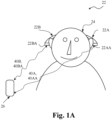
- FIGS. 1A-1B illustrate an example hearing system 22 according to this disclosure.
- FIG. 1A illustrates an example application scenario of the hearing system 22 according to this disclosure.
- the scenario comprises a user 24, hearing aids 22A, 22B, and an auxiliary device 26, the hearing aids 22A, 22B having one or more audio events.
- the hearing system 22 comprises one or more of: the hearing aid 22A (e.g., right hearing aid), the hearing aid 22B (e.g., left hearing aid) and the auxiliary device 26.
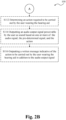
- FIG. 1B illustrates an auxiliary device (e.g., auxiliary device 26) running an example APP for enabling notification intelligibility of a hearing aid (e.g., hearing aid 22A and/or hearing aid 22B) having one or more audio events.
- FIG. 1B may illustrate a representation of a graphical interface and/or display of the auxiliary device 26 when the hearing system 22 is configured to perform any of the methods disclosed in FIGS. 2A-2B .
- the auxiliary device 26 may be configured to communicate with the hearing aids 22A, 22B via a wireless link (e.g., radio access link, radio frequency (RF) link) 40A, 40B respectively.
- a wireless link e.g., radio access link, radio frequency (RF) link
- Such wireless links 40A, 40B may be implemented in the hearing aids 22A, 22B by corresponding antenna and transceiver circuitry, e.g., illustrated in FIG. 1A as 22AA and 22BA, respectively.
- the wireless links 40A, 40B are configured to allow an exchange of audio signals and/or audio information and/or control signals (e.g., including information regarding a mapping of an audio signal to at least one of the one or more audio signals and/or audio output signals in response to an action required to be performed by the user 24 and/or acceptance/rejection signals in response to user interactions) between the hearing aids 22A, 22B and the auxiliary device 26 (e.g., audio signals 42AA, 42BA).
- audio signals 42AA, 42BA e.g., audio signals
- the APP is a non-transitory application (APP) comprising executable instructions configured to be executed on a processor of the auxiliary device 26 to implement a graphical interface 26A (e.g., a user interface) for the hearing system 22.
- a graphical interface 26A e.g., a user interface
- the APP is configured to run on a smartphone, or on another portable device allowing communication with the hearing aid 22A and/or hearing aid 22B.
- the auxiliary device 26 comprising the graphical interface 26A may be adapted for being held in a hand of a user (e.g., user 24).
- the APP can be configured to run in one or more of: an electronic device, a wearable electronic device, and a smartwatch.
- the hearing system 22 is configured to obtain user input indicating at least one of the one or more audio events 16A, 16B, 16C, 16D to be mapped.
- the hearing system 22 is configured to obtain the user input via the auxiliary device 26.
- the user 24 may indicate the at least one of the one or more audio events 16A, 16B, 16C, 16D to be mapped via a touch gesture, e.g., by touching at least one of graphical representations of the one or more audio events 16A, 16B, 16C, 16D.
- the hearing system 22 is configured to obtain the user input indicating that the audio event 16C is to be mapped to the audio signal.
- the hearing system 22 is configured to obtain a request from the user 24 to record and/or import the audio signal to the hearing system 22 (e.g., to the auxiliary device 26).
- the user 24 may record the audio signal using the auxiliary device.
- the recording of the audio signal may be illustrated by graphical representation 12.
- the audio signal may be stored in a memory of the auxiliary device 26.
- the hearing system 22 is configured to obtain the request from the user 24 upon user interaction, e.g., by a touch gesture on a graphical representation of a recording button 10 in the graphical interface 26A of the auxiliary device 26.
- the hearing system 22 is configured to obtain the request from the user 24 via a pressure gesture, e.g., by having the user 24 pressing a button in the hearing aid 22A and/or 22B (e.g., button not shown in FIGS. 1A-1B ).
- the hearing system 22 is configured to obtain an audio signal indicative of a sound in an environment via a microphone (e.g., a microphone in hearing aid 22A and/or hearing aid 22B and/or auxiliary device 26).
- the hearing system 22 may be configured to obtain the audio signal upon accepting the request from the user 24.
- the hearing system 22 is configured to obtain the user input indicating the at least one of the one or more audio events 16A, 16B, 16C, 16D to be mapped to the audio signal after obtaining the audio signal.
- the hearing system 22 is configured to map the audio signal to the at least one of the one or more audio events 16A, 16B, 16C, 16D of the hearing aid 22A, 22B.
- the hearing system 22 is configured to map the audio signal to the audio event 16C, as illustrated by symbol 17.
- symbol 17 may illustrate the actual mapping of the audio signal with the audio event 16C.
- the user 24 assigns the audio signal to the audio event 16C.
- the mapping is capable of being performed throughout a time of use of the hearing aid 22A and/or hearing aid 22B.
- the time of use of the hearing aid 22A and/or hearing aid 22B is in one or more of: a turn on state, a charging state, and a turn off state.
- FIG. 1B A screen of an example graphical interface 26A of the auxiliary device 26 is illustrated in FIG. 1B .
- the graphical interface 26A comprises a display, e.g., a touch sensitive display, displaying the one or more audio events 16A, 16B, 16C, 16D of the hearing aid 22A and/or hearing aid 22B for enabling the user 24 to map an audio signal to at least one of the one or more audio events 16A, 16B, 16C, 16D.
- the hearing system 22 is configured to map the audio signal to the at least one of the one or more audio events 16A, 16B, 16C, 16D of the hearing aid 22A, 22B via the graphical interface 26A.
- the user 24 can select the at least one of the one or more audio events 16A, 16B, 16C, 16D of the hearing aid 22A, 22B via the graphical interface 26A to be assigned to the audio signal.
- the hearing system 22 is configured to display an interface object indicative of the at least one of the one or more audio events 16A, 16B, 16C, 16D. In one or more examples, the hearing system 22 is configured to display the interface object via the auxiliary device 26. In one or more examples, the hearing system 22 is configured to display the one or more audio events 16A, 16B, 16C, 16D via the graphical interface 26A of the auxiliary device 26.
- an audio event (e.g., audio events 16A, 16B, 16C, 16D) is associated with a functionality of the hearing aid 22A and/or hearing aid 22B.
- the one or more audio events 16A, 16B, 16C, 16D of the hearing aid 22A and/or hearing aid 22B are pre-determined (e.g., stored in a memory and/or data repository of the auxiliary device 26).
- the hearing system 22 is configured to obtain user input request indicative of a request to modify the mapping of the audio signal to the at least one of the one or more audio events 16A, 16B, 16C, 16D of the hearing aid 22A and/or hearing aid 22B. In one or more examples, the hearing system 22 is configured to, upon obtaining the user input request, determining whether the user 24 is allowed to perform such modification. In one or more examples, the hearing system 22 is configured to obtain the user input request when detecting a touch gesture on a graphical representation of a button 14 (e.g., a "Save as" button) in the graphical interface 26A of the auxiliary device 26.
- a button 14 e.g., a "Save as" button
- the hearing system 22 is configured to, upon obtaining the user input request, provide an acceptance mapping message indicating acceptance to modify the mapping of the mapping of the audio signal to the at least one of the one or more audio events 16A, 16B, 16C, 16D. In one or more examples, the hearing system 22 is configured to, upon providing the acceptance mapping message, modify the mapping of the audio signal to the at least one of the one or more audio events 16A, 16B, 16C, 16D of the hearing aid 22A and/or hearing aid 22B. Optionally, the hearing system 22 may be configured to modify the mapping of the audio signal to the at least one of the one or more audio events 16A, 16B, 16C, 16D of the hearing aid 22A and/or hearing aid 22B without obtaining the user input request. The hearing system 22 may be configured to provide the acceptance mapping message perceivable to the user 24 as sound (e.g., in form of a spoken message and/or a tonal indication, e.g., a beep).
- the hearing device is configured to, upon obtaining the user input request, providing a rejection mapping message indicating rejection to modify the mapping of the audio signal to the at least one of the one or more audio events 16A, 16B, 16C, 16D.
- the hearing system 22 may be configured to provide the rejection mapping message perceivable to the user 24 as sound (e.g., in form of a spoken message and/or a tonal indication, e.g., a beep).
- the hearing system 22 may be configured to, upon providing the rejection mapping message, maintain the mapping of the audio signal to the at least one of the one or more audio events 16A, 16B, 16C, 16D.
- the hearing system 22 is configured to obtain new user input indicating an audio event (e.g., of the one or more audio events 16A, 16B, 16C, 16D) to be mapped.
- the hearing system 22 is configured to modify the mapping of the audio signal by obtaining a new audio signal indicative of a new sound in an environment via the microphone.
- the user 24 may select an audio event to be mapped to the new audio signal, e.g., by touching one of the graphical representations of the one or more audio events 16A, 16B, 16C, 16D.
- the user 24 may select an audio event of the one or more audio events 16A, 16B, 16C, 16D to be mapped to the new audio signal after obtaining the new audio signal.
- the user 24 may select an audio event of the one or more audio events 16A, 16B, 16C, 16D to be mapped to the new audio signal before obtaining the new audio signal.
- the hearing system 22 is configured to modify the mapping of the audio signal by mapping the new audio signal to the at least one of the one or more audio events 16A, 16B, 16C, 16D of the hearing aid (e.g., without removing the mapping of the audio signal).
- the hearing system 22 is configured to modify the mapping of the audio signal to the audio event 16C, e.g., previously recorded by the user 24 and/or stored in the memory of the auxiliary device 26.
- the mapping of the audio signal to the audio event 16C may be stored in the memory of the auxiliary device 26.
- the hearing system 22 is configured to modify the mapping of the audio signal to the audio event 16C by mapping the new audio signal to the audio event 16C.
- the hearing system 22 is configured to modify the mapping of the audio signal to the audio event 16C by mapping the audio signal to at least one of the audio events 16A, 16B, 16D.
- the hearing system 22 is configured to modify the mapping of the audio signal by removing the mapping of the audio signal to the at least one of the one or more audio events 16A, 16B, 16C, 16D of the hearing aid 22A and/or hearing aid 22B. In one or more example methods, the hearing system 22 is configured to modify the mapping of the audio signal by mapping a pre-determined signal to the at least one of the one or more audio events 16A, 16B, 16C, 16D of the hearing aid 22A and/or hearing aid 22B.
- the hearing system 22 is configured to modify the mapping of the audio signal by retrieving from a memory of the hearing system 22 (e.g., the memory of the auxiliary device 26) the mapping of the pre-determined signal to the at least one of the one or more audio events 16A, 16B, 16C, 16D.
- a memory of the hearing system 22 e.g., the memory of the auxiliary device 26
- the hearing system 22 is configured to modify the mapping of the audio signal to the audio event 16C by removing the mapping of the audio signal to the audio event 16C.
- the hearing system 22 may be configured to remove the mapping of the audio signal to the audio event 16C by disabling and/or deactivating such mapping.
- the hearing system 22 may be configured to remove the mapping of the audio signal to the audio event 16C by deleting the audio signal from the memory of the hearing system 22, e.g., from the memory of the auxiliary device 26.
- the hearing system 22 is configured to modify the mapping of the audio signal by generating an updated version of the audio signal based on the audio signal and one or more audio parameters 14A, 14B, 14C.
- an audio parameter of the one or more audio parameters 14A, 14B, 14C is indicative of an auditory characteristic of the hearing aid 22A and/or hearing aid 22B.
- An auditory characteristic of the hearing aid 22A and or hearing aid 22B may comprise one or more of: background noise reduction, speed, pitch, a loudness level, timbre, rhythm, and any other suitable characteristic.
- the audio parameters 14A, 14B, 14C may be indicative of auditory characteristics such as pitch, speed, and noise reduction (NR) respectively.
- each audio parameter is associated with a modification range (e.g., modification range 15A, 15B, 15C).
- the hearing system 22 is configured to modify the mapping of the audio signal (e.g., and/or the new audio signal) upon user interaction.
- the hearing system 22 may be configured to detect a change in the value of the one or more audio parameters 14A, 14B, 14C.
- the hearing system 22 is configured to detect a change in the value of the one or more audio parameters 14A, 14B, 14C when detecting a touch gesture on a modification range 15A, 15B, 15C in the graphical interface 26A of the auxiliary device 26.
- the hearing system 22 may be configured to detect a change in the value of the one or more audio parameters 14A, 14B, 14C when the user 24 moves object 15AA, 15BA, 15CA towards a value and/or level a desired by the user 24 within the modification range 15A, 15B, 15C respectively.
- the hearing system 22 is configured to obtain the user input request, e.g., when detecting a touch gesture on the graphical representation of a button 14 (e.g., a "Save as” button) in the graphical interface 26A of the auxiliary device 26.
- the hearing system 22 may be configured to obtain the user input request (e.g., as a touch gesture in the button 14), after detecting a change in the value of the one or more audio parameters 14A, 14B, 14C (e.g., when detecting a touch gesture on at least one of the modification ranges 15A, 15B, 15C in the graphical interface 26A of the auxiliary device 26).
- the hearing system 22 is configured to, upon obtaining the user input request, providing a modification acceptance message indicating acceptance to modify the one or more audio parameters. In one or more example methods, the hearing system 22 is configured to, upon obtaining the user input request, providing a modification rejection message indicating rejection to modify the one or more audio parameters. The hearing system 22 may be configured to, upon providing the modification rejection message, do not generate of the updated version of the audio signal (e.g., and/or of the new audio signal).
- the hearing system 22 can be configured to modify the audio signal mapped to the audio event 16C by modifying at least one of the one or more audio parameters 14A, 14B, 14C.
- the hearing system 22 can be configured to modify the mapping of the audio signal to the audio event 16C by mapping the new audio signal to the audio event 16C and modifying at least one of the one or more audio parameters 14A, 14B, 14C associated with the new audio signal.
- the user 24 may request validation of such modification by touching the graphical representation of the button 14.
- the hearing system 22 may approve or reject such modification.
- button 14 may be enable validation or rejection of one or more modifications.
- Such one or more modifications may include one or more of: removal of the audio signal from the mapping, mapping of a new audio signal to an audio event already mapped to another audio signal, mapping of the audio signal to another audio event, and modification of one or more audio parameters associated with a hearing perception of the user 24 (e.g., for easing perception of the audio signal and/or the new audio signal).
- the hearing system 22 is configured to determine an action required to be carried out by the user wearing the hearing aid. For example, the hearing system 22 is configured to determine the action based on a status of functionality of the hearing aid 22A and/or the hearing aid 22B, e.g., when there is a change in the status of functionality of the hearing aid 22A and/or hearing aid 22B. In the embodiment of FIGS. 1A-1B , the hearing system 22 may be configured to determine a change in the battery level of the hearing aid 22A and/or the hearing aid 22B. In other words, the hearing system may be configured to determine that the battery level of the hearing aid 22A and/or hearing aid 22B is below a power threshold, e.g., that the hearing aid 22A and/or hearing aid 22B are running out of battery.
- the hearing system 22 is configured to output an audio output signal perceivable by the user 24 as sound based on one or more of: the audio signal, the pre-determined signal, and the action.
- the hearing system 22 may be configured to output the audio output signal based on the new audio signal and the action when modifying the mapping of the audio signal to at least one of the one or more audio events 16A, 16B, 16C, 16D.
- the hearing system 22 may be configured to output the audio output signal based on the updated version of the audio signal and the action when modifying the one or more audio parameters.
- the hearing system 22 may be configured to output the audio output signal based on the pre-determined signal and the action when removing the audio signal from the memory of the hearing system (e.g., the memory of the auxiliary device 26).
- the hearing system 22 is configured to output the audio output signal perceivable by the user 24 as sound via the hearing aid 22A and/or hearing aid 22B.
- the audio output signal perceivable by the user 24 as sound can be seen as a recorded message in the auxiliary device 24 and/or an imported message to the auxiliary device 26. Put differently, the audio output signal perceivable by the user 24 as sound may be seen as a spoken notification.
- the hearing system 22 is configured to output a written message 18 indicative of the action to be carried out by the user wearing the hearing aid in addition to the audio output signal.
- the hearing system 22 is configured to output the written message 18 for notifying the user 24 of the low battery level of the hearing aid 22A and/or hearing aid 22B.
- the mapping is capable of being performed without intervention of an audiologist. In one or more examples, the mapping is performed by the user 24.
- the present disclosure may enable the user 24 to adjust the audio signal and/or to modify the mapping of the audio signal to an audio event of the one or more audio events to its own preference, thereby improving notification perception.
- the user 24 may easily (e.g., without any effort) understand that there has been a change in the level of battery (e.g., a change in the status of the battery of the hearing aid 22A and/or hearing aid 22B).
- the hearing system 22 may be configured to perform any of the method disclosed in FIGS. 2A-2B .
- the hearing system 22 may comprise a processor (e.g., a signal processing unit), the processor being optionally configured to perform any of the operations disclosed in FIGS. 2A-2B (such as any one or more of: S101, S102, S104, S106, S106A, S108, S110, S110A, S110B, S110C, S110D, S110E, S112, S114, S116).
- a processor e.g., a signal processing unit
- the processor being optionally configured to perform any of the operations disclosed in FIGS. 2A-2B (such as any one or more of: S101, S102, S104, S106, S106A, S108, S110, S110A, S110B, S110C, S110D, S110E, S112, S114, S116).
- the operations of the hearing system 22 may be embodied in the form of executable logic routines (e.g., lines of code, software programs, etc.) that are stored on a non-transitory computer readable medium (for example, a memory) and are executed by such processor.
- executable logic routines e.g., lines of code, software programs, etc.
- the hearing system 22 may comprise a memory, the memory being one or more of a buffer, a flash memory, a hard drive, a removable media, a volatile memory, a non-volatile memory, a random-access memory (RAM), and any other suitable device.
- a memory may include a non-volatile memory for long term data storage and a volatile memory that functions as system memory for the processor.
- Such memory may exchange data with the processor over a data bus.
- the memory 10A may be a non-transitory computer readable medium.
- Such memory may be configured to store information such as one or more audio events, at least one of the one or more audio events to be mapped, an audio signal, a mapping of the audio signal to at least one of the one or more audio events, a mapping of a new audio signal to the at least one of the one or more audio events, a pre-determined signal, a mapping of the pre-determined signal to at least one of the one or more audio events, an updated version of the audio signal, an action required to be carried out by a user, the audio output signal in a part of the memory.
- FIGS. 2A-2B are a flow-chart of an example method 100 of enabling notification intelligibility of a hearing aid having one or more audio events according to this disclosure.
- the method 100 comprises obtaining S102 user input indicating at least one of the one or more audio events to be mapped.
- the method 100 comprises obtaining S104 an audio signal indicative of a sound in an environment via a microphone.
- the method 100 comprises mapping S106 the audio signal to the at least one of the one or more audio events of the hearing aid. The mapping is capable of being performed throughout a time of use of the hearing aid.
- the time of use of the hearing aid is in one or more of: a turn on state, a charging state, and a turn off state.
- the method 100 comprises displaying S 101 an interface object indicative of the at least one of the one or more audio events.
- an audio event is associated with a functionality of the hearing aid.
- the one or more audio events of the hearing aid are pre-determined.
- the method 100 comprises mapping S106A the audio signal to the at least one of the one or more audio events of the hearing aid via a graphical interface.
- the method 100 comprises obtaining S108 user input request indicative of a request to modify the mapping of the audio signal to the at least one of the one or more audio events of the hearing aid. In one or more example methods, the method 100 comprises, upon obtaining S108 the user input request, modifying S 110 the mapping of the audio signal to the at least one of the one or more audio events of the hearing aid.
- modifying S 110 the mapping of the audio signal comprises obtaining S110A a new audio signal indicative of a new sound in an environment via the microphone. In one or more example methods, modifying S 110 the mapping of the audio signal comprises mapping S110B the new audio signal to the at least one of the one or more audio events of the hearing aid.
- modifying S 110 the mapping of the audio signal comprises removing S110C the mapping of the audio signal to the at least one of the one or more audio events of the hearing aid. In one or more example methods, modifying S110 the mapping of the audio signal comprises mapping S110D a pre-determined signal to the at least one of the one or more audio events of the hearing aid.
- modifying S 110 the mapping of the audio signal comprises generating S 1 10E an updated version of the audio signal based on the audio signal and one or more audio parameters.
- an audio parameter of the one or more audio parameters is indicative of an auditory characteristic of the hearing aid.
- the method 100 comprises determining S 112 an action required to be carried out by the user wearing the hearing aid. In one or more example methods, the method 100 comprises outputting S 114 an audio output signal perceivable by the user as sound based on one or more of: the audio signal, the pre-determined signal, and the action.
- the method 100 comprises outputting S 116 a written message indicative of the action to be carried out by the user wearing the hearing aid in addition to the audio output signal.
- the mapping is capable of being performed without intervention of an audiologist.
Landscapes
- Engineering & Computer Science (AREA)
- Health & Medical Sciences (AREA)
- General Health & Medical Sciences (AREA)
- Otolaryngology (AREA)
- Neurosurgery (AREA)
- Physics & Mathematics (AREA)
- Acoustics & Sound (AREA)
- Signal Processing (AREA)
- Computer Networks & Wireless Communication (AREA)
- Circuit For Audible Band Transducer (AREA)
Priority Applications (1)
| Application Number | Priority Date | Filing Date | Title |
|---|---|---|---|
| EP23217576.0A EP4475563A1 (fr) | 2023-12-18 | 2023-12-18 | Procédé permettant une intelligibilité de notification d'une prothèse auditive ayant un ou plusieurs événements audio et système auditif associé |
Applications Claiming Priority (1)
| Application Number | Priority Date | Filing Date | Title |
|---|---|---|---|
| EP23217576.0A EP4475563A1 (fr) | 2023-12-18 | 2023-12-18 | Procédé permettant une intelligibilité de notification d'une prothèse auditive ayant un ou plusieurs événements audio et système auditif associé |
Publications (1)
| Publication Number | Publication Date |
|---|---|
| EP4475563A1 true EP4475563A1 (fr) | 2024-12-11 |
Family
ID=89223393
Family Applications (1)
| Application Number | Title | Priority Date | Filing Date |
|---|---|---|---|
| EP23217576.0A Withdrawn EP4475563A1 (fr) | 2023-12-18 | 2023-12-18 | Procédé permettant une intelligibilité de notification d'une prothèse auditive ayant un ou plusieurs événements audio et système auditif associé |
Country Status (1)
| Country | Link |
|---|---|
| EP (1) | EP4475563A1 (fr) |
Citations (5)
| Publication number | Priority date | Publication date | Assignee | Title |
|---|---|---|---|---|
| WO2001030127A2 (fr) * | 2001-01-23 | 2001-05-03 | Phonak Ag | Procede de communication et systeme d'appareil de correction auditive |
| DE102004037376B3 (de) * | 2004-08-02 | 2005-12-29 | Siemens Audiologische Technik Gmbh | Frei konfigurierbare Informationssignale bei Hörhilfegeräten |
| WO2010094335A1 (fr) * | 2009-02-20 | 2010-08-26 | Widex A/S | Système d'enregistrement de message sonore pour prothèse auditive |
| EP2814264A1 (fr) * | 2013-06-14 | 2014-12-17 | GN Resound A/S | Instrument auditif pour messages vocaux hors ligne |
| US9466226B1 (en) * | 2015-10-20 | 2016-10-11 | International Business Machines Corporation | General purpose device to assist the hard of hearing |
-
2023
- 2023-12-18 EP EP23217576.0A patent/EP4475563A1/fr not_active Withdrawn
Patent Citations (5)
| Publication number | Priority date | Publication date | Assignee | Title |
|---|---|---|---|---|
| WO2001030127A2 (fr) * | 2001-01-23 | 2001-05-03 | Phonak Ag | Procede de communication et systeme d'appareil de correction auditive |
| DE102004037376B3 (de) * | 2004-08-02 | 2005-12-29 | Siemens Audiologische Technik Gmbh | Frei konfigurierbare Informationssignale bei Hörhilfegeräten |
| WO2010094335A1 (fr) * | 2009-02-20 | 2010-08-26 | Widex A/S | Système d'enregistrement de message sonore pour prothèse auditive |
| EP2814264A1 (fr) * | 2013-06-14 | 2014-12-17 | GN Resound A/S | Instrument auditif pour messages vocaux hors ligne |
| US9466226B1 (en) * | 2015-10-20 | 2016-10-11 | International Business Machines Corporation | General purpose device to assist the hard of hearing |
Similar Documents
| Publication | Publication Date | Title |
|---|---|---|
| US10356536B2 (en) | Hearing device comprising an own voice detector | |
| US12058493B2 (en) | Hearing device comprising an own voice processor | |
| US10149069B2 (en) | Configurable hearing system | |
| US8526649B2 (en) | Providing notification sounds in a customizable manner | |
| US11576001B2 (en) | Hearing aid comprising binaural processing and a binaural hearing aid system | |
| US11265661B1 (en) | Hearing aid comprising a record and replay function | |
| US20220256296A1 (en) | Binaural hearing system comprising frequency transition | |
| US20200275217A1 (en) | Hearing device comprising a loop gain limiter | |
| US10966038B2 (en) | Method of fitting a hearing device to a user's needs, a programming device, and a hearing system | |
| US10085099B2 (en) | Hearing aid system, a hearing aid device and a method of operating a hearing aid system | |
| US20190200141A1 (en) | Adaptive level estimator, a hearing device, a method and a binaural hearing system | |
| EP4432703A1 (fr) | Prothèse auditive ayant une perception environnementale | |
| US20240089671A1 (en) | Hearing aid comprising a voice control interface | |
| US20220406328A1 (en) | Hearing device comprising an adaptive filter bank | |
| US20240348990A1 (en) | A hearing aid having acceleration based discoverability | |
| EP4598058A1 (fr) | Rejet d'artefacts à partir de données d'accéléromètre d'aide auditive | |
| US20240251208A1 (en) | Hearing aid and distance-specific amplifier | |
| US20250251454A1 (en) | Method for estimating a state of charge for a hearing aid | |
| EP4598059A1 (fr) | Prescription de caractéristiques d'aide auditive à partir de mesures de diagnostic | |
| EP4598057A1 (fr) | Prothèse auditive avec réduction de bruit et formation de faisceau basées sur l'intention | |
| EP4723680A1 (fr) | Procédé de fonctionnement d'une prothèse auditive recevant des sources de diffusion sans fil, et prothèse auditive | |
| KR20210045374A (ko) | 모바일 플러그인 보청기 |
Legal Events
| Date | Code | Title | Description |
|---|---|---|---|
| PUAI | Public reference made under article 153(3) epc to a published international application that has entered the european phase |
Free format text: ORIGINAL CODE: 0009012 |
|
| STAA | Information on the status of an ep patent application or granted ep patent |
Free format text: STATUS: THE APPLICATION HAS BEEN PUBLISHED |
|
| AK | Designated contracting states |
Kind code of ref document: A1 Designated state(s): AL AT BE BG CH CY CZ DE DK EE ES FI FR GB GR HR HU IE IS IT LI LT LU LV MC ME MK MT NL NO PL PT RO RS SE SI SK SM TR |
|
| STAA | Information on the status of an ep patent application or granted ep patent |
Free format text: STATUS: THE APPLICATION HAS BEEN WITHDRAWN |
|
| 18W | Application withdrawn |
Effective date: 20241213 |