EP4477195A2 - Pessaire vaginal - Google Patents
Pessaire vaginal Download PDFInfo
- Publication number
- EP4477195A2 EP4477195A2 EP24181313.8A EP24181313A EP4477195A2 EP 4477195 A2 EP4477195 A2 EP 4477195A2 EP 24181313 A EP24181313 A EP 24181313A EP 4477195 A2 EP4477195 A2 EP 4477195A2
- Authority
- EP
- European Patent Office
- Prior art keywords
- base body
- wall section
- contour line
- wall sections
- opening
- Prior art date
- Legal status (The legal status is an assumption and is not a legal conclusion. Google has not performed a legal analysis and makes no representation as to the accuracy of the status listed.)
- Granted
Links
Images



Classifications
-
- A—HUMAN NECESSITIES
- A61—MEDICAL OR VETERINARY SCIENCE; HYGIENE
- A61F—FILTERS IMPLANTABLE INTO BLOOD VESSELS; PROSTHESES; DEVICES PROVIDING PATENCY TO, OR PREVENTING COLLAPSING OF, TUBULAR STRUCTURES OF THE BODY, e.g. STENTS; ORTHOPAEDIC, NURSING OR CONTRACEPTIVE DEVICES; FOMENTATION; TREATMENT OR PROTECTION OF EYES OR EARS; BANDAGES, DRESSINGS OR ABSORBENT PADS; FIRST-AID KITS
- A61F6/00—Contraceptive devices; Pessaries; Applicators therefor
- A61F6/06—Contraceptive devices; Pessaries; Applicators therefor for use by females
- A61F6/08—Pessaries, i.e. devices worn in the vagina to support the uterus, remedy a malposition or prevent conception, e.g. combined with devices protecting against contagion
-
- A—HUMAN NECESSITIES
- A61—MEDICAL OR VETERINARY SCIENCE; HYGIENE
- A61F—FILTERS IMPLANTABLE INTO BLOOD VESSELS; PROSTHESES; DEVICES PROVIDING PATENCY TO, OR PREVENTING COLLAPSING OF, TUBULAR STRUCTURES OF THE BODY, e.g. STENTS; ORTHOPAEDIC, NURSING OR CONTRACEPTIVE DEVICES; FOMENTATION; TREATMENT OR PROTECTION OF EYES OR EARS; BANDAGES, DRESSINGS OR ABSORBENT PADS; FIRST-AID KITS
- A61F2/00—Filters implantable into blood vessels; Prostheses, i.e. artificial substitutes or replacements for parts of the body; Appliances for connecting them with the body; Devices providing patency to, or preventing collapsing of, tubular structures of the body, e.g. stents
- A61F2/0004—Closure means for urethra or rectum, i.e. anti-incontinence devices or support slings against pelvic prolapse
- A61F2/0031—Closure means for urethra or rectum, i.e. anti-incontinence devices or support slings against pelvic prolapse for constricting the lumen; Support slings for the urethra
- A61F2/005—Closure means for urethra or rectum, i.e. anti-incontinence devices or support slings against pelvic prolapse for constricting the lumen; Support slings for the urethra with pressure applied to urethra by an element placed in the vagina
Definitions
- the present invention relates to a vaginal pessary with a circumferentially closed base body, wherein the base body has two (lateral) side wall sections, a front (anterior) wall section and a rear (posterior) wall section, and wherein a central opening of the base body is delimited by a closed, inner contour line of the wall sections.
- the side wall sections together with the front wall section and the rear wall section form a circumferential, i.e. self-contained, side wall of the pessary.
- Vaginal pessaries of the type in question are used to treat gynecological conditions that are associated with a weakening of the uterus's supporting structure or the internal organs adjacent to the vaginal area.
- the condition affects around a third of all women and, depending on their constitution, occurs after pregnancies and births due to the associated stress. This results in gaps in care and high costs.
- Pessaries therefore represent a minimally invasive, cost-effective alternative to high-risk surgery. In most countries, they are now even recommended as the first choice before surgery (1-4).
- vaginal pessaries The treatment of urogynecological complaints (prolapse and/or incontinence) with vaginal pessaries is usually carried out with ring-shaped models such as ring, urethra or sieve bowl pessaries as well as with cube pessaries, which are characterized by their concave Wall structures cling to the vaginal wall.
- ring-shaped models such as ring, urethra or sieve bowl pessaries
- cube pessaries which are characterized by their concave Wall structures cling to the vaginal wall.
- reliable fixation of the position of the pessaries inside the vagina is of great importance in order to provide sufficient support for prolapsed internal organs or the urethra.
- Ring-shaped pessaries used to date depend on the pelvic floor being stable enough to support the pessary. They have the disadvantage that the vagina is not circular, but rather oval, and the lateral walls of the vagina are therefore further dilated by the pessary, which can have an adverse effect on the clinical picture.
- the fixation of a cube pessary used to date is based on the concave side walls, which can adhere to the mucous membrane with their surface and thus fix the pessary.
- these pessaries fill the entire space of the vagina, they have to be removed every evening and reinserted during the day. This is annoying for many patients.
- the cubes necessarily have a thread for handling, which can also be annoying for patients in the long term.
- the vaginal pessaries known to date from practice and the state of the art could be improved.
- the fixation of the ring-shaped pessaries at the expense of dilation and that of the cube pessaries at the expense of possibly preventing discharge from flowing out (e.g. during menstruation) are limited in their therapeutic treatment options.
- the object of the present invention is therefore to provide a prototype of a vaginal pessary that allows a reliable treatment without side effects in the context of the prevention and treatment of prolapse of internal organs and/or stress incontinence.
- the inner contour line of the wall sections delimits a central opening that is essentially egg-shaped and deviates from a circular shape. This corresponds more closely to the actual anatomy and is intended to reduce the dilation of the lateral vaginal walls.
- the concave, inward-turned surfaces of the side walls are not only intended to improve the holding function of the pessary, but also to bring the lateral walls together, since the egg-shaped contour is optimally adapted to the anatomical conditions in the vaginal area when inserted and rests against the surrounding tissue structure without lateral stretching. Due to the nature of the outer walls, the vaginal pessary according to the invention takes on a reliable and resilient support function.
- vaginal pessary also has a high resistance to collapsing or radially inward deformation, which continues to allow an efficient support function, since a sufficiently high radial outer seal is always ensured.
- it allows discharge or blood to drain away.
- void in the sense of the invention refers to the geometry of an inner contour line of a circumferential side wall of the pessary according to the invention, which delimits the central opening of the pessary, with reference to a plan view of the pessary.
- the opening preferably has rounded corners.
- the opening can preferably have a pointed end in the region of a front wall section of the pessary when the pessary is inserted and a blunt end in the region of a rear wall section.
- egg-shaped or “oval” in the sense of the invention refers to a flat, rounded, convex figure or contour line of the middle opening of the pessary according to the invention in a plane or in the top view of the pessary, which in the broadest sense resembles the profile of a bird's egg. According to the invention, however, it does not include a circular shape, but possibly an ellipse as a special case.
- An egg-shaped or oval, non-circular central opening in the sense of the invention has in particular the following properties:
- the contour line of the central opening has in particular no loops or loops and/or the oriented curvature of the contour line has in particular no change of sign, i.e., depending on the direction of passage, the oriented curvature for each point of the contour line is either non-negative or non-positive, which means that it has no turns or indentations.
- the contour line can only be traversed in a pure left-hand curve or right-hand curve.
- the contour line of the central opening is also composed of arcs, in particular circular arcs, and at least one substantially straight contour line section or an arcuate contour line section with very slight curvature.
- the contour line is particularly preferably made up of a front, convex contour line section and a rear, also convex or preferably essentially straight contour line section.
- the front, convex contour line section is preferably more curved or more pointed than the rear, convex contour line section, which can then be described as "blunt”.
- the contour line can have a rear, straight contour line section which is connected to the front, convex contour line section via two lateral convex contour line sections.
- the front, convex contour line section can be more curved than the two lateral contour line sections.
- the contour line is rounded, in particular at the transitions between the contour line sections.
- the contour line of the middle opening can have an axis of symmetry. However, this is not absolutely necessary.
- An egg-shaped inner contour line of the middle opening of the pessary does not necessarily require a symmetrical design or a related axis of symmetry.
- Asymmetrically designed contour lines are also covered by the teaching according to the invention if this improves the treatment. Nevertheless, a symmetrical, egg-shaped design of the inner contour line is preferred in order to be able to adapt to the anatomical conditions in a particularly reliable sealing manner when in use. For routine production, a symmetrical design of the inner contour line has proven to be advantageous.
- the egg-shaped inner contour line is better adapted to the anatomy of the vagina, especially in contrast to a circular contour line. This improves the insertion and wearing comfort of the vaginal pessary.
- a trapezoidal inner contour line preferably with rounded corner areas, can still be referred to as an egg-shaped contour line according to the invention.
- the inner contour line has an at least substantially egg-shaped course with a substantially pointed end on the side of the front (anterior) wall section and with a substantially blunt end on the side of the rear (posterior) wall section.
- the egg-shaped course forms a preferred embodiment of the generally oval-shaped opening of the vaginal pessary according to the invention.
- the elliptical shape represents a preferred design of the opening, which is limited by the inner contour line.
- the elliptical shape is mathematically defined and is particularly designed in the form of a conic section.
- the front (anterior) wall section is convexly curved and/or the rear (posterior) wall section of the pessary according to the invention is essentially convexly curved or essentially straight. This allows a particularly gentle and at the same time reliable connection of the vaginal pessary.
- the front (anterior) wall section and/or the rear (posterior) wall section is/are curved in a substantially different convex manner in a plan view of the opening.
- the anterior wall section is preferably curved more strongly than the rear wall section in order to implement a more pointed or shorter design of the anterior wall section compared to the rear blunt or longer wall section.
- the inner contour line of the central opening is designed to be mirror-symmetrical to a central longitudinal axis and/or central transverse axis of the base body.
- the mirror symmetry can relate to a single central axis, for example to a central longitudinal axis in the case of an egg-shaped or trapezoidal contour line.
- a mirror-symmetrical design of the contour line to the central longitudinal axis and to a central transverse axis is also possible, for example in the case of an elliptical design of the inner contour line or the opening.
- the inner contour line along the central opening has a continuous convex course, which is more curved in the area of the front (anterior) wall section than in the area of the rear (posterior) wall section.
- the inner contour line is in particular equally curved, whereas at the posterior and anterior wall sections there is a different curvature of the inner contour line.
- the thickness of the wall sections decreases starting from a proximal outer side of the base body in the direction of a distal outer side of the base body.
- the wall thickness increases in relation to the state in which the pessary is inserted in the body in the direction of the center of the body.
- the wall sections preferably the side wall sections, are designed to taper and/or narrow towards the distal outer side of the base body.
- the wall sections in particular the side wall sections, are drop-shaped and/or egg-shaped in a cross-section perpendicular to the opening or to the base body.
- the side wall sections are designed in a tab-shaped manner. This also has the side effect of making it easier to insert into the vaginal area.
- the above-mentioned object is also achieved in that the wall sections of the vaginal pessary according to the invention delimit a substantially trapezoidal opening. This also allows corresponding advantages to be realized.
- An inner contour line for forming a trapezoidal opening is also to be understood broadly and does not necessarily require straight wall sections to form the inner contour line. Arched or convex wall sections, particularly in the area of the side wall sections, can also form a trapezoidal inner contour line.
- the base body has a height of the circumferential side wall that preferably changes continuously in the circumferential direction, whereby, preferably, a smaller height can be achieved at the anterior wall section and/or a greater height at the posterior wall section.
- the height at the anterior wall section and the height at the posterior wall section can also be essentially the same.
- the side sections preferably have the greatest height, more preferably in a middle region of the side wall sections, whereby the height drops from a maximum height to the height at the anterior wall section and/or the height at the posterior wall section.
- the term "height" in the sense of the invention describes the extent or the extension of the wall sections between a distal outer surface and a proximal outer surface of the wall sections.
- the change in height in the circumferential direction of the base body preferably takes place steadily and/or continuously.
- a minimum height can be achieved at the anterior wall section and a maximum height at the posterior wall section.
- the maximum height can be achieved at one side wall section, in particular with the maximum height being achieved at both opposite side wall sections.
- the changing height in the circumferential direction of the base body is associated with improved stability of the vaginal pessary with adjacent tissue sections.
- the changing height in the circumferential direction enables flexible adaptation to the anatomical conditions of the vagina, whereby a reliable attachment of the vaginal pessary in the circumferential direction to the adjacent tissue sections is always guaranteed.
- the same minimum height is achieved at the anterior wall section and at the posterior wall section, in particular wherein the maximum height is achieved at both side wall sections.
- the proximal outer surfaces of the side wall sections, the front wall section and the rear wall section of the pessary preferably lie in one plane.
- the base body On the distal outer side of the base body, the base body then has a height that changes in the circumferential direction.
- the object in question is achieved by providing that the base body, preferably on at least one side wall section, has at least one pocket-like depression open on the outside of the base body in order to form better adhesion for adjacent tissue in the deployed state or in the inserted state of the vaginal pessary.
- the special feature of this embodiment is that there are one or more indentations or pocket-like depressions in both side wall sections, in particular in the side wall sections opposite one another, whereby the walls adhere better to the vaginal wall and thus ensure a secure hold.
- the essential characteristic of the present invention according to this aspect are the side walls, which are essentially convexly curved or arched inwards in the cross-sectional view. This allows a particularly gentle and at the same time reliable connection of the vaginal pessary to the vaginal mucosa, as a partial vacuum effect is created. As a result, when verified on the pig model (a vagina similar to a human), the pessary holds approximately 5 times better when pulled outwards than a normal ring pessary (on average, with closed recesses, 18 Newtons of pulling force are required for removal, compared to 3 Newtons, see Table 1 below).
- the aspect in question of the at least one pocket-shaped depression in an associated wall section of the pessary has proven to be particularly advantageous with regard to the first aspect, according to which the inner contour line of the wall sections delimits an opening that is essentially egg-shaped and deviates from a circular shape. While a pessary with an egg-shaped inner contour line adapts better to the anatomy inside the vagina, the at least one indentation or pocket-shaped depression ensures that, despite the improved adaptability ensures a reliable connection of the vaginal pessary to the vaginal mucosa. In this respect, the anatomically adapting egg-shaped design of the vaginal pessary is conveniently supplemented by the indentation or the pocket-shaped depression.
- the two positive effects of the two aspects in question namely the egg-shaped design on the one hand and the pocket-shaped depression on the other, complement each other in a reinforcing or synergistic way, whereby a comfortable or pleasant wearing feeling is simultaneously enabled and a reliable fixation of the vaginal pessary at the place of use or in the state of use is made possible.
- the geometry of the pessary according to the invention is particularly preferably similar to a ring pessary with a non-circular cross-section, wherein, preferably, the lateral wall sections have a greater height than the posterior and anterior wall sections and/or are designed to be tab-like and/or distally tapered, so that when the pessary is inserted, it can be grasped and held at the lateral wall sections.
- the posterior and anterior wall sections can have a substantially circular cross-section.
- at least one pocket-like depression is then provided in the middle region of the respective side wall section, in which the side wall section reaches a maximum height, wherein the introduction of the depression is facilitated by the distally tapering wall thickness of the side wall section.
- the pocket-shaped depression or indentation in question thus functions as a receiving pocket and/or suction cup, whereby a negative pressure is generated within the pocket-shaped depression or indentation in the application state to the adjacent tissue during insertion, accompanied by a particularly reliable and/or resistant fixation of the vaginal pessary at the site of use.
- the depression can preferably be closed on an inner side of the base body and then forms a pocket in the wall section of the base body that is closed on the inside and open on the outside of the pessary.
- all depressions can be closed.
- at least one depression can be closed and at least one can be open on an inner side of the base body, whereby an open depression can be used to drain body fluids.
- the depression is directed radially inwards, wherein the depression on the inner side(s) of the base body is formed by a thin-walled wall section which is everted inwards relative to the wall sections of the base body adjacent to the depression.
- the everting enables deformability and is intended to increase or generate the suction effect within the pocket-shaped depression when inserted.
- the formation of a pocket-like depression can lead to only a negligible reduction in the rigidity of the vaginal pessary according to the invention compared to a geometrically identical vaginal pessary without a pocket-like depression.
- the formation of a pocket-like or pocket-shaped depression leads to only a negligible reduction in the rigidity of the vaginal pessary according to the invention compared to a conventional ring pessary as a reference body, which in particular has a circular central opening and a substantially identical diameter and/or a substantially identical height of the wall sections of the ring pessary that delimit the central opening.
- the diameter, circumference and/or height of the ring pessary as a reference body can preferably correspond to the diameter, circumference and/or height of the anterior and/or posterior wall section of the pessary according to the invention.
- the term "rigidity" in the sense of the invention relates in particular to the resistance of the pessary to the application of a force from the outside to a wall section, in particular to opposite wall sections, further in particular to both side wall sections of the base body in the direction of the middle of the vaginal pessary or when the vaginal pessary is (laterally) compressed in the area of the wall sections. Furthermore in particular the term “rigidity” in the sense of the invention relates to the resistance of the pessary to the application of a compressive force to the wall sections in the proximal direction below the at least one pocket-like depression.
- the diameter, circumference and/or height of the ring pessary as a reference body corresponds to the diameter, circumference and height of the anterior and/or posterior wall section of the pessary according to the invention.
- the calculations showed that the stiffness of the pessary according to the invention is between 30% and 100% of the stiffness of the ring pessary as a reference object.
- the depression is formed by a wall section of the base body which has a higher elasticity and/or a lower wall thickness and/or a lower hardness than wall sections of the base body adjacent to the depression.
- a reduced wall thickness enables improved deformability and/or increased flexibility of the pessary in the area of the depression in order to increase and/or generate the suction effect accordingly.
- the recess is formed by a thin-walled wall section of the base body, which has a material thickness or wall thickness reduced by at least 40%, preferably at least 60%, particularly preferably at least 80%, very particularly preferably at least 90%, compared to an adjacent recess-free wall section of the base body.
- the thin-walled wall section in particular in the center of the recess, has a thickness in the range of 0.1 mm to 4 mm, preferably 0.5 to 3 mm, particularly preferably 0.5 to 2 mm.
- the non-recessed wall section of the base body adjacent to the recess has a thickness in the range of 3 to 12 mm, preferably in the range of 5 to 10 mm, particularly preferably in the range of 6 to 8 mm.
- the manufacture of the base body or the vaginal pessary can in principle be carried out using different manufacturing or production processes, for example by vacuum, hand, forming or injection molding.
- the shaping to form the pocket-like depression is always carried out using an appropriate tool, regardless of the production process selected.
- plastics or silicones approved for medical applications in particular casting compounds, liquid or solid silicones, can be used to manufacture the base body.
- the base body is made and/or formed from a silicone plastic.
- the base body is made of a plastic material with proven biocompatibility according to DIN EN ISO 10993.
- the hardness of the material used can vary depending on the shape, from solid to delicate, between a Shore hardness in the range of 30 to 80 Shore A.
- the Shore hardness is selected such that the stiffness of the vaginal pessary with a molded pocket-like depression is between 30 and 100% of the stiffness of a vaginal pessary without a pocket-like depression and/or of a ring pessary with approximately the same circumference and/or approximately the same diameter.
- At least one depression in particular of the same design or dimension, is provided in each lateral side wall section, wherein the depressions are preferably arranged opposite one another. This enables improved or bilateral adhesion of the vaginal pessary.
- At least one depression is provided or formed in the posterior wall section. It is not excluded that additionally or alternatively at least one depression is formed in the anterior wall section.
- the absorption volume of the depression is between 1 and 10 milliliters (ml), preferably between 2 and 4 ml.
- the opening area of the recess on the outside of the base body is between 1 and 8 cm 2 , preferably between 2 and 3 cm 2 .
- the proportion of the opening area of the recess to the total contour area of the vaginal pessary can be between 20% and 70%, preferably between 20 and 30%.
- the recess is curved inwards or is dome-shaped and pressed in towards the centre of the central opening of the main body of the pessary.
- the contour line of the depression is preferably elongated, egg-shaped, preferably elliptical, with reference to a side view of the wall section of the pessary having the depression.
- a circular design of the inner contour is also possible.
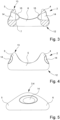
- FIGS. 1 to 5 show a vaginal pessary 1 according to a first embodiment, which is used as a vaginally insertable support structure in cases of prolapse, for example after childbirth and/or as a recovery or fixation aid.
- the vaginal pessary 1 has a circumferentially closed base body 2, which is designed or dimensioned for vaginal insertion for the purpose of support in the introitus area (entrance to the vagina) and/or in the case of a prolapsed uterus.
- the base body 2 has two lateral side wall sections 3, 4, a front or anterior wall section 5 and a rear, posterior wall section 6.
- the anterior wall section 5 is in an orientation or alignment directed towards the front of the body, whereas the rear or posterior wall section 6 is in an orientation or alignment directed towards the back or back of the body.
- the lateral side wall sections 3, 4 located between the anterior wall section 5 and the posterior wall section 6 are correspondingly assigned to opposite sides of the body, i.e. the left or right side of the body, of a patient.
- the base body 2 lies directly or circumferentially on adjacent tissue sections, in particular in such a way that body areas or organs to be supported, such as the uterus, are held or supported in the opposite direction to the direction of gravity by means of the vaginal pessary 1 or the base body 2.
- the base body 2 has a central opening 7, which in a cross-sectional view transverse to the height of the base body 2 is limited by a closed, inner contour line 8 of the wall sections 3, 4, 5 and 6.
- the cross-sectional view transverse to the height of the base body 2 is ultimately parallel to the Fig. 2 shown top view of the base body 2.
- the inner contour line 8 defines an opening 7 which is essentially oval and deviates from the circular shape, as shown in Fig. 2 visible.
- the deviation from the circular shape can ultimately be arbitrarily designed, whereby circular contour sections can be provided along the inner contour line 8. However, at least one section is then provided along the inner contour line 8 in such a way that, in particular with respect to the Fig. 2 shown top view of the base body 2, an opening 7 deviating from the circular shape is created.
- the opening 7 deviating from the circular shape can be asymmetrical and ultimately present as any oval in order to form an inner contour line 8 deviating from the circular shape.
- the inner contour line 8 is formed symmetrically to a central longitudinal axis 9 of the base body 2 and has, in particular, a substantially egg-shaped course.
- the contour line 8 has a pointed or short end on the side of the anterior wall section 5 and a long or blunt end on the side of the posterior wall section 6. Accordingly, the opening 7 in the region of the anterior wall section 5 has a smaller width, i.e. opening width, than in the region of the posterior wall section 6.
- the different width of the opening 7 is to be understood in particular in relation to a central transverse axis 10 of the opening 7 and/or of the base body 2 running transversely to the central longitudinal axis 9.
- the opening 7 in the region of the anterior wall section 5 has a reduced opening width b1 than in the region of the posterior wall section 6 with a larger width b2.
- the width of the opening 7 decreases towards the anterior wall section 5, whereas the width initially increases starting from the central transverse axis 10 towards the posterior wall section 6 and then greatly reduces immediately in front of the posterior wall section 6.
- the base body 2 has an outer contour line 11 opposite the inner contour line 8, wherein the outer contour line 11 at least substantially and/or partially follows the course of the inner contour line 8.
- the base body 2 is at least substantially ring-shaped with contour lines 8, 11 that are adapted to one another, in particular at least partially parallel to one another.
- the inner contour line 8 and/or the outer contour line 11 is/are at least essentially mirror-symmetrical to the central longitudinal axis 9 and/or to the central transverse axis 10 of the base body 2.
- a preferably egg-shaped opening 7 is provided in the case of mirror symmetry in relation to the central longitudinal axis 9, a preferably egg-shaped opening 7 is provided. If there is mirror symmetry to both central axes 9, 10, the opening 7 or the contour lines 8, 11 are preferably elliptical.
- the shape to be selected is therefore varied and can be individually adapted with regard to the intended application.
- the opposite side wall sections 3, 4 are preferably substantially uniformly convexly curved, in particular wherein the inner contour line 8 and the outer contour line 11 in the region of the lateral side wall sections 3, 4 are each uniformly convexly curved.
- the thickness of the wall sections decreases starting from a proximal outer side 12 of the base body 2 in the direction of a distal outer side 13 of the base body 2.
- the proximal outer side 12 is directed towards the middle of the body when inserted, whereas the distal outer side 13 is directed away from the middle of the body.
- the thickness of the base body 2 decreasing towards the distal outer side 13 allows further improvement or adaptation of the base body 2 in the area of use, in particular with regard to a tight contact of the base body 2 with the adjacent tissue. This ensures secure support of the tissue sections on the vaginal pessary 1.
- the base body 2 has a height that preferably changes continuously in the circumferential direction. With a constantly changing height, preferably no abrupt transition or no abrupt change in the height in the circumferential direction of the base body 2 is provided.
- the side wall sections 3, 4 are raised relative to the anterior wall section 5 and/or the posterior wall section 6.
- the side wall sections 3, 4 have the same maximum height.
- the lateral side wall sections 3, 4 have tabs with an arched upper side that protrude from the posterior wall section 5 and the anterior wall section 6. This facilitates the insertion of the base body 2 into the vagina.
- the lateral side wall sections 3, 4 can, however, also have different heights.
- the posterior wall section 5 and the anterior wall section 6 preferably have the same height, which is reduced, in particular minimal, compared to the side wall sections 3, 4. However, a different height between the anterior wall section 5 and the posterior wall section 6 is also possible.
- the base body 2 has a pocket-shaped recess 14 open on the outside of the base body 2 in order to form a better attachment for adjacent tissue in the inserted state of the vaginal pessary 1.
- the side walls 3, 4 each have a recess 14 which is designed to project radially inwards and/or radially into the opening 7, as in Fig. 2 shown.
- the aspect of the pocket-shaped depression 14 is realized in conjunction with an egg-shaped inner contour line 8.
- improved adaptability and at the same time secure connection of the vaginal pessary 1 can be achieved.
- Fig. 3 clarifies that the depressions 14 on the inside of the base body 2, namely on the side of the central opening 7, are closed.
- the depressions 14 on the inside of the base body 2 are delimited by a further or thin-walled wall section 15, which has a reduced material thickness and/or elasticity compared to the wall sections adjoining the depressions 14, preferably side wall sections 3, 4 of the base body 2.
- the depressions 14 on the wall sections 15 are particularly preferably turned out inwards.
- the thin-walled wall section 15 has a material thickness reduced by at least 40%, preferably at least 60%, particularly preferably at least 80%, very particularly preferably at least 90%, compared to the wall section adjacent to the recess 14, preferably an associated side wall section 3, 4.
- a reduction in the suction volume within the recesses 14 can be formed prior to the use state in order to achieve a suction effect on this basis when the wall sections 15 align themselves radially inwards again in the use state due to their elasticity and a negative pressure builds up within the recesses 14.
- the thin-walled wall sections 15 preferably have, in particular in the center, a thickness in the range from 0.1 mm to 4 mm, preferably from 0.5 mm to 3 mm, in particular from 0.5 mm to 2 mm, particularly preferably from 0.5 mm to 1 mm.
- the base body 2 can be manufactured by conventional production processes, for example by injection molding, casting and/or pressing with an elastomeric plastic and/or silicone.
- the base body 2 has a height that changes continuously in the circumferential direction, with a minimum height being reached at the anterior wall section 5 and a maximum height being reached at the posterior wall section 6.
- the constantly changing height is preferably to be understood in relation to the distal outer side 13 of the base body 2, with the proximal outer side 12 preferably having a constant height and/or providing small changes in height in the circumferential direction.
- the distal outer side 13 or upper side of the base body 2 is preferably bevelled.
- vaginal pessary 1 According to the second embodiment.
- the vaginal pessary 1 according to the second embodiment has a central opening 7, the inner contour line 8 of the wall sections 3, 4, 5 and 6 has a substantially oval shape deviating from the circular shape.
- the third embodiment of the vaginal pessary 1 according to the invention shown essentially corresponds to the second embodiment, wherein the base body 2 has more than two, in the example shown three, recesses 14. There is one recess 14 on each of the opposite side wall sections 3, 4. In addition, a further recess 14 is also arranged on the posterior wall section 6.
- the depressions 14 can be of different sizes and/or have different accommodating volumes. Particularly preferably, the depressions 14 associated with the side walls 3, 4 are of the same size, whereas the depression 14 associated with the posterior wall section 6 has a larger accommodating volume.
- At least one recess 14 is opened radially or on the inside.
- each, recess 14 has an opening 16, as in Fig. 11 illustrated.
- the opening 16 enables fluid to drain out of the base body 2.
- the contour line 8 is essentially straight in the area of the opposite side wall sections 3, 4. However, a preferably slightly convex design of the contour line 8 in the area of the opposite side wall sections 3, 4 is also possible, with a trapezoidal opening 17 still being present.
- the contour line 8 is correspondingly convexly curved in the area of the anterior wall section 5 and the posterior wall section 6.
- a straight-line design of the anterior and/or posterior wall section 5, 6 is also possible, in particular in order to form an exactly trapezoidal inner contour line 8 or central opening 17.
- a further notch 18 is also provided on the side wall sections 3, 4.
- the posterior wall section 6 and the side wall sections 3, 4 have the same maximum height.
- the posterior wall section 6 together with the side wall sections 3, 4 forms a plateau region.
- the minimum height of the base body 2 is present at the anterior wall section 5, in particular wherein, starting from the anterior wall section 5, the height of the base body 2 increases on both sides in the direction of the side wall sections 3, 4 and finally reaches the maximum height at the side wall sections 3, 4.
- the base body 2 has a length in the range of 55 to 90 mm, preferably in the range of 60 to 75 mm.
- the base body 2 has a maximum height in the range of 15 to 45 mm, preferably in the range of 25 to 35 mm.
- the maximum width, i.e. opening width, of the opening 7 and/or 17 is in the range of 30 to 50 mm, preferably in the range of 35 to 40 mm.
- the base body 2 has a front, preferably bead-like, reinforcement, in particular wherein the reinforcement is formed on the anterior wall section 5.
- the recess 14 or the receiving volume of the recess 14 is semi-elliptical and/or dome-shaped.
- the receiving volume can also be hemispherical and/or semi-elliptical.
Landscapes
- Health & Medical Sciences (AREA)
- Urology & Nephrology (AREA)
- Public Health (AREA)
- Life Sciences & Earth Sciences (AREA)
- Veterinary Medicine (AREA)
- Engineering & Computer Science (AREA)
- Biomedical Technology (AREA)
- Heart & Thoracic Surgery (AREA)
- Vascular Medicine (AREA)
- General Health & Medical Sciences (AREA)
- Animal Behavior & Ethology (AREA)
- Oral & Maxillofacial Surgery (AREA)
- Cardiology (AREA)
- Transplantation (AREA)
- Reproductive Health (AREA)
- Prostheses (AREA)
- Orthopedics, Nursing, And Contraception (AREA)
Applications Claiming Priority (2)
| Application Number | Priority Date | Filing Date | Title |
|---|---|---|---|
| DE102023115232 | 2023-06-12 | ||
| DE102023132833.6A DE102023132833A1 (de) | 2023-06-12 | 2023-11-24 | Vaginalpessar |
Publications (4)
| Publication Number | Publication Date |
|---|---|
| EP4477195A2 true EP4477195A2 (fr) | 2024-12-18 |
| EP4477195A3 EP4477195A3 (fr) | 2025-02-12 |
| EP4477195C0 EP4477195C0 (fr) | 2026-01-21 |
| EP4477195B1 EP4477195B1 (fr) | 2026-01-21 |
Family
ID=91530250
Family Applications (1)
| Application Number | Title | Priority Date | Filing Date |
|---|---|---|---|
| EP24181313.8A Active EP4477195B1 (fr) | 2023-06-12 | 2024-06-11 | Pessaire vaginal |
Country Status (2)
| Country | Link |
|---|---|
| US (1) | US20240407941A1 (fr) |
| EP (1) | EP4477195B1 (fr) |
Family Cites Families (5)
| Publication number | Priority date | Publication date | Assignee | Title |
|---|---|---|---|---|
| GB670349A (en) * | 1949-04-20 | 1952-04-16 | Arthur Henry Dodd | An improved surgical pessary |
| US4858624A (en) * | 1988-02-24 | 1989-08-22 | Vance Products Incorporated D/B/A/ Cook Urological Incorporated And Cook Ob/Gyn | Device and method for intravaginal, barrier-type prevention of conception and infection |
| DE202012001380U1 (de) * | 2012-02-08 | 2012-03-15 | Bernd Hamann | Cerclage-Stützpessar |
| WO2017152029A1 (fr) * | 2016-03-04 | 2017-09-08 | The Trustees Of Columbia University In The City Of New York | Dispositifs et procédés pour empêcher une naissance prématurée |
| NL2025355B1 (en) * | 2020-04-16 | 2021-10-26 | Perfect Pessary B V | Pessary |
-
2024
- 2024-06-11 EP EP24181313.8A patent/EP4477195B1/fr active Active
- 2024-06-11 US US18/739,611 patent/US20240407941A1/en active Pending
Non-Patent Citations (7)
| Title |
|---|
| DIETZ HPWALSH CSUBRAMANIAM NFRIEDMAN T: "Levator avulsion and vaginal parity: do subsequent vaginal births matter?", INT UROGYNECOL J, vol. 31, no. 11, 2020, pages 2311 - 5, XP037270017, DOI: 10.1007/s00192-020-04330-4 |
| HARVEY MALEMIEUX MCROBERT MSCHULZ JA: "Guideline No. 411: Vaginal Pessary Use", J OBSTET GYNAECOL CAN, vol. 43, no. 2, 2021, pages 255 - 66 |
| HILDE GSTAER-JENSEN JSIAFARIKAS FELLSTRÖM M: "B0 K: Postpartum pelvic floor muscle training, levator ani avulsion and levator hiatus area: a randomized trial", INT UROGYNECOL J, vol. 34, 2023, pages 413 - 23 |
| LONE FTHAKAR RSULTAN AH: "One-year prospective comparison of vaginal pessaries and surgery for pelvic organ prolapse using the validated ICIQ-VS and ICIQ-UI (SF) questionnaires", INT UROGYNECOL J, vol. 26, no. 9, 2015, pages 1305 - 12 |
| NATIONAL INSTITUTE FOR HEALTH AND CARE EXCELLENCE: "Urinary incontinence and pelvic organ prolapse in women: management", BJU INT, vol. 123, 2019, pages 777 - 803 |
| SANTE HAD, PROLAPSUS GENITAL DE LA FEMME - DES SOLUTIONS POUR LE TRAITER, 21 December 2022 (2022-12-21), Retrieved from the Internet <URL:https://www.has-sante.fr/upload/docs/application/pdf/2022-04/reco443_fiche_patient_principale_prolapsus__cd_2022_04_28_v0.pdf> |
| TUNN RALBRICH SBEILECKE KKOCISZEWSKI JLINDIG-KNOPKE CREISENAUER C ET AL., INTERDISCIPLINARY S2K GUIDELINE: SONOGRAPHY IN UROGYNECOLOGY, vol. 74, no. 12, 2014, pages 1093 - 8 |
Also Published As
| Publication number | Publication date |
|---|---|
| EP4477195C0 (fr) | 2026-01-21 |
| US20240407941A1 (en) | 2024-12-12 |
| EP4477195A3 (fr) | 2025-02-12 |
| EP4477195B1 (fr) | 2026-01-21 |
Similar Documents
| Publication | Publication Date | Title |
|---|---|---|
| EP0975385B1 (fr) | Dispositif de preparation et de facilitation de l'accouchement et gymnastique preparatoire | |
| DE69928272T2 (de) | Ausdehnbare schlinge zur behandlung von harninkontinenz | |
| DE2320250A1 (de) | Abortus erleichternde vorrichtung | |
| EP0810001B1 (fr) | Dispositif de traitement des troubles pour vider la vessie chez l'homme et la femme | |
| DE69213441T2 (de) | Analsphinkterprothese | |
| DE69730533T2 (de) | Irrigationsvorrichtung | |
| DE2513018A1 (de) | Cervikal-dilator | |
| DE112009001110B4 (de) | Stift zur hygienischen und/oder medizinischen Verwendung im Analbereich | |
| EP0301292A1 (fr) | Fermeture pour un urètre mâle | |
| WO1984003619A1 (fr) | Pessaire tubaire | |
| DE69625063T2 (de) | Harninkontinenzvorrichtung für frauen | |
| DE102004052139A1 (de) | Implantierbare Vorrichtung und Verfahren zur Behandlung der Stuhlinkontinenz | |
| EP4477195B1 (fr) | Pessaire vaginal | |
| DE202023106963U1 (de) | Vaginalpessar | |
| DE102023132833A1 (de) | Vaginalpessar | |
| EP3048996B1 (fr) | Dispositif destiné à être utilisé pour traiter des saignements utérins | |
| DE69933548T2 (de) | Ligatur-system mit grösserer dehnbarkeit, längerer haltbarkeit und grösseren ligatur-eigenschaften | |
| DE2161576A1 (de) | In trauterine Kontrazeptionseinlage | |
| DE2913036A1 (de) | Krallenpessar | |
| DE3720346A1 (de) | Haemorrhoidenbehandlungsgeraet | |
| DE69621433T2 (de) | Transcervicale infusionspipette | |
| EP3065678B1 (fr) | Pessaire thérapeutique | |
| DE10203094B4 (de) | Besteck zur Gebärmutterhalspassage beim Nashorn, Flusspferd, Tapir, Okapi und bei der Giraffe | |
| DE19925156C1 (de) | Dilatationsvorrichtung zur Aufweitung von Verengungen im Bereich der Haut, insbesondere zur Behandlung von Phimose | |
| DE10217787C1 (de) | Verhütungsmittel zum Einsetzen in die männliche Harnröhre |
Legal Events
| Date | Code | Title | Description |
|---|---|---|---|
| PUAI | Public reference made under article 153(3) epc to a published international application that has entered the european phase |
Free format text: ORIGINAL CODE: 0009012 |
|
| STAA | Information on the status of an ep patent application or granted ep patent |
Free format text: STATUS: THE APPLICATION HAS BEEN PUBLISHED |
|
| AK | Designated contracting states |
Kind code of ref document: A2 Designated state(s): AL AT BE BG CH CY CZ DE DK EE ES FI FR GB GR HR HU IE IS IT LI LT LU LV MC ME MK MT NL NO PL PT RO RS SE SI SK SM TR |
|
| PUAL | Search report despatched |
Free format text: ORIGINAL CODE: 0009013 |
|
| AK | Designated contracting states |
Kind code of ref document: A3 Designated state(s): AL AT BE BG CH CY CZ DE DK EE ES FI FR GB GR HR HU IE IS IT LI LT LU LV MC ME MK MT NL NO PL PT RO RS SE SI SK SM TR |
|
| RIC1 | Information provided on ipc code assigned before grant |
Ipc: A61F 6/08 20060101AFI20250103BHEP |
|
| STAA | Information on the status of an ep patent application or granted ep patent |
Free format text: STATUS: REQUEST FOR EXAMINATION WAS MADE |
|
| REG | Reference to a national code |
Ref country code: DE Ref legal event code: R079 Free format text: PREVIOUS MAIN CLASS: A61F0006080000 Ipc: A61F0002000000 Ref country code: DE Ref legal event code: R079 Ref document number: 502024000634 Country of ref document: DE Free format text: PREVIOUS MAIN CLASS: A61F0006080000 Ipc: A61F0002000000 |
|
| 17P | Request for examination filed |
Effective date: 20250812 |
|
| GRAP | Despatch of communication of intention to grant a patent |
Free format text: ORIGINAL CODE: EPIDOSNIGR1 |
|
| STAA | Information on the status of an ep patent application or granted ep patent |
Free format text: STATUS: GRANT OF PATENT IS INTENDED |
|
| RIC1 | Information provided on ipc code assigned before grant |
Ipc: A61F 2/00 20060101AFI20250905BHEP Ipc: A61F 6/08 20060101ALI20250905BHEP |
|
| INTG | Intention to grant announced |
Effective date: 20251007 |
|
| GRAS | Grant fee paid |
Free format text: ORIGINAL CODE: EPIDOSNIGR3 |
|
| GRAA | (expected) grant |
Free format text: ORIGINAL CODE: 0009210 |
|
| STAA | Information on the status of an ep patent application or granted ep patent |
Free format text: STATUS: THE PATENT HAS BEEN GRANTED |
|
| AK | Designated contracting states |
Kind code of ref document: B1 Designated state(s): AL AT BE BG CH CY CZ DE DK EE ES FI FR GB GR HR HU IE IS IT LI LT LU LV MC ME MK MT NL NO PL PT RO RS SE SI SK SM TR |
|
| REG | Reference to a national code |
Ref country code: CH Ref legal event code: F10 Free format text: ST27 STATUS EVENT CODE: U-0-0-F10-F00 (AS PROVIDED BY THE NATIONAL OFFICE) Effective date: 20260121 |
|
| REG | Reference to a national code |
Ref country code: DE Ref legal event code: R096 Ref document number: 502024000634 Country of ref document: DE |
|
| REG | Reference to a national code |
Ref country code: CH Ref legal event code: R17 Free format text: ST27 STATUS EVENT CODE: U-0-0-R10-R17 (AS PROVIDED BY THE NATIONAL OFFICE) Effective date: 20260219 |
|
| REG | Reference to a national code |
Ref country code: IE Ref legal event code: FG4D Free format text: LANGUAGE OF EP DOCUMENT: GERMAN |
|
| U01 | Request for unitary effect filed |
Effective date: 20260217 |
|
| U07 | Unitary effect registered |
Designated state(s): AT BE BG DE DK EE FI FR IT LT LU LV MT NL PT RO SE SI Effective date: 20260220 |