EP4477641A1 - Procédé de production d'alcool par alcoxycarbonylation de di-isobutène par distillation préalable et hydrogénation subséquente - Google Patents
Procédé de production d'alcool par alcoxycarbonylation de di-isobutène par distillation préalable et hydrogénation subséquente Download PDFInfo
- Publication number
- EP4477641A1 EP4477641A1 EP23179203.7A EP23179203A EP4477641A1 EP 4477641 A1 EP4477641 A1 EP 4477641A1 EP 23179203 A EP23179203 A EP 23179203A EP 4477641 A1 EP4477641 A1 EP 4477641A1
- Authority
- EP
- European Patent Office
- Prior art keywords
- trimethylpent
- ene
- stream
- alcohol
- process according
- Prior art date
- Legal status (The legal status is an assumption and is not a legal conclusion. Google has not performed a legal analysis and makes no representation as to the accuracy of the status listed.)
- Pending
Links
- 238000004821 distillation Methods 0.000 title claims abstract description 91
- LFQSCWFLJHTTHZ-UHFFFAOYSA-N Ethanol Chemical compound CCO LFQSCWFLJHTTHZ-UHFFFAOYSA-N 0.000 title claims abstract description 73
- 238000007083 alkoxycarbonylation reaction Methods 0.000 title claims abstract description 40
- 238000005984 hydrogenation reaction Methods 0.000 title claims description 21
- 238000004519 manufacturing process Methods 0.000 title description 9
- FXNDIJDIPNCZQJ-UHFFFAOYSA-N 2,4,4-trimethylpent-1-ene Chemical compound CC(=C)CC(C)(C)C FXNDIJDIPNCZQJ-UHFFFAOYSA-N 0.000 claims abstract description 95
- 238000000034 method Methods 0.000 claims abstract description 51
- 150000002148 esters Chemical class 0.000 claims abstract description 30
- 239000002253 acid Substances 0.000 claims abstract description 22
- 239000002815 homogeneous catalyst Substances 0.000 claims abstract description 19
- UGFAIRIUMAVXCW-UHFFFAOYSA-N Carbon monoxide Chemical compound [O+]#[C-] UGFAIRIUMAVXCW-UHFFFAOYSA-N 0.000 claims abstract description 18
- 229910002091 carbon monoxide Inorganic materials 0.000 claims abstract description 17
- 239000003446 ligand Substances 0.000 claims abstract description 14
- 229910052751 metal Inorganic materials 0.000 claims abstract description 11
- 239000002184 metal Substances 0.000 claims abstract description 11
- OAICVXFJPJFONN-UHFFFAOYSA-N Phosphorus Chemical compound [P] OAICVXFJPJFONN-UHFFFAOYSA-N 0.000 claims abstract description 8
- 150000001875 compounds Chemical class 0.000 claims abstract description 8
- 229910052698 phosphorus Inorganic materials 0.000 claims abstract description 8
- 239000011574 phosphorus Substances 0.000 claims abstract description 8
- 230000000737 periodic effect Effects 0.000 claims abstract description 6
- 239000000203 mixture Substances 0.000 claims description 40
- 238000000926 separation method Methods 0.000 claims description 40
- 238000006317 isomerization reaction Methods 0.000 claims description 38
- LAAVYEUJEMRIGF-UHFFFAOYSA-N 2,4,4-trimethylpent-2-ene Chemical compound CC(C)=CC(C)(C)C LAAVYEUJEMRIGF-UHFFFAOYSA-N 0.000 claims description 37
- 238000006243 chemical reaction Methods 0.000 claims description 25
- 239000003456 ion exchange resin Substances 0.000 claims description 21
- 229920003303 ion-exchange polymer Polymers 0.000 claims description 21
- 239000012528 membrane Substances 0.000 claims description 21
- 239000010457 zeolite Substances 0.000 claims description 16
- OKKJLVBELUTLKV-UHFFFAOYSA-N Methanol Chemical compound OC OKKJLVBELUTLKV-UHFFFAOYSA-N 0.000 claims description 12
- 229910021536 Zeolite Inorganic materials 0.000 claims description 12
- 150000001298 alcohols Chemical class 0.000 claims description 12
- HNPSIPDUKPIQMN-UHFFFAOYSA-N dioxosilane;oxo(oxoalumanyloxy)alumane Chemical compound O=[Si]=O.O=[Al]O[Al]=O HNPSIPDUKPIQMN-UHFFFAOYSA-N 0.000 claims description 12
- UFHFLCQGNIYNRP-UHFFFAOYSA-N Hydrogen Chemical compound [H][H] UFHFLCQGNIYNRP-UHFFFAOYSA-N 0.000 claims description 10
- 125000004432 carbon atom Chemical group C* 0.000 claims description 10
- 239000012043 crude product Substances 0.000 claims description 10
- 239000012263 liquid product Substances 0.000 claims description 10
- NWUYHJFMYQTDRP-UHFFFAOYSA-N 1,2-bis(ethenyl)benzene;1-ethenyl-2-ethylbenzene;styrene Chemical compound C=CC1=CC=CC=C1.CCC1=CC=CC=C1C=C.C=CC1=CC=CC=C1C=C NWUYHJFMYQTDRP-UHFFFAOYSA-N 0.000 claims description 9
- 239000001257 hydrogen Substances 0.000 claims description 9
- 229910052739 hydrogen Inorganic materials 0.000 claims description 9
- 238000006277 sulfonation reaction Methods 0.000 claims description 9
- 239000002638 heterogeneous catalyst Substances 0.000 claims description 8
- LRHPLDYGYMQRHN-UHFFFAOYSA-N N-Butanol Chemical compound CCCCO LRHPLDYGYMQRHN-UHFFFAOYSA-N 0.000 claims description 6
- 229920001577 copolymer Polymers 0.000 claims description 4
- 238000002425 crystallisation Methods 0.000 claims description 3
- 230000008025 crystallization Effects 0.000 claims description 3
- 238000000605 extraction Methods 0.000 claims description 3
- 238000002156 mixing Methods 0.000 claims description 3
- BDERNNFJNOPAEC-UHFFFAOYSA-N propan-1-ol Chemical compound CCCO BDERNNFJNOPAEC-UHFFFAOYSA-N 0.000 claims description 3
- 238000010626 work up procedure Methods 0.000 claims description 3
- ISWSIDIOOBJBQZ-UHFFFAOYSA-N Phenol Chemical compound OC1=CC=CC=C1 ISWSIDIOOBJBQZ-UHFFFAOYSA-N 0.000 claims description 2
- 125000002485 formyl group Chemical class [H]C(*)=O 0.000 claims 1
- 239000003054 catalyst Substances 0.000 description 24
- KDLHZDBZIXYQEI-UHFFFAOYSA-N Palladium Chemical compound [Pd] KDLHZDBZIXYQEI-UHFFFAOYSA-N 0.000 description 21
- 239000000047 product Substances 0.000 description 15
- 239000000463 material Substances 0.000 description 13
- 238000009835 boiling Methods 0.000 description 9
- 239000007789 gas Substances 0.000 description 9
- 239000004696 Poly ether ether ketone Substances 0.000 description 7
- 239000006227 byproduct Substances 0.000 description 7
- 229910052763 palladium Inorganic materials 0.000 description 7
- 229920006260 polyaryletherketone Polymers 0.000 description 7
- 229920002530 polyetherether ketone Polymers 0.000 description 7
- 238000012545 processing Methods 0.000 description 7
- VQTUBCCKSQIDNK-UHFFFAOYSA-N Isobutene Chemical compound CC(C)=C VQTUBCCKSQIDNK-UHFFFAOYSA-N 0.000 description 6
- QAOWNCQODCNURD-UHFFFAOYSA-N Sulfuric acid Chemical compound OS(O)(=O)=O QAOWNCQODCNURD-UHFFFAOYSA-N 0.000 description 6
- 229920000642 polymer Polymers 0.000 description 6
- 238000010992 reflux Methods 0.000 description 6
- JOXIMZWYDAKGHI-UHFFFAOYSA-N toluene-4-sulfonic acid Chemical compound CC1=CC=C(S(O)(=O)=O)C=C1 JOXIMZWYDAKGHI-UHFFFAOYSA-N 0.000 description 6
- 239000002841 Lewis acid Substances 0.000 description 5
- 238000007037 hydroformylation reaction Methods 0.000 description 5
- 230000010354 integration Effects 0.000 description 5
- 150000007517 lewis acids Chemical class 0.000 description 5
- 239000012466 permeate Substances 0.000 description 5
- 238000010926 purge Methods 0.000 description 5
- 239000012465 retentate Substances 0.000 description 5
- MYRTYDVEIRVNKP-UHFFFAOYSA-N 1,2-Divinylbenzene Chemical compound C=CC1=CC=CC=C1C=C MYRTYDVEIRVNKP-UHFFFAOYSA-N 0.000 description 4
- IJGRMHOSHXDMSA-UHFFFAOYSA-N Atomic nitrogen Chemical compound N#N IJGRMHOSHXDMSA-UHFFFAOYSA-N 0.000 description 4
- AFVFQIVMOAPDHO-UHFFFAOYSA-N Methanesulfonic acid Chemical compound CS(O)(=O)=O AFVFQIVMOAPDHO-UHFFFAOYSA-N 0.000 description 4
- 101001073211 Solanum lycopersicum Suberization-associated anionic peroxidase 2 Proteins 0.000 description 4
- PPBRXRYQALVLMV-UHFFFAOYSA-N Styrene Chemical compound C=CC1=CC=CC=C1 PPBRXRYQALVLMV-UHFFFAOYSA-N 0.000 description 4
- 150000007513 acids Chemical class 0.000 description 4
- 150000001299 aldehydes Chemical class 0.000 description 4
- 150000001335 aliphatic alkanes Chemical class 0.000 description 4
- 230000015572 biosynthetic process Effects 0.000 description 4
- 238000005810 carbonylation reaction Methods 0.000 description 4
- 229920001429 chelating resin Polymers 0.000 description 4
- 238000009833 condensation Methods 0.000 description 4
- 230000005494 condensation Effects 0.000 description 4
- 238000001816 cooling Methods 0.000 description 4
- 238000013461 design Methods 0.000 description 4
- 238000009826 distribution Methods 0.000 description 4
- 239000007788 liquid Substances 0.000 description 4
- 238000012856 packing Methods 0.000 description 4
- CHRJZRDFSQHIFI-UHFFFAOYSA-N 1,2-bis(ethenyl)benzene;styrene Chemical compound C=CC1=CC=CC=C1.C=CC1=CC=CC=C1C=C CHRJZRDFSQHIFI-UHFFFAOYSA-N 0.000 description 3
- UHOVQNZJYSORNB-UHFFFAOYSA-N Benzene Chemical compound C1=CC=CC=C1 UHOVQNZJYSORNB-UHFFFAOYSA-N 0.000 description 3
- 239000004215 Carbon black (E152) Substances 0.000 description 3
- 101000579490 Solanum lycopersicum Suberization-associated anionic peroxidase 1 Proteins 0.000 description 3
- 230000006315 carbonylation Effects 0.000 description 3
- 239000002826 coolant Substances 0.000 description 3
- 238000010438 heat treatment Methods 0.000 description 3
- 229930195733 hydrocarbon Natural products 0.000 description 3
- 150000002430 hydrocarbons Chemical class 0.000 description 3
- 239000007791 liquid phase Substances 0.000 description 3
- JKDRQYIYVJVOPF-FDGPNNRMSA-L palladium(ii) acetylacetonate Chemical compound [Pd+2].C\C([O-])=C\C(C)=O.C\C([O-])=C\C(C)=O JKDRQYIYVJVOPF-FDGPNNRMSA-L 0.000 description 3
- 239000011148 porous material Substances 0.000 description 3
- 230000009257 reactivity Effects 0.000 description 3
- 238000003786 synthesis reaction Methods 0.000 description 3
- 238000012546 transfer Methods 0.000 description 3
- XLYOFNOQVPJJNP-UHFFFAOYSA-N water Substances O XLYOFNOQVPJJNP-UHFFFAOYSA-N 0.000 description 3
- CYPYTURSJDMMMP-WVCUSYJESA-N (1e,4e)-1,5-diphenylpenta-1,4-dien-3-one;palladium Chemical compound [Pd].[Pd].C=1C=CC=CC=1\C=C\C(=O)\C=C\C1=CC=CC=C1.C=1C=CC=CC=1\C=C\C(=O)\C=C\C1=CC=CC=C1.C=1C=CC=CC=1\C=C\C(=O)\C=C\C1=CC=CC=C1 CYPYTURSJDMMMP-WVCUSYJESA-N 0.000 description 2
- RYGMFSIKBFXOCR-UHFFFAOYSA-N Copper Chemical compound [Cu] RYGMFSIKBFXOCR-UHFFFAOYSA-N 0.000 description 2
- LCGLNKUTAGEVQW-UHFFFAOYSA-N Dimethyl ether Chemical compound COC LCGLNKUTAGEVQW-UHFFFAOYSA-N 0.000 description 2
- NBIIXXVUZAFLBC-UHFFFAOYSA-N Phosphoric acid Chemical compound OP(O)(O)=O NBIIXXVUZAFLBC-UHFFFAOYSA-N 0.000 description 2
- 150000001336 alkenes Chemical class 0.000 description 2
- VSCWAEJMTAWNJL-UHFFFAOYSA-K aluminium trichloride Chemical compound Cl[Al](Cl)Cl VSCWAEJMTAWNJL-UHFFFAOYSA-K 0.000 description 2
- 239000002585 base Substances 0.000 description 2
- FKOASGGZYSYPBI-UHFFFAOYSA-K bis(trifluoromethylsulfonyloxy)alumanyl trifluoromethanesulfonate Chemical compound [Al+3].[O-]S(=O)(=O)C(F)(F)F.[O-]S(=O)(=O)C(F)(F)F.[O-]S(=O)(=O)C(F)(F)F FKOASGGZYSYPBI-UHFFFAOYSA-K 0.000 description 2
- WTEOIRVLGSZEPR-UHFFFAOYSA-N boron trifluoride Chemical compound FB(F)F WTEOIRVLGSZEPR-UHFFFAOYSA-N 0.000 description 2
- 239000007795 chemical reaction product Substances 0.000 description 2
- 229910052802 copper Inorganic materials 0.000 description 2
- 239000010949 copper Substances 0.000 description 2
- 239000007857 degradation product Substances 0.000 description 2
- 239000000539 dimer Substances 0.000 description 2
- 238000006471 dimerization reaction Methods 0.000 description 2
- 150000002170 ethers Chemical class 0.000 description 2
- 238000001704 evaporation Methods 0.000 description 2
- 230000008020 evaporation Effects 0.000 description 2
- 239000012535 impurity Substances 0.000 description 2
- 238000009434 installation Methods 0.000 description 2
- 150000002576 ketones Chemical group 0.000 description 2
- 229940098779 methanesulfonic acid Drugs 0.000 description 2
- BDAGIHXWWSANSR-UHFFFAOYSA-N methanoic acid Natural products OC=O BDAGIHXWWSANSR-UHFFFAOYSA-N 0.000 description 2
- 238000006063 methoxycarbonylation reaction Methods 0.000 description 2
- 229910052757 nitrogen Inorganic materials 0.000 description 2
- JRZJOMJEPLMPRA-UHFFFAOYSA-N olefin Natural products CCCCCCCC=C JRZJOMJEPLMPRA-UHFFFAOYSA-N 0.000 description 2
- 150000002941 palladium compounds Chemical class 0.000 description 2
- VLTRZXGMWDSKGL-UHFFFAOYSA-N perchloric acid Chemical compound OCl(=O)(=O)=O VLTRZXGMWDSKGL-UHFFFAOYSA-N 0.000 description 2
- 239000002243 precursor Substances 0.000 description 2
- 239000011541 reaction mixture Substances 0.000 description 2
- 239000011347 resin Substances 0.000 description 2
- 229920005989 resin Polymers 0.000 description 2
- 150000003460 sulfonic acids Chemical class 0.000 description 2
- ITMCEJHCFYSIIV-UHFFFAOYSA-N triflic acid Chemical compound OS(=O)(=O)C(F)(F)F ITMCEJHCFYSIIV-UHFFFAOYSA-N 0.000 description 2
- UKSZBOKPHAQOMP-SVLSSHOZSA-N (1e,4e)-1,5-diphenylpenta-1,4-dien-3-one;palladium Chemical compound [Pd].C=1C=CC=CC=1\C=C\C(=O)\C=C\C1=CC=CC=C1.C=1C=CC=CC=1\C=C\C(=O)\C=C\C1=CC=CC=C1 UKSZBOKPHAQOMP-SVLSSHOZSA-N 0.000 description 1
- RRHPTXZOMDSKRS-PHFPKPIQSA-L (1z,5z)-cycloocta-1,5-diene;dichloropalladium Chemical compound Cl[Pd]Cl.C\1C\C=C/CC\C=C/1 RRHPTXZOMDSKRS-PHFPKPIQSA-L 0.000 description 1
- LDMOEFOXLIZJOW-UHFFFAOYSA-N 1-dodecanesulfonic acid Chemical compound CCCCCCCCCCCCS(O)(=O)=O LDMOEFOXLIZJOW-UHFFFAOYSA-N 0.000 description 1
- WAEOXIOXMKNFLQ-UHFFFAOYSA-N 1-methyl-4-prop-2-enylbenzene Chemical group CC1=CC=C(CC=C)C=C1 WAEOXIOXMKNFLQ-UHFFFAOYSA-N 0.000 description 1
- IGGDKDTUCAWDAN-UHFFFAOYSA-N 1-vinylnaphthalene Chemical compound C1=CC=C2C(C=C)=CC=CC2=C1 IGGDKDTUCAWDAN-UHFFFAOYSA-N 0.000 description 1
- COJYJCJUBHUSDJ-UHFFFAOYSA-N 2,3,5,5-tetramethylhexanal Chemical group CC(C)(C)CC(C)C(C)C=O COJYJCJUBHUSDJ-UHFFFAOYSA-N 0.000 description 1
- LXFQSRIDYRFTJW-UHFFFAOYSA-N 2,4,6-trimethylbenzenesulfonic acid Chemical compound CC1=CC(C)=C(S(O)(=O)=O)C(C)=C1 LXFQSRIDYRFTJW-UHFFFAOYSA-N 0.000 description 1
- ISRGONDNXBCDBM-UHFFFAOYSA-N 2-chlorostyrene Chemical compound ClC1=CC=CC=C1C=C ISRGONDNXBCDBM-UHFFFAOYSA-N 0.000 description 1
- WCBWZBSYSCYPTM-UHFFFAOYSA-N 2-hydroxypropane-2-sulfonic acid Chemical compound CC(C)(O)S(O)(=O)=O WCBWZBSYSCYPTM-UHFFFAOYSA-N 0.000 description 1
- XCJGLBWDZKLQCY-UHFFFAOYSA-N 2-methylpropane-2-sulfonic acid Chemical compound CC(C)(C)S(O)(=O)=O XCJGLBWDZKLQCY-UHFFFAOYSA-N 0.000 description 1
- WTPYRCJDOZVZON-UHFFFAOYSA-N 3,5,5-Trimethylhexanal Chemical group O=CCC(C)CC(C)(C)C WTPYRCJDOZVZON-UHFFFAOYSA-N 0.000 description 1
- OSWFIVFLDKOXQC-UHFFFAOYSA-N 4-(3-methoxyphenyl)aniline Chemical compound COC1=CC=CC(C=2C=CC(N)=CC=2)=C1 OSWFIVFLDKOXQC-UHFFFAOYSA-N 0.000 description 1
- JLBJTVDPSNHSKJ-UHFFFAOYSA-N 4-Methylstyrene Chemical compound CC1=CC=C(C=C)C=C1 JLBJTVDPSNHSKJ-UHFFFAOYSA-N 0.000 description 1
- 229910015900 BF3 Inorganic materials 0.000 description 1
- FGUUSXIOTUKUDN-IBGZPJMESA-N C1(=CC=CC=C1)N1C2=C(NC([C@H](C1)NC=1OC(=NN=1)C1=CC=CC=C1)=O)C=CC=C2 Chemical compound C1(=CC=CC=C1)N1C2=C(NC([C@H](C1)NC=1OC(=NN=1)C1=CC=CC=C1)=O)C=CC=C2 FGUUSXIOTUKUDN-IBGZPJMESA-N 0.000 description 1
- 239000004743 Polypropylene Substances 0.000 description 1
- KJTLSVCANCCWHF-UHFFFAOYSA-N Ruthenium Chemical compound [Ru] KJTLSVCANCCWHF-UHFFFAOYSA-N 0.000 description 1
- VYPSYNLAJGMNEJ-UHFFFAOYSA-N Silicium dioxide Chemical compound O=[Si]=O VYPSYNLAJGMNEJ-UHFFFAOYSA-N 0.000 description 1
- HCHKCACWOHOZIP-UHFFFAOYSA-N Zinc Chemical compound [Zn] HCHKCACWOHOZIP-UHFFFAOYSA-N 0.000 description 1
- 238000009825 accumulation Methods 0.000 description 1
- 150000001241 acetals Chemical class 0.000 description 1
- RBYGDVHOECIAFC-UHFFFAOYSA-L acetonitrile;palladium(2+);dichloride Chemical compound [Cl-].[Cl-].[Pd+2].CC#N.CC#N RBYGDVHOECIAFC-UHFFFAOYSA-L 0.000 description 1
- 230000000274 adsorptive effect Effects 0.000 description 1
- 125000003158 alcohol group Chemical group 0.000 description 1
- 125000000217 alkyl group Chemical group 0.000 description 1
- AZDRQVAHHNSJOQ-UHFFFAOYSA-N alumane Chemical compound [AlH3] AZDRQVAHHNSJOQ-UHFFFAOYSA-N 0.000 description 1
- 229910000147 aluminium phosphate Inorganic materials 0.000 description 1
- 125000003118 aryl group Chemical group 0.000 description 1
- PBGVMIDTGGTBFS-UHFFFAOYSA-N but-3-enylbenzene Chemical compound C=CCCC1=CC=CC=C1 PBGVMIDTGGTBFS-UHFFFAOYSA-N 0.000 description 1
- 229910052799 carbon Inorganic materials 0.000 description 1
- 238000012824 chemical production Methods 0.000 description 1
- 239000003426 co-catalyst Substances 0.000 description 1
- 230000006835 compression Effects 0.000 description 1
- 238000007906 compression Methods 0.000 description 1
- 239000000498 cooling water Substances 0.000 description 1
- 239000013256 coordination polymer Substances 0.000 description 1
- JGDFBJMWFLXCLJ-UHFFFAOYSA-N copper chromite Chemical compound [Cu]=O.[Cu]=O.O=[Cr]O[Cr]=O JGDFBJMWFLXCLJ-UHFFFAOYSA-N 0.000 description 1
- 230000001419 dependent effect Effects 0.000 description 1
- VURFVHCLMJOLKN-UHFFFAOYSA-N diphosphane Chemical class PP VURFVHCLMJOLKN-UHFFFAOYSA-N 0.000 description 1
- 238000007700 distillative separation Methods 0.000 description 1
- 230000000694 effects Effects 0.000 description 1
- 125000004185 ester group Chemical group 0.000 description 1
- 125000001033 ether group Chemical group 0.000 description 1
- 238000011049 filling Methods 0.000 description 1
- 239000012530 fluid Substances 0.000 description 1
- 235000019253 formic acid Nutrition 0.000 description 1
- 238000011065 in-situ storage Methods 0.000 description 1
- 150000002500 ions Chemical class 0.000 description 1
- 150000002739 metals Chemical class 0.000 description 1
- 150000004702 methyl esters Chemical class 0.000 description 1
- YACKEPLHDIMKIO-UHFFFAOYSA-N methylphosphonic acid Chemical compound CP(O)(O)=O YACKEPLHDIMKIO-UHFFFAOYSA-N 0.000 description 1
- IJDNQMDRQITEOD-UHFFFAOYSA-N n-butane Chemical compound CCCC IJDNQMDRQITEOD-UHFFFAOYSA-N 0.000 description 1
- 238000001728 nano-filtration Methods 0.000 description 1
- 239000003960 organic solvent Substances 0.000 description 1
- TWNQGVIAIRXVLR-UHFFFAOYSA-N oxo(oxoalumanyloxy)alumane Chemical compound O=[Al]O[Al]=O TWNQGVIAIRXVLR-UHFFFAOYSA-N 0.000 description 1
- LXNAVEXFUKBNMK-UHFFFAOYSA-N palladium(II) acetate Substances [Pd].CC(O)=O.CC(O)=O LXNAVEXFUKBNMK-UHFFFAOYSA-N 0.000 description 1
- PIBWKRNGBLPSSY-UHFFFAOYSA-L palladium(II) chloride Chemical compound Cl[Pd]Cl PIBWKRNGBLPSSY-UHFFFAOYSA-L 0.000 description 1
- YJVFFLUZDVXJQI-UHFFFAOYSA-L palladium(ii) acetate Chemical compound [Pd+2].CC([O-])=O.CC([O-])=O YJVFFLUZDVXJQI-UHFFFAOYSA-L 0.000 description 1
- 239000004033 plastic Substances 0.000 description 1
- 229920003023 plastic Polymers 0.000 description 1
- 229920001467 poly(styrenesulfonates) Polymers 0.000 description 1
- -1 polypropylene Polymers 0.000 description 1
- 229920001155 polypropylene Polymers 0.000 description 1
- 150000007519 polyprotic acids Chemical class 0.000 description 1
- 229910021426 porous silicon Inorganic materials 0.000 description 1
- 239000002244 precipitate Substances 0.000 description 1
- 238000012913 prioritisation Methods 0.000 description 1
- HJWLCRVIBGQPNF-UHFFFAOYSA-N prop-2-enylbenzene Chemical compound C=CCC1=CC=CC=C1 HJWLCRVIBGQPNF-UHFFFAOYSA-N 0.000 description 1
- 239000012429 reaction media Substances 0.000 description 1
- 238000004064 recycling Methods 0.000 description 1
- 229910052702 rhenium Inorganic materials 0.000 description 1
- WUAPFZMCVAUBPE-UHFFFAOYSA-N rhenium atom Chemical compound [Re] WUAPFZMCVAUBPE-UHFFFAOYSA-N 0.000 description 1
- 229910052703 rhodium Inorganic materials 0.000 description 1
- 239000010948 rhodium Substances 0.000 description 1
- MHOVAHRLVXNVSD-UHFFFAOYSA-N rhodium atom Chemical compound [Rh] MHOVAHRLVXNVSD-UHFFFAOYSA-N 0.000 description 1
- 229910052707 ruthenium Inorganic materials 0.000 description 1
- 239000007787 solid Substances 0.000 description 1
- 239000000243 solution Substances 0.000 description 1
- 230000000087 stabilizing effect Effects 0.000 description 1
- 230000008961 swelling Effects 0.000 description 1
- FAQYAMRNWDIXMY-UHFFFAOYSA-N trichloroborane Chemical compound ClB(Cl)Cl FAQYAMRNWDIXMY-UHFFFAOYSA-N 0.000 description 1
- JLTRXTDYQLMHGR-UHFFFAOYSA-N trimethylaluminium Chemical compound C[Al](C)C JLTRXTDYQLMHGR-UHFFFAOYSA-N 0.000 description 1
- OBAJXDYVZBHCGT-UHFFFAOYSA-N tris(pentafluorophenyl)borane Chemical compound FC1=C(F)C(F)=C(F)C(F)=C1B(C=1C(=C(F)C(F)=C(F)C=1F)F)C1=C(F)C(F)=C(F)C(F)=C1F OBAJXDYVZBHCGT-UHFFFAOYSA-N 0.000 description 1
- 229910052725 zinc Inorganic materials 0.000 description 1
- 239000011701 zinc Substances 0.000 description 1
Images
Classifications
-
- C—CHEMISTRY; METALLURGY
- C07—ORGANIC CHEMISTRY
- C07C—ACYCLIC OR CARBOCYCLIC COMPOUNDS
- C07C29/00—Preparation of compounds having hydroxy or O-metal groups bound to a carbon atom not belonging to a six-membered aromatic ring
- C07C29/132—Preparation of compounds having hydroxy or O-metal groups bound to a carbon atom not belonging to a six-membered aromatic ring by reduction of an oxygen containing functional group
- C07C29/136—Preparation of compounds having hydroxy or O-metal groups bound to a carbon atom not belonging to a six-membered aromatic ring by reduction of an oxygen containing functional group of >C=O containing groups, e.g. —COOH
- C07C29/147—Preparation of compounds having hydroxy or O-metal groups bound to a carbon atom not belonging to a six-membered aromatic ring by reduction of an oxygen containing functional group of >C=O containing groups, e.g. —COOH of carboxylic acids or derivatives thereof
- C07C29/149—Preparation of compounds having hydroxy or O-metal groups bound to a carbon atom not belonging to a six-membered aromatic ring by reduction of an oxygen containing functional group of >C=O containing groups, e.g. —COOH of carboxylic acids or derivatives thereof with hydrogen or hydrogen-containing gases
-
- C—CHEMISTRY; METALLURGY
- C07—ORGANIC CHEMISTRY
- C07C—ACYCLIC OR CARBOCYCLIC COMPOUNDS
- C07C11/00—Aliphatic unsaturated hydrocarbons
- C07C11/02—Alkenes
-
- C—CHEMISTRY; METALLURGY
- C07—ORGANIC CHEMISTRY
- C07C—ACYCLIC OR CARBOCYCLIC COMPOUNDS
- C07C29/00—Preparation of compounds having hydroxy or O-metal groups bound to a carbon atom not belonging to a six-membered aromatic ring
- C07C29/56—Preparation of compounds having hydroxy or O-metal groups bound to a carbon atom not belonging to a six-membered aromatic ring by isomerisation
-
- C—CHEMISTRY; METALLURGY
- C07—ORGANIC CHEMISTRY
- C07C—ACYCLIC OR CARBOCYCLIC COMPOUNDS
- C07C29/00—Preparation of compounds having hydroxy or O-metal groups bound to a carbon atom not belonging to a six-membered aromatic ring
- C07C29/74—Separation; Purification; Use of additives, e.g. for stabilisation
- C07C29/76—Separation; Purification; Use of additives, e.g. for stabilisation by physical treatment
-
- C—CHEMISTRY; METALLURGY
- C07—ORGANIC CHEMISTRY
- C07C—ACYCLIC OR CARBOCYCLIC COMPOUNDS
- C07C29/00—Preparation of compounds having hydroxy or O-metal groups bound to a carbon atom not belonging to a six-membered aromatic ring
- C07C29/74—Separation; Purification; Use of additives, e.g. for stabilisation
- C07C29/76—Separation; Purification; Use of additives, e.g. for stabilisation by physical treatment
- C07C29/78—Separation; Purification; Use of additives, e.g. for stabilisation by physical treatment by condensation or crystallisation
-
- C—CHEMISTRY; METALLURGY
- C07—ORGANIC CHEMISTRY
- C07C—ACYCLIC OR CARBOCYCLIC COMPOUNDS
- C07C29/00—Preparation of compounds having hydroxy or O-metal groups bound to a carbon atom not belonging to a six-membered aromatic ring
- C07C29/74—Separation; Purification; Use of additives, e.g. for stabilisation
- C07C29/76—Separation; Purification; Use of additives, e.g. for stabilisation by physical treatment
- C07C29/80—Separation; Purification; Use of additives, e.g. for stabilisation by physical treatment by distillation
-
- C—CHEMISTRY; METALLURGY
- C07—ORGANIC CHEMISTRY
- C07C—ACYCLIC OR CARBOCYCLIC COMPOUNDS
- C07C31/00—Saturated compounds having hydroxy or O-metal groups bound to acyclic carbon atoms
- C07C31/02—Monohydroxylic acyclic alcohols
-
- C—CHEMISTRY; METALLURGY
- C07—ORGANIC CHEMISTRY
- C07C—ACYCLIC OR CARBOCYCLIC COMPOUNDS
- C07C5/00—Preparation of hydrocarbons from hydrocarbons containing the same number of carbon atoms
- C07C5/22—Preparation of hydrocarbons from hydrocarbons containing the same number of carbon atoms by isomerisation
- C07C5/2206—Catalytic processes not covered by C07C5/23 - C07C5/31
- C07C5/222—Catalytic processes not covered by C07C5/23 - C07C5/31 with crystalline alumino-silicates, e.g. molecular sieves
-
- C—CHEMISTRY; METALLURGY
- C07—ORGANIC CHEMISTRY
- C07C—ACYCLIC OR CARBOCYCLIC COMPOUNDS
- C07C5/00—Preparation of hydrocarbons from hydrocarbons containing the same number of carbon atoms
- C07C5/22—Preparation of hydrocarbons from hydrocarbons containing the same number of carbon atoms by isomerisation
- C07C5/2206—Catalytic processes not covered by C07C5/23 - C07C5/31
- C07C5/2266—Catalytic processes not covered by C07C5/23 - C07C5/31 with hydrides or organic compounds
- C07C5/2273—Catalytic processes not covered by C07C5/23 - C07C5/31 with hydrides or organic compounds with ion-exchange resins
-
- C—CHEMISTRY; METALLURGY
- C07—ORGANIC CHEMISTRY
- C07C—ACYCLIC OR CARBOCYCLIC COMPOUNDS
- C07C67/00—Preparation of carboxylic acid esters
- C07C67/36—Preparation of carboxylic acid esters by reaction with carbon monoxide or formates
- C07C67/38—Preparation of carboxylic acid esters by reaction with carbon monoxide or formates by addition to an unsaturated carbon-to-carbon bond
-
- C—CHEMISTRY; METALLURGY
- C07—ORGANIC CHEMISTRY
- C07C—ACYCLIC OR CARBOCYCLIC COMPOUNDS
- C07C67/00—Preparation of carboxylic acid esters
- C07C67/48—Separation; Purification; Stabilisation; Use of additives
- C07C67/52—Separation; Purification; Stabilisation; Use of additives by change in the physical state, e.g. crystallisation
- C07C67/54—Separation; Purification; Stabilisation; Use of additives by change in the physical state, e.g. crystallisation by distillation
-
- C—CHEMISTRY; METALLURGY
- C07—ORGANIC CHEMISTRY
- C07C—ACYCLIC OR CARBOCYCLIC COMPOUNDS
- C07C69/00—Esters of carboxylic acids; Esters of carbonic or haloformic acids
- C07C69/02—Esters of acyclic saturated monocarboxylic acids having the carboxyl group bound to an acyclic carbon atom or to hydrogen
- C07C69/22—Esters of acyclic saturated monocarboxylic acids having the carboxyl group bound to an acyclic carbon atom or to hydrogen having three or more carbon atoms in the acid moiety
-
- C—CHEMISTRY; METALLURGY
- C07—ORGANIC CHEMISTRY
- C07C—ACYCLIC OR CARBOCYCLIC COMPOUNDS
- C07C7/00—Purification; Separation; Use of additives
- C07C7/04—Purification; Separation; Use of additives by distillation
-
- C—CHEMISTRY; METALLURGY
- C07—ORGANIC CHEMISTRY
- C07C—ACYCLIC OR CARBOCYCLIC COMPOUNDS
- C07C2529/00—Catalysts comprising molecular sieves
- C07C2529/04—Catalysts comprising molecular sieves having base-exchange properties, e.g. crystalline zeolites, pillared clays
- C07C2529/06—Crystalline aluminosilicate zeolites; Isomorphous compounds thereof
-
- C—CHEMISTRY; METALLURGY
- C07—ORGANIC CHEMISTRY
- C07C—ACYCLIC OR CARBOCYCLIC COMPOUNDS
- C07C2529/00—Catalysts comprising molecular sieves
- C07C2529/04—Catalysts comprising molecular sieves having base-exchange properties, e.g. crystalline zeolites, pillared clays
- C07C2529/06—Crystalline aluminosilicate zeolites; Isomorphous compounds thereof
- C07C2529/70—Crystalline aluminosilicate zeolites; Isomorphous compounds thereof of types characterised by their specific structure not provided for in groups C07C2529/08 - C07C2529/65
-
- C—CHEMISTRY; METALLURGY
- C07—ORGANIC CHEMISTRY
- C07C—ACYCLIC OR CARBOCYCLIC COMPOUNDS
- C07C2531/00—Catalysts comprising hydrides, coordination complexes or organic compounds
- C07C2531/02—Catalysts comprising hydrides, coordination complexes or organic compounds containing organic compounds or metal hydrides
- C07C2531/06—Catalysts comprising hydrides, coordination complexes or organic compounds containing organic compounds or metal hydrides containing polymers
- C07C2531/08—Ion-exchange resins
- C07C2531/10—Ion-exchange resins sulfonated
-
- Y—GENERAL TAGGING OF NEW TECHNOLOGICAL DEVELOPMENTS; GENERAL TAGGING OF CROSS-SECTIONAL TECHNOLOGIES SPANNING OVER SEVERAL SECTIONS OF THE IPC; TECHNICAL SUBJECTS COVERED BY FORMER USPC CROSS-REFERENCE ART COLLECTIONS [XRACs] AND DIGESTS
- Y02—TECHNOLOGIES OR APPLICATIONS FOR MITIGATION OR ADAPTATION AGAINST CLIMATE CHANGE
- Y02P—CLIMATE CHANGE MITIGATION TECHNOLOGIES IN THE PRODUCTION OR PROCESSING OF GOODS
- Y02P20/00—Technologies relating to chemical industry
- Y02P20/50—Improvements relating to the production of bulk chemicals
- Y02P20/582—Recycling of unreacted starting or intermediate materials
Definitions
- the present invention relates to a process for preparing a target alcohol by hydrogenating an ester which is formed by alkoxycarbonylation of diisobutene.
- the diisobutene stream used in the alkoxycarbonylation is subjected to distillation before the alkoxycarbonylation in order to enrich 2,4,4-trimethylpent-1-ene in the stream to be alkoxycarbonylated.
- the alkoxycarbonylation is carried out with an alcohol and carbon monoxide in the presence of a homogeneous catalyst system which comprises at least one metal from group 8 to 10 of the Periodic Table of the Elements or a compound thereof, a phosphorus-containing ligand and an acid.
- Diisobutene is a technically relevant product obtained by dimerization of isobutene.
- Diisobutene consists of the isomers 2,4,4-trimethylpent-1-ene (hereinafter also: TMP1) and 2,4,4-trimethylpent-2-ene (hereinafter also: TMP2) with a mass distribution TMP1:TMP2 of about 78:22 to 81:19 (equilibrium distribution). This mixture can be converted into higher-value products in carbonylation processes, among other things.
- the internal olefin TMP2 has a significantly lower reactivity than the terminal olefin TMP1. Often, reaction conditions or residence times in these carbonylation reactions cannot be adjusted to ensure complete reaction of the terminal TMP2 due to the lack of stability of the catalysts or due to economic factors (e.g. reactor size).
- the object of the present invention was therefore a process for producing a target alcohol which does not have the aforementioned problems.
- the alkoxycarbonylation should be carried out with diisobutene streams which have a high proportion of 2,4,4-trimethylpent-1-ene.
- One advantage of the process is the distillation of the diisobutene stream before the alkoxycarbonylation, because this allows the proportion of 2,4,4-trimethylpent-1-ene in the top stream of the at least one distillation column to be increased compared to the stream used. It is thus possible to achieve proportions of more than 85% by weight, preferably more than 90% by weight, particularly preferably more than 95% by weight of 2,4,4-trimethylpent-1-ene in the stream, which is advantageous for the downstream alkoxycarbonylation due to the higher reactivity of 2,4,4-trimethylpent-1-ene.
- Step a of the process according to the invention relates to the distillation of a diisobutene stream which contains 2,4,4-trimethylpent-2-ene and 2,4,4-trimethylpent-1-ene.
- the diisobutene stream is separated into at least one top stream which is enriched in 2,4,4-trimethylpent-1-ene compared to the diisobutene stream used and which preferably contains more than 85% by weight of 2,4,4-trimethylpent-1-ene, more preferably more than 90% by weight of 2,4,4-trimethylpent-1-ene, particularly preferably more than 95% by weight of 2,4,4-trimethylpent-1-ene, and a residual stream which is depleted in 2,4,4-trimethylpent-1-ene compared to the diisobutene stream used.
- the diisobutene stream used in step a contains 2,4,4-trimethylpent-2-ene and 2,4,4-trimethylpent-1-ene.
- Such streams can be diisobutene streams which can be prepared by dimerization from isobutene or isobutene-containing hydrocarbon mixtures, for example as described in EP 1 360 160 B1
- the streams to be used here can arise as unreacted residual streams in carbonylation processes, for example in methoxycarbonylation or in hydroformylation. It has already been mentioned that the feed stream can be fed to isomerization and/or distillation.
- the designation of steps a. and b. in the present claim therefore does not represent a prioritization or chronology. It is understood that both steps must be carried out and that the individual steps are fed from the other step. Which step is considered to be carried out first is therefore irrelevant.
- the distillation in step a of the process according to the invention is carried out in at least one distillation column.
- Distillation columns are known in principle to the person skilled in the art.
- the distillation unit of the present invention preferably comprises at least one distillation column, particularly preferably at least two distillation columns. The The following description of features of the distillation column always applies even if there is more than one distillation column in the distillation unit.
- the at least one distillation column preferably has internals to accomplish the separation task. Corresponding internals are familiar to the person skilled in the art. Particularly suitable here are random packings or structured packings, as known to the person skilled in the art under trade names such as MellaPak ® , MellapakPlus ® , Flexipac ® etc.
- the at least one distillation column comprises at least 50 theoretical separation stages, preferably at least 70 theoretical separation stages, particularly preferably at least 90 theoretical separation stages. If there are two or more distillation columns, the distillation columns can have an identical or a different number of theoretical separation stages.
- the operating parameters of the at least one distillation column are based on the separation task and the design of the distillation column.
- the at least one distillation column is operated at reduced pressure, particularly preferably at a pressure of 0.2 to 0.9 bar.
- reduced pressure is always present when work is carried out below the ambient pressure of approx. 1 bar, i.e. the atmospheric pressure at the respective location. If there are two or more distillation columns, the distillation columns can be operated at the same or at different pressures.
- the temperature in the bottom of the at least one distillation column is in the range from 50 to 100 °C. If two or more distillation columns are present, the distillation columns can be operated at the same or at different temperatures.
- the reflux ratio means the ratio of reflux (recyclate) to distillate (condensate removed, in this case the top stream K).
- the reflux is therefore a condensed part of the top stream that is returned to the distillation column.
- the reflux ratio of the at least one distillation column during the distillation in step a. is in the range from 5 to 15.
- the distillation according to the invention in step a produces a top stream in the at least one distillation column which preferably contains at least 85% by weight of 2,4,4-trimethylpent-1-ene, more preferably at least 90% by weight of 2,4,4-trimethylpent-1-ene, particularly preferably at least 95% by weight of 2,4,4-trimethylpent-1-ene. Furthermore, During distillation, a residual stream is produced which is depleted in 2,4,4-trimethylpent-1-ene compared to the diisobutene stream used.
- the residual stream additionally produced during distillation in step a can be removed as a bottom stream or as a side stream from at least one distillation column. If two distillation columns are present, the residual stream, regardless of whether it is removed as a side stream or bottom stream, will be produced in the last distillation column. If the residual stream is removed as a side stream, it can in principle be arranged at the same height or below the inlet for the di-isonbutene stream used. It is understood that the inlet and outlet must be arranged sufficiently spaced apart from one another.
- the residual stream, regardless of whether it is removed as a side stream or bottom stream preferably contains 80 to 92% by weight of 2,4,4-trimethylpent-2-ene.
- a purge stream is preferably removed from the residual stream, which contains high boilers formed during the isomerization, e.g. dimers or oligomers of 2,4,4-trimethylpent-2-ene and/or 2,4,4-trimethylpent-1-ene.
- the high boilers separated off can be burned to generate energy or subjected to hydrogenation in order to produce valuable alkanes therefrom.
- a stream will preferably be obtained in the bottom of the at least one distillation column which contains the high boilers formed during the isomerization, e.g. dimers or oligomers of 2,4,4-trimethylpent-2-ene and/or 2,4,4-trimethylpent-1-ene.
- the high boilers separated off can be burned to generate energy or subjected to hydrogenation in order to produce valuable alkanes therefrom.
- Distillation columns are known to be heated in the bottom in order to be able to cope with the separation task.
- Energy can be supplied here via heating steam, which is often available at chemical production sites.
- part of the bottom is passed through a heat exchanger (bottom evaporator), heated there and then fed back into the bottom of the distillation column.
- heat integration can be provided during distillation in step a.
- Heat integration means that energy which is generated or present within the process is used elsewhere.
- the (released) condensation energy which arises at the top of at least one distillation column of the distillation unit is particularly suitable.
- heat integration is carried out in step a. in such a way that at least part of the condensation energy at the top is used to heat the bottom.
- vapor compression in which at least part of the vapor (head stream) is compressed, i.e. brought to a higher pressure level, and optionally heated.
- the vapor compressed and optionally heated in this way is fed to the heat exchanger (bottom evaporator) in order to heat the bottom.
- the condensation heat of the vapor is used for this purpose.
- the top stream obtained from the distillation in step a is fed to the subsequent step b of the alkoxycarbonylation and reacted there.
- the residual stream also obtained from the distillation in step a is, according to a preferred embodiment, led to an isomerization in which 2,4,4-trimethylpent-2-ene is at least partially isomerized to 2,4,4-trimethylpent-1-ene using a heterogeneous catalyst based on a zeolite or an ion exchange resin.
- the isomerization can therefore be carried out with the residual stream which is depleted in 2,4,4-trimethylpent-1-ene compared to the diisobutene stream used in step a and is taken from the distillation in step a.
- Carrying out an isomerization before the distillation in step a has the advantage that a heterogeneous catalyst system is used. Such a catalyst system does not have to be separated from the isomerization stream and remains in the reaction vessel or reactor. With the catalyst systems preferred according to the invention based on a zeolite or an ion exchange resin, high conversions can also be achieved.
- the isomerization can be carried out in any suitable reactor. It is possible for the isomerization to take place in a single reactor or in several reactors connected in parallel or in series. It is also possible to carry out the process in batches or in continuous operation.
- the isomerization is preferably carried out in one or more continuously operating reactors, which are usually used in solid/liquid contact reactions.
- continuously operating flow reactors A fixed bed is usually, but not exclusively, used. When a fixed bed flow reactor is used, the liquid can flow upwards or downwards. In most cases, downward flow of the liquid is preferred. It is also possible to operate the reactor with product recirculation or in a straight pass.
- Another concept to fixed bed reactors are, for example, reactors in which the ion exchanger or zeolite is suspended in a liquid phase.
- Tubular reactors or tube bundle reactors particularly those with internal tube diameters of 10 to 60 mm, can be used as reactors for isomerization.
- the ratio of length to diameter of the catalyst bed can be varied, either by the geometric dimensions of the reactor or by its filling level. With the same contact quantity and load (LHSV), different empty tube velocities can thus be achieved and the heat transfer to the cooling medium can be specifically influenced.
- LHSV contact quantity and load
- the cooling of the tubes of the reactor can be carried out using a cooling medium (e.g. cooling water or a heat-absorbing process fluid for heat integration) via the jacket space of the reactor or a heat exchanger in an external recycle.
- a cooling medium e.g. cooling water or a heat-absorbing process fluid for heat integration
- the jacket side is designed in such a way that a temperature gradient that is as homogeneous as possible is applied to all tubes.
- the technical measures required for this are known to the person skilled in the art and are described in the literature (installation of baffles, disc-on-donut design, feeding/removing the heat transfer medium at different points in the reactor, etc.).
- the reaction medium and heat transfer medium are preferably fed in cocurrent, particularly preferably from top to bottom through the reactor tubes or the reactor jacket.
- a preferred embodiment is, for example, in DE 10 2006 040 433 A1 described.
- the isomerization of 2,4,4-trimethylpent-2-ene to 2,4,4-trimethylpent-1-ene is exothermic, i.e. it releases energy, which leads to heating of the reaction mixture.
- the feed stream can be diluted, for example by recycling product.
- the reactor(s) used in the isomerization can be operated adiabatically, polytropically or practically isothermally. Practically isothermal means that the temperature at any point in the reactor is a maximum of 10°C higher than the temperature at the reactor inlet. When the reactors are operated adiabatically, it is usually sensible to connect several reactors in series and to provide cooling between the reactors. Reactors that are suitable for polytropic or practically isothermal operation include the tube bundle reactors mentioned above, but also stirred tank and loop reactors.
- the process can be carried out at relatively mild temperatures.
- the isomerization is preferably carried out at a temperature of 25 to 90 °C, preferably 30 to 80 °C, particularly preferably 35 to 70 °C.
- the isomerization according to the invention can be carried out at a pressure equal to or greater than the vapor pressure of the feed stream mixture and/or the reaction mixture at the respective reaction temperature, preferably at a pressure of more than 0 bar but less than 40 bar.
- the isomerization is preferably carried out in the liquid phase. It should be clear that in this case the pressure and temperature must be selected so that the feed stream is or can be in the liquid phase.
- different catalysts based on a zeolite or an ion exchange resin can also be used during isomerization.
- a mixture of ion exchange resins with different reactivity can be used.
- a reactor it is also possible for a reactor to contain catalysts with different activities, which are arranged in layers, for example. If more than one reactor is used, the individual reactors can be filled with the same or different catalyst(s) based on a zeolite or an ion exchange resin.
- a catalyst based on a zeolite or an ion exchange resin can be used as a heterogeneous catalyst in the isomerization.
- Corresponding zeolites and ion exchange resins are available in large numbers on the market. It has been shown that the catalyst based on a zeolite preferably has a Si:Al ratio in the range from 40:1 to 200:1. It has also been shown that the styrene-divinylbenzene type is particularly suitable as a catalyst based on an ion exchange resin in H form and in partially neutralized form.
- the catalyst is a zeolite
- some zeolites have proven to be particularly advantageous, for example beta and gamma zeolites.
- the zeolite is therefore preferably selected from the group consisting of Z-beta-H-25, Z-beta-H-38, Z-beta-H-360, Z-Mor-H-20, Z-Y-H-60, Z-Y-H-80, Z-beta-H, Z-CFG-1, Z-beta-ammonium-38, Z-CBV 760 CY (1.6), Z-CBV 780 CY (1.6), CP 814E CY (1.6), CBV 500 CY (1.6), H-CZB-150 and mixtures thereof.
- Ion exchange resins that can be used as ion exchange resins are those that are produced by the sulfonation of phenol/aldehyde condensates or by the sulfonation of copolymers of aromatic vinyl compounds.
- aromatic vinyl compounds for the production of the copolymers are: styrene, vinyltoluene, vinylnaphthalene, vinylethylbenzene, methylstyrene, vinylchlorobenzene, vinylxylene and divinylbenzene.
- Particularly preferred ion exchange resins for the isomerization are those that are produced by the sulfonation of copolymers that are formed by reacting styrene with divinylbenzene.
- the ion exchange resins can be produced in gel form, macroporous or sponge form. The properties of these resins, in particular specific surface area, porosity, stability, swelling or shrinkage and exchange capacity, can be varied by the manufacturing process.
- Ion exchange resins of the preferred styrene-divinylbenzene type are sold under the following trade names, among others: CT 151 and CT275 from Purolite, Amberlyst ® 15, Amberlyst ® 35, Amberlite ® IR-120, Amberlite ® 200 from Rohm&Haas, Dowex M-31 from DOW, LEWATIT ® K 2621, LEWATIT ® K 2431 from Lanxess.
- the pore volume of the ion exchange resins that can be used as catalysts, in particular of the preferred styrene-divinylbenzene type, is preferably 0.3 to 0.9 ml/g, particularly preferably 0.5 to 0.9 ml/g.
- the pore volume can be determined, for example, using adsorptive techniques.
- the grain size of the ion exchange resins is preferably from 0.3 mm to 1.5 mm, particularly preferably 0.5 mm to 1.0 mm.
- the grain size distribution can be selected to be narrower or wider. For example, ion exchange resins with a very uniform grain size (monodisperse resins) can be used.
- the ion exchange resins that can be used as catalysts in the isomerization can be partially neutralized ion exchange resins.
- the ion exchange resin can be treated with acids or bases, as described in the EP 1 360 160 B1 described.
- an isomerization stream is obtained in which the proportion of 2,4,4-trimethylpent-2-ene is lower and the proportion of 2,4,4-trimethylpent-1-ene in the isomerization stream is higher than in the residual stream used.
- the isomerization stream can be at least partially fed to the distillation in step a, preferably the isomerization stream is fed completely to the distillation in step a.
- the process may further comprise supplying a feed stream to the process.
- the feed stream to the process containing 2,4,4-trimethylpent-2-ene and 2,4,4-trimethylpent-1-ene may be passed to the distillation unit in step a in addition to the isomerization stream and/or to the isomerization residue stream.
- the flexible supply of the feed stream is advantageous. This means that the process can be adapted to the respective conditions, for example depending on the feed stream used. If the proportions of 2,4,4-trimethylpent-2-ene and 2,4,4-trimethylpent-1-ene in the feed stream are close to the equilibrium distribution, the stream can be fed directly to the distillation. If the proportions of 2,4,4-trimethylpent-2-ene and 2,4,4-trimethylpent-1-ene in the feed stream, the stream could first be fed to isomerization. The installation in existing production plants is therefore possible in a simple manner, depending on the composition of the feed stream.
- the overhead stream obtained from the distillation in step a is, as mentioned, fed to the subsequent alkoxycarbonylation step b and reacted there.
- the carbon monoxide can be provided in step b directly as a feed mixture or by adding a carbon monoxide-containing gas selected from synthesis gas, water gas, generator gas and other carbon monoxide-containing gases. It is also possible to provide the carbon monoxide by first separating the carbon monoxide-containing gas into its components in a manner known to the person skilled in the art and then passing the carbon monoxide to the reaction zone.
- the carbon monoxide can also contain a certain proportion of hydrogen or other gases, because complete separation is hardly possible.
- the alcohol used in step b preferably the monohydric alcohol having 1 to 4 carbon atoms, in particular methanol, ethanol, propanol or butanol, is used in a molar ratio to the total amount of all diisobutenes, alcohol:diisobutenes in a range from 10:1 to 1:1, preferably 8:1 to 1.5:1, particularly preferably 7:1 to 2:1.
- the alcohol is thus added - based on the diisobutenes used - at least in an identical molar amount, but preferably in a molar excess.
- the reaction according to the invention in step b is carried out in the presence of a homogeneous catalyst system which comprises at least one metal from group 8 to 10 of the Periodic Table of the Elements (PSE) or a compound thereof, a phosphorus-containing ligands and an acid as co-catalyst.
- a homogeneous catalyst system which comprises at least one metal from group 8 to 10 of the Periodic Table of the Elements (PSE) or a compound thereof, a phosphorus-containing ligands and an acid as co-catalyst.
- the content of the metal of group 8 to 10 of the Periodic Table of the Elements, in particular palladium, in the reaction solution in the alkoxycarbonylation in step b is preferably 100 to 500 ppm, further preferably 150 to 450 ppm, particularly preferably 180 to 350 ppm.
- the metal from group 8 to 10 of the PSE is preferably palladium.
- the palladium is preferably used in the form of a precursor compound as a palladium compound which is coordinated by the phosphorus-containing ligand.
- Examples of palladium compounds that can be used as precursors are palladium chloride [PdCl 2 ], palladium(II) acetylacetonate [Pd(acac) 2 ], palladium(II) acetate [Pd(OAc) 2 ], dichloro-(1,5-cyclooctadiene)palladium(II) [Pd(cod) 2 Cl2], bis(dibenzylideneacetone)palladium(0) [Pd(dba) 2 ], tris(dibenzylideneacetone)dipalladium(0) [Pd 2 (dba) 3 ], bis(acetonitrile)dichloropalladium(II) [Pd(CH 3 CN) 2 Cl
- the compounds [Pd(acac) 2 ] or [Pd(OAc) 2 ] are used.
- the metal concentration of palladium in step b is preferably between 0.01 and 0.6 mol%, preferably between 0.03 and 0.3 mol%, particularly preferably between 0.04 and 0.2 mol%, based on the amount of hydrocarbon used.
- Suitable phosphorus-containing ligands of the catalyst system according to the invention preferably have a bidentate structure.
- Preferred phosphorus-containing ligands for the catalyst system according to the invention are benzene-based diphosphine compounds, as described, for example, in EP 3 121 184 A2 are disclosed.
- the ligands can be combined with the palladium in a preliminary reaction so that the palladium-ligand complex is fed to the reaction zone, or added to the reaction in situ and combined there with the palladium.
- the molar ratio of ligand:metal for the described reaction in step b can be 1:1 to 10:1, preferably 2:1 to 6:1, particularly preferably 3:1 to 5:1.
- the homogeneous catalyst system further comprises an acid, which is in particular a Brönsted acid or a Lewis acid.
- the Lewis acid used is preferably aluminum triflate, aluminum chloride, aluminum hydride, trimethylaluminum, tris(pentafluorophenyl)borane, boron trifluoride, boron trichloride or mixtures thereof.
- aluminum triflate is preferably used.
- the Lewis acid is preferably added in a Lewis acid:ligand molar ratio of 1:1 to 20:1, preferably 2:1 to 15:1, particularly preferably 5:1 to 10:1.
- Suitable Brönsted acids preferably have an acid strength of pKs ⁇ 5, particularly preferably an acid strength of pKs ⁇ 3.
- the stated acid strength pKs refers to the pKs value determined under standard conditions (25°C, 1.01325 bar).
- the acid strength pKs in the context of this invention refers to the pKs value of the first Protolysis step.
- the Brönsted acid is preferably added in a Brönsted acid:ligand molar ratio of 1:1 to 15:1, preferably 2:1 to 10:1, particularly preferably 3:1 to 5:1.
- Perchloric acid, sulfuric acid, phosphoric acid, methylphosphonic acid or sulfonic acids can be used in particular as Brönsted acids.
- Suitable sulfonic acids are, for example, methanesulfonic acid, trifluoromethanesulfonic acid, tert-butanesulfonic acid, p-toluenesulfonic acid (PTSA), 2-hydroxypropane-2-sulfonic acid, 2,4,6-trimethylbenzenesulfonic acid and dodecylsulfonic acid.
- Particularly preferred acids are sulfuric acid, methanesulfonic acid, trifluoromethanesulfonic acid and p-toluenesulfonic acid.
- the acid is preferably sulfuric acid.
- the alkoxycarbonylation in step b is preferably carried out at a temperature in the range from 60 to 120 °C, further preferably in the range from 65 to 110 °C, particularly preferably in the range from 70 to 100 °C.
- the alkoxycarbonylation in step b is further preferably carried out at a carbon monoxide pressure of 10 to 35 bar, preferably 12.5 to 30 bar, particularly preferably 15 to 25 bar.
- the alkoxycarbonylation in step b takes place in a suitable reaction zone.
- the reaction zone for the reaction comprises at least one reactor, but can also consist of two or more reactors arranged in parallel or in series.
- the at least one reactor can in particular be selected from the group consisting of a stirred tank reactor, a loop reactor, a jet loop reactor, a bubble column reactor or combinations thereof. If several reactors are present, the reactors can be the same or different from one another.
- the alkoxycarbonylation in step b described above gives a liquid product mixture which comprises at least the ester formed by the alkoxycarbonylation, the homogeneous catalyst system, the unreacted diisobutenes 2,4,4-trimethylpent-2-ene and 2,4,4-trimethylpent-1-ene and unreacted alcohol.
- the liquid product mixture can contain low-boiling by-products such as dimethyl ether or formic acid and/or high-boiling components such as ligand degradation products.
- the product mixture thus obtained is fed to the following step c in order to separate the homogeneous catalyst system from the liquid product mixture.
- low-boiling components for example a portion of the unreacted alcohol and/or the low-boiling by-products, can be separated off.
- the alcohol can be returned to step b, i.e. the alkoxycarbonylation.
- the low-boiling by-products can be removed from the process in the sense of a purge. so that they do not accumulate in the process. Separation of the homogeneous catalyst system yields a crude product mixture which comprises at least the esters formed by the alkoxycarbonylation, unreacted diisobutenes and at least some of the unreacted alcohols.
- the separation of the homogeneous catalyst system to obtain the crude product mixture in step c can be carried out using various separation processes, for example by means of thermal separation and/or by membrane separation.
- the separation of the homogeneous catalyst system in step c in the context of the present invention is preferably carried out by means of membrane separation.
- a membrane separation produces a retentate and a permeate.
- the homogeneous catalyst system will accumulate in the retentate.
- the permeate then represents the crude product mixture already mentioned and is passed on to the following step d, the distillative workup.
- the retentate is returned to the alkoxycarbonylation in step b or to the reaction zone where the alkoxycarbonylation is carried out.
- the catalyst system can be reused.
- a catalyst circuit is created in which only minor process-related catalyst losses, if any, have to be compensated for. If the diisobutene stream, the alcohol and the homogeneous catalyst system are mixed in accordance with the preferred embodiment before the alkoxycarbonylation in step b, in particular in a suitable mixing vessel, the retentate is fed to the mixing vessel.
- a purge stream which may contain inert alkanes, low-boiling by-products (e.g. ethers), possible degradation products of the catalyst system or other impurities such as traces of water or nitrogen, can also be removed in order to avoid accumulation in the reaction zone(s).
- any suitable membrane material can be used for the membrane separation.
- OSN membrane material Organic Solvent Nanofiltration
- Such a membrane material preferably consists of at least one separation-active layer (also: active separation layer) and a substructure on which the separation-active layer is located.
- the membrane material according to the invention consists of at least one separation-active layer and a substructure.
- the membrane material consisting of at least a separating layer and a substructure, should be acid-stable so that the membrane material is not damaged by the acid in the liquid product mixture.
- the substructure preferably has a porous structure that is permeable to the permeate that has passed through the separation-active layer.
- the substructure has a stabilizing function and serves as a carrier for the separation-active layer.
- the substructure can basically consist of any suitable porous material. Suitable materials are familiar to the person skilled in the art. However, the prerequisite is that the material is acid and base stable.
- the substructure can also consist of the same material as the separation-active layer.
- Preferred materials for the substructure are plastics such as polypropylene or a PAEK polymer PAEK stands for polyaryletherketone.
- the PAEK polymer is in particular PEEK (polyetheretherketone), particularly preferably a PEEK polymer with a degree of sulfonation of less than 20%, particularly preferably with a degree of sulfonation of less than 10%
- the release-active layer according to the invention preferably consists of a PAEK polymer (polyaryletherketone).
- PAEK is characterized by the fact that aryl groups are linked alternately via an ether functionality and a ketone functionality within the repeating unit.
- a release-active layer preferred according to the invention consists of PEEK (polyetheretherketone).
- PEEK polymers with a degree of sulfonation of less than 20%, particularly preferably with a degree of sulfonation of less than 10%, can be used as the release-active layer.
- the corresponding PEEK polymers and their production are described in the WO 2015/110843 A1 described.
- the membrane separation in step c is preferably carried out at a temperature in the range from 25 to 100°C, more preferably in the range from 30 to 80°C and particularly preferably in the range from 40 to 70°C.
- the product mixture can be cooled.
- the cooling can also be achieved via a heat exchanger, whereby another stream is heated within the process according to the invention.
- the transmembrane pressure (TMP) in the membrane separation in step c is preferably in the range from 10 to 60 bar, further preferably in the range from 15 to 55 bar, particularly preferably in the range from 20 to 50 bar.
- the permeate-side pressure can be above atmospheric pressure and preferably up to 15 bar, preferably 3 to 7 bar.
- the retentate-side pressure results from the difference between TMP and permeate-side pressure.
- the crude product mixture or the permeate from the membrane separation is processed by distillation in at least one distillation column to separate the unreacted alcohols and the unreacted diisobutenes.
- the ester product contains the esters formed from the diisobutene, i.e. the 3,5,5-trimethylhexanoic acid alkyl esters, where the alkyl radical comprises 1 to 4 carbon atoms depending on the alcohol used.
- the unreacted alcohol and the unreacted diisobutenes are obtained at the top of the at least one distillation column.
- the ester product is therefore obtained in the bottom of the at least one distillation column.
- the top stream which contains the unreacted alcohol and the unreacted diisobutenes separated in the at least one distillation column, is recycled for alkoxycarbonylation in step b. If the components used are mixed before alkoxycarbonylation, the top stream is naturally recycled. This enables continuous operation of the process according to the invention with the highest possible yield.
- a purge can be drawn off from the recycled top stream in order to remove low-boiling by-products from the process.
- the distillative processing to separate the unreacted alcohols and the unreacted diisobutenes in step d can be carried out in one distillation column. It would be conceivable that the distillative processing to separate the unreacted alcohols and the unreacted diisobutenes in step d could be carried out in several distillation columns. However, this would mean a significantly higher expenditure on equipment. It is therefore preferred that the distillative processing in step d is carried out in a single distillation column.
- the pressure in the distillation column during the distillative processing in step d is preferably in the range from 0.3 to 2 bar, further preferably in the range from 0.4 to 1 bar, particularly preferably in the range from 0.5 to 0.7 bar.
- the temperature in the bottom of the distillation column during the distillative processing in step d is preferably in the range from 80 °C to 160 °C.
- the temperature at the top of the distillation column during the distillative processing in step d is preferably in the range from 30 to 80 °C. It is further preferred that the reflux ratio in the distillation column is between 1 and 2.
- the distillation column for the separation in step d preferably comprises 10 to 30 theoretical stages.
- the distillation column can contain high-performance structured packings. Corresponding high-performance structured packings are known to the person skilled in the art.
- step e The ester produced in step b and separated and possibly purified in step d is then subjected to hydrogenation in step e.
- the hydrogenation therefore produces an alcohol mixture which comprises at least the target alcohol, the split-off alcohol and unreacted esters.
- the alcohol recovered during the hydrogenation in step e can be separated from the resulting alcohol mixture in a subsequent process step and returned to the first reaction zone.
- Hydrogenation is a known reaction.
- the typical hydrogenation conditions are known to the person skilled in the art and are described, for example, in EP 1 042 260 A1 disclosed.
- the hydrogenation according to the invention in step e is preferably carried out at a pressure of 10 to 300 bar, further preferably at a pressure of 100 to 280 bar and particularly preferably at a pressure of 150 to 270 bar.
- the hydrogenation temperature is preferably between 100 °C and 300 °C, preferably between 150 °C and 280 °C and particularly preferably between 180 °C and 220 °C.
- an offgas can also be removed in order to remove low-boiling components, such as impurities such as nitrogen or low-boiling by-products.
- the hydrogenation in step e takes place in the presence of a heterogeneous catalyst system.
- Typical catalyst systems are, for example, from the EP 1 338 557 A1 known.
- the heterogeneous catalyst system preferably comprises a metal from the group consisting of copper, rhodium, ruthenium, rhenium or compounds of these metals.
- Catalyst systems based on copper-chromium oxide are also suitable.
- Particularly preferred catalyst systems comprise copper and/or zinc as the active component, which are applied to a support material.
- Porous silicon oxide and/or aluminum oxide are suitable as the support material.
- the hydrogen required for hydrogenation can be provided directly as a feedstock. It is also possible to provide the hydrogen by first separating a hydrogen-containing gas into its components in a manner known to those skilled in the art and then feeding the hydrogen to the hydrogenation zone.
- the hydrogen can still contain a certain proportion of carbon monoxide or other gases, because complete separation is hardly possible.
- the alcohol mixture from the hydrogenation in step e is separated in the following step f in at least one separation process step selected from the group consisting of a thermal Separation, for example distillation, extraction, crystallization or further membrane separation, in order to separate the target alcohol formed in step e from the remaining alcohol mixture.
- the separation process is preferably a distillation.
- the corresponding process conditions are known to the person skilled in the art.
- a multi-stage distillation can also be carried out.
- the alcohol separated in the at least one separation process step that was used in the alkoxycarbonylation can be returned to the reaction zone.
- a purge stream can be removed in order to remove, for example, by-products of the hydrogenation, inert alkanes, aldehydes, acetals, ethers, ketones or carbons, from the process.
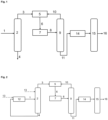
- Fig. 1 shows an embodiment in which the diisobutene stream (1) is fed to the distillation column (2) in step a.
- the top stream (3) is enriched in 2,4,4-trimethylpent-1-ene compared to the diisobutene stream used.
- the distillation also produces the residual stream (4), which is depleted in 2,4,4-trimethylpent-1-ene compared to the diisobutene stream used.
- the top stream (3) is then fed to the alkoxycarbonylation (5) in step b, which produces a product mixture (6).
- This product mixture (6) passes through the catalyst separation (7) in step c to the crude product mixture (8), which is subjected to distillation (9) in step d.
- the product (11) as well as the unreacted alcohols and the unreacted 2,4,4-trimethylpent-2-ene and 2,4,4-trimethylpent-1-ene precipitate as stream (10), which is recycled to the alkoxycarbonylation (5).
- the product i.e. the alkyl 3,5,5-trimethylhesanoate, is then fed to the hydrogenation (14) and converted there to the target alcohol, which is separated in the downstream distillative separation (15) as stream (16).
- Fig. 2 relates to a further embodiment in which an isomerization (12) is also present.
- the diisobutene stream (13) used can be fed to the isomerization and/or to the distillation (2). This is indicated by the dashed lines.
- the isomerized stream (1) then becomes the feed to the distillation (2).
- the isomerization is also fed with the residual stream (4) from the distillation in order to convert 2,4,4-trimethylpent-2-ene at least partially into 2,4,4-trimethylpent-1-ene.
Landscapes
- Chemical & Material Sciences (AREA)
- Organic Chemistry (AREA)
- Chemical Kinetics & Catalysis (AREA)
- Crystallography & Structural Chemistry (AREA)
- Engineering & Computer Science (AREA)
- Analytical Chemistry (AREA)
- Oil, Petroleum & Natural Gas (AREA)
- Water Supply & Treatment (AREA)
- Organic Low-Molecular-Weight Compounds And Preparation Thereof (AREA)
Priority Applications (5)
| Application Number | Priority Date | Filing Date | Title |
|---|---|---|---|
| EP23179203.7A EP4477641A1 (fr) | 2023-06-14 | 2023-06-14 | Procédé de production d'alcool par alcoxycarbonylation de di-isobutène par distillation préalable et hydrogénation subséquente |
| TW113121416A TW202513522A (zh) | 2023-06-14 | 2024-06-11 | 透過二異丁烯的烷氧基羰基化並預先蒸餾及隨後的氫化生產醇的方法 |
| US18/739,433 US20240417353A1 (en) | 2023-06-14 | 2024-06-11 | Process for producing an alcohol by alkoxycarbonylation of diisobutene with prior distillation and subsequent hydrogenation |
| CN202410753277.5A CN119143574A (zh) | 2023-06-14 | 2024-06-12 | 通过具有预先蒸馏和随后氢化的二异丁烯的烷氧基羰基化来制备醇的方法 |
| KR1020240076773A KR20240176451A (ko) | 2023-06-14 | 2024-06-13 | 사전 증류 및 후속 수소화를 이용하는 디이소부텐의 알콕시카르보닐화에 의해 알콜을 제조하는 방법 |
Applications Claiming Priority (1)
| Application Number | Priority Date | Filing Date | Title |
|---|---|---|---|
| EP23179203.7A EP4477641A1 (fr) | 2023-06-14 | 2023-06-14 | Procédé de production d'alcool par alcoxycarbonylation de di-isobutène par distillation préalable et hydrogénation subséquente |
Publications (1)
| Publication Number | Publication Date |
|---|---|
| EP4477641A1 true EP4477641A1 (fr) | 2024-12-18 |
Family
ID=86776170
Family Applications (1)
| Application Number | Title | Priority Date | Filing Date |
|---|---|---|---|
| EP23179203.7A Pending EP4477641A1 (fr) | 2023-06-14 | 2023-06-14 | Procédé de production d'alcool par alcoxycarbonylation de di-isobutène par distillation préalable et hydrogénation subséquente |
Country Status (5)
| Country | Link |
|---|---|
| US (1) | US20240417353A1 (fr) |
| EP (1) | EP4477641A1 (fr) |
| KR (1) | KR20240176451A (fr) |
| CN (1) | CN119143574A (fr) |
| TW (1) | TW202513522A (fr) |
Citations (10)
| Publication number | Priority date | Publication date | Assignee | Title |
|---|---|---|---|---|
| EP1042260A1 (fr) | 1997-12-17 | 2000-10-11 | Basf Aktiengesellschaft | Procede d'hydrogenation d'acides carboxyliques ou de leurs anhydrides ou esters en alcools |
| EP1338557A1 (fr) | 2000-10-18 | 2003-08-27 | Jgc Corporation | Procede et appareil destines a eliminer un compose sulfure a partir d'un gaz contenant de l'hydrogene sulfure, du mercaptan, du dioxyde de carbone et un hydrocarbure aromatique |
| US20040122278A1 (en) * | 2002-12-20 | 2004-06-24 | Powers Donald H. | Alpha olefin production |
| DE102006040433A1 (de) | 2006-08-29 | 2008-03-13 | Oxeno Olefinchemie Gmbh | Verfahren zur Herstellung von Isoolefinen |
| EP1360160B1 (fr) | 2001-02-13 | 2009-03-11 | Evonik Oxeno GmbH | Procede de production de diisobutene de grande purete |
| WO2015110843A1 (fr) | 2014-01-27 | 2015-07-30 | Imperial Innovations Limited | Membrane de nanofiltration |
| EP3121184A2 (fr) | 2015-07-23 | 2017-01-25 | Evonik Degussa GmbH | Ligands de disphosphine à base de benzol pour l'alkoxy-carbonylation |
| EP3750866A1 (fr) * | 2019-06-12 | 2020-12-16 | Evonik Operations GmbH | Procédé de fabrication d'un alcool à partir des hydrocarbures |
| CN113198519A (zh) * | 2021-04-27 | 2021-08-03 | 万华化学集团股份有限公司 | 一种采用背包式反应精馏装置生产高纯度α-烯烃的方法 |
| WO2022144208A1 (fr) * | 2020-12-30 | 2022-07-07 | Sabic Global Technologies B.V. | Procédé de purification de hex-1-ène |
-
2023
- 2023-06-14 EP EP23179203.7A patent/EP4477641A1/fr active Pending
-
2024
- 2024-06-11 US US18/739,433 patent/US20240417353A1/en active Pending
- 2024-06-11 TW TW113121416A patent/TW202513522A/zh unknown
- 2024-06-12 CN CN202410753277.5A patent/CN119143574A/zh active Pending
- 2024-06-13 KR KR1020240076773A patent/KR20240176451A/ko active Pending
Patent Citations (10)
| Publication number | Priority date | Publication date | Assignee | Title |
|---|---|---|---|---|
| EP1042260A1 (fr) | 1997-12-17 | 2000-10-11 | Basf Aktiengesellschaft | Procede d'hydrogenation d'acides carboxyliques ou de leurs anhydrides ou esters en alcools |
| EP1338557A1 (fr) | 2000-10-18 | 2003-08-27 | Jgc Corporation | Procede et appareil destines a eliminer un compose sulfure a partir d'un gaz contenant de l'hydrogene sulfure, du mercaptan, du dioxyde de carbone et un hydrocarbure aromatique |
| EP1360160B1 (fr) | 2001-02-13 | 2009-03-11 | Evonik Oxeno GmbH | Procede de production de diisobutene de grande purete |
| US20040122278A1 (en) * | 2002-12-20 | 2004-06-24 | Powers Donald H. | Alpha olefin production |
| DE102006040433A1 (de) | 2006-08-29 | 2008-03-13 | Oxeno Olefinchemie Gmbh | Verfahren zur Herstellung von Isoolefinen |
| WO2015110843A1 (fr) | 2014-01-27 | 2015-07-30 | Imperial Innovations Limited | Membrane de nanofiltration |
| EP3121184A2 (fr) | 2015-07-23 | 2017-01-25 | Evonik Degussa GmbH | Ligands de disphosphine à base de benzol pour l'alkoxy-carbonylation |
| EP3750866A1 (fr) * | 2019-06-12 | 2020-12-16 | Evonik Operations GmbH | Procédé de fabrication d'un alcool à partir des hydrocarbures |
| WO2022144208A1 (fr) * | 2020-12-30 | 2022-07-07 | Sabic Global Technologies B.V. | Procédé de purification de hex-1-ène |
| CN113198519A (zh) * | 2021-04-27 | 2021-08-03 | 万华化学集团股份有限公司 | 一种采用背包式反应精馏装置生产高纯度α-烯烃的方法 |
Also Published As
| Publication number | Publication date |
|---|---|
| US20240417353A1 (en) | 2024-12-19 |
| CN119143574A (zh) | 2024-12-17 |
| KR20240176451A (ko) | 2024-12-24 |
| TW202513522A (zh) | 2025-04-01 |
Similar Documents
| Publication | Publication Date | Title |
|---|---|---|
| EP3750866B1 (fr) | Procédé de fabrication d'un alcool à partir des hydrocarbures | |
| EP1669337B1 (fr) | Procédé pour la fabrication d'alcools à partir d'oléfines par hydroformylation et hydrogenation | |
| EP1489062B1 (fr) | Procédé de préparation d'isobutène à partir de tertiaire butanol | |
| KR102646549B1 (ko) | 알데히드로부터 알콜을 수득하는 방법 | |
| EP2041049A1 (fr) | Procede de fabrication de 3-methylbut-1-ene | |
| EP3744707B1 (fr) | Procédé d'hydroformylation d'oléfines à chaîne courte dans le flux de recyclage d'une phase liquide de l'hydroformylation | |
| DE2537890C2 (de) | Verfahren zur Herstellung von Diacetoxybutan | |
| EP1231198B1 (fr) | Hydroformylation | |
| DE102008007080A1 (de) | Verfahren zur Herstellung von C9-Alkohol aus C8-Olefinen | |
| EP4477641A1 (fr) | Procédé de production d'alcool par alcoxycarbonylation de di-isobutène par distillation préalable et hydrogénation subséquente | |
| EP4477645A1 (fr) | Procédé d'alcoxycarbonylation de di-isobutène par distillation préalable | |
| EP4477644A1 (fr) | Procédé de préparation d'un acide carboxylique ou de son sel par alkoxycarbonylation du di-isobutène par distillation préalable et hydrolyse subséquente | |
| DE3509292A1 (de) | Verfahren zur herstellung von reinen tertiaeren olefinen | |
| EP2822921B1 (fr) | Procédé d'integration thermique lors de l'hydrogénation et de la distillation d'aldéhydes en c3-c20 | |
| EP4495091B1 (fr) | Procédé de production d'alcools par alcoxycarbonylation de di-isobutène et d'une oléfine c4- à c7 et hydrogénation subséquente | |
| EP4477640A1 (fr) | Procédé d'hydroformylation de di-isobutène de distillation préalable | |
| EP4495090B1 (fr) | Procédé d'alcoxycarbonylation de di-isobutène et d'une oléfine c4- à c7 et d'une hydrolyse ultérieure | |
| EP4574804A1 (fr) | Procédé de conversion de dibutène avec distillation préalable | |
| EP4495089A1 (fr) | Procédé d'alcoxycarbonylation de di-isobutène et d'une oléfine c4- à c7 | |
| EP4574803A1 (fr) | Procédé de conversion d'oléfines en c11 à c20 par distillation préalable | |
| DE2653445C2 (de) | Verfahren zur Hydrierung von 4-Acetoxycrotonaldehyd enthaltendem 1,4-Diacetoxybuten-2 | |
| DE102006057856A1 (de) | Verfahren zur Herstellung von Alkyl-tert-butylether und hochreinem Raffinat II | |
| EP3077358B1 (fr) | Procédé de préparation de 2-méthylbutanal à partir des flux secondaires produits lors de la préparation de mélanges de décénals , -insaturés isomères | |
| EP4574806A1 (fr) | Procédé de conversion en deux étapes d'oléfines par distillation intermédiaire | |
| EP4574805A1 (fr) | Procédé de conversion d'oléfines avec séparation préalable du courant d'alimentation |
Legal Events
| Date | Code | Title | Description |
|---|---|---|---|
| PUAI | Public reference made under article 153(3) epc to a published international application that has entered the european phase |
Free format text: ORIGINAL CODE: 0009012 |
|
| STAA | Information on the status of an ep patent application or granted ep patent |
Free format text: STATUS: THE APPLICATION HAS BEEN PUBLISHED |
|
| AK | Designated contracting states |
Kind code of ref document: A1 Designated state(s): AL AT BE BG CH CY CZ DE DK EE ES FI FR GB GR HR HU IE IS IT LI LT LU LV MC ME MK MT NL NO PL PT RO RS SE SI SK SM TR |
|
| STAA | Information on the status of an ep patent application or granted ep patent |
Free format text: STATUS: REQUEST FOR EXAMINATION WAS MADE |
|
| 17P | Request for examination filed |
Effective date: 20250103 |