EP4478212A1 - Élection de noeud de confiance pour grappes de bases de données - Google Patents
Élection de noeud de confiance pour grappes de bases de données Download PDFInfo
- Publication number
- EP4478212A1 EP4478212A1 EP24182203.0A EP24182203A EP4478212A1 EP 4478212 A1 EP4478212 A1 EP 4478212A1 EP 24182203 A EP24182203 A EP 24182203A EP 4478212 A1 EP4478212 A1 EP 4478212A1
- Authority
- EP
- European Patent Office
- Prior art keywords
- node
- database
- database cluster
- cluster
- trusted
- Prior art date
- Legal status (The legal status is an assumption and is not a legal conclusion. Google has not performed a legal analysis and makes no representation as to the accuracy of the status listed.)
- Pending
Links
Images



Classifications
-
- G—PHYSICS
- G06—COMPUTING OR CALCULATING; COUNTING
- G06F—ELECTRIC DIGITAL DATA PROCESSING
- G06F16/00—Information retrieval; Database structures therefor; File system structures therefor
- G06F16/20—Information retrieval; Database structures therefor; File system structures therefor of structured data, e.g. relational data
- G06F16/27—Replication, distribution or synchronisation of data between databases or within a distributed database system; Distributed database system architectures therefor
-
- G—PHYSICS
- G06—COMPUTING OR CALCULATING; COUNTING
- G06F—ELECTRIC DIGITAL DATA PROCESSING
- G06F16/00—Information retrieval; Database structures therefor; File system structures therefor
- G06F16/90—Details of database functions independent of the retrieved data types
- G06F16/906—Clustering; Classification
Definitions
- database cluster state is determined via reliance on information reported by each node participating in a given database cluster, where said information is scoped around the individual purview of the reporting node.
- embodiments described herein relate to a method for trusted node election.
- the method includes: identifying a database cluster implemented on a node subset of a plurality of nodes forming a data center; receiving node state from each node in the node subset; and electing, for the database cluster and from the node subset, a trusted node based on the node state from each node in the node subset and a database cluster type of the database cluster.
- inventions described herein relate to a non-transitory computer readable medium (CRM).
- CRM computer readable medium
- the non-transitory CRM includes computer readable program code, which when executed by a computer processor, enables the computer processor to perform a method for trusted node election.
- the method includes: identifying a database cluster implemented on a node subset of a plurality of nodes forming a data center; receiving node state from each node in the node subset; and electing, for the database cluster and from the node subset, a trusted node based on the node state from each node in the node subset and a database cluster type of the database cluster.
- inventions described herein relate to a system.
- the system includes: a data center including a plurality of nodes; and a data protection service operatively connected to the data center, and including a computer processor configured to perform a method for trusted node election.
- the method includes: identifying a database cluster implemented on a node subset of the plurality of nodes; receiving node state from each node in the node subset; and electing, for the database cluster and from the node subset, a trusted node based on the node state from each node in the node subset and a database cluster type of the database cluster.
- any component described with regard to a figure in various embodiments described herein, may be equivalent to one or more like-named components described with regard to any other figure.
- descriptions of these components may not be repeated with regard to each figure.
- each and every embodiment of the components of each figure is incorporated by reference and assumed to be optionally present within every other figure having one or more like-named components.
- any description of the components of a figure is to be interpreted as an optional embodiment, which may be implemented in addition to, in conjunction with, or in place of the embodiments described with regard to a corresponding like-named component in any other figure.
- ordinal numbers e.g., first, second, third, etc.
- an element i.e., any noun in the application.
- the use of ordinal numbers is not to imply or create any particular ordering of the elements, nor to limit any element to being only a single element unless expressly disclosed, such as by the use of the terms "before”, “after”, “single”, and other such terminology. Rather, the use of ordinal numbers is to distinguish between the elements.
- a first element is distinct from a second element, and the first element may encompass more than one element and succeed (or precede) the second element in an ordering of elements.
- a data structure may include a first element labeled as A and a second element labeled as N.
- This labeling convention means that the data structure may include any number of the elements.
- a second data structure also labeled as A to N, may also include any number of elements. The number of elements of the first data structure and the number of elements of the second data structure may be the same or different.
- the phrase operatively connected, or operative connection means that there exists between elements/components/devices a direct or indirect connection that allows the elements to interact with one another in some way.
- the phrase 'operatively connected' may refer to any direct (e.g., wired directly between two devices or components) or indirect (e.g., wired and/or wireless connections between any number of devices or components connecting the operatively connected devices) connection.
- any path through which information may travel may be considered an operative connection.
- embodiments described herein relate to trusted node election for database clusters.
- Concerning data management and/or protection purposes it is important to maintain a consistent, holistic view of database cluster state for any database cluster(s) implemented throughout a data center.
- database cluster state is determined via reliance on information reported by each node participating in a given database cluster, where said information is scoped around the individual purview of the reporting node.
- Various individual node views of the database cluster state thus undergo complex processing to attempt to build an accurate, holistic view of the database cluster state, which tends to be error prone. This often leads to incorrect database cluster state being available at any given time, thereby impacting the efficacy of data pertinent processes, such as data backup and/or recovery operations.
- Embodiments described herein accordingly, implement a solution addressing the above-mentioned issue(s) by way of trusted node election for database clusters.
- the solution provides a mechanism through which a trusted node, from a group of nodes participating in any given database cluster, may be elected based, at least in part, on a database cluster type of the given database cluster. Said trusted node, once elected, may subsequently be relied upon to obtain trusted database cluster state that may be used to maintain a holistic view of the given database cluster, as well as to orchestrate, for example, data backup and/or recovery operations.
- FIG. 1A shows a system in accordance with one or more embodiments described herein.
- the system (100) may include a data protection service (102), a data center (104), and, optionally, a target storage (106). Each of these system (100) components is described below.
- the data protection service (102) may represent any enterprise information technology (IT) infrastructure at least configured to orchestrate, and thus centralize, asset (e.g., database) discovery, protection, and governance.
- the data protection service (102) may include functionality to: interface with the data center (104) and/or the target storage (106) in order to perform trusted node elections (see e.g., FIG. 2 ), database cluster change notification processing (see e.g., FIG. 3 ), and cluster backup request processing (see e.g., FIG. 4 ).
- the data protection service (102) may perform other functionalities without departing from the scope of the embodiments described herein.
- the data protection service (102) may be implemented through on-premises infrastructure, cloud computing infrastructure, or any hybrid infrastructure thereof.
- the data protection service (102), accordingly, may be implemented using one or more network servers (not shown), where each network server may represent a physical or a virtual network server.
- the data protection service (102) may be implemented using one or more computing systems similar to the exemplary computing system illustrated and described with respect to FIG. 5 , below.
- the data protection service (102) is illustrated and described in further detail below with respect to FIG. 1B .
- the data center (104) may represent any privately owned and maintained enterprise IT environment.
- the data center (104) may include functionality to: encompass various networked resources (e.g., computer processors, memory, storage, virtualization, etc.), which may be allocated, as needed, to support any number of products and/or services offered locally or remotely over a network (not shown); and maintain any data generated, received, and/or employed by said offered products and/or services.
- networked resources e.g., computer processors, memory, storage, virtualization, etc.
- the data center (104) may perform other functionalities without departing from the scope of the embodiments described herein.
- the data center (104) may be implemented through on-premises infrastructure, cloud computing infrastructure, or any hybrid infrastructure thereof.
- the data center (104), accordingly, may be implemented using one or more network servers (not shown), where each network server may represent a physical or a virtual network server.
- the data center (104) may be implemented using one or more computing systems similar to the exemplary computing system illustrated and described with respect to FIG. 5 , below.
- the data center (104) is illustrated and described in further detail below with respect to FIG. 1C .
- the target storage (106) may represent any data backup, archiving, and/or disaster recovery storage system.
- the target storage (106) may be implemented through on-premises infrastructure, cloud computing infrastructure, or any hybrid infrastructure thereof.
- the target storage (106), accordingly, may be implemented using one or more storage servers (not shown), where each storage server may represent a physical or a virtual storage server. Additionally, or alternatively, the target storage (106) may be implemented using one or more computing systems similar to the exemplary computing system illustrated and described with respect to FIG. 5 , below.
- the storage server(s) of the target storage (106) may be supported by a collection of one or more physical storage devices (not shown) on which various forms of digital information - e.g., database copies (described below) (see e.g., FIG. 4 ) - may be maintained.
- Each physical storage device may encompass non-transitory computer readable storage media on which said digital information may be stored in whole or in part, and temporarily or permanently. Further, the physical storage device(s) may, at least in part, be implement using persistent (i.e., non-volatile) storage.
- persistent storage may include, but may not be limited to, optical storage, magnetic storage, NAND Flash Memory, NOR Flash Memory, Magnetic Random Access Memory (M-RAM), Spin Torque Magnetic RAM (ST-MRAM), Phase Change Memory (PCM), or any other storage defined as non-volatile Storage Class Memory (SCM).
- M-RAM Magnetic Random Access Memory
- ST-MRAM Spin Torque Magnetic RAM
- PCM Phase Change Memory
- the above-mentioned system (100) components may communicate with one another through a network (not shown) (e.g., a local area network (LAN), a wide area network (WAN) such as the Internet, a mobile network, any other network type, or any combination thereof).
- the network may be implemented using any combination of wired and/or wireless connections.
- the network may encompass various interconnected, network-enabled subcomponents (or systems) (e.g., switches, routers, gateways, etc.) that may facilitate communications between the above-mentioned system (100) components (or subcomponents thereof).
- the above-mentioned system (100) components (or subcomponents thereof) may employ any combination of wired and/or wireless communication protocols.
- FIG. 1A shows a configuration of components and/or subcomponents
- system (100) configurations may be used without departing from the scope of the embodiments described herein.
- the system (100) may further include a trusted node elector (not shown) operating as a standalone service - i.e., a standalone trusted node elector - that may operatively connect to the data protection service (102) and the data center (104), instead of operating as a subcomponent of the data protection service (102) as depicted and described with respect to FIG. 1B , below.
- a trusted node elector (not shown) operating as a standalone service - i.e., a standalone trusted node elector - that may operatively connect to the data protection service (102) and the data center (104), instead of operating as a subcomponent of the data protection service (102) as depicted and described with respect to FIG. 1B , below.
- the standalone trusted node elector may represent any enterprise IT infrastructure at least configured to elect or otherwise determine a trusted node, from a subset of nodes forming the data center (104) (see e.g., FIG. 1C ), for each database cluster implemented throughout the data center (104).
- the standalone trusted node elector may perform substantially the same functionalities of a trusted node elector that operates as a subcomponent of the data protection service (102) as illustrated/described in further detail below with respect to FIG. 1B .
- the standalone trusted node elector may be implemented through on-premises infrastructure, cloud computing infrastructure, or any hybrid infrastructure thereof.
- the standalone trusted node elector accordingly, may be implemented using one or more network servers (not shown), where each network server may represent a physical or a virtual network server. Additionally, or alternatively, the standalone trusted node elector may be implemented using one or more computing systems similar to the exemplary computing system illustrated and described with respect to FIG. 5 , below.
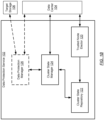
- FIG. 1B shows a data protection service in accordance with one or more embodiments described herein.
- the data protection service (102) may include a trusted node elector (120), a cluster state repository (122), a cluster state manager (124), and, optionally, a data protection manager (126). Each of these data protection service (102) components is described below.
- the trusted node elector (120) may refer to instruction-processing hardware (e.g., any number of integrated circuits for processing computer readable instructions), a computer program executing on the underlying hardware of the data protection service (102), or any combination thereof, at least configured to elect or otherwise determine a trusted node, from at least a subset of nodes forming the data center (104) (see e.g., FIG. 1C ), for each database cluster implemented throughout the data center (104).
- the trusted node elector (120) may include functionality to: perform the method for trusted node election as illustrated and described with respect to FIG. 2 , below.
- the trusted node elector (120) may perform other functionalities without departing from the scope of the embodiments described herein.
- the cluster state repository (122) may refer to dedicated storage at least configured to maintain database cluster state pertaining to the database cluster(s) (see e.g., FIG. 1C ) implemented throughout the data center (104).
- Any database cluster (not shown) may refer to a collection or group of database instances that may be hosted by at least a subset of the nodes forming the data center (104).
- Any database instance of a given database cluster may refer to software (e.g., a computer program) at least configured to manage the storage and retrieval of, as well as access to, data in a database implemented either locally at each node on which a database instance of the given database cluster operates or shared virtually across the at least subset of nodes hosting the given database cluster.
- whether the database may be implemented locally at each node, or shared virtually across the at least subset of nodes, hosting the database cluster may depend on a database cluster type of the database cluster with which the database may be associated. For example, if the database cluster type reflects a failover cluster instance (FCI) configuration, then the database may be shared as virtual storage across the at least subset of nodes hosting the database cluster. By way of another example, if the database cluster type reflects an always-on and available group (AAG) configuration, then a replica of the database may be maintained locally on each node in the at least subset of nodes hosting the database cluster.
- FCI failover cluster instance
- AAG always-on and available group
- the maintained database cluster state within the cluster state repository (122) may include, but may not be limited to: a database cluster identifier (ID) assigned to, and that uniquely identifies, the database cluster; a database cluster type (e.g., FCI, AAG, real application cluster (RAC), etc.) through which the database cluster may be configured; node metadata (e.g., network address, host name, status/state, etc.) associated with each node, in the at least subset of nodes of the data center (104), that hosts a database instance of the database cluster; a database instance ID assigned to, and that uniquely identifies, each database instance of the database cluster; a database cluster status indicating a current, holistic state (e.g., online/available, offline/unavailable, deleted, etc.) of the database cluster; and trusted node metadata (e.g., network address, host name, status/state, etc.) associated with a current, elected trusted node for the database cluster.
- ID database cluster identifier
- RAC real application cluster
- the cluster state manager (124) may refer to instruction-processing hardware (e.g., any number of integrated circuits for processing computer readable instructions), a computer program executing on the underlying hardware of the data protection service (102), or any combination thereof, at least configured to gather trusted/trustworthy database cluster state for the database cluster(s) implemented throughout the data center (104) and maintain/manage said database cluster state in the cluster state repository (122).
- the cluster state manager (124) may include functionality to: perform the method for database cluster change notification processing as illustrated and described with respect to FIG. 3 , below.
- the cluster state manager (124) may perform other functionalities without departing from the scope of the embodiments described herein.
- the data protection manager (126) may refer to instruction-processing hardware (e.g., any number of integrated circuits for processing computer readable instructions), a computer program executing on the underlying hardware of the data protection service (102), or any combination thereof, at least configured to oversee and/or manage backup and restore operations targeting any granularity of data stored in any database corresponding to any database cluster(s) (see e.g., FIG. 1C ) implemented throughout the data center (104).
- the data protection manager (126) include functionality to: perform the method for cluster backup request processing as illustrated and described with respect to FIG. 4 , below.
- the data protection manager (126) may perform other functionalities without departing from the scope of the embodiments described herein.
- FIG. 1B shows a configuration of components and/or subcomponents
- other data protection service (102) configurations may be used without departing from the scope of the embodiments described herein.
- the data protection service (102) may exclude the trusted node elector (120), where the latter may operate external to the data protection service (102) as a standalone service - i.e., a standalone trusted node elector (not shown).
- the standalone trusted node elector may represent any enterprise IT infrastructure at least configured to elect or otherwise determine a trusted node, from a subset of nodes forming the data center (104) (see e.g., FIG. 1C ), for each database cluster implemented throughout the data center (104).
- the standalone trusted node elector may perform substantially the same functionalities of the trusted node elector (120) that operates as a subcomponent of the data protection service (102) as illustrated/described above with respect to FIG. 1B .
- the standalone trusted node elector may be implemented through on-premises infrastructure, cloud computing infrastructure, or any hybrid infrastructure thereof.
- the standalone trusted node elector accordingly, may be implemented using one or more network servers (not shown), where each network server may represent a physical or a virtual network server. Additionally, or alternatively, the standalone trusted node elector may be implemented using one or more computing systems similar to the exemplary computing system illustrated and described with respect to FIG. 5 , below.
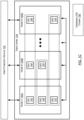
- FIG. 1C shows a data center in accordance with one or more embodiments described herein.
- the data center (104) may include two or more nodes (140A-140N), which are described below.
- any node may refer to a physical network server, a virtual network server, or any computing system similar to the exemplary computing system illustrated and described below with respect to FIG. 5 , at least configured to implement or host one or more database clusters (156).
- database clusters e.g., three database clusters (156) (i.e., corresponding to databases DB1, DB2, and DB3) are depicted in FIG. 1C ; however, one of ordinary skill will appreciate that a lesser or greater number of database cluster(s) may be implemented throughout the data center (104) without departing from the scope of the embodiments described herein.
- any database cluster (156) may refer to a collection or group of database instances (e.g., 142, 144, 146), which may be implemented or hosted across at least a subset of the nodes (140A-140N) forming the data center (104). Further, for a given database cluster (156), each database instance (e.g., 142, 144, 146) may refer to software (e.g., a computer program) at least configured to manage the storage and retrieval of, as well as access to, data in a database (e.g., DB1) corresponding to the given database cluster (156).
- software e.g., a computer program
- the database (e.g., DB1), respective to a given database cluster (156) may be implemented locally as a database replica at each node on which a database instance (e.g., 142, 144, 146) of the given database cluster (156) operates, or may alternatively be implemented as virtual storage shared amongst the at least subset of the nodes (140A-140N), forming the data center (104), that may be hosting the given database cluster (156).
- FIG. 1C depicts: a group of three database instances (142, 144, 146) that form a first database cluster corresponding to a first database DB1; a group of two database instances (148, 150) that form a second database cluster corresponding to a second database DB2; and another group of two database instances (152, 154) that form a third database cluster corresponding to a third database DB3.
- the three database instances (142, 144, 146) of the first database cluster are hosted on Nodes A, B, and N (140A, 140B, 140N), respectively.
- the two database instances (148, 150) of the second database cluster are hosted on Nodes A and B (140A, 140B), respectively; and the two database instances (152, 154) of the third database cluster are hosted on Nodes A and N (140A, 140N), respectively.
- any given database cluster (156) may be configured based on, and thus may be associated with, a database cluster type - examples of which may include, but may not be limited to: a failover cluster instance (FCI) type/configuration, an always-on and available group (AAG) type/configuration, and a real application cluster (RAC) type/configuration.
- FCI failover cluster instance
- AAG always-on and available group
- RAC real application cluster
- implementation of the database e.g., DB1, DB2, or DB3
- corresponding to a given database cluster (156) may be contingent on the database cluster type of the given database cluster (156).
- the database e.g., DB1
- the database may be implemented as shared virtual storage pooled from at least a portion of the physical storage on each node participating in the implementation of the database cluster (156), where each database instance (e.g., 142, 144, 146) of the database cluster (156) may store and retrieve, as well as provide access to, any granularity of data in the shared virtual storage.
- the database e.g., DB2
- the database may be implemented as separate (unshared, yet synchronization-capable) database replicas, where each database replica may be supported by at least a portion of the physical storage on a different node participating in the implementation of the database cluster (156), and where each database instance (e.g., 148, 150) of the database cluster (156) may store and retrieve, as well as provide access to, any granularity of data in the database replica respective to the node on which the database instance (e.g., 148, 150) is being hosted.
- FIG. 1C shows a configuration of components and/or subcomponents
- other data center (104) configurations may be used without departing from the scope of the embodiments described herein.
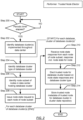
- FIG. 2 shows a flowchart describing a method for trusted node election in accordance with one or more embodiments described herein.
- the various steps outlined below may be performed by the trusted node elector of the data protection service (see e.g., FIGS. 1A and 1B ). Further, while the various steps in the flowchart are presented and described sequentially, one of ordinary skill will appreciate that some or all steps may be executed in different orders, may be combined or omitted, and some or all steps may be executed in parallel.
- the periodic timer may refer to a time device (e.g., a hardware- or software-implemented clock) configured to measure a preset time interval, where the preset time interval corresponds to a periodicity at which a trusted node may be elected for each database cluster implemented throughout the data center (see e.g., FIG. 1C ).
- the preset time interval may be dynamically configured by administrators of the data protection service and/or the data center.
- the method proceeds to Step 202.
- the method reverts or remains at Step 200 until the periodic timer elapses.
- Step 202 following the determination (made in Step 200) that the periodic timer has elapsed, at least one database cluster is identified.
- the at least one database cluster may be implemented throughout the data center (see e.g., FIG. 1C ). Particularly, each identified database cluster may be implemented amongst at least a different or a same subset of the nodes forming the data center. Further, each identified database cluster may refer to, and thus encompass, a separate collection or group of database instances (described above) (see e.g., FIGS. 1B and/or 1C) and, further, may correspond to a separate database.
- Steps 204, 206, 208, 210, 212, and 214 are pertinent to, and thus performed for, each database cluster of the at least one database cluster (identified in Step 202).
- a database cluster type of the database cluster, is identified.
- the database cluster type may be stored in, and thus may be retrieved from, a data entry corresponding to the database cluster and maintained within the cluster state repository (see e.g., FIG. 1B ).
- Examples of the database cluster type may include, but may not be limited to, a failover cluster instance (FCI) type/configuration, an always-on and available group (AAG) type/configuration, and a real application cluster (RAC) type/configuration.
- FCI failover cluster instance
- AAG always-on and available group
- RAC real application cluster
- the database cluster type may reference a schema through which the at least subset of data center nodes, participating in the implementation of the database cluster, may be configured.
- Said schema may reflect: the role (e.g., active or passive node in a FCI database cluster type, primary or secondary node in an AAG database cluster type, etc.) assigned to each node in the at least subset of data center nodes pertinent to the database cluster; and any rules governing role changes (e.g., a passive node becomes an active node in a FCI based database cluster when the previous active node fails) amongst the at least subset of data center nodes, pertinent to the database cluster, due to failover, scheduled node maintenance, and other events.
- said schema is not limited to the aforementioned specific examples.
- a node subset of the nodes forming the data center, is identified.
- the node subset may refer to at least two nodes each configured to host a database instance of the database cluster. Further, the node subset may be identified via node metadata stored in, and thus retrievable from, the data entry corresponding to the database cluster and maintained within the cluster state repository (see e.g., FIG. 1B ).
- examples of node metadata descriptive thereof may include: a network address assigned to the given node; a host name belonging to the given node; and a status/state reflective of the given node.
- node metadata, for any node is not limited to the aforementioned specific examples.
- a node state request is issued to each node in the node subset (identified in Step 206).
- the node state request may refer to a communication message asking the recipient (i.e., a node in the node subset) for current node state (described below) pertaining to the recipient.
- any node state response is received from each node in the node subset (identified in Step 206) and in reply to the node state request (issued thereto in Step 208).
- any node state response may refer to a communication message returning, and thus may include, current node state pertaining to the recipient (i.e., a node in the node subset) of the node state request.
- the current node state may include the role (e.g., active or passive node in a FCI database cluster type, primary or secondary node in an AAG database cluster type, etc.) currently held by the recipient with respect to the database cluster type of the database cluster.
- a trusted node for the database cluster, is elected.
- the trusted node may be elected from the node subset (identified in Step 206) based on the node state responses (received in Step 210) and the database cluster type (identified in Step 204). Particularly, provided the database cluster type associated with the database cluster, election of the trusted node for the database cluster may rely on the role currently held by each node in the node subset.
- a node subset pertinent to the database cluster may include at least one active node and at least one passive node.
- the active node(s) tend to conduct read and write operations targeting the database corresponding to the database cluster, whereas the passive node(s) tend to standby and take over the responsibilities of any failed active node(s). Accordingly, the node with the most up-to-date, and thus trusted or trustworthy, database cluster state falls to one of the active nodes, if not the active node, which is elected as the trusted node for the database cluster.
- a node subset pertinent to the database cluster may include a single primary node and at least one secondary node.
- the primary node tends to conduct read and write operations targeting a primary database replica of the database corresponding to the database cluster, whereas any secondary node tends to conduct read-only operations targeting a respective secondary database replica of the database corresponding to the database cluster. Accordingly, the node with the most up-to-date, and thus trusted or trustworthy, database cluster state falls to the primary node, which is elected as the trusted node for the database cluster.
- a node subset pertinent to the database cluster may include all active nodes. That is, each node in the node subset may be capable of conducting read and write operations targeting a shared database there-between corresponding to the database cluster. Accordingly, any one of the active nodes (i.e., any node in the node subset) may retain the most up-to-date, and thus trusted or trustworthy, database cluster state; and, subsequently, any one of said active nodes may be elected as the trusted node for the database cluster.
- trusted node metadata describing the trusted node (elected in Step 212) for the database cluster, is stored.
- the trusted node metadata may include: a network address assigned to the trusted node; a host name belonging to the trusted node; and a status/state reflective of the trusted node.
- the trusted node metadata is not limited to the aforementioned specific examples. Concerning the storage thereof, the trusted node metadata may be retained in a data entry corresponding to the database cluster and maintained within the cluster state repository (see e.g., FIG. 1B ).
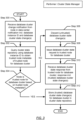
- FIG. 3 shows a flowchart describing a method for database cluster change notification processing in accordance with one or more embodiments described herein.
- the various steps outlined below may be performed by the cluster state manager of the data protection service (see e.g., FIGS. 1A and 1B ). Further, while the various steps in the flowchart are presented and described sequentially, one of ordinary skill will appreciate that some or all steps may be executed in different orders, may be combined or omitted, and some or all steps may be executed in parallel.
- a database cluster change notification is received from a node, at least in part, forming the data center (see e.g., FIG. 1C ).
- the database cluster change notification may refer to a communication message informing a recipient (i.e., cluster state manager) thereof of one or more database cluster state changes.
- the database cluster change notification may include: a database instance ID assigned to, and thus uniquely identifying, a database instance of a database cluster implemented across at least a subset of the data center, where the node, from which the database cluster change notification had been received, hosts the database instance; and said database cluster state change(s), which may reflect, and thus be an extension of, any detected status change(s) (e.g., online/available, offline/unavailable, deleted, etc.) entailing the node, the database instance hosted on the node, and/or the database corresponding to the database cluster - all from the perspective of, and thus based on the role held by, the node in the database cluster.
- the database cluster change notification may additionally include, or may be received alongside, node metadata (e.g., network address, host name, etc.) associated with the node.
- the cluster state repository, of the data protection service (see e.g., FIG. 1B ), is queried using the database instance ID (received via the database cluster change notification in Step 300).
- a lookup may be performed across the cluster state repository using the database instance ID to identify a data entry therein corresponding to the database cluster and, thus, includes the database instance ID as one of at least two database instance IDs associated with at least two database instances, respectively, of the database cluster.
- the identified data entry further, may also include trusted node metadata, descriptive of a trusted node for the database cluster, stored therein following a most recent election of the trusted node (see e.g., FIG. 2 ).
- Step 304 a determination is made as to whether the node (from which the database cluster change notification had been received in Step 300) is the trusted node for the database cluster.
- the determination may involve comparing the node metadata (received via or alongside the database cluster change notification in Step 300) against the trusted node metadata (obtained in Step 302).
- the method proceeds to Step 306.
- the method alternatively proceeds to Step 312.
- Step 306 following the determination (made in Step 304) that the node (from which the database cluster change notification had been received in Step 300) is not the trusted node for the database cluster, the database cluster state change(s) (received via the database cluster change notification in Step 300) is deemed untrusted or untrustworthy and, subsequently, discarded.
- a database cluster state request is issued to the trusted node (identified via the trusted node metadata obtained in Step 302) (or more specifically, to the database instance hosted thereon) for the database cluster.
- the database cluster state request may refer to a communication message asking the recipient (i.e., the trusted node for the database cluster) for any change(s) in database cluster state from the perspective of the recipient.
- the trusted node elected to represent the database cluster at any given point-in-time, tends to, for example, hold the role of an/the active node in a FCI based database cluster, the primary node in an AAG based database cluster, etc., and therefore retains the most up-to-date and accurate state (e.g., whether, comprehensively, the database cluster is online/available, offline/unavailable, deleted, etc.) concerning the database cluster.
- any database cluster state change(s) from the perspective of the trusted node, can be relied upon as trusted or trustworthy information that conveys an overall or holistic view of the current status, or change(s) thereof, describing the database cluster.
- the database cluster state request may or may not include a database cluster ID assigned to, and thus uniquely identifying, the database cluster.
- a database cluster state response from the trusted node for the database cluster, is received in reply to the database cluster state request (issued thereto in Step 308).
- the database cluster state response may refer to a communication message returning, and thus may include, database cluster state change(s) from the perspective of the recipient (i.e., the trusted node for the database cluster) of the database cluster state request.
- any information e.g., database cluster state and/or change(s) thereof
- relayed from the trusted node for the database cluster may be deemed trusted or trustworthy as supported by the role of the trusted node with respect to the database cluster.
- Step 312 following the database cluster state response (received in Step 310) from the trusted node for the database cluster in reply to the database cluster state request (issued thereto in Step 308), or following the alternate determination (made in Step 304) that the node (from which the database cluster change notification had been received in Step 300) is the trusted node for the database cluster, the database cluster state change(s) (either received in Step 300 or Step 310) is/are deemed trusted/trustworthy and, subsequently, stored.
- the database cluster state change(s) may be maintained in the cluster state repository of the data protection service (see e.g., FIG. 1B ); and, more specifically, within the data entry therein relative to the database cluster.
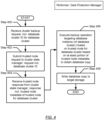
- FIG. 4 shows a flowchart describing a method for cluster backup request processing in accordance with one or more embodiments described herein.
- the various steps outlined below may be performed by the data protection manager of the data protection service (see e.g., FIGS. 1A and 1B ). Further, while the various steps in the flowchart are presented and described sequentially, one of ordinary skill will appreciate that some or all steps may be executed in different orders, may be combined or omitted, and some or all steps may be executed in parallel.
- the cluster backup request may refer to a communication message asking or instructing the recipient (i.e., the data protection manager) to perform a backup operation targeting the database corresponding to a specified database cluster.
- the cluster backup request accordingly, may include a database cluster ID assigned to, and thus uniquely identifying, a target database cluster.
- a trusted node request is submitted.
- the trusted node request may be directed to the cluster state manager (see e.g., FIG. 1B ) of the data protection service, and may refer to a communication message asking for information concerning the trusted node for the target database cluster.
- the trusted node request may include the database cluster ID (received via the cluster backup request in Step 400).
- a trusted node response is received in reply to the trusted node request (submitted in Step 402).
- the trusted node response may be delivered by the cluster state manager, and may refer to a communication message returning, and thus may include, trusted node metadata (e.g., network address, host name, etc.) associated with the trusted node for the target database cluster.
- the cluster state manager may retrieve and provide said trusted node metadata by, for example, performing a lookup in the cluster state repository (see e.g., FIG. 1B ) using the database cluster ID in order to identify a data entry therein respective to the target database cluster and, subsequently, obtaining said trusted node metadata that may be stored in the identified data entry.
- a backup operation is executed.
- the backup operation may target, or be directed to, the trusted node (or more specifically, the database instance operating/hosted thereon).
- the backup operation further, may identify the trusted node and/or the database instance thereon based, at least in part, on the trusted node metadata (received via the trusted node response in Step 404).
- execution of the backup operation may employ any existing full, incremental, or other backup creation technique(s) focusing on the backup of the database made accessible via the database instance and corresponding to the target database cluster.
- Execution of the backup operation may result in obtaining a database copy (e.g., all data if a full backup, data change(s) if an incremental backup, etc.) of the database corresponding to the target database cluster.
- Step 408 the database copy (obtained in Step 406) is written to, and thus stored in, target storage (see e.g., FIG. 1A ), thereby fulfilling the cluster backup request (received in Step 400).
- FIG. 5 shows a computing system in accordance with one or more embodiments described herein.
- the computing system (500) may include one or more computer processors (502), non-persistent storage (504) (e.g., volatile memory, such as random access memory (RAM), cache memory), persistent storage (506) (e.g., a hard disk, an optical drive such as a compact disk (CD) drive or digital versatile disk (DVD) drive, a flash memory, etc.), a communication interface (512) (e.g., Bluetooth interface, infrared interface, network interface, optical interface, etc.), input devices (510), output devices (508), and numerous other elements (not shown) and functionalities.
- non-persistent storage e.g., volatile memory, such as random access memory (RAM), cache memory
- persistent storage e.g., a hard disk, an optical drive such as a compact disk (CD) drive or digital versatile disk (DVD) drive, a flash memory, etc.
- a communication interface e.g., Bluetooth
- the computer processor(s) (502) may be an integrated circuit for processing instructions.
- the computer processor(s) may be one or more cores or micro-cores of a central processing unit (CPU) and/or a graphics processing unit (GPU).
- the computing system (500) may also include one or more input devices (510), such as a touchscreen, keyboard, mouse, microphone, touchpad, electronic pen, or any other type of input device.
- the communication interface (512) may include an integrated circuit for connecting the computing system (500) to a network (not shown) (e.g., a local area network (LAN), a wide area network (WAN) such as the Internet, mobile network, or any other type of network) and/or to another device, such as another computing device.
- a network not shown
- LAN local area network
- WAN wide area network
- the Internet such as the Internet
- mobile network such as another computing device.
- the computing system (500) may include one or more output devices (508), such as a screen (e.g., a liquid crystal display (LCD), a plasma display, touchscreen, cathode ray tube (CRT) monitor, projector, or other display device), a printer, external storage, or any other output device.
- a screen e.g., a liquid crystal display (LCD), a plasma display, touchscreen, cathode ray tube (CRT) monitor, projector, or other display device
- One or more of the output devices may be the same or different from the input device(s).
- the input and output device(s) may be locally or remotely connected to the computer processor(s) (502), non-persistent storage (504), and persistent storage (506).
- the computer processor(s) may be locally or remotely connected to the computer processor(s) (502), non-persistent storage (504), and persistent storage (506).
- the aforementioned input and output device(s) may take other forms.
- Software instructions in the form of computer readable program code to perform embodiments described herein may be stored, in whole or in part, temporarily or permanently, on a non-transitory computer readable medium such as a CD, DVD, storage device, a diskette, a tape, flash memory, physical memory, or any other computer readable storage medium.
- the software instructions may correspond to computer readable program code that, when executed by a processor(s), is configured to perform one or more embodiments described herein.
- FIG. 6 shows an example scenario in accordance with one or more embodiments described herein.
- the example scenario (600), illustrated through FIG. 6 and described below, is for explanatory purposes only and not intended to limit the scope of the embodiments described herein.
- FIG. 6 consider the example scenario (600) where the data protection service (602) is tasked with the election of a trusted node for a database cluster implemented in the data center (614), where identification of the trusted node, further, drives the attainment of accurate database cluster state change(s) and the backup of the database, corresponding to the database cluster, from a trustworthy source (i.e., the trusted node).
- a trustworthy source i.e., the trusted node
Landscapes
- Engineering & Computer Science (AREA)
- Databases & Information Systems (AREA)
- Theoretical Computer Science (AREA)
- Data Mining & Analysis (AREA)
- Physics & Mathematics (AREA)
- General Engineering & Computer Science (AREA)
- General Physics & Mathematics (AREA)
- Computing Systems (AREA)
- Information Retrieval, Db Structures And Fs Structures Therefor (AREA)
Applications Claiming Priority (1)
| Application Number | Priority Date | Filing Date | Title |
|---|---|---|---|
| US18/335,892 US11989238B1 (en) | 2023-06-15 | 2023-06-15 | Trusted node election for database clusters |
Publications (1)
| Publication Number | Publication Date |
|---|---|
| EP4478212A1 true EP4478212A1 (fr) | 2024-12-18 |
Family
ID=91081707
Family Applications (1)
| Application Number | Title | Priority Date | Filing Date |
|---|---|---|---|
| EP24182203.0A Pending EP4478212A1 (fr) | 2023-06-15 | 2024-06-14 | Élection de noeud de confiance pour grappes de bases de données |
Country Status (2)
| Country | Link |
|---|---|
| US (1) | US11989238B1 (fr) |
| EP (1) | EP4478212A1 (fr) |
Families Citing this family (2)
| Publication number | Priority date | Publication date | Assignee | Title |
|---|---|---|---|---|
| US12566676B2 (en) | 2023-10-27 | 2026-03-03 | Dell Products L.P. | Enforcing full backup when role switch occurs in a database in a high-availability configuration |
| US12511200B2 (en) * | 2023-10-27 | 2025-12-30 | Dell Products L.P. | Scheduling backups on a standby database in a high-availability configuration |
Citations (1)
| Publication number | Priority date | Publication date | Assignee | Title |
|---|---|---|---|---|
| US20180097845A1 (en) * | 2016-10-05 | 2018-04-05 | Rapid Focus Security, Llc | Self-Managed Intelligent Network Devices that Protect and Monitor a Distributed Network |
Family Cites Families (3)
| Publication number | Priority date | Publication date | Assignee | Title |
|---|---|---|---|---|
| US20050132154A1 (en) * | 2003-10-03 | 2005-06-16 | International Business Machines Corporation | Reliable leader election in storage area network |
| US20080140734A1 (en) * | 2006-12-07 | 2008-06-12 | Robert Edward Wagner | Method for identifying logical data discrepancies between database replicas in a database cluster |
| US9984140B1 (en) * | 2015-02-05 | 2018-05-29 | Amazon Technologies, Inc. | Lease based leader election system |
-
2023
- 2023-06-15 US US18/335,892 patent/US11989238B1/en active Active
-
2024
- 2024-06-14 EP EP24182203.0A patent/EP4478212A1/fr active Pending
Patent Citations (1)
| Publication number | Priority date | Publication date | Assignee | Title |
|---|---|---|---|---|
| US20180097845A1 (en) * | 2016-10-05 | 2018-04-05 | Rapid Focus Security, Llc | Self-Managed Intelligent Network Devices that Protect and Monitor a Distributed Network |
Non-Patent Citations (3)
| Title |
|---|
| AKA: "Oracle RAC", 3 October 2021 (2021-10-03), pages 1 - 5, XP093217832, Retrieved from the Internet <URL:https://de.wikipedia.org/w/index.php?title=Oracle_RAC&oldid=216087368> [retrieved on 20241024] * |
| NEUGEBAUER NIKO: "High Availability in Azure SQL MI: Business Critical service tier", 17 June 2022 (2022-06-17), pages 1 - 8, XP093217829, Retrieved from the Internet <URL:https://techcommunity.microsoft.com/t5/azure-sql-blog/high-availability-in-azure-sql-mi-business-critical-service-tier/ba-p/3521212> [retrieved on 20241024] * |
| PITCHGLX WIKIPEDIA: "Failover", 14 June 2023 (2023-06-14), pages 1 - 2, XP093217822, Retrieved from the Internet <URL:https://en.wikipedia.org/w/index.php?title=Failover&oldid=1160106747> [retrieved on 20241024] * |
Also Published As
| Publication number | Publication date |
|---|---|
| US11989238B1 (en) | 2024-05-21 |
Similar Documents
| Publication | Publication Date | Title |
|---|---|---|
| US11868323B2 (en) | Orchestrated disaster recovery | |
| EP4478212A1 (fr) | Élection de noeud de confiance pour grappes de bases de données | |
| US11709743B2 (en) | Methods and systems for a non-disruptive automatic unplanned failover from a primary copy of data at a primary storage system to a mirror copy of the data at a cross-site secondary storage system | |
| US8055735B2 (en) | Method and system for forming a cluster of networked nodes | |
| US10402115B2 (en) | State machine abstraction for log-based consensus protocols | |
| US10367676B1 (en) | Stable leader selection for distributed services | |
| US11799839B2 (en) | Cross-regional replication of keys | |
| US9760529B1 (en) | Distributed state manager bootstrapping | |
| CN113646749B (zh) | Iot分区管理和负载平衡 | |
| US20240061754A1 (en) | Management of logs and cache for a graph database | |
| CA3041211A1 (fr) | Utilisation d'une table de nonces pour resoudre un echec de transactions de chaines de blocs simultanees | |
| US11243843B2 (en) | Method and system for optimizing backup and backup discovery operations using change based metadata tracking (CBMT) | |
| US11397632B2 (en) | Safely recovering workloads within a finite timeframe from unhealthy cluster nodes | |
| US11119866B2 (en) | Method and system for intelligently migrating to a centralized protection framework | |
| JP2015095015A (ja) | データ配置方法、データ配置プログラムおよび情報処理システム | |
| US20220342773A1 (en) | Globally unique way to identify a resource | |
| US20240348502A1 (en) | Configuration checking of asset protection infrastructure | |
| US12007853B2 (en) | Clustered asset backup in non-federated way | |
| US12124598B2 (en) | Copy discovery of clustered assets in node agnostic way | |
| US10977138B1 (en) | Method and system for efficiently handling backup discovery operations | |
| US20250335337A1 (en) | Accelerated event generation for supervised learning | |
| US20250330516A1 (en) | Leader election for active-passive configured containerized application clusters | |
| US12436852B2 (en) | Methods and systems for negotiating a primary bias state in a distributed storage system | |
| US12353290B2 (en) | Applications and file system cluster protection | |
| US12554432B2 (en) | Methods and systems for handling race conditions associated with a primary bias state in a distributed storage system |
Legal Events
| Date | Code | Title | Description |
|---|---|---|---|
| PUAI | Public reference made under article 153(3) epc to a published international application that has entered the european phase |
Free format text: ORIGINAL CODE: 0009012 |
|
| STAA | Information on the status of an ep patent application or granted ep patent |
Free format text: STATUS: THE APPLICATION HAS BEEN PUBLISHED |
|
| AK | Designated contracting states |
Kind code of ref document: A1 Designated state(s): AL AT BE BG CH CY CZ DE DK EE ES FI FR GB GR HR HU IE IS IT LI LT LU LV MC ME MK MT NL NO PL PT RO RS SE SI SK SM TR |
|
| STAA | Information on the status of an ep patent application or granted ep patent |
Free format text: STATUS: REQUEST FOR EXAMINATION WAS MADE |
|
| 17P | Request for examination filed |
Effective date: 20250519 |