EP4480205B1 - Gestion et sécurité de tranche de réseau - Google Patents
Gestion et sécurité de tranche de réseau Download PDFInfo
- Publication number
- EP4480205B1 EP4480205B1 EP22710493.2A EP22710493A EP4480205B1 EP 4480205 B1 EP4480205 B1 EP 4480205B1 EP 22710493 A EP22710493 A EP 22710493A EP 4480205 B1 EP4480205 B1 EP 4480205B1
- Authority
- EP
- European Patent Office
- Prior art keywords
- network
- slice
- qpl
- component
- quantum
- Prior art date
- Legal status (The legal status is an assumption and is not a legal conclusion. Google has not performed a legal analysis and makes no representation as to the accuracy of the status listed.)
- Active
Links
Images



Classifications
-
- H—ELECTRICITY
- H04—ELECTRIC COMMUNICATION TECHNIQUE
- H04L—TRANSMISSION OF DIGITAL INFORMATION, e.g. TELEGRAPHIC COMMUNICATION
- H04L43/00—Arrangements for monitoring or testing data switching networks
- H04L43/20—Arrangements for monitoring or testing data switching networks the monitoring system or the monitored elements being virtualised, abstracted or software-defined entities, e.g. SDN or NFV
-
- H—ELECTRICITY
- H04—ELECTRIC COMMUNICATION TECHNIQUE
- H04W—WIRELESS COMMUNICATION NETWORKS
- H04W12/00—Security arrangements; Authentication; Protecting privacy or anonymity
- H04W12/30—Security of mobile devices; Security of mobile applications
-
- G—PHYSICS
- G06—COMPUTING OR CALCULATING; COUNTING
- G06F—ELECTRIC DIGITAL DATA PROCESSING
- G06F21/00—Security arrangements for protecting computers, components thereof, programs or data against unauthorised activity
- G06F21/50—Monitoring users, programs or devices to maintain the integrity of platforms, e.g. of processors, firmware or operating systems
-
- H—ELECTRICITY
- H04—ELECTRIC COMMUNICATION TECHNIQUE
- H04L—TRANSMISSION OF DIGITAL INFORMATION, e.g. TELEGRAPHIC COMMUNICATION
- H04L41/00—Arrangements for maintenance, administration or management of data switching networks, e.g. of packet switching networks
- H04L41/08—Configuration management of networks or network elements
- H04L41/0895—Configuration of virtualised networks or elements, e.g. virtualised network function or OpenFlow elements
-
- H—ELECTRICITY
- H04—ELECTRIC COMMUNICATION TECHNIQUE
- H04L—TRANSMISSION OF DIGITAL INFORMATION, e.g. TELEGRAPHIC COMMUNICATION
- H04L41/00—Arrangements for maintenance, administration or management of data switching networks, e.g. of packet switching networks
- H04L41/40—Arrangements for maintenance, administration or management of data switching networks, e.g. of packet switching networks using virtualisation of network functions or resources, e.g. SDN or NFV entities
-
- H—ELECTRICITY
- H04—ELECTRIC COMMUNICATION TECHNIQUE
- H04L—TRANSMISSION OF DIGITAL INFORMATION, e.g. TELEGRAPHIC COMMUNICATION
- H04L63/00—Network architectures or network communication protocols for network security
- H04L63/20—Network architectures or network communication protocols for network security for managing network security; network security policies in general
- H04L63/205—Network architectures or network communication protocols for network security for managing network security; network security policies in general involving negotiation or determination of the one or more network security mechanisms to be used, e.g. by negotiation between the client and the server or between peers or by selection according to the capabilities of the entities involved
-
- H—ELECTRICITY
- H04—ELECTRIC COMMUNICATION TECHNIQUE
- H04L—TRANSMISSION OF DIGITAL INFORMATION, e.g. TELEGRAPHIC COMMUNICATION
- H04L9/00—Cryptographic mechanisms or cryptographic arrangements for secret or secure communications; Network security protocols
- H04L9/08—Key distribution or management, e.g. generation, sharing or updating, of cryptographic keys or passwords
- H04L9/0816—Key establishment, i.e. cryptographic processes or cryptographic protocols whereby a shared secret becomes available to two or more parties, for subsequent use
- H04L9/0852—Quantum cryptography
-
- H—ELECTRICITY
- H04—ELECTRIC COMMUNICATION TECHNIQUE
- H04L—TRANSMISSION OF DIGITAL INFORMATION, e.g. TELEGRAPHIC COMMUNICATION
- H04L9/00—Cryptographic mechanisms or cryptographic arrangements for secret or secure communications; Network security protocols
- H04L9/08—Key distribution or management, e.g. generation, sharing or updating, of cryptographic keys or passwords
- H04L9/0861—Generation of secret information including derivation or calculation of cryptographic keys or passwords
- H04L9/0866—Generation of secret information including derivation or calculation of cryptographic keys or passwords involving user or device identifiers, e.g. serial number, physical or biometrical information, DNA, hand-signature or measurable physical characteristics
-
- H—ELECTRICITY
- H04—ELECTRIC COMMUNICATION TECHNIQUE
- H04W—WIRELESS COMMUNICATION NETWORKS
- H04W24/00—Supervisory, monitoring or testing arrangements
- H04W24/02—Arrangements for optimising operational condition
-
- H—ELECTRICITY
- H04—ELECTRIC COMMUNICATION TECHNIQUE
- H04W—WIRELESS COMMUNICATION NETWORKS
- H04W48/00—Access restriction; Network selection; Access point selection
- H04W48/08—Access restriction or access information delivery, e.g. discovery data delivery
-
- H—ELECTRICITY
- H04—ELECTRIC COMMUNICATION TECHNIQUE
- H04W—WIRELESS COMMUNICATION NETWORKS
- H04W48/00—Access restriction; Network selection; Access point selection
- H04W48/18—Selecting a network or a communication service
-
- H—ELECTRICITY
- H04—ELECTRIC COMMUNICATION TECHNIQUE
- H04L—TRANSMISSION OF DIGITAL INFORMATION, e.g. TELEGRAPHIC COMMUNICATION
- H04L9/00—Cryptographic mechanisms or cryptographic arrangements for secret or secure communications; Network security protocols
- H04L9/08—Key distribution or management, e.g. generation, sharing or updating, of cryptographic keys or passwords
- H04L9/0861—Generation of secret information including derivation or calculation of cryptographic keys or passwords
- H04L9/0869—Generation of secret information including derivation or calculation of cryptographic keys or passwords involving random numbers or seeds
Definitions
- the present application relates to a method for operating a network slice management function configured to manage a network slice of a cellular network, to a communication network device hosting the corresponding network slice management function, to a method for operating a security management entity configured to orchestrate network slices in a cellular network, to a communication device hosting the corresponding security management entity, to a method for operating a network component of a cellular network and to a communication network device hosting the corresponding network component.
- a system comprising the communication network device hosting the network slice management function and communication network device hosting the security manager entity is provided, a computer program comprising program code and a carrier comprising the computer program.
- 5G technology is the latest evolution of mobile telecommunication. It improves 4G (and all previous mobile technologies), in particular 5G improves: Data transmission speed; Bandwidth; and Latency.
- 5G Due to its characteristics, 5G will be applied in fields that up until now have not been suitable for mobile technology, such as applications requiring ultra-low latency, mission critical applications, etc. In addition, some applications like remote surgery and +autonomous vehicles, will require High Availability (HA) levels not satisfied by the current telecom infrastructure. 5G communication should provide automation in vertical domains that necessitate high reliability and high communication service availability. Moreover, the latter and other services may run in parallel on the same 5G infrastructure. This parallel use is achieved through slicing.
- HA High Availability
- Network Slices which need very low latency, ultra-reliability and very high availability, are for example related to the following services (URLLC services):
- a network slice is a dynamically-created logical end-to-end network with an optimized topology to serve a specific use case, a service class or a customer.
- a mobile network operator will be able to slice the network resources (routers and links) along with compute and storage resources (for running NFVs and cloud apps) and allocate them to a service.
- network slicing is likely to find application in fixed networks as well.
- An orchestrator can slice a network, along with compute and storage resources, and run a service in that slice. Isolated performance guarantees ensure one slice cannot interfere with the performance of another slice.
- One slice of the network may provide mission-critical services (such as emergency response), another slice might serve traditional cellular users, a third slice might be allocated for Internet of Things devices, and perhaps a fourth slice might be for an MVNO (Mobile Virtual Network Operator) customer, and so on.
- MVNO Mobile Virtual Network Operator
- Network slicing is a form of virtual network architecture using Software Defined Network (SDN) and Network Functions Virtualization (NFV) technologies for leveraging network functions and services in the slices, as described in ETSI GR NFV-EVE 012 V3.1.1 (2017-12). SDN and NFV are now being commercially deployed to deliver greater network flexibility by allowing traditional network architectures to be partitioned into virtual elements that can be linked (also through software). Network slicing allows multiple virtual networks to be created on top of a common shared physical infrastructure.
- SDN Software Defined Network
- NFV Network Functions Virtualization
- An end-to-end (E2E) service might comprise different domains, each one having different technologies.
- the E2E slice will consist of sub-slices that belong to one or more domains.
- the slice is an instance that will implement and run the services requested by the verticals independently of each other with a distinct set of resources. Therefore, slicing is an enabler to support the verticals on a single infrastructure while maintaining and satisfying the QoS guarantees and SLA agreements with the verticals.
- a first aspect provides a method for operating a network slice management function configured to manage a network slice of a cellular network.
- the method comprises receiving a request for a network slice.
- the request includes a specified end-to-end slice quantum protection level, QPL, for the network slice.
- QPL quantum protection level
- requesting from a security management entity of the cellular network, allocation of network components having component QPLs at least equal to the specified slice QPL.
- a component QPL is indicative of a level of security, against an attack operated by a quantum computer, provided to the network component by quantum-resistant technology when the network component is using the quantum-resistant technology.
- the method further comprises receiving, from the security management entity, information identifying allocated network components and instantiating the network slice using network components of the allocated network components.
- the method advantageously requires that an entire network slice is instantiated using network components able to operate using quantum-resistant technology.
- the method may enable end-to-end quantum-resistant security covering the whole network, from user equipment, UEs, and Internet of Things, IoT, devices to national backbones, FrontHaul, Access Aggregation and Metro-Regional Aggregation segments.
- the method may enable all data to be transmitted over quantum-resistant technology-protected links.
- the method further comprises receiving, from the security management entity, information indicative of component QPLs of the allocated network components. Further, determining a slice QPL of the network slice based on a lowest component QPL of the network components of the instantiated network slice.
- the method further comprises, in response to receiving the request for a network slice, searching existing network slices for a network slice having a slice QPL at least equal to the specified slice QPL. Further, in response to the searching finding a network slice having a slice QPL at least equal to the specified slice QPL, assigning said network slice in response to said request for a network slice. Further, in response to not finding a network slice having a slice QPL at least equal to the specified slice QPL, proceeding to said requesting, from a security management entity of the cellular network, allocation of network components to instantiate the requested network slice.
- the request for a network slice is one of a registration request message including a slice differentiator containing the specified slice QPL and a subscribed network slice selection assistance information, N-NSSAI, message including a slice differentiator containing the specified slice QPL.
- the method further comprises, following instantiation of the network slice, periodically determining a current slice QPL of the network slice and performing one of the following depending on the current slice QPL: no action required; perform active monitoring of the network slice and start actions to update network slice components when the current slice QPL is below a threshold slice QPL value; inform a Service Provider requesting the network slice that the current network slice QPL is less than the specified slice QPL; and stop operation of the network slice and move a Service using the network slice to another slice having a slice QPL at least equal to the specified slice QPL.
- periodically determining a current slice QPL of the network slice comprises periodically receiving current component QPLs of network components of the network slice and determining the current slice QPL of the network slice based on a lowest component QPL of the received current component QPLs.
- the current component QPLs are received from at least one of network components of the network slice and the security management entity.
- a second aspect provides a method for operating a security management entity configured to orchestrate network slices in a cellular network wherein the network slices are generated from network components.
- the method comprises determining component quantum protection levels, QPLs, of network components.
- a component QPL is indicative of a level of security, against an attack operated by a quantum computer, provided to the network component by quantum-resistant technology when the network component is using the quantum-resistant technology.
- receiving, from a network slice management function of the cellular network a request for allocation of network components having component QPLs at least equal to a specified slice QPL. Further, allocating from available network components network components having component QPLs at least equal to the specified slice QPL. Further, sending, to the network slice management function, information identifying the allocated network components.
- the method advantageously requires that an entire network slice is instantiated using network components able to operate using quantum-resistant technology.
- the method may enable end-to-end quantum-resistant security covering the whole network, from user equipment, UEs, and Internet of Things, IoT, devices to national backbones, FrontHaul, Access Aggregation and Metro-Regional Aggregation segments.
- the method may enable all data to be transmitted over quantum-resistant technology-protected links.
- the method further comprises, subsequent to said sending, periodically determining current component QPLs of network components and sending the current component QPLs to the network slice management function.
- periodically determining current component QPLs is performed with a periodicity that depends inversely on the specified slice QPL.
- the method further comprises adding QPLs of network components to deployment templates of network components.
- a third aspect provides a method for operating a network component of a cellular network.
- the method comprises determining a component quantum protection level, QPL, of the network component.
- the component QPL is indicative of a level of security, against an attack operated by a quantum computer, provided to the network component by quantum-resistant technology when the network component is using the quantum-resistant technology. Further, sending the component QPL to a network slice management function of the cellular network.
- the method advantageously requires that an entire network slice is instantiated using network components able to operate using quantum-resistant technology.
- the method may enable end-to-end quantum-resistant security covering the whole network, from user equipment, UEs, and Internet of Things, IoT, devices to national backbones, FrontHaul, Access Aggregation and Metro-Regional Aggregation segments.
- the method may enable all data to be transmitted over quantum-resistant technology-protected links.
- a component QPL of a network component comprises a QPL value indicative of at least one type of quantum-resistant technology that the network component uses and an implementation approach of the at least one type of quantum-resistant technology.
- the level of security depends on at least one implementation characteristic of the quantum-resistant technology and said determining comprises mapping a network component to a QPL value depending on the quantum-resistant technology that the network component uses and the at least one implementation characteristic of the quantum-resistant technology.
- the at least one type of quantum-resistant technology comprises at least one of quantum key distribution, QKD, a quantum random number generator, QRNG, or post-quantum cryptography, PQC.
- QKD QKD
- QRNG Quick Network Generation
- PQC PQC will allow communication to use the latest available protocols that can protect from quantum-computer enabled attacks.
- a fourth aspect provides a communication network device hosting a network slice management function configured to manage a network slice of a cellular network.
- the communication network device comprises interface circuitry, at least one processor and memory comprising instructions executable by the at least one processor whereby the network slice management function is operative as follows.
- To receive a request for a network slice the request including a specified end-to-end slice quantum protection level, QPL, for the network slice.
- a component QPL is indicative of a level of security against an attack operated by a quantum computer, provided to the network component by quantum-resistant technology when the network component is using the quantum-resistant technology.
- To receive, from the security management entity information identifying allocated network components. To instantiate the network slice using network components of the allocated network components.
- a fifth aspect provides communication network device hosting a security management entity configured to orchestrate network slices in a cellular network wherein the network slices are generated from available network components.
- the communication network device comprises interface circuitry, at least one processor and memory comprising instructions executable by the at least one processor whereby the security management is operative as follows.
- QPLs component quantum protection levels
- a component QPL is indicative of a level of security against an attack operated by a quantum computer, provided to the network component by quantum-resistant technology when the network component is using the quantum-resistant technology.
- a sixth aspect provides a communication network device hosting a network component, the communication network device comprising interface circuitry, at least one processor and memory comprising instructions executable by the at least one processor whereby the network component is operative as follows.
- the component QPL is indicative of a level of security against an attack operated by a quantum computer, provided to the network component by quantum-resistant technology when the network component is using the quantum-resistant technology.
- a seventh aspect provides a system comprising a communication network device hosting a network slice management function configured to manage a network slice of a cellular network as detailed above and a communication network device hosting a security management entity as detailed above.
- system further comprising at least one communication device hosting a network component as detailed above.
- An eighth aspect provides a computer program comprising instructions which when executed on at least one processor cause the at least one processor to carry out steps of the above method for operating a network slice management function configured to manage a network slice of a cellular network.
- a ninth aspect provides a computer program comprising instructions which when executed on at least one processor cause the at least one processor to carry out steps of the above method for operating a security management entity configured to orchestrate network slices in a cellular network.
- a tenth aspect provides a computer program comprising instructions which when executed on at least one processor cause the at least one processor to carry out steps of the above method for operating a network component of a cellular network.
- An eleventh aspect provides a carrier comprising a computer program as described above, wherein the carrier is one of a radio signal, electronic signal, optical signal and computer readable storage medium.
- an embodiment provides a method 100 for operating a network slice management function configured to manage a network slice of a cellular network.
- the method comprises:
- a network component may be a physical node (physical network function, PNF) a virtualized node (virtualized network function, VNF) or a cloud-native service (cloud-native network function, CNF) in a 5G network.
- PNF physical network function
- VNF virtualized network function
- CNF cloud-native service
- a component QPL is indicative of a level of security, against an attack operated by a quantum computer, provided to the network component by quantum-resistant technology when the network component is using the quantum-resistant technology.
- Quantum-resistant technology is technology that is resistant to an attack operated by means of a quantum computer.
- a quantum-resistant technology has a security level dependent on its implementation approach, and may be dependent on the underlying hardware and/or software used to implement the quantum-resistant technology.
- QKD may have an implementation approach of discrete-variable QKD, DV-QKD, continuous-variable QKD, CV-QKD, measurement-device-independent QKD, MDI-QKD, or twin-field QKD, TF-QKD.
- Each implementation approach may have one or more variants depending on characteristics of the implementation approach such as key rate, bit rate, adherence to standard certifications, sequence length (QRNG) and entropy level (QRNG).
- QRNG sequence length
- QRNG entropy level
- Each implementation approach/variant of each type of quantum-resistant technology may be implemented by different underlying hardware and/or software.
- an embodiment provides a method 200 for operating a network slice management function configured to manage a network slice of a cellular network.
- the method comprises:
- the request for a network slice is a registration request message including a slice differentiator containing the specified slice QPL, or a subscribed network slice selection assistance information, N-NSSAI, message including a slice differentiator containing the specified slice QPL.
- S-NSSAI Single - Network Slice Selection Assistance Information
- An S-NSSAI can have standard values (i.e. such S-NSSAI is only comprised of an SST with a standardized SST value, see clause 5.15.2.23GPP TS 23.501 V16.4.0 (2020-03), and no SD) or non-standard values (i.e. such S-NSSAI is comprised of either both an SST and an SD or only an SST without a standardized SST value and no SD).
- An S-NSSAI with a non-standard value identifies a single Network Slice within the public land mobile network, PLMN, with which it is associated.
- An S-NSSAI with a non-standard value shall not be used by the user equipment, UE, in access stratum procedures in any PLMN other than the one to which the S-NSSAI is associated.
- the slice QPL may be configured explicitly to the UE and sent in a Registration Request message to the network using an existing parameter (such as an S-NSSAI in the Requested NSSAI where the SST is URLLC; the slice QPL can be decided based on the SD part).
- the slice QPL could be encoded in the SD or in the nsilnformationList reported by the Network Slice Selection Service instance contacted by the access and mobility management function, AMF, that has received the request from the UE.
- Instantiating the network slice using network components of the allocated network components may be performed using GSMA - NG.116 Generic Network Slice Template version 2.0 (16.10.2019) having an additional attribute "Slice QS" added to specify the slice QPL, as illustrated below (see Table 1 and Table 2): Table 1 Parameters Value type ⁇ Integer ⁇ Value range Range [0-100] Example QPL ⁇ 80 ⁇ Tag Character parameter, Function related Table 2 Attribute Presence Mandatory Conditional Optional X
- the possible value of the additional attribute "Slice QS" is an integer QPL value. In this example, 100 is considered the highest QPL, while 0 is the lowest one. Lower QPLs may also indicate a slower reaction to any new discovered vulnerability.
- the method 300 further comprises, in response to receiving the request for a network slice, searching 302 existing network slices for a network slice having a slice QPL at least equal to the specified slice QPL.
- searching 302 existing network slices for a network slice having a slice QPL at least equal to the specified slice QPL.
- searching finding 304 a network slice having a slice QPL at least equal to the specified slice QPL
- said network slice is assigned 214 to the user in response to the request for a network slice.
- the method proceeds as described above with reference to Figure 2 , by requesting 204, from a security management entity of the cellular network, allocation of network components to instantiate the requested network slice.
- the method 100, 200, 300 further comprises, following instantiation of the network slice, periodically determining a current slice QPL of the network slice. Depending on the current slice QPL, one of the following are performed:
- the slice QPL may become unavailable because the specified QPL is not available in a part of the network, i.e., at one or more network components. This might lead to a reduced protection level and therefore a slice with the specified QPL not being available. Users and applications of a network slice with a slice QPL that has reduced below the specified slice QPL may be made aware that the slice is no longer available. Users and applications that are going to request a slice with a certain QPL will receive the information that such a QPL is not available, thus getting the possibility to decide to stop some operations that are sensitive and require a specified QPL.
- Slice QPL unavailability may occur for a number of reasons, including for example: sudden unavailability/malfunction of a node, a severe security weakness detected in a node's SW component, an end-user of the slice who is in motion and, as such, could be routed via another node not belonging to the original slice, which doesn't have a proper QPL.
- the network provider may increase a level of monitoring or decide to add specific security controls to mitigate the situation.
- a network provider may define a service level agreement, SLA, for the slice QPL and ensure that an instantiated slice complies with the SLA.
- Slice QPL Action 80-100 None 79-70 Perform active monitoring and start actions to update slice components 69-60 Inform the Slice Provider with an alarm of severity warning of degraded protection 59-40 Inform the Slice Provider of the increased severity of the alarm to major which needs immediate action 39-0 Stop the slice and move the Service immediately to another slice with specified QPL.
- the slice QPL is at least equal to a threshold slice QPL value, in this example 80.
- a threshold slice QPL value in this example 80.
- performing active monitoring starts and actions to update slice components start.
- the slice QPL is below the threshold slice QPL value in a second, lower range, in this example 60-69, an alarm is generated to inform the slice provider of a severity warning of degraded protection.
- the slice QPL is below the threshold slice QPL value in a third, lover range, in this example 40-59, the slice provider is informed of the increased severity of the alarm to major, which needs immediate action.
- slice operation is stopped and a service using the slice is immediately moved to another slice having the specified QPL. If the slice QPL is subsequently restored (e.g. >80), the actions may be immediately stopped and the normal slice activity resumed, according to the requested slice SLA.
- Monitoring tools such as SIEM, IDS, and others, may be used to increase the slice QS; the tool security level can be set according to the decreased QS.
- Slice users may indicate in the SLA the low QPL thresholds for which they wish to be advised and also the possible actions to be consequently triggered: matrix of security levels and actions.
- a current slice QPL of the network slice is periodically determined, as follows. Current component QPLs of network components of the network slice are periodically received by the network slice management function. The current slice QPL of the network slice is then determined based on a lowest component QPL of the received current component QPLs.
- the slice QPL should be updated if there is a change which causes the component QPL of a network component of the network slice to go below the specified QPL.
- the current component QPLs are received from network components of the network slice and/or from the security management entity.
- Corresponding embodiments also apply to the communication network device 600 hosting a network slice management function described below.
- an embodiment provides a method 400 for operating a security management entity configured to orchestrate network slices in a cellular network.
- the network slices are generated from network components.
- the method comprises:
- a network component may be a physical node (physical network function, PNF) a virtualized node (virtualized network function, VNF) or a cloud-native service (cloud-native network function, CNF) in a 5G network.
- PNF physical network function
- VNF virtualized network function
- CNF cloud-native service
- a component QPL is indicative of a level of security, against an attack operated by a quantum computer, provided to the network component by quantum-resistant technology when the network component is using the quantum-resistant technology.
- Quantum-resistant technology is technology that is resistant to an attack operated by means of a quantum computer.
- a quantum-resistant technology has a security level dependent on its implementation approach, and may be dependent on the underlying hardware and/or software used to implement the quantum-resistant technology.
- QKD may have an implementation approach of discrete-variable QKD, DV-QKD, continuous-variable QKD, CV-QKD, measurement-device-independent QKD, MDI-QKD, or twin-field QKD, TF-QKD.
- Each implementation approach may have one or more variants depending on characteristics of the implementation approach such as key rate, bit rate, adherence to standard certifications, sequence length (QRNG) and entropy level (QRNG).
- QRNG sequence length
- QRNG entropy level
- Each implementation approach/variant of each type of quantum-resistant technology may be implemented by different underlying hardware and/or software.
- the method 400 further comprises, subsequent to sending the information identifying the allocated network components to the network slice management function, periodically determining current component QPLs of network components.
- the current component QPLs are sent to the network slice management function.
- periodically determining current component QPLs is performed with a periodicity that depends inversely on the specified slice QPL.
- the current component QPLs will therefore be determined more often for a network slice having a relatively high specified slice QPL as compared to one having a relatively low specified slice QPL.
- the method 400 further comprises adding QPLs of network components to deployment templates of network components.
- a new attribute may be added to a virtualized network function, VNF, descriptor, VNFD, information element table 7.1.2.2-1 in ETSI GS NFV-IFA 011 V3.3.1 (2019-09): Network Functions Virtualisation (NFV) Release 3; Management and Orchestration; VNF Descriptor and Packaging Specification.
- VNF virtualized network function
- a VNFD is a deployment template which describes a VNF in terms of deployment and operational behaviour requirements. It also contains connectivity, interface and virtualised resource requirements.
- the attributes of the VNFD information element shall follow the indications provided in table 7.1.2.2-1: Attributes of the Vnfd information element.
- a new attribute, QPL may be added to table 7.1.2.2-1 as follows: Attribute Qualifier Cardinality Content Description
- QPL M 1 integer Indicate the QPL of the VNF related to the applied quantum-resistant technology
- Section 7.3.1 of 3GPP TR 28.801 V15.1.0 (2018-01 ) may also be amended to introduce slice QPL in the set of attributes to specify different options and other service requirements.
- a component QPL of a network component comprises a QPL value indicative of at least one type of quantum-resistant technology that the network component uses and an implementation approach of the at least one type of quantum-resistant technology.
- the at least one type of quantum-resistant technology comprises at least one of quantum key distribution, QKD, a quantum random number generator, QRNG, or post-quantum cryptography, PQC.
- a QRNG generates random numbers using a high entropy source, enabling high entropy key generation, as described for example in Lin, X., Wang, S., Yin, ZQ. et al. "Security analysis and improvement of source independent quantum random number generators with imperfect devices", npj Quantum Information vol 6, 100 (2020 ).
- QKD detailed for example in, ETSI GR QKD 003 V2.1.1 (2018-03), implements unconditionally secure key exchange, thus enabling the use of cryptographic algorithms based on symmetric keys, which are simpler, quantum secure and less expensive than cryptographic algorithms based on asymmetric keys.
- QKD also enables continuous generation of keys, thus not requiring, in principle, key storage and relay infrastructures.
- PQC bridges the gap between currently used asymmetric key encryption algorithms and QKD, as described for example at https://csrc.nist.gov/projects/post-quantum-cryptography/post-quantum-cryptography-standardization/evaluation-criteria/security-(evaluation-criteria).
- QRNGs and QKD are quantum technologies but not fully-fledged security solutions, they are used to strengthen specific parts of legacy security solutions, which they still require in order to work.
- PQC is a complete security solution; it is not a quantum technology, but it is a quantum-resistant technology, i.e. a classical security solution resistant to known attacks deliverable via a quantum computer. PQC is made stronger and more effective if one uses a QRNG together with it, for high entropy key generation.
- QKD may be implemented as discrete-variable QKD, DV-QKD, continuous -variable QKD, CV-QKD, measurement-device-independent QKD, MDI-QKD, or twin-field QKD, TF-QKD.
- Each implementation approach may have one or more variants depending on implementation characteristics such as key rate, bit rate, adherence to standard certifications, sequence length (QRNG) and entropy level (QRNG).
- QRNG sequence length
- QRNG entropy level
- Each class of quantum-resistant technology is associated with a different type or mix of quantum-resistant technology. Cardinality is the number of different implementation approaches/variants currently available in the market.
- the QPL ranges (QPL_MIN to QPL_MAX) in table 3 are set based on the type and mix of quantum-resistant technology in each class. There is of course a dependency in some cases on whether the underlying hardware and/or software is available to a network component, in particular specialized hardware such as is required for QRNG and QKD.
- Table 4 below gives examples of quantum-resistant technology implementation approaches and their associated QPLs, for each of the classes in Table 3. Comments on some of the approaches are also provided. Table 4: Quantum-resistant technology approaches and associated QPLs Quantum-resistant technology approach QPL Comment (Source Dependent) QRNG 1 QRNGs based on very diverse physical principles and algorithms. (Source-Independent) SI-QRNG 2 QRNGs which can be certified and reach a medium-high bit rate, but have potential security holes in their practical implementations (Device-Independent) DI-QRNG 3 QRNGs which can be certified and are based on Bell Tests, so more secure than others, though reaching low bit-rates.
- Isogeny-based PQC 4 Short keys, so more suitable for commercial use, but with relatively lower security Code-based PQC 5 Extremely long keys. Practical implementations with shorter keys lead to a drop in security Lattice-based PQC 6 Allegedly harder to break, but using relatively long keys Isogeny-based PQC + (Source Dependent) QRNG 7 Isogeny-based PQC + (Source-Independent) SI-QRNG 8 Isogeny-based PQC + (Device-Independent) DI-QRNG 9 Code-based PQC + (Source Dependent) QRNG 10 Code-based PQC + (Source-Independent) SI-QRNG 11 Code-based PQC + (Device-Independent) DI-QRNG 12 Lattice-based PQC + (Source Dependent) QRNG 13 Lattice-based PQC + (Source-Independent) SI-QRNG 14 Lattice-based PQC + (Device-Independent) DI-QRNG 15 (Continuous Variable) CV-QK
- Table 4 would constantly be updated to reflect the progress being made in the various technologies.
- Table 4 may be expanded to include implementation variants, specific commercial products and further mixes of technologies.
- variants may be included indicating the cryptographic algorithm used in conjunction with the keys to protect the QKD link and types of authentication protocols, such as classical asymmetric key exchange, for example elliptic curve Diffie-Hellman (ECDH) or a PQC-based Key Exchange Mechanism (KEM).
- ECDH elliptic curve Diffie-Hellman
- KEM PQC-based Key Exchange Mechanism
- an embodiment provides a method 500 for operating a network component of a cellular network.
- the method comprises:
- the component QPL is indicative of a level of security, against an attack operated by a quantum computer, provided to the network component by quantum-resistant technology when operating the network component is using the quantum-resistant technology.
- an embodiment provides a communication network device 600 hosting a network slice management function configured to manage a network slice of a cellular network.
- the communication network device comprising interface circuitry 602, a processor 604 and memory 606.
- the memory comprising instructions 610 executable by the processor whereby the network slice management function is operative to receive a request for a network slice.
- the request includes a specified end-to-end slice QPL for the network slice.
- the network slice management function is further operative to request, from a security management entity of the cellular network, allocation of network components having component QPLs at least equal to the specified slice QPL.
- the network slice management function is further operative to receive, from the security management entity, information identifying allocated network components and instantiate the network slice using network components of the allocated network components.
- a component QPL is indicative of a level of security against an attack operated by a quantum computer, provided to the network component by quantum-resistant technology that the network component has when operating the network component is using the quantum-resistant technology.
- an embodiment provides a communication network device 700 hosting a security management entity configured to orchestrate network slices in a cellular network.
- the network slices are generated from available network components.
- the communication network device comprises interface circuitry 702, a processor 704 and memory 706.
- the memory comprises instructions 710 executable by the processor whereby the security management entity is operative to determine component QPLs of network components.
- the security management entity is further operative to receive, from a network slice management function of the cellular network, a request for allocation of network components having component QPLs at least equal to a specified slice QPL.
- the security management entity is operative to then allocate, from available network components, network components having component QPLs at least equal to the specified slice QPL and to send, to the network slice management function, information identifying the allocated network components.
- a component QPL is indicative of a level of security against an attack operated by a quantum computer, provided to the network component by quantum-resistant technology when the network component is using the quantum-resistant technology.
- an embodiment provides a communication network device 750 hosting a network component.
- the communication network device comprises interface circuitry 752, a processor 754 and memory 756.
- the memory comprises instructions 760 executable by the processor whereby the network component is operative to determine a component QPL of the network component and send the component QPL to a network slice management function of the cellular network.
- a component QPL is indicative of a level of security against an attack operated by a quantum computer, provided to the network component by quantum-resistant technology when the network component is using the quantum-resistant technology.
- an embodiment provides a system 800 comprising a communication network device 600 hosting a network slice management function 820 and a communication network device 700 hosting a security management entity 872.
- the system is provided within the network function virtualization, NFV, framework and uses the Os-Ma_Nfvo interface.
- the security management entity is an orchestrator level of a security manager 870.
- the NFV framework additionally comprises a Network Function Orchestrator, NFO, an element manager level 874 and an infrastructure level 876 within the security manager, a virtualized network function/physical network function, VNF/PNF, Manager, an Element Manager and VNF/PNF/Open radio access network, O-RAN, nodes.
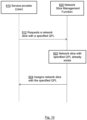
- network slice orchestration is performed by a service provider (user) 810 sending a request 812 for a network slice having a specified slice QPL to the network slice management function 820.
- the network slice management function checks whether a network slice with the specified QPL already exists. If a network slice with the specified slice QPL exists 822, the network slice management function assigns 824 a network slice with the specified slice QPL to the user.
- the network slice management function 820 sends a request to the security manager (orchestration level) 870 for allocation of network components (VNF, PNF, O-RAN) with component QPLs that are greater than or equal to the specified slice QPL.
- the security manager (orchestrator level) allocates, from available network components, VNF/PNF/O-RAN network components with component QPLs at least equal to the specified slice QPL and sends 872 information identifying the allocated network components and their QPLs to the network slice management function.
- the network slice management function instantiates the requested network slice using network components of the allocated network components and assigns 824 the instantiated network slice to the user 810.
- an embodiment provides a computer program 608 comprising instructions which when executed on a processor 604 cause the processor to carry out steps of the method 100, 200, 300 for operating a network slice management function described above.
- an embodiment provides a computer program 708 comprising instructions which when executed on a processor 704 cause the processor to carry out steps of the method 400 for operating a security management entity described above.
- an embodiment provides a computer program 758 comprising instructions which when executed on a processor 754 cause the processor to carry out steps of the method 500 for operating a network component described above.
Landscapes
- Engineering & Computer Science (AREA)
- Computer Security & Cryptography (AREA)
- Computer Networks & Wireless Communication (AREA)
- Signal Processing (AREA)
- Theoretical Computer Science (AREA)
- Physics & Mathematics (AREA)
- Electromagnetism (AREA)
- Computer Hardware Design (AREA)
- General Engineering & Computer Science (AREA)
- Software Systems (AREA)
- Computing Systems (AREA)
- General Physics & Mathematics (AREA)
- Mobile Radio Communication Systems (AREA)
Claims (15)
- Procédé (100, 200, 300) de fonctionnement d'une fonction de gestion de tranche de réseau configurée pour gérer une tranche de réseau d'un réseau cellulaire, le procédé étant réalisé par un dispositif de réseau de communication hébergeant la fonction de gestion de tranche de réseau, le procédé comprenant :- la réception (102, 202) d'une demande d'une tranche de réseau, la demande incluant un niveau de protection quantique, QPL, de bout-à-bout spécifié pour la tranche de réseau ;- la demande (104, 204), depuis une entité de gestion de sécurité du réseau cellulaire, d'une allocation de composants de réseau présentant des QPL de composants au moins égaux au QPL de tranche spécifié, un QPL de composant indiquant un niveau de sécurité, contre une attaque engagée par un ordinateur quantique, fourni au composant de réseau par une technologie de résistance aux attaques quantiques lorsque le composant de réseau utilise la technologie de résistance aux attaques quantiques ;- la réception (106, 206), depuis l'entité de gestion de sécurité, d'informations identifiant des composants de réseau alloués ;- l'instanciation (108, 212) de la tranche de réseau à l'aide de composants de réseau parmi les composants de réseau alloués ; et- à la suite de l'instanciation de la tranche de réseau, la détermination périodique d'un QPL de tranche actuel de la tranche de réseau et la réalisation de l'un de ce qui suit en fonction du QPL de tranche actuel :- aucune action requise ;- réaliser une surveillance active de la tranche de réseau et démarrer des actions pour mettre à jour des composants de tranche de réseau lorsque le QPL de tranche actuel est inférieur à une valeur de seuil de QPL de tranche ;- informer un fournisseur de services demandant la tranche de réseau que le QPL de tranche de réseau actuel est inférieur au QPL de tranche spécifié ; et- arrêter le fonctionnement de la tranche de réseau et déplacer un service utilisant la tranche de réseau vers une autre tranche présentant un QPL de tranche au moins égal au QPL de tranche spécifié.
- Procédé selon la revendication 1, comprenant en outre :- la réception (206), depuis l'entité de gestion de sécurité, d'informations indiquant des QPL de composants des composants de réseau alloués ; et- la détermination (208) d'un QPL de tranche de la tranche de réseau sur la base d'un QPL de composant le plus bas des composants de réseau de la tranche de réseau instanciée.
- Procédé selon l'une quelconque des revendications 1 et 2, comprenant en outre :- en réponse à la réception de la demande d'une tranche de réseau, la recherche (302), parmi des tranches de réseau existantes, d'une tranche de réseau présentant un QPL de tranche au moins égal au QPL de tranche spécifié ;- en réponse à la découverte (304), dans la recherche, d'une tranche de réseau présentant un QPL de tranche au moins égal au QPL de tranche spécifié, l'attribution (214) de ladite tranche de réseau en réponse à ladite demande d'une tranche de réseau ; et- en réponse à la non-découverte d'une tranche de réseau présentant un QPL de tranche au moins égal au QPL de tranche spécifié, le passage à ladite demande (204), depuis une entité de gestion de sécurité du réseau cellulaire, d'une allocation de composants de réseau pour instancier la tranche de réseau demandée.
- Procédé selon l'une quelconque des revendications 1 à 3, dans lequel la demande d'une tranche de réseau est l'un parmi un message de demande d'enregistrement incluant un différenciateur de tranche contenant le QPL de tranche spécifié et un message d'informations d'aide à la sélection de tranche de réseau, N-NSSAI, abonné incluant un différenciateur de tranche contenant le QPL de tranche spécifié.
- Procédé selon l'une quelconque des revendications 1 à 4, dans lequel la détermination périodique d'un QPL de tranche actuel de la tranche de réseau comprend :- la réception périodique de QPL de composants actuels de composants de réseau de la tranche de réseau ; et- la détermination du QPL de tranche actuel de la tranche de réseau sur la base d'un QPL de composant le plus bas parmi les QPL de composants actuels reçus.
- Procédé (400) de fonctionnement d'une entité de gestion de sécurité configurée pour orchestrer des tranches de réseau dans un réseau cellulaire, dans lequel les tranches de réseau sont générées à partir de composants de réseau, le procédé étant réalisé par un dispositif de réseau de communication hébergeant l'entité de gestion de sécurité, le procédé comprenant :- la détermination (402) de niveaux de protection quantique, QPL, de composants de composants de réseau, un QPL de composant indiquant un niveau de sécurité, contre une attaque engagée par un ordinateur quantique, fourni au composant de réseau par une technologie de résistance aux attaques quantiques lorsque le composant de réseau utilise la technologie de résistance aux attaques quantiques ;- la réception (404), depuis une fonction de gestion de tranche de réseau du réseau cellulaire, d'une demande d'allocation de composants de réseau présentant des QPL de composants au moins égaux à un QPL de tranche spécifié ;- l'allocation (406), parmi des composants de réseau disponibles, de composants de réseau présentant des QPL de composants au moins égaux au QPL de tranche spécifié ;- l'envoi (408), à la fonction de gestion de tranche de réseau, d'informations identifiant les composants de réseau alloués ; et après ledit envoi :- la détermination périodique de QPL de composants actuels de composants de réseau ; et- l'envoi des QPL de composants actuels à la fonction de gestion de tranche de réseau.
- Procédé selon la revendication 6, dans lequel la détermination périodique de QPL de composants actuels est réalisée avec une périodicité inversement proportionnelle au QPL de tranche spécifié.
- Procédé selon l'une quelconque des revendications 6 et 7, comprenant en outre l'ajout de QPL de composants de réseau à des modèles de déploiement de composants de réseau.
- Procédé (500) de fonctionnement d'un composant de réseau d'un réseau cellulaire, le procédé étant réalisé par un dispositif de réseau de communication hébergeant le composant de réseau, le procédé comprenant :- la détermination (502) d'un niveau de protection quantique, QPL, de composant du composant de réseau, le QPL de composant indiquant un niveau de sécurité, contre une attaque engagée par un ordinateur quantique, fourni au composant de réseau par une technologie de résistance aux attaques quantiques lorsque le composant de réseau utilise la technologie de résistance aux attaques quantiques ; et- l'envoi (504) du QPL de composant à une fonction de gestion de tranche de réseau du réseau cellulaire.
- Dispositif de réseau de communication (600) hébergeant une fonction de gestion de tranche de réseau configurée pour gérer une tranche de réseau d'un réseau cellulaire, le dispositif de réseau de communication comprenant une circuiterie d'interface (602), au moins un processeur (604) et une mémoire (606) comprenant des instructions (610) exécutables par l'au moins un processeur selon lesquelles la fonction de gestion de tranche de réseau est fonctionnelle pour :- recevoir une demande d'une tranche de réseau, la demande incluant un niveau de protection quantique, QPL, de bout-à-bout spécifié pour la tranche de réseau ;- demander, depuis une entité de gestion de sécurité du réseau cellulaire, une allocation de composants de réseau présentant des QPL de composants au moins égaux au QPL de tranche spécifié, un QPL de composant indiquant un niveau de sécurité, contre une attaque engagée par un ordinateur quantique, fourni au composant de réseau par une technologie de résistance aux attaques quantiques lorsque le composant de réseau utilise la technologie de résistance aux attaques quantiques ;- recevoir, depuis l'entité de gestion de sécurité, des informations identifiant des composants de réseau alloués ;- instancier la tranche de réseau à l'aide de composants de réseau parmi les composants de réseau alloués ; et- à la suite de l'instanciation de la tranche de réseau, déterminer périodiquement un QPL de tranche actuel de la tranche de réseau et réaliser l'un de ce qui suit en fonction du QPL de tranche actuel :- aucune action requise ;- réaliser une surveillance active de la tranche de réseau et démarrer des actions pour mettre à jour des composants de tranche de réseau lorsque le QPL de tranche actuel est inférieur à une valeur de seuil de QPL de tranche ;- informer un fournisseur de services demandant la tranche de réseau que le QPL de tranche de réseau actuel est inférieur au QPL de tranche spécifié ; et- arrêter le fonctionnement de la tranche de réseau et déplacer un service utilisant la tranche de réseau vers une autre tranche présentant un QPL de tranche au moins égal au QPL de tranche spécifié.
- Dispositif de réseau de communication (700) hébergeant une entité de gestion de sécurité configurée pour orchestrer des tranches de réseau dans un réseau cellulaire, dans lequel les tranches de réseau sont générées à partir de composants de réseau disponibles, le dispositif de réseau de communication comprenant une circuiterie d'interface (702), au moins un processeur (704) et une mémoire (706) comprenant des instructions (710) exécutables par l'au moins un processeur selon lesquelles l'entité de gestion de sécurité est fonctionnelle pour :- déterminer des niveaux de protection quantique, QPL, de composants de composants de réseau, un QPL de composant indiquant un niveau de sécurité, contre une attaque engagée par un ordinateur quantique, fourni au composant de réseau par une technologie de résistance aux attaques quantiques lorsque le composant de réseau utilise la technologie de résistance aux attaques quantiques ;- recevoir, depuis une fonction de gestion de tranche de réseau du réseau cellulaire, une demande d'allocation de composants de réseau présentant des QPL de composants au moins égaux à un QPL de tranche spécifié ;- allouer, parmi des composants de réseau disponibles, des composants de réseau présentant des QPL de composants au moins égaux au QPL de tranche spécifié ;- envoyer, à la fonction de gestion de tranche de réseau, des informations identifiant les composants de réseau alloués ; et après ledit envoi :- déterminer périodiquement des QPL de composants actuels de composants de réseau ; et- envoyer les QPL de composants actuels à la fonction de gestion de tranche de réseau.
- Dispositif de réseau de communication (750) hébergeant un composant de réseau, le dispositif de réseau de communication comprenant une circuiterie d'interface (752), au moins un processeur (754) et une mémoire (756) comprenant des instructions (760) exécutables par l'au moins un processeur selon lesquelles le composant de réseau est fonctionnel pour :- déterminer un niveau de protection quantique, QPL, de composant du composant de réseau, le QPL de composant indiquant un niveau de sécurité, contre une attaque engagée par un ordinateur quantique, fourni au composant de réseau par une technologie de résistance aux attaques quantiques lorsque le composant de réseau utilise la technologie de résistance aux attaques quantiques ;- envoyer le QPL de composant à une fonction de gestion de tranche de réseau du réseau cellulaire ; et après ledit envoi :- déterminer périodiquement des QPL de composants actuels de composants de réseau ; et- envoyer les QPL de composants actuels à la fonction de gestion de tranche de réseau.
- Programme informatique (608) comprenant des instructions (610) qui, lorsqu'elles sont exécutées sur au moins un processeur, amènent l'au moins un processeur à réaliser le procédé selon l'une quelconque des revendications 1 à 5.
- Programme informatique (708) comprenant des instructions (710) qui, lorsqu'elles sont exécutées sur au moins un processeur, amènent l'au moins un processeur à réaliser le procédé selon l'une quelconque des revendications 6 à 8.
- Programme informatique (758) comprenant des instructions (760) qui, lorsqu'elles sont exécutées sur au moins un processeur, amènent l'au moins un processeur à réaliser le procédé selon la revendication 9.
Applications Claiming Priority (1)
| Application Number | Priority Date | Filing Date | Title |
|---|---|---|---|
| PCT/EP2022/053693 WO2023155977A1 (fr) | 2022-02-15 | 2022-02-15 | Gestion et sécurité de tranche de réseau |
Publications (2)
| Publication Number | Publication Date |
|---|---|
| EP4480205A1 EP4480205A1 (fr) | 2024-12-25 |
| EP4480205B1 true EP4480205B1 (fr) | 2025-06-11 |
Family
ID=80780953
Family Applications (1)
| Application Number | Title | Priority Date | Filing Date |
|---|---|---|---|
| EP22710493.2A Active EP4480205B1 (fr) | 2022-02-15 | 2022-02-15 | Gestion et sécurité de tranche de réseau |
Country Status (3)
| Country | Link |
|---|---|
| US (1) | US20250141668A1 (fr) |
| EP (1) | EP4480205B1 (fr) |
| WO (1) | WO2023155977A1 (fr) |
Families Citing this family (1)
| Publication number | Priority date | Publication date | Assignee | Title |
|---|---|---|---|---|
| US20250175329A1 (en) * | 2023-11-27 | 2025-05-29 | T-Mobile Innovations Llc | Data communication with network slices that deliver quantum capabilities |
Family Cites Families (19)
| Publication number | Priority date | Publication date | Assignee | Title |
|---|---|---|---|---|
| KR102358918B1 (ko) * | 2016-07-04 | 2022-02-07 | 삼성전자 주식회사 | 무선 통신 시스템에서 서비스에 따른 보안 관리 방법 및 장치 |
| US20190174368A1 (en) * | 2016-07-22 | 2019-06-06 | Nokia Technologies Oy | Security handling for network slices in cellular networks |
| CN113826359B (zh) * | 2019-03-22 | 2024-08-20 | 皇家Kpn公司 | 第三方网络和网络切片管理 |
| WO2020209861A1 (fr) * | 2019-04-11 | 2020-10-15 | Nokia Technologies, OY | Sélection de tranche de réseau dans un réseau sur la base d'un cas d'utilisation |
| US12212604B2 (en) * | 2019-04-29 | 2025-01-28 | Nokia Technologies Oy | Method and apparatus for security assurance of a network or management function |
| US10939267B1 (en) * | 2019-08-15 | 2021-03-02 | Netsia, Inc. | Apparatus and method for a unified slice manager |
| US11444835B2 (en) * | 2019-09-06 | 2022-09-13 | Wipro Limited | System and method of maintenance of network slice templates for slice orchestration |
| US11490322B2 (en) * | 2020-03-23 | 2022-11-01 | T-Mobile Usa, Inc. | Provisioning of network slicing in a communication system |
| EP4147419A4 (fr) * | 2020-05-06 | 2024-01-17 | Nokia Technologies Oy | Procédé et appareil de prévention d'attaques réseau dans une tranche de réseau |
| US11888700B2 (en) * | 2020-08-03 | 2024-01-30 | Nokia Solutions And Networks Oy | Method and apparatus for fine-grained isolation in CN NSS domain of E2E network slice |
| US11696167B2 (en) * | 2020-10-16 | 2023-07-04 | Verizon Patent And Licensing Inc. | Systems and methods to automate slice admission control |
| US11683691B2 (en) * | 2021-01-07 | 2023-06-20 | Verizon Patent And Licensing Inc. | Methods and systems for 5G slicing based on dynamic security properties |
| US12166784B1 (en) * | 2021-01-21 | 2024-12-10 | T-Mobile Usa, Inc. | Cybersecurity system for network slices of wireless telecommunications network |
| KR20240082329A (ko) * | 2021-07-14 | 2024-06-10 | 제너럴 일렉트릭 캄파니 | 양자 보안 무선 네트워크를 구현하기 위한 시스템 및 방법 |
| US12592924B2 (en) * | 2022-04-11 | 2026-03-31 | At&T Intellectual Property I, L.P. | Smart hub quantum key distribution and security management in advanced networks |
| US12490178B2 (en) * | 2022-08-04 | 2025-12-02 | At&T Intellectual Property I, L.P. | Facilitating radio access network on-demand dynamic bandwidth allocation in advanced networks |
| US12363547B2 (en) * | 2022-11-08 | 2025-07-15 | Thales Dis France Sas | Method to monitor the management of network slices |
| US20250150952A1 (en) * | 2023-11-08 | 2025-05-08 | Samsung Electronics Co., Ltd. | Method and apparatus for providing network access to devices in a wireless communication system |
| US20260003944A1 (en) * | 2024-06-27 | 2026-01-01 | Maynard Dokken | Bio-Origin Validation Engine with Ownership Rights Management and Certification Apparatus, System and Method |
-
2022
- 2022-02-15 EP EP22710493.2A patent/EP4480205B1/fr active Active
- 2022-02-15 WO PCT/EP2022/053693 patent/WO2023155977A1/fr not_active Ceased
- 2022-02-15 US US18/837,873 patent/US20250141668A1/en active Pending
Also Published As
| Publication number | Publication date |
|---|---|
| EP4480205A1 (fr) | 2024-12-25 |
| WO2023155977A1 (fr) | 2023-08-24 |
| US20250141668A1 (en) | 2025-05-01 |
Similar Documents
| Publication | Publication Date | Title |
|---|---|---|
| US10129108B2 (en) | System and methods for network management and orchestration for network slicing | |
| EP3610670B1 (fr) | Fourniture de services permettant d'offrir des tranches de réseau à un client | |
| EP3292708B1 (fr) | Admission d'une session individuelle dans un réseau | |
| EP2880829B1 (fr) | Infrastructure adaptative pour un commutateur virtuel distribué | |
| US20190089747A1 (en) | Protecting secure session from iot gateways | |
| US20190327317A1 (en) | Service providing method, apparatus, and system | |
| CN114788241B (zh) | 提供网络管理与切片管理之间的接口 | |
| KR20190073520A (ko) | 중앙 집중식 관리 및 제어 네트워크에 기초한 양자 암호 키 중계 방법 및 장치 | |
| US12149507B2 (en) | Proxy network with self-erasing processing elements | |
| EP4413694B1 (fr) | Système de sélection cryptographique régi par une politique | |
| CN115915173A (zh) | 网络管理方法及装置 | |
| EP4480205B1 (fr) | Gestion et sécurité de tranche de réseau | |
| US11849314B2 (en) | Selectable tunnel encryption level management for multi access user equipment | |
| EP3402121B1 (fr) | Procédé et dispositif de transmission de règles dans un système nfv | |
| Gayathri et al. | An Innovation Development of Resource Management in 5G Wireless Local Area Network (5G-Wlan) using Machine Learning Model | |
| EP4298757B1 (fr) | Procédé et appareil pour un réseau défini par logiciel | |
| US20240121668A1 (en) | Dynamic transmission bandwidth contracts between hub and spoke devices | |
| US10623279B2 (en) | Method and network entity for control of value added service (VAS) | |
| Jin et al. | Resource multiplexing schemes of URLLC and eMBB under multi-service coexistence scenario based on management aspects | |
| Chintalapati et al. | Following the Journey of Network Slicing in 5G and 5G Advanced: Essential Concepts, Key Operations, Lifecycle Management, and Future Enhancements | |
| US12519732B1 (en) | Classifier for network policy-based traffic management | |
| US20250097198A1 (en) | Zero-trust packet routing | |
| US20260040184A1 (en) | Apparatus and method for user traffic control based on request of application service function in wireless communication system | |
| US20230413353A1 (en) | Inter-plmn user plane integration | |
| Giorgi | DESIGN AND ASSESSMENT OF A CLOUD-BASED REAL-TIME GEO-REFERENCED VEHICULAR NOTIFICATION SYSTEM |
Legal Events
| Date | Code | Title | Description |
|---|---|---|---|
| STAA | Information on the status of an ep patent application or granted ep patent |
Free format text: STATUS: UNKNOWN |
|
| STAA | Information on the status of an ep patent application or granted ep patent |
Free format text: STATUS: THE INTERNATIONAL PUBLICATION HAS BEEN MADE |
|
| PUAI | Public reference made under article 153(3) epc to a published international application that has entered the european phase |
Free format text: ORIGINAL CODE: 0009012 |
|
| STAA | Information on the status of an ep patent application or granted ep patent |
Free format text: STATUS: REQUEST FOR EXAMINATION WAS MADE |
|
| 17P | Request for examination filed |
Effective date: 20240628 |
|
| AK | Designated contracting states |
Kind code of ref document: A1 Designated state(s): AL AT BE BG CH CY CZ DE DK EE ES FI FR GB GR HR HU IE IS IT LI LT LU LV MC MK MT NL NO PL PT RO RS SE SI SK SM TR |
|
| GRAP | Despatch of communication of intention to grant a patent |
Free format text: ORIGINAL CODE: EPIDOSNIGR1 |
|
| STAA | Information on the status of an ep patent application or granted ep patent |
Free format text: STATUS: GRANT OF PATENT IS INTENDED |
|
| DAV | Request for validation of the european patent (deleted) | ||
| DAX | Request for extension of the european patent (deleted) | ||
| INTG | Intention to grant announced |
Effective date: 20250324 |
|
| GRAS | Grant fee paid |
Free format text: ORIGINAL CODE: EPIDOSNIGR3 |
|
| GRAA | (expected) grant |
Free format text: ORIGINAL CODE: 0009210 |
|
| STAA | Information on the status of an ep patent application or granted ep patent |
Free format text: STATUS: THE PATENT HAS BEEN GRANTED |
|
| AK | Designated contracting states |
Kind code of ref document: B1 Designated state(s): AL AT BE BG CH CY CZ DE DK EE ES FI FR GB GR HR HU IE IS IT LI LT LU LV MC MK MT NL NO PL PT RO RS SE SI SK SM TR |
|
| REG | Reference to a national code |
Ref country code: GB Ref legal event code: FG4D |
|
| REG | Reference to a national code |
Ref country code: CH Ref legal event code: EP |
|
| REG | Reference to a national code |
Ref country code: DE Ref legal event code: R096 Ref document number: 602022015808 Country of ref document: DE |
|
| REG | Reference to a national code |
Ref country code: IE Ref legal event code: FG4D |
|
| REG | Reference to a national code |
Ref country code: NL Ref legal event code: FP |
|
| PG25 | Lapsed in a contracting state [announced via postgrant information from national office to epo] |
Ref country code: FI Free format text: LAPSE BECAUSE OF FAILURE TO SUBMIT A TRANSLATION OF THE DESCRIPTION OR TO PAY THE FEE WITHIN THE PRESCRIBED TIME-LIMIT Effective date: 20250611 Ref country code: ES Free format text: LAPSE BECAUSE OF FAILURE TO SUBMIT A TRANSLATION OF THE DESCRIPTION OR TO PAY THE FEE WITHIN THE PRESCRIBED TIME-LIMIT Effective date: 20250611 |
|
| REG | Reference to a national code |
Ref country code: LT Ref legal event code: MG9D |
|
| PG25 | Lapsed in a contracting state [announced via postgrant information from national office to epo] |
Ref country code: NO Free format text: LAPSE BECAUSE OF FAILURE TO SUBMIT A TRANSLATION OF THE DESCRIPTION OR TO PAY THE FEE WITHIN THE PRESCRIBED TIME-LIMIT Effective date: 20250911 Ref country code: GR Free format text: LAPSE BECAUSE OF FAILURE TO SUBMIT A TRANSLATION OF THE DESCRIPTION OR TO PAY THE FEE WITHIN THE PRESCRIBED TIME-LIMIT Effective date: 20250912 |
|
| PG25 | Lapsed in a contracting state [announced via postgrant information from national office to epo] |
Ref country code: BG Free format text: LAPSE BECAUSE OF FAILURE TO SUBMIT A TRANSLATION OF THE DESCRIPTION OR TO PAY THE FEE WITHIN THE PRESCRIBED TIME-LIMIT Effective date: 20250611 |
|
| PG25 | Lapsed in a contracting state [announced via postgrant information from national office to epo] |
Ref country code: HR Free format text: LAPSE BECAUSE OF FAILURE TO SUBMIT A TRANSLATION OF THE DESCRIPTION OR TO PAY THE FEE WITHIN THE PRESCRIBED TIME-LIMIT Effective date: 20250611 |
|
| PG25 | Lapsed in a contracting state [announced via postgrant information from national office to epo] |
Ref country code: RS Free format text: LAPSE BECAUSE OF FAILURE TO SUBMIT A TRANSLATION OF THE DESCRIPTION OR TO PAY THE FEE WITHIN THE PRESCRIBED TIME-LIMIT Effective date: 20250911 |
|
| PG25 | Lapsed in a contracting state [announced via postgrant information from national office to epo] |
Ref country code: LV Free format text: LAPSE BECAUSE OF FAILURE TO SUBMIT A TRANSLATION OF THE DESCRIPTION OR TO PAY THE FEE WITHIN THE PRESCRIBED TIME-LIMIT Effective date: 20250611 |
|
| PG25 | Lapsed in a contracting state [announced via postgrant information from national office to epo] |
Ref country code: PT Free format text: LAPSE BECAUSE OF FAILURE TO SUBMIT A TRANSLATION OF THE DESCRIPTION OR TO PAY THE FEE WITHIN THE PRESCRIBED TIME-LIMIT Effective date: 20251013 |
|
| REG | Reference to a national code |
Ref country code: AT Ref legal event code: MK05 Ref document number: 1803221 Country of ref document: AT Kind code of ref document: T Effective date: 20250611 |
|
| PG25 | Lapsed in a contracting state [announced via postgrant information from national office to epo] |
Ref country code: IS Free format text: LAPSE BECAUSE OF FAILURE TO SUBMIT A TRANSLATION OF THE DESCRIPTION OR TO PAY THE FEE WITHIN THE PRESCRIBED TIME-LIMIT Effective date: 20251011 |
|
| PG25 | Lapsed in a contracting state [announced via postgrant information from national office to epo] |
Ref country code: AT Free format text: LAPSE BECAUSE OF FAILURE TO SUBMIT A TRANSLATION OF THE DESCRIPTION OR TO PAY THE FEE WITHIN THE PRESCRIBED TIME-LIMIT Effective date: 20250611 Ref country code: SM Free format text: LAPSE BECAUSE OF FAILURE TO SUBMIT A TRANSLATION OF THE DESCRIPTION OR TO PAY THE FEE WITHIN THE PRESCRIBED TIME-LIMIT Effective date: 20250611 |
|
| PG25 | Lapsed in a contracting state [announced via postgrant information from national office to epo] |
Ref country code: CZ Free format text: LAPSE BECAUSE OF FAILURE TO SUBMIT A TRANSLATION OF THE DESCRIPTION OR TO PAY THE FEE WITHIN THE PRESCRIBED TIME-LIMIT Effective date: 20250611 |
|
| PG25 | Lapsed in a contracting state [announced via postgrant information from national office to epo] |
Ref country code: PL Free format text: LAPSE BECAUSE OF FAILURE TO SUBMIT A TRANSLATION OF THE DESCRIPTION OR TO PAY THE FEE WITHIN THE PRESCRIBED TIME-LIMIT Effective date: 20250611 |
|
| PG25 | Lapsed in a contracting state [announced via postgrant information from national office to epo] |
Ref country code: EE Free format text: LAPSE BECAUSE OF FAILURE TO SUBMIT A TRANSLATION OF THE DESCRIPTION OR TO PAY THE FEE WITHIN THE PRESCRIBED TIME-LIMIT Effective date: 20250611 |
|
| PG25 | Lapsed in a contracting state [announced via postgrant information from national office to epo] |
Ref country code: SK Free format text: LAPSE BECAUSE OF FAILURE TO SUBMIT A TRANSLATION OF THE DESCRIPTION OR TO PAY THE FEE WITHIN THE PRESCRIBED TIME-LIMIT Effective date: 20250611 |
|
| REG | Reference to a national code |
Ref country code: DE Ref legal event code: R097 Ref document number: 602022015808 Country of ref document: DE |
|
| PGFP | Annual fee paid to national office [announced via postgrant information from national office to epo] |
Ref country code: NL Payment date: 20260226 Year of fee payment: 5 |
|
| PGFP | Annual fee paid to national office [announced via postgrant information from national office to epo] |
Ref country code: GB Payment date: 20260227 Year of fee payment: 5 |
|
| PG25 | Lapsed in a contracting state [announced via postgrant information from national office to epo] |
Ref country code: DK Free format text: LAPSE BECAUSE OF FAILURE TO SUBMIT A TRANSLATION OF THE DESCRIPTION OR TO PAY THE FEE WITHIN THE PRESCRIBED TIME-LIMIT Effective date: 20250611 |
|
| PGFP | Annual fee paid to national office [announced via postgrant information from national office to epo] |
Ref country code: DE Payment date: 20260227 Year of fee payment: 5 |
|
| PG25 | Lapsed in a contracting state [announced via postgrant information from national office to epo] |
Ref country code: IT Free format text: LAPSE BECAUSE OF FAILURE TO SUBMIT A TRANSLATION OF THE DESCRIPTION OR TO PAY THE FEE WITHIN THE PRESCRIBED TIME-LIMIT Effective date: 20250611 |
|
| PLBE | No opposition filed within time limit |
Free format text: ORIGINAL CODE: 0009261 |
|
| STAA | Information on the status of an ep patent application or granted ep patent |
Free format text: STATUS: NO OPPOSITION FILED WITHIN TIME LIMIT |
|
| REG | Reference to a national code |
Ref country code: CH Ref legal event code: L10 Free format text: ST27 STATUS EVENT CODE: U-0-0-L10-L00 (AS PROVIDED BY THE NATIONAL OFFICE) Effective date: 20260423 |