EP4480603A1 - Kupferlegierungspulver zur generativen schichtfertigung, herstellungsverfahren und beurteilungsverfahren dafür - Google Patents
Kupferlegierungspulver zur generativen schichtfertigung, herstellungsverfahren und beurteilungsverfahren dafür Download PDFInfo
- Publication number
- EP4480603A1 EP4480603A1 EP22933469.3A EP22933469A EP4480603A1 EP 4480603 A1 EP4480603 A1 EP 4480603A1 EP 22933469 A EP22933469 A EP 22933469A EP 4480603 A1 EP4480603 A1 EP 4480603A1
- Authority
- EP
- European Patent Office
- Prior art keywords
- copper alloy
- additive manufacturing
- additively manufactured
- less
- alloy powder
- Prior art date
- Legal status (The legal status is an assumption and is not a legal conclusion. Google has not performed a legal analysis and makes no representation as to the accuracy of the status listed.)
- Pending
Links
Images



Classifications
-
- C—CHEMISTRY; METALLURGY
- C22—METALLURGY; FERROUS OR NON-FERROUS ALLOYS; TREATMENT OF ALLOYS OR NON-FERROUS METALS
- C22C—ALLOYS
- C22C9/00—Alloys based on copper
-
- C—CHEMISTRY; METALLURGY
- C22—METALLURGY; FERROUS OR NON-FERROUS ALLOYS; TREATMENT OF ALLOYS OR NON-FERROUS METALS
- C22C—ALLOYS
- C22C1/00—Making non-ferrous alloys
- C22C1/04—Making non-ferrous alloys by powder metallurgy
- C22C1/0425—Copper-based alloys
-
- B—PERFORMING OPERATIONS; TRANSPORTING
- B22—CASTING; POWDER METALLURGY
- B22F—WORKING METALLIC POWDER; MANUFACTURE OF ARTICLES FROM METALLIC POWDER; MAKING METALLIC POWDER; APPARATUS OR DEVICES SPECIALLY ADAPTED FOR METALLIC POWDER
- B22F1/00—Metallic powder; Treatment of metallic powder, e.g. to facilitate working or to improve properties
- B22F1/05—Metallic powder characterised by the size or surface area of the particles
-
- B—PERFORMING OPERATIONS; TRANSPORTING
- B22—CASTING; POWDER METALLURGY
- B22F—WORKING METALLIC POWDER; MANUFACTURE OF ARTICLES FROM METALLIC POWDER; MAKING METALLIC POWDER; APPARATUS OR DEVICES SPECIALLY ADAPTED FOR METALLIC POWDER
- B22F10/00—Additive manufacturing of workpieces or articles from metallic powder
- B22F10/20—Direct sintering or melting
- B22F10/28—Powder bed fusion, e.g. selective laser melting [SLM] or electron beam melting [EBM]
-
- B—PERFORMING OPERATIONS; TRANSPORTING
- B22—CASTING; POWDER METALLURGY
- B22F—WORKING METALLIC POWDER; MANUFACTURE OF ARTICLES FROM METALLIC POWDER; MAKING METALLIC POWDER; APPARATUS OR DEVICES SPECIALLY ADAPTED FOR METALLIC POWDER
- B22F10/00—Additive manufacturing of workpieces or articles from metallic powder
- B22F10/30—Process control
- B22F10/34—Process control of powder characteristics, e.g. density, oxidation or flowability
-
- B—PERFORMING OPERATIONS; TRANSPORTING
- B22—CASTING; POWDER METALLURGY
- B22F—WORKING METALLIC POWDER; MANUFACTURE OF ARTICLES FROM METALLIC POWDER; MAKING METALLIC POWDER; APPARATUS OR DEVICES SPECIALLY ADAPTED FOR METALLIC POWDER
- B22F10/00—Additive manufacturing of workpieces or articles from metallic powder
- B22F10/60—Treatment of workpieces or articles after build-up
- B22F10/64—Treatment of workpieces or articles after build-up by thermal means
-
- B—PERFORMING OPERATIONS; TRANSPORTING
- B22—CASTING; POWDER METALLURGY
- B22F—WORKING METALLIC POWDER; MANUFACTURE OF ARTICLES FROM METALLIC POWDER; MAKING METALLIC POWDER; APPARATUS OR DEVICES SPECIALLY ADAPTED FOR METALLIC POWDER
- B22F9/00—Making metallic powder or suspensions thereof
- B22F9/02—Making metallic powder or suspensions thereof using physical processes
- B22F9/06—Making metallic powder or suspensions thereof using physical processes starting from liquid material
- B22F9/08—Making metallic powder or suspensions thereof using physical processes starting from liquid material by casting, e.g. through sieves or in water, by atomising or spraying
- B22F9/082—Making metallic powder or suspensions thereof using physical processes starting from liquid material by casting, e.g. through sieves or in water, by atomising or spraying atomising using a fluid
-
- B—PERFORMING OPERATIONS; TRANSPORTING
- B22—CASTING; POWDER METALLURGY
- B22F—WORKING METALLIC POWDER; MANUFACTURE OF ARTICLES FROM METALLIC POWDER; MAKING METALLIC POWDER; APPARATUS OR DEVICES SPECIALLY ADAPTED FOR METALLIC POWDER
- B22F9/00—Making metallic powder or suspensions thereof
- B22F9/02—Making metallic powder or suspensions thereof using physical processes
- B22F9/14—Making metallic powder or suspensions thereof using physical processes using electric discharge
-
- B—PERFORMING OPERATIONS; TRANSPORTING
- B33—ADDITIVE MANUFACTURING TECHNOLOGY
- B33Y—ADDITIVE MANUFACTURING, i.e. MANUFACTURING OF THREE-DIMENSIONAL [3D] OBJECTS BY ADDITIVE DEPOSITION, ADDITIVE AGGLOMERATION OR ADDITIVE LAYERING, e.g. BY 3D PRINTING, STEREOLITHOGRAPHY OR SELECTIVE LASER SINTERING
- B33Y10/00—Processes of additive manufacturing
-
- B—PERFORMING OPERATIONS; TRANSPORTING
- B33—ADDITIVE MANUFACTURING TECHNOLOGY
- B33Y—ADDITIVE MANUFACTURING, i.e. MANUFACTURING OF THREE-DIMENSIONAL [3D] OBJECTS BY ADDITIVE DEPOSITION, ADDITIVE AGGLOMERATION OR ADDITIVE LAYERING, e.g. BY 3D PRINTING, STEREOLITHOGRAPHY OR SELECTIVE LASER SINTERING
- B33Y40/00—Auxiliary operations or equipment, e.g. for material handling
- B33Y40/20—Post-treatment, e.g. curing, coating or polishing
-
- B—PERFORMING OPERATIONS; TRANSPORTING
- B33—ADDITIVE MANUFACTURING TECHNOLOGY
- B33Y—ADDITIVE MANUFACTURING, i.e. MANUFACTURING OF THREE-DIMENSIONAL [3D] OBJECTS BY ADDITIVE DEPOSITION, ADDITIVE AGGLOMERATION OR ADDITIVE LAYERING, e.g. BY 3D PRINTING, STEREOLITHOGRAPHY OR SELECTIVE LASER SINTERING
- B33Y70/00—Materials specially adapted for additive manufacturing
-
- B—PERFORMING OPERATIONS; TRANSPORTING
- B33—ADDITIVE MANUFACTURING TECHNOLOGY
- B33Y—ADDITIVE MANUFACTURING, i.e. MANUFACTURING OF THREE-DIMENSIONAL [3D] OBJECTS BY ADDITIVE DEPOSITION, ADDITIVE AGGLOMERATION OR ADDITIVE LAYERING, e.g. BY 3D PRINTING, STEREOLITHOGRAPHY OR SELECTIVE LASER SINTERING
- B33Y80/00—Products made by additive manufacturing
-
- C—CHEMISTRY; METALLURGY
- C22—METALLURGY; FERROUS OR NON-FERROUS ALLOYS; TREATMENT OF ALLOYS OR NON-FERROUS METALS
- C22F—CHANGING THE PHYSICAL STRUCTURE OF NON-FERROUS METALS AND NON-FERROUS ALLOYS
- C22F1/00—Changing the physical structure of non-ferrous metals or alloys by heat treatment or by hot or cold working
- C22F1/08—Changing the physical structure of non-ferrous metals or alloys by heat treatment or by hot or cold working of copper or alloys based thereon
-
- B—PERFORMING OPERATIONS; TRANSPORTING
- B22—CASTING; POWDER METALLURGY
- B22F—WORKING METALLIC POWDER; MANUFACTURE OF ARTICLES FROM METALLIC POWDER; MAKING METALLIC POWDER; APPARATUS OR DEVICES SPECIALLY ADAPTED FOR METALLIC POWDER
- B22F10/00—Additive manufacturing of workpieces or articles from metallic powder
- B22F10/30—Process control
- B22F10/36—Process control of energy beam parameters
-
- B—PERFORMING OPERATIONS; TRANSPORTING
- B22—CASTING; POWDER METALLURGY
- B22F—WORKING METALLIC POWDER; MANUFACTURE OF ARTICLES FROM METALLIC POWDER; MAKING METALLIC POWDER; APPARATUS OR DEVICES SPECIALLY ADAPTED FOR METALLIC POWDER
- B22F9/00—Making metallic powder or suspensions thereof
- B22F9/02—Making metallic powder or suspensions thereof using physical processes
- B22F9/06—Making metallic powder or suspensions thereof using physical processes starting from liquid material
- B22F9/08—Making metallic powder or suspensions thereof using physical processes starting from liquid material by casting, e.g. through sieves or in water, by atomising or spraying
- B22F9/082—Making metallic powder or suspensions thereof using physical processes starting from liquid material by casting, e.g. through sieves or in water, by atomising or spraying atomising using a fluid
- B22F2009/0824—Making metallic powder or suspensions thereof using physical processes starting from liquid material by casting, e.g. through sieves or in water, by atomising or spraying atomising using a fluid with a specific atomising fluid
-
- B—PERFORMING OPERATIONS; TRANSPORTING
- B22—CASTING; POWDER METALLURGY
- B22F—WORKING METALLIC POWDER; MANUFACTURE OF ARTICLES FROM METALLIC POWDER; MAKING METALLIC POWDER; APPARATUS OR DEVICES SPECIALLY ADAPTED FOR METALLIC POWDER
- B22F2202/00—Treatment under specific physical conditions
- B22F2202/13—Use of plasma
-
- B—PERFORMING OPERATIONS; TRANSPORTING
- B22—CASTING; POWDER METALLURGY
- B22F—WORKING METALLIC POWDER; MANUFACTURE OF ARTICLES FROM METALLIC POWDER; MAKING METALLIC POWDER; APPARATUS OR DEVICES SPECIALLY ADAPTED FOR METALLIC POWDER
- B22F2301/00—Metallic composition of the powder or its coating
- B22F2301/10—Copper
-
- B—PERFORMING OPERATIONS; TRANSPORTING
- B22—CASTING; POWDER METALLURGY
- B22F—WORKING METALLIC POWDER; MANUFACTURE OF ARTICLES FROM METALLIC POWDER; MAKING METALLIC POWDER; APPARATUS OR DEVICES SPECIALLY ADAPTED FOR METALLIC POWDER
- B22F2304/00—Physical aspects of the powder
- B22F2304/10—Micron size particles, i.e. above 1 micrometer up to 500 micrometer
-
- B—PERFORMING OPERATIONS; TRANSPORTING
- B22—CASTING; POWDER METALLURGY
- B22F—WORKING METALLIC POWDER; MANUFACTURE OF ARTICLES FROM METALLIC POWDER; MAKING METALLIC POWDER; APPARATUS OR DEVICES SPECIALLY ADAPTED FOR METALLIC POWDER
- B22F2998/00—Supplementary information concerning processes or compositions relating to powder metallurgy
- B22F2998/10—Processes characterised by the sequence of their steps
-
- B—PERFORMING OPERATIONS; TRANSPORTING
- B22—CASTING; POWDER METALLURGY
- B22F—WORKING METALLIC POWDER; MANUFACTURE OF ARTICLES FROM METALLIC POWDER; MAKING METALLIC POWDER; APPARATUS OR DEVICES SPECIALLY ADAPTED FOR METALLIC POWDER
- B22F2999/00—Aspects linked to processes or compositions used in powder metallurgy
-
- B—PERFORMING OPERATIONS; TRANSPORTING
- B33—ADDITIVE MANUFACTURING TECHNOLOGY
- B33Y—ADDITIVE MANUFACTURING, i.e. MANUFACTURING OF THREE-DIMENSIONAL [3D] OBJECTS BY ADDITIVE DEPOSITION, ADDITIVE AGGLOMERATION OR ADDITIVE LAYERING, e.g. BY 3D PRINTING, STEREOLITHOGRAPHY OR SELECTIVE LASER SINTERING
- B33Y50/00—Data acquisition or data processing for additive manufacturing
- B33Y50/02—Data acquisition or data processing for additive manufacturing for controlling or regulating additive manufacturing processes
-
- C—CHEMISTRY; METALLURGY
- C22—METALLURGY; FERROUS OR NON-FERROUS ALLOYS; TREATMENT OF ALLOYS OR NON-FERROUS METALS
- C22F—CHANGING THE PHYSICAL STRUCTURE OF NON-FERROUS METALS AND NON-FERROUS ALLOYS
- C22F1/00—Changing the physical structure of non-ferrous metals or alloys by heat treatment or by hot or cold working
- C22F1/02—Changing the physical structure of non-ferrous metals or alloys by heat treatment or by hot or cold working in inert or controlled atmosphere or vacuum
-
- Y—GENERAL TAGGING OF NEW TECHNOLOGICAL DEVELOPMENTS; GENERAL TAGGING OF CROSS-SECTIONAL TECHNOLOGIES SPANNING OVER SEVERAL SECTIONS OF THE IPC; TECHNICAL SUBJECTS COVERED BY FORMER USPC CROSS-REFERENCE ART COLLECTIONS [XRACs] AND DIGESTS
- Y02—TECHNOLOGIES OR APPLICATIONS FOR MITIGATION OR ADAPTATION AGAINST CLIMATE CHANGE
- Y02P—CLIMATE CHANGE MITIGATION TECHNOLOGIES IN THE PRODUCTION OR PROCESSING OF GOODS
- Y02P10/00—Technologies related to metal processing
- Y02P10/25—Process efficiency
Definitions
- the present invention relates to a copper alloy powder for additive manufacturing, a manufacturing method and evaluation method thereof, a manufacturing method of a copper alloy additively manufactured product, and a copper alloy additively manufactured product.
- patent literature 1 discloses a copper alloy powder for additive manufacturing, which is manufactured by an atomization method and contains chromium more than 1.00 mass% to 2.80 mass% or less and copper as a balance.
- Patent literature 1 Japanese Patent No. 6389557
- the strength (hardness) and the electrical conductivity of a copper alloy have a tradeoff relationship, and the technique described in the above literature cannot obtain a copper alloy additively manufactured product having a high strength and a high electrical conductivity.
- the present invention enables to provide a technique of solving the above-described problem.
- One example aspect of the invention provides a copper alloy powder for additive manufacturing used to manufacture an additively manufactured product by an additive manufacturing method, wherein the copper alloy powder contains not less than 0.70 wt% to not more than 1.5 wt% of chromium and not less than 0.05 wt% to not more than 0.35 wt% of magnesium, and a balance is formed from copper and an unavoidable impurity.
- Another example aspect of the present invention provides a copper alloy additively manufactured product additively manufactured by an additive manufacturing apparatus using the above-described copper alloy powder for additive manufacturing, wherein the copper alloy additively manufactured product contains not less than 0.70 wt% to not more than 1.5 wt% of chromium and not less than 0.05 wt% to not more than 0.35 wt% of magnesium, and a balance is formed from copper and an unavoidable impurity.
- Still other example aspect of the present invention provides a manufacturing method of a copper alloy additively manufactured product, comprising:
- Still other example aspect of the present invention provides a manufacturing method of a copper alloy powder for additive manufacturing, which is a manufacturing method of a copper alloy powder for additive manufacturing used to manufacture an additively manufactured product by an additive manufacturing method, comprising:
- Still other example aspect of the present invention provides an evaluation method of a copper alloy powder for additive manufacturing, comprising:
- An additive manufacturing technique enables to produce a product that has a complex shape and is difficult to manufacture by a conventional processing technique, and this technique is expected to be applied in various fields. In particular, application of metal materials excellent in a mechanical characteristic is demanded.
- copper has a high electrical conductivity or thermal conductivity, and application of the additive manufacturing method to a product having a complex shape such as a heat sink or a heat exchanger is expected.
- major materials that have conventionally been applied as metal powders for additive manufacturing are iron, nickel, aluminum, titanium, and alloys thereof, and there are still few application examples of copper and copper alloys. The reason for this is as follows. Since copper has a high electrical conductivity and a high thermal conductivity, heat energy that is applied as a laser beam at the time of additive manufacturing is quickly radiated and diffused, and therefore, copper cannot sufficiently be molten so it is difficult to obtain a high-density additively manufactured product.
- patent literature 1 discloses a copper alloy powder for additive manufacturing, which is manufactured by an atomization method and contains chromium more than 1.00 mass% to 2.80 mass% or less and copper as a balance.
- the copper alloy powder is rapidly solidified from a molten state, chromium is in a super-saturated solid solution state. Since the thermal diffusibility/heat dissipation lowers, and the thermal conductivity lowers, the copper alloy powder can easily be molten and manufactured using a low-output manufacturing apparatus.
- a manufacturing region is temporarily molten and then rapidly solidified, and therefore, chromium is in the super-saturated solid solution state.
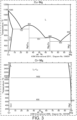
- Fig. 1 is a graph showing the relationship and the boundary line between the Vickers hardness and the electrical conductivity of the additively manufactured product in patent literature 1.
- a Vickers hardness Y (Hv) and an electrical conductivity X (%IACS) is limited in a region on the lower side of the boundary line represented by equation (1) below, that is, in a region on a low strength side and a low electrical conductivity side.
- Hv Vickers hardness
- %IACS electrical conductivity X
- a practical copper alloy for additive manufacturing is required not only to implement a high density and develop an excellent electrical conductivity intrinsic to copper but also to simultaneously achieve the electrical conductivity and the mechanical strength at high level.
- the electrical conductivity and the strength have a tradeoff relationship, it is not easy to achieve both characteristics.
- a copper alloy for additive manufacturing in a region on the upper side of the boundary line represented by equation (1) above, that is, in a region on a high strength side and a high electrical conductivity side cannot be obtained.
- equation (2) is used as a reference that specifically indicates a high strength and a high electrical conductivity.
- %IACS electrical conductivity
- Hv Vickers hardness
- a copper alloy additively manufactured product additively manufactured by an additive manufacturing apparatus using a copper alloy powder for additive manufacturing according to the present invention has an excellent electrical conductivity, and can therefore be used as a copper alloy additively manufactured product having a high thermal conductivity.
- Fig. 2 is a flowchart showing the procedure of an evaluation method of the copper alloy powder for additive manufacturing according to this example embodiment.
- step S201 of Fig. 2 formation processing of a powder layer for additive manufacturing is performed using a copper alloy powder for additive manufacturing of an evaluation target.
- step S202 it is determined whether a powder layer capable of additive manufacturing can be formed by the copper alloy powder for additive manufacturing of the evaluation target. If the squeegeeing property is poor, and the powder layer capable of additive manufacturing cannot be formed, it is evaluated in step S209 that the powder is insufficient as a copper alloy powder for additive manufacturing.
- step S203 an additively manufactured product is manufactured using an additive manufacturing apparatus or the like using the copper alloy powder for additive manufacturing of the evaluation target.
- step S204 the electrical conductivity X (%IACS) and the Vickers hardness Y (Hv) of the manufactured additively manufactured product are measured.
- step S205 it is determined whether a plot point (X, Y) on a two-dimensional graph (see Fig.
- step S207 If the plot point is located in the upper region (Y ⁇ -1.1X + 300), it is evaluated in step S207 that the powder is sufficient as a copper alloy powder for additive manufacturing. On the other hand, if the plot point is located in the lower region (Y ⁇ -1.1X + 300), it is evaluated in step S209 that the powder is insufficient as a copper alloy powder for additive manufacturing.
- the evaluation method of the copper alloy powder for additive manufacturing of this example embodiment it is possible to evaluate a copper alloy powder for additive manufacturing, which can obtain a copper alloy additively manufactured product having a high strength and a high electrical conductivity.
- a manufacturing method of a raw material powder capable of implementing a characteristic in the region on the upper side of the boundary line represented by equation (2), that is, in the region on the high strength side and the high electrical conductivity side, the raw material powder, and an additively manufactured product obtained using the raw material powder.
- magnesium is one of alloy elements for copper which have the weakest effect of increasing the resistivity of the substrate, and even if magnesium is added as the third element to the copper-chromium alloy, the influence on the electrical conductivity can be expected to be suppressed minimum.
- the present inventors arrived at adding magnesium as the third element to the copper-chromium alloy and the present invention was accomplished as a result of intensive studies.
- the copper alloy powder for additive manufacturing according to this example embodiment is a copper alloy powder containing 0.70 wt% or more to 1.5 wt% or less of chromium, 0.05 wt% or more to 0.35 wt% or less of magnesium, and a balance formed from copper and unavoidable impurities.
- the 50% particle size is 3.0 ⁇ m or more to 200 ⁇ m or less.
- the apparent density of the powder measured by the measurement method of JIS Z 2504 is 3.5 g/cm 3 or more.
- the adhesion of the copper alloy powder obtained from a failure envelope obtained by a shearing test is 0.600 kPa or less.
- the copper alloy additively manufactured product according to this example embodiment is additively manufactured by an additive manufacturing apparatus using the copper alloy powder for additive manufacturing according to this example embodiment, and contains 0.70 wt% or more to 1.5 wt% or less of chromium, 0.05 wt% or more to 0.35 wt% or less of magnesium, and a balance formed from copper and unavoidable impurities.
- the copper alloy additively manufactured product according to this example embodiment has an electrical conductivity of 60%IACS or more.
- the copper alloy additively manufactured product according to this example embodiment has a Vickers hardness of 230 Hv or more.
- the manufacturing method of the copper alloy additively manufactured product according to this example embodiment further includes an aging treatment step of holding the copper alloy additively manufactured product according to this example embodiment at 400°C or more to 500°C or less. It is more desirable to hold the copper alloy additively manufactured product at 450°C or more to 500°C or less.
- the copper alloy powder for additive manufacturing enables to manufacture the copper alloy additively manufactured product that has an excellent electrical conductivity and mechanical strength located in the region on the upper side of the boundary line represented by equation (2), that is, in the region on the high strength side and the high electrical conductivity side.
- the manufacturing method of the copper alloy powder for additive manufacturing according to this example embodiment is not particularly limited.
- a method of rapidly solidifying powder particles from a molten state such as a gas atomization method, a water atomization method, a centrifugal atomization method, a plasma atomization method, or a plasma rotating electrode method, is preferably used.
- the gas atomization method is particularly preferable.
- the manufactured powder can be classified by a known classifying method under predetermined classifying conditions and adjusted to a copper alloy powder for additive manufacturing with an appropriate grain size.
- an air flow classifier can suitably be used as a classifying apparatus for executing classification.
- the content of chromium is preferably 0.70 wt% or more. If the content is less than 0.70 wt%, the precipitation amount in aging treatment is insufficient, and the effect of improving the strength cannot sufficiently be obtained.
- the solid-solubility limit of chromium to copper is said to be 0.7 wt% or more to 0.8 wt% or less at a eutectic temperature of about 1,076°C.
- the amount is small, if a manufacturing method of melting a metal and rapidly solidifying it, like an atomization method, is used as the powder manufacturing method, chromium more than the solid-solubility limit can be contained in the copper substrate. Also, if an additive manufacturing method such as a powder bed fusion method is used, fusion by a laser or electron beam and rapid solidification are performed in the step. Hence, an additively manufactured product can be produced while keeping chromium more than the solid-solubility limit contained in the copper substrate. However, if the content of chromium exceeds 1.5 wt%, the electrical conductivity greatly lowers, although an effect of further improving the mechanical strength can be obtained. For this reason, the content of chromium is preferably 1.5 wt% or less.
- Magnesium is an important element considered to raise the chemical potential of chromium and enhance the repulsive interaction between elements to promote precipitation of chromium, as described above. If the content of magnesium is less than 0.05 wt%, precipitation of chromium is insufficient, and the high strength and the high electrical conductivity of the present invention cannot simultaneously be satisfied in balance. If the content of magnesium exceeds 0.35 wt%, the ratio of magnesium becomes high. However, even if the content of magnesium is increased, no large effect can be obtained in terms of characteristic. In addition, since expensive magnesium is excessively contained, the cost increases. For these reasons, the content of magnesium is preferably 0.05 wt% or more to 0.35 wt% or less and, more preferably 0.06 wt% or more to 0.25 wt% or less.
- the copper alloy powder for additive manufacturing sometimes contains unavoidable impurities in addition to chromium and magnesium.
- the unavoidable impurities are unavoidably mixed in the manufacturing steps of the copper alloy powder for additive manufacturing, and examples are oxygen, phosphorus, iron, aluminum, silicon, and titanium. Since these unavoidable impurities may lower the electrical conductivity, their content is preferably 0.10 wt% or less, more preferably 0.05 wt% or less, and more preferably 0.01 wt% or less.
- the powder used for additive manufacturing is required to be suitable for the processes of additive manufacturing, such as the step of supplying the powder from a hopper onto a manufacturing stage, the step of forming a powder layer evenly laid in a predetermined thickens, and the step of melting and solidification.
- the conditions are a particle size adjusted within an appropriate range, an apparent density within an appropriate range, and the fluidity of the powder that enables supply from the supply hopper and formation of an appropriate powder layer.
- the 50% particle size of the copper alloy powder for additive manufacturing means the integrated 50% particle size (so-called median diameter D50) of the powder in the integrated grain size distribution based on a volume measured by a laser diffraction method, and is preferably included in the range of 3.0 ⁇ m or more to 200 ⁇ m or less. If the 50% particle size is less than 3.0 ⁇ m, the fluidity of the powder does not exist, and no powder bed can be formed even by an additive manufacturing apparatus using a laser powder bed fusion method. Also, the powder intensely spatters and readheres to the additively manufactured product, resulting in surface defects.
- the 50% particle size is larger than 100 ⁇ m in a case where additive manufacturing is performed by the laser powder bed fusion method, or if the 50% particle size is larger than 200 ⁇ m in a case where additive manufacturing is performed by an electron beam powder bed fusion method, the surface of the powder bed is rough, and a powder bed suitable for manufacturing cannot be formed. In addition, the surface of the additively manufactured product is roughened to cause an improper appearance, and a molten pool generated in the powder layer at the time of beam irradiation does not reach a solidification layer immediately below, resulting in insufficient melting and solidification and a manufacturing failure.
- the 50% particle size is preferably 3.0 ⁇ m or more to 100 ⁇ m or less, more preferably 5.0 ⁇ m or more to 75 ⁇ m or less, and more preferably 10 ⁇ m or more to 45 ⁇ m or less.
- the 50% particle size is preferably 10 ⁇ m or more to 200 ⁇ m or less, more preferably 25 ⁇ m or more to 150 ⁇ m or less, and more preferably 45 ⁇ m or more to 105 ⁇ m or less.
- the apparent density of the powder measured by the measurement method of JIS Z 2504 is preferably 3.5 g/cm 3 or more. If the apparent density is less than 3.5 g/cm 3 , the powder filling property of a powder layer laid by squeegeeing lowers, and an appropriate powder layer cannot be formed. In addition, since the filling property of the powder lowers, holes are formed in the additively manufactured product, and the density of the additively manufactured product lowers.
- a fluidity is an especially important powder characteristic.
- the fluidity is the most important powder characteristic directly associated with the quality of an additively manufactured product in powder supply from the supply hopper, powder supply from a recoater, and formation of a powder layer on the manufacturing stage.
- the step of laying the powder is called squeegeeing, and the laying property of the powder is called a squeegeeing property.
- the powder used in the additive manufacturing method needs to have a sufficient squeegeeing property, and an appropriate fluidity is thus needed for the powder.
- FR flow rate
- JIS Z 2502 Metallic powders - Determination of flow rate
- an adhesion of powder which is obtained by a direct shear testing method of powder bed (to be referred to as a shearing test hereinafter) defined in the standard of The Association of Powder Process Industry and Engineering, JAPAN (SAP15-13: 2013) "Direct shear testing method of powder bed”.
- a shearing test a shearing stress generated when a pressure is applied vertically to a powder layer formed by consolidation in the vertical direction, and the powder layer is slid sideways in the horizontal direction in this state is measured, thereby obtaining the adhesion from the obtained failure envelope of the powder layer.
- the measurement can be done using, for example, Powder Rheometer FT4 available from Freeman Technology. If the adhesion is 0.600 kPa or less, it can be determined that the copper alloy powder for additive manufacturing has a sufficient fluidity for enabling to lay an even powder layer and a satisfactory squeegeeing property. This can obtain a high-density homogeneous additively manufactured product. If the adhesion is larger than 0.600 kPa, the fluidity of the copper alloy powder for additive manufacturing is not sufficient, the squeegeeing property is poor, and an appropriate powder layer cannot be formed. Hence, in the copper alloy powder for additive manufacturing, the adhesion of the copper alloy powder obtained from the failure envelope obtained by the shearing test is preferably 0.600 kPa or less.
- various known metal additive manufacturing techniques can be used. For example, in the powder bed fusion method, steps of laying a metal powder on the manufacturing stage while smoothing it by a blade or a roller to form a powder layer, and irradiating a predetermined position of the formed powder layer with a laser or electron beam to sinter/melt the metal powder are repetitively performed, thereby producing an additively manufactured product.
- the manufacturing process of metal additive manufacturing it is necessary to control a very large number of process parameters to obtain a high-quality additively manufactured product.
- the laser powder bed fusion method many scanning conditions such as a laser output and a laser scanning speed exist.
- the energy density is preferably 150 J/mm 3 or more to 450 J/mm 3 or less. If the energy density is less than 150 J/mm 3 , an unmolten part or a melting failure occurs in the powder layer, and a defect such as a void occurs in the additively manufactured product.
- the energy density exceeds 450 J/mm 3 , sputtering occurs to make the surface of the powder layer unstable, and a defect such as a void occurs in the additively manufactured product.
- a defect such as a void occurs in the additively manufactured product.
- the electron beam powder bed fusion method if negative charges are accumulated in the powder layer to cause charge-up when the powder layer is irradiated with an electron beam, a smoke phenomenon that the powder is thrown up like a fog occurs, resulting in a melting failure.
- a preliminary step of preheating and temporarily sintering the powder layer is necessary. However, if the preheating temperature is too high, sintering progresses to cause necking, and the remaining powder is difficult to remove from the additively manufactured product after manufacturing.
- the preheating temperature is preferably set to 400°C or more to 800°C or less.
- the metal additive manufacturing technique using the powder bed fusion method has been exemplified here.
- the general additive manufacturing method of producing an additively manufactured product using the copper alloy powder for additive manufacturing according to the present invention is not limited to this, and, for example, an additive manufacturing method using a directed energy deposition method may be employed.
- the aging treatment step is an essential step to obtain the high-strength and high-electrical conductivity characteristic of the present invention.
- the aging treatment can be executed by heating the additively manufactured product to a predetermined temperature and holding this for a predetermined time.
- the aging treatment is preferably performed in a reducing atmosphere, in an inert gas, or in vacuum.
- the effect of the aging treatment is determined by the combination of the aging treatment temperature and the aging treatment time. It is therefore important to set appropriate conditions in consideration of the balance between efficiency and a target characteristic.
- the aging treatment temperature is preferably 400°C or more to 500°C or less. More preferably, the aging treatment temperature is 450°C or more to 500°C or less. To particularly improve the mechanical strength, the aging treatment temperature is preferably set to 450°C. To obtain a particularly high electrical conductivity, the aging treatment temperature can be set to 500°C or more.
- the aging treatment time is preferably set to 0.5 hrs or more to 10 hrs or less if the aging treatment temperature is less than 500°C.
- the aging treatment time is preferably set to 0.5 hrs or more to 3 hrs or less if the aging treatment temperature is 500°C or more. If the aging treatment time is less than the above-described set time, precipitation of chromium is insufficient.
- the aging treatment temperature exceeds the above-described set time, overaging occurs, and precipitated chromium particles become coarse, resulting in lowering of the hardness. If the aging treatment temperature is less than 400°C, it is not practical because a long time is needed to obtain the aging effect. If the aging treatment temperature exceeds 500°C, overaging occurs, and the precipitation phase of chromium becomes coarse, resulting in lowering of the strength. In the additively manufactured product produced using the copper alloy powder for additive manufacturing according to the present invention, even if the aging treatment temperature is 450°C, and the aging treatment time is a few hours, the electrical conductivity and the mechanical strength can sufficiently be improved by the repulsive interaction between chromium and magnesium.
- the Vickers hardness is measured by a method complying with "JIS Z 2244: Vickers hardness test-Test method".
- the Vickers hardness can be measured using, for example, a micro Vickers hardness tester HMV-G21-DT available from Shimadzu Corporation.
- An additively manufactured product has an electrical conductivity of 60%IACS or more.
- the electrical conductivity can be measured by, for example, an eddy current conductivity meter.
- An example of the eddy current conductivity meter is a high-performance eddy current conductivity meter SigmaCheck available from Nihon Matech Corporation.
- IACS International Annealed Copper Standard
- the electrical conductivity can be adjusted by aging treatment and is preferably appropriately adjusted in consideration of the balance to a desired Vickers hardness.
- the electrical conductivity is preferably 60%IACS or more.
- a copper alloy powder for additive manufacturing capable of obtaining a copper alloy additively manufactured product having a high strength and a high electrical conductivity, and a copper alloy additively manufactured product.
- Copper alloy powders for additive manufacturing of various kinds of compositions shown in Table 1 below were manufactured by the gas atomization method.
- Various kinds of obtained copper alloy powders were classified such that the particle size for the laser powder bed fusion method was 10 ⁇ m or more to 45 ⁇ m or less, and the particle size for the electron beam powder bed fusion method was 45 ⁇ m or more to 105 ⁇ m or less.
- the content of each component element in the obtained copper alloy powders for additive manufacturing was measured by the ICP atomic emission spectrometry method. Also, the apparent density (AD) (g/cm 3 ) of each obtained copper alloy powder for additive manufacturing was measured in accordance with JIS Z 2504. In addition, the flow rate (FR) (sec/50g) of each obtained copper alloy powder for additive manufacturing was measured in accordance with JIS Z 2502. Also, the 50% particle size (D50) ( ⁇ m) was measured by the laser diffraction method (Microtrac MT3300: available from MicrotracBEL).
- a shearing test was conducted using Powder Rheometer FT4 (available from Freeman Technology), and the adhesion (kPa) of each obtained copper alloy powder for additive manufacturing was measured.
- the squeegeeing property of each obtained copper alloy powder for additive manufacturing was evaluated by actually laying out the powder to be used in the manufacturing test to form a powder layer on the manufacturing stage of a 3D powder additive manufacturing apparatus (powder bed fusion method/laser method or electron beam method).
- the measurement results of various kinds of powder characteristics concerning the copper alloy powders for additive manufacturing used in Examples 1 to 4 and Comparative Examples 1 to 10 are shown in Table 1.
- Comparative Example 8 is a copper fine powder for a conductive material, which was manufactured using a high pressure water atomization method
- Comparative Example 9 is a copper spherical powder, which was manufactured using a plasma rotating electrode method.
- the copper alloy powder in each of Comparative Examples 8 to 10 had a poor squeegeeing property, and therefore, squeegeeing was impossible, and additive manufacturing could not be executed.
- an additively manufactured product to be used in tests was produced by a 3D powder additive manufacturing apparatus (SLM280HL available from SLM Solutions GmbH) including an Yb fiber laser with a wavelength of 1,064 nm. Additive manufacturing were performed under the conditions that the thickness of an additive layer was 25 ⁇ m or more to 50 ⁇ m or less, the laser output was 300 W or more to 700 W or less, the scanning speed was 900 mm/sec or more to 1,500 mm/sec or less, and the energy density was 150 J/mm 3 or more to 450 J/mm 3 or less.
- SLM280HL available from SLM Solutions GmbH
- the electrical conductivity (%IACS) was measured using an eddy current conductivity meter (high-performance eddy current conductivity meter SigmaCheck: available from Nihon Matech Corporation).
- the Vickers hardness (Hv) of each of the additively manufactured products was measured using a micro Vickers hardness tester (micro Vickers hardness tester HMV-G21-DT: available from Shimadzu Corporation).
- Example 1 Composition Additive manufacturing propriety Electrical conductivity [%IACS] Vickers hardness [Hv] Element content (wt%) Aging treatment 400°C ⁇ 1h Aging treatment 450°C ⁇ 1h Aging treatment 500°C ⁇ 1h Aging treatment 400°C ⁇ 1h Aging treatment 450°C ⁇ 1h Aging treatment 500°C ⁇ 1h Cr Mg
- Example 1 1.10 0.06 ⁇ 48.5 68.6 156.52 238.52 -
- Example 2 1.12 0.21 ⁇ 46.6 64.1 73.7 156.52 238.95 208.74
- Example 3 1.07 0.31 ⁇ 47.1 63.7 73.0 167.56 232.98 198.37
- Example 4 1.34 0.24 ⁇ 45.9 62.2 75.2 163.80 241.80 213.10 Comparative Example 1 1.06 - ⁇ 48.1 62.3 79.3 154.78 217.06 206.07 Comparative Example 2 0.52 - ⁇ 72.4 81.1 89.5 130
- Fig. 4 is a graph showing the relationship and the boundary line between the Vickers hardness and the electrical conductivity of each of copper alloy additively manufactured products obtained in examples and comparative examples. Note that in Fig. 4 , Example 1-1 and Comparative Example 1-1 indicate the measurement results, plotted on the graph, obtained by measuring the copper alloy additively manufactured products which underwent the aging treatment at 400°C while using the copper alloy powders for additive manufacturing of Example 1 and Comparative Example 1, respectively.
- Example 1-2 and Comparative Example 1-2 indicate the measurement results, plotted on the graph, obtained by measuring the copper alloy additively manufactured products which underwent the aging treatment at 450°C while using the copper alloy powders for additive manufacturing of Example 1 and Comparative Example 1, respectively.
- Example 1-3 and Comparative Example 1-3 indicate the measurement results, plotted on the graph, obtained by measuring the copper alloy additively manufactured products which underwent the aging treatment at 500°C while using the copper alloy powders for additive manufacturing of Example 1 and Comparative Example 1, respectively.
- the copper alloy powders for additive manufacturing are evaluated below based on whether a copper alloy additively manufactured product having a high strength (Vickers hardness of 230 Hv or more) and a high electrical conductivity (electroconductivity of 60%IACS or more) can be obtained. Note that, depending on the application of the copper alloy additively manufactured product, the copper alloy additively manufactured product not having a high strength and a high electrical conductivity is also usable.
- Comparative Examples 1 and 2 since a copper-chromium alloy containing no magnesium was used, the high strength and the high electrical conductivity of the present invention could not simultaneously be satisfied in balance.
- Comparative Example 3 since the content of magnesium was larger than the content of the present invention, the high strength and the high electrical conductivity of the present invention could not simultaneously be satisfied in balance.
- Comparative Example 4 since the content of magnesium was smaller than the content of the present invention, the high strength and the high electrical conductivity of the present invention could not simultaneously be satisfied in balance.
Landscapes
- Chemical & Material Sciences (AREA)
- Engineering & Computer Science (AREA)
- Materials Engineering (AREA)
- Manufacturing & Machinery (AREA)
- Physics & Mathematics (AREA)
- Mechanical Engineering (AREA)
- Metallurgy (AREA)
- Organic Chemistry (AREA)
- Thermal Sciences (AREA)
- Plasma & Fusion (AREA)
- Automation & Control Theory (AREA)
- Crystallography & Structural Chemistry (AREA)
- Powder Metallurgy (AREA)
Applications Claiming Priority (1)
| Application Number | Priority Date | Filing Date | Title |
|---|---|---|---|
| PCT/JP2022/014272 WO2023181329A1 (ja) | 2022-03-25 | 2022-03-25 | 積層造形用銅合金粉末とその製造方法および評価方法、銅合金積層造形体の製造方法および銅合金積層造形体 |
Publications (2)
| Publication Number | Publication Date |
|---|---|
| EP4480603A1 true EP4480603A1 (de) | 2024-12-25 |
| EP4480603A4 EP4480603A4 (de) | 2025-08-13 |
Family
ID=88100263
Family Applications (1)
| Application Number | Title | Priority Date | Filing Date |
|---|---|---|---|
| EP22933469.3A Pending EP4480603A4 (de) | 2022-03-25 | 2022-03-25 | Kupferlegierungspulver zur generativen schichtfertigung, herstellungsverfahren und beurteilungsverfahren dafür |
Country Status (5)
| Country | Link |
|---|---|
| US (1) | US20250215530A1 (de) |
| EP (1) | EP4480603A4 (de) |
| JP (1) | JP7774710B2 (de) |
| CN (1) | CN118984745A (de) |
| WO (1) | WO2023181329A1 (de) |
Family Cites Families (8)
| Publication number | Priority date | Publication date | Assignee | Title |
|---|---|---|---|---|
| JP6389557B1 (ja) | 2016-10-25 | 2018-09-12 | 株式会社ダイヘン | 銅合金粉末、積層造形物の製造方法および積層造形物 |
| WO2018079304A1 (ja) * | 2016-10-25 | 2018-05-03 | 株式会社ダイヘン | 銅合金粉末、積層造形物の製造方法および積層造形物 |
| JP6803021B2 (ja) * | 2016-10-25 | 2020-12-23 | 株式会社ダイヘン | 積層造形物の製造方法および積層造形物 |
| US11667991B2 (en) * | 2017-06-21 | 2023-06-06 | Fukuda Metal Foil & Powder Co., Ltd. | Lamination shaping copper powder and laminated and shaped product |
| WO2019017467A1 (ja) * | 2017-07-21 | 2019-01-24 | 三井金属鉱業株式会社 | 銅粉、それを用いた光造形物の製造方法、および銅による光造形物 |
| WO2019239655A1 (ja) * | 2018-06-14 | 2019-12-19 | 古河電気工業株式会社 | 銅合金粉末、積層造形物および積層造形物の製造方法ならびに各種金属部品 |
| WO2020185641A1 (en) * | 2019-03-14 | 2020-09-17 | Hoeganaes Corporation | Metallurgical compositions for press-and sinter and additive manufacturing |
| CN111378867A (zh) * | 2020-05-14 | 2020-07-07 | 中南大学 | 一种高导电高强铜铬镁合金及其制备方法 |
-
2022
- 2022-03-25 US US18/848,178 patent/US20250215530A1/en active Pending
- 2022-03-25 EP EP22933469.3A patent/EP4480603A4/de active Pending
- 2022-03-25 JP JP2024509634A patent/JP7774710B2/ja active Active
- 2022-03-25 CN CN202280094055.6A patent/CN118984745A/zh active Pending
- 2022-03-25 WO PCT/JP2022/014272 patent/WO2023181329A1/ja not_active Ceased
Also Published As
| Publication number | Publication date |
|---|---|
| JP7774710B2 (ja) | 2025-11-21 |
| WO2023181329A1 (ja) | 2023-09-28 |
| EP4480603A4 (de) | 2025-08-13 |
| JPWO2023181329A1 (de) | 2023-09-28 |
| US20250215530A1 (en) | 2025-07-03 |
| CN118984745A (zh) | 2024-11-19 |
Similar Documents
| Publication | Publication Date | Title |
|---|---|---|
| KR102722473B1 (ko) | 알루미늄 합금 부품 제조 공정 | |
| CN113348262A (zh) | 制造铝合金零件的方法 | |
| US20170312857A1 (en) | Methods of additive manufacturing | |
| WO2019239655A1 (ja) | 銅合金粉末、積層造形物および積層造形物の製造方法ならびに各種金属部品 | |
| CN110621796A (zh) | 制造铝合金零件的方法 | |
| EP3804879A1 (de) | Cu-basiertes legierungspulver | |
| KR20130028067A (ko) | 스퍼터링 타깃 및 그 제조 방법 | |
| EP4269638A1 (de) | Aluminiumpulvermischung und verfahren zur herstellung eines aluminiumsinterkörpers | |
| KR20230010034A (ko) | 알루미늄 합금 부품을 제조하기 위한 방법 | |
| EP3674016A1 (de) | Kupferlegierungspulver für laminationsformen, laminationsformproduktherstellungsverfahren und laminationsformprodukt | |
| JP7422095B2 (ja) | スパッタリングターゲット材 | |
| EP3643428A1 (de) | Kupferpulver zum schichtformen und schichtgeformtes produkt daraus | |
| EP4556144A1 (de) | Verfahren zur herstellung von kupferlegierungspulver für metall-am | |
| EP4556141A1 (de) | Kupferlegierungspulver zur generativen metallfertigung und verfahren zur herstellung eines laminatformartikels | |
| EP4269636A1 (de) | Kupferlegierungspulver zur generativen fertigung und verfahren zur beurteilung dieses kupferlegierungspulvers, verfahren zur herstellung eines generativen artikels und generativ gefertigter kupferlegierungsartikel | |
| EP4480603A1 (de) | Kupferlegierungspulver zur generativen schichtfertigung, herstellungsverfahren und beurteilungsverfahren dafür | |
| EP3760342B1 (de) | Kupferlegierungspulver mit ausgezeichneter laserabsorptionsfähigkeit | |
| US11752556B2 (en) | Lamination shaping copper powder and laminated and shaped product | |
| EP4541484A1 (de) | Kupferlegierungspulver zur generativen fertigung, generativ gefertigter kupferlegierungsartikel und verfahren zur herstellung eines generativ gefertigten kupferlegierungsartikels | |
| EP4484605A1 (de) | Sputtertarget und verfahren zur herstellung davon | |
| EP4212638A1 (de) | Ni-basiertes legierungspulver und verfahren zur herstellung eines laminierten formartikels unter verwendung des ni-basierten legierungspulvers | |
| HK40112428A (zh) | 层叠造形用铜合金粉末和其制造方法及评价方法、铜合金层叠造形体的制造方法及铜合金层叠造形体 | |
| JP7763997B1 (ja) | 銅合金粉末、及び該銅合金粉を用いた積層造形物の製造方法 | |
| HK40092778A (zh) | 层叠造形用铜合金粉末及其评价方法、铜合金层叠造形体的制造方法及铜合金层叠造形体 | |
| EP4567144A1 (de) | Fe-cr-al-basiertes legierungspulver zur generativen fertigung, fe-cr-al-basiertes legierungselement und verfahren zur herstellung eines fe-cr-al-basierten legierungselements |
Legal Events
| Date | Code | Title | Description |
|---|---|---|---|
| STAA | Information on the status of an ep patent application or granted ep patent |
Free format text: STATUS: THE INTERNATIONAL PUBLICATION HAS BEEN MADE |
|
| PUAI | Public reference made under article 153(3) epc to a published international application that has entered the european phase |
Free format text: ORIGINAL CODE: 0009012 |
|
| STAA | Information on the status of an ep patent application or granted ep patent |
Free format text: STATUS: REQUEST FOR EXAMINATION WAS MADE |
|
| 17P | Request for examination filed |
Effective date: 20240917 |
|
| AK | Designated contracting states |
Kind code of ref document: A1 Designated state(s): AL AT BE BG CH CY CZ DE DK EE ES FI FR GB GR HR HU IE IS IT LI LT LU LV MC MK MT NL NO PL PT RO RS SE SI SK SM TR |
|
| DAV | Request for validation of the european patent (deleted) | ||
| DAX | Request for extension of the european patent (deleted) | ||
| A4 | Supplementary search report drawn up and despatched |
Effective date: 20250716 |
|
| RIC1 | Information provided on ipc code assigned before grant |
Ipc: B22F 1/00 20220101AFI20250710BHEP Ipc: B22F 1/052 20220101ALI20250710BHEP Ipc: B22F 10/20 20210101ALI20250710BHEP Ipc: B33Y 70/00 20200101ALI20250710BHEP |