EP4480671A1 - Procédé de fabrication d'un produit écologique à partir de fibres placées à sec - Google Patents
Procédé de fabrication d'un produit écologique à partir de fibres placées à sec Download PDFInfo
- Publication number
- EP4480671A1 EP4480671A1 EP23181118.3A EP23181118A EP4480671A1 EP 4480671 A1 EP4480671 A1 EP 4480671A1 EP 23181118 A EP23181118 A EP 23181118A EP 4480671 A1 EP4480671 A1 EP 4480671A1
- Authority
- EP
- European Patent Office
- Prior art keywords
- layer
- water
- soluble polymer
- product
- polymer material
- Prior art date
- Legal status (The legal status is an assumption and is not a legal conclusion. Google has not performed a legal analysis and makes no representation as to the accuracy of the status listed.)
- Withdrawn
Links
Images

Classifications
-
- B—PERFORMING OPERATIONS; TRANSPORTING
- B29—WORKING OF PLASTICS; WORKING OF SUBSTANCES IN A PLASTIC STATE IN GENERAL
- B29C—SHAPING OR JOINING OF PLASTICS; SHAPING OF MATERIAL IN A PLASTIC STATE, NOT OTHERWISE PROVIDED FOR; AFTER-TREATMENT OF THE SHAPED PRODUCTS, e.g. REPAIRING
- B29C51/00—Shaping by thermoforming, i.e. shaping sheets or sheet like preforms after heating, e.g. shaping sheets in matched moulds or by deep-drawing; Apparatus therefor
- B29C51/002—Shaping by thermoforming, i.e. shaping sheets or sheet like preforms after heating, e.g. shaping sheets in matched moulds or by deep-drawing; Apparatus therefor characterised by the choice of material
-
- B—PERFORMING OPERATIONS; TRANSPORTING
- B29—WORKING OF PLASTICS; WORKING OF SUBSTANCES IN A PLASTIC STATE IN GENERAL
- B29C—SHAPING OR JOINING OF PLASTICS; SHAPING OF MATERIAL IN A PLASTIC STATE, NOT OTHERWISE PROVIDED FOR; AFTER-TREATMENT OF THE SHAPED PRODUCTS, e.g. REPAIRING
- B29C51/00—Shaping by thermoforming, i.e. shaping sheets or sheet like preforms after heating, e.g. shaping sheets in matched moulds or by deep-drawing; Apparatus therefor
- B29C51/14—Shaping by thermoforming, i.e. shaping sheets or sheet like preforms after heating, e.g. shaping sheets in matched moulds or by deep-drawing; Apparatus therefor using multilayered preforms or sheets
- B29C51/145—Shaping by thermoforming, i.e. shaping sheets or sheet like preforms after heating, e.g. shaping sheets in matched moulds or by deep-drawing; Apparatus therefor using multilayered preforms or sheets having at least one layer of textile or fibrous material combined with at least one plastics layer
-
- B—PERFORMING OPERATIONS; TRANSPORTING
- B32—LAYERED PRODUCTS
- B32B—LAYERED PRODUCTS, i.e. PRODUCTS BUILT-UP OF STRATA OF FLAT OR NON-FLAT, e.g. CELLULAR OR HONEYCOMB, FORM
- B32B27/00—Layered products comprising a layer of synthetic resin
- B32B27/12—Layered products comprising a layer of synthetic resin next to a fibrous or filamentary layer
-
- B—PERFORMING OPERATIONS; TRANSPORTING
- B32—LAYERED PRODUCTS
- B32B—LAYERED PRODUCTS, i.e. PRODUCTS BUILT-UP OF STRATA OF FLAT OR NON-FLAT, e.g. CELLULAR OR HONEYCOMB, FORM
- B32B29/00—Layered products comprising a layer of paper or cardboard
- B32B29/02—Layered products comprising a layer of paper or cardboard next to a fibrous or filamentary layer
-
- B—PERFORMING OPERATIONS; TRANSPORTING
- B32—LAYERED PRODUCTS
- B32B—LAYERED PRODUCTS, i.e. PRODUCTS BUILT-UP OF STRATA OF FLAT OR NON-FLAT, e.g. CELLULAR OR HONEYCOMB, FORM
- B32B5/00—Layered products characterised by the non- homogeneity or physical structure, i.e. comprising a fibrous, filamentary, particulate or foam layer; Layered products characterised by having a layer differing constitutionally or physically in different parts
- B32B5/22—Layered products characterised by the non- homogeneity or physical structure, i.e. comprising a fibrous, filamentary, particulate or foam layer; Layered products characterised by having a layer differing constitutionally or physically in different parts characterised by the presence of two or more layers which are next to each other and are fibrous, filamentary, formed of particles or foamed
- B32B5/24—Layered products characterised by the non- homogeneity or physical structure, i.e. comprising a fibrous, filamentary, particulate or foam layer; Layered products characterised by having a layer differing constitutionally or physically in different parts characterised by the presence of two or more layers which are next to each other and are fibrous, filamentary, formed of particles or foamed one layer being a fibrous or filamentary layer
- B32B5/26—Layered products characterised by the non- homogeneity or physical structure, i.e. comprising a fibrous, filamentary, particulate or foam layer; Layered products characterised by having a layer differing constitutionally or physically in different parts characterised by the presence of two or more layers which are next to each other and are fibrous, filamentary, formed of particles or foamed one layer being a fibrous or filamentary layer another layer next to it also being fibrous or filamentary
- B32B5/265—Layered products characterised by the non- homogeneity or physical structure, i.e. comprising a fibrous, filamentary, particulate or foam layer; Layered products characterised by having a layer differing constitutionally or physically in different parts characterised by the presence of two or more layers which are next to each other and are fibrous, filamentary, formed of particles or foamed one layer being a fibrous or filamentary layer another layer next to it also being fibrous or filamentary characterised by one fibrous or filamentary layer being a non-woven fabric layer
- B32B5/266—Layered products characterised by the non- homogeneity or physical structure, i.e. comprising a fibrous, filamentary, particulate or foam layer; Layered products characterised by having a layer differing constitutionally or physically in different parts characterised by the presence of two or more layers which are next to each other and are fibrous, filamentary, formed of particles or foamed one layer being a fibrous or filamentary layer another layer next to it also being fibrous or filamentary characterised by one fibrous or filamentary layer being a non-woven fabric layer next to one or more non-woven fabric layers
-
- B—PERFORMING OPERATIONS; TRANSPORTING
- B29—WORKING OF PLASTICS; WORKING OF SUBSTANCES IN A PLASTIC STATE IN GENERAL
- B29C—SHAPING OR JOINING OF PLASTICS; SHAPING OF MATERIAL IN A PLASTIC STATE, NOT OTHERWISE PROVIDED FOR; AFTER-TREATMENT OF THE SHAPED PRODUCTS, e.g. REPAIRING
- B29C51/00—Shaping by thermoforming, i.e. shaping sheets or sheet like preforms after heating, e.g. shaping sheets in matched moulds or by deep-drawing; Apparatus therefor
- B29C51/002—Shaping by thermoforming, i.e. shaping sheets or sheet like preforms after heating, e.g. shaping sheets in matched moulds or by deep-drawing; Apparatus therefor characterised by the choice of material
- B29C51/004—Textile or other fibrous material made from plastics fibres
-
- B—PERFORMING OPERATIONS; TRANSPORTING
- B29—WORKING OF PLASTICS; WORKING OF SUBSTANCES IN A PLASTIC STATE IN GENERAL
- B29C—SHAPING OR JOINING OF PLASTICS; SHAPING OF MATERIAL IN A PLASTIC STATE, NOT OTHERWISE PROVIDED FOR; AFTER-TREATMENT OF THE SHAPED PRODUCTS, e.g. REPAIRING
- B29C51/00—Shaping by thermoforming, i.e. shaping sheets or sheet like preforms after heating, e.g. shaping sheets in matched moulds or by deep-drawing; Apparatus therefor
- B29C51/08—Deep drawing or matched-mould forming, i.e. using mechanical means only
- B29C51/082—Deep drawing or matched-mould forming, i.e. using mechanical means only by shaping between complementary mould parts
-
- B—PERFORMING OPERATIONS; TRANSPORTING
- B29—WORKING OF PLASTICS; WORKING OF SUBSTANCES IN A PLASTIC STATE IN GENERAL
- B29C—SHAPING OR JOINING OF PLASTICS; SHAPING OF MATERIAL IN A PLASTIC STATE, NOT OTHERWISE PROVIDED FOR; AFTER-TREATMENT OF THE SHAPED PRODUCTS, e.g. REPAIRING
- B29C51/00—Shaping by thermoforming, i.e. shaping sheets or sheet like preforms after heating, e.g. shaping sheets in matched moulds or by deep-drawing; Apparatus therefor
- B29C51/14—Shaping by thermoforming, i.e. shaping sheets or sheet like preforms after heating, e.g. shaping sheets in matched moulds or by deep-drawing; Apparatus therefor using multilayered preforms or sheets
-
- B—PERFORMING OPERATIONS; TRANSPORTING
- B29—WORKING OF PLASTICS; WORKING OF SUBSTANCES IN A PLASTIC STATE IN GENERAL
- B29K—INDEXING SCHEME ASSOCIATED WITH SUBCLASSES B29B, B29C OR B29D, RELATING TO MOULDING MATERIALS OR TO MATERIALS FOR MOULDS, REINFORCEMENTS, FILLERS OR PREFORMED PARTS, e.g. INSERTS
- B29K2023/00—Use of polyalkenes or derivatives thereof as moulding material
- B29K2023/04—Polymers of ethylene
- B29K2023/08—Copolymers of ethylene
- B29K2023/086—EVOH, i.e. ethylene vinyl alcohol copolymer
-
- B—PERFORMING OPERATIONS; TRANSPORTING
- B29—WORKING OF PLASTICS; WORKING OF SUBSTANCES IN A PLASTIC STATE IN GENERAL
- B29K—INDEXING SCHEME ASSOCIATED WITH SUBCLASSES B29B, B29C OR B29D, RELATING TO MOULDING MATERIALS OR TO MATERIALS FOR MOULDS, REINFORCEMENTS, FILLERS OR PREFORMED PARTS, e.g. INSERTS
- B29K2029/00—Use of polyvinylalcohols, polyvinylethers, polyvinylaldehydes, polyvinylketones or polyvinylketals or derivatives thereof as moulding material
- B29K2029/04—PVOH, i.e. polyvinyl alcohol
-
- B—PERFORMING OPERATIONS; TRANSPORTING
- B29—WORKING OF PLASTICS; WORKING OF SUBSTANCES IN A PLASTIC STATE IN GENERAL
- B29K—INDEXING SCHEME ASSOCIATED WITH SUBCLASSES B29B, B29C OR B29D, RELATING TO MOULDING MATERIALS OR TO MATERIALS FOR MOULDS, REINFORCEMENTS, FILLERS OR PREFORMED PARTS, e.g. INSERTS
- B29K2995/00—Properties of moulding materials, reinforcements, fillers, preformed parts or moulds
- B29K2995/0037—Other properties
- B29K2995/0059—Degradable
- B29K2995/0062—Degradable water-soluble
-
- B—PERFORMING OPERATIONS; TRANSPORTING
- B29—WORKING OF PLASTICS; WORKING OF SUBSTANCES IN A PLASTIC STATE IN GENERAL
- B29L—INDEXING SCHEME ASSOCIATED WITH SUBCLASS B29C, RELATING TO PARTICULAR ARTICLES
- B29L2031/00—Other particular articles
- B29L2031/712—Containers; Packaging elements or accessories, Packages
- B29L2031/7174—Capsules
-
- B—PERFORMING OPERATIONS; TRANSPORTING
- B32—LAYERED PRODUCTS
- B32B—LAYERED PRODUCTS, i.e. PRODUCTS BUILT-UP OF STRATA OF FLAT OR NON-FLAT, e.g. CELLULAR OR HONEYCOMB, FORM
- B32B2262/00—Composition or structural features of fibres which form a fibrous or filamentary layer or are present as additives
- B32B2262/06—Vegetal fibres
- B32B2262/062—Cellulose fibres, e.g. cotton
-
- B—PERFORMING OPERATIONS; TRANSPORTING
- B32—LAYERED PRODUCTS
- B32B—LAYERED PRODUCTS, i.e. PRODUCTS BUILT-UP OF STRATA OF FLAT OR NON-FLAT, e.g. CELLULAR OR HONEYCOMB, FORM
- B32B2307/00—Properties of the layers or laminate
- B32B2307/70—Other properties
- B32B2307/716—Degradable
- B32B2307/7163—Biodegradable
-
- B—PERFORMING OPERATIONS; TRANSPORTING
- B32—LAYERED PRODUCTS
- B32B—LAYERED PRODUCTS, i.e. PRODUCTS BUILT-UP OF STRATA OF FLAT OR NON-FLAT, e.g. CELLULAR OR HONEYCOMB, FORM
- B32B2307/00—Properties of the layers or laminate
- B32B2307/70—Other properties
- B32B2307/718—Weight, e.g. weight per square meter
-
- B—PERFORMING OPERATIONS; TRANSPORTING
- B32—LAYERED PRODUCTS
- B32B—LAYERED PRODUCTS, i.e. PRODUCTS BUILT-UP OF STRATA OF FLAT OR NON-FLAT, e.g. CELLULAR OR HONEYCOMB, FORM
- B32B2439/00—Containers; Receptacles
- B32B2439/70—Food packaging
-
- B—PERFORMING OPERATIONS; TRANSPORTING
- B32—LAYERED PRODUCTS
- B32B—LAYERED PRODUCTS, i.e. PRODUCTS BUILT-UP OF STRATA OF FLAT OR NON-FLAT, e.g. CELLULAR OR HONEYCOMB, FORM
- B32B27/00—Layered products comprising a layer of synthetic resin
- B32B27/30—Layered products comprising a layer of synthetic resin comprising vinyl (co)polymers; comprising acrylic (co)polymers
- B32B27/306—Layered products comprising a layer of synthetic resin comprising vinyl (co)polymers; comprising acrylic (co)polymers comprising vinyl acetate or vinyl alcohol (co)polymers
-
- B—PERFORMING OPERATIONS; TRANSPORTING
- B32—LAYERED PRODUCTS
- B32B—LAYERED PRODUCTS, i.e. PRODUCTS BUILT-UP OF STRATA OF FLAT OR NON-FLAT, e.g. CELLULAR OR HONEYCOMB, FORM
- B32B5/00—Layered products characterised by the non- homogeneity or physical structure, i.e. comprising a fibrous, filamentary, particulate or foam layer; Layered products characterised by having a layer differing constitutionally or physically in different parts
- B32B5/02—Layered products characterised by the non- homogeneity or physical structure, i.e. comprising a fibrous, filamentary, particulate or foam layer; Layered products characterised by having a layer differing constitutionally or physically in different parts characterised by structural features of a fibrous or filamentary layer
- B32B5/024—Woven fabric
-
- B—PERFORMING OPERATIONS; TRANSPORTING
- B65—CONVEYING; PACKING; STORING; HANDLING THIN OR FILAMENTARY MATERIAL
- B65D—CONTAINERS FOR STORAGE OR TRANSPORT OF ARTICLES OR MATERIALS, e.g. BAGS, BARRELS, BOTTLES, BOXES, CANS, CARTONS, CRATES, DRUMS, JARS, TANKS, HOPPERS, FORWARDING CONTAINERS; ACCESSORIES, CLOSURES, OR FITTINGS THEREFOR; PACKAGING ELEMENTS; PACKAGES
- B65D65/00—Wrappers or flexible covers; Packaging materials of special type or form
- B65D65/38—Packaging materials of special type or form
- B65D65/46—Applications of disintegrable, dissolvable or edible materials
- B65D65/466—Bio- or photodegradable packaging materials
-
- B—PERFORMING OPERATIONS; TRANSPORTING
- B65—CONVEYING; PACKING; STORING; HANDLING THIN OR FILAMENTARY MATERIAL
- B65D—CONTAINERS FOR STORAGE OR TRANSPORT OF ARTICLES OR MATERIALS, e.g. BAGS, BARRELS, BOTTLES, BOXES, CANS, CARTONS, CRATES, DRUMS, JARS, TANKS, HOPPERS, FORWARDING CONTAINERS; ACCESSORIES, CLOSURES, OR FITTINGS THEREFOR; PACKAGING ELEMENTS; PACKAGES
- B65D85/00—Containers, packaging elements or packages, specially adapted for particular articles or materials
- B65D85/70—Containers, packaging elements or packages, specially adapted for particular articles or materials for materials not otherwise provided for
- B65D85/804—Disposable containers or packages with contents which are mixed, infused or dissolved in situ, i.e. without having been previously removed from the package
- B65D85/8043—Packages adapted to allow liquid to pass through the contents
Definitions
- the invention relates to a method for manufacturing a product. It relates to methods according to the opening clauses of the claims and to correspondingly manufactured products. Such methods can be applied to produce ecological products, such as biodegradable and/or compostable products and/or products comprising recycled material.
- a multilayer cellulose blank structure is formed, comprising a middle layer of dry-formed cellulose fibers and one or two further layers; and subsequently, said blank structure is formed using a mold.
- the layers are superimposed, and then compacted by moving them through a pair of rollers which are pushed against one another with a force (pressurized rollers).
- one or more additives altering the mechanical, hydrophobic, and/or oleophobic properties of the product are added to the formed multi-layer cellulose blank structure.
- a layer to become part of the blank structure in a continuous process is unwound from a roll, then an additive is applied to the unwound layer, and then the layer with the freshly applied additive is superimposed with further layers in order to eventually form the blank structure using the pressurized pair of rollers compacting the superimposed layers.
- the application of the additive is accomplished either by sprinkling or spraying of the additive to distribute the additive on top of the unwound layer, or by transferring the additive from a tray to the unwound layer using an application roller.
- the additive is applied "in-situ", in other words, the additive is added to the just unwound layer just before superimposing the layers and compacting them using the pressurized pair of rollers.
- the additive is applied only after the process of producing the blank structure has been started.
- the additives to be added to a further layer of cellulose fibers cannot be thermoplastic fibers, since those could melt and impact the bonding between the cellulose fibers of said further layer.
- the choice of ways of producing a layer comprising an additive is very limited, as the additive application has to be compatible with the "in-situ" way of processing and also with the process parameters applied, such as with the parameters (mainly the pressure, possibly also the temperature) regarding the pressurized rollers and with the feed rate and possibly also the molding parameters - and thereby, the choice of parameters applicable for producing a layer comprising an additive is limited.
- the inventor contemplated a way of overcoming, at least in part, these shortcomings of the prior art. He developed the idea of separating the production of a layer comprising an additive, more particularly comprising a water-soluble polymer material, from the production of a blank structure comprising this layer amongst other layers and including a layer comprising a fibrous material obtained from dryly placed fibers. From a particular point of view, he developed the idea of pre-producing said layer comprising an additive and a water-soluble polymer material, respectively. Materials and process parameters for (pre-) producing said layer can in this case be selected much more independently from the following process steps such as the formation of the (multilayer) blank structure. And also, differently structured additive-containing layers and/or further kinds of distributions of the additive (more specifically: of the water-soluble polymer material) in the blank structure can be produced.
- the blank structure comprises at least three layers, i.e. at least one in addition to a first one comprising the water-soluble polymer material and to the second one comprising the fibrous material obtained from dryly placed fibers.
- One object of the invention is to create a method for manufacturing a product that does not have the disadvantages mentioned above. And, consequently, correspondingly manufactured products shall be provided.
- Another object of the invention is to provide a method for manufacturing a product in a particularly ecological (environmentally friendly) way.
- Another object of the invention is to provide a method for manufacturing a product which is particularly ecological (environmentally friendly), e.g., a biodegradable (in particular compostable) product and/or a product comprising recycled matter.
- a product which is particularly ecological (environmentally friendly), e.g., a biodegradable (in particular compostable) product and/or a product comprising recycled matter.
- Another object of the invention is to provide a method for manufacturing a product which can be recycled in wastepaper recycling.
- Another object of the invention is to provide an increased amount of flexibility in a method for manufacturing a product, regarding properties of the product, in particular regarding material properties of the product.
- Another object of the invention is to provide a method for manufacturing a product which makes possible to very flexibly tailor properties, in particular material properties, of the product.
- Another object of the invention is to provide a method for manufacturing a product which comprises an oxygen barrier, in particular for protecting a good comprised or contained in the product, e.g., foodstuff, from oxygen.
- Another object of the invention is to provide a method for manufacturing a product which exhibits a good resistance against alcohol.
- Another object of the invention is to provide a method for manufacturing a product which comprises a fibrous material and/or a cellulose-based fiber material while largely preventing abrasion of said fibrous material and/or said cellulose-based fiber material.
- Another object of the invention is to provide a method for manufacturing a product which comprises a fibrous material and/or a cellulose-based fiber material and which simultaneously provides scratch protection, e.g., by providing a smooth surface of the product.
- the method can be the following method: A method for manufacturing a product, the method comprising
- the blank structure may comprise a layer, e.g., the second layer or the third layer or a further layer, which may not be exposed to a temperature exceeding a threshold temperature. Then it would be no problem to produce in advance a first layer requiring a temperature exceeding this threshold temperature during its production. The pre-produced stack of such a high-temperature processed first layer could then be used in producing the blank structure at suitably low temperatures.
- the stock of the first material can comprise, e.g., the sheet material wound to a roll.
- the stock of the first material can comprise, e.g., a layered continuous sheet of the sheet material.
- Other forms of stocks of the first material are possible.
- the sheet material wound to a roll can have practical advantages in the production of the product.
- the fibrous material in the second layer can in particular be renewable material. This way, the product can be particularly environmentally friendly.
- the fibrous material in the second layer can in particular be recycled material, such as wastepaper or material obtained from wastepaper. This way, the product can be particularly environmentally friendly.
- the fibrous material can comprise plant fibers at at least 70% by weight, more particularly at at least 85% by weight.
- the plant fibers furthermore can be shredded and/or milled plant fibers.
- Plant fibers are renewable and can be compostable and/or biodegradable, thus making the product particularly environmentally friendly.
- the fibrous material can comprise recycled material at at least 70% by weight, more particularly at at least 85% by weight. This can make the product particularly environmentally friendly.
- the fibrous material can be a nonwoven fibrous material.
- Dryly placing fibers means, in other words, that fibers are placed in a dry fashion, i.e. with a gas as a carrying medium, such as with air.
- a gas as a carrying medium, such as with air.
- fibers are placed in order to form the fibrous material or a precursor of the fibrous material.
- the fibrous material can be obtained from the precursor fibrous material by applying pressure, such as to compact the fibers and/or to achieve an increased mechanical stability, e.g., by increasing entanglement between the fibers.
- Dryly placing fibers differs from wetly placing fibers, as in the latter case a liquid, usually water, is used as a carrying medium for placement of the fibers.
- a liquid usually water
- Such (traditional) pulp-based fibrous materials have to be freed from the liquid carrying medium which usually is accomplished by heating which however results in a high energy consumption.
- a layer containing dryly placed fibers tends to exhibit a too rough surface. This problem can be mitigated by sandwiching that (second) layer between further layers, such as between the first and the third layer.
- the first layer can be arranged in direct contact with the second layer.
- one or more further layers are present between the first layer and the second layer.
- the third layer can be arranged in direct contact with the second layer.
- one or more further layers are present between the third layer and the second layer.
- the provision of the water-soluble polymer material in the first layer can improve the properties of the product, while maintaining environmental compatibility, in particular when one or more of
- the cohesion of the first layer can be particularly high due to providing the water-soluble polymer material, and/or a particularly flat or smooth surface of the first layer and/or of the product can result from the use of the water-soluble polymer material.
- the water-soluble polymer material can function as an oxygen barrier and/or as a vapor barrier. This can be very valuable when the product is a packaging or a package, but also in case of other products.
- the first layer and/or the blank structure shaped in a molding step can exhibit an oxygen transmission rate (OTR), at 23°C and a relative humidity of 50%, of at most 3 cm 3 /m 2 per day, in particular of at most 1 cm 3 /m 2 per day, more particularly of at most 0.2 cm 3 /m 2 per day.
- OTR oxygen transmission rate
- this can effect an increased shelf life. This can be particularly important, e.g., when it comes to packaging coffee, in particular ground coffee.
- the water-soluble polymer material can make it possible to maintain environmental compatibility of the product, at least to a high extent.
- the product can be biodegradable or even compostable, despite of the water-soluble polymer material.
- the first layer comprises, in addition to the water-soluble polymer material, a further material, such as a fiber material, e.g., a cellulose-based fiber material.
- a further material such as a fiber material, e.g., a cellulose-based fiber material.
- the further material and the water-soluble polymer material are present in the first layer in an intermixed way. This is the case, e.g., when the further material is a fiber material and the water-soluble polymer material can be interdispersed between the fibers of the fiber material. This can result in improved haptics of the product, more particularly in a particularly agreeable or "natural" touch experience when manually handling the product; especially in case the water-soluble polymer material comprises (in particular: is) PVOH.
- the water-soluble polymer material comprises a poly(vinyl alcohol) (PVOH), more particularly the water-soluble polymer material is a poly(vinyl alcohol) (PVOH).
- the poly(vinyl alcohol) can in particular be a vinyl-alcohol copolymer.
- the water-soluble polymer material comprises a cellulose-ether polymer, more particularly the water-soluble polymer material is a cellulose-ether polymer.
- the water-soluble polymer material comprises a butenediol-vinylalcohol-copolymer (BVOH), more particularly the water-soluble polymer material is a butenediol-vinylalcohol-copolymer (BVOH).
- BVOH can have a particularly good solubility, especially at high degrees of hydrolysis, such as close to or at 100%.
- the water-soluble polymer material comprises a ethylene-vinylalcohol-copolymers (EVOH), more particularly the water-soluble polymer material is a ethylene-vinylalcohol-copolymers (EVOH).
- EVOH can provide, especially at high ethylene contents, a particularly good oxygen barrier function, in particular at high humidities.
- the water-soluble polymer in particular the PVOH, can have a degree of hydrolysis of 70% to 99,9%.
- the degree of saponification can control the performance to the oxygen transmission barrier.
- a higher saponification can, for instance, improve the oxygen transmission barrier performance.
- Vinyl-alcohol containing polymer in the water soluble polymer material can comprise, e.g., more than 75%, in particular more than 90% monomer units carrying an OH unit each.
- the first layer comprises (in particular: essentially is) a sheet essentially composed of the water-soluble polymer material, in particular wherein the sheet comprises the water-soluble polymer material at at least 80% by weight.
- the sheet can be a foil essentially made of the water-soluble polymer material.
- a barrier function such as an oxygen barrier function, resistance to alcohol, scratch protection (e.g., by creating a smooth product surface), inhibition of abrasion of the fibrous material otherwise potentially contaminating goods (e.g., foodstuffs) in contact with the product, and usability with foodstuffs (by inhibiting migration of substances from the fibrous material to the foodstuffs, wherein the latter is particularly relevant in case the fibrous material is, at least in part, recycled material.
- the foil in the product, has a thickness of at least 10 ⁇ m, more particularly of at least 15 ⁇ m. This way, a suitable oxygen barrier can be established by the foil, especially in case the water-soluble polymer material comprises (in particular: is) PVOH.
- the first layer comprises, in addition to the water-soluble polymer material, a cellulose-based fiber material.
- the first layer can comprise the water-soluble polymer material in particular at at least 30% by weight, more particularly at at least 40% by weight, and the cellulose-based fiber material at at least 25% by weight, more particularly at at least 40% by weight.
- the first layer can be, e.g., essentially comprised of the water-soluble polymer material and the cellulose-based fiber material.
- the cellulose-based fiber material can comprise (or essentially be), e.g., waste paper fibers.
- the cellulose-based fiber material can form, e.g., cellulose based nonwoven.
- the combination of water-soluble polymer material and the cellulose-based fiber material can be particularly advantageuos because it can provide a good mechanical stability, wherein the cohesion between the fibers of the cellulose-based fiber material can be strongly increased by the water-soluble polymer material, and barrier properties, such as oxygen barrier and/or vapor barrier properties of the first layer can be very good - and all this while the first layer can be very environmentally friendly, e.g., compostable and/or biodegradable.
- such a first layer also can provide usability with foodstuff, resistance to alcohol, and scratch protection, and abrasion of the cellulose-based fiber material can be minimized (and even completely impeded), so as to protect goods in contact with the product, e.g., foodstuffs, from contamination due to such abrasion.
- the first layer comprises (in particular: essentially is) a sheet of a paper compound material comprising a cellulose based nonwoven and the water-soluble polymer material, in particular wherein the paper compound material comprises at at least 50% the cellulose based nonwoven and at at least 25% the water-soluble polymer material.
- a paper in this regard means, more specifically, a pulp-based material comprising (wetly placed) cellulose fibers, in particular at at least 40% by weight, more particularly at at least 60% by weight, forming a nonwoven.
- the sheet can thus be, e.g., a paper, augmented with the water-soluble polymer material, e.g., for increasing cohesion between the fibers of the cellulose based nonwoven and/or for achieving barrier properties as described above.
- Fibers of the cellulose based nonwoven can comprise (or essentially be), e.g., waste paper fibers.
- the first layer comprises a sheet comprising (in particular; essentially being) a first sub-layer and a second sub-layer, wherein the first layer is essentially composed of the water-soluble polymer material, in particular comprising at at least 80 % by weight the water-soluble polymer material.
- the second sub-layer adheres to the first sub-layer, in particular directly to the first sub-layer.
- the second sub-layer can comprise (or essentially is) a cellulose based nonwoven, wherein, in particular, the second sub-layer comprises the cellulose based nonwoven at at least 60% by weight, more particularly at at least 80% by weight.
- Such a layered first layer can be produced, e.g., by applying the water-soluble polymer material to merely a single side of a pre-fabricated paper.
- the water-soluble polymer material is applied to both sides of a pre-fabricated paper.
- the first layer comprises a third sub-layer.
- a barrier function e.g., inhibiting oxygen transmission
- the third layer comprises a water-soluble polymer material.
- This water-soluble polymer material can be identical to or different from the water-soluble polymer material in the first layer.
- the water-soluble polymer material in the third layer can comprise one or more of
- the third layer comprises a cellulose-based fiber material, in particular a cellulose based nonwoven.
- the third layer can comprise, in addition, a water-soluble polymer material as just described.
- the third layer comprises both, said cellulose-based fiber material and said water-soluble polymer material.
- the molding step comprises
- pressures above 2 MPa can be applied, in particular pressures between 4 MPa and 20 MPa.
- temperatures above 70°C can be applied, more particularly temperatures between 100°C and 300°C.
- the blank structure as shaped in the molding step is biodegradable and/or compostable. More particularly, the product can be biodegradable and/or compostable. This can be very environmentally friendly.
- the blank structure as shaped in the molding step comprises at at least 50% by weight, more particularly at at least 75% by weight, even more particularly at at least 90% by weight, materials which are recycled or renewable. More particularly, the product can comprise at at least 50% by weight, more particularly at at least 75% by weight, even more particularly at at least 90% by weight, materials which are recycled or renewable. This can be very environmentally friendly.
- producing the blank structure furthermore comprises joining the first, the second and the third layer in a joining process before shaping the blank structure in the molding step.
- the joining process can comprise, e.g., feeding the superimposed first, second and third layers (and optionally also further superimposed layers) between pressurized rollers.
- the joining can comprise compacting the superimposed layers.
- the product is a constituent of a packaging for foodstuff, in particular of a packaging for packaging roasted coffee.
- the roasted coffee can be whole coffee beans or ground beans (coffee powder).
- said constituent is identical to the packaging.
- the product is a capsule-type portion package containing ground coffee.
- the portion package can comprise, more particularly, a main part and a lid part, wherein at least one of the main part and the lid part or at least one of a precursor of the main part and a precursor of the lid part is produced in the molding step.
- particularly environmentally friendly capsule-type portion packages can be produced, in particular, biodegradable and/or compostable capsule-type portion packages can be produced, and/or capsule-type portion packages can be produced which comprise a large amount of recyled and/or renewable material.
- the method can furthermore comprise sealing the main part and the lid part to one another. And it can comprise, before the sealing, filling ground coffee into the main part.
- the sealing it an be advantageous to provide that the surface portions of the main part and of the lid part, respectively, which are to be sealed to one another to seal the main part to the lid part are made of the water-soluble polymer material, as this can simplify the sealing (which may be accomplished by, e.g., glueing or welding or by other bonding techniques). A fibrous surface is likely to be more problematic in this regard.
- thermal sealing can be applied, so as to bond the water-soluble polymer material of the main part to the water-soluble polymer material of the lid part by heating one or both.
- the water-soluble polymer is cold soluble, meaning that the water-soluble polymer is soluble in cold water.
- Cold water in this regard can be water of a temperature of 40 °C or less, in particular of 38°C or less, more particularly of 35°C or less, most particularly of 30°C or less.
- Such a solubility in water can facilitate biodegradation and/or composting of the product. And it can facilitate an integration of the product in a paper recycling cycle, in particular in paper recycling according to DIN EN 13430 (as of the end of 2021, or DIN EN 13430:2004), DIN EN being a European standard.
- compostable can more specifically mean home compostable.
- biodegradable can, more specifically, mean biologically degradable according to the European standard EN 13432 (more particularly: EN 13432:2004). In addition, or as an alternative, it can mean biologically degradable according to the European standard EN 14995 (more particularly EN 14995:2006). Thus “biodegradable” especially can refer to “biologically degradable” according to EN 13432 and/or according to EN 14995.
- compostable or “home compostable” can, more specifically, mean compostable or home compostable according to the European standard EN 13432 (more particularly: EN 13432:2004) for packaging and/or according to the European standard EN14995 (more particularly EN 14995:2006) for plastics/synthetic materials.
- EN 13432 more particularly: EN 13432:2004
- EN14995 European standard EN 14995:2006
- Fig. 1 shows a schematic cross-sectional illustration of a first part of a method for manufacturing a product, where a blank structure 10 is produced
- Fig. 2 shows a schematic cross-sectional illustration of a second part of this method, where the blank structure 10 is shaped in a molding step
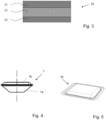
- Figs. 4 and 5 show exemplary products, namely a capsule-type portion package and its main part and lid part, respectively.
- a first material constituting a sheet material forming a first layer 11 is unwound from a stock 110 embodied as a roll of the sheet material and is fed through a pair of rollers 21, 22.
- the arrows in Fig. 1 indicate the direction of movement of the layers and materials.
- a third material constituting a sheet material forming a third layer 13 is unwound from a stock 130 embodied as a roll of the sheet material and is fed through the pair of rollers 21, 22.
- a second material constituting a sheet material forming a second layer 12 is fed through the pair of rollers 21, 22.
- rollers 21, 22 are pressurized, e.g., to enhance cohesion between the layers 11, 12, 13 of the blank structure 10. They may be heated, too.
- Second layer 12 forms an inner layer and comprises, e.g., at at least 50% by weight, a fibrous material obtained from dryly placed fibers, e.g., from dryly placed plant fibers or from dryly placed recycled material fibers such as from dryly placed wasterpaper fibers.
- First layer 11 comprises a water-soluble polymer material, e.g., a PVOH (other examples have been described above).
- the water-soluble polymer material can improve and/or tailor properties of the blank structure and of the product, while maintaining environmental friendliness.
- the first layer 11 can comprise a further material, in particular paper or a cellulose based nonwoven.
- the water-soluble polymer material and the further material can be present in the first layer in an intermixed way. As an alternative or in addition, they can be arranged in a layered way, such as in form of a first sub-layer made of (or at least comprising) the water-soluble polymer material and a second sub-layer made of (or at least comprising) the further material.
- the third layer 13 can be, e.g., composed identically to the first layer.
- the blank structure 10 After the blank structure 10 has been produced, it is shaped using a mold comprising mold parts 55 and 56 as illustrated in Fig. 2 .
- the formerly flat blank structure is given a more three-dimensional shape.
- Heat and pressure can be applied in the molding step. This way, the product or a part of the product can be produced. Or, in particular, when subsequent processing steps will be applied, a precursor of the product or of the part of the product can be obtained in the molding step.
- the product can be a packaging such as a packaging for foodstuff.
- the product can be, e.g., a capsule-type portion package for ground coffee as illustrated in Fig. 4 comprising a main part 1a and a lid part 1b.
- the method in particular in this case, can comprise filling the main part 1a with ground coffee and sealing the main part 1a and the lid part 1b to one another.
- the product can also be the main part 1a as shown in Fig. 4 or the lid part 1b shown in Fig. 5 .
- biodegradability and/or compostability can be very valuable properties. Also very valuable can be to produce the product to a large extent from renewable and/or from recycled materials. All this can be the case using the described method.
- process steps for producing the first material need not be carried out at the time and place of production of the blank structure, but can be carried out beforehand. And thus, it is possible to separately optimize process parameters such as pressures, temperatures, feed rates separately for the production of the first layer and for subsequent processes such as the production of the blank structure and to in fact use - compatibility provided - such optimized parameters. Compromises regarding processing parameters, which are likely to be necessary when incorporating the production of the first layer into the process in which the blank structure is produced, need not be made. Likewise, the choice of materials for the first layer and for the blank structure, respectively, is less limited when providing the first layer from a stock, i.e. when using a pre-fabricated first layer (and first material), in particular in the sense that the first layer (and first material) already exists before the process of producing the blank structure is started.
Landscapes
- Engineering & Computer Science (AREA)
- Textile Engineering (AREA)
- Mechanical Engineering (AREA)
- Laminated Bodies (AREA)
Priority Applications (2)
| Application Number | Priority Date | Filing Date | Title |
|---|---|---|---|
| EP23181118.3A EP4480671A1 (fr) | 2023-06-23 | 2023-06-23 | Procédé de fabrication d'un produit écologique à partir de fibres placées à sec |
| PCT/EP2024/067201 WO2024261112A1 (fr) | 2023-06-23 | 2024-06-20 | Procédé de fabrication d'un produit écologique à partir de fibres placées à sec |
Applications Claiming Priority (1)
| Application Number | Priority Date | Filing Date | Title |
|---|---|---|---|
| EP23181118.3A EP4480671A1 (fr) | 2023-06-23 | 2023-06-23 | Procédé de fabrication d'un produit écologique à partir de fibres placées à sec |
Publications (1)
| Publication Number | Publication Date |
|---|---|
| EP4480671A1 true EP4480671A1 (fr) | 2024-12-25 |
Family
ID=87003349
Family Applications (1)
| Application Number | Title | Priority Date | Filing Date |
|---|---|---|---|
| EP23181118.3A Withdrawn EP4480671A1 (fr) | 2023-06-23 | 2023-06-23 | Procédé de fabrication d'un produit écologique à partir de fibres placées à sec |
Country Status (2)
| Country | Link |
|---|---|
| EP (1) | EP4480671A1 (fr) |
| WO (1) | WO2024261112A1 (fr) |
Citations (5)
| Publication number | Priority date | Publication date | Assignee | Title |
|---|---|---|---|---|
| US20160271021A1 (en) * | 2010-07-02 | 2016-09-22 | The Procter & Gamble Company | Dissolvable fibrous web structure article comprising active agents |
| US20210069942A1 (en) | 2018-04-25 | 2021-03-11 | Pulpac AB | A method for producing a cellulose product |
| US20210347547A1 (en) * | 2018-09-04 | 2021-11-11 | Ahlstrom-Munksjö Oyj | Compostable lid for sealing a capsule and a capsule sealed by the lid |
| EP4101631A1 (fr) * | 2021-06-09 | 2022-12-14 | Tetra Laval Holdings & Finance S.A. | Matériau d'emballage multicouche thermosoudable et re-pulpable à base de cellulose, son procédé de fabrication et conteneur d'emballage |
| WO2023084067A1 (fr) * | 2021-11-15 | 2023-05-19 | Société des Produits Nestlé S.A. | Capsule pour la préparation d'une boisson et procédé de fabrication de ladite capsule |
-
2023
- 2023-06-23 EP EP23181118.3A patent/EP4480671A1/fr not_active Withdrawn
-
2024
- 2024-06-20 WO PCT/EP2024/067201 patent/WO2024261112A1/fr not_active Ceased
Patent Citations (5)
| Publication number | Priority date | Publication date | Assignee | Title |
|---|---|---|---|---|
| US20160271021A1 (en) * | 2010-07-02 | 2016-09-22 | The Procter & Gamble Company | Dissolvable fibrous web structure article comprising active agents |
| US20210069942A1 (en) | 2018-04-25 | 2021-03-11 | Pulpac AB | A method for producing a cellulose product |
| US20210347547A1 (en) * | 2018-09-04 | 2021-11-11 | Ahlstrom-Munksjö Oyj | Compostable lid for sealing a capsule and a capsule sealed by the lid |
| EP4101631A1 (fr) * | 2021-06-09 | 2022-12-14 | Tetra Laval Holdings & Finance S.A. | Matériau d'emballage multicouche thermosoudable et re-pulpable à base de cellulose, son procédé de fabrication et conteneur d'emballage |
| WO2023084067A1 (fr) * | 2021-11-15 | 2023-05-19 | Société des Produits Nestlé S.A. | Capsule pour la préparation d'une boisson et procédé de fabrication de ladite capsule |
Also Published As
| Publication number | Publication date |
|---|---|
| WO2024261112A1 (fr) | 2024-12-26 |
Similar Documents
| Publication | Publication Date | Title |
|---|---|---|
| US12138830B2 (en) | Method for producing a cellulose product | |
| US8647717B2 (en) | Packaging materials with enhanced thermal-insulating performance | |
| EP0514137B2 (fr) | Composition dégradable de produits stratifiés | |
| EP3077192B1 (fr) | Emballage scellable et sa production | |
| EP1232060B1 (fr) | Procede de fabrication d'un materiau d'emballage stratifie | |
| RS64138B1 (sr) | Postupak za proizvodnju proizvoda od celuloze, uređaj za oblikovanje proizvoda od celuloze i proizvod od celuloze | |
| EP1082215B1 (fr) | Procede de production de lamine impermeable au gaz a base d'amidon pour conditionnement et recipients de conditionnement | |
| EP0958190B1 (fr) | Materiau d'emballage lamine, procede de production de ce materiau et recipient d'emballage realise dans ce materiau | |
| WO2023078834A2 (fr) | Procédé de production d'un produit cellulosique et produit cellulosique | |
| EP4294638A1 (fr) | Matériau d'emballage en carton recyclable comprenant une couche barrière métallisée appliquée par métallisation par transfert | |
| EP4480671A1 (fr) | Procédé de fabrication d'un produit écologique à partir de fibres placées à sec | |
| CN114096418B (zh) | 包装材料及其制造方法 | |
| WO2025008658A1 (fr) | Procédé de production de produits cellulosiques | |
| EP4509431A1 (fr) | Emballage de café écologique, en particulier capsule de café | |
| KR20230035092A (ko) | 복합형 열성형 식기 및 그의 제조 방법 | |
| EP4530050A1 (fr) | Matériau composite renforcé par des fibres, emballages de portion et emballages de portion fabriqués à l'aide de celui-ci | |
| US20260124784A1 (en) | A method for manufacturing a cellulose product and a cellulose product | |
| WO2025008659A1 (fr) | Procédé de production de produits cellulosiques | |
| WO2025132690A1 (fr) | Procédé de production de produit cellulosique et produit cellulosique | |
| WO2025132688A1 (fr) | Procédé de production de produit cellulosique et produit cellulosique | |
| WO2025126052A1 (fr) | Procédé et élément multicouche pour la fabrication d'objets par compression | |
| KR20260010797A (ko) | 페이퍼몰드 및 이의 제조방법 | |
| JP2002294543A (ja) | 植物繊維からなる立体成形物 |
Legal Events
| Date | Code | Title | Description |
|---|---|---|---|
| PUAI | Public reference made under article 153(3) epc to a published international application that has entered the european phase |
Free format text: ORIGINAL CODE: 0009012 |
|
| STAA | Information on the status of an ep patent application or granted ep patent |
Free format text: STATUS: THE APPLICATION HAS BEEN PUBLISHED |
|
| AK | Designated contracting states |
Kind code of ref document: A1 Designated state(s): AL AT BE BG CH CY CZ DE DK EE ES FI FR GB GR HR HU IE IS IT LI LT LU LV MC ME MK MT NL NO PL PT RO RS SE SI SK SM TR |
|
| STAA | Information on the status of an ep patent application or granted ep patent |
Free format text: STATUS: REQUEST FOR EXAMINATION WAS MADE |
|
| 17P | Request for examination filed |
Effective date: 20250121 |
|
| GRAP | Despatch of communication of intention to grant a patent |
Free format text: ORIGINAL CODE: EPIDOSNIGR1 |
|
| STAA | Information on the status of an ep patent application or granted ep patent |
Free format text: STATUS: GRANT OF PATENT IS INTENDED |
|
| RIC1 | Information provided on ipc code assigned before grant |
Ipc: B32B 27/30 20060101ALN20250312BHEP Ipc: B32B 5/02 20060101ALN20250312BHEP Ipc: B65D 85/804 20060101ALN20250312BHEP Ipc: B65D 65/46 20060101ALN20250312BHEP Ipc: B29K 29/00 20060101ALN20250312BHEP Ipc: B29K 23/00 20060101ALN20250312BHEP Ipc: B29L 31/00 20060101ALN20250312BHEP Ipc: B32B 29/02 20060101ALI20250312BHEP Ipc: B32B 27/12 20060101ALI20250312BHEP Ipc: B32B 5/26 20060101ALI20250312BHEP Ipc: B29C 51/14 20060101ALI20250312BHEP Ipc: B29C 51/08 20060101ALI20250312BHEP Ipc: B29C 51/00 20060101AFI20250312BHEP |
|
| INTG | Intention to grant announced |
Effective date: 20250321 |
|
| STAA | Information on the status of an ep patent application or granted ep patent |
Free format text: STATUS: THE APPLICATION IS DEEMED TO BE WITHDRAWN |
|
| 18D | Application deemed to be withdrawn |
Effective date: 20250722 |