EP4480703A2 - Procédé de fabrication d'une pièce composite à matrice céramique - Google Patents
Procédé de fabrication d'une pièce composite à matrice céramique Download PDFInfo
- Publication number
- EP4480703A2 EP4480703A2 EP24176875.3A EP24176875A EP4480703A2 EP 4480703 A2 EP4480703 A2 EP 4480703A2 EP 24176875 A EP24176875 A EP 24176875A EP 4480703 A2 EP4480703 A2 EP 4480703A2
- Authority
- EP
- European Patent Office
- Prior art keywords
- stack
- semi
- permeable membrane
- composite
- composite plies
- Prior art date
- Legal status (The legal status is an assumption and is not a legal conclusion. Google has not performed a legal analysis and makes no representation as to the accuracy of the status listed.)
- Withdrawn
Links
Images



Classifications
-
- B—PERFORMING OPERATIONS; TRANSPORTING
- B32—LAYERED PRODUCTS
- B32B—LAYERED PRODUCTS, i.e. PRODUCTS BUILT-UP OF STRATA OF FLAT OR NON-FLAT, e.g. CELLULAR OR HONEYCOMB, FORM
- B32B18/00—Layered products essentially comprising ceramics, e.g. refractory products
-
- B—PERFORMING OPERATIONS; TRANSPORTING
- B29—WORKING OF PLASTICS; WORKING OF SUBSTANCES IN A PLASTIC STATE IN GENERAL
- B29C—SHAPING OR JOINING OF PLASTICS; SHAPING OF MATERIAL IN A PLASTIC STATE, NOT OTHERWISE PROVIDED FOR; AFTER-TREATMENT OF THE SHAPED PRODUCTS, e.g. REPAIRING
- B29C70/00—Shaping composites, i.e. plastics material comprising reinforcements, fillers or preformed parts, e.g. inserts
- B29C70/02—Shaping composites, i.e. plastics material comprising reinforcements, fillers or preformed parts, e.g. inserts comprising combinations of reinforcements, e.g. non-specified reinforcements, fibrous reinforcing inserts and fillers, e.g. particulate fillers, incorporated in matrix material, forming one or more layers and with or without non-reinforced or non-filled layers
- B29C70/021—Combinations of fibrous reinforcement and non-fibrous material
- B29C70/025—Combinations of fibrous reinforcement and non-fibrous material with particular filler
-
- B—PERFORMING OPERATIONS; TRANSPORTING
- B29—WORKING OF PLASTICS; WORKING OF SUBSTANCES IN A PLASTIC STATE IN GENERAL
- B29C—SHAPING OR JOINING OF PLASTICS; SHAPING OF MATERIAL IN A PLASTIC STATE, NOT OTHERWISE PROVIDED FOR; AFTER-TREATMENT OF THE SHAPED PRODUCTS, e.g. REPAIRING
- B29C70/00—Shaping composites, i.e. plastics material comprising reinforcements, fillers or preformed parts, e.g. inserts
- B29C70/04—Shaping composites, i.e. plastics material comprising reinforcements, fillers or preformed parts, e.g. inserts comprising reinforcements only, e.g. self-reinforcing plastics
- B29C70/28—Shaping operations therefor
- B29C70/40—Shaping or impregnating by compression not applied
- B29C70/42—Shaping or impregnating by compression not applied for producing articles of definite length, i.e. discrete articles
- B29C70/44—Shaping or impregnating by compression not applied for producing articles of definite length, i.e. discrete articles using isostatic pressure, e.g. pressure difference-moulding, vacuum bag-moulding, autoclave-moulding or expanding rubber-moulding
-
- B—PERFORMING OPERATIONS; TRANSPORTING
- B29—WORKING OF PLASTICS; WORKING OF SUBSTANCES IN A PLASTIC STATE IN GENERAL
- B29C—SHAPING OR JOINING OF PLASTICS; SHAPING OF MATERIAL IN A PLASTIC STATE, NOT OTHERWISE PROVIDED FOR; AFTER-TREATMENT OF THE SHAPED PRODUCTS, e.g. REPAIRING
- B29C70/00—Shaping composites, i.e. plastics material comprising reinforcements, fillers or preformed parts, e.g. inserts
- B29C70/04—Shaping composites, i.e. plastics material comprising reinforcements, fillers or preformed parts, e.g. inserts comprising reinforcements only, e.g. self-reinforcing plastics
- B29C70/28—Shaping operations therefor
- B29C70/54—Component parts, details or accessories; Auxiliary operations, e.g. feeding or storage of prepregs or SMC after impregnation or during ageing
- B29C70/544—Details of vacuum bags, e.g. materials or shape
-
- C—CHEMISTRY; METALLURGY
- C04—CEMENTS; CONCRETE; ARTIFICIAL STONE; CERAMICS; REFRACTORIES
- C04B—LIME, MAGNESIA; SLAG; CEMENTS; COMPOSITIONS THEREOF, e.g. MORTARS, CONCRETE OR LIKE BUILDING MATERIALS; ARTIFICIAL STONE; CERAMICS; REFRACTORIES; TREATMENT OF NATURAL STONE
- C04B35/00—Shaped ceramic products characterised by their composition; Ceramics compositions; Processing powders of inorganic compounds preparatory to the manufacturing of ceramic products
- C04B35/622—Forming processes; Processing powders of inorganic compounds preparatory to the manufacturing of ceramic products
- C04B35/626—Preparing or treating the powders individually or as batches ; preparing or treating macroscopic reinforcing agents for ceramic products, e.g. fibres; mechanical aspects section B
- C04B35/62605—Treating the starting powders individually or as mixtures
- C04B35/6269—Curing of mixtures
-
- C—CHEMISTRY; METALLURGY
- C04—CEMENTS; CONCRETE; ARTIFICIAL STONE; CERAMICS; REFRACTORIES
- C04B—LIME, MAGNESIA; SLAG; CEMENTS; COMPOSITIONS THEREOF, e.g. MORTARS, CONCRETE OR LIKE BUILDING MATERIALS; ARTIFICIAL STONE; CERAMICS; REFRACTORIES; TREATMENT OF NATURAL STONE
- C04B35/00—Shaped ceramic products characterised by their composition; Ceramics compositions; Processing powders of inorganic compounds preparatory to the manufacturing of ceramic products
- C04B35/622—Forming processes; Processing powders of inorganic compounds preparatory to the manufacturing of ceramic products
- C04B35/626—Preparing or treating the powders individually or as batches ; preparing or treating macroscopic reinforcing agents for ceramic products, e.g. fibres; mechanical aspects section B
- C04B35/628—Coating the powders or the macroscopic reinforcing agents
- C04B35/62844—Coating fibres
-
- C—CHEMISTRY; METALLURGY
- C04—CEMENTS; CONCRETE; ARTIFICIAL STONE; CERAMICS; REFRACTORIES
- C04B—LIME, MAGNESIA; SLAG; CEMENTS; COMPOSITIONS THEREOF, e.g. MORTARS, CONCRETE OR LIKE BUILDING MATERIALS; ARTIFICIAL STONE; CERAMICS; REFRACTORIES; TREATMENT OF NATURAL STONE
- C04B35/00—Shaped ceramic products characterised by their composition; Ceramics compositions; Processing powders of inorganic compounds preparatory to the manufacturing of ceramic products
- C04B35/622—Forming processes; Processing powders of inorganic compounds preparatory to the manufacturing of ceramic products
- C04B35/626—Preparing or treating the powders individually or as batches ; preparing or treating macroscopic reinforcing agents for ceramic products, e.g. fibres; mechanical aspects section B
- C04B35/628—Coating the powders or the macroscopic reinforcing agents
- C04B35/62892—Coating the powders or the macroscopic reinforcing agents with a coating layer consisting of particles
-
- C—CHEMISTRY; METALLURGY
- C04—CEMENTS; CONCRETE; ARTIFICIAL STONE; CERAMICS; REFRACTORIES
- C04B—LIME, MAGNESIA; SLAG; CEMENTS; COMPOSITIONS THEREOF, e.g. MORTARS, CONCRETE OR LIKE BUILDING MATERIALS; ARTIFICIAL STONE; CERAMICS; REFRACTORIES; TREATMENT OF NATURAL STONE
- C04B35/00—Shaped ceramic products characterised by their composition; Ceramics compositions; Processing powders of inorganic compounds preparatory to the manufacturing of ceramic products
- C04B35/622—Forming processes; Processing powders of inorganic compounds preparatory to the manufacturing of ceramic products
- C04B35/64—Burning or sintering processes
- C04B35/645—Pressure sintering
-
- C—CHEMISTRY; METALLURGY
- C04—CEMENTS; CONCRETE; ARTIFICIAL STONE; CERAMICS; REFRACTORIES
- C04B—LIME, MAGNESIA; SLAG; CEMENTS; COMPOSITIONS THEREOF, e.g. MORTARS, CONCRETE OR LIKE BUILDING MATERIALS; ARTIFICIAL STONE; CERAMICS; REFRACTORIES; TREATMENT OF NATURAL STONE
- C04B35/00—Shaped ceramic products characterised by their composition; Ceramics compositions; Processing powders of inorganic compounds preparatory to the manufacturing of ceramic products
- C04B35/71—Ceramic products containing macroscopic reinforcing agents
- C04B35/78—Ceramic products containing macroscopic reinforcing agents containing non-metallic materials
- C04B35/80—Fibres, filaments, whiskers, platelets, or the like
-
- B—PERFORMING OPERATIONS; TRANSPORTING
- B29—WORKING OF PLASTICS; WORKING OF SUBSTANCES IN A PLASTIC STATE IN GENERAL
- B29C—SHAPING OR JOINING OF PLASTICS; SHAPING OF MATERIAL IN A PLASTIC STATE, NOT OTHERWISE PROVIDED FOR; AFTER-TREATMENT OF THE SHAPED PRODUCTS, e.g. REPAIRING
- B29C63/00—Lining or sheathing, i.e. applying preformed layers or sheathings of plastics; Apparatus therefor
- B29C63/0017—Lining or sheathing, i.e. applying preformed layers or sheathings of plastics; Apparatus therefor characterised by the choice of the material
-
- B—PERFORMING OPERATIONS; TRANSPORTING
- B29—WORKING OF PLASTICS; WORKING OF SUBSTANCES IN A PLASTIC STATE IN GENERAL
- B29C—SHAPING OR JOINING OF PLASTICS; SHAPING OF MATERIAL IN A PLASTIC STATE, NOT OTHERWISE PROVIDED FOR; AFTER-TREATMENT OF THE SHAPED PRODUCTS, e.g. REPAIRING
- B29C63/00—Lining or sheathing, i.e. applying preformed layers or sheathings of plastics; Apparatus therefor
- B29C63/02—Lining or sheathing, i.e. applying preformed layers or sheathings of plastics; Apparatus therefor using sheet or web-like material
-
- B—PERFORMING OPERATIONS; TRANSPORTING
- B30—PRESSES
- B30B—PRESSES IN GENERAL
- B30B5/00—Presses characterised by the use of pressing means other than those mentioned in the preceding groups
- B30B5/02—Presses characterised by the use of pressing means other than those mentioned in the preceding groups wherein the pressing means is in the form of a flexible element, e.g. diaphragm, urged by fluid pressure
-
- C—CHEMISTRY; METALLURGY
- C04—CEMENTS; CONCRETE; ARTIFICIAL STONE; CERAMICS; REFRACTORIES
- C04B—LIME, MAGNESIA; SLAG; CEMENTS; COMPOSITIONS THEREOF, e.g. MORTARS, CONCRETE OR LIKE BUILDING MATERIALS; ARTIFICIAL STONE; CERAMICS; REFRACTORIES; TREATMENT OF NATURAL STONE
- C04B2235/00—Aspects relating to ceramic starting mixtures or sintered ceramic products
- C04B2235/02—Composition of constituents of the starting material or of secondary phases of the final product
- C04B2235/30—Constituents and secondary phases not being of a fibrous nature
- C04B2235/48—Organic compounds becoming part of a ceramic after heat treatment, e.g. carbonising phenol resins
-
- C—CHEMISTRY; METALLURGY
- C04—CEMENTS; CONCRETE; ARTIFICIAL STONE; CERAMICS; REFRACTORIES
- C04B—LIME, MAGNESIA; SLAG; CEMENTS; COMPOSITIONS THEREOF, e.g. MORTARS, CONCRETE OR LIKE BUILDING MATERIALS; ARTIFICIAL STONE; CERAMICS; REFRACTORIES; TREATMENT OF NATURAL STONE
- C04B2235/00—Aspects relating to ceramic starting mixtures or sintered ceramic products
- C04B2235/02—Composition of constituents of the starting material or of secondary phases of the final product
- C04B2235/50—Constituents or additives of the starting mixture chosen for their shape or used because of their shape or their physical appearance
- C04B2235/52—Constituents or additives characterised by their shapes
- C04B2235/5208—Fibers
- C04B2235/5252—Fibers having a specific pre-form
-
- C—CHEMISTRY; METALLURGY
- C04—CEMENTS; CONCRETE; ARTIFICIAL STONE; CERAMICS; REFRACTORIES
- C04B—LIME, MAGNESIA; SLAG; CEMENTS; COMPOSITIONS THEREOF, e.g. MORTARS, CONCRETE OR LIKE BUILDING MATERIALS; ARTIFICIAL STONE; CERAMICS; REFRACTORIES; TREATMENT OF NATURAL STONE
- C04B2235/00—Aspects relating to ceramic starting mixtures or sintered ceramic products
- C04B2235/60—Aspects relating to the preparation, properties or mechanical treatment of green bodies or pre-forms
- C04B2235/604—Pressing at temperatures other than sintering temperatures
-
- C—CHEMISTRY; METALLURGY
- C04—CEMENTS; CONCRETE; ARTIFICIAL STONE; CERAMICS; REFRACTORIES
- C04B—LIME, MAGNESIA; SLAG; CEMENTS; COMPOSITIONS THEREOF, e.g. MORTARS, CONCRETE OR LIKE BUILDING MATERIALS; ARTIFICIAL STONE; CERAMICS; REFRACTORIES; TREATMENT OF NATURAL STONE
- C04B2235/00—Aspects relating to ceramic starting mixtures or sintered ceramic products
- C04B2235/60—Aspects relating to the preparation, properties or mechanical treatment of green bodies or pre-forms
- C04B2235/616—Liquid infiltration of green bodies or pre-forms
-
- C—CHEMISTRY; METALLURGY
- C04—CEMENTS; CONCRETE; ARTIFICIAL STONE; CERAMICS; REFRACTORIES
- C04B—LIME, MAGNESIA; SLAG; CEMENTS; COMPOSITIONS THEREOF, e.g. MORTARS, CONCRETE OR LIKE BUILDING MATERIALS; ARTIFICIAL STONE; CERAMICS; REFRACTORIES; TREATMENT OF NATURAL STONE
- C04B2235/00—Aspects relating to ceramic starting mixtures or sintered ceramic products
- C04B2235/65—Aspects relating to heat treatments of ceramic bodies such as green ceramics or pre-sintered ceramics, e.g. burning, sintering or melting processes
- C04B2235/656—Aspects relating to heat treatments of ceramic bodies such as green ceramics or pre-sintered ceramics, e.g. burning, sintering or melting processes characterised by specific heating conditions during heat treatment
Definitions
- a ceramic matrix composite material can be formed using prepreg, a fibrous material pre-impregnated with a resin.
- the prepreg has solid particles in suspension, so a significant amount of solvent or matrix is needed to keep those solid particles in suspension. This results in an excess amount of matrix material, which needs to be removed during processing in an autoclave. Specifically, to get the target fiber volume fraction needed for a structural part, the excess matrix needs to be removed and there needs to be a pathway for volatiles to escape during autoclave processing.
- the challenge of 1) removal of excess matrix and 2) pathway for volatile escape is currently solved by using a fiberglass bleeder stack which soaks up excess matrix.
- a fiberglass bleeder stack which soaks up excess matrix.
- the fiberglass bleeder stack acts like a sponge to soak up excess matrix during autoclave processing.
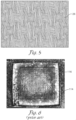
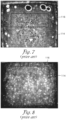
- This traditional process is difficult to scale up (e.g., matrix needs to travel through the thickness of the part, which means thicker parts require the matrix to travel farther and potentially get trapped). Furthermore, this traditional process is difficult when working with curved/complex structures (e.g., getting a thick fiberglass stack to conform to complex geometries is challenging). Another challenge with this traditional process is that it can be difficult to implement for closed geometries. Specifically, the thick fiberglass stack adds a significant amount of bulk/thickness so fitting that into a closed shape is challenging. As a result of these challenges, when this traditional process is used, the resultant part is not homogeneous as detected by non-dimensional inspection, which indicates differences in mechanical properties throughout the part. This inconsistency is often seen in the edges of the parts as the matrix can be removed from the edges of the parts in addition to through the thickness.
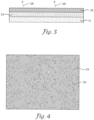
- a method of fabricating a composite material into a composite part includes the steps of applying at least one semi-permeable membrane over a stack of a plurality of composite plies.
- the semi-permeable membrane comprises a porous plastic material and may have a thickness of approximately 0.002 to 0.008 inches.
- the method may further include the steps of compressing the at least one semi-permeable membrane and the stack of the one or more composite plies together and heating the at least one semi-permeable membrane and the stack of the one or more composite plies to cure the stack into the composite part.
- a method of fabricating a ceramic matrix composite material into a composite part includes a step of arranging a plurality of composite plies pre-impregnated with a ceramic matrix (containing solid ceramic particles in suspension) into a stack.
- the method may further include a step of applying semi-permeable membrane over the stack of the plurality of composite plies, compressing the semi-permeable membrane and the stack of the plurality of composite plies together, and heating the stack and the semi-permeable membrane to cure the stack into the composite part.
- the semi-permeable membrane may include a semi-permeable plastic sheet having a plurality of pores large enough to allow volatile gasses to escape therethrough during curing but equal to or smaller than the solid ceramic particles or clusters of the solid ceramic particles suspended in the ceramic matrix in order to retain matrix in the composite.
- a method of fabricating a ceramic matrix composite material into a composite part includes a step of arranging a plurality of composite plies pre-impregnated with ceramic matrix into a stack and applying a semi-permeable membrane over the stack.
- each of the plurality of composite plies contains 35 percent to 45 percent of the ceramic matrix by weight relative to an overall weight of the stack of the one or more composite plies pre-impregnated with the ceramic matrix.
- the method may also include the steps of compressing the semi-permeable membrane and the stack of the plurality of composite plies together and heating the semi-permeable membrane and the stack to a temperature sufficient to cure the stack of the one or more composite plies into the composite part.
- references to “one embodiment”, “an embodiment”, or “embodiments” mean that the feature or features being referred to are included in at least one embodiment of the technology.
- references to “one embodiment”, “an embodiment”, or “embodiments” in this description do not necessarily refer to the same embodiment and are also not mutually exclusive unless so stated and/or except as will be readily apparent to those skilled in the art from the description.
- a feature, structure, act, etc. described in one embodiment may also be included in other embodiments but is not necessarily included.
- the present technology can include a variety of combinations and/or integrations of the embodiments described herein.
- a ceramic matrix composite material is formed using prepreg.
- preg refers to a fibrous material or a composite ply pre-impregnated with a resin, such as a ceramic matrix.
- the prepreg has solid particles (e.g., ceramic particles) in suspension within the matrix, so a significant amount of solvent or matrix is needed to keep those solid particles in suspension, resulting in excess matrix material during curing of the prepreg which needs to be removed.
Landscapes
- Chemical & Material Sciences (AREA)
- Engineering & Computer Science (AREA)
- Ceramic Engineering (AREA)
- Manufacturing & Machinery (AREA)
- Organic Chemistry (AREA)
- Materials Engineering (AREA)
- Structural Engineering (AREA)
- Inorganic Chemistry (AREA)
- Mechanical Engineering (AREA)
- Composite Materials (AREA)
- Chemical Kinetics & Catalysis (AREA)
- Casting Or Compression Moulding Of Plastics Or The Like (AREA)
- Porous Artificial Stone Or Porous Ceramic Products (AREA)
- Separation Using Semi-Permeable Membranes (AREA)
Applications Claiming Priority (1)
| Application Number | Priority Date | Filing Date | Title |
|---|---|---|---|
| US18/325,835 US20240400463A1 (en) | 2023-05-30 | 2023-05-30 | Method for fabrication of a ceramic matrix composite part |
Publications (2)
| Publication Number | Publication Date |
|---|---|
| EP4480703A2 true EP4480703A2 (fr) | 2024-12-25 |
| EP4480703A3 EP4480703A3 (fr) | 2025-03-12 |
Family
ID=91186627
Family Applications (1)
| Application Number | Title | Priority Date | Filing Date |
|---|---|---|---|
| EP24176875.3A Withdrawn EP4480703A3 (fr) | 2023-05-30 | 2024-05-20 | Procédé de fabrication d'une pièce composite à matrice céramique |
Country Status (2)
| Country | Link |
|---|---|
| US (1) | US20240400463A1 (fr) |
| EP (1) | EP4480703A3 (fr) |
Family Cites Families (6)
| Publication number | Priority date | Publication date | Assignee | Title |
|---|---|---|---|---|
| US4936939A (en) * | 1989-05-05 | 1990-06-26 | Ceracom Technologies, Inc. | Fabric-reinforced ceramic matrix composite material |
| US6013361A (en) * | 1995-10-31 | 2000-01-11 | Lockheed Martin Corporation | High performance structural laminate composite material for use to 1000° F and above, apparatus for and method of manufacturing same, and articles made with same |
| DE19813104A1 (de) * | 1998-03-25 | 1999-09-30 | Daimler Chrysler Ag | Verfahren zur Herstellung von Faserverbundbauteilen |
| DE10013409C1 (de) * | 2000-03-17 | 2000-11-23 | Daimler Chrysler Ag | Verfahren und Vorrichtung zur Herstellung von faserverstärkten Bauteilen mittels eines Injektionsverfahrens |
| US10618227B2 (en) * | 2006-03-25 | 2020-04-14 | Hexcel Composites, Ltd. | Structured thermoplastic in composite interleaves |
| US10369756B2 (en) * | 2015-08-25 | 2019-08-06 | The Boeing Company | Method of manufacturing a composite article |
-
2023
- 2023-05-30 US US18/325,835 patent/US20240400463A1/en active Pending
-
2024
- 2024-05-20 EP EP24176875.3A patent/EP4480703A3/fr not_active Withdrawn
Also Published As
| Publication number | Publication date |
|---|---|
| US20240400463A1 (en) | 2024-12-05 |
| EP4480703A3 (fr) | 2025-03-12 |
Similar Documents
| Publication | Publication Date | Title |
|---|---|---|
| US5145621A (en) | Crossover mold tool for consolidating composite material | |
| US8052831B2 (en) | Low temperature, vacuum cure fabrication process for large, honeycomb core stiffened composite structures | |
| JP5597134B2 (ja) | 被成形材の成形方法 | |
| JP2010502483A (ja) | ハニカムサンドイッチパネルを製造する方法 | |
| WO2008109029A2 (fr) | Processus de réduction d'un article composite | |
| US20080182054A1 (en) | Multi-function vacuum bag for composite part manufacture | |
| WO2005060386A2 (fr) | Procede pour produire des structures composites | |
| JP5519699B2 (ja) | バリア層と共に粘弾性層を含む複合物品 | |
| GB2450196A (en) | Prepregs and manufacturing structural members of fibre-reinforced composite materials | |
| US20090272486A1 (en) | Method of manufacturing wind turbine blades comprising composite materials | |
| EP1625929A1 (fr) | Moule | |
| Mujahid et al. | A comparison of single-vacuum-bag and double-vacuum-bag methods for manufacturing high-quality laminated composites | |
| US7662334B2 (en) | Vacuum heat-set of net shape latex vacuum bags | |
| JP2007521987A5 (fr) | ||
| EP4480703A2 (fr) | Procédé de fabrication d'une pièce composite à matrice céramique | |
| AU2021379587B2 (en) | Embossed vacuum bag film, vacuum bagging system including an embossed vacuum bag film, and methods of fabricating a composite part using the same | |
| JP2007118598A (ja) | プリフォームの製造方法および製造装置 | |
| Wang et al. | Influence of tool assembly schemes and integral molding technologies on compaction of T-stiffened skins in autoclave process | |
| US7935200B1 (en) | Process development protocol and vacuum bag process for carbon-epoxy prepreg production | |
| EP1775109B1 (fr) | Procédé et dispositif de moulage d'articles composites avec un sac sous vide | |
| US20090165945A1 (en) | Tool for use in the manufacture of turbine bucket shroud and related method | |
| US10899084B2 (en) | Methods for forming composite structures | |
| US11554558B2 (en) | Tool for manufacturing a composite component | |
| EP4046781B1 (fr) | Film séparateur gaufré, système d'ensachage sous vide et procédés de fabrication de pièces composites l'utilisant | |
| Slobodzinsky | Bag molding processes |
Legal Events
| Date | Code | Title | Description |
|---|---|---|---|
| PUAI | Public reference made under article 153(3) epc to a published international application that has entered the european phase |
Free format text: ORIGINAL CODE: 0009012 |
|
| STAA | Information on the status of an ep patent application or granted ep patent |
Free format text: STATUS: THE APPLICATION HAS BEEN PUBLISHED |
|
| AK | Designated contracting states |
Kind code of ref document: A2 Designated state(s): AL AT BE BG CH CY CZ DE DK EE ES FI FR GB GR HR HU IE IS IT LI LT LU LV MC ME MK MT NL NO PL PT RO RS SE SI SK SM TR |
|
| PUAL | Search report despatched |
Free format text: ORIGINAL CODE: 0009013 |
|
| AK | Designated contracting states |
Kind code of ref document: A3 Designated state(s): AL AT BE BG CH CY CZ DE DK EE ES FI FR GB GR HR HU IE IS IT LI LT LU LV MC ME MK MT NL NO PL PT RO RS SE SI SK SM TR |
|
| RIC1 | Information provided on ipc code assigned before grant |
Ipc: C04B 35/80 20060101ALI20250205BHEP Ipc: B32B 18/00 20060101ALI20250205BHEP Ipc: B32B 37/18 20060101ALI20250205BHEP Ipc: B32B 37/00 20060101AFI20250205BHEP |
|
| STAA | Information on the status of an ep patent application or granted ep patent |
Free format text: STATUS: THE APPLICATION IS DEEMED TO BE WITHDRAWN |
|
| 18D | Application deemed to be withdrawn |
Effective date: 20250913 |