EP4480921A1 - Procédé de conversion hydrothermale d'oxydes d'uranium en dioxyde d'uranium nanocristallin - Google Patents
Procédé de conversion hydrothermale d'oxydes d'uranium en dioxyde d'uranium nanocristallin Download PDFInfo
- Publication number
- EP4480921A1 EP4480921A1 EP23305975.7A EP23305975A EP4480921A1 EP 4480921 A1 EP4480921 A1 EP 4480921A1 EP 23305975 A EP23305975 A EP 23305975A EP 4480921 A1 EP4480921 A1 EP 4480921A1
- Authority
- EP
- European Patent Office
- Prior art keywords
- uranium
- process according
- anyone
- oxide
- uranium oxide
- Prior art date
- Legal status (The legal status is an assumption and is not a legal conclusion. Google has not performed a legal analysis and makes no representation as to the accuracy of the status listed.)
- Pending
Links
Images







Classifications
-
- C—CHEMISTRY; METALLURGY
- C01—INORGANIC CHEMISTRY
- C01G—COMPOUNDS CONTAINING METALS NOT COVERED BY SUBCLASSES C01D OR C01F
- C01G43/00—Compounds of uranium
- C01G43/003—Preparation involving a liquid-liquid extraction, an adsorption or an ion-exchange
-
- C—CHEMISTRY; METALLURGY
- C01—INORGANIC CHEMISTRY
- C01P—INDEXING SCHEME RELATING TO STRUCTURAL AND PHYSICAL ASPECTS OF SOLID INORGANIC COMPOUNDS
- C01P2002/00—Crystal-structural characteristics
- C01P2002/70—Crystal-structural characteristics defined by measured X-ray, neutron or electron diffraction data
- C01P2002/72—Crystal-structural characteristics defined by measured X-ray, neutron or electron diffraction data by d-values or two theta-values, e.g. as X-ray diagram
-
- C—CHEMISTRY; METALLURGY
- C01—INORGANIC CHEMISTRY
- C01P—INDEXING SCHEME RELATING TO STRUCTURAL AND PHYSICAL ASPECTS OF SOLID INORGANIC COMPOUNDS
- C01P2004/00—Particle morphology
- C01P2004/01—Particle morphology depicted by an image
- C01P2004/03—Particle morphology depicted by an image obtained by SEM
-
- C—CHEMISTRY; METALLURGY
- C01—INORGANIC CHEMISTRY
- C01P—INDEXING SCHEME RELATING TO STRUCTURAL AND PHYSICAL ASPECTS OF SOLID INORGANIC COMPOUNDS
- C01P2004/00—Particle morphology
- C01P2004/01—Particle morphology depicted by an image
- C01P2004/04—Particle morphology depicted by an image obtained by TEM, STEM, STM or AFM
-
- C—CHEMISTRY; METALLURGY
- C01—INORGANIC CHEMISTRY
- C01P—INDEXING SCHEME RELATING TO STRUCTURAL AND PHYSICAL ASPECTS OF SOLID INORGANIC COMPOUNDS
- C01P2004/00—Particle morphology
- C01P2004/30—Particle morphology extending in three dimensions
- C01P2004/32—Spheres
-
- C—CHEMISTRY; METALLURGY
- C01—INORGANIC CHEMISTRY
- C01P—INDEXING SCHEME RELATING TO STRUCTURAL AND PHYSICAL ASPECTS OF SOLID INORGANIC COMPOUNDS
- C01P2004/00—Particle morphology
- C01P2004/50—Agglomerated particles
-
- C—CHEMISTRY; METALLURGY
- C01—INORGANIC CHEMISTRY
- C01P—INDEXING SCHEME RELATING TO STRUCTURAL AND PHYSICAL ASPECTS OF SOLID INORGANIC COMPOUNDS
- C01P2004/00—Particle morphology
- C01P2004/60—Particles characterised by their size
- C01P2004/64—Nanometer sized, i.e. from 1-100 nanometer
-
- Y—GENERAL TAGGING OF NEW TECHNOLOGICAL DEVELOPMENTS; GENERAL TAGGING OF CROSS-SECTIONAL TECHNOLOGIES SPANNING OVER SEVERAL SECTIONS OF THE IPC; TECHNICAL SUBJECTS COVERED BY FORMER USPC CROSS-REFERENCE ART COLLECTIONS [XRACs] AND DIGESTS
- Y02—TECHNOLOGIES OR APPLICATIONS FOR MITIGATION OR ADAPTATION AGAINST CLIMATE CHANGE
- Y02E—REDUCTION OF GREENHOUSE GAS [GHG] EMISSIONS, RELATED TO ENERGY GENERATION, TRANSMISSION OR DISTRIBUTION
- Y02E30/00—Energy generation of nuclear origin
- Y02E30/30—Nuclear fission reactors
Definitions
- the present invention relates to the field of nuclear energy, and more particularly the production and recycling of uranium oxides.
- Uranium dioxide (UO 2 ) is the most used nuclear fuel in light water reactors (LWR). Uranium dioxide naturally occurs in the mineral uraninite.
- UO 2 may accommodate excess oxygen atoms as interstitial defects and forms a series of hyper-stoichiometric phases with a general formula of UO 2+x (0 ⁇ x ⁇ 0.25).
- the UO 2.12 oxide phase is energetically favorable and is believed to influence the fuel properties, including thermal conductivity, fission product diffusion, high burn-up structure, and corrosion behavior.
- Triuranium octoxide (U 3 O 8 ) is the most stable uranium oxide. It may be naturally present in uraninite, and is one of the more popular forms of uranium concentrate powder obtained in the processing of uranium ores, after it has been mined and before uranium enrichment and fuel fabrication. It is also used for safe and stable storage for example after enrichment operation, for depleted uranium or after reprocessing of used fuel prior to subsequent reuse in the manufacture of UO 2 or MOX fuel.
- actinide oxide and actinide mixed oxide nanocrystals can be obtained by hydrothermal decomposition of actinide oxalates: Manaud & al. Inorganic Chemistry 2020, 59, 3260-3273 and Popa & al. CrystEngComm 2018, 20, 4614 disclose the formation of uranium oxides by hydrothermal conversion of uranium(IV) oxalate.
- UO 2 The preparation of UO 2 faces the management of uranium scraps which typically involves heavy recycling steps: the pellets are crushed and then dissolved, and UOa or uranate is re-precipitated, calcined and then reduced to sinterable UO 2 . This involves a number of stages and, above all, the effluents (often nitrates) have to be treated.
- UO 2+x nanoparticles are obtained thanks to the condensation of an oversaturated vapour above the sample surface in laser evaporation, the sizes of the droplets depending on the power of laser radiation and the pressure of the inert gas.
- this is a multistep process which requires to shape the uranium oxide powder into a sintered pellet. It also requires the use of a 1000 W laser beam which is energy intensive and expensive to implement.
- the size of the droplets needs to be carefully controlled. This is done by means of the power of laser radiation and the pressure of the inert gas: this remains difficult to implement at an industrial scale. At last but not least, the yield of conversion of UO 2 into nanoparticles of UO 2+x remains well below to 100% as the surface area heated by the focused laser beam is 1 mm 2 whereas the pellet has a 9 mm diameter.
- One aim of the invention is to allow the industrialization of the production of UO 2+x nanoparticles, by reducing the steps required for the production of UO 2+x nanoparticles from uranium oxides powders.
- a further aim is also to control the size of the crystalline nanoparticles by a versatile process.
- a still further objective is to provide an improved process to recycle uranium side products of the uranium fuel production, including the straightforward processing of uranium oxide scraps products generated by the uranium fuel production.
- the present invention allows to directly convert uranium oxide powders, such as UO 2 and UsOs, into crystalline uranium dioxide nanoparticles, UO 2+x .
- the present invention is directed to a process for the hydrothermal conversion of a uranium oxide into nanocrystalline uranium dioxide of formula (I) UO 2+x (I) where 0 ⁇ x ⁇ 0,25, said process comprising :
- uranium dioxide refers to the compound of formula (I) UO 2+x (I) where 0 ⁇ x ⁇ 0,25, which thus includes hyper-stoichiometric uranium dioxide, where 0 ⁇ x ⁇ 0.25.
- Uranium oxides may reflect the various oxidation states of uranium and include uranium dioxide (or uranium(IV) oxide, ⁇ UO 2 ), diuranium pentoxide (or uranium(V) oxide, U 2 O 5 ), uranium trioxide (or uranium(VI) oxide, UO 3 ), triuranium octoxide (U 3 O 8 ), uranyl peroxide (UO 2 O 2 or UOa), or amorphous uranium(VI) oxide ( am -U 2 O 7 ).
- uranium dioxide or uranium(IV) oxide, ⁇ UO 2
- diuranium pentoxide or uranium(V) oxide, U 2 O 5
- uranium trioxide or uranium(VI) oxide, UO 3
- triuranium octoxide U 3 O 8
- uranyl peroxide UO 2 O 2 or UOa
- said uranium oxides may be chosen from uranium dioxide (UO 2 ), uranium trioxide (or uranium(VI) oxide, UO 3 ), and triuranium octoxide (U 3 O 8 ), or a mixture thereof.
- Said uranium oxides may be amorphous or crystalline. It may be typically in the form of a ceramics of powder such as a free-flowing powder or compacted powder.
- the process may comprise a preliminary step of mechanically grinding the uranium oxide e.g. where said uranium oxide is in the form of a ceramics and/or to achieve a powder of the desirable granulometry.
- Nanocrystalline uranium dioxide refers to uranium dioxide of formula (I) above in the form of crystalline nanoparticles.
- nanoparticle generally refers to a particle that is less than 1000 nm in diameter.
- nanocrystalline UO 2+x has a cubic structure of the fluorite type and crystallizes in the space group Fm-3m (225).
- the crystalline nanoparticles of the invention are composed of crystallites.
- said crystallites assemble in an isotropic fashion. Therefore, the shape of the crystalline nanoparticles does generally not depend on direction.
- said crystalline nanoparticles have a substantially spherical morphology.
- the crystallites have a mean diameter comprised between between 1 and 100 nm, particularly less than 80 nm, more preferably less than 60 nm in diameter.
- Said mean diameter is understood in number (frequency).
- nanometric uranium dioxide as prepared by the process of the invention is in the form of a powder that is sinterable, particularly sinterable at lower temperatures.
- said uranium oxide When used as a starting product, said uranium oxide typically has an anisotropic morphology.
- said uranium dioxide typically has a needle-shaped morphology.
- the process of the invention not only allows to convert an uranium oxide to uranium dioxide, but also allows the conversion of the particles morphology from anisotropic to isotropic nanoparticles.
- the size of the nanoparticles may be controlled and adjusted by varying the reactional conditions, such as the temperature, pH, and/or duration of the reaction.
- the reaction of said uranium oxide with a carbonate salt and hydrogen peroxide in water consists in an oxidative dissolution of uranium in the aqueous solution, whereas the carbonate salt further exhibits a complexing and basifying action.
- carbonate salt refers to the salt formed by a carbonate anion with a suitable cation such as ammonium (NH 4 + ) or a cation of an alkali metal, such as sodium (Na + ) or potassium (K + ).
- a suitable cation such as ammonium (NH 4 + ) or a cation of an alkali metal, such as sodium (Na + ) or potassium (K + ).
- said carbonate salt is ammonium carbonate ((NH 4 ) 2 CO 3 ) as NH 4 + is thermally labile.
- an aqueous solution of ammonium or of alkali carbonate may be used as a source of carbonate salt in the process of the invention.
- Variously concentrated ammonium or alkali carbonate solutions may be used.
- Hydrogen peroxide refers to the compound with the formula H 2 O 2 and is typically used as an oxidant. According to an embodiment, as aqueous solution of hydrogen peroxide may be used as a source of hydrogen peroxide in the process of the invention. Variously concentrated hydrogen peroxide solutions may be used.
- hydrogen peroxide and carbonate salt may be used in excess with respect to the uranium oxide.
- Step (i) typically involves the addition of said uranium oxide to an aqueous mixture comprising an aqueous solution of said carbonate salt and an aqueous solution of hydrogen peroxide.
- Oxalic acid dihydrate may be conveniently used as a source of oxalic acid.
- Said reducing agent may be chosen from hydrazine, hydroxylammonium nitrate (NHA) and their mixtures.
- Hydrazine monohydrate may be suitably used as a source of hydrazine.
- reducing agent encompasses said reducing agent or a source thereof.
- uranium oxide dissolves into water. It may be also oxidized, depending on its initial oxidation state in the starting uranium oxide. For example, in the case of uranium dioxide or triuranium octoxide, uranium is dissolved and actually oxidized into uranium(VI). In the case of uranium(VI) trioxide, uranium(VI) is already present and is readily dissolved.
- uranium(VI) is first dissolved in water and then reduced by reacting with oxalic acid and said reducing agent.
- the process may thus include the addition of oxalic acid dihydrate and said reducing agent either at the same time as said uranium oxide, said carbonate salt and hydrogen peroxide, or after oxidative dissolution of uranium.
- the reagents may thus be added in sequence, where step (i) involves a first adding step of adding uranium oxide, carbonate salt and hydrogen peroxide to water, followed by a second adding step of adding oxalic acid and the reducing agent to said aqueous solution.
- the source of oxalic acid and the reducing agent are added to the reactional mixture only after the oxidative dissolution has been satisfyingly performed.
- the dissolution may be considered as satisfyingly performed when uranium has been fully dissolved or has been dissolved to an extent that is considered suitable or acceptable.
- the second adding sequence may be carried out between few minutes to few hours after the first adding sequence.
- all reagents (oxalic acid, the reducing agent, uranium oxide, carbonate salt and hydrogen peroxide) are simultaneously added to water, by contacting together all reactants.
- the process includes contacting said uranium oxide comprising UO 2 with a source of carbonate salt, a source of hydrogen peroxide, a source oxalic acid and said reducing agent in water. Accordingly, the reduction will occur once uranium(VI) is dissolved in water.
- Step (i) may be conducted over a wide range of temperatures, typically at room temperature.
- step (ii) is conducted under heating, typically at a temperature comprised between 90°C and 250°C, preferably comprised between 90°C and 200°C.
- step (ii) is conducted under pressure.
- a suitable pressure may be achieved by autogenous pressure generated by the reactional mixture itself when the process is conducted in a sealed reactor.
- the process may thus be adequately conducted in a heated autoclave.
- the reactants carbonate salt, hydrogen peroxide, oxalic acid and reducing agent
- the reactants are used in excess with respect to the quantity of uranium that is present in the amount of uranium oxide that is reacted.
- the process may be conducted without pH adjustment which is naturally alkaline.
- the process may further comprise the step of adjusting the pH.
- the pH of the solution may be adjusted between 6 and 11, typically between 6.5 and 9.
- the pH adjustment may be particularly useful to tune the size of the nanoparticles that is desired and/or the morphology of the aggregates in to which they assemble.
- the pH may typically be acidified by adding a strong or weak acid to the reaction mixture, such as an aqueous solution of nitric acid, e.g. HNOs 2M, or hydrochloric acid.
- a strong or weak acid such as an aqueous solution of nitric acid, e.g. HNOs 2M, or hydrochloric acid.
- the contacting steps may be conducted over a wide range of duration, typically over a duration that is sufficient to achieve the yield, such as between few minutes and several days.
- the duration may also be conveniently adjusted to tune the morphology of the obtained product. It has been hypothesized that the duration may affect the way obtained nanoparticles may assemble to form aggregates, where higher duration may lead to bigger aggregates.
- the obtained product may typically precipitate form the reactional mixture.
- the process may thus further comprise one or more additional steps for recovering the desired nanocrystalline particles of uranium dioxide that are formed.
- recovery steps may be chosen from separating, washing and drying said uranium dioxide that precipitates from the reactional mixture.
- Separation may be done by centrifugation and/or filtration of the precipitate.
- Washing may be conveniently achieved by rinsing the separated product, with water or ethanol, or a mixture thereof.
- Drying may typically be done according to any known procedures.
- the present invention also concerns the nanocrystalline particles of uranium dioxide of formula (I) UO 2+x (I) where 0 ⁇ x ⁇ 0,25, and wherein said particles have a spherical shape.
- the nanocrystalline particles are typically composed of crystallites which generally have a mean diameter comprised between 1 and 100 nm, particularly less than 80 nm, more preferably less than 60 nm in diameter.
- said nanocrystalline particles are obtained by the process of the invention.
- one or more of the nanocrystalline particles and/or crystallites of the invention may assemble in larger aggregates. Such aggregates are also encompassed by the present invention.
- said aggregates have an average size of less than 10 ⁇ m, typically less than 5 ⁇ m, in particular ranging from 500 nm to 5 ⁇ m.
- the process of invention ensures the synthesis of nanocrystalline uranium dioxide of high purity, in particular with a low residual carbon content due to the most complete oxalate degradation through heating (step ii) of the process).
- the nanocrystalline particles according to the invention exhibit a residual carbon content of less than 1.5% (in weight), preferably less than 1%, more preferably less than 0.5%, still more preferably less than 0.3% (in weight).
- the present invention also concerns a process for controlling the size of nanocrystalline particles of uranium dioxide of formula (I) UO 2+x (I) where 0 ⁇ x ⁇ 0,25,
- the pH adjustment may be obtained by acidifying the reactional mixture, for example by adding a suitable amount of an acidic solution, such as a nitric acid solution or a hydrochloric acid.
- an acidic solution such as a nitric acid solution or a hydrochloric acid.
- the process may include the step of adding an acidic solution to increase the average size of the crystallite.
- the process may include the step of extending the duration of the contacting step ii) to increase the size of the aggregates formed by said crystalline particles.
- the process may include the step of increasing the temperature of the contacting step ii) to increase the average size of the crystallite.
- the present invention also concerns a recycling process of uranium, said process comprising conducting the hydrothermal conversion of the invention on a uranium oxide generated as scraps from uranium fuel production.
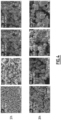
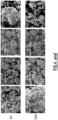
- All the XRD patterns of the samples obtained after hydrothermal treatment are typical of UO 2+x which has a cubic structure of fluorite type and crystallize in the space group Fm-3m (225). No typical features of the U 3 O 7 XRD pattern was observed in the samples but the presence of U 4 O 9 which crystallizes in a superlattice derived from the fluorite structure cannot be excluded when working with a classical laboratory XRD instrument. All the obtained samples are characterized by their round, spherical shape. The particle size ranged from 6 to 90 nm, depending on the reaction conditions.
- the influence of the initial pH of the mixtures on the material properties was investigated at fixed temperature (170°C) and heating time (12 hours).
- the six samples named A1 to A6 were respectively obtained at the pH values equal to 6.5, 7.1, 7.3, 8.1, 9.0 and 9.2.
- the calculated value for the cell parameter a of the obtained samples ranged from 5.42 ⁇ to 5.43 ⁇ ( Fig.1B ), indicating that the uranium is present as UO 2+x / U 4 O 9 .
- a neutral or slightly basic reaction medium (pH 6.5 - 8) favored crystal growth during hydrothermal treatment and crystallites sizes of 86 nm could be achieved ( Fig.1A ). These crystallites agglomerate to rather small agglomerates below 1 ⁇ m ( Fig.2 ). The yield of conversion under these conditions was about 91 % as shown in Table 1.
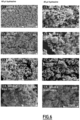
- the formed agglomerates appear to be slightly smaller after a reaction time of only one hour than for the analogous powders treated for 3 hours or longer ( Fig.4 ).
- the yield of the reaction strongly depends on the reaction time (Table 2).
- UO 2 treated hydrothermally for only one hour was converted preferably between 42 to 95 % (depending on pH), at 3 hours the yield was already above 94 % and above 99 % for longer treatment times.
- the unconverted uranium remained in solution as U(VI) in dissolved form.
- the slightly increased amount of hydrazine leads to smaller crystallites sizes.
- the cell parameter remains unchanged except for the powder obtained after 10 hours of treatment, namely equal to 5.438(1) ⁇ .
- the acicular UO 2 powder was hydrothermally converted at 250°C for 12 h.
- the initial pH values were 7.0, 8.3 and 9.1.
- the recorded XRD diagram of the samples in Figure 7A shows a pure phase of UO 2 /U 4 O 9 preferably for the sample converted at pH 8.3, while for other pH values an additional, second phase representing the U 3 O 8 was observed, which is undesirable.
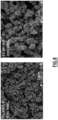
- Figure 7B shows the SEM images of the sample, which is pure UO 2+x sample.
- the particle size of the obtained powder was distributed in two sizes. The large particles that have a size of about 5 ⁇ m and the smaller particles that are 1 ⁇ m small.
- XRD refinement Figure 7 C and D
- the starting material was UsOs powder prepared by oxidation of UO 2 at 800 °C (2 hours, air atmosphere). All reagents used were of analytical grade and listed below:
- All the XRD patterns ( Fig.10 ) of the sample obtained after hydrothermal treatment are typical of UO 2+x which has a cubic structure of fluorite type and crystallize in the space group Fm-3m (225).
- the lattice parameter a is 5.444(4) ⁇ and the crystallite size is 30(6) nm.
- Oxalic acid and the reducing agent can then be added.
- Fig. 11 A comparison of uranium oxide powder morphology is shown in Fig. 11 , for UO 2 obtained by hydrothermal conversion at 170 °C [ Balice & al J. Nucl. Mater., 2018, 498, 307-313 ] (A), by thermal conversion at 800 °C [ Tyrpekl & al J. Nucl. Mater. 460 (2015) 200-208 ] (B) and 500 °C ( Martinez & al J. Eur. Ceram. Soc. 35 (2015) 4535 ).
- the hydrothermal decomposition leads to nanocrystalline UO 2 with a spherical shape, while the thermal treatment of oxalates forms platelet-shaped agglomerates not optimal for the sintering behavior [ Tyrpekl & al. J. Am. Ceram. Soc. 100 (2017) 1269-1274 ].
- the residual carbon impurity in the oxide powder also play an important role on the oxide final properties since it is expected to delay and/or hinder the sintering process.
- the amount of elemental carbon in the final oxide powder is less than 1 wt.% (less than 3.8 wt.% for COs entities) [ Tyrpekl & al. J. Nucl. Mater. 460 (2015) 200-208 ; Martinez & al J. Eur. Ceram. Soc. 35 (2015) 4535 ; Vigier & al. J.
- HBS high burn-up structure
Landscapes
- Chemical & Material Sciences (AREA)
- Organic Chemistry (AREA)
- Life Sciences & Earth Sciences (AREA)
- General Life Sciences & Earth Sciences (AREA)
- Geology (AREA)
- Inorganic Chemistry (AREA)
- Inorganic Compounds Of Heavy Metals (AREA)
Priority Applications (1)
| Application Number | Priority Date | Filing Date | Title |
|---|---|---|---|
| EP23305975.7A EP4480921A1 (fr) | 2023-06-20 | 2023-06-20 | Procédé de conversion hydrothermale d'oxydes d'uranium en dioxyde d'uranium nanocristallin |
Applications Claiming Priority (1)
| Application Number | Priority Date | Filing Date | Title |
|---|---|---|---|
| EP23305975.7A EP4480921A1 (fr) | 2023-06-20 | 2023-06-20 | Procédé de conversion hydrothermale d'oxydes d'uranium en dioxyde d'uranium nanocristallin |
Publications (1)
| Publication Number | Publication Date |
|---|---|
| EP4480921A1 true EP4480921A1 (fr) | 2024-12-25 |
Family
ID=87553605
Family Applications (1)
| Application Number | Title | Priority Date | Filing Date |
|---|---|---|---|
| EP23305975.7A Pending EP4480921A1 (fr) | 2023-06-20 | 2023-06-20 | Procédé de conversion hydrothermale d'oxydes d'uranium en dioxyde d'uranium nanocristallin |
Country Status (1)
| Country | Link |
|---|---|
| EP (1) | EP4480921A1 (fr) |
Citations (4)
| Publication number | Priority date | Publication date | Assignee | Title |
|---|---|---|---|---|
| FR2973557A1 (fr) * | 2011-03-31 | 2012-10-05 | Korea Atomic Energy Res | Procede de recuperation d'oxyde d'uranium dans un dechet de (u, gd)o2 au moyen d'une solution de carbonate contenant du peroxyde d'hydrogene |
| US20130280157A1 (en) * | 2010-12-24 | 2013-10-24 | Comurhex Societe Pour La Conversion De L'uranium En Metal Et Hexafluorure | Method for converting uo3 or u3o8 into hydrated uo4 |
| RU2542317C2 (ru) * | 2013-06-25 | 2015-02-20 | Российская Федерация, от имени которой выступает Государственная корпорация по атомной энергии "Росатом" | Способ получения порошка диоксида урана |
| US20170050847A1 (en) * | 2014-02-19 | 2017-02-23 | Areva Nc | Method for activating u3o8 with a view to converting same into hydrated uo4 |
-
2023
- 2023-06-20 EP EP23305975.7A patent/EP4480921A1/fr active Pending
Patent Citations (4)
| Publication number | Priority date | Publication date | Assignee | Title |
|---|---|---|---|---|
| US20130280157A1 (en) * | 2010-12-24 | 2013-10-24 | Comurhex Societe Pour La Conversion De L'uranium En Metal Et Hexafluorure | Method for converting uo3 or u3o8 into hydrated uo4 |
| FR2973557A1 (fr) * | 2011-03-31 | 2012-10-05 | Korea Atomic Energy Res | Procede de recuperation d'oxyde d'uranium dans un dechet de (u, gd)o2 au moyen d'une solution de carbonate contenant du peroxyde d'hydrogene |
| RU2542317C2 (ru) * | 2013-06-25 | 2015-02-20 | Российская Федерация, от имени которой выступает Государственная корпорация по атомной энергии "Росатом" | Способ получения порошка диоксида урана |
| US20170050847A1 (en) * | 2014-02-19 | 2017-02-23 | Areva Nc | Method for activating u3o8 with a view to converting same into hydrated uo4 |
Non-Patent Citations (17)
| Title |
|---|
| BALICE, J. NUCL. MATER., vol. 498, 2018, pages 307 - 313 |
| CAPPIA, PROGRESS IN NUCLEAR ENERGY, vol. 72, 2014, pages 11 - 16 |
| HASAN SHAMEEM ET AL: "Synthesis of Uranium Oxide Nanoparticles in Aqueous Solutions", NUCLEAR TECHNOLOGY, vol. 173, no. 3, 10 April 2017 (2017-04-10), US, pages 310 - 317, XP093106097, ISSN: 0029-5450, DOI: 10.13182/NT11-A11664 * |
| MANAUD JÉRÉMIE ET AL: "Hydrothermal Conversion of Uranium(IV) Oxalate into Oxides: A Comprehensive Study", INORGANIC CHEMISTRY, vol. 59, no. 5, 11 February 2020 (2020-02-11), Easton , US, pages 3260 - 3273, XP093106092, ISSN: 0020-1669, DOI: 10.1021/acs.inorgchem.9b03672 * |
| MANAUD, INORGANIC CHEMISTRY, vol. 59, 2020, pages 3260 - 3273 |
| MARTINEZ, J. EUR. CERAM. SOC., vol. 35, 2015, pages 4535 |
| POPE, J. NUCL. MATER., vol. 52, 1974, pages 241 - 254 |
| RONDINELLA, MATER. TODAY, vol. 13, 2010, pages 24 - 32 |
| SALIKHOV, INTERNATIONAL JOURNAL OF THERMOPHYSICS, vol. 26, no. 4, 2005, pages 1215 - 1228 |
| SPIN, J. NUCL. MATER., vol. 422, no. 1-3, 2012, pages 27 - 44 |
| TYRPEKL, J. AM. CERAM. SOC., vol. 100, 2017, pages 1269 - 1274 |
| TYRPEKL, J. NUCL. MATER., vol. 460, 2015, pages 200 - 208 |
| VIGIER, J. ALLOYS COMPD., vol. 444-445, 2007, pages 594 - 597 |
| WALTER ET AL., OPEN. CHEM., vol. 14, 2016, pages 170 - 174 |
| WANG QUN ET AL: "Synthesis of uranium oxide nanoparticles and their catalytic performance for benzyl alcohol conversion to benzaldehyde", JOURNAL OF MATERIALS CHEMISTRY, vol. 18, no. 10, 30 January 2008 (2008-01-30), GB, pages 1146, XP093106089, ISSN: 0959-9428, DOI: 10.1039/b716990f * |
| WU HUIMENG ET AL: "Synthesis of Colloidal Uranium-Dioxide Nanocrystals", JOURNAL OF THE AMERICAN CHEMICAL SOCIETY, vol. 128, no. 51, 1 December 2006 (2006-12-01), pages 16522 - 16523, XP093106102, ISSN: 0002-7863, DOI: 10.1021/ja067940p * |
| ZVORISTE-WALTERS, J. NUCL. MATER., vol. 1-3, 2013, pages 123 - 127 |
Similar Documents
| Publication | Publication Date | Title |
|---|---|---|
| JP5355095B2 (ja) | 超高純度の金属酸化物、混合金属酸化物、金属、および合金の均一なナノ粒子の製造 | |
| CA2478698C (fr) | Methode de synthese de particules nanometriques et submicroniques d'oxydes de lithium et d'un metal de transition | |
| JP5528346B2 (ja) | Liイオン蓄電池用オルトリン酸鉄(III) | |
| JP5038389B2 (ja) | 遷移金属酸化物ナノ粒子の製造方法 | |
| DE60117992T2 (de) | Mechanochemische synthese von lithium enthaltendem mangandioxyd | |
| DE60202373T2 (de) | Verfahren zur herstellung von lithiumtitanat | |
| EP3337764B1 (fr) | Particules d'oxyde de métaux de transition à base de lithium-nickel-manganèse, leur production ainsi que leur utilisation en tant que matériau d'électrode | |
| TW462952B (en) | Process for preparing lithium transition metallates | |
| AU2002319587A1 (en) | Process for making lithium titanate | |
| JP4829557B2 (ja) | リチウム鉄複合酸化物の製造方法 | |
| CA2851432A1 (fr) | Phosphates metalliques contenant du manganese et procede pour la production de ceux-ci | |
| US20240034626A1 (en) | Method for preparing high performance lithium iron phosphate nanopowder | |
| JPH11510467A (ja) | リチウム化酸化遷移金属の製法 | |
| WO2013021974A1 (fr) | Micro-poudre d'oxyde de nickel et son procédé de fabrication | |
| CN120035562A (zh) | 高熵氧化物 | |
| Tsang et al. | A new route for the synthesis of LiMn2O4 cathode: variation of composition, microstructure, and electrochemical behavior with synthesis temperature | |
| Ribero et al. | Synthesis of LiFePO4 powder by the organic–inorganic steric entrapment method | |
| DE2811959A1 (de) | Verfahren zur herstellung von (u, pu)0 tief 2 -mischkristallen | |
| CN117361478B (zh) | 一种钛白浓缩渣制备磷酸铁锂的方法 | |
| EP4480921A1 (fr) | Procédé de conversion hydrothermale d'oxydes d'uranium en dioxyde d'uranium nanocristallin | |
| JP2011225395A (ja) | 酸化ニッケル微粉末及びその製造方法 | |
| JP7219756B2 (ja) | 固体材料へのチタンの均一導入 | |
| WO2012002456A1 (fr) | Procédé de régulation de réaction de synthèse hydrothermale par aldéhyde | |
| KR101480109B1 (ko) | 재순환 공정을 이용한 이차전지 양극재용 나노 이산화망간(cmd) 제조방법 | |
| KR100382104B1 (ko) | 수용성 금속 염화물을 사용한 이차전지용 나노입자전극물질의 제조방법 |
Legal Events
| Date | Code | Title | Description |
|---|---|---|---|
| PUAI | Public reference made under article 153(3) epc to a published international application that has entered the european phase |
Free format text: ORIGINAL CODE: 0009012 |
|
| STAA | Information on the status of an ep patent application or granted ep patent |
Free format text: STATUS: THE APPLICATION HAS BEEN PUBLISHED |
|
| AK | Designated contracting states |
Kind code of ref document: A1 Designated state(s): AL AT BE BG CH CY CZ DE DK EE ES FI FR GB GR HR HU IE IS IT LI LT LU LV MC ME MK MT NL NO PL PT RO RS SE SI SK SM TR |
|
| STAA | Information on the status of an ep patent application or granted ep patent |
Free format text: STATUS: REQUEST FOR EXAMINATION WAS MADE |
|
| 17P | Request for examination filed |
Effective date: 20250526 |