EP4480924A1 - Anodes catalytiques et procédés pour leur utilisation dans l'électrochloration - Google Patents
Anodes catalytiques et procédés pour leur utilisation dans l'électrochloration Download PDFInfo
- Publication number
- EP4480924A1 EP4480924A1 EP23180253.9A EP23180253A EP4480924A1 EP 4480924 A1 EP4480924 A1 EP 4480924A1 EP 23180253 A EP23180253 A EP 23180253A EP 4480924 A1 EP4480924 A1 EP 4480924A1
- Authority
- EP
- European Patent Office
- Prior art keywords
- composition
- anode
- atom
- metallurgical
- ruthenium
- Prior art date
- Legal status (The legal status is an assumption and is not a legal conclusion. Google has not performed a legal analysis and makes no representation as to the accuracy of the status listed.)
- Pending
Links
- 238000000034 method Methods 0.000 title claims abstract description 129
- 230000008569 process Effects 0.000 title claims abstract description 124
- 230000003197 catalytic effect Effects 0.000 title claims abstract description 39
- 238000005660 chlorination reaction Methods 0.000 title claims abstract description 17
- 229910052707 ruthenium Inorganic materials 0.000 claims abstract description 68
- KJTLSVCANCCWHF-UHFFFAOYSA-N Ruthenium Chemical compound [Ru] KJTLSVCANCCWHF-UHFFFAOYSA-N 0.000 claims abstract description 67
- ATJFFYVFTNAWJD-UHFFFAOYSA-N Tin Chemical compound [Sn] ATJFFYVFTNAWJD-UHFFFAOYSA-N 0.000 claims abstract description 58
- 229910052718 tin Inorganic materials 0.000 claims abstract description 58
- 239000010936 titanium Substances 0.000 claims abstract description 56
- RTAQQCXQSZGOHL-UHFFFAOYSA-N Titanium Chemical compound [Ti] RTAQQCXQSZGOHL-UHFFFAOYSA-N 0.000 claims abstract description 42
- 229910052719 titanium Inorganic materials 0.000 claims abstract description 41
- ZAMOUSCENKQFHK-UHFFFAOYSA-N Chlorine atom Chemical compound [Cl] ZAMOUSCENKQFHK-UHFFFAOYSA-N 0.000 claims abstract description 30
- 239000000460 chlorine Substances 0.000 claims abstract description 30
- 229910052801 chlorine Inorganic materials 0.000 claims abstract description 29
- 238000002360 preparation method Methods 0.000 claims abstract description 14
- 239000007864 aqueous solution Substances 0.000 claims abstract description 13
- 239000000203 mixture Substances 0.000 claims description 149
- 150000001875 compounds Chemical class 0.000 claims description 47
- 239000000758 substrate Substances 0.000 claims description 46
- 229910052751 metal Inorganic materials 0.000 claims description 40
- XLYOFNOQVPJJNP-UHFFFAOYSA-N water Substances O XLYOFNOQVPJJNP-UHFFFAOYSA-N 0.000 claims description 38
- 239000002184 metal Substances 0.000 claims description 35
- KDLHZDBZIXYQEI-UHFFFAOYSA-N Palladium Chemical compound [Pd] KDLHZDBZIXYQEI-UHFFFAOYSA-N 0.000 claims description 30
- KFZMGEQAYNKOFK-UHFFFAOYSA-N Isopropanol Chemical compound CC(C)O KFZMGEQAYNKOFK-UHFFFAOYSA-N 0.000 claims description 28
- 239000002904 solvent Substances 0.000 claims description 25
- 238000000576 coating method Methods 0.000 claims description 24
- 239000011248 coating agent Substances 0.000 claims description 17
- 238000010438 heat treatment Methods 0.000 claims description 17
- 229910052763 palladium Inorganic materials 0.000 claims description 15
- PXHVJJICTQNCMI-UHFFFAOYSA-N Nickel Chemical compound [Ni] PXHVJJICTQNCMI-UHFFFAOYSA-N 0.000 claims description 12
- 229910044991 metal oxide Inorganic materials 0.000 claims description 12
- KZBUYRJDOAKODT-UHFFFAOYSA-N Chlorine Chemical compound ClCl KZBUYRJDOAKODT-UHFFFAOYSA-N 0.000 claims description 11
- 229910052741 iridium Inorganic materials 0.000 claims description 11
- GKOZUEZYRPOHIO-UHFFFAOYSA-N iridium atom Chemical compound [Ir] GKOZUEZYRPOHIO-UHFFFAOYSA-N 0.000 claims description 11
- 239000007787 solid Substances 0.000 claims description 9
- 239000004411 aluminium Substances 0.000 claims description 8
- 229910052782 aluminium Inorganic materials 0.000 claims description 8
- XAGFODPZIPBFFR-UHFFFAOYSA-N aluminium Chemical compound [Al] XAGFODPZIPBFFR-UHFFFAOYSA-N 0.000 claims description 8
- RYGMFSIKBFXOCR-UHFFFAOYSA-N Copper Chemical compound [Cu] RYGMFSIKBFXOCR-UHFFFAOYSA-N 0.000 claims description 7
- 229910052802 copper Inorganic materials 0.000 claims description 7
- 239000010949 copper Substances 0.000 claims description 7
- 150000004706 metal oxides Chemical class 0.000 claims description 7
- VEXZGXHMUGYJMC-UHFFFAOYSA-M Chloride anion Chemical compound [Cl-] VEXZGXHMUGYJMC-UHFFFAOYSA-M 0.000 claims description 6
- 229910052759 nickel Inorganic materials 0.000 claims description 6
- 230000003115 biocidal effect Effects 0.000 claims description 5
- 238000003843 chloralkali process Methods 0.000 claims description 5
- 150000003609 titanium compounds Chemical class 0.000 claims description 5
- YRKCREAYFQTBPV-UHFFFAOYSA-N acetylacetone Chemical compound CC(=O)CC(C)=O YRKCREAYFQTBPV-UHFFFAOYSA-N 0.000 claims description 4
- 239000003139 biocide Substances 0.000 claims description 4
- 238000001035 drying Methods 0.000 claims description 4
- 239000010842 industrial wastewater Substances 0.000 claims description 4
- 238000005507 spraying Methods 0.000 claims description 4
- 238000011084 recovery Methods 0.000 claims description 3
- 229910003455 mixed metal oxide Chemical class 0.000 claims description 2
- 150000004820 halides Chemical class 0.000 claims 1
- 239000010841 municipal wastewater Substances 0.000 claims 1
- 150000003467 sulfuric acid derivatives Chemical class 0.000 claims 1
- 238000006243 chemical reaction Methods 0.000 abstract description 25
- 238000004519 manufacturing process Methods 0.000 abstract description 4
- 239000000376 reactant Substances 0.000 abstract description 2
- 230000015572 biosynthetic process Effects 0.000 description 18
- 239000002245 particle Substances 0.000 description 14
- 230000008901 benefit Effects 0.000 description 13
- 239000003054 catalyst Substances 0.000 description 13
- 239000000243 solution Substances 0.000 description 12
- 238000012360 testing method Methods 0.000 description 9
- 239000002131 composite material Substances 0.000 description 7
- -1 metal oxide compounds Chemical class 0.000 description 7
- 150000002739 metals Chemical class 0.000 description 7
- 239000010970 precious metal Substances 0.000 description 7
- 150000003839 salts Chemical class 0.000 description 7
- 238000005336 cracking Methods 0.000 description 6
- 238000004626 scanning electron microscopy Methods 0.000 description 5
- LFQSCWFLJHTTHZ-UHFFFAOYSA-N Ethanol Chemical compound CCO LFQSCWFLJHTTHZ-UHFFFAOYSA-N 0.000 description 4
- VEXZGXHMUGYJMC-UHFFFAOYSA-N Hydrochloric acid Chemical compound Cl VEXZGXHMUGYJMC-UHFFFAOYSA-N 0.000 description 4
- FAPWRFPIFSIZLT-UHFFFAOYSA-M Sodium chloride Chemical compound [Na+].[Cl-] FAPWRFPIFSIZLT-UHFFFAOYSA-M 0.000 description 4
- 229910010062 TiCl3 Inorganic materials 0.000 description 4
- 239000003792 electrolyte Substances 0.000 description 4
- 230000006872 improvement Effects 0.000 description 4
- 230000007774 longterm Effects 0.000 description 4
- YONPGGFAJWQGJC-UHFFFAOYSA-K titanium(iii) chloride Chemical compound Cl[Ti](Cl)Cl YONPGGFAJWQGJC-UHFFFAOYSA-K 0.000 description 4
- HEMHJVSKTPXQMS-UHFFFAOYSA-M Sodium hydroxide Chemical compound [OH-].[Na+] HEMHJVSKTPXQMS-UHFFFAOYSA-M 0.000 description 3
- QVGXLLKOCUKJST-UHFFFAOYSA-N atomic oxygen Chemical compound [O] QVGXLLKOCUKJST-UHFFFAOYSA-N 0.000 description 3
- 239000003651 drinking water Substances 0.000 description 3
- 235000020188 drinking water Nutrition 0.000 description 3
- 238000011065 in-situ storage Methods 0.000 description 3
- 239000001301 oxygen Substances 0.000 description 3
- 229910052760 oxygen Inorganic materials 0.000 description 3
- XTEGARKTQYYJKE-UHFFFAOYSA-M Chlorate Chemical compound [O-]Cl(=O)=O XTEGARKTQYYJKE-UHFFFAOYSA-M 0.000 description 2
- 229910019891 RuCl3 Inorganic materials 0.000 description 2
- 239000002253 acid Substances 0.000 description 2
- 230000001476 alcoholic effect Effects 0.000 description 2
- 239000002585 base Substances 0.000 description 2
- 230000000052 comparative effect Effects 0.000 description 2
- 239000008367 deionised water Substances 0.000 description 2
- 230000006866 deterioration Effects 0.000 description 2
- 238000005868 electrolysis reaction Methods 0.000 description 2
- 230000002708 enhancing effect Effects 0.000 description 2
- 238000002474 experimental method Methods 0.000 description 2
- 238000001095 inductively coupled plasma mass spectrometry Methods 0.000 description 2
- 239000007788 liquid Substances 0.000 description 2
- 238000012423 maintenance Methods 0.000 description 2
- 239000000463 material Substances 0.000 description 2
- 238000010907 mechanical stirring Methods 0.000 description 2
- 230000000149 penetrating effect Effects 0.000 description 2
- 238000000746 purification Methods 0.000 description 2
- YBCAZPLXEGKKFM-UHFFFAOYSA-K ruthenium(iii) chloride Chemical compound [Cl-].[Cl-].[Cl-].[Ru+3] YBCAZPLXEGKKFM-UHFFFAOYSA-K 0.000 description 2
- 239000011780 sodium chloride Substances 0.000 description 2
- 239000007858 starting material Substances 0.000 description 2
- 239000000126 substance Substances 0.000 description 2
- 230000009182 swimming Effects 0.000 description 2
- KHMOASUYFVRATF-UHFFFAOYSA-J tin(4+);tetrachloride;pentahydrate Chemical compound O.O.O.O.O.Cl[Sn](Cl)(Cl)Cl KHMOASUYFVRATF-UHFFFAOYSA-J 0.000 description 2
- 239000002351 wastewater Substances 0.000 description 2
- 229910009112 xH2O Inorganic materials 0.000 description 2
- XUIMIQQOPSSXEZ-UHFFFAOYSA-N Silicon Chemical compound [Si] XUIMIQQOPSSXEZ-UHFFFAOYSA-N 0.000 description 1
- QCWXUUIWCKQGHC-UHFFFAOYSA-N Zirconium Chemical compound [Zr] QCWXUUIWCKQGHC-UHFFFAOYSA-N 0.000 description 1
- 230000001133 acceleration Effects 0.000 description 1
- 150000007513 acids Chemical class 0.000 description 1
- 230000001464 adherent effect Effects 0.000 description 1
- 230000002411 adverse Effects 0.000 description 1
- 239000000956 alloy Substances 0.000 description 1
- 229910045601 alloy Inorganic materials 0.000 description 1
- FAPDDOBMIUGHIN-UHFFFAOYSA-K antimony trichloride Chemical compound Cl[Sb](Cl)Cl FAPDDOBMIUGHIN-UHFFFAOYSA-K 0.000 description 1
- 230000004888 barrier function Effects 0.000 description 1
- 239000012267 brine Substances 0.000 description 1
- 239000006227 byproduct Substances 0.000 description 1
- 229910001902 chlorine oxide Inorganic materials 0.000 description 1
- 238000004769 chrono-potentiometry Methods 0.000 description 1
- 238000004140 cleaning Methods 0.000 description 1
- 239000008199 coating composition Substances 0.000 description 1
- 229910000428 cobalt oxide Inorganic materials 0.000 description 1
- IVMYJDGYRUAWML-UHFFFAOYSA-N cobalt(ii) oxide Chemical compound [Co]=O IVMYJDGYRUAWML-UHFFFAOYSA-N 0.000 description 1
- 239000012141 concentrate Substances 0.000 description 1
- 238000007796 conventional method Methods 0.000 description 1
- 238000001816 cooling Methods 0.000 description 1
- 238000007766 curtain coating Methods 0.000 description 1
- 238000006731 degradation reaction Methods 0.000 description 1
- 238000013461 design Methods 0.000 description 1
- 238000003618 dip coating Methods 0.000 description 1
- 239000006185 dispersion Substances 0.000 description 1
- 230000000694 effects Effects 0.000 description 1
- 238000007787 electrohydrodynamic spraying Methods 0.000 description 1
- 238000009713 electroplating Methods 0.000 description 1
- 230000001747 exhibiting effect Effects 0.000 description 1
- 230000002349 favourable effect Effects 0.000 description 1
- 238000003384 imaging method Methods 0.000 description 1
- 238000009776 industrial production Methods 0.000 description 1
- 238000007689 inspection Methods 0.000 description 1
- 238000003760 magnetic stirring Methods 0.000 description 1
- 230000000873 masking effect Effects 0.000 description 1
- 150000002736 metal compounds Chemical class 0.000 description 1
- 238000002156 mixing Methods 0.000 description 1
- 230000000877 morphologic effect Effects 0.000 description 1
- 229910052758 niobium Inorganic materials 0.000 description 1
- 239000010955 niobium Substances 0.000 description 1
- GUCVJGMIXFAOAE-UHFFFAOYSA-N niobium atom Chemical compound [Nb] GUCVJGMIXFAOAE-UHFFFAOYSA-N 0.000 description 1
- 230000020477 pH reduction Effects 0.000 description 1
- 230000035515 penetration Effects 0.000 description 1
- VLTRZXGMWDSKGL-UHFFFAOYSA-M perchlorate Chemical compound [O-]Cl(=O)(=O)=O VLTRZXGMWDSKGL-UHFFFAOYSA-M 0.000 description 1
- 239000002243 precursor Substances 0.000 description 1
- 239000000047 product Substances 0.000 description 1
- 230000009467 reduction Effects 0.000 description 1
- 230000002441 reversible effect Effects 0.000 description 1
- 150000003303 ruthenium Chemical class 0.000 description 1
- 238000001878 scanning electron micrograph Methods 0.000 description 1
- 239000013049 sediment Substances 0.000 description 1
- 229910052710 silicon Inorganic materials 0.000 description 1
- 239000010703 silicon Substances 0.000 description 1
- 238000010583 slow cooling Methods 0.000 description 1
- HPALAKNZSZLMCH-UHFFFAOYSA-M sodium;chloride;hydrate Chemical compound O.[Na+].[Cl-] HPALAKNZSZLMCH-UHFFFAOYSA-M 0.000 description 1
- 239000011343 solid material Substances 0.000 description 1
- 238000003756 stirring Methods 0.000 description 1
- 239000000725 suspension Substances 0.000 description 1
- 229910052715 tantalum Inorganic materials 0.000 description 1
- GUVRBAGPIYLISA-UHFFFAOYSA-N tantalum atom Chemical compound [Ta] GUVRBAGPIYLISA-UHFFFAOYSA-N 0.000 description 1
- 239000012085 test solution Substances 0.000 description 1
- 238000012546 transfer Methods 0.000 description 1
- 230000000007 visual effect Effects 0.000 description 1
- 238000003260 vortexing Methods 0.000 description 1
- 230000003313 weakening effect Effects 0.000 description 1
- 229910052726 zirconium Inorganic materials 0.000 description 1
Images

Classifications
-
- C—CHEMISTRY; METALLURGY
- C02—TREATMENT OF WATER, WASTE WATER, SEWAGE, OR SLUDGE
- C02F—TREATMENT OF WATER, WASTE WATER, SEWAGE, OR SLUDGE
- C02F1/00—Treatment of water, waste water, or sewage
- C02F1/46—Treatment of water, waste water, or sewage by electrochemical methods
- C02F1/461—Treatment of water, waste water, or sewage by electrochemical methods by electrolysis
- C02F1/467—Treatment of water, waste water, or sewage by electrochemical methods by electrolysis by electrochemical disinfection; by electrooxydation or by electroreduction
- C02F1/4672—Treatment of water, waste water, or sewage by electrochemical methods by electrolysis by electrochemical disinfection; by electrooxydation or by electroreduction by electrooxydation
- C02F1/4674—Treatment of water, waste water, or sewage by electrochemical methods by electrolysis by electrochemical disinfection; by electrooxydation or by electroreduction by electrooxydation with halogen or compound of halogens, e.g. chlorine, bromine
-
- C—CHEMISTRY; METALLURGY
- C25—ELECTROLYTIC OR ELECTROPHORETIC PROCESSES; APPARATUS THEREFOR
- C25B—ELECTROLYTIC OR ELECTROPHORETIC PROCESSES FOR THE PRODUCTION OF COMPOUNDS OR NON-METALS; APPARATUS THEREFOR
- C25B11/00—Electrodes; Manufacture thereof not otherwise provided for
- C25B11/04—Electrodes; Manufacture thereof not otherwise provided for characterised by the material
- C25B11/051—Electrodes formed of electrocatalysts on a substrate or carrier
- C25B11/073—Electrodes formed of electrocatalysts on a substrate or carrier characterised by the electrocatalyst material
- C25B11/075—Electrodes formed of electrocatalysts on a substrate or carrier characterised by the electrocatalyst material consisting of a single catalytic element or catalytic compound
- C25B11/089—Alloys
-
- C—CHEMISTRY; METALLURGY
- C25—ELECTROLYTIC OR ELECTROPHORETIC PROCESSES; APPARATUS THEREFOR
- C25B—ELECTROLYTIC OR ELECTROPHORETIC PROCESSES FOR THE PRODUCTION OF COMPOUNDS OR NON-METALS; APPARATUS THEREFOR
- C25B11/00—Electrodes; Manufacture thereof not otherwise provided for
- C25B11/04—Electrodes; Manufacture thereof not otherwise provided for characterised by the material
- C25B11/051—Electrodes formed of electrocatalysts on a substrate or carrier
- C25B11/073—Electrodes formed of electrocatalysts on a substrate or carrier characterised by the electrocatalyst material
- C25B11/091—Electrodes formed of electrocatalysts on a substrate or carrier characterised by the electrocatalyst material consisting of at least one catalytic element and at least one catalytic compound; consisting of two or more catalytic elements or catalytic compounds
- C25B11/093—Electrodes formed of electrocatalysts on a substrate or carrier characterised by the electrocatalyst material consisting of at least one catalytic element and at least one catalytic compound; consisting of two or more catalytic elements or catalytic compounds at least one noble metal or noble metal oxide and at least one non-noble metal oxide
-
- C—CHEMISTRY; METALLURGY
- C02—TREATMENT OF WATER, WASTE WATER, SEWAGE, OR SLUDGE
- C02F—TREATMENT OF WATER, WASTE WATER, SEWAGE, OR SLUDGE
- C02F1/00—Treatment of water, waste water, or sewage
- C02F1/46—Treatment of water, waste water, or sewage by electrochemical methods
- C02F1/461—Treatment of water, waste water, or sewage by electrochemical methods by electrolysis
- C02F1/46104—Devices therefor; Their operating or servicing
- C02F1/46109—Electrodes
-
- C—CHEMISTRY; METALLURGY
- C02—TREATMENT OF WATER, WASTE WATER, SEWAGE, OR SLUDGE
- C02F—TREATMENT OF WATER, WASTE WATER, SEWAGE, OR SLUDGE
- C02F1/00—Treatment of water, waste water, or sewage
- C02F1/46—Treatment of water, waste water, or sewage by electrochemical methods
- C02F1/461—Treatment of water, waste water, or sewage by electrochemical methods by electrolysis
- C02F1/46104—Devices therefor; Their operating or servicing
- C02F1/46109—Electrodes
- C02F1/46114—Electrodes in particulate form or with conductive and/or non conductive particles between them
-
- C—CHEMISTRY; METALLURGY
- C25—ELECTROLYTIC OR ELECTROPHORETIC PROCESSES; APPARATUS THEREFOR
- C25B—ELECTROLYTIC OR ELECTROPHORETIC PROCESSES FOR THE PRODUCTION OF COMPOUNDS OR NON-METALS; APPARATUS THEREFOR
- C25B1/00—Electrolytic production of inorganic compounds or non-metals
- C25B1/01—Products
- C25B1/24—Halogens or compounds thereof
- C25B1/26—Chlorine; Compounds thereof
-
- C—CHEMISTRY; METALLURGY
- C25—ELECTROLYTIC OR ELECTROPHORETIC PROCESSES; APPARATUS THEREFOR
- C25B—ELECTROLYTIC OR ELECTROPHORETIC PROCESSES FOR THE PRODUCTION OF COMPOUNDS OR NON-METALS; APPARATUS THEREFOR
- C25B1/00—Electrolytic production of inorganic compounds or non-metals
- C25B1/01—Products
- C25B1/34—Simultaneous production of alkali metal hydroxides and chlorine, oxyacids or salts of chlorine, e.g. by chlor-alkali electrolysis
-
- C—CHEMISTRY; METALLURGY
- C25—ELECTROLYTIC OR ELECTROPHORETIC PROCESSES; APPARATUS THEREFOR
- C25B—ELECTROLYTIC OR ELECTROPHORETIC PROCESSES FOR THE PRODUCTION OF COMPOUNDS OR NON-METALS; APPARATUS THEREFOR
- C25B1/00—Electrolytic production of inorganic compounds or non-metals
- C25B1/01—Products
- C25B1/34—Simultaneous production of alkali metal hydroxides and chlorine, oxyacids or salts of chlorine, e.g. by chlor-alkali electrolysis
- C25B1/46—Simultaneous production of alkali metal hydroxides and chlorine, oxyacids or salts of chlorine, e.g. by chlor-alkali electrolysis in diaphragm cells
-
- C—CHEMISTRY; METALLURGY
- C25—ELECTROLYTIC OR ELECTROPHORETIC PROCESSES; APPARATUS THEREFOR
- C25B—ELECTROLYTIC OR ELECTROPHORETIC PROCESSES FOR THE PRODUCTION OF COMPOUNDS OR NON-METALS; APPARATUS THEREFOR
- C25B11/00—Electrodes; Manufacture thereof not otherwise provided for
- C25B11/04—Electrodes; Manufacture thereof not otherwise provided for characterised by the material
- C25B11/051—Electrodes formed of electrocatalysts on a substrate or carrier
- C25B11/052—Electrodes comprising one or more electrocatalytic coatings on a substrate
-
- C—CHEMISTRY; METALLURGY
- C25—ELECTROLYTIC OR ELECTROPHORETIC PROCESSES; APPARATUS THEREFOR
- C25B—ELECTROLYTIC OR ELECTROPHORETIC PROCESSES FOR THE PRODUCTION OF COMPOUNDS OR NON-METALS; APPARATUS THEREFOR
- C25B11/00—Electrodes; Manufacture thereof not otherwise provided for
- C25B11/04—Electrodes; Manufacture thereof not otherwise provided for characterised by the material
- C25B11/051—Electrodes formed of electrocatalysts on a substrate or carrier
- C25B11/055—Electrodes formed of electrocatalysts on a substrate or carrier characterised by the substrate or carrier material
- C25B11/057—Electrodes formed of electrocatalysts on a substrate or carrier characterised by the substrate or carrier material consisting of a single element or compound
- C25B11/061—Metal or alloy
- C25B11/063—Valve metal, e.g. titanium
-
- C—CHEMISTRY; METALLURGY
- C25—ELECTROLYTIC OR ELECTROPHORETIC PROCESSES; APPARATUS THEREFOR
- C25B—ELECTROLYTIC OR ELECTROPHORETIC PROCESSES FOR THE PRODUCTION OF COMPOUNDS OR NON-METALS; APPARATUS THEREFOR
- C25B11/00—Electrodes; Manufacture thereof not otherwise provided for
- C25B11/04—Electrodes; Manufacture thereof not otherwise provided for characterised by the material
- C25B11/051—Electrodes formed of electrocatalysts on a substrate or carrier
- C25B11/073—Electrodes formed of electrocatalysts on a substrate or carrier characterised by the electrocatalyst material
- C25B11/075—Electrodes formed of electrocatalysts on a substrate or carrier characterised by the electrocatalyst material consisting of a single catalytic element or catalytic compound
-
- C—CHEMISTRY; METALLURGY
- C02—TREATMENT OF WATER, WASTE WATER, SEWAGE, OR SLUDGE
- C02F—TREATMENT OF WATER, WASTE WATER, SEWAGE, OR SLUDGE
- C02F1/00—Treatment of water, waste water, or sewage
- C02F1/46—Treatment of water, waste water, or sewage by electrochemical methods
- C02F1/461—Treatment of water, waste water, or sewage by electrochemical methods by electrolysis
- C02F1/46104—Devices therefor; Their operating or servicing
- C02F1/46109—Electrodes
- C02F2001/46133—Electrodes characterised by the material
- C02F2001/46138—Electrodes comprising a substrate and a coating
-
- C—CHEMISTRY; METALLURGY
- C02—TREATMENT OF WATER, WASTE WATER, SEWAGE, OR SLUDGE
- C02F—TREATMENT OF WATER, WASTE WATER, SEWAGE, OR SLUDGE
- C02F1/00—Treatment of water, waste water, or sewage
- C02F1/46—Treatment of water, waste water, or sewage by electrochemical methods
- C02F1/461—Treatment of water, waste water, or sewage by electrochemical methods by electrolysis
- C02F1/46104—Devices therefor; Their operating or servicing
- C02F1/46109—Electrodes
- C02F2001/46133—Electrodes characterised by the material
- C02F2001/46138—Electrodes comprising a substrate and a coating
- C02F2001/46142—Catalytic coating
-
- C—CHEMISTRY; METALLURGY
- C02—TREATMENT OF WATER, WASTE WATER, SEWAGE, OR SLUDGE
- C02F—TREATMENT OF WATER, WASTE WATER, SEWAGE, OR SLUDGE
- C02F1/00—Treatment of water, waste water, or sewage
- C02F1/46—Treatment of water, waste water, or sewage by electrochemical methods
- C02F1/461—Treatment of water, waste water, or sewage by electrochemical methods by electrolysis
- C02F1/46104—Devices therefor; Their operating or servicing
- C02F1/46109—Electrodes
- C02F2001/46152—Electrodes characterised by the shape or form
- C02F2001/46157—Perforated or foraminous electrodes
- C02F2001/46161—Porous electrodes
-
- C—CHEMISTRY; METALLURGY
- C02—TREATMENT OF WATER, WASTE WATER, SEWAGE, OR SLUDGE
- C02F—TREATMENT OF WATER, WASTE WATER, SEWAGE, OR SLUDGE
- C02F2103/00—Nature of the water, waste water, sewage or sludge to be treated
- C02F2103/008—Originating from marine vessels, ships and boats, e.g. bilge water or ballast water
-
- C—CHEMISTRY; METALLURGY
- C02—TREATMENT OF WATER, WASTE WATER, SEWAGE, OR SLUDGE
- C02F—TREATMENT OF WATER, WASTE WATER, SEWAGE, OR SLUDGE
- C02F2303/00—Specific treatment goals
- C02F2303/04—Disinfection
Definitions
- the present invention relates to catalytic anodes for use in electro-chlorination systems which generate chlorine from aqueous solutions containing chloride ions, via the chlorine evolution reaction.
- Such chlorine-generating systems are especially useful in the industrial treatment and purification of waste water, such as ballast water treatment systems and industrial and municipal water. They may also particularly be utilised in the industrial production of chlorine in the chlor-alkali process.
- the chlorine evolution reaction is a well-known reaction in industrial chemistry, which finds application in both the large-scale generation of chlorine for capture, and in the generation of chlorine for immediate applications.
- the chlor-alkali process generates chlorine and sodium hydroxide through the electrolysis of sodium chloride aqueous solutions; the products are recovered and put to subsequent industrial use.
- Chlorine is also an effective biocide, and consequently electro-chlorination systems are also independently used for water purification based on in situ generation of aqueous chlorine and its biocidal effect. Microbially-contaminated water can be effectively treated by electro-chlorination, which is deployed in a variety of settings such as industrial waste water and general water sanitation.
- ballast water treatment systems to treat ballast tank water before discharge.
- Electro-chlorination systems driven by electrical generators on board the ship offer an effective and immediate solution for treating such water before discharge.
- catalytic coatings typically comprise significant amounts of one or more precious metals, of which the most commonly used are iridium and ruthenium, thereby adding significant cost and complexity to anode manufacture.
- the catalyst chosen must be sufficiently selective for the chlorine evolution reaction, so as to reduce the loss of efficiency that results from the competing oxygen evolution reaction, which can otherwise also occur at the anode from the electrolytic splitting of the water in aqueous solutions.
- the catalytic coating must be sufficiently durable to withstand long-term operation and the acidification of electrolyte that can occur with electro-chlorination. Durability also requires good mechanical adhesion of the catalyst to the anode substrate surface.
- the anode coating should be highly conductive, to improve electrical efficiency by avoiding the need for large over-potentials to drive the electrolytic cell. In practice, some degree of overpotential is typically evident in electrolytic cells due to efficiency losses; lower degrees of over-potential, however, provide important relative efficiency gains, and the maintenance of lower over-potentials over extended operation provides another relevant measure of electrode durability and useful lifetime.
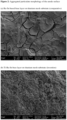
- catalytic anode coatings in the art typically show an outer surface morphology that resembles a dry lake-bed, having the appearance of finely-deposited sediment extensively interrupted by characteristic "mud-cracks" as illustrated in Figure 1 . These cracks provide weak points in the catalyst layer, and allow the penetration of electrolyte and reactive species down towards the substrate of the anode, resulting in degradation processes that weaken the adhesion of the catalyst to the substrate and attack the exposed compositions. Loss of electrical efficiency (as evidenced, for example, by increases in over-potential) and loss of catalytic activity typically result and reduce the useful life of the anode, leading to costly replacement.
- the catalytic obtainable by the process of the first aspect of the invention provide an advantageous balance of properties addressing these technical demands of such anodes, whilst avoiding the need for significant amounts of costly precious metals, especially iridium.
- the catalyst-coated anode structures defined in the first aspect of the present invention show high catalytic activity and selectivity for the chlorine evolution reaction, show excellent durability in terms of operating lifetime and mechanical adhesion of the catalyst to the anode surface, and show improved resistance to acids formed during operation. They also possess high anode conductivity, resulting in efficient electrical operation without excessive over-potential, maintained over extended running periods.
- the present invention accordingly provides, in a first aspect, a process for the preparation of a catalytic anode structure for use in an electro-chlorination system, comprising the following sequential steps:
- the process of the first aspect of the invention prepares a catalytic anode structure for use in an electro-chlorination system comprising an electrically conductive solid substrate overlaid, on its electrolyte-facing surface, with an electrically conductive metallurgical layer, this layer having the morphology of aggregated particles interspersed with voids, and comprising metal oxide compounds of ruthenium, tin and titanium, wherein the ruthenium and tin are present in amounts providing the metallurgical layer with an overall metallic stoichiometric ratio for Ru : Sn of 1 : ⁇ 1 based on the total content of ruthenium and tin in the metallurgical layer.
- atom% of the total metal atom content in relation to a specified metal in a composition refers to the number of atoms of that metal that are present in the relevant composition, expressed as the percentage of the total number of atoms of metallic elements that are present in the relevant composition, and irrespective of whether such metallic elements are present in elemental or compound form.
- all metallic stoichiometric ratio for particular metallic elements means the stoichiometric ratio of all atoms of those metallic elements present within the composite metallurgical layer (or other composition, where applicable), irrespective of whether such metallic elements are present in elemental or compound form.
- the overall metallic stoichiometric ratio for Ru : Sn is 15:15 or 1:1; and in a structure containing 15 atom% of ruthenium in the form of elemental ruthenium, 15 atom% of elemental tin, and a further 15 atom% of tin compounded in oxide form, the overall metallic stoichiometric ratio for Ru : Sn is 15 : (15+15) or 1:2.
- morphology is used to denote the three-dimensional structure and appearance of the material in question.
- the morphology can most usefully be identified by scanning electron microscopy as hereinafter described, which provides three-dimensional imaging of the material surface in a way that allows direct visual recognition of its structure and appearance.
- the present invention is based, in part, on the finding that an anode structure having excellent properties for obtaining the CER reaction in electro-chlorination can be advantageously obtained through the process of the invention, the process providing a metallurgical layer on the anode surface directly exposed to the electrolyte, this layer comprising tin in combination with ruthenium and titanium.
- the metallurgical layer on the anode provides the anode with a surface chemical composition and advantageous morphology that achieves excellent durability, in terms of operating lifetime and mechanical adhesion to the anode substrate, and offers advantageous catalytic activity and selectivity for the chlorine evolution reaction.
- the metallurgical layer also offers the anode high resistance to acid attack, and a high conductivity leading to high electrical efficiency and operating performance at low over-potentials for extended periods.
- the use of tin in the structural base composition also enables this anode performance to be reached at substantially lower costs than conventional catalytic anodes based on iridium and/or larger quantities of ruthenium as the predominant components.
- the metallurgical layer composition essentially comprises the combination of ruthenium, tin and titanium in metal oxide form, wherein the presence of a minimum proportion of ruthenium and the co-presence of tin in a stoichiometric amount equal to or exceeding the amount of ruthenium, in combination with titanium, provides a composition capable of forming a structure having the morphology of aggregated particles interspersed with voids, as further demonstrated hereunder.
- the particulate morphology of this composition contributes to improved mechanical adhesion of the metallurgical layer onto the substrate, resulting in a highly adherent layer on the electrolyte-facing surface of the anode having the above-described advantageous combination of properties for the chlorine evolution reaction.
- the aggregated particles on the outer surface of the morphological layer are also essential for providing a highly effective and available surface area for catalytic activity.
- this particulate morphology overcomes the mass transfer limitations of conventional lake-bed sedimentary catalyst layers, enabling the catalytic anodes of the invention to operate a higher efficiency for the chlorine evolution reaction and contributing to their various advantages.
- the efficiency advantage in the chlorine evolution reaction for the catalytic anode prepared by the process of the present invention is particularly demonstrated with aqueous solutions of chloride ions (such as brine) having low salt levels.
- Increased efficiency at low salt levels provides an electrode with wide suitability for water treatment, for example in municipal water applications or for treating drinking water, in addition to the treatment of waste water and other chlorination applications.
- the increased efficiency also results in lower levels of unwanted electrolysis by-products such as chlorate and perchlorate ions.
- the formation of the catalytic anode structure is realised through a process which adds the metallurgical layer under process conditions ideally favourable to the formation of the correct morphology of the composition.
- the use of process solvent volatile under that condition further enables the formation of voids in the metallurgical layer.
- This solvent also results in the concomitant loss of a certain proportion of more volatile metallic salts contained within the defined metallurgical content of the starting composition (i), resulting in the formation of a metallurgical layer with overall metallic stoichiometry different in respect of ruthenium, tin and titanium to that of the starting composition (i).
- the use of the defined composition (i) and the defined process conditions is believed to advantageously accommodate for this concomitant metal salt volatility loss, and results in the formation of an applied metallurgical layer having the desired composition and morphology.
- this composition of process solvent has been found to advantageously control the surface morphology of the layer formed by the application of the metallurgical composition, both before and after the final heat-treatment step, and in particular contributes to the aggregated particulate morphology, free of integrity-weakening cracks.
- This ability to control layer morphology is particularly attributed to the choice of alcohol and the ratio of alcohol to water in the process solvent, and is optimally controlled at the volume ratio of 85:15 (isopropanol:water).
- the chlorine gas evolved by the process is used as a biocide to disinfect water, and more especially used to disinfect ballast water or industrial waste water, or municipal or domestic water, such as recreational water in swimming pools and domestic drinking water.
- the process is a chlor-alkali process for the generation and recovery of chlorine.
- the first aspect provides a process for the preparation of a catalytic anode structure for use in an electro-chlorination system, comprising the following sequential steps:
- the process of the invention obtains the catalytic anode structure defined below, and is the preferred process for preparing the anode of this kind.
- the temperature conditions and process solvent defined in the process are important to obtaining the desired catalytic anode structure.
- the resulting structure is heat-treated at a temperature in the range of at least 450°C, and preferably heat-treated at a temperature in the range of 450 to 600°C, such as 450°C to 550°C. More preferably, the resulting structure is heat-treated at a temperature in the range of 475 to 525°C, and optimally at a temperature of 500°C.
- the process of the invention also requires the use of a specified process solvent for applying the metallurgical composition in step (b), this process solvent being a mixture of isopropanol and water in the ratio range of 80:20 to 95:5 by volume, and preferably in the ratio range of 82.5:17.5 to 87.5:12.5 by volume. Most preferably, the process solvent is a mixture of isopropanol and water in the ratio of 85:15 by volume.
- This composition of process solvent has been found to show advantages over similar alcoholic solvents for solvency of the starting compounds used in the process of the first aspect.
- this composition of process solvent has been found to advantageously control the surface morphology of the layer formed by the application of the metallurgical composition, both before and after the final heat-treatment step, and in particular contributes to obtaining an aggregated particulate morphology to the resulting metallurgical layer, and more preferably free of integrity-weakening cracks.
- This ability to control layer morphology is particularly attributed to the choice of alcohol and the ratio of alcohol to water in the process solvent, and is optimally controlled at the volume ratio of 85:15 (isopropanol:water).
- the anode substrate (a) is heated to a temperature in the range of 55-200°C during step (b), and the resulting structure is thereafter dried at a temperature within the same range.
- the heating of the anode substrate to this temperature range is conducted throughout step (b), and the resulting structure is thereafter dried at a temperature within the same range.
- the substrate (a) is heated to a temperature of 100°C throughout step (b), and the resulting structure thereafter dried at that temperature.
- step (b) of the process the use of the defined process solvent volatile under that condition, and where present the heat treatment of the substrate, enables the formation of voids in the resulting metallurgical layer.
- applying the metallurgical composition (i) to a substrate that is preferably heated in accordance with the second aspect of the invention has been found to enhance the formation of the desired metallurgical layer on the anode.
- the drying of the resulting structure at the same temperature range has also importantly been found to enhance the formation of the desired metallurgical layer, in particular by favouring the formation of the desired morphology of a continuous layer, and especially one uninterrupted by mud-cracks or other significant penetrating discontinuities.
- the essential final heat-treatment of the resulting structure at a temperature of at least 450°C has importantly been found to enhance the formation of the desired metallurgical layer, in particular by favouring the improvement in mechanical adhesion of the metallurgical layer to the anode substrate, and by favouring high selectivity for the chlorine evolution reaction over the oxygen evolution reaction from water splitting.
- the process of the invention prefers a final heat-treatment in the range of 450 to 550°C, and especially an optimal final heat-treatment at 500°C, wherein higher selectivity for the chlorine evolution reaction and mechanical adhesion is observed.
- composition (i) applied in step (b) comprises compounds of ruthenium, tin and titanium in amounts providing the composition (i) with the overall metallic stoichiometry Ru ⁇ 0.3 (Sn+Ti) ⁇ 0.7 .
- Composition (i) is the starting composition for the metallurgical layer on the anode, and it is important in the process of the present invention that the ruthenium content of composition (i) is stoichiometrically at the level of 0.3 or above (corresponding to 30 atom%) relative to the tin and titanium present in the composition in order to arrive at the desired layer structure. It has been found that the durability of the resulting composition is much improved when the ruthenium is at or above this level in the starting composition (i), when applied according to the process of the first aspect. In addition, the ruthenium assists with the overall conductivity of the composition.
- composition (i) applied in step (b) of the process comprises compounds of ruthenium, tin and titanium in amounts providing the composition (i) with the overall metallic stoichiometry Ru 0.3 (Sn+Ti) 0.7 .
- This level of ruthenium is considered optimal in the composition (i) of the process of the invention, giving rise to a particularly efficient and durable anode structure.
- the combined presence of tin and titanium in addition to ruthenium in the composition (i) results in the formation, via its application in the process, of a metallurgical layer composition having the desired morphology of aggregated particles and an absence of the extensive mud-cracking behaviour seen in other compositions comprising ruthenium with only titanium or tin alone.
- the minimum level of 30 atom% of ruthenium relative to tin and titanium in the starting composition (i) also leads, under the conditions of the process, to the enhanced formation of the network of aggregated particles in the morphology of the resulting composition, and a lack of cracking behaviour.
- composition (i) in combination with ruthenium and titanium also importantly contributes to an increase in long-term durability of the anode prepared according to the process, and gives rise to an increase in the mechanical adhesion of the metallurgical layer to the anode substrate.
- the tin content within composition (i) can be further adjusted to provide the resulting anode with the desired overall stoichiometric ratio of Ru : Sn in the final anode structure, and desired performance in this regard.
- composition (i) applied in step (b) comprises compounds of ruthenium, tin and titanium in amounts providing the composition (i) with the overall metallic stoichiometry Ru 0.3 Sn ⁇ 0.3 Ti ⁇ 0.4 , and optimally Ru 0.3 Sn 0.35 Ti 0.35 .
- composition (i) consist essentially of compounds of ruthenium, tin and titanium, and more preferred that composition (i) consist of compounds of ruthenium, tin and titanium, preferably in amounts providing the composition (i) with the overall metallic stoichiometry Ru 0.3 (Sn+Ti) 0.7 , and most preferably with the overall metallic stoichiometry Ru 0.3 Sn 0.35 Ti 0.35
- compositions may be applied to the surface of the metallurgical layer resulting from the application of composition (i), for example as auxiliary catalyst compositions for specific applications, provided that such auxiliary compositions do not inhibit the primary role and benefits of the layer resulting from the application of composition (i).
- composition (i) for use in the process of the first aspect may be prepared from compounds known in the art for the purpose of metal oxide catalyst preparation, mixed together in the appropriate ratios according to the teaching of the invention in the presence of the process solvent. Whilst such compounds may include the relevant metal oxide compounds where practical, typically other compounds are used that allow better mixing or suspension and will oxidise under the subsequent heat-treatment of the process to give rise in situ to the desired metal oxides.
- the ruthenium, tin, and titanium compounds present in composition (i) each comprise compounds other than oxide compounds; and wherein their heated application in process step (b), followed by drying and heat-treatment, thermally decomposes these compounds into one or more of their respective metal oxide or mixed metal oxide compounds within the composite metallurgical layer of the final anode structure.
- the ruthenium, tin and titanium compounds present in composition (i) preferably comprise, and more preferably consist of, their respective halide compounds, and/or complexes with acetylacetone.
- Such compounds provide for suitable dispersion of the metals in the composition used in the process, and subsequently convert to their respective oxides under the conditions of the process of the invention to give rise to the desired anode of the invention.
- the starting composition (i) for the process may additionally comprise other metal compounds bringing further advantages to the resulting anodes.
- the starting composition (i) may additionally comprise at least one compound of palladium, in an amount providing an overall palladium content of preferably at most 7 atom%, and preferably at most 5 atom% based on the total metal atom content of the starting composition.
- composition (i) may additionally comprise at least one compound of copper, or at least one compound of aluminium, or at least one compound of nickel, or more than one of the above, in amounts respectively providing composition (i) with an overall copper content of at most 10 atom% , and preferably at most 2 atom% based on the total metal atom content of the composition, or an overall aluminium content of at most 30 atom%, and preferably at most 20 atom% based on the total metal atom content of the composition, or an overall nickel content of at most 15 atom%, and preferably at most 10 atom% based on the total metal atom content of the composition,.
- composition (i) may additionally comprise at least one compound of iridium, in an amount respectively providing an overall iridium content of at most 15 atom%, and preferably at most 10 atom%.
- the electrically conductive solid substrate consists essentially of a valve metal, preferably titanium, as detailed under the first aspect of the invention.
- the metallurgical composition applied in step (b) may be sequentially applied by coating techniques known in the art, such as brush, roller or drawdown application, spray coating by means such as electro-spraying or pressure spraying, dip coating and curtain coating. Thicker coatings may be applied here required, by the coating technique making multiple passes over the underlying structure.
- the anode obtained by the process of the first aspect comprises an electrically conductive solid substrate overlaid, on its electrolyte-facing surface, with an electrically conductive catalytic metallurgical layer having the morphology of aggregated particles interspersed with voids, and comprising metal oxide compounds of ruthenium, tin and titanium; wherein the ruthenium and tin are present in amounts providing the metallurgical layer with the overall metallic stoichiometric ratio for Ru:Sn of 1 : ⁇ 1, based on the total content of ruthenium and tin in the metallurgical layer.
- the aggregated particulate morphology of the outer surface of the metallurgical layer contrasts with the extensively cracked sediment-like surface morphology of conventional catalytic anodes, and can best be visualised by examination under scanning electron microscopy, as illustrated in the accompanying Figures.
- the scanning electron micrographs were obtained using a JSM-IT500 InTouchScope TM Scanning Electron Microscope instrument, using the settings stated in the legend of the relevant Figure.
- the overall metallic stoichiometric ratio for Ru : Sn, based on the total content of ruthenium and tin in the metallurgical layer is preferably 1 : ⁇ 1.5, and more preferably 1 : ⁇ 2. Even more preferably, the overall metallic stoichiometric ratio for Ru : Sn, based on the total content of ruthenium and tin in the metallurgical layer, is 1 : ⁇ 3, and most preferably 1 : ⁇ 5.
- Optimal values for this ratio in the present invention lie in the range of 1:8 to 1:20, for example in the range of 1:8 to 1:15.
- the metallurgical layer may also comprise an auxiliary catalyst composition distributed on the upper surface of, and within the voids of the metallurgical layer. It is preferred that any such auxiliary composition does not comprise substantial or any amounts of precious metal oxides such as palladium or iridium, other than as provided herein.
- the anode of all embodiments resulting from the first aspect essentially consists of an electrically conductive solid substrate, which substrates are known in the art.
- This substrate preferably consists essentially of a valve metal, such as titanium, zirconium, niobium and tantalum (and alloys/mixtures containing these metals) and preferably titanium, and most preferably consists essentially of titanium. Mixtures of valve metals may be present in the substrate.
- the anode substrate may be produced by means conventional in the art, and may be purchased or manufactured to order and be formed into any shape suitable for eventual application as an anode in an electrochemical cell or system.
- the substrate may be formed into meshes, plates and more complex three-dimensional shapes such as cylinders.
- the substrates may be coated by the composite metallurgical layer on one or more sides depending on their design and arrangement.
- the metallurgical layer of all embodiments of the anode resulting from the process of the first aspect comprises metal oxide compounds of ruthenium, tin and titanium, and preferably consists essentially of metal oxide compounds of ruthenium, tin and titanium, to the desired stoichiometric ratio of Ru : Sn.
- the combination of these three metals is important to obtaining the correct morphology for the metallurgical layer composition in situ on the anode surface.
- Other metal oxides or other compounds may additionally present provided they do not adversely affect the morphology, however most preferably the composition consists of metal oxide compounds of ruthenium, tin and titanium.
- the specific combination of ruthenium, tin and titanium in the layer composition provides improved durability for the anode resulting from the first aspect of the invention, when compared to layer compositions comprising only ruthenium and titanium, or ruthenium and tin.
- the combination of both tin and titanium with ruthenium provides the anode with improved anode lifetime and improved mechanical adhesion, and further contributes to the advantages of the invention.
- the application of a starting composition (i) having the metallic stoichiometry Ru ⁇ 0.3 (Sn+Ti) ⁇ 0.7 will arrive at a suitable overall stoichiometry for these metals within the metallurgical layer, and in regard to the process of the first aspect, it is important that the ruthenium is present to the stoichiometric level of at least 0.3 in the starting composition (i) to obtain the anode and advantages of the invention. Within this limitation the skilled person may, however, vary this starting composition 9i) to obtain a particular desired overall metallic stoichiometry.
- the anode metallurgical layer of all embodiments may further comprise at least one compound of copper in an amount providing the metallurgical layer with an overall copper content of at most 10 atom%, and preferably at most 2 atom% of the total metal atom content of the metallurgical layer;;or at least one compound of aluminium in an amount providing the layer with an overall aluminium content of at most 30 atom%, and preferably at most 20 atom% of the total metal atom content of the metallurgical layer; at least one compound of nickel in an amount providing the layer with an overall aluminium content of at most 15 atom%, and preferably at most 10 atom% of the total metal atom content of the metallurgical layer; or more than one of the above.
- the additional presence of copper, aluminium or nickel within the metallurgical layer provides a further increase in the catalyst selectivity for the chlorine evolution reaction, as measured for example by the low salt efficiency.
- a preferred composition (i) consisting essentially of ruthenium, tin and titanium compounds having the overall metallic stoichiometry Ru 0.3 Sno 0.35 Ti 0.35 for use in the process to form the metallurgical layer was prepared according to the following sequence.
- An anode was prepared according to the process of the first aspect of the invention, as follows.
- a titanium mesh was sourced as the anode substrate and, after cleaning, heated to the temperature of 100°C using a heating plate. Whilst at this temperature, the above-prepared composition (i) was applied to the hot substrate surface by brush-coating. The resulting coated sample was held at 100°C for 1 minute the substrate with turned over and the reverse side coated again the substrate was held at 100°C for 1 minute. The coated sample was then transferred to a 500°C oven for 5 minutes. The coated sample was then transferred back to the to the hotplate at 100°C and the coating and heat treatment steps repeated. This brush-coating of the substrate surface with composition (i) was repeated four additional times, resulting in a total of five brush passes over the surface being coated.
- the dried resulting structure was thereafter finally heat-treated in an oven for 1 hour at 500°C, followed by slow cooling within the oven over a period of 8 hours, to obtain the anode structure of the invention.
- CER Chlorine Evolution Reaction
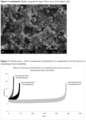
- the Faradic Efficiency (FE) of the electrolytic cell measured regularly over long-term testing provides an important demonstration of the lifetime of the catalysed anode, and hence the durability of the anode for the CER reaction.
- a rapid increase in FE signals deterioration of the anode and indicates it is reaching the end if its durability for CER.
- An electrolytic cell with counter and working electrodes was configured as described above.
- the working electrode (anode) was masked to 1 cm 2 to concentrate the current density for test acceleration purposes.
- the masking was done by applying silicon tape, overlaid by electroplating tape.
- the top of the working electrode was also ground back to the metal substrate before being connected.
- the metallurgical layer of the anode originates, in the accompanying process of the first aspect of the invention, from a composition (i) comprising compounds of ruthenium, tin and titanium in amounts providing the composition (i) with the overall metallic stoichiometry Ru ⁇ 0.3 (Sn+Ti) ⁇ 0.7 .
- the importance of these defined features in the process of the invention was demonstrated as follows.
- Figure 3 reports the results of CER lifetime tests conducted according to the test methodology described above.
- the working electrode anode under test
- Three examples of this type were prepared by varying the amount of ruthenium added to the composition (i), and maintaining the tin and titanium components at a 1:1 stoichiometric ratio as the balance of each composition.
- the CER lifetime results show the maintenance of a low over-potential for an extended period (corresponding to excellent lifetime for the catalytic performance of the anode) was not achieved where ruthenium was present to the stoichiometric level below 0.3.
- the specified stoichiometry is therefore required in which the ruthenium is present in at least the stoichiometric level of 0.3 in the composition (i).
- This ruthenium stoichiometry also ensures the obtention of the desired morphology for the composition, as a layer of aggregated particles interspersed with voids.
- a ruthenium stoichiometry of 0.3 in composition (i) resulted in a structure showed a defined crystalline structure by XPS and defined, connected particles when imaged using SEM.
Landscapes
- Chemical & Material Sciences (AREA)
- Organic Chemistry (AREA)
- Chemical Kinetics & Catalysis (AREA)
- Electrochemistry (AREA)
- Engineering & Computer Science (AREA)
- Materials Engineering (AREA)
- Metallurgy (AREA)
- General Chemical & Material Sciences (AREA)
- Life Sciences & Earth Sciences (AREA)
- Hydrology & Water Resources (AREA)
- Environmental & Geological Engineering (AREA)
- Water Supply & Treatment (AREA)
- Inorganic Chemistry (AREA)
- Electrodes For Compound Or Non-Metal Manufacture (AREA)
- Electrolytic Production Of Non-Metals, Compounds, Apparatuses Therefor (AREA)
Priority Applications (7)
| Application Number | Priority Date | Filing Date | Title |
|---|---|---|---|
| EP23180253.9A EP4480924A1 (fr) | 2023-06-20 | 2023-06-20 | Anodes catalytiques et procédés pour leur utilisation dans l'électrochloration |
| US18/738,566 US20240426006A1 (en) | 2023-06-20 | 2024-06-10 | Catalytic Anodes and Processes for Use in Electro-chlorination-3 |
| JP2024099008A JP2025003385A (ja) | 2023-06-20 | 2024-06-19 | 電気塩素化に使用するための触媒アノード及び方法 |
| CN202410792003.7A CN119162612A (zh) | 2023-06-20 | 2024-06-19 | 用于电解制氯的催化阳极和方法 |
| CA3244025A CA3244025A1 (en) | 2023-06-20 | 2024-06-19 | Catalytic anodes and processes for use in electro-chlorination |
| KR1020240080322A KR20240177737A (ko) | 2023-06-20 | 2024-06-20 | 전기-염소화에 사용하기 위한 촉매성 애노드 및 방법 |
| AU2024204211A AU2024204211A1 (en) | 2023-06-20 | 2024-06-20 | Catalytic anodes and processes for use in electro-chlorination |
Applications Claiming Priority (1)
| Application Number | Priority Date | Filing Date | Title |
|---|---|---|---|
| EP23180253.9A EP4480924A1 (fr) | 2023-06-20 | 2023-06-20 | Anodes catalytiques et procédés pour leur utilisation dans l'électrochloration |
Publications (1)
| Publication Number | Publication Date |
|---|---|
| EP4480924A1 true EP4480924A1 (fr) | 2024-12-25 |
Family
ID=86904038
Family Applications (1)
| Application Number | Title | Priority Date | Filing Date |
|---|---|---|---|
| EP23180253.9A Pending EP4480924A1 (fr) | 2023-06-20 | 2023-06-20 | Anodes catalytiques et procédés pour leur utilisation dans l'électrochloration |
Country Status (7)
| Country | Link |
|---|---|
| US (1) | US20240426006A1 (fr) |
| EP (1) | EP4480924A1 (fr) |
| JP (1) | JP2025003385A (fr) |
| KR (1) | KR20240177737A (fr) |
| CN (1) | CN119162612A (fr) |
| AU (1) | AU2024204211A1 (fr) |
| CA (1) | CA3244025A1 (fr) |
Citations (4)
| Publication number | Priority date | Publication date | Assignee | Title |
|---|---|---|---|---|
| US3846273A (en) * | 1967-12-14 | 1974-11-05 | Electronor Corp | Method of producing valve metal electrode with valve metal oxide semiconductive coating having a chlorine discharge catalyst in said coating |
| WO2004101852A2 (fr) * | 2003-05-07 | 2004-11-25 | Eltech Systems Corporation | Revetement anodique au chlorate presentant une morphologie de surface lisse |
| KR100553364B1 (ko) * | 2004-03-09 | 2006-02-20 | (주)에이엠티기술 | 금속 혼합 산화물 전극 및 그의 제조방법 |
| WO2019243163A1 (fr) * | 2018-06-21 | 2019-12-26 | Industrie De Nora S.P.A. | Anode de dégagement électrolytique de chlore |
-
2023
- 2023-06-20 EP EP23180253.9A patent/EP4480924A1/fr active Pending
-
2024
- 2024-06-10 US US18/738,566 patent/US20240426006A1/en active Pending
- 2024-06-19 CN CN202410792003.7A patent/CN119162612A/zh active Pending
- 2024-06-19 JP JP2024099008A patent/JP2025003385A/ja active Pending
- 2024-06-19 CA CA3244025A patent/CA3244025A1/en active Pending
- 2024-06-20 AU AU2024204211A patent/AU2024204211A1/en active Pending
- 2024-06-20 KR KR1020240080322A patent/KR20240177737A/ko active Pending
Patent Citations (4)
| Publication number | Priority date | Publication date | Assignee | Title |
|---|---|---|---|---|
| US3846273A (en) * | 1967-12-14 | 1974-11-05 | Electronor Corp | Method of producing valve metal electrode with valve metal oxide semiconductive coating having a chlorine discharge catalyst in said coating |
| WO2004101852A2 (fr) * | 2003-05-07 | 2004-11-25 | Eltech Systems Corporation | Revetement anodique au chlorate presentant une morphologie de surface lisse |
| KR100553364B1 (ko) * | 2004-03-09 | 2006-02-20 | (주)에이엠티기술 | 금속 혼합 산화물 전극 및 그의 제조방법 |
| WO2019243163A1 (fr) * | 2018-06-21 | 2019-12-26 | Industrie De Nora S.P.A. | Anode de dégagement électrolytique de chlore |
Non-Patent Citations (1)
| Title |
|---|
| "REALISATION DE NOUVELLES ANODES A FAIBLE COUT POUR LE TRAITEMENT ELECTROCHIMIQUE DES EAUX", REVUE GENERALE DE L'ELECTRICITE, RGE. PARIS, FR, no. 1, 1 January 1994 (1994-01-01), pages 34 - 37, XP000423960, ISSN: 0035-3116 * |
Also Published As
| Publication number | Publication date |
|---|---|
| AU2024204211A1 (en) | 2025-01-16 |
| US20240426006A1 (en) | 2024-12-26 |
| CA3244025A1 (en) | 2025-06-06 |
| JP2025003385A (ja) | 2025-01-09 |
| CN119162612A (zh) | 2024-12-20 |
| KR20240177737A (ko) | 2024-12-27 |
Similar Documents
| Publication | Publication Date | Title |
|---|---|---|
| EP0046447B1 (fr) | Electrode à surface électrocatalytique et son procédé de fabrication | |
| US8124556B2 (en) | Electrochemically active composition, methods of making, and uses thereof | |
| EP0047595B1 (fr) | Cellule électrochimique | |
| RU2561565C1 (ru) | Анод для выделения хлора | |
| CN101528985B (zh) | 用于电解的阳极 | |
| JPS6318672B2 (fr) | ||
| EP0014596B1 (fr) | Procédé de fabrication d'électrodes portant une couche de revêtement catalytiquement active à base de mélanges d'oxydes métalliques | |
| WO1979000842A1 (fr) | Electrodes pour procedes electrolytiques | |
| EP0955395B1 (fr) | Electrode pour électrolyse et procédé pour sa fabrication | |
| KR870001769B1 (ko) | 전기화학 전해조용 전극 및 그 제조방법 | |
| KR860001050B1 (ko) | 할로겐 화합물 또는 산함유 전해질의 전해용 금속전극 | |
| NO861978L (no) | Katalytisk komposittmateriale, spesielt for elektrolyseelektroder, og fremstillingsmetode. | |
| EP4480924A1 (fr) | Anodes catalytiques et procédés pour leur utilisation dans l'électrochloration | |
| US4760041A (en) | Preparation and use of electrodes | |
| US20240426003A1 (en) | Catalytic Anodes and Processes for Use in Electro-chlorination-2 | |
| US20240426004A1 (en) | Catalytic Anodes and Processes for Use in Electro-chlorination-1 | |
| JP3724096B2 (ja) | 酸素発生用電極とその製造方法 | |
| KR20230094624A (ko) | 선박평형수 전기분해용 루테늄-주석 산화물 촉매 전극 및 이의 제조방법 | |
| KR20210146017A (ko) | 파이로클로르계 촉매를 포함하는 전기분해용 촉매 전극 및 이의 제조방법 | |
| JPS5827353B2 (ja) | 電解用陽極 | |
| NO150127B (no) | Sintret elektrode for elektroutvinning av metall, for katodisk beskyttelse, og for bruk som anode ved kloralkalielektrolyse |
Legal Events
| Date | Code | Title | Description |
|---|---|---|---|
| PUAI | Public reference made under article 153(3) epc to a published international application that has entered the european phase |
Free format text: ORIGINAL CODE: 0009012 |
|
| STAA | Information on the status of an ep patent application or granted ep patent |
Free format text: STATUS: THE APPLICATION HAS BEEN PUBLISHED |
|
| STAA | Information on the status of an ep patent application or granted ep patent |
Free format text: STATUS: REQUEST FOR EXAMINATION WAS MADE |
|
| AK | Designated contracting states |
Kind code of ref document: A1 Designated state(s): AL AT BE BG CH CY CZ DE DK EE ES FI FR GB GR HR HU IE IS IT LI LT LU LV MC ME MK MT NL NO PL PT RO RS SE SI SK SM TR |
|
| 17P | Request for examination filed |
Effective date: 20241219 |