EP4481002A1 - Glucosediffusionssteuerungsschichtlösung für biosensor zur kontinuierlichen blutzuckermessung, glucosediffusionssteuerungsschicht damit und biosensor zur kontinuierlichen blutzuckermessung - Google Patents
Glucosediffusionssteuerungsschichtlösung für biosensor zur kontinuierlichen blutzuckermessung, glucosediffusionssteuerungsschicht damit und biosensor zur kontinuierlichen blutzuckermessung Download PDFInfo
- Publication number
- EP4481002A1 EP4481002A1 EP23756547.8A EP23756547A EP4481002A1 EP 4481002 A1 EP4481002 A1 EP 4481002A1 EP 23756547 A EP23756547 A EP 23756547A EP 4481002 A1 EP4481002 A1 EP 4481002A1
- Authority
- EP
- European Patent Office
- Prior art keywords
- glucose
- control layer
- diffusion control
- continuous blood
- blood glucose
- Prior art date
- Legal status (The legal status is an assumption and is not a legal conclusion. Google has not performed a legal analysis and makes no representation as to the accuracy of the status listed.)
- Pending
Links
Images

Classifications
-
- C—CHEMISTRY; METALLURGY
- C08—ORGANIC MACROMOLECULAR COMPOUNDS; THEIR PREPARATION OR CHEMICAL WORKING-UP; COMPOSITIONS BASED THEREON
- C08L—COMPOSITIONS OF MACROMOLECULAR COMPOUNDS
- C08L75/00—Compositions of polyureas or polyurethanes; Compositions of derivatives of such polymers
- C08L75/04—Polyurethanes
- C08L75/06—Polyurethanes from polyesters
-
- A—HUMAN NECESSITIES
- A61—MEDICAL OR VETERINARY SCIENCE; HYGIENE
- A61B—DIAGNOSIS; SURGERY; IDENTIFICATION
- A61B5/00—Measuring for diagnostic purposes; Identification of persons
- A61B5/145—Measuring characteristics of blood in vivo, e.g. gas concentration or pH-value ; Measuring characteristics of body fluids or tissues, e.g. interstitial fluid or cerebral tissue
- A61B5/14532—Measuring characteristics of blood in vivo, e.g. gas concentration or pH-value ; Measuring characteristics of body fluids or tissues, e.g. interstitial fluid or cerebral tissue for measuring glucose, e.g. by tissue impedance measurement
-
- A—HUMAN NECESSITIES
- A61—MEDICAL OR VETERINARY SCIENCE; HYGIENE
- A61B—DIAGNOSIS; SURGERY; IDENTIFICATION
- A61B5/00—Measuring for diagnostic purposes; Identification of persons
- A61B5/145—Measuring characteristics of blood in vivo, e.g. gas concentration or pH-value ; Measuring characteristics of body fluids or tissues, e.g. interstitial fluid or cerebral tissue
- A61B5/1468—Measuring characteristics of blood in vivo, e.g. gas concentration or pH-value ; Measuring characteristics of body fluids or tissues, e.g. interstitial fluid or cerebral tissue using chemical or electrochemical methods, e.g. by polarographic means
- A61B5/1486—Measuring characteristics of blood in vivo, e.g. gas concentration or pH-value ; Measuring characteristics of body fluids or tissues, e.g. interstitial fluid or cerebral tissue using chemical or electrochemical methods, e.g. by polarographic means using enzyme electrodes, e.g. with immobilised oxidase
-
- A—HUMAN NECESSITIES
- A61—MEDICAL OR VETERINARY SCIENCE; HYGIENE
- A61B—DIAGNOSIS; SURGERY; IDENTIFICATION
- A61B5/00—Measuring for diagnostic purposes; Identification of persons
- A61B5/145—Measuring characteristics of blood in vivo, e.g. gas concentration or pH-value ; Measuring characteristics of body fluids or tissues, e.g. interstitial fluid or cerebral tissue
- A61B5/1468—Measuring characteristics of blood in vivo, e.g. gas concentration or pH-value ; Measuring characteristics of body fluids or tissues, e.g. interstitial fluid or cerebral tissue using chemical or electrochemical methods, e.g. by polarographic means
- A61B5/1486—Measuring characteristics of blood in vivo, e.g. gas concentration or pH-value ; Measuring characteristics of body fluids or tissues, e.g. interstitial fluid or cerebral tissue using chemical or electrochemical methods, e.g. by polarographic means using enzyme electrodes, e.g. with immobilised oxidase
- A61B5/14865—Measuring characteristics of blood in vivo, e.g. gas concentration or pH-value ; Measuring characteristics of body fluids or tissues, e.g. interstitial fluid or cerebral tissue using chemical or electrochemical methods, e.g. by polarographic means using enzyme electrodes, e.g. with immobilised oxidase invasive, e.g. introduced into the body by a catheter or needle or using implanted sensors
-
- C—CHEMISTRY; METALLURGY
- C08—ORGANIC MACROMOLECULAR COMPOUNDS; THEIR PREPARATION OR CHEMICAL WORKING-UP; COMPOSITIONS BASED THEREON
- C08L—COMPOSITIONS OF MACROMOLECULAR COMPOUNDS
- C08L53/00—Compositions of block copolymers containing at least one sequence of a polymer obtained by reactions only involving carbon-to-carbon unsaturated bonds; Compositions of derivatives of such polymers
-
- C—CHEMISTRY; METALLURGY
- C12—BIOCHEMISTRY; BEER; SPIRITS; WINE; VINEGAR; MICROBIOLOGY; ENZYMOLOGY; MUTATION OR GENETIC ENGINEERING
- C12Q—MEASURING OR TESTING PROCESSES INVOLVING ENZYMES, NUCLEIC ACIDS OR MICROORGANISMS; COMPOSITIONS OR TEST PAPERS THEREFOR; PROCESSES OF PREPARING SUCH COMPOSITIONS; CONDITION-RESPONSIVE CONTROL IN MICROBIOLOGICAL OR ENZYMOLOGICAL PROCESSES
- C12Q1/00—Measuring or testing processes involving enzymes, nucleic acids or microorganisms; Compositions therefor; Processes of preparing such compositions
- C12Q1/001—Enzyme electrodes
- C12Q1/005—Enzyme electrodes involving specific analytes or enzymes
- C12Q1/006—Enzyme electrodes involving specific analytes or enzymes for glucose
-
- G—PHYSICS
- G01—MEASURING; TESTING
- G01N—INVESTIGATING OR ANALYSING MATERIALS BY DETERMINING THEIR CHEMICAL OR PHYSICAL PROPERTIES
- G01N33/00—Investigating or analysing materials by specific methods not covered by groups G01N1/00 - G01N31/00
- G01N33/48—Biological material, e.g. blood, urine; Haemocytometers
- G01N33/50—Chemical analysis of biological material, e.g. blood, urine; Testing involving biospecific ligand binding methods; Immunological testing
- G01N33/66—Chemical analysis of biological material, e.g. blood, urine; Testing involving biospecific ligand binding methods; Immunological testing involving blood sugars, e.g. galactose
-
- A—HUMAN NECESSITIES
- A61—MEDICAL OR VETERINARY SCIENCE; HYGIENE
- A61B—DIAGNOSIS; SURGERY; IDENTIFICATION
- A61B5/00—Measuring for diagnostic purposes; Identification of persons
- A61B5/145—Measuring characteristics of blood in vivo, e.g. gas concentration or pH-value ; Measuring characteristics of body fluids or tissues, e.g. interstitial fluid or cerebral tissue
- A61B5/14507—Measuring characteristics of blood in vivo, e.g. gas concentration or pH-value ; Measuring characteristics of body fluids or tissues, e.g. interstitial fluid or cerebral tissue specially adapted for measuring characteristics of body fluids other than blood
- A61B5/1451—Measuring characteristics of blood in vivo, e.g. gas concentration or pH-value ; Measuring characteristics of body fluids or tissues, e.g. interstitial fluid or cerebral tissue specially adapted for measuring characteristics of body fluids other than blood for interstitial fluid
-
- G—PHYSICS
- G01—MEASURING; TESTING
- G01N—INVESTIGATING OR ANALYSING MATERIALS BY DETERMINING THEIR CHEMICAL OR PHYSICAL PROPERTIES
- G01N33/00—Investigating or analysing materials by specific methods not covered by groups G01N1/00 - G01N31/00
- G01N33/48—Biological material, e.g. blood, urine; Haemocytometers
- G01N33/483—Physical analysis of biological material
- G01N33/487—Physical analysis of biological material of liquid biological material
Definitions
- the present invention relates to a glucose diffusion control layer solution for a continuous blood glucose-measuring biosensor, a glucose diffusion control layer for a continuous blood glucose-measuring biosensor including the same, and a continuous blood glucose-measuring biosensor including the same. More specifically, the present invention relates to a glucose diffusion control layer solution for a continuous blood glucose-measuring biosensor, in which, by using only a substance of which biocompatibility has been verified, stability can be ensured even when injected into the human body, and glucose permeability and water absorbance can be controlled; a glucose diffusion control layer for a continuous blood glucose-measuring biosensor including the same; and a continuous blood glucose-measuring biosensor including the same.
- IDF Diabetes ATLAS 9 th Edition which is a diabetes white paper published by the International Diabetes Federation (IDF) every two years, in 2019, 463 million (9.3%) were diabetic patients aged 20 to 79 worldwide. This is an increase of 39 million compared to the 425 million reported in 2017.
- ADA American Diabetes Association
- blood glucose management through CGM was more effective when programs such as education training and follow-up were provided together, thereby helping to correct blood glucose patterns and improve glycated hemoglobin in glycemic patients.
- the Korean Diabetes Association (KDA) 2021 treatment guidelines recommend the use of a real-time continuous blood glucose-measuring device to control blood sugar levels and lower the risk of hypoglycemia in adults with type 1 diabetes, and stated that adults with type 2 diabetes receiving multiple insulin injection therapy may use a real-time continuous glucose-measuring device to control their blood sugar levels.
- the sensor of such a continuous blood glucose-measuring device may include a glucose diffusion control layer at the outermost part of the sensor.
- the glucose diffusion control layer does not negatively affect the human body when the sensor is inserted into the human body, and prevents a sensor material from being discharged into the human body. In addition, it is possible to control the diffusion of glucose introduced from the human body.
- the flow rate of glucose flowing into the outermost part of the sensor through the glucose diffusion control layer may increase. Accordingly, it may be difficult to accurately measure blood glucose.
- a glucose diffusion control layer for a continuous blood glucose-measuring biosensor is prepared by using a glucose diffusion control layer solution including a mixture of a specific hydrophilic material and a specific hydrophobic material
- the inventors of the present invention confirmed that stability can be secured even when inserted into the human body by using only materials with proven biocompatibility, and glucose permeability and water absorption can be controlled, thereby completing the present invention.
- the present invention has been devised to solve the above problems, and the problems to be solved by the present invention are to ensure stability even when inserted into the human body by using only materials whose biocompatibility has been verified, and to provide a glucose diffusion control layer solution for a continuous blood glucose-measuring biosensor with controllable glucose permeability and water absorption, a glucose diffusion control layer for a continuous blood glucose-measuring biosensor including the same, and a continuous blood glucose-measuring biosensor including the same.
- the glucose diffusion control layer solution of the present invention includes a hydrophilic material and a hydrophobic material
- the glucose diffusion control layer solution for a continuous blood glucose-measuring biosensor according to the present invention may include an aliphatic polyester-based thermoplastic polyurethane as the hydrophilic material
- the hydrophobic material may include a styrene block copolymer
- the aliphatic polyester-based thermoplastic polyurethane may have a specific gravity of 1.0 to 1.2 g/cm 3 according to the ASTM D792 measurement method.
- the aliphatic polyester-based thermoplastic polyurethane may have a shore hardness of 78 to 88A according to the ASTM D2240 measurement method.
- the aliphatic polyester-based thermoplastic polyurethane may have a flexural modulus of 2,400 to 3,400 psi according to the ASTM D790 measurement method.
- the aliphatic polyester-based thermoplastic polyurethane may have an ultimate tensile of 1,700 to 2,700 psi in a dry state and an ultimate tensile of 900 to 1,900 psi in a wet state according to the ASTM D412 measurement method.
- the aliphatic polyester-based thermoplastic polyurethane may have an ultimate elongation of 540 to 1,540 psi in a dry state and an ultimate elongation of 320 to 920 psi in a wet state according to the ASTM D412 measurement method.
- the styrene block copolymer may have a specific gravity of 0.9 to 1.1 g/cm 3 according to the ISO 1183-1 measurement method.
- the styrene block copolymer may have a shore hardness of 60 to 80A according to the ISO 48-4 measurement method.
- the styrene block copolymer may have a tensile strength of 8.2 to 10.2 MPa according to the ISO 37 measurement method.
- the styrene block copolymer may have an elongation at break of 414 to 614% according to the ISO 37 measurement method.
- the styrene block copolymer may have a tear strength of 15 to 25 N/mm according to the ISO 34-1 measurement method.
- the hydrophilic material and hydrophobic material may have a weight ratio of 1:0.1 to 4.
- the glucose diffusion control layer for a continuous blood glucose-measuring biosensor may be prepared by drying the glucose diffusion control layer solution of the present invention.
- the continuous blood glucose-measuring biosensor of the present invention may include the glucose diffusion control layer of the present invention.
- the glucose diffusion control layer solution for a continuous blood glucose-measuring biosensor according to the present invention the glucose diffusion control layer for a continuous blood glucose-measuring biosensor including the same, and the continuous blood glucose-measuring biosensor including the same only use materials with proven biocompatibility, and when they are inserted into the human body, it is possible to secure safety, and glucose permeability and water absorption can be controlled.
- the biosensor for continuous glucose measurement of the present invention may include a glucose diffusion control layer for a continuous blood glucose-measuring biosensor according to the present invention.
- the glucose diffusion control layer for a continuous glucose-measuring biosensor of the present invention may be prepared by drying a glucose diffusion control layer solution for a continuous glucose-measuring biosensor of the present invention, which will be described below.
- the biosensor for continuous blood glucose measurement of the present invention is an electrochemical sensor for measuring blood glucose.
- Such a continuous blood glucose-measuring biosensor may include, for example, an electrode, an insulator, a substrate, an electron transfer mediator, an enzyme layer including an enzyme and a crosslinking agent, a glucose diffusion control layer and the like.
- the enzyme layer may include an enzyme which is capable of oxidizing or reducing a liquid biological specimen and an oxidation-reduction polymer. It may be an enzyme layer for an electrochemical biosensor including an electron transfer mediator, and an oxidoreductase is a general term for enzymes that catalyze an oxidation-reduction reaction in the living body.
- an enzyme layer for an electrochemical biosensor including an electron transfer mediator and an oxidoreductase is a general term for enzymes that catalyze an oxidation-reduction reaction in the living body.
- a target substance to be measured such as a biosensor
- it means an enzyme that reacts with the target substance to be reduced.
- the reduced enzyme reacts with the electron transfer mediator, and the target substance is quantified by measuring signals such as current changes generated at this time.
- the oxidoreductase that is usable in the present invention may be at least one selected from the group consisting of various dehydrogenases, oxidases, esterases and the like, and depending on the target substance for redox or detection, an enzyme that uses the target substance as a substrate can be selected and used among enzymes belonging to the enzyme group.
- the oxidoreductase may be at least one selected from the group consisting of glucose dehydrogenase, glutamate dehydrogenase, glucose oxidase, cholesterol oxidase, cholesterol esterase, lactate oxidase, ascorbic acid oxidase, alcohol oxidase, alcohol dehydrogenase, bilirubin oxidase, uricase and the like.
- the electron transfer mediator may include at least one selected from a metal-containing complex and an organic conducting salt.
- It may include group 8 elements such as ruthenium complex, osmium complex and ferricyanide complex as a metal-containing complex, and it may include ferrocene and quinone, a derivative of quinone, methylene blue and the like as an organic conductive salt.
- the oxidoreductase may also include a cofactor that serves to store hydrogen taken away by the oxidoreductase from the target substance to be measured (e.g., the target substance), and for example, it may be at least one selected from the group consisting of flavin adenine dinucleotide (FAD), nicotinamide adenine dinucleotide (NAD), pyrroloquinoline quinone (PQQ) and the like.
- FAD flavin adenine dinucleotide
- NAD nicotinamide adenine dinucleotide
- PQQ pyrroloquinoline quinone
- the enzyme layer may further include at least one additive selected from the group consisting of a crosslinking agent, a surfactant, a water-soluble polymer, a quaternary ammonium salt, a fatty acid, a thickener and the like, in order to serve as a dispersing agent for dissolving a reagent, an adhesive for preparing a reagent, a stabilizer for long-term storage and the like.
- at least one additive selected from the group consisting of a crosslinking agent, a surfactant, a water-soluble polymer, a quaternary ammonium salt, a fatty acid, a thickener and the like, in order to serve as a dispersing agent for dissolving a reagent, an adhesive for preparing a reagent, a stabilizer for long-term storage and the like.
- the electrode it may include two types of electrodes, such as a working electrode and a counter electrode, or may include three types of electrodes, such as a working electrode, a counter electrode and a reference electrode.
- the biosensor according to the present invention may be an electrochemical biosensor which is manufactured by applying an enzyme solution including an enzyme that is capable of oxidizing and reducing glucose, a cross-linker and an electron transfer mediator to a substrate having at least two, and preferably, two or three electrodes, and then drying the solution.
- an electrochemical biosensor it is possible to provide a planar electrochemical biosensor which is characterized in that a working electrode, a counter electrode and a reference electrode are disposed on the same surface of a substrate, an enzyme layer according to the present invention is laminated on the working electrode, an insulator is laminated on the substrate and electrodes (working electrode, counter electrode, a reference electrode), and a glucose diffusion control layer is laminated on the electrode.
- the substrate may be made of at least one material selected from the group consisting of polydimethylsiloxane (PDMS), polyimide (PI) and polyethylene terephthalate (PET).
- PDMS polydimethylsiloxane
- PI polyimide
- PET polyethylene terephthalate
- an electrode made of carbon, gold, platinum or silver may be used as the working electrode.
- a counter electrode also serves as a reference electrode
- gold, platinum, silver or silver/silver chloride electrodes may be used as the counter electrode
- a silver/silver chloride electrode may be used as a reference electrode
- a carbon electrode may be used as a counter electrode.
- silver chloride or silver may be used in the case of two electrodes because the counter electrode also serves as the reference electrode, and in the case of three electrodes, silver chloride or silver may be used as the reference electrode, and a carbon electrode may be used as the counter electrode.
- the glucose diffusion control layer solution for a continuous blood glucose-measuring biosensor of the present invention includes a hydrophilic material and a hydrophobic material.
- the glucose diffusion control layer solution for a continuous blood glucose-measuring biosensor of the present invention includes both of a hydrophilic material and a hydrophobic material, the glucose permeability control is excellent even in the human body environment, and the glucose sensing sensitivity can be implemented.
- the glucose diffusion control layer solution for a continuous blood glucose-measuring biosensor of the present invention includes only a hydrophilic material, there may be a problem in that the performance of the sensor is deteriorated due to excessive permeation of glucose at the outermost periphery of the continuous blood glucose-measuring biosensor.
- a hydrophobic material there may be a problem in that glucose is not sensed because glucose is not permeated at the outermost part of the biosensor for continuous glucose measurement.
- an aliphatic polyester-based thermoplastic polyurethane may be included as a hydrophilic material.
- the aliphatic polyester-based thermoplastic polyurethane may have a specific gravity of 1.0 to 1.2 g/cm 3 , and preferably, 1.1 to 1.16 g/cm 3 according to the ASTM D792 measurement method.
- the aliphatic polyester-based thermoplastic polyurethane may have shore hardness of 78 to 88A, and preferably 81 to 85A, according to the ASTM D2240 measurement method.
- the aliphatic polyester-based thermoplastic polyurethane may have a flexural modulus of 2,400 to 3,400 psi, and preferably, 2,700 to 3,100 psi, according to the ASTM D790 measurement method.
- the aliphatic polyester-based thermoplastic polyurethane may have an ultimate tensile strength of 1,700 to 2,700 psi, and preferably, 2,000 to 2,400 psi, in a dry state according to the ASTM D412 measurement method.
- the aliphatic polyester-based thermoplastic polyurethane may have an ultimate tensile strength of 900 to 1,900 psi, and preferably, 1,200 to 1,600 psi, in a wet state according to the ASTM D412 measurement method.
- the aliphatic polyester-based thermoplastic polyurethane may have an ultimate elongation of 540 to 1,540 psi, and preferably, 840 to 1,240 psi, in a dry state according to the ASTM D412 measurement method.
- the aliphatic polyester-based thermoplastic polyurethane may have an ultimate elongation of 320 to 920 psi, and preferably, 520 to 720 psi, in a wet state according to the ASTM D412 measurement method.
- it may include a styrene block copolymer as a hydrophobic material.
- the styrene block copolymer may have a specific gravity of 0.9 to 1.1 g/cm 3 , and preferably, 1.0 to 1.05 g/cm 3 , according to the ISO 1183-1 measurement method.
- the styrene block copolymer may have a shore hardness of 60 to 80A, and preferably, 65 to 75A, according to the ISO 48-4 measurement method.
- the styrene block copolymer may have a tensile strength of 8.2 to 10.2 MPa, and preferably, 8.7 to 9.7 Mpa, according to the ISO 37 measurement method.
- the styrene block copolymer may have an elongation at break of 414 to 614%, and preferably, 464 to 564%, according to the ISO 37 measurement method.
- the styrene block copolymer has a tear strength of 15 to 25 N/mm, and preferably, 18 to 22 N/mm, according to the ISO 34-1 measurement method, and preferably, the ISO 34-1 method B (b) (Graves) measurement method.
- the hydrophilic material and the hydrophobic material have a weight ratio of 1:0.1 to 4, preferably, a weight ratio of 1:0.1 to 3, and more preferably, a weight ratio of 1:0.15 to 0.8., and if the weight ratio is less than 1:0.1, an excessive amount of glucose permeates at the outermost part of the continuous blood glucose-measuring biosensor, and there may be a problem in that the performance of the sensor is deteriorated, and if the weight ratio is more than 1:4, there may be a problem in that glucose is not sensed because glucose does not penetrate the outermost part of the continuous blood glucose-measuring biosensor.
- the glucose diffusion control layer solution for a continuous blood glucose-measuring biosensor of the present invention may further include an organic solvent, and the concentration of the glucose diffusion control layer solution for a continuous blood glucose-measuring biosensor of the present invention may be adjusted through the organic solvent.
- Any organic solvent used in the art can be used for the organic solvent of the present invention, and preferably, it may include at least one selected from the group consisting of chloroform, cyclohexanone, cyclopentanone, dimethylacetamide, dimethylformamide, dioxane, methylene chloride, trichloroethane, tetrahydrofuran, xylene and toluene, and more preferably it may include tetrahydrofuran
- styrene block copolymer (TM7APO, KRAIBURG), which is a hydrophobic material
- tetrahydrofuran which is an organic solvent
- Example 1 Preparation of glucose diffusion control layer solution for continuous blood glucose-measuring biosensor
- the glucose diffusion control layer solution included aliphatic polyester-based thermoplastic polyurethane (HP-93A-100, Lubrizol) and a styrene block copolymer (TM7APO, KRAIBURG) at a weight ratio of 1:0.25.
- Example 2 Preparation of glucose diffusion control layer solution for continuous blood glucose-measuring biosensor
- the glucose diffusion control layer solution included aliphatic polyester-based thermoplastic polyurethane (HP-93A-100, Lubrizol) and a styrene block copolymer (TM7APO, KRAIBURG) at a weight ratio of 1:1.
- Example 3 Preparation of glucose diffusion control layer solution for continuous blood glucose-measuring biosensor
- the glucose diffusion control layer solution included aliphatic polyester-based thermoplastic polyurethane (HP-93A-100, Lubrizol) and a styrene block copolymer (TM7APO, KRAIBURG) at a weight ratio of 1:4.
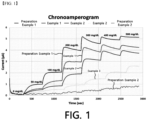
- glucose was provided to the PBS solution such that the concentration of glucose was 50, 100, 200, 300, 400 and 500 mg/dL, and then, the chronoamperometry (CA) condition was measured through a potentiostat (Multi-Palmsens 4, applied voltage: 0.3 V), and the results are shown in FIG. 1 .
- CA chronoamperometry
- the glucose sensing sensitivity can be selectively controlled by controlling the ratio of the hydrophobic material included in the glucose diffusion control layer.
- the prepared glucose diffusion control layer was immersed in ultrapure water (DI water) for 24 hours, and then, the weight was measured.
- DI water ultrapure water
- the water absorption rate can be selectively controlled by controlling the ratio of the hydrophobic material included in the glucose diffusion control layer.
- Comparative Example 1 Preparation of glucose diffusion control layer solution for continuous blood glucose-measuring biosensor
- the glucose diffusion control layer solution included aliphatic polyester-based thermoplastic polyurethane (HP-93A-100, Lubrizol) and aliphatic polyester-based thermoplastic polyurethane (SG-80A, Lubrizol) at a weight ratio of 1:0.25.
- the CA chronoamperometry condition was measured by using a potentiostat (Multi-Palmsens 4, applied voltage: 0.3 V), and the results are shown in FIG. 2 .
Landscapes
- Health & Medical Sciences (AREA)
- Life Sciences & Earth Sciences (AREA)
- Chemical & Material Sciences (AREA)
- Physics & Mathematics (AREA)
- Engineering & Computer Science (AREA)
- Molecular Biology (AREA)
- General Health & Medical Sciences (AREA)
- Biomedical Technology (AREA)
- Organic Chemistry (AREA)
- Biophysics (AREA)
- Pathology (AREA)
- Chemical Kinetics & Catalysis (AREA)
- Medical Informatics (AREA)
- Optics & Photonics (AREA)
- Surgery (AREA)
- Animal Behavior & Ethology (AREA)
- Heart & Thoracic Surgery (AREA)
- Public Health (AREA)
- Veterinary Medicine (AREA)
- Emergency Medicine (AREA)
- Medicinal Chemistry (AREA)
- Immunology (AREA)
- Hematology (AREA)
- Zoology (AREA)
- Wood Science & Technology (AREA)
- Proteomics, Peptides & Aminoacids (AREA)
- Polymers & Plastics (AREA)
- Biochemistry (AREA)
- Biotechnology (AREA)
- Analytical Chemistry (AREA)
- General Chemical & Material Sciences (AREA)
- Microbiology (AREA)
- Urology & Nephrology (AREA)
- General Engineering & Computer Science (AREA)
- Bioinformatics & Cheminformatics (AREA)
- Genetics & Genomics (AREA)
- Cell Biology (AREA)
- Diabetes (AREA)
- Food Science & Technology (AREA)
- General Physics & Mathematics (AREA)
Applications Claiming Priority (2)
| Application Number | Priority Date | Filing Date | Title |
|---|---|---|---|
| KR1020220020018A KR102389269B1 (ko) | 2022-02-16 | 2022-02-16 | 연속혈당측정 바이오센서용 글루코즈 확산 제어막 용액, 이를 포함하는 연속혈당측정 바이오센서용 글루코즈 확산 제어막 및 이를 포함하는 연속혈당측정용 바이오센서 |
| PCT/KR2023/001456 WO2023158134A1 (ko) | 2022-02-16 | 2023-02-01 | 연속혈당측정 바이오센서용 글루코즈 확산 제어막 용액, 이를 포함하는 연속혈당측정 바이오센서용 글루코즈 확산 제어막 및 이를 포함하는 연속혈당측정용 바이오센서 |
Publications (2)
| Publication Number | Publication Date |
|---|---|
| EP4481002A1 true EP4481002A1 (de) | 2024-12-25 |
| EP4481002A4 EP4481002A4 (de) | 2026-01-07 |
Family
ID=81437248
Family Applications (1)
| Application Number | Title | Priority Date | Filing Date |
|---|---|---|---|
| EP23756547.8A Pending EP4481002A4 (de) | 2022-02-16 | 2023-02-01 | Glucosediffusionssteuerungsschichtlösung für biosensor zur kontinuierlichen blutzuckermessung, glucosediffusionssteuerungsschicht damit und biosensor zur kontinuierlichen blutzuckermessung |
Country Status (7)
| Country | Link |
|---|---|
| US (1) | US20250152049A1 (de) |
| EP (1) | EP4481002A4 (de) |
| JP (1) | JP7753563B2 (de) |
| KR (1) | KR102389269B1 (de) |
| CN (1) | CN119365540A (de) |
| CA (1) | CA3244172A1 (de) |
| WO (1) | WO2023158134A1 (de) |
Cited By (1)
| Publication number | Priority date | Publication date | Assignee | Title |
|---|---|---|---|---|
| US20240328989A1 (en) * | 2023-01-13 | 2024-10-03 | Abbott Diabetes Care Inc. | Biosensors with hydrophilic polyurethane membranes |
Families Citing this family (2)
| Publication number | Priority date | Publication date | Assignee | Title |
|---|---|---|---|---|
| KR102389269B1 (ko) * | 2022-02-16 | 2022-04-21 | 네메시스 주식회사 | 연속혈당측정 바이오센서용 글루코즈 확산 제어막 용액, 이를 포함하는 연속혈당측정 바이오센서용 글루코즈 확산 제어막 및 이를 포함하는 연속혈당측정용 바이오센서 |
| KR102790925B1 (ko) | 2022-11-02 | 2025-04-07 | 재단법인 대구경북첨단의료산업진흥재단 | 향상된 젖음성을 가지는 적층체, 이를 포함하는 액체 시료 분석용 디바이스 및 이를 이용한 액체 시료 분석방법 |
Family Cites Families (15)
| Publication number | Priority date | Publication date | Assignee | Title |
|---|---|---|---|---|
| US5670097A (en) * | 1994-12-08 | 1997-09-23 | Minnesota Mining And Manufacturing Company | Method of making blood gas sensors overcoats using permeable polymeric compositions |
| JP2003089749A (ja) * | 2001-09-18 | 2003-03-28 | Kanegafuchi Chem Ind Co Ltd | 難燃性ポリカーボネート樹脂組成物 |
| US7761130B2 (en) * | 2003-07-25 | 2010-07-20 | Dexcom, Inc. | Dual electrode system for a continuous analyte sensor |
| CN101018599A (zh) * | 2004-08-16 | 2007-08-15 | 诺和诺德公司 | 用于生物传感器的多相生物相容性半透膜 |
| US8512731B2 (en) * | 2007-11-13 | 2013-08-20 | Medtronic Minimed, Inc. | Antimicrobial coatings for medical devices and methods for making and using them |
| JP2010001442A (ja) * | 2008-06-23 | 2010-01-07 | Toyota Boshoku Corp | 熱可塑性樹脂組成物及びその製造方法並びに成形体 |
| AU2012234345A1 (en) * | 2011-03-28 | 2013-09-05 | F. Hoffmann-La Roche Ag | Improved diffusion layer for an enzymatic in-vivo sensor |
| CA2867766C (en) | 2012-03-27 | 2018-08-07 | F. Hoffmann-La Roche Ag | Improved spacer membrane for an enzymatic in-vivo sensor |
| CA3002099A1 (en) * | 2015-12-30 | 2017-07-06 | Dexcom, Inc. | Diffusion resistance layer for analyte sensors |
| JP7542311B2 (ja) | 2017-01-19 | 2024-08-30 | デックスコム・インコーポレーテッド | 軟質検体センサ |
| CN112566548A (zh) * | 2018-03-20 | 2021-03-26 | 格拉夫威尔科技公司 | 可替换式传感器系统和方法 |
| JP7161610B2 (ja) * | 2018-09-27 | 2022-10-26 | アイセンス,インコーポレーテッド | 血中グルコースの流入を調節する重合体ブレンド、これを含む持続血糖測定用バイオセンサ |
| JP7349255B2 (ja) | 2019-04-08 | 2023-09-22 | コベストロ、ドイチュラント、アクチエンゲゼルシャフト | 熱可塑性ポリウレタン樹脂組成物及び成形体 |
| KR20210042686A (ko) * | 2019-10-10 | 2021-04-20 | 주식회사 아이센스 | 바이오센서용 다기능성 고분자 코팅막 조성물 및 이를 포함하는 바이오센서 |
| KR102389269B1 (ko) * | 2022-02-16 | 2022-04-21 | 네메시스 주식회사 | 연속혈당측정 바이오센서용 글루코즈 확산 제어막 용액, 이를 포함하는 연속혈당측정 바이오센서용 글루코즈 확산 제어막 및 이를 포함하는 연속혈당측정용 바이오센서 |
-
2022
- 2022-02-16 KR KR1020220020018A patent/KR102389269B1/ko active Active
-
2023
- 2023-02-01 WO PCT/KR2023/001456 patent/WO2023158134A1/ko not_active Ceased
- 2023-02-01 CA CA3244172A patent/CA3244172A1/en active Pending
- 2023-02-01 CN CN202380022083.1A patent/CN119365540A/zh active Pending
- 2023-02-01 EP EP23756547.8A patent/EP4481002A4/de active Pending
- 2023-02-01 US US18/838,531 patent/US20250152049A1/en active Pending
- 2023-02-01 JP JP2024548711A patent/JP7753563B2/ja active Active
Cited By (1)
| Publication number | Priority date | Publication date | Assignee | Title |
|---|---|---|---|---|
| US20240328989A1 (en) * | 2023-01-13 | 2024-10-03 | Abbott Diabetes Care Inc. | Biosensors with hydrophilic polyurethane membranes |
Also Published As
| Publication number | Publication date |
|---|---|
| CA3244172A1 (en) | 2025-01-17 |
| JP2025508751A (ja) | 2025-04-10 |
| EP4481002A4 (de) | 2026-01-07 |
| JP7753563B2 (ja) | 2025-10-14 |
| WO2023158134A1 (ko) | 2023-08-24 |
| US20250152049A1 (en) | 2025-05-15 |
| KR102389269B1 (ko) | 2022-04-21 |
| CN119365540A (zh) | 2025-01-24 |
Similar Documents
| Publication | Publication Date | Title |
|---|---|---|
| EP4481002A1 (de) | Glucosediffusionssteuerungsschichtlösung für biosensor zur kontinuierlichen blutzuckermessung, glucosediffusionssteuerungsschicht damit und biosensor zur kontinuierlichen blutzuckermessung | |
| US12023155B2 (en) | Polycarbonate urea/urethane polymers for use with analyte sensors | |
| US6642015B2 (en) | Hydrophilic polymeric material for coating biosensors | |
| Vashist et al. | Technology behind commercial devices for blood glucose monitoring in diabetes management: A review | |
| JP5324473B2 (ja) | 複素環式窒素含有ポリマーで被覆された検体監視装置 | |
| JP2025508751A5 (de) | ||
| US12109023B2 (en) | Thermally stable glucose limiting membrane for glucose sensors | |
| US12228542B2 (en) | Crosslinker comprising genipin for use in preparation of sensing film or diffusion control film of electrochemical sensor | |
| US20260036541A1 (en) | Sensors for 3-hydroxybutyrate detection | |
| CN112088217A (zh) | 用于葡萄糖传感器的热稳定葡萄糖限制膜 | |
| JP7161610B2 (ja) | 血中グルコースの流入を調節する重合体ブレンド、これを含む持続血糖測定用バイオセンサ | |
| US20240328989A1 (en) | Biosensors with hydrophilic polyurethane membranes | |
| EP1587546A2 (de) | Hydrophile vernetzungsmittel zur verwendung in enzymatischen sensoren | |
| US12527500B2 (en) | Ketone limiting membrane and dual layer membrane approach for ketone sensing | |
| US20250194963A1 (en) | Stabilization of nad(p)-dependent sensor with negatively charged membrane | |
| US20250160702A1 (en) | Highly permeable membrane for biosensor | |
| WO2025128711A1 (en) | Alcohol sensor membrane | |
| HK40093368A (zh) | 分析物传感器及其制造 |
Legal Events
| Date | Code | Title | Description |
|---|---|---|---|
| STAA | Information on the status of an ep patent application or granted ep patent |
Free format text: STATUS: THE INTERNATIONAL PUBLICATION HAS BEEN MADE |
|
| PUAI | Public reference made under article 153(3) epc to a published international application that has entered the european phase |
Free format text: ORIGINAL CODE: 0009012 |
|
| STAA | Information on the status of an ep patent application or granted ep patent |
Free format text: STATUS: REQUEST FOR EXAMINATION WAS MADE |
|
| 17P | Request for examination filed |
Effective date: 20240911 |
|
| AK | Designated contracting states |
Kind code of ref document: A1 Designated state(s): AL AT BE BG CH CY CZ DE DK EE ES FI FR GB GR HR HU IE IS IT LI LT LU LV MC ME MK MT NL NO PL PT RO RS SE SI SK SM TR |
|
| DAV | Request for validation of the european patent (deleted) | ||
| DAX | Request for extension of the european patent (deleted) | ||
| A4 | Supplementary search report drawn up and despatched |
Effective date: 20251205 |
|
| RIC1 | Information provided on ipc code assigned before grant |
Ipc: C08L 75/06 20060101AFI20251201BHEP Ipc: C08L 53/00 20060101ALI20251201BHEP Ipc: G01N 33/487 20060101ALI20251201BHEP Ipc: G01N 33/66 20060101ALI20251201BHEP Ipc: C12Q 1/00 20060101ALI20251201BHEP Ipc: A61B 5/145 20060101ALI20251201BHEP Ipc: A61B 5/1486 20060101ALI20251201BHEP |