EP4481073A2 - Verfahren zur laugung von metall und verfahren zur rückgewinnung von metall - Google Patents
Verfahren zur laugung von metall und verfahren zur rückgewinnung von metall Download PDFInfo
- Publication number
- EP4481073A2 EP4481073A2 EP24210334.9A EP24210334A EP4481073A2 EP 4481073 A2 EP4481073 A2 EP 4481073A2 EP 24210334 A EP24210334 A EP 24210334A EP 4481073 A2 EP4481073 A2 EP 4481073A2
- Authority
- EP
- European Patent Office
- Prior art keywords
- leaching
- solution
- leached
- leaching step
- acidic
- Prior art date
- Legal status (The legal status is an assumption and is not a legal conclusion. Google has not performed a legal analysis and makes no representation as to the accuracy of the status listed.)
- Pending
Links
Images


Classifications
-
- C—CHEMISTRY; METALLURGY
- C22—METALLURGY; FERROUS OR NON-FERROUS ALLOYS; TREATMENT OF ALLOYS OR NON-FERROUS METALS
- C22B—PRODUCTION AND REFINING OF METALS; PRETREATMENT OF RAW MATERIALS
- C22B23/00—Obtaining nickel or cobalt
- C22B23/04—Obtaining nickel or cobalt by wet processes
- C22B23/0407—Leaching processes
- C22B23/0415—Leaching processes with acids or salt solutions except ammonium salts solutions
- C22B23/043—Sulfurated acids or salts thereof
-
- C—CHEMISTRY; METALLURGY
- C22—METALLURGY; FERROUS OR NON-FERROUS ALLOYS; TREATMENT OF ALLOYS OR NON-FERROUS METALS
- C22B—PRODUCTION AND REFINING OF METALS; PRETREATMENT OF RAW MATERIALS
- C22B23/00—Obtaining nickel or cobalt
-
- B—PERFORMING OPERATIONS; TRANSPORTING
- B09—DISPOSAL OF SOLID WASTE; RECLAMATION OF CONTAMINATED SOIL
- B09B—DISPOSAL OF SOLID WASTE NOT OTHERWISE PROVIDED FOR
- B09B3/00—Destroying solid waste or transforming solid waste into something useful or harmless
- B09B3/80—Destroying solid waste or transforming solid waste into something useful or harmless involving an extraction step
-
- C—CHEMISTRY; METALLURGY
- C22—METALLURGY; FERROUS OR NON-FERROUS ALLOYS; TREATMENT OF ALLOYS OR NON-FERROUS METALS
- C22B—PRODUCTION AND REFINING OF METALS; PRETREATMENT OF RAW MATERIALS
- C22B15/00—Obtaining copper
-
- C—CHEMISTRY; METALLURGY
- C22—METALLURGY; FERROUS OR NON-FERROUS ALLOYS; TREATMENT OF ALLOYS OR NON-FERROUS METALS
- C22B—PRODUCTION AND REFINING OF METALS; PRETREATMENT OF RAW MATERIALS
- C22B15/00—Obtaining copper
- C22B15/0063—Hydrometallurgy
- C22B15/0065—Leaching or slurrying
- C22B15/0067—Leaching or slurrying with acids or salts thereof
-
- C—CHEMISTRY; METALLURGY
- C22—METALLURGY; FERROUS OR NON-FERROUS ALLOYS; TREATMENT OF ALLOYS OR NON-FERROUS METALS
- C22B—PRODUCTION AND REFINING OF METALS; PRETREATMENT OF RAW MATERIALS
- C22B23/00—Obtaining nickel or cobalt
- C22B23/04—Obtaining nickel or cobalt by wet processes
- C22B23/0407—Leaching processes
-
- C—CHEMISTRY; METALLURGY
- C22—METALLURGY; FERROUS OR NON-FERROUS ALLOYS; TREATMENT OF ALLOYS OR NON-FERROUS METALS
- C22B—PRODUCTION AND REFINING OF METALS; PRETREATMENT OF RAW MATERIALS
- C22B3/00—Extraction of metal compounds from ores or concentrates by wet processes
- C22B3/04—Extraction of metal compounds from ores or concentrates by wet processes by leaching
- C22B3/045—Leaching using electrochemical processes
-
- C—CHEMISTRY; METALLURGY
- C22—METALLURGY; FERROUS OR NON-FERROUS ALLOYS; TREATMENT OF ALLOYS OR NON-FERROUS METALS
- C22B—PRODUCTION AND REFINING OF METALS; PRETREATMENT OF RAW MATERIALS
- C22B3/00—Extraction of metal compounds from ores or concentrates by wet processes
- C22B3/04—Extraction of metal compounds from ores or concentrates by wet processes by leaching
- C22B3/06—Extraction of metal compounds from ores or concentrates by wet processes by leaching in inorganic acid solutions, e.g. with acids generated in situ; in inorganic salt solutions other than ammonium salt solutions
-
- C—CHEMISTRY; METALLURGY
- C22—METALLURGY; FERROUS OR NON-FERROUS ALLOYS; TREATMENT OF ALLOYS OR NON-FERROUS METALS
- C22B—PRODUCTION AND REFINING OF METALS; PRETREATMENT OF RAW MATERIALS
- C22B3/00—Extraction of metal compounds from ores or concentrates by wet processes
- C22B3/04—Extraction of metal compounds from ores or concentrates by wet processes by leaching
- C22B3/06—Extraction of metal compounds from ores or concentrates by wet processes by leaching in inorganic acid solutions, e.g. with acids generated in situ; in inorganic salt solutions other than ammonium salt solutions
- C22B3/08—Sulfuric acid, other sulfurated acids or salts thereof
-
- C—CHEMISTRY; METALLURGY
- C22—METALLURGY; FERROUS OR NON-FERROUS ALLOYS; TREATMENT OF ALLOYS OR NON-FERROUS METALS
- C22B—PRODUCTION AND REFINING OF METALS; PRETREATMENT OF RAW MATERIALS
- C22B7/00—Working up raw materials other than ores, e.g. scrap, to produce non-ferrous metals and compounds thereof; Methods of a general interest or applied to the winning of more than two metals
-
- C—CHEMISTRY; METALLURGY
- C22—METALLURGY; FERROUS OR NON-FERROUS ALLOYS; TREATMENT OF ALLOYS OR NON-FERROUS METALS
- C22B—PRODUCTION AND REFINING OF METALS; PRETREATMENT OF RAW MATERIALS
- C22B7/00—Working up raw materials other than ores, e.g. scrap, to produce non-ferrous metals and compounds thereof; Methods of a general interest or applied to the winning of more than two metals
- C22B7/006—Wet processes
- C22B7/007—Wet processes by acid leaching
-
- H—ELECTRICITY
- H01—ELECTRIC ELEMENTS
- H01M—PROCESSES OR MEANS, e.g. BATTERIES, FOR THE DIRECT CONVERSION OF CHEMICAL ENERGY INTO ELECTRICAL ENERGY
- H01M10/00—Secondary cells; Manufacture thereof
- H01M10/54—Reclaiming serviceable parts of waste accumulators
-
- B—PERFORMING OPERATIONS; TRANSPORTING
- B09—DISPOSAL OF SOLID WASTE; RECLAMATION OF CONTAMINATED SOIL
- B09B—DISPOSAL OF SOLID WASTE NOT OTHERWISE PROVIDED FOR
- B09B2101/00—Type of solid waste
- B09B2101/15—Electronic waste
- B09B2101/16—Batteries
-
- Y—GENERAL TAGGING OF NEW TECHNOLOGICAL DEVELOPMENTS; GENERAL TAGGING OF CROSS-SECTIONAL TECHNOLOGIES SPANNING OVER SEVERAL SECTIONS OF THE IPC; TECHNICAL SUBJECTS COVERED BY FORMER USPC CROSS-REFERENCE ART COLLECTIONS [XRACs] AND DIGESTS
- Y02—TECHNOLOGIES OR APPLICATIONS FOR MITIGATION OR ADAPTATION AGAINST CLIMATE CHANGE
- Y02P—CLIMATE CHANGE MITIGATION TECHNOLOGIES IN THE PRODUCTION OR PROCESSING OF GOODS
- Y02P10/00—Technologies related to metal processing
- Y02P10/20—Recycling
-
- Y—GENERAL TAGGING OF NEW TECHNOLOGICAL DEVELOPMENTS; GENERAL TAGGING OF CROSS-SECTIONAL TECHNOLOGIES SPANNING OVER SEVERAL SECTIONS OF THE IPC; TECHNICAL SUBJECTS COVERED BY FORMER USPC CROSS-REFERENCE ART COLLECTIONS [XRACs] AND DIGESTS
- Y02—TECHNOLOGIES OR APPLICATIONS FOR MITIGATION OR ADAPTATION AGAINST CLIMATE CHANGE
- Y02W—CLIMATE CHANGE MITIGATION TECHNOLOGIES RELATED TO WASTEWATER TREATMENT OR WASTE MANAGEMENT
- Y02W30/00—Technologies for solid waste management
- Y02W30/50—Reuse, recycling or recovery technologies
- Y02W30/84—Recycling of batteries or fuel cells
Definitions
- This specification describes a method for leaching metals and a method for recovering metals.
- battery powder obtained through a heat treatment or other treatments is brought into contact with an acidic leaching solution to leach in the acidic leaching solution metals such as nickel, cobalt, manganese, aluminum and iron in the battery powder.
- an acidic leaching solution to leach in the acidic leaching solution metals such as nickel, cobalt, manganese, aluminum and iron in the battery powder. This can provide a leached solution in which the metals are dissolved.
- Patent Literatures 1 to 3 neutralization or solvent extraction is carried out to remove sequentially or simultaneously aluminum, iron and manganese, among the metals dissolved in the leached solution. Nickel and cobalt are then separated by solvent extraction and concentrated to recover them.
- Patent Literature 4 proposes "a method for treating a lithium ion battery, comprising: a leaching step of leaching battery powder in a leaching solution containing 0.9 to 1.5-fold molar equivalents of sulfuric acid required for dissolving all metal components contained in the battery powder, and terminating the leaching before an oxidation-reduction potential ORP value (on silver/silver chloride potential basis) of the leaching solution exceeds 0 mV".
- Patent Literature 4 when copper is left in a solid state at the end of leaching, the copper can be easily removed by solid-liquid separation after leaching. However, in this case, the leaching is terminated before copper begins to be dissolved, resulting in insufficient leaching of cobalt and nickel.
- This specification provides a method for leaching at least one metal and a method for recovering at least one metal, which can improve a leaching rate of cobalt and/or nickel while easily removing copper.
- the method for leaching metals as disclosed herein is a method for leaching at least one metal in battery powder comprising at least copper and one or more of cobalt and nickel, the method comprising a leaching process repeating multiple times, wherein the leaching process comprises: a first leaching step of leaching at least one metal in the battery powder in an acidic leaching solution, terminating the leaching before the copper begins to be dissolved, and removing a leached residue from the resulting leached solution; and a second leaching step of leaching at least one metal in the leached residue of the first leaching step in an acidic leaching solution, and terminating the leaching after the copper begins to be dissolved to obtain a leached solution, wherein the leached solution obtained in the second leaching step of the leaching process is used as an acidic leaching solution in a first leaching step of a leaching process followed by said leaching process, and wherein a leached residue is removed from a leached solution in a second leaching step of at least one
- the method for recovering at least one metal as disclosed in this specification recovers at least one metal from the leached solution after removing the leached residue in the first leaching step of the leaching process in the method for leaching at least one metal as described above.
- the method for leaching metals is a method of leaching at least one metal in battery powder containing at least copper and one or more of cobalt and nickel.
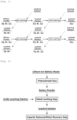
- the method for leaching the metal includes a leaching step that is repeated multiple times, as shown in Fig. 1 .
- the leaching process includes a first leaching step and a second leaching step.
- the metals in the battery powder are leached in an acidic leaching solution, the leaching is terminated before the copper begins to be dissolved, and the resulting leached residue is removed from the resulting leached solution.
- the leaching is terminated before the copper begins to be dissolved, so that the leached solution after removing the leached residue contains cobalt ions and/or nickel ions, but is substantially free of copper ions, as shown in Fig. 1 .
- This leached solution can be sent to subsequent steps such as neutralization and solvent extraction.
- the leached residue obtained in the first leaching step contains undissolved cobalt and/or nickel and copper remaining in the first leaching step, and subjected to the second leaching step in order to leach the cobalt and/or nickel.
- the metals in the leached residue of the first leaching step are leached in an acidic leaching solution, and after the copper begins to be dissolved, the leaching is terminated to obtain a leached solution.
- the leaching is terminated to obtain a leached solution.
- the second leaching step involves removing the leached residue from the leached solution.
- the leached residue is removed from the leached solution in the second leaching step of each leaching process. This allows a part of the copper residue that has not been leached in the second leaching step to be separated and removed as a leached residue.
- the leached solution obtained in the second leaching step of the leaching process is used as an acidic leaching solution in a first leaching step of a leaching process (a next leaching process) followed by the former leaching process.
- a first leaching step of a leaching process copper ions in the above leached solution carried over from the second leaching step of that former leaching process (previous leaching process) are precipitated by a substitution reaction with a less-noble metal such as cobalt and/or nickel to transfer to the leached residue, which is sent to the second leaching step.
- the cobalt ions and/or nickel ions in the leached solution carried over from the previous leaching process are contained in the leached solution of the first leaching step together with the cobalt ions and/or nickel ions eluted from fresh battery powder in the first leaching process, and send to a subsequent step after the leached residue is removed.
- the leaching process as described above allows the cobalt and/or nickel to be sufficiently leached while easily removing the copper, as compared to a single leaching step.
- This embodiment can be used in processes for recovering predetermined metals, such as valuable metals, from lithium ion battery waste. Described herein is, as an example, a case where the method for leaching metals is applied to a metal leaching step in a method for recovering metals in lithium ion battery waste as illustrated in Fig. 2 .
- the method for leaching metals is not limited to this example, and it can be used for various methods including a step of leaching metals in battery powder of lithium ion battery waste in an acidic leaching solution.
- the battery powder containing copper and one or more of cobalt and nickel is to be treated, it is not necessarily limited to lithium ion battery waste. It is also possible to use battery powder obtained from battery waste that does not derived from lithium ion batteries.
- Lithium ion battery waste of interest is vehicle lithium ion secondary batteries or consumer electronics lithium ion secondary batteries, which have been discarded due to battery product life, manufacturing failure, or other reasons.
- the vehicle lithium ion secondary batteries include those contained in vehicle battery packs mounted on vehicles such as hybrid vehicles and electric vehicles.
- the consumer electronics lithium ion secondary batteries include those used in various electronic devices such as mobile phones. Recovery of valuable metals such as cobalt, nickel and other valuable metals from such lithium ion battery waste is required from the viewpoint of effective utilization of resources.
- the other valuable metals may include, for example, manganese and lithium.
- the vehicle battery pack generally includes a metal case forming a housing around the case, a battery having a plurality of battery cells such as lithium secondary ion batteries and other components that are housed inside the case.
- a battery having a plurality of battery cells such as lithium secondary ion batteries and other components that are housed inside the case.
- the lithium ion battery waste typically includes: a cathode material in which a cathode active material comprised of single metal oxides of one or more of lithium, nickel, cobalt and manganese, or two or more composite metal oxides is applied and fixed onto an aluminum foil (a cathode substrate) via, for example, an organic binder such as polyvinylidene fluoride (PVDF); an anode material made of a carbon-based material; and an organic electrolytic solution such as ethylene carbonate or diethyl carbonate or other electrolyte.
- PVDF polyvinylidene fluoride
- the lithium ion battery waste may contain copper, iron, and the like.
- the pretreatment step may include a heat treatment, a crushing treatment and a sieving treatment in this order or in random order, but at least one of them may be omitted.
- the lithium ion battery waste is subjected to the pretreatment step to obtain the battery powder.
- the battery powder refers to powder obtained by subjecting the lithium ion battery waste to any pretreatment step to separate and concentrate cathode material components.
- the battery powder may be obtained as powder by subjecting the lithium ion battery waste to the crushing treatment and the sieving treatment, with or without the heat treatment, thereby concentrating the cathode material components.
- the heat treatment is performed.
- the residual electricity of the lithium ion battery waste is first discharged, and then crushed and sieved; and the resulting cathode material with the aluminum foil is then treated with a solvent to dissolve the binder, and the cathode electrode material components are separated from the aluminum foil and recovered.
- the heat treatment involves heating the lithium ion battery waste.
- An atmosphere in this case may be an inert atmosphere or an air atmosphere.
- the heat treatment may also be performed at a plurality of stages under different heating temperature conditions and different atmospheric conditions. For example, the heat treatment may be first performed in an inert atmosphere, and the atmosphere may be then changed to perform the heat treatment in the air atmosphere.
- the atmosphere for this heat treatment can be appropriately selected in view of various factors such as characteristics of each atmosphere and working efficiency, which will be described later.
- the heat treatment in the inert atmosphere can be performed in an atmosphere containing at least one selected from the group consisting of nitrogen, carbon dioxide and water vapor.
- an atmosphere mainly containing nitrogen is preferable.
- the heat treatment may be performed while allowing such an inert gas to flow.
- Oxygen may be contained in a trace amount to some extent, and an oxygen partial pressure during heat treatment can be maintained in a range of 0 atm to 4 ⁇ 10 -2 atm as measured by a zirconia-type oxygen concentration meter.
- the oxygen concentration of the inert gas may be 0.05% by volume to 4.00% by volume, and the flow rate in the heat treatment furnace may be 6 m 3 /hr to 60 m 3 /hr.
- the lithium ion battery waste can be heated to reach and maintain a temperature of 400°C to 800°C.
- the heat treatment in the air atmosphere can suppress a foaming phenomenon in acid leaching in the metal leaching step. Substances resulting from incomplete pyrolysis of the heat treatment in the inert atmosphere can cause the foaming during acid leaching.
- the heat treatment in the air atmosphere is preferable because any adjustment of the atmosphere becomes unnecessary and simple.
- the lithium ion battery waste can be heated to reach and maintain a temperature of 400°C to 800°C.
- an atmospheric electric furnace or atmospheric muffle furnace can be used in the case of a batch type, or a roller hearth kiln, mesh belt kiln, pusher kiln or the like can be used in the case of a continuous type.
- the roller hearth kiln and pusher kiln are preferred because they are suitable for large-scale processing.
- the crushing treatment is carried out, for example, in order to remove the battery from the case of the vehicle battery pack in the lithium ion battery waste and destroy the housing of the battery, and also selectively separate the cathode active material from the aluminum foil coated with the cathode active material.
- various known devices or equipment can be used, and specific examples thereof include an impact-type crusher capable of crushing the case and the battery by applying an impact while cutting them, such as a sample mill, a Hammer mill, a pin mill, a wing mill, a tornado mill, a hammer crusher and the like.
- a screen can be installed at the outlet of the crusher, so that the battery is discharged from the crusher through the screen when the battery is crushed to have a size that can pass through the screen.
- the crushed battery is roughly pulverized or powdered into powder, and then sieved using a sieve having an appropriate mesh size.
- a sieve having an appropriate mesh size.
- aluminum, copper and the like can remain on the sieve, for example, and battery powder containing lithium, cobalt, nickel and the like from which aluminum, copper, and the like have been removed to some extent can be obtained under the sieve.
- the battery powder can optionally be brought into contact with a liquid such as water to selectively leach lithium prior to a leaching process as described below.
- a liquid such as water
- tap water, industrial water, distilled water, purified water, ion-exchanged water, pure water, ultrapure water, and the like can be used, and a liquid temperature at the time of contact of the battery powder with the liquid can be 10°C to 60°C.
- the lithium-dissolved solution obtained by the leaching of lithium can be subjected to treatments such as solvent extraction, neutralization, and carbonation, thereby recovering lithium in the lithium-dissolved solution as lithium carbonate.
- the lithium carbonate thus obtained may optionally be purified to reduce impurity grade.
- the battery powder after the pretreatment step or the battery powder as the residue after the leaching of lithium as described above contains at least copper and one or more metals selected from cobalt and nickel.
- the battery powder may contain cobalt, nickel, manganese, lithium, aluminum, copper, iron, and the like.
- the metal leaching step the battery powder is brought into contact with an acidic leaching solution to obtain a leached solution containing cobalt ions and/or nickel ions.
- the pH of the acidic leaching solution at the time of leaching is preferably -0.5 to 3.0, and the pH of the leaching solution at the end of leaching may be 0.5 to 2.0.
- an agitator may optionally be used to agitate the acidic leaching solution at 100 rpm to 400 rpm, and the liquid temperature may be adjusted to 65°C to 70°C.
- a given leaching process is repeated multiple times to improve a leaching rate of cobalt and/or nickel while removing copper. More particularly, in the leaching process, as shown in Fig. 1 , a first leaching step and a second leaching step are performed in this order. Described herein is, as an example, a case where the battery powder contains cobalt, nickel and copper, but it may not contain either cobalt or nickel, and alternatively, it may further contain other metal(s).
- the battery powder is brought into contact with an acidic leaching solution to leaching metals in the battery powder, but before copper begins to be dissolved, the leaching is terminated and the leached residue is removed from the leached solution by solid-liquid separation. This results in a leached solution containing cobalt ions and nickel ions but containing no copper ions.
- the leached solution is sent to subsequent steps such as impurity removal, which will be described below.
- the leached residue will contain undissolved, remaining cobalt and nickel, as well as will contain copper.
- a second leaching step is performed.
- the leached residue is brought into contact with an acidic leaching solution to leach the metals in the leached residue.
- the leaching is continued even after the copper begins to be dissolved. This allows substantially all cobalt and/or nickel in the leached residue to be leached out.
- the leaching is terminated and the leached residue is removed by solid-liquid separation, resulting in the leached residue which contains copper and is substantially free of cobalt and nickel.
- the leached solution from which the leached residue has been removed contains cobalt ions, nickel ions and copper ions.
- fresh battery powder may be added to leach not only the metals in the leached residue of the first leaching step, but also the metals in the fresh battery powder.
- the leaching is continued even after the copper begins to be dissolved, so that cobalt and nickel in the fresh battery powder can also be sufficiently leached.
- the leached solution obtained in the second leaching step of the first leaching process is used as an acidic leaching solution in the first leaching step.
- a fresh acidic leaching solution may be added.
- copper ions in the leached solution are reduced by a substitution reaction due to a metal that is less noble than copper in the fresh battery powder introduced into the first leaching step, and are precipitated as copper, which will be contained in the leached residue.
- the leached residue is removed from the leached solution by solid-liquid separation, and subjected to the leaching of metals in the second leaching step.
- the leached solution from which the leached residue has been removed contains not only the cobalt ions and nickel ions beginning to be eluted from the fresh battery powder, but also the cobalt ions and nickel ions carried over from the first leaching process, and is sent to the subsequent step.
- the amount of substance of metal(s) that are less noble than copper, in the battery powder subjected to the next first leaching step is preferably greater than the amount of substance of metal that are less noble than copper required for causing the substitution reaction with all of the copper ions in the leached solution obtained in the previous second leaching step.
- examples of metals that are less noble than copper include cobalt, nickel, manganese, lithium, iron, and aluminum.
- the total amount of substance of those metals in the fresh battery powder to be introduced in the next leaching process may be larger than the amount of substance of the less-noble metal required for causing the substitution reaction with all of the copper ions in the previously obtained leached solution.
- the second leaching step of the second leaching process is carried out in the same manner as the second leaching step of the first leaching process, and so the repeated descriptions thereof will be omitted.
- the solid-liquid separation in the second leaching step need not be performed in every leaching process. If solid-liquid separation is not performed in the second leaching step, the leached solution including the leached residue is sent to the next leaching process, and copper will accumulate in the leached residue. If solid-liquid separation is performed in the second leaching step of at least one of the leaching processes, the leached residue containing copper can be separated and removed in the second leaching step at the present stage. Preferably, the solid-liquid separation is performed in the second leaching step in each leaching process, and the leached residue containing copper is removed each time.
- the phrase "before the copper begins to be dissolved " in the first leaching step” means that the copper ion concentration in the acidic leaching solution is lower than that in the leached solution obtained in the second leaching step of the leaching process at the present stage.
- the time when the copper ion concentration in the acidic leaching solution is 0.01 g/L or less may be regarded as "before copper begins to be dissolved”.
- this copper ion concentration does not include the copper ion concentration of the leached solution obtained in the second leaching step of the previous leaching process and used as the acidic leaching solution in the first leaching step of the present leaching process.
- a period of time during which after the period of time when the relatively high copper ion concentration before leaching tends to be reduced by the precipitation of copper due to the substitution reaction is terminated, and once the copper ion concentration is 0.01 g/L or less, for example, the copper ion concentration is 0.01 g/L or less, may be regarded as "before copper begins to be dissolved". In this case, it may be terminated in the period of time during which the copper ion concentration is 0.01 g/L or less (before the copper ion concentration exceeds 0.01 g/L).
- the phrase "after the copper begins to be dissolved" in the second leaching step means a state where the copper ion concentration in the acidic leaching solution is higher than that in the leached solution obtained in the first leaching step of the present leaching process. Therefore, in each of the leaching processes, the copper ion concentration of the leached solution obtained in the second leaching step becomes higher than the copper ion concentration of the leached solution obtained in the first leaching step. For example, the time when the copper ion concentration in the acidic leaching solution is higher than 0.01 g/L may be regarded as "after the copper begins to be dissolved". In the second leaching step, the leaching may be terminated, for example, after the copper ion concentration of the acidic leaching solution is higher than 0.01 g/L.
- the oxidation-reduction potential (on a silver/silver chloride potential basis) of the acidic leaching solution may be sufficiently lower than 0 mV before leaching, and gradually increase as the leaching progresses.
- the "oxidation-reduction potential (on a silver/silver chloride potential basis)" is simply referred to as “oxidation-reduction potential”.
- This oxidation-reduction potential may be referred to as ORP.
- the leaching is terminated before the oxidation-reduction potential of the acidic leaching solution is preferably 0 mV or higher, more preferably higher than -300 mV. This is because when the oxidation-reduction potential increases, the copper ion concentration may increase to some extent, so that the leached solution may contain copper ions.
- the second leaching step it is preferable to terminate the leaching after the oxidation-reduction potential of the acidic leaching solution reaches 0 mV or higher. As a result, a larger amount of cobalt or nickel can be leached, so that loss of cobalt or nickel is suppressed.
- the second leaching step it is preferable to terminate the leaching before the oxidation-reduction potential of the acidic leaching solution is higher than 60 mV in order to prevent excessive leaching of copper.
- the first leaching step when the leaching of metals proceeds to some extent, an amount of an increase in the oxidation-reduction potential of the acidic leaching solution tends to increase.
- the first leaching step is preferably terminated before an amount of an increase in the oxidation-reduction potential of the acidic leaching solution per hour reaches 233 mV or more.
- the second leaching step it is preferable to terminate the second leaching step after the amount of the increase in the oxidation-reduction potential of the acidic leaching solution per hour is 233 mV or more, from the viewpoint of leaching cobalt and nickel as much as possible.
- the amount of the increase in the oxidation-reduction potential per hour means a value obtained by subtracting the value of the oxidation-reduction potential on one hour before that a predetermined period of time from the value of the oxidation-reduction potential at that period of time.
- the leaching can be regarded as terminated when the agitation by the agitator that has been performed at the time of leaching is stopped, and the next operation such as solid-liquid separation or the addition of fresh battery powder is started.
- the solid-liquid separation for removing the leached residue from the leached solution can be performed by a known apparatus and method such as a filter press or a thickener.
- the leaching process may include not only the first leaching step and the second leaching step, but also three or more leaching steps.
- the first leaching step and/or the second leaching step is/are performed in multiple stages.
- all of the first leaching steps performed at the multiple stages are terminated while the copper ion concentration in the acidic leaching solution is lower than the copper ion concentration in the leached solution obtained in the second leaching step.
- each of the first leaching steps may be terminated while the copper ion concentration of the acidic leaching solution is 0.01 g/L or less.
- the leaching is terminated after the copper ion concentration in the acidic leaching solution becomes higher than the copper ion concentration in the leached solution obtained in the first leaching step.
- the leaching may be terminated after the copper ion concentration of the acidic leaching solution becomes higher than 0.01 g/L.
- the migration of cobalt and/or nickel to the leaching residue of the second leaching step leads to loss of cobalt and/or nickel, so that it is desirable to suppress it as much as possible.
- the total or sum of the cobalt content of the battery powder to be subjected to the first leaching step of the target leaching process and the cobalt ion content of the acidic leaching solution used in the first leaching step of that leaching process is 100%
- the total of the cobalt ion content of the leached solution obtained in the first leaching step and the cobalt ion content of the leached solution obtained in the second leaching step is preferably 95% or more, in each of the leaching processes.
- the total or sum of the nickel content of the battery powder to be subjected to the first leaching step of the target leaching process and the nickel ion content of the acidic leaching solution used in the first leaching step of that leaching process is 100%
- the total of the nickel ion content in the leached solution obtained in the first leaching step and the nickel ion content of the leached solution obtained in the second leaching step is preferably 95% or more in each of the leaching processes.
- both the cobalt ion content and the nickel ion content of the acidic leaching solution used in the first leaching step are zero.
- the cobalt ion content or nickel ion content of the acidic leaching solution used in the first leaching step described above means the cobalt ion content or the nickel ion content of the leached solution obtained in the second leaching process of the previous leaching process that is the one before the above leaching process, which leached solution is used as the acidic leaching solution in the first leaching step.
- the leached solution obtained in each first leaching step contains substantially no copper ions, but contains cobalt and nickel.
- This leached solution may further contain at least one selected from the group consisting of manganese, lithium, aluminum and iron.
- that leached solution may be subjected to a step of recovering at least one metal such as cobalt and nickel.
- the removal of impurities includes removal of some of aluminum and iron by neutralization, and removal of the remaining aluminum and manganese by solvent extraction.
- cobalt and nickel can be recovered by sequentially extracting and back-extracting cobalt and nickel by solvent extraction. Further, lithium can be recovered by various methods from the extraction residue after recovering cobalt and nickel.
- the extraction residue is an aqueous lithium sulfate solution
- a hydroxylation step of preparing an aqueous lithium hydroxide solution from the aqueous lithium sulfate solution and a crystallization step of precipitating the aqueous lithium hydroxide solution can be carried out.
- Battery powder obtained by treating lithium ion battery waste was subjected to the leaching process shown in Fig. 1 , which was repeated three times to obtain a leached solution.
- changes in pH, ORP, and concentration in the solution were confirmed in the first leaching step and the second leaching step in each leaching process. Specifically, it is as follows.
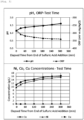
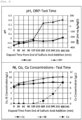
- Figs. 3 and 4 show changes in pH, ORP, and each metal concentration over time from the end of the addition of sulfuric acid for the first and second leaching steps of the first leaching process, respectively.
- each metal concentration was measured by analyzing the leached solution with an ICP emission spectrometer.
- the pH changed from 1.14 to 1.61 and the ORP changed from -283 mV to -340 mV during the reaction.
- the concentrations in the solution increased to 15.6 g/L for Ni, 16.4 g/L for Co, and 0 g/L (0.01 g/L or less) for Cu.
- the second leaching step as shown in Fig.
- the concentrations in the solution increased to 10.3 g/L for Ni, 8.0 g/L for Co, and 8.0 g/L for Cu.
- the amount of the increase in the oxidation-reduction potential of the acidic leaching solution per hour was 303 mV at the highest point (a point where the slope of the graph is steep).
- the second leaching process was carried out by substantially the same method as that of the first leaching process, with the exception that the leached solution obtained in the second leaching step of the first leaching process was used as the acidic leaching solution for the first leaching step, and the proportion of sulfuric acid added was changed accordingly. However, in the second leaching step, the leaching was terminated after 180 minutes from the termination of the addition of sulfuric acid (after the copper begun to be dissolved).
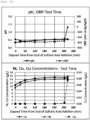
- Figs. 5 and 6 show changes in pH and ORP and each metal concentration over time from the end of the addition of sulfuric acid for the first and second leaching steps of the second leaching process, respectively.
- the pH changed from 1.27 to 1.7
- the ORP changed from -250 mV to -336 mV during the reaction.
- the concentrations in the solution increased to 15.3 g/L for Ni, 16.2 g/L for Co, and 0 g/L (0.01 g/L or less) for Cu.
- the leached solution obtained in the second leaching step of the first leaching process was used as the acidic leaching solution in the first leaching step. Nevertheless, Cu was 0 g/L at the end of the addition of sulfuric acid. This indicates that the copper ions contained in the acidic leaching solution are reduced by a substitution reaction with metals that are less noble than copper in the fresh battery powder introduced in the second leaching process.
- the concentrations in the solution increased to 8.8 g/L for Ni, 7.6 g/L for Co, and 0.38 g/L for Cu.
- the amount of the increase in the oxidation-reduction potential of the acidic leaching solution per hour was 306 mV at the highest point.
- the leached solution obtained in the second leaching step of the previous leaching process was used as the acidic leaching solution in the first leaching step.
- the percentage of sulfuric acid added was also the same as that of the second leaching process.
- Figs. 7 and 8 show changes in pH, ORP and each metal concentration over time from the end of addition of sulfuric acid for the first and second leaching steps of the third leaching process, respectively.
- the pH changed from 1.22 to 1.73 and the ORP changed from -327 to -369 mV during the reaction.
- the concentrations in the solution increased to 15.1 g/L for Ni, 15.6 g/L for Co, and 0 g/L (0.01 g/L or less) for Cu.
- Cu was 0 g/L at the end of the addition of sulfuric acid, as in the second leaching process.
- the copper ions contained in the acidic leaching solution are reduced by a substitution reaction with metals that are less noble than copper in the fresh battery powder introduced in the third leaching process.
- the concentrations in the solution increased to 8.0 g/L for Ni, 7.1 g/L for Co, and 1.8 g/L for Cu.
- the amount of the increase in the oxidation-reduction potential of the acidic leaching solution per hour was 233 mV at the highest point.
- the leaching process as shown in Fig. 1 was repeated five times on the battery powder.
- an amount of 80% with respect to 1.1-fold molar equivalents of sulfuric acid was added over 120 minutes, and after 300 minutes from the end of the addition of sulfuric acid (before copper begun to be dissolved), the leaching was terminated.
- the pulp density was adjusted so that the Ni concentration after leaching was 20 g/L.
- the liquid temperature was 70°C.
- Table 1 shows distribution percentages of Co, Ni, Mn, Li, and Cu to the leached solution (Liquid) and leached residue (Residue) in the first leaching step (1st Leaching) and the second leaching step (2nd Leaching) in each leaching process; the total of an input amount (Input) and an output amount (Output); a result of determining its ratio; and reaction termination conditions.
- the distribution percentages in Table 1 are shown in percentages when the content of each metal in the battery powder charged in the first leaching process is 100%, on a mass basis.
- Table 2 shows the total distribution percentage of the metals in the first to fifth leaching processes.
- the distribution percentages in Table 2 are shown in percentages when the content of each metal contained in the total amount (total input amount) of the battery powder input in the first to fifth leaching processes is 100%, on a mass basis.
- “Liquid: 1st Leaching” means the content of each metal contained in the total amount of the leached solutions obtained in the first leaching steps (1st Leaching) in the first to fifth leaching processes
- “Liquid: 2nd Leaching” means the content of each metal contained in the leached solution obtained in the second leaching step (2nd Leaching) in the fifth leaching process.
- Residue: 2nd Leaching refers to the content of each metal contained in the total amount of the residues obtained in the second leaching steps (2nd Leaching) in the first to fifth leaching processes.
- Table 3 shows an amount of substance of Cu contained in the acidic leaching solution used in the second to fifth leaching processes, which was the leached solution obtained in the second leaching step in the process before each stage (Previous Cycle 2nd Leaching Filtrate); an amount of substance of each metal contained in the battery powder newly introduced in the second to fifth leaching processes, which metal was less noble than Cu; and an amount of substance of Cu (Cu Substance Amount Conversion) capable of causing a reduction substitution reaction with all the respective metals.
- a ratio (Output/Input) of the total (Output) of both Co and Ni contents in the leached solution obtained in the first leaching step and those in the leached solution obtained in the second leaching step to the total (Input) of both Co Ni contents in the battery powder newly introduced in each leaching process and those in the leached solution used as the acidic leaching solution (the leached solution obtained in the previous leaching process) was 95% or more.
- the copper ion content of the acidic leaching solution during leaching was 16.6% by mass or less when the ORP was 57 mV (60 mV or less), but it was 42.8% by mass, which was a higher value, when the ORP was 97 mV (more than 60 mV). This indicates that in the second leaching step, it is preferable to terminate the leaching before the oxidation-reduction potential of the acidic leaching solution becomes higher than 60 mV, in order to suppress excessive leaching of copper.
- Mn and Li are also contained in the leached solution obtained in the second leaching step, although they are in smaller amounts than those of Co and Ni. Therefore, it can be said that manganese and lithium are leached at a higher leaching rate while effectively suppressing Cu from being mixed into the final leached solution.
- the amount of substance of the metal contained in the battery powder newly introduced in each leaching process is higher than that of the less-noble metal required for causing the substitution reaction with all of the Cu ions in the leached solution obtained in the previous second leaching step. This indicates that in the first leaching step of each process, theoretically all the Cu ions in the leached solution can be effectively reduced by the less-noble metals in the battery powder.
- the metals in the battery powder were leached in a single leaching step as shown in Fig. 9 .
- six elements of Ni, Co, Mn, Li, Al and Fe in total were the metals to be leached, and the molar equivalent of sulfuric acid required for leaching was calculated from the content of each metal in the battery powder calculated from the weight and grade, and 1.1 times the molar equivalent was used as the amount of sulfuric acid added as an acidic leaching solution.
- the total amount of sulfuric acid was added for 120 minutes, and the leaching was terminated after 320 minutes of the determination of the addition of sulfuric acid.
- the pulp density was adjusted so that the Ni concentration after leaching was 20 g/L.
- the target for the termination of the reaction was ORP of 0 mV.
- the liquid temperature was 70°C.
- Fig. 10 shows changes in pH, ORP, and each metal concentration over time.
- Table 4 also shows distribution percentages of Co, Ni, Mn, Li, and Cu to the leached solution (Liquid) and the leached residue (Residue).
- the distribution percentages in Table 4 are shown in percentages when the content of each metal in the battery powder to be input is 100%.
- [Table 4] (unit : %) Co Ni Mn Li Cu Material 100.0 100.0 100.0 100.0 100.0 100.0 Liquid 99.3 96.6 99.9 98.0 16.4 Residue 0.7 3.4 0.1 2.0 83.6
Landscapes
- Chemical & Material Sciences (AREA)
- Engineering & Computer Science (AREA)
- Manufacturing & Machinery (AREA)
- Organic Chemistry (AREA)
- Metallurgy (AREA)
- Mechanical Engineering (AREA)
- Materials Engineering (AREA)
- Environmental & Geological Engineering (AREA)
- Life Sciences & Earth Sciences (AREA)
- General Life Sciences & Earth Sciences (AREA)
- Geology (AREA)
- Geochemistry & Mineralogy (AREA)
- General Chemical & Material Sciences (AREA)
- Electrochemistry (AREA)
- Chemical Kinetics & Catalysis (AREA)
- Inorganic Chemistry (AREA)
- Manufacture And Refinement Of Metals (AREA)
Applications Claiming Priority (3)
| Application Number | Priority Date | Filing Date | Title |
|---|---|---|---|
| JP2022060711 | 2022-03-31 | ||
| PCT/JP2023/009406 WO2023189436A1 (en) | 2022-03-31 | 2023-03-10 | Method for leaching metal and method for recovering metal |
| EP23713980.3A EP4278020B1 (de) | 2022-03-31 | 2023-03-10 | Verfahren zur laugung von metall und verfahren zur rückgewinnung von metall |
Related Parent Applications (2)
| Application Number | Title | Priority Date | Filing Date |
|---|---|---|---|
| EP23713980.3A Division EP4278020B1 (de) | 2022-03-31 | 2023-03-10 | Verfahren zur laugung von metall und verfahren zur rückgewinnung von metall |
| EP23713980.3A Division-Into EP4278020B1 (de) | 2022-03-31 | 2023-03-10 | Verfahren zur laugung von metall und verfahren zur rückgewinnung von metall |
Publications (2)
| Publication Number | Publication Date |
|---|---|
| EP4481073A2 true EP4481073A2 (de) | 2024-12-25 |
| EP4481073A3 EP4481073A3 (de) | 2025-04-23 |
Family
ID=85778885
Family Applications (2)
| Application Number | Title | Priority Date | Filing Date |
|---|---|---|---|
| EP24210334.9A Pending EP4481073A3 (de) | 2022-03-31 | 2023-03-10 | Verfahren zur laugung von metall und verfahren zur rückgewinnung von metall |
| EP23713980.3A Active EP4278020B1 (de) | 2022-03-31 | 2023-03-10 | Verfahren zur laugung von metall und verfahren zur rückgewinnung von metall |
Family Applications After (1)
| Application Number | Title | Priority Date | Filing Date |
|---|---|---|---|
| EP23713980.3A Active EP4278020B1 (de) | 2022-03-31 | 2023-03-10 | Verfahren zur laugung von metall und verfahren zur rückgewinnung von metall |
Country Status (6)
| Country | Link |
|---|---|
| US (1) | US20250197965A1 (de) |
| EP (2) | EP4481073A3 (de) |
| KR (1) | KR20240156391A (de) |
| CN (1) | CN118871599A (de) |
| CA (1) | CA3253635A1 (de) |
| WO (2) | WO2023188489A1 (de) |
Families Citing this family (1)
| Publication number | Priority date | Publication date | Assignee | Title |
|---|---|---|---|---|
| JP7349592B1 (ja) * | 2022-03-31 | 2023-09-22 | Jx金属株式会社 | 金属浸出方法及び金属回収方法 |
Citations (3)
| Publication number | Priority date | Publication date | Assignee | Title |
|---|---|---|---|---|
| JP2010180439A (ja) | 2009-02-04 | 2010-08-19 | Sumitomo Metal Mining Co Ltd | 硫酸酸性水溶液からのニッケル回収方法 |
| JP2014162982A (ja) | 2013-02-27 | 2014-09-08 | Jx Nippon Mining & Metals Corp | 金属混合溶液からの金属の分離回収方法 |
| JP2017036489A (ja) | 2015-08-13 | 2017-02-16 | Jx金属株式会社 | リチウムイオン電池の処理方法 |
Family Cites Families (7)
| Publication number | Priority date | Publication date | Assignee | Title |
|---|---|---|---|---|
| KR101011260B1 (ko) * | 2009-10-27 | 2011-01-26 | 주식회사 에코닉스 | 망간 및 아연을 함유하는 폐전지로부터의 cmd 제조방법 |
| JP5565380B2 (ja) * | 2011-06-13 | 2014-08-06 | 住友金属鉱山株式会社 | ニッケルの浸出方法 |
| JP6571123B2 (ja) * | 2017-03-01 | 2019-09-04 | Jx金属株式会社 | リチウムイオン電池スクラップの浸出方法および、リチウムイオン電池スクラップからの金属の回収方法 |
| JP7008904B2 (ja) * | 2018-03-22 | 2022-01-25 | 三菱マテリアル株式会社 | コバルトと銅およびアルミニウムの分離方法 |
| MY202229A (en) * | 2018-12-21 | 2024-04-18 | Umicore Nv | Process for the recovery of metals from polymetallic nodules |
| CN111118296A (zh) * | 2020-02-07 | 2020-05-08 | 中国恩菲工程技术有限公司 | 一种废旧锂离子电池黑粉的回收方法及系统 |
| CN113174486A (zh) * | 2021-03-31 | 2021-07-27 | 广东邦普循环科技有限公司 | 回收废旧锂离子电池有价金属的方法 |
-
2022
- 2022-10-24 WO PCT/JP2022/039561 patent/WO2023188489A1/ja not_active Ceased
-
2023
- 2023-03-10 EP EP24210334.9A patent/EP4481073A3/de active Pending
- 2023-03-10 WO PCT/JP2023/009406 patent/WO2023189436A1/en not_active Ceased
- 2023-03-10 CN CN202380027349.1A patent/CN118871599A/zh active Pending
- 2023-03-10 CA CA3253635A patent/CA3253635A1/en active Pending
- 2023-03-10 EP EP23713980.3A patent/EP4278020B1/de active Active
- 2023-03-10 KR KR1020247032035A patent/KR20240156391A/ko active Pending
- 2023-03-10 US US18/849,033 patent/US20250197965A1/en active Pending
Patent Citations (4)
| Publication number | Priority date | Publication date | Assignee | Title |
|---|---|---|---|---|
| JP2010180439A (ja) | 2009-02-04 | 2010-08-19 | Sumitomo Metal Mining Co Ltd | 硫酸酸性水溶液からのニッケル回収方法 |
| US20110135547A1 (en) | 2009-02-04 | 2011-06-09 | Sumitomo Metal Mining Co., Ltd. | Method for recovering nickel from sulfuric acid aqueous solution |
| JP2014162982A (ja) | 2013-02-27 | 2014-09-08 | Jx Nippon Mining & Metals Corp | 金属混合溶液からの金属の分離回収方法 |
| JP2017036489A (ja) | 2015-08-13 | 2017-02-16 | Jx金属株式会社 | リチウムイオン電池の処理方法 |
Also Published As
| Publication number | Publication date |
|---|---|
| KR20240156391A (ko) | 2024-10-29 |
| WO2023189436A1 (en) | 2023-10-05 |
| EP4278020C0 (de) | 2025-01-22 |
| WO2023188489A1 (ja) | 2023-10-05 |
| EP4278020A1 (de) | 2023-11-22 |
| CN118871599A (zh) | 2024-10-29 |
| US20250197965A1 (en) | 2025-06-19 |
| EP4481073A3 (de) | 2025-04-23 |
| CA3253635A1 (en) | 2023-10-05 |
| EP4278020B1 (de) | 2025-01-22 |
Similar Documents
| Publication | Publication Date | Title |
|---|---|---|
| EP3604568B1 (de) | Lithiumrückgewinnungsverfahren | |
| KR102829860B1 (ko) | 금속 혼합 용액의 제조 방법 및, 혼합 금속염의 제조 방법 | |
| CN111466051A (zh) | 通过用金属镍处理浸提液的电池组再循环 | |
| US12522514B2 (en) | Method for producing mixed metal salt | |
| EP3279342B1 (de) | Verfahren zur entfernung von eisen aus eisenhaltiger lösung und verfahren zur rückgewinnung wertvoller metalle | |
| EP3903951B1 (de) | Verfahren zur wiedergewinnung wertvoller metalle | |
| JP2020045576A (ja) | リチウム回収方法 | |
| JP7317761B2 (ja) | リチウムイオン電池廃棄物の処理方法 | |
| EP4540428B1 (de) | Verfahren zur rückgewinnung von metallen | |
| EP4481073A2 (de) | Verfahren zur laugung von metall und verfahren zur rückgewinnung von metall | |
| EP4417721A1 (de) | Verfahren zur herstellung einer kobaltlösung, verfahren zur herstellung eines kobaltsalzes, verfahren zur herstellung einer nickellösung und verfahren zur herstellung eines nickelsalzes | |
| EP4555113B1 (de) | Verfahren zur entfernung von aluminium | |
| EP4446446A1 (de) | Verfahren zur metalllaugung | |
| JP7349592B1 (ja) | 金属浸出方法及び金属回収方法 | |
| WO2025220452A1 (en) | Method for removing impurities and method for recovering metals | |
| KR102800032B1 (ko) | 음극 집전체를 이용한 폐배터리로부터 유가 금속을 회수하는 방법 | |
| WO2026070247A1 (en) | Method for recovering metals from lithium ion battery waste | |
| WO2025099984A1 (ja) | 金属回収方法 |
Legal Events
| Date | Code | Title | Description |
|---|---|---|---|
| PUAI | Public reference made under article 153(3) epc to a published international application that has entered the european phase |
Free format text: ORIGINAL CODE: 0009012 |
|
| STAA | Information on the status of an ep patent application or granted ep patent |
Free format text: STATUS: THE APPLICATION HAS BEEN PUBLISHED |
|
| AC | Divisional application: reference to earlier application |
Ref document number: 4278020 Country of ref document: EP Kind code of ref document: P |
|
| AK | Designated contracting states |
Kind code of ref document: A2 Designated state(s): AL AT BE BG CH CY CZ DE DK EE ES FI FR GB GR HR HU IE IS IT LI LT LU LV MC ME MK MT NL NO PL PT RO RS SE SI SK SM TR |
|
| REG | Reference to a national code |
Ref country code: DE Ref legal event code: R079 Free format text: PREVIOUS MAIN CLASS: C22B0023000000 Ipc: C22B0003060000 |
|
| PUAL | Search report despatched |
Free format text: ORIGINAL CODE: 0009013 |
|
| AK | Designated contracting states |
Kind code of ref document: A3 Designated state(s): AL AT BE BG CH CY CZ DE DK EE ES FI FR GB GR HR HU IE IS IT LI LT LU LV MC ME MK MT NL NO PL PT RO RS SE SI SK SM TR |
|
| RIC1 | Information provided on ipc code assigned before grant |
Ipc: B09B 101/16 20220101ALI20250318BHEP Ipc: B09B 3/00 20220101ALI20250318BHEP Ipc: C22B 23/00 20060101ALI20250318BHEP Ipc: C22B 15/00 20060101ALI20250318BHEP Ipc: C22B 7/00 20060101ALI20250318BHEP Ipc: C22B 3/06 20060101AFI20250318BHEP |
|
| STAA | Information on the status of an ep patent application or granted ep patent |
Free format text: STATUS: REQUEST FOR EXAMINATION WAS MADE |
|
| 17P | Request for examination filed |
Effective date: 20250630 |