EP4481431A1 - Verfahren und systeme zur bestimmung einer strahlvektorliste zur objekterkennung - Google Patents
Verfahren und systeme zur bestimmung einer strahlvektorliste zur objekterkennung Download PDFInfo
- Publication number
- EP4481431A1 EP4481431A1 EP23180557.3A EP23180557A EP4481431A1 EP 4481431 A1 EP4481431 A1 EP 4481431A1 EP 23180557 A EP23180557 A EP 23180557A EP 4481431 A1 EP4481431 A1 EP 4481431A1
- Authority
- EP
- European Patent Office
- Prior art keywords
- range
- neural network
- beam vector
- determining
- vector list
- Prior art date
- Legal status (The legal status is an assumption and is not a legal conclusion. Google has not performed a legal analysis and makes no representation as to the accuracy of the status listed.)
- Pending
Links
Images


Classifications
-
- G—PHYSICS
- G01—MEASURING; TESTING
- G01S—RADIO DIRECTION-FINDING; RADIO NAVIGATION; DETERMINING DISTANCE OR VELOCITY BY USE OF RADIO WAVES; LOCATING OR PRESENCE-DETECTING BY USE OF THE REFLECTION OR RERADIATION OF RADIO WAVES; ANALOGOUS ARRANGEMENTS USING OTHER WAVES
- G01S7/00—Details of systems according to groups G01S13/00, G01S15/00, G01S17/00
- G01S7/02—Details of systems according to groups G01S13/00, G01S15/00, G01S17/00 of systems according to group G01S13/00
- G01S7/41—Details of systems according to groups G01S13/00, G01S15/00, G01S17/00 of systems according to group G01S13/00 using analysis of echo signal for target characterisation; Target signature; Target cross-section
- G01S7/417—Details of systems according to groups G01S13/00, G01S15/00, G01S17/00 of systems according to group G01S13/00 using analysis of echo signal for target characterisation; Target signature; Target cross-section involving the use of neural networks
-
- G—PHYSICS
- G01—MEASURING; TESTING
- G01S—RADIO DIRECTION-FINDING; RADIO NAVIGATION; DETERMINING DISTANCE OR VELOCITY BY USE OF RADIO WAVES; LOCATING OR PRESENCE-DETECTING BY USE OF THE REFLECTION OR RERADIATION OF RADIO WAVES; ANALOGOUS ARRANGEMENTS USING OTHER WAVES
- G01S13/00—Systems using the reflection or reradiation of radio waves, e.g. radar systems; Analogous systems using reflection or reradiation of waves whose nature or wavelength is irrelevant or unspecified
- G01S13/02—Systems using reflection of radio waves, e.g. primary radar systems; Analogous systems
- G01S13/06—Systems determining position data of a target
- G01S13/42—Simultaneous measurement of distance and other co-ordinates
-
- G—PHYSICS
- G01—MEASURING; TESTING
- G01S—RADIO DIRECTION-FINDING; RADIO NAVIGATION; DETERMINING DISTANCE OR VELOCITY BY USE OF RADIO WAVES; LOCATING OR PRESENCE-DETECTING BY USE OF THE REFLECTION OR RERADIATION OF RADIO WAVES; ANALOGOUS ARRANGEMENTS USING OTHER WAVES
- G01S13/00—Systems using the reflection or reradiation of radio waves, e.g. radar systems; Analogous systems using reflection or reradiation of waves whose nature or wavelength is irrelevant or unspecified
- G01S13/02—Systems using reflection of radio waves, e.g. primary radar systems; Analogous systems
- G01S13/50—Systems of measurement based on relative movement of target
- G01S13/58—Velocity or trajectory determination systems; Sense-of-movement determination systems
-
- G—PHYSICS
- G01—MEASURING; TESTING
- G01S—RADIO DIRECTION-FINDING; RADIO NAVIGATION; DETERMINING DISTANCE OR VELOCITY BY USE OF RADIO WAVES; LOCATING OR PRESENCE-DETECTING BY USE OF THE REFLECTION OR RERADIATION OF RADIO WAVES; ANALOGOUS ARRANGEMENTS USING OTHER WAVES
- G01S13/00—Systems using the reflection or reradiation of radio waves, e.g. radar systems; Analogous systems using reflection or reradiation of waves whose nature or wavelength is irrelevant or unspecified
- G01S13/02—Systems using reflection of radio waves, e.g. primary radar systems; Analogous systems
- G01S13/50—Systems of measurement based on relative movement of target
- G01S13/58—Velocity or trajectory determination systems; Sense-of-movement determination systems
- G01S13/583—Velocity or trajectory determination systems; Sense-of-movement determination systems using transmission of continuous unmodulated waves, amplitude-, frequency-, or phase-modulated waves and based upon the Doppler effect resulting from movement of targets
- G01S13/584—Velocity or trajectory determination systems; Sense-of-movement determination systems using transmission of continuous unmodulated waves, amplitude-, frequency-, or phase-modulated waves and based upon the Doppler effect resulting from movement of targets adapted for simultaneous range and velocity measurements
-
- G—PHYSICS
- G01—MEASURING; TESTING
- G01S—RADIO DIRECTION-FINDING; RADIO NAVIGATION; DETERMINING DISTANCE OR VELOCITY BY USE OF RADIO WAVES; LOCATING OR PRESENCE-DETECTING BY USE OF THE REFLECTION OR RERADIATION OF RADIO WAVES; ANALOGOUS ARRANGEMENTS USING OTHER WAVES
- G01S13/00—Systems using the reflection or reradiation of radio waves, e.g. radar systems; Analogous systems using reflection or reradiation of waves whose nature or wavelength is irrelevant or unspecified
- G01S13/88—Radar or analogous systems specially adapted for specific applications
- G01S13/93—Radar or analogous systems specially adapted for specific applications for anti-collision purposes
- G01S13/931—Radar or analogous systems specially adapted for specific applications for anti-collision purposes of land vehicles
-
- G—PHYSICS
- G01—MEASURING; TESTING
- G01S—RADIO DIRECTION-FINDING; RADIO NAVIGATION; DETERMINING DISTANCE OR VELOCITY BY USE OF RADIO WAVES; LOCATING OR PRESENCE-DETECTING BY USE OF THE REFLECTION OR RERADIATION OF RADIO WAVES; ANALOGOUS ARRANGEMENTS USING OTHER WAVES
- G01S7/00—Details of systems according to groups G01S13/00, G01S15/00, G01S17/00
- G01S7/02—Details of systems according to groups G01S13/00, G01S15/00, G01S17/00 of systems according to group G01S13/00
- G01S7/35—Details of non-pulse systems
- G01S7/352—Receivers
- G01S7/356—Receivers involving particularities of FFT processing
-
- G—PHYSICS
- G01—MEASURING; TESTING
- G01S—RADIO DIRECTION-FINDING; RADIO NAVIGATION; DETERMINING DISTANCE OR VELOCITY BY USE OF RADIO WAVES; LOCATING OR PRESENCE-DETECTING BY USE OF THE REFLECTION OR RERADIATION OF RADIO WAVES; ANALOGOUS ARRANGEMENTS USING OTHER WAVES
- G01S7/00—Details of systems according to groups G01S13/00, G01S15/00, G01S17/00
- G01S7/02—Details of systems according to groups G01S13/00, G01S15/00, G01S17/00 of systems according to group G01S13/00
- G01S7/41—Details of systems according to groups G01S13/00, G01S15/00, G01S17/00 of systems according to group G01S13/00 using analysis of echo signal for target characterisation; Target signature; Target cross-section
Definitions
- the present disclosure relates to methods and systems for determining a beam vector list for object detection.
- Various sensors such as cameras, radar sensors or LIDAR sensors, may be used in automotive applications to monitor the environment of a vehicle.
- Driver assistant systems may make use of data captured from the sensors, for example by analyzing the data to detect objects.
- Object detection may be based on a strength of a signal that is received with a sensor.
- the received signal may be difficult to distinguish from noise, which may also be captured by the sensor.
- reliable object detection may be a cumbersome task.
- the present disclosure provides a computer implemented method, a computer system, a vehicle, and a non-transitory computer readable medium according to the independent claims. Embodiments are given in the subclaims, the description and the drawings.
- the present disclosure is directed at a computer implemented method for determining a beam vector list for object detection, wherein the method comprises the following steps carried out by computer hardware components: receiving radar data from at least one radar sensor; determining range information and velocity information based on the radar data; and determining at least one beam vector list based on the range information and the velocity information using a neural network.
- the computer implemented method described herein may determine a sub-selection of beam vectors or beamforming vectors of a radar sensor which may be important for a specific task.
- the specific task may be, for example, an object detection, for example of vulnerable road users (VRU) like cyclists or pedestrians. It is understood, that the systems and methods described herein may also be used for other tasks.
- the sub-selection of beam vectors may be described by a beam vector list.
- the beam vector list may comprise an ordered or unordered list, wherein each entry of the beam vector list may correspond to a beam vector of the radar sensor.
- the beam vector list may be determined based on radar data received by a radar sensor.
- the radar data may comprise raw radar data, for example, analog-to-digital converter (ADC) data.
- ADC analog-to-digital converter
- the radar sensor may be mounted on a vehicle and configured to transmit and receive radar data.
- the radar sensor may comprise a plurality of antennas, wherein each of the plurality of antennas may be configured to transmit and receive radar data.
- the transmitted radar data may comprise electromagnetic waves transmitted by the radar sensor.
- the received radar data may comprise a part of the transmitted electromagnetic waves that is reflected from an object in a vicinity of the vehicle.
- the computer implemented method may determine range information of an object in an environment of the vehicle based on the radar data of the radar sensor.
- the range information may describe a distance between the object and the vehicle.
- the range information may be determined using a Fast Fourier Transformation (FFT) method.
- FFT Fast Fourier Transformation
- the computer-implemented method may determine velocity information of the object in the environment of the vehicle based on the radar data of the radar sensor.
- the velocity information may be a radial velocity information or a Doppler information of the object.
- a neural network may be used to determine the beam vector list based on the range information of the object in the environment of the vehicle and the velocity information of the object in the environment of the vehicle.
- the neural network may be a trained neural network.
- the neural network may be trained with a plurality of appropriate training data.
- the training data may be input data to the neural network and output data of the neural network may be compared to ground-truth data, and then weights of the neural network may be adapted so that the output data is close to the ground-truth data.
- the neural network may be a convolutional neural network (CNN) or a recurrent neural network (RNN). It is understood that also other kinds of neural networks may be used to determine the at least one beam vector list based on the range information and the velocity information of the radar sensor.
- CNN convolutional neural network
- RNN recurrent neural network
- the method may further comprise the following steps carried out by computer hardware components: determining a signal strength of the radar data based on the range information and the velocity information; transmitting the signal strength as input to the neural network; and determining the at least one beam vector list based on the range information, the velocity information and the signal strength of the radar data using the neural network.
- the signal strength (for example: a norm) of the radar data may be a signal strength of the received radar data.
- the signal strength may be a signal strength of reflected electromagnetic waves from an object in the vicinity of the vehicle and received by the radar sensor.
- the signal strength may depend on a size of the object in the environment of the vehicle. Further, the signal strength may depend on a distance (or a range) between the object and the radar sensor.
- the method may further comprise the following steps carried out by computer hardware components: determining at least one angle based on the range information and the velocity information; transmitting the at least one angle as input to the neural network; and determining the at least one beam vector list based on the range information, the velocity information and the at least one angle using the neural network.
- the at least one angle may comprise an estimation of an azimuth angle and/or an elevation angle.
- the azimuth angle and/or the elevation angle may describe an angle between the radar sensor and an object or target from that the radar sensor may receive the radar data.
- the at least one angle may be determined using a Discrete Fourier Transformation (DFT) method.
- DFT Discrete Fourier Transformation
- the method may further comprise the following steps carried out by computer hardware components: determining at least one numerical value based on the range information and the velocity information; transmitting the at least one numerical value as input to the neural network; and determining the at least one beam vector list based on the range information, the velocity information and the at least one numerical value using the neural network.
- the at least one numerical value may comprise contextual information, for example, a mean value over a range region of a range-Doppler map and/or a mean value over a Doppler region of a range-Doppler map.
- the at least one numerical value may be a mean of range regions and/or a mean of Doppler regions of a range-Doppler map.
- the range-Doppler map may comprise a two-dimensional matrix. One dimension may describe range information of received radar data of a radar sensor. The other dimension may describe Doppler information or velocity information of received radar data of a radar sensor.
- the range-Doppler map may be divided into a plurality of range-Doppler regions (in other words: range-Doppler cells).
- the plurality of range-Doppler regions may comprise a plurality of range regions and a plurality of Doppler regions (in other words: velocity regions).
- the range-Doppler map may be a dense map.
- the range-Doppler map may visualize received radar signals of objects in an environment of a vehicle.
- a beam vector corresponding to an entry of the at least one beam vector list may comprise an azimuth angle and an elevation angle.
- the azimuth angle and the elevation angle of the object may be known which may improve a localization of the object in relation to the radar sensor or the vehicle.
- the method may further comprise the following steps carried out by computer hardware components: determining selection values based on an output of the neural network using a sigmoid function; and determining the at least one beam vector list based on the selection values.
- a selection value For each range-Doppler cell of the plurality of range-Doppler cells, a selection value may be determined.
- Each of the selection values of the plurality of selection values may comprise a value between zero and one.
- the selection value may describe how important the respective range-Doppler cell may be for a specific task. A high selection value may mean that the respective range-Doppler cell is more important to the specific task than a range-Doppler cell with a low selection value.
- the at least one beam vector list may correspond to a number of cells in a range-Doppler map.
- the number of cells, or the number of range-Doppler cells of the range-Doppler map may be an integer number.
- a number of entries of the at least one beam vector list may correspond to the number of range-Doppler cells in the range-Doppler map.
- the at least one beam vector list may include 1, 2, 3, 4, or 5 entries.
- the number of entries of the at least one beam vector list is 1, 2, 3, 4, or 5. Therefore, the number of cells in the range-Doppler map is 1, 2, 3, 4, or 5, respectively.
- the number of cells corresponding to the number of entries in the at least one beam vector list may determine the most important cells in the range-Doppler map to the specific task.
- the specific task may be a detection of pedestrians, cyclists, or the like in an environment of the vehicle.
- the number of cells may be a predefined fixed number of cells in the range-Doppler map or a dynamic number of cells in the range-Doppler map. Thus, it may be determined in advance how many cells in the range-Doppler map may be selected for further processing.
- the predefined fixed number of cells in the range-Doppler map may be 1, 2, or 3.
- Further processing may comprise object detection using another neural network.
- the number of cells may depend on the specific task.
- the number of cells corresponding to entries of the at least one beam vector list may be different for different specific tasks.
- detecting a pedestrian in the environment of the vehicle may comprise a higher (or lower) number of cells than detecting a cyclist in the environment of the vehicle.
- a higher (or lower) number of entries of the at least one beam vector list may be selected for further processing.
- the number of cells may also be a dynamic number.
- the number of cells may depend on a number of detected objects in the environment of the vehicle.
- the neural network may be trained end-to-end.
- the neural network may be trained for a specific task using appropriate training data and respective ground-truth data.
- the neural network may be trained to determine at least one beam vector list for pedestrian detection in an environment of a vehicle.
- the neural network may be a deep neural network (DNN) comprising a plurality of layers, wherein each layer may solve a part of the specific task, for example, extracting relevant features from input data of the neural network.
- the neural network may be trained end-to-end together with a further neural network, wherein, for example, the further neural network may be a neural network for object detection.
- DNN deep neural network
- the method may further comprise the following step carried out by computer hardware components: transmitting the at least one beam vector list to another neural network.
- the other neural network may be used for further processing the at least one beam vector list. In particular for further processing entries of the at least one beam vector list or corresponding beam vectors.
- the other neural network may be used for object detection based on the at least one beam vector list. It is understood that the task of determining at least one beam vector list and object detection may be performed using one neural network, wherein the one neural network may comprise the neural network and the other neural network.
- the neural network and the other neural network may be trained end-to-end.
- the present disclosure is directed at a computer system, said computer system comprising a plurality of computer hardware components configured to carry out several or all steps of the computer implemented method described herein.
- the computer system can be part of a vehicle.
- the computer system may comprise a plurality of computer hardware components (for example a processor, for example processing unit or processing network, at least one memory, for example memory unit or memory network, and at least one non-transitory data storage). It will be understood that further computer hardware components may be provided and used for carrying out steps of the computer implemented method in the computer system.
- the non-transitory data storage and/or the memory unit may comprise a computer program for instructing the computer to perform several or all steps or aspects of the computer implemented method described herein, for example using the processing unit and the at least one memory unit.
- range information may be retrieved from the ADC data.
- a radial velocity information or "Doppler” information may be determined by running afterwards a FFT on the slow-time dimension of the chirp.
- a direction-of-arrival module may be used along the antenna dimension to determine azimuth and/or elevation angles of detections based on the ADC data.
- the first two steps, running a respective FFT method on the fast-time dimension of the chirp and running a respective FFT on the slow-time dimension of the chirp, may be performed (in other words: carried out) with relatively little computational effort.
- the last step of determining at least one of an azimuth angle or an elevation angle of a detection may require more computational costs than the first two steps. Thus, this last step may be expensive, expansive, dynamic and/or sophisticated.
- the range-Doppler map may represent signal strengths of signals received from the radar sensor in a coordinate system with an axis of ordinates showing the range information and an axis of abscissae showing the Doppler information (or radial velocity information) of a possible detection.
- the range-Doppler map may include a plurality of range-Doppler cells. This means the two-dimensional range-Doppler map may contain a signal strength of each range-Doppler cell.
- Classical CFAR algorithms may be performed on range-Doppler maps where the antenna dimension is compressed by a signal strength (wherein the signal strength may be based on a norm or may be a norm) or an approximation of it.
- the CFAR algorithm may be used to find a local threshold which separates noise from the signals of detections (in other words: targets).
- Neural networks may be used in the field of radar signal processing and high-level tasks like object detection or semantic segmentation. However, a neural network (deep learning or machine learning) may also be used for a thresholding task. In particular, a neural network may be used as a thresholding algorithm or filtering algorithm to determine a beam vector list or a sub-selection of a beam vector list.
- a range-Doppler-antenna cube including range information and Doppler information may be provided to the neural network as an input.
- the neural network may output a beam vector list (in other words: a list of beam vectors) as will be described in more detail further below.
- the usage of neural networks may enable the algorithm to adapt in an end-to-end trained manner to an optimization goal of a follow up neural network for high level tasks like object detection or semantic segmentation. Therefore, the methods described herein may be optimized for different goals, for example, to determine a beam vector list based on radar data for pedestrian detection, pole detection, or both, pedestrian detection and pole detection, etc.
- Classical algorithms may only take information within one range into account, for example, a CFAR thresholding algorithm may purely be based on Doppler cells in a neighborhood in the Doppler map. Also, classical CFAR algorithms may mainly be based on the norm along the antenna dimension, for example, the signal strength in one range-Doppler cell.
- Fig. 1 shows a scheme 100 according to an embodiment.
- Radar data 102 may be received from at least one radar sensor.
- the at least one radar sensor may include at least one antenna configured to transmit and receive radar signals.
- the radar data 100 may include analog-to-digital converter (ADC) data.
- ADC analog-to-digital converter
- the ADC data or the radar data 100 may include a fast-time dimension of a chirp and a slow-time dimension of a chirp for each antenna of the radar sensor, wherein a chirp may be a radar signal of an antenna of the at least one radar sensor in which a frequency of the radar signal increases or decreases with time.
- a Fast Fourier Transformation (FFT) method 104 (which may also be referred to as range and Doppler FFT) may be performed on the fast-time dimension of the chirp to determine range information of a target or a detection in a field-of-view of the at least one radar sensor. Also, a Fast Fourier Transformation method 104 may be performed on the slow-time dimension of the chirp to determine radial velocity information (in other words: Doppler information) of the target or the detection in the field-of-view of the at least one radar sensor.
- FFT Fast Fourier Transformation
- the range information and the radial velocity information may be represented in a range-Doppler map 106 (which may also be referred to as range-Doppler-antenna cube) for each antenna of the at least one radar sensor.
- the range-Doppler map 106 including the range information and the radial velocity information for each antenna of the radar sensor may be provided as input to a neural network based subselection module 108.
- the neural network based subselection module 108 may include an end-to-end trained neural network, for example a neural network 214 like will be described in more detail below.
- the neural network based subselection module 108 may determine at least one beam vector list 110 based on the range information and the radial velocity information determined by a respective FFT applied to the radar data 102 of each antenna of the at least one radar sensor.
- the at least one beam vector list 110 may include a number of beam vectors that may be used for further processing, for example for object detection using another neural network.
- Fig. 2 shows a further scheme 200 according to an embodiment.
- the radar data 102, the Fast Fourier Transformation method 104, the range-Doppler map 106, the neural network based subselection module 108 and the beam vector list 110 as described in Fig. 1 may also be used in this embodiment.
- at least one of multiple input data (in other words: input features) may be used as input to a neural network 214 provided in the neural network based subselection module 108.
- the neural network 214 may be a convolutional neural network (CNN) on range-Doppler dimension. It is understood, that also other architectures of the neural network 214 may be possible.
- CNN convolutional neural network
- the neural network based subselection module 108 may determine a signal strength 202 of the radar data 102 or signal strength data based on the information of the range-Doppler map 106.
- a signal strength 202 of a radar signal (or a chirp) received by the at least one radar sensor may be determined based on the range information and the velocity information.
- the signal strength 202 may be transmitted as input to the neural network 214.
- the neural network based subselection module 108 may determine at least one beam vector list 110 based on the range information, the velocity information and the signal strength 202 of the radar data 102.
- At least one angle 204 may be determined based on the information of the range-Doppler map 106.
- the at least one angle 204 may be an estimation of an azimuth angle and/or an estimation of an elevation angle of a possible detection of an object in the field-of-view of the at least one radar sensor.
- an estimation of the angle 204 may be determined based on the range information and the velocity information.
- a Discrete Fourier Transformation (DFT) method may be used to determine the angle 204 or an estimation of the angle 204.
- DFT Discrete Fourier Transformation
- a DFT method with a number of output bins that may roughly be equal the number of antennas of the at least one radar sensor may be used to determine the angle 204 or rough angular information (in other words: an estimation of the angle 204).
- At least one numerical value 206 may be determined based on the information of the range-Doppler map 106.
- the at least one numerical value 206 may be a mean of range regions (in other words: a mean of range cells) in the range-Doppler map 106 and/or a mean of Doppler regions (or radial velocity cells) of the range-Doppler map 106.
- the at least one numerical value 206 may be determined based on the range information and the velocity information.
- the at least one numerical value 206 may be transmitted as input to the neural network 214.
- the neural network based subselection module 108 may determine at least one beam vector list 110 based on the range information, the velocity information and the at least one numerical value 206.
- the method may further include the following steps carried out by computer hardware components: determining a signal strength of the radar data based on the range information and the velocity information; transmitting the signal strength as input to the neural network; and determining the at least one beam vector list based on the range information, the velocity information and the signal strength of the radar data using the neural network.
- the method may further include the following steps carried out by computer hardware components: determining at least one angle based on the range information and the velocity information; transmitting the at least one angle as input to the neural network; and determining the at least one beam vector list based on the range information, the velocity information and the at least one angle using the neural network.
- the method may further include the following steps carried out by computer hardware components: determining at least one numerical value based on the range information and the velocity information; transmitting the at least one numerical value as input to the neural network; and determining the at least one beam vector list based on the range information, the velocity information and the at least one numerical value using the neural network.
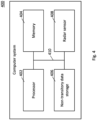
- steps 302, 304, 306, and the further steps described above may be performed by computer hardware components, for example as described with reference to Fig. 4 .
- the processor 402 may carry out instructions provided in the memory 404.
- the non-transitory data storage 406 may store a computer program, including the instructions that may be transferred to the memory 404 and then executed by the processor 402.
- the radar sensor 408 may be used to determine radar data, for example radar data that is provided to the methods as described herein.
- the processor 402, the memory 404, and the non-transitory data storage 406 may be coupled with each other, e.g. via an electrical connection 410, such as e.g. a cable or a computer bus or via any other suitable electrical connection to exchange electrical signals.
- the radar sensor 408 may be coupled to the computer system 400, for example via an external interface, or may be provided as part of the computer system (in other words: internal to the computer system 400, for example coupled via the electrical connection 410).
- Coupled or “connection” are intended to include a direct “coupling” (for example via a physical link) or direct “connection” as well as an indirect “coupling” or indirect “connection” (for example via a logical link), respectively.
Landscapes
- Engineering & Computer Science (AREA)
- Radar, Positioning & Navigation (AREA)
- Remote Sensing (AREA)
- Physics & Mathematics (AREA)
- Computer Networks & Wireless Communication (AREA)
- General Physics & Mathematics (AREA)
- Artificial Intelligence (AREA)
- Evolutionary Computation (AREA)
- Electromagnetism (AREA)
- Radar Systems Or Details Thereof (AREA)
Priority Applications (3)
| Application Number | Priority Date | Filing Date | Title |
|---|---|---|---|
| EP23180557.3A EP4481431A1 (de) | 2023-06-21 | 2023-06-21 | Verfahren und systeme zur bestimmung einer strahlvektorliste zur objekterkennung |
| US18/747,760 US20240426978A1 (en) | 2023-06-21 | 2024-06-19 | Methods And Systems For Determining A Beam Vector List For Object Detection |
| CN202410799416.8A CN119179054A (zh) | 2023-06-21 | 2024-06-20 | 用于确定用于对象检测的波束向量列表的方法和系统 |
Applications Claiming Priority (1)
| Application Number | Priority Date | Filing Date | Title |
|---|---|---|---|
| EP23180557.3A EP4481431A1 (de) | 2023-06-21 | 2023-06-21 | Verfahren und systeme zur bestimmung einer strahlvektorliste zur objekterkennung |
Publications (1)
| Publication Number | Publication Date |
|---|---|
| EP4481431A1 true EP4481431A1 (de) | 2024-12-25 |
Family
ID=86942221
Family Applications (1)
| Application Number | Title | Priority Date | Filing Date |
|---|---|---|---|
| EP23180557.3A Pending EP4481431A1 (de) | 2023-06-21 | 2023-06-21 | Verfahren und systeme zur bestimmung einer strahlvektorliste zur objekterkennung |
Country Status (3)
| Country | Link |
|---|---|
| US (1) | US20240426978A1 (de) |
| EP (1) | EP4481431A1 (de) |
| CN (1) | CN119179054A (de) |
Citations (3)
| Publication number | Priority date | Publication date | Assignee | Title |
|---|---|---|---|---|
| US10996311B2 (en) * | 2017-08-04 | 2021-05-04 | Infineon Technologies Ag | Distributed radar sensor system |
| US20220283288A1 (en) * | 2021-03-02 | 2022-09-08 | Indie Semiconductor, Inc. | Methods for classifying objects in automotive-grade radar signals |
| EP4063909A1 (de) * | 2021-03-25 | 2022-09-28 | Aptiv Technologies Limited | Teilweise erlerntes modell für geschwindigkeitsschätzungen bei der radarverfolgung |
-
2023
- 2023-06-21 EP EP23180557.3A patent/EP4481431A1/de active Pending
-
2024
- 2024-06-19 US US18/747,760 patent/US20240426978A1/en active Pending
- 2024-06-20 CN CN202410799416.8A patent/CN119179054A/zh active Pending
Patent Citations (3)
| Publication number | Priority date | Publication date | Assignee | Title |
|---|---|---|---|---|
| US10996311B2 (en) * | 2017-08-04 | 2021-05-04 | Infineon Technologies Ag | Distributed radar sensor system |
| US20220283288A1 (en) * | 2021-03-02 | 2022-09-08 | Indie Semiconductor, Inc. | Methods for classifying objects in automotive-grade radar signals |
| EP4063909A1 (de) * | 2021-03-25 | 2022-09-28 | Aptiv Technologies Limited | Teilweise erlerntes modell für geschwindigkeitsschätzungen bei der radarverfolgung |
Also Published As
| Publication number | Publication date |
|---|---|
| US20240426978A1 (en) | 2024-12-26 |
| CN119179054A (zh) | 2024-12-24 |
Similar Documents
| Publication | Publication Date | Title |
|---|---|---|
| Major et al. | Vehicle detection with automotive radar using deep learning on range-azimuth-doppler tensors | |
| Brodeski et al. | Deep radar detector | |
| US11506776B2 (en) | Method and device with improved radar resolution | |
| CN112240999B (zh) | 处理雷达反射的方法和系统 | |
| CN111521989B (zh) | 用于雷达系统中的超分辨率的深度学习 | |
| US12372636B2 (en) | Method and system for object detection | |
| EP4158378A1 (de) | Clustering in der automobilbildgebung | |
| US10338216B2 (en) | Object detection in multiple radars | |
| CN108369271A (zh) | 配置用于确定空闲域的车辆雷达系统 | |
| EP4024077A1 (de) | Verfahren und system zur komprimierung von radardaten | |
| CN113009441A (zh) | 一种雷达运动反射面多径目标的识别方法及装置 | |
| US12411228B2 (en) | Machine-learning-based super resolution of radar data | |
| CN110325876B (zh) | 用于车辆雷达系统的逆合成孔径雷达 | |
| Franceschi et al. | Deep learning-based radar detector for complex automotive scenarios | |
| US12386038B2 (en) | Radar system using a machine-learned model for identifying a number of objects | |
| US12339396B2 (en) | Radar reflection detection with convolutional neural network kernels matched to reflection-ghost offset | |
| CN112034464B (zh) | 一种目标分类方法 | |
| US20230350020A1 (en) | False target filtering | |
| EP4481431A1 (de) | Verfahren und systeme zur bestimmung einer strahlvektorliste zur objekterkennung | |
| US20240159870A1 (en) | Interface for Detection Representation of Hidden Activations in Neural Networks for Automotive Radar | |
| KR20240098644A (ko) | 인공지능에서의 레이더 포인트 클라우드 및 레이더 텐서 융합 방법 및 데이터 처리 방법 및 시스템 | |
| Lu et al. | Cascaded object detection networks for FMCW radars | |
| Zhang et al. | A novel method for micro-motion target detection and ghost track suppression in automotive radar | |
| Nogueira et al. | Study of Detection Object and People with Radar Technology | |
| Pan | Object Classification Using Range-Doppler Plots from a High Density PMCW MIMO mmWave Radar System |
Legal Events
| Date | Code | Title | Description |
|---|---|---|---|
| PUAI | Public reference made under article 153(3) epc to a published international application that has entered the european phase |
Free format text: ORIGINAL CODE: 0009012 |
|
| STAA | Information on the status of an ep patent application or granted ep patent |
Free format text: STATUS: THE APPLICATION HAS BEEN PUBLISHED |
|
| AK | Designated contracting states |
Kind code of ref document: A1 Designated state(s): AL AT BE BG CH CY CZ DE DK EE ES FI FR GB GR HR HU IE IS IT LI LT LU LV MC ME MK MT NL NO PL PT RO RS SE SI SK SM TR |
|
| STAA | Information on the status of an ep patent application or granted ep patent |
Free format text: STATUS: REQUEST FOR EXAMINATION WAS MADE |
|
| 17P | Request for examination filed |
Effective date: 20250113 |