EP4481612A2 - Procédé et appareil de consensus distribué utilisant un identifiant de noeud public et procédé de génération de chaîne de blocs l'utilisant - Google Patents
Procédé et appareil de consensus distribué utilisant un identifiant de noeud public et procédé de génération de chaîne de blocs l'utilisant Download PDFInfo
- Publication number
- EP4481612A2 EP4481612A2 EP24182294.9A EP24182294A EP4481612A2 EP 4481612 A2 EP4481612 A2 EP 4481612A2 EP 24182294 A EP24182294 A EP 24182294A EP 4481612 A2 EP4481612 A2 EP 4481612A2
- Authority
- EP
- European Patent Office
- Prior art keywords
- node
- vote
- nodes
- consensus
- public
- Prior art date
- Legal status (The legal status is an assumption and is not a legal conclusion. Google has not performed a legal analysis and makes no representation as to the accuracy of the status listed.)
- Pending
Links
Images


Classifications
-
- G—PHYSICS
- G06—COMPUTING OR CALCULATING; COUNTING
- G06F—ELECTRIC DIGITAL DATA PROCESSING
- G06F21/00—Security arrangements for protecting computers, components thereof, programs or data against unauthorised activity
- G06F21/60—Protecting data
- G06F21/64—Protecting data integrity, e.g. using checksums, certificates or signatures
-
- H—ELECTRICITY
- H04—ELECTRIC COMMUNICATION TECHNIQUE
- H04L—TRANSMISSION OF DIGITAL INFORMATION, e.g. TELEGRAPHIC COMMUNICATION
- H04L9/00—Cryptographic mechanisms or cryptographic arrangements for secret or secure communications; Network security protocols
- H04L9/50—Cryptographic mechanisms or cryptographic arrangements for secret or secure communications; Network security protocols using hash chains, e.g. blockchains or hash trees
-
- H—ELECTRICITY
- H04—ELECTRIC COMMUNICATION TECHNIQUE
- H04L—TRANSMISSION OF DIGITAL INFORMATION, e.g. TELEGRAPHIC COMMUNICATION
- H04L9/00—Cryptographic mechanisms or cryptographic arrangements for secret or secure communications; Network security protocols
- H04L9/32—Cryptographic mechanisms or cryptographic arrangements for secret or secure communications; Network security protocols including means for verifying the identity or authority of a user of the system or for message authentication, e.g. authorization, entity authentication, data integrity or data verification, non-repudiation, key authentication or verification of credentials
- H04L9/3236—Cryptographic mechanisms or cryptographic arrangements for secret or secure communications; Network security protocols including means for verifying the identity or authority of a user of the system or for message authentication, e.g. authorization, entity authentication, data integrity or data verification, non-repudiation, key authentication or verification of credentials using cryptographic hash functions
- H04L9/3239—Cryptographic mechanisms or cryptographic arrangements for secret or secure communications; Network security protocols including means for verifying the identity or authority of a user of the system or for message authentication, e.g. authorization, entity authentication, data integrity or data verification, non-repudiation, key authentication or verification of credentials using cryptographic hash functions involving non-keyed hash functions, e.g. modification detection codes [MDCs], MD5, SHA or RIPEMD
-
- H—ELECTRICITY
- H04—ELECTRIC COMMUNICATION TECHNIQUE
- H04L—TRANSMISSION OF DIGITAL INFORMATION, e.g. TELEGRAPHIC COMMUNICATION
- H04L2209/00—Additional information or applications relating to cryptographic mechanisms or cryptographic arrangements for secret or secure communication H04L9/00
- H04L2209/46—Secure multiparty computation, e.g. millionaire problem
- H04L2209/463—Electronic voting
Definitions
- the present disclosure relates generally to technology for a distributed consensus in a blockchain, and more particularly to technology for selecting random nodes for a consensus congress for each block and performing a consensus for adding a new block to a chain by the consensus congress.
- each node performs an operation corresponding to the VRF, and whether it is selected for a consensus congress is determined based on the result of the operation.
- the node selected for the consensus congress submits the voting result thereof along with evidence.
- this method has a disadvantage that the size of the consensus congress can be estimated based only on a probability distribution and it cannot be exactly known how many nodes are selected for the consensus congress. As a result, the exact number of nodes comprising the majority or two-thirds of the consensus congress cannot be precisely known, and thus a complex consensus process is required.
- the message transfer protocol for determining a consensus congress includes a process of sending and receiving messages for forming a consensus congress between nodes, which imposes a significant load on the system as the number of nodes participating in a blockchain increases. Therefore, new blockchain consensus technology that can reduce or eliminate message exchanges for forming a consensus congress is urgently required.
- An object of the present disclosure is to form a blockchain consensus congress by selecting a number of random nodes corresponding to the size of the consensus congress determined depending on the number of participating nodes while minimizing exchanges of messages for forming the consensus congress.
- Another object of the present disclosure is to use public node identifiers such that a consensus congress, which is randomly selected for each block without the exchange of messages for forming the consensus congress, performs a consensus using a simple consensus algorithm, such as PBFT or the like, thereby maintaining decentralization while reducing message complexity of a blockchain system and improving performance.
- a simple consensus algorithm such as PBFT or the like
- a method for a distributed consensus performed by a distributed consensus apparatus includes generating public vote identifiers using public node identifiers corresponding to nodes constituting a blockchain, generating a pass vote list by performing an operation corresponding to a success probability of p for each of the public vote identifiers, and performing a distributed consensus based on at least part of consensus congress nodes corresponding to the pass vote list.
- the pass vote list may be generated in such a way that each of the nodes constituting the blockchain performs the operation for the nodes, including itself, based on the public vote identifiers.
- pass vote lists that the nodes constituting the blockchain generate at a specific time may be identical to each other.
- the operation may be to compare a random value generated using the public vote identifier and previous block information with a threshold corresponding to the success probability.
- a number of public vote identifiers equal to the number of votes of each of the nodes may be generated for the node using the public node identifier corresponding to the node.
- consensus congress nodes may be selected from among nodes included in the pass vote list.
- a consensus for a previous block corresponding to the previous block information may be finally confirmed by a chair node selected from among the consensus congress nodes for a current block.
- the public vote identifiers may be generated by adding or subtracting one of generation values, including 0, to or from the public node identifier corresponding to each of the nodes.
- the public node identifiers may be public keys corresponding to the nodes.
- a node corresponding to a largest or smallest value, among values corresponding to results of the operations, may become a chair node.
- an apparatus for a distributed consensus includes one or more processors and executable memory for storing at least one program executed by the one or more processors.
- the at least one program may generate public vote identifiers using public node identifiers corresponding to nodes constituting a blockchain, generate a pass vote list by performing an operation corresponding to a success probability of p for each of the public vote identifiers, and perform a distributed consensus based on at least part of consensus congress nodes corresponding to the pass vote list.
- the pass vote list may be generated in such a way that each of the nodes constituting the blockchain performs the operation for the nodes, including itself, based on the public vote identifiers.
- pass vote lists that the nodes constituting the blockchain generate at a specific time may be identical to each other.
- the operation may be to compare a random value generated using the public vote identifier and previous block information with a threshold corresponding to the success probability.
- a number of public vote identifiers equal to the number of votes of each of the nodes may be generated for the node using the public node identifier corresponding to the node.
- consensus congress nodes may be selected from among nodes included in the pass vote list.
- a consensus for a previous block corresponding to the previous block information may be finally confirmed by a chair node selected from among the consensus congress nodes for a current block.
- a method for generating a blockchain includes receiving a committed message corresponding to a previous block; generating a pass vote list using information about the previous block and public vote identifiers; receiving, by a chair node corresponding to a current block, confirm messages from consensus congress nodes corresponding to the pass vote list and finally confirming, by the chair node, a result of a consensus for the previous block based on the confirm messages, the chair node being recognized based on the pass vote list; and transmitting, by the chair node, a prepare message for connecting the current block to the blockchain to consensus committee nodes selected from among the consensus congress nodes.
- the method for generating a blockchain may further include receiving, by the chair node, commit messages from the consensus committee nodes; and transmitting, by the chair node, a committed message corresponding to the current block to all nodes.
- the pass vote list may be generated in such a way that each of nodes constituting the blockchain performs an operation corresponding to a success probability of p for the nodes, including itself, based on the public vote identifiers.
- pass vote lists that the nodes constituting the blockchain generate at a specific time may be identical to each other.
- the operation may be to compare a random value generated using the public vote identifier and the information about the previous block with a threshold corresponding to the success probability.
- a number of public vote identifiers equal to the number of votes of each of the nodes may be generated for the node using a public node identifier corresponding to the node.
- the number of nodes to be selected as candidates for a consensus congress cannot be known before a chair node receives messages about whether other nodes are selected for the consensus congress in the process for forming the consensus congress. Accordingly, the chair node according to the existing technologies sets the threshold time for forming a consensus congress, waits for responses from 3f + 1 nodes (f being a Byzantine size and an integer equal to or greater than 1), and requires an exception handling process for handling the case in which the number of nodes forming the consensus congress is less than 3f + 1 when the threshold time expires.
- f being a Byzantine size and an integer equal to or greater than 1
- the consensus may be immediately performed without the exchange of messages related to the configuration of the consensus congress.
- participating nodes which participate in a blockchain, may be assumed to be connected with a network.
- the nodes generally use cryptography based on a public key for integrity of transferred data
- a blockchain node x may generate a public key pk x from its private key sk x and share its public key with additional nodes connected with the network.
- the node x may securely transfer data using its private key sk x
- the additional nodes may decrypt the transferred data using the public key pk x of the node x and also authenticate the source of the data.
- the public key of each of the blockchain nodes may be an example of a public node identifier according to an embodiment of the present disclosure. That is, in an embodiment of the present disclosure, a public node identifier is information open to other nodes, and may be information through which a specific node can be identified.
- the public node identifier may be the identifier of a specific node that other nodes know or can know about.
- the public node identifier may be shared among the corresponding node and the additional nodes, and may be transferred through information included in a message transmitted from the corresponding node to the additional nodes.
- the public node identifier may alternatively be a serial number assigned to each of the blockchain nodes.
- the public node identifier may be the public key itself of each of the blockchain nodes, or may be identification information generated based on the public key.
- blockchain nodes may have a number of votes corresponding to shares possessed thereby.
- blockchain nodes may have a number of votes greater than 1, and a consensus congress may be selected based on a result of performing a number of operations corresponding to the number of votes with a success probability of p. For example, when a specific node has two votes, if it succeeds in the operation corresponding to the success probability of p even for one of the two votes, the node may become a candidate for a consensus congress.
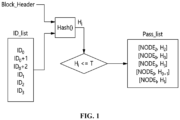
- FIG. 1 is a view illustrating an example of a process in which a pass vote list is generated from public vote identifiers according to an embodiment of the present disclosure.
- a pass vote list pass_list is generated using a vote identifier list ID_list in which public vote identifiers are stored.
- the public vote identifier may be an identifier corresponding to each vote (or a coin toss), and may be generated from a public node identifier.
- a number of public vote identifiers equal to the number of votes of each of nodes participating in a blockchain may be generated for the node using the public node identifier corresponding to the node. For example, when node A has ten votes because it has ten shares, ten public vote identifiers for node A may be generated based on the public node identifier of node A. For example, when node B has two votes because it has two shares, two public vote identifiers for node B may be generated based on the public node identifier of node B.
- the vote identifier list ID_list illustrated in FIG. 1 stores public vote identifiers therein when the number of nodes participating in a blockchain is 4.
- the four nodes may have their unique public node identifiers.
- the public node identifier of the first node may be ID 0
- the public node identifier of the second node may be ID 1
- the public node identifier of the third node may be ID 2
- the public node identifier of the fourth node may be ID 3 .
- the public node identifiers ID 0 , ID 1 , ID 2 , and ID 3 may be the public keys of the respective nodes.
- the first node may have three votes
- the second node may have one vote
- the third node may have one vote
- the fourth node may have one vote. That is, the total number of votes is 6 in the example illustrated in FIG. 1 .
- the first node transfers the public node identifier thereof (e.g., the public key pk 0 ) and the fact that it has three votes to the additional nodes.
- Each of the additional nodes receiving the data may calculate three public vote identifiers ID 0 , ID 0 +1, and ID 0 +2 of the first node, and the calculated three public vote identifiers of the first node may be stored in the vote identifier list ID_list. Because each of the additional nodes also transfers the public node identifier thereof and the number of votes possessed thereby to other nodes in the same manner, the nodes participating in the blockchain may individually generate the vote identifier list ID_list illustrated in FIG. 1 .
- the nodes exchange information about the votes thereof with each other and respectively generate a vote identifier list ID_list including the six public vote identifiers.
- a single public vote identifier may be generated for each of the second node, the third node, and the fourth node, and three public vote identifiers may be generated for the first node.
- ID 0 that is one of the three public vote identifiers for the first node may be set to be the same as the public node identifier (e.g., the public key pk 0 ) of the first node.
- ID 0 +1 that is another one of the three public vote identifiers for the first node may be set to a value acquired by adding 1 to the public node identifier thereof.
- ID 0 +2 that is a further one of the three public vote identifiers for the first node may be set to a value acquired by adding 2 to the public node identifier of the first node.
- a public key is used as the public node identifier, even though public vote identifiers generated by sequentially incrementing by 1 from the public node identifier are used as described above, the possibility that the public vote identifiers are repeated is close to zero. That is, each of the public vote identifiers ID 0 +1 and ID 0 +2 is a value acquired by adding an arbitrary value to the public key of the node, and because it is almost impossible to find a private key corresponding thereto, it may be regarded as arbitrary data.
- the public keys of the nodes and the pieces of arbitrary data, the total number of which equals to the total number of votes may be stored in the vote identifier list ID_list.
- ID 1 that is the public vote identifier for the second node may be set to be the same as the public node identifier (e.g., the public key pk 1 ) of the second node.
- ID 2 that is the public vote identifier for the third node may be set to be the same as the public node identifier (e.g., the public key pk 2 ) of the third node.
- ID 3 that is the public vote identifier for the fourth node may be set to be the same as the public node identifier (e.g., the public key pk 3 ) of the fourth node.
- a total of six public vote identifiers ID 0 , ID 0 +1, ID 0 +2, ID 1 , ID 2 , and ID 3 for the four nodes may be stored in the vote identifier list, as illustrated in FIG. 1 , and because the vote identifier list is generated based on the public node identifiers open to all of the nodes, it may be individually generated by each of the nodes participating in the blockchain. The generated public vote identifiers may match with the votes in a one-to-one manner.
- a method of sequentially incrementing by a preset number e.g., 1 from the public node identifier (the first public vote identifier being set to the public node identifier) is used in the example of FIG. 1 , but any of various methods may also be used as the method of generating multiple public vote identifiers from a single public node identifier.
- a preset number e.g. 1
- each of nodes participating in a blockchain may disclose the public node identifier (e.g., the public key) thereof and the number of votes possessed thereby to the other nodes. Accordingly, all of the nodes participating in the blockchain may respectively generate the vote identifier list ID_list illustrated in FIG. 1 because each of the nodes is aware of the public node identifiers and the numbers of votes of all of the nodes, including itself, participating in the blockchain.
- the public vote identifiers included in the vote identifier list ID_list may correspond to the votes, respectively.
- the pass vote list pass_list when the block to be added to the blockchain is input, the data stored in the vote identifier list ID_list is extracted, and a pass vote list pass_list may be generated. That is, the pass vote list pass_list according to an embodiment of the present disclosure may be generated after a block that is agreed upon is completed, and may be maintained for only the corresponding block.
- the agreed-upon block is stored in a committed message after it is completed, and may then be propagated to all nodes. That is, in the blockchain consensus process, a chair may propagate the block completed in a commit phase to all the nodes in a committed phase. Accordingly, when the agreed-upon block is completed, the respective nodes of the blockchain may have already generated the vote identifier list ID_list, and upon receiving the committed message, by which the agreed-upon block that is completed is propagated to all of the nodes, the nodes may generate a pass vote list Pass_list by performing an operation corresponding to a success probability of p using the header value Block_Header of the completed block.
- the nodes receiving the block extract the header value Block_Header of the block and perform the operation corresponding to the success probability (p) using the extracted header value along with the public vote identifiers within the vote identifier list ID_list generated as shown in FIG. 1 , thereby generating a pass vote list Pass_list.
- 'Hash()' is a hash function that receives the header value Block _Header of a block and a public vote identifier as input, and H; (i being a vote identifier) is a random value generated through the hash function.
- the public vote identifiers are brought from the vote identifier list ID_list one by one, and the hash operation is performed on the public vote identifier and the header value Block_Header of the block, whereby H i may be calculated.
- H i may be represented as Hash (Header_B n , ID i ).
- Header_B n may indicate Block _Header corresponding to the block B n illustrated in FIG. 2
- ID i may be the public vote identifier corresponding to the index i.
- the hash function may be SHA256 or the like.
- the random value H; generated to correspond to the public vote identifier ID i may be a value acquired by extracting some bits from the output of the hash function.
- the random value H i may be a value corresponding to part (e.g., lower 32 bits [31:0]) of 256 bits [255:0] output from the SHA256 function.
- the random values H; corresponding to the respective votes are generated, and only values that are not greater than a preset threshold T, among the generated random values, may be stored in the pass vote list Pass_list in the form of a pair of [node number, H;] .
- the threshold T an arbitrary value may be used as the threshold T, and as described in the aforementioned U.S. Patent Application Publication No. 2023-0066169 and the like, the success probability p of the votes (coin tosses) of nodes and 3f +1, which is the size of a consensus congress, may be calculated by applying Equations (1) and (2) below.
- the threshold T satisfying the success probability p of the coin toss may be calculated in consideration of the maximum value of the random value H i .
- Coin tosses are performed for all random values H i by implementing the coin toss with the success probability of p through a process (operation) of comparing the threshold T with the magnitude of the random value H i , and when the coin toss succeeds, the pair of [node number, H i ] is added to the pass vote list Pass_list.
- the two results including [NODE 0 , H 0 ], which is the result of the operation performed using the public vote identifier ID 0 , and [NODE 0 , H 0+1 ], which is the result of the operation performed using the public vote identifier ID 0 +1, are stored for the first node, [NODE 1 , H 1 ], which is the result of the operation performed using the public vote identifier ID 1 , is stored for the second node, [NODE 2 , H 2 ], which is the result of the operation performed using the public vote identifier ID 2 , is stored for the third node, and [NODE 3 , H 3 ], which is the result of the operation performed using the public vote identifier ID 3 , is stored for the fourth node.
- the result values stored in the pass vote list Pass_list may be arranged in order of the magnitude of the random values.
- the results values stored in the pass vote list Pass_list may be arranged in ascending order of the magnitude of the random values.
- the magnitude of the random values is H 2 ⁇ H 0 ⁇ H 3 ⁇ H 0+1 ⁇ H 1 .
- 3f + 1 nodes may be selected from the pass vote list Pass_list according to the ascending order and set as the nodes for forming a consensus congress.
- FIG. 2 is a view illustrating an example of a distributed consensus method according to an embodiment of the present disclosure.
- a total of four nodes including NODEO, NODE1, NODE2, and NODE3, participate in a blockchain and that the total number of votes is 6 (three votes for NODEO, one vote for NODE1, one vote for NODE2, and one vote for NODE3).
- the node NODE2 is a chair node for a consensus for a block B n .
- the node NODE2 transmits a prepare message for the consensus for the block B n to consensus committee nodes NODE1, NODE2, and NODE3, completes the agreed-upon block B n by receiving commit messages from the consensus committee nodes NODE1, NODE2, and NODE3, and transmits a committed message for propagating the completed agreed-upon block B n to all of the nodes NODEO, NODE1, NODE2, and NODE3.
- All of the nodes NODEO, NODE1, NODE2, and NODE3 receiving the committed message for the completed agreed-upon block B n may form a consensus congress for a block B n+1 using block information Header_B n for the completed agreed-upon block B n .
- the chair node NODE2 corresponding to the agreed-upon block B n propagates the block B n , which is completed in the commit phase, to all of the nodes NODEO, NODE1, NODE2, and NODE3 in the committed phase, as illustrated in FIG. 2 .
- the nodes receiving the block B n extract the header value of the block B n , generate random values by performing a hash operation on the extracted header value and respective public vote identifiers included in a vote identifier list, and generate a pass vote list by comparing the random values with a preset threshold.
- the pass vote list for the block B n+1 may be calculated by all of the nodes receiving the committed message corresponding to the block B n , and information about the members of the consensus congress of the pass vote list needs to be maintained in order for all of the nodes receiving the committed message corresponding to the block B n+1 to confirm that the block is signed by valid signers.
- the chair may need the information about the members of the consensus congress of the pass vote list in all of the phases (including confirm, prepare, commit, and committed phases) of the consensus in order to form the consensus congress and the consensus committee.
- the remaining nodes excluding the chair, need the information about the members of the consensus congress of the pass vote list in order to check the chair node and to perform a consensus when they are the members of the consensus congress, and nodes that are not included in the consensus congress may need the information about the members of the consensus congress of the pass vote list in order to check whether the committed block is signed by the nodes belonging to the consensus committee.
- the pass vote list for the block B n+1 may be generated only after the committed message corresponding to the block B n is received. Accordingly, a time period during which the valid pass vote list is maintained is managed to not be too long, and a random value to be used for a coin toss (an operation with a success probability of p) may be appropriately generated.
- the pass vote list for the block B n+1 may store [NODE 1 , H 1 ], [NODE 0 , H 0 ], [NODE 3 , H 3 ], [NODE 0 , H 0+1 ], and [NODE 2 , H 2 ] in ascending order of the magnitude of the random values H i . That is, in the example illustrated in FIG. 2 , it can be seen that the magnitude of the random values is H 1 ⁇ H 0 ⁇ H 3 ⁇ H 0+1 ⁇ H 2 . Also, in the example illustrated in FIG. 2 , it can be seen that a coin toss for only the public vote identifier corresponding to the third vote of the node NODEO, among the six votes, fails, and that coin tosses for all of the remaining public vote identifiers succeed.
- [NODE 1 , H 1 ] may be the operation result corresponding to the random value H 1 calculated based on a single public vote identifier of the node NODE1
- [NODE 0 , H 0 ] may be the operation result corresponding to the random value H 0 calculated based on the first public vote identifier (e.g., the public key of the node NODEO), among the three public vote identifiers of the node NODEO
- [NODE 3 , H 3 ] may be the operation result corresponding to the random value H 3 calculated based on a single public vote identifier of the node NODE3
- [NODE 0 , H 0+1 ] may be the operation result corresponding to the random value H 0+1 calculated based on the second public vote identifier (e.g., the public key of the NODEO + 1), among the three public vote identifiers of the node NODEO
- [NODE 2 , H 2 ] may be the operation result corresponding to the random
- the random value H 0+2 calculated based on the third public vote identifier e.g., the public key of the node NODEO + 2
- the third public vote identifier e.g., the public key of the node NODEO + 2
- the threshold coin toss
- the consensus congress 201 for the block B n+1 is configured with [NODE 1 , H 1 ], [NODE 0 , H 0 ], [NODE 3 , H 3 ], and [NODE 0 , H 0+1 ].
- [NODE 1 , H 1 ] corresponds to the smallest random value
- the node NODE1 may become a chair node for a consensus for the subsequent block B n+1 , as illustrated in FIG. 2 .
- the consensus for the block B n+1 is started, and the node NODE1, which is a chair, selects [NODE 1 , H 1 ], [NODE 0 , H 0 ], and [NODE 3 , H 3 ] for a consensus committee 202 and transmits a prepare message to the nodes NODE1, NODEO, and NODE3 corresponding thereto.
- the existing technology does not allow each of votes by the shares of nodes to be exercised individually for each consensus congress, but according to the present disclosure, when a consensus congress is selected, the votes of the nodes may be individually exercised for selecting the consensus congress.
- the consensus for the block B n+1 may be performed through a process in which the chair node NODE1 receives commit messages from the nodes NODEO, NODE1, and NODE3 corresponding to the consensus committee and transmits a committed message corresponding thereto to all of the nodes, as illustrated in FIG. 2 .
- all of the nodes may generate a pass vote list corresponding to a block B n+2 . That is, each of the nodes receiving the committed message corresponding to the block B n+1 extracts the header value of the block B n+1 , generates random values by performing a hash operation on the extracted header value and the respective public vote identifiers included in the vote identifier list, and generates a pass vote list for the block B n+2 by comparing the random values with a preset threshold.
- the pass vote list for the block B n+2 may store [NODE 3 , H 3 ], [NODE 0 , H 0+1 ], [NODE 0 , H 0 ], [NODE 2 , H 2 ], and [NODE 1 , H 1 ] in ascending order of the magnitude of the random values H i . That is, in the example illustrated in FIG. 2 , it can be seen that the magnitude of the random values generated for a consensus for the block B n+2 is H 3 ⁇ H 0+1 ⁇ H 0 ⁇ H 2 ⁇ H 1 . Also, in the example illustrated in FIG. 2 , it can be seen that only the coin toss for the public vote identifier corresponding to the third vote of the node NODEO, among the six votes, fails, and coin tosses for all of the remaining public vote identifiers succeed.
- [NODE 3 , H 3 ] may be the operation result corresponding to the random value H 3 calculated based on a single public vote identifier of the node NODE3
- [NODE 0 , H 0+1 ] may be the operation result corresponding to the random value H 0+1 calculated based on the second public vote identifier (e.g., the public key of the node NODEO + 1), among the three public vote identifiers of the node NODEO
- [NODE 0 , H 0 ] may be the operation result corresponding to the random value H 0 calculated based on the first public vote identifier (e.g., the public key of the node NODEO), among the three public vote identifiers of the node NODEO
- [NODE 2 , H 2 ] may be the operation result corresponding to the random value H 2 calculated based on a single public vote identifier of the node NODE2
- [NODE 1 , H 1 ] may be the operation result corresponding to
- the random value H 0+2 calculated based on the third public vote identifier e.g., the public key of the node NODEO + 2
- the third public vote identifier e.g., the public key of the node NODEO + 2
- the threshold coin toss
- the consensus congress 205 for the block B n+2 is configured with [NODE 3 , H 3 ], [NODE 0 , H 0+1 ], [NODE 0 , H 0 ], and [NODE 2 , H 2 ].
- [NODE 3 , H 3 ] corresponds to the smallest random value
- the node NODE3 may become a chair node for the consensus for the subsequent block B n+2 , as illustrated in FIG. 2 .
- the consensus for the block B n+2 is started, and the node NODE2, which is a chair, selects [NODE 3 , H 3 ], [NODE 0 , H 0+1 ], and [NODE 0 , H 0 ] for a consensus committee 206 and transmits a prepare message to the nodes NODE3 and NODEO corresponding thereto.
- each of nodes succeeding in a coin toss has to generate a message for verifying that the node itself succeeds in the coin toss and transmit the same to additional nodes. Based on the message received from the specific node, the additional nodes confirm that the corresponding node succeeded in the coin toss and form a consensus congress.
- all nodes are able to generate an identical pass vote list for a specific block using public node identifiers assigned to the respective nodes, such as public keys or the like, and thus, the nodes can easily check the nodes forming a consensus congress without special messages for forming the consensus congress, whereby the consensus efficiency may be maximized.
- distributed nodes connected to a blockchain may calculate the configuration of a consensus congress for a subsequent block by themselves without receiving messages related to the new consensus congress from other nodes.
- the nodes participating in the consensus individually calculate values for selecting the consensus congress for the subsequent block for each of the nodes using the public vote identifiers of all of the participating nodes and data extracted from a current block, thereby calculating the consensus congress for the subsequent block.
- FIG. 3 is a view illustrating another example of the distributed consensus method according to an embodiment of the present disclosure.
- FIG. 3 it can be seen that a total of five nodes NODEO, NODE1, NODE2, NODE3, and NODE4 participate in a blockchain and that the total number of votes is 5 (each node having one vote). That is, FIG. 3 illustrates a process in which a random consensus congress is formed without the exchange of additional messages for forming the consensus congress when all participating nodes each have a share of 1, and the consensus congress performs a consensus.
- the example of FIG. 3 may correspond to the process of generating an initial block after the participating nodes participating in the blockchain share the public node identifiers thereof and the numbers of votes possessed thereby.
- the setup of a vote identifier list including public vote identifiers may have been completed.
- a protocol for generation of an initial block and a consensus process is described on the assumption that all of the nodes each have one vote for convenience of description, but each of the nodes may have multiple votes, as described above.
- efficient consensus is possible by transferring only one message for the consensus and using a count included in a committee as a consensus count.
- the node NODEO that is randomly selected as a chair for the consensus for the initial block solely generates the initial block by signing the block while passing through prepare and commit phases, and transfers the initial block to all of the nodes NODEO, NODE1, NODE2, NODE3, and NODE4.
- the consensus process includes four phases. Because only the node NODEO participates in the consensus congress in the process for the consensus for the initial block B init , the prepare and commit phases may be performed in the node NODEO. In this process, signing the initial block B init is performed using the private key of the node NODEO, and the signed final block is transferred to all of the nodes NODEO, NODE1, NODE2, NODE3, and NODE4 in the committed phase.
- EC-Schnorr multi-signature may be used for the consensus. The multi-signature and the like in the consensus process are disclosed in detail in the aforementioned U.S. Patent Application Publication No. 2020-0403776 , and the like.
- each of the nodes verifies the signature of the initial block B init , and when there is a problem, this indicates failure of the consensus, and a protocol for again performing a consensus is performed.
- a pass vote list Pass_list is generated using vote identifiers contained in the stored vote identifier list ID_list of the nodes and the header value of the initial block B init , as described with reference to FIG. 1 .
- all of the nodes receiving the committed message may generate a pass vote list.
- Equations (1) and (2) above are 1.0 and 1, respectively.
- All of [node number, H i ] pairs satisfying the condition of comparison with a threshold are added to the pass vote list Pass_list, and four nodes are selected therefrom in ascending order of H; for a consensus congress.
- all of the five votes pass the comparison with the threshold, and the five [node number, H i ] pairs arranged in ascending order may be stored in the pass vote list Pass_list.
- the result values for 3f + 1 nodes may be selected as nodes corresponding to the consensus congress.
- the consensus congress nodes for a consensus for a subsequent block B init+1 may be the nodes NODE2, NODEO, NODE4, and NODE3, and the node NODE2 corresponding to the smallest H i becomes a chair node for the block B init+1 .
- FIG. 3 illustrates an example in which the nodes NODE2, NODEO, NODE4, and NODE3 are selected for the consensus congress and perform a consensus. This process may be performed by all of the distributed nodes, and because the results of the operation (coin toss) by all of the nodes confirming the same initial block B init are the same as each other, all of the nodes may form the same consensus congress without the exchange of messages for forming the consensus congress between the nodes.
- the nodes NODE2, NODEO, NODE4, and NODE3 selected for a consensus congress in the confirm phase respectively generate random k i and generate Q i on the elliptic curve.
- Each of the nodes included in the consensus congress transfers the checksum of the block header received thereby and Q i to the node NODE2, which is the chair node for the subsequent block B init+1 , thereby enabling the result of the consensus for the initial block B init to be confirmed and preparing for the consensus for the subsequent block.
- the checksum and Q i are transferred along with the signature of node i, whereby the integrity is ensured.
- the nodes selected for the consensus congress transfer the transactions yet to be processed to the chair node such that the chair node is able to process the same.
- the node NODE2 which is a chair for the block B init+1 , randomly selects 2f + 1 nodes from among the nodes submitting the checksum and Q i .
- the node NODE2 checks whether the checksums of the selected nodes are the same as each other to thereby confirm that the nodes receive the same block B init , and performs a consensus together with the 2f + 1 nodes.
- FIG. 1 In the example illustrated in FIG.
- the node NODE2 which is the chair for the block B init+1 , selects three (2f + 1) consensus committee nodes NODE2, NODEO, and NODE3 from among the four (3f + 1) consensus congress nodes NODE2, NODEO, NODE4, and NODE3, confirms that the checksums of the nodes NODE2, NODEO, and NODE3 are the same as each other, and performs the consensus together with the nodes NODE2, NODEO, and NODE3.
- the chair that initiates the initial block B init is the node NODEO, but the node NODE2 that is the chair for the subsequent block B init+1 may finally confirm the result of the consensus for the initial block B init .
- the node NODE2 In the prepare phase for the block B init+1 , the node NODE2 generates a preparatory block including transactions received from a guest or the transactions received from the nodes in the confirm phase for the block B init .
- a prepare message (including a prepare block) may be generated by including the values of Pk, Q, and r acquired by combining the public keys and Q i of the respective nodes NODE2, NODEO, and NODE3 in the block, and may then be transferred to the nodes NODE2, NODEO, and NODE3 for the consensus.
- the nodes NODE2, NODEO, and NODE3 receiving the prepare message check whether or not the block is normal, and when the block is normal, each of the nodes generates s; signed with the private key thereof and returns a commit message to the chair node NODE2.
- the chair node NODE2 receiving all of the commit messages generates S by combining values corresponding to s i , generates a committed block by completing a signature (r, S), and transfers the committed block to all of the nodes.
- Each of the nodes receiving the committed block checks the validity of the block by checking the public keys and signatures corresponding to the 2f + 1 nodes of the consensus congress.
- H i is calculated using the header value of the block B init+1 and a next pass vote list may be generated, whereby a consensus congress for a block B init+2 may be formed.
- the nodes NODE4, NODE3, NODE1 and NODE2 form the consensus congress and transmit a confirm message to the node NODE4 that is the chair for the block B init+2 .
- each of the nodes NODE4, NODE3, NODE1, and NODE2 transfers the checksum and Q; to the node NODE4, thereby completing the consensus for the block B init+1 .
- a consensus for the block B init+2 may be performed in the same manner as the above-described process for the block B init+1 .
- FIG. 4 is a view illustrating a further example of the distributed consensus method according to an embodiment of the present disclosure.
- the node NODES is added as a participating node in addition to the existing five nodes NODEO, NODE1, NODE2, NODE3, and NODE4.
- the node NODES when the node NODES is added as a participating node during the consensus period for a block B n , as shown in FIG.4 , the node NODES is able to participate normally in the consensus congress from a consensus for a block B n+1 (a node addition process).
- the intention of the node NODE5 to participate in the consensus is transferred to the node NODE3, which is a chair for the block B n .
- the node NODE5 first accesses the network over which the consensus is underway and thereby collects information about the nodes currently participating in the consensus. After receiving the information about the consensus congress nodes and public node identifiers (e.g., public keys), the node NODE5 generates a vote identifier list ID_list including public vote identifiers based thereon and transfers its intention to participate in the consensus to other nodes.
- public node identifiers e.g., public keys
- Each of the nodes receiving the information about the new participating node during the time period corresponding to a block B n-1 may transfer the corresponding content to the node NODE3, which is a chair, during the time period corresponding to the block B n .
- the node NODE3 includes the corresponding content in the transactions to be agreed upon, thereby performing the consensus.
- the block for which the commit phase is completed may include the information about the new participating node. Accordingly, when the commit phase is completed, the node NODE3, which is the chair, may add the public vote identifier(s) of the node NODE5 in the vote identifier list ID_list thereof. In the committed phase, the node NODE3, which is the chair, may transfer the generated block to all of the nodes.
- All of the nodes receiving the committed message respectively add the public vote identifier(s) of the node NODE5, which is the new node, in their vote identifier lists ID_list. Accordingly, from the confirm phase of the block B n , the nodes NODEO, NODE1, NODE2, NODE3, NODE4, and NODE5 are able to participate in the consensus.
- the node NODE2 which is a chair node, agrees upon the new block through the prepare and commit phases and propagates the completed block to all of the nodes. That is, the new node may participate in the consensus through the process illustrated in FIG. 4 .
- FIG. 5 is a flowchart illustrating an example of a process in which one or more public vote identifiers are generated from a public node identifier according to an embodiment of the present disclosure.
- a public key is used as an example of a public node identifier of a node, and one or more public vote identifiers are generated based on the public key of the node and included in a vote identifier list ID_list.
- the steps illustrated in FIG. 5 show a process of generating one or more public vote identifiers using the public node identifier of a specific node for the corresponding node.
- the steps illustrated in FIG. 5 may be performed for each public node identifier.
- a specific public node identifier e.g., a public key
- a number of public vote identifiers equal to the number of votes of the corresponding node may be generated through the process illustrated in FIG. 5 .
- variables for generating public vote identifiers are initialized at step S510. That is, at step S510, the variable 'loop' is set to a value corresponding to the number of votes of a corresponding node, the variable 'count' is set to 0, and a vote identifier list ID_list is initialized.
- variable 'count' is compared with the variable 'loop' at step S520.
- 'count' is less than 'loop' as the result of the comparison at step S520
- a public vote identifier corresponding to the sum of the public key (the public node identifier) of the corresponding node and the variable 'count' is added in the vote identifier list ID_list at step S530.
- a node number may also be stored in the vote identifier list ID_list along with the public vote identifier.
- step S530 When the public vote identifier is added at step S530, the variable 'count' is increased by 1 at step S540, and the process goes back to step S520, whereby the variable 'count' is compared with the variable ⁇ loop'.
- a number of public vote identifiers (the public key, the public key + 1, the public key + 2, ..., the public key + the number of votes - 1) equal to the number of votes corresponding to a specific node may be generated.
- the public vote identifiers may be generated by a vote identifier generator (function).
- the vote identifier generator may be a function that adds count, which increases by 1, to the input public node identifier (public key).
- the vote identifier generator may be any of various forms of functions that receive a public node identifier as input and output a number of public vote identifiers equal to the number of votes.
- the vote identifier generator may include a duplicate checker for checking whether the generated public vote identifiers are repeated.
- the duplicate checker may check not only whether the generated public vote identifier is a duplicate of other vote identifiers but also whether the generated public vote identifier is a duplicate of a public node identifier corresponding to another node.
- the coin tosses can be performed in parallel, whereby the speed of the operation for selecting a consensus congress may increase, compared to a method in which the result of a single coin toss performed in a specific node is hashed and a subsequent coin toss is performed based thereon.
- the public vote identifiers generated by the vote identifier generator may be unique identifiers respectively corresponding to the votes possessed by the node, and the number of bits representing the public vote identifier and the number of bits representing the public node identifier may be equal to each other or may be different from each other.
- FIG. 6 is a view illustrating a use case of a pass vote list in a distributed consensus method according to an embodiment of the present disclosure.
- the pass vote lists 601 generated by the nodes NODEO, NODE1, NODE2, and NODE3 that receive the committed block of a block B n are identical to each other.
- the nodes NODEO, NODE1, NODE2, and NODE3 may confirm that a chair is the node NODE1 and check whether they are included in a consensus congress.
- the node NODEO confirms that [NODE 1 , H 1 ], [NODE 0 , H 0 ], [NODE 3 , H 3 ], and [NODE 0 , H 0+1 ] are selected from the pass vote list for a consensus congress and confirms that the result value [NODE 0 , H 0 ] corresponding to itself is located at the second position in the pass vote list, thereby confirming that it is selected for the consensus congress.
- the node NODEO may know that the node NODE1 becomes a chair based on the first result value [NODE 1 , H 1 ] of the pass vote list. Further, the node NODEO confirms that the result value [NODE 0 , H 0+1 ] corresponding to itself is located at the fourth position in the pass vote list, thereby confirming that it has two votes in the consensus congress.
- the node NODE1 confirms that [NODE 1 , H 1 ], [NODE 0 , H 0 ], [NODE 3 , H 3 ], and [NODE 0 , H 0+1 ] are selected from the pass vote list for a consensus congress, and may know that it is selected for the consensus congress based on the first result value [NODE 1 , H 1 ] and it becomes a chair.
- the node NODE2 confirms that [NODE 1 , H 1 ], [NODE 0 , H 0 ], [NODE 3 , H 3 ], and [NODE 0 , H 0+1 ] are selected from the pass vote list for a consensus congress, and may confirm that the result value [NODE 2 , H 2 ] corresponding to itself is not included in the consensus congress.
- the node NODE2 may know that the node NODE1 becomes a chair based on the first result value [NODE 1 , H 1 ] of the pass vote list.
- the node NODE3 confirms that [NODE 1 , H 1 ], [NODE 0 , H 0 ], [NODE 3 , H 3 ], and [NODE 0 , H 0+1 ] are selected from the pass vote list for a consensus congress and confirms that the result value [NODE 3 , H 3 ] corresponding to itself is located at the third position in the pass vote list, thereby confirming that it is selected for the consensus congress.
- the node NODE3 may know that the node NODE1 becomes a chair based on the first result value [NODE 1 , H 1 ] of the pass vote list.
- the node NODE1 receives confirm messages from the consensus congress nodes NODEO, NODE1, and NODE3 because it is a chair.
- the nodes NODEO and NODE3 send the confirm message to the node NODE1 after they confirm that they are included in the consensus congress although they are not a chair node.
- the chair forms a consensus committee by selecting nodes from the consensus congress, and it can be seen that the nodes NODE1, NODEO, and NODE3 are selected for the consensus committee in the example illustrated in FIG. 6 .
- the result value [NODE 0 , H 0+1 ] corresponding to the second public vote identifier ID 0 +1 of the node NODEO is included in the consensus congress, but is not included in the consensus committee.
- the chair When the chair forms the consensus committee by selecting the nodes NODE1, NODEO, and NODE3, as illustrated in FIG. 6 , it generates r 103 using Pk 103 acquired by combining the public keys of the nodes NODE1, NODEO, and NODE3 when it combines the public keys, and provides the same to the consensus committee nodes.
- the chair forms the consensus committee by selecting [NODE 1 , H 1 ], [NODE 0 , H 0 ], and [NODE 0 , H 0+1 ] from among the result values corresponding to the consensus congress, unlike that illustrated in FIG. 6 , it generates r 10 using Pk 10 acquired by combining the public keys of the nodes NODE1 and NODEO when it combines the public keys, and provides the same to the consensus committee nodes.
- the members of the consensus committee generate s; using the received r in the state in which they do not know the signers, and the chair is not able to simultaneously generate two multi-signatures.
- the consensus committee configuration information may be represented as a bitmap and transferred.
- the chair maintains the consensus committee in the pass vote list Pass_list in order to check the consensus committee members that put a signature (604).
- the block that is agreed upon is transferred as a committed block.
- the consensus committee configuration information is provided, and may be used to check the nodes that put a signature in the pass vote list Pass_list (605).
- the nodes again generate a pass vote list Pass_list in order to form a consensus congress for a subsequent block B n+2 using the received block.
- FIG. 7 is a flowchart illustrating an example of a distributed consensus method according to an embodiment of the present disclosure.
- public vote identifiers are generated using public node identifiers corresponding to nodes constituting a blockchain at step S710.
- a number of public vote identifiers equal to the number of votes of each of the nodes may be generated for the node using the public node identifier corresponding to the node.
- the public vote identifiers may be generated by adding or subtracting one of generation values, including 0, to or from the public node identifier corresponding to each of the nodes.
- the public node identifiers may be public keys corresponding to the nodes.
- an operation corresponding to a success probability of p is performed for each of the public vote identifiers, whereby a pass vote list is generated at step S720.
- the pass vote list may be generated in such a way that each of the nodes constituting the blockchain performs the operations for the nodes, including itself, based on the public vote identifiers.
- the pass vote lists that the nodes constituting the blockchain generate at a specific time may be identical to each other.
- the operation may be to compare a random value generated using the public vote identifier and previous block information with a threshold corresponding to the success probability.
- a distributed consensus is performed based on at least part of consensus congress nodes corresponding to the pass vote list at step S730.
- consensus congress nodes may be selected from among nodes included in the pass vote list.
- a consensus for a previous block corresponding to the previous block information may be finally confirmed by a chair node selected from among the consensus congress nodes for a current block.
- a node corresponding to a largest or smallest value, among values corresponding to results of the operations, may become a chair node.
- the distributed consensus method illustrated in FIG. 7 may be performed by a distributed consensus apparatus.
- the distributed consensus apparatus may be implemented based on the configuration illustrated in FIG. 9 .
- FIG. 8 is a flowchart illustrating an example of a blockchain generation method according to an embodiment of the present disclosure.
- a committed message corresponding to a previous block is received at step S810.
- a pass vote list is generated using information about the previous block and public vote identifiers at step S820.
- the pass vote list may be generated in such a way that each of nodes constituting the blockchain performs an operation corresponding to a success probability of p for the nodes, including itself, based on the public vote identifiers.
- the pass vote lists that the nodes constituting the blockchain generate at a specific time may be identical to each other.
- the operation may be to compare a random value generated using the public vote identifier and the information about the previous block with a threshold corresponding to the success probability.
- a number of public vote identifiers equal to the number of votes of each of the nodes may be generated for the node using the public node identifier corresponding to the node.
- a chair node corresponding to a current block receives confirm messages from consensus congress nodes corresponding to the pass vote list and finally confirms the result of the consensus for the previous block based on the confirm messages at step S830.
- the chair node may be recognized based on the pass vote list.
- the chair node transmits a prepare message for connecting the current block to the blockchain to consensus committee nodes selected from among the consensus congress nodes at step S840.
- the chair node receives commit messages from the consensus committee nodes at step S850.
- the chair node transmits a committed message corresponding to the current block to all of the nodes at step S860.
- FIG. 9 is a block diagram illustrating a computer system configuration according to an embodiment of the present disclosure.
- the distributed consensus apparatus, the blockchain generation apparatus, and nodes constituting a blockchain may be implemented in a computer system 900 including a computer-readable recording medium.
- the computer system 900 may include one or more processors 910, memory 930, a user-interface input device 940, a user-interface output device 950, and storage 960, which communicate with each other via a bus 920. Also, the computer system 900 may further include a network interface 970 connected with a network 980.
- the processor 910 may be a central processing unit or a semiconductor device for executing a program or processing instructions stored in the memory 930 or the storage 960.
- the memory 930 and the storage 960 may be storage media including at least one of a volatile medium, a nonvolatile medium, a detachable medium, a non-detachable medium, a communication medium, or an information delivery medium, or a combination thereof.
- the memory 930 may include ROM 931 or RAM 932.
- At least one program may be recorded in the memory 930.
- the processor 910 may execute the program.
- the program may generate public vote identifiers using public node identifiers corresponding to the nodes constituting the blockchain, generate a pass vote list by performing an operation corresponding to a success probability of p for each of the public vote identifiers, and perform a distributed consensus based on at least part of consensus congress nodes corresponding to the pass vote list.
- the pass vote list may be generated in such a way that each of the nodes constituting the blockchain performs the operation for the nodes including itself based on the public vote identifiers.
- the pass vote lists that the nodes constituting the blockchain generate at a specific time may be identical to each other.
- the operation may be to compare a random value generated using the public vote identifier and previous block information with a threshold corresponding to the success probability.
- a number of public vote identifiers equal to the number of votes of each of the nodes may be generated for the node using the public node identifier corresponding to the node.
- consensus congress nodes may be selected from among nodes included in the pass vote list.
- a consensus for a previous block corresponding to the previous block information may be finally confirmed by a chair node selected from among the consensus congress nodes for a current block.
- the public vote identifiers may be generated by adding or subtracting one of generation values, including 0, to or from the public node identifier corresponding to each of the nodes.
- the public node identifiers may be public keys corresponding to the nodes.
- a node corresponding to a largest or smallest value, among values corresponding to the results of the operations, may become a chair node.
- all blockchain nodes including a chair node, are aware of the nodes selected for a consensus congress, the number of nodes selected for the consensus congress, and the chair node before they receive messages about whether other nodes are selected for the consensus congress, so a consensus may be immediately performed without the exchange of messages related to the configuration of the consensus congress.
- the present disclosure may form a blockchain consensus congress by selecting a number of random nodes corresponding to the size of the consensus congress determined depending on the number of participating nodes while minimizing exchanges of messages for forming the consensus congress.
- the present disclosure uses public node identifiers such that a consensus congress randomly selected for each block without the exchange of messages for forming the consensus congress performs a consensus using a simple consensus algorithm, such as PBFT or the like, thereby reducing the message complexity of a blockchain system, improving performance, and maintaining decentralization.
- a simple consensus algorithm such as PBFT or the like
- the present disclosure may efficiently reconfigure a blockchain consensus congress, the size of which is set for each block, without the exchange of additional messages.
- the present disclosure may prevent the complexity of a protocol for message exchanges from increasing and reduce latency because it does not require the exchange of messages for forming a consensus congress.
- the present disclosure may be easily applied to existing simple consensus algorithms by forming a consensus congress, the size of which is set depending on the number of participating nodes, without the exchange of messages for forming the consensus congress.
- the method and apparatus for a distributed consensus and the blockchain generation method using the same are not limitedly applied to the configurations and operations of the above-described embodiments, but all or some of the embodiments may be selectively combined and configured, so the embodiments may be modified in various ways.
Landscapes
- Engineering & Computer Science (AREA)
- Computer Security & Cryptography (AREA)
- Computer Networks & Wireless Communication (AREA)
- Signal Processing (AREA)
- Theoretical Computer Science (AREA)
- Health & Medical Sciences (AREA)
- General Health & Medical Sciences (AREA)
- Computer Hardware Design (AREA)
- Software Systems (AREA)
- Physics & Mathematics (AREA)
- General Engineering & Computer Science (AREA)
- General Physics & Mathematics (AREA)
- Bioethics (AREA)
- Information Retrieval, Db Structures And Fs Structures Therefor (AREA)
- Multi Processors (AREA)
- Management, Administration, Business Operations System, And Electronic Commerce (AREA)
Applications Claiming Priority (2)
| Application Number | Priority Date | Filing Date | Title |
|---|---|---|---|
| KR20230078605 | 2023-06-20 | ||
| KR1020240063090A KR20240177706A (ko) | 2023-06-20 | 2024-05-14 | 퍼블릭 노드 식별자를 이용한 분산 합의 방법, 장치 및 이를 이용한 블록체인 생성 방법 |
Publications (2)
| Publication Number | Publication Date |
|---|---|
| EP4481612A2 true EP4481612A2 (fr) | 2024-12-25 |
| EP4481612A3 EP4481612A3 (fr) | 2025-02-19 |
Family
ID=91581157
Family Applications (1)
| Application Number | Title | Priority Date | Filing Date |
|---|---|---|---|
| EP24182294.9A Pending EP4481612A3 (fr) | 2023-06-20 | 2024-06-14 | Procédé et appareil de consensus distribué utilisant un identifiant de noeud public et procédé de génération de chaîne de blocs l'utilisant |
Country Status (3)
| Country | Link |
|---|---|
| US (1) | US20240430113A1 (fr) |
| EP (1) | EP4481612A3 (fr) |
| JP (1) | JP7698115B2 (fr) |
Citations (4)
| Publication number | Priority date | Publication date | Assignee | Title |
|---|---|---|---|---|
| US20190327084A1 (en) | 2018-04-19 | 2019-10-24 | Electronics And Telecommunications Research Institute | Method for selecting consensus node using nonce and method and apparatus for generating blockchain using the same |
| US20190379538A1 (en) | 2018-06-12 | 2019-12-12 | Electronics And Telecommunications Research Institute | Method and apparatus for selecting distributed consensus node based on proof of nonce |
| US20200403776A1 (en) | 2019-06-18 | 2020-12-24 | Electronics And Telecommunications Research Institute | Apparatus and method for achieving distributed consensus based on decentralized byzantine fault tolerance |
| US20230066169A1 (en) | 2021-08-10 | 2023-03-02 | Electronics And Telecommunications Research Institute | Method and apparatus for distributed consensus in consideration of share proportions of nodes and method of generating blockchain using the same |
Family Cites Families (2)
| Publication number | Priority date | Publication date | Assignee | Title |
|---|---|---|---|---|
| EP3452975A4 (fr) * | 2016-05-04 | 2020-04-15 | Algorand Inc. | Système réparti de propagation et de vérification de transactions |
| CN115034794B (zh) * | 2022-08-09 | 2023-01-13 | 北京航天奥祥通风科技股份有限公司 | 一种区块链系统的节点共识方法及装置 |
-
2024
- 2024-06-14 EP EP24182294.9A patent/EP4481612A3/fr active Pending
- 2024-06-18 JP JP2024098042A patent/JP7698115B2/ja active Active
- 2024-06-18 US US18/746,263 patent/US20240430113A1/en active Pending
Patent Citations (4)
| Publication number | Priority date | Publication date | Assignee | Title |
|---|---|---|---|---|
| US20190327084A1 (en) | 2018-04-19 | 2019-10-24 | Electronics And Telecommunications Research Institute | Method for selecting consensus node using nonce and method and apparatus for generating blockchain using the same |
| US20190379538A1 (en) | 2018-06-12 | 2019-12-12 | Electronics And Telecommunications Research Institute | Method and apparatus for selecting distributed consensus node based on proof of nonce |
| US20200403776A1 (en) | 2019-06-18 | 2020-12-24 | Electronics And Telecommunications Research Institute | Apparatus and method for achieving distributed consensus based on decentralized byzantine fault tolerance |
| US20230066169A1 (en) | 2021-08-10 | 2023-03-02 | Electronics And Telecommunications Research Institute | Method and apparatus for distributed consensus in consideration of share proportions of nodes and method of generating blockchain using the same |
Non-Patent Citations (1)
| Title |
|---|
| ALGORITHM BASED ON BYZANTINE AGREEMENT AMONG DECENTRALIZED AGENTS (BADA, 20 October 2020 (2020-10-20) |
Also Published As
| Publication number | Publication date |
|---|---|
| JP2025001655A (ja) | 2025-01-08 |
| EP4481612A3 (fr) | 2025-02-19 |
| JP7698115B2 (ja) | 2025-06-24 |
| US20240430113A1 (en) | 2024-12-26 |
Similar Documents
| Publication | Publication Date | Title |
|---|---|---|
| EP3780553B1 (fr) | Procédé et appareil de traitement de consensus de transaction sur la base d'une chaîne de blocs et dispositif électronique | |
| US10862959B2 (en) | Consensus system and method for adding data to a blockchain | |
| Miller et al. | The honey badger of BFT protocols | |
| US11362808B2 (en) | Method and system for consensus in a permissioned blockchain | |
| US11050762B2 (en) | High throughput secure multi-party computation with identifiable abort | |
| CN111682942B (zh) | 一种应用于许可链的二元加权拜占庭容错共识方法 | |
| JP6751130B2 (ja) | 効率的なメッセージ集約を用いたスケーラブルなクラッシュ故障耐性コンセンサスプロトコル | |
| US20250202715A1 (en) | Unity protocol consensus | |
| EP4091085B1 (fr) | Système de signature numérique utilisant des serveurs fiables | |
| CN113612604A (zh) | 面向异步网络的安全分布式随机数生成方法及装置 | |
| CN115051985A (zh) | 一种基于动态节点的拜占庭容错共识协议的数据共识方法 | |
| CN111582843A (zh) | 一种基于聚合签名的区块链隐私交易方法 | |
| US12506626B2 (en) | Method and apparatus for distributed consensus in consideration of share proportions of nodes and method of generating blockchain using the same | |
| Hermans et al. | Private yoking proofs: attacks, models and new provable constructions | |
| KR20260038899A (ko) | 포스트 양자 임계 서명 | |
| CN114140233A (zh) | 分片区块链安全跨片视图转换方法及装置 | |
| EP4481612A2 (fr) | Procédé et appareil de consensus distribué utilisant un identifiant de noeud public et procédé de génération de chaîne de blocs l'utilisant | |
| Farley et al. | BADGER-blockchain auditable distributed (RSA) key GEneRation | |
| Christ et al. | Cornucopia: Distributed randomness beacons at scale | |
| KR20240177706A (ko) | 퍼블릭 노드 식별자를 이용한 분산 합의 방법, 장치 및 이를 이용한 블록체인 생성 방법 | |
| Steinwandt et al. | Attribute-based group key establishment | |
| CN111612445B (zh) | 基于区块链的数据处理方法、系统、设备和存储介质 | |
| Zhao | Concurrent/Resettable Zero-Knowledge With Concurrent Soundness in the Bare Public-Key Model and Its Applications. | |
| US12177358B2 (en) | Apparatus and method for processing distributed consensus using multi-signature | |
| Levrat et al. | Proofs of non-supermajority: The missing link for two-phase BFT with responsive view-change and linear complexity |
Legal Events
| Date | Code | Title | Description |
|---|---|---|---|
| PUAI | Public reference made under article 153(3) epc to a published international application that has entered the european phase |
Free format text: ORIGINAL CODE: 0009012 |
|
| STAA | Information on the status of an ep patent application or granted ep patent |
Free format text: STATUS: THE APPLICATION HAS BEEN PUBLISHED |
|
| AK | Designated contracting states |
Kind code of ref document: A2 Designated state(s): AL AT BE BG CH CY CZ DE DK EE ES FI FR GB GR HR HU IE IS IT LI LT LU LV MC ME MK MT NL NO PL PT RO RS SE SI SK SM TR |
|
| PUAL | Search report despatched |
Free format text: ORIGINAL CODE: 0009013 |
|
| AK | Designated contracting states |
Kind code of ref document: A3 Designated state(s): AL AT BE BG CH CY CZ DE DK EE ES FI FR GB GR HR HU IE IS IT LI LT LU LV MC ME MK MT NL NO PL PT RO RS SE SI SK SM TR |
|
| RIC1 | Information provided on ipc code assigned before grant |
Ipc: H04L 9/00 20220101ALI20250115BHEP Ipc: G06F 21/64 20130101AFI20250115BHEP |
|
| STAA | Information on the status of an ep patent application or granted ep patent |
Free format text: STATUS: REQUEST FOR EXAMINATION WAS MADE |
|
| 17P | Request for examination filed |
Effective date: 20250819 |