EP4481730A2 - Décodage stéréo à prédiction complexe à base de mdct - Google Patents
Décodage stéréo à prédiction complexe à base de mdct Download PDFInfo
- Publication number
- EP4481730A2 EP4481730A2 EP24212301.6A EP24212301A EP4481730A2 EP 4481730 A2 EP4481730 A2 EP 4481730A2 EP 24212301 A EP24212301 A EP 24212301A EP 4481730 A2 EP4481730 A2 EP 4481730A2
- Authority
- EP
- European Patent Office
- Prior art keywords
- signal
- frequency
- stereo
- downmix
- stage
- Prior art date
- Legal status (The legal status is an assumption and is not a legal conclusion. Google has not performed a legal analysis and makes no representation as to the accuracy of the status listed.)
- Granted
Links
Images



Classifications
-
- G—PHYSICS
- G01—MEASURING; TESTING
- G01L—MEASURING FORCE, STRESS, TORQUE, WORK, MECHANICAL POWER, MECHANICAL EFFICIENCY, OR FLUID PRESSURE
- G01L19/00—Details of, or accessories for, apparatus for measuring steady or quasi-steady pressure of a fluent medium insofar as such details or accessories are not special to particular types of pressure gauges
-
- G—PHYSICS
- G06—COMPUTING OR CALCULATING; COUNTING
- G06F—ELECTRIC DIGITAL DATA PROCESSING
- G06F3/00—Input arrangements for transferring data to be processed into a form capable of being handled by the computer; Output arrangements for transferring data from processing unit to output unit, e.g. interface arrangements
- G06F3/16—Sound input; Sound output
- G06F3/162—Interface to dedicated audio devices, e.g. audio drivers, interface to CODECs
-
- G—PHYSICS
- G10—MUSICAL INSTRUMENTS; ACOUSTICS
- G10L—SPEECH ANALYSIS TECHNIQUES OR SPEECH SYNTHESIS; SPEECH RECOGNITION; SPEECH OR VOICE PROCESSING TECHNIQUES; SPEECH OR AUDIO CODING OR DECODING
- G10L19/00—Speech or audio signals analysis-synthesis techniques for redundancy reduction, e.g. in vocoders; Coding or decoding of speech or audio signals, using source filter models or psychoacoustic analysis
- G10L19/002—Dynamic bit allocation
-
- G—PHYSICS
- G10—MUSICAL INSTRUMENTS; ACOUSTICS
- G10L—SPEECH ANALYSIS TECHNIQUES OR SPEECH SYNTHESIS; SPEECH RECOGNITION; SPEECH OR VOICE PROCESSING TECHNIQUES; SPEECH OR AUDIO CODING OR DECODING
- G10L19/00—Speech or audio signals analysis-synthesis techniques for redundancy reduction, e.g. in vocoders; Coding or decoding of speech or audio signals, using source filter models or psychoacoustic analysis
- G10L19/008—Multichannel audio signal coding or decoding using interchannel correlation to reduce redundancy, e.g. joint-stereo, intensity-coding or matrixing
-
- G—PHYSICS
- G10—MUSICAL INSTRUMENTS; ACOUSTICS
- G10L—SPEECH ANALYSIS TECHNIQUES OR SPEECH SYNTHESIS; SPEECH RECOGNITION; SPEECH OR VOICE PROCESSING TECHNIQUES; SPEECH OR AUDIO CODING OR DECODING
- G10L19/00—Speech or audio signals analysis-synthesis techniques for redundancy reduction, e.g. in vocoders; Coding or decoding of speech or audio signals, using source filter models or psychoacoustic analysis
- G10L19/012—Comfort noise or silence coding
-
- G—PHYSICS
- G10—MUSICAL INSTRUMENTS; ACOUSTICS
- G10L—SPEECH ANALYSIS TECHNIQUES OR SPEECH SYNTHESIS; SPEECH RECOGNITION; SPEECH OR VOICE PROCESSING TECHNIQUES; SPEECH OR AUDIO CODING OR DECODING
- G10L19/00—Speech or audio signals analysis-synthesis techniques for redundancy reduction, e.g. in vocoders; Coding or decoding of speech or audio signals, using source filter models or psychoacoustic analysis
- G10L19/02—Speech or audio signals analysis-synthesis techniques for redundancy reduction, e.g. in vocoders; Coding or decoding of speech or audio signals, using source filter models or psychoacoustic analysis using spectral analysis, e.g. transform vocoders or subband vocoders
- G10L19/0212—Speech or audio signals analysis-synthesis techniques for redundancy reduction, e.g. in vocoders; Coding or decoding of speech or audio signals, using source filter models or psychoacoustic analysis using spectral analysis, e.g. transform vocoders or subband vocoders using orthogonal transformation
-
- G—PHYSICS
- G10—MUSICAL INSTRUMENTS; ACOUSTICS
- G10L—SPEECH ANALYSIS TECHNIQUES OR SPEECH SYNTHESIS; SPEECH RECOGNITION; SPEECH OR VOICE PROCESSING TECHNIQUES; SPEECH OR AUDIO CODING OR DECODING
- G10L19/00—Speech or audio signals analysis-synthesis techniques for redundancy reduction, e.g. in vocoders; Coding or decoding of speech or audio signals, using source filter models or psychoacoustic analysis
- G10L19/02—Speech or audio signals analysis-synthesis techniques for redundancy reduction, e.g. in vocoders; Coding or decoding of speech or audio signals, using source filter models or psychoacoustic analysis using spectral analysis, e.g. transform vocoders or subband vocoders
- G10L19/022—Blocking, i.e. grouping of samples in time; Choice of analysis windows; Overlap factoring
-
- G—PHYSICS
- G10—MUSICAL INSTRUMENTS; ACOUSTICS
- G10L—SPEECH ANALYSIS TECHNIQUES OR SPEECH SYNTHESIS; SPEECH RECOGNITION; SPEECH OR VOICE PROCESSING TECHNIQUES; SPEECH OR AUDIO CODING OR DECODING
- G10L19/00—Speech or audio signals analysis-synthesis techniques for redundancy reduction, e.g. in vocoders; Coding or decoding of speech or audio signals, using source filter models or psychoacoustic analysis
- G10L19/02—Speech or audio signals analysis-synthesis techniques for redundancy reduction, e.g. in vocoders; Coding or decoding of speech or audio signals, using source filter models or psychoacoustic analysis using spectral analysis, e.g. transform vocoders or subband vocoders
- G10L19/03—Spectral prediction for preventing pre-echo; Temporary noise shaping [TNS], e.g. in MPEG2 or MPEG4
-
- G—PHYSICS
- G10—MUSICAL INSTRUMENTS; ACOUSTICS
- G10L—SPEECH ANALYSIS TECHNIQUES OR SPEECH SYNTHESIS; SPEECH RECOGNITION; SPEECH OR VOICE PROCESSING TECHNIQUES; SPEECH OR AUDIO CODING OR DECODING
- G10L19/00—Speech or audio signals analysis-synthesis techniques for redundancy reduction, e.g. in vocoders; Coding or decoding of speech or audio signals, using source filter models or psychoacoustic analysis
- G10L19/04—Speech or audio signals analysis-synthesis techniques for redundancy reduction, e.g. in vocoders; Coding or decoding of speech or audio signals, using source filter models or psychoacoustic analysis using predictive techniques
- G10L19/06—Determination or coding of the spectral characteristics, e.g. of the short-term prediction coefficients
-
- G—PHYSICS
- G10—MUSICAL INSTRUMENTS; ACOUSTICS
- G10L—SPEECH ANALYSIS TECHNIQUES OR SPEECH SYNTHESIS; SPEECH RECOGNITION; SPEECH OR VOICE PROCESSING TECHNIQUES; SPEECH OR AUDIO CODING OR DECODING
- G10L19/00—Speech or audio signals analysis-synthesis techniques for redundancy reduction, e.g. in vocoders; Coding or decoding of speech or audio signals, using source filter models or psychoacoustic analysis
- G10L19/04—Speech or audio signals analysis-synthesis techniques for redundancy reduction, e.g. in vocoders; Coding or decoding of speech or audio signals, using source filter models or psychoacoustic analysis using predictive techniques
- G10L19/16—Vocoder architecture
- G10L19/167—Audio streaming, i.e. formatting and decoding of an encoded audio signal representation into a data stream for transmission or storage purposes
-
- G—PHYSICS
- G10—MUSICAL INSTRUMENTS; ACOUSTICS
- G10L—SPEECH ANALYSIS TECHNIQUES OR SPEECH SYNTHESIS; SPEECH RECOGNITION; SPEECH OR VOICE PROCESSING TECHNIQUES; SPEECH OR AUDIO CODING OR DECODING
- G10L19/00—Speech or audio signals analysis-synthesis techniques for redundancy reduction, e.g. in vocoders; Coding or decoding of speech or audio signals, using source filter models or psychoacoustic analysis
- G10L19/04—Speech or audio signals analysis-synthesis techniques for redundancy reduction, e.g. in vocoders; Coding or decoding of speech or audio signals, using source filter models or psychoacoustic analysis using predictive techniques
- G10L19/16—Vocoder architecture
- G10L19/18—Vocoders using multiple modes
-
- H—ELECTRICITY
- H04—ELECTRIC COMMUNICATION TECHNIQUE
- H04S—STEREOPHONIC SYSTEMS
- H04S3/00—Systems employing more than two channels, e.g. quadraphonic
- H04S3/008—Systems employing more than two channels, e.g. quadraphonic in which the audio signals are in digital form, i.e. employing more than two discrete digital channels
-
- G—PHYSICS
- G10—MUSICAL INSTRUMENTS; ACOUSTICS
- G10L—SPEECH ANALYSIS TECHNIQUES OR SPEECH SYNTHESIS; SPEECH RECOGNITION; SPEECH OR VOICE PROCESSING TECHNIQUES; SPEECH OR AUDIO CODING OR DECODING
- G10L25/00—Speech or voice analysis techniques not restricted to a single one of groups G10L15/00 - G10L21/00
- G10L25/03—Speech or voice analysis techniques not restricted to a single one of groups G10L15/00 - G10L21/00 characterised by the type of extracted parameters
- G10L25/12—Speech or voice analysis techniques not restricted to a single one of groups G10L15/00 - G10L21/00 characterised by the type of extracted parameters the extracted parameters being prediction coefficients
-
- H—ELECTRICITY
- H04—ELECTRIC COMMUNICATION TECHNIQUE
- H04S—STEREOPHONIC SYSTEMS
- H04S2400/00—Details of stereophonic systems covered by H04S but not provided for in its groups
- H04S2400/01—Multi-channel, i.e. more than two input channels, sound reproduction with two speakers wherein the multi-channel information is substantially preserved
Definitions
- the invention disclosed herein generally relates to stereo audio coding.
- Joint coding of the left (L) and right (R) channels of a stereo signal enables more efficient coding compared to independent coding of L and R.
- a common approach for joint stereo coding is mid/side (M/S) coding.
- M/S mid/side
- the M and S signals are coded instead of the L and R signals.
- L/R stereo coding and M/S stereo coding can be chosen in a time-variant and frequency-variant manner.
- the stereo encoder can apply L/R coding for some frequency bands of the stereo signal, whereas M/S coding is used for encoding other frequency bands of the stereo signal (frequency variant).
- the encoder can switch over time between L/R and M/S coding (time-variant).
- the stereo encoding is carried out in the frequency domain, more particularly the MDCT (modified discrete cosine transform) domain. This allows choosing adaptively either L/R or M/S coding in a frequency and also time variable manner.
- Parametric stereo coding is a technique for efficiently coding a stereo audio signal as a monaural signal plus a small amount of side information for stereo parameters. It is part of the MPEG-4 Audio standard (see standard document ISO/IEC 14496-3).
- the monaural signal can be encoded using any audio coder.
- the stereo parameters can be embedded in the auxiliary part of the mono bit stream, thus achieving full forward and backward compatibility. In the decoder, it is the monaural signal that is first decoded, after which the stereo signal is reconstructed with the aid of the stereo parameters.
- a decorrelated version of the decoded mono signal which has zero cross correlation with the mono signal, is generated by means of a decorrelator, e.g., an appropriate all-pass filter which may include one or more delay lines.
- the decorrelated signal has the same spectral and temporal energy distribution as the mono signal.
- the monaural signal together with the decorrelated signal are input to the upmix process which is controlled by the stereo parameters and which reconstructs the stereo signal.
- MPEG Surround (MPS; see ISO/IEC 23003-1 and the paper " MPEG Surround - The ISO/MPEG Standard for Efficient and Compatible Multi-Channel Audio Coding", J. Herre et al., Audio Engineering Convention Paper 7084, 122nd Convention, May 5-8, 2007 ) allows combining the principles of parametric stereo coding with residual coding, substituting the decorrelated signal with a transmitted residual and hence improving the perceptual quality.
- Residual coding may be achieved by downmixing a multi-channel signal and, optionally, by extracting spatial cues. During the process of downmixing, residual signals representing the error signal are computed and then encoded and transmitted. They may take the place of the decorrelated signals in the decoder. In a hybrid approach, they may replace the decorrelated signals in certain frequency bands, preferably in relatively low bands.
- the decoder comprises a complex-valued quadrature mirror filter (QMF) bank located downstream of the core decoder.
- QMF quadrature mirror filter
- the QMF representation obtained as the output of the filter bank is complex - thus oversampled by a factor two - and can be arranged as a downmix signal (or, equivalently, mid signal) M and a residual signal D, to which an upmix matrix with complex entries is applied.
- ⁇ is chosen such that the energy of the residual signal D is minimized.
- the gain factor may be determined by normalization, that is, to ensure that the power of the sum signal is equal to the sum of the powers of the left and right signals.
- the real and imaginary parts of each of the L and R signals are mutually redundant - in principle, each of them can be computed on the basis of the other - but are beneficial for enabling the subsequent application of a spectral band replication (SBR) decoder without audible aliasing artifacts occurring.
- SBR spectral band replication
- the use of an oversampled signal representation may also, for similar reasons, be chosen with the aim of preventing artifacts connected with other time- or frequency-adaptive signal processing (not shown), such as the mono-to-stereo upmix.
- Inverse QMF filtering is the last processing step in the decoder. It is noted that the band-limited QMF representation of the signal allows for band-limited residual techniques and "residual fill" techniques, which
- the above coding structure is well suited for low bit rates, typically below 80 kb/s, but is not optimal for higher bit rates with respect to computational complexity. More precisely, at higher bitrates, the SBR tool is typically not utilized (as it would not improve coding efficiency). Then, in a decoder without a SBR stage, only the complex-valued upmix matrix motivates the presence of the QMF filter bank, which is computationally demanding and introduces a delay (at a frame length of 1024 samples, the QMF analysis/synthesis filter bank introduces a delay of 961 samples). This clearly indicates a need for a more efficient coding structure.
- the invention fulfils this object by providing a coder and decoder, coding and decoding methods and computer program products for coding and decoding, respectively, as defined by the independent claims.
- the dependent claims define embodiments of the invention.
- the invention provides a decoder system for providing a stereo signal by complex prediction stereo coding, the decoder system comprising:
- the invention provides an encoder system for encoding a stereo signal by a bit stream signal by complex prediction stereo coding, including:
- a third and a fourth aspect of the invention there are provided methods for encoding a stereo signal into a bit stream and for decoding a bit stream into at least one stereo signal.
- the technical features of each method are analogous to those of the encoder system and the decoder system, respectively.
- the invention further provides a computer program product containing instructions for executing each of the methods on a computer.
- the invention benefits from the advantages of unified stereo coding in the MPEG USAC system. These advantages are preserved also at higher bit rates, at which SBR is typically not utilized, without the significant increase in computational complexity that would accompany a QMF-based approach.
- the critically sampled MDCT transform which is the basis of the MPEG USAC transform coding system, can be used for complex prediction stereo coding as provided by the invention, at least in cases where the code audio bandwidths of the downmix and residual channels are the same and the upmix process does not include decorrelation. This means that an additional QMF transform is not required any longer.
- a representative implementation of complex-prediction stereo coding in the QMF domain would actually increase the number of operations per unit time significantly compared to traditional L/R or M/S stereo.
- the coding apparatus according to the invention appear to be competitive at such bitrates, providing high audio quality at moderate computational expense.
- the upmix stage is further operable in a pass-through mode enables the decoder to adaptively decode according to conventional direct or joint coding and complex prediction coding, as determined on the encoder side.
- the decoder cannot positively increase the level of quality beyond that of conventional direct L/R stereo coding or joint M/S stereo coding, it can at least guarantee that the same level is maintained.
- a decoder according to this aspect of the invention may, from a functional point of view, be regarded as a superset in relation to the background art.
- an apparatus according to the invention provides coding apparatus for transform-based stereo coding by complex prediction.
- an apparatus according to the invention is not limited to complex prediction stereo coding, but is operable also in a direct L/R stereo coding or joint M/S stereo coding regime according to the background art, so that it is possible to select the most suitable coding method for a particular application or during a particular time interval.
- An oversampled (e.g., complex) representation of the signal is used as a basis for the complex prediction according to the invention, and hence, modules for computing such oversampled representation are arranged in the encoder system and the decoder system according to the invention.
- the spectral components refer to first and second subspaces of a multidimensional space, which may be the set of time-dependent functions on an interval of given length (e.g., a predefined time frame length) sampled at a finite sampling frequency. It is well-known that functions in this particular multidimensional space may be approximated by a finite weighted sum of base functions.
- an encoder adapted to cooperate with a decoder is equipped with equivalent modules for providing the oversampled representation on which the prediction coding is based, so as to enable faithful reproduction of the encoded signal.
- equivalent modules may be identical or similar modules or modules having identical or similar transfer characteristics.
- the modules in the encoder and decoder, respectively may be similar or dissimilar processing units executing respective computer programs that perform equivalent sets of mathematical operations.
- the first spectral components have real values expressed in the first subspace, and the second spectral components have imaginary values expressed in the second subspace.
- the first and second spectral components together form a complex spectral representation of the signal.
- the first subspace may be the linear span of a first set of base functions, while the second subspace may be the linear span of a set of second base functions, some of which are linearly independent of the first set of base functions.
- the first spectral components are transform coefficients arranged in one or more time blocks of transform coefficients, each block generated by application of a transform to a time segment of a time-domain signal.
- the module for computing a second frequency-domain representation of the downmix signal is adapted to:
- first frequency-domain data from three time blocks are required for exact calculation of the second frequency-domain representation of the downmix signal in one block, namely a block contemporaneous with the output block, a preceding block and a subsequent block.
- the coding stage of the encoder system is operable, further, to function as pass-through stage so as to enable direct stereo coding.
- direct stereo coding in situations where this is expected to provide a higher quality, the encoder system can guarantee that the coded stereo signal has at least the same quality as in direct coding.
- an option of economizing computational resources is thus readily available to the encoder system.
- the decision between joint, direct, real-prediction and complex-prediction coding in the coder is generally based on a rate/distortion optimization rationale.
- the final operation may be effected either by feedback control, wherein the estimator may receive the residual signal obtained by current prediction coefficient values to be adjusted further if needed, or, in a feed-forward manner, by computations effected directly on the left/right channels of an original stereo signal or the mid/side channels.
- the feed-forward method is preferred, by which the complex prediction coefficient is determined directly (particularly, in a non-iterative or non-feedback manner) based on the first and second frequency-domain representations of the mid signal and the first frequency-domain representation of the side signal.
- the determination of the complex prediction coefficient may be followed by a decision whether to apply direct, joint, real-prediction or complex-prediction coding, wherein the resulting quality (preferably the perceptual quality, taking into account, e.g., signal-to-mask effects) of each available option is considered; thus the statements above are not to be construed to the effect that no feedback mechanism exists in the encoder.
- the encoder system comprises modules for computing a second frequency-domain representation of the mid (or downmix) signal via the time domain. It is understood that implementation details relating to this embodiment, at least as far as the computation of the second frequency-domain representation is concerned, are similar or can be worked out analogously to corresponding decoder embodiments.
- the coding stage comprises:
- the real and imaginary parts ⁇ R, ⁇ I of the prediction coefficient may have been quantized and/or coded jointly.
- the real and imaginary parts are quantized independently and uniformly, typically with a step size of 0.1 (dimensionless number).
- the frequency-band resolution used for the complex prediction coefficient is not necessarily the same as the resolution for scale factors bands ( sfb ; i.e., a group of MDCT lines that are using the same MDCT quantization step size and quantization range) according to the MPEG standard.
- the frequency-band resolution for the prediction coefficient may be one that is psycho-acoustically justified, such as the Bark scale.
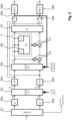
- a demultiplexer 201 is adapted to extract these MDCT representations and the prediction coefficient (part of Control information as indicated in the figure) from the bit stream that is supplied to it.
- TNS information may include values of the TNS parameters to be applied by the TNS (synthesis) filters of the decoder system. If identical sets of TNS parameters are to be used for several TNS filters, such as for both channels, it is economical receive this information in the form of a bit indicating such identity of the parameter sets rather than receiving the two sets of parameters independently. Information may also be included whether to apply TNS before or after the upmix stage, as appropriate based on, e.g., a psycho-acoustic evaluation of the two available options.
- control information may indicate individually limited bandwidths for the downmix and residual signals.
- frequency bands above a bandwidth limit will not be decoded but will be set to zero.
- the highest frequency bands have so small energy content that they are already quantized down to zero.
- Normal practice cf. the parameter max_sfb in the MPEG standard
- the residual signal to a greater extent than the downmix signal, has its energy content localized to lower frequency bands. Therefore, by placing a dedicated upper bandwidth limit on the residual signal, a bit-rate reduction is possible at no significant loss of quality. For instance, this may be governed by two independent max_sfb parameters encoded in the bit stream, one for the downmix signal and one for the residual signal.
- the MDCT representation of the stereo signal is segmented into successive time frames (or time blocks) comprising a fixed number of data points (e.g., 1024 points), one of several fixed numbers of data points (e.g., 128 or 1024 points) or a variable number of points.
- the MDCT is critically sampled.
- the output of the decoding system indicated in the right part of the drawing, is a time-domain stereo signal having left L and right R channels.
- Dequantization modules 202 are adapted to handle the bit stream input to the decoding system or, where appropriate, two bit streams obtained after demultiplexing of an original bit stream and corresponding to each of the downmix and residual channels.
- the dequantized channel signals are provided to a switching assembly 203 operable either in a pass-through mode or a sum-and-difference mode corresponding to the respective transformation matrices 1 0 0 1 and 1 2 1 1 1 ⁇ 1 .
- the decoder system includes a second switching assembly 205. Both switching assemblies 203, 205, like most other switches and switching assemblies in this embodiment and the embodiments to be described, are operable in a frequency-selective fashion. This enables decoding of a large variety of decoding modes, e.g., decoding frequency-dependent L/R or M/S decoding, as known in the related art. Hence, the decoder according to the invention can be regarded as a superset in relation to the related art.
- the dequantized channel signals are passed, in this embodiment, through respective TNS filters 204.
- the TNS filters 204 are not essential to the operation of the decoding system and may be replaced by pass-through elements.
- the signal is supplied to the second switching assembly 205 having the same functionality as the switching assembly 203 located upstream. With inputs signals as previously described and with the second switching assembly 205 set in its pass-through mode is, the output of the former is the downmix channel signal and the residual channel signal.
- the downmix signal still represented by its time-successive MDCT spectra, is supplied to a real-to-imaginary transform 206 adapted to compute, based thereon, MDST spectra of the downmix signal.
- one MDST frame is based on three MDCT frames, one previous frame, one current (or contemporaneous) frame and one subsequent frame. It is indicated symbolically ( Z -1 , Z ) that the input side of the real-to-imaginary transform 206 comprises delay components.
- the MDST representation of the downmix signal obtained from the real-to-imaginary transform 206 is weighted by the imaginary part ⁇ I of the prediction coefficient and is added to the MDCT representation of the downmix signal weighted by the real part ⁇ R of the prediction coefficient and the MDCT representation of the residual signal.
- the two additions and multiplications are performed by multipliers and adders 210, 211, together forming (functionally) a weighted adder, which are supplied with the value of the complex prediction coefficient ⁇ encoded in the bit stream initially received by the decoder system.
- the complex prediction coefficient may be determined once for every time frame. It may also be determined more often, such as once for every frequency band within a frame, the frequency bands being a psycho-acoustically motivated partition.
- the real-to-imaginary transform 206 is synchronized with the weighted adder in such manner that a current MDST frame of the downmix channel signal is combined with one contemporaneous MDCT frames of each of the downmix channel signal and the residual channel signal.
- the last step of the decoding system is to apply an inverse MDCT 209 to each of the channels, whereby a time-domain representation of the left/right stereo signal is obtained.
- h I,III ,h II are impulse responses depending on the window function applied, and are therefore determined for each choice of window function, such as rectangular, sinusoidal and Kaiser-Bessel-derived, and for each frame length.
- the complexity of this computation may be reduced by omitting those impulse responses which have a relatively smaller energy content and contribute relatively less to the MDST data.
- the impulse responses themselves may be shortened, e.g., from the full frame length N to smaller number of points.
- the impulse response length may be decreased from 1024 points (taps) to 10 points.
- Other straightforward approaches can be found in US 2005/0197831 A1 .
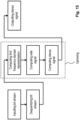
- the real-to-imaginary transform 206 and its upstream connections which are indicated as a portion denoted by "A" on the drawing, be replaced by a simplified variant, two of which A' and A" are shown in figure 10 .
- the variant A' provides an approximate imaginary representation of the signal.
- this approximation somewhat reduces the accuracy of the MDST signal obtained, but may also imply that the energy of this signal becomes reduced; the latter fact can be fully compensated by an increase in ⁇ , as a result of the nature of prediction coding.
- variant A which uses as input only the MDCT data for the current time frame.
- Variant A arguably produces a less accurate MDST representation than variant A'.
- it operates at zero delay, just like variant A', and has lower computational complexity.
- the waveform coding properties are not affected as long as the same approximation is used in the encoder system and the decoder system.
- the real-to-imaginary transform 206 is adapted to respond to occurrences of very small
- any units upstream of the transform 206 should suitably continue operating even though no MDST spectrum is needed - in particular, the second switching assembly 205 should keep forwarding MDCT spectra - so that sufficient input data are already available to the real-to-imaginary transform 206 already when the next time frame associated with a non-zero prediction coefficient occurs; this may of course be the next time block.
- the decoder system can as well decode signals that are not prediction coded.
- the second switching assembly 205 will be set in its sum-and-difference mode and suitably, as indicated on the drawing, a selector arrangement 208 will be set in its lower position, thereby ensuring that signals are fed directly to the inverse transform 209 from a source point between the TNS filters 204 and the second switching assembly 205.
- the signal suitably has L/R form at the source point.
- the second switching assembly 205 is preferably set in its sum-and-difference mode during decoding of a non-prediction-coded stereo signal.
- prediction coding may be replaced by conventional direct or joint coding for certain frames based on, e.g., a data rate-to-audio quality decision. The outcome of such decision may be communicated from the encoder to the decoder in various ways, e.g., by the value of a dedicated indicator bit in each frame, or by the absence or presence of a value of the prediction coefficient.
- the role of the first switching assembly 203 can be easily realized. Indeed, in non-prediction coding mode, the decoder system can process both signals according to direct (L/R) stereo coding or joint (M/S) coding, and by operating the first switching assembly 203 either in pass-through or sum-and-difference mode, it is possible to ensure that the source point is always provided with a directly coded signal. Clearly, the switching assembly 203 when functioning as sum-and-difference stage will convert an input signal in M/S form into an output signal (supplied to the optional TNS filters 204) in L/R form.
- the decoder system receives a signal whether a particular time frame is to be decoded by the decoder system in prediction-coding or non-prediction-coding mode.
- Non-prediction mode may be signaled by the value of a dedicated indicator bit in each frame or by the absence (or the value zero) of the prediction coefficient.
- Prediction mode may be communicated analogously.
- a particularly advantageous implementation which enables fallback without any overhead, makes use of a reserved fourth value of the two-bit field ms_mask_present (see MPEG-2 AAC, document ISO/IEC 13818-7), which is transmitted per time frame and defined as follows: Table 1: Definition of ms_mask_present in USAC Value Meaning 00 L/R coding for all frequency bands 01 one signaling bit per band is used to indicate L/R or M/S 10 M/S coding for all frequency bands 11 reserved By redefining the value 11 to mean "complex prediction coding", the decoder can be operated in all legacy modes, particularly M/S and L/R coding, without any bit-rate penalty and is yet able to receive a signal indicating complex prediction coding mode for the relevant frames.
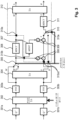
- Figure 4 shows a decoder system of the same general structure as the one shown in figure 2 but including, however, at least two different structures.
- the system of figure 4 includes switches 404, 411 enabling the application of some processing step involving frequency-domain modification upstream and/or downstream of the upmix stage. This is achieved, on the one hand, by a first set of frequency-domain modifiers 403 (drawn as TNS synthesis filters in this figure) provided together with the first switch 404 downstream of dequantization modules 401 and a first switching assembly 402 but upstream of a second switching assembly 405 arranged immediately upstream of the upmix stage 406, 407, 408, 409.
- a first set of frequency-domain modifiers 403 (drawn as TNS synthesis filters in this figure) provided together with the first switch 404 downstream of dequantization modules 401 and a first switching assembly 402 but upstream of a second switching assembly 405 arranged immediately upstream of the upmix stage 406, 407, 408, 409.
- the decoder system includes a second set of frequency-domain modifiers 410 provided together with a second switch 411 downstream of the upmix stage 406, 407, 408, 409 but upstream of an inverse transform stage 412.
- each frequency-domain modifier is arranged in parallel with a pass-through line which is connected upstream to the input side of the frequency-domain modifier and is connected downstream to the associated switch.
- the first switching assembly 302 is set in its pass-through mode and the second switches 305, 310 are set in the upper position.
- the two channels of the (dequantized, TNS-filtered, MDCT) stereo signal are processed in different ways.
- the downmix channel is provided, on the one hand, to a multiplier and summer 308, which adds the MDCT representation of the downmix channel weighted by the real part ⁇ R of the prediction coefficient to the MDCT representation of the residual channel, and, on the other hand, to one 306 of the inverse MDCT transform modules.
- figure 14C shows an configuration in which the stereo signal from the combined demultiplexer and dequantization module 1430 is initially processed by the first frequency-domain modifying device 1431, is then supplied to the upmix stage 1433 and is finally forwarded directly an inverse MDCT module 1437, without passing through the second frequency-domain modifying device 1435.
- this configuration is preferred over the option of performing TNS after upmixing in complex prediction coding.
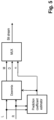
- FIG. 5 is a generalized block diagram of an encoder system for encoding a left/right (L/R) stereo signal as an output bit stream by complex prediction coding.
- the encoder system receives a time-domain or frequency-domain representation of the signal and supplies this to both a downmix stage and a prediction coefficient estimator.
- the real and imaginary parts of the prediction coefficients are provided to the downmix stage in order to govern the conversion of the left and right channels into downmix and residual channels, which are then supplied to a final multiplexer MUX. If the signal was not supplied as a frequency-domain representation to the encoder, it is transformed into such representation in the downmix stage or multiplexer.
- the real and imaginary parts ⁇ R , ⁇ I of the prediction coefficient may be quantized and/or coded jointly. Preferably however, the real and imaginary parts are quantized independently and uniformly, typically with a step size of 0.1 (dimensionless number).
- the frequency-band resolution used for the complex prediction coefficient is not necessarily the same as the resolution for scale factors bands ( sfb ; i.e., a group of MDCT lines that are using the same MDCT quantization step size and quantization range) according to the MPEG standard.
- the frequency-band resolution for the prediction coefficient may be one that is psycho-acoustically justified, such as the Bark scale. It is noted that the frequency-band resolution may vary in cases the transform length varies.
- a particularly advantageous implementation which enables fallback without any overhead, makes use of a reserved fourth value of the two-bit field ms_mask_present (see MPEG-2 AAC, document ISO/IEC 131818-7), which is transmitted per time frame and defined as follows: Table 1: Definition of ms_mask_present in USAC Value Meaning 00 L/R coding for all frequency bands 01 one signaling bit per band is used to indicate L/R or M/S 10 M/S coding for all frequency bands 11 reserved By redefining the value 11 to mean "complex prediction coding", the encoder can be operated in all legacy modes, particularly M/S and L/R coding, without any bit-rate penalty and is yet able to signal complex prediction coding for those frames where it is advantageous.
- the substantive decision may be based on a data rate-to-audio quality rationale.
- a quality measure data obtained using a psychoacoustic model included in the encoder (as is often the case of available MDCT-based audio encoders) may be used.
- some embodiments of the encoder provides a rate-distortion optimized selection of the prediction coefficient. Accordingly, in such embodiments, the imaginary part - and possibly the real part too - of the prediction coefficient is set to zero if the increase in prediction gain does not economize enough bits for the coding of the residual signal to justify spending the bits required for coding the prediction coefficient.
- Embodiments of the encoder may encode information relating to TNS in the bit stream. Such information may include values of the TNS parameters to be applied by the TNS (synthesis) filters on the decoder side. If identical sets of TNS parameters are to be used for both channels, it is economical to include a signaling bit indicating this identity of the parameter sets rather than to transmit the two sets of parameters independently. Information may also be included whether to apply TNS before or after the upmix stage, as appropriate based on, e.g., a psychoacoustic evaluation of the two available options.
- the encoder may be adapted to use an individually limited bandwidth for the encoding of the residual signal. Frequency bands above this limit will not be transmitted to the decoder but will be set to zero. In certain cases, the highest frequency bands have so small energy content that they are already quantized down to zero. Normal practice (cf. the parameter max_sfb in the MPEG standard) has entailed using the same bandwidth limitation for both the downmix and residual signals. Now, the inventors have found empirically that the residual signal, to a greater extent than the downmix signal, has its energy content localized to lower frequency bands.
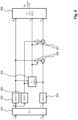
- Figure 6 shows another encoder system according to the invention adapted to perform complex prediction stereo coding.
- the system receives as input a time-domain representation of a stereo signal segmented into successive, possibly overlapping, time frames and comprising left and right channels.
- a sum-and-difference stage 601 converts the signal into mid and side channels.
- the mid channel is supplied to both an MDCT module 602 and an MDST module 603, while the side channel is supplied to an MDCT module 604 only.
- a prediction coefficient estimator 605 estimates for each time frame - and possibly for individual frequency bands within a frame - a value of the complex prediction coefficient ⁇ as explained above.
- the value of the coefficient ⁇ is supplied as weight to weighted summers 606, 607, which form a residual signal D as a linear combination of the MDCT and MDST representations of the mid signal and the MDCT representation of the side signal.
- the complex prediction coefficient is supplied to the weighted summers 606, 607 represented by the same quantization scheme which will be used when it is encoded into the bit stream; this obviously provides more faithful reconstruction, as both encoder and decoder applies the same value of the prediction coefficient.
- the residual signal, the mid signal (which may be more appropriately called downmix signal when it appears in combination with a residual signal) and the prediction coefficient are supplied to a combined quantization and multiplexer stage 608, which encodes these and possible additional information as an output bit stream.
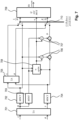
- Figure 7 shows a variation to the encoder system of figure 6 . As is clear from the similarity of symbols in the figure, it has as similar structure but also the added functionality of operating in a direct L/R coding fallback mode.
- the encoder system is actuated between the complex prediction coding mode and the fallback mode by means of a switch 710 provided immediately upstream of the combined quantization and multiplexer stage 709. In its upper position, as shown in the figure, the switch 710 will cause the encoder to operate in the fallback mode.
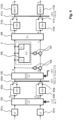
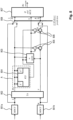
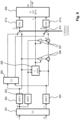
- Figure 8 shows an encoder system according to the present invention.
- this embodiment derives the MDST data required for the complex prediction coding directly from the MDCT data, that is, by a real-to-imaginary transform in the frequency domain.
- the real-to-imaginary transform applies any of the approaches discussed in connection with the decoder systems of figures 2 and 4 . It is important to match the computation method of the decoder with that of the encoder, so that faithful decoding can be achieved; preferably, identical real-to-imaginary transform methods are used on the encoder side and the decoder side.
- the portion A enclosed by a dashed line and comprising the real-to-imaginary transform 804 can be replaced by approximate variants or using fewer input time frames as input.
- the coding may be simplified using any one of the other approximation approaches described above.
- the encoder system of figure 8 has a structure differing from that which would probably follow by a straightforward action of replacing the MDST module in figure 7 by a (suitably connected) real-to-imaginary module.
- the present architecture is clean and achieves the functionality of switching between prediction coding and direct L/R coding in a robust and computationally economical manner.
- the input stereo signal is fed to MDCT transform modules 801, which output a frequency-domain representation of each channel. This is fed both to a final switch 808 for actuating the encoder system between its prediction and direct coding modes and to a sum-and-difference stage 802.
- a further weighted summer 805 is used to combine the side signal with weighted MDCT and MDST representations of the mid signal to form a residual channel signal, which is encoded together with the mid (i.e., downmix) channel signal and the prediction coefficient by the combined quantization and multiplexer module 807.
- each of the embodiments of the encoder system may be combined with one or more TNS (analysis) filters.
- TNS analysis
- the adaptation of the encoder system of figure 7 to include TNS is effected by adding TNS filters 911 immediately upstream of the combined quantization and multiplexer module 909.
- TNS filters are but one example of frequency-domain modifying devices, notably devices basing their processing on more frame than the current one, which may benefit from such a placement as much as or more than at TNS filter does.
- TNS filters for selective activation can be arranged at more than one point for each channel. This is similar to the structure of the decoder system shown in figure 4 , where different sets of TNS filters can be connected by means of switches. This allows selection of the most suitable available stage for TNS filtering for each time frame. In particular, it may be advantageous to switch between different TNS locations in connection with switching between complex prediction stereo coding and other coding modes.
- Figure 11 shows a variation based on the encoder system of figure 8 , in which a second frequency-domain representation of the downmix signal is derived by means of a real-to-imaginary transform 1105.
- this encoder system also includes selectively activable frequency-domain modifier modules, one 1102 provided upstream of the downmix stage and one 1109 provided downstream thereof.
- the frequency-domain modules 1102, 1109 which have in this figure been exemplified by TNS filters, can be connected into each of the signal paths using the four switches 1103a, 1103b, 1109a and 1109b.
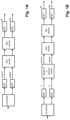
- FIG. 15 shows a method for decoding a bit stream into a stereo signal, comprising the following steps:
- Figure 16 shows a method for encoding a stereo signal as a bit stream signal, comprising the following steps:
- Both methods may be expressed as computer-readable instructions in the form of software programs and may be executed by a computer.
- the scope of protection of this invention extends to such software and computer-program products for distributing such software.
- the listening tests were accomplished according to the MUSHRA methodology, entailing in particular playback over headphones and the use of 8 test items with a sampling rate of 48 kHz. Three, five or six test subjects participated in each test.
- the invention may be embodied as a decoder system for decoding a bit stream signal into a stereo signal by complex prediction stereo coding, the decoder system comprising:
- the invention may be embodied as a decoder system for decoding a bit stream signal into a stereo signal by complex prediction stereo coding, the decoder system comprising:
- the invention may be embodied as a decoder system with the features set forth in the independent decoder system claim, wherein the module for computing a second frequency-domain representation of the downmix signal comprises:
- the stereo signal may be represented in the time domain and the decoder system may further comprise:
- any signals, parameters and matrices mentioned in connections with the described embodiments may be frequency-variant or frequency-invariant and/or time-variant or time-invariant.
- the described computing steps may be carried out frequency-wise or for all frequency bands at a time, and all entities may be embodied to have a frequency-selective action.
- any quantization schemes may be adapted according to psycho-acoustic models.
- the systems and methods disclosed hereinabove may be implemented as software, firmware, hardware or a combination thereof. Certain components or all components may be implemented as software executed by a digital signal processor or microprocessor, or be implemented as hardware or as an application-specific integrated circuit. Such software may be distributed on computer readable media, which may comprise computer storage media and communication media. As is well known to a person skilled in the art, computer storage media includes both volatile and nonvolatile, removable and non-removable media implemented in any method or technology for storage of information such as computer readable instructions, data structures, program modules or other data.
Landscapes
- Engineering & Computer Science (AREA)
- Physics & Mathematics (AREA)
- Multimedia (AREA)
- Signal Processing (AREA)
- Acoustics & Sound (AREA)
- Health & Medical Sciences (AREA)
- Audiology, Speech & Language Pathology (AREA)
- Human Computer Interaction (AREA)
- Computational Linguistics (AREA)
- Spectroscopy & Molecular Physics (AREA)
- Mathematical Physics (AREA)
- General Physics & Mathematics (AREA)
- Theoretical Computer Science (AREA)
- General Health & Medical Sciences (AREA)
- General Engineering & Computer Science (AREA)
- Compression, Expansion, Code Conversion, And Decoders (AREA)
- Stereophonic System (AREA)
- Compression Or Coding Systems Of Tv Signals (AREA)
- Stereo-Broadcasting Methods (AREA)
- Semiconductor Integrated Circuits (AREA)
Priority Applications (1)
| Application Number | Priority Date | Filing Date | Title |
|---|---|---|---|
| EP25182908.1A EP4593010A3 (fr) | 2010-04-09 | 2011-04-06 | Décodage stéréo à prédiction complexe à base de mdct |
Applications Claiming Priority (5)
| Application Number | Priority Date | Filing Date | Title |
|---|---|---|---|
| US32245810P | 2010-04-09 | 2010-04-09 | |
| EP19184726.8A EP3582217B1 (fr) | 2010-04-09 | 2011-04-06 | Codage stéréo à l'aide d'un mode de prédiction ou d'un mode de non-prédiction |
| PCT/EP2011/055350 WO2011124608A1 (fr) | 2010-04-09 | 2011-04-06 | Codage stéréo à prédiction complexe à base de mdct |
| EP22188294.7A EP4120246B1 (fr) | 2010-04-09 | 2011-04-06 | Décodage à prédiction complexe à base de mdct |
| EP11713754.7A EP2556503B1 (fr) | 2010-04-09 | 2011-04-06 | Codage stereo avec prédiction complexe assis sur mdct |
Related Parent Applications (4)
| Application Number | Title | Priority Date | Filing Date |
|---|---|---|---|
| EP22188294.7A Division EP4120246B1 (fr) | 2010-04-09 | 2011-04-06 | Décodage à prédiction complexe à base de mdct |
| EP22188294.7A Division-Into EP4120246B1 (fr) | 2010-04-09 | 2011-04-06 | Décodage à prédiction complexe à base de mdct |
| EP19184726.8A Division EP3582217B1 (fr) | 2010-04-09 | 2011-04-06 | Codage stéréo à l'aide d'un mode de prédiction ou d'un mode de non-prédiction |
| EP11713754.7A Division EP2556503B1 (fr) | 2010-04-09 | 2011-04-06 | Codage stereo avec prédiction complexe assis sur mdct |
Related Child Applications (1)
| Application Number | Title | Priority Date | Filing Date |
|---|---|---|---|
| EP25182908.1A Division EP4593010A3 (fr) | 2010-04-09 | 2011-04-06 | Décodage stéréo à prédiction complexe à base de mdct |
Publications (4)
| Publication Number | Publication Date |
|---|---|
| EP4481730A2 true EP4481730A2 (fr) | 2024-12-25 |
| EP4481730A3 EP4481730A3 (fr) | 2025-01-08 |
| EP4481730C0 EP4481730C0 (fr) | 2025-06-25 |
| EP4481730B1 EP4481730B1 (fr) | 2025-06-25 |
Family
ID=43952840
Family Applications (17)
| Application Number | Title | Priority Date | Filing Date |
|---|---|---|---|
| EP26166489.0A Pending EP4738350A3 (fr) | 2010-04-09 | 2011-04-06 | Codage stereo de prediction complexe base sur mdct |
| EP19184726.8A Active EP3582217B1 (fr) | 2010-04-09 | 2011-04-06 | Codage stéréo à l'aide d'un mode de prédiction ou d'un mode de non-prédiction |
| EP18206652.2A Active EP3474278B1 (fr) | 2010-04-09 | 2011-04-06 | Décodage stéréo à prédiction complexe à base de mdct |
| EP20200782.9A Active EP3799043B8 (fr) | 2010-04-09 | 2011-04-06 | Décodage stéréo à prédiction complexe à base de mdct |
| EP11714256.2A Active EP2556504B1 (fr) | 2010-04-09 | 2011-04-06 | Codage stereo avec prédiction complexe en base de mdct |
| EP24201777.0A Active EP4459881B1 (fr) | 2010-04-09 | 2011-04-06 | Codage stereo de prediction complexe base sur mdct |
| EP11713754.7A Active EP2556503B1 (fr) | 2010-04-09 | 2011-04-06 | Codage stereo avec prédiction complexe assis sur mdct |
| EP22188294.7A Active EP4120246B1 (fr) | 2010-04-09 | 2011-04-06 | Décodage à prédiction complexe à base de mdct |
| EP20184885.0A Active EP3739577B1 (fr) | 2010-04-09 | 2011-04-06 | Codage stéréo à prédiction complexe à base de mdct |
| EP22190159.8A Active EP4120247B1 (fr) | 2010-04-09 | 2011-04-06 | Codage stéréo à prédiction complexe à base de mdct |
| EP24170668.8A Active EP4376000B1 (fr) | 2010-04-09 | 2011-04-06 | Decodage stereo de prediction complexe base sur mdct |
| EP26182750.5A Pending EP4776281A2 (fr) | 2010-04-09 | 2011-04-06 | Codage stereo de prediction complexe base sur mdct |
| EP22188499.2A Active EP4116969B1 (fr) | 2010-04-09 | 2011-04-06 | Codage stéréo à prédiction complexe à base de mdct |
| EP25182908.1A Pending EP4593010A3 (fr) | 2010-04-09 | 2011-04-06 | Décodage stéréo à prédiction complexe à base de mdct |
| EP18206651.4A Active EP3474277B1 (fr) | 2010-04-09 | 2011-04-06 | Système de décodeur, méthode de décodage et programme d'ordinateur correspondant |
| EP24212301.6A Active EP4481730B1 (fr) | 2010-04-09 | 2011-04-06 | Décodage stéréo à prédiction complexe à base de mdct |
| EP11713259.7A Active EP2556502B1 (fr) | 2010-04-09 | 2011-04-06 | Décodage stéreo avec prédiction complexe basé sur mdct |
Family Applications Before (15)
| Application Number | Title | Priority Date | Filing Date |
|---|---|---|---|
| EP26166489.0A Pending EP4738350A3 (fr) | 2010-04-09 | 2011-04-06 | Codage stereo de prediction complexe base sur mdct |
| EP19184726.8A Active EP3582217B1 (fr) | 2010-04-09 | 2011-04-06 | Codage stéréo à l'aide d'un mode de prédiction ou d'un mode de non-prédiction |
| EP18206652.2A Active EP3474278B1 (fr) | 2010-04-09 | 2011-04-06 | Décodage stéréo à prédiction complexe à base de mdct |
| EP20200782.9A Active EP3799043B8 (fr) | 2010-04-09 | 2011-04-06 | Décodage stéréo à prédiction complexe à base de mdct |
| EP11714256.2A Active EP2556504B1 (fr) | 2010-04-09 | 2011-04-06 | Codage stereo avec prédiction complexe en base de mdct |
| EP24201777.0A Active EP4459881B1 (fr) | 2010-04-09 | 2011-04-06 | Codage stereo de prediction complexe base sur mdct |
| EP11713754.7A Active EP2556503B1 (fr) | 2010-04-09 | 2011-04-06 | Codage stereo avec prédiction complexe assis sur mdct |
| EP22188294.7A Active EP4120246B1 (fr) | 2010-04-09 | 2011-04-06 | Décodage à prédiction complexe à base de mdct |
| EP20184885.0A Active EP3739577B1 (fr) | 2010-04-09 | 2011-04-06 | Codage stéréo à prédiction complexe à base de mdct |
| EP22190159.8A Active EP4120247B1 (fr) | 2010-04-09 | 2011-04-06 | Codage stéréo à prédiction complexe à base de mdct |
| EP24170668.8A Active EP4376000B1 (fr) | 2010-04-09 | 2011-04-06 | Decodage stereo de prediction complexe base sur mdct |
| EP26182750.5A Pending EP4776281A2 (fr) | 2010-04-09 | 2011-04-06 | Codage stereo de prediction complexe base sur mdct |
| EP22188499.2A Active EP4116969B1 (fr) | 2010-04-09 | 2011-04-06 | Codage stéréo à prédiction complexe à base de mdct |
| EP25182908.1A Pending EP4593010A3 (fr) | 2010-04-09 | 2011-04-06 | Décodage stéréo à prédiction complexe à base de mdct |
| EP18206651.4A Active EP3474277B1 (fr) | 2010-04-09 | 2011-04-06 | Système de décodeur, méthode de décodage et programme d'ordinateur correspondant |
Family Applications After (1)
| Application Number | Title | Priority Date | Filing Date |
|---|---|---|---|
| EP11713259.7A Active EP2556502B1 (fr) | 2010-04-09 | 2011-04-06 | Décodage stéreo avec prédiction complexe basé sur mdct |
Country Status (19)
| Country | Link |
|---|---|
| US (20) | US9159326B2 (fr) |
| EP (17) | EP4738350A3 (fr) |
| JP (24) | JP5813094B2 (fr) |
| KR (15) | KR101698439B1 (fr) |
| CN (6) | CN102884570B (fr) |
| AU (3) | AU2011237877B2 (fr) |
| BR (6) | BR122019013299B1 (fr) |
| CA (16) | CA3045686C (fr) |
| DK (2) | DK2556502T3 (fr) |
| ES (12) | ES3002807T3 (fr) |
| FI (1) | FI4376000T3 (fr) |
| IL (22) | IL303558B2 (fr) |
| MX (3) | MX2012011530A (fr) |
| MY (5) | MY209178A (fr) |
| PL (2) | PL2556504T3 (fr) |
| RU (6) | RU2683175C2 (fr) |
| SG (4) | SG10202101745XA (fr) |
| TR (2) | TR201901336T4 (fr) |
| WO (3) | WO2011124608A1 (fr) |
Families Citing this family (85)
| Publication number | Priority date | Publication date | Assignee | Title |
|---|---|---|---|---|
| CA3045686C (fr) * | 2010-04-09 | 2020-07-14 | Dolby International Ab | Melangeur elevateur audio fonctionnel en mode de prediction ou de non-prediction |
| EP2375409A1 (fr) * | 2010-04-09 | 2011-10-12 | Fraunhofer-Gesellschaft zur Förderung der angewandten Forschung e.V. | Codeur audio, décodeur audio et procédés connexes pour le traitement de signaux audio multicanaux au moyen d'une prédiction complexe |
| ES3066502T3 (en) * | 2010-04-13 | 2026-05-13 | Fraunhofer Ges Forschung | Audio decoding method for processing stereo audio signals using a variable prediction direction |
| WO2012150482A1 (fr) * | 2011-05-04 | 2012-11-08 | Nokia Corporation | Codage de signaux stéréophoniques |
| US8798180B1 (en) * | 2011-11-16 | 2014-08-05 | Marvell International Ltd. | Method and apparatus for transmitting time domain signals over a network |
| JP5949270B2 (ja) * | 2012-07-24 | 2016-07-06 | 富士通株式会社 | オーディオ復号装置、オーディオ復号方法、オーディオ復号用コンピュータプログラム |
| PL2883225T3 (pl) | 2012-08-10 | 2017-10-31 | Fraunhofer Ges Forschung | Koder, dekoder, układ i sposób, wykorzystujące koncepcje resztki dla parametrycznego kodowania obiektów audio |
| KR101726205B1 (ko) * | 2012-11-07 | 2017-04-12 | 돌비 인터네셔널 에이비 | 감소된 복잡성 변환기 snr 계산 |
| SG11201505922XA (en) | 2013-01-29 | 2015-08-28 | Fraunhofer Ges Forschung | Low-complexity tonality-adaptive audio signal quantization |
| WO2014126689A1 (fr) | 2013-02-14 | 2014-08-21 | Dolby Laboratories Licensing Corporation | Procédés pour contrôler la cohérence inter-canaux de signaux audio mélangés |
| TWI618050B (zh) | 2013-02-14 | 2018-03-11 | 杜比實驗室特許公司 | 用於音訊處理系統中之訊號去相關的方法及設備 |
| WO2014126688A1 (fr) | 2013-02-14 | 2014-08-21 | Dolby Laboratories Licensing Corporation | Procédés de détection transitoire et de commande de décorrélation de signal audio |
| CN122531400A (zh) | 2013-02-21 | 2026-08-07 | 杜比国际公司 | 用于参数化多声道编码的方法 |
| TWI546799B (zh) | 2013-04-05 | 2016-08-21 | 杜比國際公司 | 音頻編碼器及解碼器 |
| RU2645271C2 (ru) | 2013-04-05 | 2018-02-19 | Долби Интернэшнл Аб | Стереофонический кодер и декодер аудиосигналов |
| ES2643789T3 (es) | 2013-05-24 | 2017-11-24 | Dolby International Ab | Codificación eficiente de escenas de audio que comprenden objetos de audio |
| EP2973551B1 (fr) | 2013-05-24 | 2017-05-03 | Dolby International AB | Reconstruction de scènes audio à partir d'un signal de mixage réducteur |
| MY199032A (en) | 2013-05-24 | 2023-10-10 | Dolby Int Ab | Audio encoder and decoder |
| WO2014187990A1 (fr) | 2013-05-24 | 2014-11-27 | Dolby International Ab | Codage efficace de scènes audio comprenant des objets audio |
| CA3017077C (fr) | 2013-05-24 | 2021-08-17 | Dolby International Ab | Codage de scenes audio |
| EP2824661A1 (fr) * | 2013-07-11 | 2015-01-14 | Thomson Licensing | Procédé et appareil de génération à partir d'une représentation dans le domaine des coefficients de signaux HOA et représentation dans un domaine mixte spatial/coefficient de ces signaux HOA |
| CN109887520B (zh) * | 2013-07-18 | 2022-12-02 | 日本电信电话株式会社 | 线性预测分析装置、线性预测分析方法以及记录介质 |
| EP2830053A1 (fr) * | 2013-07-22 | 2015-01-28 | Fraunhofer-Gesellschaft zur Förderung der angewandten Forschung e.V. | Décodeur audio multicanal, codeur audio multicanal, procédés et programme informatique utilisant un ajustement basé sur un signal résiduel d'une contribution d'un signal décorrélé |
| EP2830061A1 (fr) | 2013-07-22 | 2015-01-28 | Fraunhofer Gesellschaft zur Förderung der angewandten Forschung e.V. | Appareil et procédé permettant de coder et de décoder un signal audio codé au moyen de mise en forme de bruit/ patch temporel |
| EP2830051A3 (fr) * | 2013-07-22 | 2015-03-04 | Fraunhofer-Gesellschaft zur Förderung der angewandten Forschung e.V. | Encodeur audio, décodeur audio, procédés et programme informatique utilisant des signaux résiduels codés conjointement |
| RU2639952C2 (ru) * | 2013-08-28 | 2017-12-25 | Долби Лабораторис Лайсэнзин Корпорейшн | Гибридное усиление речи с кодированием формы сигнала и параметрическим кодированием |
| CN111292757B (zh) | 2013-09-12 | 2024-05-24 | 杜比国际公司 | 基于qmf的处理数据的时间对齐 |
| EP3561809B1 (fr) * | 2013-09-12 | 2023-11-22 | Dolby International AB | Procédé de décodage et décodeur. |
| CN106165453A (zh) * | 2013-10-02 | 2016-11-23 | 斯托明瑞士有限责任公司 | 用于下混多通道信号和用于上混下混信号的方法和装置 |
| EP2879131A1 (fr) | 2013-11-27 | 2015-06-03 | Fraunhofer-Gesellschaft zur Förderung der angewandten Forschung e.V. | Décodeur, codeur et procédé pour estimation de sons informée des systèmes de codage audio à base d'objets |
| PL3462448T3 (pl) * | 2014-01-24 | 2020-08-10 | Nippon Telegraph And Telephone Corporation | Urządzenie, sposób i program do analizy liniowo-predykcyjnej oraz nośnik zapisu |
| EP2916319A1 (fr) * | 2014-03-07 | 2015-09-09 | Fraunhofer-Gesellschaft zur Förderung der angewandten Forschung e.V. | Concept pour le codage d'informations |
| CN110808056B (zh) * | 2014-03-14 | 2023-10-17 | 瑞典爱立信有限公司 | 音频编码方法和装置 |
| TWI794032B (zh) * | 2014-03-24 | 2023-02-21 | 瑞典商杜比國際公司 | 應用動態範圍壓縮至高階保真立體音響信號之方法和裝置 |
| EP3127109B1 (fr) | 2014-04-01 | 2018-03-14 | Dolby International AB | Codage efficace de scènes audio comprenant des objets audio |
| KR102196190B1 (ko) | 2014-04-10 | 2020-12-30 | 주식회사 만도 | 차량용 전자제어 브레이크 장치의 피스톤 펌프 어셈블리 |
| JP6270992B2 (ja) * | 2014-04-24 | 2018-01-31 | 日本電信電話株式会社 | 周波数領域パラメータ列生成方法、周波数領域パラメータ列生成装置、プログラム及び記録媒体 |
| KR101870947B1 (ko) | 2014-05-01 | 2018-06-25 | 니폰 덴신 덴와 가부시끼가이샤 | 부호화 장치, 복호 장치 및 그 방법, 프로그램, 기록 매체 |
| KR102655047B1 (ko) * | 2014-06-27 | 2024-04-08 | 돌비 인터네셔널 에이비 | Hoa 데이터 프레임 표현의 압축을 위해 비차분 이득 값들을 표현하는 데 필요하게 되는 비트들의 최저 정수 개수를 결정하는 방법 |
| JP6641304B2 (ja) * | 2014-06-27 | 2020-02-05 | ドルビー・インターナショナル・アーベー | 非差分的な利得値を表現するのに必要とされる最低整数ビット数をhoaデータ・フレーム表現の圧縮のために決定する装置 |
| CN105336334B (zh) * | 2014-08-15 | 2021-04-02 | 北京天籁传音数字技术有限公司 | 多声道声音信号编码方法、解码方法及装置 |
| KR102486338B1 (ko) * | 2014-10-31 | 2023-01-10 | 돌비 인터네셔널 에이비 | 멀티채널 오디오 신호의 파라메트릭 인코딩 및 디코딩 |
| US10424305B2 (en) * | 2014-12-09 | 2019-09-24 | Dolby International Ab | MDCT-domain error concealment |
| WO2016142002A1 (fr) | 2015-03-09 | 2016-09-15 | Fraunhofer-Gesellschaft Zur Foerderung Der Angewandten Forschung E.V. | Codeur audio, décodeur audio, procédé de codage de signal audio et procédé de décodage de signal audio codé |
| EP3067889A1 (fr) | 2015-03-09 | 2016-09-14 | Fraunhofer-Gesellschaft zur Förderung der angewandten Forschung e.V. | Procédé et appareil de commutation de noyau de transformée adaptive de signal en codage audio |
| TWI879690B (zh) | 2015-03-13 | 2025-04-01 | 瑞典商杜比國際公司 | 音訊處理單元、用於將經編碼的音訊位元流解碼之方法以及非暫態電腦可讀媒體 |
| EP3298606B1 (fr) * | 2015-05-20 | 2019-05-01 | Telefonaktiebolaget LM Ericsson (PUBL) | Codage de signaux audio multicanaux |
| US12125492B2 (en) | 2015-09-25 | 2024-10-22 | Voiceage Coproration | Method and system for decoding left and right channels of a stereo sound signal |
| RU2765565C2 (ru) * | 2015-09-25 | 2022-02-01 | Войсэйдж Корпорейшн | Способ и система для кодирования стереофонического звукового сигнала с использованием параметров кодирования первичного канала для кодирования вторичного канала |
| ES2727462T3 (es) * | 2016-01-22 | 2019-10-16 | Fraunhofer Ges Forschung | Aparatos y procedimientos para la codificación o decodificación de una señal multicanal de audio mediante el uso de repetición de muestreo de dominio espectral |
| SG11201806256SA (en) * | 2016-01-22 | 2018-08-30 | Fraunhofer Ges Forschung | Apparatus and method for mdct m/s stereo with global ild with improved mid/side decision |
| EP3208800A1 (fr) | 2016-02-17 | 2017-08-23 | Fraunhofer-Gesellschaft zur Förderung der angewandten Forschung e.V. | Appareil et procédé pour enregistrement stéréo dans un codage multi-canaux |
| US9959877B2 (en) * | 2016-03-18 | 2018-05-01 | Qualcomm Incorporated | Multi channel coding |
| EP3246923A1 (fr) | 2016-05-20 | 2017-11-22 | Fraunhofer-Gesellschaft zur Förderung der angewandten Forschung e.V. | Appareil et procédé de traitement d'un signal audio multicanal |
| US10217467B2 (en) * | 2016-06-20 | 2019-02-26 | Qualcomm Incorporated | Encoding and decoding of interchannel phase differences between audio signals |
| RU2628201C1 (ru) * | 2016-07-07 | 2017-08-15 | Самсунг Электроникс Ко., Лтд. | Способ адаптивного квантования для кодирования изображения радужной оболочки |
| RU2727799C1 (ru) | 2016-11-08 | 2020-07-24 | Фраунхофер-Гезелльшафт Цур Фердерунг Дер Ангевандтен Форшунг Е.Ф. | Устройство и способ понижающего или повышающего микширования многоканального сигнала с использованием фазовой компенсации |
| JP6817433B2 (ja) | 2016-11-08 | 2021-01-20 | フラウンホファー ゲセルシャフト ツール フェールデルンク ダー アンゲヴァンテン フォルシュンク エー.ファオ. | 少なくとも2つのチャンネルをダウンミックスするためのダウンミキサおよび方法ならびにマルチチャンネルエンコーダおよびマルチチャンネルデコーダ |
| US10210874B2 (en) * | 2017-02-03 | 2019-02-19 | Qualcomm Incorporated | Multi channel coding |
| US10475457B2 (en) | 2017-07-03 | 2019-11-12 | Qualcomm Incorporated | Time-domain inter-channel prediction |
| KR102392804B1 (ko) * | 2017-07-28 | 2022-04-29 | 프라운호퍼 게젤샤프트 쭈르 푀르데룽 데어 안겐반텐 포르슝 에. 베. | 인코딩된 다채널 신호를 광대역 필터에 의해 생성된 충전 신호를 사용하여 인코딩 또는 디코딩하는 장치 |
| US10553743B2 (en) | 2017-11-20 | 2020-02-04 | The Government Of The United States Of America, As Represented By The Secretary Of The Navy | Flexible crystalline ultra-thin Si solar cells |
| WO2019121982A1 (fr) | 2017-12-19 | 2019-06-27 | Dolby International Ab | Procédés et appareil pour des améliorations d'un système de transposition d'harmoniques de décodage de flux audio et vocal unifié |
| EP3729298A1 (fr) | 2017-12-19 | 2020-10-28 | Dolby International AB | Procédés, appareil et systèmes pour voix unifiée et améliorations de décodage et d'encodage audio |
| TWI812658B (zh) * | 2017-12-19 | 2023-08-21 | 瑞典商都比國際公司 | 用於統一語音及音訊之解碼及編碼去關聯濾波器之改良之方法、裝置及系統 |
| TWI895201B (zh) | 2018-01-26 | 2025-08-21 | 瑞典商都比國際公司 | 用於執行一音訊信號之高頻重建之方法、音訊處理單元及非暫時性電腦可讀媒體 |
| CN110556116B (zh) * | 2018-05-31 | 2021-10-22 | 华为技术有限公司 | 计算下混信号和残差信号的方法和装置 |
| CN110556119B (zh) | 2018-05-31 | 2022-02-18 | 华为技术有限公司 | 一种下混信号的计算方法及装置 |
| TWI681384B (zh) * | 2018-08-01 | 2020-01-01 | 瑞昱半導體股份有限公司 | 音訊處理方法與音訊等化器 |
| US11527252B2 (en) * | 2019-08-30 | 2022-12-13 | Fraunhofer-Gesellschaft zur Förderung der angewandten Forschung e.V. | MDCT M/S stereo |
| WO2021064413A1 (fr) * | 2019-10-02 | 2021-04-08 | V-Nova International Limited | Utilisation de signalisation intégrée pour des améliorations de mise à l'échelle rétrocompatible et une signalisation à très haute résolution |
| WO2021140791A1 (fr) * | 2020-01-09 | 2021-07-15 | パナソニック インテレクチュアル プロパティ コーポレーション オブ アメリカ | Dispositif de codage, dispositif de décodage, procédé de codage et procédé de décodage |
| JP7485037B2 (ja) | 2020-06-24 | 2024-05-16 | 日本電信電話株式会社 | 音信号復号方法、音信号復号装置、プログラム及び記録媒体 |
| EP4179529B1 (fr) | 2020-07-07 | 2024-10-30 | Fraunhofer-Gesellschaft zur Förderung der angewandten Forschung e.V. | Décodeur audio, codeur audio et procédés associés utilisant un codage conjoint de paramètres d'échelle pour des canaux d'un signal audio multicanal |
| JP7787169B2 (ja) | 2020-10-09 | 2025-12-16 | フラウンホーファー-ゲゼルシャフト・ツール・フェルデルング・デル・アンゲヴァンテン・フォルシュング・アインゲトラーゲネル・フェライン | パラメータ変換を用いて符号化されたオーディオシーンを処理するための装置、方法、またはコンピュータプログラム |
| AU2021357364B2 (en) | 2020-10-09 | 2024-06-27 | Fraunhofer-Gesellschaft zur Förderung der angewandten Forschung e.V. | Apparatus, method, or computer program for processing an encoded audio scene using a parameter smoothing |
| CA3194876A1 (fr) * | 2020-10-09 | 2022-04-14 | Franz REUTELHUBER | Appareil, procede ou programme informatique servant a traiter une scene audio encodee a l'aide d'une extension de bande passante |
| UA130176C2 (uk) | 2020-12-02 | 2025-12-03 | Долбі Лабораторіс Лайсензін Корпорейшн | Носій інформації та спосіб кодування звукового сигналу, в якому використовують стратегію понижувального мікшування |
| WO2022214480A1 (fr) | 2021-04-06 | 2022-10-13 | Dolby International Ab | Codage d'informations d'enveloppe d'un signal de mixage réducteur audio |
| CN115206332B (zh) * | 2021-04-12 | 2025-09-16 | 炬芯科技股份有限公司 | 一种音效的处理方法、装置、电子设备及存储介质 |
| KR20230004007A (ko) | 2021-06-30 | 2023-01-06 | 삼성전자주식회사 | 오디오 데이터에 오디오 효과의 중복 적용을 방지하는 방법 및 이를 지원하는 전자 장치 |
| US20250104721A1 (en) * | 2021-12-15 | 2025-03-27 | Electronics And Telecommunications Research Institute | Audio processing method using complex number data, and apparatus for performing same |
| KR20230121431A (ko) * | 2022-02-11 | 2023-08-18 | 한국전자통신연구원 | 복소 신호를 이용한 부호화 방법 및 부호화 장치, 그리고 복호화 방법 및 복호화 장치 |
| CN116320962B (zh) * | 2023-01-03 | 2026-06-12 | 蔚来汽车科技(安徽)有限公司 | 音频处理方法、装置、计算机设备和存储介质 |
| CN116913290A (zh) * | 2023-07-24 | 2023-10-20 | 上海交通大学宁波人工智能研究院 | 一种无速率编码及空间音频不等差错保护系统与方法 |
Citations (2)
| Publication number | Priority date | Publication date | Assignee | Title |
|---|---|---|---|---|
| US20050197831A1 (en) | 2002-07-26 | 2005-09-08 | Bernd Edler | Device and method for generating a complex spectral representation of a discrete-time signal |
| US6980933B2 (en) | 2004-01-27 | 2005-12-27 | Dolby Laboratories Licensing Corporation | Coding techniques using estimated spectral magnitude and phase derived from MDCT coefficients |
Family Cites Families (86)
| Publication number | Priority date | Publication date | Assignee | Title |
|---|---|---|---|---|
| US165587A (en) | 1875-07-13 | Improvement in vehicle-wheels | ||
| GB8913758D0 (en) * | 1989-06-15 | 1989-08-02 | British Telecomm | Polyphonic coding |
| US5812971A (en) * | 1996-03-22 | 1998-09-22 | Lucent Technologies Inc. | Enhanced joint stereo coding method using temporal envelope shaping |
| DE19747132C2 (de) * | 1997-10-24 | 2002-11-28 | Fraunhofer Ges Forschung | Verfahren und Vorrichtungen zum Codieren von Audiosignalen sowie Verfahren und Vorrichtungen zum Decodieren eines Bitstroms |
| RU2174714C2 (ru) | 1998-05-12 | 2001-10-10 | Научно-технический центр "Вычислительная техника" | Способ выделения основного тона |
| US6539357B1 (en) | 1999-04-29 | 2003-03-25 | Agere Systems Inc. | Technique for parametric coding of a signal containing information |
| DE19959156C2 (de) * | 1999-12-08 | 2002-01-31 | Fraunhofer Ges Forschung | Verfahren und Vorrichtung zum Verarbeiten eines zu codierenden Stereoaudiosignals |
| WO2003086017A2 (fr) | 2002-04-05 | 2003-10-16 | Koninklijke Philips Electronics N.V. | Traitement de signaux |
| JP4464101B2 (ja) * | 2003-10-10 | 2010-05-19 | キヤノン株式会社 | トランスポートストリーム編集方法及び装置 |
| BRPI0415951B1 (pt) | 2003-10-30 | 2018-08-28 | Coding Tech Ab | método e codificador de áudio para codificar um sinal de áudio, e, método e decodificador de áudio para decodificar um sinal de áudio codificado |
| KR20070001115A (ko) | 2004-01-28 | 2007-01-03 | 코닌클리케 필립스 일렉트로닉스 엔.브이. | 복소수 값 데이터를 이용하는 오디오 신호 디코딩 |
| DE102004007191B3 (de) | 2004-02-13 | 2005-09-01 | Fraunhofer-Gesellschaft zur Förderung der angewandten Forschung e.V. | Audiocodierung |
| DE102004009955B3 (de) | 2004-03-01 | 2005-08-11 | Fraunhofer-Gesellschaft zur Förderung der angewandten Forschung e.V. | Vorrichtung und Verfahren zum Ermitteln einer Quantisierer-Schrittweite |
| CN1677490A (zh) | 2004-04-01 | 2005-10-05 | 北京宫羽数字技术有限责任公司 | 一种增强音频编解码装置及方法 |
| US8843378B2 (en) | 2004-06-30 | 2014-09-23 | Fraunhofer-Gesellschaft Zur Foerderung Der Angewandten Forschung E.V. | Multi-channel synthesizer and method for generating a multi-channel output signal |
| TWI393121B (zh) | 2004-08-25 | 2013-04-11 | 杜比實驗室特許公司 | 處理一組n個聲音信號之方法與裝置及與其相關聯之電腦程式 |
| TWI498882B (zh) | 2004-08-25 | 2015-09-01 | Dolby Lab Licensing Corp | 音訊解碼器 |
| US8423372B2 (en) * | 2004-08-26 | 2013-04-16 | Sisvel International S.A. | Processing of encoded signals |
| US8204261B2 (en) | 2004-10-20 | 2012-06-19 | Fraunhofer-Gesellschaft Zur Foerderung Der Angewandten Forschung E.V. | Diffuse sound shaping for BCC schemes and the like |
| ES2791001T3 (es) | 2004-11-02 | 2020-10-30 | Koninklijke Philips Nv | Codificación y decodificación de señales de audio mediante el uso de bancos de filtros de valor complejo |
| SE0402649D0 (sv) | 2004-11-02 | 2004-11-02 | Coding Tech Ab | Advanced methods of creating orthogonal signals |
| SE0402652D0 (sv) | 2004-11-02 | 2004-11-02 | Coding Tech Ab | Methods for improved performance of prediction based multi- channel reconstruction |
| JP2008519306A (ja) * | 2004-11-04 | 2008-06-05 | コーニンクレッカ フィリップス エレクトロニクス エヌ ヴィ | 信号の組のエンコード及びデコード |
| US20110236902A1 (en) | 2004-12-13 | 2011-09-29 | Tyco Healthcare Group Lp | Testing a patient population having a cardiovascular condition for drug efficacy |
| US7573912B2 (en) * | 2005-02-22 | 2009-08-11 | Fraunhofer-Gesellschaft Zur Foerderung Der Angewandten Forschunng E.V. | Near-transparent or transparent multi-channel encoder/decoder scheme |
| WO2006091150A1 (fr) | 2005-02-23 | 2006-08-31 | Telefonaktiebolaget Lm Ericsson (Publ) | Lissage par filtre ameliore dans le codage et/ou le decodage audio multicanaux |
| WO2006091139A1 (fr) | 2005-02-23 | 2006-08-31 | Telefonaktiebolaget Lm Ericsson (Publ) | Attribution adaptative de bits pour le codage audio a canaux multiples |
| KR100736607B1 (ko) | 2005-03-31 | 2007-07-09 | 엘지전자 주식회사 | 오디오 부호화 방법 및 장치 |
| US7961890B2 (en) * | 2005-04-15 | 2011-06-14 | Fraunhofer-Gesellschaft Zur Foerderung Der Angewandten Forschung, E.V. | Multi-channel hierarchical audio coding with compact side information |
| US7751572B2 (en) | 2005-04-15 | 2010-07-06 | Dolby International Ab | Adaptive residual audio coding |
| ATE421845T1 (de) * | 2005-04-15 | 2009-02-15 | Dolby Sweden Ab | Zeitliche hüllkurvenformgebung von entkorrelierten signalen |
| AU2006266579B2 (en) * | 2005-06-30 | 2009-10-22 | Lg Electronics Inc. | Method and apparatus for encoding and decoding an audio signal |
| US7693709B2 (en) | 2005-07-15 | 2010-04-06 | Microsoft Corporation | Reordering coefficients for waveform coding or decoding |
| US7684981B2 (en) | 2005-07-15 | 2010-03-23 | Microsoft Corporation | Prediction of spectral coefficients in waveform coding and decoding |
| US7599840B2 (en) * | 2005-07-15 | 2009-10-06 | Microsoft Corporation | Selectively using multiple entropy models in adaptive coding and decoding |
| JP5108768B2 (ja) | 2005-08-30 | 2012-12-26 | エルジー エレクトロニクス インコーポレイティド | オーディオ信号をエンコーディング及びデコーディングするための装置とその方法 |
| EP1912206B1 (fr) | 2005-08-31 | 2013-01-09 | Panasonic Corporation | Dispositif de codage stereo, dispositif de decodage stereo et procede de codage stereo |
| US8259840B2 (en) | 2005-10-24 | 2012-09-04 | General Motors Llc | Data communication via a voice channel of a wireless communication network using discontinuities |
| US7831434B2 (en) * | 2006-01-20 | 2010-11-09 | Microsoft Corporation | Complex-transform channel coding with extended-band frequency coding |
| WO2007097549A1 (fr) | 2006-02-23 | 2007-08-30 | Lg Electronics Inc. | Procédé et appareil de traitement d'un signal audio |
| JP5154538B2 (ja) | 2006-03-29 | 2013-02-27 | コーニンクレッカ フィリップス エレクトロニクス エヌ ヴィ | オーディオ復号 |
| EP1853092B1 (fr) | 2006-05-04 | 2011-10-05 | LG Electronics, Inc. | Amélioration de signaux audio stéréo par capacité de remixage |
| US8027479B2 (en) | 2006-06-02 | 2011-09-27 | Coding Technologies Ab | Binaural multi-channel decoder in the context of non-energy conserving upmix rules |
| KR101435893B1 (ko) | 2006-09-22 | 2014-09-02 | 삼성전자주식회사 | 대역폭 확장 기법 및 스테레오 부호화 기법을 이용한오디오 신호의 부호화/복호화 방법 및 장치 |
| WO2008046531A1 (fr) * | 2006-10-16 | 2008-04-24 | Dolby Sweden Ab | Codage amélioré et représentation de paramètres d'un codage d'objet à abaissement de fréquence multi-canal |
| SG166095A1 (en) * | 2006-11-10 | 2010-11-29 | Panasonic Corp | Parameter decoding device, parameter encoding device, and parameter decoding method |
| KR101434198B1 (ko) | 2006-11-17 | 2014-08-26 | 삼성전자주식회사 | 신호 복호화 방법 |
| BRPI0711094A2 (pt) | 2006-11-24 | 2011-08-23 | Lg Eletronics Inc | método para codificação e decodificação de sinal de áudio baseado em objeto e aparelho deste |
| DE102006055737A1 (de) * | 2006-11-25 | 2008-05-29 | Deutsche Telekom Ag | Verfahren zur skalierbaren Codierung von Stereo-Signalen |
| JP5554065B2 (ja) | 2007-02-06 | 2014-07-23 | コーニンクレッカ フィリップス エヌ ヴェ | 複雑さの軽減されたパラメトリックステレオデコーダ |
| MX2009011405A (es) | 2007-04-26 | 2009-11-05 | Dolby Sweden Ab | Aparato y metodo para sintetizar una señal de salida. |
| CN101067931B (zh) * | 2007-05-10 | 2011-04-20 | 芯晟(北京)科技有限公司 | 一种高效可配置的频域参数立体声及多声道编解码方法与系统 |
| US7885819B2 (en) * | 2007-06-29 | 2011-02-08 | Microsoft Corporation | Bitstream syntax for multi-process audio decoding |
| US8521540B2 (en) * | 2007-08-17 | 2013-08-27 | Qualcomm Incorporated | Encoding and/or decoding digital signals using a permutation value |
| US8385556B1 (en) | 2007-08-17 | 2013-02-26 | Dts, Inc. | Parametric stereo conversion system and method |
| PL2201566T3 (pl) | 2007-09-19 | 2016-04-29 | Ericsson Telefon Ab L M | Połączone, wielokanałowe kodowanie/dekodowanie audio |
| MX2010004220A (es) * | 2007-10-17 | 2010-06-11 | Fraunhofer Ges Forschung | Codificacion de audio usando mezcla descendente. |
| CN101202043B (zh) * | 2007-12-28 | 2011-06-15 | 清华大学 | 音频信号的编码方法和装置与解码方法和装置 |
| KR20100095586A (ko) | 2008-01-01 | 2010-08-31 | 엘지전자 주식회사 | 신호 처리 방법 및 장치 |
| US8103005B2 (en) * | 2008-02-04 | 2012-01-24 | Creative Technology Ltd | Primary-ambient decomposition of stereo audio signals using a complex similarity index |
| KR101452722B1 (ko) | 2008-02-19 | 2014-10-23 | 삼성전자주식회사 | 신호 부호화 및 복호화 방법 및 장치 |
| AU2009220321B2 (en) | 2008-03-03 | 2011-09-22 | Intellectual Discovery Co., Ltd. | Method and apparatus for processing audio signal |
| RU2473140C2 (ru) * | 2008-03-04 | 2013-01-20 | Фраунхофер-Гезелльшафт цур Фёрдерунг дер ангевандтен | Устройство для микширования множества входных данных |
| JP5122681B2 (ja) * | 2008-05-23 | 2013-01-16 | コーニンクレッカ フィリップス エレクトロニクス エヌ ヴィ | パラメトリックステレオアップミクス装置、パラメトリックステレオデコーダ、パラメトリックステレオダウンミクス装置、及びパラメトリックステレオエンコーダ |
| US20090319263A1 (en) * | 2008-06-20 | 2009-12-24 | Qualcomm Incorporated | Coding of transitional speech frames for low-bit-rate applications |
| EP2311033B1 (fr) * | 2008-07-11 | 2011-12-28 | Fraunhofer-Gesellschaft zur Förderung der angewandten Forschung e.V. | Fourniture d'un signal d'activation d'alignement temporel et codage d'un signal audio l'utilisant |
| EP2144231A1 (fr) * | 2008-07-11 | 2010-01-13 | Fraunhofer-Gesellschaft zur Förderung der angewandten Forschung e.V. | Schéma de codage/décodage audio à taux bas de bits avec du prétraitement commun |
| EP2144230A1 (fr) * | 2008-07-11 | 2010-01-13 | Fraunhofer-Gesellschaft zur Förderung der angewandten Forschung e.V. | Schéma de codage/décodage audio à taux bas de bits disposant des commutateurs en cascade |
| KR101428487B1 (ko) * | 2008-07-11 | 2014-08-08 | 삼성전자주식회사 | 멀티 채널 부호화 및 복호화 방법 및 장치 |
| KR101756834B1 (ko) | 2008-07-14 | 2017-07-12 | 삼성전자주식회사 | 오디오/스피치 신호의 부호화 및 복호화 방법 및 장치 |
| ES2592416T3 (es) * | 2008-07-17 | 2016-11-30 | Fraunhofer-Gesellschaft zur Förderung der angewandten Forschung e.V. | Esquema de codificación/decodificación de audio que tiene una derivación conmutable |
| US8619856B2 (en) * | 2008-10-03 | 2013-12-31 | Qualcomm Incorporated | Video coding with large macroblocks |
| KR101649376B1 (ko) * | 2008-10-13 | 2016-08-31 | 한국전자통신연구원 | Mdct 기반 음성/오디오 통합 부호화기의 lpc 잔차신호 부호화/복호화 장치 |
| JP5214058B2 (ja) | 2009-03-17 | 2013-06-19 | ドルビー インターナショナル アーベー | 適応的に選択可能な左/右又はミッド/サイド・ステレオ符号化及びパラメトリック・ステレオ符号化の組み合わせに基づいた高度ステレオ符号化 |
| US8392200B2 (en) | 2009-04-14 | 2013-03-05 | Qualcomm Incorporated | Low complexity spectral band replication (SBR) filterbanks |
| US8346547B1 (en) * | 2009-05-18 | 2013-01-01 | Marvell International Ltd. | Encoder quantization architecture for advanced audio coding |
| MY163358A (en) * | 2009-10-08 | 2017-09-15 | Fraunhofer-Gesellschaft Zur Förderung Der Angenwandten Forschung E V | Multi-mode audio signal decoder,multi-mode audio signal encoder,methods and computer program using a linear-prediction-coding based noise shaping |
| KR101710113B1 (ko) * | 2009-10-23 | 2017-02-27 | 삼성전자주식회사 | 위상 정보와 잔여 신호를 이용한 부호화/복호화 장치 및 방법 |
| JP5299327B2 (ja) * | 2010-03-17 | 2013-09-25 | ソニー株式会社 | 音声処理装置、音声処理方法、およびプログラム |
| CA3045686C (fr) * | 2010-04-09 | 2020-07-14 | Dolby International Ab | Melangeur elevateur audio fonctionnel en mode de prediction ou de non-prediction |
| EP2375409A1 (fr) * | 2010-04-09 | 2011-10-12 | Fraunhofer-Gesellschaft zur Förderung der angewandten Forschung e.V. | Codeur audio, décodeur audio et procédés connexes pour le traitement de signaux audio multicanaux au moyen d'une prédiction complexe |
| ES3066502T3 (en) * | 2010-04-13 | 2026-05-13 | Fraunhofer Ges Forschung | Audio decoding method for processing stereo audio signals using a variable prediction direction |
| KR101726205B1 (ko) * | 2012-11-07 | 2017-04-12 | 돌비 인터네셔널 에이비 | 감소된 복잡성 변환기 snr 계산 |
| CA3012134C (fr) * | 2013-01-08 | 2019-10-15 | Dolby International Ab | Prediction basee sur un modele dans un bloc de filtres echantillonnes de maniere critique |
| CA3017077C (fr) * | 2013-05-24 | 2021-08-17 | Dolby International Ab | Codage de scenes audio |
| FR3007563A1 (fr) * | 2013-06-25 | 2014-12-26 | France Telecom | Extension amelioree de bande de frequence dans un decodeur de signaux audiofrequences |
-
2011
- 2011-04-06 CA CA3045686A patent/CA3045686C/fr active Active
- 2011-04-06 TR TR2019/01336T patent/TR201901336T4/tr unknown
- 2011-04-06 CN CN201180023421.0A patent/CN102884570B/zh active Active
- 2011-04-06 ES ES22188294T patent/ES3002807T3/es active Active
- 2011-04-06 BR BR122019013299-2A patent/BR122019013299B1/pt not_active IP Right Cessation
- 2011-04-06 CA CA3125378A patent/CA3125378C/fr active Active
- 2011-04-06 EP EP26166489.0A patent/EP4738350A3/fr active Pending
- 2011-04-06 CA CA2793140A patent/CA2793140C/fr active Active
- 2011-04-06 JP JP2013503096A patent/JP5813094B2/ja active Active
- 2011-04-06 CA CA3040779A patent/CA3040779C/fr active Active
- 2011-04-06 KR KR1020147006735A patent/KR101698439B1/ko active Active
- 2011-04-06 ES ES18206652T patent/ES2831357T3/es active Active
- 2011-04-06 US US13/638,900 patent/US9159326B2/en active Active
- 2011-04-06 WO PCT/EP2011/055350 patent/WO2011124608A1/fr not_active Ceased
- 2011-04-06 KR KR1020127029111A patent/KR101437896B1/ko active Active
- 2011-04-06 KR KR1020177001234A patent/KR101823870B1/ko active Active
- 2011-04-06 BR BR112012025868-0A patent/BR112012025868B1/pt active IP Right Grant
- 2011-04-06 CA CA2988745A patent/CA2988745C/fr active Active
- 2011-04-06 PL PL11714256T patent/PL2556504T3/pl unknown
- 2011-04-06 CA CA3076786A patent/CA3076786C/fr active Active
- 2011-04-06 ES ES22190159T patent/ES2992997T3/es active Active
- 2011-04-06 IL IL303558A patent/IL303558B2/en unknown
- 2011-04-06 TR TR2019/01375T patent/TR201901375T4/tr unknown
- 2011-04-06 DK DK11713259.7T patent/DK2556502T3/en active
- 2011-04-06 CA CA3296922A patent/CA3296922A1/en active Pending
- 2011-04-06 CN CN201510245573.5A patent/CN104851427B/zh active Active
- 2011-04-06 MX MX2012011530A patent/MX2012011530A/es active IP Right Grant
- 2011-04-06 KR KR1020257017011A patent/KR20250079058A/ko active Pending
- 2011-04-06 SG SG10202101745XA patent/SG10202101745XA/en unknown
- 2011-04-06 KR KR1020217001535A patent/KR20210008945A/ko not_active Ceased
- 2011-04-06 SG SG10201502597QA patent/SG10201502597QA/en unknown
- 2011-04-06 KR KR1020197002371A patent/KR102011793B1/ko active Active
- 2011-04-06 RU RU2015121322A patent/RU2683175C2/ru active
- 2011-04-06 KR KR1020197023095A patent/KR102207086B1/ko active Active
- 2011-04-06 IL IL286761A patent/IL286761B/en unknown
- 2011-04-06 PL PL11713259T patent/PL2556502T3/pl unknown
- 2011-04-06 EP EP19184726.8A patent/EP3582217B1/fr active Active
- 2011-04-06 BR BR112012025878-8A patent/BR112012025878B1/pt active IP Right Grant
- 2011-04-06 EP EP18206652.2A patent/EP3474278B1/fr active Active
- 2011-04-06 MY MYPI2023004912A patent/MY209178A/en unknown
- 2011-04-06 BR BR122019026166-0A patent/BR122019026166B1/pt active IP Right Grant
- 2011-04-06 RU RU2012144366/08A patent/RU2554844C2/ru active
- 2011-04-06 WO PCT/EP2011/055374 patent/WO2011124621A1/fr not_active Ceased
- 2011-04-06 EP EP20200782.9A patent/EP3799043B8/fr active Active
- 2011-04-06 EP EP11714256.2A patent/EP2556504B1/fr active Active
- 2011-04-06 ES ES11713259T patent/ES2709755T3/es active Active
- 2011-04-06 WO PCT/EP2011/055369 patent/WO2011124616A1/fr not_active Ceased
- 2011-04-06 CA CA2793320A patent/CA2793320C/fr active Active
- 2011-04-06 ES ES20184885T patent/ES2936278T3/es active Active
- 2011-04-06 IL IL295039A patent/IL295039B2/en unknown
- 2011-04-06 KR KR1020217031115A patent/KR102537360B1/ko active Active
- 2011-04-06 ES ES11714256T patent/ES2712073T3/es active Active
- 2011-04-06 IL IL317239A patent/IL317239B1/en unknown
- 2011-04-06 ES ES11713754T patent/ES2763367T3/es active Active
- 2011-04-06 JP JP2013503104A patent/JP5814341B2/ja active Active
- 2011-04-06 CA CA3110542A patent/CA3110542C/fr active Active
- 2011-04-06 MY MYPI2012004218A patent/MY164393A/en unknown
- 2011-04-06 KR KR1020157025399A patent/KR101698442B1/ko active Active
- 2011-04-06 KR KR1020197020021A patent/KR102168140B1/ko active Active
- 2011-04-06 EP EP24201777.0A patent/EP4459881B1/fr active Active
- 2011-04-06 SG SG2012069738A patent/SG184167A1/en unknown
- 2011-04-06 BR BR112012025863-0A patent/BR112012025863B1/pt active IP Right Grant
- 2011-04-06 FI FIEP24170668.8T patent/FI4376000T3/fi active
- 2011-04-06 JP JP2013503101A patent/JP5814340B2/ja active Active
- 2011-04-06 RU RU2012143501/08A patent/RU2559899C2/ru active
- 2011-04-06 US US13/638,901 patent/US9378745B2/en active Active
- 2011-04-06 ES ES19184726T patent/ES2935962T3/es active Active
- 2011-04-06 EP EP11713754.7A patent/EP2556503B1/fr active Active
- 2011-04-06 CA CA2793317A patent/CA2793317C/fr active Active
- 2011-04-06 ES ES24212301T patent/ES3036396T3/es active Active
- 2011-04-06 EP EP22188294.7A patent/EP4120246B1/fr active Active
- 2011-04-06 SG SG10202104412WA patent/SG10202104412WA/en unknown
- 2011-04-06 MY MYPI2016000052A patent/MY184661A/en unknown
- 2011-04-06 AU AU2011237877A patent/AU2011237877B2/en active Active
- 2011-04-06 MY MYPI2023000785A patent/MY199366A/en unknown
- 2011-04-06 CA CA3097372A patent/CA3097372C/fr active Active
- 2011-04-06 CA CA3185301A patent/CA3185301C/fr active Active
- 2011-04-06 MX MX2012011528A patent/MX2012011528A/es active IP Right Grant
- 2011-04-06 EP EP20184885.0A patent/EP3739577B1/fr active Active
- 2011-04-06 BR BR122019026130-0A patent/BR122019026130B1/pt active IP Right Grant
- 2011-04-06 MY MYPI2019003854A patent/MY198783A/en unknown
- 2011-04-06 CN CN201180028342.9A patent/CN102947880B/zh active Active
- 2011-04-06 KR KR1020187001783A patent/KR101944328B1/ko active Active
- 2011-04-06 EP EP22190159.8A patent/EP4120247B1/fr active Active
- 2011-04-06 KR KR1020127029113A patent/KR101437899B1/ko active Active
- 2011-04-06 IL IL311483A patent/IL311483B2/en unknown
- 2011-04-06 CN CN201510437095.8A patent/CN105023578B/zh active Active
- 2011-04-06 EP EP24170668.8A patent/EP4376000B1/fr active Active
- 2011-04-06 EP EP26182750.5A patent/EP4776281A2/fr active Pending
- 2011-04-06 RU RU2012147499/08A patent/RU2525431C2/ru active
- 2011-04-06 ES ES20200782T patent/ES2935911T3/es active Active
- 2011-04-06 EP EP22188499.2A patent/EP4116969B1/fr active Active
- 2011-04-06 ES ES22188499T patent/ES2982065T3/es active Active
- 2011-04-06 CA CA2924315A patent/CA2924315C/fr active Active
- 2011-04-06 ES ES18206651T patent/ES2810824T3/es active Active
- 2011-04-06 KR KR1020147006732A patent/KR101698438B1/ko active Active
- 2011-04-06 CA CA2992917A patent/CA2992917C/fr active Active
- 2011-04-06 CA CA2921437A patent/CA2921437C/fr active Active
- 2011-04-06 EP EP25182908.1A patent/EP4593010A3/fr active Pending
- 2011-04-06 CN CN201510245509.7A patent/CN104851426B/zh active Active
- 2011-04-06 MX MX2012011532A patent/MX2012011532A/es active IP Right Grant
- 2011-04-06 KR KR1020237017236A patent/KR102814254B1/ko active Active
- 2011-04-06 AU AU2011237882A patent/AU2011237882B2/en active Active
- 2011-04-06 DK DK11714256.2T patent/DK2556504T3/en active
- 2011-04-06 AU AU2011237869A patent/AU2011237869B2/en active Active
- 2011-04-06 EP EP18206651.4A patent/EP3474277B1/fr active Active
- 2011-04-06 EP EP24212301.6A patent/EP4481730B1/fr active Active
- 2011-04-06 KR KR1020127029106A patent/KR101586198B1/ko active Active
- 2011-04-06 US US13/638,898 patent/US9111530B2/en active Active
- 2011-04-06 EP EP11713259.7A patent/EP2556502B1/fr active Active
- 2011-04-06 CN CN201180025305.2A patent/CN103119647B/zh active Active
- 2011-04-06 CA CA3105050A patent/CA3105050C/fr active Active
-
2012
- 2012-09-12 IL IL221911A patent/IL221911A/en active IP Right Grant
- 2012-09-13 IL IL221962A patent/IL221962A/en active IP Right Grant
- 2012-10-09 IL IL222294A patent/IL222294A/en active IP Right Grant
-
2015
- 2015-03-02 JP JP2015040746A patent/JP6062467B2/ja active Active
- 2015-07-07 US US14/793,297 patent/US9892736B2/en active Active
- 2015-09-17 JP JP2015184492A patent/JP6197011B2/ja active Active
- 2015-09-17 JP JP2015184493A patent/JP6203799B2/ja active Active
-
2016
- 2016-05-01 IL IL245338A patent/IL245338A/en active IP Right Grant
- 2016-05-03 IL IL245444A patent/IL245444A/en active IP Right Grant
- 2016-06-01 US US15/170,100 patent/US9761233B2/en active Active
- 2016-12-14 JP JP2016242097A patent/JP6437990B2/ja active Active
-
2017
- 2017-02-20 IL IL250687A patent/IL250687B/en active IP Right Grant
- 2017-07-17 IL IL253522A patent/IL253522B/en active IP Right Grant
- 2017-08-07 US US15/670,709 patent/US10347260B2/en active Active
- 2017-08-14 IL IL253972A patent/IL253972B/en active IP Right Grant
- 2017-08-21 JP JP2017158657A patent/JP6405008B2/ja active Active
- 2017-08-30 JP JP2017165152A patent/JP6405010B2/ja active Active
- 2017-12-20 US US15/849,622 patent/US10283126B2/en active Active
- 2017-12-20 US US15/849,645 patent/US10276174B2/en active Active
- 2017-12-20 US US15/849,653 patent/US10283127B2/en active Active
-
2018
- 2018-02-28 IL IL25779218A patent/IL257792B/en active IP Right Grant
- 2018-09-13 JP JP2018171542A patent/JP6633706B2/ja active Active
- 2018-09-13 JP JP2018171632A patent/JP6633707B2/ja active Active
- 2018-11-15 JP JP2018214489A patent/JP6665260B2/ja active Active
- 2018-12-17 US US16/222,721 patent/US10360920B2/en active Active
-
2019
- 2019-02-11 IL IL264774A patent/IL264774B/en active IP Right Grant
- 2019-02-19 IL IL264905A patent/IL264905B/en active IP Right Grant
- 2019-03-11 RU RU2019106714A patent/RU2698154C1/ru active
- 2019-05-28 US US16/424,395 patent/US10586545B2/en active Active
- 2019-05-31 US US16/427,735 patent/US10475459B2/en active Active
- 2019-06-04 US US16/431,081 patent/US10475460B2/en active Active
- 2019-06-07 RU RU2019117738A patent/RU2717387C1/ru active
- 2019-06-17 IL IL267420A patent/IL267420B/en active IP Right Grant
- 2019-06-24 US US16/449,942 patent/US10553226B2/en active Active
- 2019-06-25 JP JP2019117104A patent/JP6677846B2/ja active Active
- 2019-09-23 IL IL269537A patent/IL269537B/en active IP Right Grant
- 2019-10-04 US US16/593,235 patent/US10734002B2/en active Active
- 2019-12-12 JP JP2019224406A patent/JP6833961B2/ja active Active
- 2019-12-12 JP JP2019224408A patent/JP6833962B2/ja active Active
-
2020
- 2020-02-16 IL IL272689A patent/IL272689B/en active IP Right Grant
- 2020-02-20 US US16/796,150 patent/US11264038B2/en active Active
- 2020-03-13 JP JP2020043882A patent/JP6740496B2/ja active Active
- 2020-06-23 IL IL275616A patent/IL275616B/en active IP Right Grant
- 2020-07-16 US US16/931,377 patent/US11217259B2/en active Active
- 2020-07-22 JP JP2020125072A patent/JP6817486B2/ja active Active
- 2020-12-24 JP JP2020215098A patent/JP6886069B2/ja active Active
-
2021
- 2021-01-18 IL IL280247A patent/IL280247B/en unknown
- 2021-01-28 IL IL280464A patent/IL280464B/en unknown
- 2021-05-13 JP JP2021081465A patent/JP6961854B2/ja active Active
- 2021-10-13 JP JP2021167954A patent/JP7193603B2/ja active Active
- 2021-12-23 US US17/560,295 patent/US11810582B2/en active Active
-
2022
- 2022-12-08 JP JP2022196162A patent/JP7451659B2/ja active Active
-
2023
- 2023-11-06 US US18/502,973 patent/US12322399B2/en active Active
-
2024
- 2024-03-06 JP JP2024033809A patent/JP7651751B2/ja active Active
-
2025
- 2025-03-13 JP JP2025039836A patent/JP7703123B2/ja active Active
- 2025-05-29 US US19/222,983 patent/US20260024534A1/en active Pending
- 2025-06-24 JP JP2025106047A patent/JP2025134923A/ja active Pending
Patent Citations (2)
| Publication number | Priority date | Publication date | Assignee | Title |
|---|---|---|---|---|
| US20050197831A1 (en) | 2002-07-26 | 2005-09-08 | Bernd Edler | Device and method for generating a complex spectral representation of a discrete-time signal |
| US6980933B2 (en) | 2004-01-27 | 2005-12-27 | Dolby Laboratories Licensing Corporation | Coding techniques using estimated spectral magnitude and phase derived from MDCT coefficients |
Non-Patent Citations (2)
| Title |
|---|
| H. PURNHAGEN: "Low Complexity Parametric Stereo Coding in MPEG-4", PROC. OF THE 7TH INT. CONFERENCE ON DIGITAL AUDIO EFFECTS (DAFX'04, 2004, pages 163 - 168 |
| J. HERRE ET AL.: "MPEG Surround - The ISO/MPEG Standard for Efficient and Compatible Multi-Channel Audio Coding", AUDIO ENGINEERING CONVENTION PAPER 7084, 122ND CONVENTION, 2007 |
Also Published As
Similar Documents
| Publication | Publication Date | Title |
|---|---|---|
| US11810582B2 (en) | MDCT-based complex prediction stereo coding | |
| HK40079883A (en) | Mdct-based complex prediction stereo decoding | |
| HK40077728A (en) | Mdct-based complex prediction stereo coding | |
| HK40077729A (en) | Mdct-based complex prediction stereo coding | |
| HK40077729B (en) | Mdct-based complex prediction stereo coding | |
| HK40077728B (en) | Mdct-based complex prediction stereo coding | |
| HK40079883B (en) | Mdct-based complex prediction stereo decoding | |
| HK40050545A (en) | Mdct-based complex prediction stereo decoding | |
| HK40050545B (en) | Mdct-based complex prediction stereo decoding | |
| HK40041088A (en) | Mdct-based complex prediction stereo coding | |
| HK40006338A (en) | Mdct-based complex prediction stereo decoding | |
| HK40006338B (en) | Mdct-based complex prediction stereo decoding | |
| HK1180825B (en) | Mdct-based complex prediction stereo coding | |
| HK1180825A (en) | Mdct-based complex prediction stereo coding |
Legal Events
| Date | Code | Title | Description |
|---|---|---|---|
| PUAI | Public reference made under article 153(3) epc to a published international application that has entered the european phase |
Free format text: ORIGINAL CODE: 0009012 |
|
| STAA | Information on the status of an ep patent application or granted ep patent |
Free format text: STATUS: THE APPLICATION HAS BEEN PUBLISHED |
|
| REG | Reference to a national code |
Ref country code: DE Ref legal event code: R079 Free format text: PREVIOUS MAIN CLASS: G10L0019008000 Ipc: G10L0019000000 Ref country code: DE Ref legal event code: R079 Ref document number: 602011075388 Country of ref document: DE Free format text: PREVIOUS MAIN CLASS: G10L0019008000 Ipc: G10L0019000000 |
|
| PUAL | Search report despatched |
Free format text: ORIGINAL CODE: 0009013 |
|
| AC | Divisional application: reference to earlier application |
Ref document number: 2556503 Country of ref document: EP Kind code of ref document: P Ref document number: 3582217 Country of ref document: EP Kind code of ref document: P Ref document number: 4120246 Country of ref document: EP Kind code of ref document: P |
|
| AK | Designated contracting states |
Kind code of ref document: A2 Designated state(s): AL AT BE BG CH CY CZ DE DK EE ES FI FR GB GR HR HU IE IS IT LI LT LU LV MC MK MT NL NO PL PT RO RS SE SI SK SM TR |
|
| AK | Designated contracting states |
Kind code of ref document: A3 Designated state(s): AL AT BE BG CH CY CZ DE DK EE ES FI FR GB GR HR HU IE IS IT LI LT LU LV MC MK MT NL NO PL PT RO RS SE SI SK SM TR |
|
| RIC1 | Information provided on ipc code assigned before grant |
Ipc: G06F 3/16 20060101ALN20241204BHEP Ipc: G10L 25/12 20130101ALN20241204BHEP Ipc: G10L 19/02 20130101ALN20241204BHEP Ipc: G10L 19/18 20130101ALI20241204BHEP Ipc: G10L 19/008 20130101ALI20241204BHEP Ipc: H04B 1/66 20060101ALI20241204BHEP Ipc: G10L 19/00 20130101AFI20241204BHEP |
|
| STAA | Information on the status of an ep patent application or granted ep patent |
Free format text: STATUS: REQUEST FOR EXAMINATION WAS MADE |
|
| 17P | Request for examination filed |
Effective date: 20250114 |
|
| GRAP | Despatch of communication of intention to grant a patent |
Free format text: ORIGINAL CODE: EPIDOSNIGR1 |
|
| STAA | Information on the status of an ep patent application or granted ep patent |
Free format text: STATUS: GRANT OF PATENT IS INTENDED |
|
| P01 | Opt-out of the competence of the unified patent court (upc) registered |
Free format text: CASE NUMBER: APP_8076/2025 Effective date: 20250218 |
|
| RIC1 | Information provided on ipc code assigned before grant |
Ipc: G06F 3/16 20060101ALN20250225BHEP Ipc: G10L 25/12 20130101ALN20250225BHEP Ipc: G10L 19/02 20130101ALN20250225BHEP Ipc: G10L 19/18 20130101ALI20250225BHEP Ipc: G10L 19/008 20130101ALI20250225BHEP Ipc: H04B 1/66 20060101ALI20250225BHEP Ipc: G10L 19/00 20130101AFI20250225BHEP |
|
| INTG | Intention to grant announced |
Effective date: 20250306 |
|
| GRAS | Grant fee paid |
Free format text: ORIGINAL CODE: EPIDOSNIGR3 |
|
| GRAA | (expected) grant |
Free format text: ORIGINAL CODE: 0009210 |
|
| STAA | Information on the status of an ep patent application or granted ep patent |
Free format text: STATUS: THE PATENT HAS BEEN GRANTED |
|
| AC | Divisional application: reference to earlier application |
Ref document number: 2556503 Country of ref document: EP Kind code of ref document: P Ref document number: 3582217 Country of ref document: EP Kind code of ref document: P Ref document number: 4120246 Country of ref document: EP Kind code of ref document: P |
|
| AK | Designated contracting states |
Kind code of ref document: B1 Designated state(s): AL AT BE BG CH CY CZ DE DK EE ES FI FR GB GR HR HU IE IS IT LI LT LU LV MC MK MT NL NO PL PT RO RS SE SI SK SM TR |
|
| REG | Reference to a national code |
Ref country code: GB Ref legal event code: FG4D |
|
| REG | Reference to a national code |
Ref country code: CH Ref legal event code: EP |
|
| REG | Reference to a national code |
Ref country code: DE Ref legal event code: R096 Ref document number: 602011075388 Country of ref document: DE |
|
| REG | Reference to a national code |
Ref country code: CH Ref legal event code: EP |
|
| REG | Reference to a national code |
Ref country code: IE Ref legal event code: FG4D |
|
| U01 | Request for unitary effect filed |
Effective date: 20250715 |
|
| U07 | Unitary effect registered |
Designated state(s): AT BE BG DE DK EE FI FR IT LT LU LV MT NL PT RO SE SI Effective date: 20250721 |
|
| REG | Reference to a national code |
Ref country code: ES Ref legal event code: FG2A Ref document number: 3036396 Country of ref document: ES Kind code of ref document: T3 Effective date: 20250918 |
|
| PG25 | Lapsed in a contracting state [announced via postgrant information from national office to epo] |
Ref country code: NO Free format text: LAPSE BECAUSE OF FAILURE TO SUBMIT A TRANSLATION OF THE DESCRIPTION OR TO PAY THE FEE WITHIN THE PRESCRIBED TIME-LIMIT Effective date: 20250925 Ref country code: GR Free format text: LAPSE BECAUSE OF FAILURE TO SUBMIT A TRANSLATION OF THE DESCRIPTION OR TO PAY THE FEE WITHIN THE PRESCRIBED TIME-LIMIT Effective date: 20250926 |
|
| PG25 | Lapsed in a contracting state [announced via postgrant information from national office to epo] |
Ref country code: HR Free format text: LAPSE BECAUSE OF FAILURE TO SUBMIT A TRANSLATION OF THE DESCRIPTION OR TO PAY THE FEE WITHIN THE PRESCRIBED TIME-LIMIT Effective date: 20250625 |
|
| PG25 | Lapsed in a contracting state [announced via postgrant information from national office to epo] |
Ref country code: RS Free format text: LAPSE BECAUSE OF FAILURE TO SUBMIT A TRANSLATION OF THE DESCRIPTION OR TO PAY THE FEE WITHIN THE PRESCRIBED TIME-LIMIT Effective date: 20250925 |
|
| PG25 | Lapsed in a contracting state [announced via postgrant information from national office to epo] |
Ref country code: IS Free format text: LAPSE BECAUSE OF FAILURE TO SUBMIT A TRANSLATION OF THE DESCRIPTION OR TO PAY THE FEE WITHIN THE PRESCRIBED TIME-LIMIT Effective date: 20251025 |
|
| PG25 | Lapsed in a contracting state [announced via postgrant information from national office to epo] |
Ref country code: SM Free format text: LAPSE BECAUSE OF FAILURE TO SUBMIT A TRANSLATION OF THE DESCRIPTION OR TO PAY THE FEE WITHIN THE PRESCRIBED TIME-LIMIT Effective date: 20250625 |
|
| PG25 | Lapsed in a contracting state [announced via postgrant information from national office to epo] |
Ref country code: CZ Free format text: LAPSE BECAUSE OF FAILURE TO SUBMIT A TRANSLATION OF THE DESCRIPTION OR TO PAY THE FEE WITHIN THE PRESCRIBED TIME-LIMIT Effective date: 20250625 |
|
| PG25 | Lapsed in a contracting state [announced via postgrant information from national office to epo] |
Ref country code: PL Free format text: LAPSE BECAUSE OF FAILURE TO SUBMIT A TRANSLATION OF THE DESCRIPTION OR TO PAY THE FEE WITHIN THE PRESCRIBED TIME-LIMIT Effective date: 20250625 |
|
| PG25 | Lapsed in a contracting state [announced via postgrant information from national office to epo] |
Ref country code: SK Free format text: LAPSE BECAUSE OF FAILURE TO SUBMIT A TRANSLATION OF THE DESCRIPTION OR TO PAY THE FEE WITHIN THE PRESCRIBED TIME-LIMIT Effective date: 20250625 |
|
| PGFP | Annual fee paid to national office [announced via postgrant information from national office to epo] |
Ref country code: GB Payment date: 20260319 Year of fee payment: 16 |
|
| U1N | Appointed representative for the unitary patent procedure changed after the registration of the unitary effect |
Representative=s name: MARKS & CLERK LLP; GB |
|
| U20 | Renewal fee for the european patent with unitary effect paid |
Year of fee payment: 16 Effective date: 20260319 |
|
| PLBE | No opposition filed within time limit |
Free format text: ORIGINAL CODE: 0009261 |
|
| STAA | Information on the status of an ep patent application or granted ep patent |
Free format text: STATUS: NO OPPOSITION FILED WITHIN TIME LIMIT |
|
| REG | Reference to a national code |
Ref country code: CH Ref legal event code: L10 Free format text: ST27 STATUS EVENT CODE: U-0-0-L10-L00 (AS PROVIDED BY THE NATIONAL OFFICE) Effective date: 20260507 |
|
| 26N | No opposition filed |
Effective date: 20260326 |
|
| PGFP | Annual fee paid to national office [announced via postgrant information from national office to epo] |
Ref country code: ES Payment date: 20260504 Year of fee payment: 16 |