EP4484264A1 - Structure de sous-protection et procédé de fabrication - Google Patents
Structure de sous-protection et procédé de fabrication Download PDFInfo
- Publication number
- EP4484264A1 EP4484264A1 EP23182906.0A EP23182906A EP4484264A1 EP 4484264 A1 EP4484264 A1 EP 4484264A1 EP 23182906 A EP23182906 A EP 23182906A EP 4484264 A1 EP4484264 A1 EP 4484264A1
- Authority
- EP
- European Patent Office
- Prior art keywords
- under
- shield structure
- vehicle
- support beam
- panel
- Prior art date
- Legal status (The legal status is an assumption and is not a legal conclusion. Google has not performed a legal analysis and makes no representation as to the accuracy of the status listed.)
- Pending
Links
Images


Classifications
-
- B—PERFORMING OPERATIONS; TRANSPORTING
- B62—LAND VEHICLES FOR TRAVELLING OTHERWISE THAN ON RAILS
- B62D—MOTOR VEHICLES; TRAILERS
- B62D35/00—Vehicle bodies characterised by streamlining
- B62D35/02—Streamlining the undersurfaces
-
- B—PERFORMING OPERATIONS; TRANSPORTING
- B62—LAND VEHICLES FOR TRAVELLING OTHERWISE THAN ON RAILS
- B62D—MOTOR VEHICLES; TRAILERS
- B62D25/00—Superstructure or monocoque structure sub-units; Parts or details thereof not otherwise provided for
- B62D25/20—Floors or bottom sub-units
- B62D25/2072—Floor protection, e.g. from corrosion or scratching
-
- B—PERFORMING OPERATIONS; TRANSPORTING
- B60—VEHICLES IN GENERAL
- B60R—VEHICLES, VEHICLE FITTINGS, OR VEHICLE PARTS, NOT OTHERWISE PROVIDED FOR
- B60R13/00—Elements for body-finishing, identifying, or decorating; Arrangements or adaptations for advertising purposes
- B60R13/08—Insulating elements, e.g. for sound insulation
- B60R13/0861—Insulating elements, e.g. for sound insulation for covering undersurfaces of vehicles, e.g. wheel houses
-
- B—PERFORMING OPERATIONS; TRANSPORTING
- B60—VEHICLES IN GENERAL
- B60L—PROPULSION OF ELECTRICALLY-PROPELLED VEHICLES; SUPPLYING ELECTRIC POWER FOR AUXILIARY EQUIPMENT OF ELECTRICALLY-PROPELLED VEHICLES; ELECTRODYNAMIC BRAKE SYSTEMS FOR VEHICLES IN GENERAL; MAGNETIC SUSPENSION OR LEVITATION FOR VEHICLES; MONITORING OPERATING VARIABLES OF ELECTRICALLY-PROPELLED VEHICLES; ELECTRIC SAFETY DEVICES FOR ELECTRICALLY-PROPELLED VEHICLES
- B60L50/00—Electric propulsion with power supplied within the vehicle
- B60L50/50—Electric propulsion with power supplied within the vehicle using propulsion power supplied by batteries or fuel cells
- B60L50/60—Electric propulsion with power supplied within the vehicle using propulsion power supplied by batteries or fuel cells using power supplied by batteries
-
- B—PERFORMING OPERATIONS; TRANSPORTING
- B62—LAND VEHICLES FOR TRAVELLING OTHERWISE THAN ON RAILS
- B62D—MOTOR VEHICLES; TRAILERS
- B62D29/00—Superstructures, understructures, or sub-units thereof, characterised by the material thereof
- B62D29/001—Superstructures, understructures, or sub-units thereof, characterised by the material thereof characterised by combining metal and synthetic material
- B62D29/004—Superstructures, understructures, or sub-units thereof, characterised by the material thereof characterised by combining metal and synthetic material the metal being over-moulded by the synthetic material, e.g. in a mould
Definitions
- the present disclosure relates to an under-vehicle enclosure, and more particularly to an under-shield structure and related manufacturing method thereof.
- an under-vehicle enclosure or under-shield structure is provided on a bottom part of a vehicle, e.g., below an engine or battery pack.
- Several advancements have been proposed in under-vehicle enclosures to overcome the above-stated difficulties, including lightweight materials, reinforcement structures, and aerodynamics.
- an under-shield is evident in many vehciles to reduce drag and an under-shield may be typically made of carpet or composite plastic to reduce overall weight. Howver, due to a lack of stiffness, a lightweight shield may have suboptimal noise, vibration, and harshness (NVH) characteristics. Therefore, there is a need for an under-shield structure that enhances the aerodynamic efficiency and range, while optimising the NVH characteristics of a vehicle.
- NVH suboptimal noise, vibration, and harshness
- An object of the present disclosure is to provide an under-shield structure to increase aerodynamic efficiency, hence, improving the range of vehicles, such as EVs.
- Another object of the present disclosure is to provide an under-shield structure to reduce manufacturing complexity and cost of vehciles.
- Another object is to provide an under-shield structure that improves the workability of recurring maintenance operations, reducing cost assocoated the maintenance of vehicles.
- Another object of the present disclosure is to provide an under-shield structure to reduce the NVH characteristics of vehicles, such as EVs.
- Another object of the present disclosure is to provide an under-shield structure to meet vehicle dynamics and durability requirements.
- an under-shield structure comprises at least one support beam and a panel.
- the panel is over-moulded on the at least one support beam.
- the under-shield structure may be configured to attach to an underside of a vehicle, e.g., an EV.
- the at least one support beam is arranged along an x-axis of the vehicle.
- the at least one support beam is arranged along a z-axis of the vehicle.
- the at least one support beam arranged along the x-axis of the vehicle and the at least one support beam arranged along the z-axis of the vehicle are further arranged in an intersecting configuration.
- the at least one support beam is fastened to the vehicle using at least one of a rivet arrangement, bolt arrangement, wielding, and/or a combination thereof.
- the under-shield structure is a unitary/integral structure comprising the at least one support beam and the panel.
- the under-shield structure is an aerodynamic under-shield structure.
- the under-shield structure may comprise an aerodynamic surface configured to enhance the aerodynamics of the vehicle.
- the aerodynamic under-shield structure may be configured to improve the vehicle range and/or reduce fuel consumption and vehicle emissions.
- the panel further comprises a base plate and at least one reinforcement structure.
- the base plate may further comprise an inner surface and an outer surface.
- the at least one reinforcement structure may protrude along a y-axis from the inner surface of the base plate.
- the outer surface of the base plate may comprise an aerodynamic surface, e.g., a smooth and/or flat surface.
- the at least one reinforcement structure is arranged along an x-axis of the base plate.
- the at least one reinforcement structure is arranged along a z-axis of the base plate.
- the, e.g., first, under-shield structure comprises one or more openings, e.g., in the panel, which may be referred to as a primary panel.
- a first opening may be configured to receive another, e.g., second, under-shield structure.
- the second under-shield structure may be an under-shield structure of a component of the vehicle, such as a motor.
- the second under-shield structure comprises aerodynamic surface configured to enhance the aerodynamics of the vehicle.
- the aerodynamic surface of the first under-shield structure may be configured to be (substantially) contiguous with the aerodynamic surface of the second under-shield structure, e.g., in an installed configuration, accounting for assembly tolerances and the like.
- the under-shield structure may comprise one or more secondary panels configured to cover an opening in the panel.
- the one or more secondary panels may be moveably and/or removably secured to the primary panel.
- an opening of the primary panel may be positioned to allow access to another vehicle component, e.g., when the secondary panel is not covering the opening.
- an under-shield assembly comprises a first under-shield structure and a second under-shield structure.
- the first under-shield structure comprises at least one support beam and a panel.
- the panel is over-moulded on the at least one support beam.
- the first under-shield structure may comprise an aerodynamic surface configured to be (substantially) contiguous with an aerodynamic surface of the second under-shield structure, e.g., in an installed configuration, accounting for assembly tolerances and the like.
- a panel of the first under-shield structure may comprise one or more openings to receive a panel of the second under-shield structure.
- the first and second under-shield structures may cooperate to provide an aerodynamic surface.
- a vehicle comprising an under-shield structure.
- the under-shield structure comprises at least one support beam and a panel.
- the panel is over-moulded on the at least one support beam.
- the under-shield structure may be secured to the vehicle by virtue of attachment between the at least one support beam and a fixing point of the vehicle, such as a fixing point on a vehicle chassis and/or other structural component of the vehicle.
- the present disclosure provides a method of manufacturing an under-shield structure of a vehicle.
- the method comprises the steps of: a) providing at least one support beam, e.g., using a stamping process; and b) over-moulding a panel on the at least one support beam, thereby defining the under-shield structure.
- the under-shield structure e.g., the panel of the under-shield structure, is made up of a composite material.
- the stamping includes metal stamping or plastic stamping.
- the over-moulding further includes but is not limited to injection moulding, two-color moulding, insert moulding or two-short moulding.
- the over-moulding comprises at least one of plastic over plastic, plastic over metal, elastomer over plastic, or elastomer over metal over-moulding.
- FIG. 1(a) an illustration of an underside of a vehicle.
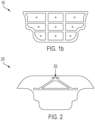
- FIG. 1(b) is an illustration of a conventional under-shield 100 attached to the vehicle shown in FIG. 1(a) .
- the under-shield 100 is fixed on the bottom part of a vehicle.
- the under-shield 100 may be made up of plastic or carpet to reduce the overall weight. However, such a lightweight sheet may impact on the NVH characteristics of the vehicle.
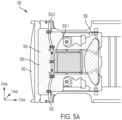
- FIG. 2 is an illustration of a vehicle subframe 202 positioned behind an under-shield of a conventional vehicle.
- the vehicle subframe 202 may be reinforcement brace for adding stiffness to the vehicle, e.g., to improve a driving characteristic of the vehicle.
- the use of such a vehicle subframe 202 is common in the automotive industry. However, including such structures can add mass to the vehicle, which may impact a maximum range of a vehicle.
- a new under-shield structure is proposed for improving the NVH characteristics and/or the range of a vehicle.
- FIG. 3 is a schematic illustration of a vehicle 300 equipped with an under-shield structure 304 in accordance with an example of the present disclosure.
- a passenger compartment 302, and the under-shield structure 304 form a body part of the vehicle 300.
- the under-shield structure 304 encloses vehicle components, such as the powertrain or battery pack of the vehicle 300.
- vehicle components such as the powertrain or battery pack of the vehicle 300.
- the vehicle 300 illustrated in FIG. 3 is shown as an automobile, such as a hybrid electric vehicle (HEV) or a battery electric vehicle (BEV), the present disclosure may extend, where technically possible, to use on any appropriate type of vehicle, such as a motorcycle, a marine vessel, or an aircraft.
- HEV hybrid electric vehicle
- BEV battery electric vehicle
- FIG. 4 is an illustration of an under-shield structure 400 fixed underneath a vehicle 402 in accordance with an example of the present disclosure.
- the under-shield structure 400 includes at least one support beam 404 and a panel 406.
- the at least one support beam 404 is fastened to the vehicle 402 using at least one of a rivet arrangement, bolt arrangement, welding, and/or a combination thereof.
- the shape of the at least one support beam 404 includes at least one of a U-shaped cross section, box-shaped cross section, tubular-shaped cross section, and/or a combination thereof.
- the support beam 404 is secured to a body portion of the vehicle 402.
- the support beam 404 may be secured to any appropriate portion of the vehicle, such as a chassis, a subframe, a suspension component, a power train component, etc.
- the panel 406 is over-moulded on the at least one support beam 404, thereby defining the under-shield structure 400.
- the under-shield structure 400 When the under-shield structure 400 is attached to the vehicle 402 it helps prevent debris on the road, such as small rocks, nails, water, or dust from damaging the underside of the vehicle 402. This may be particularly beneficial for EVs, which typically house a battery and associated components beneath the battery 402. Therefore, the panel 406 shields the underneath components from debris in various driving conditions.
- the under-shield structure 400 is secured to vehicle 402, the stiffness of the vehicle is increased, which improves a driving characteristic of the vehicle. Inclusion of under-shield structure 400 on a vehicle removes the need for additional reinforcement, such as vehicle subframe 202 shown in FIG. 2 .
- the total mass of the under-shield structure 400 may be less than the total mass of vehicle subframe 202 and a conventional under-shield structure 400. As such, inclusion of under-shield structure 400 on a vehicle may reduce the overall mass of the vehicle and improve the driving range of the vehicle.
- the under-shield structure 400 is a unitary/integral structure comprising the at least one support beam 404 and the panel 406.
- the under-shield structure 400 is a non-integral structure comprising the at least one support beam 404 and the panel 406.
- the at least one support beam 404 is fixedly arranged with the panel 406 using any one of a rivet arrangement, bolt arrangement, welding, and/or a combination thereof in the under-shield structure 400.
- the under-shield structure 400 is an aerodynamic under-shield structure.
- the under-shield structure 400 enhances the aerodynamics of the vehicle 402. Thereby, improving vehicle range, lowering fuel consumption, and reducing vehicle emissions.
- the panel 406 may comprise one or more aerodynamic surfaces and/or features, such as fins, configured to improve the aerodynamics of the vehicle 402, in use.
- the under-shield structure 400 comprises a plurality of openings in panel 406.
- panel 406 comprises a first opening 408 and a second opening 410 (which are shown in more detail in FIG. 5B ).
- the first opening 408 is configured, e.g., shaped and/or sized, to receive another vehicle component, such as another under-shield structure 412 of another vehicle component, e.g., so that the under-shield structure 412 is contiguous with opening 408.
- under-shield structure 412 may comprise a panel that sits within opening 408 of panel 412 such that a continuous surface is across the underside of under-shield structure 400 and under-shield structure 412 (accounting for assembly tolerances, panel gaps, etc.).
- the second opening 410 is covered by a secondary panel 414.
- the secondary panel 414 may be removeably secured to panel 406, e.g., by virtue of one or more fasteners, hinges, etc., so that when panel 414 no longer covers (or partially covers) opening 410, access is given to one or more components located behind panel 406, in an installed configuration on vehicle 402.
- the panel 406 may be referred to as a primary panel, and panel 414 maybe referred to as a secondary panel.
- panel 406 and 412 may be provided as part of a panel assembly.
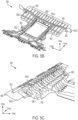
- FIGS. 5(a) and 5(b) are detailed illustrations of an under-shield structure 500 with a support beam in accordance with an example of the present disclosure.
- the under-shield structure 500 comprises at least one support beam 502 and a panel 504.
- FIG. 5(a) is a detailed illustration of the under-shield structure 500 fixed underneath vehicle 402.
- At least one support beam 502-1 is arranged along an x-axis of the vehicle 402.
- At least one support beam 502-2 is arranged along a z-axis of the vehicle 402.
- the at least one support beam 502-1 arranged along the x-axis and at least one support beam 502-2 arranged along the z-axis are further arranged in an intersecting configuration.
- the at least one support beam 502 may be arranged diagonally or partially inclined at an angle from the x-axis of the vehicle 402 or partially inclined at an angle from the z-axis of the vehicle 402.
- support beam 502-1 and 502-2 may be arranged in any appropriate configuration so as to sit within the package requirements of panel 506 and to engage suitable portions of vehicle 402 for securing the under-shield structure 500 to vehicle 402.
- the at least one support beam 502 is fastened to the vehicle 402 using any appropriate assembly method, such as at least one of a rivet arrangement, bolt arrangement, welding, adhesive, and/or a combination thereof.
- the shape of the at least one support beam 502 includes at least one of a U-shaped cross section, a box-shaped cross section, a tubular-shaped cross section, and/or a combination thereof.
- the at least one support beam 502 is formed using metal stamping.
- the materials used for metal stamping include at least one of a steel, carbon steel, alloy steel, stainless steel, aluminum, iron, copper, brass, aluminum alloys, high-strength steel, and/or a combination thereof.
- the at least one support beam 502 is formed using plastic stamping.
- the materials used for plastic stamping include at least one of a vulcanized fibre, laminates, thermoplastics, acetal, delrin, teflon, nylon, high or low-density polyethylene, engineering plastics, polyurethanes, polymers, and/or a combination thereof.
- the panel 504 is over-moulded on the at least one support beam 502-1 arranged along the x-axis and/or at least one support beam 502-2 structured along the z-axis of the vehicle 402, thereby defining the under-shield structure 500.
- the resultant under-shield structure 500 is stiffer than it otherwise would have been without the over-moulded support beams 502-1 and 502-2. This improves the NVH characteristics of the vehicle.
- the panel 504 further comprises a base plate 506 and at least one reinforcement structure 508 (illustrated in FIG.5(b) ).
- the base plate 506 comprises an outer surface 506-1 and an inner surface 506-2 (illustrated in FIG. 5(b) ).
- the outer surface 506-1 of the base plate 506 is a smooth and/or flat surface.
- the outer surface 506-1 of the base plate 506 is in direct contact with the airflow, while the under-shield structure 500 is in an assembled configuration with the vehicle 402.
- the smooth and/or flat outer surface 506-1 enables the base plate to be aerodynamically compliant.
- FIG. 5(b) is a detailed illustration of the under-shield structure 500.
- the at least one reinforcement structure 508 protrudes along a y-axis from the inner surface 506-2 of the base plate 506.
- the at least one reinforcement structure 508-1 is arranged along the x-axis of the base plate 506 and/or at least one reinforcement structure 508-2 is arranged along the z-axis of the base plate 506.
- the at least one reinforcement structure 508-1 arranged along the x-axis of the base plate 506 and the at least one reinforcement structure 508-2 arranged along the z-axis of the base plate 506 are further arranged in an intersecting configuration.
- the intersecting configuration of the at least one reinforcement structure 508-1 and the at least one reinforcement structure 508-2 enhances the stiffness of the base plate 506. Thereby, reducing the overall weight and manufacturing cost.
- the at least one reinforcement structure 508 may be arranged diagonally or partially inclined at an angle from the x-axis of the base plate 506 or partially inclined at an angle from the z-axis of the base plate 506.
- the panel 504 is over-moulded on the at least one support beam 502-1 arranged along the x-axis and/or at least one support beam 502-2 arranged along the z-axis allows structural strengthening of the vehicle 402 (illustrated in Fig. 5(a) ).
- the structural strengthening includes providing body rigidity for characteristics of the vehicle.
- the over-moulded panel 504 acts as a stiffener to the under-shield structure 500. Thereby, reducing the need to add additional ribbing to the under-shield structure 500.
- the stiffening of the under-shield structure 500 may reduce deflection of base plate 506, e.g., at high speed.
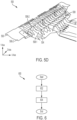
- FIG. 5(c) is a magnified illustration of an under-shield structure 500 in accordance with an example of the present disclosure.
- the under-shield structure 500 comprises at least one support beam 502 and a panel 504.
- the panel 504, further comprises a base plate 506 and at least one reinforcement structure 508.
- the base plate 506 comprises an outer surface 506-1 (illustrated in Fig. 5(a) ) and an inner surface 506-2.
- the at least one reinforcement structure 508 protrudes along the y-axis from the inner surface 506-2 of the base plate 506.
- the at least one reinforcement structure 508-1 is arranged along an x-axis of the base plate 506 and/or the at least one reinforcement structure 508-2 is arranged along a z-axis of the base plate 506.
- the at least one reinforcement structure 508-1 arranged along the x-axis of the base plate 506 and the at least one reinforcement structure 508-2 arranged along the z-axis of the base plate 506 are further
- the panel 504 is over-moulded on the at least one support beam 502 in a manner that the at least one support beam 502 is embedded in the at least one reinforcement structure 508 of the panel 504 to achieve a unitary/integral under-shield structure 500.
- multiple reinforcement structures are arranged along the x-axis of the base plate 506.
- multiple reinforcement structures are arranged along the z-axis of the base plate 506.
- the multiple reinforcement structures arranged along the x-axis and multiple reinforcement structures arranged along the z-axis are further arranged in an intersecting configuration to form a multi-slot arrangement.
- the multi-slot arrangement of the under-shield structure 500 enables better aerodynamic features with reduced underbody drag and fluttering of the base plate 506.
- FIG. 5(d) is a magnified illustration of an under-shield structure 500 in accordance with an exemplary embodiment of the present disclosure.
- the under-shield structure 500 comprises a panel 504.
- the panel 504, further comprises a base plate 506 and at least one reinforcement structure 508.
- the base plate 506 comprises an outer surface 506-1 (shown in Fig. 5(a) ) and an inner surface 506-2.
- the at least one reinforcement structure 508 protrudes along the y-axis from the inner surface 506-2 of the base plate 506.
- the at least one reinforcement structure 508-1 is arranged along an x-axis of the base plate 506 and/or the at least one reinforcement structure 508-2 is arranged along a z-axis of the base plate 506.
- the panel 504 is fixedly arranged with at least one support beam 502 (illustrated in Fig. 5(c) ) using at least one of a rivet arrangement, bolt arrangement, welding, adhesive, and/or a combination thereof in the under-shield structure 500. Thereby, achieving a non-integral under-shield structure 500.
- the combination of the at least one reinforcement structure 508 and the at least one support beam 502 eliminates the need for additional mass, body-in-white (BIW) cross members, or welded-on/bolted reinforcement braces. Thereby reducing the fluttering, NVH at high vehicle speed and increasing the overall stiffness of the under-shield structure 500. This also reduces the manufacturing complexity of the under-shield structure 500.
- BAW body-in-white
- FIG. 6 illustrates a method 600 of manufacturing an under-shield structure of a vehicle in accordance with an example of the present disclosure.
- the method 600 comprises the following steps: (a) forming 602 at least one support beam, e.g., using a stamping process, and (b) over-moulding 604 a panel on the at least one support beam.
- the under-shield structure may be made up of a composite material or any other materials solving a similar purpose.
- the composite material comprises at least one of a thermoplastic polymer, metal, a fiber-reinforced composite, and a combination thereof.
- the thermoplastic polymer includes at least one of a polyvinylchloride, polyethylene, polyester, polyetheretherketone, a polyurethane film, a thermoplastic polyurethane, and/or a combination thereof.
- the metal includes at least one of a steel, carbon steel, alloy steel, stainless steel, aluminum, iron, copper, brass, aluminum alloys, or high-strength steel and/or a combination thereof.
- the fiber-reinforced composite is composed of a high-strength fiber in a matrix material.
- the fiber-reinforced composite comprises at least one of a non-woven cellulosic bast fibers, non-woven polyester fibers, glass fibers, carbon fibers, and/or aramid fibers.
- Glass fibers are an alumina-lime-borosilicate based composition.
- the composition of the graphite fibers is based on poly acrylo nitrile, rayon, and/or petroleum pitch.
- the composite materials of the present disclosure are capable of being welded to at least one of metal materials, identical composite materials, different composite materials, and/or a combination thereof.
- the composite materials are welded to other metal materials but are not limited to aluminum based metal matrix composites, magnesium alloys, copper-based composites, or titanium based composites.
- the at least one support beam is formed, e.g., using stamping.
- the stamping further includes metal stamping.
- materials used for metal stamping include at least one of a steel, carbon steel, alloy steel, stainless steel, aluminum, iron, copper, brass, aluminum alloys, or high-strength steel and/or a combination thereof.
- the stamping includes plastic stamping.
- the materials used for plastic stamping include but are not limited to vulcanized fibre, laminates, thermoplastics, acetal, delrin, teflon, nylon, high or low-density polyethylene, engineering plastics, polyurethanes, polymers, and/or a combination thereof.
- the at least one support beam provides body rigidity for improving NVH characteristics after connecting to the underside of the vehicle.
- the at least one support beam may aid the suspension system to maintain stability or improve handling characteristics of the vehicle, and/or may support one or more other components of the vehicle.
- the panel is over-moulded on the at least one support beam.
- the panel formation using over-moulding reduces the manufacturing complexity and cost. Additionally, increasing the ability of the under-shield structure to absorb shock and vibration.
- the over-moulding includes but is not limited to injection moulding, two-color moulding, insert moulding or two-short moulding.
- the over-moulding comprises at least one of a plastic over plastic, plastic over metal, elastomer over plastic, or elastomer over metal over-moulding.
- the under-shield structure 500 may be assembled to a vehicle in the following order. 1) provide vehicle body with motor components, battery components, and/or suspension components assembled to vehicle body. 2) Attach one or more second under-shield structures (e.g., panel 412 of FIG. 4 ) to vehicle body and/or vehicle components.
- the second under-shield structure may be configured to shield one or more power distribution units of an EV from debris.
- the under-shield structure 500 comprises multiple opening (e.g., openings 408 and 410).
- an opening in a panel of under-shield structure 500 receives the second under-shield structure, which is attached to the vehicle.
- a secondary panel is secures to the under-shield structure 500, e.g., so as to cover one or more of the openings (e.g., see secondary panel 414 covering opening 410). 4) The secondary panel is moved so as to uncover an opening of the under-shield structure 500, e.g., to provide access to one or more vehicle components behind the under-shield structure 500.
- the secondary panel 414 may be removed to allow adjustment of a component provided on the vehicle body in step 1. 5)
- the secondary panel is replaced over the opening.
- the secondary panel is removeably secured in place, e.g., using a fastener, or is permanently attached to the under-shield structure 500, e.g., using a welding operation, so as to restrict future access to the vehicle components behind under-shield structure 500.
Landscapes
- Engineering & Computer Science (AREA)
- Mechanical Engineering (AREA)
- Transportation (AREA)
- Chemical & Material Sciences (AREA)
- Combustion & Propulsion (AREA)
- Life Sciences & Earth Sciences (AREA)
- Sustainable Development (AREA)
- Sustainable Energy (AREA)
- Power Engineering (AREA)
- Physics & Mathematics (AREA)
- Acoustics & Sound (AREA)
- Body Structure For Vehicles (AREA)
Priority Applications (3)
| Application Number | Priority Date | Filing Date | Title |
|---|---|---|---|
| EP23182906.0A EP4484264A1 (fr) | 2023-06-30 | 2023-06-30 | Structure de sous-protection et procédé de fabrication |
| US18/739,878 US20250002092A1 (en) | 2023-06-30 | 2024-06-11 | Under-shield structure and manufacturing method |
| CN202410820994.5A CN119218125A (zh) | 2023-06-30 | 2024-06-24 | 下部挡板结构及制造方法 |
Applications Claiming Priority (1)
| Application Number | Priority Date | Filing Date | Title |
|---|---|---|---|
| EP23182906.0A EP4484264A1 (fr) | 2023-06-30 | 2023-06-30 | Structure de sous-protection et procédé de fabrication |
Publications (1)
| Publication Number | Publication Date |
|---|---|
| EP4484264A1 true EP4484264A1 (fr) | 2025-01-01 |
Family
ID=87060710
Family Applications (1)
| Application Number | Title | Priority Date | Filing Date |
|---|---|---|---|
| EP23182906.0A Pending EP4484264A1 (fr) | 2023-06-30 | 2023-06-30 | Structure de sous-protection et procédé de fabrication |
Country Status (3)
| Country | Link |
|---|---|
| US (1) | US20250002092A1 (fr) |
| EP (1) | EP4484264A1 (fr) |
| CN (1) | CN119218125A (fr) |
Families Citing this family (1)
| Publication number | Priority date | Publication date | Assignee | Title |
|---|---|---|---|---|
| JP7361145B2 (ja) * | 2022-02-16 | 2023-10-13 | 本田技研工業株式会社 | 車両下部構造 |
Citations (5)
| Publication number | Priority date | Publication date | Assignee | Title |
|---|---|---|---|---|
| FR2866623B1 (fr) * | 2004-02-23 | 2006-06-16 | Peguform France | Procede de fabrication d'un plancher de vehicule comprenant une couche de materiau synthetique |
| EP2029416B1 (fr) * | 2006-06-08 | 2010-08-11 | Compagnie Plastic Omnium | Piece de structure pour bloc avant de vehicule automobile |
| WO2016035430A1 (fr) * | 2014-09-04 | 2016-03-10 | 本田技研工業株式会社 | Structure pour une partie inférieure de véhicule |
| EP3501954B1 (fr) * | 2017-12-22 | 2020-08-12 | Compagnie Plastic Omnium | Structure de plancher mono-pièce en matière composite |
| EP3954584A1 (fr) * | 2020-08-11 | 2022-02-16 | RENAULT s.a.s. | Convergent inférieur d'un bouclier avant d'un véhicule automobile |
Family Cites Families (7)
| Publication number | Priority date | Publication date | Assignee | Title |
|---|---|---|---|---|
| US5992926A (en) * | 1997-07-30 | 1999-11-30 | Dana Corporation | Vehicular skid plate and cross member assembly |
| US8262155B2 (en) * | 2009-12-06 | 2012-09-11 | Honda Motor Co., Ltd. | Overmolded joint for beam assembly |
| US8839901B1 (en) * | 2013-03-20 | 2014-09-23 | International Truck Intellectual Property Company, Llc | Transfer case skid shield |
| US9902439B2 (en) * | 2016-01-04 | 2018-02-27 | GM Global Technology Operations LLC | Control of airflow relative to a vehicle via active underbody panel(s) |
| US9937781B1 (en) * | 2016-12-19 | 2018-04-10 | GM Global Technology Operations LLC | Battery pack mounting architecture with shear plate for electric drive motor vehicles |
| WO2018128404A1 (fr) * | 2017-01-05 | 2018-07-12 | 삼성에스디아이 주식회사 | Composants de châssis, système de batterie de véhicule formé d'un seul tenant avec des composants de châssis et véhicule à système de batterie intégré les comprenant |
| DE102021118286B4 (de) * | 2021-07-15 | 2023-03-23 | Audi Aktiengesellschaft | Unterbodenschutzelement aus duroplastischem Material, Herstellungsverfahren und Kraftfahrzeug mit einem Unterbodenschutzelement |
-
2023
- 2023-06-30 EP EP23182906.0A patent/EP4484264A1/fr active Pending
-
2024
- 2024-06-11 US US18/739,878 patent/US20250002092A1/en active Pending
- 2024-06-24 CN CN202410820994.5A patent/CN119218125A/zh active Pending
Patent Citations (5)
| Publication number | Priority date | Publication date | Assignee | Title |
|---|---|---|---|---|
| FR2866623B1 (fr) * | 2004-02-23 | 2006-06-16 | Peguform France | Procede de fabrication d'un plancher de vehicule comprenant une couche de materiau synthetique |
| EP2029416B1 (fr) * | 2006-06-08 | 2010-08-11 | Compagnie Plastic Omnium | Piece de structure pour bloc avant de vehicule automobile |
| WO2016035430A1 (fr) * | 2014-09-04 | 2016-03-10 | 本田技研工業株式会社 | Structure pour une partie inférieure de véhicule |
| EP3501954B1 (fr) * | 2017-12-22 | 2020-08-12 | Compagnie Plastic Omnium | Structure de plancher mono-pièce en matière composite |
| EP3954584A1 (fr) * | 2020-08-11 | 2022-02-16 | RENAULT s.a.s. | Convergent inférieur d'un bouclier avant d'un véhicule automobile |
Also Published As
| Publication number | Publication date |
|---|---|
| US20250002092A1 (en) | 2025-01-02 |
| CN119218125A (zh) | 2024-12-31 |
Similar Documents
| Publication | Publication Date | Title |
|---|---|---|
| US11524606B2 (en) | Vehicle floor structure | |
| CN114379486B (zh) | 车辆前保险杠系统 | |
| EP3012175B1 (fr) | Véhicule de construction monocoque constitué par des éléments en résine thermoplastique | |
| US12084112B2 (en) | Dash panel structure for vehicle | |
| US11465693B2 (en) | Structural member for vehicle | |
| CN115485184A (zh) | 电动汽车的车底结构 | |
| EP4484264A1 (fr) | Structure de sous-protection et procédé de fabrication | |
| US12344313B2 (en) | Side sill reinforcement structure of vehicle | |
| CN216833895U (zh) | 用于车辆的设备和车辆 | |
| JP2019182166A (ja) | 車両用構造部材 | |
| CN110920550B (zh) | 发动机舱骨架 | |
| US20240399988A1 (en) | Vehicle front structure | |
| WO2022163054A1 (fr) | Carrosserie de structure de véhicule | |
| JP6693605B1 (ja) | 車両用構造部材 | |
| JP5630694B2 (ja) | 電気自動車用フロア構造体 | |
| WO2020017647A1 (fr) | Élément structurel de véhicule | |
| JP6617859B1 (ja) | 車両用構造部材 | |
| CN118163860A (zh) | 具有成角度的偏转器的结构总成 | |
| US12509162B2 (en) | Micro vehicle | |
| CN220535763U (zh) | 车架纵梁和具有其的车辆 | |
| US20250136189A1 (en) | Hood for vehicle | |
| US20250376217A1 (en) | Rear side structure for vehicle | |
| US20250050950A1 (en) | Structure of the vehicle body | |
| JP7087768B2 (ja) | 車両用構造部材 | |
| JP7107055B2 (ja) | 車両用構造部材 |
Legal Events
| Date | Code | Title | Description |
|---|---|---|---|
| PUAI | Public reference made under article 153(3) epc to a published international application that has entered the european phase |
Free format text: ORIGINAL CODE: 0009012 |
|
| STAA | Information on the status of an ep patent application or granted ep patent |
Free format text: STATUS: THE APPLICATION HAS BEEN PUBLISHED |
|
| AK | Designated contracting states |
Kind code of ref document: A1 Designated state(s): AL AT BE BG CH CY CZ DE DK EE ES FI FR GB GR HR HU IE IS IT LI LT LU LV MC ME MK MT NL NO PL PT RO RS SE SI SK SM TR |
|
| STAA | Information on the status of an ep patent application or granted ep patent |
Free format text: STATUS: REQUEST FOR EXAMINATION WAS MADE |
|
| 17P | Request for examination filed |
Effective date: 20250701 |