EP4484377A1 - Effizientes trennverfahren für seltenerdelementverbindungen und neuartige seltenerdelementkomplexe dafür - Google Patents
Effizientes trennverfahren für seltenerdelementverbindungen und neuartige seltenerdelementkomplexe dafür Download PDFInfo
- Publication number
- EP4484377A1 EP4484377A1 EP23306022.7A EP23306022A EP4484377A1 EP 4484377 A1 EP4484377 A1 EP 4484377A1 EP 23306022 A EP23306022 A EP 23306022A EP 4484377 A1 EP4484377 A1 EP 4484377A1
- Authority
- EP
- European Patent Office
- Prior art keywords
- compounds
- formula
- rare earth
- iii
- group
- Prior art date
- Legal status (The legal status is an assumption and is not a legal conclusion. Google has not performed a legal analysis and makes no representation as to the accuracy of the status listed.)
- Withdrawn
Links
Images



Classifications
-
- C—CHEMISTRY; METALLURGY
- C22—METALLURGY; FERROUS OR NON-FERROUS ALLOYS; TREATMENT OF ALLOYS OR NON-FERROUS METALS
- C22B—PRODUCTION AND REFINING OF METALS; PRETREATMENT OF RAW MATERIALS
- C22B59/00—Obtaining rare earth metals
-
- C—CHEMISTRY; METALLURGY
- C01—INORGANIC CHEMISTRY
- C01F—COMPOUNDS OF THE METALS BERYLLIUM, MAGNESIUM, ALUMINIUM, CALCIUM, STRONTIUM, BARIUM, RADIUM, THORIUM, OR OF THE RARE-EARTH METALS
- C01F17/00—Compounds of rare earth metals
- C01F17/10—Preparation or treatment, e.g. separation or purification
-
- C—CHEMISTRY; METALLURGY
- C01—INORGANIC CHEMISTRY
- C01G—COMPOUNDS CONTAINING METALS NOT COVERED BY SUBCLASSES C01D OR C01F
- C01G39/00—Compounds of molybdenum
- C01G39/006—Compounds containing molybdenum, with or without oxygen or hydrogen, and containing two or more other elements
-
- C—CHEMISTRY; METALLURGY
- C01—INORGANIC CHEMISTRY
- C01G—COMPOUNDS CONTAINING METALS NOT COVERED BY SUBCLASSES C01D OR C01F
- C01G41/00—Compounds of tungsten
- C01G41/006—Compounds containing tungsten, with or without oxygen or hydrogen, and containing two or more other elements
-
- C—CHEMISTRY; METALLURGY
- C07—ORGANIC CHEMISTRY
- C07F—ACYCLIC, CARBOCYCLIC OR HETEROCYCLIC COMPOUNDS CONTAINING ELEMENTS OTHER THAN CARBON, HYDROGEN, HALOGEN, OXYGEN, NITROGEN, SULFUR, SELENIUM OR TELLURIUM
- C07F11/00—Compounds containing elements of Groups 6 or 16 of the Periodic Table
- C07F11/005—Compounds containing elements of Groups 6 or 16 of the Periodic Table compounds without a metal-carbon linkage
-
- C—CHEMISTRY; METALLURGY
- C22—METALLURGY; FERROUS OR NON-FERROUS ALLOYS; TREATMENT OF ALLOYS OR NON-FERROUS METALS
- C22B—PRODUCTION AND REFINING OF METALS; PRETREATMENT OF RAW MATERIALS
- C22B3/00—Extraction of metal compounds from ores or concentrates by wet processes
- C22B3/04—Extraction of metal compounds from ores or concentrates by wet processes by leaching
- C22B3/16—Extraction of metal compounds from ores or concentrates by wet processes by leaching in organic solutions
-
- C—CHEMISTRY; METALLURGY
- C22—METALLURGY; FERROUS OR NON-FERROUS ALLOYS; TREATMENT OF ALLOYS OR NON-FERROUS METALS
- C22B—PRODUCTION AND REFINING OF METALS; PRETREATMENT OF RAW MATERIALS
- C22B3/00—Extraction of metal compounds from ores or concentrates by wet processes
- C22B3/20—Treatment or purification of solutions, e.g. obtained by leaching
- C22B3/26—Treatment or purification of solutions, e.g. obtained by leaching by liquid-liquid extraction using organic compounds
-
- C—CHEMISTRY; METALLURGY
- C22—METALLURGY; FERROUS OR NON-FERROUS ALLOYS; TREATMENT OF ALLOYS OR NON-FERROUS METALS
- C22B—PRODUCTION AND REFINING OF METALS; PRETREATMENT OF RAW MATERIALS
- C22B3/00—Extraction of metal compounds from ores or concentrates by wet processes
- C22B3/20—Treatment or purification of solutions, e.g. obtained by leaching
- C22B3/26—Treatment or purification of solutions, e.g. obtained by leaching by liquid-liquid extraction using organic compounds
- C22B3/38—Treatment or purification of solutions, e.g. obtained by leaching by liquid-liquid extraction using organic compounds containing phosphorus
-
- C—CHEMISTRY; METALLURGY
- C07—ORGANIC CHEMISTRY
- C07F—ACYCLIC, CARBOCYCLIC OR HETEROCYCLIC COMPOUNDS CONTAINING ELEMENTS OTHER THAN CARBON, HYDROGEN, HALOGEN, OXYGEN, NITROGEN, SULFUR, SELENIUM OR TELLURIUM
- C07F5/00—Compounds containing elements of Groups 3 or 13 of the Periodic Table
- C07F5/003—Compounds containing elements of Groups 3 or 13 of the Periodic Table without C-Metal linkages
-
- Y—GENERAL TAGGING OF NEW TECHNOLOGICAL DEVELOPMENTS; GENERAL TAGGING OF CROSS-SECTIONAL TECHNOLOGIES SPANNING OVER SEVERAL SECTIONS OF THE IPC; TECHNICAL SUBJECTS COVERED BY FORMER USPC CROSS-REFERENCE ART COLLECTIONS [XRACs] AND DIGESTS
- Y02—TECHNOLOGIES OR APPLICATIONS FOR MITIGATION OR ADAPTATION AGAINST CLIMATE CHANGE
- Y02P—CLIMATE CHANGE MITIGATION TECHNOLOGIES IN THE PRODUCTION OR PROCESSING OF GOODS
- Y02P10/00—Technologies related to metal processing
- Y02P10/20—Recycling
Definitions
- the present invention relates to a separation process for rare earth element compounds by converting a mixture of rare earth element compounds into novel thiometallate complexes which exhibit substantially different structures and thus solubility depending on the rare earth metals employed in said process and their state of oxidation.
- the invention further encompasses the thiometallate complexes as such.
- the Rare Earth Elements are a group of 17 chemically similar metallic elements comprising 15 lanthanides as well as scandium and yttrium.
- REEs are key in many technologies, from permanent magnets in wind turbines to batteries in electric cars and lamp phosphors in optical displays and energy-saving lamps. The demand for these elements is therefore expected to increase tremendously in the next 20 years. But because of their unequal geographic distribution they are highly susceptible to global supply risks and surge pricing.
- current mining and separation technologies typically go along with a high environmental burden due to radioactive by-products, very high water consumption and extensive use of chemicals which often leak in groundwater and waterways.
- Europium (Eu) is one of the most critical. Its scarcity - Eu accounts for only 0.05-0.10% w/w of common ores - and the high demand to produce red lamp phosphors Y 2 O 3 :Eu 3+ have resulted in high market value (see [4] Y. Fujita, S.K McCall, D. Ginosar," Recycling rare earths: Perspectives and recent advances”; MRS Bulletin 47, 283-288 ; . and [5] C. Ramprasad, Willis Gwenzi, Nhamo Chaukura, Nur Izyan Wan Azelee, Anushka Upamali Rajapaksha, M. Naushad, S. Rangabhashiyam, "Strategies and options for the sustainable recovery of rare earth elements from electrical and electronic waste", Chemical Engineering Journal, 442,1 (2022 ).
- a method of recovery of rare earth element compounds from fluorescent lamps comprises six steps including mechanical separation of coarse components, separation of the REE halophosphates, extraction in acids of easily soluble rare-earth fluorescent substances, mainly Yttrium and Europium oxides, extraction in acids of rare earth fluorescent substances which dissolve with difficulty like rare-earth phosphates, breakdown of the remaining components which contain rare earths such as rare-earth-aluminates and a final treatment.
- WO 2015/106324 A1 discloses a solvent extraction process for the extraction of rare earth element compounds as a group and for the separation of a mixture of rare earths into the individual elements by extracting the rare earths from a feed solution containing anions that form weakly extracting complexes such as chloride or sulfate salts to an organic phase through complex formation with anions present exclusively In the organic phase.
- the organic phase comprises a water-immiscible ionic liquid with nitrate or thiocyanate anions.
- the organic phase can also contain a neutral extractant.
- the rare earths are finally stripped as chloride or sulfate salts from the loaded organic phase.
- a further process for the recycling of critical rare earth elements (REEs) from end of life lamp fluorescent powder electronic waste is disclosed in WO 2019/201581 A1 .
- the process involves the use of mineral acid for the sequential digestion of REE compounds and numerous liquid-liquid extractive separation cycles using selective extractant ligand molecules followed by a hydrometallurgical process to separate Y, Eu, and Tb, to more than 99% purity and Gd, La and Ce to elevated purities each from the digested electronic waste.
- DE102014206223 and DE 102014224015 present a process for recovering rare earths from rare earth-containing compositions such as, for example, FeNdB magnets or fluorescent lamp waste as rare earth fluorides or rare earth oxalates, the process comprising the steps of crushing the rare earth-containing compositions under an inert gas atmosphere to a particle size in the range of 50 to 400 ⁇ m; adding solid ammonium chloride and chlorinating the chlorinatable metals to metal chlorides at a temperature in the range of 200 to 800°C for a period of 1 to 5 hours. Thereafter, an acidic solution is added to the metal chlorides followed by a multi-step workup to obtain rare earth-containing precipitates.
- rare earth-containing compositions such as, for example, FeNdB magnets or fluorescent lamp waste as rare earth fluorides or rare earth oxalates
- the process comprising the steps of crushing the rare earth-containing compositions under an inert gas atmosphere to a particle size in the range of 50 to 400 ⁇ m; adding
- Another aspect the invention relates to compounds comprising the structural units of formulae (III), (IV) or (V) Cat 2 [M II (MetS x O (4-x) ) 2 ] (III) Cat 3 [M III L z (MetS x O (4-x) ) 3 ] (IV) Cat 6 [M III (MetS x O (4-x) ) 3 ] 2 (V)
- the invention further encompasses the use of compounds of formula (II) for the separation of rare earth element compounds.
- the invention encompasses a process for production, purification or recycling of rare earth metals comprising the inventive separation process.
- the invention also encompasses all combinations of all levels of preferential embodiments or parameter ranges as disclosed hereinafter either with each other or with the broadest disclosed parameter range or embodiment.
- step 1) of the inventive process a mixture of at least two compounds of formula (I) is reacted with the compounds of formula (II) i.e. thiometallates in the presence of at least one organic donor solvent.
- An represents a monoanion such monoanion is specifically and preferably selected from the group consisting of: nitrate, sulfate, chloride, bromide, iodide, thiocyanate, perchlorate, hexafluorophosphate, tetrafluoroborate, phosphate, phosphonates R 1 PO 3 2- , hydrogen phosphonates R 1 PO 3 H - ; organophosphinates R 2 1 PO 2 - or R 1 PO 2 H - , sulfonates R 1 SO 3 - , carboxylic acids R 1 CO 2 - , wherein R 1 denotes alkyl or aryl.
- dianion such dianion is specifically and preferably selected from the group consisting of disulfonates R 2 (SO 3 - ) 2 , dicarboxylates R 2 (CO 2 - ) 2 , wherein R 2 denotes alkane-diyl or aryl-diyl.
- triianion is specifically and preferably selected from the group consisting of tricarboxylates R 3 (CO 2 - ) 3 , wherein R 3 denotes alkane-triyl or aryl-triyl.
- alkyl aryl, alkane-diyl, alkanetriyl, aryl, aryl-diyl and aryl-triyl substituents are
- aryl denotes carbocyclic aromatic substituents, whereby said carbocyclic, aromatic substituents are unsubstituted or substituted by up to five identical or different substituents per cycle.
- the substituents are selected from the group consisting of fluorine, bromine, chlorine, iodine, nitro, cyano, C 1 -C 8 -alkyl, C 1 -C 8 -alkoxy, C 6 -C 14 -aryl, in particular phenyl and naphthyl.
- the carbocyclic, aromatic substituents are unsubstituted or substituted by up to three identical or different substituents per cycle selected from the group consisting of fluorine, chlorine, cyano, C 1 -C 8 -alkyl, C 1 -C 8 -haloalkyl, C 1 -C 8 -alkoxy, C 1 -C 8 -haloalkoxy, C 6 -C 14 -aryl, in particular phenyl.
- the carbocyclic, aromatic substituents are unsubstituted or substituted by up to three identical or different substituents per cycle selected from the group consisting of fluorine, C 1 -C 8 -alkyl, C 1 -C 8 -perfluoroalkyl, C 1 -C 8 -alkoxy, C 1 -C 8 -perfluoroalkoxy, and phenyl.
- aryl substituents are C 6 -C 14 -aryl substituents, more preferably phenyl, naphthyl, phenanthrenyl and anthracenyl.
- C 6 -C 14 indicates that the number of carbon atoms of the respective carbocyclic, aromatic ring system is from 6 to 14.
- the possible and preferred substitution patterns mentioned above are likewise applicable.
- heterocyclyl denotes heterocyclic aliphatic, aromatic or mixed aliphatic and aromatic substituents in which no, one, two or three skeleton atoms per cycle, but at least one skeleton atom in the entire cyclic system is a heteroatom selected from the group consisting of nitrogen, sulphur and oxygen which are unsubstituted or substituted by up to five identical or different substituents per cycle, whereby the substituents are selected from the same group as given above for carbocyclic aromatic substituents including the areas of preference.
- Preferred heterocyclyl-substituents and heteroaryl-substituents respectively are pyridinyl, oxazolyl, thiophen-yl, benzofuranyl, benzothiophen-yl, dibenzofuranyl, dibenzothiophenyl, furanyl, indolyl, pyridazinyl, pyrazinyl, imidazolyl, pyrimidinyl and quinolinyl, either unsubstituted or substituted with one, two or three substituents selected from the group consisting of fluorine, C 1 -C 8 -alkyl, C 1 -C 8 -perfluoroalkyl, C 1 -C 8 -alkoxy, C 1 -C 8 -perfluoroalkoxy, and phenyl.
- alkyl, alkane-diyl and alkanetriyl are straight-chained, cyclic either in part or as a whole, branched or unbranched.
- C 1 -C 18 -alkyl indicates that the straight-chained, cyclic either in part or as a whole, branched or unbranched alkyl substituent contains from 1 to 18 carbon atoms excluding the carbon atoms of optionally present substituents to the C 1 -C 18 -alkyl substituent.
- C 1 -C 4 -alkyl are methyl, ethyl, n-propyl, isopropyl, n-butyl, tert-butyl.
- Additional examples for C 1 -C 8 -alkyl are n-pentyl, cyclohexyl, n-hexyl, n-heptyl, n-octyl, isooctyl.
- Additional examples for C 1 -C 18 -alkyl are norbornyl, adamantyl, n-decyl, n-dodecyl, n-hexadecyl, n-octadecyl.
- C 1 -C 8 -alkane-diyl-substituents are methylene, 1,1-ethylene, 1,2-ethylene, 1,1-propylene, 1,2-propylene, 1,3-propylene, 1,1-butylene, 1,2-butylene, 2,3-butylene and 1,4-butylene, 1,5-pentylene, 1,6-hexylene, 1,1-cyclohexylene, 1,4-cyclohexylene, 1,2-cyclohexylene and 1,8-octylene.
- C 1 -C 4 -alkoxy-substituents are methoxy, ethoxy, isopropoxy, n-propoxy, n-butoxy and tert-butoxy.
- An additional example for C 1 -C 8 -alkoxy is cyclohexyloxy.
- C 1 -C 8 -haloalkyl and C 1 -C 8 -haloalkoxy are C 1 -C 8 -alkyl and C 1 -C 8 - alkoxy sustituents which are once, more than once or fully substituted by halogen atoms.
- Substituents which are fully substituted by fluorine are referred to as C 1 -C 8 -perfluoroalkyl and C 1 -C 8 -perfluoroalkoxy, respectively.
- C 1 -C 8 -haloalkyl-substituents are trifluoromethyl, 2,2,2-trifluoroethyl, chloromethyl, fluoromethyl, bromomethyl, 2-bromoethyl, 2-chloroethyl, nonafluorobutyl and n-perfluorooctyl.
- An denotes perchlorate, hexafluorophosphate, tetrafluoroborate, methanesulfonate (mesylate), p-methylphenylsulfonate (tosylate), trifluoromethylsulfonate (triflate) and trifluoroacetate and 3
- An together denote citrate, whereby methanesulfonate (mesylate) and trifluoromethanesulfonate (triflate) are more preferred.
- At least two compounds of formula (I) comprising at least two different rare earth elements M are employed in the process.
- the compounds of formula (I) are selected that the mixture of compounds of formula (I) comprises either two, three, four, five, six, seven, eight, nine, ten, eleven, twelve, thirteen, fourteen, fifteen, sixteen or seventeen different rare earth elements M.
- Cat 2 is a dication in a preferred embodiment denotes an primary, secondary, tertiary or quaternary organic diammonium ion, in particular those of formula + [N(C 1 -C 18 -alkyl) s H t ]-R 8 -[N(C 1 -C 18 -alkyl) s H t ] + wherein s is 0, 1, 2 or 3 and t is 3-s or is a heteroarylium dication, for example bi-pyridinium.
- MetalS x O (4-x) as a whole denotes tetrathiomolybdate MoS 4 2- or tetrathiotungstate WS 4 2- , whereby tetrathiotungstate WS 4 2- is preferred.
- Step 1) of the process is carried out in the presence of at least one organic donor solvent preferably a donor solvent capable of coordinating to rare earth metal ions M.
- Preferred organic donor solvents are nitriles, for example acetonitrile, benzonitrile and benzylnitrile, whereby acetonitrile is preferred.
- the compounds of formula (I) are reacted with compounds of formula (II) in solution.
- in solution means that either compounds of formula (I) or the compounds of formula (II) or all compounds of formulae (I) and (II) are provided as solutions to be reacted.
- “In solution” further means that the compounds of the solution are at least substantially, for example to at least 95 wt-%, preferably 98 wt-%, for example are fully dissolved.
- the solvent to produce the solution may be the at least an organic donor solvent either neat or in combination with another organic solvent such as aliphatic hydrocarbons, for example pentane, hexane, heptane, octane and long-chain unbranched or branched aliphatic hydrocarbons, cyclohexane, methylcyclohexane, petroleum ether having different boiling ranges and paraffin oils, aromatic hydrocarbons, for example benzene, toluene, o-, m- or p-xylene and mesitylene, and aromatic chlorohydrocarbons such as chlorobenzene or the isomeric chlorotoluenes, sulfones like dimethylsulfone, tetramethylene sulfone and also any mixture of such solvents.
- aliphatic hydrocarbons for example pentane, hexane, heptane, octane and long-chain unbranched or branched
- the compounds of formula (I) are reacted with compounds of formula (II) without being in solution.
- the compounds are reacted in the presence of the organic donor solvent either neat or in combination with another organic solvent such as those mentioned above or any mixture thereof. While the reaction proceeds compounds of formulae (I) and (II) are dissolving while the precipitates are formed simultaneously or after dissolution.
- the presence of water is in principle possible but adds no advantage.
- the water content of the solvent is therefore less than 20 wt.-%, preferably less than 5 wt.-% and even more preferably less than 0.5 wt.-%.
- the molar ratio of compounds of formula (II) to compounds of formula (I) is for example in the range of from 1 to 1000, preferably 2.8 to 12.0 and more preferably 3.0 to 5.0. A further excess of compounds of formula (II) are possible but add no advantage.
- the amount of organic donor solvents to be applied in step 1) is dependent on the type, solubility and amount of compounds of formula (I) and may be determined by one skilled in a very few orienting examples. For example the amount of organic donor solvent may be chosen to be in the range of 1 to 1000, preferably in the range of 3 to 1000 times with respect to the molar ratio of organic donor solvent and compounds of formula (I).
- solvents in which the compounds comprising the structural elements of formula (III) and/or (IV) and/or (V) are less soluble may be added to fulfil the same purpose.
- the solubility of the rare earth metal thiolates comprising the structural units according to formulae (III) to (V) obtained in step 1) of the inventive process differ substantially and by around an order of magnitude depending on the oxidation state for Europium, Ytterbium, Samarium, Thulium and Dysprosium being either (+II) or (+III) and/or which type rare earth element M is employed in combination with which thiometallates.
- the Europium compounds comprising the structural element of formula (III) are formed upon the internal reduction of Europium(III) to Europium(ll) by a sulfur atom of the thiometallates.
- the required electron transfer can be for example be triggered by temperatures above -20°C or by exposure of the reaction mixture in step 1) to light, whereby ambient daylight is sufficient.
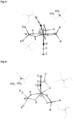
- a coordination polymer with the Europium centers being coordinated just by the sulfur donors of the thiometallates is formed as can be seen in the crystallographic structure of figure 2 . If the same reaction is carried out at temperatures lower than - 30°C and under exclusion of light for the reduction of Europium(III) is not observed immediately and compounds comprising the structural element of formula (IV) are formed like for all other rare earth elements.
- the reduction of Ytterbium, Samarium, Thulium and Dysprosium to their oxidation state (+II) also leads to formation of compounds comprising the structural units of formula (III).
- Such conditions could for example include irradiation with UV-Light, in particular for Ytterbium, or addition of a reducing agent such as cobaltocene or decamethylcobaltocene or a reducing metal like zinc or tin, or a reducing gas like dihydrogen.
- the reduction may be accomplished electrochemically by applying a sufficient potential, preferably while not consuming a sacrificial reducing agent.
- the at least two compounds of formula (I) comprising at least two different rare earth elements M are selected from at least two different of the three groups wherein in Group A: M is La, Ce, Pr, Pm, Nd or Sm Group B: M is Eu, Yb, Sm, Tm, Dy Group C: M is Sc, Y, Nd, Sm, Gd, Tb, Ho, Er,or Lu
- step 1) of the process according to the invention is carried out while or before reducing Ytterbium and/or Samarium and/or Dysprosium and/or Europium, i.e. by applying reductive conditions as described above.
- the compounds of formula (I) are in one exemplary embodiment selected such that they, taken in total, comprise either one, two, three, four or all five of the rare earth elements M of Group A) and one, two, three, four or all five of the rare earth elements M of Group B).
- the process allows in particular to separate the thiometallates of Group A) elements M from thiometallates of Group B) elements M.
- the compounds of formula (I) are in another exemplary embodiment selected such that they, taken in total, comprise either one, two, three, four, five, six or all seven of the rare earth elements M of Group C) and one, two, three, four or all five of the rare earth elements M of Group B).
- the process allows in particular to separate the thiometallates of Group C) elements M from thiometallates of Group B) elements M.
- the compounds of formula (I) are in yet another exemplary embodiment selected such that they, taken in total, comprise either one, two, three, four or all five of the elements M of Group A), and either one, two, three, four or all five of the rare earth elements M of Group B) and either one, two, three, four, five, six or all seven of the rare earth elements M of Group C).
- the process allows in particular to separate the thiometallates of Group C) elements M from thiometallates of Group B) elements M and thiometallates of Group A) elements M.
- this separation could optionally form part of a second step once the compounds comprising rare earth elements M of Group A) or the compounds comprising rare earth elements M of Group C) are separated from compounds comprising rare earth elements M of Group B) in a first step.
- this separation could optionally, if desired, form part of a third step to obtain the single compounds of elements M of Group A) and/or Group C).
- the at least two compounds of formula (I) comprising at least two different rare earth elements M are selected from at least two different of the three groups wherein in Group A: M is La, Ce, Pr, Pm or Nd Group B: M is Eu Group C: M is Sc, Y, Gd, Tb, Ho, Er, Tm, Yb, Sm, Dy or Lu
- step 1) of the process according to the invention is carried without reducing Ytterbium and/or Samarium and/or Dysprosium but using the auto reduction observed and described for Europium above.
- the compounds of formula (I) are in one exemplary embodiment selected such that they, taken in total, comprise either one, two, three, four or all five of the rare earth elements M of Group A) and Europium of Group B).
- the process allows in particular to separate the thiometallates of Group A) elements M from Europium(II)thiometallates.
- the compounds of formula (I) are in another exemplary embodiment selected such that they, taken in total, comprise either one, two, three, four, five, six, seven, eight, nine, ten or all eleven rare earth elements M of Group C) and Europium of Group B).
- the process allows in particular to separate the thiometallates of Group C) elements M from Europium(II) thiometallates.
- the compounds of formula (I) are in yet another exemplary embodiment selected such that they, taken in total, comprise either one, two, three, four or all five of the elements M of Group A), and Europium of Group B) and either one, two, three, four, five, six, seven, eight, nine, ten or all eleven of the rare earth elements M of Group C).
- the process allows in particular to separate the thiometallates of Group C) elements M from thiometallates of Group A) elements M and Europium(II) thiometallates.
- Compounds comprising the structural units of formula (III) include those of formula (Illa): Cat 2 [M II (MetS 4 ) 2 ] n (IIIa) wherein Cat, M and Met have the meaning including its preferential meanings set forth for formula (III) above and n denotes an integer of larger than 1 indicating a polymeric structure.
- step 2) the precipitate formed in step 1) is separated from the residual solution.
- separation can be accomplished by any manner and in any vessel known to those skilled in the art for that purpose. This includes sedimentation and decantation, centrifugation and filtration.
- the process according to the invention is in particular suitable to form part of a process wherein the thiometallates are recycled and marketable commodity compounds of REEs are prepared.
- the separation process may further contain a further step 3) reacting the compounds comprising the structural elements of formulae (III) or (IV) or (V) with at least one compound of formula (VI) Cat 2 An 2 (VI) wherein Cat denotes a monocation as defined above, preferably ammonium an
- Step 3) may be carried out in water.
- Specific compounds of formula (VI) are ammonium oxalate, sodium oxalate and potassium oxalate, whereby ammonium oxalate is preferred.
- a specific compound of formula (VII) are Europium(II)oxalate.
- Specific compounds of formula (VIII) are Scandium(III)oxalate, Yttrium(III)oxalate, Scandium(III)oxalate, Lanthanum(III)oxalate, Cerium(III)oxalate, Praeseodymium(III)-oxalate, Neodymium(III)oxalate, Promethium(III)oxalate, Samarium(lll)oxalate, Gadolinium(III)oxalate, Terbium(III)oxalate, Dysprosium(III)-oxalate, Holmium(III)-oxalate, Erbium(III)oxalate, Thulium(III)oxalate, Ytterbium(III)oxalate and Lutetium(III)-oxalate.
- step 3 compounds of formula (II) are recovered and may be recycled into in step 1) either directly or after changing the cation by known methods.
- the compounds of formulae (VII) and (VIII) may be converted to common rare earth metal oxides by step 4) calcinating compounds of formula (VII) or (VIII) at a temperature of 500°C or more, preferably between 500 and 1200°C , more preferably between 600° and 1000°C.
- the process according to the invention is suitable in all processes where separation or purification of REEs is important. This includes recycling processes for electronic materials, REE separation from mixed REE concentrates which are typically mixed oxides obtained from REE ores or extraction of other sources of REEs such as coal ashes and ashes obtained by burning electronic waste or waste comprising electronic components, as well as the separation of REEs from actinides in the workup of used nuclear fuels.
- the optional step of separating the aqueous solutions of compounds of formula (I) from remaining solids may be accomplished e.g. by filtration, centrifugation, decantation or any other method known to those skilled in the art for that purpose.
- the optional step of exchanging anions may be accomplished e.g. by anion exchange on anion exchange resins, by anion exchange utilizing different salt solubilities or any other method known to those skilled in the art for that purpose.
- materials comprising rare earth metal compounds encompass rare earth element ores like for example Monazite, Bastnäsite, Synchisite, Gadolinite, Samarskite, Euxenite, Pyrochlore or mixtures thereof.
- rare earth metal concentrates such as mixed rare earth metal oxides, carbonates or hydroxides.
- Further examples include electronic waste materials such as for example large and small appliances, screens and monitors, telecommunication devices such as computers and mobile phones, magnets, fluorescent lamps, whereby screens, monitors and fluorescent lamps are preferred.
- a major advantage of the present invention is the possibility to separate rare earth metal compounds by an easy and efficient process without the necessity of harsh conditions, numerous chemicals or process steps.
- Tungstic acid H 2 WO 4 was purchased from Fluka.
- Europium(III)oxide Eu 2 O 3 was purchased from Sigma-Aldrich and Yttrium(lll)oxide Y 2 O 3 from Ventron.
- Ammonium thiotungstate (NH 4 ) 2 WS 4 and Tetraethylammonium tetrathiotungstate (NEt 4 ) 2 [WS 4 ] and tetrathiomolybdate (NEt 4 ) 2 [MoS 4 ] were synthesized according to [13] McDonald, J. W.; Friesen, G. D.; Rosenhein, L. D.; Newton, W. E., Syntheses and characterization of ammonium and tetraalkylammonium thiomolybdates and thiotungstates. Inorganica Chim. Acta 1983, 72, 205-210 .
- structures were solved by intrinsic phasing (SHELXT) and refined by full- matrix least-squares procedures on F 2 using SHELXL in the olex2 program suite [14] G. M. Sheldrick, Acta Cryst., 2015, 71, 3-8 . 7., [15] G. M. Sheldrick, Acta Cryst., 2008, 64, 112-122 . All non-hydrogen atoms were refined with anisotropic displacement parameters. The hydrogen atoms were placed in positions of optimized geometry.
- Raman Spectroscopy spectra were collected using a Thermo Scientific DXR SmartRaman spectrometer and data were processed with the OMNIC software. Measurements were realized at a fixed power (10 mW) under irradiation at 532 nm with a 50 ⁇ m slit aperture.
- X-ray photoelectron spectroscopy was performed on a Sigma 2 instrument (Thermo Fisher Scientific) equipped with an UHV chamber (non-monochromatic 200 W Al K ⁇ source, a hemispherical analyzer, and a seven channel electron multiplier).
- the C 1s peak of adventitious carbon was set at 284.8 eV to compensate for any charge induced shifts.
- XPS data was analyzed using CasaXPS software. Quantification of the Eu/Y At% were obtained by fitting the data with a Linear Baseline for the Eu 3d region between 1132 and 1112 eV and for the Y 3p region between 318 and 308 eV.
- H 2 WO 4 (10 g, 40 mmol) was treated with aqueous ammonia NH 3 (25 wt-%, 80 mL), and the solution was saturated with an excess of H 2 S.
- H 2 S was generated in situ from iron(ll) sulfide (FeS) and 1 M sulfuric acid (H 2 SO 4 ) using a Kipp's apparatus. Evolution of toxic H 2 S gas was quenched using gas-wash bottles filled first with sodium hypochlorite and secondly with 1 M potassium hydroxide (KOH).
- the synthesis was performed under aerobic conditions in a well-ventilated fumehood.
- miliQ water H 2 O (2 mL) was added by syringe to anhydrous trifluoromethanesulfonic acid (2 mL) at 0 °C.
- the reaction was stirred until fuming stopped.
- Europium(III)oxide Eu 2 O 3 (5.73 mmol) was added portion wise under strong stirring, and the suspension was heated at 110 °C for 2 h.
- the reaction was allowed to cool down to room temperature and diluted with water (50 mL).
- the synthesis was performed under aerobic conditions in a well-ventilated fumehood.
- miliQ water H 2 O (2 mL) was added by syringe to anhydrous trifluoromethanesulfonic acid (2 mL) at 0 °C.
- the reaction was stirred until fuming stopped.
- Yttrium(III)oxide Y 2 O 3 (5.73 mmol) was added portion wise under strong stirring, and the suspension was heated at 110 °C for 2 h.
- the reaction was allowed to cool down to room temperature and diluted with water (50 mL).
- the crystal structure is shown in figure 2 .
- the crystal structure is shown in figure 3 .
- the crystal structure is shown in figure 4 .
- the reaction mixture was stirred for 2 hours at room temperature before it was crystallized by layering with pentane (2 mL) and Et 2 O (10 mL) and crystallization was set at - 35°C. After a day, colored crystals (yellow for La and Pr, brown Ce and Nd, red for Sm-Tm including Y and dark red for Yb) were isolated by pipetting out the supernatant, washed with THF (3 ⁇ 2 mL) and Et 2 O (2 ⁇ 2 mL), and dried under vacuum.
- UV-Vis (2.48 ⁇ 10 -5 mol ⁇ L -1 in MeCN): 217 nm (57 725 L ⁇ mol -1 ⁇ cm -1 ), 283 nm (97 848 L ⁇ mol -1 ⁇ cm -1 ), 397 nm (104 823 L ⁇ mol -1 ⁇ cm -1 ), 444 nm (24 320 L ⁇ mol -1 ⁇ cm -1 ).
- Raman (in MeCN) 173 cm -1 , 219 cm -1 , 461 cm -1 , 487 cm -1 .
- Example 10a Separation of Europium compounds from a mixture comprising Europium and Yttrium compounds using tetrathiotungstate
- the reaction was stirred at room temperature for 24 h, before the solution was filtered on a porcelain 4 frit resulting in a golden-brown powder which was further dried under vacuum and a red filtrate which was taken to dryness and both were characterized by X-ray photoelectron spectroscopy.
- the golden-brown precipitate was found to contain 98.88 Atom-% of Europium tetrathiotungstate and 1.12% of Yttrium tetrathiotungstate, the dried red filtrate contained 5.02 mol-% of Europium tetrathiotungstate and 94.98 mol-% of Yttrium tetrathiotungstate.
- Example 10b Separation of Europium compounds from a mixture comprising Europium and Yttrium compounds using tetrathiomolybdate
- the bronze precipitate was found to contain 94.97 Atom-% of Europium tetrathiomolybdate and 5.03 % of Yttrium tetrathiomolybdate, the dried red filtrate contained 13.96 mol-% of Europium tetrathiomolybdate and 86.04 mol-% of Yttrium tetrathiomolybdate.
- a compact fluorescent light bulb (Lightway 7 W, 385 Lumens 60 mA, 230 V) was smashed inside a zip lock bag to separate the glass from the bulb socket.
- the extracted glass (17.1445 g) was mortared into a fine white sand. That powder was then suspended in a 1:2 mixture of trifluoromethanesulfonic acid (2 mL) and water at 0 °C, resulting in an off-white slurry.
- the suspension was heated at 110 °C for 2 h resulting in a color change to light pink.
- Water was added (10 mL) and the slurry was stirred for 30 min before being filtered and the filtrate taken to dryness at 200 °C for 25 h (0.568 g, 3.3 wt%) to obtain a powder.
- a compact fluorescent light bulb (PHILIPS Genie 14 W energy saver 230-240 V) was smashed inside a zip lock bag to separate the glass from the bulb socket.
- the extracted glass (21.150 g) was mortared into a fine white sand. That powder was then suspended 5 in a 1:2 mixture of trifluoromethane sulfonic acid (2 mL) and water at 0 °C, resulting in an off-white slurry.
- the suspension was heated at 110 °C for 2 h resulting in a color change to light pink.
- Water was added (10 mL) and the slurry was stirred for 30 min before being filtered and the filtrate taken to dryness at 200 °C for 25 h to obtain a powder (1.2275 g, 5.8 wt%)
- the golden-brown precipitate was found to contain 71.31 Atom-% of Europium tetrathiotungstate and 28.69 Atom-% of Yttrium tetrathiotungstate, the dried red filtrate contained no detectable trace of Europium tetrathiotungstate and 100 Atom-% of Yttrium tetrathiotungstate.
Landscapes
- Chemical & Material Sciences (AREA)
- Organic Chemistry (AREA)
- Engineering & Computer Science (AREA)
- Geology (AREA)
- Life Sciences & Earth Sciences (AREA)
- Manufacturing & Machinery (AREA)
- General Life Sciences & Earth Sciences (AREA)
- Environmental & Geological Engineering (AREA)
- Materials Engineering (AREA)
- Mechanical Engineering (AREA)
- Metallurgy (AREA)
- Geochemistry & Mineralogy (AREA)
- Inorganic Chemistry (AREA)
- Analytical Chemistry (AREA)
- Manufacture And Refinement Of Metals (AREA)
Priority Applications (4)
| Application Number | Priority Date | Filing Date | Title |
|---|---|---|---|
| EP23306022.7A EP4484377A1 (de) | 2023-06-26 | 2023-06-26 | Effizientes trennverfahren für seltenerdelementverbindungen und neuartige seltenerdelementkomplexe dafür |
| CN202480043070.7A CN121399065A (zh) | 2023-06-26 | 2024-06-24 | 稀土元素化合物的高效分离方法以及为此使用的新的稀土元素配合物 |
| EP24736772.5A EP4705244A1 (de) | 2023-06-26 | 2024-06-24 | Effizientes trennverfahren für seltenerdelementverbindungen und neuartige seltenerdelementkomplexe dafür |
| PCT/EP2024/067706 WO2025003082A1 (en) | 2023-06-26 | 2024-06-24 | An efficient separation process for rare earth element compounds and novel rare earth element complexes used therefor |
Applications Claiming Priority (1)
| Application Number | Priority Date | Filing Date | Title |
|---|---|---|---|
| EP23306022.7A EP4484377A1 (de) | 2023-06-26 | 2023-06-26 | Effizientes trennverfahren für seltenerdelementverbindungen und neuartige seltenerdelementkomplexe dafür |
Publications (1)
| Publication Number | Publication Date |
|---|---|
| EP4484377A1 true EP4484377A1 (de) | 2025-01-01 |
Family
ID=87557906
Family Applications (2)
| Application Number | Title | Priority Date | Filing Date |
|---|---|---|---|
| EP23306022.7A Withdrawn EP4484377A1 (de) | 2023-06-26 | 2023-06-26 | Effizientes trennverfahren für seltenerdelementverbindungen und neuartige seltenerdelementkomplexe dafür |
| EP24736772.5A Pending EP4705244A1 (de) | 2023-06-26 | 2024-06-24 | Effizientes trennverfahren für seltenerdelementverbindungen und neuartige seltenerdelementkomplexe dafür |
Family Applications After (1)
| Application Number | Title | Priority Date | Filing Date |
|---|---|---|---|
| EP24736772.5A Pending EP4705244A1 (de) | 2023-06-26 | 2024-06-24 | Effizientes trennverfahren für seltenerdelementverbindungen und neuartige seltenerdelementkomplexe dafür |
Country Status (3)
| Country | Link |
|---|---|
| EP (2) | EP4484377A1 (de) |
| CN (1) | CN121399065A (de) |
| WO (1) | WO2025003082A1 (de) |
Citations (12)
| Publication number | Priority date | Publication date | Assignee | Title |
|---|---|---|---|---|
| US4647438A (en) * | 1984-04-02 | 1987-03-03 | Rhone-Poulenc Specialties Chimiques | Separation of rare earth values by liquid/liquid extraction |
| US20090162267A1 (en) * | 2006-06-02 | 2009-06-25 | Osram Gesellschaft Mit Beschrankter Haftung | Method for Recovery of Rare Earths from Fluorescent Lamps |
| WO2015106324A1 (en) | 2014-01-17 | 2015-07-23 | Katholieke Universiteit Leuven Ku Leuven Research & Development | Process for extraction and separation of rare earths by split-anion extraction with ionic liquids |
| DE102014206223A1 (de) | 2014-04-01 | 2015-10-01 | Fme Freiberger Metallrecycling Und Entwicklungsdienstleistungen Gmbh | Verfahren zur Rückgewinnung Seltener Erden aus Seltene Erden-haltigen Zusammensetzungen |
| DE102014224015A1 (de) | 2014-11-25 | 2016-05-25 | Fme Freiberger Metallrecycling Und Entwicklungsdienstleistungen Gmbh | Verfahren zur Rückgewinnung Seltener Erden aus Seltene Erden-haltigen Leuchtstoffen |
| US20190078175A1 (en) * | 2015-10-30 | 2019-03-14 | Ii-Vi Delaware, Inc. | Selective Recovery of Rare Earth Metals From an Acidic Slurry or Acidic Solution |
| WO2019201581A1 (de) | 2018-04-19 | 2019-10-24 | Hanwha Q Cells Gmbh | Anschlagelement für eine solarmodulhalterung |
| WO2021127497A1 (en) * | 2019-12-19 | 2021-06-24 | Georgia Tech Research Corporation | Methods for selective recovery of rare earth elements and metals from coal ash by ionic liquids |
| US20210261510A1 (en) * | 2018-06-15 | 2021-08-26 | Seren Technologies Limited | Ionic Liquid Preparation |
| US20210269322A1 (en) * | 2018-06-15 | 2021-09-02 | Seren Technologies Limited | Enhanced Separation of Rare Earth Metals |
| JP2021528359A (ja) * | 2018-06-15 | 2021-10-21 | セレン テクノロジーズ リミテッドSeren Technologies Limited | 希土類金属酸化物の調製方法 |
| US20230059863A1 (en) * | 2016-12-16 | 2023-02-23 | The Queen's University Of Belfast | Separation of rare earth metals |
-
2023
- 2023-06-26 EP EP23306022.7A patent/EP4484377A1/de not_active Withdrawn
-
2024
- 2024-06-24 EP EP24736772.5A patent/EP4705244A1/de active Pending
- 2024-06-24 WO PCT/EP2024/067706 patent/WO2025003082A1/en not_active Ceased
- 2024-06-24 CN CN202480043070.7A patent/CN121399065A/zh active Pending
Patent Citations (14)
| Publication number | Priority date | Publication date | Assignee | Title |
|---|---|---|---|---|
| US4647438A (en) * | 1984-04-02 | 1987-03-03 | Rhone-Poulenc Specialties Chimiques | Separation of rare earth values by liquid/liquid extraction |
| US20090162267A1 (en) * | 2006-06-02 | 2009-06-25 | Osram Gesellschaft Mit Beschrankter Haftung | Method for Recovery of Rare Earths from Fluorescent Lamps |
| US20120027651A1 (en) | 2006-06-02 | 2012-02-02 | Osram Gesellschaft Mit Beschraenkter Haftung | Method for recovery of rare earths from fluorescent lamps |
| WO2015106324A1 (en) | 2014-01-17 | 2015-07-23 | Katholieke Universiteit Leuven Ku Leuven Research & Development | Process for extraction and separation of rare earths by split-anion extraction with ionic liquids |
| DE102014206223A1 (de) | 2014-04-01 | 2015-10-01 | Fme Freiberger Metallrecycling Und Entwicklungsdienstleistungen Gmbh | Verfahren zur Rückgewinnung Seltener Erden aus Seltene Erden-haltigen Zusammensetzungen |
| DE102014224015A1 (de) | 2014-11-25 | 2016-05-25 | Fme Freiberger Metallrecycling Und Entwicklungsdienstleistungen Gmbh | Verfahren zur Rückgewinnung Seltener Erden aus Seltene Erden-haltigen Leuchtstoffen |
| US20190078175A1 (en) * | 2015-10-30 | 2019-03-14 | Ii-Vi Delaware, Inc. | Selective Recovery of Rare Earth Metals From an Acidic Slurry or Acidic Solution |
| US20230059863A1 (en) * | 2016-12-16 | 2023-02-23 | The Queen's University Of Belfast | Separation of rare earth metals |
| WO2019201581A1 (de) | 2018-04-19 | 2019-10-24 | Hanwha Q Cells Gmbh | Anschlagelement für eine solarmodulhalterung |
| US20210261510A1 (en) * | 2018-06-15 | 2021-08-26 | Seren Technologies Limited | Ionic Liquid Preparation |
| US20210269322A1 (en) * | 2018-06-15 | 2021-09-02 | Seren Technologies Limited | Enhanced Separation of Rare Earth Metals |
| JP2021528359A (ja) * | 2018-06-15 | 2021-10-21 | セレン テクノロジーズ リミテッドSeren Technologies Limited | 希土類金属酸化物の調製方法 |
| US11401579B2 (en) * | 2018-06-15 | 2022-08-02 | Seren Technologies Limited | Rare earth metal oxide process including extracting rare earth metal from acidic solution with an ionic liquid composition |
| WO2021127497A1 (en) * | 2019-12-19 | 2021-06-24 | Georgia Tech Research Corporation | Methods for selective recovery of rare earth elements and metals from coal ash by ionic liquids |
Non-Patent Citations (24)
| Title |
|---|
| A. ANANDR. SINGH, SEP. PURIF. REV., vol. 50, 2021, pages 96 - 112 |
| A. KUMARIM. K. JHAD. D. PATHAKS. CHAKRAVARTYJ.-C. LEE, SEP. PURIF. REV., vol. 48, 2019, pages 91 - 121 |
| B. VAN DEN BOGAERTD. HAVAUXK. BINNEMANST. VAN GERVEN, GREEN CHEM., vol. 17, 2015, pages 2180 - 2187 |
| BRADZIL J ET AL: "Relationship between solid state structure and catalytic activity of rare earth and bismuth-containing molybdate ammoxidation catalysts", JOURNAL OF CATALYSIS, ACADEMIC PRESS, DULUTH, MN, US, vol. 79, no. 1, 1 January 1983 (1983-01-01), pages 104 - 117, XP009119093, ISSN: 0021-9517, DOI: 10.1016/0021-9517(83)90293-2 * |
| C. HAGELUKEND. GOLDMANN, MINER. ECON, 2022 |
| C. RAMPRASADWILLIS GWENZINHAMO CHAUKURANUR IZYAN WAN AZELEEANUSHKA UPAMALI RAJAPAKSHAM. NAUSHADS. RANGABHASHIYAM: "Strategies and options for the sustainable recovery of rare earth elements from electrical and electronic waste", CHEMICAL ENGINEERING JOURNAL, vol. 442, 2022, pages 1 |
| DATABASE COMPENDEX [online] ENGINEERING INFORMATION, INC., NEW YORK, NY, US; 1 March 2022 (2022-03-01), FUJITA Y [0000-0002-4472-4102] ET AL: "Recycling rare earths: Perspectives and recent advances", XP002810712, Database accession no. E20221712028844 * |
| DATABASE COMPENDEX [online] ENGINEERING INFORMATION, INC., NEW YORK, NY, US; 15 August 2022 (2022-08-15), RAMPRASAD C: "Strategies and options for the sustainable recovery of rare earth elements from electrical and electronic waste", XP002810710, Database accession no. E20221511958007 * |
| DATABASE COMPENDEX [online] ENGINEERING INFORMATION, INC., NEW YORK, NY, US; 20 July 2019 (2019-07-20), WU Y ET AL: "Selective recovery of Y and Eu from rare-earth tricolored phosphorescent powders waste via a combined acid-leaching and photo-reduction process", XP002810711, Database accession no. E20191806852350 * |
| E. O. OPAREE. STRUHSA. MIRKOUEI, RENEW. SUST. ENERG. REV., vol. 143, 2021, pages 110917 |
| FUJITA Y [0000-0002-4472-4102] ET AL: "Recycling rare earths: Perspectives and recent advances", MRS BULLETIN 20220301 SPRINGER NATURE CHE, vol. 47, no. 3, 1 March 2022 (2022-03-01), pages 283 - 288, DOI: 10.1557/S43577-022-00301-W * |
| G. M. SHELDRICK, ACTA CRYST., vol. 64, 2008, pages 112 - 122 |
| G. M. SHELDRICK, ACTA CRYST., vol. 71, 2015, pages 3 - 8 |
| L. R. MORSS, CHEM. REV., vol. 76, 1976, pages 827 - 841 |
| MCDONALD, J. W.FRIESEN, G. D.ROSENHEIN, L. D.NEWTON, W. E.: "Inorganica Chim. Acta", SYNTHESES AND CHARACTERIZATION OF AMMONIUM AND TETRAALKYLAMMONIUM THIOMOLYBDATES AND THIOTUNGSTATES, vol. 72, 1983, pages 205 - 210 |
| NIKHIL DHAWANHIMANSHU TANVAR: "A critical review of end-of-life fluorescent lamps recycling for recovery of rare earth values", SUSTAINABLE MATERIALS AND TECHNOLOGIES, vol. 32, 2022 |
| P. FROHLICHT. LORENZG. MARTINB. BRETTM. BERTAU, ANGEW. CHEM. INT. ED., vol. 56, 2017, pages 2544 - 2580 |
| PETER FRÖHLICH ET AL: "Valuable Metals-Recovery Processes, Current Trends, and Recycling Strategies", ANGEWANDTE CHEMIE INTERNATIONAL EDITION, VERLAG CHEMIE, HOBOKEN, USA, vol. 56, no. 10, 27 January 2017 (2017-01-27), pages 2544 - 2580, XP072104843, ISSN: 1433-7851, DOI: 10.1002/ANIE.201605417 * |
| RAMPRASAD C: "Strategies and options for the sustainable recovery of rare earth elements from electrical and electronic waste", CHEMICAL ENGINEERING JOURNAL 20220815 ELSEVIER B.V. NLD, vol. 442, 15 August 2022 (2022-08-15), DOI: 10.1016/J.CEJ.2022.135992 * |
| SOLODOVNIKOV S F ET AL: "MOLYBDATES AND TUNGSTATES OF THE ALLUAUDITE FAMILY: CRYSTAL CHEMISTRY, COMPOSITION, AND IONIC MOBILITY", JOURNAL OF STRUCTURAL CHEMISTRY, PLEIADES PUBLISHING, MOSCOW, vol. 63, no. 7, 1 July 2022 (2022-07-01), pages 1101 - 1133, XP037918335, ISSN: 0022-4766, [retrieved on 20220728], DOI: 10.1134/S0022476622070071 * |
| WU Y ET AL: "Selective recovery of Y and Eu from rare-earth tricolored phosphorescent powders waste via a combined acid-leaching and photo-reduction process", JOURNAL OF CLEANER PRODUCTION 20190720 ELSEVIER LTD GBR, vol. 226, 20 July 2019 (2019-07-20), pages 858 - 865, DOI: 10.1016/J.JCLEPRO.2019.04.137 * |
| Y. FUJITAS.K MCCALLD. GINOSAR: "Recycling rare earths: Perspectives and recent advances", MRS BULLETIN, vol. 47, pages 283 - 288 |
| Y. WUQ. ZHANGT. ZUO, J. CLEAN. PROD., vol. 226, 2019, pages 858 - 865 |
| Y. WUX. YINQ. ZHANGW. WANGX. MU, RESOUR. CONSERV. RECYCL., vol. 88, 2014, pages 21 - 31 |
Also Published As
| Publication number | Publication date |
|---|---|
| WO2025003082A1 (en) | 2025-01-02 |
| CN121399065A (zh) | 2026-01-23 |
| EP4705244A1 (de) | 2026-03-11 |
Similar Documents
| Publication | Publication Date | Title |
|---|---|---|
| Liu et al. | Efficient recovery of end-of-life NdFeB permanent magnets by selective leaching with deep eutectic solvents | |
| CN110300810B (zh) | 稀土金属的分离 | |
| Matsumiya et al. | Extraction of rare earth ions by tri-n-butylphosphate/phosphonium ionic liquids and the feasibility of recovery by direct electrodeposition | |
| Behrsing et al. | The chemistry of rare earth metals, compounds, and corrosion inhibitors | |
| Zhao et al. | Synergistic extraction and separation of valuable metals from waste cathodic material of lithium ion batteries using Cyanex272 and PC-88A | |
| EP2679693B1 (de) | Wertmetall-extraktionsmittel und wertmetall-extraktionsverfahren unter verwendung dieses extraktionsmittels | |
| CN112639141B (zh) | 稀土金属氧化物的制备 | |
| US20240076195A1 (en) | Task-specific ionic liquids for selective separation and recovery of rare earth elements | |
| Wehbie et al. | Organization of diglycolamides on resorcinarene cavitand and its effect on the selective extraction and separation of HREEs | |
| Cole et al. | Understanding molecular factors that determine performance in the rare earth (TriNOx) separations system | |
| Shimojo et al. | Extraction behavior of rare-earth elements using a mono-alkylated diglycolamic acid extractant | |
| CN112639142A (zh) | 逆流稀土分离工艺 | |
| EP2902512B1 (de) | Verfahren zum sammeln scandium | |
| Falco et al. | Semirigid ligands enhance different coordination behavior of Nd and Dy relevant to their separation and recovery in a non-aqueous environment | |
| Kulasekara et al. | Cryptands on a solid support for the separation of europium from gadolinium | |
| EP3156128B1 (de) | Ionenaustauscherharz und verfahren zur adsorption und trennung von metall | |
| CN101514165B (zh) | 一种利用萃取反应制备含金属离子液体的方法 | |
| EP4484377A1 (de) | Effizientes trennverfahren für seltenerdelementverbindungen und neuartige seltenerdelementkomplexe dafür | |
| Alcaraz et al. | From magnet waste to rare earth oxides: A sustainable route for recovering neodymium and holmium from electric vehicle motors | |
| Sugita et al. | A comprehensive extraction study using a mono-alkylated diglycolamic acid extractant: Comparison between a secondary amide group and a tertiary amide group | |
| Zhang et al. | A strategy for selective extraction of lanthanides based on self-assembly with MPyEDChDGA from nitric acid solution | |
| US20240294553A1 (en) | Size-selective acyclic chelators and their use for the recovery of rare earth elements | |
| Muhammad et al. | Synthesis, Characterization and Application of A Novel Extracting Agent 2-(4-methylphenyl)-8, 9-Dihydro-8, 8-Dimethyl-7H-Pyrazolo [1, 5-a] Quinazolin-6-one (MPHPQ) for U (VI) Removal from Sulfate Aqueous Solutions | |
| Nelson | Ligand Design For The Separation Of Rare Earth Elements | |
| Chang | INVESTIGATIONS INTO THE COORDINATION CHEMISTRY OF SUBSITUTED THIOBIURETS AND THEIR ANALOGUES WITH LANTHANIDES AND EARTH-ABUNDANT METALS |
Legal Events
| Date | Code | Title | Description |
|---|---|---|---|
| PUAI | Public reference made under article 153(3) epc to a published international application that has entered the european phase |
Free format text: ORIGINAL CODE: 0009012 |
|
| STAA | Information on the status of an ep patent application or granted ep patent |
Free format text: STATUS: THE APPLICATION HAS BEEN PUBLISHED |
|
| AK | Designated contracting states |
Kind code of ref document: A1 Designated state(s): AL AT BE BG CH CY CZ DE DK EE ES FI FR GB GR HR HU IE IS IT LI LT LU LV MC ME MK MT NL NO PL PT RO RS SE SI SK SM TR |
|
| STAA | Information on the status of an ep patent application or granted ep patent |
Free format text: STATUS: THE APPLICATION IS DEEMED TO BE WITHDRAWN |
|
| 18D | Application deemed to be withdrawn |
Effective date: 20250702 |