EP4484575A1 - Séquences de marqueurs pour le diagnostic et la régulation thérapeutique de patients déficients en testostérone - Google Patents
Séquences de marqueurs pour le diagnostic et la régulation thérapeutique de patients déficients en testostérone Download PDFInfo
- Publication number
- EP4484575A1 EP4484575A1 EP23182935.9A EP23182935A EP4484575A1 EP 4484575 A1 EP4484575 A1 EP 4484575A1 EP 23182935 A EP23182935 A EP 23182935A EP 4484575 A1 EP4484575 A1 EP 4484575A1
- Authority
- EP
- European Patent Office
- Prior art keywords
- testosterone deficiency
- diagnosis
- patients
- testosterone
- prognosis
- Prior art date
- Legal status (The legal status is an assumption and is not a legal conclusion. Google has not performed a legal analysis and makes no representation as to the accuracy of the status listed.)
- Withdrawn
Links
Images
Classifications
-
- C—CHEMISTRY; METALLURGY
- C12—BIOCHEMISTRY; BEER; SPIRITS; WINE; VINEGAR; MICROBIOLOGY; ENZYMOLOGY; MUTATION OR GENETIC ENGINEERING
- C12Q—MEASURING OR TESTING PROCESSES INVOLVING ENZYMES, NUCLEIC ACIDS OR MICROORGANISMS; COMPOSITIONS OR TEST PAPERS THEREFOR; PROCESSES OF PREPARING SUCH COMPOSITIONS; CONDITION-RESPONSIVE CONTROL IN MICROBIOLOGICAL OR ENZYMOLOGICAL PROCESSES
- C12Q1/00—Measuring or testing processes involving enzymes, nucleic acids or microorganisms; Compositions therefor; Processes of preparing such compositions
- C12Q1/68—Measuring or testing processes involving enzymes, nucleic acids or microorganisms; Compositions therefor; Processes of preparing such compositions involving nucleic acids
- C12Q1/6876—Nucleic acid products used in the analysis of nucleic acids, e.g. primers or probes
- C12Q1/6883—Nucleic acid products used in the analysis of nucleic acids, e.g. primers or probes for diseases caused by alterations of genetic material
Definitions
- the present invention relates to a method for the diagnosis, prognosis, risk stratification and therapy control of testosterone deficiency or testosterone deficit in patients and patient populations as well as the use of suitable marker sequences and a test kit.
- Testosterone (17 ⁇ -hydroxyandrost-4-en-3-one) is a male sex hormone or androgen produced in the testes (gonads). It is known to promote male physical characteristics such as muscle mass and body hair, as well as increasing libido and supporting sperm production.
- Testosterone deficiency also known as hypogonadism, refers to a condition when the testes do not produce enough testosterone or when the body cannot properly use the testosterone produced due to age, injury or illness. There may also be genetic causes.
- a testosterone deficiency can have many effects on the body, including a decrease in muscle mass and strength, an increase in body fat, a decrease in bone density, a reduction in libido, and erectile dysfunction. It can also lead to fatigue, depression, mood swings, and decreased mental acuity.
- testosterone deficiency Diagnosis of testosterone deficiency is made through blood tests to measure testosterone levels in the body. If a deficiency is diagnosed, treatment can be done using hormone replacement therapies, such as testosterone injections, gels or patches.
- hormone replacement therapies such as testosterone injections, gels or patches.
- Epigenetics refers to changes in gene expression that are not due to changes in the DNA sequence itself. Instead, epigenetic mechanisms, such as chromatin structure and DNA methylation, regulate which genes are active or inactive and thus which proteins are produced.
- Chromatin is the structure in which DNA is packaged in the cell nucleus, and methylation of DNA is a process by which methyl groups are attached to the DNA, altering the chromatin structure. These epigenetic changes can be permanent or temporary and can be influenced by various factors such as age, environment and lifestyle.
- Epigenetic changes can have important effects on health and development. For example, an aberration in the methylation of certain genes can increase the risk of certain diseases or even affect the course of the disease. An aberration in chromatin structure can also lead to certain genes no longer being expressed, which in turn can lead to an abnormality in development.
- Epigenetics also has the potential to contribute to the development of therapies by allowing certain genes to be activated or deactivated to treat certain diseases. Epigenetics is also being intensively researched to learn more about the underlying mechanisms of gene expression and to deepen the understanding of developmental processes and diseases.
- CpG sites are regions of DNA consisting of a cytosine (C) and a guanine (G) linked together by a phosphate bond. These CpG dinucleotides are not evenly distributed in DNA, but occur in groups called CpG islands.
- CpG sites play an important role in epigenetics as they are the primary target region for DNA methylation reactions.
- DNA methylation involves the attachment of a methyl group to the carbon atom of cytosine, resulting in the formation of 5-methylcytosine (5mC).
- Methylation of CpG sites can result in gene expression being repressed in the surrounding DNA region, resulting in a reduction or even shutdown of gene expression.
- CpG islands are often found in promoter regions of genes that are associated with the regulation of gene expression.
- An aberration in the methylation of CpG islands can affect the expression of genes and contribute to various diseases or conditions, whereby methylation or demethylation of the CpG sites or CpG islands occurs.
- the most common form is the so-called hypermethylation of the CpG sites or CpG islands. Hypomethylation has also been described.
- the inventors were able to identify epigenetic markers for the state of testosterone deficiency in a patient, particularly as a function of aging.
- an object of the present invention is to improve the therapy, prophylaxis and prevention of testosterone deficiency by means of drug treatment as well as with regard to clinical decisions.
- a further object of the invention is also the therapy control by means of a prognosis or diagnosis of testosterone deficiency or testosterone deficiency patients.
- the object is achieved according to the invention by providing a method for the diagnosis or prognosis of patients with testosterone deficiency, comprising analysis of the methylation status of at least one CpG island of a marker sequence (MS) selected from MS No. 1 - 23 of a patient sample, wherein at least one modification by methylation and/or demethylation is indicative in comparison with the respective MS No. 1 - 23.
- MS marker sequence
- the invention relates to a method for the diagnosis or prognosis of patients with testosterone deficiency, comprising analysis of the methylation status of at least one CpG island of a marker sequence selected from MS No. 1 - 23, wherein hypermethylation or hypomethylation of the respective MS No. 1 - 23 is present and indicative.
- the invention therefore relates to a method for the diagnosis or prognosis of patients with testosterone deficiency, wherein the patients are selected from the group 30 - 55 years.
- the invention also relates to the use of one or more marker sequences according to the invention for the stratification and therapy control of testosterone deficiency or testosterone deficit patients.
- a further embodiment relates to the use according to the invention, characterized in that 2 or 3, preferably 4 or 5, particularly preferably 6, 7 or 8 or more different marker sequences, for example 10 to 20 different marker sequences, are used.
- Such a set of marker sequences is called a panel.
- the invention also relates to a method for stratification, in particular for risk stratification, or for therapy control of a patient with testosterone deficiency or testosterone deficiency, wherein at least one marker sequence according to the invention is used to examine a sample of the patient.
- the method according to the invention is particularly suitable for the early diagnosis or early detection of testosterone deficiency, in particular when no, i.e. asymptomatic, or few symptoms (supra) are detected in the patient.
- One embodiment relates to a method according to the invention for diagnosing testosterone deficiency, wherein the stratification or therapy control comprises decisions on the treatment and therapy of the patient, in particular the use, effect and/or dosage of one or more drugs, a therapeutic measure or the monitoring of a disease course as well as the course of therapy, etiology or classification of a disease, if applicable including prognosis.
- the invention relates to the use of marker sequences for stratification or therapy control of testosterone deficiency, wherein at least one marker sequence selected from the group of marker sequences MS No. 1-23 partial sequences or fragments thereof, homologues of the sequences MS No. 1-23 with at least 90% homology to a patient to be examined is determined, wherein at least one Modification by methylation and/or demethylation is indicative in comparison with the respective MS No. 1 - 23.
- a further embodiment of the invention relates to the use of the marker sequence(s) according to the invention for the stratification or therapy control of testosterone deficiency, wherein the determination is carried out by means of an in vitro diagnosis.
- the determination of the marker sequences takes place outside the human body and the determination is carried out in an ex vivo / in vitro diagnosis.
- the marker sequences according to the invention could be identified by differential screening of samples from healthy volunteers with patient samples with testosterone deficiency, see examples.
- the analysis is carried out by amplification by a polymerase enzyme, a PCR or a chemical amplification reaction or other amplification methods, ie within the framework of MSP, HeavyMethyl, Scorpion, MS-SNUPE, MethylLight, bisulfite sequencing, methyl-specific restriction assays and/or digital PCR (see, for Example Kristensen and Hansen PCR-Based Methods for Detecting Single-Locus DNA Methylation Biomarkers in Cancer Diagnostics, Prognostics, and Response to Treatment Clinical Chemistry 55:8 1471-1483 (2009 )).
- the analysis of the methylation status comprises a method selected from methylation-specific enzymatic digestion, bisulfite sequencing, an analysis selected from promoter methylation, CpG island methylation, MSP, HeavyMethyl, MethyLight, Ms-SNuPE or other methods based on the detection of amplified DNA.
- the method is suitable for routine applications, for example on a DNA array. Based on the above information and the relevant literature, the person skilled in the art can adapt the above method to these settings as described above.
- testosterone deficiency is defined according to the invention as the patient having less than 30 pg/ml or 40 pg/ml free testosterone in the saliva in the age group 30-65 years.
- diagnosis and prognosis should also be understood to mean that the test subject may be affected by testosterone deficiency in the future, even if he has normal testosterone levels at the time of sample collection, namely 30-140 pg/ml free testosterone in the saliva.
- Diagnosis or “prognosis” in the sense of this invention means the positive determination or prediction or probability of the occurrence of testosterone deficiency or testosterone deficit using the marker sequences according to the invention as well as the assignment of the patient to the indication of testosterone deficiency or testosterone deficit.
- diagnosis includes medical diagnostics and related examinations, in particular in-vitro diagnostics and laboratory diagnostics.
- the invention relates to a method for stratification, in particular for risk stratification and/or therapy control of a patient with testosterone deficiency or testosterone deficit, for example in a patient with a very early stage of testosterone deficiency or testosterone deficiency.
- Stratification or therapy control in the sense of this invention means that the method according to the invention allows decisions on the treatment and therapy of the patient, be it hospitalization of the patient, use, effect and/or dosage of one or more drugs, a therapeutic measure or the monitoring of a disease course as well as the course of therapy or etiology or classification of testosterone deficiency or testosterone deficit.
- the term "stratification” particularly includes risk stratification with the prognosis of an "outcome” of an adverse health event.
- patient is understood to mean any test subject - human or mammal, preferably male - with the proviso that the test subject is being examined for testosterone deficiency or testosterone deficit, in particular a therapeutic success or therapy improvement, or with the proviso that the test subject or individual receives or is to receive medication for the treatment of testosterone deficiency or testosterone deficit, such as by means of hormone replacement therapy.
- the sequences to be examined in a sample are components of a body fluid, in particular blood, whole blood, blood plasma, blood serum, patient serum, urine, cerebrospinal fluid, synovial fluid or a tissue extract from the patient.
- sampling using a cheek swab is particularly preferred.
- the marker sequences MS No. 1-23 are the subject of Table 1 and can be clearly identified by the respective cited database entry (Internet: www.http://www.ewascatalog.org/) (see cg and gene name including position).
- Table 1 Marker sequences (MS) from Homo sapiens ⁇ /b> MS No SEQ ID cg name Gene Type genes 1 1 cg 15570860 TMEM9B antisense RNA 1 ncRNA C11orf15 Chr11:8986840 2 cg01659459 protein phosphatase 2 regulatory subunit B'gammaprovided protein coding chr14:102227496 3 cg 16398051 ADAM metallopeptidase with thrombospondin type 1 motif 17 protein coding chr15:100821467 4 2 cg26624794 endoplasmic reticulum-golgi intermediate compartment 1 protein coding chr5:172332685 5 cg24534774 pre-m
- homologues of the marker sequences according to the invention are included.
- Partial sequences or fragments are those sequences that contain 50 to 100 nucleotides, preferably 100-500, particularly preferably 500 up to 1000 nucleotides of one of the marker sequences MS No. 1-23, such as oligonucleotides.
- Such marker sequences of the respective genomic DNA for MS No. 1 - 23 are shown in the sequences SEQ ID No. 1-12 according to Table 1 and are to be read accordingly.
- the SEQ ID No. 1-12 are contained in the respective associated MS No.
- a further preferred aspect of the present invention relates to a (test) kit for carrying out the method according to the invention, in particular based on the analysis of the bisulfite accessibility of CpG islands of the marker sequences MS No. 1-23, comprising components for carrying out the method according to the invention, in particular optionally comprising a bisulfite reagent and materials for analyzing the methylation status of the CpG islands selected from at least one marker sequence, in particular an oligomer.
- the subject's DNA is taken using the Oracollect sampling system by swabbing the epithelial cells of the inner cheek according to the manufacturer's instructions.
- the DNA is purified for analysis using the Qiagen DNA purification kit (QIAamp UCP DNA Micro Kit) according to the instructions for use.
- Qiagen DNA purification kit QIAamp UCP DNA Micro Kit
- the methylation intensity of the marker sequences mentioned is compared with the existing standards from the Epigenetic Database.
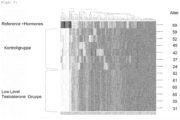
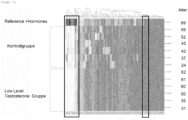
- Figures 1 and 2 show the heat map of 184 investigated GpC islands depending on age and population groups (low level testosterone group and control group).
Landscapes
- Chemical & Material Sciences (AREA)
- Life Sciences & Earth Sciences (AREA)
- Proteomics, Peptides & Aminoacids (AREA)
- Health & Medical Sciences (AREA)
- Organic Chemistry (AREA)
- Wood Science & Technology (AREA)
- Analytical Chemistry (AREA)
- Zoology (AREA)
- Genetics & Genomics (AREA)
- Engineering & Computer Science (AREA)
- Pathology (AREA)
- Immunology (AREA)
- Microbiology (AREA)
- Molecular Biology (AREA)
- Biotechnology (AREA)
- Biophysics (AREA)
- Physics & Mathematics (AREA)
- Biochemistry (AREA)
- Bioinformatics & Cheminformatics (AREA)
- General Engineering & Computer Science (AREA)
- General Health & Medical Sciences (AREA)
- Measuring Or Testing Involving Enzymes Or Micro-Organisms (AREA)
Priority Applications (2)
| Application Number | Priority Date | Filing Date | Title |
|---|---|---|---|
| EP23182935.9A EP4484575A1 (fr) | 2023-06-30 | 2023-06-30 | Séquences de marqueurs pour le diagnostic et la régulation thérapeutique de patients déficients en testostérone |
| PCT/EP2024/068519 WO2025003527A1 (fr) | 2023-06-30 | 2024-07-01 | Séquences de marqueurs utilisées à des fins de diagnostic et de suivi thérapeutique de patients présentant une déficience en testostérone |
Applications Claiming Priority (1)
| Application Number | Priority Date | Filing Date | Title |
|---|---|---|---|
| EP23182935.9A EP4484575A1 (fr) | 2023-06-30 | 2023-06-30 | Séquences de marqueurs pour le diagnostic et la régulation thérapeutique de patients déficients en testostérone |
Publications (1)
| Publication Number | Publication Date |
|---|---|
| EP4484575A1 true EP4484575A1 (fr) | 2025-01-01 |
Family
ID=87071020
Family Applications (1)
| Application Number | Title | Priority Date | Filing Date |
|---|---|---|---|
| EP23182935.9A Withdrawn EP4484575A1 (fr) | 2023-06-30 | 2023-06-30 | Séquences de marqueurs pour le diagnostic et la régulation thérapeutique de patients déficients en testostérone |
Country Status (2)
| Country | Link |
|---|---|
| EP (1) | EP4484575A1 (fr) |
| WO (1) | WO2025003527A1 (fr) |
Citations (1)
| Publication number | Priority date | Publication date | Assignee | Title |
|---|---|---|---|---|
| WO2021262894A1 (fr) * | 2020-06-23 | 2021-12-30 | The Regents Of The University Of Colorado, A Body Corporate | Méthodes de diagnostic d'agents pathogènes respiratoires et de prédiction d'évolutions associées à la covid-19 |
-
2023
- 2023-06-30 EP EP23182935.9A patent/EP4484575A1/fr not_active Withdrawn
-
2024
- 2024-07-01 WO PCT/EP2024/068519 patent/WO2025003527A1/fr not_active Ceased
Patent Citations (1)
| Publication number | Priority date | Publication date | Assignee | Title |
|---|---|---|---|---|
| WO2021262894A1 (fr) * | 2020-06-23 | 2021-12-30 | The Regents Of The University Of Colorado, A Body Corporate | Méthodes de diagnostic d'agents pathogènes respiratoires et de prédiction d'évolutions associées à la covid-19 |
Non-Patent Citations (6)
| Title |
|---|
| ALMSTRUP KRISTIAN ET AL: "Pubertal development in healthy children is mirrored by DNA methylation patterns in peripheral blood", SCIENTIFIC REPORTS, vol. 6, no. 1, 28 June 2016 (2016-06-28), US, pages 1 - 12, XP093109676, ISSN: 2045-2322, Retrieved from the Internet <URL:https://www.nature.com/articles/srep28657.pdf> DOI: 10.1038/srep28657 * |
| BEISPIEL KRISTENSEN UND HANSEN PCR-BASED METHODS FOR DETECTING SINGLE-LOCUS DNA METHYLATION BIOMARKERS IN CANCER DIAGNOSTICS, PROGNOSTICS, AND RESPONSE TO TREATMENT CLINICAL CHEMISTRY, vol. 55, no. 8, 2009, pages 1471 - 1483 |
| BIBIKOVA MLE JBARNES BSAEDINIA-MELNYK SZHOU LSHEN RGUNDERSON KL: "Genome-wide DNA methylation profiling using Infinium® assay", EPIGENOMICS, vol. 1, no. 1, 2009, pages 177 - 200, XP009158623, DOI: 10.2217/epi.09.14 |
| HARBS JUSTIN ET AL: "An epigenome-wide analysis of sex hormone levels and DNA methylation in male blood samples", EPIGENETICS, vol. 18, no. 1, 30 March 2023 (2023-03-30), US, pages 1 - 14, XP093109269, ISSN: 1559-2294, DOI: 10.1080/15592294.2023.2196759 * |
| KENNEDY MAOSBORNE AJ: "A validation of Illumina EPIC array system with bisulfite-based amplicon sequencing", PEERJ, vol. 9, 10 February 2021 (2021-02-10), pages e10762 |
| SUGRUE VICTORIA J ET AL: "Castration delays epigenetic aging and feminizes DNA methylation at androgen-regulated loci", ELIFE, vol. 10, 6 July 2021 (2021-07-06), XP093020749, Retrieved from the Internet <URL:https://cdn.elifesciences.org/articles/64932/elife-64932-v1.xml> DOI: 10.7554/eLife.64932 * |
Also Published As
| Publication number | Publication date |
|---|---|
| WO2025003527A1 (fr) | 2025-01-02 |
Similar Documents
| Publication | Publication Date | Title |
|---|---|---|
| DE60218182T2 (de) | Methoden um dns von verschiedenen individuen nachzuweisen | |
| DE10019058A1 (de) | Detektion von Variationen des DNA-Methylierungsprofils | |
| JP5934726B2 (ja) | 疾患マーカーの存在を被験者の血液サンプルで分析する方法 | |
| WO2012120026A1 (fr) | Procédé pour identifier une partie de polynucléotides dans une quantité de polynucléotides de départ correspondant au génome humain pour la détermination in vitro de la sévérité de la réponse d'hôte d'un patient | |
| EP3019630B1 (fr) | Biomarqueurs de type méthylation de l'adn et génotype spécifiques des tentatives de suicide et/ou des idées suicidaires | |
| US10865446B2 (en) | DNA methylation biomarkers of post-partum depression risk | |
| EP1523575A1 (fr) | Jeu ordonne d'acides nucleiques constitue de genes selectifs de monocytes-macrophages | |
| DE112009001722B4 (de) | Verfahren zur Diagnose von Legasthenie | |
| EP4484575A1 (fr) | Séquences de marqueurs pour le diagnostic et la régulation thérapeutique de patients déficients en testostérone | |
| DE102020005556B4 (de) | Verfahren zur Prognose der Schwere des Verlaufs einer COVID-19-Erkrankung | |
| KR102139315B1 (ko) | Tnfrsf19 유전자의 dna 메틸레이션 변화를 이용한 알츠하이머병 치매 조기진단 마커 | |
| CN117603982B (zh) | 肌萎缩侧索硬化症的SQSTM1的p.P374TfsTer18突变致病基因及其应用 | |
| DE102005048899A1 (de) | Verfahren zur Diagnose thromboembolischer Erkrankungen und koronarer Herzerkrankungen | |
| EP1709205B1 (fr) | Diagnostic de disomie uniparentale a l'aide de polymorphismes d'un seul nucleotide | |
| WO2024019556A1 (fr) | Marqueur de diagnostic prédictif pour la maladie d'alzheimer à l'aide d'un changement de méthylation d'adn dans le gène krt32 | |
| WO2023112946A1 (fr) | Procédé de collecte de données et kit permettant de déterminer la probabilité de développement de la maladie d'alzheimer | |
| KR102139314B1 (ko) | 유전자의 후성학적 메틸화 변화를 이용한 알츠하이머병 치매의 조기 진단 및 예측 | |
| KR20240012659A (ko) | Atp2c1 유전자의 dna 메틸화 변화를 이용한 알츠하이머병 치매진단 마커 | |
| EP2379743A1 (fr) | Procédé de détermination de la prédisposition pour la maladie de crohn | |
| CN112111570A (zh) | 一种与缺血性卒中辅助诊断相关的血清miRNA标志物及其应用 | |
| AT408989B (de) | Verfahren zur detektion und evaluierung einer potentiell aberrant methylierten dns-region am x-chromosom oder der klonalität | |
| EP3103882B1 (fr) | Procédé de diagnostic génétique d'un risque de dyslexie | |
| RU2688208C1 (ru) | Способ прогнозирования развития сахарного диабета 2 типа у населения башкортостана | |
| DE102020111423B4 (de) | MYH11/NDE1 Region als epigenetischer Marker für die Identifizierung von Endothel-Vorläuferzellen (EPCs) | |
| Coppedè | Methylation analysis of DNA in Alzheimer's disease |
Legal Events
| Date | Code | Title | Description |
|---|---|---|---|
| PUAI | Public reference made under article 153(3) epc to a published international application that has entered the european phase |
Free format text: ORIGINAL CODE: 0009012 |
|
| STAA | Information on the status of an ep patent application or granted ep patent |
Free format text: STATUS: THE APPLICATION HAS BEEN PUBLISHED |
|
| AK | Designated contracting states |
Kind code of ref document: A1 Designated state(s): AL AT BE BG CH CY CZ DE DK EE ES FI FR GB GR HR HU IE IS IT LI LT LU LV MC ME MK MT NL NO PL PT RO RS SE SI SK SM TR |
|
| STAA | Information on the status of an ep patent application or granted ep patent |
Free format text: STATUS: THE APPLICATION IS DEEMED TO BE WITHDRAWN |
|
| 18D | Application deemed to be withdrawn |
Effective date: 20250702 |