EP4485236A1 - Procédé et système d'octroi de licence adaptatif sur la base de données d'utilisation en temps réel - Google Patents
Procédé et système d'octroi de licence adaptatif sur la base de données d'utilisation en temps réel Download PDFInfo
- Publication number
- EP4485236A1 EP4485236A1 EP23182533.2A EP23182533A EP4485236A1 EP 4485236 A1 EP4485236 A1 EP 4485236A1 EP 23182533 A EP23182533 A EP 23182533A EP 4485236 A1 EP4485236 A1 EP 4485236A1
- Authority
- EP
- European Patent Office
- Prior art keywords
- license
- software
- usage
- terms
- usage data
- Prior art date
- Legal status (The legal status is an assumption and is not a legal conclusion. Google has not performed a legal analysis and makes no representation as to the accuracy of the status listed.)
- Withdrawn
Links
Images

Classifications
-
- G—PHYSICS
- G06—COMPUTING OR CALCULATING; COUNTING
- G06F—ELECTRIC DIGITAL DATA PROCESSING
- G06F21/00—Security arrangements for protecting computers, components thereof, programs or data against unauthorised activity
- G06F21/10—Protecting distributed programs or content, e.g. vending or licensing of copyrighted material ; Digital rights management [DRM]
- G06F21/105—Arrangements for software license management or administration, e.g. for managing licenses at corporate level
-
- G—PHYSICS
- G06—COMPUTING OR CALCULATING; COUNTING
- G06Q—INFORMATION AND COMMUNICATION TECHNOLOGY [ICT] SPECIALLY ADAPTED FOR ADMINISTRATIVE, COMMERCIAL, FINANCIAL, MANAGERIAL OR SUPERVISORY PURPOSES; SYSTEMS OR METHODS SPECIALLY ADAPTED FOR ADMINISTRATIVE, COMMERCIAL, FINANCIAL, MANAGERIAL OR SUPERVISORY PURPOSES, NOT OTHERWISE PROVIDED FOR
- G06Q20/00—Payment architectures, schemes or protocols
- G06Q20/08—Payment architectures
- G06Q20/12—Payment architectures specially adapted for electronic shopping systems
- G06Q20/123—Shopping for digital content
- G06Q20/1235—Shopping for digital content with control of digital rights management [DRM]
-
- G—PHYSICS
- G06—COMPUTING OR CALCULATING; COUNTING
- G06Q—INFORMATION AND COMMUNICATION TECHNOLOGY [ICT] SPECIALLY ADAPTED FOR ADMINISTRATIVE, COMMERCIAL, FINANCIAL, MANAGERIAL OR SUPERVISORY PURPOSES; SYSTEMS OR METHODS SPECIALLY ADAPTED FOR ADMINISTRATIVE, COMMERCIAL, FINANCIAL, MANAGERIAL OR SUPERVISORY PURPOSES, NOT OTHERWISE PROVIDED FOR
- G06Q20/00—Payment architectures, schemes or protocols
- G06Q20/08—Payment architectures
- G06Q20/14—Payment architectures specially adapted for billing systems
- G06Q20/145—Payments according to the detected use or quantity
-
- G—PHYSICS
- G06—COMPUTING OR CALCULATING; COUNTING
- G06Q—INFORMATION AND COMMUNICATION TECHNOLOGY [ICT] SPECIALLY ADAPTED FOR ADMINISTRATIVE, COMMERCIAL, FINANCIAL, MANAGERIAL OR SUPERVISORY PURPOSES; SYSTEMS OR METHODS SPECIALLY ADAPTED FOR ADMINISTRATIVE, COMMERCIAL, FINANCIAL, MANAGERIAL OR SUPERVISORY PURPOSES, NOT OTHERWISE PROVIDED FOR
- G06Q30/00—Commerce
- G06Q30/04—Billing or invoicing
-
- G—PHYSICS
- G06—COMPUTING OR CALCULATING; COUNTING
- G06Q—INFORMATION AND COMMUNICATION TECHNOLOGY [ICT] SPECIALLY ADAPTED FOR ADMINISTRATIVE, COMMERCIAL, FINANCIAL, MANAGERIAL OR SUPERVISORY PURPOSES; SYSTEMS OR METHODS SPECIALLY ADAPTED FOR ADMINISTRATIVE, COMMERCIAL, FINANCIAL, MANAGERIAL OR SUPERVISORY PURPOSES, NOT OTHERWISE PROVIDED FOR
- G06Q30/00—Commerce
- G06Q30/06—Buying, selling or leasing transactions
-
- G—PHYSICS
- G06—COMPUTING OR CALCULATING; COUNTING
- G06Q—INFORMATION AND COMMUNICATION TECHNOLOGY [ICT] SPECIALLY ADAPTED FOR ADMINISTRATIVE, COMMERCIAL, FINANCIAL, MANAGERIAL OR SUPERVISORY PURPOSES; SYSTEMS OR METHODS SPECIALLY ADAPTED FOR ADMINISTRATIVE, COMMERCIAL, FINANCIAL, MANAGERIAL OR SUPERVISORY PURPOSES, NOT OTHERWISE PROVIDED FOR
- G06Q30/00—Commerce
- G06Q30/06—Buying, selling or leasing transactions
- G06Q30/0645—Rental transactions; Leasing transactions
-
- G—PHYSICS
- G06—COMPUTING OR CALCULATING; COUNTING
- G06Q—INFORMATION AND COMMUNICATION TECHNOLOGY [ICT] SPECIALLY ADAPTED FOR ADMINISTRATIVE, COMMERCIAL, FINANCIAL, MANAGERIAL OR SUPERVISORY PURPOSES; SYSTEMS OR METHODS SPECIALLY ADAPTED FOR ADMINISTRATIVE, COMMERCIAL, FINANCIAL, MANAGERIAL OR SUPERVISORY PURPOSES, NOT OTHERWISE PROVIDED FOR
- G06Q2220/00—Business processing using cryptography
- G06Q2220/10—Usage protection of distributed data files
- G06Q2220/18—Licensing
Definitions
- the present disclosure generally relates to software licensing and control over license use. More particularly, but not exclusively, the present disclosure relates to a method of adaptive licensing based upon real-time usage data.
- Software licensing is a process through which an Independent Software Vendor (ISV) and/or Identity Verification (IDV) offers their software application product or embedded device firmware to an individual or business for a fee. It is a means by which end-users gain access to software and products, while the ownership rights remain with the software publisher. End-users must generally accept some form of a software licensing agreement in order to use the software. Numerous types of software licensing models are available to unlock software for users, varying from simple perpetual licenses and subscription licenses to more advanced models such as floating licensing.
- a traditional fixed license may be considered inflexible and inconvenient from the licensee and licensors perspective.
- ISV's Independent Service Vendors
- IDV's Identify Vendors
- licenses are generally fixed at the onset without further oversight or guidelines on using the license after deployment.
- the typical existing strategies fail to dynamically adapt for the actual software usage.
- Other systems may track usage for compliance, but similarly fail to adequately modify or adapt licenses considering several use case scenarios that will enable licensors to still monetize their software in a cloud computing environment with existing customers while still providing improved customer satisfaction with advantages over traditional licensing.
- US Patent No. 9246916 issued on Jan 26, 2016 is directed to an architecture for enforcing rights in digital content that allows access to encrypted digital content only in accordance with parameters specified by license rights acquired by a user of the digital content.
- a point of novelty in this license approach is use of a license server that issues a license to a DRM system that is 'trusted', and is equipped with a 'black box' that performs decryption and encryption functions for such DRM system.
- the license is stored in the DRM system thereby allowing the user to render the digital content according to the rights conferred by the license and specified in the license terms.
- US Patent No. 4937863 issued on June 26, 1990 to assignee Digital Equipment Corporation entitled “Software Licensing Management System” discloses a license management system which includes a license management facility that determines whether usage of a licensed program is within the scope of the license.
- the license management system maintains a license unit value for each licensed program and a pointer to a table identifying an allocation unit value associated with each use of the licensed program.
- the license management system responds with an indication as to whether the license unit value exceeds the allocation unit value associated with the use.
- the operation of the licensed program depends upon policies established by the licensor.
- Such system is static in many ways and not sufficiently adaptive for today's cloud computing environments.
- US Patent No. 9,569,598 issued on February 14, 2017 to assignee Kyndryl Inc. entitled "Software license management in a networked computing environment” discloses an approach for managing licenses for software installations on virtual machine (VM) instances in a networked computing environment (e.g., a cloud computing environment) is provided.
- data e.g., real-time and/or historical
- a request is received (e.g., from a requester) for a license for a particular software installation of the set of software installations, it is determined whether the license is available.
- the license is obtainable based on the collected data and a current configuration of the networked computing environment. Then, responsive to the license being obtainable, the requested license may be allocated. Again, such a system is static in many respect and not sufficiently adaptive for today's cloud computing environments.
- a system for adaptive licensing comprises: a license design module to receive predetermined options for configuring an automatic adaptability of a license model for terms and conditions of a license; a license usage collection module coupled to the license design module, to collect real-time usage data and user interaction of licensed software at a licensee client device under the license according to said license model; a license analyzer module coupled to the license usage collection module for analyzing the real-time usage data and user interaction, and therefrom identifying patterns and trends of licensed features of the licensed software under the license according to said license model; a license adjustment module coupled to the analyzer module that, responsive to identification of said patterns and trends, adjusts the terms and conditions of the license according to configuring of said automatic adaptability.
- the analyzer module in conjunction with said license adjustment module automatically adapts the license terms and conditions to establish usage of said licensed features and provide a cost effective and robustly monetizable license under the predetermined options of the license model, thereby providing a flexible and responsive licensing approach to a licensee of the licensed software with via a pre-set and configurable adaptive licensing module.
- the license usage collection module obtains usage data from various sources, including user interactions with the software, system logs, license usage data and telemetry data of the licensee client device.
- the analyzer module identifies customer use and purchase behaviors associated with a use of the licensed features and corresponding usage data in view of said patterns and trends.
- the analyzer module adjusts license terms, including adding or removing features, increasing or decreasing usage limits, or changing pricing models, in view of opportunities identified in said patterns and trends.
- the license usage collection module obtains usage data from various sources, including user interactions with the software, system logs, license usage data and telemetry data of the licensee client device. It may also notify and prompt a user of the licensed software for acceptance or denial of license terms deemed applicable to said real-time usage data and user interactions. Terms that are applicable, and/or deemed to apply can occur, for example, when a user invokes a new software feature, downloads a new software functionality, or favorably or negatively responds to a new software offer or feature offer or utility, or other interaction that the device observes or acknowledges from usage data or user interface functions.
- the analyzer module and license adjustment module continue to monitor usage patterns and adjust license terms to optimize licensing costs and ensure that users have access to the features and services they need.
- the license adjustment module changes a license duration based on how frequently the software is being used or how long the customer has been using it.
- the license adjustment module changes license scope to allow and restrict certain features or functionality of the licensed software based on how the customer is using it. In some embodiments, the license adjustment module changes a price of the license based on how often the software is being used, the number of users, and the features being used. In some embodiments, the license adjustment module changes a level of customer support based on how often the software is being used and the level of support needed based on the number of issues encountered.
- a method of adaptive licensing comprising: receiving predetermined options for configuring an automatic adaptability of a license model for terms and conditions of a license by way of a license design module; collecting real-time usage data and user interaction of licensed software at a licensee client device under the license according to said license model by way of a license usage collection module coupled to the license design module; analyzing the real-time usage data and user interaction, and therefrom identifying patterns and trends of licensed features of the licensed software under the license according to said license model by way of an analyzer module coupled to the license usage collection module; and adjusting the terms and conditions of the license according to configuring of said automatic adaptability by way of a license adjustment module coupled to the analyzer module device responsive to identification of said patterns and trends.
- the method automatically adapts the license terms and conditions to establish usage of said licensed features and provide a cost effective and robustly monetizable license under the predetermined options of the license model, and providing a flexible and responsive licensing approach to a licensee of the licensed software with via a pre-set and configurable adaptive licensing module.
- the step of collecting real-time usage data and user interaction of licensed software comprises obtaining usage data from various sources, including user interactions with the software, system logs, license usage data and telemetry data of the licensee client device.
- the method includes identifying customer use and purchase behaviors associated with a use of the licensed features and corresponding usage data in view of said patterns and trends; adjusting license terms, including adding or removing features, increasing or decreasing usage limits, or changing pricing models, in view of opportunities identified in said patterns and trends; and continually monitoring usage patterns and adjust license terms to optimize licensing costs and ensure that users have access to the features and services they need.
- the method includes limiting a number of concurrent users based on usage data and adjusting license fees according to a number of multiple devices using the licensed software, and adjusting license renewal terms based on licensee's usage behavior and history, including offering discounts for loyalty to customers who have been using the software frequently or automatically renewing or extending the license.
- the method includes performing an analysis or audit usage based on adherence to one or more predetermined usage policy options under the license, and modify the license based on the analyzing or auditing of usage to provide the licensee with a modified license in accordance with the one or more predetermined usage policy options that are active, wherein the usage policy options reference or include parameters pre-set in a configuration stage and associated with software application features.
- an adaptive license model that resolves the aforementioned problems to provide a more flexible and responsive licensing approach than traditional licensing models, and does so by leveraging real-time usage data to dynamically adjust license terms. More specifically, the technical embodiments discussed ahead provide a system and method of adaptive licensing to adaptively modify a license, based on configured options, and dynamically adjust license terms therein, in view of software feature and data usage based on tracked license usage information that can be automatically and continuously collected, monitored and optimized.
- the system 100 includes a license design module 110, a license usage collection module 120, a license analyzer module 130, and a license adjustment module 140.
- a license design module 110 includes a license usage collection module 120, a license analyzer module 130, and a license adjustment module 140.
- all the modules may reside together in a cloud component, for example, providing cloud license manager services via a service provider, or in other arrangements, may be distributed across clouds over components supported by multiple service providers.
- an Identify Verification manager may be included for verifying user identities and authorizing user access to resources.
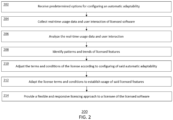
- FIG. 2 shows corresponding method steps 202-214 for adaptive licensing.
- the adaptive licensing model approach may include more or less than the number of steps shown in FIG. 2 , and is not limited to only these steps.
- the steps of the method 200 may be practiced by the components shown in system 100 of FIG1 as described next, though other embodiments are contemplated.
- license design module 110 receives as input configuration settings, for example, from a license administrator or other management source to establish or identify parameters of an adaptive license model. For instance, it receives 202 predetermined options (e.g. A, B and C) for configuring an automatic adaptability of a license model for terms and conditions of a license 101.
- the license model is a combination of various parameters that define within the scope of a designed license how software can be used by a customer.
- This design module maps different license attributes into logical groups, which define how a protected application is to be deployed and used under a license.
- one novel embodiment is this initial design stage for intentionally generating a license model lifecycle with preset entries for configuring an automatic adaptability of a license with terms and conditions. That is, the configuring provides for later automatic adaptation to within the range of predetermined and preset options.
- license design parameters each with preset ranges and trigger points, for adapting the license in real-time based on usage as it occurs.
- a license owner can design into the license model certain parameters with bounds (e.g., upper and lower limits) for how the license should adapt, for instance, with respect to usage, features, applications and add-ons, including, times, durations, conditions, scope, fees, ads, and so on.
- the license usage collection module 120 is coupled to the license design module 110, and collects 204 real-time usage data and user interaction. It collects real-time usage data, for example, interaction with the licensed software (application) 107 at a licensee client device 102 (e.g., mobile phone, laptop, console, etc.) under the license 101 according to the license model.
- the usage collection module 120 implements and uses a webSocket is to fetch realtime usage data and realtime license delivery. It collects usage data from various sources, such as user interactions with the software, system logs, license usage data and other telemetry data (e.g. network traffic, device information, user activity, location info, neighbor cells, idle time, security, performance, bandwidth, etc.), and does so in real-time. As an example, it can determine which application functions (e.g., via features 1, 2 and 3) the user interacts with, along with relevant usage data for that feature, such as, how often the feature is used, for how long and where.
- application functions e.g., via features 1, 2
- the license analyzer module 130 is coupled to the license usage collection module 120 for analyzing 206 the real-time usage data and user interaction, and therefrom, identifying 208 patterns and trends of licensed features of the licensed software (application) 110 under the license according to the license model.
- the analysis helps identify opportunities to adjust license terms, such as adding or removing features, increasing or decreasing usage limits, or changing pricing models. Analysis can also include customer behavior, purchases and old usage data.
- the license analyzer module 130 may quantify the extent of the interaction and log the activity (e.g., user selected feature 1 at hh:mm:ss on mm/dd/yy for xx seconds) associated with a corresponding feature (e.g., camera, phone app, GPS, etc.).
- the license adjustment module 140 is coupled to the analyzer module 130 that, in response to identification of the patterns and trends, adjusts 210 the terms and conditions of the license 101 according to the configuring of automatic adaptability.
- the predetermined options e.g., Option A, B and C
- the adaptable license model (whereby a licensed use of the features will be adapted according to predetermined options and presets for real-time use) are associated with application utilities (e.g. Feature 1, 2 and 3) and license terms that are configurable (before, during or after license deployment) along with triggers to invoke (restrict, limit or grant) use of application feature based on real-time data and usage factors analyzed during application run-time.
- the adaptive license model system automatically adjusts license terms and pushes them through to the application, and similarly, pulls usage information and reports activity of a licensed application on a licensed device to an ISF or software publisher. That is, based on the usage data analysis and configuration of adaptability terms during initial license design stage by ISV, the license adjustment module 140 automatically adjusts license terms and conditions for individual users or organizations. These adjustments are made in real-time and require no or optional manual intervention.
- the analyzer module 130 in conjunction with the license adjustment module 140 automatically adapts 212 the license 101 terms and conditions to establish usage of said licensed features and provide a cost effective and robustly monetizable license under the predetermined options of the license model.
- the system 100 continues to monitor usage patterns and adjust license terms as needed to optimize licensing costs and ensure that users have access to the features and services they need.
- an optional manual intervention may occur through a notification system, where the customer is notified about updated license terms. In these cases, the customer may be prompted to accept new license terms that will be applied immediately, or at a scheduled time. If the customer accepts new license terms it will be applied, else it will continue with old license terms, or the software will be disabled. For instance, the customer may be prompted to continue with old license terms without any change, or with notification that certain features, or the software all together, will be disabled.
- the system 100 of FIG. 1 , and corresponding method 200 of FIG. 2 provide a flexible and responsive licensing approach to a licensee of the licensed software with via a pre-set and configurable adaptive licensing module.
- the application adapts its licensable features according to the user's usage of the application in real-time and evolves upon analysis of customer data and usage is analyzed.
- the system 100 and method 200 provide the software publishers with control and visibility into how their applications are deployed and used. Enforcement of licensing terms and conditions provides vendors software protection from unauthorized use or distribution of their products.
- arrows 302-330 between modules of the system 100 of FIG. 1 show one practical embodiment of how the modules interact together to modify a license, though others interactions are contemplated.
- the analysis module 130 at step 302 is provided these settings, or alternatively, can pull these settings from the design module 110.
- the usage collection module 120 collects use information as shown in step 312, which includes access to software features that may be available, or already granted, for licensed use.
- the analysis module 130 receives the returned queried usage data at step 314 and compares it to the predetermined options received from the design module 110 to decide whether to update/modify/terminate the license and/or otherwise how to respond to the user's action. Although not shown, the analysis module 130 may also reference a license policy associated with the options configured by the design module 110.
- the analysis module 130 will automatically update the license terms of the license at step 326, followed by the adjustment module 140 sending an updated license at step 328.
- the user or device 102 may send a license request at step 322 to the adjustment module 140 specifically requesting a license update. This could occur in response to the user becoming aware of a desired software feature either on their own, through a message, a notification, or software update, or so on, separate from a user action using the software.
- This request may also contain additional license terms and conditions, or modified terms and conditions the user makes for condition to accept (such as an offer) the license.
- the adjustment module 140 then sends these license terms and conditons at step 324 to the analysis module 130, which similarly compares to the range of preconfigured options designed into the adapative license model 110.
- the license model design may be a manual action by an admin issuing a license for example, or an automatic update to the options responsive to a preconfigured event (e.g. date, deadline, limited offer, advertisement, etc.) or other option.
- the system 100 can further include a licensing application programming interface (API) 122 on a client-side.
- the API 122 can access the license locally (on the client device 102 side) or online from a cloud license manager service.
- the API 122 can have a set that includes APIs such as login, encryption, decryption, read, write, and/or logout.
- the API 122 can also provide a credentialing or identity function enabling access to a public cloud license manager where each client would be assigned with a unique credential that can be an API key. Any license detach can be handled by a login API internally (to the API), and can be further controlled by the cloud license manager service.
- a licensed application can reside on the client-side within a local storage at a local license manager service ( 102 ).
- the licensed application can integrate with a licensing API to check for a valid license either used locally or as a cloud license. If a license is not available or expired, then the licensed application will be forced to exit.
- the system 100 for adaptive license modification will enable the cloud license manager service to decide when and how to perform a license modification in accordance with the embodiments discussed herein.
- a computer program product includes a non-transitory computer-readable storage medium containing computer program code, the computer program code when executed by one or more processors causes the one or more processors to perform operations similar to the method described above and with respect to FIG. 2 .
- the computer program code can include instructions to deliver, enable or modify a license and software for a licensee under the license at a licensee client device or a plurality of licensee client devices.
- a webSocket is implemented and used to fetch realtime usage data and provide for realtime license delivery.
- the analyzer module 130 can perform an analysis or audit usage based on adherence to one or more predetermined usage policy options under the license, and modify the license under the one or more predetermined policy options based on the analyzing or auditing of usage to provide the licensee with a modified license in accordance with the one or more predetermined usage policy options that are active.
- a policy may reference or include the parameters to be pre-set in the configuration stage (e.g., Option A, B and C) and associated software application uses (e.g., Feature 1, 2 and 3) shown in FIG. 1 .
- the system 100 and method 200 provide and control license duration changes based on how frequently the software is being used or how long the customer has been using it. In some embodments, the system 100 and method 200 provide and control license scope changes to allow or restrict certain features or functionality of the software based on how the customer is using it. This allows the customer to access additional features or services based on their usage patterns and behavior or if a customer is using a particular feature of the product or service more than others. The license terms are modified to provide greater access to that feature.
- the system 100 and method 200 change and control license renewal terms based on the customer's usage behavior and history, such as offering discounts for loyal customers or customers who have been using the software frequently or Automatically renewing or extending the license based on the customer's usage patterns and behavior.
- the license termination terms can be similarly changed based on the customer's usage behavior, such as terminating the license if the customer violates certain usage policies or uses the software in an unauthorized manner.
- the system 100 and method 200 provide and control the number of users who can access the software based on the usage data. For example, if a customer is adding more users than anticipated, the license terms are modified to allow for a higher number of users.
- the price of the license can also be changed based on how often the software is being used, the number of users, and the features being used. For example, if a customer is using the licensed product or service more frequently than anticipated, the license price can be increased to reflect the increased usage.
- the system 100 and method 200 change and control a level of support provided with the license based on how often the software is being used and the level of support needed based on the number of issues encountered. This includes usage restriction changes, such as the number of concurrent users, can be changed based on the usage data. Depending on the number of devices being used to access the licensed software or service, components of the system 100 can change the license fee. For example, if a user is accessing a software on multiple devices, the license fee can be increased as per the usage data.
- the system 200 for adaptive license modeling is provided by way of a service provider or other platform provider or cloud computation platform.
- the entire system or certain components thereof may run on a cloud-based infrastructure, for example: Software as a Service (SaaS), Platform as a Service (PaaS), or Infrastructure as a Service (IaaS).
- SaaS Software as a Service
- PaaS Platform as a Service
- IaaS Infrastructure as a Service
- the components shown in FIG 1 may each be a computing platform (see FIGS 3-5 ) including one or more hardware processors and hardware memory coupled to the one or more processors, wherein the memory (also storage medium) includes computer instructions and data which when executed by the one or more processors causes them to perform the method steps or other operations disclosed (e.g. method 200 of FIG. 2 or steps 302-330 in FIG. 1 ) .
- Computing platforms and/or components disclosed herein with hardware processors may include, but are not limited, to the client device 102, the license design module 110, the license usage collection module 120, the license analyzer module 130, the license adjustment module 140.
- the adaptive license model shown in FIG. 1 is based on real-time usage data and offers several advantages over traditional licensing models; namely, flexibility, better compliance, additional insights, improved customer satisfaction, increased revenue potential, and cost savings.
- the adaptive license model provides a more flexible licensing approach that can adapt to the changing needs of users and organizations over time.
- Real time usage data helps to monitor compliance/regulatory guidelines and trigger necessary changes to adaptive license model in controlling the application/device usage.
- more insights can be drawing for future decisions based on real-time license model changes and usage behavior.
- the adaptive license model helps improve customer satisfaction by providing a licensing approach that aligns with their actual software usage patterns and needs. It helps identify opportunities to upsell or cross-sell additional features or services based on usage patterns, increasing revenue potential for software vendors. And, users and organizations would only pay for the features and services they actually use, resulting in significant cost savings compared to traditional licensing models.
- the adaptive license model provides a competitive advantage over software vendors that offer traditional licensing models, particularly in industries where software usage patterns can vary widely among users and organizations.
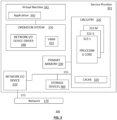
- FIG. 3 shows a service provider 301 that includes circuitry 320, primary memory 330, operating system (OS) 350, Network (NW) I/O device driver 340 , virtual machine manager (VMM) (also known as a hypervisor) 351, at least one application 360 running in a virtual machine (VM) 361, and one or more storage devices 365.
- OS 350 is Linux TM .
- OS 350 is Windows ® Server.
- application 360 comprises one or more of a cloud license manager service having one or more smart license automatic detach policies.
- Network I/O device driver 340 operates to initialize and manage I/O requests performed by network I/O device 310.
- packets and/or packet metadata transmitted to network I/O device 310 and/or received from network I/O device 310 are stored in one or more of primary memory 330 and/or storage devices 365.
- storage devices 365 may be one or more of hard disk drives (HDDs) and/or solid-state drives (SSDs). In an embodiment, storage devices 365 may be non-volatile memories (NVMs).
- circuitry 320 may communicatively couple to network I/O device 310 via communications link 355.
- communications link 355 is a peripheral component interface express (PCIe) bus conforming to version 3.0 or other versions of the PCIe standard published by the PCI Special Interest Group (PCI-SIG).
- PCIe peripheral component interface express
- operating system 350, network I/O device driver 340, VM 361, and application 360 are implemented, at least in part, via cooperation between one or more memory devices included in primary memory 330 (e.g., volatile or non-volatile memory devices), storage devices 365, and elements of circuitry 320 such as processing cores 322-1 to 322- m , where "m" is any positive whole integer greater than 2.
- OS 350, VMM 351, network I/O device driver 340, VM 361 and application 360 are executed by one or more processing cores 322-1 to 322 - m .
- service provider 301 includes but is not limited to a server, a server array or server farm, a web server, a network server, an Internet server, a work station, a mini-computer, a main frame computer, a supercomputer, a network appliance, a web appliance, a distributed computing system, multiprocessor systems, processor-based systems, a laptop computer, a tablet computer, a smartphone, a system-on-a-chip (SoC), or a combination thereof.
- service provider 301 is a disaggregated server.
- a disaggregated server is a server that breaks up components and resources into subsystems (e.g., network sleds). Disaggregated servers can be adapted to changing storage or compute loads as needed without replacing or disrupting an entire server for an extended period of time.
- a server could, for example, be broken into modular compute, I/O, power and storage modules that can be shared among other nearby servers.
- Circuitry 320 having processing cores 322-1 to 322 - m may include various commercially available processors, including without limitation Intel ® Atom ® , Celeron ® , Core (2) Duo ® , Core i3, Core i5, Core i7, Itanium ® , Pentium ® , Xeon ® or Xeon Phi ® processors, ARM processors, and similar processors. Circuitry 320 may include at least one cache 335 to store data.
- primary memory 330 may be composed of one or more memory devices or dies which may include various types of volatile and/or non-volatile memory.
- Volatile types of memory may include, but are not limited to, dynamic random-access memory (DRAM), static random-access memory (SRAM), thyristor RAM (TRAM) or zero-capacitor RAM (ZRAIVI).
- Non-volatile types of memory may include byte or block addressable types of non-volatile memory having a 3-dimensional (3-D) cross-point memory structure that includes chalcogenide phase change material (e.g., chalcogenide glass) hereinafter referred to as "3-D cross-point memory".
- chalcogenide phase change material e.g., chalcogenide glass
- Non-volatile types of memory may also include other types of byte or block addressable non-volatile memory such as, but not limited to, multi-threshold level NAND flash memory, NOR flash memory, single or multi-level phase change memory (PCM), resistive memory, nanowire memory, ferroelectric transistor random access memory (FeTRAM), magneto-resistive random-access memory (MRAM) that incorporates memristor technology, spin transfer torque MRAM (STT-MRAM), or a combination of any of the above.
- primary memory 330 may include one or more hard disk drives within and/or accessible by service provider 301.
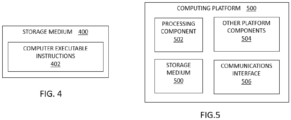
- FIG. 4 illustrates an example of a storage medium 400.
- Storage medium 400 may comprise an article of manufacture.
- storage medium 400 may include any non-transitory computer readable medium or machine readable medium, such as an optical, magnetic or semiconductor storage.
- Storage medium 400 may store various types of computer executable instructions, such as instructions 402 to implement method steps and logic flows described in the above figures.
- Examples of a computer readable or machine-readable storage medium may include any tangible media capable of storing electronic data, including volatile memory or non-volatile memory, removable or non-removable memory, erasable or non-erasable memory, writeable or re-writeable memory, and so forth.
- Examples of computer executable instructions may include any suitable type of code, such as source code, compiled code, interpreted code, executable code, static code, dynamic code, object-oriented code, visual code, and the like. The examples are not limited in this context.
- FIG. 5 illustrates an example computing platform 500.
- computing platform 500 may include a processing component 502, other platform components 504 and/or a communications interface 506.
- processing component 502 may execute processing operations or logic for instructions stored on storage medium 400.
- Processing component 502 may include various hardware elements, software elements, or a combination of both.
- Examples of hardware elements may include devices, logic devices, components, processors, microprocessors, circuits, processor circuits, circuit elements (e.g., transistors, resistors, capacitors, inductors, and so forth), integrated circuits, application specific integrated circuits (ASIC), programmable logic devices (PLD), digital signal processors (DSP), field programmable gate array (FPGA), memory units, logic gates, registers, semiconductor device, chips, microchips, chip sets, and so forth.
- ASIC application specific integrated circuits
- PLD programmable logic devices
- DSP digital signal processors
- FPGA field programmable gate array
- Examples of software elements may include software components, programs, applications, computer programs, application programs, device drivers, system programs, software development programs, machine programs, operating system software, middleware, firmware, software modules, routines, subroutines, functions, methods, procedures, software interfaces, application program interfaces (API), instruction sets, computing code, computer code, code segments, computer code segments, words, values, symbols, or any combination thereof. Determining whether an example is implemented using hardware elements and/or software elements may vary in accordance with any number of factors, such as desired computational rate, power levels, heat tolerances, processing cycle budget, input data rates, output data rates, memory resources, data bus speeds and other design or performance constraints, as desired for a given example.
- other platform components 504 may include common computing elements, such as one or more processors, multi-core processors, co-processors, memory units, chipsets, controllers, peripherals, interfaces, oscillators, timing devices, video cards, audio cards, multimedia input/output (I/O) components (e.g., digital displays), power supplies, and so forth.
- processors such as one or more processors, multi-core processors, co-processors, memory units, chipsets, controllers, peripherals, interfaces, oscillators, timing devices, video cards, audio cards, multimedia input/output (I/O) components (e.g., digital displays), power supplies, and so forth.
- I/O multimedia input/output
- Examples of memory units may include without limitation various types of computer readable and machine readable storage media in the form of one or more higher speed memory units, such as read-only memory (ROM), random-access memory (RAM), dynamic RAM (DRAM), Double-Data-Rate DRAM (DDRAM), synchronous DRAM (SDRAM), static RAM (SRAM), programmable ROM (PROM), erasable programmable ROM (EPROM), electrically erasable programmable ROM (EEPROM), types of non-volatile memory such as 3-D cross-point memory that may be byte or block addressable.
- ROM read-only memory
- RAM random-access memory
- DRAM dynamic RAM
- DDRAM Double-Data-Rate DRAM
- SDRAM synchronous DRAM
- SRAM static RAM
- PROM programmable ROM
- EPROM erasable programmable ROM
- EEPROM electrically erasable programmable ROM
- Non-volatile types of memory may also include other types of byte or block addressable non-volatile memory such as, but not limited to, multi-threshold level NAND flash memory, NOR flash memory, single or multi-level PCM, resistive memory, nanowire memory, FeTRAM, MRAM that incorporates memristor technology, STT-MRAM, or a combination of any of the above.
- Other types of computer readable and machine-readable storage media may also include magnetic or optical cards, an array of devices such as Redundant Array of Independent Disks (RAID) drives, solid state memory devices (e.g., USB memory), solid state drives (SSD) and any other type of storage media suitable for storing information.
- RAID Redundant Array of Independent Disks
- SSD solid state drives
- communications interface 506 may include logic and/or features to support a communication interface.
- communications interface 506 may include one or more communication interfaces that operate according to various communication protocols or standards to communicate over direct or network communication links or channels.
- Direct communications may occur via use of communication protocols or standards described in one or more industry standards (including progenies and variants) such as those associated with the peripheral component interconnect express (PCIe) specification.
- Network communications may occur via use of communication protocols or standards such those described in one or more Ethernet standards promulgated by the Institute of Electrical and Electronics Engineers (IEEE).
- IEEE Institute of Electrical and Electronics Engineers
- one such Ethernet standard may include IEEE 802.3.
- Network communication may also occur according to one or more OpenFlow specifications such as the OpenFlow Switch Specification.
- computing platform 500 including logic represented by the instructions stored on storage medium 400 may be implemented using any combination of discrete circuitry, ASICs, logic gates and/or single chip architectures. Further, the features of computing platform 700 may be implemented using microcontrollers, programmable logic arrays and/or microprocessors or any combination of the foregoing where suitably appropriate. It is noted that hardware, firmware and/or software elements may be collectively or individually referred to herein as “logic” or “circuit.”
- exemplary computing platform 500 shown in the block diagram of FIG. 5 may represent one functionally descriptive example of many potential implementations. Accordingly, division, omission or inclusion of block functions depicted in the accompanying figures does not infer that the hardware components, circuits, software and/or elements for implementing these functions would necessarily be divided, omitted, or included in embodiments.
- hardware elements may include devices, components, processors, microprocessors, circuits, circuit elements (e.g., transistors, resistors, capacitors, inductors, and so forth), integrated circuits, ASIC, programmable logic devices (PLD), digital signal processors (DSP), FPGA, memory units, logic gates, registers, semiconductor device, chips, microchips, chip sets, and so forth.
- PLD programmable logic devices
- DSP digital signal processors
- FPGA field-programmable gate arrays
- memory units logic gates, registers, semiconductor device, chips, microchips, chip sets, and so forth.
- software elements may include software components, programs, applications, computer programs, application programs, system programs, machine programs, operating system software, middleware, firmware, software modules, routines, subroutines, functions, methods, procedures, software interfaces, application program interfaces (API), instruction sets, computing code, computer code, code segments, computer code segments, words, values, symbols, or any combination thereof. Determining whether an example is implemented using hardware elements and/or software elements may vary in accordance with any number of factors, such as desired computational rate, power levels, heat tolerances, processing cycle budget, input data rates, output data rates, memory resources, data bus speeds and other design or performance constraints, as desired for a given implementation.
- a computer-readable medium may include a non-transitory storage medium to store logic.
- the non-transitory storage medium may include one or more types of computer-readable storage media capable of storing electronic data, including volatile memory or non-volatile memory, removable or non-removable memory, erasable or non-erasable memory, writeable or re-writeable memory, and so forth.
- the logic may include various software elements, such as software components, programs, applications, computer programs, application programs, system programs, machine programs, operating system software, middleware, firmware, software modules, routines, subroutines, functions, methods, procedures, software interfaces, API, instruction sets, computing code, computer code, code segments, computer code segments, words, values, symbols, or any combination thereof.
- a logic flow or scheme may be implemented in software, firmware, and/or hardware.
- a logic flow or scheme may be implemented by computer executable instructions stored on at least one non-transitory computer readable medium or machine readable medium, such as an optical, magnetic or semiconductor storage. The embodiments are not limited in this context.
- Coupled and “connected” along with their derivatives. These terms are not necessarily intended as synonyms for each other. For example, descriptions using the terms “connected” and/or “coupled” may indicate that two or more elements are in direct physical or electrical contact with each other. The term “coupled,” however, may also mean that two or more elements are not in direct contact with each other, but yet still co-operate or interact with each other.
- conjunctive lists make use of a comma, which may be known as an Oxford comma, a Harvard comma, a serial comma, or another like term. Such lists are intended to connect words, clauses or sentences such that the thing following the comma is also included in the list.
- each computing device or processor may be transformed from a generic and unspecific computing device or processor to a combination device comprising hardware and software configured for a specific and particular purpose providing more than conventional functions and solving a particular technical problem with a particular technical solution.
- a generic and unspecific computing device or processor to a combination device comprising hardware and software configured for a specific and particular purpose providing more than conventional functions and solving a particular technical problem with a particular technical solution.
Landscapes
- Business, Economics & Management (AREA)
- Accounting & Taxation (AREA)
- Engineering & Computer Science (AREA)
- Finance (AREA)
- Theoretical Computer Science (AREA)
- Physics & Mathematics (AREA)
- General Physics & Mathematics (AREA)
- Development Economics (AREA)
- Strategic Management (AREA)
- General Business, Economics & Management (AREA)
- Economics (AREA)
- Marketing (AREA)
- Software Systems (AREA)
- Multimedia (AREA)
- Technology Law (AREA)
- Computer Hardware Design (AREA)
- Computer Security & Cryptography (AREA)
- General Engineering & Computer Science (AREA)
- Management, Administration, Business Operations System, And Electronic Commerce (AREA)
Priority Applications (3)
| Application Number | Priority Date | Filing Date | Title |
|---|---|---|---|
| EP23182533.2A EP4485236A1 (fr) | 2023-06-29 | 2023-06-29 | Procédé et système d'octroi de licence adaptatif sur la base de données d'utilisation en temps réel |
| PCT/US2024/033503 WO2025006177A1 (fr) | 2023-06-29 | 2024-06-12 | Procédé et système de licence adaptative basés sur des données d'utilisation en temps réel |
| EP24736629.7A EP4736033A1 (fr) | 2023-06-29 | 2024-06-12 | Procédé et système de licence adaptative basés sur des données d'utilisation en temps réel |
Applications Claiming Priority (1)
| Application Number | Priority Date | Filing Date | Title |
|---|---|---|---|
| EP23182533.2A EP4485236A1 (fr) | 2023-06-29 | 2023-06-29 | Procédé et système d'octroi de licence adaptatif sur la base de données d'utilisation en temps réel |
Publications (1)
| Publication Number | Publication Date |
|---|---|
| EP4485236A1 true EP4485236A1 (fr) | 2025-01-01 |
Family
ID=87060082
Family Applications (2)
| Application Number | Title | Priority Date | Filing Date |
|---|---|---|---|
| EP23182533.2A Withdrawn EP4485236A1 (fr) | 2023-06-29 | 2023-06-29 | Procédé et système d'octroi de licence adaptatif sur la base de données d'utilisation en temps réel |
| EP24736629.7A Pending EP4736033A1 (fr) | 2023-06-29 | 2024-06-12 | Procédé et système de licence adaptative basés sur des données d'utilisation en temps réel |
Family Applications After (1)
| Application Number | Title | Priority Date | Filing Date |
|---|---|---|---|
| EP24736629.7A Pending EP4736033A1 (fr) | 2023-06-29 | 2024-06-12 | Procédé et système de licence adaptative basés sur des données d'utilisation en temps réel |
Country Status (2)
| Country | Link |
|---|---|
| EP (2) | EP4485236A1 (fr) |
| WO (1) | WO2025006177A1 (fr) |
Citations (6)
| Publication number | Priority date | Publication date | Assignee | Title |
|---|---|---|---|---|
| US4937863A (en) | 1988-03-07 | 1990-06-26 | Digital Equipment Corporation | Software licensing management system |
| US20080243699A1 (en) * | 2007-03-29 | 2008-10-02 | Microsoft Corporation | License optimization and automated management |
| US20110191255A1 (en) * | 1999-10-15 | 2011-08-04 | Invensys Systems, Inc. | Distributing and billing software according to customer use of program modules |
| US9246916B2 (en) | 1999-03-27 | 2016-01-26 | Microsoft Technology Licensing, Llc | Specifying rights in a digital rights license according to events |
| US9569598B2 (en) | 2012-01-24 | 2017-02-14 | International Business Machines Corporation | Software license management in a networked computing environment |
| US20170308685A1 (en) * | 2016-04-21 | 2017-10-26 | Servicenow, Inc. | Application usage analytics for licensing analysis |
-
2023
- 2023-06-29 EP EP23182533.2A patent/EP4485236A1/fr not_active Withdrawn
-
2024
- 2024-06-12 WO PCT/US2024/033503 patent/WO2025006177A1/fr not_active Ceased
- 2024-06-12 EP EP24736629.7A patent/EP4736033A1/fr active Pending
Patent Citations (6)
| Publication number | Priority date | Publication date | Assignee | Title |
|---|---|---|---|---|
| US4937863A (en) | 1988-03-07 | 1990-06-26 | Digital Equipment Corporation | Software licensing management system |
| US9246916B2 (en) | 1999-03-27 | 2016-01-26 | Microsoft Technology Licensing, Llc | Specifying rights in a digital rights license according to events |
| US20110191255A1 (en) * | 1999-10-15 | 2011-08-04 | Invensys Systems, Inc. | Distributing and billing software according to customer use of program modules |
| US20080243699A1 (en) * | 2007-03-29 | 2008-10-02 | Microsoft Corporation | License optimization and automated management |
| US9569598B2 (en) | 2012-01-24 | 2017-02-14 | International Business Machines Corporation | Software license management in a networked computing environment |
| US20170308685A1 (en) * | 2016-04-21 | 2017-10-26 | Servicenow, Inc. | Application usage analytics for licensing analysis |
Also Published As
| Publication number | Publication date |
|---|---|
| EP4736033A1 (fr) | 2026-05-06 |
| WO2025006177A1 (fr) | 2025-01-02 |
Similar Documents
| Publication | Publication Date | Title |
|---|---|---|
| JP7601522B2 (ja) | コンテンツ管理方法、システム、プログラム | |
| CN103299314B (zh) | 基于云的实时app 隐私操控面板 | |
| US20190332372A1 (en) | Authentication and notification heuristics | |
| US10037416B2 (en) | Method and apparatus for licensing web assets | |
| CA2947151C (fr) | Fourniture de ressources informatiques en exces au moyen d'une virtualisation | |
| CN102663273B (zh) | 计算机网络中软件许可证的改进管理 | |
| US20130085882A1 (en) | Offline Optimization of Computer Software | |
| AU2018204629A1 (en) | Rolling resource credits for scheduling of virtual computer resources | |
| US20120254042A1 (en) | Integrated Mobile/Server Applications | |
| US20130247135A1 (en) | Method and apparatus for security-aware elasticity of application and services | |
| CN111181770A (zh) | 一种资源分配方法、系统、电子设备和存储介质 | |
| US20110296402A1 (en) | Software license serving in a massively parallel processing environment | |
| EP2174287A1 (fr) | Expérience de calcul de facturation à l'utilisation mesurée | |
| US20140208399A1 (en) | Method and system for accessing a computing resource | |
| US12367124B2 (en) | Managing the degradation of information handling system (IHS) performance due to software installations | |
| TW202101266A (zh) | 用於安全介面控制之安全執行客體所有者控制 | |
| WO2008157667A1 (fr) | Compteur pour matériel informatique | |
| EP4485236A1 (fr) | Procédé et système d'octroi de licence adaptatif sur la base de données d'utilisation en temps réel | |
| US11799864B2 (en) | Computer systems for regulating access to electronic content using usage telemetry data | |
| US10901893B2 (en) | Memory bandwidth management for performance-sensitive IaaS | |
| US7707290B2 (en) | Securing leased resources on a computer | |
| US10505897B2 (en) | Automated firewall-compliant customer support resolution provisioning system | |
| CN119011156A (zh) | 用于由云许可证管理器服务进行智能许可证自动分离的系统和方法 | |
| US20090064089A1 (en) | System and Method for Autonomic Software Price Variation Via Application Virtualization and Streaming Technology | |
| US20130031637A1 (en) | System and method for automated processing and publication of content |
Legal Events
| Date | Code | Title | Description |
|---|---|---|---|
| PUAI | Public reference made under article 153(3) epc to a published international application that has entered the european phase |
Free format text: ORIGINAL CODE: 0009012 |
|
| STAA | Information on the status of an ep patent application or granted ep patent |
Free format text: STATUS: THE APPLICATION HAS BEEN PUBLISHED |
|
| AK | Designated contracting states |
Kind code of ref document: A1 Designated state(s): AL AT BE BG CH CY CZ DE DK EE ES FI FR GB GR HR HU IE IS IT LI LT LU LV MC ME MK MT NL NO PL PT RO RS SE SI SK SM TR |
|
| STAA | Information on the status of an ep patent application or granted ep patent |
Free format text: STATUS: THE APPLICATION IS DEEMED TO BE WITHDRAWN |
|
| 18D | Application deemed to be withdrawn |
Effective date: 20250702 |