EP4485361A1 - Procédé de détermination d'un résultat de test à l'aide d'un dispositif mobile - Google Patents
Procédé de détermination d'un résultat de test à l'aide d'un dispositif mobile Download PDFInfo
- Publication number
- EP4485361A1 EP4485361A1 EP23182096.0A EP23182096A EP4485361A1 EP 4485361 A1 EP4485361 A1 EP 4485361A1 EP 23182096 A EP23182096 A EP 23182096A EP 4485361 A1 EP4485361 A1 EP 4485361A1
- Authority
- EP
- European Patent Office
- Prior art keywords
- test
- camera
- image data
- mobile device
- colour
- Prior art date
- Legal status (The legal status is an assumption and is not a legal conclusion. Google has not performed a legal analysis and makes no representation as to the accuracy of the status listed.)
- Pending
Links
Images

Classifications
-
- G—PHYSICS
- G06—COMPUTING OR CALCULATING; COUNTING
- G06T—IMAGE DATA PROCESSING OR GENERATION, IN GENERAL
- G06T7/00—Image analysis
- G06T7/80—Analysis of captured images to determine intrinsic or extrinsic camera parameters, i.e. camera calibration
-
- G—PHYSICS
- G06—COMPUTING OR CALCULATING; COUNTING
- G06T—IMAGE DATA PROCESSING OR GENERATION, IN GENERAL
- G06T2207/00—Indexing scheme for image analysis or image enhancement
- G06T2207/10—Image acquisition modality
- G06T2207/10141—Special mode during image acquisition
- G06T2207/10144—Varying exposure
-
- G—PHYSICS
- G06—COMPUTING OR CALCULATING; COUNTING
- G06T—IMAGE DATA PROCESSING OR GENERATION, IN GENERAL
- G06T2207/00—Indexing scheme for image analysis or image enhancement
- G06T2207/30—Subject of image; Context of image processing
- G06T2207/30004—Biomedical image processing
Definitions
- the invention relates to rapid tests, e.g. lateral flow immunoassay tests, and how these tests can be read by using a mobile phone application or the like. More particularly, it is related to a computer-implemented method for determining a test result outcome based on image data depicting a test arrangement by using a mobile device, as well as a test arrangement and a mobile device.
- the company Calpro is offering CalproSmart TM , a self-test for monitoring patients suffering from chronic inflammatory bowel disease (IBD), such as Ulcerative Colitis and Crohn's disease.
- IBD chronic inflammatory bowel disease
- the test is based on Calprotectin, an inflammatory biomarker. Since this biomarker will increase 3-6 months before clinical symptoms can be detected, this test provides for that it is possible to detect and treat I BD at an early stage.
- the mobile phone application can be used.
- the general approach of this is capturing image data depicting a test section of a test cassette by using a camera of the mobile phone, processing the image data such that the extent the biomarker is increased is quantified, and transmitting the test result outcome to the remote server such that the information can be made available for further analysis by a healthcare professional.
- test frame can be used.
- the test frame is provided with a cut-out having the same contour as the test cassette such that the test cassette can be fitted into the frame.
- the test frame may be provided with reference markings such that the test frame can be identified via the captured image data.
- Today, many mobile phones are configured to provide image data that are considered appealing by users, but not necessarily configured to provide image data that consistently and correctly reflects changes. For instance, a change in luminosity of the test line in the test section may give rise to different image data output by different camera-equipped mobile phones. Since the changes of the test line corresponds to the increase of the biomarker, using different types of mobile phones for determining the test result outcome may therefore result in that different outcomes are provided, which negatively affects the reliability.
- a computer-implemented method for determining a test result outcome by using a mobile device equipped with a camera arranged to capture image data depicting a test arrangement may comprise
- test result outcome determination is not affected, or at least to a lesser degree affected, by which type of mobile device that is used.
- the test arrangement may comprise a test cassette placed inside a test frame, wherein the CRS is provided on the test frame and the test section is provided on the test cassette.
- the reference colour or colours are provided on a part that can be re-used several times.
- the CRS can be produced with high accuracy and still provide cost-efficiency.
- the test arrangement may be provided with at least one two-dimensional code, such as an Aruco code, for facilitating spatial alignment of the camera of the mobile device with respect to the test arrangement.
- the at least one reference colour may comprise a bright colour and a dark colour, wherein the camera response for the bright colour is greater than the camera response for the dark colour.
- the bright colour is related to a photon flux that is greater than a photon flux related to the dark colour.
- the method may further comprise, prior to the step of identifying the CRS, activating a flash on the camera to reduce variance in illumination.
- the CRS may be matte to reduce impact of reflections.
- the method may further comprise, prior to the step of identifying the CRS, detecting movement of the camera by using an accelerometer provided in the mobile device, in case the movement is below a threshold, continue with the identifying of the CRS.
- the obtaining the image data, identifying the CRS, determining the camera response function and capturing the at least one test image data set may be performed within a time span of less than 1 second such that effects of changes in light conditions are reduced.
- test arrangement comprising
- the test arrangement may further comprising a test cassette arranged to be placed inside a test frame, wherein the CRS may be provided on the test frame and the test section may be provided on the test cassette.
- the test arrangement may further comprise at least one two-dimensional code, such as an AruCo code, for facilitating spatial alignment of the camera of the mobile device with respect to the test arrangement.
- at least one two-dimensional code such as an AruCo code
- a position of the CRS relative to a position of the at least one two-dimensional code may be pre-set such that the position of the CRS can be determined based on the position of the at least one code.
- the at least one reference colour may comprise a bright colour and a dark colour, wherein the camera response for the bright colour is greater than the camera response for the dark colour.
- a mobile device comprising a processor device, a memory and a camera, wherein the processor device may be configured to
- a system for determining a test result outcome by analysing image data depicting a test arrangement comprising a server and a mobile device equipped with a camera, wherein the system is configured to
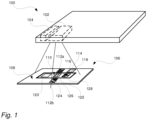
- Fig. 1 illustrates by way of example a mobile device 100, provided with a camera 102 and a flash 104, as well as a test arrangement 106 comprising a test frame 108 and a test cassette 110, placed inside the test frame 108 during use.
- the mobile device 100 may be a mobile phone, but it may also be a tablet or any other device that can be used by a user to capture image data depicting the test arrangement 106 and processing this image data such that a test result outcome can be determined.
- the test arrangement 106 may be a so-called lateral flow test, also sometimes referred to as a lateral flow immunochromatographic assay or rapid test.
- the test arrangement 106 may be used to detect different diseases or health conditions.
- the test cassette 110 may be using the biomarker Calprotectin to detect inflammatory states.
- the test frame 108 can be provided with a cut-out for holding the test cassette 110.
- the test frame 108 can be re-used for several test cassettes, and the frame may be linked to a patient and/or to a batch of test cassettes.
- the test cassette 110 may however be a single-use device.
- the test frame 108 may be equipped with first and second two-dimensional codes 112a, 112b, such as ArUco codes. These codes may be used for identifying the test frame 108, but also for providing spatial reference points.
- a position of the mobile device 100 may be spatially aligned with respect to the test frame 108.
- the mobile device 100 may be provided with a display and a user interface.
- the user interface may be arranged such that a user is guided to place the test arrangement 106 such that this is placed in a field of view of the camera 102.
- boxes in which the first and second two-dimensional codes are intended to be placed can be provided via the user interface such that the user can adjust the position of the mobile device with respect to the test arrangement.
- the test frame 108 may also be provided with a colour reference section (CRS) 114.
- CRS colour reference section
- the CRS 114 may be coloured in specific reference colours such that these colours can be used as references for assuring that colour intensities of the test cassette 110 are interpreted device-agnostically, as will be further explained below with reference to Fig. 2 to 8 .
- the CRS 114 may be placed at a specific distance and/or distances from the first and/or second two-dimensional code 112a, 112b. By having a position of the CRS 114 linked to position(s) of the first and/or second two-dimensional codes 112a, 112b, the CRS 114 can be identified more reliably in the image data once the position(s) of the first and/or second two-dimensional code 112a, 112b are identified.
- the CRS 114 comprises two different colours, a dark colour 116 and a bright colour 118. Even though it is illustrated that two different colours are used in the CRS 114, it is possible to have only one and it is also possible to have more than two colours.
- a sample section 120 for receiving a sample fluid.
- a test section 122 in which the outcome of the test can be presented in the form of a test object 124, such as a test line or a test dot.
- a so-called conjugate section may be provided.
- the sample fluid can be put in contact with reagents and a bio-marker such that reactions occur that can be reflected in the test object 124 and/or a control object 126.
- test object 124 serves the purpose of reflecting presence of a particular substance in the sample fluid such that e.g. indications of the health condition can be reflected
- control object 126 serves the purpose of reflecting that the sample fluid has been transported adequately from the sample section 120 to the test section 122.
- the test object 124 and the control object 126 may be lines, but they may also have other geometrical shapes, such as dots.
- the test cassette 110 may also be provided with a two-dimensional code, herein referred to as cassette two-dimensional code 128, for identification purposes.
- a two-dimensional code herein referred to as cassette two-dimensional code 128, for identification purposes.
- cassette two-dimensional code 128 By having two-dimensional codes on both the test cassette 110 and the test frame 108, a relative position between the two can be determined accurately since the two-dimensional codes may also serve as spatial reference positions. Still an advantage with having two-dimensional codes on both the test cassette 110 and the test frame 108 is that these can be identified and once identified, information related to these can be retrieved via e.g. a remote server. For instance, in case the colour changes related to the test object 124 has been changed from one batch of test cassettes 110 to another, this may be compensated for if the test cassette is possible to identify.
- test frame 108 provided with one or several two-dimensional codes, or other similar identification marks, it is possible to retrieve data related to previously performed test sessions.
- An advantage with this is that if a current test session deviates from the previous sessions, e.g. the CRS 114 give rise to significantly different colour information in the image data captured by the camera compared to previous test sessions, this may be indicated to the user via the mobile device 100. For instance, the user may be asked to confirm that he or she is using a new device for determining the test result.
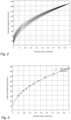
- Fig. 2 is a diagram illustrating camera responses for a plurality of different mobile devices.
- the camera responses for different colours are non-linear and also different for different devices.
- a colour of the test object 124 is not directly proportional to an output voltage from an image sensor.
- a gamma value may be different for different mobile devices 100, i.e. they may be set to reflect the colour intensities in different ways. Due to the differences that may occur between the different devices, as illustrated in fig. 2 , the colour changes cannot be determined in a precise manner based on the camera response alone, but the type of mobile device must be known to make such link.
- the camera response is to be understood to be a number of counts registered by the image sensor.
- Fig. 3 illustrates another diagram.
- a camera response function has been made by using a number of data points.
- the different data points are associated to different exposure times.
- a so-called gamma fit that will serve as the camera response function, i.e. the link between the counts registered by the image sensor and the colour of the test object.
- the dark offset is 20 counts.
- the image sensor is arranged to register photons.
- the colour is represented by photon flux.
- a bright colour will provide more photons per time unit compared to a dark colour.
- the number of photons generated is proportional to the photon flux times an exposure time.
- the relationship between the number of photons and the photon flux i.e. colour, can be determined by having the colour fixed and registering the number of photons for different exposure times.
- the photon flux of the two colours may also be weighed in by multiplying the exposure times with the photon flux of the two different colours.
- the x-axis is rescaled and the gamma fit can be determined based on data points both from the dark and bright colour, as illustrated in fig. 5 .
- test frame 108 may be matte such that less reflections occur.
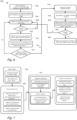
- Fig. 6 is a flowchart illustrating an example of a method 600 for determining the gamma fit, that is, the camera response function, by making use of different exposure times such that, as an effect, more reliable test result outcome determination can be achieved.
- the flash 104 may be turned on 602, and the camera may start capturing image data. Autofocus and auto-exposure may be used at this stage.
- an outline may be provided 604 for the user on how the test cassette 110 and the test frame 108 are to be placed such that spatial alignment of the test arrangement 106 and the mobile device 100 is generally achieved.
- image data can be captured and the first and/or second two-dimensional codes 112a, 112b of the test frame and/or the cassette two-dimensional code 128, herein exemplified by ArUco (Augmented Reality University of Cordoba) codes, can be identified 606.
- ArUco Augmented Reality University of Cordoba
- focus and exposure settings are fixed 616.
- the mobile device and the test arrangement are identified to be placed at a distance from each other corresponding to a reference distance, that one or several rotational angle differences of the mobile device and the test arrangement are identified to be within set limits, and also that inclination angle differences between the two are within set limits, this can result in that the positions of the mobile device is considered spatially aligned with respect to the test arrangement.
- the mobile device is provided with an accelerometer, this can be used for identifying whether or not the camera is in motion.
- a software application e.g. the mobile phone application
- a sequence of images may be captured. In case there is no motion between consecutive image frames, it can be determined that no camera motion has been affecting the image data.
- exposure levels can assessed by identifying whether or not reflections are occurring in the image data.
- Focus deviations can be assessed by identifying if lateral motion has occurred or not. This may be made by identifying if lateral motion has occurred between consecutive image frames.
- the image data set is considered to be consistent 622, that is, no deviations in terms of motion between consecutive frames, no exposure deviations and/or no focus deviations
- the image data may be used for quantifying 624 the colour intensity changes occurring in the test section 122.
- the process will go back to the step of identifying 606 the two-dimensional codes.
- the tilt may be determined by taking into account data from an accelerometer built-in in the mobile device 100.
- the built-in accelerometer may also be used in the step 620 when assessing the consistency. The data from the accelerometer may be taken into account when determining the tilt and/or the motion.
- Fig. 7 illustrates, by way of example, three modules for determining the test result outcome.
- the image data can be converted from raw format to PNG format, and thereafter the image data can be aligned by using the two-dimensional codes as described above.
- test section and white balance areas of the test arrangement can be identified and used for setting white balance.
- the test object and the control object in the test section can be identified.
- the test outcome and a validity score can be determined.
- the test outcome may comprise a positive outcome in which a non-zero test line and the control line are found, a negative outcome in which only the control line is found, and a faulty outcome in which no control line is found.
- the validity score may be a numerical value that indicates how certain the test outcome is.
- the test outcome and the validity score may in combination provide the test result outcome.
- the image data may be de-processed such that white balance can be corrected and, in addition, the image data may be transformed from RGB to luminosity.
- the camera response function can be determined by using multiple exposure times and luminosity counts as described above.
- concentration can be computed. This may be achieved by evaluate line peak, i.e. the luminosity of the test object and the control object.
- a baseline for background luminosity can be established. Once having the background luminosity determined, the concentration can be calculated as a ratio between the peaks of the test object and control object and the baseline. Even if the test is negative, i.e. no test object, the analysis can be performed to provide data one the control object intensity.
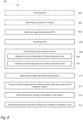
- Fig. 8 is a flowchart illustrating a method 800 according for determining a test result outcome by using the mobile device 100 equipped with a camera.
- the method may comprise obtaining 802 image data using the mobile device, and identifying 804 the CRS 114 in the image data. Once the CRS 114 is identified, the camera response function specific for a mobile device type associated with the mobile device can be determined 806. This step may comprise the sub-steps of registering 808 camera responses for different exposure times, and combining 810 camera responses into the camera response function.
- the method may comprise obtaining 812 test image data depicting the test section, transforming 814 the test image data into camera-neutral image data using the camera response function, determining 816 the intensity of the test object in the test section and determining 818 the test result outcome by fitting the intensity to a calibration curve.
- the method may comprise activating 820 the flash on the camera to reduce variance in illumination.
- the method may comprise detecting 822 movement of the camera by using the accelerometer provided in the mobile device, in case the movement is below a threshold, continue with the identifying of the CRS.
Landscapes
- Engineering & Computer Science (AREA)
- Computer Vision & Pattern Recognition (AREA)
- Physics & Mathematics (AREA)
- General Physics & Mathematics (AREA)
- Theoretical Computer Science (AREA)
- Investigating Or Analysing Biological Materials (AREA)
- Health & Medical Sciences (AREA)
- General Health & Medical Sciences (AREA)
- Medical Informatics (AREA)
- Nuclear Medicine, Radiotherapy & Molecular Imaging (AREA)
- Radiology & Medical Imaging (AREA)
- Quality & Reliability (AREA)
- Spectrometry And Color Measurement (AREA)
- Testing, Inspecting, Measuring Of Stereoscopic Televisions And Televisions (AREA)
Priority Applications (6)
| Application Number | Priority Date | Filing Date | Title |
|---|---|---|---|
| EP23182096.0A EP4485361A1 (fr) | 2023-06-28 | 2023-06-28 | Procédé de détermination d'un résultat de test à l'aide d'un dispositif mobile |
| KR1020267001664A KR20260029347A (ko) | 2023-06-28 | 2024-06-27 | 모바일 장치를 이용한 검사 결과 판정 방법 |
| EP24735265.1A EP4736122A1 (fr) | 2023-06-28 | 2024-06-27 | Procédé de détermination d'un résultat de test à l'aide d'un dispositif mobile |
| PCT/EP2024/068071 WO2025003304A1 (fr) | 2023-06-28 | 2024-06-27 | Procédé de détermination d'un résultat de test à l'aide d'un dispositif mobile |
| AU2024306776A AU2024306776A1 (en) | 2023-06-28 | 2024-06-27 | A method for determining a test result outcome by using a mobile device |
| IL325632A IL325632A (en) | 2023-06-28 | 2025-12-25 | Method for determining a test result using a mobile device |
Applications Claiming Priority (1)
| Application Number | Priority Date | Filing Date | Title |
|---|---|---|---|
| EP23182096.0A EP4485361A1 (fr) | 2023-06-28 | 2023-06-28 | Procédé de détermination d'un résultat de test à l'aide d'un dispositif mobile |
Publications (1)
| Publication Number | Publication Date |
|---|---|
| EP4485361A1 true EP4485361A1 (fr) | 2025-01-01 |
Family
ID=87059957
Family Applications (2)
| Application Number | Title | Priority Date | Filing Date |
|---|---|---|---|
| EP23182096.0A Pending EP4485361A1 (fr) | 2023-06-28 | 2023-06-28 | Procédé de détermination d'un résultat de test à l'aide d'un dispositif mobile |
| EP24735265.1A Pending EP4736122A1 (fr) | 2023-06-28 | 2024-06-27 | Procédé de détermination d'un résultat de test à l'aide d'un dispositif mobile |
Family Applications After (1)
| Application Number | Title | Priority Date | Filing Date |
|---|---|---|---|
| EP24735265.1A Pending EP4736122A1 (fr) | 2023-06-28 | 2024-06-27 | Procédé de détermination d'un résultat de test à l'aide d'un dispositif mobile |
Country Status (5)
| Country | Link |
|---|---|
| EP (2) | EP4485361A1 (fr) |
| KR (1) | KR20260029347A (fr) |
| AU (1) | AU2024306776A1 (fr) |
| IL (1) | IL325632A (fr) |
| WO (1) | WO2025003304A1 (fr) |
Citations (4)
| Publication number | Priority date | Publication date | Assignee | Title |
|---|---|---|---|---|
| US20150212074A1 (en) * | 2012-07-24 | 2015-07-30 | Fio Corporation | Immunoassay rapid diagnostic test universal analysis device, system, method and computer readable medium |
| EP2893477B1 (fr) * | 2012-09-05 | 2021-02-17 | Jana Care Inc. | Systèmes de diagnostic médical portables, et procédés associés, mis en uvre sur un dispositif mobile |
| US11192100B2 (en) * | 2020-03-25 | 2021-12-07 | Vessel Health, Inc. | Multi-factor urine test system that adjusts for lighting and timing |
| WO2023037101A1 (fr) * | 2021-09-08 | 2023-03-16 | Oxford University Innovation Limited | Procédé d'obtention d'un résultat de test à partir d'une bandelette réactive pour tester un échantillon liquide |
-
2023
- 2023-06-28 EP EP23182096.0A patent/EP4485361A1/fr active Pending
-
2024
- 2024-06-27 KR KR1020267001664A patent/KR20260029347A/ko active Pending
- 2024-06-27 EP EP24735265.1A patent/EP4736122A1/fr active Pending
- 2024-06-27 WO PCT/EP2024/068071 patent/WO2025003304A1/fr not_active Ceased
- 2024-06-27 AU AU2024306776A patent/AU2024306776A1/en active Pending
-
2025
- 2025-12-25 IL IL325632A patent/IL325632A/en unknown
Patent Citations (4)
| Publication number | Priority date | Publication date | Assignee | Title |
|---|---|---|---|---|
| US20150212074A1 (en) * | 2012-07-24 | 2015-07-30 | Fio Corporation | Immunoassay rapid diagnostic test universal analysis device, system, method and computer readable medium |
| EP2893477B1 (fr) * | 2012-09-05 | 2021-02-17 | Jana Care Inc. | Systèmes de diagnostic médical portables, et procédés associés, mis en uvre sur un dispositif mobile |
| US11192100B2 (en) * | 2020-03-25 | 2021-12-07 | Vessel Health, Inc. | Multi-factor urine test system that adjusts for lighting and timing |
| WO2023037101A1 (fr) * | 2021-09-08 | 2023-03-16 | Oxford University Innovation Limited | Procédé d'obtention d'un résultat de test à partir d'une bandelette réactive pour tester un échantillon liquide |
Non-Patent Citations (1)
| Title |
|---|
| SAISIN LALITA ET AL: "Significant Sensitivity Improvement for Camera-Based Lateral Flow Immunoassay Readers", SENSORS, 19 November 2018 (2018-11-19), XP055837664, Retrieved from the Internet <URL:https://www.ncbi.nlm.nih.gov/pmc/articles/PMC6263405/pdf/sensors-18-04026.pdf> [retrieved on 20210903] * |
Also Published As
| Publication number | Publication date |
|---|---|
| EP4736122A1 (fr) | 2026-05-06 |
| KR20260029347A (ko) | 2026-03-04 |
| WO2025003304A1 (fr) | 2025-01-02 |
| AU2024306776A1 (en) | 2026-01-15 |
| IL325632A (en) | 2026-02-01 |
Similar Documents
| Publication | Publication Date | Title |
|---|---|---|
| US12216060B2 (en) | Quantifying color changes in chemical test pads induced by different concentrations of analytes under different lighting conditions | |
| US9607380B2 (en) | Methods and apparatus for quantifying color changes induced by specific concentrations of biological analytes | |
| AU2018356358C1 (en) | Methods and devices for performing an analytical measurement based on a color formation reaction | |
| KR200470398Y1 (ko) | 소변검사용 스트립 | |
| JP7651585B2 (ja) | スキャナとして使用するためのデジタルカメラのキャリブレーション | |
| EP2916117A1 (fr) | Quantification des changements de couleur de plages de test chimique induits par des concentrations spécifiques d'analytes biologiques dans des conditions d'éclairage différentes | |
| TW201006439A (en) | Analysis system with coding recognition | |
| KR20120120077A (ko) | 분석 장치 | |
| JP2019132771A (ja) | 呈色反応観察補助システム、呈色反応観察補助方法及びプログラム | |
| EP4485361A1 (fr) | Procédé de détermination d'un résultat de test à l'aide d'un dispositif mobile | |
| US20220299445A1 (en) | Screening Test Paper Reading System | |
| JP2025507363A (ja) | 体液中の少なくとも1つの被検物質の濃度を決定するための方法および装置 | |
| JP7592038B2 (ja) | 体液中の分析物の濃度を決定する方法 | |
| RU2824292C2 (ru) | Способ определения концентрации аналита в физиологической жидкости | |
| HK40070113A (en) | Determination of a concentration of an analyte in a bodily fluid by using a mobile device with a camera | |
| JP2008261850A (ja) | 検査プレートの画像検査方法 | |
| TW202346832A (zh) | 判定體液中至少一種分析物之濃度的方法及裝置 | |
| KR20220109704A (ko) | 스마트폰을 활용한 소변 진단 검사지용 자가진단 시스템 | |
| HK40115757A (zh) | 使用移动装置来确定与体液中分析物的浓度对应的最终数值分析物结果值的方法 | |
| KR20240073566A (ko) | 아베 굴절계용 굴절률 측정 자동화 시스템 및 이의 구동방법 | |
| JP2023079616A (ja) | 抗体検査装置、抗体検査システム、抗体検査方法、コンピュータプログラム、及び台紙 | |
| HK40031609A (en) | Methods and devices for performing an analytical measurement based on a color formation reaction |
Legal Events
| Date | Code | Title | Description |
|---|---|---|---|
| PUAI | Public reference made under article 153(3) epc to a published international application that has entered the european phase |
Free format text: ORIGINAL CODE: 0009012 |
|
| STAA | Information on the status of an ep patent application or granted ep patent |
Free format text: STATUS: THE APPLICATION HAS BEEN PUBLISHED |
|
| AK | Designated contracting states |
Kind code of ref document: A1 Designated state(s): AL AT BE BG CH CY CZ DE DK EE ES FI FR GB GR HR HU IE IS IT LI LT LU LV MC ME MK MT NL NO PL PT RO RS SE SI SK SM TR |
|
| STAA | Information on the status of an ep patent application or granted ep patent |
Free format text: STATUS: REQUEST FOR EXAMINATION WAS MADE |
|
| 17P | Request for examination filed |
Effective date: 20250521 |